從屬子句英文(Dependent Clause)指南:定義、種類、用法與練習
什麼是從屬子句?為什麼掌握從屬子句是英文寫作進階的關鍵?從屬子句(Dependent Clause)是一種包含主詞與動詞,但無法單獨表達完整意思的子句結構,必須依附在獨立子句上才能形成有意義的完整句子。這個看似簡單的文法概念,卻是區分基礎英文使用者與高階寫作者的分水嶺。
許多英文學習者在寫作時常侷限於簡單句型,無法精確表達複雜的因果、時間、條件等邏輯關係。事實上,從屬子句不僅能讓您的英文表達更加豐富專業,更是TOEIC、IELTS等國際英語測驗中高分作文的必備技能。無論是商務信件、學術論文或日常溝通,靈活運用名詞子句、形容詞子句與副詞子句,都能大幅提升語言的精確度與層次感。
本文由PREPEDU專業團隊精心整理,將系統性地為您解析從屬子句的定義、三大類別、實際用法、標點符號規則,並提供豐富的台灣在地情境範例與實戰練習題,協助您徹底掌握這個重要的英文文法結構,邁向高階英語能力。
I. 什麼是從屬子句英文?定義與核心結構
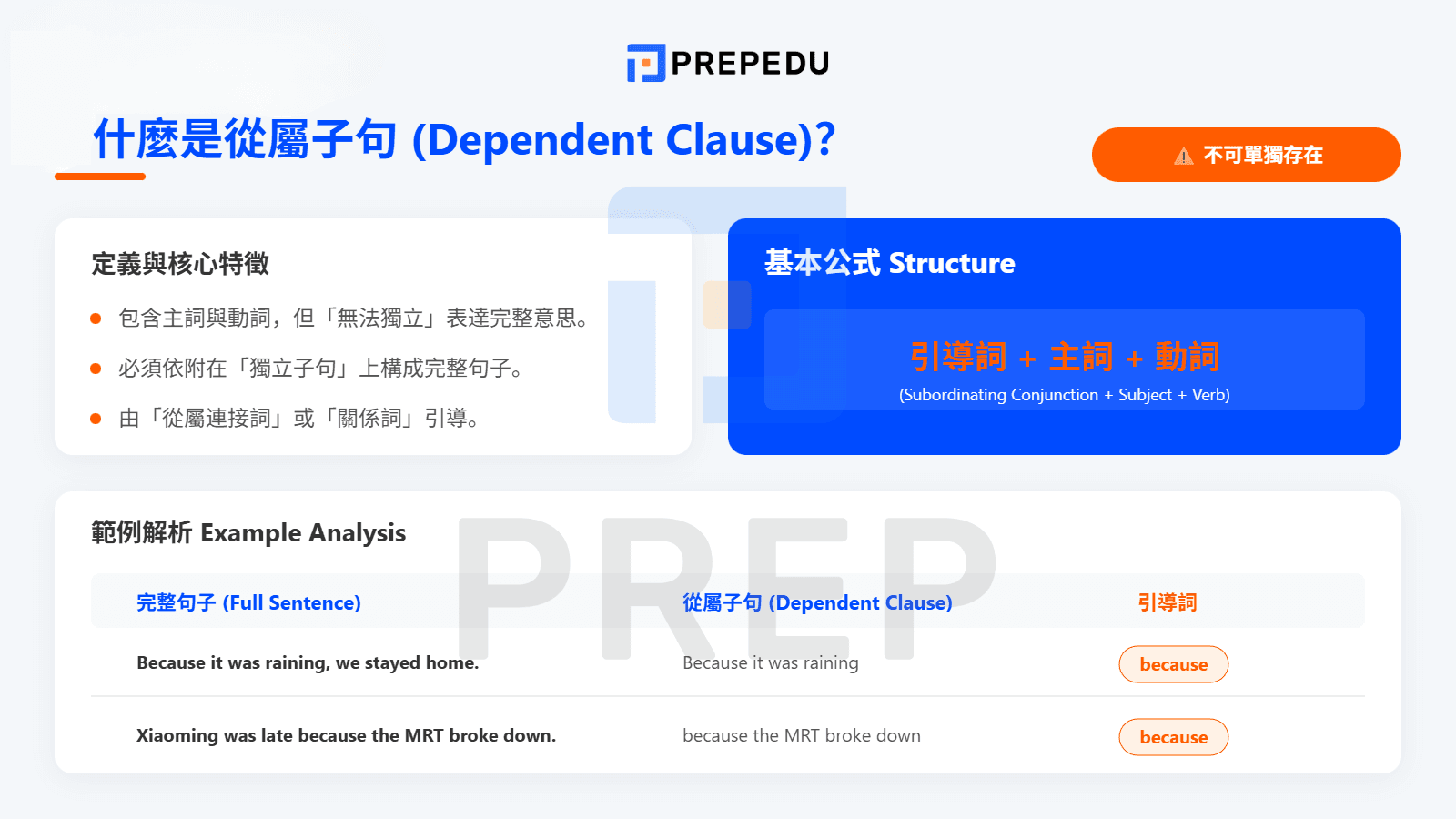
從屬子句英文(Dependent Clause),又稱為附屬子句英文,是一種包含主詞與動詞但無法獨立表達完整意思的子句結構。這類子句必須依附在獨立子句(Independent Clause)上才能構成有意義的完整句子,就像建築物中的支撐樑柱,雖然結構完整卻無法單獨存在。
從屬子句的核心特徵在於它必須由從屬連接詞(Subordinating Conjunction)或關係詞(Relative Pronoun)引導,這些引導詞明確標示出該子句的依附性質。
基本公式:
從屬連接詞/關係詞 + 主詞 + 動詞(+ 其他成分)
結構組成:
-
從屬連接詞/關係詞:because、although、when、if、who、which、that 等
-
主詞:名詞、代名詞或名詞片語
-
動詞:動作動詞或連綴動詞
範例:
|
完整句子 |
從屬子句 |
引導詞 |
主詞 |
動詞 |
|
Because it was raining, we stayed home.(因為正在下雨,我們待在家裡。) |
Because it was raining |
because |
it |
was raining |
|
When Xiaofang studied at the Hong Kong University library, she always ordered milk tea from the nearby café.(當小芳在香港大學圖書館讀書時,她總是向附近的咖啡廳訂購奶茶。) |
When Xiaofang studied at the Hong Kong University library |
when |
Xiaofang |
studied |
|
Xiaoming couldn't arrive at his Taipei office on time because the MRT broke down during rush hour.(小明無法準時抵達他位於台北的辦公室,因為捷運在尖峰時段故障了。) |
because the MRT broke down during rush hour |
because |
the MRT |
broke down |
特殊注意事項:
-
不可單獨存在:從屬子句如果單獨出現會形成句子碎片(Fragment)錯誤
-
必須結合獨立子句:才能表達完整意思
-
引導詞不可省略(大部分情況):移除引導詞會改變句子性質
II. 獨立子句從屬子句的差異
|
比較項目 |
獨立子句(Independent Clause) |
從屬子句(Dependent Clause) |
|
結構完整性 |
包含主詞和動詞,表達完整意思 |
包含主詞和動詞,但意思不完整 |
|
獨立存在 |
可單獨成為完整句子 |
無法單獨存在,需依附獨立子句 |
|
引導詞需求 |
不需要從屬連接詞引導 |
必須由從屬連接詞或關係詞引導 |
|
句中功能 |
作為句子的主幹 |
擔任名詞、形容詞或副詞角色 |
|
標點使用 |
可用句號結束 |
不能單獨用句號結束 |
|
範例 |
The students passed the exam.(學生們通過了考試。)→ 可單獨成立 |
|
從屬子句英文寫作的關鍵在於理解其依附性質。當您在書寫時遇到由 when、if、because、although 等詞引導的子句,務必確認該子句已與獨立子句正確結合,避免產生句子碎片(Fragment)的錯誤。這種結構認知能大幅提升您的英文寫作準確度,讓句子邏輯更加清晰連貫。
III. 從屬子句的三大類別與用法詳解
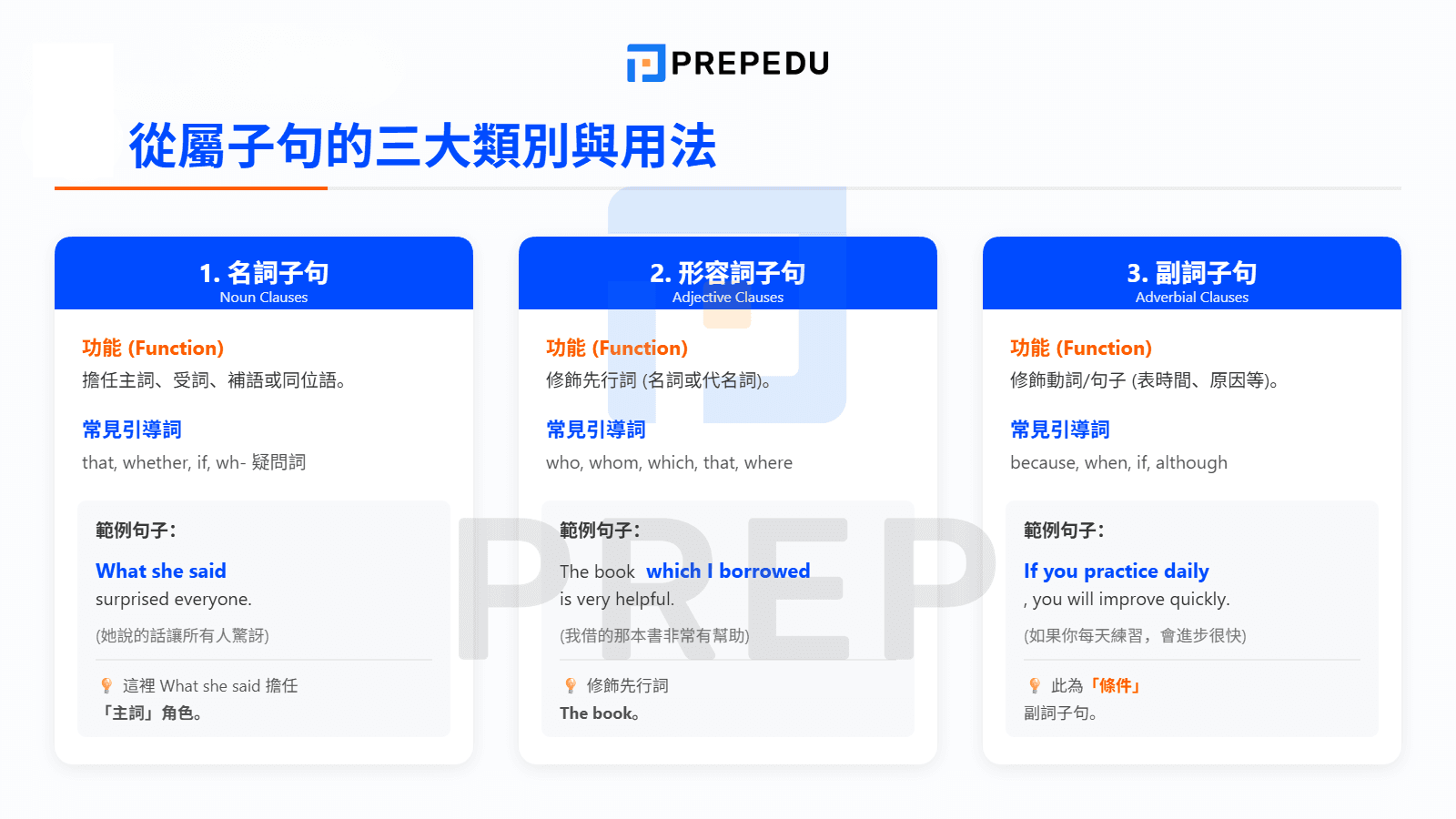
從屬子句用法根據其在句中擔任的文法功能,可劃分為三大核心類別:名詞子句、形容詞子句與副詞子句。每種類別都有其特定的引導詞與使用情境。
1. 名詞子句(Noun Clauses)
名詞子句在句中扮演名詞的角色,可以擔任主詞、受詞、補語或同位語。這類從屬子句通常由 that、whether、if 或疑問詞(who、what、where、when、why、how)引導。
結構公式:
引導詞 + 主詞 + 動詞
常見引導詞:
-
that:表達事實或想法
-
whether/if:表達選擇或不確定性
-
疑問詞(what、who、where、when、why、how):表達疑問或未知資訊
範例:
|
功能 |
範例句子 |
名詞子句 |
功能說明 |
|
作為主詞 |
What she said surprised everyone.(她說的話讓所有人感到驚訝。) |
What she said |
整個子句作為句子主詞 |
|
That he passed the TOEIC exam proves his dedication.(他通過多益考試證明了他的投入。) |
That he passed the TOEIC exam |
整個子句作為句子主詞 |
|
|
作為動詞受詞 |
I believe that practice makes perfect.(我相信熟能生巧。) |
that practice makes perfect |
作為動詞 believe 的受詞 |
|
She doesn't know whether the meeting will be postponed.(她不知道會議是否會延期。) |
whether the meeting will be postponed |
作為動詞 know 的受詞 |
|
|
作為補語 |
The problem is that we don't have enough time.(問題是我們沒有足夠的時間。) |
that we don't have enough time |
補充說明主詞 problem |
|
The question remains whether we should accept the offer.(問題仍然是我們是否應該接受這個提議。) |
whether we should accept the offer |
作為主詞補語 |
2. 形容詞子句(Adjective Clauses / Relative Clauses)
形容詞子句,也稱為關係子句,用來修飾名詞或代名詞,提供額外的描述或辨識資訊。這類從屬子句必須緊接在所修飾的先行詞(antecedent)之後。
結構公式:
先行詞 + 關係代名詞/關係副詞 + 主詞 + 動詞
引導詞分類:
|
類型 |
引導詞 |
用途 |
|
關係代名詞(指人) |
who, whom, whose |
修飾人 |
|
關係代名詞(指物) |
which, that |
修飾物 |
|
關係副詞(地點) |
where |
修飾地點 |
|
關係副詞(時間) |
when |
修飾時間 |
|
關係副詞(原因) |
why |
修飾原因 |
範例:
|
範例從屬子句 |
形容詞子句 |
說明 |
|
|
指人:who/ whom |
The teacher who teaches grammar is experienced.(教文法的老師很有經驗。) |
who teaches grammar |
who 作主詞,修飾 teacher |
|
The student whom you met yesterday is my classmate.(你昨天遇見的學生是我同學。) |
whom you met yesterday |
whom 作受詞,修飾 student |
|
|
指物:which/ that |
The book which I borrowed is very helpful.(我借的那本書很有幫助。) |
which I borrowed |
which 作受詞,修飾 book |
|
The method that works best varies by individual.(最有效的方法因人而異。) |
that works best |
that 作主詞,修飾 method |
|
|
所有格:whose |
The writer whose articles we read won an award.(我們讀過文章的那位作家得了獎。) |
whose articles we read |
whose 表示所有關係 |
關係副詞使用範例
|
關係副詞 |
範例從屬子句 |
形容詞子句 |
|
where |
This is the library where I study every day.(這是我每天讀書的圖書館。) |
where I study every day |
|
when |
I remember the day when we first met.(我記得我們初次見面的那一天。) |
when we first met |
|
why |
That's the reason why she left early.(那就是她提早離開的原因。) |
why she left early |
限制性與非限制性子句
|
類型 |
特徵 |
標點 |
功能 |
範例 |
|
限制性子句 |
提供辨識所必需的資訊 |
不用逗號 |
限定先行詞 |
Students who study regularly perform better.(定期學習的學生表現較好。) |
|
非限制性子句 |
提供補充資訊 |
必須用逗號 |
補充說明 |
My brother, who lives in Taipei, is a doctor.(我住在台北的哥哥是醫生。) |
3. 副詞子句(Adverbial Clauses)
副詞子句在句中擔任副詞的功能,用來修飾動詞、形容詞或整個句子,表達時間、地點、原因、結果、目的、條件、讓步、方式或比較等各種邏輯關係。
結構公式:
從屬連接詞 + 主詞 + 動詞
副詞子句的九大類型
|
類型 |
常用連接詞 |
從屬子句例句 |
副詞子句 |
|
時間副詞子句 |
when, while, as, before, after, until, since, as soon as |
When you finish your homework, you can watch TV.(當你完成作業後,你可以看電視。) |
When you finish your homework |
|
I will wait here until she arrives.(我會在這裡等到她抵達。) |
until she arrives |
||
|
After I graduate next year, I will work abroad.(明年畢業後,我會到國外工作。) |
After I graduate next year |
||
|
地點副詞子句 |
where, wherever |
You can sit wherever you like.(你可以坐在任何你喜歡的地方。) |
wherever you like |
|
Where there is a will, there is a way.(有志者事竟成。) |
Where there is a will |
||
|
原因副詞子句 |
because, since, as |
Because it was raining heavily, we cancelled the outdoor activity.(因為雨下得很大,我們取消了戶外活動。) |
Because it was raining heavily |
|
Since you are busy, I won't disturb you.(既然你很忙,我就不打擾你了。) |
Since you are busy |
||
|
結果副詞子句 |
so…that, such…that |
The exam was so difficult that many students failed.(考試太難了,以至於許多學生不及格。) |
so difficult that many students failed |
|
It was such a beautiful day that we decided to go hiking.(天氣如此美好,我們決定去健行。) |
such a beautiful day that we decided to go hiking |
||
|
目的副詞子句 |
so that, in order that |
She studies hard so that she can pass the IELTS exam.(她努力讀書以便能通過雅思考試。) |
so that she can pass the IELTS exam |
|
We arrived early in order that we could get good seats.(我們提早到達,以便能佔到好位子。) |
in order that we could get good seats |
||
|
條件副詞子句 |
if, unless, provided that, as long as |
If you practice daily, you will improve quickly.(如果你每天練習,你會快速進步。) |
If you practice daily |
|
Unless you study harder, you won't pass the test.(除非你更用功,否則你不會通過測驗。) |
Unless you study harder |
||
|
讓步副詞子句 |
although, though, even though, while, whereas |
Although he is young, he is very mature.(雖然他年輕,但他很成熟。) |
Although he is young |
|
Even though the task is challenging, we must complete it.(即使任務很有挑戰性,我們也必須完成。) |
Even though the task is challenging |
||
|
方式副詞子句 |
as, as if, as though |
Do as I say, not as I do.(照我說的做,不要照我做的做。) |
as I say |
|
She talks as if she knows everything.(她說話的樣子好像她什麼都知道。) |
as if she knows everything |
||
|
比較副詞子句 |
than, as…as |
She runs faster than I do.(她跑得比我快。) |
than I do |
|
This book is as interesting as the one I read last week.(這本書跟我上週讀的那本一樣有趣。) |
as the one I read last week |
時態使用規則:在時間副詞子句和條件副詞子句中,談論未來時使用現在式
-
錯誤:If it will rain tomorrow...
-
正確:If it rains tomorrow...(如果明天下雨...)
IV. 從屬子句在句中的位置與標點符號
1. 規則一:從屬子句在句首
規則: 必須在從屬子句結尾加上逗號
範例:
|
範例句子 |
標點說明 |
|
Because the weather was bad, we postponed the trip.(因為天氣不好,我們延後了旅行。) |
逗號分隔從屬子句與獨立子句 |
|
When you have time, please call me.(當你有時間時,請打電話給我。) |
逗號標示主要句子開始 |
|
Although he studied hard, he didn't pass the exam.(雖然他努力讀書,但他沒有通過考試。) |
逗號提醒讀者主要訊息即將出現 |
2. 規則二:從屬子句在句尾
規則: 通常不需要逗號
範例:
-
We postponed the trip because the weather was bad.(我們延後了旅行因為天氣不好。)
-
Please call me when you have time.(請在你有時間時打電話給我。)
-
He didn't pass the exam although he studied hard.(他沒有通過考試雖然他努力讀書。)
3. 規則三:非限制性子句
規則: 永遠需要逗號,無論位置
範例:
|
範例句子 |
標點說明 |
|
My teacher, who has 20 years of experience, gives excellent advice.(我的老師擁有二十年經驗,給予很棒的建議。) |
前後都需要逗號 |
|
I met John, who used to be my classmate.(我遇見了約翰,他以前是我的同學。) |
即使在句尾也需要逗號 |
V. 如何利用從屬子句構建複雜句與複合複雜句
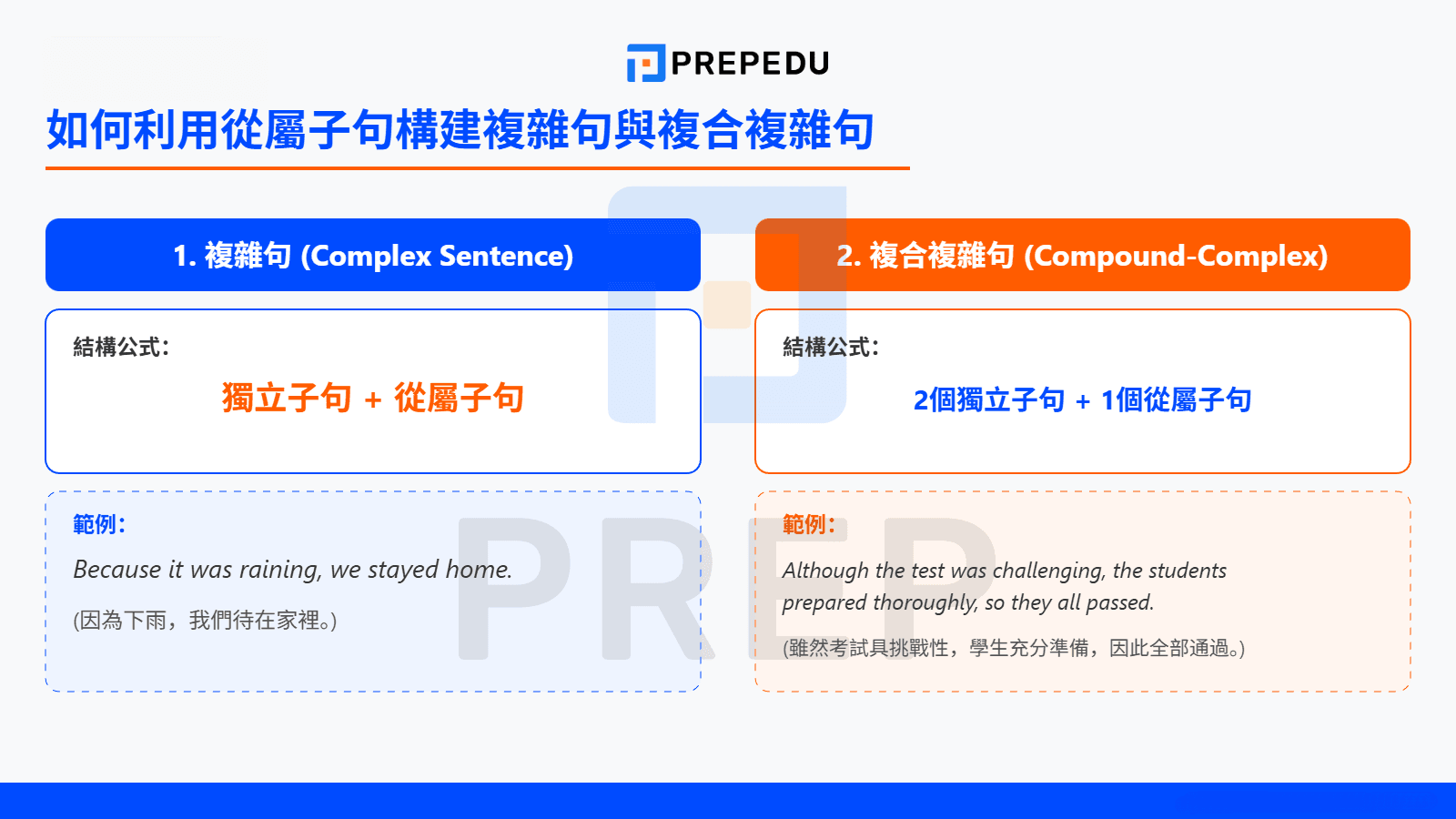
1. 複雜句(Complex Sentence)
複雜句由一個獨立子句和至少一個從屬子句組成,透過從屬連接詞建立邏輯關係。
結構公式:
獨立子句 + 從屬子句
從屬子句 + 獨立子句
獨立子句(部分)+ 從屬子句 + 獨立子句(部分)
範例
|
原始簡單句 |
合併後的複雜句 |
|
It was raining. We stayed home. |
Because it was raining, we stayed home.(因為下雨,我們待在家裡。) |
|
She studies English. She wants to work abroad. |
She studies English so that she can work abroad.(她學英文以便能在國外工作。) |
2. 複合複雜句(Compound-Complex Sentence)
複合複雜句結合了對等連接詞(and、but、or、so)和從屬連接詞,包含至少兩個獨立子句和至少一個從屬子句。
結構公式:
至少2個獨立子句 + 至少1個從屬子句
從屬子句 + 獨立子句1, and/but/so + 獨立子句2
範例:
|
階段 |
句子內容 |
句型說明 |
|
起點:三個簡單句 |
The students prepared thoroughly. The test was challenging. They all passed. |
三個獨立句子 |
|
第一步:複雜句 |
Although the test was challenging, the students prepared thoroughly. |
1個從屬子句 + 1個獨立子句 |
|
第二步:複合複雜句 |
Although the test was challenging, the students prepared thoroughly, so they all passed. (雖然考試具有挑戰性,學生們仍然充分準備,因此他們全部都通過了考試。) |
1個從屬子句 + 2個獨立子句 |
VI. 使用從屬子句的常見錯誤與注意事項
1. 錯誤類型一:句子碎片
將從屬子句單獨使用,形成不完整的句子。從屬子句因為有從屬連接詞的引導,無法單獨表達完整意思。
錯誤範例與改正:
|
錯誤寫法 |
為何錯誤 |
正確寫法 |
|
✗ Because I was tired. |
只有從屬子句,意思不完整 |
✓ Because I was tired, I went to bed early.(因為我累了,所以我很早就上床睡覺。) |
|
✗ When she arrives at the office. |
讀者不知道「然後呢?」 |
✓ When she arrives at the office, she checks her emails.(當她到達辦公室時,她會查看電子郵件。) |
檢查清單:
-
☑ 句子開頭有從屬連接詞嗎?
-
☑ 是否有獨立子句與之結合?
-
☑ 句子能表達完整意思嗎?
2. 錯誤類型二:連接詞重複使用
中文使用者容易同時使用兩個連接詞(如「因為...所以...」、「雖然...但是...」),但英文只需要一個連接詞。
常見錯誤組合
|
錯誤組合 |
原因 |
正確用法 |
|
✗ Because...so... |
中文「因為...所以...」的影響 |
✓ Because... 或 ...so... |
|
✗ Although...but... |
中文「雖然...但是...」的影響 |
✓ Although... 或 ...but... |
錯誤從屬子句範例與改正
|
錯誤寫法 |
正確寫法一 |
正確寫法二 |
|
✗ Because it was raining, so we stayed home. |
✓ Because it was raining, we stayed home.(因為正在下雨,我們待在家裡。) |
✓ It was raining, so we stayed home.(正在下雨,所以我們待在家裡。) |
|
✗ Although he studied hard, but he failed. |
✓ Although he studied hard, he failed.(雖然他努力讀書,但他還是失敗了。) |
✓ He studied hard, but he failed.(他努力讀書,但仍然失敗了。) |
3. 錯誤類型三:條件句時態陷阱
在條件副詞子句和時間副詞子句中,談論未來時必須使用現在式代替未來式。
錯誤範例與改正:
|
錯誤寫法 |
正確寫法 |
|
✗ If it will rain tomorrow, we will cancel the picnic. |
✓ If it rains tomorrow, we will cancel the picnic.(如果明天下雨,我們會取消野餐。) |
|
✗ When you will finish your work, please call me. |
✓ When you finish your work, please call me.(當你完成工作時,請打電話給我。) |
時態使用規則表:
|
子句類型 |
從屬子句時態 |
獨立子句時態 |
範例 |
|
條件句 |
現在式 |
未來式 |
If it rains, we will stay home.(如果下雨,我們就會待在家裡。) |
|
時間子句 |
現在式 |
未來式 |
When she arrives, I will call you.(當她到達時,我會打電話給你。) |
4. 錯誤類型四:關係代名詞選擇錯誤
使用錯誤的關係代名詞,或在關係子句中重複使用代名詞。
關係代名詞選擇規則
|
先行詞類型 |
正確用法 |
錯誤用法 |
|
人 |
who, whom, whose |
✗ which |
|
物 |
which, that |
✗ who |
錯誤範例與改正
|
錯誤寫法 |
錯誤原因 |
正確寫法 |
|
✗ The person which helped me was very kind. |
先行詞是人,不能用 which |
✓ The person who helped me was very kind.(幫助我的那個人非常善良。) |
|
✗ The book I need it is on the shelf. |
不應重複使用代名詞 it |
✓ The book I need is on the shelf.(我需要的那本書在書架上。) |
VII. 從屬子句實戰練習題
1. 練習一:辨識子句類型
請判斷以下句子中畫底線的從屬子句屬於名詞子句、形容詞子句還是副詞子句。
-
I don't know where she lives.
-
The book that you recommended is excellent.
-
When the bell rings, students leave the classroom.
-
What he said surprised everyone.
-
She smiled because she was happy.
-
The house where I grew up has been sold.
-
I believe that honesty is important.
-
Although it was late, he continued working.
-
The reason why he left is unclear.
-
They will succeed if they work hard.
練習一解答
|
題號 |
從屬子句 |
類型 |
理由說明 |
|
1 |
where she lives |
名詞子句 |
擔任動詞 know 的受詞 |
|
2 |
that you recommended |
形容詞子句 |
修飾名詞 book |
|
3 |
When the bell rings |
副詞子句 |
時間副詞子句,修飾動詞 leave |
|
4 |
What he said |
名詞子句 |
擔任句子主詞 |
|
5 |
because she was happy |
副詞子句 |
原因副詞子句,修飾動詞 smiled |
|
6 |
where I grew up |
形容詞子句 |
修飾名詞 house |
|
7 |
that honesty is important |
名詞子句 |
擔任動詞 believe 的受詞 |
|
8 |
Although it was late |
副詞子句 |
讓步副詞子句,修飾動詞 continued |
|
9 |
why he left |
形容詞子句 |
修飾名詞 reason |
|
10 |
if they work hard |
副詞子句 |
條件副詞子句,修飾動詞 will succeed |
2. 練習二:填入正確的從屬連接詞
從括號中選擇最適當的從屬連接詞填入空格。
|
題號 |
句子 |
選項 |
|
1 |
_______ you finish your homework, you can play video games. |
(When/ Because/ Although) |
|
2 |
I will lend you the book _______ you promise to return it. |
(so that/ if/ unless) |
|
3 |
She speaks English fluently _______ she has never been abroad. |
(although/ because/ after) |
|
4 |
We stayed indoors _______ it was raining heavily. |
(while/ because/ unless) |
|
5 |
_______ hard you try, you won't succeed without dedication. |
(However/ Wherever/ Unless) |
|
6 |
He studies every day _______ he can improve his English. |
(so that/ even though/ whereas) |
|
7 |
_______ I mentioned earlier, this topic is crucial for the exam. |
(As/ That/ Which) |
|
8 |
She will call you _______ she arrives at the airport. |
(as soon as/ so that/ in order that) |
|
9 |
_______ you need help, don't hesitate to ask. |
(Wherever/ Whenever/ However) |
|
10 |
The meeting will proceed _______ the director approves. |
(provided that/ even though/ as if) |
練習二解答
|
題號 |
正確答案 |
理由說明 |
|
1 |
When |
時間關係最合理 |
|
2 |
if |
條件關係:如果你承諾歸還 |
|
3 |
although |
讓步關係:雖然從未出國但說得流利 |
|
4 |
because |
原因關係:因為下大雨所以待在室內 |
|
5 |
However |
讓步關係:無論多努力,沒有投入都不會成功 |
|
6 |
so that |
目的關係:為了能進步英文 |
|
7 |
As |
如同我先前提到的 |
|
8 |
as soon as |
時間關係:一抵達就打電話 |
|
9 |
Whenever |
時間關係:無論何時需要幫助 |
|
10 |
provided that |
條件關係:假如主管批准 |
3. 練習三:句子合併練習
請將以下每組的兩個句子合併為一個包含從屬子句的完整句子,可視情況調整語序或文字。
-
The weather is good. / We will go hiking.
-
She was tired. / She continued working.
-
I can't find my keys. / I looked everywhere.
-
The restaurant is expensive. / The food is delicious.
-
He arrived late. / The meeting had already started.
-
You should study regularly. / You want to pass the exam.
-
The movie was boring. / We left early.
-
She speaks three languages. / She travels frequently.
-
The project is challenging. / Our team is confident.
-
I will wait here. / You come back.
參考答案(可能有多種正確答案)
-
If the weather is good, we will go hiking. / We will go hiking if the weather is good.(如果天氣好,我們就會去健行。/如果天氣好,我們就會去健行。)
-
Although she was tired, she continued working. / She continued working although she was tired.(雖然她很累,但她仍然繼續工作。/她雖然很累,但仍然繼續工作。)
-
I can't find my keys although I looked everywhere. / Although I looked everywhere, I can't find my keys.(雖然我到處找了,還是找不到我的鑰匙。/雖然我到處找了,但我還是找不到我的鑰匙。)
-
Although the restaurant is expensive, the food is delicious.(雖然這家餐廳很貴,但食物很好吃。)
-
When he arrived, the meeting had already started. / The meeting had already started when he arrived.(當他到達時,會議已經開始了。/會議在他到達時就已經開始了。)
-
You should study regularly if you want to pass the exam. / If you want to pass the exam, you should study regularly.(如果你想通過考試,就應該規律地讀書。/如果你想通過考試,你就應該規律地讀書。)
-
Because the movie was boring, we left early. / We left early because the movie was boring.(因為電影很無聊,我們提早離開了。/我們因為電影很無聊而提早離開。)
-
She speaks three languages because she travels frequently.(因為她經常旅行,所以她會說三種語言。)
-
Although the project is challenging, our team is confident. / Our team is confident although the project is challenging.(雖然這個專案很有挑戰性,但我們的團隊很有信心。/我們的團隊很有信心,雖然這個專案很有挑戰性。)
-
I will wait here until you come back. / Until you come back, I will wait here.(我會在這裡等你回來。/直到你回來為止,我都會在這裡等。)
結論
從屬子句是英文文法中不可或缺的重要結構,掌握其定義、種類與用法能夠顯著提升您的英文表達能力。記住,熟練運用從屬子句需要持續的練習與應用。建議您在日常閱讀與寫作中有意識地觀察和使用這些結構,逐步內化成自然的語言習慣。
面對緊迫的考試期限和龐大的準備內容感到壓力? PREP 理解這種處境,致力於在有限時間內最大化你的學習成果。
放棄漫無目的的練習。系統運用測驗結果精準分析你的優勢和弱點,找出你急需改善的核心能力。這種智能學習策略比傳統方法節省高達 50% 的時間。
雅思模擬試題和 TOEIC 線上題庫依難度排列,幫助你先鞏固基礎再逐步建立技能。你投入的每分鐘都創造價值,每次測驗都推動你朝目標前進。
別讓時間流逝而沒有真正成果。今天就開始 PREP 的智能學習之旅,找到達成理想分數的最短路徑!

你好!我叫黃秋賢,現在在 prepedu.com 擔任內容企劃。我有超過5年的英語與韓語自學經歷,親身備考 IELTS、TOEIC 與 TOPIK,累積了大量第一手的學習者視角——包括哪些語法規則最讓台灣與香港學習者混淆,以及如何在有限的備考時間內最有效地修正這些錯誤。目前已在 prepedu.com 撰寫超過 1000 篇英語學習文章,內容涵蓋語法、詞彙與考試策略,累積協助數千位學習者解決自學過程中的語法疑問。
評論












統一企業編號:202227322W
地址:114 LAVENDER STREET, #11-83 CT HUB 2, SINGAPORE (338729)