英文關係子句(Relative Clause)全攻略:定義、用法、省略與練習
什麼是關係子句?為什麼它在英文寫作和口說中如此重要?關係子句(Relative Clause)是一種從屬子句,透過關係代名詞(who,which,that等)或關係副詞(when,where,why)連接兩個句子,用來修飾名詞或代名詞,讓表達更精確流暢。掌握關係子句不僅是通過IELTS、TOEIC等國際英語檢定的關鍵,更是提升學術寫作與商務溝通能力的必備技能。
然而,許多學習者在使用關係子句時經常遇到困難:不知道何時該用who還是which、搞不清楚什麼時候可以省略關係代名詞、分不清限定與非限定關係子句的差異,甚至在逗號後方誤用that而不自知。這些看似細微的錯誤,卻可能讓英文寫作顯得不夠專業,影響溝通效果。
PREPEDU 特別為您整理這份完整的關係子句全攻略,涵蓋定義解析、關係代名詞與關係副詞的詳細用法、that的必用與禁用時機、限定非限定子句的差別、省略與簡化規則,以及常見錯誤剖析,更提供30道精心設計的練習題,幫助您從基礎到進階,全面掌握這個重要的英文文法概念,讓英文表達更上一層樓。

I. 關係子句(Relative Clause)是什麼?
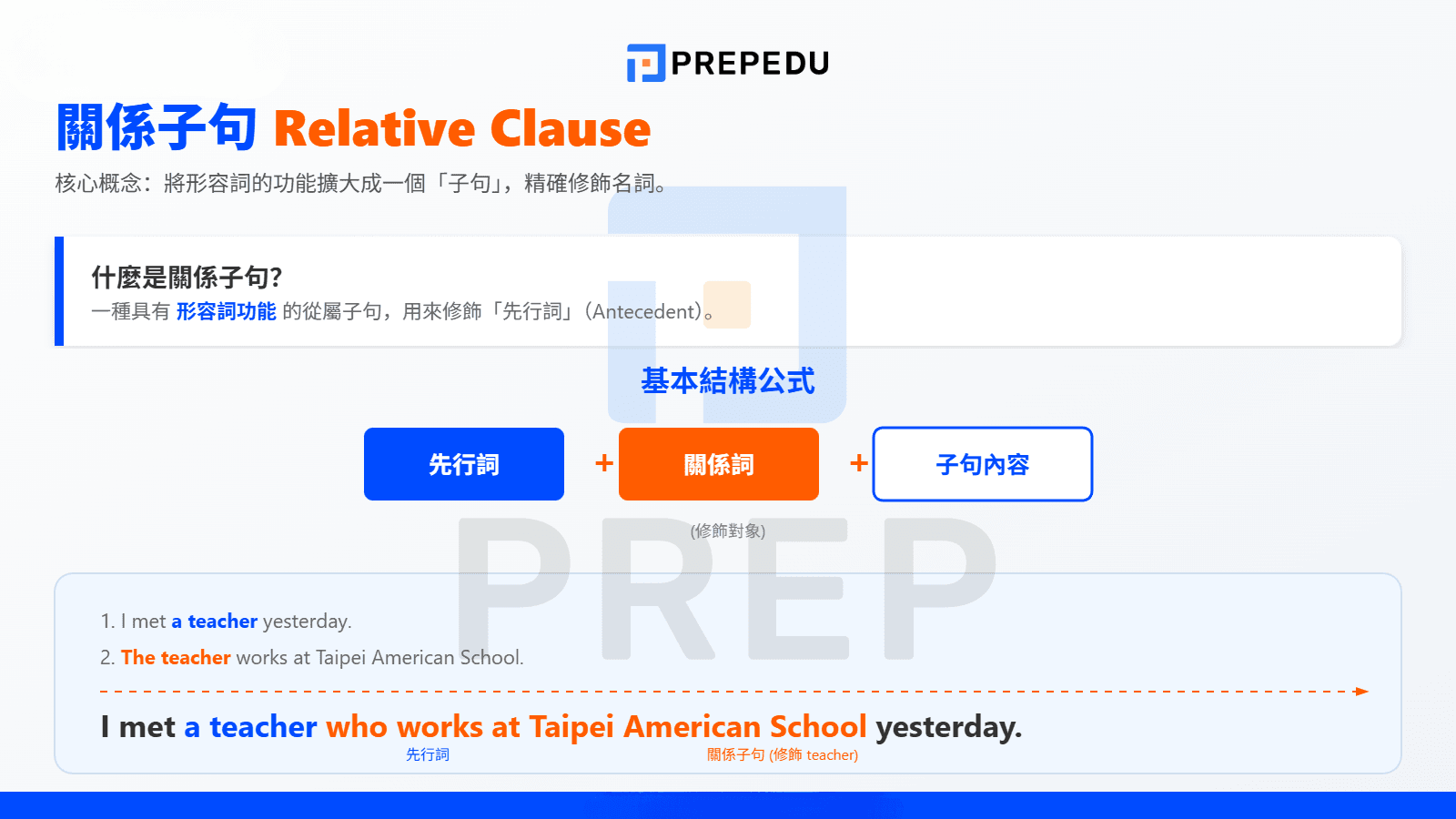
關係子句(Relative Clause)是英文句型中一種從屬子句,具有形容詞的功能,用來修飾或描述句中的名詞或代名詞。這個被修飾的詞稱為「先行詞」(antecedent)。關係子句透過關係詞(包括關係代名詞和關係副詞)與主要子句連接,提供關於先行詞的額外資訊,讓句子表達更精確完整。
關係子句的基本結構:
先行詞 + 關係詞 + 子句內容
實例說明:
原本兩個句子:
-
I met a teacher yesterday.(我昨天遇到一位老師。)
-
The teacher works at Taipei American School.(那位老師在台北美國學校工作。)
合併成關係子句:I met a teacher who works at Taipei American School yesterday.(我昨天遇到一位在台北美國學校工作的老師。)
在這個例句中,「who works at Taipei American School」就是關係子句,修飾先行詞「a teacher」,告訴我們是哪一位老師。理解關係子句的形容詞本質,是掌握英文複雜句型的關鍵第一步。
英文各類從句總整理:子句英文全書(Clauses)定義、種類、用法與三大子句詳解
II. 關係子句在句中的位置
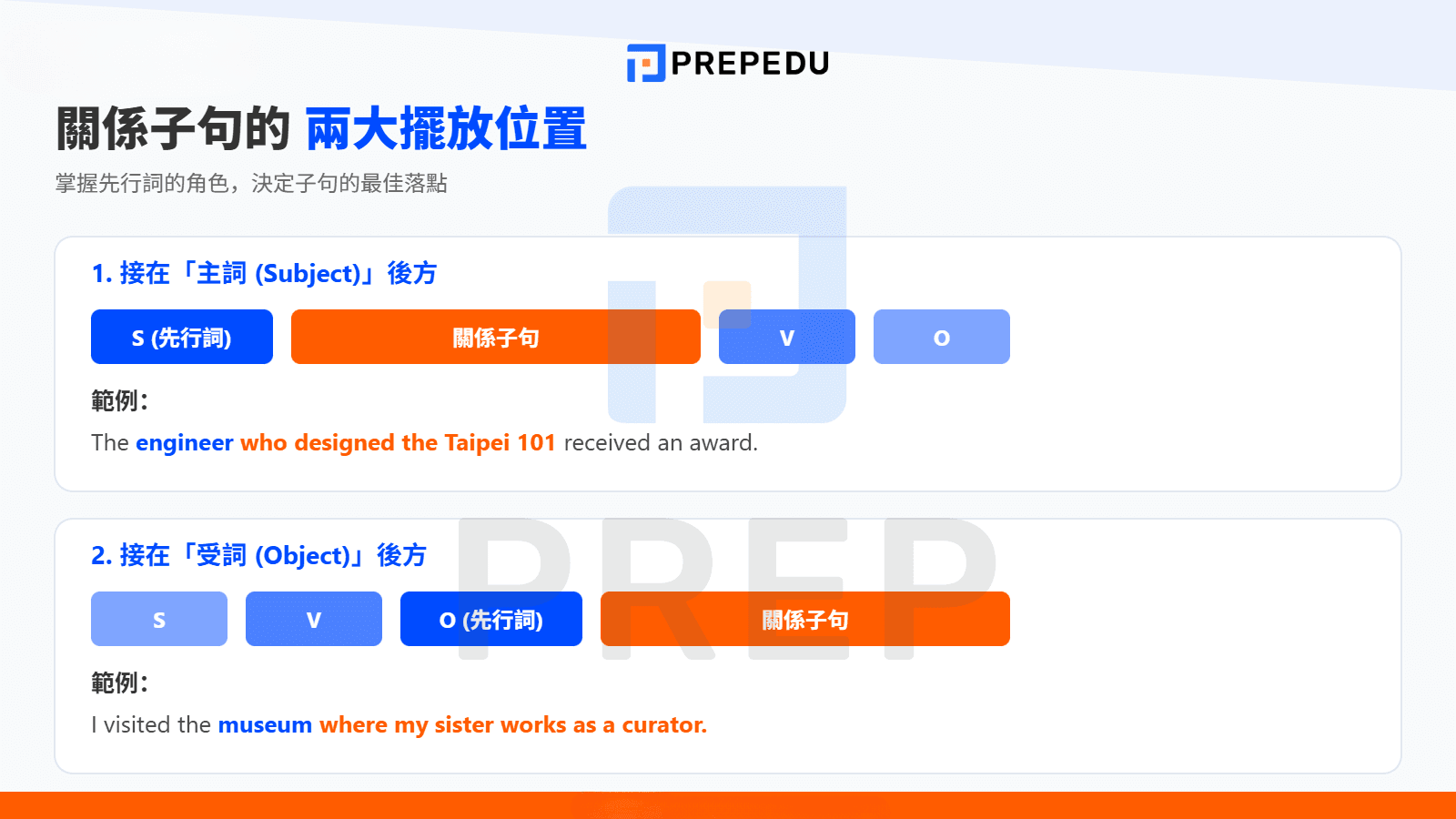
關係子句的位置取決於先行詞在主要子句中的角色,主要有兩種擺放模式,正確的位置安排是寫出清晰關係子句的基礎。
1. 接在主格(主詞)後方
當先行詞擔任主要子句的主詞時,關係子句緊接在主詞之後,形成「主詞+關係子句+動詞+其他成分」的結構。
公式:
S(先行詞)+ 關係子句 + V + O
範例:
-
The engineer who designed the Taipei 101 received an international award.(設計台北101的那位工程師獲得了國際獎項。)
-
The documentary that Xiaoming watched last night discusses climate change.(小明昨晚看的那部紀錄片討論氣候變遷。)
2. 接在受格(受詞)後方
當先行詞擔任主要子句的受詞時,關係子句會接在受詞之後,形成「主詞+動詞+受詞+關係子句」的結構。
公式:
S + V + O(先行詞)+ 關係子句
範例:
-
Xiaowang finally bought the apartment that he had been saving for five years to afford.(小王終於買下他存了五年錢才買得起的公寓。)
-
I visited the museum where my sister works as a curator.(我參觀了我姊姊擔任策展人的那間博物館。)
III. 關係代名詞的用法
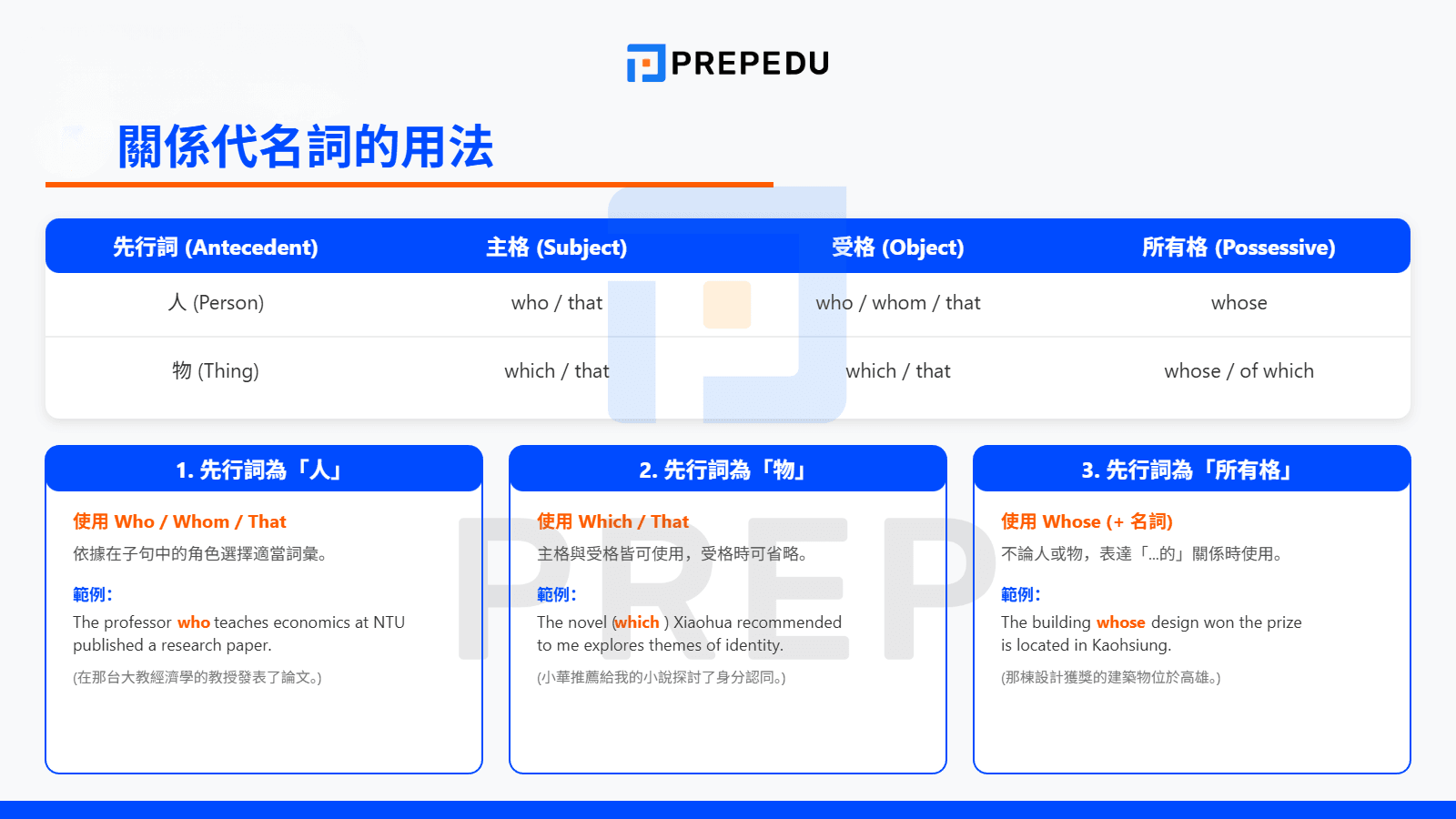
關係代名詞的選擇取決於先行詞的性質(指人或指物)以及在關係子句中擔任的角色(主格、受格或所有格),正確選用關係代名詞是寫出精確關係子句的基礎。
關係代名詞總表
|
先行詞 |
主格 |
受格 |
所有格 |
|
人 |
who / that |
who / whom / that(可省略) |
whose |
|
物 |
which / that |
which / that(可省略) |
whose / of which |
|
人+物 |
that |
that(可省略) |
whose |
1. 先行詞為「人」:Who,Whom,That
當先行詞指人時,我們需要根據關係代名詞在子句中的角色來選擇適當的詞彙。
|
主格用法:使用 who 或 that |
|
|
受格用法:使用 who、whom 或 that(可省略) |
|
說明:whom 在正式寫作中較常用,尤其是在介係詞後方,但在口語中多以 who 取代。例如:"The person to whom I spoke"(與我交談的那個人)。
2. 先行詞為「物」:Which,That
當先行詞指物時,主格和受格都可使用 which 或 that,但在某些情況下有偏好使用的慣例。
|
主格用法:使用 which 或 that |
|
|
受格用法:使用 which 或 that(可省略) |
|
3. 先行詞為「所有格」:Whose
無論先行詞是人或物,表達所有關係(「...的」)時一律使用 whose,這是關係子句中表達所屬關係的唯一方式。
|
人的所有格 |
|
|
物的所有格 |
|
結構說明:whose 後方必須緊接名詞,形成「whose + 名詞」的結構,整個片語在關係子句中擔任所有格的角色。當先行詞為物時,也可使用「of which」來表達所有關係,但 whose 的用法更為簡潔自然。
IV. 關係子句 that 的必用與禁用時機
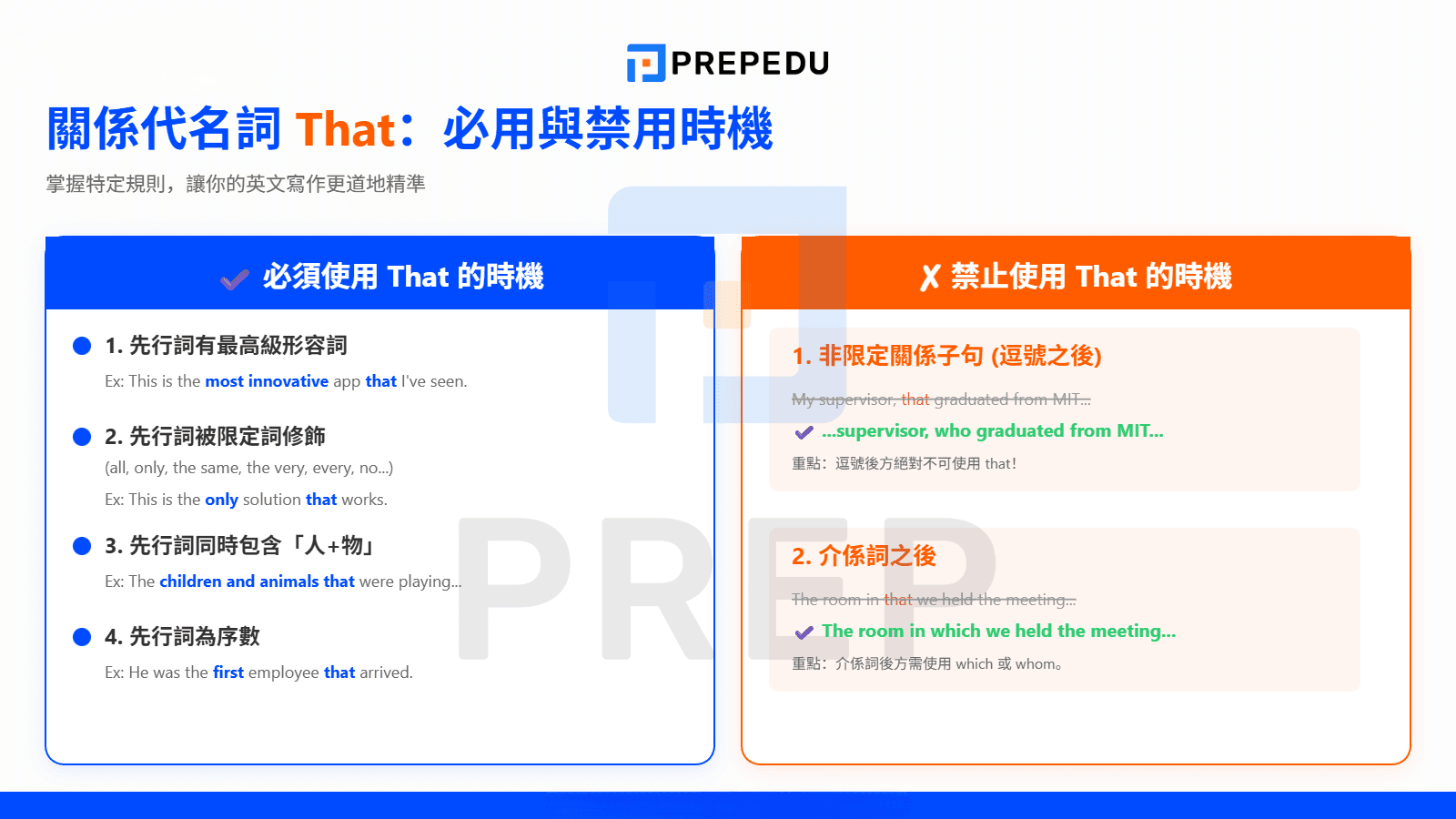
That 關係子句連接詞有特定的使用規則,某些情況下必須使用,某些情況則絕對不能使用,掌握這些規則能讓英文表達更加道地準確。
1. 必須使用 that 的情況
|
情況 |
例句 |
|
先行詞被最高級形容詞修飾 |
|
|
先行詞被限定詞修飾(all,only,the same,the very,every,any,no) |
|
|
先行詞同時包含人和物 |
|
|
先行詞是序數詞或被序數詞修飾 |
|
2. 禁止使用 that 的情況
|
情況 |
錯誤 |
正確 |
|
非限定關係子句(逗號之後) |
My supervisor,that graduated from MIT,has extensive experience in AI research. |
My supervisor,who graduated from MIT,has extensive experience in AI research.(我的主管畢業於麻省理工學院,在人工智慧研究方面經驗豐富。) |
|
The Taipei Metro,that serves millions of passengers daily,is known for its efficiency. |
The Taipei Metro,which serves millions of passengers daily,is known for its efficiency.(台北捷運每天服務數百萬乘客,以其效率聞名。) |
|
|
介係詞之後 |
The conference room in that we held the meeting is being renovated. |
The conference room in which we held the meeting is being renovated.(我們開會的那間會議室正在整修。) |
|
The principles on that this theory is based require further examination. |
The principles on which this theory is based require further examination.(這個理論所依據的原則需要進一步檢視。) |
重點提醒:記住關係子句逗號後方絕對不可使用 that,這是學習者最常犯的錯誤之一。
V. 關係副詞(Relative Adverbs)的用法
關係副詞用來連接關係子句與主要子句,專門修飾表示時間、地點或原因的先行詞,在關係子句中擔任副詞的角色。
1. When:修飾時間
When 用來修飾表示時間的先行詞,可以替換為「介系詞 + which」的結構。
例句:
-
The year when Taiwan hosted the Summer Universiade brought unprecedented international attention to Taipei.(台灣主辦世界大學運動會的那一年為台北帶來前所未有的國際關注。)
-
Do you remember the moment when the company announced its plan to establish a research center in Hsinchu Science Park?(你還記得公司宣布要在新竹科學園區設立研究中心的那一刻嗎?)
可替換形式:
-
the year when = the year on which
-
the moment when = the moment at which
2. Where:修飾地點
Where 用來修飾表示地點的先行詞,可以替換為「介系詞 + which」的結構。
例句:
-
The coffee shop where Xiaofang meets her clients every Tuesday afternoon is located in the Daan District.(小芳每週二下午與客戶會面的那間咖啡店位於大安區。)
-
Tainan is the city where my grandparents have lived for over sixty years and witnessed tremendous urban development.(台南是我祖父母居住超過六十年並見證巨大都市發展的城市。)
可替換形式:
-
the shop where = the shop in which
-
the city where = the city in which
3. Why:修飾原因
Why 用來修飾表示原因的先行詞 reason,可以替換為「for which」,也可以直接省略。
例句:
The manager explained the reason why the project deadline was extended to accommodate additional quality checks.(經理解釋了為什麼專案截止日期延長以容納額外品質檢查的原因。)
Nobody understands the reason why Xiaojun suddenly resigned from his position at the telecommunications company.(沒人理解小軍為什麼突然從電信公司的職位辭職。)
可替換形式:the reason why = the reason for which = the reason(省略)
重要提醒:關係副詞 when 和 where 在關係子句中不可省略,也不能作為主詞。只有 why 可以省略,因為 reason 這個先行詞本身已經表達了原因的概念。
VI. 複合關係代名詞
複合關係代名詞是將先行詞與關係代名詞合併為單一字詞的特殊形式,本身已經包含先行詞的意義,因此使用時不需要另外提供先行詞,能讓句子結構更加簡潔有力。
基本概念:
複合關係代名詞 = 先行詞 + 關係代名詞
1. What:任何事物
What = the thing(s)that / which,表示「所...的事物」。
關係子句:
-
What Xiaowei discovered during her market research in Taichung contradicted the company's initial assumptions.(小薇在台中進行市場研究期間發現的事情與公司最初的假設相矛盾。)
-
The design team needs to focus on what actually improves user experience rather than following trends blindly.(設計團隊需要專注於真正改善用戶體驗的事情,而不是盲目跟隨趨勢。)
等同於:What you said = The things that you said
2. Whatever:無論什麼
Whatever = anything that,表示「無論什麼」,強調任何情況都適用。
關係子句:
-
The supervisor will support whatever decision the Hong Kong team makes regarding the product launch strategy.(主管將支持香港團隊對於產品發表策略做出的任何決定。)
-
Xiaoming can choose whatever training course best aligns with his career development goals at the technology park.(小明可以選擇任何與他在科技園區職涯發展目標最契合的培訓課程。)
等同於:Whatever you want = Anything that you want
3. Whoever:任何人
Whoever = anyone who,表示「任何...的人」。
關係子句:
-
Whoever completes the Mandarin language proficiency certification will receive priority consideration for the Shanghai office position.(任何完成中文語言能力認證的人將優先考慮上海辦公室的職位。)
-
The scholarship will be awarded to whoever demonstrates outstanding academic achievement and community service in Tainan.(獎學金將頒發給任何在台南展現傑出學術成就和社區服務的人。)
等同於:Whoever applies = Anyone who applies
4. Whomever:任何人(受格)
Whomever = anyone whom,是 whoever 的受格形式,在現代英文中使用頻率較低。
關係子句:
-
The manager will interview whomever the recruitment team recommends for the financial analyst position.(經理將面試招聘團隊推薦擔任財務分析師職位的任何人。)
-
You may invite whomever you consider suitable to join the project team in Kaohsiung.(你可以邀請任何你認為適合加入高雄專案團隊的人。)
等同於:Whomever you choose = Anyone whom you choose
5. Whichever:任何一個
Whichever = any one that,表示「無論哪一個」,用於有限選項中的任意選擇。
例句:
-
Whichever marketing strategy the Taipei headquarters approves will be implemented across all regional branches.(台北總部批准的任何行銷策略都將在所有區域分公司實施。)
-
Xiaoling can select whichever laptop model meets her technical requirements within the allocated budget.(小玲可以在分配的預算內選擇任何符合她技術需求的筆記型電腦型號。)
等同於:Whichever option you prefer = Any one that you prefer
VII. 關係子句限定非限定的差別
關係子句限定非限定的區分是學習英文關係子句最重要的概念之一,兩者在句意、標點符號和使用的關係詞上都有明顯差異,理解這個區別能大幅提升英文寫作精確度。
|
特徵 |
限定關係子句 |
非限定關係子句 |
|
功能 |
提供必要資訊以識別先行詞 |
提供額外補充資訊 |
|
標點符號 |
不使用逗號 |
前後必須加逗號 |
|
可否刪除 |
刪除後句意不完整或不明確 |
刪除後句意仍完整 |
|
關係詞 |
可用 that |
不可用 that |
|
受格省略 |
關係代名詞作受格時可省略 |
不可省略關係代名詞 |
|
語調 |
與主句連貫,無停頓 |
有短暫停頓 |
1. 限定關係子句(Defining Relative Clause)
限定關係子句提供識別先行詞所需的必要資訊,如果移除關係子句,句子的意思會變得不明確或不完整,這類子句不使用逗號與主要子句分隔。
例句:
-
The engineers who developed the high-speed rail technology received commendations from the Ministry of Transportation.(開發高速鐵路技術的工程師們獲得交通部的表揚。)➡️「who developed the high-speed rail technology」用來區分是哪些工程師,移除後無法知道是哪些工程師獲得表揚。
-
Students who submit their applications before the deadline will be considered for early admission to National Taiwan University.(在截止日期前提交申請的學生將被考慮提前錄取國立台灣大學。)➡️ 關係子句指出哪些學生有資格,移除後句意不清楚。
2. 非限定關係子句與關係子句逗號
非限定關係子句提供關於先行詞的額外補充資訊,這些資訊雖然有助於理解,但即使移除也不影響句子的基本意義,這類子句前後必須使用關係子句逗號分隔。
例句:
Dr. Chen,who graduated from Harvard Medical School,now leads the cardiology department at National Taiwan University Hospital.(陳醫師畢業於哈佛醫學院,現在領導台大醫院心臟科部門。)➡️ 「who graduated from Harvard Medical School」只是補充說明陳醫師的背景,移除後句子意思仍完整。
The Taipei 101,which was the world's tallest building from 2004 to 2010,remains an iconic landmark in Taiwan.(台北101在2004年至2010年間曾是世界最高建築,至今仍是台灣的地標性建築。)➡️ 關係子句提供額外歷史資訊,移除後句意依然清楚。
關鍵差異實例比較:
|
限定關係子句 |
非限定關係子句 |
|
The employees who work in the marketing department attended the seminar.(在行銷部門工作的員工參加了研討會。)→ 只有行銷部門的員工參加 |
The employees,who work in the marketing department,attended the seminar.(那些員工在行銷部門工作,他們參加了研討會。)→ 所有員工都參加,他們剛好都在行銷部門工作 |
|
My sister who lives in Kaohsiung is a dentist.(我住在高雄的姊姊是牙醫。)→ 我有多個姊姊,只有住高雄的那位是牙醫 |
My sister,who lives in Kaohsiung,is a dentist.(我姊姊住在高雄,她是牙醫。)→ 我只有一個姊姊,她住高雄且是牙醫 |
重要提醒:非限定關係子句絕對不可使用 that,必須用 which(物)或 who(人),且關係代名詞不可省略。非限定關係子句常用於補充專有名詞、獨一無二的事物或已經明確指定的對象。
VIII. 關係子句省略與簡化規則
關係子句的省略與簡化是讓英文句子更簡潔流暢的重要技巧,掌握這些規則能讓寫作更加精煉專業,同時保持句意的完整性。
1. 當關係代名詞作為「受格」時的省略
當關係代名詞在關係子句中擔任受詞角色時,可以直接省略,但必須符合兩個條件。
省略條件:
-
該關係子句必須是限定關係子句(無逗號)
-
關係代名詞前方不可有介係詞
|
完整形式 |
省略形式 |
|
The research paper(that/ which)Xiaojie wrote about renewable energy technology won the innovation award. |
The research paper Xiaojie wrote about renewable energy technology won the innovation award.(小杰撰寫的關於再生能源技術的研究論文獲得創新獎。) |
|
The restaurant(that/ which)we visited in Tamsui serves authentic Mediterranean cuisine. |
The restaurant we visited in Tamsui serves authentic Mediterranean cuisine.(我們在淡水參觀的那家餐廳供應正宗地中海料理。) |
|
The consultant(whom/ who/ that)the company hired from Singapore specializes in blockchain technology. |
The consultant the company hired from Singapore specializes in blockchain technology.(公司從新加坡聘請的那位顧問專精於區塊鏈技術。) |
|
The novel(that/ which)Xiaowen recommended explores cultural identity in post-war Taiwan. |
The novel Xiaowen recommended explores cultural identity in post-war Taiwan.(小文推薦的那本小說探討戰後台灣的文化認同。) |
不可省略的情況:
-
The colleague to whom I spoke → 介係詞後不可省略
-
My supervisor,who I respect → 非限定子句不可省略
2. 關係子句簡化為分詞片語
關係子句可以透過移除關係代名詞和 be 動詞來簡化為分詞片語,這個技巧在學術寫作和正式文體中特別常見。
2.1. 主動語態的簡化(使用V-ing)
當關係子句使用主動語態時,省略關係代名詞後,將動詞改為現在分詞(V-ing)。
|
完整形式 |
簡化形式 |
|
The software engineer who is developing the new mobile application graduated from National Chiao Tung University. |
The software engineer developing the new mobile application graduated from National Chiao Tung University.(正在開發新行動應用程式的軟體工程師畢業於國立交通大學。) |
|
The tourists who are visiting the National Palace Museum come from various Asian countries. |
The tourists visiting the National Palace Museum come from various Asian countries.(正在參觀故宮博物院的遊客來自各個亞洲國家。) |
2.2. 被動語態的簡化(使用V-p.p.)
當關係子句使用被動語態時,省略關係代名詞和 be 動詞後,保留過去分詞(V-p.p.)。
|
完整形式 |
簡化形式 |
|
The products which are manufactured in the Taoyuan factory meet international quality standards. |
The products manufactured in the Taoyuan factory meet international quality standards.(在桃園工廠製造的產品符合國際品質標準。) |
|
The report that was submitted by Xiaoming contains comprehensive market analysis of the Greater China region. |
The report submitted by Xiaoming contains comprehensive market analysis of the Greater China region.(小明提交的報告包含大中華地區的全面市場分析。) |
2.3. 省略「關代 + be動詞」
當關係子句中包含 be 動詞時,可以同時省略關係代名詞和 be 動詞。
|
完整形式 |
簡化形式 |
|
The candidates who are interested in the position should submit their resumes to the Taipei headquarters. |
The candidates interested in the position should submit their resumes to the Taipei headquarters.(對該職位有興趣的應徵者應將履歷提交至台北總部。) |
|
The document which is available on the company intranet contains detailed guidelines for remote work. |
The document available on the company intranet contains detailed guidelines for remote work.(公司內部網路上可取得的文件包含遠距工作的詳細指南。) |
重要提醒:簡化後的分詞片語必須緊接在先行詞之後,以避免修飾對象不清。
IX. 使用關係子句的注意事項與常見錯誤
使用關係子句時有幾個常見錯誤需要特別注意,避免這些錯誤能讓英文表達更加準確專業,展現對語法細節的掌握能力。
|
錯誤類型 |
錯誤範例 |
正確範例 |
說明 |
|
冗贅代名詞 |
The manager who she works at the Xinyi branch is very experienced. |
The manager who works at the Xinyi branch is very experienced.(在信義分公司工作的經理經驗非常豐富。) |
關係代名詞本身已經代表先行詞,不需要再使用代名詞 she 或 he。 |
|
逗號後誤用 that |
My colleague,that graduated from National Taiwan University,speaks five languages. |
My colleague,who graduated from National Taiwan University,speaks five languages.(我的同事畢業於國立台灣大學,會說五種語言。) |
非限定關係子句(有逗號)絕對不可使用 that,必須用 which 或 who。 |
|
The employees who works in the Kaohsiung office are attending the training. |
The employees who work in the Kaohsiung office are attending the training.(在高雄辦公室工作的員工們正在參加培訓。) |
關係子句中的動詞必須與先行詞 employees(複數)一致,所以用 work 而非 works。 |
|
|
介係詞位置錯誤 |
The project for that we have been preparing is launching next month. |
The project for which we have been preparing is launching next month.(我們一直在準備的專案將於下個月啟動。) |
介係詞後方不可使用 that,必須用 which 或 whom。 |
|
混淆限定與非限定 |
My brother who lives in Hong Kong,is a financial analyst. |
My brother,who lives in Hong Kong,is a financial analyst.(我哥哥住在香港,他是財務分析師。) |
若只有一個哥哥,應使用非限定子句(有逗號);若有多個哥哥,才使用限定子句(無逗號)。 |
|
關係副詞誤用 |
The reason when we postponed the meeting was scheduling conflicts. |
The reason why we postponed the meeting was scheduling conflicts.(我們延後會議的原因是時程衝突。) |
修飾 reason 應使用 why,不用 when。 |
X. 關係子句練習題(附答案)
透過以下關係子句練習題,您可以檢驗自己對關係子句的理解程度,這些關係子句選擇題由基礎到進階,涵蓋各種關係子句的用法情境。
1. 練習題一:選擇正確的關係代名詞
-
The entrepreneur _____ founded the successful startup in Taipei's Nangang Software Park is only 25 years old. A)who B)which C)whose D)whom
-
The electric scooter _____ Xiaoming purchased last month has already malfunctioned twice. A)who B)which C)where D)when
-
The colleague _____ desk is next to the window always arrives early. A)who B)which C)whose D)whom
-
This is the conference room _____ we usually hold our weekly team meetings. A)which B)where C)that D)when
-
Can you tell me the reason _____ the project was delayed?A)which B)that C)why D)B and C
-
The researcher _____ I met at the Academia Sinica symposium specializes in quantum computing. A)who B)which C)whose D)where
-
The smartphone application _____ was developed by the Taiwanese team won international recognition. A)who B)which C)whose D)whom
-
This is the most challenging project _____ our department has ever undertaken. A)which B)that C)who D)A or B
-
The architect to _____ the award was presented designed the iconic building in Taichung. A)who B)whom C)which D)that
-
The year _____ Taiwan experienced rapid technological advancement was remarkable. A)which B)where C)when D)that
答案:1.A - 2.B - 3.C - 4.B - 5.D - 6.A - 7.B - 8.B - 9.B - 10.C
2. 練習題二:限定與非限定關係子句
-
Professor Wang _____ teaches Advanced Mathematics at National Taiwan University is retiring next year. A)who B),who C)that D),that
-
Employees _____ submit their timesheets before Friday will receive their salaries on schedule. A)who B),who C)which D),which
-
The Taipei 101,_____ was designed by C.Y. Lee & Partners,incorporates traditional Asian elements. A)that B)which C),which D),that
-
The candidates _____ possess strong communication skills will advance to the second interview round. A)who B),who C)which D)whom
-
My supervisor,_____ has over 20 years of industry experience,will mentor the new team members. A)that B)which C),which D),who
-
The software _____ helps employees track their project progress is being upgraded. A)which B),which C)that D)A or C
-
Dr. Lin,_____ published groundbreaking research on artificial intelligence,will give the keynote speech. A)who B),who C)that D)whom
-
The participants _____ registered before the deadline received early bird discounts. A)who B),who C)which D)that
-
The National Palace Museum,_____ houses over 700,000 pieces of Chinese art,attracts millions of visitors annually. A)that B)which C),which D)who
-
Companies _____ prioritize employee wellbeing typically experience lower turnover rates. A)which B),which C)that D)A or C
答案:1.B - 2.A - 3.C - 4.A - 5.D - 6.D - 7.B - 8.A - 9.C - 10.D
3. 練習題三:關係子句的省略與簡化
-
The proposal(which)the marketing team submitted to the Hong Kong office was approved. 關係代名詞可以省略嗎?A)可以 B)不可以
-
The researcher who is analyzing the data from the Tainan field study will present findings next month. 可以簡化為:The researcher _____ the data from the Tainan field study will present findings next month. A)analyze B)analyzing C)analyzed D)to analyze
-
The components which are imported from Germany meet strict quality standards. 可以簡化為:The components _____ from Germany meet strict quality standards. A)import B)importing C)imported D)to import
-
This is the office in which Xiaohua works as a senior financial analyst. "in which" 可以省略嗎?A)可以 B)不可以
-
The candidate whom the recruitment committee selected yesterday has accepted the offer. 關係代名詞可以省略嗎?A)可以 B)不可以
-
Anyone who is interested in participating in the Kaohsiung workshop should register online. 可以簡化為:Anyone _____ in participating in the Kaohsiung workshop should register online. A)interest B)interesting C)interested D)to interest
-
My colleague,who graduated from Cambridge University,will lead the international project. 這個關係子句可以省略關係代名詞嗎?A)可以 B)不可以
-
The documents which were prepared by Xiaojie for the board meeting are comprehensive. 可以簡化為:The documents _____ by Xiaojie for the board meeting are comprehensive. A)prepare B)preparing C)prepared D)to prepare
-
The engineers who are working on the high-speed rail expansion project face tight deadlines. 可以簡化為:The engineers _____ on the high-speed rail expansion project face tight deadlines. A)work B)working C)worked D)to work
-
The business strategy that we discussed at the Taipei conference will be implemented next quarter. 關係代名詞可以省略嗎?A)可以 B)不可以
答案:1.A - 2.B - 3.C - 4.B - 5.A - 6.C - 7.B - 8.C - 9.B - 10.A
結論
掌握英文關係子句需要時間和練習,但只要理解其基本原理並熟悉各種用法規則,您就能在寫作和口說中自如運用這個重要的文法結構。記住關鍵概念:關係子句是形容詞子句,用來修飾先行詞;限定與非限定關係子句的差異在於資訊的必要性和逗號的使用;關係代名詞的選擇取決於先行詞性質和在子句中的角色。
對 IELTS 和 TOEIC 考試格式感到不熟悉?陌生的考試環境會阻礙你的表現。PREPEDU 的 Test Practice 重現真實考場氛圍,幫助你掌握題型和答題節奏。
豐富的 IELTS 真題和 TOEIC 題型題庫涵蓋超過一千道精選練習題,持續更新以追蹤考試趨勢,收錄高頻題目。智能分析工具深入檢視每個錯誤,提供個人化學習建議,助你快速突破。
獨特的視覺化學習路徑讓你在每個階段見證顯著進步。成功就在眼前。把握機會拉開與對手的差距。
立即開始 PREP 練習,自信迎接挑戰。現在就體驗 IELTS 和 TOEIC 備考!
你好!我叫黃秋賢,現在在 prepedu.com 擔任內容企劃。我有超過5年的英語與韓語自學經歷,親身備考 IELTS、TOEIC 與 TOPIK,累積了大量第一手的學習者視角——包括哪些語法規則最讓台灣與香港學習者混淆,以及如何在有限的備考時間內最有效地修正這些錯誤。目前已在 prepedu.com 撰寫超過 1000 篇英語學習文章,內容涵蓋語法、詞彙與考試策略,累積協助數千位學習者解決自學過程中的語法疑問。
評論











統一企業編號:202227322W
地址:114 LAVENDER STREET, #11-83 CT HUB 2, SINGAPORE (338729)