er 結尾的單字全攻略︱名詞、形容詞、動詞、副詞一次掌握
er 結尾的單字有哪些?它們在英文中代表什麼意思?其實,er 結尾的單字最常見的功能,是用來表示「做某件事的人」或構成形容詞的比較級。例如 teacher(教書的人)、driver(駕駛的人),以及 taller(更高的),都屬於典型的 er 結尾用法。只要掌握這個核心概念,你就能快速理解大量高頻英文單字的形成規則,而不必死背。
想像一下,當你看到 writer、speaker、runner 這些單字時,如果知道 er 有「行為執行者」的含義,就能立即推測它們的意思。另一方面,在形容詞中加上 er,如 faster、smarter,則表示比較級的變化。許多學習者常混淆名詞型 er 與比較級 er 的差異,甚至誤用在拼寫或發音上,這正是學習英文構詞法時容易忽略的細節。
在這篇文章中,PREPEDU 將系統整理常見的 er 結尾單字類型,說明其構詞規則、詞性變化與實際用法,並搭配例句與發音提醒,幫助你建立清晰的語言邏輯。只要理解規則,而不是零散記憶,你就能更有效率地擴充詞彙量,並在寫作與口說中自然運用這些單字。

I. 以字母 -er 結尾的英文單字整理
-er 是使用頻率最高的英文字尾之一。它能附加在動詞後,形成表示「執行者」的名詞(如 teacher、writer);也能用於形容詞比較級(如 faster、smarter);甚至可以構成動詞(如 shiver、flutter)。理解這個字尾的功能,就能舉一反三,在陌生語境中快速推測詞義。以下四個詞類分類,是你建構 er 結尾的字詞彙庫的核心基礎。
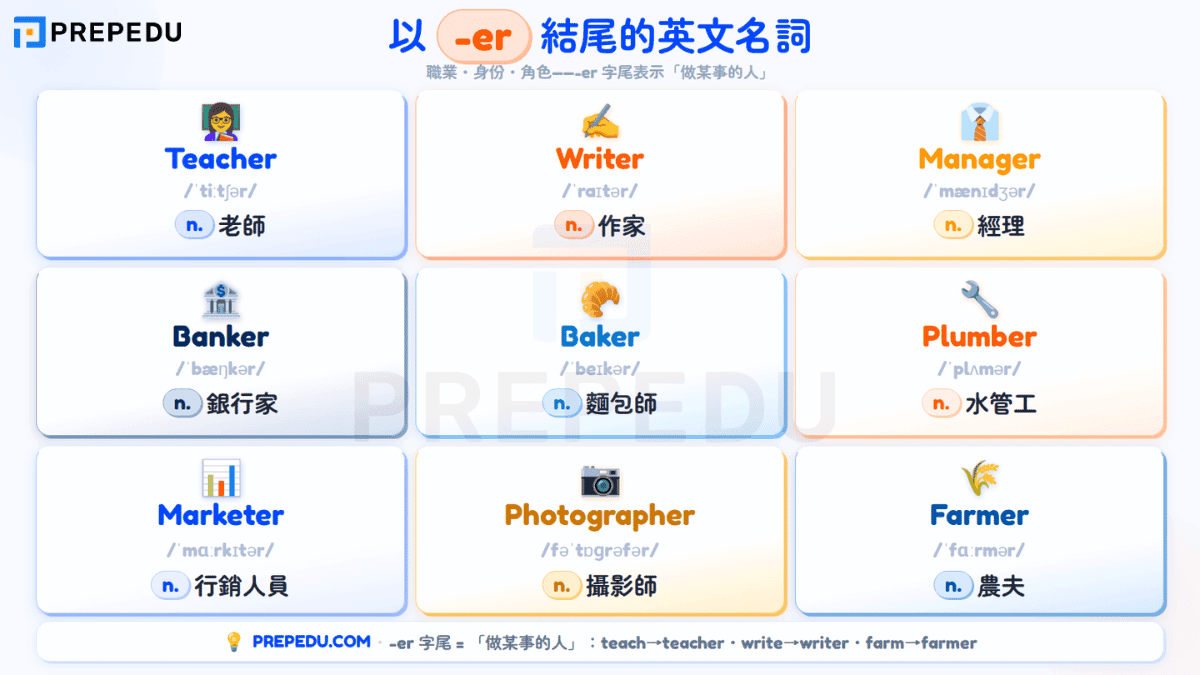
1. 英文名詞
英文名詞是 er 結尾的單字中數量最龐大的類別。其中最具代表性的構詞方式,是在動詞後加上 -er,表示「從事某動作的人或物」。例如:teach → teacher(教師)、run → runner(跑者)。這類詞彙在日常對話與學術寫作中出現頻率極高,是詞彙積累的優先目標。
|
er 結尾的單字 |
中文翻譯 |
例句 |
|
職人與身份 |
||
|
teacher /ˈtiːtʃər/ (n.) |
教師 |
My teacher explained the grammar rule clearly.(我的教師把文法規則解釋得很清楚。) |
|
writer /ˈraɪtər/ (n.) |
作家;寫作者 |
She became a professional writer after years of practice.(她經過多年練習後成為了一名專業作家。) |
|
manager /ˈmænɪdʒər/ (n.) |
經理;管理者 |
The manager approved the new project proposal.(經理批准了新的專案提案。) |
|
banker /ˈbæŋkər/ (n.) |
銀行家;出納員 |
The banker approved the loan quickly.(銀行家迅速批准了貸款。) |
|
baker /ˈbeɪkər/ (n.) |
麵包師;烘焙師 |
The baker bakes fresh bread every morning.(烘焙師每天早晨都烤新鮮麵包。) |
|
plumber /ˈplʌmər/ (n.) |
水管工 |
The plumber fixed the leaking pipe.(水管工修好了漏水的管道。) |
|
photographer /fəˈtɑːgrəfər/ (n.) |
攝影師 |
The photographer captured the beautiful sunset.(攝影師捕捉到了美麗的日落。) |
|
researcher /rɪˈsɜːrtʃər/ (n.) |
研究員 |
The researcher published a new study on climate change.(研究員發表了一項新的氣候變化研究。) |
|
programmer /ˈproʊɡræmər/ (n.) |
程式設計師 |
The programmer wrote efficient code for the app.(程式設計師為應用程式撰寫了高效的程式碼。) |
|
marketer /ˈmɑːrkətər/ (n.) |
行銷人員 |
The marketer launched a successful ad campaign.(行銷人員推出了一個成功的廣告活動。) |
|
editor /ˈɛdɪtər/ (n.) |
編輯 |
The editor reviewed the manuscript and suggested revisions.(編輯審閱了手稿並提出了修訂建議。) |
|
designer /dɪˈzaɪnər/ (n.) |
設計師 |
The designer created a modern logo for the startup.(設計師為這家新創公司設計了現代化的標誌。) |
|
farmer /ˈfɑːrmər/ (n.) |
農夫;農場主 |
The farmer harvests the corn every September.(農夫每年九月收割玉米。) |
|
runner /ˈrʌnər/ (n.) |
跑者;賽跑選手 |
The runner finished the marathon in under four hours.(那位跑者在四小時內完成了馬拉松。) |
|
player /ˈpleɪər/ (n.) |
選手;演奏者 |
He is the best player on the basketball team.(他是籃球隊中最出色的選手。) |
|
singer /ˈsɪŋər/ (n.) |
歌手 |
She is a talented singer with a beautiful voice.(她是一位擁有美麗嗓音的才華橫溢的歌手。) |
|
dancer /ˈdænsər/ (n.) |
舞者;跳舞者 |
The dancer practiced for hours before the performance.(舞者在表演前排練了好幾個小時。) |
|
driver /ˈdraɪvər/ (n.) |
駕駛員;司機 |
The taxi driver took us to the airport on time.(計程車司機準時把我們送到機場。) |
|
painter /ˈpeɪntər/ (n.) |
畫家;油漆工 |
The painter worked all day to finish the portrait.(畫家花了一整天完成了這幅肖像畫。) |
|
speaker /ˈspiːkər/ (n.) |
演講者;講話者 |
The keynote speaker delivered an inspiring talk.(主講人在演講中傳達了鼓舞人心的講話。) |
|
reader /ˈriːdər/ (n.) |
讀者;閱讀者 |
The reader finished the novel in two days.(讀者兩天內讀完了這本小說。) |
|
catcher /ˈkætʃər/ (n.) |
捕捉者;接球手 |
The catcher caught the final strike.(接球手抓住了最後一球。) |
|
watcher /ˈwɒtʃər/ (n.) |
觀察者;看守 |
The night watcher patrols the building.(夜間看守巡邏這座建築。) |
|
volunteer /ˌvɒlənˈtɪər/ (n.) |
志工;義工 |
She worked as a volunteer at the local hospital.(她在當地醫院擔任志工。) |
|
customer /ˈkʌstəmər/ (n.) |
顧客;客戶 |
Every customer deserves respectful and prompt service.(每一位顧客都應獲得有禮貌且迅速的服務。) |
|
reporter /rɪˈpɔːrtər/ (n.) |
記者;報導者 |
The reporter interviewed witnesses at the scene.(記者在現場採訪了目擊者。) |
|
engineer /ˌɛn.dʒəˈnɪər/ (n.) |
工程師 |
The engineer designed a more efficient bridge.(工程師設計了一座更高效的橋梁。) |
|
lawyer /ˈlɔː.jər/ (n.) |
律師 |
She hired a lawyer to handle the contract.(她聘請了律師處理合約。) |
|
worker /ˈwɜːrkər/ (n.) |
工人;職員 |
Factory workers operate the machines.(工廠工人操作機器。) |
|
passenger /ˈpæsɪndʒər/ (n.) |
乘客 |
All passengers must fasten their seat belts.(所有乘客必須繫好安全帶。) |
|
messenger /ˈmesɪndʒər/ (n.) |
信差;送信者 |
The messenger delivered the package.(信差送達了包裹。) |
|
observer /əbˈzɜːrvər/ (n.) |
觀察者 |
An observer took notes during the experiment.(一位觀察者在實驗過程中做了筆記。) |
|
trainer /ˈtreɪnər/ (n.) |
培訓師;馴獸師 |
The trainer prepared the staff for the new software.(培訓師為員工準備了新軟件的操作。) |
|
waiter /ˈweɪtər/ (n.) |
服務生 |
The waiter took our order quickly.(服務生迅速記下了我們的點單。) |
|
listener /ˈlɪsənər/ (n.) |
聽眾 |
Listeners praised the podcast episode.(聽眾稱讚了這集播客。) |
|
shopper /ˈʃɒpər/ (n.) |
購物者 |
Shoppers flocked to the sale event.(購物者蜂擁而至這場特賣會。) |
|
publisher /ˈpʌblɪʃər/ (n.) |
出版商;出版社 |
The publisher released the new textbook this month.(出版社本月出版了新教科書。) |
|
member /ˈmembər/ (n.) |
成員;會員 |
She became a member of the student council.(她成為了學生會的一員。) |
|
owner /ˈoʊnər/ (n.) |
擁有者 |
The house owner hired a painter to repaint the walls.(房屋擁有者聘請畫家重新粉刷牆壁。) |
|
buyer /ˈbaɪər/ (n.) |
買方 |
The buyer inspected the car before signing the contract.(買方在簽合同前檢查了車輛。) |
|
seller /ˈselər/ (n.) |
賣方 |
The seller agreed to lower the price by $100.(賣方同意將價格降低100美元。) |
|
borrower /ˈbɑːroʊər/ (n.) |
借用者 |
Each borrower must return the book within two weeks.(每位借書者須在兩週內歸還書籍。) |
|
lender /ˈlendər/ (n.) |
出借者 |
Banks are the main lenders for small businesses.(銀行是小型企業的主要出借者。) |
|
supplier /səˈplaɪər/ (n.) |
供應商 |
We found a local supplier of organic vegetables.(我們找到了一家當地有機蔬菜供應商。) |
|
consumer /kənˈsjuːmər/ (n.) |
消費者 |
Modern consumers demand both quality and convenience.(現代消費者既要求品質又要便利性。) |
|
employer /ɪmˈplɔɪər/ (n.) |
雇主 |
Employers must provide a safe working environment.(雇主必須提供安全的工作環境。) |
|
leader /ˈliːdər/ (n.) |
領導者 |
A good leader inspires confidence in the team.(優秀的領導者能激發團隊的信心。) |
|
follower /ˈfɑːloʊər/ (n.) |
追隨者 |
Celebrities often have thousands of social media followers.(名人經常擁有數千名社群粉絲。) |
|
winner /ˈwɪnər/ (n.) |
獲勝者 |
The winner of the competition received a cash prize.(比賽獲勝者獲得了一筆現金獎勵。) |
|
loser /ˈluːzər/ (n.) |
失敗者 |
No one likes to be called a loser, so he tried harder next time.(沒人喜歡被稱為「失敗者」,因此他下次更加努力。) |
|
其他英文名詞 |
||
|
chapter /ˈtʃæptər/ (n.) |
章節 |
Read the first chapter before tomorrow's class.(在明天上課前讀完第一章節。) |
|
center /ˈsentər/ (n.) |
中心;核心 |
The center of the city is always crowded on weekends.(城市中心在週末總是人山人海。) |
|
semester /sɪˈmestər/ (n.) |
學期 |
This semester, I am taking five courses.(這個學期,我選修了五門課。) |
|
career /kəˈrɪər/ (n.) |
職業;事業 |
Building a successful career requires consistent effort.(建立成功的事業需要持續的努力。) |
|
character /ˈkærɪktər/ (n.) |
性格;角色 |
The main character in the novel shows remarkable courage.(小說中的主角展現出了非凡的勇氣。) |
|
disaster /dɪˈzæstər/ (n.) |
災難;大失敗 |
The earthquake was a natural disaster that affected thousands.(這場地震是影響數千人的自然災難。) |
|
thunder /ˈθʌndər/ (n.) |
雷聲 |
The thunder woke everyone up in the middle of the night.(雷聲在半夜把所有人都吵醒了。) |
|
computer /kəmˈpjuːtər/ (n.) |
電腦 |
She uses a computer to draft all her reports.(她用電腦撰寫所有的報告。) |
|
weather /ˈweðər/ (n.) |
天氣 |
The weather has been very hot lately.(最近天氣非常炎熱。) |
|
river /ˈrɪvər/ (n.) |
河流 |
The river overflowed after heavy rain.(大雨後河水泛濫。) |
|
printer /ˈprɪntər/ (n.) |
印表機;打印機 |
The office bought a new color printer.(辦公室購買了一台新的彩色印表機。) |
|
scanner /ˈskænər/ (n.) |
掃描器 |
I use a scanner to digitize old photographs.(我用掃描器將舊照片數位化。) |
|
letter /ˈletər/ (n.) |
信;信件 |
She wrote a letter to her friend yesterday.(她昨天給朋友寫了一封信。) |
|
paper /ˈpeɪpər/ (n.) |
紙;報告 |
Please hand in your paper by Friday.(請在週五之前交報告。) |
|
number /ˈnʌmbər/ (n.) |
數字;號碼 |
What is your phone number?(你的電話號碼是多少?) |
|
meter /ˈmiːtər/ (n.) |
計量器;公尺 |
The gas meter needs to be read monthly.(天然氣儀表需要每月抄表一次。) |
|
filter /ˈfɪltər/ (n.) |
過濾器 |
Remember to clean the water filter regularly.(別忘了定期清潔水過濾器。) |
|
container /kənˈteɪnər/ (n.) |
容器;集裝箱 |
They shipped the goods in a large container.(他們用大集裝箱運送貨物。) |
|
heater /ˈhiːtər/ (n.) |
暖氣機;加熱器 |
Turn on the heater when it gets cold.(天冷時就開暖氣機吧。) |
|
freezer /ˈfriːzər/ (n.) |
冷凍庫;冷凍室 |
The freezer is full of ice cream.(冷凍庫裡全是冰淇淋。) |
|
toaster /ˈtoʊstər/ (n.) |
烤麵包機 |
I use the toaster every morning.(我每天早上都用烤麵包機。) |
|
blender /ˈblendər/ (n.) |
果汁機;攪拌機 |
Put the fruits in the blender and press start.(把水果放進攪拌機,然後按開始。) |
|
ladder /ˈlædər/ (n.) |
梯子 |
He climbed the ladder to fix the roof.(他爬上梯子修屋頂。) |
|
hammer /ˈhæmər/ (n.) |
錘子 |
Use a hammer to drive the nail into the wood.(用錘子把釘子打進木頭。) |
|
charger /ˈtʃɑːrdʒər/ (n.) |
充電器 |
I need my phone charger.(我需要我的手機充電器。) |
|
router /ˈruːtər/ (n.) |
路由器 |
The router is not working properly.(路由器運作不正常。) |
|
adapter /əˈdæptər/ (n.) |
轉接器 |
Don’t forget to bring a travel adapter for your charger.(別忘了帶旅行用轉接器給你的充電器。) |
|
folder /ˈfoʊldər/ (n.) |
檔案夾 |
Please save the report in the shared folder.(請將報告保存在共享檔案夾中。) |
|
binder /ˈbaɪndər/ (n.) |
活頁夾 |
She organized all her notes in a three-ring binder.(她將所有筆記整理在一個活頁夾中。) |
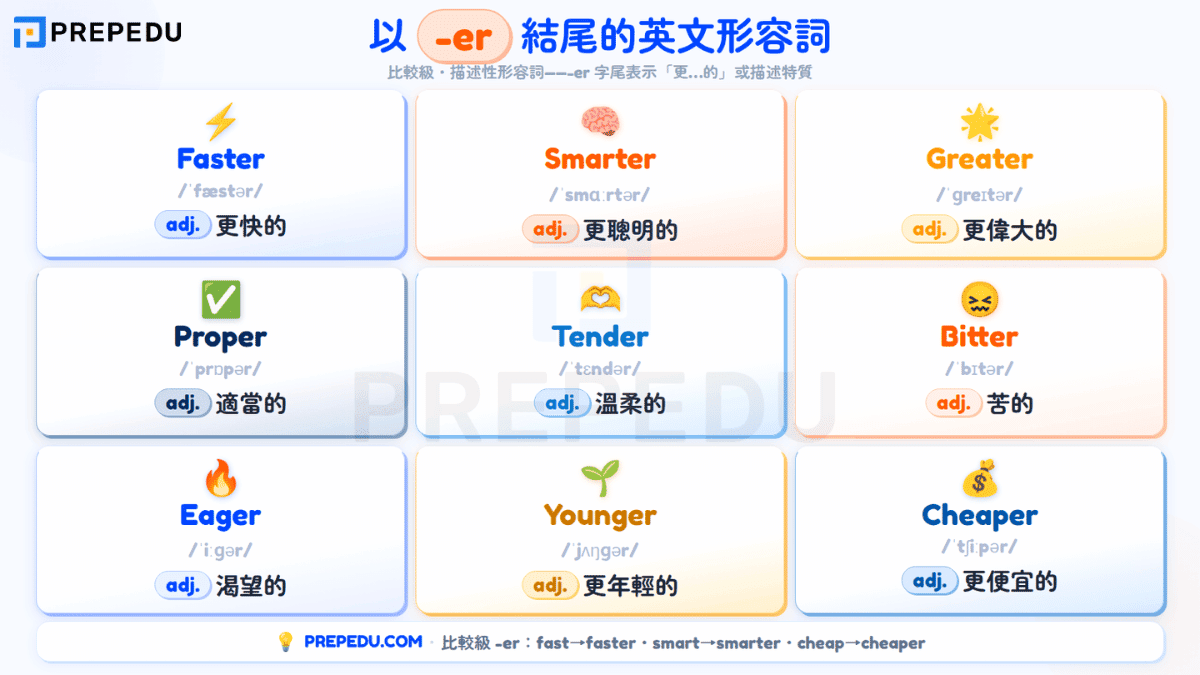
2. 英文形容詞
在英文形容詞中,-er 最常見的功能是構成比較級,用於比較兩個事物之間的差異。此外,部分形容詞本身就以 -er 結尾,並非比較級形式,而是獨立的描述性詞彙。掌握這兩種用法的區別,對於標準化考試的文法題型尤其重要。
|
er 結尾的單字 |
中文翻譯 |
例句 |
|
faster /ˈfæstər/ (adj.) |
更快的 |
Electric cars are getting faster every year.(電動車每年都在變得更快。) |
|
smarter /ˈsmɑːrtər/ (adj.) |
更聰明的 |
With practice, you become smarter at problem-solving.(透過練習,你在解決問題上會變得更聰明。) |
|
greater /ˈɡreɪtər/ (adj.) |
更大的;更偉大的 |
The project required greater effort than expected.(這個專案需要比預期更大的努力。) |
|
proper /ˈprɒpər/ (adj.) |
適當的;正確的 |
Always follow proper safety procedures in the lab.(在實驗室裡請務必遵守適當的安全程序。) |
|
clever /ˈklevər/ (adj.) |
聰明的;機靈的 |
She gave a clever answer that surprised everyone.(她給出了一個讓所有人都驚訝的機靈回答。) |
|
tender /ˈtendər/ (adj.) |
溫柔的;嫩的 |
The tender melody made the audience emotional.(那段溫柔的旋律讓觀眾動容。) |
|
bitter /ˈbɪtər/ (adj.) |
苦的;激烈的 |
The bitter cold made it difficult to go outside.(刺骨的寒冷讓人難以外出。) |
|
sober /ˈsoʊbər/ (adj.) |
清醒的;冷靜的 |
Stay sober and focused during the exam.(考試時保持清醒並集中注意力。) |
|
eager /ˈiːɡər/ (adj.) |
熱切的;渴望的 |
The students were eager to learn new vocabulary.(學生們熱切地想學習新詞彙。) |
|
younger /ˈjʌŋər/ (adj.) |
更年輕的 |
The younger generation adapts to technology quickly.(更年輕的一代能迅速適應科技。) |
|
louder /ˈlaʊdər/ (adj.) |
更響亮的 |
Please speak louder so everyone can hear you.(請說大聲一點,讓所有人都能聽到你說的話。) |
|
older /ˈoʊldər/ (adj.) |
更年長的 |
My older brother lives in Canada.(我哥哥住在加拿大。) |
|
better /ˈbetər/ (adj.) |
更好的 |
Eating healthy foods makes you feel better.(吃健康食物讓你感覺更好。) |
|
slower /ˈsloʊər/ (adj.) |
更慢的 |
The traffic today was slower than yesterday.(今天的交通比昨天更慢。) |
|
cheaper /ˈtʃiːpər/ (adj.) |
更便宜的 |
These shoes are cheaper than the ones I tried on before.(這雙鞋比我之前試的那雙便宜。) |
|
easier /ˈiːziər/ (adj.) |
更簡單的 |
Math becomes easier with regular practice.(經常練習讓數學變得更簡單。) |
|
happier /ˈhæpiər/ (adj.) |
更快樂的 |
They seemed happier after the holiday.(假期過後他們看起來更快樂了。) |
|
stronger /ˈstrɔːŋgər/ (adj.) |
更強壯的 |
Lifting weights makes your muscles stronger.(舉重能讓肌肉更強壯。) |
|
weaker /ˈwiːkər/ (adj.) |
更虛弱的 |
After the illness, I felt much weaker.(生病後我感到虛弱得多。) |
|
wiser /ˈwaɪzər/ (adj.) |
更明智的 |
Experience makes us wiser over time.(經驗使我們隨著時間變得更明智。) |
|
wider /ˈwaɪdər/ (adj.) |
更寬的 |
This road is wider than the old one.(這條路比舊路更寬。) |
|
narrower /ˈnæroʊər/ (adj.) |
更窄的 |
The alley is even narrower up ahead.(前面這條小巷更窄。) |
|
deeper /ˈdiːpər/ (adj.) |
更深的 |
The lake gets deeper toward the center.(湖中心更深。) |
|
higher /ˈhaɪər/ (adj.) |
更高的 |
The mountain peak is higher than any nearby hill.(這座山峰比附近任何山丘都高。) |
|
closer /ˈkloʊsər/ (adj.) |
更近的 |
As we walked, the station got closer.(走著走著車站就近了。) |
|
simpler /ˈsɪmplər/ (adj.) |
更簡單的 |
A diagram makes the concept simpler to understand.(圖解讓概念更容易理解。) |
|
safer /ˈseɪfər/ (adj.) |
更安全的 |
Wearing a helmet makes biking safer.(戴安全帽讓騎車更安全。) |
|
harder /ˈhɑːrdər/ (adj.) |
更困難的;更用力的 |
Climbing Everest is much harder than any other hike.(爬珠峰比其他任何健行都要困難得多。) |
|
lighter /ˈlaɪtər/ (adj.) |
更輕的 |
This laptop is lighter than my old one.(這台筆電比我的舊筆電更輕。) |
|
harder /ˈhɑːrdər/ (adj.) |
更用力的 |
You must press harder to make it stick.(你必須用更大的力才能讓它黏住。) |
|
outer /ˈaʊtər/ (adj.) |
外部的 |
The outer layer protects against wind.(外層可抵禦風。) |
|
inner /ˈɪnər/ (adj.) |
內部的 |
He kept a secret in his inner thoughts.(他在內心深處保守了一個秘密。) |
|
other /ˈʌðər/ (adj.) |
其他的 |
Do you have any other questions?(你還有其他問題嗎?) |
|
senior /ˈsiːniər/ (adj.) |
年長的;資深的 |
She is the senior member of the team.(她是團隊裡資歷最深的成員。) |
|
junior /ˈdʒuːniər/ (adj.) |
年輕的;職位較低的 |
He’s a junior analyst at the firm.(他是公司裡的初級分析師。) |
3. 英文動詞
英語動詞類的 er 結尾的字通常描述持續性的動作或自然現象,語感鮮明而生動。這類詞彙在英語寫作中能有效提升表達的感染力,尤其在描述場景或情境時,遠比平淡的替代詞更具力度。
|
er 結尾的單字 |
中文翻譯 |
例句 |
|
consider /kənˈsɪdər/ (v.) |
考慮;認為 |
Please consider all the options before making a decision.(請在做決定之前考慮所有選項。) |
|
discover /dɪˈskʌvər/ (v.) |
發現;探索 |
Scientists continue to discover new species every year.(科學家每年持續發現新物種。) |
|
remember /rɪˈmembər/ (v.) |
記得;記住 |
Always remember to review your notes after class.(課後一定要記得複習筆記。) |
|
deliver /dɪˈlɪvər/ (v.) |
遞送;傳達 |
She will deliver the presentation to the board tomorrow.(她明天將向董事會進行簡報。) |
|
recover /rɪˈkʌvər/ (v.) |
恢復;康復 |
It took him three weeks to recover from the illness.(他花了三週時間從病中康復。) |
|
shiver /ˈʃɪvər/ (v.) |
顫抖;發抖 |
She began to shiver as the temperature dropped suddenly.(氣溫驟降時,她開始顫抖起來。) |
|
flutter /ˈflʌtər/ (v.) |
拍翅;飄動 |
The flag began to flutter in the strong wind.(旗子在強風中開始飄動。) |
|
gather /ˈɡæðər/ (v.) |
聚集;收集 |
Students gather in the library to study for exams.(學生們聚集在圖書館備考。) |
|
wander /ˈwɒndər/ (v.) |
漫步;徘徊 |
He likes to wander through the old streets on weekends.(他喜歡在週末漫步於舊街道間。) |
|
differ /ˈdɪfər/ (v.) |
不同;有差異 |
The two reports differ significantly in their conclusions.(這兩份報告的結論有顯著差異。) |
|
offer /ˈɒfər/ (v.) |
提供;提出 |
The company will offer three new positions next month.(公司下個月將提供三個新職位。) |
|
transfer /trænsˈfɜːr/ (v.) |
轉移;轉讓 |
Please transfer the files to the shared drive.(請將檔案轉移到共用硬碟。) |
|
answer /ˈænsər/ (v.) |
回答;答覆 |
She answered all the exam questions.(她回答了所有考題。) |
|
wonder /ˈwʌndər/ (v.) |
想知道;納悶 |
I wonder what time the train arrives.(我想知道火車幾點到。) |
|
prefer /prɪˈfɜːr/ (v.) |
較喜歡 |
I prefer tea over coffee.(我比起咖啡更喜歡喝茶。) |
|
enter /ˈentər/ (v.) |
進入;輸入 |
Please enter your password.(請輸入你的密碼。) |
|
suffer /ˈsʌfər/ (v.) |
遭受;受苦 |
He suffered a severe injury in the accident.(他在事故中受了重傷。) |
|
whisper /ˈwɪspər/ (v.) |
低聲說;耳語 |
They whispered secrets in the dark.(他們在黑暗中低聲說著秘密。) |
|
conquer /ˈkɒŋkər/ (v.) |
征服;戰勝 |
The army conquered the city after a long siege.(軍隊經過長期圍攻後征服了這座城市。) |
|
hinder /ˈhɪndər/ (v.) |
阻礙;妨礙 |
Bad weather hindered the rescue efforts.(惡劣天氣阻礙了救援行動。) |
|
foster /ˈfɒstər/ (v.) |
培養;促進 |
The program aims to foster creativity in students.(該計畫旨在培養學生的創造力。) |
|
alter /ˈɔːltər/ (v.) |
改變;修改 |
The tailor altered the dress to fit her better.(裁縫師修改了那件洋裝以使她更合身。) |
|
filter /ˈfɪltər/ (v.) |
過濾;篩選 |
Please filter out the impurities before using.(使用前請將雜質過濾掉。) |
|
linger /ˈlɪŋɡər/ (v.) |
逗留;徘徊 |
The scent of flowers lingered in the room.(花香在房間裡縈繞不散。) |
|
treasure /ˈtreʒər/ (v.) |
珍藏;珍視 |
She treasures the memories of her childhood.(她珍藏著童年的回憶。) |
|
adhere /ədˈhɪər/ (v.) |
遵守;黏附 |
All staff must adhere to the company’s policies.(所有員工必須遵守公司的政策。) |
|
deter /dɪˈtɜːr/ (v.) |
威懾;阻止 |
Security cameras deter crime.(監視器能阻止犯罪。) |
|
ponder /ˈpɑːndər/ (v.) |
沉思;深思 |
She sat by the window to ponder her next move.(她坐在窗邊沉思下一步該怎麼做。) |
|
mutter /ˈmʌtər/ (v.) |
喃喃自語;低聲抱怨 |
He muttered under his breath when he saw the mess.(看到這麼一團糟,他低聲抱怨起來。) |
|
chatter /ˈtʃætər/ (v.) |
喋喋不休;吱吱喳喳 |
The children chattered excitedly about the trip.(孩子們興奮地喋喋不休地談論這次旅行。) |
|
meander /miˈændər/ (v.) |
漫步;蜿蜒而行 |
We meandered along the riverbank all afternoon.(我們整個下午沿著河岸漫步。) |
|
stagger /ˈstæɡər/ (v.) |
蹣跚;錯開時間 |
He staggered home after the long shift.(長時間輪班後,他踉蹌著回到家。) |
|
hamper /ˈhæmpər/ (v.) |
妨礙;阻礙 |
Heavy traffic hampered our progress.(繁忙的交通阻礙了我們的行進。) |
|
empower /ɪmˈpaʊər/ (v.) |
授權;使能夠 |
The new policy will empower local communities.(這項新政策將賦能地方社區。) |
|
render /ˈrendər/ (v.) |
使得;給予;翻譯 |
The artist rendered the landscape in vivid colors.(藝術家用鮮明的色彩描繪了這片風景。) |
|
usher /ˈʌʃər/ (v.) |
引導;開創 |
This discovery may usher in a new era of medicine.(這一發現可能開創醫學的新時代。) |
|
shelter /ˈʃeltər/ (v.) |
避難;庇護 |
They sheltered from the storm in a nearby barn.( 他們在附近的穀倉裡避雨。) |
|
refer /rɪˈfɜːr/ (v.) |
參考;提及;轉介 |
Please refer to page 10 for more details.(詳情請參閱第10頁。) |
|
defer /dɪˈfɜːr/ (v.) |
推遲;延緩 |
We agreed to defer the meeting until next week.(我們同意將會議推遲到下週。) |
|
bother /ˈbɒðər/ (v.) |
打擾;費心 |
Don’t bother me while I’m working.(我工作時別來打擾我。) |
|
slaughter /ˈslɔːtər/ (v.) |
屠殺;殘殺 |
The novel describes how villagers were brutally slaughtered.(小說描述了村民慘遭屠殺的情景。) |

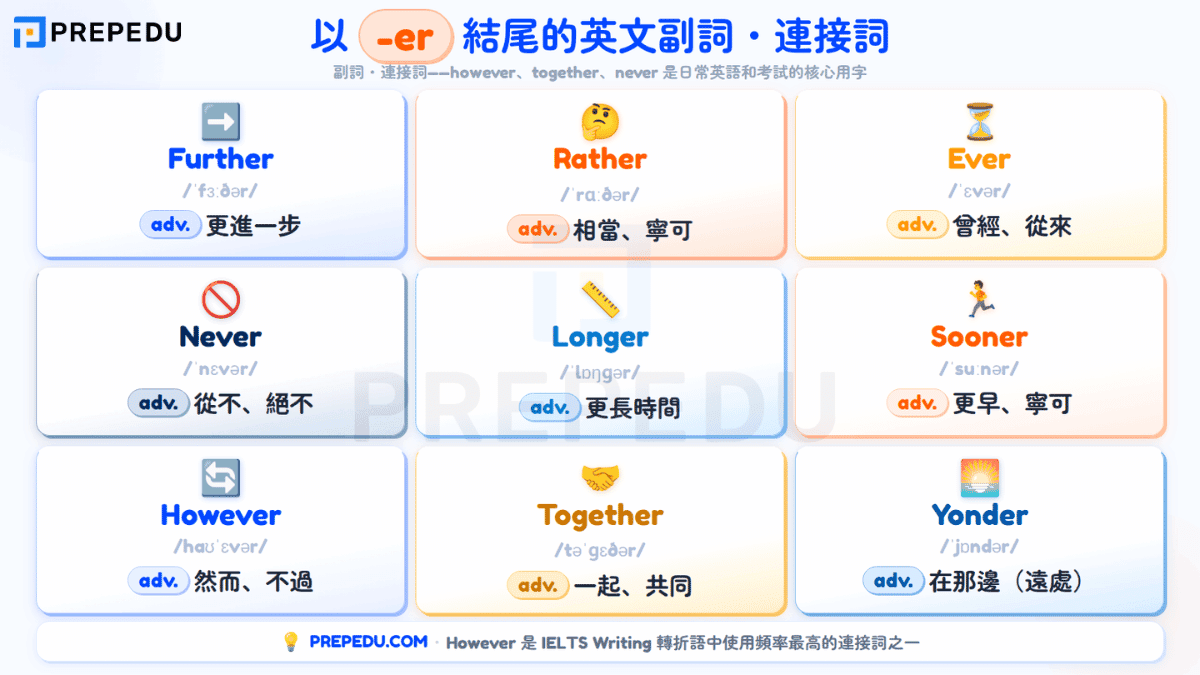
4. 英文副詞與其他詞類
英文副詞類的 er 結尾的單字相對較少,但它們在句子中扮演調節語氣與程度的關鍵角色。此外,部分詞彙屬於比較副詞,用於比較兩個動作或狀態的程度差異。這一類詞彙看似簡單,卻在寫作精準度上有舉足輕重的影響力。
|
er 結尾的單字 |
中文翻譯 |
例句 |
|
further /ˈfɜːrðər/ (adv./adj.) |
更遠;進一步 |
We need to further investigate the root cause.(我們需要進一步調查根本原因。) |
|
rather /ˈræðər/ (adv.) |
相當;寧願 |
I would rather study at home than go to a café.(我寧願在家學習,也不想去咖啡廳。) |
|
ever /ˈevər/ (adv.) |
曾經;在任何時候 |
Have you ever tried speaking English with a native speaker? (你曾經嘗試過和母語人士說英文嗎?) |
|
never /ˈnevər/ (adv.) |
從不;絕不 |
She has never missed a single class this semester.(這學期她從未缺席過一堂課。) |
|
longer /ˈlɔːŋər/ (adv./adj.) |
更長地;更久 |
You should spend longer on each practice question.(你應該在每道練習題上花更多時間。) |
|
sooner /ˈsuːnər/ (adv.) |
更早;寧願 |
The sooner you start, the more time you have to revise.(你越早開始,就有越多時間複習。) |
|
however /haʊˈevər/ (adv./conj.) |
然而;無論如何 |
The test was difficult; however, most students passed.(考試很難,然而大多數學生都通過了。) |
|
wherever /werˈevər/ (adv./conj.) |
無論何處 |
You can access the platform wherever you have internet.(只要有網路,你在任何地方都能使用這個平台。) |
|
whenever /wenˈevər/ (adv./conj.) |
無論何時 |
Review your vocabulary whenever you have a spare moment.(只要有空閒時間,就複習你的詞彙。) |
|
together /təˈɡeðər/ (adv.) |
一起;共同 |
We learn better when we study together.(一起學習時,我們的學習效果更好。) |
|
harder /ˈhɑːrdər/ (adv.) |
更用力地、更艱難地 |
You need to hit the ball harder.(你需要更用力地擊球。) |
|
yonder /ˈjɒndər/ (adv./adj.) |
在那邊 |
Look yonder at the hills.(看那邊的山丘。) |
|
hither /ˈhɪðər/ (adv.) |
到此地 |
Come hither, child.(孩子,過來這裡。) |
|
whither /ˈwɪðər/ (adv.) |
向何處 |
Whither are you going?(你要去哪裡?) |
|
either /ˈaɪðər/ (adv./conj.) |
也(用於否定句);要麼 |
You can choose either.(你可以任選其一。) |
|
neither /ˈnaɪðər/ (adv./conj.) |
也不;既不…也不… |
Neither option is good.(這兩個選項都不好。) |
|
over /ˈoʊvər/ (prep./adv.) |
在…之上;超過 |
The cat jumped over the fence.(貓跳過了柵欄。) |
|
under /ˈʌndər/ (prep./adv.) |
在…之下;不足 |
The keys are under the mat.(鑰匙在墊子下。) |
|
after /ˈæftər/ (prep./conj./adv.) |
在…之後 |
After the meeting, we went for lunch.(會議後我們去吃午餐。) |
學習這些 er 結尾的單字,關鍵不在於死記硬背,而在於在真實語境中反覆運用。建議你從每個詞類中挑選五個最陌生的詞彙,嘗試自己造句,並在日常英語練習中有意識地使用它們。
除了以 er 結尾的英文詞彙外,你還可以參考 PREPEDU 的「R 開頭的英文單字全攻略:快速強化詞彙量與應用力」文章,學習更多有關詞彙主題的實用知識!
II. 關於 er 結尾單字的練習題
為了幫助你檢驗與鞏固對本文所列 er 結尾詞彙的掌握程度,以下設計了三種題型:選擇題、填空題與詞類判斷題。各題型側重詞義辨認、句中應用和詞性分辨,完成後可對照「答案解析」深入理解每個選項背後的邏輯。祝你練習順利!
1. 練習題目
學過詞彙之後,最重要的一步是測試自己的掌握程度。以下三種題型,分別考核詞義辨認、句子填空與詞類判斷能力,幫助你全面鞏固本篇所學的 er 結尾單字。
題型一:選擇題 → 選出句子中空白處最適合的 er 結尾的字。
-
The company decided to __________ the funds to a new account. (A) discover (B) transfer (C) shiver (D) flutter
-
She is a very __________ student who always finds creative solutions. (A) tender (B) bitter (C) clever (D) sooner
-
I would __________ spend my weekend reading than watching TV. (A) however (B) never (C) rather (D) ever
-
Before hiring, we need to ______ each candidate carefully. (A) suffer (B) consider (C) shiver (D) enter
-
The experimental results ______ slightly from our hypothesis. (A) differ (B) hinder (C) scatter (D) answer
-
Please ______ the slides to everyone’s inbox after the meeting. (A) doodle (B) transfer (C) flutter (D) wander
-
It’s ______ to learn a language when you’re young. (A) harder (B) louder (C) easier (D) colder
-
They worked ______ to finish the project on time. (A) together (B) never (C) however (D) under
-
The new policy will ______ farmers to adopt sustainable practices. (A) empower (B) deter (C) mutter (D) shutter
-
The university plans to ______ several scholarships next year. (A) deliver (B) offer (C) wander (D) suffer
題型二:填空題 → 根據句意,將下列詞彙填入適當的空格中。(每個詞彙只能使用一次)
|
詞彙:whisper / gather / winner / recover / traveler / customer / printer / chapter / further / owner |
-
Please __________ in the main hall for the opening ceremony.
-
The doctor said it would take two weeks to __________ from the surgery.
-
Every __________ who completes the survey will receive a discount code.
-
Read __________ three before the next lecture.
-
We need __________ evidence before making a final conclusion.
-
The weary ______ finally checked into the mountain lodge at midnight.
-
After a tense finale, she was announced as the competition ______.
-
As the new ______ of the café, he plans to renovate the interior this summer.
-
Please don’t ______ during the ceremony; save your comments until afterward.
-
The report was ready, but the office ______ ran out of paper.
題型三:詞類判斷題 → 判斷下列各句中劃線詞彙的詞類(名詞 / 形容詞 / 動詞 / 副詞)。
-
The manager held a team meeting every Monday morning.
-
He spoke in a louder voice so the audience at the back could hear him.
-
They wander through the market looking for fresh ingredients.
-
She would never compromise on the quality of her work.
-
The thunder outside made it hard to concentrate on studying.
-
Every morning, students enter the campus at 8 o’clock.
-
The winner climbed onto the podium to receive the trophy.
-
The path gets narrower as you approach the summit.
-
He pressed the gas pedal harder to overtake the truck.
-
During the storm, they shelter under the old bridge.
2. 答案解析
核對答案的過程,是學習的延伸,不只是確認對錯,更要理解每個選項背後的邏輯。
|
題型一 |
題型二 |
題型三 |
|
|
|
結論
掌握 er 結尾的單字,並不是一次性的記憶任務,而是一個持續積累的過程。從本篇的名詞、形容詞、動詞到副詞,每一類詞彙都有其獨特的使用邏輯。建議你將這些 er 結尾單字整合進日常的英語學習計畫中,無論是備考 IELTS、TOEIC,還是提升職場英語表達能力,這些詞彙都將成為你語言工具箱中最實用的部分。語言學習的核心在於持續練習與真實應用,從現在開始,在每一個對話與寫作機會中,主動運用你所學到的詞彙。
對 IELTS 或 TOEIC 考試結構感到陌生?考試當天的不確定感會影響你的表現。PREPEDU 的 Test Practice 提供真實模擬環境,讓你在實戰前熟悉題型和時間限制。
系統收錄超過 1,000 道練習題,定期更新以反映最新考試趨勢。AI 引擎分析你的錯誤,針對弱點提供改進方案。進度追蹤系統將你的成長數據化,讓進步一目了然。
現在開始練習,在考試中展現實力。立即體驗 PREPEDU 的雅思真題和多益測驗試題。

你好!我叫黃秋賢,現在在 prepedu.com 擔任內容企劃。我有超過5年的英語與韓語自學經歷,親身備考 IELTS、TOEIC 與 TOPIK,累積了大量第一手的學習者視角——包括哪些語法規則最讓台灣與香港學習者混淆,以及如何在有限的備考時間內最有效地修正這些錯誤。目前已在 prepedu.com 撰寫超過 1000 篇英語學習文章,內容涵蓋語法、詞彙與考試策略,累積協助數千位學習者解決自學過程中的語法疑問。
評論












統一企業編號:202227322W
地址:114 LAVENDER STREET, #11-83 CT HUB 2, SINGAPORE (338729)