子句英文全書(Clauses)定義、種類、用法與三大子句詳解
什麼是子句英文?如何正確運用子句提升英文寫作能力?子句是包含「主詞+限定動詞」的語法單位,是構成複雜句型的核心要素。無論你正在準備IELTS、TOEIC等國際英語檢定,或是希望突破英文寫作瓶頸,掌握子句英文都是不可或缺的基本功。
想像一下,當你閱讀英文文章時,面對一個長達三行的複雜句子卻無法理解其結構;或是在寫作時,只能用簡單句表達想法,無法呈現邏輯層次。這些困擾的根源,往往就是對子句結構理解不足。從名詞子句、形容詞子句到副詞子句,這英文三大子句系統決定了你能否精準表達複雜概念。
本文由PREPEDU專業教學團隊撰寫,將系統性地解析子句定義、主要子句與從屬子句的區別、三大子句的完整用法,並提供30道實戰練習題。透過真實情境範例與詳細圖表說明,協助你徹底掌握英文子句文法,讓英文表達更加流暢精準。
I. 子句是什麼?與片語有何不同?
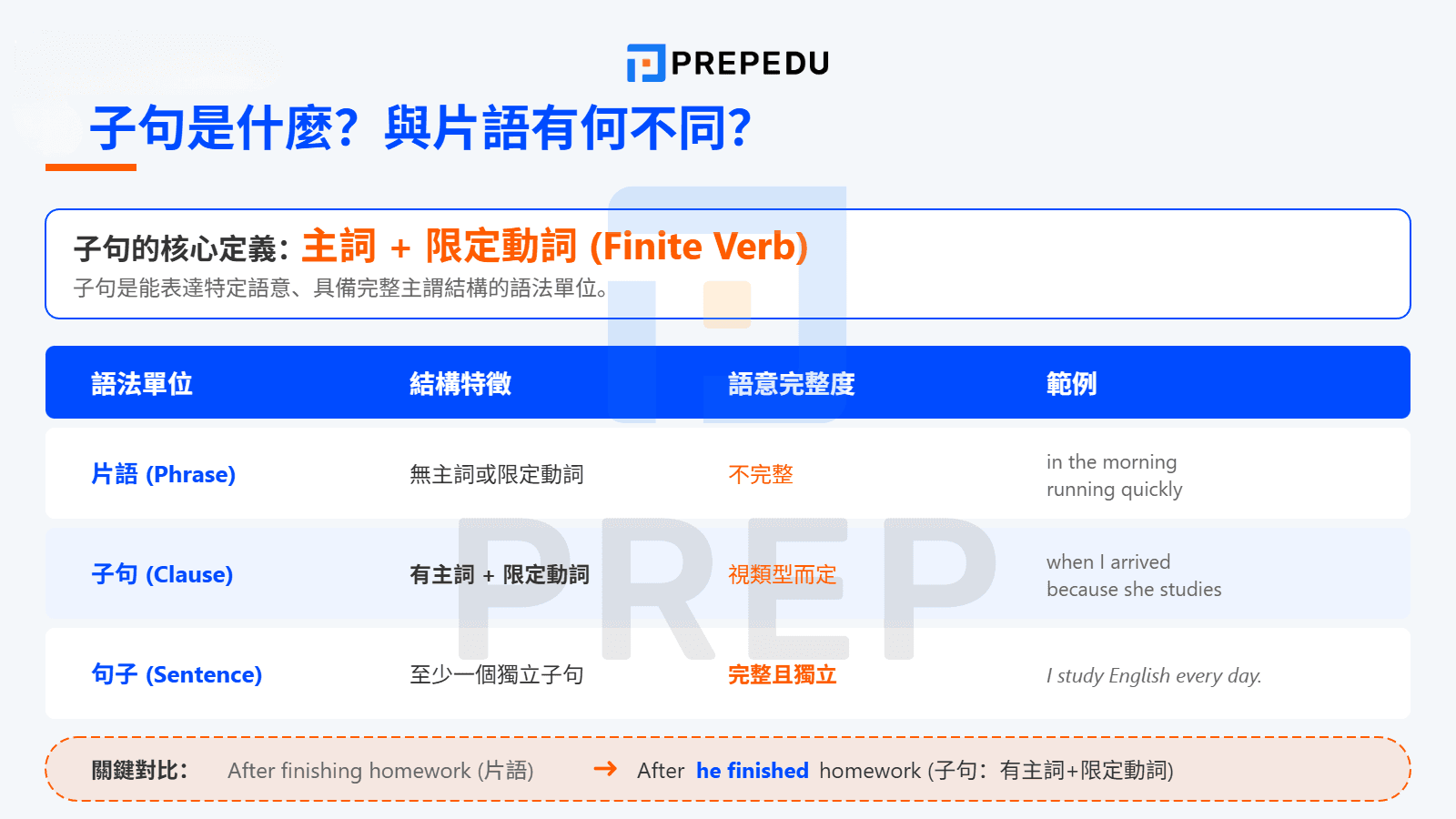
什麼是子句英文(Clauses)?子句英文是包含「主詞+限定動詞」的語法單位,能夠表達特定的語意內容。這個定義是理解英文子句的核心起點。相較於片語(Phrase)僅是詞組的組合,子句具備完整的主謂結構,這項特徵使子句在句子中扮演更複雜的功能角色。
1. 子句、片語、句子的核心差異
許多學習者在掌握子句英文時,容易混淆這三個概念。以下表格清楚呈現它們在結構與語意完整度上的關鍵差異:
|
語法單位 |
結構特徵 |
語意完整度 |
範例 |
|
片語(Phrase) |
無主詞或限定動詞 |
不完整 |
|
|
子句(Clause) |
有主詞+限定動詞 |
視類型而定 |
|
|
句子(Sentence) |
至少一個主要子句 |
完整且獨立 |
|
從表格可見,子句定義的核心在於「主詞+限定動詞」的存在。這項結構要素讓子句能夠承載時態與主語資訊,進而在句子中發揮多元功能。
2. 限定動詞在子句中的必要角色
限定動詞(Finite Verb)是理解子句英文時不可或缺的概念,因為它能夠顯示英文時態、人稱與數的變化。例如「walks」、「walked」、「is walking」都是限定動詞,而「to walk」、「walking」則屬於非限定動詞。只有當動詞呈現限定形式,整個結構才符合子句的標準。
這解釋了為何「Before leaving Taipei」僅是片語,而「Before Xiaowang left Taipei」卻是完整的副詞子句,差異就在於後者包含主詞「Xiaowang」與限定動詞「left」。同樣地,「After finishing homework」是片語,但「After he finished homework」則是子句,因為具備完整的主謂結構。
II. 兩大子句英文:主要子句與從屬子句
理解子句英文的兩大核心分類,即主要子句(Independent Clause)與從屬子句(Dependent Clause)的區別,是掌握英文子句架構的基礎。這兩類子句在語意獨立性與句法功能上有著本質差異,認識它們的特性將協助你建構更精確的英文句型。
1. 獨立子句英文(Independent Clause):主要子句的特性
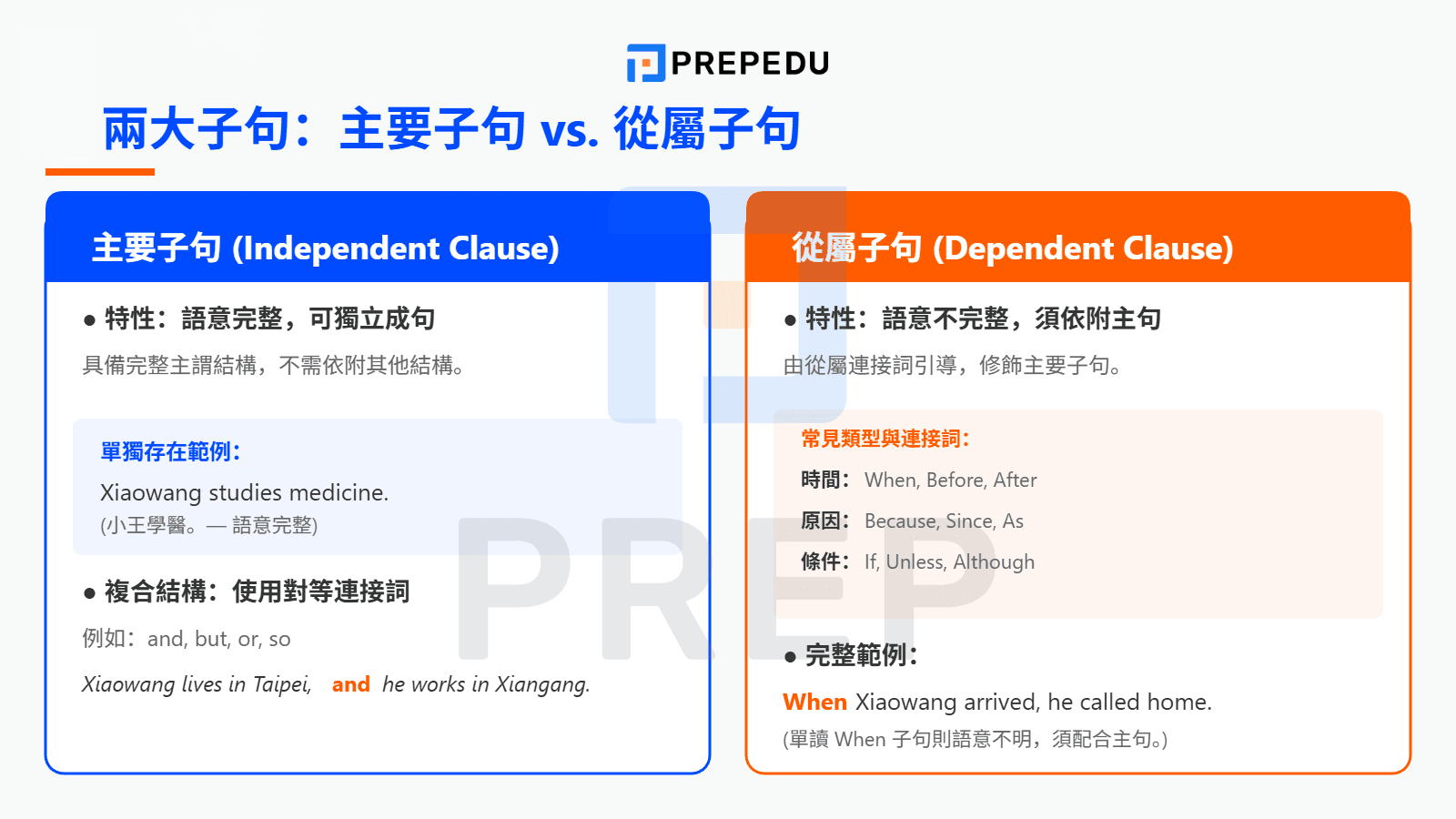
主要子句英文又稱為獨立子句,具備完整的語意表達能力,可以單獨存在成為一個完整句子。它包含主詞、限定動詞,並傳達完整的概念,不需依賴其他結構即可理解。
|
結構類型 |
公式 |
範例 |
|
簡單主要子句 |
主詞+動詞 |
|
|
複合主要子句 |
主詞+動詞+連接詞+主詞+動詞 |
|
主要子句是句子的核心骨幹,即使添加從屬子句進行修飾,主要子句仍然保有獨立表達完整語意的能力。當兩個主要子句結合時,必須使用對等連接詞(and,but,or,so,for,nor,yet)或適當標點符號(分號、句號),才能形成合乎文法的複合句。
2. 從屬子句英文(Dependent Clause):依附關係與連接詞
從屬子句英文雖然包含主詞與限定動詞,卻無法獨立存在,必須依附於主要子句才能構成完整語意。從屬連接詞(Subordinating Conjunction)將原本可能獨立的子句轉化為從屬結構。
|
從屬連接詞類型 |
常見連接詞 |
範例 |
|
時間連接詞 |
when,while,before,after,until,since |
|
|
原因連接詞 |
because,since,as |
|
|
條件連接詞 |
if,unless,provided that |
|
|
讓步連接詞 |
although,though,even though,while |
|
從屬子句在句子中扮演名詞、形容詞或副詞的角色,為主要子句提供額外資訊或修飾內容。理解這些從屬連接詞的功能,是精通子句英文的關鍵步驟。
III. 英文三大子句英文:名詞、形容詞、副詞子句詳解
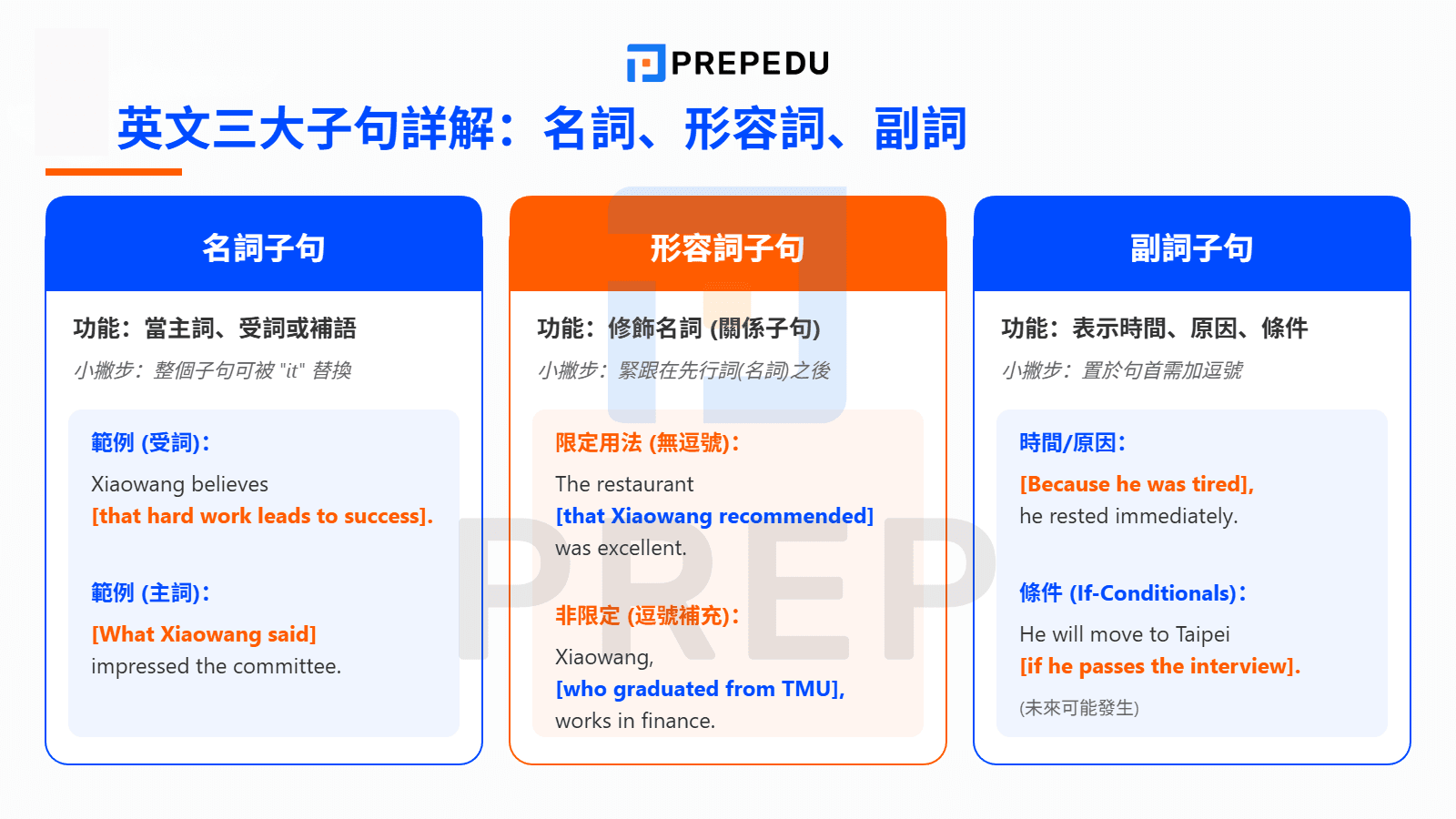
英文三大子句根據其在句中的功能分為名詞子句、形容詞子句與副詞子句。掌握這三類英文子句的特性與用法,是精通英文文法子句的關鍵。以下將針對每種子句類型進行深入解析,並提供實用例句協助理解子句英文的運用方式。
1. 名詞子句英文(Noun Clause):當主詞、受詞、補語
名詞子句英文在句中扮演名詞的角色,可作為主詞、受詞或補語使用。這是英文子句中最常見的類型之一,對於理解複雜句型至關重要。
|
名詞子句類型 |
引導詞 |
句中功能 |
範例 |
|
That子句 |
that |
主詞 |
|
|
That子句 |
that |
受詞 |
|
|
Wh-疑問子句 |
what,who,when,where,why,how |
主詞 |
|
|
Wh-疑問子句 |
what,who,when,where,why,how |
受詞 |
|
|
Whether/If子句 |
whether,if |
主詞 |
|
|
Whether/If子句 |
whether,if |
受詞 |
|
名詞子句英文的辨識技巧:嘗試將整個子句替換為代名詞「it」或「something」,若句子依然成立,該子句即為名詞子句。例如將「What Xiaowang said」替換為「It」,句子「It impressed the committee」仍然通順,確認這是名詞子句。
2. 形容詞子句英文(Adjective Clause):關係子句用法
形容詞子句英文又稱關係子句,用於修飾名詞或代名詞,通常由關係代名詞或關係副詞引導。這類英文子句緊接在所修飾的名詞之後,提供額外描述或限定資訊。
|
形容詞子句類型 |
關係詞 |
用法 |
範例 |
|
限定用法(無逗號) |
who,that |
修飾人 |
|
|
限定用法(無逗號) |
which,that |
修飾物 |
|
|
非限定用法(有逗號) |
who |
修飾人 |
|
|
非限定用法(有逗號) |
which |
修飾物 |
|
|
關係副詞 |
where |
修飾地點 |
|
|
關係副詞 |
when |
修飾時間 |
|
限定與非限定用法的差異:限定用法不使用逗號,提供必要資訊以確認所指對象;非限定用法使用逗號隔開,提供補充說明而非必要資訊。這是理解英文子句文法時的重要區別。
3. 副詞子句英文(Adverbial Clause):時間、原因、條件
副詞子句英文修飾動詞、形容詞或整個句子,說明時間、原因、條件、讓步、目的、結果、方式或地點等概念。這類英文三大子句之一通常由從屬連接詞引導,位置可在主要子句之前或之後。
|
副詞子句類型 |
連接詞 |
功能 |
範例 |
|
時間副詞子句 |
when,while,before,after,until |
表示時間 |
|
|
原因副詞子句 |
because,since,as |
表示原因 |
|
|
條件副詞子句 |
if,unless,provided that |
表示條件 |
|
|
讓步副詞子句 |
although,though,even though |
表示讓步 |
|
|
目的副詞子句 |
so that,in order that |
表示目的 |
|
|
結果副詞子句 |
so...that,such...that |
表示結果 |
|
|
方式副詞子句 |
as,as if,as though |
表示方式 |
|
|
地點副詞子句 |
where,wherever |
表示地點 |
|
副詞子句英文若置於句首則需用逗號隔開,若在句尾則通常不需逗號。掌握這些子句英文的使用規則,能讓你的寫作更加精確流暢。
4. 條件子句英文(Conditional Clause)
條件子句英文是副詞子句的一種特殊類型,值得獨立說明,因其在假設語氣中扮演重要角色。英文條件句分為四種主要類型,各自對應不同的真實程度與時間框架,這是理解英文子句文法時的進階概念。
|
條件句類型 |
結構 |
使用情境 |
範例 |
|
零條件句(真理/習慣) |
If+現在式,現在式 |
普遍真理、科學事實 |
|
|
第一類(未來可能) |
If+現在式,will+原形動詞 |
未來可能發生的事 |
|
|
第二類(現在不太可能) |
If+過去式,would+原形動詞 |
現在不太可能或與事實相反 |
|
|
第三類(過去不可能) |
If+過去完成式,would have+過去分詞 |
過去與事實相反 |
|
這些條件子句的類型展現了子句英文在表達不同假設情境時的靈活性與精確性。
IV. 子句英文結合規律:標點符號與連接詞使用規範
正確運用標點符號與連接詞結合子句英文,是避免常見文法錯誤的關鍵。許多學習者在撰寫英文子句時容易產生逗號誤接(Comma Splice)或不當省略連接詞等問題,理解以下規範將協助你建構合乎文法的複雜句型。
|
規則類型 |
情況說明 |
正確範例 |
錯誤範例 |
|
主要子句結合 |
兩個主要子句需要對等連接詞+逗號或分號 |
Xiaowang loves Taipei,and he plans to settle there permanently.(小王熱愛台北,並且他計劃永久定居那裡。) |
Xiaowang loves Taipei,he plans to settle there permanently. |
|
從屬子句在前 |
從屬子句置於主要子句之前時需用逗號隔開 |
When the conference ended in Xiangang,all participants received certificates.(當香港的會議結束時,所有參與者都收到了證書。) |
When the conference ended in Xiangang all participants received certificates. |
|
從屬子句在後 |
從屬子句在主要子句之後通常不需逗號 |
Xiaowang will relocate when he receives the offer from Xiangang.(小王收到香港的聘書時會搬遷。) |
Xiaowang will relocate,when he receives the offer from Xiangang. |
|
限定關係子句 |
限定用法不使用逗號,因提供必要識別資訊 |
The professor who teaches at Taipei University is renowned.(在台北大學任教的教授很有名。) |
The professor,who teaches at Taipei University,is renowned. |
|
非限定關係子句 |
非限定用法需用逗號隔開,因僅提供補充說明 |
Xiaowang,who graduated from Taipei University,works in technology.(小王畢業於台北大學,從事科技業。) |
Xiaowang who graduated from Taipei University works in technology. |
|
避免片段句 |
從屬子句不能單獨存在,必須搭配主要子句 |
Because Xiaowang was tired,he went to bed early.(因為小王疲累,他早早就寢。) |
Because Xiaowang was tired. |
|
避免連接詞重複 |
同一對子句不使用多個連接詞 |
Although it was raining in Taipei,we still went out.(儘管台北在下雨,我們還是出門了。) |
Although it was raining in Taipei,but we still went out. |
這些子句英文的標點符號與連接詞規則,是確保寫作正確性與可讀性的基本要求。熟練掌握這些規範,能有效提升你的英文三大子句運用能力。
V. 實戰演練:英文子句文法練習題
透過實際練習能夠鞏固你對子句英文的理解。以下提供三組練習題,涵蓋子句種類辨識、引導詞選用與句子結構重組,每組十題並附詳解,協助你檢視學習成效並找出需要加強的部分。
1. 練習一:子句英文種類辨識
請判斷以下句子中畫線部分屬於名詞子句、形容詞子句或副詞子句:
-
Xiaowang believes that Taipei offers excellent career opportunities.
-
The restaurant where we met in Xiangang serves authentic dim sum.
-
When he arrived at the office,everyone was already in the meeting.
-
She doesn't know how long the flight from Taipei to Xiangang takes.
-
This is the reason why Xiaowang decided to study abroad.
-
Although living costs in Xiangang are high,many people choose to work there.
-
The fact that she graduated with honors impressed the hiring committee.
-
I will help you if you need assistance with the Taipei project.
-
The colleague who transferred to Xiangang last month speaks three languages.
-
What Xiaowang accomplished in his first year exceeded all expectations.
參考答案:
-
名詞子句(作believe的受詞)
-
形容詞子句(修飾restaurant)
-
副詞子句(時間)
-
名詞子句(作know的受詞)
-
形容詞子句(修飾reason)
-
副詞子句(讓步)
-
名詞子句(與fact同位)
-
副詞子句(條件)
-
形容詞子句(修飾colleague)
-
名詞子句(作主詞)
2. 練習二:引導詞與關係詞填空
請選擇適當的引導詞或關係詞填入空格:
-
The manager _____ works in the Taipei office won an innovation award.(who/which/where)
-
Xiaowang doesn't remember _____ he parked his car in Xiangang.(what/where/which)
-
_____ the presentation was excellent,the client requested several revisions.(Because/Although/If)
-
This is the conference center in Taipei _____ the annual summit takes place.(which/where/when)
-
She asked _____ Xiaowang could attend the meeting in Xiangang next week.(that/if/what)
-
The strategy _____ the team developed in Taipei was highly successful.(who/that/where)
-
_____ you complete the training program,you will receive certification.(If/Because/Although)
-
Everyone knows _____ Xiangang has become a major financial hub.(that/what/where)
-
2019 was the year _____ Xiaowang first visited Taipei.(which/when/where)
-
He studies diligently _____ he can achieve his career goals.(because/so that/although)
參考答案:
-
who
-
where
-
Although
-
where
-
if/whether
-
that/which
-
If
-
that
-
when
-
so that
3. 練習三:子句英文合併與結構糾錯
請將以下兩個簡單句合併為含從屬子句的複合句,或糾正錯誤句子:
-
Xiaowang was exhausted from the business trip. He still attended the evening meeting.
-
The restaurant is located in central Taipei. We celebrated there last weekend.(使用關係子句)
-
[糾錯] Although Xiangang is crowded,but it has efficient public transportation.
-
I don't know. When will the project in Taipei be completed?(合併為名詞子句)
-
The manager praised Xiaowang. Xiaowang submitted the quarterly report ahead of schedule.(使用關係子句)
-
[糾錯] Because the typhoon warning was issued for Taipei.
-
You should prepare thoroughly. You want to succeed in the Xiangang interview.(使用條件句)
-
[糾錯] The colleague,that sits next to Xiaowang,graduated from the same university.
-
Xiaowang arrived at the Taipei office. The morning briefing had already started.(使用時間副詞子句)
-
She speaks four languages fluently. This skill is valuable in Xiangang's international environment.(使用名詞子句或關係子句)
參考答案:
-
Although Xiaowang was exhausted from the business trip,he still attended the evening meeting. / Xiaowang still attended the evening meeting although he was exhausted from the business trip.
-
The restaurant where we celebrated last weekend is located in central Taipei. / The restaurant which/that is located in central Taipei is where we celebrated last weekend.
-
Although Xiangang is crowded,it has efficient public transportation. / Xiangang is crowded,but it has efficient public transportation.
-
I don't know when the project in Taipei will be completed.
-
The manager praised Xiaowang,who submitted the quarterly report ahead of schedule.
-
Because the typhoon warning was issued for Taipei,all schools were closed. / The typhoon warning was issued for Taipei.
-
If you want to succeed in the Xiangang interview,you should prepare thoroughly.
-
The colleague who sits next to Xiaowang graduated from the same university.(限定用法不用逗號和that)/ The colleague,who sits next to Xiaowang,graduated from the same university.(非限定用法用who不用that)
-
When Xiaowang arrived at the Taipei office,the morning briefing had already started. / The morning briefing had already started when Xiaowang arrived at the Taipei office.
-
That she speaks four languages fluently is valuable in Xiangang's international environment. / The fact that she speaks four languages fluently is valuable in Xiangang's international environment. / She speaks four languages fluently,which is valuable in Xiangang's international environment.
VI. 常見問題解答(FAQs)
學習子句英文過程中,許多學習者會遇到相似的疑惑。以下整理三個常見問題並提供清晰解答,協助你釐清容易混淆的概念並建立更穩固的文法基礎。
1. 一個完整的英文句子可以沒有主要子句嗎?
不可以。完整的子句英文必須至少包含一個主要子句,因為主要子句是句子能夠獨立表達完整語意的核心結構。從屬子句雖然包含主詞與動詞,但由於其語意依賴性,無法單獨構成句子。
例如「Because Xiaowang was late for the Taipei meeting」僅是從屬子句,必須搭配主要子句如「he apologized to everyone」才能形成完整句子:「Because Xiaowang was late for the Taipei meeting,he apologized to everyone.」(因為小王台北的會議遲到了,他向每個人道歉。)若只寫從屬子句而無主要子句,就會形成片段句(Sentence Fragment),這是英文子句文法上的嚴重錯誤。
2. 關係子句跟形容詞子句是一樣的東西嗎?
是的,關係子句英文(Relative Clause)與形容詞子句(Adjective Clause)在文法學術界指稱相同的語法結構。這兩個名稱的使用因地區與教學傳統而有所不同:
-
「關係子句」強調其由關係代名詞或關係副詞引導的特性。
-
「形容詞子句」則著重其在句中扮演修飾名詞的功能角色。
無論使用哪個名稱,其本質都是透過關係詞引導並修飾先行詞的子句結構,提供額外描述或限定資訊。例如「The office where Xiaowang works in Xiangang is near the harbor」(小王在香港工作的辦公室靠近海港)中,「where Xiaowang works in Xiangang」既可稱為關係子句,也可稱為形容詞子句。港台教材兩種說法皆常見,理解它們為同義概念即可,這對掌握子句英文並無影響。
3. That在名詞子句與形容詞子句中有何區別?
「That」在兩類子句英文中的功能與角色截然不同,這是理解英文三大子句時的重要區別。
-
在名詞子句中,「that」是從屬連接詞(Subordinating Conjunction),本身不充當句子成分,僅引導子句。例如:「Xiaowang knows that the Taipei office will expand next year.」(小王知道台北辦公室明年會擴張。)此處「that」可省略而不影響句意,因為它只是引導詞。
-
在形容詞子句中,「that」是關係代名詞(Relative Pronoun),必須在子句內擔任主詞或受詞角色。例如:「The proposal that Xiaowang submitted to the Xiangang headquarters was approved.」(小王提交給香港總部的提案獲得批准。)此處「that」代替「proposal」並在子句中作「submitted」的受詞。
判斷技巧:若「that」後方的子句結構完整(有主詞與動詞),則為名詞子句;若「that」後方缺少主詞或受詞,則為形容詞子句,因為「that」本身就扮演該角色。這項區別對於精通英文子句文法至關重要。
結論
掌握子句英文需要系統性學習與持續練習。從理解子句定義開始,逐步建立主要子句與從屬子句的概念,進而熟悉英文三大子句的功能與用法,最後透過實戰練習鞏固所學。記住,每個複雜的英文句子都是由簡單的子句組合而成,當你能夠辨識並正確使用各類子句時,你的英文閱讀理解與寫作表達能力都將顯著提升。
持續運用本文提供的概念與技巧,你將能自信地處理任何英文子句文法挑戰,在英文學習路上穩健前進。無論是準備IELTS、TOEIC等國際英語檢定,或是提升日常溝通能力,精通子句英文都將成為你最有力的語言工具。
您是否曾懷疑自己能否達到目標分數?PREPEDU.COM 的 Test Practice 不僅協助您練習考題,更能根據目前成績精準預測達分可能性。
憑藉數千名成功學員的資料庫,系統分析分數趨勢並提供符合各項具體目標的個人化學習路徑。無論您的目標是雅思 6.5 分或多益 850 分,每個目標都有專屬策略。
視覺化進度追蹤功能顯示您目前的位置,以及達成目標還需多長時間。許多學員在持續練習 4-6 週後,雅思成績提升 0.5-1.0 分,多益成績增加 100-200 分。
成功並非來自運氣,而是源於周全的準備。讓 PREP Test Practice 成為連結現在與夢想的橋樑!

你好!我叫黃秋賢,現在在 prepedu.com 擔任內容企劃。我有超過5年的英語與韓語自學經歷,親身備考 IELTS、TOEIC 與 TOPIK,累積了大量第一手的學習者視角——包括哪些語法規則最讓台灣與香港學習者混淆,以及如何在有限的備考時間內最有效地修正這些錯誤。目前已在 prepedu.com 撰寫超過 1000 篇英語學習文章,內容涵蓋語法、詞彙與考試策略,累積協助數千位學習者解決自學過程中的語法疑問。
評論












統一企業編號:202227322W
地址:114 LAVENDER STREET, #11-83 CT HUB 2, SINGAPORE (338729)