現在分詞英文(Present Participle)用法全攻略:定義 V-ing,句型與比較
什麼是現在分詞?如何正確使用現在分詞英文? 現在分詞是動詞加上 -ing 字尾的形式,用於表達主動或進行中的動作狀態。它在英文句子中扮演三大核心角色:構成進行式時態(如 I am studying),作為形容詞修飾名詞(如 a running dog),以及形成分詞構句簡化句子結構。掌握現在分詞英文的正確用法,是從基礎英文進階到流利表達的關鍵轉折點。
許多台灣和香港的英文學習者在使用現在分詞時經常遇到三大困惑:不知道何時該用 -ing 而非 -ed,無法區分現在分詞與動名詞的差異,以及在分詞構句中出現主詞不一致的錯誤。這些問題不僅影響考試成績,更會在商務溝通和學術寫作中造成理解障礙。PREPEDU 教學團隊根據多年英文教學經驗,整理出最完整的現在分詞使用指南。
本文將帶您深入了解現在分詞的拼寫規則,三大核心功能,特殊動詞搭配句型,並透過 150 個以上台北與香港真實情境範例,14 個實用對比表格,以及 30 題實戰練習題,幫助您徹底精通現在分詞英文,在 TOEIC,IELTS 等英文檢定考試中展現專業實力。

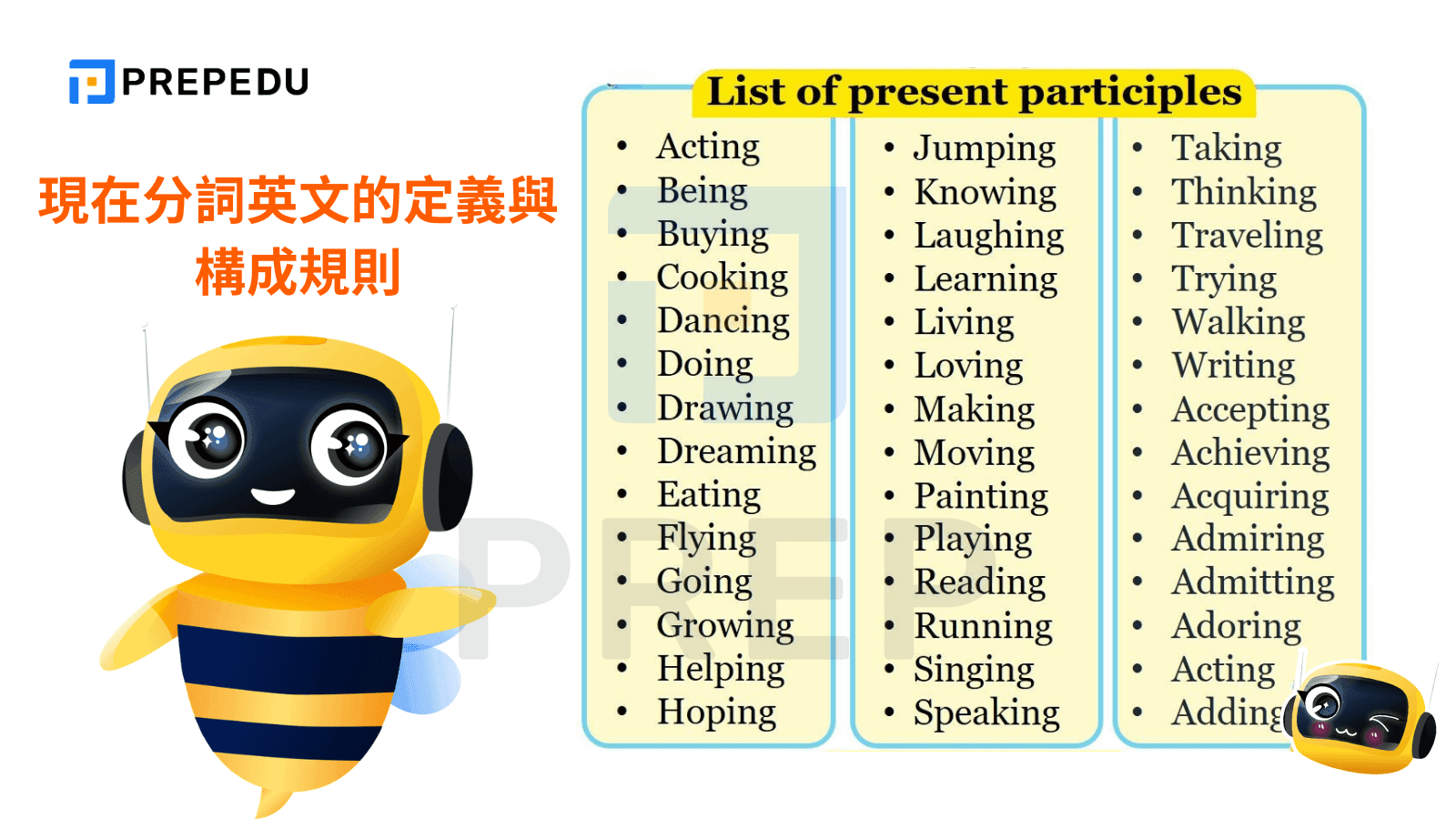
I. 現在分詞英文的定義與構成規則
現在分詞是動詞英文的一種變化形式,通過在動詞原形後加上 -ing 字尾形成,用於表達「主動」或「進行中」的動作狀態。當您看到 walking(走路),reading(閱讀),swimming(游泳)這類詞彙時,它們就是動詞的現在分詞形式。現在分詞英文在句子中扮演多重角色,可以構成進行式時態,作為形容詞英文修飾名詞英文,或組成分詞構句來簡化複雜句型。
理解現在分詞的構成規則是正確使用的第一步,這些規則看似簡單卻包含許多細節變化。掌握現在分詞的拼寫規則能幫助您避免常見錯誤,特別是在書寫測驗或正式場合中展現專業的英文能力。以下是現在分詞英文的完整拼寫規則總表:
|
拼寫規則類型 |
規則說明 |
原形動詞範例 |
現在分詞形式 |
注意事項 |
|
一般情況 |
直接在動詞原形後加 -ing |
|
|
大部分規則動詞與不規則動詞皆適用此規則 |
|
去 e 加 ing |
動詞字尾為不發音的 e,去掉 e 再加 -ing |
|
|
字尾 -ee 的動詞不適用,如 see → seeing |
|
重複字尾加 |
單音節動詞,結尾為「子音-母音-子音」結構時,重複最後一個子音再加 -ing |
|
|
雙音節動詞若重音在最後音節也適用,如 begin,admit |
|
不重複字尾的情況 |
雙音節或多音節動詞,重音不在最後音節時,不重複字尾直接加 -ing |
|
|
重音位置是判斷關鍵,如 visit 重音在第一音節 |
|
ie 變 y 加 ing |
動詞字尾為 ie 時,將 ie 改為 y 再加 -ing |
|
|
這是特殊變化,需要特別記憶 |
|
c 結尾變 ck |
動詞字尾為 c 時,加 k 再加 -ing 保持發音 |
|
|
加 k 是為了維持 /k/ 音,否則會變成 /s/ 音 |
II. 現在分詞英文的核心功能與應用
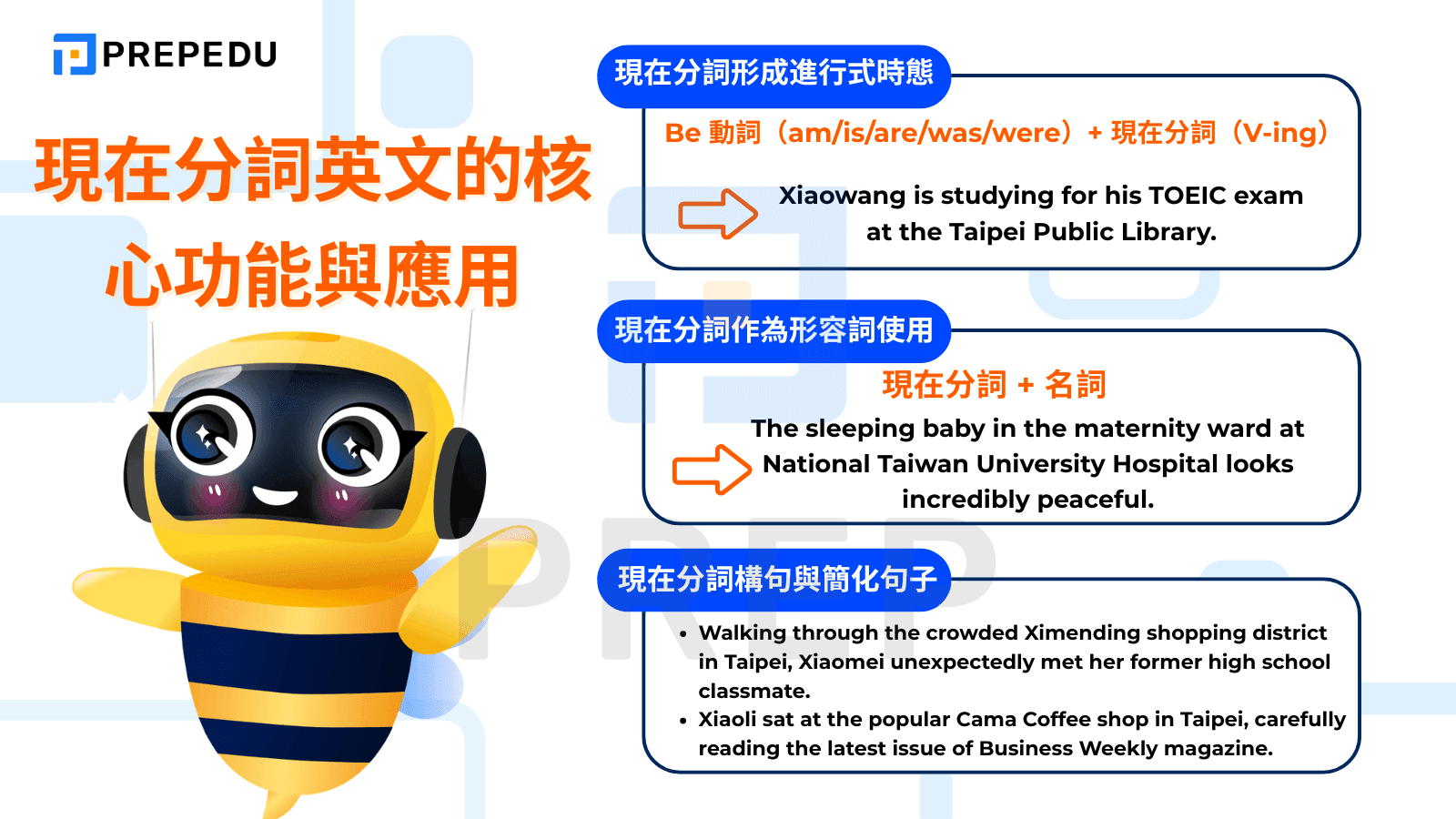
理解現在分詞英文的應用時機,關鍵在於掌握它的核心功能。現在分詞在英文句子中有三大主要用途,每個功能都有其獨特的語法結構和使用邏輯。學習者需要分別理解並在實際應用中靈活運用,當您能清楚辨識現在分詞在句子中扮演的角色,就能避免混淆並正確判斷句子結構。
1. 現在分詞英文形成進行式時態
現在分詞最基本也最重要的功能是與 be 動詞結合,形成進行式時態來表達正在進行的動作或狀態。進行式時態的標準公式為:
Be 動詞(am/is/are/was/were)+ 現在分詞(V-ing)
這個結構能夠清楚表達動作在特定時間點正在發生或持續進行。現在分詞英文在此功能中是構成進行式不可或缺的元素,缺少任何一個部分都無法形成完整的進行式結構。
進行式時態涵蓋多種時間層次,從現在進行式到過去進行式,甚至包括完成進行式。每種英文時態都使用相同的現在分詞形式,只是 be 動詞會隨著時態改變而變化。需要特別注意的是,單獨出現的 V-ing 形式並不構成進行式時態,必須有 be 動詞或助動詞英文才能形成完整的進行式結構。
|
時態類型 |
句型結構 |
範例 |
|
現在進行式(Present Continuous) |
am/ is/ are + V-ing |
|
|
過去進行式(Past Continuous) |
was/ were + V-ing |
|
|
現在完成進行式(Present Perfect Continuous) |
has/ have + been + V-ing |
|
|
過去完成進行式(Past Perfect Continuous) |
had + been + V-ing |
|
|
未來進行式(Future Continuous) |
will + be + V-ing |
|
2. 現在分詞英文作為形容詞使用
現在分詞可以轉變為形容詞,用來修飾名詞並描述該名詞的特性或狀態,這個功能讓句子表達更加生動具體。作為形容詞的現在分詞英文有兩種主要位置安排方式:前位修飾與後位修飾,選擇哪種方式取決於修飾內容的複雜程度。使用現在分詞作為形容詞的邏輯基礎在於「主動執行」,被修飾的名詞是主動進行該動作的執行者,這個概念能幫助您正確選擇使用現在分詞還是過去分詞。
前位修飾適用於單一分詞修飾名詞的情況,將現在分詞直接放在名詞前面,形成簡潔有力的描述。後位修飾則用於現在分詞片語修飾名詞的情況,將整個分詞片語放在名詞後面以提供更詳細的資訊。這種結構能夠承載更多描述細節,讓讀者或聽者更清楚理解所指的對象。
|
修飾方式 |
句型結構 |
範例 |
|
前位修飾 |
現在分詞 + 名詞 |
|
|
前位修飾 |
現在分詞 + 名詞 |
|
|
後位修飾 |
名詞 + 現在分詞片語 |
|
|
後位修飾 |
名詞 + 現在分詞片語 |
|
3. 現在分詞英文構句與簡化句子
分詞構句是現在分詞英文的高階應用,用於簡化複雜句子並使表達更加精練流暢。這個進階語法結構能將兩個子句合併成一個句子,減少重複並提升寫作的專業度,特別常見於正式寫作,學術文章和新聞報導中。分詞構句的形成過程需要遵循特定的轉換邏輯:首先確認兩個子句的主詞必須一致,接著省略從屬子句的主詞與 be 動詞如果有的話,最後保留現在分詞形式來表達附屬動作或狀況。
分詞構句可以表達多種邏輯關係,理解這些關係能幫助您正確詮釋和使用分詞英文。使用分詞構句時最關鍵的規則是主詞一致性,如果兩個子句的主詞不同,就不能使用分詞構句,否則會造成懸垂分詞的錯誤。掌握分詞構句能讓您的英文表達更加成熟專業,這是進階學習者必須精通的重要技巧。
|
邏輯關係類型 |
等同連接詞 |
範例(現在分詞英文構句) |
範例(完整句子) |
|
時間關係 |
when / while / as |
Walking through the crowded Ximending shopping district in Taipei,Xiaomei unexpectedly met her former high school classmate.(走過台北擁擠的西門町購物區時,小美意外地遇到了她以前的高中同學。) |
When Xiaomei was walking through the crowded Ximending shopping district in Taipei,she unexpectedly met her former high school classmate. |
|
原因關係 |
because / since / as |
Feeling extremely tired after the three-hour client meeting at the Taipei World Trade Center,the sales manager decided to take a taxi home instead of riding the MRT.(在台北世界貿易中心與客戶開完三小時的會議後感到非常疲倦,業務經理決定搭計程車回家而不是搭捷運。) |
Because the sales manager felt extremely tired after the three-hour client meeting at the Taipei World Trade Center,he decided to take a taxi home instead of riding the MRT. |
|
附帶動作 |
and 同時發生 |
Xiaoli sat at the popular Cama Coffee shop in Taipei,carefully reading the latest issue of Business Weekly magazine.(小李坐在台北很受歡迎的 Cama Coffee 咖啡廳,仔細閱讀最新一期的商業週刊雜誌。) |
Xiaoli sat at the popular Cama Coffee shop in Taipei and carefully read the latest issue of Business Weekly magazine. |
|
條件關係 |
if |
Working diligently on this important project for the next three months,you will almost certainly receive a promotion at the Taipei headquarters.(在接下來三個月勤奮地進行這個重要專案,你幾乎肯定會在台北總部獲得升遷。) |
If you work diligently on this important project for the next three months,you will almost certainly receive a promotion at the Taipei headquarters. |
III. 現在分詞英文的特殊動詞句型搭配
某些動詞在與現在分詞英文搭配使用時,會形成特定的固定句型,這些句型在日常溝通和正式寫作中都極為常見。這些句型涵蓋感官動詞,移動與位置動詞,以及時間花費等常用表達方式,每種類型都有其獨特的語意重點和使用情境。
1. 感官動詞搭配
感官動詞搭配使用公式為:
感官動詞 + 受詞 + 現在分詞(V-ing)
這個結構強調動作正在進行或過程的持續性。常見的感官動詞包括 see(看見),hear(聽見),watch(觀看),notice(注意到),observe(觀察),feel(感覺等)。這個句型經常用來測試學習者對動作進行狀態的理解,是現在分詞英文的重要應用之一。
|
感官動詞類型 |
句型公式 |
範例現在分詞英文 |
|
see / watch |
動詞 + O + V-ing |
|
|
hear / listen to |
動詞 + O + V-ing |
|
|
notice / observe |
動詞 + O + V-ing |
|
|
feel / smell |
動詞 + O + V-ing |
|
這些例句展現了感官動詞與現在分詞英文搭配時強調動作進行過程的特點,與使用原形動詞強調完整動作形成對比。
2. 移動與位置動詞搭配
現在分詞英文在移動與位置動詞搭配中形成許多日常生活中的慣用表達。
Go + V-ing 是描述從事戶外活動或休閒運動的標準句型。
Sit/Stand/Lie + V-ing 則描述在特定姿勢下進行某個動作。
範例:
-
Every Sunday morning without fail, Xiaowang goes jogging along the scenic Tamsui River waterfront trail in northern Taipei for about an hour.(每個星期天早上無一例外,小王都會沿著台北北部風景優美的淡水河濱步道慢跑大約一小時。)
-
Xiaomei contentedly sat reading her favorite detective novel at the cozy Eslite Bookstore in the basement of Taipei 101 for almost three hours.(小美滿足地坐在台北 101 地下室舒適的誠品書店閱讀她最喜歡的偵探小說,時間長達近三小時。)
-
The professional security guard stood patiently watching the incredibly busy crowd rushing through the Hong Kong MTR Central Station during the intense morning rush hour.(專業的保全人員在激烈的早晨尖峰時段耐心地站著觀看在香港地鐵中環站匆忙穿梭的非常繁忙的人群。)
3. 時間與金錢花費動詞搭配(Spend/Waste + Time/Money + V-ing)
現在分詞英文在花費時間與金錢的動詞搭配中也是重要的固定句型。
Spend + 時間/金錢 + V-ing 表達在某活動上花費時間或金錢。
Waste + 時間/金錢 + V-ing 表達浪費時間或金錢在某事上。
Catch/Find + 受詞 + V-ing 表達發現某人正在做某事。
範例:
-
Xiaoli realistically spends at least two full hours every single weekday morning commuting from his affordable apartment in New Taipei City to his demanding office job in downtown Taipei.(小李實際上每個工作日早晨都會花至少兩個小時從他在新北市的經濟實惠公寓通勤到他在台北市中心要求嚴格的辦公室工作。)
-
Don't foolishly waste your precious study time mindlessly scrolling through various social media platforms when you should be seriously preparing for the challenging TOEIC exam next month.(當你應該認真準備下個月具有挑戰性的多益考試時,不要愚蠢地浪費你寶貴的學習時間漫無目的地滑動各種社交媒體平台。)
-
The strict department manager unexpectedly caught Xiaowang sleeping deeply at his messy desk during regular office hours at the professional Taipei headquarters building.(嚴格的部門經理在台北專業總部大樓的正常上班時間意外抓到小王在他凌亂的辦公桌前熟睡。)
-
I surprisingly found my dedicated colleague still working intensely late into the night at the quiet Hong Kong office in order to meet the extremely tight project deadline.(我驚訝地發現我敬業的同事仍在寧靜的香港辦公室工作到深夜,以趕上極其緊迫的專案截止日期。)

IV. 現在分詞英文 vs. 動名詞英文:功能與辨識
現在分詞英文與動名詞是學習分詞英文時最容易混淆的兩個概念,因為它們的外型完全相同都是 V-ing 形式,但在句子中的功能和角色卻截然不同。正確區分這兩者不僅是文法測驗的重點,更是理解句子結構和準確表達的關鍵能力。
現在分詞英文的核心功能是作為形容詞,用來修飾名詞或代名詞英文,描述該名詞的特性,狀態或正在進行的動作。動名詞的核心功能則是作為名詞,可以擔任主詞,受詞或補語,代表一個動作,活動或概念本身。
|
比較項目 |
現在分詞(Present Participle) |
動名詞(Gerund) |
|
詞性功能 |
形容詞 - 修飾名詞或代名詞 |
名詞 - 擔任主詞,受詞,補語 |
|
語意焦點 |
強調動作的「進行狀態」或「主動特性」 |
強調動作或活動「本身」作為一個概念 |
|
句中位置 |
|
|
|
範例 |
The enthusiastically dancing girl performing on the main stage at Taipei Arena is actually Xiaomei's talented younger sister.(在台北小巨蛋主舞台上表演的熱情跳舞女孩實際上是小美才華洋溢的妹妹。)→ dancing 修飾 girl,是形容詞 |
Dancing has always been Xiaomei's absolute favorite hobby since childhood,and she regularly practices at the professional Taipei Dance Center every single week.(跳舞從小就一直是小美最喜歡的嗜好,她每週都會定期在專業的台北舞蹈中心練習。)→ Dancing 是主詞,是名詞 |
|
範例 |
The incredibly exciting news about the company's major expansion into the competitive Hong Kong market spread like wildfire throughout the entire office within minutes.(關於公司大舉擴展到競爭激烈的香港市場的極其令人興奮的消息在幾分鐘內像野火一樣在整個辦公室傳開。)→ exciting 修飾 news,是形容詞 |
Mr. Chen genuinely enjoys traveling to many different countries around the world,and he visits the fascinating city of Hong Kong at least twice every year for both business and pleasure.(陳先生真心喜歡去世界各地許多不同的國家旅行,他每年至少去迷人的香港市兩次,既為公事也為休閒。)→ traveling 是 enjoys 的受詞,是名詞 |
|
判斷關鍵 |
問:「這個 V-ing 在描述名詞的什麼狀態或特性嗎?」如果答案是「是」→ 現在分詞 |
問:「這個 V-ing 能被替換成其他名詞嗎?」如果答案是「是」→ 動名詞 |
V. 現在分詞英文(-ing)vs. 過去分詞(-ed):主動被動的語意對比
現在分詞英文與過去分詞的區別是理解現在分詞英文的另一個關鍵面向,這兩種分詞形式雖然都能作為形容詞使用,但它們表達的語意方向完全相反。
-
現在分詞英文(-ing)表達「主動」或「令人產生某種感受」的特性,描述某事物具有讓他人產生某種感覺或反應的能力。當我們說某事物是 interesting,exciting,boring 時,表示這個事物本身具有引起興趣,興奮或無聊的特質,它是動作的發出者。
-
過去分詞(-ed)則表達「被動」或「感受到某種狀態」,描述某人或某物接收到外界刺激後產生的感受或狀態。當我們說某人是 interested,excited,bored 時,表示這個人接收到外界事物的影響而產生了興趣,興奮或無聊的感覺,是動作的接受者。
|
比較項目 |
現在分詞英文(-ing) |
過去分詞(-ed) |
|
語意方向 |
主動 - 令人... / 使人...(Causing) |
被動 - 感到... / 被...(Experiencing) |
|
修飾對象 |
通常修飾「事物」(things)- 描述事物的特性 |
通常修飾「人」(people)- 描述人的感受 |
|
邏輯關係 |
主體「散發」某種特質 → 影響他人 |
主體「接收」外界刺激 → 產生感受 |
情緒形容詞配對完整列表:
|
現在分詞(-ing) 主動/令人 |
範例 |
過去分詞(-ed) 被動/感到 |
範例 |
|
interesting /ˈɪntrəstɪŋ/ 有趣的 |
The exhibition at the National Palace Museum in Taipei is very interesting.(台北故宮博物院的展覽非常有趣。) |
interested /ˈɪntrəstɪd/ 感興趣的 |
Many tourists are interested in visiting the Peak and Victoria Harbour.(許多遊客對參觀太平山頂和維多利亞港感興趣。) |
|
exciting /ɪkˈsaɪtɪŋ/ 令人興奮的 |
The night market experience in Shilin,Taipei is always exciting for visitors.(對遊客來說,台北士林夜市的體驗總是令人興奮的。) |
excited /ɪkˈsaɪtɪd/ 感到興奮的 |
The children are excited to visit Ocean Park during the holidays.(孩子們對假期去海洋公園感到興奮。) |
|
boring /ˈbɔːrɪŋ/ 無聊的 |
The three-hour training session at the Taipei headquarters was boring.(台北總部三小時的培訓課程很無聊。) |
bored /bɔːrd/ 感到無聊的 |
Xiaoli was bored waiting for his flight at Hong Kong International Airport.(小李在香港國際機場等待班機時感到無聊。) |
|
tiring /ˈtaɪərɪŋ/ 累人的 |
Commuting from New Taipei City to Taipei during rush hour is very tiring.(尖峰時段從新北市通勤到台北非常累人。) |
tired /taɪərd/ 感到疲倦的 |
The sales team was tired after the intense product launch in Hong Kong.(在香港進行密集的產品發表會後,業務團隊感到疲倦。) |
|
amazing /əˈmeɪzɪŋ/ 令人驚奇的 |
The view from Taipei 101 observatory is amazing,especially at sunset.(從台北 101 觀景台看到的景色令人驚奇,尤其是在日落時分。) |
amazed /əˈmeɪzd/ 感到驚奇的 |
Xiaomei was amazed at how efficient the Hong Kong MTR system is.(小美對香港地鐵系統的高效率感到驚奇。) |
|
surprising /sərˈpraɪzɪŋ/ 令人驚訝的 |
The news about the company merger was surprising to everyone in the Taipei office.(關於公司合併的消息對台北辦公室的每個人來說都很令人驚訝。) |
surprised /sərˈpraɪzd/ 感到驚訝的 |
Investors were surprised by the market's strong performance.(投資者們對市場的強勁表現感到驚訝。) |
|
confusing /kənˈfjuːzɪŋ/ 令人困惑的 |
The new MRT route map in Taipei is confusing for first-time visitors.(對初次來訪者來說,台北新的捷運路線圖令人困惑。) |
confused /kənˈfjuːzd/ 感到困惑的 |
Many business owners are confused by the new regulations.(許多企業主對新法規感到困惑。) |
|
frightening /ˈfraɪtənɪŋ/ 可怕的 |
The earthquake that hit Taipei last night was frightening.(昨晚襲擊台北的地震很可怕。) |
frightened /ˈfraɪtənd/ 感到害怕的 |
The children were frightened by the loud thunder.(孩子們對巨大的雷聲感到害怕。) |
|
disappointing /ˌdɪsəˈpɔɪntɪŋ/ 令人失望的 |
The restaurant's service at the Taipei branch was disappointing.(台北分店餐廳的服務令人失望。) |
disappointed /ˌdɪsəˈpɔɪntɪd/ 感到失望的 |
Shareholders are disappointed by the poor performance.(股東們對糟糕的表現感到失望。) |
|
embarrassing /ɪmˈbærəsɪŋ/ 令人尷尬的 |
The mistake Xiaowang made during the presentation at the Taipei conference was embarrassing.(小王在台北會議簡報期間犯的錯誤令人尷尬。) |
embarrassed /ɪmˈbærəst/ 感到尷尬的 |
The marketing team was embarrassed by the error.(行銷團隊對這個錯誤感到尷尬。) → 團隊感到尷尬 |
記住簡單的判斷原則能幫助您在使用現在分詞英文時做出正確選擇:
-
主詞是「人」且表達感受 → 通常使用過去分詞(-ed)➡️ I am interested in history.(我對歷史感興趣。)
-
主詞是「事物」且描述特性 → 通常使用現在分詞(-ing)➡️ The movie is interesting.(這部電影很有趣。)
-
問自己:誰/什麼在製造這種感受?
-
如果是被描述的對象本身 → 用 -ing
-
如果是外界刺激 → 用 -ed
-
為了更深入了解這項語法知識,您可以閱讀 PREPEDU 的文章《英文形容詞大解析:ed 和 ing 結尾形容詞用法全攻略(分詞形容詞)》!
VI. 實戰現在分詞英文練習題
透過實際練習能有效鞏固您對現在分詞英文的理解和應用能力。
1. 基礎拼寫與形成
請將下列動詞原形轉換成正確的現在分詞形式。這個部分測試您對拼寫規則的掌握程度,特別注意重複字尾,去 e 加 ing 和特殊變化規則。
-
write → __________
-
run → __________
-
lie → __________
-
begin → __________
-
make → __________
-
swim → __________
-
die → __________
-
study → __________
-
picnic → __________
-
travel → __________
答案與詳細解析:
-
writing - 動詞字尾是不發音的 e,去掉 e 再加 -ing
-
running - 單音節動詞,CVC 結構 run = 子音 r + 母音 u + 子音 n,重複最後子音 n 再加 -ing
-
lying - 字尾是 ie,將 ie 改為 y 再加 -ing
-
beginning - 雙音節動詞,重音在第二音節,CVC 結構,重複 n 再加 -ing
-
making - 字尾是不發音的 e,去掉 e 再加 -ing
-
swimming - 單音節動詞,CVC 結構 swim = 子音 sw + 母音 i + 子音 m,重複 m 再加 -ing
-
dying - 字尾是 ie,將 ie 改為 y 再加 -ing
-
studying - 字尾是 y,但 y 前面是母音 u,直接加 -ing,不需要改變
-
picnicking - 字尾是 c,加 k 再加 -ing 以保持 /k/ 的發音
-
travelling 英式 / traveling 美式 - 雙音節動詞,重音在第一音節,英式英文重複 l,美式英文不重複
2. 辨析動名詞與現在分詞
請判斷下列句子中畫底線的 V-ing 是現在分詞(P)還是動名詞(G)。這個部分測試您對現在分詞英文與動名詞功能差異的理解,需要分析該 V-ing 在句中扮演的角色。
-
Swimming in the pool at the Taipei Sports Center is my favorite weekend activity.
-
I saw a flying bird over Victoria Harbour this morning.
-
Xiaomei enjoys reading English novels at the Eslite bookstore.
-
The sleeping baby in the Taipei hospital nursery looks so adorable.
-
Cooking traditional dishes takes a lot of time and patience.
-
Mr. Chen is very good at speaking Cantonese and Mandarin.
-
The running water from the Hong Kong fountain is clean and clear.
-
Most students dislike waiting in long lines at the Taipei MRT station.
-
The teacher was explaining the grammar rules when the principal entered the Hong Kong classroom.
-
A washing machine is an essential appliance in every household.
答案與詳細解析:
-
(G)動名詞 - Swimming 作為主詞,是名詞功能,表示游泳這個活動本身。 整句意思:在台北運動中心的游泳池游泳是我最喜歡的週末活動。
-
(P)現在分詞 - flying 修飾 bird,是形容詞功能,描述鳥正在飛的狀態。 整句意思:今天早上我看到一隻鳥在維多利亞港上空飛。
-
(G)動名詞 - reading 作為 enjoy 的受詞,是名詞功能。 整句意思:小美喜歡在誠品書店閱讀英文小說。
-
(P)現在分詞 - sleeping 修飾 baby,是形容詞功能,描述嬰兒正在睡覺的狀態。 整句意思:台北醫院育嬰室裡睡覺的嬰兒看起來好可愛。
-
(G)動名詞 - Cooking 作為主詞,是名詞功能,表示烹飪這個活動。 整句意思:烹煮傳統菜餚需要很多時間和耐心。
-
(G)動名詞 - speaking 作為介系詞 at 的受詞,是名詞功能。 整句意思:陳先生非常擅長說廣東話和普通話。
-
(P)現在分詞 - running 修飾 water,是形容詞功能,描述水正在流動的狀態。 整句意思:香港噴泉流動的水乾淨清澈。
-
(G)動名詞 - waiting 作為 dislike 的受詞,是名詞功能。 整句意思:大多數學生不喜歡在台北捷運站排長隊等候。
-
(P)現在分詞 - explaining 與 was 構成過去進行式,是動詞的一部分,不是單獨的分詞。 整句意思:當校長進入香港教室時,老師正在解釋文法規則。
-
(G)動名詞 - washing 描述機器的用途 a machine for washing,是名詞功能。 整句意思:洗衣機是每個家庭必備的家電。
3. 選擇題 -ing vs. -ed 與綜合應用(10題)
請選擇正確的分詞形式填入空格。這個部分綜合測驗現在分詞英文與過去分詞的區別,以及分詞構句的正確應用,需要理解主動被動概念和句子邏輯。
-
The documentary about Taipei's development was very __________. Everyone in the cinema fell asleep.(A)boring(B)bored
-
Xiaowang is really __________ in learning about Hong Kong's financial markets.(A)interesting(B)interested
-
__________ hard every day,you will definitely improve your English skills.(A)Working(B)Worked
-
The children at the Taipei zoo were __________ by the panda show.(A)amazing(B)amazed
-
This mystery novel set in Hong Kong is so __________ that I can't put it down.(A)exciting(B)excited
-
__________ all his savings on the failed business venture,Xiaoli had to borrow money from his family.(A)Spending(B)Having spent
-
The news about the Taipei MRT expansion was quite __________. Nobody in the meeting expected it.(A)surprising(B)surprised
-
After the long business trip to Hong Kong,Mr. Chen felt extremely __________.(A)tiring(B)tired
-
__________ in Taiwan for over twenty years,Xiaomei speaks Mandarin fluently.(A)Living(B)Having lived
-
The instructions for assembling this IKEA furniture from the Taipei store are very __________. I don't understand them at all.(A)confusing(B)confused
答案與詳細解析:
-
(A)boring - 紀錄片令人無聊,事物用 -ing 表示主動令人產生某種感受。 整句意思:關於台北發展的紀錄片非常無聊。電影院裡每個人都睡著了。
-
(B)interested - 小王感到有興趣,人的感受用 -ed 表示被動接收的感受。 整句意思:小王真的對學習香港金融市場很感興趣。
-
(A)Working - 分詞構句表條件關係,主動用現在分詞 -ing。 整句意思:每天努力工作,你一定會提高英文技能。
-
(B)amazed - 孩子們感到驚奇,人的感受用 -ed 表示被動接收的感受。 整句意思:台北動物園的孩子們對熊貓表演感到驚奇。
-
(A)exciting - 小說令人興奮,事物用 -ing 表示主動令人產生某種感受。 整句意思:這本以香港為背景的推理小說如此令人興奮,我無法放下它。
-
(B)Having spent - 完成式分詞,花錢動作先發生,然後才借錢,用 Having + Vpp。 整句意思:把所有積蓄都花在失敗的生意投資上後,小李不得不向家人借錢。
-
(A)surprising - 消息令人驚訝,事物用 -ing 表示主動令人產生某種感受。 整句意思:關於台北捷運擴建的消息相當令人驚訝。會議中沒有人預料到。
-
(B)tired - 陳先生感到疲倦,人的感受用 -ed 表示被動接收的感受。 整句意思:在去香港的長途商務旅行後,陳先生感到極度疲倦。
-
(B)Having lived - 完成式分詞更強調「已經住了二十多年」這個完成的事實,然後才會說流利的中文。 整句意思:在台灣居住超過二十年,小美說一口流利的國語。 註:使用 Living 也可以,但 Having lived 更強調時間的累積完成。
-
(A)confusing - 說明書令人困惑,事物用 -ing 表示主動令人產生某種感受。 整句意思:這個來自台北店 IKEA 家具的組裝說明非常令人困惑。我完全看不懂。
結論
掌握現在分詞英文是邁向流利英文表達的重要階梯,從基礎的拼寫規則到進階的分詞構句,每個環節都對您的語言能力有深遠影響。本文詳細解析了現在分詞的核心功能,特殊動詞搭配,與動名詞和過去分詞的重要區別,以及常見錯誤的避免方法。透過系統化的學習和實戰練習,您將能夠自信地在各種情境中正確使用現在分詞,無論是日常對話,正式寫作還是各類英文考試,都能展現精準專業的語言能力,讓您的英文表達更加自然流暢且富有深度。
面對龐大的考試準備內容感到不知所措?PREPEDU 理解這種焦慮,設計系統幫助你在最短時間內優化學習成果。
系統不讓你盲目練習。PREPEDU 透過每次測驗分析你的優勢和弱點,專注於最需要改善的技能。這種智能學習方法比傳統方式節省高達 50% 的時間。
PREPEDU 將雅思考題和多益題型練習題按難度遞增排列,幫助你建立穩固基礎後再挑戰更難的題目。每分鐘練習都有價值,每次測驗都讓你更接近目標。
別讓時間流逝而沒有顯著進步。立即開始 PREP 的 IELTS 和 TOEIC 智能學習之旅,在最短時間內達成理想分數。
今天就開始智能練習!

你好!我叫黃秋賢,現在在 prepedu.com 擔任內容企劃。我有超過5年的英語與韓語自學經歷,親身備考 IELTS、TOEIC 與 TOPIK,累積了大量第一手的學習者視角——包括哪些語法規則最讓台灣與香港學習者混淆,以及如何在有限的備考時間內最有效地修正這些錯誤。目前已在 prepedu.com 撰寫超過 1000 篇英語學習文章,內容涵蓋語法、詞彙與考試策略,累積協助數千位學習者解決自學過程中的語法疑問。
評論












統一企業編號:202227322W
地址:114 LAVENDER STREET, #11-83 CT HUB 2, SINGAPORE (338729)