Was Were 用法全攻略:從基礎 be 動詞文法到假設語氣陷阱,一文搞定!
Was Were 用法有什麼差別?什麼時候該用哪一個? 這是無數英語學習者在寫作與備考中反覆遇到的問題。簡單來說,was 與 were 都是 be 動詞的過去式:was 對應單數主詞(I、He、She、It),were 對應複數主詞(We、You、They)。掌握這個基本規則,是正確運用 Was Were 用法的第一步。
然而,真正讓人栽跟頭的,往往不是基礎配對,而是「If I were you」這樣的句子——明明主詞是 I,為什麼卻要用 were?這個看似矛盾的用法背後,隱藏著英語假設語氣的核心邏輯,也是 IELTS 寫作與 TOEIC 文法題中最常見的失分陷阱之一。許多學習者學了多年英語,仍在這個細節上反覆出錯,原因正是缺乏系統性的理解框架。
PREPEDU 整理了這篇完整攻略,從 was/were 的主詞一致性規則、五大句型結構(描述狀態、過去進行式、被動語態、存在句型、間接引語),到假設語氣與願望句的高階用法,逐層拆解。文末附有 30 道分層練習題與詳細解析,涵蓋基礎選擇、時態填充與假設語氣改錯,幫助你將規則真正內化,在考試與日常寫作中都能精準、自信地使用。
I. Was Were 用法:什麼時候用 was?什麼時候用 were?
理解 Was Were 文法的第一步,是掌握 be 動詞的完整時態變化。Be 動詞是英語中變化形式最豐富的英文動詞,依照時態與人稱呈現不同樣貌。Was Were 用法的核心差別在於主詞的人稱與數量——兩者都是 be 動詞的過去式,選錯動詞,整個句子的語法結構就會崩潰,因此主詞一致性是不可忽視的根基。
以下是 be 動詞依人稱與時態的完整對照,幫助你建立清晰的系統觀念:
|
主詞 |
||||
|
I |
am |
was |
have been |
had been |
|
You |
are |
were |
have been |
had been |
|
We |
are |
were |
have been |
had been |
|
They |
are |
were |
have been |
had been |
|
He / She / It |
is |
was |
has been |
had been |
由此可見,was 與 were 並非孤立的詞,而是整個 be 動詞系統中過去時態的核心。掌握這張表,就掌握了英語時態的基本骨架。
1. Was Were 用法——單數人稱:I / He / She / It 搭配 Was
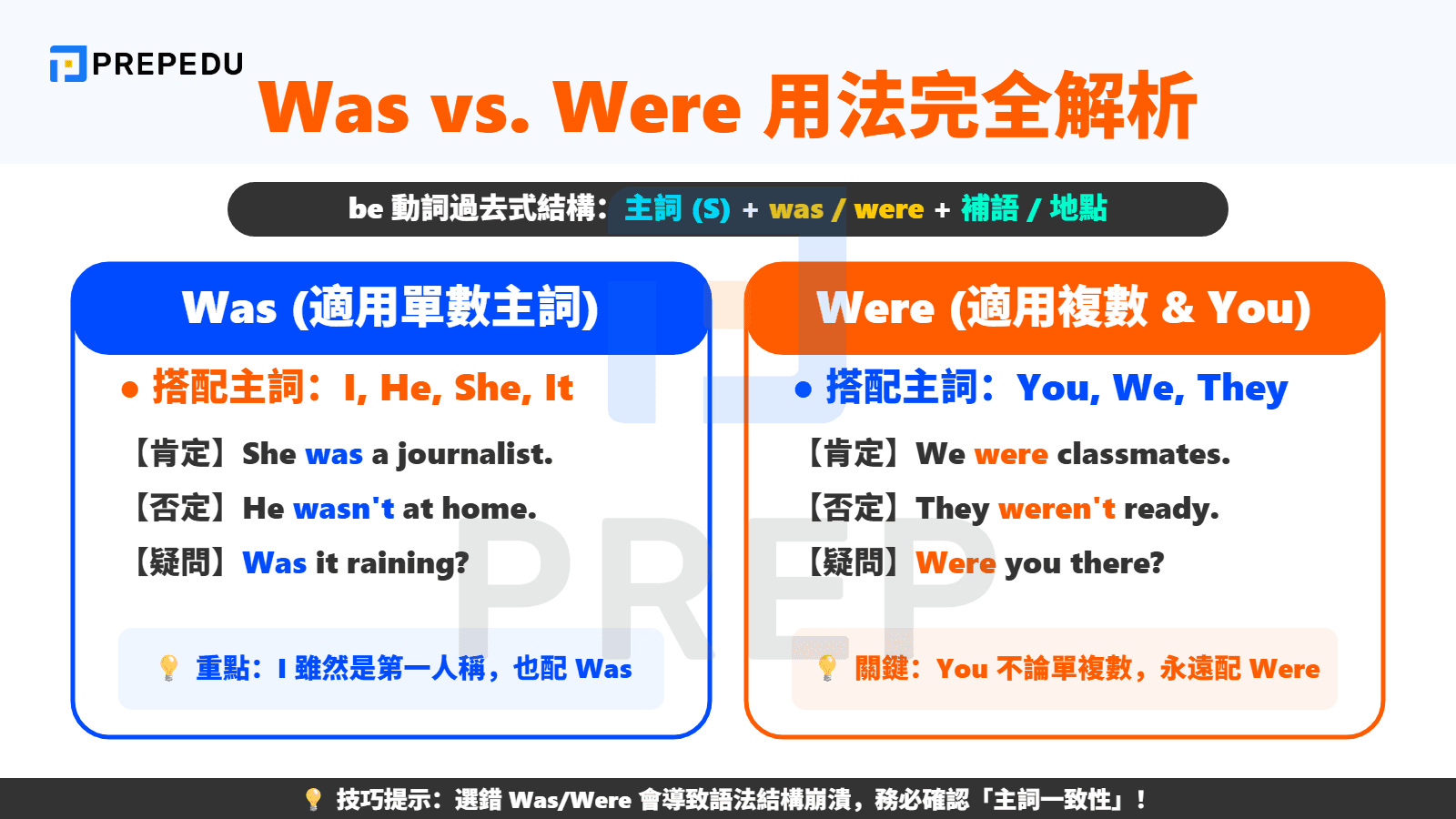
Was 是 be 動詞在過去式中對應單數主詞(第一人稱 I 及第三人稱單數 He / She / It)的形式,用於描述過去的狀態、身份或位置。
結構:
主詞(I / He / She / It / 單數名詞)+ was + 補語或地點
肯定句、否定句與疑問句對照:
|
句型 |
結構 |
範例 |
|
主詞 + was + 補語 |
She was a journalist.(她是一名記者。) |
|
|
主詞 + was not (wasn't) + 補語 |
He wasn't at home last night.(他昨晚不在家。) |
|
|
Was + 主詞 + 補語? |
Was it raining in Taipei this morning?(今早台北有在下雨嗎?) |
在 Was Were 用法中特別需要留意:I 雖然是第一人稱,卻搭配 was 而非 were——這是初學者最易混淆的地方。唯一的例外出現在假設語氣(詳見第 III 章)。
2. Was Were 用法——複數人稱:We / You / They 搭配 Were
Were 是 be 動詞在過去式中對應複數主詞(We / They)及第二人稱(You)的形式,無論 You 指單一個人或一群人,一律使用 were。
結構:
主詞(We / You / They / 複數名詞)+ were + 補語或地點
肯定句、否定句與疑問句對照:
|
句型 |
結構 |
範例 |
|
肯定句 |
主詞 + were + 補語 |
We were classmates at the language centre.(我們是語言中心的同班同學。) |
|
否定句 |
主詞 + were not (weren't) + 補語 |
They weren't ready for the TOEIC test.(他們還沒準備好參加 TOEIC 考試。) |
|
疑問句 |
Were + 主詞 + 補語? |
Were you at the seminar in Taipei last Friday?(你上週五在台北的研討會上嗎?) |
在 Was Were 文法中,You 的規則最值得特別記住:無論 you 指的是一個人還是一群人,永遠配 were,不存在例外。
-
We were both surprised when Xiaoyu scored 850 on the TOEIC exam.(小玉在 TOEIC 考試中拿到 850 分時,我們兩個都大吃一驚。)
-
You were the most dedicated student in our IELTS preparation class last semester.(你是上學期 IELTS 備考班裡最認真的學生。)
-
They were already waiting outside the examination hall when the doors opened at 8:30 AM.(早上八點半大門打開時,他們早已等在試場外面了。)
II. Was Were 用法深度解析:後面加什麼?五大常見句型全覽
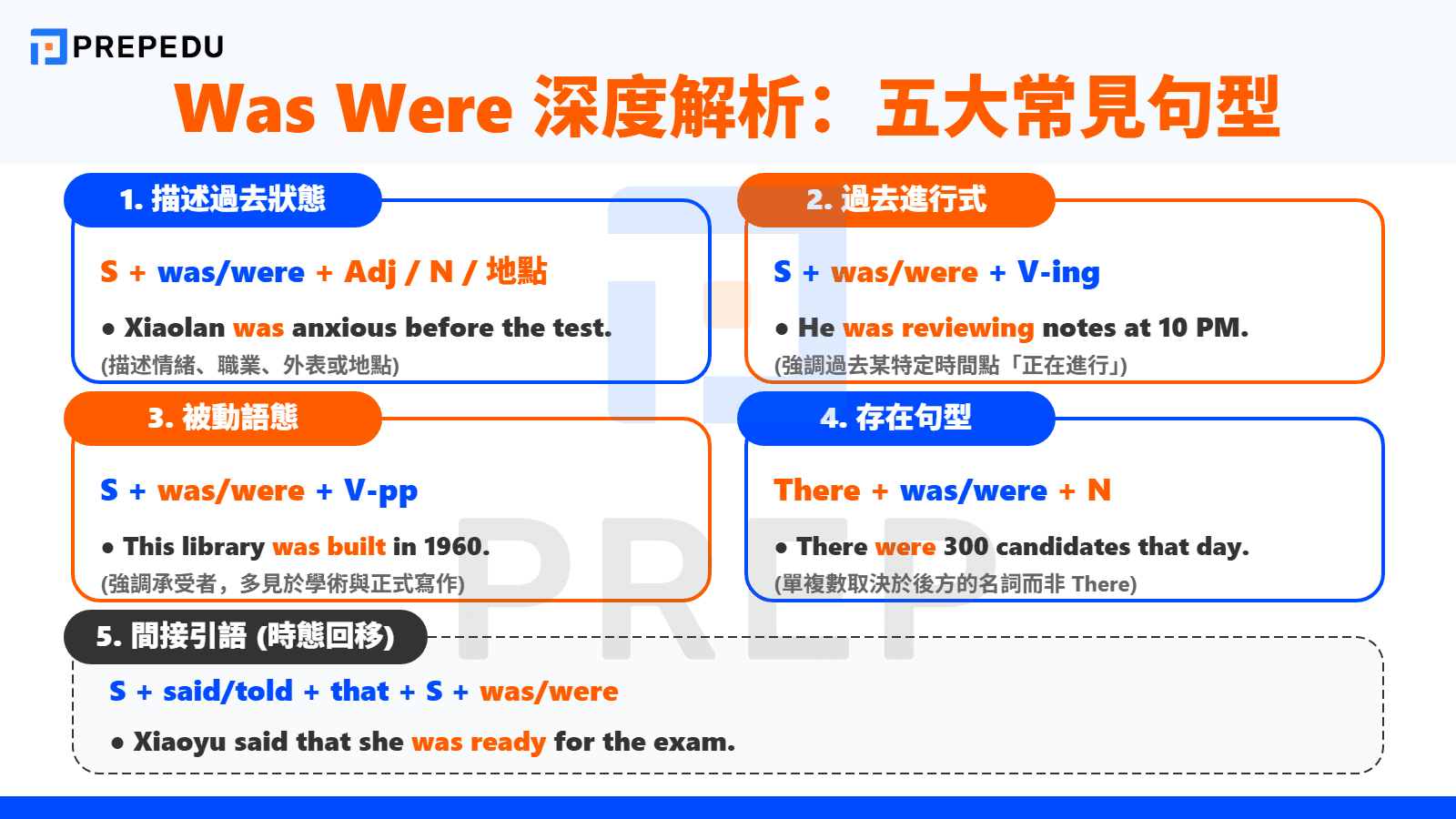
理解主詞規則之後,下一步是認識 Was Were 用法中最核心的五種句型結構——每一種都有固定的語法公式與語義功能,學習時應將兩者一併掌握。
1. Was Were 用法(一):後接名詞、形容詞或介系詞片語,描述過去狀態
Was Were 用法中最基礎的一類,描述過去某個時間點主詞的「是什麼」(身份)、「怎麼了」(狀態)或「在哪裡」(位置),是 be 動詞作為主要動詞的核心功能。
結構:
|
功能 |
例句 |
|
描述情緒 |
Xiaolan was visibly anxious before her IELTS interview.(小嵐在 IELTS 面試前明顯很緊張。) |
|
描述職業 |
They were English teachers at a training centre in Hong Kong.(他們是香港某培訓中心的英語老師。) |
|
描述外表 |
He was tall and broad-shouldered, easy to spot in a crowd.(他身材高挑、肩膀寬闊,在人群中很容易辨認。) |
|
描述地點 |
We were at the National Palace Museum in Taipei that afternoon.(那天下午我們在台北故宮博物院。) |
|
描述特質 |
The reading passage was unexpectedly challenging for most test takers.(這篇閱讀文章對多數考生來說意外地艱難。) |
重要補充: 當 be 動詞後方接介系詞片語(如 in Hong Kong、at the library、on the rooftop)時,表達的是「在某地」的含義,而非身份描述。這是初學者常忽略的 be 動詞第三種功能。
例句:Xiaowang was at the PREP learning centre in Taipei yesterday afternoon for a mock TOEIC session.(小王昨天下午在台北的 PREP 學習中心參加 TOEIC 模擬考試。)
2. Was Were 用法(二):過去進行式——Was/Were + V-ing
Was Were 用法的第二類為過去進行式,描述「過去某一個特定時間點正在進行的動作」,常與 when 或 at + 時間點連用,強調動作的持續性而非結果。
結構:
主詞 + was/were + 動詞-ing(+ when/at + 時間點)
|
情境 |
例句 |
|
過去某時刻的進行動作 |
He was reviewing his TOEIC vocabulary notes at 10 PM last night.(昨晚十點,他正在複習 TOEIC 詞彙筆記。) |
|
兩個同時進行的動作 |
While Xiaoyu was practising IELTS writing, her classmates were discussing the reading strategies.(小玉在練習 IELTS 寫作的同時,她的同學們正在討論閱讀技巧。) |
|
背景動作被打斷 |
We were walking through Ximending when the typhoon alert was announced.(颱風警報發布時,我們正走在西門町。) |
與過去簡單式的關鍵區別: 過去進行式(was/were + V-ing)強調動作「正在進行中」;過去簡單式(動詞過去式)強調動作「已完成」。
3. Was Were 用法(三):被動語態——Was/Were + 過去分詞(V-pp)
Was Were 用法的第三類為被動語態,說明「過去某動作被施加於主詞上」,強調承受者而非執行者,常見於 IELTS 學術寫作與 TOEIC 閱讀文章中。
結構:
主詞 + was/were + 過去分詞(+ by + 動作執行者)
|
被動語態 |
|
|
The examiner told Xiaoming to speak louder.(考官叫小明講大聲一點。) |
Xiaoming was told to speak louder by the examiner.(小明被考官叫去講大聲一點。) |
|
Someone built this library in 1960.(某人在 1960 年建造了這座圖書館。) |
This library was built in 1960.(這座圖書館建於 1960 年。) |
|
The teachers praised all the students who passed the IELTS test.(老師們稱讚了所有通過 IELTS 考試的學生。) |
All the students who passed the IELTS test were praised by the teachers.(所有通過 IELTS 考試的學生都被老師們稱讚了。) |
Was 與 Were 在被動句中的選擇方式: 完全取決於主詞的單複數,與動作本身無關。主詞是單數就用 was,主詞是複數就用 were。
4. Was Were 用法(四):存在句型——There was / There were
Was Were 用法的第四類為存在句型,描述過去某地點或某情境中「有」某人或某物,是英語中表達存在與數量最常見的固定結構之一。
結構:
There + was/were + 名詞
此處最重要的原則是:was 還是 were,取決於 there 後方的名詞單複數,而非 there 本身。
|
判斷依據 |
例句 |
|
後方名詞為單數 → was |
There was only one seat left when Xiaolan arrived at the examination hall.(小嵐抵達考場時,只剩一個座位了。) |
|
後方名詞為複數 → were |
There were more than three hundred candidates registered for the TOEIC exam that Saturday.(那個星期六有超過三百名考生報名參加 TOEIC 考試。) |
|
後方名詞為不可數名詞 → was |
There was no time left to revise the essay before the IELTS writing test ended.(IELTS 寫作考試結束前,已經沒有時間修改文章了。) |
否定形式: There wasn't(沒有,單數)/ There weren't(沒有,複數)
-
There wasn't a single grammar mistake in Xiaowang's writing paper.(小王的寫作試卷上一個文法錯誤都沒有。)
-
There weren't enough practice materials available for the new TOEIC format at that time.(當時沒有足夠的練習材料可用於新的 TOEIC 題型。)
5. Was Were 用法(五):間接引語中的時態回移
Was Were 用法中最容易被忽視的進階類型,正是出現在間接引語(間接報導)的時態回移情境中。當直接引語轉換為間接引語(間接報導)時,若主要動詞是過去式(如 said、told、asked),則引語中的 is/are 需回移為 was/were。
結構:
主詞 + said/told/asked + that + 主詞 + was/were + ...
|
直接引語 |
間接引語 |
|
Xiaoyu said, "I am ready for the exam."(小玉說:「我準備好考試了。」) |
Xiaoyu said that she was ready for the exam.(小玉說她準備好考試了。) |
|
The teacher said, "The results are out."(老師說:「成績出來了。」) |
The teacher said that the results were out.(老師說成績出來了。) |
這一規則在 IELTS 寫作與 TOEIC 文法題型中頻繁出現,是提升答題準確率不可忽視的知識點。
III. 進階與特殊案例:攻克 Was Were 用法中最難的環節
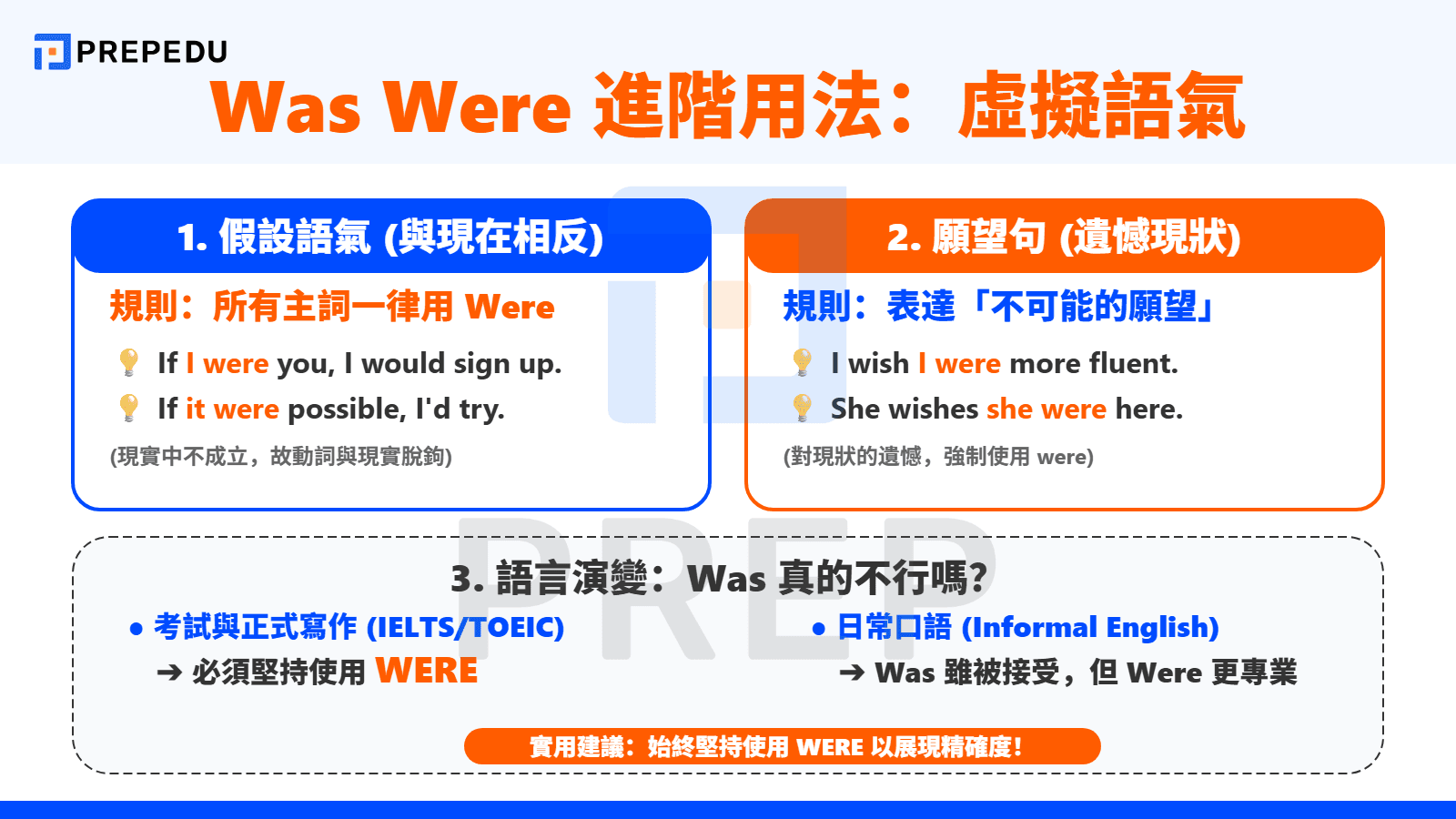
掌握基礎規則之後,真正讓學習者在考試中失分的,往往是以下三個高階情境。這些屬於 Was Were 用法中較為複雜的層次,需要從語義邏輯層面理解,而非死記規則。這三種用法都涉及英語的「虛擬語氣」(Subjunctive Mood),也就是用動詞的特殊形式來表達「與現實不符的情境」。
1. 假設語氣(If...):為什麼 I 也可以配 Were?
在 Was Were 用法的進階層次中,假設語氣(Subjunctive Mood)是最關鍵的一環,用於表達「假設、願望、想像中的情境」,而非描述真實發生的事。在第二條件句(If 子句描述與現在相反的假設)中,所有主詞後方一律使用 were,而非 was,這是正式語法的固定規則。
結構:
If + 主詞 + were + 補語,主詞 + would/could/might + 動詞原形
|
例句 |
說明 |
|
If I were you, I would sign up for the PREP IELTS preparation course right away.(如果我是你,我會馬上報名 PREP 的 IELTS 備考課程。) |
現實:我不是你 |
|
If Xiaoming were taller, he might feel more confident during job interviews.(如果小明再高一點,他在求職面試時可能會更有自信。) |
現實:小明沒那麼高 |
|
If it were possible to retake only the writing section, Xiaoyan would not hesitate.(如果只重考寫作那個部分是可行的,小燕不會猶豫。) |
現實:無法只重考單項 |
這些句子描述的是「現實中不成立的條件」,因此動詞形式刻意與現實脫鉤,以 were 標示「非現實性」。在正式寫作與 IELTS、TOEIC 考試中,使用 was 會被視為語法錯誤。
as if / as though 的假設語氣用法
同樣屬於假設語氣的還有 as if(好像)與 as though(彷彿)引導的子句。當描述的情況與現實不符時,子句中同樣使用 were:
-
He talked as if he were a fluent English speaker, though he had only studied for six months.(他說話的樣子彷彿是流利的英語使用者,但他其實只學了六個月。)
-
She acted as though the exam result were not important to her at all.(她表現得好像考試成績對她完全不重要。)
2. 願望句(I wish...):表達對過去或現狀的遺憾
Was Were 用法的另一個高階陷阱出現在 wish 句型中——wish 後方的子句遵循假設語氣規則,用於表達「對現狀的遺憾」或「對過去的惋惜」。強制使用 were 的時機,是當 wish 表達「現實中不存在的願望」時。
結構:
主詞 + wish(es) + 主詞 + were + 補語(對現狀的遺憾)
例句:
-
I wish I were more fluent in English during conversations with foreign clients.(我希望我在和外國客戶交談時英語能更流利。)
-
Xiaolan wishes she were in Hong Kong right now to attend the IELTS award ceremony.(小嵐希望她現在能在香港,親自出席 IELTS 頒獎典禮。)
若要表達對過去已發生之事的遺憾,則改用 had been(過去完成式),而非 were:I wish I had been more careful during the TOEIC listening section last week.(我希望上週在 TOEIC 聽力部分時能更加謹慎。)
3. Was Were 用法演變:現代英語中 I was 能替代 I were 嗎?
語言隨時代演進,Was Were 用法也不例外。在現代英語的非正式口語中,「If I was you」的說法已被廣泛使用,尤其在英式英語的日常對話中並不罕見。然而,這並不代表兩者可以互換,特別是在考試與正式場合中。
|
情境 |
建議用法 |
說明 |
|
正式寫作(學術、商業) |
If I were you... |
符合規範語法,評分者認可 |
|
IELTS 寫作考試 |
If I were you... |
Task 2 使用 were,有助維持語法分數 |
|
TOEIC 文法選擇題 |
If I were you... |
考題標準答案為 were |
|
日常口語 |
If I was / were 皆可接受 |
母語者兩者均使用 |
實用建議: 在寫作與任何考試情境中,始終堅持使用 were。這樣既符合語法規範,也能在評分者面前展現對英語精確度的掌控力。
IV. Was Were 用法實戰演練:練習題 30 道(附解答與詳解)
以下 Was Were 練習題組分為三個層次,共 30 題。建議先獨立作答,再對照解析,才能達到最佳學習效果。每一道題後均附有詳細說明,協助你理解選擇背後的語法邏輯,而非單純記憶答案。
1. 基礎篇:主詞動詞一致性選擇題
以下題目測試你對 Was Were 用法中主詞一致性規則的掌握程度,從括號中選出正確答案。
-
Xiaoming ___(was / were)the top scorer at the TOEIC test centre in Taipei last month.
-
All of my classmates ___(was / were)absent on the day of the mock IELTS exam.
-
The listening section of the TOEIC test ___(was / were)harder than I expected.
-
You ___(was / were)the only candidate who finished the reading section early.
-
It ___(was / were)a clear, sunny morning when the IELTS results were announced.
-
We ___(was / were)exhausted after the four-hour writing and speaking assessment.
-
She ___(was / were)Xiaoyu's closest friend during their time studying in Hong Kong.
-
The registration fees for the examination ___(was / were)higher last year than they are now.
-
He ___(was / were)the only student in the class with prior experience in academic writing.
-
I ___(was / were)completely unprepared for the indirect speech questions on the grammar test.
解答與詳解:
|
題號 |
答案 |
語法說明 |
|
1 |
was |
主詞 Xiaoming 為單數名詞 → was |
|
2 |
were |
主詞 All of my classmates 為複數 → were |
|
3 |
was |
主詞 The listening section 為單數 → was |
|
4 |
were |
主詞 You → 永遠配 were,無論單複數 |
|
5 |
was |
主詞 It(單數代名詞)→ was |
|
6 |
were |
主詞 We(複數)→ were |
|
7 |
was |
主詞 She(第三人稱單數)→ was |
|
8 |
were |
主詞 The registration fees 為複數名詞 → were |
|
9 |
was |
主詞 He(第三人稱單數)→ was |
|
10 |
was |
主詞 I → 過去簡單式中搭配 was(注意:假設語氣才用 were) |
2. 進階篇:時態與語態填充題
以下題目進一步測試 Was Were 用法在過去進行式、被動語態與存在句型中的應用,根據括號中的提示填入正確的動詞形式。
-
The IELTS score report ___(write)by the test administrator and sent out within two weeks.(被動語態)
-
Xiaowang and his study partner ___(review)grammar notes when the power went out in their Taipei apartment.(過去進行式)
-
There ___ a long queue outside the examination centre in Hong Kong at 7:30 AM.(存在句,單數)
-
All of the answer sheets ___(collect)by the invigilators at exactly 12 noon.(被動語態,複數)
-
Xiaoyan ___(practise)her pronunciation in front of the mirror when her roommate knocked on the door.(過去進行式)
-
There ___ several unfamiliar vocabulary items in the reading passage that morning.(存在句,複數)
-
The IELTS candidates ___(escort)to their seats by the examination staff before the test began.(被動語態,複數)
-
I ___(wait)at the reception desk of the British Council in Hong Kong for nearly forty minutes.(過去進行式)
-
There ___ only one grammar question in the entire TOEIC Part 5 set that Xiaoming could not answer.(存在句,單數)
-
The listening scripts ___(not distribute)to the candidates until after the test was completely over.(被動語態,否定,複數)
解答與詳解:
|
題號 |
正確答案 |
語法說明 |
|
1 |
was written |
單數主詞 The IELTS score report → was + V-pp |
|
2 |
were reviewing |
複數主詞 Xiaowang and his study partner → were + V-ing |
|
3 |
was |
There + was(後方 a long queue 為單數名詞片語) |
|
4 |
were collected |
複數主詞 All of the answer sheets → were + V-pp |
|
5 |
was practising |
單數主詞 Xiaoyan → was + V-ing |
|
6 |
were |
There + were(後方 several unfamiliar vocabulary items 為複數) |
|
7 |
were escorted |
複數主詞 The IELTS candidates → were + V-pp |
|
8 |
was waiting |
單數主詞 I → was + V-ing |
|
9 |
was |
There + was(後方 only one grammar question 為單數) |
|
10 |
were not distributed |
複數主詞 The listening scripts → were + not + V-pp |
3. 挑戰篇:假設語氣改錯題
以下題目專門針對 Was Were 用法中最易出錯的假設語氣情境,每句各含一個錯誤,請找出並改正,同時說明語法原因。
-
If I was you, I would choose the PREP IELTS course with the personalized AI learning path.
-
Xiaoyan wishes she was currently living in Taipei rather than studying abroad alone.
-
If Xiaoming was a bit more confident in speaking, he could have scored higher on the IELTS speaking test.
-
I wish the TOEIC examination hall was closer to the MTR station in Hong Kong.
-
If it was financially possible, Xiaoyu would enroll in the IELTS intensive programme immediately.
-
He behaved at the formal dinner as if he was the guest of honour, though no one had introduced him.
-
If she was more familiar with the indirect speech rules, she would not have lost marks in the grammar section.
-
I wish I was able to retake the TOEIC Part 5 section alone without redoing the entire exam.
-
If Xiaolan was here in Hong Kong with us, we could ask her to explain the passive voice rules again.
-
The student acted as though the low score on the mock test was not something worth reflecting on.
解答與詳解:
|
題號 |
錯誤處 |
正確形式 |
語法說明 |
|
1 |
was |
were |
第二條件句(If 假設語氣),I 後方用 were |
|
2 |
was |
were |
wish 表達對現狀的遺憾,she 後方用 were |
|
3 |
was |
were |
第二條件句,Xiaoming 為第三人稱單數,仍用 were |
|
4 |
was |
were |
wish 表達現狀遺憾,the examination hall 為單數名詞,假設語氣中仍用 were |
|
5 |
was |
were |
第二條件句,it 後方用 were |
|
6 |
was |
were |
as if 引導假設(與現實不符),he 後方用 were |
|
7 |
was |
were |
第二條件句,she 後方用 were |
|
8 |
was |
were |
wish 表達現狀遺憾,I 後方用 were |
|
9 |
was |
were |
第二條件句,Xiaolan 為第三人稱單數,仍用 were |
|
10 |
was |
were |
as though 引導假設(成績本身存在,但此處描述的是「當作不重要」的假設態度),用 were 更符合正式語法 |
V. Was Were 用法常見問答 FAQ 與學習建議
以下 FAQ 針對 Was Were 用法中三個最常見的延伸疑問提供精準解答,同時給出適用於 IELTS 與 TOEIC 備考的實用學習建議。
1. 疑問句怎麼改?Was/Were 置於句首的變換技巧
理解 Was Were 用法的疑問句結構,對 TOEIC 聽力測驗與 IELTS 口說考試至關重要。疑問句的構成方式是將 was 或 were 移至主詞前方。
結構:
Was/Were + 主詞 + 其餘部分?
|
陳述句 |
疑問句 |
否定簡答 |
|
She was ready for the exam. |
Was she ready for the exam?(她考試準備好了嗎?) |
No, she wasn't. |
|
They were at the PREP centre. |
Were they at the PREP centre?(他們在 PREP 中心嗎?) |
No, they weren't. |
|
There was a problem. |
Was there a problem?(有問題嗎?) |
No, there wasn't. |
|
There were enough seats. |
Were there enough seats?(有足夠的座位嗎?) |
No, there weren't. |
縮寫形式補充:
-
was not → wasn't
-
were not → weren't
在口語與非正式書面英語中,縮寫形式更為常見。在 IELTS 正式寫作(Task 1 與 Task 2)中,則建議使用完整形式 was not / were not。
2. 集體名詞(如 Team / Family)該選 was 還是 were?
這是台灣與香港英語考試中的經典難題,也是 Were Was 用法中最具爭議的一個判斷點。判斷邏輯如下:
|
判斷方式 |
對應用法 |
範例 |
|
強調整體(視整個群體為單一單位) |
was |
The PREP teaching team was well-prepared for the new IELTS exam format.(PREP 教學團隊為新版 IELTS 考試格式做好了充分準備。) |
|
強調成員各自(個體行為各有不同) |
were |
The teaching team were debating different approaches to the writing module.(教學團隊的成員們正在討論寫作模組的不同教學方式。) |
在台灣與香港的標準英語考試環境中,集體名詞通常被視為單數整體,搭配 was。若題目無特別說明,建議優先選 was。
3. 學習建議:如何在 IELTS 與 TOEIC 中避免 Was/Were 失分?
Was Were 用法的理論知識,需要透過持續練習才能真正內化成語感,以下是 PREP 建議的三步驟學習方法。
-
第一步,建立規則框架:先確認主詞的人稱與數量,再判斷是否屬於假設語氣或願望句,最後選擇正確的 was 或 were。
-
第二步,熟悉考試題型:TOEIC Part 5 的文法選擇題常考被動語態(was/were + V-pp)與主詞動詞一致性;IELTS Writing Task 2 則需要在條件句中正確使用假設語氣的 were。
-
第三步,持續輸出練習:用本文提供的 30 道練習題反覆自我測試,並嘗試在日記或寫作練習中主動造句,將規則轉化為習慣。
結論
Was Were 用法的核心分為三個層次:主詞一致性(單複數配對)、句型結構(狀態、進行、被動、存在、間接引語)、語氣邏輯(假設語氣與願望句中 were 的特殊性)。從基礎的 I was / They were,到 There was/were 的名詞判斷,再到 If I were you 背後的「非現實性」語義——每一層都有其規則,也有其必須理解的例外。
透過本文的系統整理、完整的句型對照表以及 30 道分層練習題,你已具備在 IELTS 寫作、TOEIC 語法題乃至日常英語中,自信且準確地運用這兩個詞的能力。語法的掌握從來不是一次性的記憶,而是透過反覆練習與真實語境的接觸,逐漸沉澱為直覺。踏出第一步,從今天的練習題開始。
曾經質疑自己是否能夠達標嗎?PREPEDU.COM Test Practice 超越單純題目練習,依據您當前表現科學預估達分機率。
運用數千位優秀學員的成功數據,系統深度剖析分數變化規律,為每個特定目標量身訂製學習藍圖。不論追求雅思 6.5 分或多益 850 分,皆有對應的精準攻略。
可視化追蹤介面清楚呈現您的當前定位與距離目標的剩餘路程。眾多學員經過 4-6 週規律訓練後,雅思分數躍升 0.5-1.0 分,多益成績攀升 100-200 分。
成就源自縝密規劃而非偶然。讓 PREP Test Practice 架起通往理想的堅實橋樑!

你好!我叫黃秋賢,現在在 prepedu.com 擔任內容企劃。我有超過5年的英語與韓語自學經歷,親身備考 IELTS、TOEIC 與 TOPIK,累積了大量第一手的學習者視角——包括哪些語法規則最讓台灣與香港學習者混淆,以及如何在有限的備考時間內最有效地修正這些錯誤。目前已在 prepedu.com 撰寫超過 1000 篇英語學習文章,內容涵蓋語法、詞彙與考試策略,累積協助數千位學習者解決自學過程中的語法疑問。
評論








統一企業編號:202227322W
地址:114 LAVENDER STREET, #11-83 CT HUB 2, SINGAPORE (338729)