倒裝句英文(Inversion)全攻略:文法規則、型態分類與例句題目總整理
英文倒裝句是什麼?如何在英文考試中正確運用?倒裝句(Inversion)是將英文句子中的主詞與動詞語序進行調整的特殊文法結構,主要分為全部倒裝(將完整動詞移到主詞前)與部分倒裝(僅將助動詞移到主詞前)兩大類型。這種語序變化並非隨意而為,而是在否定副詞(never、seldom)、限定詞(only)或地點副詞(here、there)置於句首時,根據特定文法規則所形成的句型結構,用於強調否定程度、時間、地點或條件等關鍵訊息。
無論你是準備TOEIC、IELTS考試的考生,還是希望提升英文寫作能力的學習者,倒裝句都是必須攻克的文法難關,因為它不僅頻繁出現在各類英文檢定考試中,更是展現進階英文能力的重要指標。然而,許多學習者常在倒裝句的時態處理、助動詞選用、主謂一致等細節上遇到困難,導致在考試中失分或在寫作中誤用。
本文由PREPEDU專業教學團隊精心整理,為你系統化呈現倒裝句的完整知識架構,從基礎定義、文法規則、十大必學型態,到實戰練習題目與高階應用解析,幫助你全面掌握這個重要的英文文法概念,在考試與實際應用中都能精準運用倒裝句,展現優異的英文實力。

I. 倒裝句英文是什麼?核心定義與基本公式解析
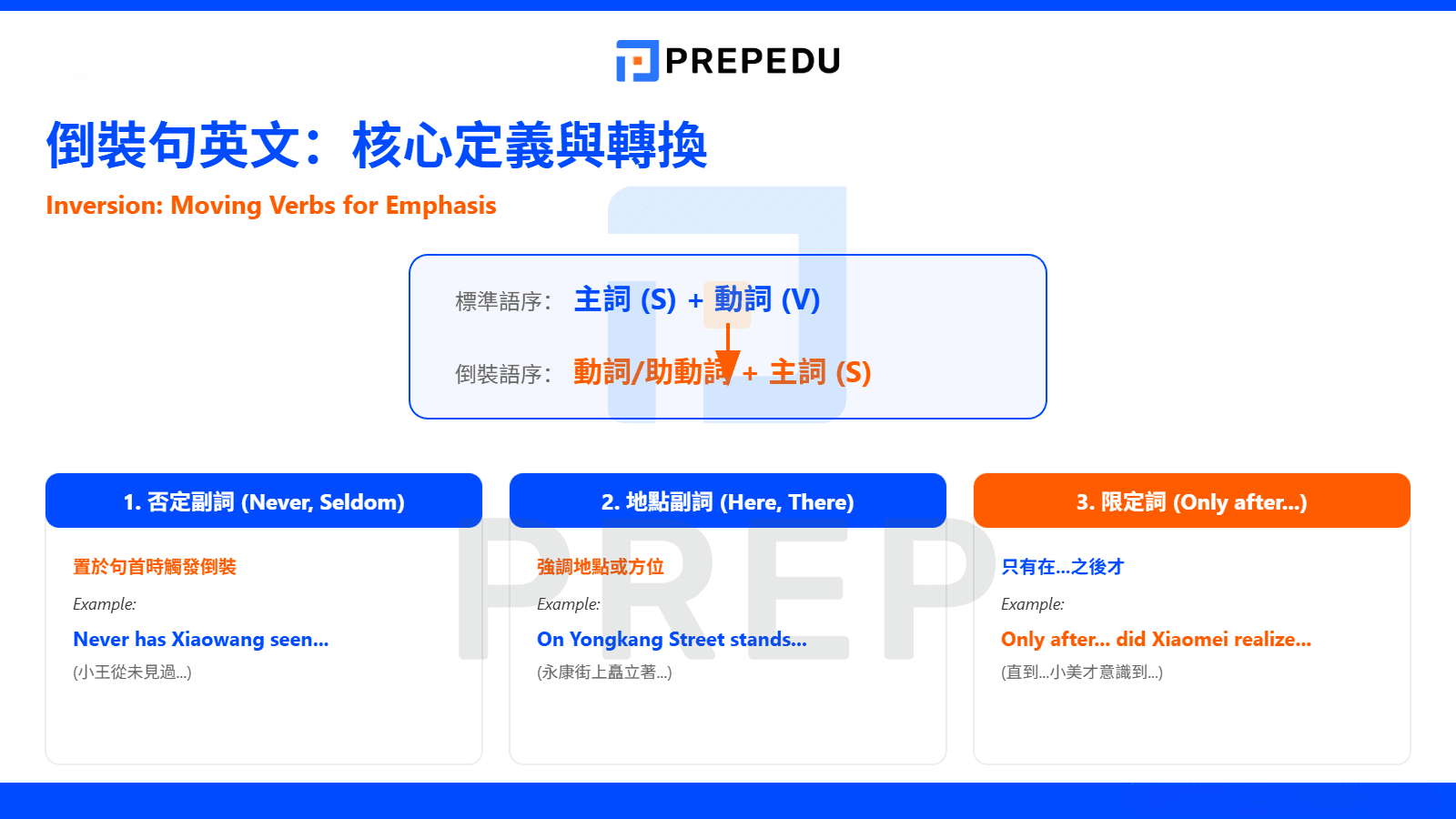
倒裝句英文怎麼說?倒裝句意思是指在英文句子中,將原本的標準語序「主詞+動詞」進行調整,把動詞或助動詞移到主詞之前的特殊文法結構。這種語序變化並非隨意而為,而是基於特定的文法規則,主要用於強調句中某些重要訊息、創造修辭效果,或符合英文慣用表達方式。
標準語序 vs. 倒裝句語序:
標準語序:主詞(S) + 動詞(V) + 其他成分
倒裝語序:動詞/助動詞 + 主詞(S) + 其他成分
倒裝句文法的基本觸發條件包括:
-
否定副詞置於句首(never,seldom,rarely)
-
限定詞置於句首(only)
-
地點或方向副詞置於句首(here,there)
-
特定結構(so...that,not until)
實際例句對照:
|
倒裝類型 |
標準語序 |
倒裝句 |
|
否定副詞倒裝 |
Xiaowang has never seen such beautiful night views in Taipei.(小王從未在台北見過如此美麗的夜景。) |
Never has Xiaowang seen such beautiful night views in Taipei.(小王從未在台北見過如此美麗的夜景。) |
|
地點副詞倒裝 |
A famous bubble tea shop stands on Yongkang Street.(永康街上矗立著一家知名的珍珠奶茶店。) |
On Yongkang Street stands a famous bubble tea shop.(永康街上矗立著一家知名的珍珠奶茶店。) |
|
限定詞倒裝 |
Xiaomei realized her mistake only after the meeting ended in Xiangang.(會議在香港結束後,小美才意識到她的錯誤。) |
Only after the meeting ended in Xiangang did Xiaomei realize her mistake.(只有在香港的會議結束後,小美才意識到她的錯誤。) |
掌握倒裝句的核心概念後,接下來我們將深入探討不同類型的倒裝結構及其具體應用規則。
II. 基礎英文倒裝句文法:全部倒裝與部分倒裝的區別
理解全部倒裝與部分倒裝的差異是掌握英文倒裝句用法的關鍵第一步,這兩種倒裝型態雖然都涉及語序的改變,但它們的結構規則、使用時機和實際應用場景卻有著明顯的不同。在學習倒裝句的過程中,清楚區分這兩種類型能夠幫助你避免常見錯誤,並在實際運用時能夠快速判斷該使用哪一種倒裝結構。
|
比較項目 |
全部倒裝(Full Inversion) |
部分倒裝(Partial Inversion) |
|
基本結構 |
副詞/片語+完整動詞+主詞 |
限制詞/否定詞+助動詞+主詞+主要動詞 |
|
動詞移動範圍 |
整個動詞片語都移到主詞前 |
只有助動詞/be動詞移到主詞前 |
|
常見引導詞 |
Here,There,地方副詞,介係詞片語 |
Never,Rarely,Seldom,Only,Not until,No sooner |
|
主詞類型限制 |
代名詞主詞通常不倒裝 |
所有主詞類型都可倒裝 |
|
時態處理 |
使用原本的動詞時態 |
需要加入適當的助動詞(do/ does/ did/ have/ has等) |
|
例句示範 |
In the meeting room sat all the senior managers from our Taipei headquarters.(會議室裡坐著所有來自我們台北總部的資深經理。) |
Rarely do we encounter such dedication among young professionals in Xiangang.(我們很少在香港的年輕專業人士中遇到如此奉獻的精神。) |
|
句子類型 |
主要用於陳述存在、位置或動作方向 |
主要用於強調否定、頻率、時間或條件 |
從上表可以清楚看出,部分倒裝在實際考試與應用中出現的頻率更高,因為它涉及的句型結構更加多樣化,包含了否定句倒裝、限定詞倒裝等多種情況。當你在句首看到否定副詞(如never、seldom)或限定詞(如 only)時,幾乎可以確定接下來需要使用部分倒裝結構。
相對地,全部倒裝主要出現在地方副詞或方向性副詞置於句首的情況,這種倒裝型態更常見於文學作品或正式寫作中,用來創造特殊的語氣效果或強調空間位置的變化。
III. 十大必學英文倒裝句型分類解析
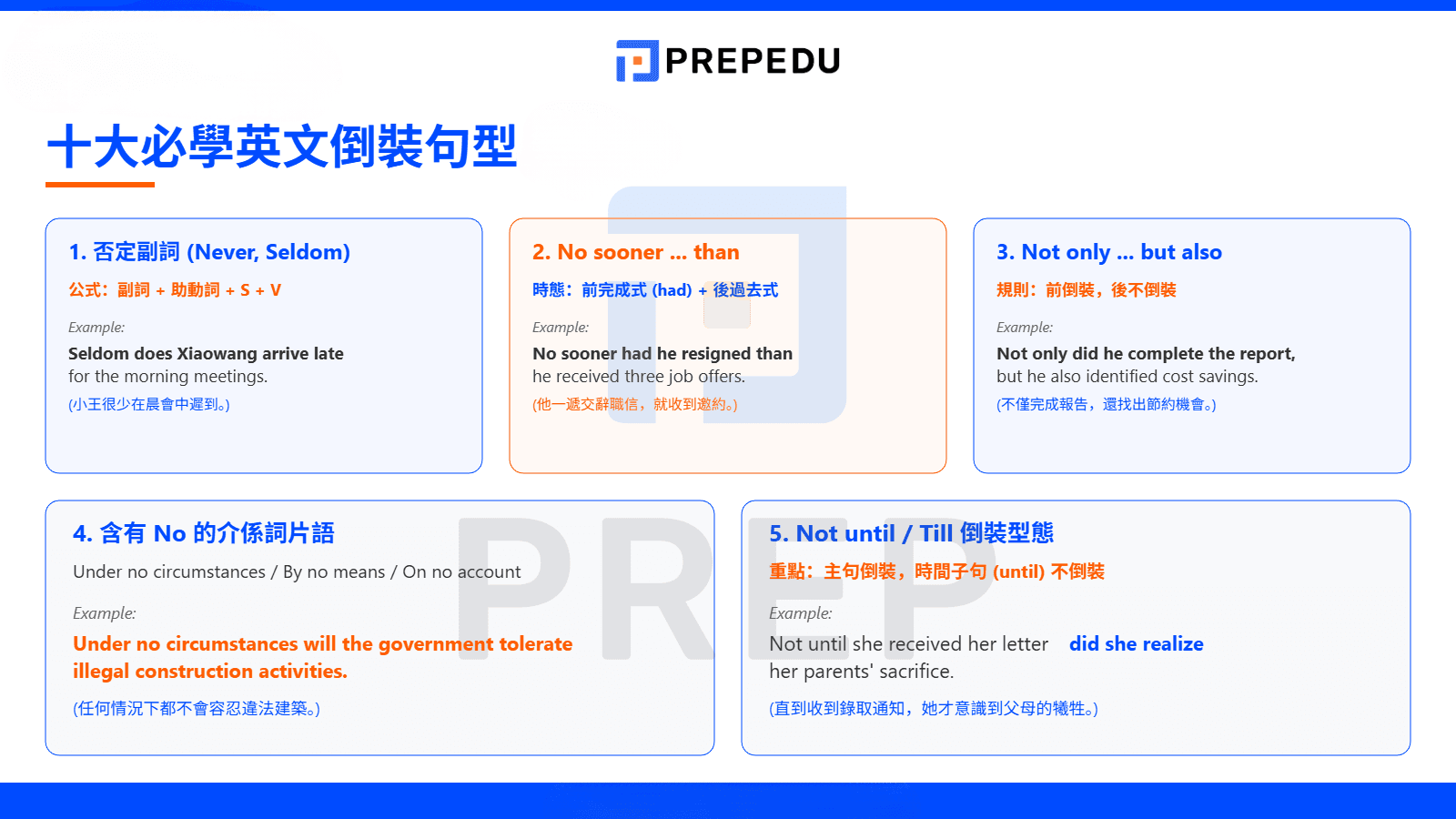
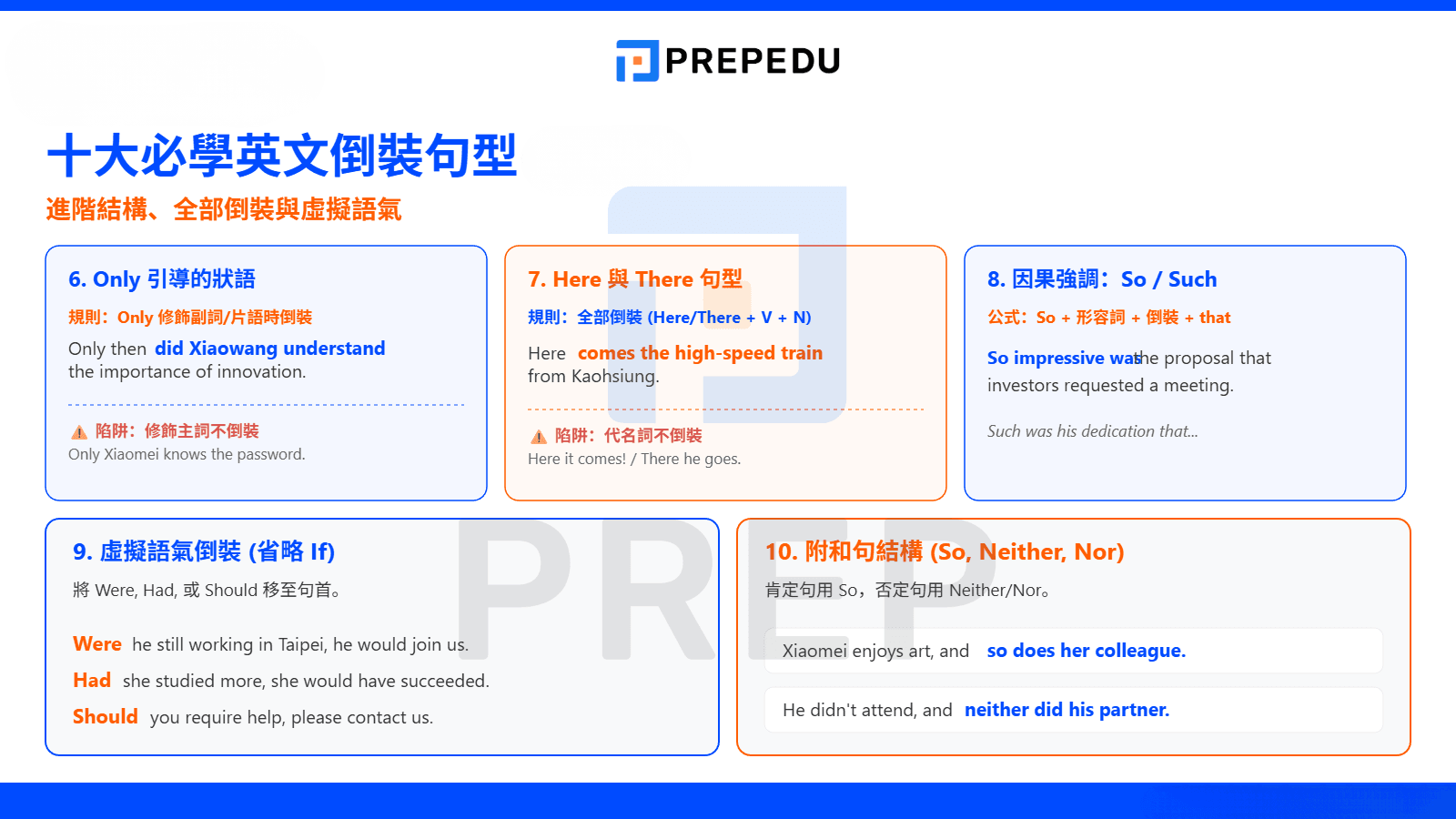
這個章節將為你詳細介紹十種最重要且最常出現在各類英文考試中的倒裝句型,每一種型態都配有清楚的公式說明、豐富的例句解析,以及實用的應用技巧,幫助你全面掌握倒裝句的各種變化形式。
1. 否定副詞置於句首(Negative Adverbs)
當否定意義的副詞出現在句首時,句子必須使用部分倒裝結構,這是never 倒裝句和否定句倒裝中最基礎也最重要的型態。常見的否定副詞包括:never(從不)、seldom(很少)、rarely(罕見地)、hardly(幾乎不)、scarcely(幾乎沒有)、barely(僅僅)、little(很少)等,這些副詞本身帶有強烈的否定含義,將它們置於句首可以達到特別強調的效果,讓聽者或讀者立即注意到這個否定概念的重要性。
基本公式:
否定副詞+助動詞/be動詞+主詞+主要動詞
倒裝句例句:
-
Seldom does Xiaowang arrive late for the morning meetings at our Xinyi District office.(小王很少在我們信義區辦公室的晨會中遲到。)
-
Rarely do we find such authentic dim sum restaurants outside of Xiangang.(在香港以外的地方,我們很少找到如此道地的點心餐廳。)
-
Hardly had Xiaomei stepped off the plane at Taoyuan Airport when she received an urgent call from her manager.(小美才剛在桃園機場下飛機,就接到經理的緊急電話。)
-
Scarcely can anyone master both Mandarin and Cantonese fluently within two years of study.(幾乎沒有人能在兩年的學習時間內同時精通國語和粵語。)
這種倒裝句型態在使用時需要特別注意英文時態的處理:
例如:Rarely does he experience such intense work pressure in the financial sector.(他在金融業很少經歷如此強大的工作壓力。)這裡使用 does 是因為原句是現在簡單式。
2. 否定結構:No sooner...than 與 Hardly...when
這兩組固定搭配用來表達「一⋯⋯就⋯⋯」的意思,強調兩個動作在時間上的緊密相連,當no sooner或hardly置於句首時,必須使用部分倒裝,且這種結構有特定的時態要求,通常前半句使用過去完成式(had+過去分詞),後半句使用過去簡單式,這個時態配合規則是考試中的常見考點。
基本公式:
No sooner+had+主詞+過去分詞(Vpp)+than+主詞+過去式動詞
Hardly/ Scarcely+had+主詞+過去分詞(Vpp)+when/before+主詞+過去式動詞
倒裝句例句:
-
No sooner had Xiaowang submitted his resignation letter than he received three job offers from leading tech companies in Taipei.(小王一遞交辭職信,就收到台北三家領先科技公司的工作邀約。)
-
Hardly had the CEO finished her presentation at the Nangang Exhibition Center when investors began asking detailed questions.(執行長才剛在南港展覽館結束她的簡報,投資者就開始詢問詳細問題。)
-
Scarcely had Xiaomei arrived at her hotel in Tsim Sha Tsui when she realized she had left her laptop charger at the airport.(小美才剛抵達她在尖沙咀的飯店,就發現她把筆記型電腦充電器忘在機場了。)
這種倒裝句型態在 IELTS、TOEIC考試中出現頻率相當高,考生常犯的錯誤包括:時態使用不當(前句未使用過去完成式)、將 than 與 when 混用(記住 no sooner 固定搭配 than,而hardly/ scarcely 則搭配 when 或 before)、以及忘記在前半句使用倒裝結構。掌握這個型態的關鍵是記住「前完成後簡單」的時態規則,以及各自固定的連接詞搭配。
3. 否定詞組開頭:Not only...but also
當 not only 置於句首時,只有 not only 引導的前半句需要倒裝,but also 引導的後半句維持正常語序,這個規則被稱為「前倒後不倒」,是學習者需要特別記住的重點。這個倒裝句結構用來強調不僅具備某個特質或完成某件事,還額外具備其他特質或成就,創造層層遞進的強調效果。
基本公式:
Not only+助動詞/be動詞+主詞+動詞+⋯⋯,but(also)+主詞+動詞+⋯⋯
倒裝句例句:
-
Not only did Xiaowang complete the quarterly financial report two days ahead of schedule,but he also identified three major cost-saving opportunities for our Taipei branch.(小王不僅提前兩天完成季度財務報告,還為我們的台北分公司找出三個重大的成本節約機會。)
-
Not only is this newly opened restaurant in Daan District affordable,but it also serves authentic Sichuan cuisine prepared by chefs from Chengdu.(這家新開在大安區的餐廳不僅價格實惠,還提供由來自成都的廚師烹調的道地川菜。)
-
Not only have local scientists at Academia Sinica discovered a breakthrough treatment for dengue fever,but they have also developed a cost-effective production method.(中央研究院的本地科學家不僅發現了登革熱的突破性治療方法,還開發出具成本效益的生產方式。)
使用這個倒裝句型時要特別注意,but also後面的子句不需要倒裝,保持「主詞+動詞」的正常語序即可。考試中常見的陷阱是學生誤以為兩個子句都需要倒裝,或者在but also子句中也使用了助動詞倒裝,這都是錯誤的用法。
4. 含有 No 的介係詞片語(Phrases with No)
當句首出現含有 no 的介系詞片語時,句子需要使用部分倒裝,這類片語包括
-
by no means(絕不)
-
under no circumstances(在任何情況下都不)
-
in no way(絕不)
-
on no account(絕對不)
-
at no time(從未)
-
in no case(絕不)
-
for no reason(絕不)等
這些片語都帶有強烈的否定語氣,用於表達堅決的立場或絕對的禁止,在正式書面語和演講中經常使用。
基本公式:
介係詞片語(with No)+助動詞/be動詞+主詞+動詞
倒裝句例句:
-
By no means should employees at our Xinyi headquarters compromise client confidentiality for personal gain.(我們信義總部的員工絕不應該為了個人利益而損害客戶機密。)
-
Under no circumstances will the Taipei City Government tolerate illegal construction activities in residential areas.(台北市政府在任何情況下都不會容忍住宅區的違法建築活動。)
-
In no way did Xiaowang's explanation justify his absence from the crucial board meeting last Friday.(小王的解釋絕不能為他上週五缺席重要董事會議的行為辯護。)
-
On no account should sensitive corporate data be shared with unauthorized third parties outside our Xiangang office.(絕對不可以與我們香港辦公室以外未經授權的第三方分享敏感的企業資料。)
-
At no time during the entire negotiation process did the supplier mention these additional charges.(在整個談判過程中,供應商從未提及這些額外費用。)
-
In no case can students submit their IELTS writing assignments after the 11:59 PM deadline on Sunday.(學生絕不能在週日晚上11點59分的截止時間之後提交他們的雅思寫作作業。)
這些含有 no 的介係詞片語在商業英文和學術寫作中使用頻率很高,它們能夠傳達出比簡單否定句更強烈的禁止或拒絕態度。
5. 時間連接詞:Not until / Till 倒裝型態
Not until 是倒裝句中非常重要的一個結構,當它置於句首時,主要子句需要倒裝,但 until 引導的時間子句保持正常語序,這種「主句倒裝,從句不倒」的規則需要特別留意。
Not until用來強調某件事情直到特定時間點或事件發生後才實現,帶有「終於」或「直到那時才」的含義,常用於敘述重要的領悟時刻或轉折點。
基本公式:
Not until+時間子句+助動詞/be動詞+主詞+動詞
倒裝句例句:
-
Not until Xiaomei received her acceptance letter from National Taiwan University did she realize how much her parents had sacrificed for her education.(直到小美收到台灣大學的錄取通知,她才意識到父母為她的教育犧牲了多少。)
-
Not until the quarterly financial results were officially published on the Taiwan Stock Exchange could investors finally assess the company's true performance.(直到季度財務結果在台灣證券交易所正式公布,投資者才終於能夠評估公司的真實表現。)
-
Not until he relocated from Taipei to Xiangang for work did Xiaowang understand the significant cultural differences between the two cities.(直到他因工作從台北搬到香港,小王才理解這兩座城市之間的重大文化差異。)
使用 not until 倒裝句時,要記住只有主要子句需要倒裝,until後面引導的時間子句保持正常的「主詞+動詞」語序。考試中常見的錯誤是學生將時間子句也進行倒裝,或者忘記在主要子句中加入適當的助動詞。這個倒裝句型在敘述個人成長經歷、重要領悟或職涯轉折點時特別有用,能夠有效地突出那個關鍵時刻的重要性。
6. 限定詞倒裝:Only 引導的狀語
only 倒裝句型是考試中的絕對重點,當only與時間副詞、地方副詞、介係詞片語或狀語子句連用並置於句首時,主要子句需要使用部分倒裝。這個 only 倒裝型態的關鍵在於 only 必須修飾副詞性成分(時間、地點、方式等),而不是主詞,這個區別非常重要,直接決定了是否需要使用倒裝結構。
基本公式:
Only+副詞/片語/子句+助動詞/be動詞+主詞+動詞
倒裝句例句:
-
Only then did Xiaowang understand why his mentor at the Hsinchu Science Park had emphasized the importance of continuous innovation.(直到那時,小王才理解為什麼他在新竹科學園區的導師一直強調持續創新的重要性。)
-
Only by collaborating closely with international partners can our Taipei-based research team achieve breakthrough results in semiconductor technology.(只有通過與國際夥伴密切合作,我們總部位於台北的研究團隊才能在半導體技術上獲得突破性成果。)
-
Only after Xiaomei graduated with honors from her MBA program at Chinese University of Hong Kong did she launch her own fintech startup.(直到小美以優異成績從香港中文大學MBA課程畢業後,她才創立自己的金融科技新創公司。)
需要特別注意的是,如果only修飾主詞,則不需要倒裝,這是一個重要的例外規則。
-
错误:Only Xiaomei knows the password to access the confidential database.(只有小美知道存取機密資料庫的密碼。)在這個句子中,only修飾主詞Xiaomei,因此不使用倒裝。
-
正确:Only with Xiaomei's authorization can employees access the confidential database.(只有獲得小美的授權,員工才能存取機密資料庫。)這時 only 修飾的是介係詞片語「with Xiaomei's authorization」,就需要使用倒裝結構。
這個區別是考試中的常見陷阱,務必仔細判斷only修飾的對象。
7. 地方副詞與方向:Here 與 There 句型
Here 倒裝句和 there 開頭的句子屬於全部倒裝的典型範例,這種結構常用來描述某物的出現、位置或動作方向,創造生動的視覺效果和戲劇性的呈現方式。這類倒裝句在文學作品、新聞報導和口語表達中都很常見,能夠讓描述更加生動具體,吸引聽者或讀者的注意力。
基本公式:
Here/ There+動詞+名詞主詞
倒裝句例句:
-
Here comes the high-speed train connecting Taipei and Kaohsiung,arriving precisely on schedule as always.(連接台北和高雄的高鐵來了,一如既往地準時抵達。)
-
There stands the historic Chiang Kai-shek Memorial Hall,one of Taipei's most iconic landmarks visited by millions annually.(那裡矗立著歷史悠久的中正紀念堂,台北每年吸引數百萬遊客參觀的最具標誌性地標之一。)
重要例外規則:當主詞是代名詞時,不使用倒裝,保持正常語序。例如:
-
Here it comes.(它來了。)而非Here comes it.
-
There he goes.(他去了。)而非There goes he.
這個規則經常在考試中作為陷阱出現,特別是在選擇題中,考生容易忽略主詞類型而錯誤地選擇倒裝形式。
8. 因果強調:So...that 與 Such...that
So 倒裝句用來強調程度或結果,當 so 與形容詞或副詞連用並置於句首時,需要使用部分倒裝結構,這種倒裝句能夠有效地突出某個特質或狀態達到極端程度,以至於導致特定的結果。Such...that 的倒裝結構則用於強調名詞片語,雖然使用頻率相對較低,但在正式寫作中仍然相當有用。
基本公式:
So+形容詞/ 副詞+be動詞/ 助動詞+主詞+that+子句
Such+be動詞+名詞片語+that+子句
倒裝句例句:
-
So impressive was Xiaomei's business proposal at the Taipei International Startup Festival that three venture capital firms immediately requested follow-up meetings.(小美在台北國際新創節的商業提案如此令人印象深刻,以至於三家創投公司立即要求後續會議。)
-
Such was Xiaowang's dedication to mastering Cantonese that he relocated to Xiangang for two years just to immerse himself in the language environment.(小王對精通粵語的投入如此之深,以至於他搬到香港兩年,只為讓自己沉浸在語言環境中。)
9. 虛擬語氣倒裝:省略 If 的結構
在虛擬語氣的條件句中,可以省略if而將 were、had 或 should 提到句首,形成倒裝結構,這種用法在正式寫作、商業通信和學術論文中相當常見,能夠讓表達更加簡潔優雅,同時保持條件句的假設性質。
這種倒裝句型主要用於三種虛擬語氣情況:與現在事實相反(用were)、與過去事實相反(用had)、以及表示未來不太可能發生的假設(用should)。
基本公式:
Were/ Had/ Should+主詞+動詞+⋯⋯,主要子句
倒裝句例句:
-
Were Xiaowang still working at the Taipei headquarters,he would definitely participate in this groundbreaking AI development project.(如果小王仍在台北總部工作,他肯定會參與這個突破性的人工智慧開發專案。)= If Xiaowang were still working...
-
Had Xiaomei studied financial management more systematically during her university years,she would have launched her startup much earlier.(如果小美在大學期間更系統地學習財務管理,她早就創立她的新創公司了。)= If Xiaomei had studied...
-
Should you require any further assistance with your IELTS preparation materials,please do not hesitate to contact our Xiangang study center.(如果你需要雅思準備資料的任何進一步協助,請不要猶豫與我們的香港學習中心聯繫。)= If you should require...
使用虛擬語氣倒裝時需要注意幾個重點:
-
Were 可以用於所有人稱,即使主詞是第一人稱或第三人稱單數,例如Were I the manager...(如果我是經理⋯⋯)或Were she more experienced...(如果她更有經驗⋯⋯)。
-
Had 用於與過去事實相反的假設,後面必須接過去分詞。
-
Should 表示未來不太可能但仍有可能發生的情況,常用於較為正式或禮貌的建議中。
10. 附和句結構:Neither,Nor,So,As,Than
這類倒裝句用來表達附和或比較,當表示「也是如此」或「也不是如此」時,需要使用倒裝結構。這種倒裝句在日常對話和寫作中都很常見,能夠簡潔地表達同意或相似的情況,避免重複冗長的句子內容。Neither 和 nor 用於否定附和,so 用於肯定附和,而 as 和 than 則用於比較結構中。
基本公式:
So/ Neither/ Nor+助動詞/ be動詞+主詞
As/ Than+助動詞/ be動詞+主詞(用於比較句)
倒裝句例句:
-
Xiaomei enjoys visiting art galleries in Taipei's vibrant cultural district,and so does her colleague from the marketing department.(小美喜歡參觀台北充滿活力的文化區的藝廊,她行銷部門的同事也是。)
-
Xiaowang didn't attend the annual shareholders meeting at the Grand Hyatt Taipei,and neither did his business partner.(小王沒有參加在台北君悅飯店舉行的年度股東大會,他的商業夥伴也沒有。)
-
The research team at National Tsing Hua University cannot confirm these preliminary findings without additional data,nor can their counterparts at National Chiao Tung University.(國立清華大學的研究團隊無法在沒有額外資料的情況下確認這些初步發現,國立交通大學的同行也無法。)
-
This year's smartphone sales exceeded our projections by 25%,as did our tablet computer sales in the Greater China region.(今年的智慧型手機銷售超出我們的預測25%,我們在大中華區的平板電腦銷售也是如此。)
使用附和句倒裝時要注意時態和主詞動詞一致性:
-
前面的句子使用現在簡單式,附和句就用do/does
-
過去簡單式,就用did
-
完成式,就用have/has/had
-
句中有情態助動詞(can,will,should等),就直接使用該情態動詞
例如:
-
Xiaowang can speak fluent English,and so can his sister who studied in Australia for four years.(小王會說流利的英語,他在澳洲讀了四年書的妹妹也會。)
-
The company will not compromise on product quality standards,nor will it sacrifice customer satisfaction for short-term profits.(公司不會在產品品質標準上妥協,也不會為了短期利潤犧牲客戶滿意度。)
這種倒裝句型在表達團隊共識、比較不同分公司表現或強調相似情況時特別有用,能夠讓表達更加簡潔有力,避免不必要的重複。
IV. 倒裝句練習題目與詳解(含三大練習型態)
完成理論學習後,實際演練是鞏固倒裝句知識的關鍵步驟,以下提供三種不同難度與型態的倒裝句練習,每一組練習都針對特定技能進行訓練,從基礎的辨識能力到進階的句型轉換與錯誤修正。
1. 練習一:選擇題
這組倒裝句練習主要測試你對不同倒裝引導詞與助動詞使用的敏感度,請選出最符合文法規則的選項。
倒裝句題目:
-
Never before _____ such an extraordinary innovation in Taiwan's semiconductor manufacturing industry.
-
A)I have witnessed
-
B)have I witnessed
-
C)I witnessed
-
D)did I witnessed
-
-
Only after completing the three-month internship at our Xinyi office _____ that digital marketing was her true passion.
-
A)Xiaomei discovered
-
B)did Xiaomei discover
-
C)Xiaomei did discover
-
D)discovered Xiaomei
-
-
Hardly _____ Taoyuan International Airport when the airline announced a two-hour flight delay.
-
A)the business delegation reached
-
B)did the business delegation reach
-
C)had the business delegation reached
-
D)the business delegation had reached
-
-
Under no circumstances _____ disclose sensitive client information to unauthorized parties at our Xiangang branch.
-
A)employees should
-
B)should employees
-
C)employees
-
D)do employees should
-
-
Here _____ the comprehensive financial reports you specifically requested from our accounting department yesterday.
-
A)is
-
B)are
-
C)comes
-
D)come
-
-
Not only _____ the quarterly sales target by 15%,but she also successfully negotiated three major contracts with international clients.
-
A)Xiaowang exceeded
-
B)exceeded Xiaowang
-
C)did Xiaowang exceed
-
D)Xiaowang did exceed
-
-
So exhausted _____ after running the Taipei Marathon that he immediately fell asleep upon returning home.
-
A)Xiaowang was
-
B)was Xiaowang
-
C)Xiaowang did
-
D)did Xiaowang
-
-
Were the economic situation _____ more favorable,our company would definitely expand operations to Southeast Asian markets.
-
A)be
-
B)to be
-
C)been
-
D)being
-
-
Seldom _____ such remarkable dedication and professionalism among entry-level employees at technology startups in Taipei.
-
A)we encounter
-
B)do we encounter
-
C)we do encounter
-
D)encounter we
-
-
Not until Xiaomei carefully reviewed the employment contract _____ the problematic non-compete clause in section seven.
-
A)she noticed
-
B)did she notice
-
C)she did notice
-
D)noticed she
-
答案與詳解:
-
B - have I witnessed ➡️ 解析:否定副詞never置於句首時,必須使用部分倒裝句結構,將助動詞have提到主詞I之前。現在完成式的倒裝形式為「have I + 過去分詞」。
-
B - did Xiaomei discover ➡️ 解析:Only after引導時間片語置於句首時,主要子句需要倒裝。原句為過去簡單式,因此使用助動詞did,主要動詞discover還原為原形。
-
C - had the business delegation reached ➡️ 解析:Hardly...when結構中,前半句必須使用過去完成式的倒裝形式「had + 主詞 + 過去分詞」,表示「一⋯⋯就⋯⋯」的意思。
-
B - should employees ➡️ 解析:Under no circumstances是含有no的否定介係詞片語,置於句首時需要倒裝,將情態動詞should移到主詞employees之前。
-
B - are ➡️ 解析:Here引導全部倒裝句時,動詞要與主詞一致。主詞是「the comprehensive financial reports」(複數),因此使用are。注意這裡用are而非come,因為reports是靜態存在而非動態來臨。
-
C - did Xiaowang exceed ➡️ 解析:Not only置於句首時,只有前半句需要倒裝。原句為過去簡單式,使用助動詞did進行倒裝,主要動詞exceed還原為原形。
-
B - was Xiaowang ➡️ 解析:So + 形容詞置於句首時,需要將be動詞移到主詞之前,形成「So exhausted was Xiaowang」的倒裝結構。
-
B - to be ➡️ 解析:虛擬語氣省略if時,were後面接「to be」表示與現在事實相反的假設,完整形式為「Were the economic situation to be more favorable」。
-
B - do we encounter ➡️ 解析:Seldom是否定副詞,置於句首需要倒裝。現在簡單式的倒裝使用助動詞do,形成「do we encounter」。
-
B - did she notice ➡️
-
解析:Not until置於句首時,主要子句需要倒裝,但until引導的時間子句保持正常語序。主要子句為過去簡單式,使用助動詞did進行倒裝。
2. 練習二:句型改寫
這組倒裝句練習測試你將正常語序轉換為英文倒裝句的能力,請將以下句子改寫為倒裝結構,並確保語意不變。
倒裝句題目:
-
Xiaomei has rarely encountered such exceptional customer service quality at restaurants in the Ximending area. → Rarely _________________________________
-
Xiaowang not only completed the comprehensive market analysis report ahead of the deadline,but he also presented innovative recommendations to senior management. → Not only _________________________________
-
The historic Longshan Temple stands majestically in the Wanhua District of Taipei. → In the Wanhua District of Taipei _________________________________
-
You should never compromise your professional integrity for temporary financial advantages in business dealings. → Never _________________________________
-
If I had known about the severe traffic congestion on the Sun Yat-sen Freeway,I would have departed from Taichung two hours earlier. → Had _________________________________
-
We can achieve sustainable growth in Taiwan's competitive market only by consistently investing in research and development. → Only by _________________________________
-
The high-speed rail train had no sooner departed from Taipei Main Station than the platform became completely empty. → No sooner _________________________________
-
Xiaowang is so talented in simultaneous interpretation that he received multiple job offers from prestigious international organizations. → So talented _________________________________
-
Xiaomei didn't fully realize the critical importance of networking until she started searching for investment opportunities for her startup. → Not until _________________________________
-
Local technology companies haven't witnessed such rapid advancement in artificial intelligence applications in several decades. → In several decades _________________________________
答案與詳解:
-
Rarely has Xiaomei encountered such exceptional customer service quality at restaurants in the Ximending area.(小美很少在西門町地區的餐廳遇到如此卓越的客戶服務品質。)➡️ 解析:Rarely置於句首使用現在完成式倒裝,助動詞has提到主詞Xiaomei之前。
-
Not only did Xiaowang complete the comprehensive market analysis report ahead of the deadline,but he also presented innovative recommendations to senior management.(小王不僅在截止日期前完成綜合市場分析報告,還向高階管理層提出創新建議。)➡️ 解析:Not only引導前句倒裝句,過去式使用助動詞did,後句but also保持正常語序。
-
In the Wanhua District of Taipei stands majestically the historic Longshan Temple.(在台北萬華區莊嚴矗立著歷史悠久的龍山寺。)➡️ 解析:地方介係詞片語置於句首使用全部倒裝,動詞stands提到主詞the historic Longshan Temple之前,副詞majestically可置於動詞後。
-
Never should you compromise your professional integrity for temporary financial advantages in business dealings.(你絕不應該在商業交易中為了暫時的財務利益而妥協你的職業誠信。)➡️ 解析:Never置於句首,情態動詞should提到主詞you之前。
-
Had I known about the severe traffic congestion on the Sun Yat-sen Freeway,I would have departed from Taichung two hours earlier.(如果我知道中山高速公路的嚴重交通堵塞,我早就提前兩小時從台中出發了。)➡️ 解析:省略if的虛擬語氣,將had提到主詞I之前,表示與過去事實相反。
-
Only by consistently investing in research and development can we achieve sustainable growth in Taiwan's competitive market.(只有通過持續投資研發,我們才能在台灣競爭激烈的市場中實現永續成長。)➡️ 解析:Only + 方式介係詞片語置於句首,主句使用倒裝句,情態動詞can提到主詞we之前。
-
No sooner had the high-speed rail train departed from Taipei Main Station than the platform became completely empty.(高鐵列車才剛從台北車站出發,月台就變得完全空蕩。)➡️ 解析:No sooner置於句首使用過去完成式倒裝「had + 主詞 + 過去分詞」,後句使用than連接並保持正常語序。
-
So talented is Xiaowang in simultaneous interpretation that he received multiple job offers from prestigious international organizations.(小王在同步口譯方面如此有才華,以至於他收到來自知名國際組織的多個工作邀約。)➡️解析:So + 形容詞置於句首,be動詞is提到主詞Xiaowang之前。
-
Not until she started searching for investment opportunities for her startup did Xiaomei fully realize the critical importance of networking.(直到她開始為新創公司尋找投資機會,小美才完全意識到人脈網絡的關鍵重要性。)➡️ 解析:Not until置於句首,主句使用過去簡單式倒裝「did + 主詞 + 原形動詞」,until子句保持正常語序。
-
In several decades have local technology companies not witnessed such rapid advancement in artificial intelligence applications. / Not in several decades have local technology companies witnessed such rapid advancement in artificial intelligence applications.(數十年來,本地科技公司未曾見證人工智慧應用如此快速的進步。/ 數十年來本地科技公司未曾見證人工智慧應用如此快速的進步。)➡️ 解析:時間片語強調可使用倒裝,將have提前,或在時間片語前加not使用否定倒裝。
3. 練習三:錯誤偵測與修正
這組倒裝句練習鎖定倒裝句中常見的陷阱,包括主謂一致、代名詞倒裝、時態還原等問題,請找出句中錯誤並加以修正。
倒裝句題目:
-
Never I have experienced such outstanding hospitality at any hotel in Xiangang before this visit.
-
Only then Xiaomei realized the fundamental mistake in her quarterly financial projections.
-
Here come it finally after three hours of waiting at the Taichung High Speed Rail Station.
-
Not only she successfully passed the IELTS examination with a band score of 7.5,but also received a prestigious scholarship offer.
-
Hardly had the investor presentation began when several venture capitalists started asking challenging questions.
-
So extraordinary was the technological breakthrough that every major media outlet in Taiwan stops to cover the story.
-
Were Xiaowang knowing the complete requirements,he would have submitted a more comprehensive proposal.
-
Seldom does he goes to the fitness center at our Taipei 101 office building these days.
-
Not until the quarterly sales results published did our management team understand the market situation.
-
Under no circumstances you should reveal this confidential merger information to competitors or journalists.
答案與詳解:
-
錯誤:Never I have → 修正:Never have I experienced such outstanding hospitality at any hotel in Xiangang before this visit.(在這次造訪之前,我從未在香港任何飯店經歷過如此傑出的款待。)➡️ 解析:否定副詞never置於句首時,助動詞must須在主詞之前,正確形式為「Never have I experienced」。
-
錯誤:then Xiaomei realized → 修正:Only then did Xiaomei realize the fundamental mistake in her quarterly financial projections.(直到那時,小美才意識到她季度財務預測中的根本錯誤。)➡️ 解析:Only then置於句首時需要倒裝句,過去簡單式需加助動詞did並將主要動詞還原為原形。
-
錯誤:Here come it → 修正:Here it comes finally after three hours of waiting at the Taichung High Speed Rail Station.(在台中高鐵站等待三小時後,它終於來了。)➡️ 解析:當主詞是代名詞時不使用倒裝,應保持正常語序「主詞 + 動詞」。
-
錯誤:Not only she successfully passed → 修正:Not only did she successfully pass the IELTS examination with a band score of 7.5,but she also received a prestigious scholarship offer.(她不僅成功通過雅思考試獲得7.5分,還收到著名的獎學金邀約。)➡️ 解析:Not only置於句首時前句需倒裝,過去簡單式使用助動詞did。
-
錯誤:had the investor presentation began → 修正:Hardly had the investor presentation begun when several venture capitalists started asking challenging questions.(投資者簡報才剛開始,數位創投資本家就開始提出具挑戰性的問題。)➡️ 解析:過去完成式倒裝句應使用過去分詞begun,而非過去式began。
-
錯誤:every major media outlet in Taiwan stops → 修正:So extraordinary was the technological breakthrough that every major media outlet in Taiwan stopped to cover the story.(這個技術突破如此非凡,以至於台灣每個主要媒體都停下來報導這個故事。)➡️ 解析:時態應與前面的be動詞was保持一致,使用過去式stopped。
-
錯誤:Were Xiaowang knowing → 修正:Were Xiaowang to know the complete requirements,he would submit a more comprehensive proposal.(如果小王知道完整的要求,他會提交更全面的提案。)或 Had Xiaowang known the complete requirements,he would have submitted a more comprehensive proposal.(如果小王當初知道完整的要求,他早就提交更全面的提案了。)➡️ 解析:虛擬語氣倒裝中,與現在相反用「were...to + 原形動詞」,與過去相反用「had...過去分詞」。
-
錯誤:does he goes → 修正:Seldom does he go to the fitness center at our Taipei 101 office building these days.(這些天他很少去我們台北101辦公大樓的健身中心。)➡️ 解析:助動詞does後面必須接原形動詞go,而非第三人稱單數形式goes。
-
錯誤:results published → 修正:Not until the quarterly sales results were published did our management team understand the market situation.(直到季度銷售結果公布,我們的管理團隊才理解市場狀況。)➡️ 解析:被動語態需要加be動詞,正確形式為「were published」。
-
錯誤:circumstances you should → 修正:Under no circumstances should you reveal this confidential merger information to competitors or journalists.(在任何情況下,你都不應該向競爭對手或記者透露這個機密的併購資訊。)➡️ 解析:Under no circumstances置於句首時,情態動詞should必須在主詞you之前。
V. 深度解惑倒裝句與高階應用
在掌握了倒裝句的基本結構與練習之後,以下針對四個常見的深層問題進行解答,幫助你建立更完整的倒裝句知識體系。
1. 倒裝句與被動語態在語氣上有什麼不同?
倒裝句強調「時間、地點、頻率、程度」等副詞性概念; 被動語態強調「動作的承受者或結果」。兩者可以同時使用,但強調重點完全不同。
例句對照:
|
結構類型 |
例句 |
強調重點 |
|
被動語態 |
The urban development plan was approved by Taipei City Council last Friday.(都市發展計畫上週五獲台北市議會批准。) |
強調「計畫被批准」這個結果 |
|
倒裝句 |
Never before has such a comprehensive urban development plan been approved for Taipei.(從未有過如此全面的都市發展計畫獲准用於台北。) |
強調「從未」的罕見程度 |
|
倒裝+被動 |
Only through public consultation can effective policies be implemented in our communities.(只有通過公眾諮詢,有效政策才能在我們的社區實施。) |
同時強調條件(only through)與結果(被實施) |
使用建議:需要客觀陳述事實時用被動語態;需要突出否定、時間或條件時用倒裝句。
2. 所謂的「虛擬語氣倒裝」真的能替代所有If 子句嗎?
不能。只有使用 were、had 或 should 的虛擬語氣條件句才能省略if並倒裝,且主要用於正式書面語。
可以倒裝的情況:
|
If子句類型 |
原句 |
倒裝句形式 |
|
與現在相反 |
If Xiaowang were in Taipei,he would attend the meeting.(如果小王在台北,他會參加會議。) |
Were Xiaowang in Taipei,he would attend the meeting. |
|
與過去相反 |
If she had studied harder,she would have passed IELTS.(如果她當初更努力,就會通過雅思。) |
Had she studied harder,she would have passed IELTS. |
|
未來不確定 |
If you should need assistance,contact us.(如果你需要協助,請聯繫我們。) |
Should you need assistance,contact us. |
不能倒裝的情況:
-
If you work hard,you will succeed.(真實條件句,動詞是work)✗ 無法倒裝
-
If he can finish today,we'll leave early.(情態動詞can)✗ 無法倒裝
-
If Xiaomei is busy,call her tomorrow.(一般現在式,動詞是is但非虛擬)✗ 無法倒裝
3. 所有的地點副詞放在句首時,都必須使用全部倒裝句嗎?
不是。是否倒裝取決於三個關鍵因素:主詞類型(代名詞絕不倒裝)、動詞性質(不及物動詞才適合)、語意重點(強調地點才倒裝)。
判斷規則與例句:
|
判斷因素 |
規則 |
例句 |
|
主詞是代名詞 |
絕不倒裝 |
✓ On the hill it stands.(它矗立在山上。) ✗ On the hill stands it. |
|
主詞是名詞 |
可以倒裝 |
✓ On the hill stands an ancient temple.(山上矗立著一座古廟。) ✓ On the hill,an ancient temple stands.(山上,一座古廟矗立著。) |
|
不及物動詞 |
適合倒裝 |
✓ In the garden sit many visitors.(花園裡坐著許多遊客。) |
|
及物動詞+受詞 |
通常不倒裝 |
✓ In this room we conduct meetings.(這房間裡我們開會。) ✗ In this room conduct we meetings. |
|
強調地點 |
使用倒裝 |
✓ In Taipei's Xinyi District stands Taipei 101.(在台北信義區矗立著台北101。) |
|
強調動作 |
不倒裝 |
✓ In Taipei's Xinyi District,Xiaomei opened her new office.(在台北信義區,小美開設她的新辦公室。) |
結論
通過本文的系統性學習,你已經完整掌握了倒裝句從基礎定義到進階應用的所有核心知識,從最基本的倒裝句意思到複雜的倒裝句文法規則,從十大必學型態到實戰倒裝句練習題目,每一個環節都為你建立了穩固的理解基礎。
對 IELTS 和 TOEIC 考試格式感到不熟悉?陌生的考試環境會阻礙你的表現。PREPEDU 的 Test Practice 重現真實考場氛圍,幫助你掌握題型和答題節奏。
豐富的 IELTS 真題和 TOEIC 題型題庫涵蓋超過一千道精選練習題,持續更新以追蹤考試趨勢,收錄高頻題目。智能分析工具深入檢視每個錯誤,提供個人化學習建議,助你快速突破。
獨特的視覺化學習路徑讓你在每個階段見證顯著進步。成功就在眼前。把握機會拉開與對手的差距。
立即開始 PREP 練習,自信迎接挑戰。現在就體驗 IELTS 和 TOEIC 備考!

你好!我叫黃秋賢,現在在 prepedu.com 擔任內容企劃。我有超過5年的英語與韓語自學經歷,親身備考 IELTS、TOEIC 與 TOPIK,累積了大量第一手的學習者視角——包括哪些語法規則最讓台灣與香港學習者混淆,以及如何在有限的備考時間內最有效地修正這些錯誤。目前已在 prepedu.com 撰寫超過 1000 篇英語學習文章,內容涵蓋語法、詞彙與考試策略,累積協助數千位學習者解決自學過程中的語法疑問。
評論












統一企業編號:202227322W
地址:114 LAVENDER STREET, #11-83 CT HUB 2, SINGAPORE (338729)