Part of Speech คืออะไร มีอะไรบ้าง? สรุปครบ 9 ชนิด พร้อม Mind Map ตัวอย่างประโยค และแบบฝึกหัด
ปัญหาที่ผู้เรียนภาษาอังกฤษเจอบ่อยที่สุดไม่ใช่การจำคำศัพท์ไม่ได้ แต่คือการ "รู้คำศัพท์เยอะ แต่สร้างประโยคยังผิด" - เพราะไม่รู้ว่าคำแต่ละคำมีหน้าที่อะไรในประโยค Part of speech (ชนิดของคำ) คือพื้นฐานที่จะคลายปมนี้ได้
บทความนี้สรุปครบทั้ง 9 ชนิดพร้อมตัวย่อที่ใช้ในพจนานุกรมจริง (n., v., adj., adv. และอื่น ๆ) ในที่เดียว มี mind map infographic สำหรับ save เก็บไว้ดูเร็ว ตัวอย่างประโยคที่เห็นตำแหน่งของแต่ละชนิดคำชัดเจน และแบบฝึกหัด 5 ข้อแบบ TOEIC Part 5 จริงพร้อมเฉลยอธิบายครบทุกข้อ นอกจากนี้ยังตอบคำถามที่สับสนกันมานาน ทั้งเรื่อง 8 หรือ 9 ชนิดกันแน่ Determiner ต่างจาก Adjective อย่างไร และ "for" ที่ดูเหมือนธรรมดาแต่จริง ๆ เป็นได้สองชนิดในประโยคเดียวกัน
- I. Part of Speech คืออะไร?
- II. Part of Speech มีอะไรบ้าง? สรุปครบ 9 ชนิดพร้อมตารางเปรียบเทียบ
- III. 9 ชนิด Part of Speech อย่างละเอียด พร้อมตัวอย่างประโยค
- IV. คำที่สลับ Part of Speech ได้ตามบริบทประโยค
- V. Adjective กับ Adverb ต่างกันอย่างไร? วิธีแยกให้ถูกทุกครั้ง
- VI. แบบฝึกหัดแยก Part of Speech พร้อมเฉลย
- VII. คำถามที่พบบ่อยเกี่ยวกับ Part of Speech

I. Part of Speech คืออะไร?
Part of Speech (ชนิดของคำ) คือการจำแนกคำในภาษาอังกฤษตามหน้าที่ที่คำนั้นทำในประโยค ไม่ได้จำแนกตามรูปร่างของคำ แต่จำแนกตาม "งาน" ที่คำทำ - ใครเป็นประธาน ใครเป็นการกระทำ ใครเป็นคำขยาย ใครเป็นตัวเชื่อม
ความสัมพันธ์ระหว่าง part of speech กับ grammar คือ part of speech เป็น "วัสดุ" ส่วน grammar เป็น "กฎการก่อสร้าง" - ถ้าไม่รู้ว่าคำไหนเป็นอิฐ คำไหนเป็นปูน การสร้างประโยคที่ถูกต้องตามกฎ grammar ก็เป็นไปไม่ได้ จากที่ PREP สอนผู้เรียนไทยเตรียมสอบ TOEIC และ IELTS จุดที่ผู้เรียนพลาดมากที่สุดในโจทย์ word form ไม่ใช่เพราะไม่รู้คำศัพท์ แต่เพราะระบุชนิดของคำในช่องว่างไม่ได้
Part of speech กับ grammar ต่างกันอย่างไร? Part of speech คือการจำแนกคำตามหน้าที่ ส่วน grammar คือกฎการนำคำเหล่านั้นมาเรียงต่อกันให้เป็นประโยคที่ถูกต้อง - ต้องรู้ชนิดคำก่อน จึงจะใช้กฎ grammar ได้
ลองดูประโยคเดียวกัน "The fast runner ran fast" - คำว่า "fast" ปรากฏสองครั้งแต่ทำหน้าที่ต่างกัน ครั้งแรกเป็น Adjective (ขยาย runner) ครั้งที่สองเป็น Adverb (ขยาย ran) ถ้าไม่รู้ part of speech ก็จะคิดว่าคำนี้คือคำเดียวกันทำหน้าที่อย่างเดียว ทั้งที่จริงทำงานคนละแบบ
เมื่อเข้าใจว่า part of speech คืออะไรแล้ว ขั้นต่อไปคือดูว่ามีทั้งหมดกี่ชนิดและแต่ละชนิดทำหน้าที่อะไรในประโยค

II. Part of Speech มีอะไรบ้าง? สรุปครบ 9 ชนิดพร้อมตารางเปรียบเทียบ
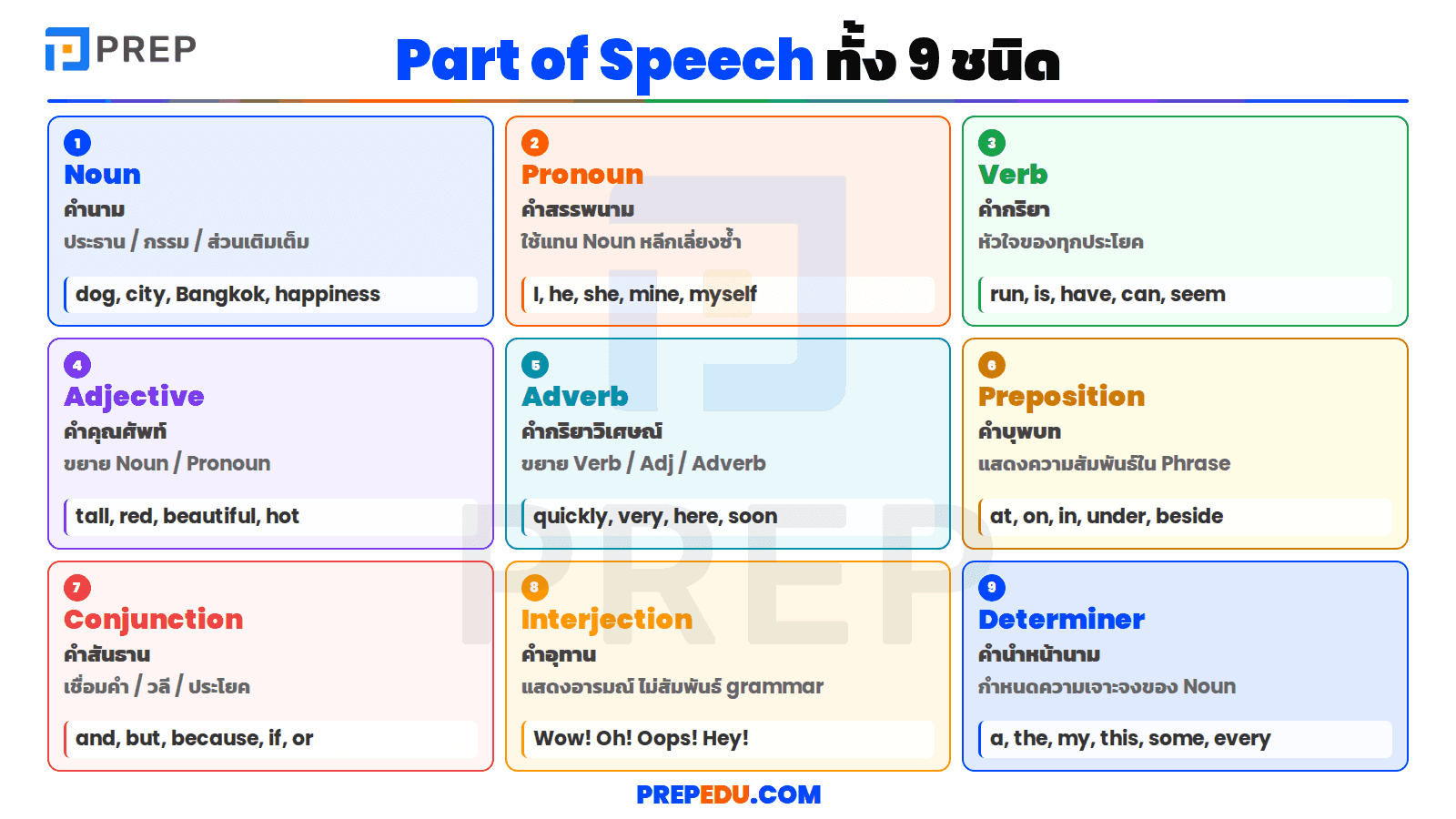
Part of speech ในภาษาอังกฤษมี 8 ชนิดหลักตามไวยากรณ์ดั้งเดิม และ 9 ชนิดตามไวยากรณ์สมัยใหม่ที่เพิ่ม Determiner เป็นชนิดที่ 9 ทั้งสองระบบใช้ได้ ขึ้นอยู่กับตำราที่อ้างอิง
ตารางด้านล่างสรุปครบทั้ง 9 ชนิด พร้อมตัวย่อที่ใช้ในพจนานุกรม Merriam-Webster และ Oxford หน้าที่หลัก และตัวอย่างคำ 3 คำที่พบบ่อย
|
ชื่อไทย |
ชื่ออังกฤษ |
ตัวย่อ |
หน้าที่หลัก |
ตัวอย่างคำ |
|
คำนาม |
Noun |
n. |
เรียกชื่อคน สัตว์ สิ่งของ สถานที่ |
dog, Bangkok, freedom |
|
คำสรรพนาม |
Pronoun |
pron. |
ใช้แทน Noun เพื่อไม่ให้ซ้ำ |
he, she, it |
|
คำกริยา |
Verb |
v. |
แสดงการกระทำหรือภาวะ |
run, eat, is |
|
คำคุณศัพท์ |
Adjective |
adj. |
ขยาย Noun/Pronoun |
tall, red, happy |
|
คำกริยาวิเศษณ์ |
Adverb |
adv. |
ขยาย Verb/Adjective/Adverb |
quickly, very, here |
|
คำบุพบท |
Preposition |
prep. |
แสดงความสัมพันธ์ของ Noun กับคำอื่น |
in, on, at |
|
คำสันธาน |
Conjunction |
conj. |
เชื่อมคำ วลี หรือประโยค |
and, but, because |
|
คำอุทาน |
Interjection |
interj. |
แสดงอารมณ์หรือปฏิกิริยา |
wow, oh, ouch |
|
คำนำหน้านาม |
Determiner |
det. |
ระบุหรือกำหนด Noun |
a, the, my |
III. 9 ชนิด Part of Speech อย่างละเอียด พร้อมตัวอย่างประโยค
1. Noun (คำนาม)
Noun คือคำที่ใช้เรียกชื่อคน สัตว์ สิ่งของ สถานที่ หรือแนวคิด - เป็น part of speech ที่ปรากฏในทุกประโยคในฐานะประธาน กรรม หรือส่วนเติมเต็ม
Noun แบ่งออกเป็น 4 ประเภทหลักที่ควรแยกให้ออก:
-
Common Noun (คำนามสามัญ) - เรียกชื่อทั่วไป ไม่เจาะจง: dog, city, book, teacher
-
Proper Noun (คำนามเฉพาะ) - ชื่อเฉพาะ ขึ้นต้นด้วยตัวพิมพ์ใหญ่: Bangkok, Apple, Sarah
-
Abstract Noun (คำนามนามธรรม) - สิ่งที่จับต้องไม่ได้: freedom, happiness, knowledge
-
Collective Noun (คำนามรวมหมู่) - เรียกกลุ่ม: team, flock, family
ตัวอย่างประโยค:
1. "The dog ran across the park." → the dog ทำหน้าที่เป็น Subject (Common Noun)
2. "Bangkok is the capital of Thailand." → Bangkok และ Thailand เป็น Proper Noun
คุณอาจมองข้ามตรงนี้: Abstract Noun อย่าง "happiness" หรือ "honesty" เป็น Noun เต็มตัว แม้จับต้องไม่ได้ก็ใช้เป็นประธานของประโยคได้ - "Honesty is the best policy."
บทความแนะนำอ่านเพิ่มเติม:
2. Pronoun (คำสรรพนาม)
Pronoun คือคำที่ใช้แทน Noun เพื่อหลีกเลี่ยงการพูดซ้ำ ทำให้ประโยคไหลลื่นและไม่ยืดยาว
ประเภทที่ใช้บ่อยที่สุด 3 ประเภท:
-
Personal Pronoun- แทนคนหรือสิ่งของในฐานะประธานหรือกรรม: I, you, he, she, it, we, they
-
Possessive Pronoun - แสดงความเป็นเจ้าของ: mine, yours, his, hers, ours, theirs
-
Reflexive Pronoun - สะท้อนกลับไปที่ประธาน: myself, yourself, himself, herself
ตัวอย่างประโยค:
1. "Maria lost her keys, so she had to call a locksmith." → her = Possessive Determiner; she = Personal Pronoun (แทน Maria)
2. "They built themselves a house." → They = Personal; themselves = Reflexive (สะท้อนกลับไปที่ They)
ระวัง: คำว่า "her", "his", "my" เมื่อตามด้วย Noun (her keys, my car) จะเป็น Possessive Determiner ไม่ใช่ Possessive Pronoun - Possessive Pronoun ใช้ยืนเดี่ยวเช่น "This book is mine"
3. Verb (คำกริยา)
Verb คือคำที่แสดงการกระทำ ภาวะ หรือสภาพของประธาน เป็นหัวใจของทุกประโยค - ไม่มี Verb ก็ไม่เป็นประโยคสมบูรณ์
Verb แบ่งออกเป็น 3 ประเภทที่ต้องแยกให้ออก:
-
Action Verb - แสดงการกระทำ: run, eat, write, jump
-
Linking Verb - เชื่อมประธานกับคำที่บรรยายประธาน: be (is, are, was), seem, become, look, smell, taste
-
Auxiliary Verb (คำช่วย) - ช่วยกริยาหลัก: have, will, can, should, do
ตัวอย่างประโยค:
1. "She runs 5 kilometers every morning." → runs = Action Verb (การกระทำ)
2. "The soup smells delicious." → smells = Linking Verb (ไม่ใช่การกระทำ แต่บอกสภาพของ soup)
Common Mistake ที่พบบ่อย: หลายคนคิดว่า smell, taste, look, feel เป็น Action Verb เสมอ แต่เมื่อตามด้วยคำขยายประธาน คำเหล่านี้เป็น Linking Verb - และคำที่ตามมาต้องเป็น Adjective ไม่ใช่ Adverb เช่น "The soup smells good" (✅) ไม่ใช่ "smells well" (❌)
4. Adjective (คำคุณศัพท์)
Adjective คือคำที่ขยาย Noun หรือ Pronoun เพื่อบอกลักษณะ ขนาด สี จำนวน หรือคุณสมบัติ - ทำให้ Noun ชัดเจนขึ้นว่าเป็น "อะไรแบบไหน"
Adjective วางได้ 2 ตำแหน่งหลัก:
-
Attributive (ก่อน Noun) - a tall building, a red car
-
Predicative (หลัง Linking Verb) - The building is tall. The car looks red.
ตัวอย่างประโยค:
1. "She bought a beautiful, red dress." → beautiful, red = Attributive Adjective (วางก่อน dress)
2. "The coffee is hot." → hot = Predicative Adjective (วางหลัง Linking Verb is)
ลำดับ Adjective หลายคำต่อกันมีกฎ - opinion → size → age → shape → color → origin (เช่น "a lovely small old round red Italian car") แต่ในระดับเริ่มต้น 2-3 คำต่อกันคั่นด้วย comma ใช้ได้
5. Adverb (คำกริยาวิเศษณ์)
Adverb คือคำที่ขยาย Verb, Adjective หรือ Adverb อื่น หรือขยายทั้งประโยค - บอก "อย่างไร เมื่อไร ที่ไหน มากแค่ไหน"
แบ่งตามความหมายเป็น 4 ประเภทที่พบบ่อย:
-
Adverb of Manner (วิธีการ) - quickly, carefully, well, badly
-
Adverb of Time (เวลา) - yesterday, soon, now, already
-
Adverb of Place (สถานที่) - here, there, abroad, everywhere
-
Adverb of Degree (ระดับ) - very, quite, extremely, almost, too
ตัวอย่างประโยค:
1. "She speaks English fluently." → fluently = Adverb of Manner (ขยาย Verb speaks)
2. "The movie was extremely long." → extremely = Adverb of Degree (ขยาย Adjective long)
ข้อสังเกตที่ช่วยจำ: Adverb ส่วนใหญ่ลงท้ายด้วย -ly (quickly, carefully, fluently) แต่ไม่ใช่ทั้งหมด - well, fast, hard, soon, here, there ก็เป็น Adverb เช่นกัน เรียกว่า "flat adverb" - รายละเอียดอยู่ในหัวข้อ VI
6. Preposition (คำบุพบท)
Preposition คือคำที่แสดงความสัมพันธ์ระหว่าง Noun หรือ Pronoun กับคำอื่นในประโยค มักวางหน้า Noun เสมอ (จึงเรียกว่า pre-position)
แบ่งออกเป็น 3 กลุ่มหลักตามความหมาย:
-
Preposition of Time (เวลา) - at, on, in, before, after, during, since
-
Preposition of Place (สถานที่) - at, on, in, under, beside, between, behind
-
Preposition of Direction (ทิศทาง) - to, from, into, through, across, towards
ข้อสังเกตสำคัญ: at, on, in ใช้ได้ทั้งเวลาและสถานที่ - แยกตามบริบทเท่านั้น
ตัวอย่างประโยค:
1. "The meeting is at 9 a.m. on Monday." → at = Preposition of Time (เวลาแน่นอน); on = Preposition of Time (วัน)
2. "She put the book on the table beside the lamp." → on = Preposition of Place; beside = Preposition of Place
คุณที่เป็นผู้เรียนไทยมักสับสนตรงนี้: ใช้ at/on/in สลับกันในเรื่องเวลา - กฎง่ายๆ คือ "at + เวลาเฉพาะ" (at 9 a.m.), "on + วัน/วันที่" (on Monday, on July 4), "in + เดือน/ปี/ช่วงเวลา" (in May, in 2026, in the morning)
7. Conjunction (คำสันธาน)
Conjunction คือคำที่ใช้เชื่อมคำ วลี หรือประโยคเข้าด้วยกัน ทำให้ประโยคซับซ้อนขึ้นและสื่อความสัมพันธ์ระหว่างความคิด
แบ่งเป็น 3 ประเภท:
-
Coordinating Conjunction - เชื่อมสิ่งที่เท่ากัน (วลีกับวลี ประโยคกับประโยค) จำง่ายด้วย FANBOYS: For, And, Nor, But, Or, Yet, So
-
Subordinating Conjunction - เชื่อมประโยคหลักกับประโยครอง: because, although, if, when, while, since, unless
-
Correlative Conjunction - ใช้คู่: either…or, neither…nor, both…and, not only…but also
ตัวอย่างประโยค:
1. "I wanted to sleep, but I had to study." → but = Coordinating Conjunction (เชื่อม 2 main clauses)
2. "Although it was raining, she went for a run." → Although = Subordinating Conjunction (นำหน้า dependent clause)
FANBOYS เป็น mnemonic ที่ใช้สอบ TOEIC ได้ตรงๆ - เมื่อเห็น comma + Coordinating Conjunction เชื่อม 2 ประโยคจะรู้ทันทีว่าเป็นโครงสร้าง compound sentence
8. Interjection (คำอุทาน)
Interjection คือคำหรือวลีที่แสดงอารมณ์หรือปฏิกิริยาทันที เช่น ความประหลาดใจ ความเจ็บปวด ความดีใจ ความผิดหวัง ลักษณะเด่นคือ ไม่มีความสัมพันธ์ทาง grammar กับส่วนอื่นของประโยค - ตัดออกประโยคก็ยังสมบูรณ์
มักตามด้วยเครื่องหมาย ! หรือ , และพบบ่อยในภาษาพูดและบทสนทนา
ตัวอย่างคำที่พบบ่อย: Oh! / Wow! / Oops! / Hey! / Well / Ouch! / Hurray! / Alas / Hmm
ตัวอย่างประโยค:
1. "Wow! That was an incredible performance." → Wow = Interjection (ความตื่นเต้น)
2. "Oops, I accidentally sent the wrong email." → Oops = Interjection (ความผิดพลาด)
ทั้ง 8 ชนิดนี้เป็นที่รู้จักกันดีในไวยากรณ์ดั้งเดิม แต่ยังมีชนิดที่ 9 ที่คุณอาจรู้จักผ่านๆ แต่ไม่เคยศึกษาแยกต่างหาก - Determiner ซึ่งเป็นต้นเหตุของความสับสน "a, the, my, this เป็น Adjective หรือเปล่า?"
9. Determiner คืออะไร? ชนิดที่ 9 ที่มักถูกสับสนกับ Adjective
Determiner (คำนำหน้านาม) คือคำที่มาก่อน Noun เพื่อ "กำหนด" ว่า Noun นั้นเจาะจง ไม่เจาะจง หรือมีจำนวนเท่าใด - เช่น a, an, the, this, that, my, some, every ความต่างที่สำคัญที่สุดจาก Adjective คือ Determiner กำหนด Noun (ว่า Noun นั้นคือตัวไหน) ส่วน Adjective บรรยาย Noun (ว่า Noun นั้นเป็นอย่างไร)
Determiner แบ่งออกเป็น 4 กลุ่มหลัก:
-
Articles - a, an, the
-
Demonstrative Determiners - this, that, these, those
-
Possessive Determiners - my, your, his, her, its, our, their
-
Quantifiers - some, any, every, all, each, many, few, several
Cambridge Grammar of English (Carter & McCarthy, 2006) กำหนดให้ Determiner เป็น word class แยกจาก Adjective อย่างชัดเจน โดยระบุว่า "Determiners precede adjectives in the noun phrase" - แสดงถึงลำดับที่ตายตัว: Determiner → Adjective → Noun เช่น "my beautiful garden" ไม่ใช่ "beautiful my garden"
ตารางด้านล่างเปรียบเทียบ Determiner กับ Adjective ใน 3 มิติที่ใช้แยกได้ทันที:
|
มิติ |
Determiner |
Adjective |
|
หน้าที่ |
กำหนด Noun (ตัวไหน/เท่าไร) |
บรรยาย Noun (อย่างไร) |
|
ตำแหน่ง |
มาก่อน Adjective เสมอ |
อยู่หลัง Determiner ก่อน Noun |
|
Quick Test |
เติม "very" นำหน้าไม่ได้ |
เติม "very" นำหน้าได้ |
วิธีแยก Determiner กับ Adjective ด้วย "very test": ลองเติม "very" นำหน้าคำที่สงสัย ถ้าได้ความหมาย = Adjective ถ้าไม่ได้ = Determiner
-
"very beautiful" ✅ → beautiful = Adjective
-
"very the" ❌ → the = Determiner
-
"very happy" ✅ → happy = Adjective
-
"very my" ❌ → my = Determiner (Possessive)
-
"very some" ❌ → some = Determiner (Quantifier)
นี่คือสาเหตุที่ตำราบางเล่มนับ part of speech เป็น 8 ชนิด (รวม Determiner เข้าไปใน Adjective) ส่วนตำราสมัยใหม่นับ 9 ชนิด (แยก Determiner ออกมา) - ทั้งสองวิธีถูกต้องในบริบทของตัวเอง แต่การแยก Determiner ออกมาจะอธิบายโครงสร้าง noun phrase ได้แม่นยำกว่า
นอกจาก Determiner แล้ว ยังมีอีกปรากฏการณ์หนึ่งที่ทำให้คุณอาจสับสนซ้ำ - คำเดียวกันสามารถเป็นได้หลาย part of speech ขึ้นอยู่กับประโยค
IV. คำที่สลับ Part of Speech ได้ตามบริบทประโยค
Part of speech ไม่ได้ติดอยู่กับรูปร่างของคำ แต่ถูกกำหนดโดย หน้าที่ที่คำนั้นทำในประโยคนั้น คำเดียวกันจึงเป็นได้หลาย part of speech ขึ้นอยู่กับตำแหน่งและงานที่ทำ ตัวอย่างคำว่า "fast" เป็น Adjective ใน "a fast car" (ขยาย Noun car) แต่เป็น Adverb ใน "She runs fast" (ขยาย Verb runs) - ตัวสะกดเหมือนกันทุกตัวอักษร แต่ทำงานคนละแบบ
ตารางด้านล่างแสดง 6 คำที่พบบ่อยและสลับ part of speech ได้ พร้อมตัวอย่างประโยคที่แสดงความต่าง:
|
คำ |
POS ที่เป็นได้ |
ตัวอย่างประโยค |
|
fast |
Adjective / Adverb |
"a fast car" (Adj) / "She runs fast" (Adv) |
|
for |
Preposition / Conjunction |
"a book for her" (Prep) / "He smiled, for he was happy" (Conj) |
|
light |
Noun / Adjective / Verb |
"turn on the light" (N) / "a light bag" (Adj) / "Light the candle" (V) |
|
well |
Adverb / Adjective / Interjection |
"She speaks well" (Adv) / "I'm not well" (Adj) / "Well, let's go" (Interj) |
|
round |
Adj / Adv / Verb / Noun |
"a round table" (Adj) / "turn round" (Adv) / "round the corner" (Prep) / "the next round" (N) |
|
still |
Adjective / Adverb / Verb |
"still water" (Adj) / "She still loves him" (Adv) / "still the engine" (V) |
วิธีระบุ part of speech ของคำที่สลับได้ ใช้ 3 ขั้นตอนนี้:
1. ดูตำแหน่ง - คำนี้อยู่ตรงไหนในประโยค? อยู่ก่อน Noun (อาจเป็น Adj/Det), อยู่หลัง Verb (อาจเป็น Adv/Noun-object), อยู่หลัง Linking Verb (อาจเป็น Adj predicative)
2. ดูหน้าที่ - คำนี้กำลังขยายอะไร แสดงการกระทำอะไร หรือเชื่อมอะไร? "fast" ใน "a fast car" ขยาย car (Noun) → Adjective; "fast" ใน "runs fast" ขยาย runs (Verb) → Adverb
3. ดูคำข้างเคียง - มี Linking Verb อยู่ก่อนหน้าไหม? มี Noun ตามหลังไหม? คำข้างเคียงช่วยยืนยันบทบาท
ตอนนี้คุณเข้าใจทุกชนิดและรู้ว่าคำเดียวกันสลับ part of speech ได้แล้ว แต่ยังมีจุดสับสนที่ใหญ่ที่สุดในหมู่ผู้เรียนไทย - คู่ที่ทำคะแนน TOEIC Part 5 หายไปบ่อยที่สุด: Adjective กับ Adverb
V. Adjective กับ Adverb ต่างกันอย่างไร? วิธีแยกให้ถูกทุกครั้ง
Adjective ขยาย Noun หรือ Pronoun เพื่อบรรยายลักษณะ (a beautiful song) ส่วน Adverb ขยาย Verb, Adjective หรือ Adverb อื่น (She sings beautifully) วิธีแยกที่เร็วและแม่นที่สุดคือถามคำถามเดียว: "คำนี้ขยายอะไร?" - ถ้าขยาย Noun = Adjective, ถ้าขยาย Verb/Adjective/Adverb = Adverb
ตารางความต่างหลักระหว่าง Adjective กับ Adverb:
|
มิติ |
Adjective |
Adverb |
|
ขยาย |
Noun, Pronoun |
Verb, Adjective, Adverb อื่น, ทั้งประโยค |
|
ตำแหน่ง |
ก่อน Noun / หลัง Linking Verb |
หลัง Action Verb / ก่อน Adj/Adv ที่ขยาย |
|
ตัวอย่าง |
a quick runner / The runner is quick |
She runs quickly / extremely fast |
คู่คำที่สับสนบ่อยที่สุด
|
คำ |
ความหมาย Adj |
ความหมาย Adv |
Common Mistake |
|
good / well |
"a good job" (ดี - ขยาย Noun) |
"She did well" (ทำได้ดี - ขยาย Verb) |
❌ "She did good" → ควรเป็น well |
|
hard / hardly |
"hard work" (หนัก - Adj) |
"work hard" (หนัก - Adv) |
hardly = แทบจะไม่ (ความหมายต่างจาก hard) เช่น "I can hardly see" = แทบมองไม่เห็น |
|
fast |
"a fast car" (เร็ว - Adj) |
"She runs fast" (เร็ว - Adv) |
❌ "She runs fastly" → ไม่มีคำว่า fastly, ใช้ fast เป็น flat adverb |
|
late / lately |
"a late flight" (สาย - Adj) / "arrive late" (สาย - Adv) |
lately = recently (เร็วๆ นี้) |
❌ "I haven't seen him late" → ควรเป็น lately (เร็วๆ นี้) |
จุดสำคัญที่ต้องจำ: คำที่ลงท้ายด้วย -ly ไม่ได้เป็น Adverb เสมอ - friendly, lovely, lonely, lively เป็น Adjective ทั้งหมด (ขยาย Noun: "a friendly dog") และ Adverb บางคำไม่ลงท้ายด้วย -ly - fast, hard, late, high, well เรียกว่า flat adverb
VI. แบบฝึกหัดแยก Part of Speech พร้อมเฉลย
1. แบบฝึกหัดที่ 1 - ระบุชนิดของคำ: คำที่พิมพ์ตัวหนาในแต่ละประโยคเป็น Part of Speech ชนิดใด?
- She quickly finished her homework before dinner.
- The beautiful garden attracted many visitors last spring.
- Ouch! That really hurt my arm.
- He placed the report on the director's desk.
- I wanted to go, but it was raining heavily outside.
- They have been working on this project for six months.
- The scientist published an important discovery in a medical journal.
- The soup tastes wonderful with fresh herbs.
- Her presentation impressed the entire board of directors.
- The new policy was surprisingly effective in reducing costs.
เฉลยพร้อมคำอธิบาย:
[prep_collapse_expand open_text="View more" close_text="Show less"]
-
Adverb
-
Adjective
-
Interjection
-
Preposition
-
Conjunction
-
Pronoun
-
Noun
-
Verb (Linking Verb)
-
Determiner
-
Adverb
[/prep_collapse_expand]
2. แบบฝึกหัดที่ 2 - เลือกคำที่ถูกต้อง
-
The new employee performed ___ on her first major assignment.
(A) excellent (B) excellence (C) excellently (D) excel
-
___ she had studied all night, she still struggled with the exam.
(A) Despite (B) Although (C) However (D) Therefore
-
The company celebrated ___ 50th anniversary with a grand ceremony.
(A) them (B) they (C) their (D) themselves
-
She felt ___ after receiving the unexpected job offer.
(A) overjoyed (B) overjoyedly (C) overjoy (D) overjoyful
-
The team placed the equipment ___ the storage room before leaving.
(A) since (B) unless (C) inside (D) whether
-
His ___ explanation helped the students understand the concept quickly.
(A) clearly (B) clearness (C) clear (D) clearing
-
___ the heavy traffic, she arrived at the meeting on time.
(A) Although (B) Despite (C) However (D) Because
-
The researchers worked ___ to complete the study before the deadline.
(A) tireless (B) tirelessness (C) tirelessly (D) tire
-
The investors reviewed ___ proposal carefully before signing the contract.
(A) our (B) we (C) us (D) ours
-
The results of the experiment were ___ different from what the team expected.
(A) dramatic (B) dramatical (C) drama (D) dramatically
เฉลยพร้อมคำอธิบาย:
[prep_collapse_expand open_text="View more" close_text="Show less"]
-
(C) excellently
-
(B) Although
-
(C) their
-
(A) overjoyed
-
(C) inside
-
(C) clear
-
(B) Despite
-
(C) tirelessly
-
(A) our
-
(D) dramatically
[/prep_collapse_expand]
VII. คำถามที่พบบ่อยเกี่ยวกับ Part of Speech
1. "for" เป็น Part of Speech อะไร?
คำว่า "for" เป็นได้ทั้ง Preposition และ Conjunction ขึ้นอยู่กับบริบทประโยค เมื่อ "for" ตามด้วย Noun หรือ Pronoun = Preposition (แสดงความสัมพันธ์) เช่น "a gift for her" เมื่อ "for" เชื่อม 2 clauses และมีความหมายว่า "because" = Conjunction เช่น "He left early, for he was tired"
ตารางเปรียบเทียบ 2 กรณี:
|
กรณี |
สัญลักษณ์ที่บอก |
ความหมาย |
ตัวอย่าง |
|
Preposition |
for + Noun/Pronoun |
สำหรับ / เพื่อ |
"This book is for you." / "Thanks for your help." |
|
Conjunction |
for เชื่อม 2 clauses (มี comma ก่อน for) |
because |
"She was tired, for she had worked all day." / "He smiled, for he was happy." |
วิธีจำ: ถ้าตัด "for + คำตามหลัง" ออกแล้วประโยคยังสมบูรณ์ → for เป็น Preposition (วลีเสริม) ถ้าตัดออกแล้วเหลือประโยคไม่สมบูรณ์ → for เป็น Conjunction (เชื่อม clause)
2. Part of Speech มี 8 ชนิดหรือ 9 ชนิดกันแน่?
Traditional grammar จำแนก part of speech เป็น 8 ชนิด ซึ่งใช้ในตำรา grammar ทั่วไปและในตำราเรียนภาษาอังกฤษระดับ ม.ต้น-ม.ปลายของไทย ส่วน Cambridge Grammar of English (Carter & McCarthy, 2006) และ A Student's Introduction to English Grammar (Huddleston & Pullum, 2005) เพิ่ม Determiner เป็นชนิดที่ 9 เนื่องจากทำหน้าที่แตกต่างจาก Adjective อย่างชัดเจน ทั้งสองระบบถูกต้อง ขึ้นอยู่กับตำราที่ใช้อ้างอิง
ถ้าคุณเตรียมสอบในไทย: ระบบ 8 ชนิดเป็นที่ใช้ในข้อสอบส่วนใหญ่ แต่การเข้าใจ Determiner แยกออกมาจะช่วยให้ตอบโจทย์ word order และ noun phrase structure ได้แม่นยำขึ้น
3. ตัวย่อ Part of Speech ในพจนานุกรม n., v., adj., adv., prep. คืออะไร?
ตัวย่อ part of speech ที่ใช้ในพจนานุกรมมาตรฐาน เช่น Merriam-Webster และ Oxford English Dictionary:
|
ตัวย่อ |
Full Form |
ความหมาย |
|
n. |
noun |
คำนาม |
|
v. |
verb |
คำกริยา |
|
adj. |
adjective |
คำคุณศัพท์ |
|
adv. |
adverb |
คำกริยาวิเศษณ์ |
|
prep. |
preposition |
คำบุพบท |
|
conj. |
conjunction |
คำสันธาน |
|
pron. |
pronoun |
คำสรรพนาม |
|
interj. |
interjection |
คำอุทาน |
|
det. |
determiner |
คำนำหน้านาม |
ตัวอย่างการอ่านพจนานุกรม: เมื่อค้นคำว่า "light" ใน Merriam-Webster จะเห็นรายการแบ่งเป็นหลายส่วน - "light n. (1)" = light เป็น Noun ความหมายแรก, "light v." = light เป็น Verb, "light adj." = light เป็น Adjective - แสดงว่าคำนี้สลับ part of speech ได้ตามที่อธิบายในหัวข้อ V
4. Gerund คือ Noun หรือ Verb?
Gerund คือ verb form ที่ลงท้ายด้วย -ing (เช่น swimming, reading, cooking) ซึ่งทำหน้าที่เป็น Noun ในประโยค รูปร่างเป็น Verb แต่ตำแหน่งและหน้าที่เป็น Noun ตัวอย่าง: "Swimming is good exercise." - Swimming ทำหน้าที่เป็น Subject (ตำแหน่ง Noun) แม้รูปคำลงท้าย -ing
จุดที่คุณอาจสับสน: Gerund (swimming = Noun) ดูเหมือน Present Participle (is swimming = Verb form) แต่ทำหน้าที่ต่างกัน - Gerund เป็น Subject/Object (Noun position) ส่วน Present Participle เป็นส่วนหนึ่งของ Verb tense
การรู้ part of speech เป็นแค่จุดเริ่มต้น - ขั้นตอนถัดไปคือนำไปใช้ในโจทย์ grammar จริงและฝึกจนกลายเป็นทักษะอัตโนมัติเวลาอ่าน เขียน หรือทำข้อสอบ PREP มีคอร์สที่ฝึกทักษะ grammar ผ่านบริบทจริงจากข้อสอบ TOEIC และ IELTS โดยมีบทเรียนเฉพาะเรื่อง word form, sentence structure และ part of speech ในประโยคซับซ้อน เพื่อให้คุณเปลี่ยนความรู้ทฤษฎีเป็นคะแนนสอบที่วัดผลได้จริง
หากคุณต้องการพัฒนาทักษะไวยากรณ์และความเข้าใจ part of speech ให้แข็งแกร่งยิ่งขึ้น PREP Edu มีหลักสูตร IELTS Course ที่ครอบคลุมการสอนไวยากรณ์อย่างเป็นระบบ ตั้งแต่ระดับพื้นฐานจนถึงขั้นสูง พร้อมแบบฝึกหัดที่หลากหลายและการติดตามผลการเรียนแบบรายบุคคล ซึ่งจะช่วยให้คุณสามารถนำความรู้เรื่อง part of speech ไปใช้ในการสอบ IELTS และการสื่อสารในชีวิตจริงได้อย่างมั่นใจ

สวัสดีค่ะ ฉันชื่อมุก ปัจจุบันดูแลด้านเนื้อหาผลิตภัณฑ์ของ Prep Education ค่ะ
ด้วยประสบการณ์มากกว่า 5 ปีในการเรียน IELTS ออนไลน์ด้วยตนเอง ฉันเข้าใจดีถึงความท้าทายที่ผู้เรียนต้องเผชิญ แล้วก็รู้ว่าอะไรที่มันเวิร์ก
มุกอยากเอาประสบการณ์ตรงนี้มาช่วยแชร์ แล้วก็ซัพพอร์ตเพื่อน ๆ ให้ได้คะแนนที่ดีที่สุดค่ะ
ความคิดเห็น
เนื้อหาแบบพรีเมียม
ดูทั้งหมด



แผนการเรียนรู้ส่วนบุคคล


อ่านมากที่สุด




ติดต่อ Prep ผ่านโซเชียล





Address: ตึก C.P. Tower 2 (ฟอร์จูนทาวน์) ชั้น 21 ถนนรัชดาภิเษก แขวงดินแดง เขตดินแดง กรุงเทพฯ 10400
Hotline: +66 25 44 0068
Email: sawatdee@prepedu.com