Noun ภาษาอังกฤษ ฉบับสมบูรณ์: 8 ประเภท คำนาม 100 คำ พร้อมคำแปล กฎพหูพจน์ และ Articles
การเขียนภาษาอังกฤษให้ถูกหลักไวยากรณ์ต้องเริ่มต้นที่ คำนาม เพราะ Noun เป็นชนิดของคำที่พบบ่อยที่สุดและใช้มากที่สุดในทุกประโยค ผู้เรียนชาวไทยส่วนใหญ่ลืมเติม -s ที่ plural บ่อย ใช้ a/an ผิด หรือสับสนระหว่าง countable กับ uncountable เพราะภาษาไทยไม่มีระบบเอกพจน์–พหูพจน์และไม่มี article system ที่ตรงกัน ปัญหาเหล่านี้ไม่ได้มาจากการขาดความสามารถ แต่มาจากการขาดระบบที่ถูกต้อง
บทความนี้รวบรวมทุกมิติของ คำนาม ภาษาอังกฤษ ไว้ในที่เดียว ได้แก่ 8 ประเภท Noun พร้อมตัวอย่าง, รายการ คำนาม 100 คำพร้อมคำแปลไทย แบ่งเป็น 8 หมวด, กฎเปลี่ยน Singular เป็น Plural รวม Irregular Plurals 16 คู่, การแยก Countable กับ Uncountable พร้อม Measure Words 22 หน่วย, Compound Noun 3 รูปแบบ, Noun Suffixes 10 แบบ, การใช้ Articles (a/an/the/zero) กับ Possessive Form, 5 ข้อผิดพลาดของคนไทย พร้อม แบบฝึกหัด 15 ข้อ มีเฉลย
หลังจากอ่านจบ คุณจะมีคลังศัพท์ noun 100 คำ เข้าใจกฎไวยากรณ์ครบถ้วน และรู้วิธีฝึกใช้ noun ในการเขียนกับการพูดอย่างมั่นใจ
- I. Noun (คำนาม ภาษาอังกฤษ) คืออะไร? และทำหน้าที่อะไรในประโยค
- II. 8 ประเภทของ Noun: Common, Proper, Concrete, Abstract, Countable, Uncountable, Collective, Compound
- III. คำนาม 100 คำพร้อมคำแปลไทย - แบ่งตาม 8 หมวด
- 1. คำนามเกี่ยวกับ "คน" (People)
- 2. คำนามเกี่ยวกับ "สถานที่" (Places)
- 3. คำนามเกี่ยวกับ "สิ่งของ" (Things)
- 4. คำนามเกี่ยวกับ "สัตว์" (Animals)
- 5. คำนามเกี่ยวกับ "ส่วนของร่างกาย" (Body Parts)
- 6. คำนามเกี่ยวกับ "อาหารและเครื่องดื่ม" (Food & Drinks)
- 7. คำนามเกี่ยวกับ "เวลาและธรรมชาติ" (Time & Nature)
- 8. คำนามแนวคิดและความรู้สึก (Abstract)
- IV. Singular vs Plural: กฎการเติม s/es และ Irregular Plurals
- V. Countable vs Uncountable Nouns + Measure Words
- VI. Compound Nouns + Noun Suffixes - วิธีสร้างคำนามใหม่
- VII. การใช้ Articles (a/an/the/zero) + Possessive Form กับคำนาม
- VII. แบบฝึกหัด Noun พร้อมเฉลย
- IX. คำถามที่พบบ่อยเกี่ยวกับ Noun (FAQ)
Key Takeaways
- คำนาม ภาษาอังกฤษ (Noun) คือคำที่ใช้เรียกชื่อบุคคล สถานที่ สิ่งของ สัตว์ แนวคิด หรือความรู้สึก เป็นองค์ประกอบพื้นฐานที่สำคัญที่สุดในประโยค
- คำนามแบ่งออกเป็น 8 ประเภทหลัก: Common Noun, Proper Noun, Concrete Noun, Abstract Noun, Countable Noun, Uncountable Noun, Collective Noun และ Compound Noun
- คำนามภาษาอังกฤษ มีอะไรบ้าง ที่ใช้บ่อย รวมถึงคำนามที่เกี่ยวกับคน (teacher, doctor), สถานที่ (school, hospital), สิ่งของ (book, phone) และแนวคิด (love, happiness)
I. Noun (คำนาม ภาษาอังกฤษ) คืออะไร? และทำหน้าที่อะไรในประโยค
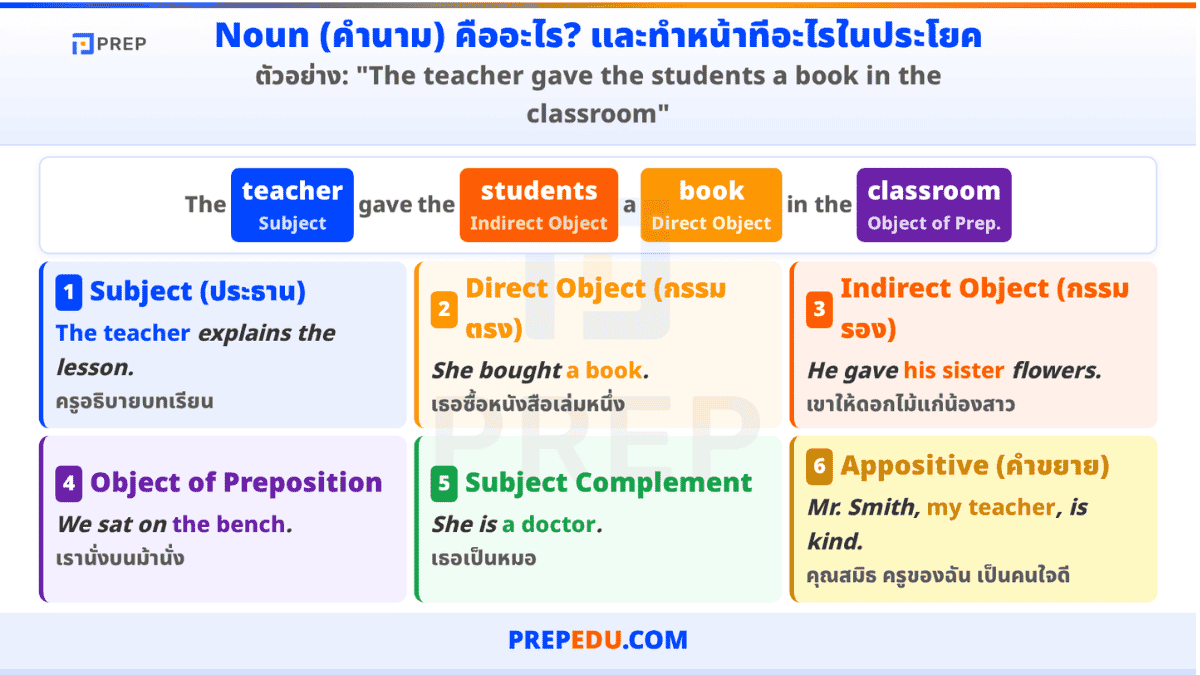
Noun (คำนาม) ในภาษาอังกฤษ คือคำที่ใช้เรียกชื่อบุคคล สถานที่ สิ่งของ สัตว์ แนวคิด หรือความรู้สึก เป็น 1 ใน 8 ชนิดของคำ (Part of Speech) และทำหน้าที่ได้ 6 ตำแหน่งในประโยค: Subject, Direct Object, Indirect Object, Object of Preposition, Subject Complement และ Appositive
1. นิยาม Noun ตามหลักภาษาศาสตร์
คำนาม คือ "a word that refers to a person, place, thing, event, substance, or quality" หรือคำที่ใช้อ้างถึงคน สถานที่ สิ่งของ เหตุการณ์ สสาร หรือคุณลักษณะ ตามพจนานุกรม Cambridge Dictionary Noun เป็น คำชนิดที่ 1 ในระบบ Part of Speech 8 ชนิด ตาม "A Comprehensive Grammar of the English Language" ของ Quirk และคณะ (1985)
ระบบ Part of Speech 8 ชนิดประกอบด้วย Noun (คำนาม), Pronoun (สรรพนาม), Verb (กริยา), Adjective (คุณศัพท์), Adverb (กริยาวิเศษณ์), Preposition (บุพบท), Conjunction (สันธาน) และ Interjection (อุทาน) Noun เป็นจุดเริ่มต้นของทุกประโยค เพราะประโยคพื้นฐานต้องมีประธาน และประธานเกือบทุกครั้งคือ noun หรือ pronoun
2. 6 หน้าที่ของ Noun ในประโยค
Noun ทำหน้าที่ได้ 6 ตำแหน่งในประโยคภาษาอังกฤษ ผู้เรียนชาวไทยมักเข้าใจแค่ Subject กับ Object แต่ความจริงมีถึง 6 บทบาท:
|
หน้าที่ |
คำอธิบาย |
ตัวอย่าง |
|
Subject (ประธาน) |
ผู้กระทำกริยา |
**The teacher** explains the lesson. (ครูอธิบายบทเรียน) |
|
Direct Object (กรรมตรง) |
สิ่งที่ถูกกระทำ |
She bought **a book**. (เธอซื้อหนังสือเล่มหนึ่ง) |
|
Indirect Object (กรรมรอง) |
ผู้รับการกระทำ |
He gave **his sister** flowers. (เขาให้ดอกไม้แก่น้องสาว) |
|
Object of Preposition |
กรรมของบุพบท |
We sat on **the bench**. (เรานั่งบนม้านั่ง) |
|
Subject Complement |
คำเสริมประธานหลัง verb to be |
She is **a doctor**. (เธอเป็นหมอ) |
|
Appositive |
คำขยายความนามอีกตัว |
Mr. Smith, **my teacher**, is kind. (คุณสมิธ ครูของฉัน เป็นคนใจดี) |
3. ความสำคัญของ Noun สำหรับผู้เรียนภาษาอังกฤษ
ในภาษาอังกฤษทั่วไป noun คิดเป็นประมาณ 25–30% ของคำในข้อความเขียน ตามผลการวิเคราะห์ corpus ของ Cambridge English การเข้าใจ Noun อย่างเป็นระบบจึงเท่ากับเข้าใจ 1 ใน 4 ของทุกคำที่คุณอ่านและเขียน ผู้เรียนที่ละเลยกฎ noun จะพบปัญหา 3 อย่างทันที: ลืมเติม -s ที่พหูพจน์, ใช้ article ผิด และสับสน countable กับ uncountable
ภาษาไทยใช้คำนามไม่เปลี่ยนรูปและไม่ต้องใส่ article ทำให้ผู้เรียนชาวไทยต้อง สร้างระบบใหม่ในหัว ก่อนที่จะใช้ภาษาอังกฤษได้คล่อง การลงรากฐานที่ noun ตั้งแต่ต้นจึงสำคัญที่สุดสำหรับผู้เรียน CEFR ระดับ A1 ถึง B1
II. 8 ประเภทของ Noun: Common, Proper, Concrete, Abstract, Countable, Uncountable, Collective, Compound
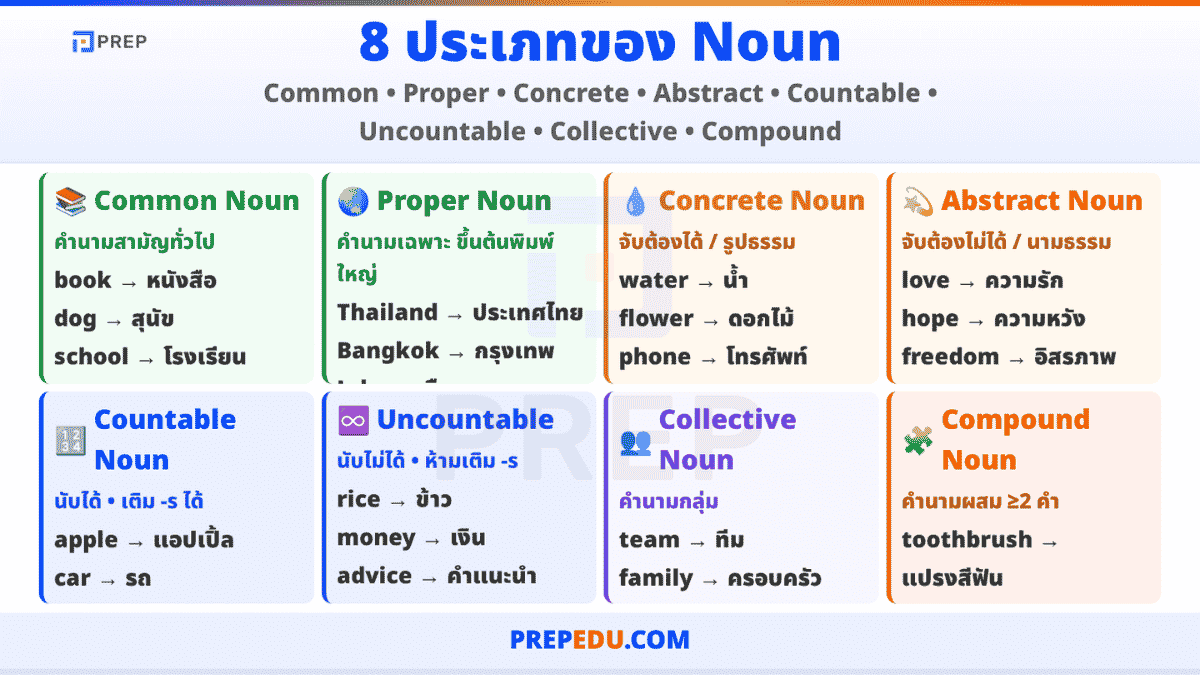
คำนามในภาษาอังกฤษแบ่งเป็น 8 ประเภทหลัก: (1) Common Noun (คำนามสามัญ), (2) Proper Noun (คำนามเฉพาะ), (3) Concrete Noun (คำนามรูปธรรม), (4) Abstract Noun (คำนามนามธรรม), (5) Countable Noun (นับได้), (6) Uncountable Noun (นับไม่ได้), (7) Collective Noun (คำนามกลุ่ม), และ (8) Compound Noun (คำนามผสม)
1. Common Noun vs Proper Noun
Common Noun คือคำนามสามัญที่ใช้เรียกสิ่งทั่วไปและไม่ขึ้นต้นด้วยตัวพิมพ์ใหญ่ ส่วน Proper Noun คือคำนามเฉพาะที่ใช้เรียกสิ่งที่ระบุตัวตนชัดเจน เช่น ชื่อคน ชื่อประเทศ ชื่อเดือน และต้องขึ้นต้นด้วยตัวพิมพ์ใหญ่เสมอ
|
Common Noun |
Proper Noun |
|
country (ประเทศ) |
Thailand (ประเทศไทย) |
|
city (เมือง) |
Bangkok (กรุงเทพ) |
|
month (เดือน) |
January (มกราคม) |
|
language (ภาษา) |
English (ภาษาอังกฤษ) |
|
teacher (ครู) |
Mr. Somchai (คุณสมชาย) |
2. Concrete Noun vs Abstract Noun
Concrete Noun คือคำนามรูปธรรมที่จับต้องได้และรับรู้ได้ด้วยประสาทสัมผัสทั้ง 5 เช่น book, water, flower ส่วน Abstract Noun คือคำนามนามธรรมที่จับต้องไม่ได้ เป็นแนวคิด ความรู้สึก หรือคุณสมบัติ เช่น love, happiness, freedom
|
Concrete Noun |
Abstract Noun |
|
chair (เก้าอี้) |
freedom (อิสรภาพ) |
|
coffee (กาแฟ) |
hope (ความหวัง) |
|
dog (สุนัข) |
success (ความสำเร็จ) |
|
rain (ฝน) |
knowledge (ความรู้) |
|
phone (โทรศัพท์) |
courage (ความกล้าหาญ) |
3. Countable Noun vs Uncountable Noun
Countable Noun คือคำนามที่นับได้และมีรูปเอกพจน์กับพหูพจน์ ใช้กับ a/an ได้และเติม -s ได้ ส่วน Uncountable Noun คือคำนามที่นับไม่ได้และไม่มีรูปพหูพจน์ ห้ามเติม -s และห้ามใช้ a/an
|
Countable |
Uncountable |
|
apple → apples (แอปเปิ้ล) |
rice (ข้าว) |
|
book → books (หนังสือ) |
water (น้ำ) |
|
car → cars (รถ) |
money (เงิน) |
|
friend → friends (เพื่อน) |
information (ข้อมูล) |
|
idea → ideas (ความคิด) |
advice (คำแนะนำ) |
บทความแนะนำ:
4. Collective Noun
Collective Noun คือคำนามกลุ่มที่ใช้เรียกคน สัตว์ หรือสิ่งของรวมกันเป็นหน่วยเดียว เช่น a team (ทีม), a family (ครอบครัว), a herd of cattle (ฝูงวัว) ในแบบ American English มักใช้กริยาเอกพจน์กับ collective noun แต่ British English ใช้ได้ทั้งเอกพจน์และพหูพจน์ตามบริบท
ตัวอย่าง: The team is winning. (American - ทีมกำลังชนะ) vs The team are arguing. (British - สมาชิกในทีมกำลังเถียงกัน) ใช้กริยาพหูพจน์เพื่อเน้นว่าหมายถึงสมาชิกแต่ละคน
5. Compound Noun
Compound Noun คือคำนามผสมที่เกิดจากการนำคำตั้งแต่ 2 คำมารวมกันเพื่อสร้างความหมายใหม่ เขียนได้ 3 รูปแบบ: closed (toothbrush), hyphenated (mother-in-law) และ open (post office) รายละเอียดอยู่ใน H2 VI
6. ตารางสรุป 8 ประเภท
|
ประเภท |
นิยามสั้น |
ตัวอย่าง |
|
Common |
คำนามสามัญทั่วไป |
book, dog, school |
|
Proper |
คำนามเฉพาะ |
Thailand, Mary, July |
|
Concrete |
จับต้องได้ |
water, table, flower |
|
Abstract |
จับต้องไม่ได้ |
love, peace, beauty |
|
Countable |
นับได้ |
apple, car, idea |
|
Uncountable |
นับไม่ได้ |
rice, money, advice |
|
Collective |
คำนามกลุ่ม |
team, family, herd |
|
Compound |
คำนามผสม |
toothbrush, post office |
III. คำนาม 100 คำพร้อมคำแปลไทย - แบ่งตาม 8 หมวด
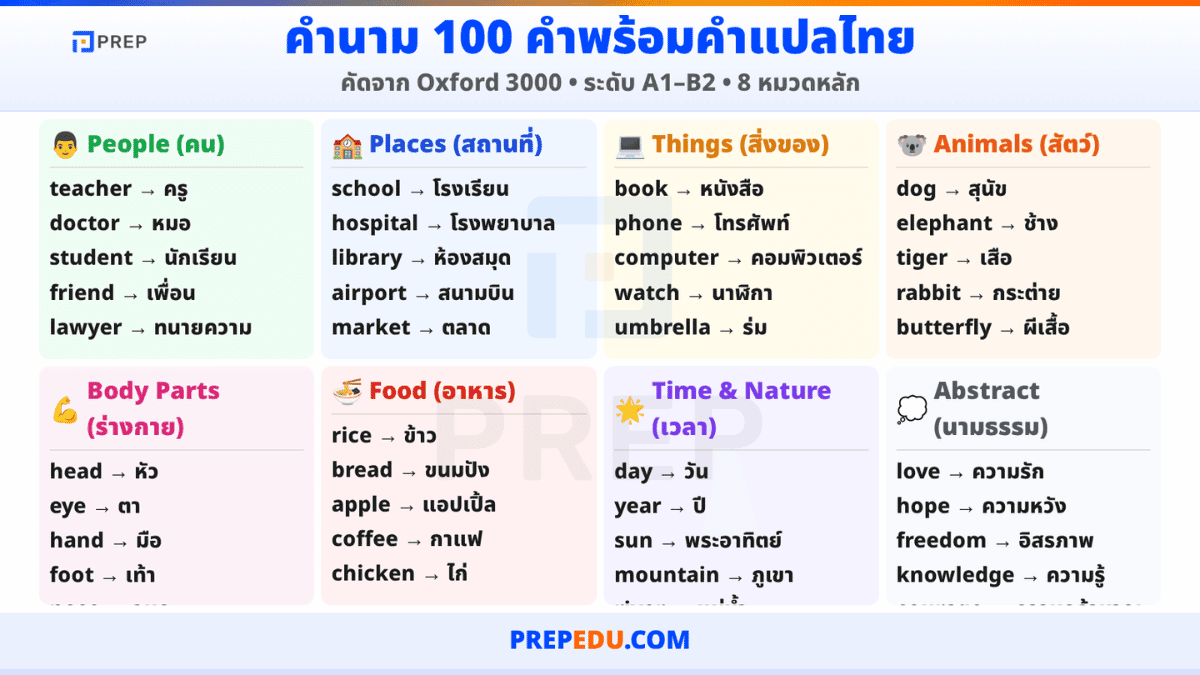
คำนามภาษาอังกฤษพื้นฐาน 100 คำที่ผู้เรียนชาวไทยควรรู้แบ่งเป็น 8 หมวด: คน (people), สถานที่ (places), สิ่งของ (things), สัตว์ (animals), ส่วนของร่างกาย (body parts), อาหาร (food), เวลาและธรรมชาติ (time & nature), และคำนามนามธรรม (abstract)
คำนาม 100 คำในรายการนี้คัดจากระดับ A1–B2 เหมาะสำหรับสร้างคลังศัพท์พื้นฐานก่อนเตรียมสอบ IELTS หรือ TOEIC โดยอ้างอิงจาก Oxford 3000 Word List ซึ่งเป็นคำหลักที่ใช้บ่อยที่สุดในภาษาอังกฤษ
1. คำนามเกี่ยวกับ "คน" (People)
|
คำนาม /IPA/ |
คำแปลไทย |
ประเภท Noun |
ตัวอย่างประโยคพร้อมแปล |
|
teacher /ˈtiːtʃər/ |
ครู |
Countable |
My teacher is kind. (ครูของฉันใจดี) |
|
doctor /ˈdɒktər/ |
หมอ |
Countable |
The doctor helps patients. (หมอช่วยเหลือผู้ป่วย) |
|
mother /ˈmʌðər/ |
แม่ |
Countable |
My mother cooks well. (แม่ของฉันทำอาหารเก่ง) |
|
father /ˈfɑːðər/ |
พ่อ |
Countable |
His father is a lawyer. (พ่อของเขาเป็นทนาย) |
|
brother /ˈbrʌðər/ |
พี่ชาย/น้องชาย |
Countable |
I have one brother. (ฉันมีพี่ชายหนึ่งคน) |
|
sister /ˈsɪstər/ |
พี่สาว/น้องสาว |
Countable |
Her sister lives in Bangkok. (น้องสาวของเธออยู่กรุงเทพ) |
|
student /ˈstjuːdənt/ |
นักเรียน |
Countable |
The student studies hard. (นักเรียนตั้งใจเรียน) |
|
friend /frend/ |
เพื่อน |
Countable |
She is my best friend. (เธอเป็นเพื่อนสนิทของฉัน) |
|
neighbor /ˈneɪbər/ |
เพื่อนบ้าน |
Countable |
Our neighbor is friendly. (เพื่อนบ้านของเราเป็นมิตร) |
|
customer /ˈkʌstəmər/ |
ลูกค้า |
Countable |
The customer is waiting. (ลูกค้ากำลังรออยู่) |
|
manager /ˈmænɪdʒər/ |
ผู้จัดการ |
Countable |
The manager signed the contract. (ผู้จัดการเซ็นสัญญา) |
|
lawyer /ˈlɔːjər/ |
ทนายความ |
Countable |
The lawyer defends his client. (ทนายปกป้องลูกความ) |
2. คำนามเกี่ยวกับ "สถานที่" (Places)
|
คำนาม /IPA/ |
คำแปลไทย |
ประเภท Noun |
ตัวอย่างประโยคพร้อมแปล |
|
school /skuːl/ |
โรงเรียน |
Countable |
I go to school every day. (ฉันไปโรงเรียนทุกวัน) |
|
hospital /ˈhɒspɪtl/ |
โรงพยาบาล |
Countable |
The hospital is new. (โรงพยาบาลใหม่) |
|
restaurant /ˈrestrɒnt/ |
ร้านอาหาร |
Countable |
Let's eat at the restaurant. (ไปกินที่ร้านอาหารกัน) |
|
library /ˈlaɪbrəri/ |
ห้องสมุด |
Countable |
She studies in the library. (เธอเรียนในห้องสมุด) |
|
office /ˈɒfɪs/ |
ออฟฟิศ |
Countable |
His office is downtown. (ออฟฟิศของเขาอยู่ใจกลางเมือง) |
|
park /pɑːrk/ |
สวนสาธารณะ |
Countable |
Children play in the park. (เด็กๆ เล่นในสวนสาธารณะ) |
|
beach /biːtʃ/ |
ชายหาด |
Countable |
The beach is beautiful. (ชายหาดสวยงาม) |
|
airport /ˈeərpɔːrt/ |
สนามบิน |
Countable |
The airport is far. (สนามบินอยู่ไกล) |
|
station /ˈsteɪʃən/ |
สถานี |
Countable |
Meet me at the station. (เจอกันที่สถานี) |
|
museum /mjuːˈziːəm/ |
พิพิธภัณฑ์ |
Countable |
The museum opens at 9. (พิพิธภัณฑ์เปิด 9 โมง) |
|
market /ˈmɑːrkɪt/ |
ตลาด |
Countable |
Fresh fruits at the market. (ผลไม้สดที่ตลาด) |
|
university /juːnɪˈvɜːrsɪti/ |
มหาวิทยาลัย |
Countable |
He studies at the university. (เขาเรียนที่มหาวิทยาลัย) |
3. คำนามเกี่ยวกับ "สิ่งของ" (Things)
|
คำนาม /IPA/ |
คำแปลไทย |
ประเภท Noun |
ตัวอย่างประโยคพร้อมแปล |
|
book /bʊk/ |
หนังสือ |
Countable |
This book is interesting. (หนังสือเล่มนี้น่าสนใจ) |
|
table /ˈteɪbl/ |
โต๊ะ |
Countable |
Put it on the table. (วางมันบนโต๊ะ) |
|
phone /fəʊn/ |
โทรศัพท์ |
Countable |
My phone is broken. (โทรศัพท์ของฉันพัง) |
|
computer /kəmˈpjuːtər/ |
คอมพิวเตอร์ |
Countable |
The computer is new. (คอมพิวเตอร์ใหม่) |
|
pen /pen/ |
ปากกา |
Countable |
I need a pen. (ฉันต้องการปากกา) |
|
bag /bæɡ/ |
กระเป๋า |
Countable |
Her bag is heavy. (กระเป๋าของเธอหนัก) |
|
chair /tʃeər/ |
เก้าอี้ |
Countable |
Sit on this chair. (นั่งบนเก้าอี้นี้) |
|
key /kiː/ |
กุญแจ |
Countable |
I lost my key. (ฉันทำกุญแจหาย) |
|
watch /wɒtʃ/ |
นาฬิกาข้อมือ |
Countable |
His watch is gold. (นาฬิกาของเขาทำจากทอง) |
|
glasses /ˈɡlɑːsɪz/ |
แว่นตา |
Plural-only |
I wear glasses. (ฉันใส่แว่น) |
|
umbrella /ʌmˈbrelə/ |
ร่ม |
Countable |
Take an umbrella. (เอาร่มไปด้วย) |
|
wallet /ˈwɒlɪt/ |
กระเป๋าเงิน |
Countable |
My wallet is empty. (กระเป๋าเงินว่าง) |
|
mirror /ˈmɪrər/ |
กระจก |
Countable |
Look in the mirror. (มองในกระจก) |
|
lamp /læmp/ |
โคมไฟ |
Countable |
Turn on the lamp. (เปิดโคมไฟ) |
4. คำนามเกี่ยวกับ "สัตว์" (Animals)
|
คำนาม /IPA/ |
คำแปลไทย |
ประเภท Noun |
ตัวอย่างประโยคพร้อมแปล |
|
dog /dɒɡ/ |
สุนัข |
Countable |
My dog is friendly. (สุนัขของฉันเป็นมิตร) |
|
cat /kæt/ |
แมว |
Countable |
The cat sleeps a lot. (แมวนอนเยอะ) |
|
elephant /ˈelɪfənt/ |
ช้าง |
Countable |
The elephant is huge. (ช้างตัวใหญ่) |
|
lion /ˈlaɪən/ |
สิงโต |
Countable |
The lion roars. (สิงโตคำราม) |
|
tiger /ˈtaɪɡər/ |
เสือ |
Countable |
A tiger is dangerous. (เสือเป็นสัตว์อันตราย) |
|
bird /bɜːrd/ |
นก |
Countable |
The bird sings. (นกร้องเพลง) |
|
fish /fɪʃ/ |
ปลา |
Same-form |
I see many fish. (ฉันเห็นปลาหลายตัว) |
|
horse /hɔːrs/ |
ม้า |
Countable |
The horse runs fast. (ม้าวิ่งเร็ว) |
|
rabbit /ˈræbɪt/ |
กระต่าย |
Countable |
The rabbit is white. (กระต่ายสีขาว) |
|
monkey /ˈmʌŋki/ |
ลิง |
Countable |
The monkey climbs trees. (ลิงปีนต้นไม้) |
|
snake /sneɪk/ |
งู |
Countable |
A snake crossed the road. (งูข้ามถนน) |
|
butterfly /ˈbʌtərflaɪ/ |
ผีเสื้อ |
Countable |
The butterfly is colorful. (ผีเสื้อมีสีสัน) |
5. คำนามเกี่ยวกับ "ส่วนของร่างกาย" (Body Parts)
|
คำนาม /IPA/ |
คำแปลไทย |
ประเภท Noun |
ตัวอย่างประโยคพร้อมแปล |
|
head /hed/ |
หัว |
Countable |
My head hurts. (หัวฉันปวด) |
|
hand /hænd/ |
มือ |
Countable |
Wash your hands. (ล้างมือ) |
|
foot /fʊt/ |
เท้า |
Countable (irregular) |
My foot is small. (เท้าของฉันเล็ก) |
|
eye /aɪ/ |
ตา |
Countable |
She has blue eyes. (เธอมีตาสีฟ้า) |
|
ear /ɪər/ |
หู |
Countable |
The dog's ears are big. (หูของสุนัขใหญ่) |
|
nose /nəʊz/ |
จมูก |
Countable |
He has a long nose. (เขามีจมูกยาว) |
|
mouth /maʊθ/ |
ปาก |
Countable |
Open your mouth. (อ้าปาก) |
|
hair /heər/ |
ผม |
Uncountable |
Her hair is long. (ผมของเธอยาว) |
|
arm /ɑːrm/ |
แขน |
Countable |
His arm is strong. (แขนของเขาแข็งแรง) |
|
leg /leɡ/ |
ขา |
Countable |
My legs are tired. (ขาของฉันเมื่อย) |
|
finger /ˈfɪŋɡər/ |
นิ้ว |
Countable |
Cut your finger. (บาดนิ้ว) |
|
knee /niː/ |
เข่า |
Countable |
She hurt her knee. (เธอเจ็บเข่า) |
6. คำนามเกี่ยวกับ "อาหารและเครื่องดื่ม" (Food & Drinks)
|
คำนาม /IPA/ |
คำแปลไทย |
ประเภท Noun |
ตัวอย่างประโยคพร้อมแปล |
|
rice /raɪs/ |
ข้าว |
Uncountable |
I eat rice every day. (ฉันกินข้าวทุกวัน) |
|
bread /bred/ |
ขนมปัง |
Uncountable |
She bought some bread. (เธอซื้อขนมปัง) |
|
water /ˈwɔːtər/ |
น้ำ |
Uncountable |
Drink more water. (ดื่มน้ำมากขึ้น) |
|
milk /mɪlk/ |
นม |
Uncountable |
The milk is fresh. (นมสด) |
|
coffee /ˈkɒfi/ |
กาแฟ |
Uncountable |
I love coffee. (ฉันชอบกาแฟ) |
|
tea /tiː/ |
ชา |
Uncountable |
Hot tea is best. (ชาร้อนอร่อยที่สุด) |
|
apple /ˈæpl/ |
แอปเปิ้ล |
Countable |
An apple a day. (กินแอปเปิ้ลวันละหนึ่งลูก) |
|
banana /bəˈnɑːnə/ |
กล้วย |
Countable |
The banana is yellow. (กล้วยสีเหลือง) |
|
chicken /ˈtʃɪkɪn/ |
ไก่ |
Both |
Fried chicken is tasty. (ไก่ทอดอร่อย) |
|
fish /fɪʃ/ |
ปลา (อาหาร) |
Uncountable |
Grilled fish for dinner. (ปลาย่างเป็นอาหารเย็น) |
|
sugar /ˈʃʊɡər/ |
น้ำตาล |
Uncountable |
Add some sugar. (เติมน้ำตาล) |
|
salt /sɔːlt/ |
เกลือ |
Uncountable |
Put salt on it. (ใส่เกลือ) |
7. คำนามเกี่ยวกับ "เวลาและธรรมชาติ" (Time & Nature)
|
คำนาม /IPA/ |
คำแปลไทย |
ประเภท Noun |
ตัวอย่างประโยคพร้อมแปล |
|
day /deɪ/ |
วัน |
Countable |
Have a nice day. (ขอให้เป็นวันที่ดี) |
|
night /naɪt/ |
คืน |
Countable |
Good night. (ราตรีสวัสดิ์) |
|
week /wiːk/ |
สัปดาห์ |
Countable |
See you next week. (เจอกันสัปดาห์หน้า) |
|
month /mʌnθ/ |
เดือน |
Countable |
This month is busy. (เดือนนี้ยุ่ง) |
|
year /jɪər/ |
ปี |
Countable |
Happy new year. (สวัสดีปีใหม่) |
|
sun /sʌn/ |
พระอาทิตย์ |
Countable (the) |
The sun is bright. (พระอาทิตย์สว่าง) |
|
moon /muːn/ |
พระจันทร์ |
Countable (the) |
The moon is full. (พระจันทร์เต็มดวง) |
|
star /stɑːr/ |
ดาว |
Countable |
I see many stars. (ฉันเห็นดาวหลายดวง) |
|
rain /reɪn/ |
ฝน |
Uncountable |
The rain is heavy. (ฝนตกหนัก) |
|
wind /wɪnd/ |
ลม |
Uncountable |
The wind is cold. (ลมเย็น) |
|
mountain /ˈmaʊntən/ |
ภูเขา |
Countable |
The mountain is high. (ภูเขาสูง) |
|
river /ˈrɪvər/ |
แม่น้ำ |
Countable |
The river flows fast. (แม่น้ำไหลเชี่ยว) |
8. คำนามแนวคิดและความรู้สึก (Abstract)
|
คำนาม /IPA/ |
คำแปลไทย |
ประเภท Noun |
ตัวอย่างประโยคพร้อมแปล |
|
love /lʌv/ |
ความรัก |
Uncountable |
Love is powerful. (ความรักมีพลัง) |
|
happiness /ˈhæpinəs/ |
ความสุข |
Uncountable |
Happiness matters. (ความสุขสำคัญ) |
|
freedom /ˈfriːdəm/ |
อิสรภาพ |
Uncountable |
Freedom is precious. (อิสรภาพมีค่า) |
|
peace /piːs/ |
สันติภาพ |
Uncountable |
We want peace. (เราต้องการสันติภาพ) |
|
anger /ˈæŋɡər/ |
ความโกรธ |
Uncountable |
Control your anger. (ควบคุมความโกรธ) |
|
fear /fɪər/ |
ความกลัว |
Uncountable |
Fear stops you. (ความกลัวขัดขวางคุณ) |
|
hope /həʊp/ |
ความหวัง |
Uncountable |
Never lose hope. (อย่าสูญเสียความหวัง) |
|
success /səkˈses/ |
ความสำเร็จ |
Uncountable |
Success takes time. (ความสำเร็จใช้เวลา) |
|
failure /ˈfeɪljər/ |
ความล้มเหลว |
Both |
Learn from failure. (เรียนรู้จากความล้มเหลว) |
|
knowledge /ˈnɒlɪdʒ/ |
ความรู้ |
Uncountable |
Knowledge is power. (ความรู้คือพลัง) |
|
friendship /ˈfrendʃɪp/ |
มิตรภาพ |
Both |
True friendship lasts. (มิตรภาพแท้คงอยู่นาน) |
|
honesty /ˈɒnəsti/ |
ความซื่อสัตย์ |
Uncountable |
Honesty is best. (ความซื่อสัตย์ดีที่สุด) |
|
courage /ˈkʌrɪdʒ/ |
ความกล้าหาญ |
Uncountable |
Courage is needed. (ความกล้าหาญเป็นสิ่งจำเป็น) |
|
dream /driːm/ |
ความฝัน |
Countable |
Follow your dreams. (ทำตามความฝันของคุณ) |
IV. Singular vs Plural: กฎการเติม s/es และ Irregular Plurals
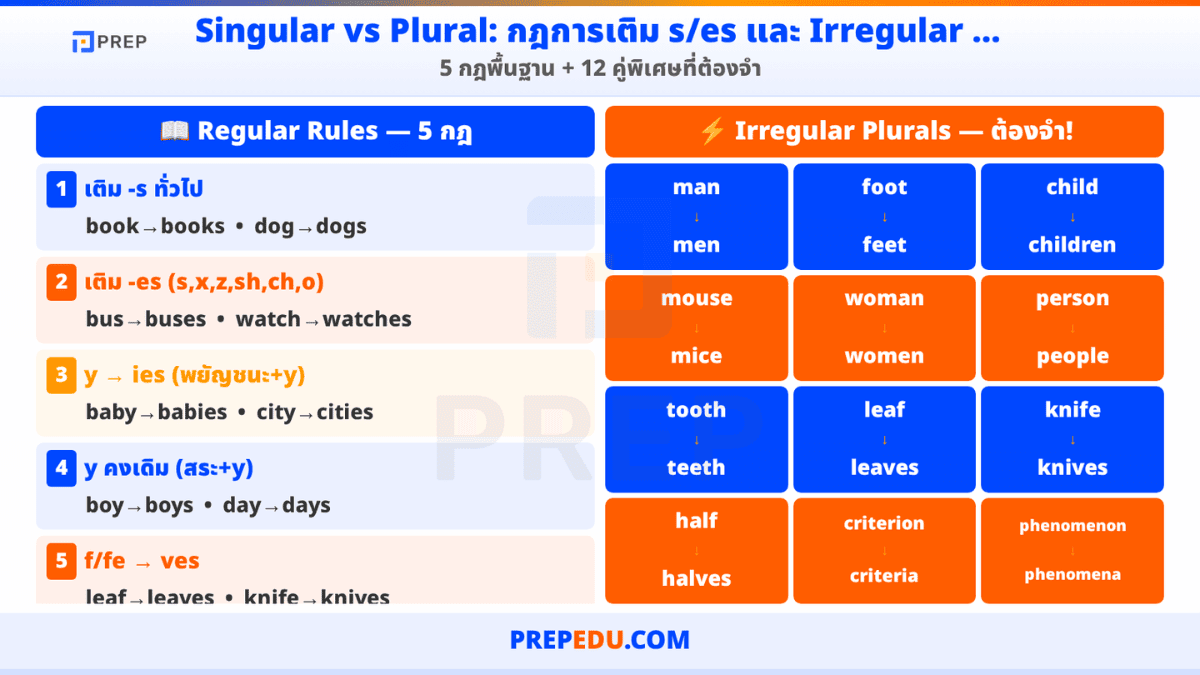
กฎเปลี่ยนคำนามเอกพจน์เป็นพหูพจน์ในภาษาอังกฤษมี 5 แบบหลัก: เติม -s ทั่วไป, เติม -es หลัง s/x/z/sh/ch/o, เปลี่ยน y เป็น ies เมื่อหน้า y เป็นพยัญชนะ, เปลี่ยน f/fe เป็น ves, และคำพิเศษ irregular plural เช่น man-men, child-children, foot-feet
1. กฎพื้นฐาน 5 แบบ
ผู้เรียนชาวไทยส่วนใหญ่จำแค่กฎ "เติม -s" แต่ความจริงมี 5 รูปแบบที่ต้องรู้:
|
กฎ |
เงื่อนไข |
ตัวอย่าง |
|
1. เติม -s |
คำนามทั่วไป |
book → books, dog → dogs, car → cars |
|
2. เติม -es |
ลงท้ายด้วย s, x, z, sh, ch, o |
bus → buses, box → boxes, dish → dishes, watch → watches, tomato → tomatoes |
|
3. y → ies |
พยัญชนะ + y |
baby → babies, city → cities, story → stories |
|
4. y คงเดิม |
สระ + y |
boy → boys, day → days, key → keys |
|
5. f/fe → ves |
ลงท้ายด้วย f หรือ fe |
leaf → leaves, knife → knives, wife → wives |
ข้อยกเว้นกฎข้อ 2: คำนามที่ลงท้ายด้วย o บางคำเติมแค่ -s เช่น photo → photos, piano → pianos, kilo → kilos เพราะเป็นคำยืมจากภาษาต่างประเทศ
2. Irregular Plurals 16 คู่ที่ต้องท่อง
Irregular Plurals คือคำพหูพจน์ที่ไม่ทำตามกฎปกติ ต้องท่องจำเป็นคู่ ผู้เรียนชาวไทยมักลืมและใช้กฎปกติแทน:
|
Singular |
Plural |
คำแปล |
|
man |
men |
ผู้ชาย |
|
woman |
women |
ผู้หญิง |
|
child |
children |
เด็ก |
|
foot |
feet |
เท้า |
|
tooth |
teeth |
ฟัน |
|
mouse |
mice |
หนู |
|
person |
people |
คน |
|
ox |
oxen |
วัว |
|
goose |
geese |
ห่าน |
|
leaf |
leaves |
ใบไม้ |
|
knife |
knives |
มีด |
|
life |
lives |
ชีวิต |
|
half |
halves |
ครึ่ง |
|
wolf |
wolves |
หมาป่า |
|
criterion |
criteria |
เกณฑ์ |
|
phenomenon |
phenomena |
ปรากฏการณ์ |
3. Same-form Nouns
บางคำนามมีรูปเอกพจน์และพหูพจน์เหมือนกันทุกประการ ไม่ต้องเติม -s:
• sheep (แกะ) → one sheep / two sheep
• fish (ปลา) → one fish / two fish
• deer (กวาง) → one deer / two deer
• species (ชนิด) → one species / two species
• aircraft (อากาศยาน) → one aircraft / two aircraft
4. Plural-only Nouns
คำนามบางคำมีรูปพหูพจน์เท่านั้นและใช้กับกริยาพหูพจน์ ส่วนใหญ่เป็นของที่มาเป็นคู่หรือชุด:
• jeans (กางเกงยีนส์), trousers (กางเกงขายาว), scissors (กรรไกร), glasses (แว่นตา)
• news (ข่าว - ใช้กริยาเอกพจน์: The news is good.)
• savings (เงินออม), congratulations (คำยินดี), clothes (เสื้อผ้า)
หมายเหตุ: ถ้าต้องการนับ ใช้ a pair of เช่น a pair of jeans, two pairs of scissors
V. Countable vs Uncountable Nouns + Measure Words
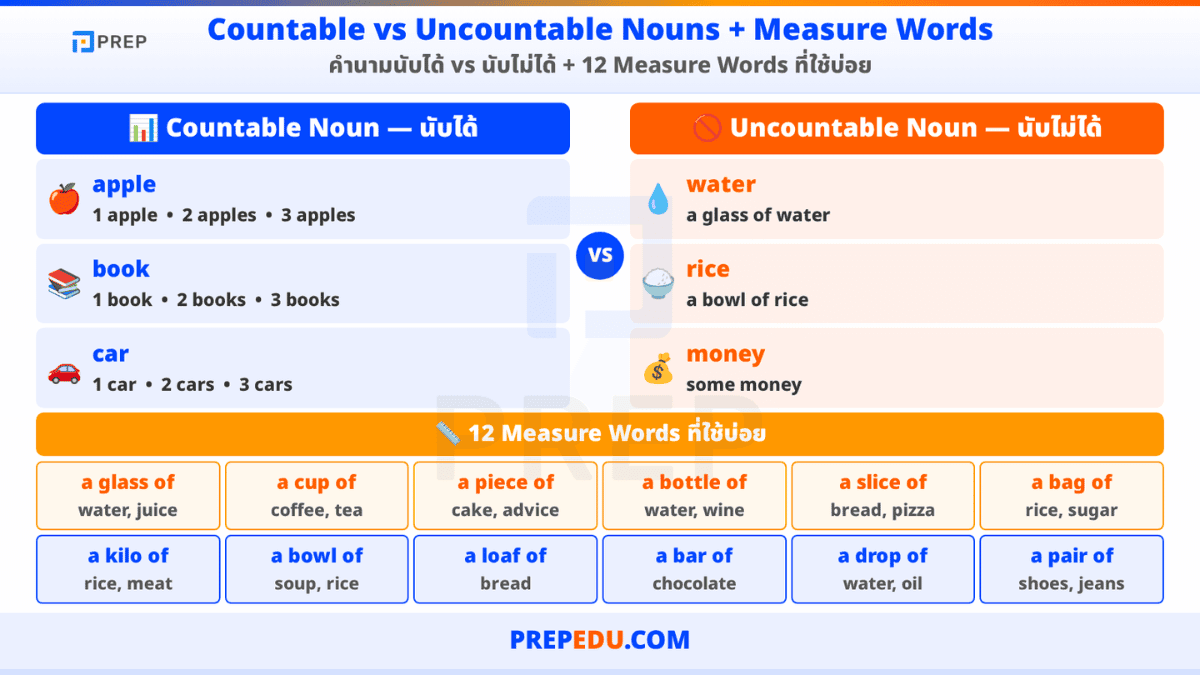
Countable Noun (คำนามนับได้) มีรูปเอกพจน์และพหูพจน์ ใช้กับ a/an และ many ส่วน Uncountable Noun (คำนามนับไม่ได้) ไม่มีรูปพหูพจน์ ใช้กับ much และต้องใช้ Measure Word เช่น a glass of water, a piece of advice ทั้งสองประเภทใช้ some และ any ได้
1. นิยาม Countable vs Uncountable
Countable Noun แบ่งเป็นชิ้นเป็นหน่วยได้ มีเอกพจน์ (apple) และพหูพจน์ (apples) ใช้กับ a, an, one, two, many, a few, several ส่วน Uncountable Noun เป็นมวลรวมหรือสารที่แบ่งไม่ได้เป็นหน่วย ไม่มีพหูพจน์ ใช้กับ much, a little, a lot of, some
|
คุณสมบัติ |
Countable |
Uncountable |
|
รูปเอกพจน์/พหูพจน์ |
มีทั้งสอง |
มีแค่เอกพจน์ |
|
ใช้กับ a/an |
ได้ (a book) |
ไม่ได้ |
|
ใช้กับ many/much |
many |
much |
|
ใช้กับ a few/a little |
a few |
a little |
|
Measure word |
ไม่จำเป็น |
จำเป็น (a glass of...) |
|
ตัวอย่าง |
book, friend, idea |
water, sugar, advice |
2. 10 คำ Uncountable ที่คนไทยมักจำผิด
10 คำต่อไปนี้คนไทยจำเป็น countable บ่อยและเติม -s ผิด ห้ามเติม -s เด็ดขาด:
|
คำ Uncountable |
คำแปล |
ผิดบ่อย |
แก้ |
|
information |
ข้อมูล |
informations |
a piece of information |
|
advice |
คำแนะนำ |
advices |
some advice |
|
furniture |
เฟอร์นิเจอร์ |
furnitures |
a piece of furniture |
|
equipment |
อุปกรณ์ |
equipments |
a lot of equipment |
|
money |
เงิน |
moneys |
some money |
|
news |
ข่าว |
newses |
a piece of news |
|
knowledge |
ความรู้ |
knowledges |
much knowledge |
|
traffic |
การจราจร |
traffics |
heavy traffic |
|
weather |
อากาศ |
weathers |
nice weather |
|
homework |
การบ้าน |
homeworks |
a lot of homework |
3. 22 Measure Words ที่ใช้บ่อย
ถ้าต้องการ "นับ" Uncountable Noun ต้องใส่หน่วยนับหรือ Measure Word คั่นกลาง โครงสร้างคือ a/two + measure word + of + uncountable noun:
|
Measure Word |
คำแปล |
ใช้กับ |
|
a glass of |
แก้วของ |
water, milk, juice |
|
a cup of |
ถ้วยของ |
coffee, tea, soup |
|
a bottle of |
ขวดของ |
wine, water, beer |
|
a can of |
กระป๋องของ |
cola, soup, beer |
|
a piece of |
ชิ้นของ |
cake, paper, advice, news |
|
a slice of |
แผ่นของ |
bread, pizza, cheese |
|
a loaf of |
ก้อนของ |
bread |
|
a bar of |
แท่งของ |
chocolate, soap |
|
a kilo of |
กิโลของ |
rice, sugar, meat |
|
a liter of |
ลิตรของ |
milk, water, gasoline |
|
a pinch of |
หยิบมือของ |
salt, sugar, pepper |
|
a sheet of |
แผ่นของ |
paper, glass, ice |
|
a pair of |
คู่ของ |
shoes, jeans, scissors, glasses |
|
a bunch of |
ช่อ/พวงของ |
flowers, grapes, keys |
|
a herd of |
ฝูงของ |
cattle, elephants |
|
a flock of |
ฝูงของ |
birds, sheep |
|
a pack of |
กล่องของ |
cards, cigarettes, wolves |
|
a roll of |
ม้วนของ |
toilet paper, film, tape |
|
a bag of |
ถุงของ |
rice, sugar, chips |
|
a spoonful of |
ช้อนของ |
sugar, syrup, medicine |
|
a tube of |
หลอดของ |
toothpaste, glue |
|
a drop of |
หยดของ |
water, oil, blood |
4. กฎใช้ a/an + Quantifiers
a/an ใช้กับ countable noun เอกพจน์เท่านั้น ห้ามใช้กับ uncountable หรือ plural เด็ดขาด ส่วน quantifier ต่อไปนี้เลือกใช้ตามประเภท noun:
|
Quantifier |
Countable |
Uncountable |
Both |
|
many |
many books |
ไม่ได้ |
|
|
much |
ไม่ได้ |
much water |
|
|
a few |
a few books |
ไม่ได้ |
|
|
a little |
ไม่ได้ |
a little water |
|
|
some |
some books, some water |
||
|
any |
any books, any water |
||
|
a lot of |
a lot of books, a lot of water |
||
|
no |
no books, no water |
VI. Compound Nouns + Noun Suffixes - วิธีสร้างคำนามใหม่
Compound Noun (คำนามผสม) ในภาษาอังกฤษเขียนได้ 3 รูปแบบ: Closed (toothbrush, classroom), Hyphenated (mother-in-law, well-being), Open (post office, ice cream) ส่วน Noun Suffixes ใช้สร้างคำนามจากกริยาหรือคำคุณศัพท์ที่พบบ่อยได้แก่ -tion, -ment, -ness, -ity, -er/-or, -ship และ -hood
1. Compound Noun แบบ Closed (10 คำ)
Closed Compound เขียนติดกันเป็นคำเดียว เป็นรูปแบบที่พบบ่อยที่สุดและคนไทยคุ้นเคยที่สุด:
|
Compound Noun |
ที่มา |
คำแปล |
|
toothbrush |
tooth + brush |
แปรงสีฟัน |
|
classroom |
class + room |
ห้องเรียน |
|
basketball |
basket + ball |
บาสเก็ตบอล |
|
notebook |
note + book |
สมุดโน้ต |
|
sunlight |
sun + light |
แสงอาทิตย์ |
|
raincoat |
rain + coat |
เสื้อกันฝน |
|
bedroom |
bed + room |
ห้องนอน |
|
toothpaste |
tooth + paste |
ยาสีฟัน |
|
blackboard |
black + board |
กระดานดำ |
|
motorcycle |
motor + cycle |
มอเตอร์ไซค์ |
2. Compound Noun แบบ Hyphenated (8 คำ)
Hyphenated Compound เขียนเชื่อมด้วยขีดกลาง (-) มักใช้กับคำที่มี 3 ส่วนหรือคำเครือญาติ:
|
Compound Noun |
คำแปล |
|
mother-in-law |
แม่ยาย/แม่สามี |
|
brother-in-law |
พี่เขย/น้องเขย |
|
sister-in-law |
พี่สะใภ้/น้องสะใภ้ |
|
well-being |
ความเป็นอยู่ที่ดี |
|
runner-up |
รองชนะเลิศ |
|
mother-of-pearl |
มุก (วัสดุ) |
|
jack-of-all-trades |
ผู้รู้รอบด้าน |
|
six-year-old |
เด็กอายุ 6 ขวบ |
3. Compound Noun แบบ Open (10 คำ)
Open Compound เขียนแยกเป็น 2 คำแต่อ่านเป็นหน่วยความหมายเดียว มักทำให้คนไทยเข้าใจผิดว่าเป็น 2 คำธรรมดา:
|
Compound Noun |
คำแปล |
|
post office |
ที่ทำการไปรษณีย์ |
|
ice cream |
ไอศกรีม |
|
swimming pool |
สระว่ายน้ำ |
|
high school |
โรงเรียนมัธยม |
|
living room |
ห้องนั่งเล่น |
|
full moon |
พระจันทร์เต็มดวง |
|
real estate |
อสังหาริมทรัพย์ |
|
dining room |
ห้องอาหาร |
|
polar bear |
หมีขั้วโลก |
|
washing machine |
เครื่องซักผ้า |
ผิดบ่อย: เขียน "icecream" (ผิด - ต้องเขียนแยก) หรือ "high-school" ในการเขียนทั่วไป (ใช้ open form ถูกกว่า) เมื่อไม่แน่ใจ ตรวจสอบกับ Cambridge Dictionary ทุกครั้ง
4. Noun Suffixes 10 แบบที่พบบ่อย
Suffixes คือคำเติมท้ายที่เปลี่ยนคำชนิดอื่น (verb, adjective) ให้กลายเป็นคำนาม รู้ 10 suffixes ต่อไปนี้จะขยายคลังศัพท์ได้เป็นเท่าตัว:
|
Suffix |
ที่มา |
ตัวอย่าง |
|
-tion |
verb → noun (action) |
act → action, educate → education |
|
-sion |
verb → noun |
decide → decision, discuss → discussion |
|
-ment |
verb → noun (result) |
achieve → achievement, develop → development |
|
-ness |
adjective → noun |
kind → kindness, happy → happiness |
|
-ity |
adjective → noun |
real → reality, possible → possibility |
|
-er |
verb → person/thing |
teach → teacher, write → writer |
|
-or |
verb → person |
act → actor, direct → director |
|
-ship |
noun → state |
friend → friendship, leader → leadership |
|
-hood |
noun → state |
child → childhood, neighbor → neighborhood |
|
-ance/-ence |
verb → noun |
perform → performance, differ → difference |
บทความแนะนำ:
VII. การใช้ Articles (a/an/the/zero) + Possessive Form กับคำนาม
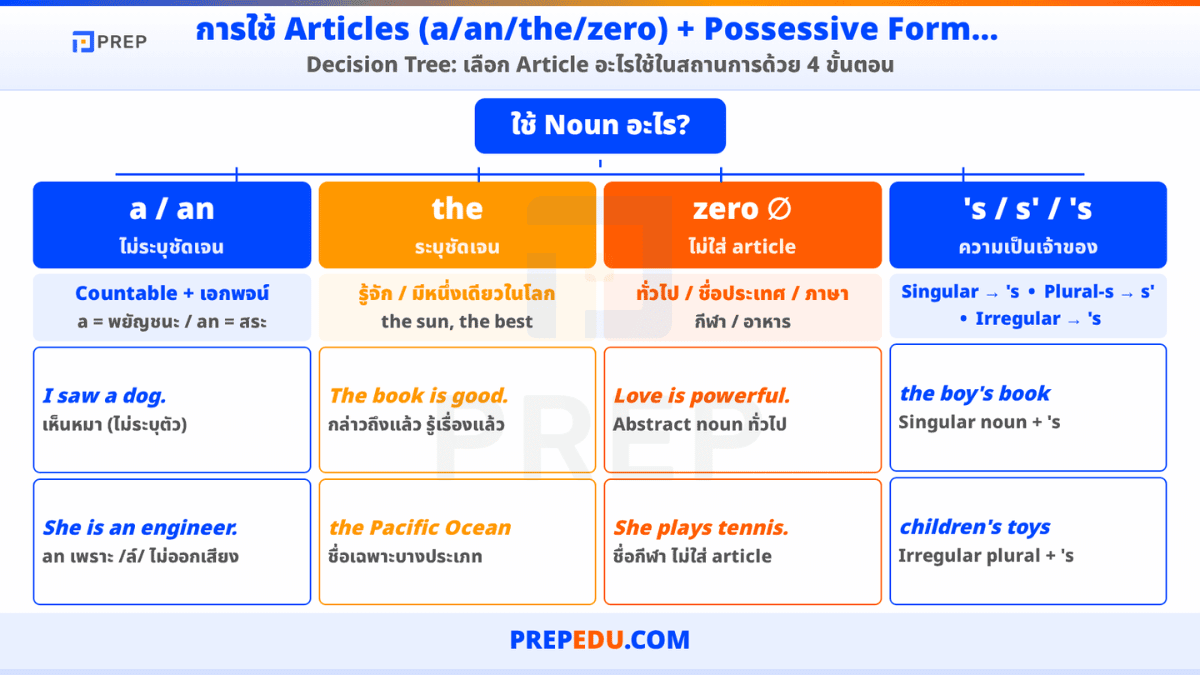
Articles ในภาษาอังกฤษมี 3 แบบ: a/an (indefinite - ใช้ตามเสียงพยัญชนะ/สระ), the (definite - ใช้กับสิ่งที่เฉพาะเจาะจง), และ zero article (ไม่ใส่ - ใช้กับชื่อประเทศ ภาษา อาหารทั่วไป กีฬา) ส่วน Possessive form ใช้ 's กับ singular, s' กับ plural ที่ลงท้าย s, และ 's กับ irregular plural เช่น children's
1. Indefinite Article (a/an) - กฎพยัญชนะ vs สระ
a/an ใช้กับคำนามนับได้เอกพจน์ที่ผู้พูดและผู้ฟังยังไม่รู้ตัวตนเฉพาะ กฎสำคัญที่คนไทยมักผิดคือเลือก a หรือ an ตาม เสียง ไม่ใช่ตามตัวอักษร:
• ถ้าคำหลังเริ่มด้วย เสียงพยัญชนะ ใช้ a
• ถ้าคำหลังเริ่มด้วย เสียงสระ ใช้ an
ตัวอย่างที่ทำให้สับสน:
|
ตัวอักษร |
เสียง |
ถูก |
|
university |
/ju/ พยัญชนะ |
a university |
|
hour |
/aʊ/ สระ (h ไม่ออกเสียง) |
an hour |
|
honest |
/ɒ/ สระ (h เงียบ) |
an honest man |
|
European |
/j/ พยัญชนะ |
a European country |
|
MBA |
/ɛm/ สระ |
an MBA |
2. Definite Article (the) - เมื่อไหร่ต้องใช้
the ใช้เมื่อผู้ฟังรู้ว่าหมายถึงสิ่งใดเฉพาะ มี 5 กรณีหลัก:
1. สิ่งที่กล่าวถึงมาแล้ว: I bought a book. The book is interesting.
2. สิ่งที่มีหนึ่งเดียวในโลก: the sun, the moon, the earth, the sky
3. Superlatives: the best, the tallest, the most expensive
4. Ordinal numbers: the first, the second, the last
5. ชื่อเฉพาะบางประเภท: the Pacific Ocean, the Himalayas, the United States, the Philippines
3. Zero Article - เมื่อไหร่ไม่ใส่
Zero article คือกรณีที่ ไม่ต้องใส่ article ใดๆ ผู้เรียนชาวไทยมักใส่ the เกินทำให้ภาษาผิดธรรมชาติ 6 กรณีต่อไปนี้ห้ามใส่ article:
|
กรณี |
ตัวอย่าง |
|
ชื่อประเทศทั่วไป |
Thailand, Japan, France (ยกเว้น the US, the UK, the Philippines) |
|
ชื่อภาษา |
English, Thai, Chinese |
|
Abstract noun ทั่วไป |
Love is powerful. Knowledge is power. |
|
มื้ออาหาร |
have breakfast, eat lunch, cook dinner |
|
กีฬา |
play tennis, play football, do yoga |
|
วิชาเรียน |
study mathematics, learn history |
4. Possessive Form 3 cases
Possessive Form แสดงความเป็นเจ้าของ มี 3 กรณีตามรูปคำนาม คนไทยมักผิดที่ irregular plural โดยเฉพาะ "children":
|
กรณี |
กฎ |
ตัวอย่าง |
|
Singular noun |
เติม 's |
the boy's book (หนังสือของเด็กชาย), John's car |
|
Plural noun ลงท้าย -s |
เติม ' เท่านั้น |
the boys' books (หนังสือของเด็กชายหลายคน), the teachers' room |
|
Irregular plural ไม่ลงท้าย -s |
เติม 's |
the children's toys (ของเล่นของเด็กๆ), women's clothes, men's shoes |
VII. แบบฝึกหัด Noun พร้อมเฉลย
1. แบบฝึกหัดที่ 1: Singular หรือ Plural (5 ข้อ)
จงเลือกรูป noun ที่ถูกต้อง:
1. I have three (child / children) at home.
2. The (woman / women) in the picture is my aunt.
3. There are many (mouse / mice) in the kitchen.
4. She brushes her (tooth / teeth) twice a day.
5. The (leaf / leaves) on the tree are turning yellow.
2. แบบฝึกหัดที่ 2: เติม a/an/the/no article (5 ข้อ)
จงเติม a, an, the หรือเว้นว่างถ้าไม่ต้องใส่:
1. She is ___ honest student.
2. ___ sun rises in the east.
3. I love ___ Thai food.
4. He plays ___ tennis every weekend.
5. We bought ___ new car last week.
3. แบบฝึกหัดที่ 3: Countable หรือ Uncountable (5 ข้อ)
จงเลือกคำขยายที่ถูกต้อง:
1. I need (many / much) information about the trip.
2. There are (a few / a little) apples on the table.
3. She drinks (many / a lot of) water every day.
4. He gave me (a / some) advice yesterday.
5. We have (many / much) furniture in our house.
4. เฉลยและคำอธิบาย
แบบฝึกที่ 1:
1. children เพราะ irregular plural ของ child
2. woman เพราะเอกพจน์ ตามด้วย is
3. mice เพราะ irregular plural ของ mouse
4. teeth เพราะ irregular plural ของ tooth
5. leaves ตามกฎ f → ves
แบบฝึกที่ 2:
1. an honest เพราะ h ใน honest ไม่ออกเสียง เริ่มด้วยเสียงสระ /ɒ/
2. The sun เพราะสิ่งมีหนึ่งเดียวในโลก ใช้ the
3. ไม่ใส่ (zero article) เพราะ Thai food เป็น food ทั่วไป ไม่เจาะจง
4. ไม่ใส่ (zero article) เพราะกีฬาไม่ใส่ article
5. a new car เพราะ countable เอกพจน์ที่ผู้ฟังยังไม่รู้ตัวตนเฉพาะ
แบบฝึกที่ 3:
1. much เพราะ information เป็น uncountable
2. a few เพราะ apples เป็น countable plural
3. a lot of เพราะ water เป็น uncountable (many ใช้กับ countable เท่านั้น)
4. some เพราะ advice เป็น uncountable ห้ามใช้ a
5. much เพราะ furniture เป็น uncountable
IX. คำถามที่พบบ่อยเกี่ยวกับ Noun (FAQ)
1. Noun มีทั้งหมดกี่ประเภท?
Noun แบ่งเป็น 8 ประเภทหลัก ตามหลักภาษาศาสตร์ ได้แก่ Common Noun (สามัญ), Proper Noun (เฉพาะ), Concrete Noun (รูปธรรม), Abstract Noun (นามธรรม), Countable (นับได้), Uncountable (นับไม่ได้), Collective (กลุ่ม) และ Compound (ผสม) ดูตัวอย่างพร้อมรายละเอียดที่ H2 II ในบทความนี้
2. คำไหนจำยากเป็นเอกพจน์/พหูพจน์ที่สุด?
คำที่จำยากที่สุด 3 คำคือ criterion → criteria, phenomenon → phenomena, foot → feet เพราะเป็น irregular plural ที่ไม่ทำตามกฎ -s ปกติ คนไทยมักเขียน criterions หรือ phenomenons ซึ่งเป็นรูปที่ผิด ดูรายการครบทั้ง 16 คู่ที่ H2 IV
3. Money เป็น Countable หรือ Uncountable?
Money เป็น Uncountable Noun ห้ามเติม -s และห้ามใช้ a/an ใช้กับ much, some, a lot of เช่น I have some money. (ฉันมีเงินอยู่บ้าง) ถ้าต้องการนับใช้สกุลเงินแทน เช่น two dollars, 100 baht ส่วน "moneys" เป็นรูปที่ผิดในการสนทนาทั่วไป (ใช้ในกฎหมายเฉพาะ)
4. คำนามที่ขึ้นต้นด้วยตัวพิมพ์ใหญ่เสมอมีคำไหนบ้าง?
Proper Noun ทุกคำต้องขึ้นต้นด้วยตัวพิมพ์ใหญ่ ครอบคลุม 6 กลุ่มหลัก: ชื่อคน (Mary, John), ชื่อประเทศและเมือง (Thailand, Bangkok), วันและเดือน (Monday, January), ภาษาและสัญชาติ (English, Thai), ชื่อบริษัทและแบรนด์ (Google, PREP) และวันสำคัญ (Christmas, Songkran)
นและสำคัญที่สุดในการเรียนภาษาอังกฤษ คำนามแบ่งออกเป็น 8 ประเภทหลัก แต่ละประเภทมีลักษณะและการใช้งานที่แตกต่างกัน การเข้าใจความแตกต่างระหว่างคำนามนับได้และนับไม่ได้ การใช้รูปเอกพจน์-พหูพจน์ให้ถูกต้อง และการรู้จักคำนามที่ใช้บ่อยจะช่วยยกระดับทักษะภาษาอังกฤษของคุณได้อย่างมาก
หากคุณต้องการพัฒนาทักษะด้านไวยากรณ์และคำศัพท์อย่างเป็นระบบเพื่อเตรียมสอบ IELTS PREP พร้อมช่วยคุณด้วยหลักสูตรที่ครอบคลุมทุกทักษะ ทั้ง Reading, Writing, Listening และ Speaking ผ่าน แผนตารางเรียน IELTS ออนไลน์ ที่ปรับให้เหมาะกับระดับของคุณ ด้วยระบบ AI Teacher Bee ที่ให้คำแนะนำและแก้ไขแบบเรียลไทม์ พร้อม Virtual Speaking Room และ Virtual Writing Room ที่ช่วยให้คุณฝึกฝนได้ทุกที่ทุกเวลา คอร์สเรียน IELTS ออนไลน์ ของ PREP English จะพาคุณไปสู่เป้าหมายอย่างมั่นใจ เริ่มต้น ฝึก IELTS กับเราวันนี้!

สวัสดีค่ะ ฉันชื่อมุก ปัจจุบันดูแลด้านเนื้อหาผลิตภัณฑ์ของ Prep Education ค่ะ
ด้วยประสบการณ์มากกว่า 5 ปีในการเรียน IELTS ออนไลน์ด้วยตนเอง ฉันเข้าใจดีถึงความท้าทายที่ผู้เรียนต้องเผชิญ แล้วก็รู้ว่าอะไรที่มันเวิร์ก
มุกอยากเอาประสบการณ์ตรงนี้มาช่วยแชร์ แล้วก็ซัพพอร์ตเพื่อน ๆ ให้ได้คะแนนที่ดีที่สุดค่ะ
ความคิดเห็น
เนื้อหาแบบพรีเมียม
ดูทั้งหมด



แผนการเรียนรู้ส่วนบุคคล
อ่านมากที่สุด




ติดต่อ Prep ผ่านโซเชียล





Address: ตึก C.P. Tower 2 (ฟอร์จูนทาวน์) ชั้น 21 ถนนรัชดาภิเษก แขวงดินแดง เขตดินแดง กรุงเทพฯ 10400
Hotline: +66 25 44 0068
Email: sawatdee@prepedu.com