Let 用法完全解析:Let 意思、Let's 句型、Lets 辨析與 Allow 比較總整理
Let 用法怎麼用才正確?Let 是英語中最核心的使役動詞之一,發音為 /lɛt/,基本意思是「讓」或「允許」,語法公式為「Let + 受詞 + 原形動詞」。它與 make、have 同屬使役動詞家族,但語氣最為寬鬆,不帶任何強迫意涵,只表達「不阻攔」或「給予空間」的概念。掌握 let 用法,是英語口語自然度的重要分水嶺。
許多英語學習者在使用 let 時容易犯三類錯誤:在 let 後面誤接 to-infinitive(如 let me to go)、混淆 let's 與 lets 的撇號差異,以及不清楚 let、allow、permit 三者在語氣與語法結構上的不同。這些問題看似細小,卻直接影響表達的正確性與專業度,在 IELTS 寫作與口語評分中更是關鍵扣分點。
本文由 PREPEDU 整理 let 英文的完整用法體系,涵蓋六大核心板塊:let 意思與詞性分類、let 後面加什麼的語法核心、let 用法在口語與寫作情境中的分類應用(含四組情境對話)、let's 的進階固定表達、lets 與 let's 的決定性差異、動詞片語與慣用語,以及 let、allow、permit 的同義詞比較。文末附三大題型共三十題的實戰測驗,讓你在閱讀理論後立即檢驗學習成果。
I. Let 意思與基本定義:Let 後面加什麼?
Let 後面加什麼,答案只有一個:受格代名詞 + 原形動詞,不加 to,無例外。掌握這條規則,就掌握了 let 用法的核心。
以下表格從語域、語氣、適用場合、語法結構與 CEFR 等五個維度,概覽 let 作為使役動詞的完整輪廓:
|
維度 |
Let 的特性 |
|
語域 |
口語、非正式書面語 |
|
語氣強度 |
寬鬆、無強迫意涵 |
|
適用場合 |
日常對話、職場口語、家庭互動 |
|
語法結構 |
Let + 受詞(受格)+ 原形動詞 |
|
CEFR 程度 |
A2(基礎)→ B2(進階被動 / 正式祈使) |
|
核心語意 |
允許、不阻攔、給予空間 |
掌握 let 用法,必須先從詞性與語意根基出發。Let 的國際音標為 /lɛt/,在英語中主要以動詞身分出現,但也兼具副詞與名詞的功能,三種詞性各有不同的語意範疇。
|
詞性 |
語意 |
例句 |
|
動詞(Verb) |
允許、讓、任由 |
Don't let it bother you.(不要讓這件事困擾你。) |
|
副詞(Adverb) |
用於強調極不可能的情境,常與 alone 連用 |
He can barely read Chinese, let alone write it.(他幾乎不會讀中文,更別說寫了。) |
|
名詞(Noun) |
障礙、阻礙,常見於法律文件或固定片語 |
The visitors may enter without let or hindrance.(訪客可自由進入,不受任何阻礙。) |
在所有 let 用法中,動詞形式最為核心,且作為使役動詞(Causative verb),let 的語氣是所有使役動詞中最為寬鬆的一個——它不含強迫語氣,只表達「允許」或「不阻攔」。這一特性是理解所有 let 用法的基石。
1. Let 基礎公式:Let + 受詞 + 原形動詞
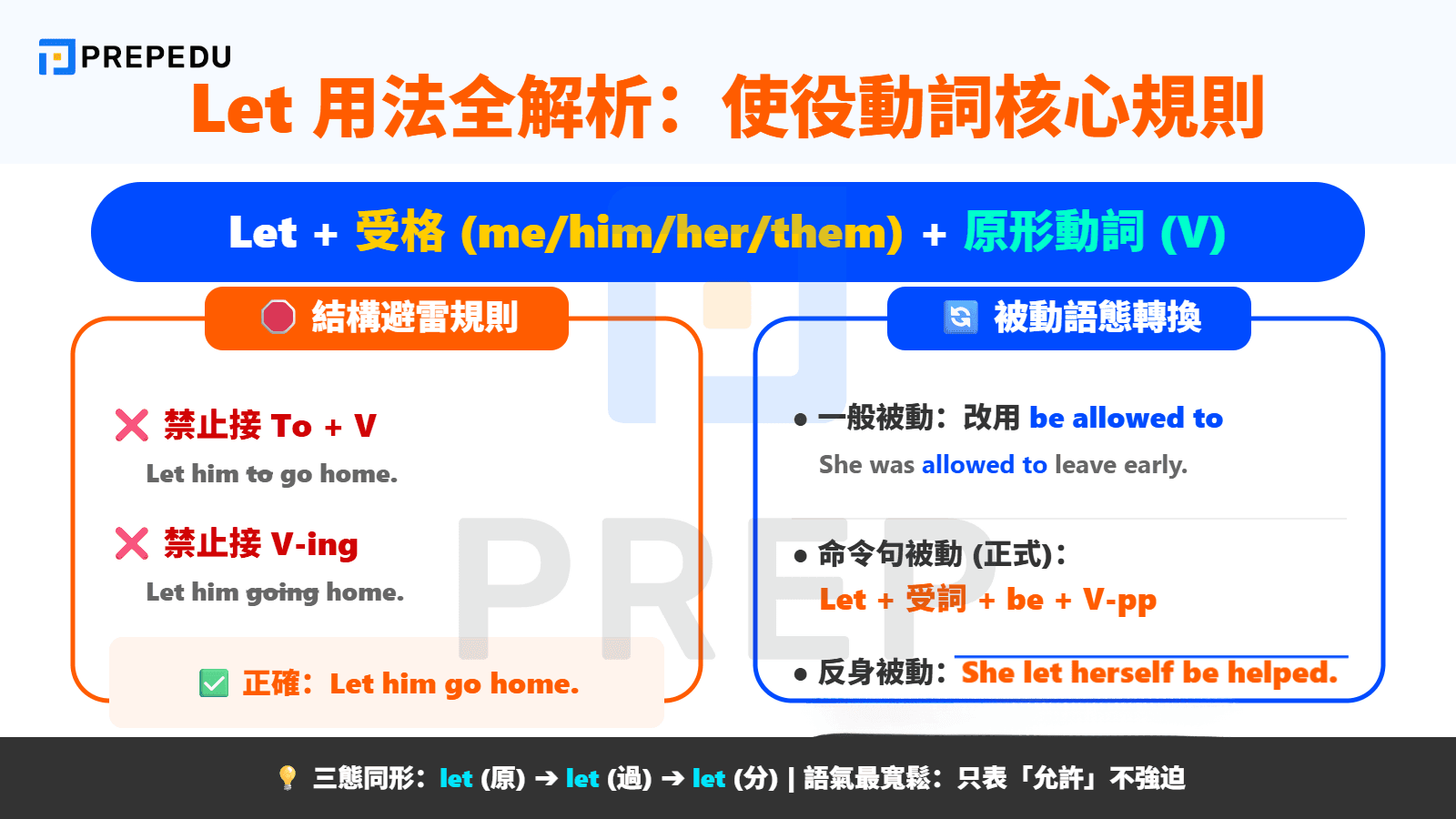
Let 最基本的 let 用法公式如下:
Let + 受詞(受格)+ 原形動詞(Base Form)
受詞必須使用受格代名詞:me、him、her、us、them,而非主格形式。以下是正確與錯誤用法的對比:
-
Let me handle the reservation for the Taipei trip.(讓我來處理台北旅遊的訂位。)
-
Let him present his findings to the team.(讓他向團隊報告他的發現。)
-
Let them decide which route to take through Kaohsiung.(讓他們決定要走高雄的哪條路線。)
-
Xiaowang's teacher let the class leave early on the last day of term.(小王的老師讓全班在學期最後一天早點離開。)
受格的選用是初學者最常出錯的第一關,確認受格無誤,才能建立正確的 let 用法框架。
2. 結構避雷:為什麼 Let 後面不能接 To-V 或 V-ing?
受到 want、hope、allow 等動詞句型的影響,許多台灣與香港的英語學習者習慣在 let 後面接「to + 動詞」或動名詞(V-ing),這是語言學習中的負遷移(negative transfer)現象。
正確的 let 用法只接一種形式:原形動詞(bare infinitive),即不帶 to 的動詞原形。
-
❌ Let me to explain the situation.
-
❌ Let him going home after dinner.
-
✅ Let me explain the situation.(讓我說明情況。)
-
✅ Let him go home after dinner.(讓他晚餐後回家。)
這個錯誤的根源,在於中文裡「讓」後面的動詞並沒有特別標記,學習者因此直接套用 allow 或 want 的句型,把 to 帶進來。使役動詞 let 要求後接的動詞省略 to,以呈現動作的即時性與直接性。這一語法規則無例外,也不因語境正式與否而改變。
🔍 教師視角:在批改台灣與香港學員的 IELTS Writing Task 1 時,「let + to-V」的錯誤出現頻率遠高於其他使役動詞錯誤。評分官不僅會扣 Grammatical Range and Accuracy(語法範疇與準確度)分,更會將這類錯誤視為「系統性語法弱點」的訊號——這代表整份試卷的語法分數都可能因此下調。單一公式記清楚,試卷上省去的不只是一題分數。
使役動詞 let 要求後接的動詞省略 to,以呈現動作的即時性與直接性。這一語法規則無例外,也不因語境正式與否而改變。
3. Let 的動詞三態與被動語態轉換
Let 用法是英語中少數「三態同形」的動詞,原形、過去式、過去分詞均為 let,學習者無需記憶任何變形。
|
時態 |
形式 |
例句 |
|
原形(Base Form) |
let |
The Hong Kong museum lets visitors photograph the exhibits.(香港博物館讓訪客拍攝展品。) |
|
過去式(Past Simple) |
let |
The manager let Xiaowang present the quarterly report alone.(主管讓小王獨自報告季度成果。) |
|
過去分詞(Past Participle) |
let |
(幾乎不用於一般被動語態) |
關於被動語態:一般情境下,let 幾乎不出現於標準被動語態。若需表達「被允許」,應改用以下替代結構:
be allowed to + 原形動詞
-
❌ She was let leave the meeting early.(錯誤)
-
✅ She was allowed to leave the meeting early.(她被允許提早離開會議。)
特殊被動語態——命令句轉換
在將祈使句轉換為被動語態時,let 有其專屬的被動結構,常見於正式書面語及法律文件:
(Don't)+ let + 受詞 + be + 過去分詞
例如:
-
主動命令句:Write down the Taipei office address.(寫下台北辦公室的地址。)
-
被動轉換:Let the Taipei office address be written down.(讓台北辦公室的地址被記下來。)
此外,若主動句中受詞與主語指同一人,被動語態可使用以下結構:
S + let + oneself + be + 過去分詞
-
主動:She let her colleague proofread her report.(她讓同事校對她的報告。)
-
被動:She let herself be helped by her colleague.(她接受了同事的幫助。)
II. Let 用法分類:口語(Speaking)與寫作(Writing)情境
Let 在口語中有五個核心功能:給予許可、主動提供幫助、預告後續行動、任由事情自然發展,以及正式場合的祈使語氣。情境不同,let 的語感與選字搭配也隨之調整。
PREPEDU 將 let 用法依語境分為口語專用與口語、書面語皆可用兩大類,幫助你在 IELTS 或日常溝通中都能恰當應用。在口語中,let 最常出現在提供幫助、給予允許、帶出後續行動,以及表達「任由」等場景。在正式書面語中,let 的出現頻率相對較低,通常由 allow 或 permit 替代。
1. 展現「允許」(Permission):正式與非正式的差異
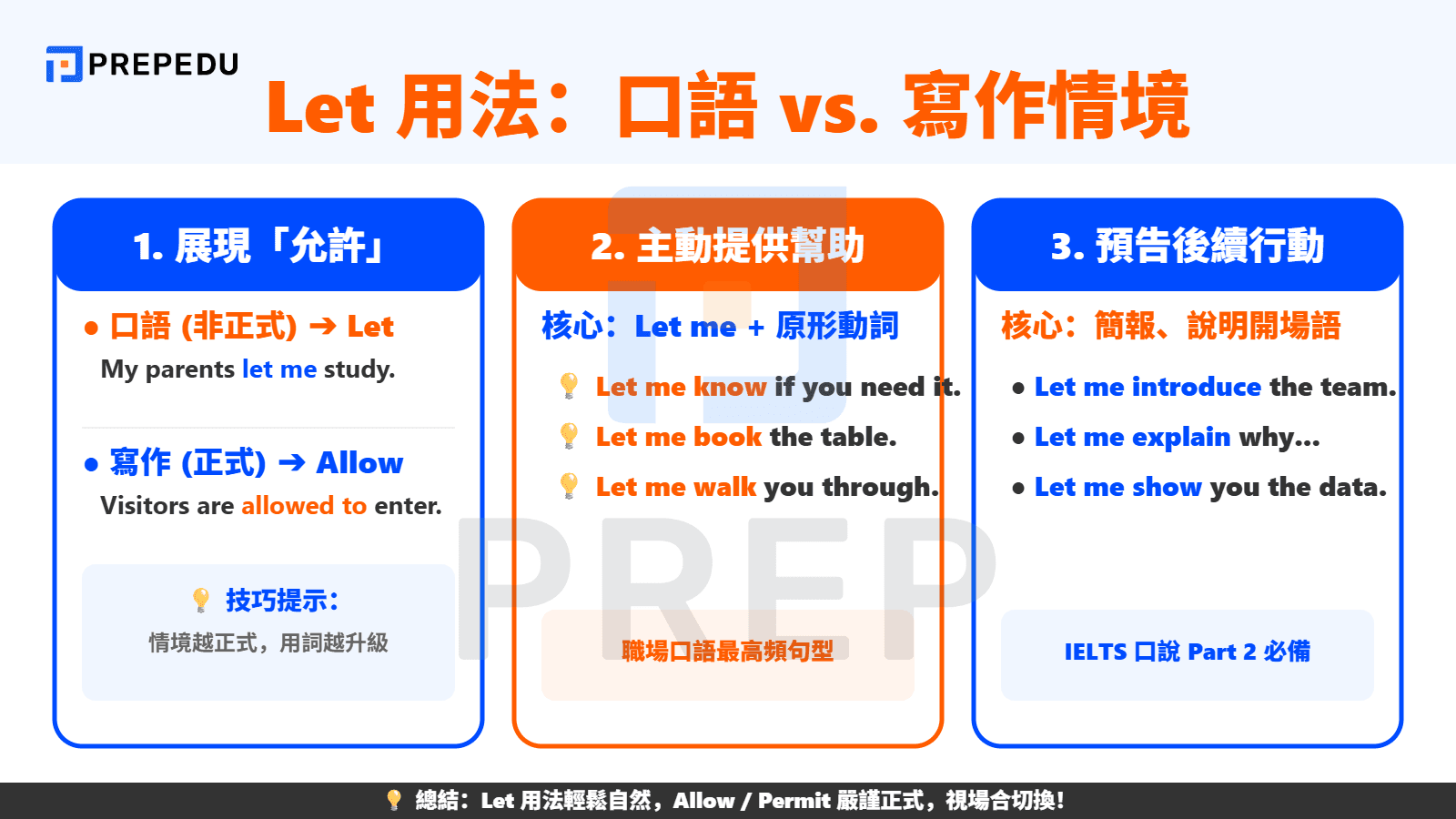
Let 用法表達許可時,語氣輕鬆,帶有「不阻擋」的意涵,適合口語及非正式書面溝通。
|
非正式口語 |
正式書面語(改用 allow 或 permit) |
|
|
選詞原則很明確:情境越正式,用詞越往上升。let 用於朋友之間,allow 用於說明規則,permit 用於法律或官方場合。
2. 主動提供幫助(Offering Help)
「Let me + 原形動詞」是英語中最自然、最高頻的主動提供幫助句型,在職場溝通與日常互動中不可或缺。
-
Let me book the restaurant in Kaohsiung for tonight's team dinner.(讓我來訂今晚高雄的團隊聚餐餐廳。)
-
Let me walk you through the new project management system step by step.(讓我一步一步帶你了解新的專案管理系統。)
-
Let me know if the Taipei meeting gets rescheduled.(如果台北的會議改期,請告訴我。)
「Let me know」是職場與日常英語中使用率極高的固定表達,意思是「讓我知道」或「通知我」,語氣禮貌而直接。
3. 預告後續行動(Introducing Actions)
Let 用法常在簡報、說明或介紹場合中用作轉場語,帶出即將發生的行動,有效建立聽者的期待感。
-
Let me introduce our new team member from the Hong Kong branch.(讓我介紹我們來自香港分部的新團隊成員。)
-
Let me explain why the Taipei market strategy needs adjustment this quarter.(讓我說明為什麼台北市場策略在本季需要調整。)
-
Let me show you the data we collected from the Kaohsiung user survey.(讓我給你看我們從高雄用戶調查中收集的數據。)
在 IELTS Speaking Part 2 的個人陳述中,以「Let me tell you about...」開頭,是一種展現流暢口語能力的有效開場方式。
4. 「任由」保持原狀(Allowing Something to Continue)
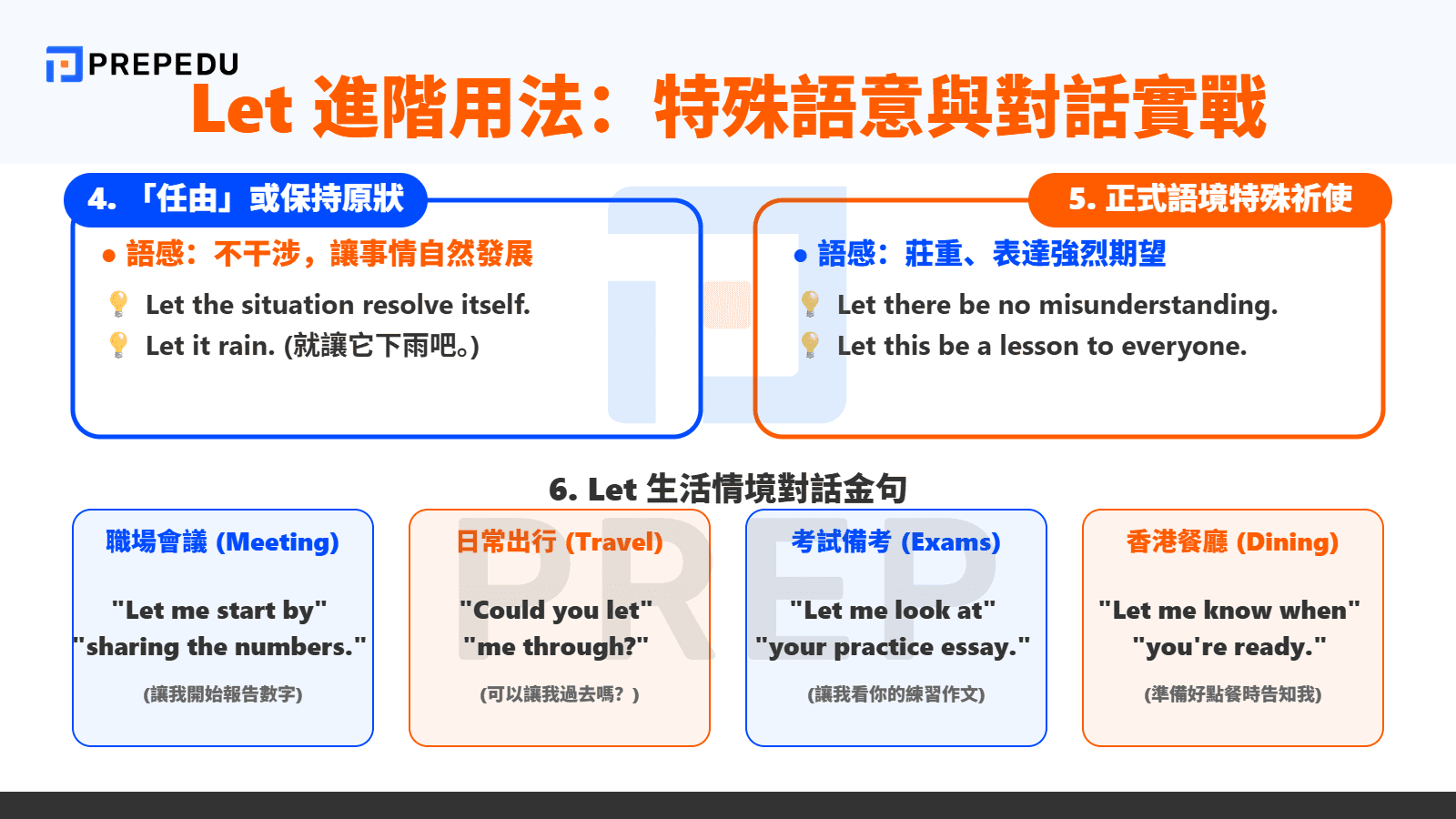
Let 用法中有一個常被忽略但非常實用的語意:「任由」或「保持原狀」,即允許某件事以自然的方式繼續進行,不加干預。
-
Xiaowang decided to let the situation resolve itself without interfering.(小王決定任由情況自行解決,不插手干預。)
-
Please let us have some quiet time before the final exam tomorrow.(請讓我們在明天期末考之前有一些安靜的時間。)
-
Let it rain. There's nothing we can do about the weather.(就讓它下雨吧。天氣是我們無法控制的。)
這個用法的語感是「讓事情自然發展」,而非「主動給予允許」,理解這一細微差異,能讓你的英語表達更貼近母語者的語感。
5. Let 在正式語境中的特殊祈使用法
在正式演說、禱告或文學語境中,let 以祈使句形式出現於句首,帶有「命令」或「表達強烈期望」的語氣。
-
Let there be no misunderstanding between our two departments.(願我們兩個部門之間沒有任何誤解。)
-
Let this be a lesson to everyone on the team.(希望這成為團隊裡每個人的一課。)
此用法語氣莊重,主要出現在書面語、演講稿或宗教文本中,口語中極少使用。
6. Let 情境對話實例
以下四組對話涵蓋不同生活情境,幫助你觀察 let 用法在真實語境中的自然節奏。
對話一:職場會議
|
角色 |
對話 |
用法類型 |
|
Xiaowang |
Let me start by sharing the Q3 numbers.(讓我先從第三季的數字開始報告。) |
預告行動 |
|
Manager |
Go ahead. Let everyone see the full slide first.(請說。先讓大家看完整份投影片。) |
給予允許 |
|
Colleague |
Let's not skip the Hong Kong data—it matters the most.(我們不要略過香港的數據——那部分最重要。) |
提議(let's not) |
|
Xiaowang |
Fair point. Let me pull up that section now.(說得有道理。讓我現在切換到那個部分。) |
主動提供行動 |
對話二:日常出行
|
角色 |
對話 |
用法類型 |
|
Passenger A |
Excuse me, could you let me through? I'm getting off at Zhongxiao Dunhua.(不好意思,可以讓我過去嗎?我在忠孝敦化下車。) |
請求允許通過 |
|
Passenger B |
Of course, go ahead.(當然,請。) |
口語許可 |
|
Passenger A |
Thank you. Let me grab that handle for a second.(謝謝。讓我扶一下那個扶手。) |
自我許可 |
|
Passenger B |
Let's move closer to the door—it's the next stop.(我們靠近門口一點吧——下一站就到了。) |
提議共同行動 |
對話三:考試備考
|
角色 |
對話 |
用法類型 |
|
Student |
I keep making the same grammar mistakes. I don't know what to do.(我一直犯同樣的文法錯誤,不知道怎麼辦。) |
— |
|
Tutor |
Let me look at your last practice essay.(讓我看一下你上一篇練習文章。) |
主動提供幫助 |
|
Tutor |
I see the pattern. Let's not focus on memorizing rules—let's focus on correcting one error type at a time.(我看出規律了。我們不要專注在背規則上——我們一次只修正一種錯誤類型。) |
提議策略 |
|
Student |
That makes sense. Let me try rewriting this paragraph now.(有道理。讓我現在試著改寫這段。) |
主動行動 |
對話四:香港餐廳
|
角色 |
對話 |
用法類型 |
|
Waiter |
Let me show you to your table.(讓我帶您到座位。) |
主動引導 |
|
Guest |
Thank you. Could you let us have a few minutes to look at the menu?(謝謝。能讓我們先看幾分鐘菜單嗎?) |
請求許可 |
|
Waiter |
Of course. Let me know when you're ready to order.(當然。您準備好點餐時告訴我。) |
通知請求 |
|
Guest |
Let's try the set menu—it seems like better value.(我們試試套餐吧——感覺比較划算。) |
共同提議 |
III. Let's 用法與意思:提出建議的常見句型
在所有 let 用法的變體中,let's 是使用率最高、語境最多元的一種。Let's 的核心功能是「提議共同行動」,將說話者與聽者同時納入一個計劃——這種包容性正是它與 Shall I...? 或 Do you want to...? 最根本的差異。
許多學習者知道 let's 表示「提議」,卻不知道 let's 在語感上比 Shall we? 更主動、更有推動力。在 IELTS Speaking Part 3 的雙向互動中,使用 let's consider... 或 let's look at this from another angle... 能有效展示你對話題的掌控感,比反覆用 I think... 開頭更能拿到 Fluency and Coherence 分數。掌握 let's 的完整用法,不僅能提升口語的自然度,也能為 IELTS Speaking 的互動環節加分。
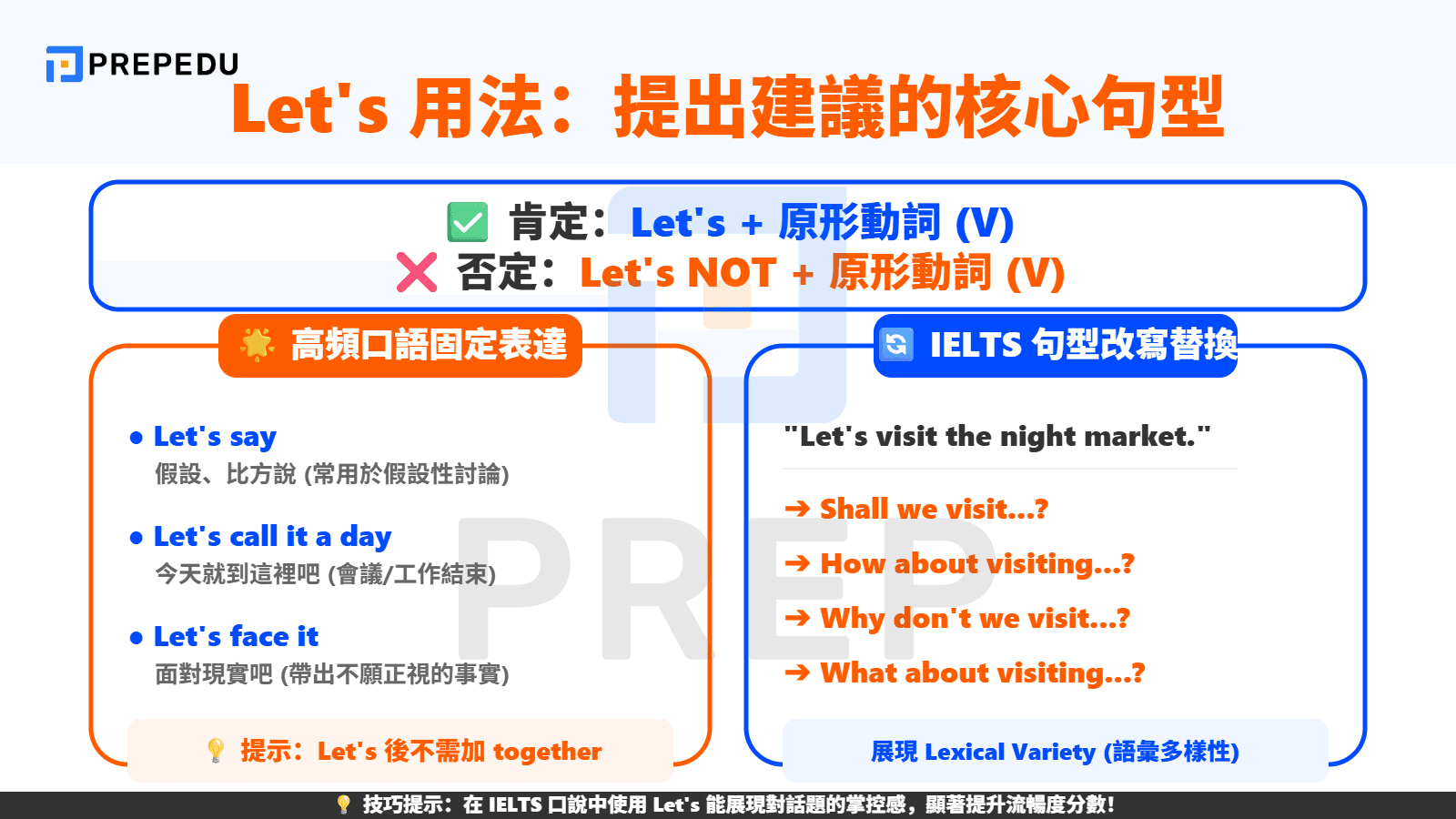
1. Let's 意思與基本公式
Let's 是 let us 的縮寫,表達「我們一起……吧」,帶有邀請或提議的語氣。
公式:Let's + 原形動詞
-
Let's grab some boba tea at the Ximending shop after class.(下課後我們去西門町那家店喝珍珠奶茶吧。)
-
Let's start the meeting now that everyone's joined the call.(大家都上線了,我們開始開會吧。)
-
Let's explore a different approach to the Hong Kong campaign this time.(這次我們試試不同的香港推廣方案吧。)
需要特別注意 let 用法:let's 後面不需再加 together,因為 let's 本身已帶有「一起」的語意,重複使用反而不自然。
2. Let's 的否定句型公式
Let's 的否定形式是學習者最常出錯的語法點之一。正確結構只有一種:
Let's not + 原形動詞
|
正確(Do) |
錯誤(Don't) |
|
Let's not rush into a decision before checking the data.(在確認數據之前,我們不要急著做決定。) |
~~Don't let's rush.~~ |
|
Let's not cancel the Kaohsiung trip because of one bad forecast.(不要因為一次不好的天氣預報就取消高雄的行程。) |
~~Let's don't cancel.~~ |
|
Let's not overthink this.(我們不要想太多。) |
~~Don't let's overthink.~~ |
「Don't let's」在現代英語中幾乎不被接受,「Let's not」才是唯一正確的否定形式,在英式與美式英語中皆通用。
3. Let's 的進階固定表達
除了基本句型,let's 還衍生出多個固定表達,在口語中使用率極高 let 用法:
|
固定表達 |
中文意思 |
例句 |
|
Let's say |
假設、比方說 |
Let's say Xiaowang has a budget of NT$50,000 for the project; how should he allocate it?(假設小王的專案預算是新台幣五萬元,他該如何分配?) |
|
Let's face it |
面對現實吧 |
Let's face it: the Taipei real estate market won't get cheaper anytime soon.(面對現實吧:台北的房地產市場短期內不會變便宜。) |
|
Let's call it a day |
今天就到這裡吧 |
We've been reviewing the report for six hours straight. Let's call it a day.(我們已經連續審查報告六個小時了。今天就到這裡吧。) |
|
Let's get started |
我們開始吧 |
Everyone's ready? Great. Let's get started.(大家都準備好了嗎?很好。我們開始吧。) |
|
Let's see |
讓我想想、我們來看看 |
Let's see what the Hong Kong team has prepared for the Q3 presentation.(我們來看看香港團隊為第三季簡報準備了什麼。) |
「Let's say」尤為實用,常用於假設性討論或進行示例說明,是英語口語中的高頻過渡表達。
4. 句型改寫(Sentence Rewriting):Let's 的同義替換
|
Let's 句型 |
同義替換 |
中文意思 |
|
Let's visit the night market tonight. |
Shall we visit the night market tonight? |
我們今晚去夜市好嗎? |
|
Let's try a new coffee shop in Taipei. |
How about trying a new coffee shop in Taipei? |
試試台北一家新咖啡廳怎麼樣? |
|
Let's review the contract terms together. |
Why don't we review the contract terms together? |
我們何不一起審閱合約條款? |
|
Let's take a different approach. |
What about taking a different approach? |
採用不同的方法如何? |
|
Let's discuss this before the Hong Kong call. |
Why not discuss this before the Hong Kong call? |
為什麼不在香港電話會議前討論這件事? |
在 IELTS 寫作與口語中靈活替換 let's 句型,能有效展現語彙多樣性(lexical variety),避免重複使用同一句型的扣分風險。
IV. Lets 用法與意思:第三人稱單數動詞
在所有 let 用法的變體中,lets(無撇號)是最容易因標點符號而造成混淆的形式。Lets 僅是動詞 let 在第三人稱單數現在式下的屈折變化,語意與 let 完全相同——「允許」——但適用主語不同。
|
項目 |
Lets |
Let's |
|
撇號 |
無(no apostrophe) |
有(apostrophe) |
|
詞性 |
動詞(第三人稱單數現在式) |
縮寫(let us 的縮寫) |
|
語意 |
允許(他/她/它允許……) |
提議(我們一起……吧) |
|
適用主語 |
He、She、It 或單數名詞 |
說話者與聽者雙方 |
|
例句 |
The Kaohsiung office manager lets staff work from home on Fridays.(高雄辦公室的主管讓員工週五居家辦公。) |
Let's meet at the Taipei Main Station at noon.(我們中午在台北車站見面吧。) |
判斷方式:若主語是第三人稱單數(he、she、it 或單數名詞),用 lets;若能將句子還原為 let us,則用 let's。兩者只差一個撇號,但語意完全不同,絕不可混用。
V. Let 搭配的介系詞與常見英文慣用語
動詞片語(phrasal verbs)是 let 用法的延伸版圖。每一個片語的語意,都無法從 let 和介系詞的字面意思推導出來,必須作為整體記憶。這些英文片語在口語與寫作中都極為常見,是詞彙提升的必備素材。
1. Let 搭配介系詞的動詞片語(Phrasal Verbs)
|
動詞片語 |
中文意思 |
例句 |
|
Let in |
讓……進入 |
The security guard at the Taipei tech company refused to let anyone in without a valid ID badge.(台北那家科技公司的保全拒絕讓任何沒有有效識別證的人進入。) |
|
Let out |
釋放;洩漏;發出聲音 |
Xiaowang let out a long sigh after finally submitting the overdue report.(小王在終於提交了延遲的報告後,長長地嘆了一口氣。) |
|
Let down |
使失望;放低 |
The whole Kaohsiung team worked overtime to meet the deadline—no one wanted to let their manager down.(高雄整個團隊都加班趕工以在截止日期前完成——沒有人想讓主管失望。) |
|
Let off |
免於懲罰;使爆炸 |
The supervisor let Xiaowang off with a warning after the first scheduling error.(主管在第一次排程失誤後只給小王一個警告,沒有進一步懲處。) |
|
Let up |
減弱;停止 |
The typhoon rain didn't let up until late Tuesday evening, delaying all Taipei Metro services.(颱風雨直到週二傍晚才停歇,導致台北捷運所有服務延誤。) |
|
Let yourself in for something |
自找麻煩;將自己捲入困境 |
By agreeing to manage three projects simultaneously, Xiaowang really let himself in for a stressful quarter.(小王同意同時管理三個專案,真的是讓自己陷入了一個極為忙碌的季度。) |
|
Let someone in on something |
將秘密或計劃告知某人 |
The director let the core team in on the new Hong Kong expansion plan before the official announcement.(在正式公告之前,總監讓核心團隊先知道新的香港擴張計劃。) |
2. 必學的 Let 英文慣用語(Idioms)
|
中文意思 |
例句 |
|
|
Let it go |
放下;隨它去 |
Xiaowang kept replaying the presentation mistake in his mind, but his mentor told him to let it go and focus on the next opportunity.(小王不斷在腦海中回放簡報的失誤,但他的導師告訴他要放下,專注於下一個機會。) |
|
Let alone |
更別說;遑論 |
The new intern can barely navigate the company's internal system, let alone manage a full client account in Hong Kong.(那位新實習生幾乎連公司的內部系統都搞不清楚,更別說管理香港的完整客戶帳號了。) |
|
Let it slip |
不小心說溜嘴;洩露 |
During the team lunch, Xiaowang accidentally let it slip that the Kaohsiung branch might be restructured next quarter.(在團隊午餐中,小王不小心說溜嘴,透露了高雄分部下季可能重組的消息。) |
|
Let someone be |
讓某人保持原狀;不打擾 |
Xiaowang looked stressed after the client call, so his colleagues decided to just let him be for a while.(客戶電話結束後小王看起來壓力很大,所以同事們決定暫時讓他一個人靜一靜。) |
|
Let yourself go |
放鬆自我;不再自我克制 |
At the year-end party in Taipei, the whole office finally let themselves go and enjoyed the music and food.(在台北的年終派對上,全辦公室的人終於放鬆自我,盡情享受音樂和食物。) |
|
Let your hair down |
放鬆、不拘謹 |
After weeks of intense project deadlines, the Hong Kong team went to a rooftop bar to let their hair down.(在幾週密集的專案截止日期之後,香港團隊去了一家天台酒吧好好放鬆。) |
|
Let someone know |
通知某人;讓某人知道 |
Please let me know by Thursday if you can join the Kaohsiung site visit next week.(如果你能參加下週的高雄現場參訪,請在週四前告訴我。) |
VI. Let 英文同義詞比較:Let、Allow、Permit 的差異
在 let 用法的學習旅程中,能分辨 let、allow、permit 三者的差異,是詞彙從「基礎」邁向「精準」的重要一步。三個詞的核心語意相同——「允許」——但在語氣、正式程度與語法結構上各有明確差異。
1. 語氣強度與正式程度對比
|
詞彙 |
語氣 |
適用語境 |
例句 |
|
Let |
非正式、口語 |
日常對話、家庭、朋友之間 |
Xiaowang's dad lets him drive to Kaohsiung on weekends.(小王的爸爸讓他週末自己開車去高雄。) |
|
Allow |
中性、一般規則 |
學校規定、一般公告、書面說明 |
Students are not allowed to use mobile phones during the examination.(學生在考試期間不得使用手機。) |
|
Permit |
正式、官方 |
法律文件、政府規定、商業合約 |
Photography is not permitted within the courtroom premises.(法庭內禁止拍照。) |
選詞的核心原則:語境越正式,用詞越往上升。
2. 語法結構差異對比
三個動詞的語法結構存在關鍵差異,是文法測驗與 IELTS 寫作中的高頻考點:
|
動詞 |
語法結構 |
例句 |
|
Let |
Let + 受詞 + 原形動詞 |
Let Xiaowang speak first.(讓小王先說。) |
|
Allow |
Allow + 受詞 + to + 原形動詞 |
Allow Xiaowang to speak first.(允許小王先說。) |
|
Permit |
Permit + 受詞 + to + 原形動詞 |
Permit Xiaowang to speak first.(准許小王先說。) |
規則簡潔明確:只有 let 後面接原形動詞(不加 to);allow 與 permit 後面一律接 to-infinitive。
3. Let、Have、Make:使役動詞三兄弟完整比較
許多學習者把 let 與其他兩個使役動詞 have、make 混用。三者語意不同,語氣力度差異顯著:
|
動詞 |
語意 |
語氣 |
例句 |
|
Let |
允許;不阻攔 |
最寬鬆,不帶強迫 |
The manager let Xiaowang leave early.(主管讓小王提早離開。)—— 主管沒有阻止 |
|
Have |
安排;指定某人做 |
中性,帶有管理或指派意涵 |
The manager had Xiaowang prepare the report.(主管請小王準備報告。)—— 主管指派任務 |
|
Make |
強迫;迫使 |
最強,帶有壓力或強制性 |
The manager made Xiaowang redo the entire report.(主管強迫小王重做整份報告。)—— 沒有選擇餘地 |
三者的語法公式相同:動詞 + 受詞 + 原形動詞(不加 to)。語氣的差異,體現在「主語對受詞施加的控制程度」上。
讀到這裡,你已完整理解 let 的語法公式、變體形式、動詞片語,以及它與 allow 和 permit 的同義比較。語法知識的真正價值,在於能否在真實語境中即時提取、準確使用。接下來的三大題型測驗,設計目的正是模擬 IELTS 與 TOEIC 的考題邏輯,檢驗你是否真正內化了上述規則——而不是只有讀過。
VII. Let 用法實戰測驗:3 大題型與詳細解答
1. 第一大題:選擇題(測試 Let 後面加什麼)
說明: 選出括號中正確的選項,每題選一個。
-
Let Xiaowang ___ the final version of the Taipei proposal. (present / presents / to present)
-
She let her younger sister ___ the new laptop for the school project. (borrow / borrows / to borrow)
-
Let ___ explain what happened at the Hong Kong branch. (I / me / my)
-
The teacher let the students ___ their notes during the open-book test. (use / used / to use)
-
Can you let ___ know once the Kaohsiung shipment arrives? (they / them / their)
-
Xiaowang's manager lets him ___ flexible hours during the busy season. (work / works / working)
-
Let ___ handle the client complaint—she has more experience in this area. (she / her / hers)
-
The Taipei head office lets the regional teams ___ their own hiring decisions. (make / makes / to make)
-
Let ___ try a different strategy for the Q4 campaign. (we / us / our)
-
Please let ___ finish the presentation before asking questions. (I / me / mine)
解答:1. present 2. borrow 3. me 4. use 5. them 6. work 7. her 8. make 9. us 10. me
2. 第二大題:改錯題(測試 Let、Let's、Lets 的分辨)
說明: 找出句中的語法或拼寫錯誤並改正。
-
Lets go to the Taipei night market before it gets too crowded.
-
Xiaowang's supervisor let's him work from the Kaohsiung office twice a week.
-
Let's not to argue about which route is faster—just use the GPS.
-
He lets Xiaowang knows the meeting has been rescheduled to Thursday.
-
Lets start the Hong Kong client call—everyone is online now.
-
The company policy let's employees take up to ten days of annual leave.
-
Let's don't cancel the Kaohsiung factory visit just because of the forecast.
-
She lets her interns choosing the research topics independently.
-
Lets take a short break and then continue with the data analysis.
-
The system lets new users to create an account for free during the trial period.
解答:
-
Let's go → 提議句型需用 let's(有撇號)
-
Xiaowang's supervisor lets him work → 第三人稱單數動詞,無撇號
-
Let's not argue → 刪去 to,接原形動詞
-
He lets Xiaowang know → 受詞後接原形動詞,不加 s
-
Let's start → 提議句型需用 let's
-
The company policy allows employees to take → let 不適用於政策說明語境,改為 allows
-
Let's not cancel → 否定形式應為 Let's not,而非 don't
-
lets her interns choose → 接原形動詞,非 V-ing
-
Let's take → 提議句型
-
lets new users create → 刪去 to,接原形動詞
3. 第三大題:句型改寫題(測試同義詞與句型轉換)
說明: 依照提示改寫句子,意思不變。
-
Let's visit the Taipei Design Festival this weekend. → Shall we ___?
-
Let's not eat instant noodles again for dinner tonight. → How about ___?
-
Let's review Xiaowang's revised proposal together. → Why don't we ___?
-
Let him use the conference room on the 12th floor. → Allow him ___?
-
Let's take the High Speed Rail to Kaohsiung instead of flying. → What about ___?
-
She lets her team members submit reports on Monday mornings. → She allows her team members ___?
-
Let's try the new Hakka restaurant near the Taipei office. → How about ___?
-
Let me carry those sample boxes to the storage room. → Allow me ___?
-
Let's plan the Hong Kong client visit for mid-November. → Shall we ___?
-
The exhibition hall lets visitors take photographs without flash. → The exhibition hall permits visitors ___?
詳細解答:
-
Shall we visit the Taipei Design Festival this weekend?
-
How about not having instant noodles again for dinner tonight? / How about cooking something at home instead?
-
Why don't we review Xiaowang's revised proposal together?
-
Allow him to use the conference room on the 12th floor.
-
What about taking the High Speed Rail to Kaohsiung instead of flying?
-
She allows her team members to submit reports on Monday mornings.
-
How about trying the new Hakka restaurant near the Taipei office?
-
Allow me to carry those sample boxes to the storage room.
-
Shall we plan the Hong Kong client visit for mid-November?
-
The exhibition hall permits visitors to take photographs without flash.
VIII. Let 用法常見問題(FAQ)
1. Let go 和 Let's go 的差別是什麼?
兩者發音相近,但語意與語法功能截然不同的 let 用法。
Let go 意思是「放手」或「放開」,引申為「釋懷、放下」,是一個動詞片語,不帶有提議的功能。
-
The team leader advised Xiaowang to let go of his perfectionism and trust the process.(團隊領導建議小王放下完美主義,相信流程。)
-
Let go of the rope slowly—don't release it all at once.(慢慢放開繩子——不要一下子全部鬆手。)
Let's go 意思是「我們走吧」或「出發」,是一個提議句型,邀請聽者一同行動。
-
The Kaohsiung train is leaving in ten minutes. Let's go!(去高雄的火車十分鐘後開車。我們走吧!)
-
Let's go—everyone is already waiting at the restaurant.(走吧——大家都已經在餐廳等了。)
2. Let us 和 Let's 意思完全一樣嗎?
不完全一樣,兩者在語用上有重要差異的 let 用法。
Let's(縮寫形式)包含說話者與聽者雙方,是一個邀請對方共同參與的提議。
-
Let's review the quarterly numbers before the Hong Kong meeting.(我們在香港會議前先來審閱季度數據吧。)
-
Let's discuss the project timeline after lunch.(我們午餐後一起討論專案時程吧。)
Let us(非縮寫形式)在特定語境下,則是向第三方請求允許說話者這一方做某事,聽者並不包含在行動之中。
-
Please let us know your decision by end of business Friday.(請在週五下班前告知我們您的決定。)——此處是禮貌請求。
-
Let us go, we have done nothing wrong.(放我們走,我們沒有做任何錯事。)——此處是向阻攔者的請求。
在非正式口語中,let us 也可以用於正式場合的提議,語氣比 let's 更為莊重,例如演講開場:
-
Let us consider what kind of future we want to build together.(讓我們一起思考,我們想要共同建立什麼樣的未來。)
-
Let us reflect on the lessons we have learned from this experience.(讓我們一起反思從這次經驗中學到的教訓。)
3. Let 後面可以接名詞嗎?
Let 用法的標準結構為「let + 受詞 + 原形動詞」,但在表達「讓某人到某處」時,let 後面可以接表示地點的介系詞片語或副詞,省略動詞。
-
The security guard let Xiaowang through without checking his ID.(保全讓小王直接通過,沒有核查他的證件。)
-
Please let the Hong Kong delegates in—they've been waiting outside for twenty minutes.(請讓香港的代表進來——他們已經在外面等了二十分鐘。)
-
She let the cat out through the balcony door.(她讓貓咪從陽台的門出去。)
結論
Let 是英語使役動詞中語氣最寬鬆的一個。它不強迫、不指派,只給予空間——這個本質,貫穿了本文所有的語法討論,從基礎公式到被動語態轉換,從 let's 的提議語氣到 lets 的第三人稱屈折變化,都只是這個核心語意在不同語法情境下的延伸。
本文涵蓋了 let 用法的六個核心板塊:let 意思與三種詞性的語意範疇、「Let + 受詞 + 原形動詞」的基礎公式與常見錯誤、五大口語情境與四組真實對話、let's 的進階固定表達與否定句型、lets 與 let's 的決定性差異,以及 let、allow、permit、have、make 的同義詞與使役動詞比較。每一個板塊的理解,都建立在前一個板塊的基礎上。
接下來的練習方向很具體:選取本文的七個 phrasal verb 片語,每天用其中一個造一個與你真實生活相關的句子。七天後,你對 let 的掌握不再停留在「看懂」的層次,而是進入「能用」的階段。PREPEDU 的學習系統提供分主題、分難度的 IELTS 與 TOEIC 語法練習題,讓你在真實考題情境中持續驗證學習成果。

你好!我叫黃秋賢,現在在 prepedu.com 擔任內容企劃。我有超過5年的英語與韓語自學經歷,親身備考 IELTS、TOEIC 與 TOPIK,累積了大量第一手的學習者視角——包括哪些語法規則最讓台灣與香港學習者混淆,以及如何在有限的備考時間內最有效地修正這些錯誤。目前已在 prepedu.com 撰寫超過 1000 篇英語學習文章,內容涵蓋語法、詞彙與考試策略,累積協助數千位學習者解決自學過程中的語法疑問。
評論












統一企業編號:202227322W
地址:114 LAVENDER STREET, #11-83 CT HUB 2, SINGAPORE (338729)