動名詞英文(Gerund)是什麼?最完整的文法解說與用法比較指南
英文動名詞是什麼?為什麼它在英文學習中如此重要?簡單來說,動名詞就是由「動詞 + ing」形成的詞類,它兼具動詞特性與名詞功能,能在句子中擔任主詞,受詞或補語。許多台灣和香港的英文學習者在準備多益,雅思等考試時,經常在動名詞與不定詞的選擇上感到困惑,不清楚什麼時候該用 "V-ing",什麼時候該用 "to V"。
想像一下,當你在商業電子郵件中寫 "Thank you for come" 而非正確的 "Thank you for coming" 時,這個小錯誤可能影響你的專業形象。動名詞的使用頻率遠超過許多人的想像 — 從日常對話的 "I enjoy swimming" 到商務溝通的 "We look forward to hearing from you",動名詞無所不在。然而,介系詞後必須接動名詞,某些動詞只能搭配動名詞,以及動名詞與現在分詞的區別,這些規則常讓學習者感到混淆。
PREPEDU 為你整理了這份完整的動名詞語法指南,涵蓋定義與構成,句中四大位置,動名詞片語,與普通名詞及現在分詞的比較,必接動名詞的動詞列表,常見慣用句型,以及最容易出錯的介系詞 "to" 特例。本文提供超過 100 個真實情境例句和綜合練習題,讓你徹底掌握這個關鍵文法概念。

I. 什麼是動名詞英文(Gerund)?定義與構成
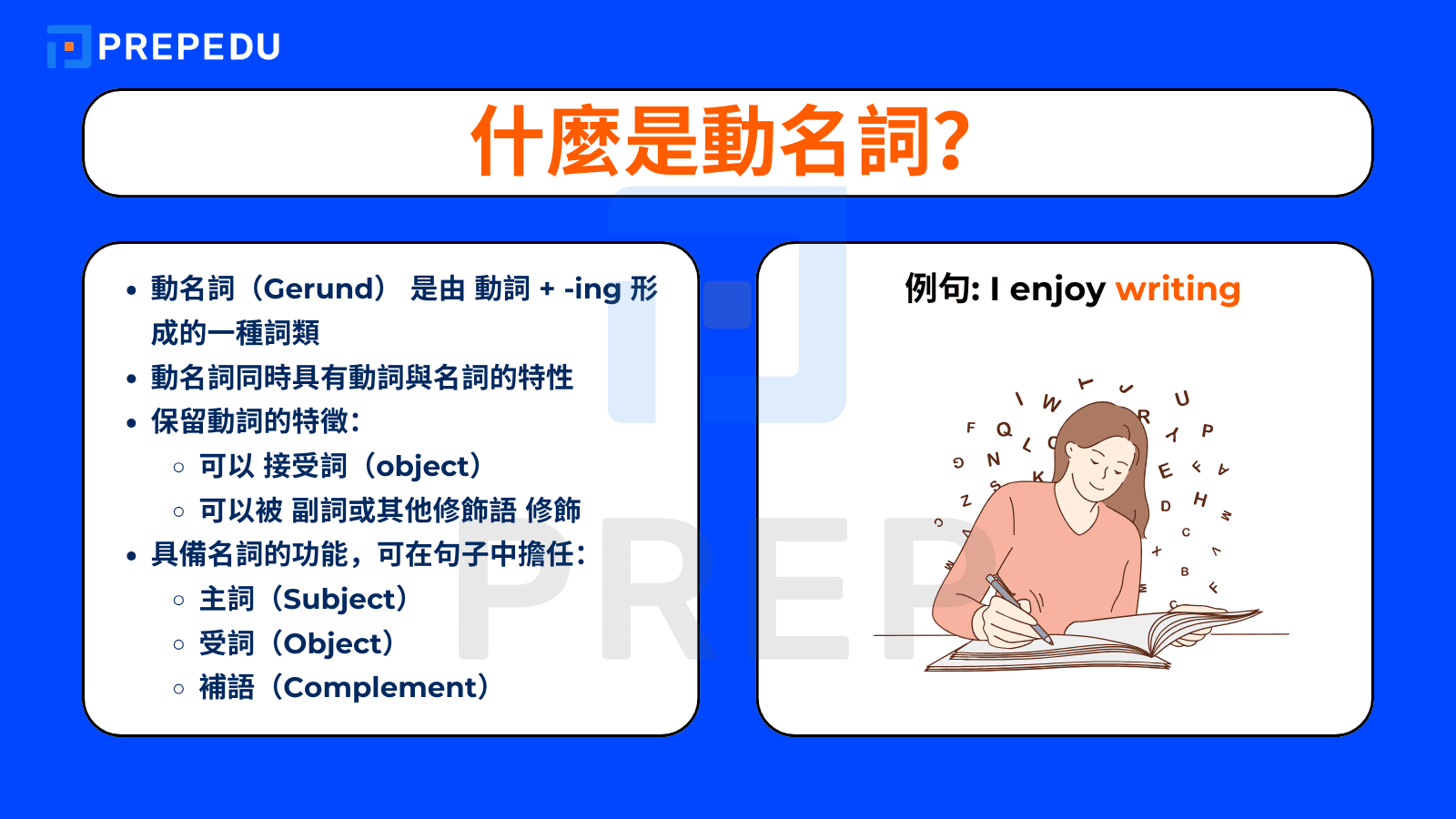
動名詞是由動詞英文加上 -ing 形成的詞類,它兼具動詞的性質與名詞英文的功能。動名詞保留了動詞的特徵,可以接受詞,修飾語,同時又能在句子中扮演名詞的角色,擔任主詞,受詞或補語等成分。這種雙重特性使動名詞成為英文表達中不可或缺的語法工具,讓你能夠將動作概念轉化為可討論的事物。
動名詞構成公式:
動詞原形 + ing = 動名詞
例句動名詞 ing:
-
eat → eating(吃/吃這件事)
-
swim → swimming(游泳/游泳這件事)
-
study → studying(學習/學習這件事)
-
run → running(跑步/跑步這件事)
理解動名詞的核心在於認識到它是「名詞化的動詞」,能夠描述一個動作或活動本身,而非正在進行的動作。舉例來說,當我們說 "Swimming is healthy"(游泳是健康的),這裡的 "swimming" 不是指某人正在游泳的動作,而是指游泳這項活動或概念。
II. 動名詞在英文句中的位置與功能
什麼時候會用到動名詞?動名詞用法在英文句子中扮演著多重角色,它可以出現在句子的不同位置,履行不同的語法功能。掌握動名詞用法的關鍵在於理解它在句中的四種主要位置:主詞,受詞,主詞補語和介系詞受詞。這四種位置涵蓋了動名詞在日常英文表達中的絕大多數應用場景,讓你能夠靈活運用這個文法工具。
1. 作為主詞(Subject)
動名詞當主詞時,整個動名詞(或動名詞片語)被視為單數名詞,因此後接的動詞需使用單數形式。這種用法在表達一般性的活動,習慣或概念時特別常見,能夠讓你的表達更加簡潔有力。在台北,香港等地的商務英文和學術寫作中,這種結構被廣泛使用。
句型公式:
動名詞 + 單數動詞 + 其他成分
例句:
-
Writing detailed proposals improves communication between departments in international companies.(撰寫詳細的提案能改善跨國公司部門之間的溝通。)
-
Conducting market research helps startups in Hong Kong understand customer behavior better.(進行市場調查有助於香港的新創企業更好地了解顧客行為。)
-
Attending virtual conferences increases access to global industry insights for professionals in Taipei.(參加線上會議讓台北的專業人士更容易接觸到全球產業洞察。)
2. 作為受詞(Object)
動名詞可以放在及物動詞之後作為受詞,表達動作的對象或內容。許多常用動詞後面習慣接動名詞而非不定詞,這是英文使用中需要特別記憶的慣用搭配。了解哪些動名詞有哪些特定的動詞搭配,是流利使用英文的關鍵之一。
句型公式:
主詞 + 及物動詞 + 動名詞
例句:
-
The HR department suggested revising the onboarding process to improve employee retention.(人資部門建議修訂新員工培訓流程,以提升員工留任率。)
-
Many professionals in Taipei prefer working remotely at least two days a week.(許多台北的專業人士偏好每週至少遠端工作兩天。)
-
She avoided mentioning the budget issues during the client meeting in Hong Kong.(她在香港的客戶會議中避免提到預算問題。)
3. 作為主詞補語(Subject Complement)
動名詞英文中作為主詞補語時,通常放在 be 動詞之後,用來說明或解釋主詞的內容。這種結構常見於描述興趣,職業,目標或問題等情境,能夠清晰地表達主詞的本質或狀態。在履歷表,自我介紹和職涯規劃討論中,這種用法特別頻繁。
句型公式:
主詞 + be 動詞 + 動名詞
例句:
-
David's favorite weekend activity is hiking in Yangmingshan National Park.(大衛最喜歡的週末活動是在陽明山國家公園健行。)
-
My colleague Yuna's main responsibility is coordinating meetings between our Taipei and Seoul offices.(我的同事允娜的主要職責是協調台北和首爾辦公室之間的會議。)
-
The biggest challenge for Hong Kong students is understanding British English accents in IELTS Listening.(香港學生最大的挑戰是理解雅思聽力中的英式英語口音。)
4. 作為介系詞受詞(Object of Preposition)
這是動名詞最常見且最重要的用法之一。在英文中,介系詞(如 in,on,at,of,for,about,without,by,after,before)後面必須接名詞或動名詞,不能接動詞原形或不定詞英文。這個規則是許多學習者容易忽略但極為關鍵的語法要點,特別是在準備多益或雅思等英文檢定時。
句型公式:
介系詞 + 動名詞
例句:
-
Before launching the new product, the team spent weeks on conducting user behavior analysis.(在推出新產品之前,團隊花了數週進行使用者行為分析。)
-
They succeeded in securing funding after months of pitching to investors across Asia.(他們在數月向亞洲各地的投資人提案後成功獲得資金。)
-
Without improving their English communication skills, many job seekers struggle in multinational companies.(若不提升英文溝通能力,許多求職者在跨國公司會遇到困難。)
了解動名詞在句中的四種主要位置後,你將能更準確地判斷何時使用動名詞,並避免常見的語法錯誤。
III. 英文動名詞片語
動名詞片語是什麼?當動名詞不是單獨出現,而是帶有受詞,修飾語或補語時,就形成了動名詞片語。動名詞片語在英文表達中非常常見,它將一個完整的動作概念包裝成一個名詞單位,使句子結構更加緊湊且富有表現力。在商業書信,學術論文和日常溝通中,動名詞片語能讓你的表達更加專業和精確。
動名詞片語結構:
動名詞 + 受詞/修飾語/補語 = 動名詞片語
動名詞片語的關鍵特點是整個片語被視為一個單一的名詞單位,在句子中可以擔任主詞,受詞或補語。修飾動名詞時,你可以添加副詞,形容詞或其他修飾成分,豐富表達的層次和意義。這種結構讓你能夠在一個名詞位置中表達完整且複雜的概念。
例句分析:
-
Eating street food regularly in Taipei night markets might affect your health.(經常在台北夜市吃街頭小吃可能影響你的健康。)
-
Writing detailed reports for clients every week requires strong analytical skills.(每週為客戶撰寫詳細報告需要強大的分析能力。)
-
Xiaohui enjoys teaching TOEIC preparation courses to university students in Hong Kong.(小慧喜歡在香港教導大學生多益準備課程。)
IV. 英文動名詞 vs. 普通名詞 vs. 現在分詞:完整比較
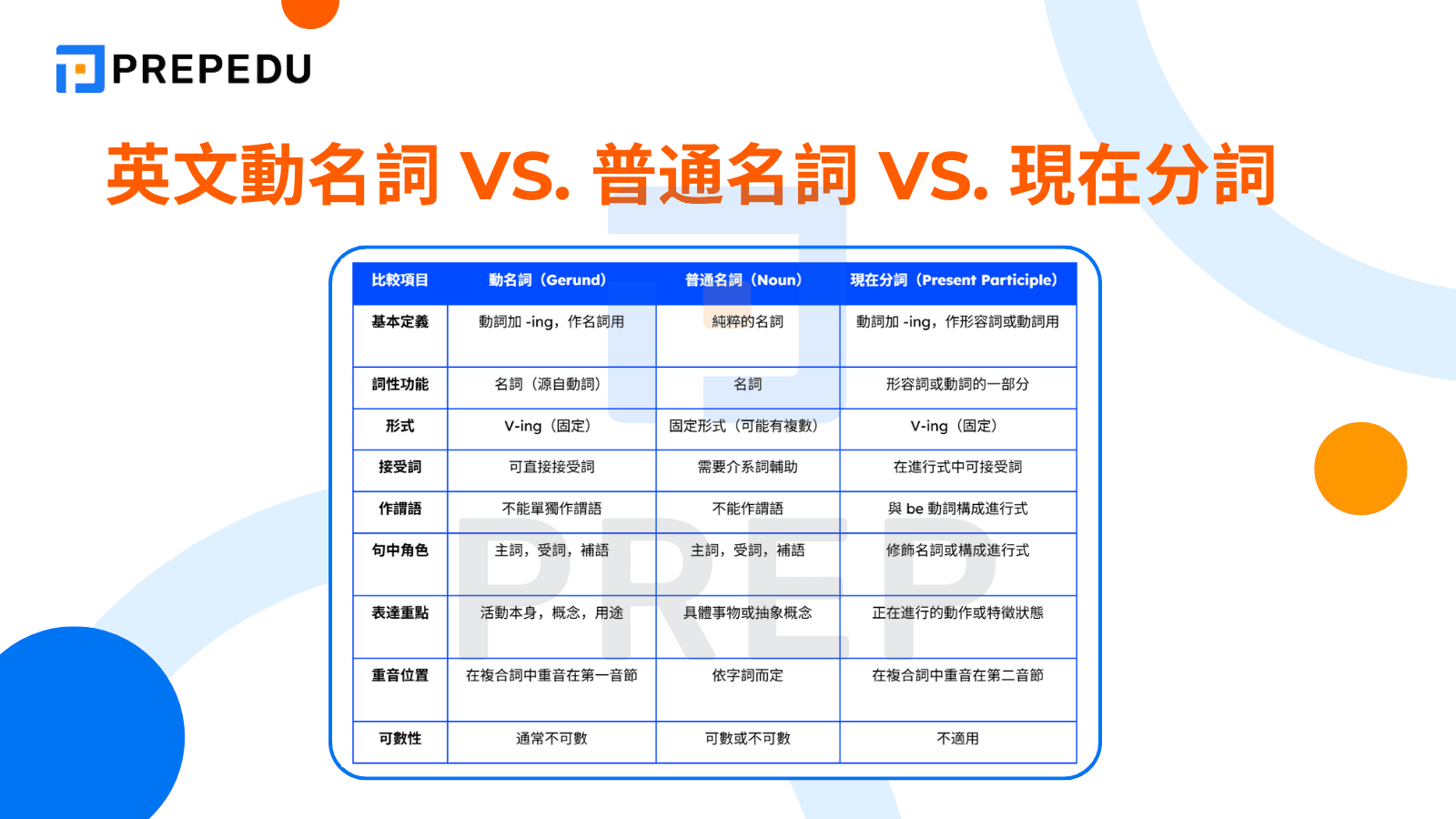
許多學習者在學習動名詞時,容易將它與普通名詞或現在分詞混淆。動名詞現在分詞都是由動詞加上 -ing 形成,外表看起來完全相同,但它們的功能和用法卻截然不同。理解現在分詞動名詞之間的差異是掌握英文文法的重要關鍵,能幫助你避免在閱讀理解和寫作中產生混淆。
動名詞,普通名詞與現在分詞的綜合比較:
|
比較項目 |
動名詞(Gerund) |
普通名詞(Noun) |
現在分詞(Present Participle) |
|
基本定義 |
動詞加 -ing,作名詞用 |
純粹的名詞 |
動詞加 -ing,作形容詞或動詞用 |
|
詞性功能 |
名詞(源自動詞) |
名詞 |
形容詞或動詞的一部分 |
|
形式 |
V-ing(固定) |
固定形式(可能有複數) |
V-ing(固定) |
|
接受詞 |
可直接接受詞 |
需要介系詞輔助 |
在進行式中可接受詞 |
|
作謂語 |
不能單獨作謂語 |
不能作謂語 |
與 be 動詞構成進行式 |
|
句中角色 |
主詞,受詞,補語 |
主詞,受詞,補語 |
修飾名詞或構成進行式 |
|
表達重點 |
活動本身,概念,用途 |
具體事物或抽象概念 |
正在進行的動作或特徵狀態 |
|
重音位置 |
在複合詞中重音在第一音節 |
依字詞而定 |
在複合詞中重音在第二音節 |
|
可數性 |
通常不可數 |
可數或不可數 |
不適用 |
動名詞 vs. 普通名詞的詳細對比例句:
|
動名詞(Gerund) |
普通名詞(Noun) |
|
Writing emails to international clients takes up most of Manager Chen's morning in Taipei.(寫電子郵件給國際客戶佔據了台北陳經理大部分的早晨時間。) → "Writing" 直接接受詞 "emails",保留動詞特性 |
The writing of business proposals requires careful attention to detail.(商業提案的撰寫需要仔細注意細節。) → "writing" 是名詞,需要介系詞 "of" 來連接後面的內容 |
|
Reading IELTS practice materials daily improves your test performance significantly.(每天閱讀雅思練習教材能顯著改善你的考試表現。) → "Reading" 可直接接受詞 "materials" |
The reading of academic papers is essential for graduate students.(學術論文的閱讀對研究生來說很重要。) → 需要用 "of" 來表達關係 |
動名詞 vs. 現在分詞的詳細對比例句:
|
動名詞(Gerund) |
現在分詞(Present Participle) |
|
Swimming in hotel pools is Xiaolin's favorite way to relax during business trips.(在飯店游泳池游泳是小林出差時最喜歡的放鬆方式。) → "Swimming" 是動名詞,作為句子主詞 |
The swimming instructor from Hong Kong teaches at three different clubs.(那位來自香港的游泳教練在三個不同的俱樂部教課。) → "swimming" 是形容詞,修飾 "instructor" |
|
Many Taiwanese students enjoy studying at 24-hour convenience stores.(許多台灣學生喜歡在 24 小時便利商店學習。) → "studying" 是動名詞,作為 enjoy 的受詞 |
The studying environment in Taiwan's libraries is excellent for exam preparation.(台灣圖書館的學習環境對考試準備來說很棒。) → "studying" 修飾 "environment" |
理解動名詞分詞的差異後,你將能更準確地理解句子結構,並在自己的表達中正確使用這兩種形式,提升英文的精確度和流暢度。
V. 英文動名詞 vs. 不定詞:To V 跟 V-ing 差在哪?
To V 跟 V-ing 差在哪?這是許多英文學習者最常提出的問題之一。動名詞有哪些特定的使用場景?某些動詞後面只能接動名詞,某些只能接不定詞,還有一些兩者皆可但意義不同。掌握這些動詞的搭配規則是流利使用英文的關鍵,能讓你的表達更加自然且符合英語母語者的習慣。
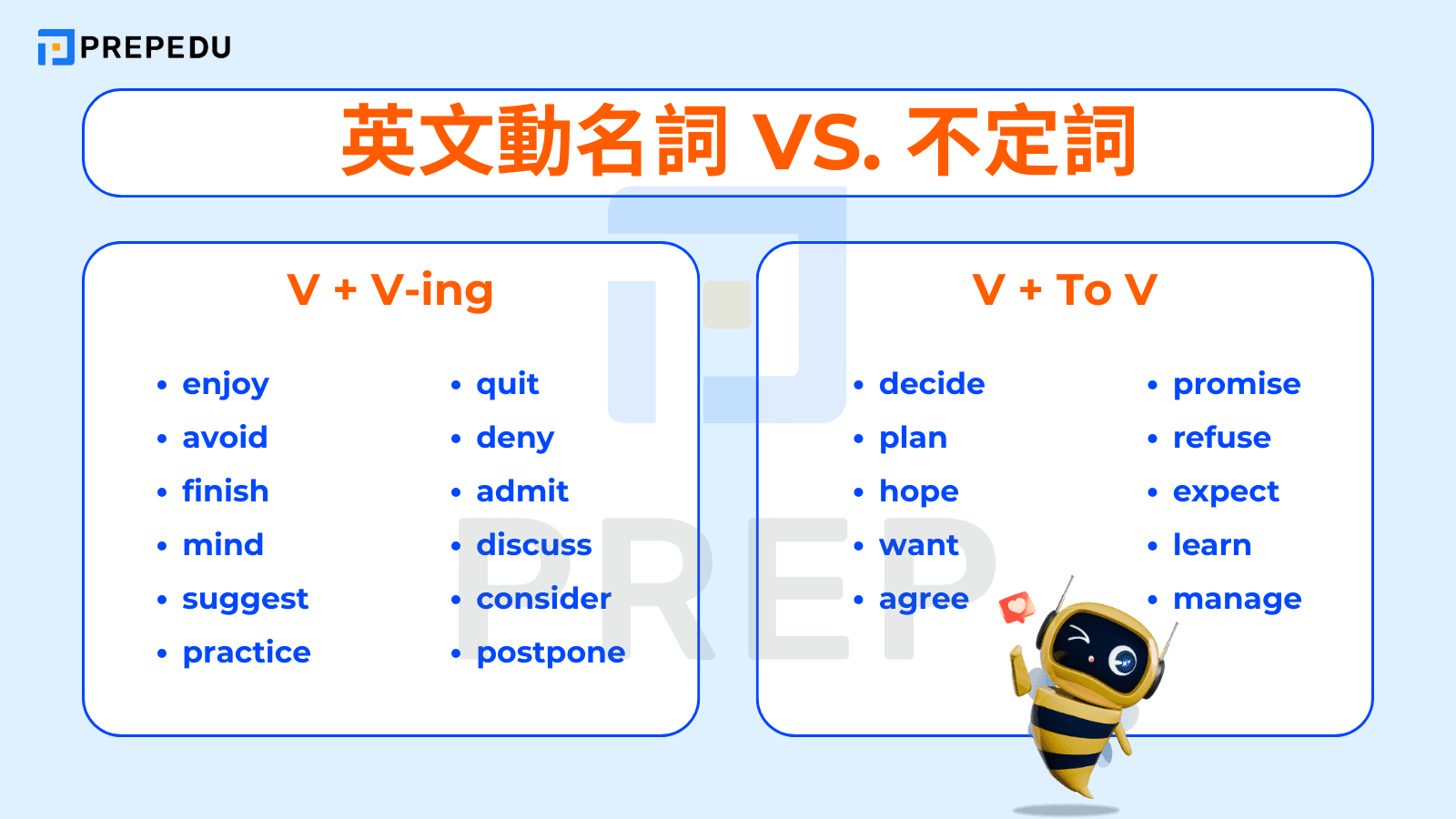
1. 必須接動名詞的動詞(V + V-ing)
以下動詞後面必須接動名詞文法規則中不能接不定詞。這些動詞多半與「過程」,「經驗」或「完成」的概念相關,記憶這些動詞能幫助你避免常見的文法錯誤。這些動詞在多益考試和雅思寫作中頻繁出現,務必熟記。
常見動詞列表:
|
動詞 |
中文 |
例句 |
|
enjoy /ɪnˈdʒɔɪ/ |
享受 |
Xiaomei enjoys swimming at the Taipei Arena pool after work.(小美喜歡下班後在台北小巨蛋游泳池游泳。) |
|
avoid /əˈvɔɪd/ |
避免 |
Most Hong Kong professionals avoid eating heavy meals before important presentations.(大多數香港專業人士避免在重要簡報前吃太飽。) |
|
finish /ˈfɪnɪʃ/ |
完成 |
Kevin finished writing his TOEIC preparation guide last month.(凱文上個月完成了他的多益準備指南撰寫。) |
|
mind /maɪnd/ |
介意 |
Do you mind closing the window?The air conditioning is quite strong.(你介意關窗嗎?空調很強。) |
|
suggest /səˈdʒest/ |
建議 |
The consultant suggested taking a different approach to the Taiwan market.(顧問建議採取不同的方式進入台灣市場。) |
|
practice /ˈpræktɪs/ |
練習 |
Successful IELTS candidates practice speaking English with native speakers daily.(成功的雅思考生每天與母語人士練習說英文。) |
|
quit /kwɪt/ |
放棄,戒除 |
James quit working overtime after his health deteriorated in Hong Kong.(詹姆斯在香港健康惡化後就不再加班了。) |
|
deny /dɪˈnaɪ/ |
否認 |
The company denied having any knowledge of the data breach incident.(公司否認知道資料外洩事件。) |
|
admit /ədˈmɪt |
承認 |
She admitted making several mistakes during the client meeting in Taipei.(她承認在台北的客戶會議中犯了幾個錯誤。) |
|
discuss /dɪˈskʌs/ |
討論 |
The board members discussed changing the company's expansion strategy.(董事會成員討論改變公司的擴張策略。) |
|
consider /kənˈsɪdə(r)/ |
考慮 |
Many graduates consider studying abroad for better career opportunities.(許多畢業生考慮出國留學以獲得更好的職涯機會。) |
|
postpone /pəʊstˈpəʊn/ |
延期 |
The organizers postponed holding the conference due to typhoon warnings.(主辦單位因颱風警報而延期舉辦會議。) |
2. 必須接不定詞的動詞(V + To V)
以下動詞後面必須接不定詞(to + 動詞原形),不能接動名詞。這些動詞通常與「意願」,「計劃」或「未來」的概念相關,反映出說話者對於未發生事件的態度或打算。
常見動詞列表:
|
動詞 |
中文 |
例句 |
|
decide /dɪˈsaɪd/ |
決定 |
Xiaojun decided to pursue a master's degree at Hong Kong University.(小軍決定在香港大學攻讀碩士學位。) |
|
plan /plæn/ |
計劃 |
The marketing team plans to launch the new campaign next quarter in Taiwan.(行銷團隊計劃下季在台灣推出新活動。) |
|
hope /həʊp/ |
希望 |
Recent graduates hope to find jobs with competitive salaries in Taipei.(應屆畢業生希望在台北找到薪水有競爭力的工作。) |
|
want /wɒnt/ |
想要 |
Most students want to improve their IELTS scores for university admission.(大多數學生想提升雅思成績以申請大學。) |
|
agree /əˈɡriː/ |
同意 |
Both companies agreed to collaborate on the technology project.(兩家公司同意在科技專案上合作。) |
|
promise /ˈprɒmɪs/ |
承諾 |
The manager promised to review the salary structure by the end of this month.(經理承諾在本月底前檢討薪資結構。) |
|
refuse /rɪˈfjuːz/ |
拒絕 |
The candidate refused to accept the job offer due to relocation concerns.(候選人因搬遷考量拒絕接受工作機會。) |
|
expect /ɪkˈspekt/ |
期待 |
Employers expect to hire candidates with both language and technical skills.(雇主期待聘用具備語言和技術能力的候選人。) |
|
learn /lɜːn/ |
學習 |
Young professionals in Hong Kong are eager to learn to use AI tools.(香港的年輕專業人士渴望學習使用人工智慧工具。) |
|
manage /ˈmænɪdʒ/ |
設法做到 |
Despite the challenges,the team managed to complete the project on time.(儘管有挑戰,團隊設法準時完成專案。) |
3. 兩者皆可但意義不同
某些動詞後面既可以接動名詞也可以接不定詞,但意義會有明顯差異。掌握這些差異對於準確表達你的意思至關重要,也是英文檢定考試中常見的測試重點。這些動名詞是什麼情況下產生意義變化,需要透過實際例句來理解。
Stop 的用法差異:
|
結構 |
意義 |
例句 |
|
Stop + V-ing |
停止正在做的事 |
Stop checking your phone during the meeting!(會議中停止看手機!) |
|
Stop + to V |
停下來去做另一件事 |
Xiaofang stopped to buy coffee at the convenience store on her way to work in Taipei.(小芳在台北上班途中停下來在便利商店買咖啡。) |
Remember / Forget 的用法差異:
|
結構 |
意義 |
例句 |
|
Remember + V-ing |
記得已經做過的事 |
I remember submitting the report to the Hong Kong office last Friday.(我記得上週五已將報告提交給香港辦公室。) |
|
Remember + to V |
記得要去做的事 |
Remember to bring your passport for tomorrow's business trip to Shanghai.(記得帶護照參加明天去上海的出差。) |
|
Forget + V-ing |
忘記已經做過的事 |
I'll never forget meeting the CEO at the Taipei conference last year.(我永遠不會忘記去年在台北會議上見到執行長。) |
|
Forget + to V |
忘記要去做的事 |
David forgot to lock the office door when he left yesterday evening.(大衛昨天傍晚離開時忘記鎖辦公室門。) |
Try 的用法差異:
|
結構 |
意義 |
例句 |
|
Try + V-ing |
嘗試某種方法(實驗性質) |
If you have difficulty sleeping, try drinking warm milk before bed.(如果你難以入睡,試試睡前喝溫牛奶。) |
|
Try + to V |
努力嘗試去做 |
Jenny tried to finish all the TOEIC practice tests before the exam but ran out of time.(珍妮試著在考試前完成所有多益練習測驗,但時間不夠。) |
Regret 的用法差異:
|
結構 |
意義 |
例句 |
|
Regret + V-ing |
後悔做過的事 |
Many professionals regret not studying English more seriously during university.(許多專業人士後悔大學時沒有更認真學習英文。) |
|
Regret + to V |
遺憾地要做某事(正式用法) |
We regret to inform you that your application was not successful this time.(我們遺憾地通知您,您的申請這次未成功。) |
Go on 的用法差異:
|
結構 |
意義 |
例句 |
|
Go on + V-ing |
繼續做同一件事 |
After a short break, the lecturer went on explaining the complex grammar rules.(短暫休息後,講師繼續解釋複雜的文法規則。) |
|
Go on + to V |
繼續做另一件事 |
After graduating from National Taiwan University, he went on to earn his PhD in the US.(從台灣大學畢業後,他繼續在美國攻讀博士學位。) |
理解這些動詞搭配規則後,你將能更精確地表達時間,意圖和動作的關係,使你的英文動名詞表達更加準確和流暢。
VI. 常見英文動名詞慣用句型
英文動名詞在許多固定句型和慣用表達中扮演重要角色。這些慣用句型在日常對話和寫作中頻繁出現,掌握這些動名詞的用法能讓你的英文表達更加地道和自然,也是提升語言流暢度的關鍵。在多益,雅思等考試中,這些句型也經常作為測試重點。
1. Spend + 時間/金錢 +(on)+ V-ing
這個句型用來表達花費時間或金錢在某個活動上,是描述時間分配和資源運用時非常實用的表達方式。介系詞 "on" 在口語中常被省略,但保留也完全正確。這個動名詞用法在商業報告和專案管理中特別常見。
句型公式:
主詞 + spend + 時間/金錢 +(on)+ V-ing
例句:
-
Marketing Manager Wang spends three hours daily responding to customer inquiries from Taiwan and Hong Kong.(行銷經理王每天花三小時回覆來自台灣和香港的客戶詢問。)
-
The company spent NT$500,000 on upgrading the office technology infrastructure.(公司花了新台幣 50 萬元升級辦公室技術基礎設施。)
-
Xiaohong spends most of her weekends studying for the IELTS exam at Taipei Public Library.(小紅大部分週末都在台北市立圖書館為雅思考試學習。)
2. Be busy + V-ing
這個句型用來表達忙於做某事,強調當下正在進行的活動或持續的忙碌狀態。這是描述工作狀態或日程安排時常用的動名詞英文表達,在辦公室環境中使用頻率極高。
句型公式:
主詞 + be busy + V-ing
例句:
-
The IT support team is busy resolving login issues reported by employees this morning.(IT 支援團隊正忙著處理今天早上員工回報的登入問題。)
-
Jessica was busy organizing client feedback from the trade show held last weekend in Taipei.(潔西卡正忙著整理上週末在台北舉辦的商展中收到的客戶回饋。)
-
We're busy drafting the agenda for next week's cross-regional strategy meeting.(我們正忙著草擬下週跨區域策略會議的議程。)
3. Have difficulty/trouble/fun +(in)+ V-ing
這個句型用來表達在做某事時遇到困難,麻煩或感到樂趣。介系詞 "in" 在現代英文中常被省略,直接接動名詞即可。這個結構在描述學習過程或工作挑戰時非常有用。
句型公式:
主詞 + have + difficulty/trouble/fun +(in)+ V-ing
例句:
-
Many Hong Kong students have difficulty understanding American English accents in TOEIC Listening tests.(許多香港學生難以理解多益聽力測驗中的美式英語口音。)
-
Xiaozhen had trouble finding a parking space near her office in downtown Taipei during rush hour.(小真在尖峰時段難以在台北市中心辦公室附近找到停車位。)
-
The software development team had fun experimenting with new programming frameworks last Friday.(軟體開發團隊上週五很開心地嘗試新的程式設計框架。)
4. Go + V-ing
這個句型專門用來表達從事休閒活動或運動,特別是戶外活動。這是英文中表達娛樂活動時非常自然且常用的動名詞表達方式,在討論週末計劃或假期安排時經常使用。
例句:
-
Some coworkers in Taipei love to go cycling along the Tamsui River after work.(台北有些同事下班後喜歡沿著淡水河騎腳踏車。)
-
On holidays, Leo's family goes camping in the mountains near Taichung.(假日時,Leo 的家人會去台中附近的山區露營。)
-
Tourists in Hong Kong often go sightseeing around Victoria Peak and Central.(來香港的觀光客常常去太平山和中環觀光。)
5. It is no use / There is no use + V-ing
這個句型用來表達做某事是沒有用的,徒勞的或無意義的,常用於勸告或表達無奈的情境中。這個動名詞文法結構在表達現實情況或給予建議時特別有效。
例句:
-
It's no use complaining about the traffic congestion in Taipei; we should leave earlier for meetings.(抱怨台北交通擁堵沒有用,我們應該提早出門開會。)
-
There's no use worrying about past IELTS scores; focus on preparing better for the next test.(擔心過去的雅思成績沒有用,專注於為下次測驗做更好的準備。)
-
It's no use arguing with customer service without proper documentation of the issue.(沒有問題的適當文件就與客服爭論是沒有用的。)
6. Can't help + V-ing
這個句型表達「忍不住」,「不禁」或「無法避免」做某事的意思,用來描述難以控制的情緒反應或自然反應。這個動名詞是什麼樣的表達在文學作品和日常對話中都很常見。
句型公式:
主詞 + can't help + V-ing
例句:
-
Xiaoming couldn't help laughing when his colleague accidentally sent a funny message to the entire company.(當同事不小心把搞笑訊息發給全公司時,小明忍不住大笑。)
-
Visitors to Taipei 101 can't help feeling amazed by the spectacular city views from the observatory.(來台北 101 的遊客不禁對觀景台的壯觀城市景觀感到驚嘆。)
-
Many employees couldn't help worrying about job security during the company restructuring period.(在公司重組期間,許多員工不禁擔心工作保障。)
7. No + V-ing(禁止告示)
這是告示牌和標誌中常見的表達方式,用來表示禁止某種行為。這種簡潔的命令式動名詞表達在公共場所隨處可見,是最直接的禁止用語。
例句與說明:
-
No smoking in the MRT stations and trains throughout Taipei and New Taipei City.(台北和新北市捷運站及列車內全面禁止吸菸。)
-
No parking in front of the building entrance during business hours on weekdays.(平日營業時間禁止在大樓入口前停車。)
-
No eating or drinking inside Taipei City Library reading rooms to maintain cleanliness.(為保持整潔,台北市立圖書館閱覽室內禁止飲食。)
8. Be worth + V-ing
這個句型表達某事值得去做,用來給予建議或評價某個行動的價值。這是一個非常實用的動名詞用法,在商業決策和個人建議中經常使用。
句型公式:
主詞 + be worth + V-ing
例句:
-
This new Thai restaurant in Xinyi District is definitely worth trying for authentic flavors.(信義區這家新的泰式餐廳絕對值得一試正宗口味。)
-
The online TOEIC preparation course from this Taiwan-based platform is worth taking for serious learners.(這個台灣平台的線上多益準備課程對認真的學習者來說值得參加。)
-
Attending international business conferences in Hong Kong is worth investing time and money for networking.(參加香港的國際商務會議值得投資時間和金錢來建立人脈。)
9. Look forward to + V-ing
這個片語動詞後面必須接動名詞,因為 "to" 在這裡是介系詞而非不定詞符號。這是商業書信和正式溝通中最常用的動名詞結構之一,表達期待之意。
句型公式:
主詞 + look forward to + V-ing
例句:
-
We look forward to hearing your feedback on the proposal we submitted last week.(我們期待聽到您對我們上週提交的提案的反饋。)
-
Xiaojie is looking forward to attending the technology conference in Taipei next month.(小杰期待參加下個月在台北的科技會議。)
-
The entire team looks forward to working with the new Hong Kong branch office.(整個團隊期待與新的香港分公司合作。)
VII. 介系詞 "To" 後接動名詞的特例
許多學習者在看到 "to" 時,會直接認為後面應該接動詞原形(不定詞)。然而,在某些固定片語中,"to" 是介系詞而非不定詞符號,因此後面必須接動名詞(V-ing)而非動詞原形。這個規則違反了許多學習者的直覺,但卻是英文文法中不可忽視的重要特例。在多益考試中,這類題目的錯誤率往往超過 60%,足見其重要性。
常見片語詳細列表:
|
片語 |
意思 |
例句 |
|
Look forward to + V-ing |
期待 |
Marketing teams across Taiwan look forward to seeing the results of the new campaign strategy.(台灣各地的行銷團隊期待看到新活動策略的成果。) |
|
Object to + V-ing |
反對 |
Several board members objected to changing the company's long-term investment plan.(幾位董事會成員反對改變公司的長期投資計劃。) |
|
Be used to + V-ing |
習慣於 |
After five years in Hong Kong,Xiaolin is completely used to working in fast-paced environments.(在香港五年後,小林完全習慣在快節奏環境中工作。) |
|
Devote oneself to + V-ing |
致力於 |
Professor Chen devotes himself to teaching international students at National Taiwan University.(陳教授致力於在台灣大學教導國際學生。) |
|
Be committed to + V-ing |
致力於 |
Our company is committed to providing excellent customer service across all branches.(我們公司致力於在所有分店提供卓越的客戶服務。) |
|
In addition to + V-ing |
除了...之外 |
In addition to managing the Taipei office,she oversees operations in three other cities.(除了管理台北辦公室外,她還監督其他三個城市的營運。) |
|
When it comes to + V-ing |
當談到 |
When it comes to preparing for IELTS Speaking,regular practice with native speakers is essential.(談到準備雅思口說,與母語人士定期練習很重要。) |
|
Be accustomed to + V-ing |
習慣於 |
Hong Kong professionals are accustomed to working long hours during busy seasons.(香港專業人士習慣在忙季長時間工作。) |
|
Contribute to + V-ing |
有助於 |
Regular exercise contributes to maintaining good health and mental clarity.(規律運動有助於維持良好健康和頭腦清晰。) |
|
Be opposed to + V-ing |
反對 |
Many environmental groups are opposed to building new factories in protected areas.(許多環保團體反對在保護區建造新工廠。) |
VIII. 動名詞綜合練習題(附詳解)
透過實際練習來鞏固動名詞文法知識是最有效的學習方式。以下提供三組不同難度的練習題,從基礎辨析到進階應用,幫助你全面掌握動名詞的各種用法。
1. 練習一:基礎辨析
題目說明:將括號內的動詞改成適當形式(動名詞或保持原形)。
-
(Read)_______ English newspapers daily improves your vocabulary significantly.
-
Manager Liu from Taipei enjoys(listen)_______ to business podcasts during commute.
-
(Exercise)_______ regularly at the gym helps reduce work-related stress.
-
The marketing team finished(write)_______ the quarterly report yesterday.
-
Xiaohong is exceptionally good at(solve)_______ complex data analysis problems.
-
(Learn)_______ Mandarin Chinese takes dedication and consistent practice.
-
All employees are busy(prepare)_______ for the annual performance review.
-
Thank you for(help)_______ organize the successful conference in Hong Kong.
-
(Travel)_______ to different countries broadens your cultural perspectives.
-
Most professionals in Taiwan avoid(eat)_______ unhealthy snacks at work.
詳解:
-
Reading - 動名詞作主詞,表示「閱讀」這個行為概念
-
listening - enjoy 後必須接動名詞,不能接不定詞
-
Exercising - 動名詞作主詞,指「運動」這件事
-
writing - finish 後必須接動名詞
-
solving - 介系詞 at 後必須接動名詞
-
Learning - 動名詞作主詞
-
preparing - be busy 後接動名詞,表示忙於做某事
-
helping - 介系詞 for 後必須接動名詞
-
Traveling - 動名詞作主詞
-
eating - avoid 後必須接動名詞
2. 練習二:動名詞 vs. 不定詞選擇
題目說明:選擇正確的形式填入空格。
-
Successful TOEIC candidates enjoy(swimming / to swim)as a stress-relief activity.
-
The project manager decided(studying / to study)for an MBA at National Taiwan University.
-
Please stop(talking / to talk)during the important client presentation!
-
I clearly remember(meeting / to meet)you at the networking event in Taipei 101 last year.
-
Our Hong Kong branch promised(helping / to help)coordinate the regional marketing campaign.
-
If you want better IELTS Writing scores,try(reading / to read)more academic articles.
-
David forgot(locking / to lock)the conference room after the meeting ended.
-
The consultant suggested(taking / to take)a different approach to penetrate the Taiwan market.
-
Several team members refused(answering / to answer)questions about the controversial policy.
-
Most graduates in Taiwan plan(visiting / to visit)multiple companies before accepting job offers.
詳解:
-
swimming - enjoy 後接動名詞,表示享受某活動
-
to study - decide 後接不定詞,表示決定做某事
-
talking - stop + V-ing 表示停止正在做的事(停止說話)
-
meeting - remember + V-ing 表示記得已做過的事
-
to help - promise 後接不定詞,表示承諾未來的行動
-
reading - try + V-ing 表示嘗試某方法看是否有效
-
to lock - forget + to V 表示忘記要做的事(還沒做)
-
taking - suggest 後接動名詞
-
to answer - refuse 後接不定詞
-
to visit - plan 後接不定詞,表示計劃未來的行動
3. 練習三:進階改寫與翻譯
題目說明:將括號內的動詞改成適當形式,完成句子。
-
Xiaojun from Hong Kong spends three hours every evening _______(study)for the CPA examination.
-
The entire sales team looks forward to _______(meet)the new regional director next Monday.
-
Marketing professionals in Taipei are busy _______(develop)strategies for the upcoming product launch.
-
It's no use _______(complain)about office politics without proposing constructive solutions.
-
International students often have difficulty _______(understand)Taiwan's traditional Chinese characters initially.
-
When watching emotional reunion videos,I can't help _______(feel)touched by family bonds.
-
_______(Maintain)work-life balance is crucial for long-term career success.
-
After lunch,she stopped _______(drink)coffee because it affected her sleep quality.(停止喝咖啡)
-
Remember _______(submit)your expense reports before the end of each month.
-
After working in Hong Kong for a decade,he is completely used to _______(commute)during peak hours.
詳解:
-
studying - spend time + V-ing 固定句型
-
meeting - look forward to 後的 to 是介系詞,必須接動名詞
-
developing - be busy + V-ing 表示忙於做某事
-
complaining - It's no use + V-ing 表示做某事沒有用
-
understanding - have difficulty + V-ing 表示做某事有困難
-
feeling - can't help + V-ing 表示忍不住做某事
-
Maintaining - 動名詞作主詞,表示「維持」這個概念
-
drinking - stop + V-ing 表示停止正在做的事(戒掉喝咖啡的習慣)
-
to submit - remember + to V 表示記得要做的事(還沒做)
-
commuting - be used to 後的 to 是介系詞,必須接動名詞
IX. 動名詞否定,被動與完成式
除了基本的動名詞形式外,動名詞還有否定句,被動語態和完成式等變化形式,這些進階用法能讓你的英文表達更加精確和專業。
1. 動名詞的否定形式
動名詞的否定是在動名詞前加 "not"。這種形式在表達建議,警告或描述後果時特別有用。例句:
-
Not preparing adequately for job interviews reduces your chances of success significantly.(沒有充分準備工作面試會大幅降低你的成功機會。)
-
The team regrets not starting the project earlier given the tight deadline.(考慮到緊迫的期限,團隊後悔沒有更早開始專案。)
-
The company faced delays due to not allocating enough resources at the planning stage.(由於在規劃階段未分配足夠資源,該公司面臨延誤。)
2. 動名詞的被動形式
當動作的接受者比執行者更重要時,使用被動動名詞。被動動名詞的結構是 "being + 過去分詞"。結構:
being + 過去分詞(p.p.)
例句:
-
Being promoted to senior manager requires consistent high performance over several years.(被升遷為高階經理需要多年持續的高績效表現。)
-
Xiaomei dislikes being interrupted during important client calls in her Taipei office.(小美不喜歡在台北辦公室進行重要客戶通話時被打斷。)
-
The employees appreciated being given additional training opportunities by the company.(員工感謝公司給予額外的培訓機會。)
3. 動名詞的完成式
動名詞完成式用來強調動名詞的動作發生在主要動詞之前,結構是 "having + 過去分詞"。結構:
having + 過去分詞(p.p.)
例句:
-
After having lived in Hong Kong for ten years,Mr. Chen understands the business culture thoroughly.(在香港生活十年後,陳先生徹底了解商業文化。)
-
She regrets having missed the important networking opportunity at the conference.(她後悔錯過了會議上重要的人脈建立機會。)
-
Having completed the intensive TOEIC course,students feel more confident about the exam.(完成密集多益課程後,學生對考試感到更有信心。)
4. 動名詞的被動完成式
結合被動和完成的概念,結構是 "having been + 過去分詞"。這種形式在正式寫作中較為常見。結構:
having been + 過去分詞(p.p.)
例句:
-
Having been selected as team leader, Xiaohua felt both honored and pressured.(被選為團隊領導後,小華既感到榮幸又感到壓力。)
-
After having been rejected multiple times, he finally received a job offer from a top firm.(在多次被拒絕後,他終於收到頂尖公司的工作邀約。)
-
Having been invited to speak at the international conference, Dr. Chen spent weeks preparing his presentation.(受邀在國際會議上發表演講後,陳博士花了數週準備簡報。)
結論
動名詞是英文文法中極為重要的概念,掌握動名詞的定義,用法,以及與其他詞類的區別,能顯著提升你的英文表達能力。從動名詞當主詞的基本用法,到介系詞後接動名詞的規則,再到動名詞與不定詞的選擇,每個細節都值得你仔細學習和練習。
您是否對能否實現目標分數存疑?PREPEDU.COM Test Practice 不只是習題演練,更基於現有成績智能推算達成機率。
借助龐大的成功學員數據庫,系統精密解析得分軌跡,針對不同分數目標制定專屬學習方案。無論志在雅思 6.5 分還是多益 850 分,都有量身打造的戰術指引。
動態進度圖表直觀展示您的階段位置及抵達終點所需時程。大量學員透過 4-6 週持續練習,雅思能力躍進 0.5-1.0 分,多益實力增長 100-200 分。
勝利來自充分籌備而非幸運眷顧。讓 PREP Test Practice 化身您從現實走向夢想的穩固紐帶!

你好!我叫黃秋賢,現在在 prepedu.com 擔任內容企劃。我有超過5年的英語與韓語自學經歷,親身備考 IELTS、TOEIC 與 TOPIK,累積了大量第一手的學習者視角——包括哪些語法規則最讓台灣與香港學習者混淆,以及如何在有限的備考時間內最有效地修正這些錯誤。目前已在 prepedu.com 撰寫超過 1000 篇英語學習文章,內容涵蓋語法、詞彙與考試策略,累積協助數千位學習者解決自學過程中的語法疑問。
評論












統一企業編號:202227322W
地址:114 LAVENDER STREET, #11-83 CT HUB 2, SINGAPORE (338729)