【直述句英文】Direct and Indirect Speech 全攻略:4 大轉換步驟、5 種時態例外
直述句英文是什麼?直述句英文(Direct Speech)是將說話者的原話逐字引用,並以引號標示的語法形式;相對地,間接引語英文(Indirect Speech)則是以轉述者的語言重新表達,省略引號並調整時態與人稱。這是英語語法中最實用、也最常被誤用的句型之一,從日常對話到 IELTS 寫作測驗,都離不開這項核心技能。
許多學習者以為,把引號拿掉就完成了轉換——但真正的挑戰才剛開始。時態退後、人稱代名詞的視角切換、時間副詞的全面調整,以及疑問句語序的還原,每一步都有可能造成語意偏差甚至失分。更少人知道的是,並非所有句子都必須遵循「時態退後」規則——客觀真理、條件句假設語氣與特定情態助動詞,都是公認的例外,一旦混淆,反而會把正確的句子改錯。
直述句英文轉換的真正難點,不在背規則,而在理解每一步背後的「視角轉換邏輯」——你從說話者的即時視角,切換到轉述者在另一個時間點的旁觀視角。時態退後、人稱調整、副詞更換,都只是這個視角切換在不同語法層面的具體體現。一旦理解這個邏輯,四大轉換步驟自然前後貫通。
PREPEDU 在這篇文章中,從直述句英文與間接引語英文的定義出發,完整拆解四大步驟的核心轉換規則,涵蓋陳述句、疑問句、祈使句與感嘆句的獨立公式,並深入解析五類不需退後時態的特殊情況。文末附有三組共 30 題實戰練習,搭配詳細解答,幫助你從理解走向真正的應用。

I. 直述句英文與間接引語英文的差異(Direct Speech vs Indirect Speech)
直接引語英文保留說話者原話視角,加引號,時態、人稱、副詞全部不動;間接引語英文切換至轉述者視角,無引號,依規則調整時態、人稱與副詞。兩者最根本的差異,是「誰的眼睛在看這件事」。
掌握直述句英文,是英語語法學習中不可跳過的核心關卡。無論是日常對話、新聞報導,還是 IELTS 寫作與口說測驗,引述他人話語的能力都直接影響表達的精準度。直接引語英文(Direct Speech)與間接引語英文(Indirect Speech)同為引述他人話語的手段,但兩者在結構、標點、時態與人稱上存在根本差異,必須分開理解、分開運用。
值得注意的是,「Indirect Speech」與「Reported Speech」是同一個語法概念的兩種稱呼,在教材與考試中可以互換使用,學習時不必困惑。
1. 什麼是直接引語英文(Direct Speech)?
直接引語英文,是將說話者的原話逐字引用,不作任何更動,必須以引號(" ")括住,並完整保留原始的時態、人稱、副詞與語序。這種方式傳遞的是話語的「即時感」,讓讀者或聽者感受到原始表達的溫度。
書寫時,引號內的第一個字必須大寫,並以逗號將引述內容與轉述動詞分開。
結構公式:
轉述動詞 + 「引用原話」,或「引用原話,」+ 轉述動詞
-
She said, "I am preparing for the IELTS exam in Taipei next month."(她說:「我下個月要在台北備考雅思。」)
-
"There is a new café near Zhongshan Station," Xiaowang told me.(小王告訴我:「中山站附近開了一家新咖啡廳。」)
2. 什麼是間接引語英文(Indirect Speech / 轉述句英文)?
轉述句英文(Indirect Speech),又稱 Reported Speech,是以說話者自己的語言重述他人的話,不加引號,通常以連接詞英文 that 引導(口語中可省略),並依據轉述當下的語境調整時態、人稱與時間地點副詞。間接引語英文強調的是「意思的傳達」,而非原話的重現。
結構公式:
轉述動詞 +(that)+ 已調整的子句
-
She said (that) she was preparing for the IELTS exam in Taipei the following month.(她說她下個月要在台北備考雅思。)
-
Xiaowang said (that) there was a new café near Zhongshan Station(他說中山站附近開了一家新咖啡廳。)
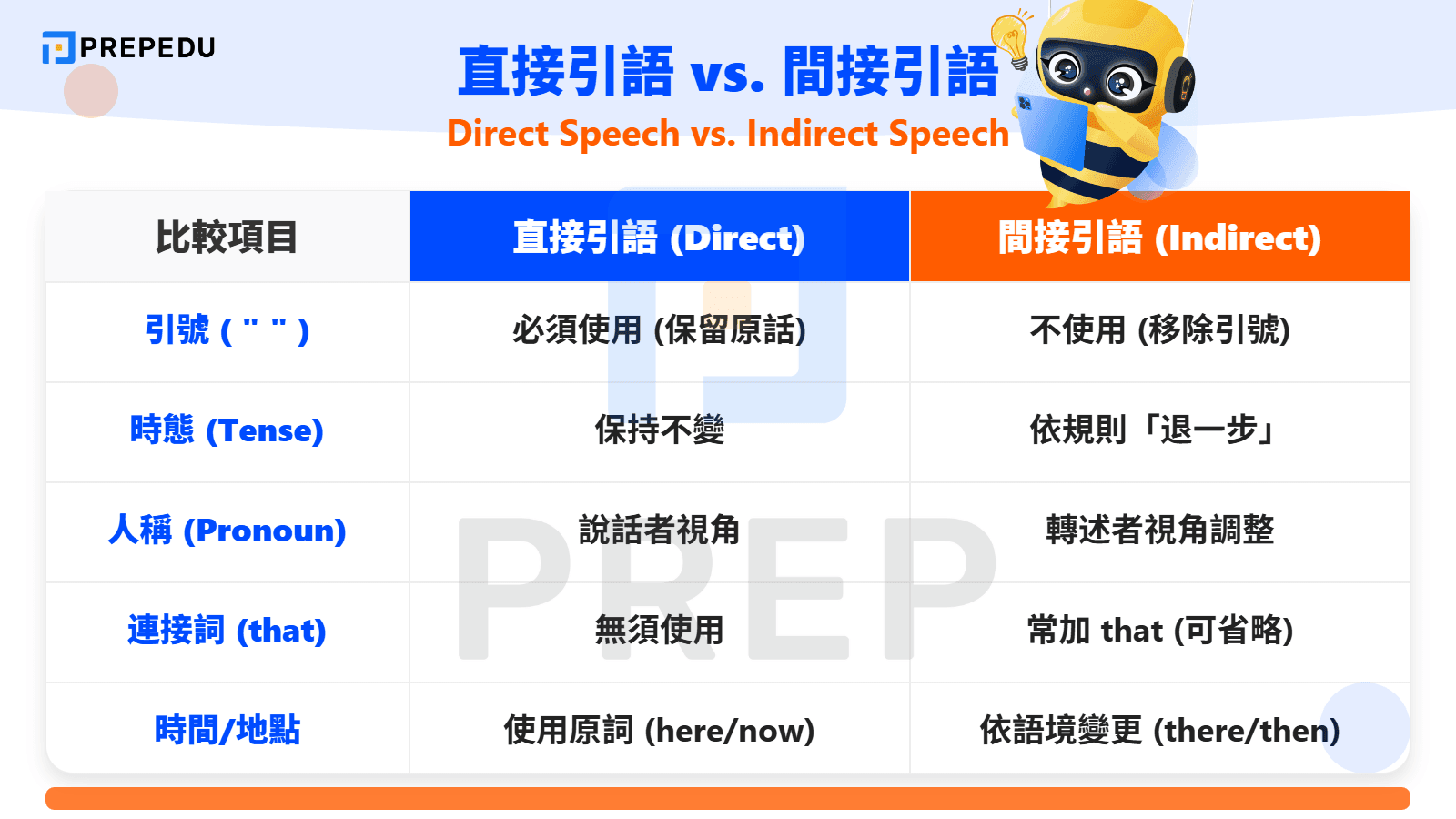
直述句英文與轉述句英文的核心差異對照:
|
比較項目 |
直接引語英文(Direct Speech) |
間接引語英文(Indirect Speech) |
|
引號 |
必須使用 " " |
不使用 |
|
連接詞 |
無 |
that(可省略) |
|
時態 |
保留原始時態 |
依規則退後(有例外) |
|
人稱代名詞 |
依說話者視角 |
依轉述者視角調整 |
|
時間、地點副詞 |
使用原詞 |
依語境調整 |
|
語序(問句) |
疑問句語序 |
恢復直述句語序 |
II. 直述句英文轉間接句的 4 大步驟
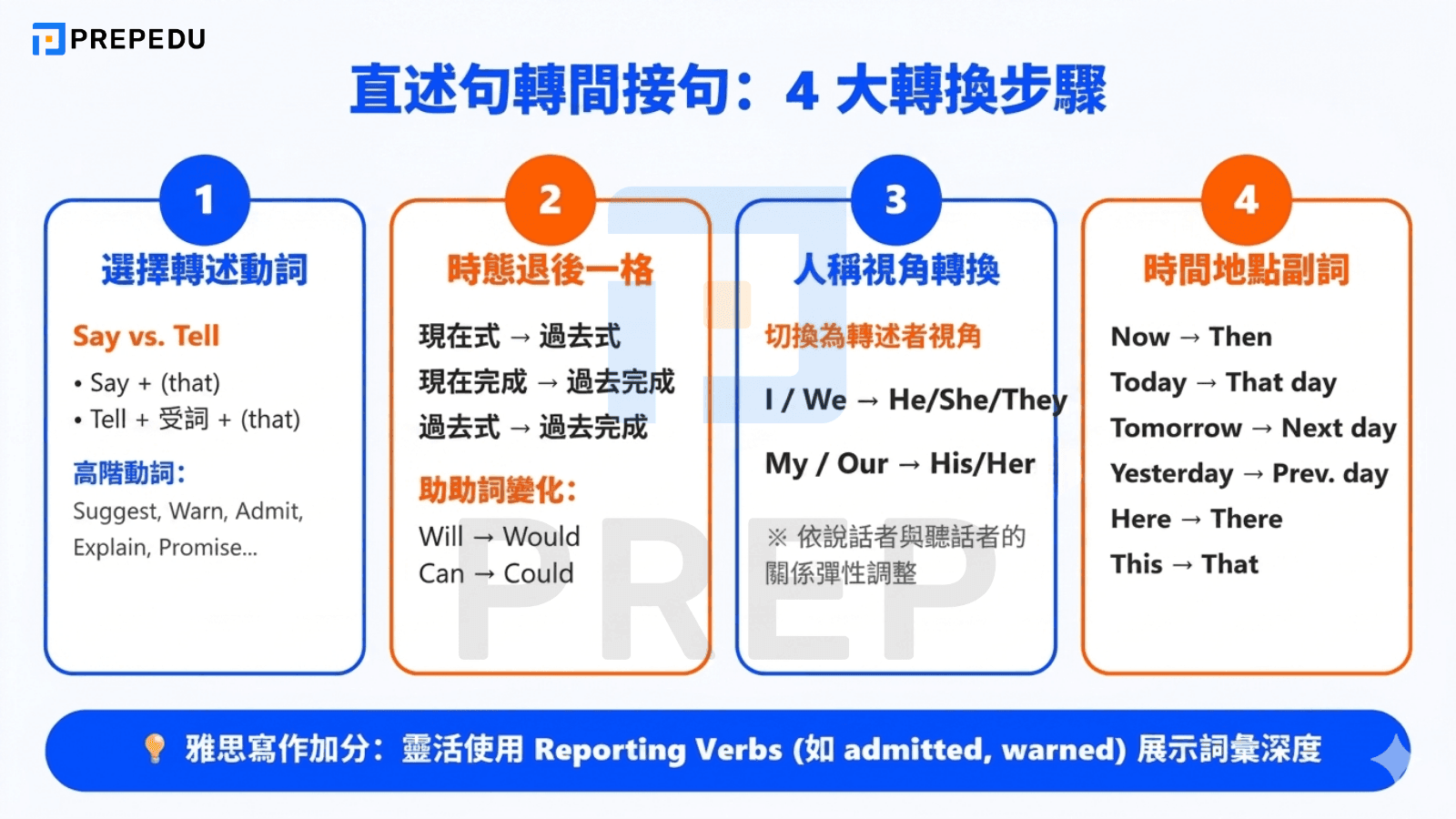
將直述句英文轉為間接引語英文,必須同時處理四個語法層面:選擇轉述動詞 → 時態退後 → 人稱轉換 → 時間地點副詞調整。四步驟缺一不可,按順序執行,每一步都有明確規則可循。
將直述句英文轉換為間接引語英文,絕不是單純去掉引號那麼簡單。你需要同時處理四個語法層面,缺一不可。每一個步驟都有明確的規則可循,只要按順序掌握,轉換過程便能條理分明。
1. 步驟一:選擇適當的轉述動詞
轉述動詞(Reporting Verbs)決定整個句子的語氣與意涵。選用不同的動詞,傳達的情感色彩與句意重點截然不同。最基礎的區分是 say 與 tell 的差異:say 後方不接受詞,tell 後方必須接受詞,表明是「告訴某人」。
|
轉述動詞 |
中文意義 |
搭配結構 |
適用情境 |
|
say |
說 |
say (that),不接受詞 |
一般陳述,無特定受詞 |
|
tell |
告訴 |
tell + 受詞 + (that) |
陳述句,有明確受詞 |
|
ask |
詢問、請求 |
ask + 受詞 + if / wh- |
問句或請求轉述 |
|
order |
命令 |
order + 受詞 + to V |
強制性指令 |
|
warn |
警告 |
warn + 受詞 + not to V |
警告不要做某事 |
|
advise |
建議 |
advise + 受詞 + to V |
提供忠告 |
|
suggest |
建議 |
suggest + that + S + (should) V 或 suggest + Ving |
非強制性建議 |
|
exclaim |
驚嘆 |
exclaim that |
表達強烈情緒 |
|
explain |
解釋 |
explain that |
說明或闡述 |
|
announce |
宣布 |
announce that |
正式宣告 |
|
complain |
抱怨 |
complain that |
表達不滿 |
|
admit |
承認 |
admit that |
坦承事實 |
|
deny |
否認 |
deny + Ving |
否定某事 |
|
promise |
承諾 |
promise + to V 或 promise that |
作出保證 |
|
refuse |
拒絕 |
refuse + to V |
表示拒絕 |
依照句意選擇最精準的轉述動詞,能讓你的直述句英文轉換為間接引語英文更自然、更有層次。這一點在 IELTS Writing 評分中同樣至關重要。
IELTS Writing 視角:在 IELTS Writing Task 1 的 Process 題型或 IELTS Writing Task 2 的引用論據中,單一使用 said/told 的考生,與靈活使用 announced、admitted、warned、suggested 的考生,在 Lexical Resource 維度上往往差距顯著。評分官能一眼看出「這位考生只懂最基礎的轉述動詞」。一個實用的備考策略:把上面表格中的 15 個轉述動詞各造一句,按照情緒強弱排序——這個練習比背單字清單更能建立「哪個情境用哪個動詞」的直覺。
2. 步驟二:時態退後規則
當引導動詞為過去式(said、told、asked 等),直述句英文中的時態必須「退後」一個時間層次。這是 Direct Speech and Indirect Speech 轉換中最核心的規則,也是最容易出錯的環節。
|
直接引語英文(原時態) |
間接引語英文(退後時態) |
轉換範例 |
|
現在簡單式(am / is / are / V) |
過去簡單式(was / were / V-ed) |
"I work in Hong Kong." → She said she worked in Hong Kong. (「我在香港工作。」→ 她說她在香港工作。) |
|
現在進行式(am/is/are + Ving) |
過去進行式(was/were + Ving) |
"He is reading." → She said he was reading. (「他正在閱讀。」→ 她說他正在閱讀。) |
|
現在完成式(have/has + PP) |
過去完成式(had + PP) |
"I have visited Kaohsiung." → He said he had visited Kaohsiung. (「我曾經去過高雄。」→ 他說他曾經去過高雄。) |
|
過去簡單式(V-ed) |
過去完成式(had + PP) |
"She left early." → He said she had left early. (「她很早就離開了。」→ 他說她已經很早離開了。) |
|
過去進行式(was/were + Ving) |
過去完成進行式(had been + Ving) |
"I was studying." → She said she had been studying. (「我當時在讀書。」→ 她說她一直在讀書。) |
|
過去完成式(had + PP) |
過去完成式(不變) |
"I had finished." → He said he had finished. (「我已經完成了。」→ 他說他已經完成了。) |
|
will + V |
would + V |
"I will call you." → She said she would call me. (「我會打電話給你。」→ 她說她會打電話給我。) |
|
can + V |
could + V |
"I can help." → He said he could help. (「我可以幫忙。」→ 他說他可以幫忙。) |
|
may + V |
might + V |
"It may rain." → She said it might rain. (「可能會下雨。」→ 她說可能會下雨) |
|
must + V(義務) |
had to + V |
"I must submit the form." → He said he had to submit the form. (「我必須提交表格。」→ 他說他必須提交表格。) |
|
must + V(推測) |
must(不變) |
"It must be true." → She said it must be true. (「這一定是真的。」→ 她說那一定是真的。) |
特別注意:過去完成式(had + PP)與過去完成進行式(had been + Ving)在直述句英文中已是最後一個時態層次,轉述時維持不變,無需再退後。
3. 步驟三:人稱代名詞與所有格的轉換
轉換直述句英文時,必須從「說話者的視角」切換為「轉述者的視角」。人稱代名詞與所有格的調整,依說話者、聽話者和轉述者三者之間的關係而定,沒有固定的萬用公式,必須根據具體語境判斷。
常見的轉換規律如下:
-
第一人稱(I、we、my、our、me、us)→ 通常轉換為第三人稱(he/she/they、his/her/their、him/her/them)
-
第二人稱(you、your)→ 依語境轉換為第一人稱或第三人稱
-
第三人稱(he、she、they)→ 通常保持不變
轉換範例:
|
直接引語英文(Direct Speech) |
間接引語英文(Indirect Speech) |
|
「I lost my phone on the MRT in Taipei」(Xiaomei said)(小美說。) |
Xiaomei said that she had lost her phone on the MRT in Taipei.(小美說她在台北捷運上把手機弄丟了。) |
|
「You should review your notes before the exam.」(The teacher told Xiaowang)(老師告訴小王。) |
The teacher told Xiaowang that he should review his notes before the exam.(老師告訴小王他應該在考試前複習筆記。) |
4. 步驟四:時間與地點副詞的變化
直述句英文中的時間與地點副詞帶有「當下」語境,一旦進入轉述場景,語境已改變,副詞必須同步調整,才能準確傳遞原意。
|
直接引語英文(原副詞) |
間接引語英文(轉換後) |
|
now(現在) |
then(那時) |
|
today(今天) |
that day(那天) |
|
yesterday(昨天) |
the day before / the previous day(前一天) |
|
tomorrow(明天) |
the next day / the following day(隔天) |
|
this week(這週) |
that week(那週) |
|
last week(上週) |
the week before / the previous week(前一週) |
|
next week(下週) |
the following week(下一週) |
|
this month(這個月) |
that month(那個月) |
|
last year(去年) |
the year before / the previous year(前一年) |
|
next year(明年) |
the following year(隔年) |
|
here(這裡) |
there(那裡) |
|
ago(……前) |
before(……之前) |
|
this(這個) |
that(那個) |
|
these(這些) |
those(那些) |
轉換範例:
-
Direct:「I will submit the assignment tomorrow.」(Xiaolan said)(小蘭說。)
-
Indirect:Xiaolan said she would submit the assignment the next day.(小蘭說她隔天會交作業。)
III. 常見句型轉換:直述句英文轉 Indirect Speech 結構
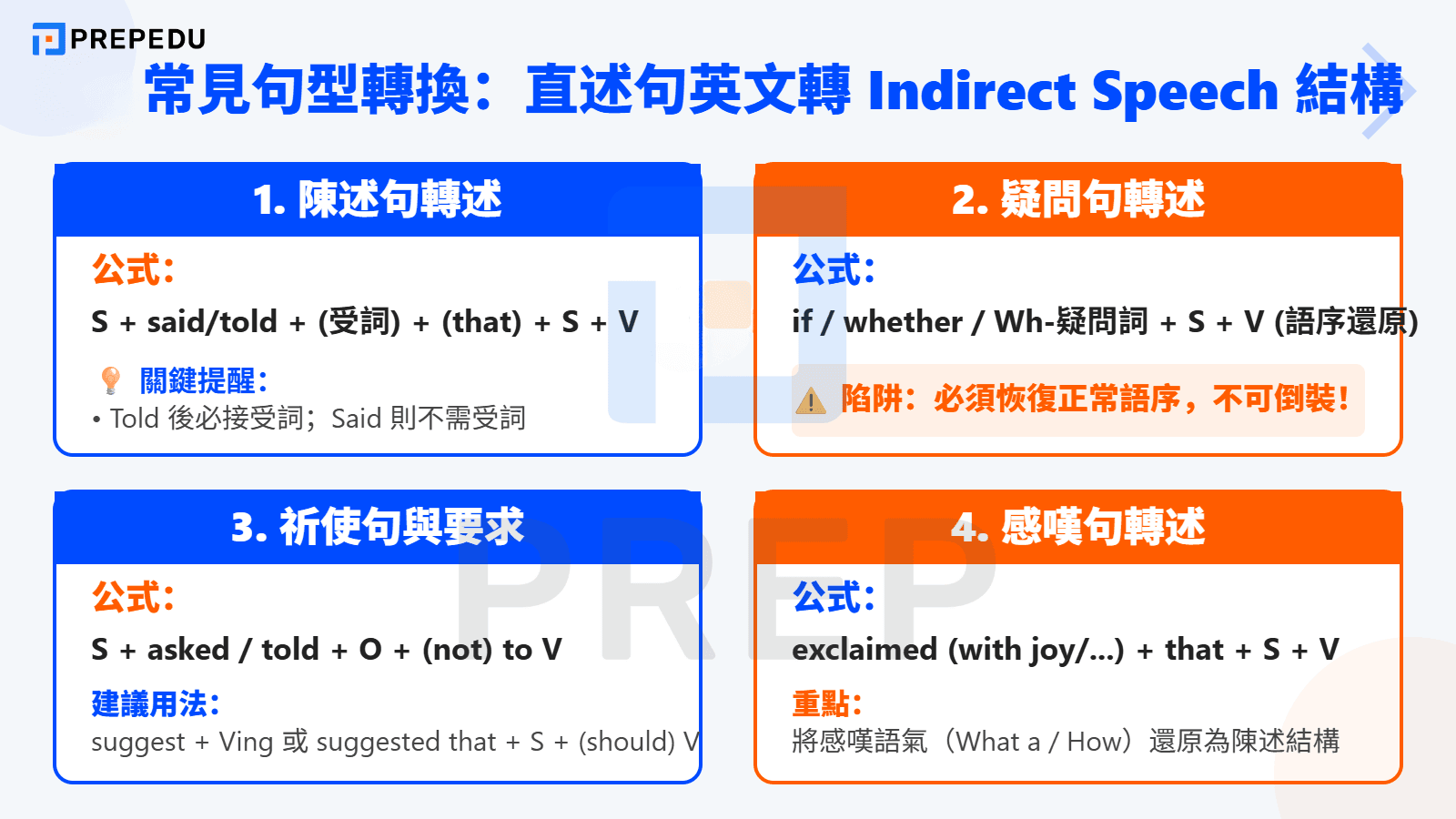
英語四大句型各有對應的間接引語公式。陳述句最直接;疑問句必須還原語序並用 if/wh-;祈使句用 to V 或 not to V;感嘆句用 exclaimed that 並還原為陳述結構。
英語的句子分為四大類型,每一類直述句英文在轉為間接引語英文時都有對應的獨立公式。逐一掌握這四套結構,你就能應對絕大多數的轉述情境,無論是日常溝通或 IELTS 考試均適用。
1. 陳述句轉述
陳述句是最基本的直述句英文類型,轉換時套用下列公式即可。
公式:
S + said / told +(受詞)+(that)+ S + V(退後時態)
That 在口語中常省略,但在正式書面語或 IELTS 寫作中建議保留。Told 後方必須接受詞,said 則不需要。
|
直接引語英文 |
間接引語英文 |
|
"I work at a company in Xianggang." (Mary said)(Mary說。) |
Mary said (that) she worked at a company in Hong Kong.(Mary說她在香港的一家公司工作。) |
|
"We have just finished the group project." (They told the teacher)(他們告訴老師。) |
They told the teacher (that) they had just finished the group project.(他們告訴老師他們剛剛完成了小組報告。) |
|
"Xiaowang is learning Mandarin calligraphy." (His mother said)(他媽媽說。) |
His mother said (that) Xiaowang was learning Mandarin calligraphy.(他媽媽說小王正在學習毛筆書法。) |
疑問句語序陷阱:台灣與香港學習者在間接疑問句中最常犯的錯誤,是保留了疑問句的倒裝語序——寫出「She asked where had she bought the book.」這個錯誤幾乎是 TOEIC Part 5 疑問句題型的「必考陷阱」。間接引語疑問句中,疑問詞後面必須恢復正常語序(主詞 + 動詞),因為這個子句已經變成了一個名詞子句,而名詞子句不用倒裝。這一條記住,TOEIC 疑問句題型就能直接排除錯誤選項。
2. 疑問句轉述
疑問句是直述句英文轉換中最容易犯錯的類型。轉為間接引語英文後,必須恢復直述句語序(主詞 + 動詞),不可保留疑問句的倒裝句結構,且句末不加問號。
-
Yes/No 問句: S + asked +(受詞)+ if / whether + S + V(退後時態)
-
Wh- 問句:S + asked +(受詞)+ Wh- 疑問詞 + S + V(退後時態)
以下是常見的疑問句轉述對照:
|
直接引語英文(Direct Speech) |
間接引語英文(Indirect Speech) |
|
「Are you going to the study group tonight?」(Xiaolan asked Xiaowang)(小蘭問小王。) |
Xiaolan asked Xiaowang if he was going to the study group that night.(小蘭問小王那天晚上是否要去讀書會。) |
|
「Where did you buy your IELTS preparation books?」(He asked her)(他問她。) |
He asked her where she had bought her IELTS preparation books.(他問她在哪裡買的雅思備考書。) |
|
「Have you ever been to Tainan?」(The tour guide asked the group)(導遊問整個團。) |
The tour guide asked the group whether any of them had ever been to Tainan.(導遊問團員們是否有人去過台南。) |
3. 祈使句與要求轉述
祈使句(命令、請求、建議)轉為間接引語英文時,使用不定詞(to V)或否定不定詞(not to V)結構,並依語氣強弱選擇對應的轉述動詞。Suggest 是特殊情況,後方使用動名詞(Ving)或 that + 子句。
公式(肯定): S + asked / told / ordered / advised + O + to V
公式(否定): S + asked / told / ordered / warned + O + not to V suggest
特殊用法: S + suggested + Ving 或 suggested that + S +(should)V
|
直接引語英文 |
間接引語英文 |
|
"Please hand in your report by Friday." (The manager said to Xiaomei)(經理對小美說。) |
The manager asked Xiaomei to hand in her report by Friday.(經理請小美在週五前交報告。) |
|
"Don't park your scooter in front of the building." (The guard told them)(警衛告訴他們。) |
The guard told them not to park their scooters in front of the building.(警衛告訴他們不要把機車停在大樓前面。) |
|
"Why don't we review the grammar notes together?" (Xiaowang said)(小王說。) |
Xiaowang suggested reviewing the grammar notes together.(小王建議大家一起複習語法筆記。) |
|
"You should apply for the exchange programme in Kyoto." (Her teacher said)(她的老師說。) |
Her teacher advised her to apply for the exchange programme in Kyoto.(她的老師建議她申請京都的交換學生計畫。) |
4. 感嘆句轉述
感嘆句帶有強烈情緒色彩,轉為間接引語英文時,需使用帶情緒意涵的轉述動詞(如 exclaim),並將感嘆句結構(What a...! / How...!)還原為完整的陳述句。
公式:
S + exclaimed (with joy / surprise / sorrow / admiration) + that + S + V
|
直接引語英文 |
間接引語英文 |
|
"What a breathtaking view from Elephant Mountain!" (Xiaomei said)(小美說。) |
Xiaomei exclaimed with admiration that the view from Elephant Mountain was breathtaking.(小美驚嘆地說象山上的景色令人屏息。) |
|
"How fast the Kaohsiung MRT runs!" (The tourist said)(遊客說。) |
The tourist exclaimed that the Kaohsiung MRT ran very fast.(遊客驚呼高雄捷運跑得非常快。) |
|
"What a terrible result for the mock test!" (He said)(他說。) |
He exclaimed with dismay that the mock test result was terrible.(他懊惱地說模擬考的成績很糟糕。) |
IV. 注意事項:不需要改變時態的轉述句英文(特殊情況)
五大不退後例外,背後都有共同邏輯:時態退後是為了標記「時間距離」,但當句子本身的時態已無法再退(假設語氣)、或時態不受時間影響(客觀真理)、或引導動詞本身是現在式時,退後規則自然失效。理解邏輯,比死背例外更有效。
語法規則從來不是單線的。直述句英文轉換為間接引語英文時,「時態退後」是主要規則,但以下五種情況被公認為例外,時態不需要退後。這些例外反映的是語意邏輯,而非任意的規定。理解背後的原因,比死記更有效。
1. 引導動詞為現在式
當引導動詞是現在式(says、tells、explains、reports、writes 等),後方子句的時態維持原始形式,不退後。這種情況常見於描述「仍然有效的陳述」或「習慣性的說法」。
-
Direct:「English is the most widely used language for international business.」(The report says)(報告指出。)
-
Indirect:The report says that English is the most widely used language for international business.(報告指出英語是國際商務中使用最廣泛的語言。)
若將 says 改為 said,後方時態才需退後為 was。
2. 描述客觀真理與不變事實
科學定律、自然法則或普世公認的真理,在直述句英文轉換後,依然維持現在簡單式,因為這些事實不受「轉述當下」的時間影響。
-
Direct:「The Earth revolves around the Sun once every 365 days.」(The science teacher said)(理科老師說。)
-
Indirect:The science teacher said that the Earth revolves around the Sun once every 365 days.(理科老師說地球每365天繞太陽公轉一次。)
勉強將此類句子的時態改為過去式(revolved),在學術英文中視為不夠嚴謹的寫法,IELTS 考官亦可能扣分。
3. 第二、第三類條件句
在直述句英文中,條件句 Type 2(與現在事實相反的假設)與條件句 Type 3(與過去事實相反的假設)條件句,本身已帶有「非現實」語氣,結構固定,轉述時時態保持原樣,不再退後——因為已無法再退。
|
直接引語英文 |
間接引語英文 |
|
「If I were fluent in English, I would apply for the job at the international firm.」(Xiaomei said)(小美說。) |
Xiaomei said that if she were fluent in English, she would apply for the job at the international firm.(小美說如果她英語流利,她會申請那家國際公司的職位。) |
|
「If Xiaowang had studied harder, he would have passed the TOEIC exam.」(His tutor said)(他的輔導老師說。) |
His tutor said that if Xiaowang had studied harder, he would have passed the TOEIC exam.(他的輔導老師說如果小王當時更用功,他就能通過多益考試了。) |
4. 特殊情態助動詞不變(Could、Should、Might、Ought to)
部分情態助動詞本身已是「過去形態」,不存在再退後的空間,因此轉述時維持不變:
-
could、should、might、ought to、would → 轉述時保持原形
-
would rather、had better → 同樣不退後
|
直接引語英文 |
間接引語英文 |
|
「You should practice speaking English with native speakers.」(The IELTS coach said)(雅思教練說。) |
The IELTS coach said that he should practice speaking English with native speakers.(雅思教練說他應該多和母語人士練習英語口說。) |
|
「She might already know the answer.」(He said)(他說。) |
He said that she might already know the answer.(他說她可能已經知道答案了。) |
5. 過去假設語氣(wish 與 as if)
在直述句英文中,以 wish 或 as if / as though 引導的假設語氣句,其時態意義已固定,轉述時不再退後。
|
直接引語英文 |
間接引語英文 |
|
「I wish I could speak Cantonese more fluently when I work in Hong Kong.」(Xiaomei said)(小美說。 |
Xiaomei said that she wished she could speak Cantonese more fluently when she worked in Hong Kong.(小美說她希望自己在香港工作時能說一口更流利的廣東話。)(wish 本身從現在式退為過去式,但後方 could 維持不變。) |
|
「He talks as if he had lived in London for years.」(Her colleague said)(她的同事說。) |
Her colleague said that he talked as if he had lived in London for years.(她的同事說他說話的口氣好像在倫敦住了好幾年似的。) |
五大轉換步驟與五大例外已全部解析完畢。接下來的三組 30 題練習分別針對「陳述句時態處理」、「疑問句語序還原」與「祈使句及特殊例外的綜合應用」,三個面向逐一驗收。建議先不看解答獨立作答,再對照解析找出自己的知識盲點。
V. 實戰演練:直述句與間接句綜合練習題(附解答)
理論架構建立之後,真正的鞏固靠的是練習。以下三組題型涵蓋直述句英文轉換的核心情境,包括陳述句時態處理、疑問句語序還原,以及祈使句與特殊例外的綜合應用。請先獨立完成每一題,再對照文末解答區。
1. 題型 1:陳述句與時態轉換
將下列直述句英文改寫為間接引語英文,注意時態退後。
-
"I am preparing for the university entrance exam." (Xiaomei said)(小美說。)
-
"We are visiting the National Palace Museum in Taipei this weekend." (They told us)(他們告訴我們。)
-
"I have already submitted the application form." (Xiaowang said)(小王說。)
-
"She attended the IELTS workshop in Kaohsiung last month." (He told me)(他告訴我。)
-
"The team will present their findings next Tuesday." (The manager said)(經理說。)
-
"I can read Traditional Chinese characters without difficulty." (She said)(她說。)
-
"We were waiting for the train at Zhongzheng station." (They said)(他們說。)
-
"I must renew my student visa before the deadline." (Xiaolan said)(小蘭說。)
-
"He has been working on the translation project for three weeks." (She told me)(她告訴我。)
-
"The café near our school may close down by the end of the year." (Xiaowang said)(小王說。)
2. 題型 2:疑問句轉換
將下列直述句英文問句改寫為間接引語英文,注意 if/whether 的使用與語序還原。
-
"Are you planning to study abroad in the UK?" (She asked Xiaomei)(她問小美。)
-
"Where did you buy your grammar reference book?" (He asked her)(他問她。)
-
"Did Xiaowang pass the TOEIC test last week?" (The teacher asked us)(老師問我們。)
-
"What time does the evening English class start?" (She asked the receptionist)(她問接待員。)
-
"Can you help me proofread this cover letter?" (He asked his colleague)(他問他的同事。)
-
"Why are you studying so late at night?" (Her mother asked her)(她媽媽問她。)
-
"Have you ever tried the night market food in Tainan?" (The host asked the guests)(主持人問嘉賓。)
-
"Who submitted the final report to the professor?" (She asked)(她問。)
-
"How long have you been living in Hong Kong?" (He asked her)(他問她。)
-
"Will the seminar on academic writing be held online or on campus?" (They asked the coordinator)(他們問協調員。)
3. 題型 3:祈使句與特殊狀況綜合測驗
本組題目混合祈使句轉述、客觀真理與條件句例外,考驗你對直述句英文完整規則的掌握。
-
"Please arrive at the exam centre at least 30 minutes early." (The test coordinator told the candidates)(測試協調員告訴考生。)
-
"Don't use your mobile phone during the lecture." (The professor told the students)(教授告訴學生。)
-
"Why don't we take the high-speed rail to Kaohsiung instead of flying?" (Xiaomei suggested)(小美建議。)
-
"Light travels at approximately 300,000 kilometres per second." (The physics teacher said)(物理老師說。)
-
"Don't leave your belongings unattended at the airport." (The airline staff warned the passengers)(航空公司員工警告旅客。)
-
"If I were a native English speaker, I would feel much more confident in job interviews." (Xiaowang said)(小王說。)
-
"You should drink at least eight glasses of water every day." (The nutritionist told her)(營養師告訴她。)
-
"Submit your portfolio before the end of this month." (The art director told the design team)(藝術總監告訴設計團隊。)
-
"Water freezes at 0 degrees Celsius and boils at 100 degrees Celsius." (The chemistry tutor said)(化學輔導老師說。)
-
"I wish I had taken more IELTS mock tests before the real exam." (Xiaolan said)(小蘭說。)
4. 解答
題型 1 解答:
-
Xiaomei said (that) she was preparing for the university entrance exam.(小美說她正在準備大學入學考試。)
-
They told us (that) they were visiting the National Palace Museum in Taipei that weekend.(他們告訴我們那個週末他們要去台北故宮博物院參觀。)
-
Xiaowang said (that) he had already submitted the application form.(小王說他已經交了申請表。)
-
He told me (that) she had attended the IELTS workshop in Kaohsiung the previous month.(他告訴我她上個月參加了在高雄舉辦的雅思工作坊。)
-
The manager said (that) the team would present their findings the following Tuesday.(經理說團隊將在下週二發表研究成果。)
-
She said (that) she could read Traditional Chinese characters without difficulty.(她說她能毫無困難地閱讀繁體中文字。)
-
They said (that) they had been waiting for the train at Zhongzheng station.(他們說他們當時在中正站等火車。)
-
Xiaolan said (that) she had to renew her student visa before the deadline.(小蘭說她必須在截止日期前更新學生簽證。)
-
She told me (that) he had been working on the translation project for three weeks.(她告訴我他已經為翻譯項目工作了三週。)
-
Xiaowang said (that) the café near their school might close down by the end of the year.(小王說他們學校附近的咖啡廳可能在年底前關閉。)
題型 2 解答:
-
She asked Xiaomei if/whether she was planning to study abroad in the UK.(她問小美是否計劃去英國留學。)
-
He asked her where she had bought her grammar reference book.(他問她在哪裡買了那本語法參考書。)
-
The teacher asked us if/whether Xiaowang had passed the TOEIC test the previous week.(老師問我們小王上週是否通過了多益考試。)
-
She asked the receptionist what time the evening English class started.(她問接待員晚間英語課幾點開始。)
-
He asked his colleague if/whether she could help him proofread the cover letter.(他問同事是否能幫他校對那份求職信。)
-
Her mother asked her why she was studying so late at night.(她媽媽問她為什麼那麼晚還在讀書。)
-
The host asked the guests if/whether they had ever tried the night market food in Tainan.(主持人問嘉賓們是否曾嘗試過台南夜市的小吃。)
-
She asked who had submitted the final report to the professor.(她問是誰把期末報告交給了教授。)
-
He asked her how long she had been living in Hong Kong.(他問她在香港住了多久。)
-
They asked the coordinator whether the seminar on academic writing would be held online or on campus.(他們問協調員學術寫作研討會將線上或在校園舉行。)
題型 3 解答:
-
The test coordinator told the candidates to arrive at the exam centre at least 30 minutes early.(測試協調員告訴考生至少提前30分鐘抵達考試中心。)
-
The professor told the students not to use their mobile phones during the lecture.(教授告訴學生上課期間不得使用手機。)
-
Xiaomei suggested taking the high-speed rail to Kaohsiung instead of flying.(小美建議搭高鐵去高雄,而不是搭飛機。)
-
The physics teacher said that light travels at approximately 300,000 kilometres per second.(物理老師說光的速度約為每秒30萬公里。)(客觀真理,時態不變。)
-
The airline staff warned the passengers not to leave their belongings unattended at the airport.(航空公司員工警告旅客不要在機場留下無人看管的隨身物品。)
-
Xiaowang said that if he were a native English speaker, he would feel much more confident in job interviews.(小王說如果他是英語母語者,他在面試時會更有自信。)(Type 2 條件句,時態不變。)
-
The nutritionist told her that she should drink at least eight glasses of water every day.(營養師告訴她每天應該至少喝八杯水。)(should 不變。)
-
The art director told the design team to submit their portfolios before the end of that month.(藝術總監告訴設計團隊在那個月底前提交作品集。)
-
The chemistry tutor said that water freezes at 0 degrees Celsius and boils at 100 degrees Celsius.(化學輔導老師說水在攝氏0度結冰,在攝氏100度沸騰。)(科學事實,時態不變。)
-
Xiaolan said that she wished she had taken more IELTS mock tests before the real exam.(小蘭說她希望在正式考試前做了更多雅思模擬測試。)(wish 從現在式退為過去式,後方假設語氣保持不變。)
VI. 直述句英文常見問題(FAQ)
1. 間接引語中一定要用 that 嗎?
不一定。that 在間接引語中是可選的(optional),在口語和非正式書面語中通常省略:She said she was tired.(她說她很累。)在正式書面語、IELTS Writing Task 2 或學術論文中,保留 that 能讓句子結構更清晰,有助於展示對複合句的掌控。在疑問句間接引語中,that 不使用——改用 if/whether(Yes/No 問句)或 wh- 疑問詞(Wh- 問句)。簡單判斷法:陳述句轉述可以省略 that;問句轉述永遠不用 that。
2. 間接引語可以不退後時態嗎?
可以,在以下三種情況下都可以不退後:引導動詞是現在式時(He says that she is tired.);說的內容仍然是當前的事實,省略退後不影響語意(She said the meeting is at 3pm. ← 會議確實還沒開,說仍然有效);以及本文第 IV 節提到的五大例外情況。值得注意的是,在日常英語口語中,即使引導動詞是過去式,若內容仍然有效,母語者有時也不退後時態——這不是語法錯誤,只是非正式語域的慣例。在 IELTS Writing 等正式考試中,建議依照標準規則退後時態,以確保評分一致性。
3. Say 和 tell 的轉述用法有什麼差別?
這是最常見的混淆點。核心差別只有一個:tell 後面必須接受詞(被告知的人),say 後面不接受詞。
-
正確:She told me (that) she was late.(O);She said (that) she was late.(O)。
-
錯誤:She said me that she was late.(X);She told that she was late.(X)。
在間接引語中,如果要強調「說給某人聽」,用 tell + 人;如果只是陳述說了什麼,用 say。TOEIC Part 5 和 IELTS 都把這個混淆列為常考語法點。
結論
直述句英文(Direct Speech)與間接引語英文(Indirect Speech)的轉換,本質上是一場「視角移交」——從說話者的即時現場,切換到轉述者在另一個時間點的語言重構。時態退後、人稱調整、副詞替換,都只是這場視角移交在不同語法層面的具體執行。一旦理解這個邏輯,四大步驟自然前後貫通。
本文完整解析了直述句英文的核心定義比較、四大句型轉換公式(陳述 / 疑問 / 祈使 / 感嘆)、15 個轉述動詞選用、時態退後對應表,以及五類不退後時態的特殊例外。三組題型 30 題練習涵蓋了所有考試可能出現的轉述結構。
接下來的練習方向很具體:在這週,把你聽到的任何三句話(新聞、對話、老師說的話)寫成正確的間接引語英文,特別注意時態退後和副詞替換。把語法練習與真實語言輸入結合,才是讓直述句英文轉換從「懂了規則」進入「說話時自動執行」的最短路徑。PREPEDU 提供分主題、分難度的 IELTS 與 TOEIC 語法練習題,讓你在真實考題情境中持續鞏固直述句英文的轉換能力。

你好!我叫黃秋賢,現在在 prepedu.com 擔任內容企劃。我有超過5年的英語與韓語自學經歷,親身備考 IELTS、TOEIC 與 TOPIK,累積了大量第一手的學習者視角——包括哪些語法規則最讓台灣與香港學習者混淆,以及如何在有限的備考時間內最有效地修正這些錯誤。目前已在 prepedu.com 撰寫超過 1000 篇英語學習文章,內容涵蓋語法、詞彙與考試策略,累積協助數千位學習者解決自學過程中的語法疑問。
評論












統一企業編號:202227322W
地址:114 LAVENDER STREET, #11-83 CT HUB 2, SINGAPORE (338729)