祈使句英文(Imperatives)全攻略:意思、用法、結構與練習題一次搞懂
什麼是祈使句?祈使句是英文中用來表達命令、請求、建議或禁止的句型,以動詞原形開頭且通常省略主詞,是日常溝通中最直接有力的表達方式。無論你在台北捷運看到的「No eating or drinking」標示,或是老師在課堂上說的「Open your books」,這些都是祈使句的實際應用。對於準備雅思、多益等英語檢定的學習者來說,正確掌握祈使句不僅能提升口語自然度,更是寫作和聽力測驗中的常見考點。
許多台港學習者在使用祈使句時,常困惑於動詞形式的選擇、否定結構的表達,以及如何在不同場合調整語氣。事實上,祈使句雖然結構簡單,但根據語境和對象的不同,可以傳達從強硬命令到溫柔建議的多種語意層次。本文由 PREPEDU 專業教學團隊整理,將帶你從定義、結構、分類到實戰應用,完整解析祈使句的各個面向,並提供 30 道精選練習題和 50+ 生活化例句,讓你徹底掌握這個實用句型,在各種情境中都能精準表達你的意圖。
I. 英文祈使句是什麼?祈使句定義、結構與特點
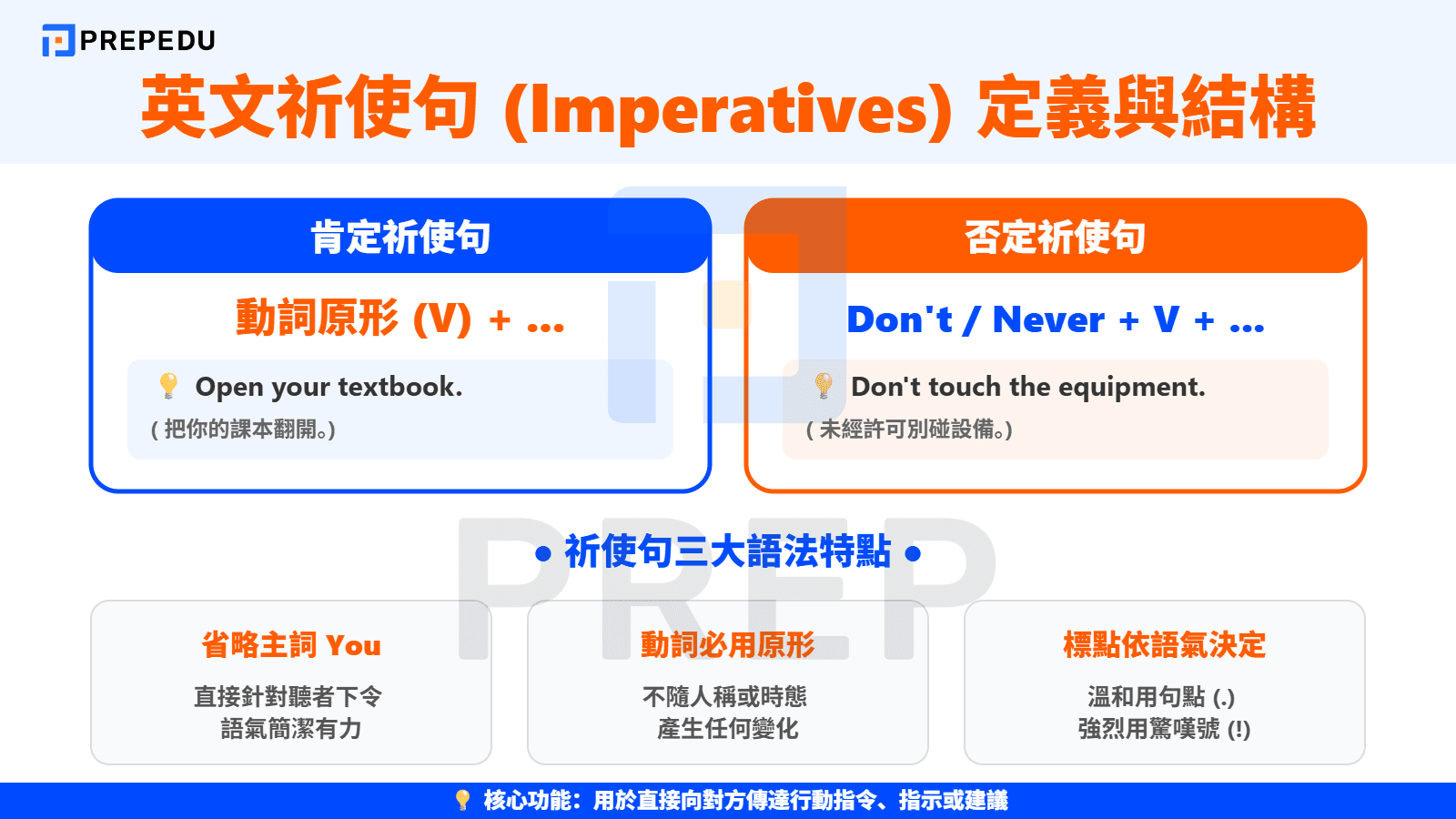
Imperatives 是什麼?祈使句(Imperatives)是一種以英文動詞原形開頭、通常省略主詞的特殊句型,用於直接向對方傳達行動指令。當你想要要求別人做某件事、給予指示或提出建議時,祈使句就是最適合的選擇。從字面上理解,「祈使」意指懇求或命令他人採取行動,因此祈使句的核心功能就是促使聽者執行特定動作。
祈使句的基本結構可以分為肯定和否定兩大類型,每種都有其特定的使用情境:
|
句型類型 |
結構公式 |
祈使句的例子 |
|
肯定祈使句 |
動詞原形 + 其他成分 |
|
|
否定祈使句 |
Don't/ Do not/ Never + 動詞原形 + 其他成分 |
|
祈使句重點具有幾個顯著的語法特點,使它在句型結構上獨樹一格:
-
第一,省略主詞英文 You。因為說話雙方都心知肚明指令是針對聽者而發,因此不需要明確說出主詞。例如當老師說「Close your textbook」時,完整的句子其實是「(You)close your textbook」,但在實際使用中會省略 You,讓句子更加簡潔有力。
-
第二,動詞必須使用原形。祈使句動詞永遠保持原形(Base Verb),不需要考慮英文時態或人稱變化。無論對方是一個人還是多人,動詞形式都不會改變。這個特點讓祈使句的構造變得相對簡單直接。
-
第三,句尾標點符號英文根據語氣決定。溫和的指示或請求使用句點(.),強烈的命令或警告則使用驚嘆號(!)。例如「Please help me.」是禮貌請求用句點,而「Watch out!」 是緊急警告用驚嘆號。
II. 英文祈使句的重點結構與語法規則
英文祈使句的結構看似簡單,但背後有幾個關鍵規則需要掌握。深入理解這些規則,能幫助你避免常見錯誤,讓祈使句的使用更加精準自然。
1. 為什麼要省略主詞 You?
祈使句句型最大的特色就是省略主詞 You,這並非隨意的語法簡化,而是基於實際溝通效率的考量。在面對面對話或明確的指令情境中,說話者和聽者都清楚知道這個動作是針對第二人稱(你或你們)而說,因此無需重複說明主詞。
例如當警察對民眾說「Stop right there」,雙方都明白這個指令是針對被攔下的人,說「You stop right there」 反而顯得累贅。
然而在某些強調或特殊情境下,主詞 You 可以保留以加強語氣。例如「You be quiet!」 比單純的「Be quiet!」 更具命令感和針對性,常用於對某個特定人的強烈要求。但這種用法較為少見,一般情況下都會省略主詞。
2. 祈使句後面動詞應該用什麼形式?
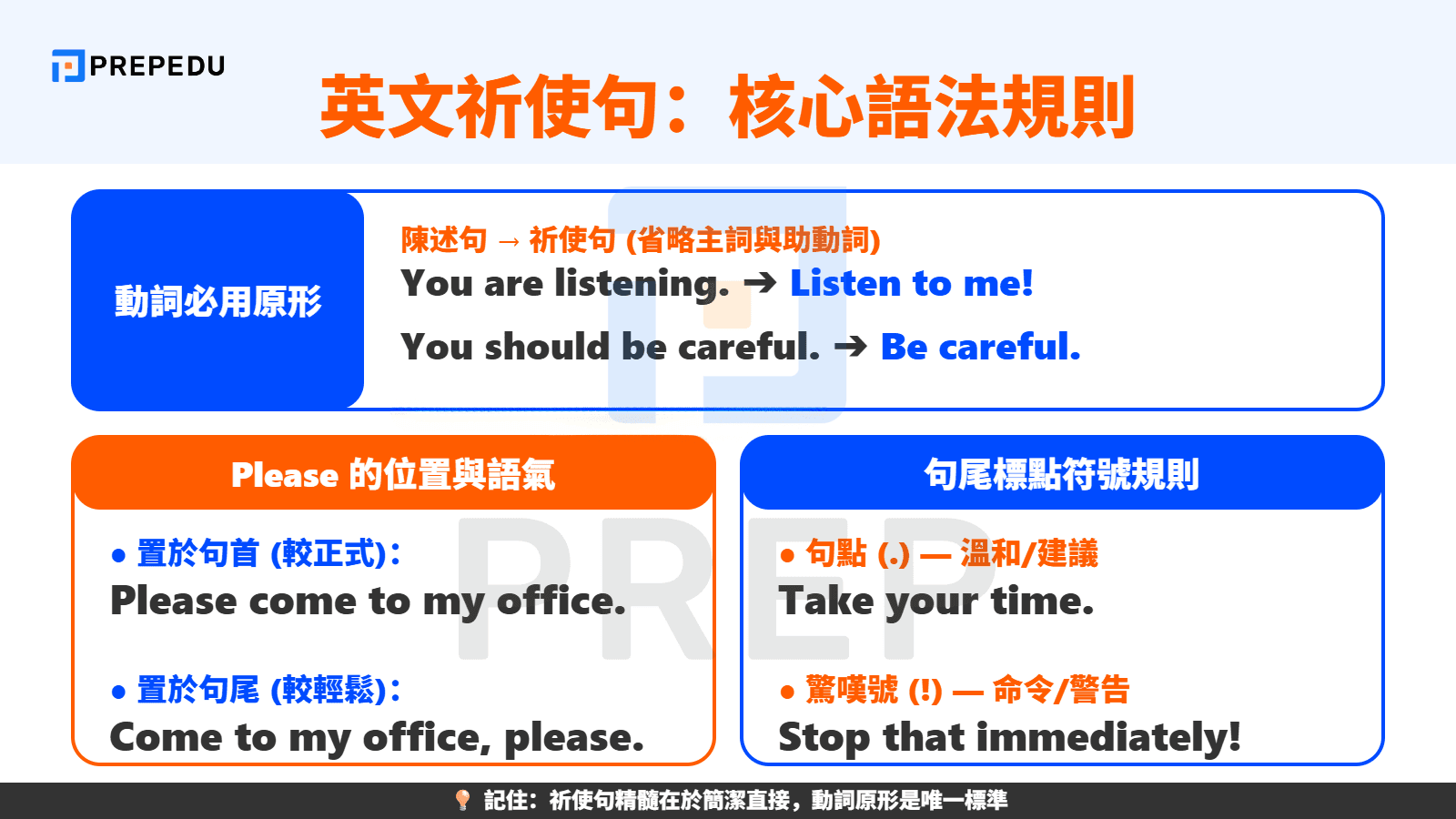
這是學習者最常問的問題,答案非常明確──祈使句必須使用動詞原形(Base Verb),不需要根據主詞改變形式,也不需要考慮時態。無論對象是單數還是複數,動詞都保持原形不變。
常見動詞形式對比:
|
陳述句(需要時態) |
祈使句(動詞原形) |
說明 |
|
You are listening to me. |
Listen to me.(聽我說。) |
省略主詞,動詞改為原形 |
|
You will come here. |
Come here.(過來這裡。) |
不需要助動詞 will |
|
You should study hard. |
Study hard.(用功讀書。) |
不需要情態動詞 should |
|
You are being careful. |
Be careful.(小心一點。) |
Be 動詞保持原形 |
|
You don't make noise. |
Don't make noise.(不要吵鬧。) |
否定只加 Don't |
3. 特殊句型:含有 Please 的祈使句
在祈使句中加入 Please 是最常見的禮貌表達方式,但 Please 的位置會影響句子的正式程度和語氣:
|
Please 位置 |
結構 |
語氣特點 |
範例 |
|
句首 |
Please + 動詞原形... |
較正式、懇切 |
Please come to my office.(請到我辦公室來。) |
|
句中 |
動詞原形 + please +... |
中性、自然 |
Come please to my office.(請來我辦公室。)── 較少用 |
|
句尾 |
動詞原形...,please. |
較輕鬆、口語 |
Come to my office, please.(來我辦公室,拜託。) |
實際應用範例:
|
正式 |
輕鬆 |
|
Please fill out this form before seeing the doctor.(看診前請先填寫這份表格。) |
Fill out this form, please.(請填一下這份表格。) |
|
Please wait a moment while I prepare your coffee.(請稍候,我準備一下您的咖啡。) |
Wait a moment, please.(請等一下。) |
4. 句尾標點符號的使用原則
祈使句的標點符號選擇直接反映說話者的語氣和意圖:
|
使用句點(.) |
使用驚嘆號(!) |
|
── 適用於溫和指示、禮貌請求、日常建議
|
── 適用於強烈命令、緊急警告、熱情邀請
|
掌握這些基本結構規則,你就能正確運用祈使句來表達各種指令與請求,讓英文溝通更加流暢自然。記住,祈使句的精髓在於簡潔直接,運用動詞原形就能清楚傳達你的意圖。
III. 祈使句英文的分類與句型變化
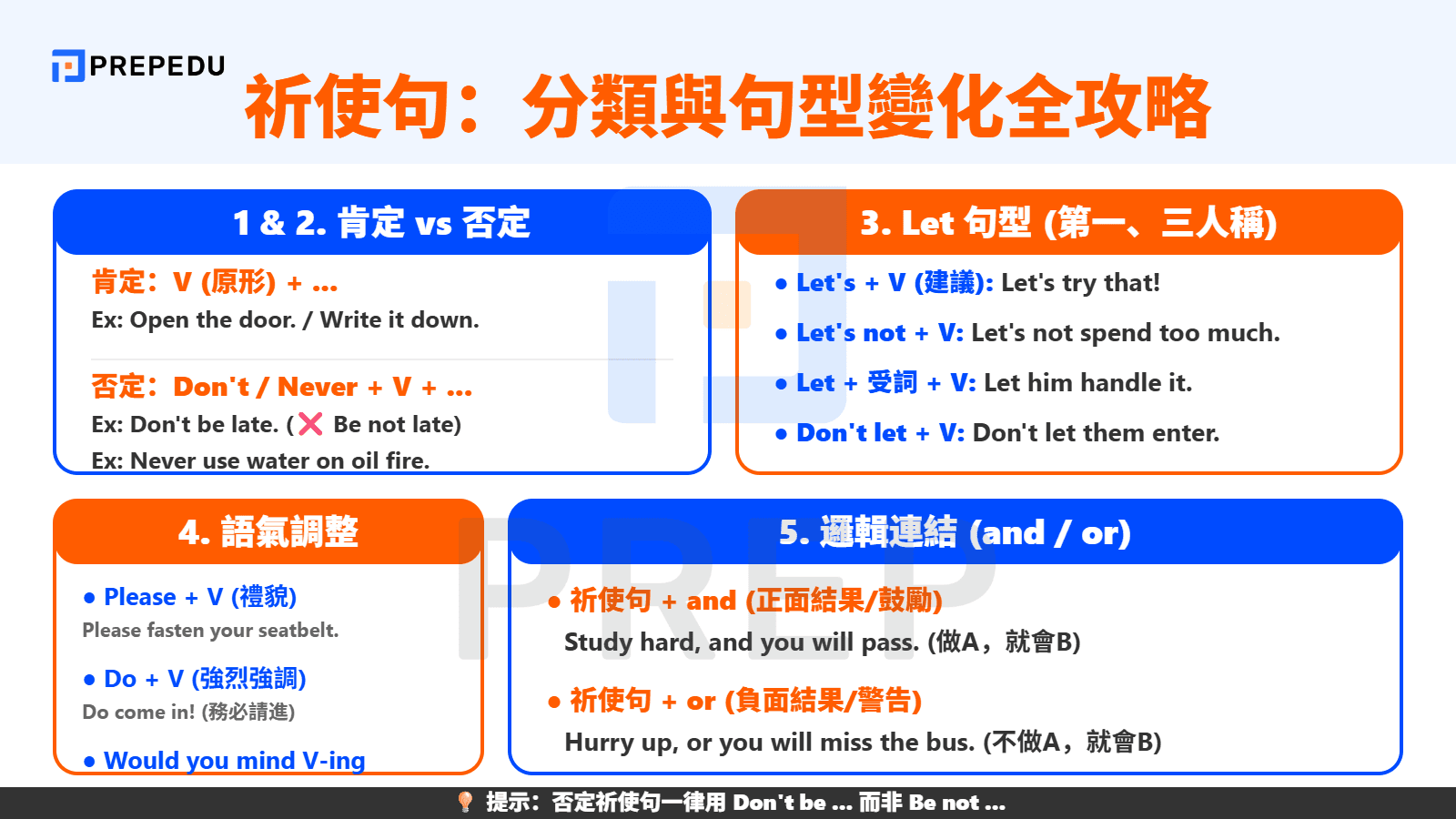
英文祈使句雖然結構簡潔,但根據表達的語氣、對象和功能不同,可以衍生出多種變化形式。從最基本的肯定祈使句,到表達禁止的否定祈使句,再到包含第一人稱和第三人稱的 Let 句型,以及加強語氣的特殊用法,每一種都有其獨特的使用情境和規則。接下來將詳細介紹這些分類,幫助你在不同場合靈活運用祈使句。
1. 肯定的祈使句
肯定祈使句是最基本也最常見的形式,用來直接要求或指示對方執行某個動作。其基本結構非常簡單:
動詞原形 + 受詞或補語
這種句型省略了主詞 You,直接以動詞開頭,簡潔有力地傳達說話者的意圖。
|
結構公式 |
實際範例 |
|
動詞原形 + 受詞 |
|
|
動詞原形 + 受詞 + 時間 |
|
|
動詞原形 + 受詞 |
|
|
動詞原形 + 方向 |
|
|
動詞原形 + 建議內容 |
|
2. 否定的祈使句
否定祈使句用來表達禁止、警告或勸阻,告訴對方不要做某件事。其基本結構是在動詞原形前加上 Don't(或更正式的 Do not)或 Never,形成 Don't/Do not/Never + 動詞原形的句型。
|
否定詞 |
語氣強度 |
使用情境範例 |
|
Don't |
中等強度 一般禁止 |
|
|
Do not |
較強烈 正式禁止 |
|
|
Never |
最強烈 絕對禁止 |
|
否定祈使句的重點提醒:即使原句是以 Be 動詞開頭,否定形式仍然是 Don't be,而不是 Be not。這是學習者最容易犯錯的地方。
|
正確用法 |
錯誤用法 |
說明 |
|
Don't be late. |
Be not late. |
否定詞放在 Be 前面 |
|
Don't be rude. |
Be not rude. |
Don't + Be 動詞原形 |
|
Don't be afraid. |
Be not afraid. |
固定用法 Don't be |
|
Never be discouraged. |
Be never discouraged. |
Never 也放在 Be 前面 |
3. 第一、三人稱的祈使句(Let 句型)
一般祈使句針對第二人稱(你/你們),但當我們想要建議「大家一起做」或表達「讓某人做某事」時,就需要使用 Let 句型。這種特殊的祈使句英文結構能夠表達第一人稱和第三人稱的指令或建議。
|
Let 句型類型 |
結構公式 |
實際範例 |
|
Let's(第一人稱複數) |
Let's + 動詞原形 |
|
|
Let's not(第一人稱否定) |
Let's not + 動詞原形 |
|
|
Let + 第三人稱(允許/讓某人) |
Let + 受詞 + 動詞原形 |
|
|
Don't let(第三人稱否定) |
Don't let + 受詞 + 動詞原形 |
|
4. 表達禮貌與強調語氣的祈使句
祈使句的用法不僅限於直接命令,透過加入特定字詞,可以讓語氣變得更禮貌或更強調。在商務溝通或正式場合中,懂得調整祈使句的語氣尤其重要。
|
語氣調整方式 |
結構 |
實際範例 |
|
Please 在句首(較正式) |
Please + 動詞原形 |
|
|
Please 在句尾(較輕鬆) |
動詞原形...,please. |
|
|
Do + 動詞原形(強調語氣) |
Do + 動詞原形 |
|
|
Would you mind...(委婉請求) |
Would you mind + V-ing |
|
5. 祈使句 + 連接詞(and / or)
祈使句搭配連接詞 and 或 or 使用,是台港地區英文考試中常見的題型,也是日常英文中非常實用的句型變化。這種結構能夠清楚表達「如果...就會...」或「否則...」的因果或條件關係。
|
連接詞 |
邏輯關係 |
結構公式 |
實際範例 |
|
and(正面結果) |
如果做A,就會得到B(鼓勵) |
祈使句 + and + 未來式/結果句 |
|
|
or(負面結果) |
如果不做A,就會發生B(警告) |
祈使句 + or + 未來式/警告句 |
|
重點提示:
這種句型的後半部通常使用未來式(will + 動詞原形),也可以使用情態助動詞(can/ may/ might)來表達可能的結果。在口語中,連接詞前通常會加上逗號,讓句子結構更清晰。
掌握這些祈使句的分類與變化,不僅能讓你在考試中游刃有餘,更能在日常溝通中準確表達各種不同的意圖和語氣,讓英文表達更加豐富多元。
IV. 進階用法:英文祈使句附加問句
祈使句附加問句是一種在祈使句後面加上簡短問句的進階用法,主要功能是緩和命令語氣或徵求對方同意。這種結構在口語對話中非常常見,能讓原本直接的指令聽起來更加委婉有禮。理解附加問句的使用規則,能大幅提升你的英文口語表達能力。
1. 祈使句附加問句的完整規則與應用
|
祈使句類型 |
附加問句 |
語氣說明 |
實際範例 |
|
一般肯定祈使句 |
will you?(最常用) |
禮貌請求,徵求同意 |
|
|
一般肯定祈使句 |
won't you?(更客氣) |
更加溫和,熱情邀請 |
|
|
一般肯定祈使句 |
can you?(詢問能力) |
詢問是否方便,確認可行性 |
|
|
否定祈使句 |
will you?(固定用法) |
提醒注意,禮貌勸阻 |
|
|
Let's 句型 |
shall we?(第一人稱) |
徵求意見,邀請共同行動 |
|
|
Let us 句型(完整形式) |
will you?(第二人稱) |
請求允許,徵求同意 |
|
2. 附加問句在不同情境中的語氣差異
|
情境類型 |
建議使用的附加問句 |
範例對比 |
|
正式商務場合 |
won't you?/ would you? |
|
|
朋友同儕間 |
will you?/ can you? |
|
|
家庭長輩晚輩 |
will you? |
|
|
服務業對顧客 |
won't you?/ would you mind? |
|
3. 常見錯誤與正確用法對照
|
常見錯誤 |
正確用法 |
說明 |
|
Don't be late, shall we? |
Don't be late, will you?(別遲到,好嗎?) |
否定祈使句只能用 will you |
|
Let's go shopping, will you? |
Let's go shopping, shall we?(我們去逛街,好嗎?) |
Let's 固定搭配 shall we |
|
Open the window, isn't it? |
Open the window, will you?(把窗戶打開,好嗎?) |
祈使句不用 isn't it |
|
Be quiet, aren't you? |
Be quiet, will you?(安靜一點,好嗎?) |
Be 動詞祈使句也用 will you |
熟練運用這些附加問句,能讓你的英文表達更加自然流暢,在需要給予指示時也能保持禮貌得體的溝通風格。記住,選擇合適的附加問句不僅關乎語法正確性,更重要的是能夠傳達出符合情境的語氣和態度。
V. 祈使句的 5 大常見功能與情境
祈使句的意思遠不止於簡單的命令,根據不同的語境和語氣,它能夠傳達多種溝通功能。理解這些功能與使用情境,能幫助你在實際交流中更精準地運用祈使句,達到理想的溝通效果。
1. 命令
這是祈使句最直接的功能,用於要求或指示對方立即執行某個動作,通常帶有權威性。在軍隊、學校或需要明確指令的場合特別常見。
|
使用場景 |
範例 |
|
軍事指令 |
|
|
課堂管理 |
|
|
緊急情況 |
|
|
家長管教 |
|
2. 請求
透過加入 please 或使用較溫和的語調,祈使句可以表達請求而非命令。這種用法在日常生活和職場中最為常見,是維持良好人際關係的重要溝通方式。
|
使用場景 |
範例 |
|
職場請求 |
|
|
日常協助 |
|
|
服務請求 |
|
|
家人請託 |
|
3. 建議與邀請
祈使句常用來提出建議或發出邀請,語氣友善且富有包容性。這種用法能夠營造輕鬆愉快的氛圍,促進人際互動。
|
使用場景 |
範例 |
|
朋友邀約 |
|
|
健康建議 |
|
|
品嚐邀請 |
|
|
休閒建議 |
|
4. 警告與禁止
否定祈使句常用於警告危險或禁止某些行為,這在公共場所的標示牌上尤為常見,也是維護公共安全和秩序的重要工具。
|
使用場景 |
範例 |
|
交通安全 |
|
|
公共禁令 |
|
|
緊急警告 |
|
|
商場規定 |
|
5. 指引與說明
祈使句也常用於提供方向指引或操作說明,讓聽者能夠清楚理解該如何執行。這種功能性的祈使句在日常生活中不可或缺。
|
使用場景 |
範例 |
|
問路指引 |
|
|
烹飪步驟 |
|
|
設備操作 |
|
|
運動指導 |
|
掌握這五大功能,你就能在各種情境中靈活運用祈使句,無論是發號施令、禮貌請求、友善建議、安全警告還是清楚指引,都能精準表達你的意圖。重要的是根據不同場合和對象,選擇適當的語氣和措辭,讓祈使句發揮最佳的溝通效果。
VI. 常用英文祈使句總整理
為了幫助你更好地理解和應用祈使句,以下整理了超過 50 個常用的祈使句例子,並依據不同場景分類。這些例句都是台港地區學習者在日常生活、學校課堂和職場環境中最常接觸到的表達方式。
|
場景分類 |
英文祈使句 |
|
課堂用語 |
Pay attention to the board.(注意看黑板。) |
|
Open your textbooks to page 42.(把課本翻到第42頁。) |
|
|
Listen carefully to the instructions.(仔細聽指示說明。) |
|
|
Raise your hand before speaking.(說話前先舉手。) |
|
|
Complete the assignment by Friday.(週五前完成作業。) |
|
|
Don't copy others' work.(別抄襲別人的作業。) |
|
|
Take notes during the lecture.(上課時做筆記。) |
|
|
Review the material before the exam.(考試前複習教材。) |
|
|
職場溝通 |
Send me the report by 5 PM today.(今天下午5點前把報告寄給我。) |
|
Please review this proposal carefully.(請仔細審閱這份提案。) |
|
|
Attend the meeting at 2 PM sharp.(準時下午2點參加會議。) |
|
|
Don't forget to CC me on all emails.(別忘了所有郵件都要副本給我。) |
|
|
Follow up with the client this week.(本週內跟進客戶狀況。) |
|
|
Keep me updated on the project progress.(隨時告知我專案進度。) |
|
|
Submit your timesheet by Monday morning.(週一早上前提交工時表。) |
|
|
Prioritize the urgent tasks first.(優先處理緊急任務。) |
|
|
日常生活 |
Have a wonderful day ahead!(祝你有美好的一天!) |
|
Take good care of yourself.(好好照顧自己。) |
|
|
Help yourself to some snacks.(請自便吃點心。) |
|
|
Make yourself comfortable.(別拘束,放輕鬆。) |
|
|
Don't worry about it too much.(別太擔心這件事。) |
|
|
Let me know if you need any help.(有需要就告訴我。) |
|
|
Keep in touch with me.(跟我保持聯絡。) |
|
|
Enjoy your weekend!(週末愉快!) |
|
|
餐廳與購物 |
Please wait to be seated.(請等候帶位。) |
|
Try our chef's special today.(試試我們今天的主廚特餐。) |
|
|
Enjoy your meal!(請慢用!) |
|
|
Don't hesitate to ask for recommendations.(別客氣,歡迎詢問推薦。) |
|
|
Take your time browsing.(慢慢看,不急。) |
|
|
Let me show you some other options.(讓我給你看一些其他選擇。) |
|
|
Feel free to try it on.(歡迎試穿看看。) |
|
|
交通與出行 |
Turn right at the next traffic light.(在下個紅綠燈右轉。) |
|
Go straight ahead for 200 meters.(往前直走200公尺。) |
|
|
Take the MTR to Tsim Sha Tsui.(搭捷運到尖沙咀。) |
|
|
Mind the gap when boarding.(上車時小心月台間隙。) |
|
|
Don't block the doorway.(別堵住門口。) |
|
|
Stand behind the yellow line.(站在黃線後面。) |
|
|
Fasten your seatbelt.(繫好安全帶。) |
|
|
健康與運動 |
Get at least eight hours of sleep.(每天至少睡8小時。) |
|
Drink plenty of water daily.(每天喝大量的水。) |
|
|
Exercise regularly three times a week.(每週定期運動三次。) |
|
|
Don't skip breakfast.(別不吃早餐。) |
|
|
Warm up before any intense exercise.(任何激烈運動前都要熱身。) |
|
|
Take a deep breath and relax.(深呼吸放鬆一下。) |
|
|
Stretch your muscles after working out.(運動後伸展肌肉。) |
|
|
社交禮儀 |
Please come in and have a seat.(請進來坐。) |
|
Allow me to introduce myself first.(容我先自我介紹。) |
|
|
Feel free to contact me anytime.(歡迎隨時聯絡我。) |
|
|
Don't mention it, you're welcome.(不客氣,不用謝。) |
|
|
Let's exchange contact information.(我們交換聯絡方式吧。) |
|
|
Give my regards to your family.(代我向你家人問好。) |
這些實用例句涵蓋了從學校到職場、從日常生活到社交禮儀的各種場景,建議你根據自己的需求挑選重點記憶。透過不斷練習這些常用表達,你會發現祈使句在英文溝通中無所不在,是提升口語流利度的關鍵句型之一。
VII. 英文祈使句練習題
透過實際練習,你能更深入理解祈使句的各種用法和變化。以下提供 30 道精心設計的祈使句題目,涵蓋基礎改寫、動詞形式選擇和翻譯重組三個部分,幫助你全面掌握這個重要句型。完成練習後,記得對照解答檢視學習成果。
1. 第一部分:基礎改寫題)
說明:請將以下陳述句改寫為祈使句,省略主詞 You 並使用動詞原形。
-
You should close the door before leaving.
-
You need to be quiet in the library.
-
You must finish your homework before going out to play.
-
You ought to listen to your teacher's advice.
-
You have to turn off your mobile phone during the exam.
-
You should not eat too much junk food.
-
You need to be careful when crossing the busy street.
-
You must not smoke in this public area.
-
You should help your elderly neighbors carry heavy items.
-
You have to clean your room thoroughly every weekend.
2. 第二部分:動詞形式與附加問句選擇題
說明:請選擇正確的動詞形式或附加問句來完成句子。
-
_____(Open / Opening / To open)the window, please. It's quite stuffy here.
-
Don't _____(be / being / to be)late for tomorrow's important meeting.
-
Let's _____(go / going / to go)to the new shopping mall tonight, shall we?
-
_____(Study / Studying / To study)harder for the next test,or you will not pass.
-
Please _____(help / helping / to help)me carry these heavy grocery bags.
-
Never _____(give up / giving up / to give up)on your dreams and ambitions.
-
Be quiet in the examination room,_____?(will you / won't you / shall we
-
Let's have a barbecue at the beach this weekend, _____?(will you / shall we / can you)
-
Don't forget to lock the front door when you leave, _____?(will you / shall we / can you)
-
Turn left at the second intersection, and you _____(will see / see / seeing)the hospital on your right.
3. 第三部分:翻譯與句子重組題
說明:請將中文翻譯成正確的英文祈使句,或重組單字成完整句子。
-
quiet / be / please / in / library / the / others / disturb / don't / and
-
forget / don't / bring / passport / to / your / boarding pass / and
-
solve / together / let's / difficult / problem / this
-
exercise / and / will / for 30 minutes / daily / you / be / healthier / more energetic
-
up / or / will / the 7 AM bus / you / miss / hurry
-
never/ in / swim/ the current / this river/ very dangerous / is
-
me / the report / send / by email / on Friday / before 5 PM / please
-
will / project / follow / these / you / detailed / successfully / steps / and / complete / this
-
results / worry / will / the / everything / about / fine / exam / be / too / don’t / much
-
own / him / decision / so / learn / make / he / his / responsible / can / be / to / let
4. 練習題解答
第一部分解答:
-
Close the door before leaving.
-
Be quiet in the library.
-
Finish your homework before going out to play.
-
Listen to your teacher's advice.
-
Turn off your mobile phone during the exam.
-
Don't eat too much junk food. / Do not eat too much junk food.
-
Be careful when crossing the busy street.
-
Don't smoke in this public area. / Do not smoke in this public area.
-
Help your elderly neighbors carry heavy items.
-
Clean your room thoroughly every weekend.
第二部分解答:
-
Open(祈使句用動詞原形開頭)
-
be(Don't 後面接動詞原形,即使是 Be 動詞也不例外)
-
go(Let's 後面必須接動詞原形)
-
Study(祈使句開頭永遠用動詞原形)
-
help(Please 後面接動詞原形,不需要 to)
-
give up(Never 後面接動詞原形)
-
will you(一般祈使句的附加問句最常用 will you)
-
shall we(Let's 的附加問句固定用 shall we)
-
will you(否定祈使句的附加問句統一用 will you)
-
will see(祈使句 + and + 未來式,表示條件和結果)
第三部分解答:
-
Please be quiet in the library and don't disturb others. / Be quiet in the library, please, and don't disturb others.
-
Don't forget to bring your passport and boarding pass.
-
Let's solve this difficult problem together.
-
Exercise for 30 minutes daily, and you will be healthier and more energetic.
-
Hurry up, or you will miss the 7 AM bus.
-
Never swim in this river. The current is very dangerous. / Don't swim in this river. The water flow is dangerous.
-
Please email me the report by Friday at 5 PM. / Send me the report by email before 5 PM on Friday, please.
-
Follow these detailed steps, and you will successfully complete this project. / Follow these steps carefully, and you can finish the project successfully.
-
Don't worry too much about the exam results. Everything will be fine. / Don't stress about the test outcome. Things will work out.
-
Let him make his own decision so he can learn to be responsible. / Let him decide by himself. This way he'll learn responsibility.
透過這 30 題的反覆練習,你應該能夠熟練掌握祈使句的各種形式和用法。如果在某些題目上遇到困難,建議回到前面章節複習相關概念,特別是動詞原形的使用、否定形式的構成和附加問句的規則。持續練習是精通祈使句的不二法門,建議你在日常生活中多留意英文對話和標示中的祈使句,觀察它們在實際情境中如何被靈活運用。
VIII. 祈使句的常見問題
在學習祈使句的過程中,許多學習者都會遇到一些共同的疑問。以下整理了最常被提問的問題,希望能解決你在學習過程中的困惑,讓你對祈使句有更全面深入的理解。
1. 祈使句一定要加 Please 嗎?
不一定。Please 只是用來讓祈使句聽起來更禮貌的選擇性詞語,並非祈使句的必要成分。在親密的朋友或家人之間,或是在需要立即行動的緊急情況下,可以省略 Please 直接使用祈使句。例如朋友之間說 Come here(過來)就很自然,不需要每次都加 Please。
但在某些情境下,加上 Please 能展現應有的禮貌和尊重:正式場合(商務會議、官方通信)、對長輩或上司說話、向陌生人提出請求、服務業對顧客的用語。在台港的商業和服務文化中,這種禮貌用法特別受到重視,能夠有效提升溝通品質和人際關係。記住,語境和對象決定了是否需要使用 Please,靈活運用才是關鍵。
2. 祈使句的主詞可以是其他人嗎?
可以,但需要使用特殊句型。一般祈使句針對第二人稱(你/你們),主詞 You 被省略。如果要對不同人稱發出指令或建議,需要使用以下結構:
-
第一人稱複數(我們):使用 Let's + 動詞原形,如「Let's go to the park」(我們去公園吧)。這種句型表達建議或邀請,語氣包容友善。
-
第三人稱(他/她/他們):使用 Let + 受詞 + 動詞原形,如 「Let him try」(讓他試試)、「Let them decide」(讓他們決定)。這種句型表達允許、許可或願望。
所以雖然祈使句動詞本身沒有人稱變化,但透過 Let 這個結構,我們可以對不同人稱發出指令或建議。重要的是理解不同句型背後的語意差異,選擇最適合情境的表達方式。
3. 祈使句可以是問句嗎?
嚴格來說,祈使句本身不是英文問句,而是用來表達命令、請求或建議的句型。但祈使句可以在後面加上附加問句,如「Close the door,will you?」(關門,好嗎?)。
這種形式在語調和語氣上接近問句,主要功能包括:緩和命令的強硬感(讓指令聽起來不那麼專制)、徵求對方同意(確認對方是否願意配合)、展現禮貌態度(特別是在正式場合或對不熟悉的人)。
但本質上仍是祈使句的一種變化形式,而非真正的疑問句。真正的問句是為了獲取資訊或答案,而附加問句的祈使句主要目的還是在於促使對方採取行動,只是語氣更加委婉客氣。這種區別對於理解英文句型的本質很重要。
4. 祈使句動詞為什麼不用過去式?
因為祈使句的本質是要求、建議或命令對方在現在或未來採取行動,而不是描述已經發生的事情。祈使句永遠使用動詞原形,這是固定的語法規則,不受時態影響。
即使你想表達「昨天應該做但沒做」的遺憾,也不會用祈使句,而會用其他句型:
-
You should have done it yesterday.(你昨天就該做了。)── 表達過去應該做的事
-
Why didn't you do it yesterday?(你昨天為什麼不做?)── 疑問句
-
You were supposed to do it yesterday.(你昨天應該要做的。)── 陳述句
祈使句的時間焦點永遠在當下或未來,因此動詞形式固定為原形,保持簡潔有力的特性。這個設計讓祈使句能夠快速直接地傳達行動指令,不需要考慮複雜的時態變化,這也是為什麼祈使句在緊急情況或需要立即反應的場合特別實用的原因。
5. 祈使句和命令句有什麼區別?
在中文語境中,許多人會把「祈使句」和「命令句」混為一談,但實際上祈使句的功能遠比單純的命令更廣泛。命令句只是祈使句的一種功能表現,祈使句還包括請求、建議、邀請、警告、指引等多種用途。
可以這樣理解:命令句是祈使句的子集,所有命令句都是祈使句,但不是所有祈使句都是命令句。例如「Have a nice day」(祝你有美好的一天)是祈使句但不是命令句,而是祝福用語。理解這個區別,能幫助你更準確地掌握祈使句在不同情境中的靈活應用。
結論
透過本文的完整介紹,你已經全面掌握了祈使句的定義、結構、分類、用法和常見問題。祈使句作為英文中最簡潔有力的句型之一,在日常溝通、課堂學習和職場互動中扮演著不可或缺的角色。無論是發出明確指令、提出禮貌請求、給予友善建議,還是表達警告禁止,祈使句都能精準傳達你的意圖。
建議你將本文收藏起來,隨時複習重點概念和例句。更重要的是,在實際生活中多加練習,嘗試在不同情境下靈活運用祈使句。記住,語言學習的關鍵在於實踐——唯有透過不斷使用,才能真正內化這個句型,讓你的英文表達更加自然流暢。從今天開始,勇敢開口說出你的第一個祈使句吧!
對 IELTS 或 TOEIC 考試結構感到陌生?考場環境的不熟悉會在關鍵時刻影響你的成績。PREPEDU Test Practice 提供完整模擬考試情境,讓你在正式考試前充分掌握題型和時間分配。
系統內建超過 1,000 道練習題,持續更新以反映最新考試趨勢。這確保你熟悉核心主題。AI 工具識別你的弱點,提供針對性改善方案,加速成績提升。
最突出的功能是即時進度追蹤系統。每次練習後,你都能清楚看到自己的進步。這個優勢讓你在競爭中保持領先。

你好!我叫黃秋賢,現在在 prepedu.com 擔任內容企劃。我有超過5年的英語與韓語自學經歷,親身備考 IELTS、TOEIC 與 TOPIK,累積了大量第一手的學習者視角——包括哪些語法規則最讓台灣與香港學習者混淆,以及如何在有限的備考時間內最有效地修正這些錯誤。目前已在 prepedu.com 撰寫超過 1000 篇英語學習文章,內容涵蓋語法、詞彙與考試策略,累積協助數千位學習者解決自學過程中的語法疑問。
評論









統一企業編號:202227322W
地址:114 LAVENDER STREET, #11-83 CT HUB 2, SINGAPORE (338729)