英文陳述句 (Declarative Sentence) 終極指南:文法結構、造句解析與練習題
什麼是陳述句?陳述句(Declarative Sentence)是英文四大句型中使用頻率最高的一種,其核心功能是傳達事實、意見或觀察,以實心句號(.)結尾,並遵守「主詞在動詞之前」的正常語序。換句話說,每當你描述一件事、分享一個想法,或說明一個現象,你都在使用陳述句。
想像一下:你每天在手機上看到的新聞標題、課本中的每一個文法說明、甚至你此刻正在閱讀的這個句子,全部都是陳述句。然而,許多學習者在辨別陳述句與其他句型時仍容易出錯,尤其是反問句是否屬於陳述句、否定句算不算陳述句,這些問題在 IELTS 與 TOEIC 備考中反覆困擾著考生。
PREPEDU 整理了這份英文陳述句終極指南,從陳述是什麼意思的詞源解析出發,涵蓋肯定句、否定句、被動語態、四大句型分類(簡單句、複合句、複雜句、複合複雜句)、間接引述轉換規則,以及與疑問句、感嘆句、祈使句的精確對比,並附上三組共 30 道實戰練習題與詳細解答。無論你是語法初學者還是 IELTS 7 分衝刺中的備考生,本文都能幫你一次徹底釐清陳述句的每一個細節。

I. 什麼是陳述句英文?解析陳述是什麼意思與陳述句意義
什麼是陳述句?陳述句(Declarative Sentence)是英文四大句型之一,其核心功能是傳達資訊——包括事實、意見或觀察——給聽者或讀者,而不帶任何疑問或命令語氣。它是人類溝通中最自然、最普遍的語言形式:從新聞報導、學術論文、小說敘事,到日常對話與社群媒體貼文,陳述句無所不在。
要理解陳述是什麼意思,可以追溯其詞源。英文「declarative」源自拉丁文 declarare,意指「使清楚明確」(to make clear)。因此,陳述句的本質就是:以明確、直接的方式讓對方理解某件事的狀態,這正是陳述句意義的核心所在。
-
一個陳述句可以陳述客觀真理,例如 The sun rises in the east.(太陽從東方升起。)
-
表達主觀意見,例如 I believe this approach is effective.(我認為這個方法有效。)
一個錯誤的陳述。無論內容真偽,只要符合陳述句的結構形式,它就是陳述句。
Declarative Sentence 的三大文法特徵 → 掌握 Declarative Sentence 的以下三個核心特徵,你便能在任何文本中精準辨識陳述句。
-
第一,傳遞事實、意見或聲明。 陳述句的功能是「告知」,內容可以是可驗證的客觀事實,也可以是個人觀點,甚至是對某一情境的描述或解釋。
-
第二,句末以實心句號(.)結尾。 這是陳述句與疑問句(問號 ?)、感嘆句(驚嘆號 !)最直接的視覺區別。
-
第三,嚴格遵守「主詞在動詞之前」的正常語序。 陳述句以 S-V 結構為基礎,這與疑問句的助動詞倒裝結構形成明確對比。
II. 陳述句英文的結構解析與陳述句造句指南
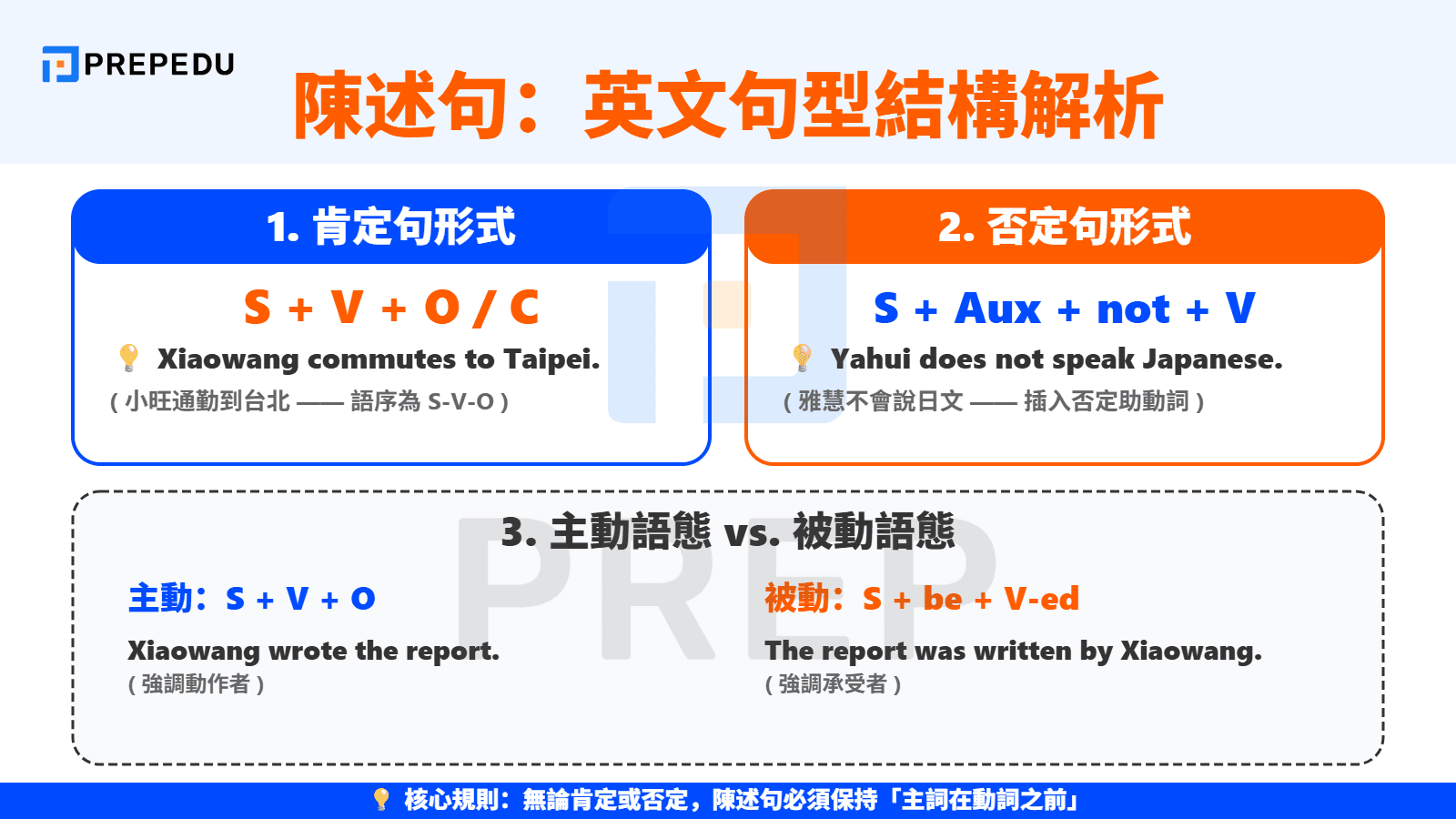
陳述句英文的核心在於語序。掌握語序規則,陳述句造句便不再困難。陳述句有兩個基本形式:肯定句與否定句,兩者都必須保持「主詞在動詞之前」的語法結構,差別僅在於動詞前是否加入否定成分。此外,語態(主動或被動)也會影響陳述句的結構,在學術寫作與 TOEIC 閱讀中尤為常見。
1. 肯定英文陳述句的語序與公式
肯定英文陳述句遵循最直觀的 S-V-O 結構,即主詞(Subject)+ 動詞(Verb)+ 受詞或補語(Object / Complement),句末以句號結尾。
公式:
主詞(S)+ 動詞(V)+ 受詞/補語(O / C)+ 句號(.)
例句:
|
英文例句 |
主詞 |
動詞 |
受詞/補語 |
|
Xiaowang commutes from Taipei to Banqiao every morning by MRT.(小旺每天早上搭捷運從台北通勤到板橋。) |
Xiaowang |
commutes |
from Taipei to Banqiao |
|
The IELTS exam in Hong Kong takes place at several designated test centres.(香港的 IELTS 考試在數個指定考場舉行。) |
The IELTS exam |
takes place |
at several designated test centres |
|
Yanting submitted her TOEIC application form two weeks before the test date.(彥廷在考試日前兩週繳交了 TOEIC 報名表。) |
Yanting |
submitted |
her TOEIC application form |
|
The Taipei 101 tower stands at 508 metres(約 1,667 英尺)above street level.(台北 101 大樓距地面高達 508 公尺。) |
The Taipei 101 tower |
stands |
at 508 metres |
|
Xiaowang's professor at National Taiwan University recommends reading original English texts daily.(小旺在國立台灣大學的教授建議每天閱讀英文原文。) |
Xiaowang's professor |
recommends |
reading original English texts |
2. 否定英文陳述句的構成與助動詞用法
否定英文陳述句同樣是陳述句的一種。它保持正常語序與句號結尾,僅在動詞前插入否定助動詞。
公式:
主詞(S)+ 助動詞 + not + 動詞(V)+ 受詞(O)+ 句號(.)
一般動詞否定使用 do not / does not(現在簡單式)或 did not(過去式);be 動詞否定則直接在後方加上 not。
例句:
|
肯定陳述句(含中文翻譯) |
否定陳述句) |
否定結構 |
|
Yahui speaks Cantonese and Mandarin.(雅慧會說廣東話和普通話。) |
Yahui does not speak Japanese.(雅慧不會說日文。) |
does not + V |
|
The Hong Kong office confirmed the schedule.(香港辦公室確認了時間表。) |
The Hong Kong office did not revise the schedule.(香港辦公室沒有修改時間表。) |
did not + V |
|
Xiaowang is ready for the IELTS Speaking test.(小旺準備好參加 IELTS 口說測驗了。) |
Xiaowang is not nervous about the test.(小旺對這次考試並不緊張。) |
is not |
|
The results were available online.(結果可在網路上查詢。) |
The results were not released ahead of schedule.(結果並未提前公布。) |
were not |
|
Yanting has finished her writing task.(彥廷已完成她的寫作任務。) |
Yanting has not reviewed her draft yet.(彥廷還沒有審閱她的草稿。) |
has not + V |
否定陳述句在 TOEIC 聽力測驗與 IELTS 閱讀中高頻出現,例如:The meeting was not postponed.(會議並未延期。)識別否定助動詞的位置,是理解句意的關鍵技能。
3. 主動語態與被動語態陳述句
除了肯定與否定的區分,陳述句還可依「語態」分為主動語態與被動語態兩種形式。兩者都是合法的陳述句,差別在於誰是句子的主詞。
|
語態 |
結構公式 |
英文例句 |
|
主動語態 |
S(動作者)+ V + O |
Xiaowang wrote the project report in English.(小旺用英文撰寫了專案報告。) |
|
被動語態 |
S(承受者)+ be + V-ed |
The project report was written in English by Xiaowang.(這份專案報告是由小旺用英文撰寫的。) |
|
主動語態(否定) |
S + did not + V |
The committee did not approve the new policy.(委員會未批准新政策。) |
|
被動語態(否定) |
S + was/were not + V-ed |
The new policy was not approved by the committee.(新政策未獲委員會批准。) |
III. 英文陳述句的四大句型分類
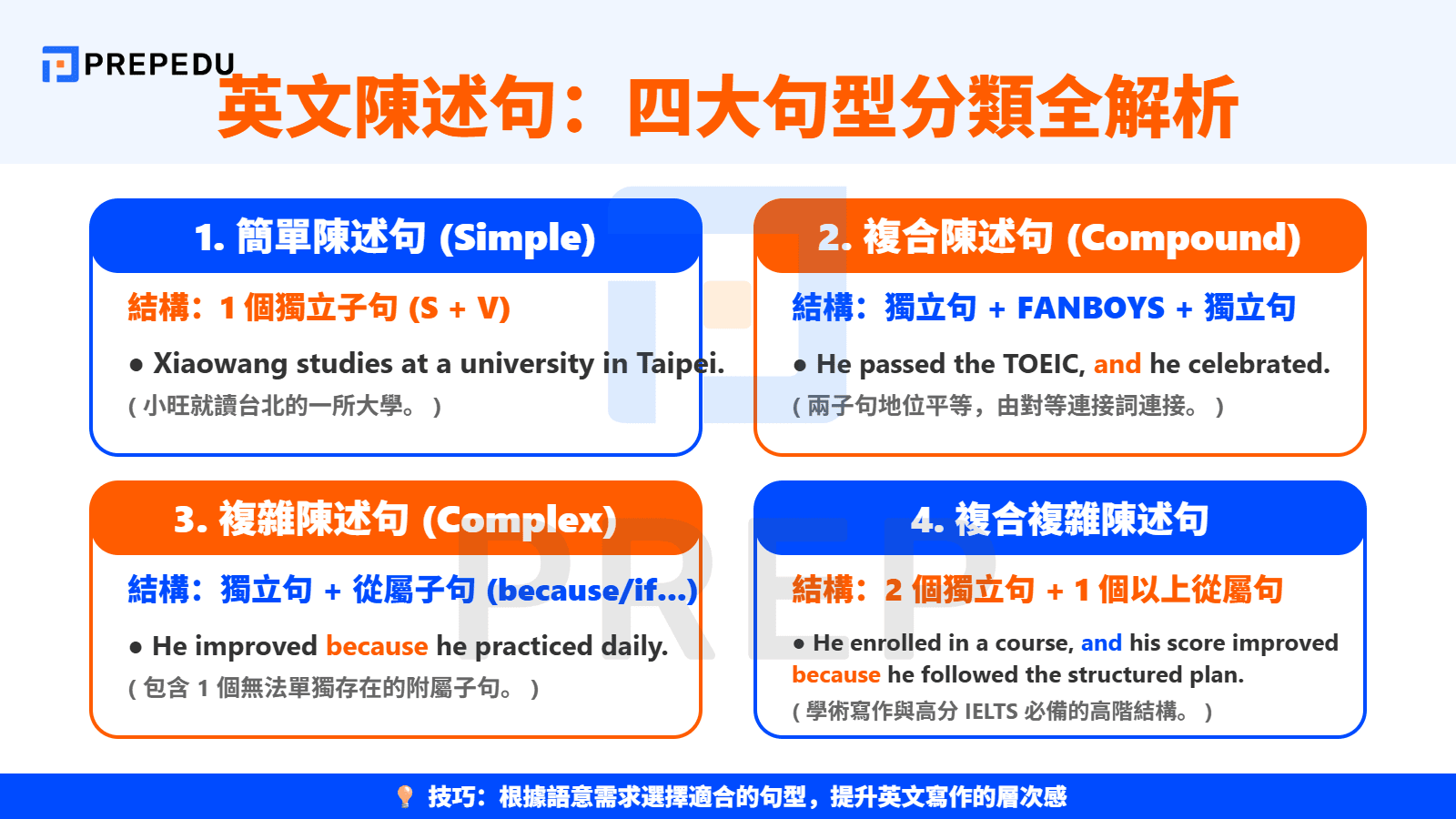
陳述句並非只有一種形式。依據子句的數量與類型,英文陳述句可進一步分為四大句型:簡單句、複合句、複雜句與複合複雜句。理解這四種分類,是你在英文寫作中靈活運用陳述句、提升語言層次的重要一步。
1. 簡單陳述句
簡單陳述句只包含一個獨立子句(Independent Clause),即只有一個主詞與一個動詞,表達一個完整的概念。它是陳述句最基本的形式,語義直接,結構精煉。
|
英文例句 |
主詞 |
動詞 |
補充說明 |
|
Xiaowang studies at a university in Taipei.(小旺就讀台北一所大學。) |
Xiaowang |
studies |
地點副詞片語 |
|
The Hong Kong MTR runs extended hours during major public holidays.(香港地鐵在主要公眾假期期間延長運行時間。) |
The Hong Kong MTR |
runs |
時間副詞片語 |
|
Yanting does not enjoy memorizing vocabulary lists.(彥廷不喜歡死背單字表。) |
Yanting |
does not enjoy |
否定句式 |
2. 複合陳述句
複合陳述句由兩個或兩個以上的獨立子句組成,各子句之間以對等連接詞(如 and、but、so、or、yet)或分號(;)連接。每個子句都可以獨立成句,但組合後能表達更豐富的語意關係,例如並列、對比或因果。
|
英文例句 |
連接詞 |
語意關係 |
|
Xiaowang passed the TOEIC exam with a score of 850, and he celebrated with his classmates in Hong Kong.(小旺以 850 分通過 TOEIC 考試,並與在香港的同學一起慶祝。) |
and |
並列關係 |
|
Yanting wanted to improve her IELTS Writing score, so she reviewed model essays every night before bed.(彥廷想提高 IELTS 寫作分數,因此每天晚上睡前複習範文。) |
so |
因果關係 |
|
The Taipei seminar was informative, but the grammar session ran considerably over the scheduled time.(台北研討會內容豐富,但文法課程大幅超過了預定時間。) |
but |
對比關係 |
3. 複雜陳述句
複雜陳述句由一個獨立子句加上一個或多個從屬子句(Dependent Clause)組成。從屬子句以從屬連接詞(如 because、when、although、if、since)引導,無法單獨構成完整 Declarative Sentences 句子,需要依附主句才能傳達完整的語意。複雜陳述句是 IELTS 寫作評分中「語法多樣性」的重要展現形式。
|
英文例句 |
獨立子句 |
從屬子句 |
連接詞 |
|
Xiaowang improved his listening comprehension significantly because he practised with authentic TOEIC audio materials for three months.(小旺的聽力理解能力顯著提升,因為他用真實的 TOEIC 音訊材料練習了三個月。) |
Xiaowang improved his listening comprehension |
he practised with authentic materials |
because |
|
Although Yanting found the IELTS Reading section challenging, she completed all forty questions within the sixty-minute limit.(雖然彥廷覺得 IELTS 閱讀部分很有挑戰性,但她在六十分鐘內完成了所有四十道題目。) |
she completed all forty questions |
Yanting found the section challenging |
Although |
|
The test centre in Hong Kong sends confirmation emails when candidates successfully register for an upcoming exam.(當考生成功報名即將到來的考試時,香港考試中心會發送確認電子郵件。) |
The test centre sends confirmation emails |
candidates successfully register |
when |
4. 複合複雜陳述句
複合複雜陳述句是結構最複雜的陳述句形式,同時具備複合句(兩個以上的獨立子句)與複雜句(至少一個從屬子句)的特徵。這類陳述句在學術論文、新聞評論與高分 IELTS 寫作範文中十分常見。
|
範例 |
結構拆解 |
|
Xiaowang enrolled in an intensive IELTS preparation course in Taipei, and his overall band score improved from 5.5 to 7.0 after eight weeks because he followed a structured learning plan every single day. (小旺在台北參加了一門密集的 IELTS 備考課程,在堅持每天依照有系統的學習計畫後,他的整體分數在八週內從 5.5 分提升至 7.0 分。) |
|
|
The Hong Kong government announced new language policy guidelines last year, but many educators argued that the changes did not adequately address the needs of non-native English speakers in secondary schools. (香港政府去年公布了新的語言政策指引,但許多教育工作者認為,這些改變未能充分照顧中學非英語母語學生的需求。) |
|
IV. 陳述句與間接引述:如何將直接陳述句轉換為間接引述?
在英文寫作與口語中,你經常需要轉述他人的話,這就是「間接引述」(Reported Speech / Indirect speech)的應用場景。許多學習者容易混淆「陳述句」(Declarative Sentence)與「間接引述中的陳述句形式」,以下為你釐清兩者的關係與轉換規則。
陳述句是語法上的句型分類,描述的是句子的結構形式。間接引述則是一種語言功能,描述的是「如何轉述他人的陳述」。當你用間接引述轉述一個直接陳述句時,該間接引述的主體依然是一個陳述句,但需要調整時態、人稱代詞及時間副詞。
|
類型 |
原句(直接引述) |
轉換後(間接引述) |
關鍵調整 |
|
Xiaowang said: "I study at a university in Taipei."(小旺說:「我在台北的一所大學就讀。」) |
Xiaowang said that he studied at a university in Taipei.(小旺說他在台北的一所大學就讀。) |
study → studied |
|
|
Yanting said: "I am preparing for the IELTS exam."(彥廷說:「我正在備考 IELTS。」) |
Yanting said that she was preparing for the IELTS exam.(彥廷說她正在備考 IELTS。) |
am preparing → was preparing |
|
|
過去式 → 過去完成式 |
Yahui said: "I visited Hong Kong last year."(雅慧說:「我去年去過香港。」) |
Yahui said that she had visited Hong Kong the previous year.(雅慧說她前一年去過香港。) |
visited → had visited |
|
未來式 → 過去未來式 |
Xiaowang said: "I will take the TOEIC exam next month."(小旺說:「我下個月要考 TOEIC。」) |
Xiaowang said that he would take the TOEIC exam the following month.(小旺說他下個月要考 TOEIC。) |
will → would |
V. 英文陳述句與其他三大句型的核心差異與轉換
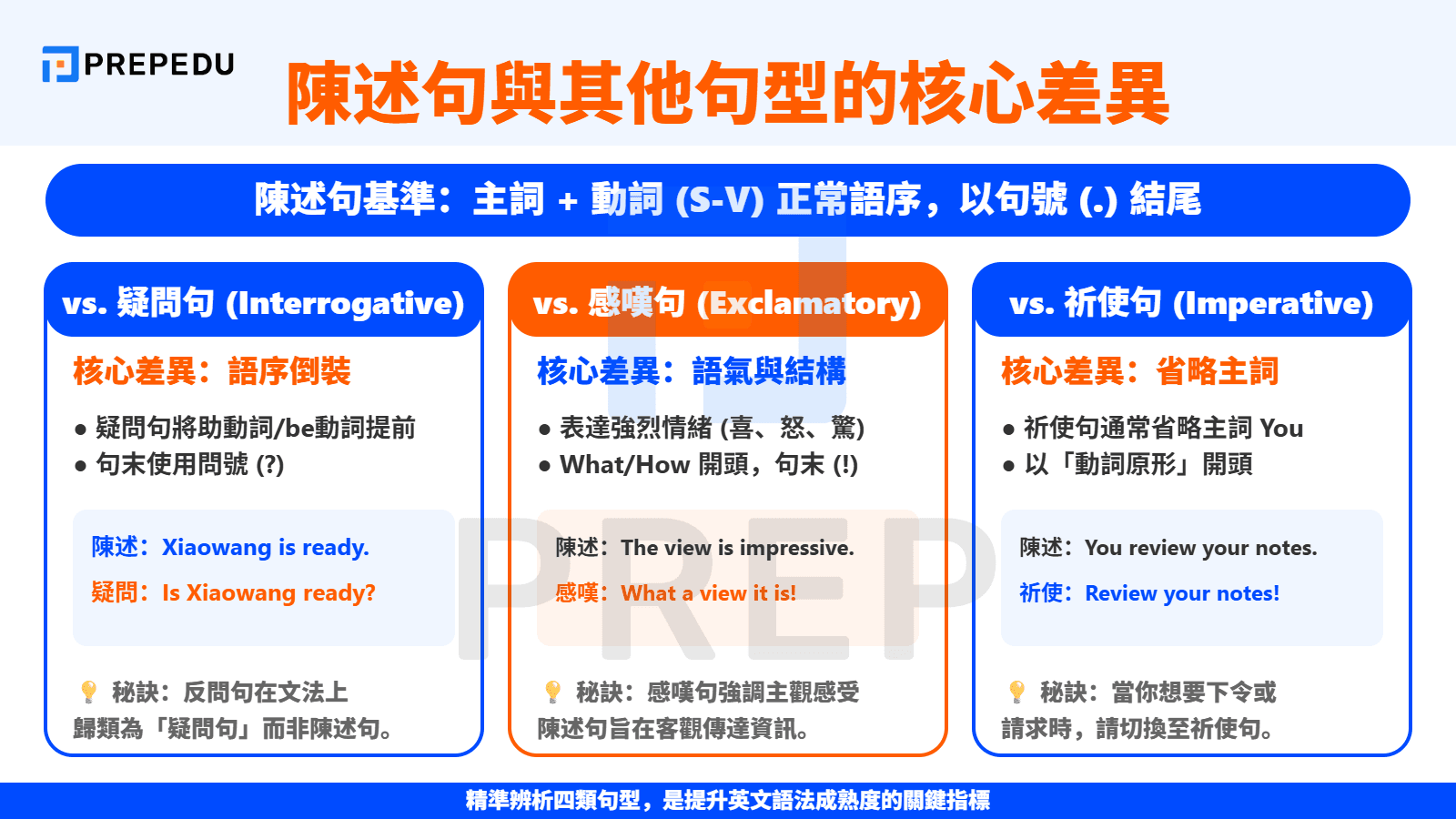
英文有四大句型:陳述句(Declarative)、疑問句(Interrogative)、感嘆句(Exclamatory)與祈使句(Imperative)。精準辨別這四種句型,是語法能力成熟的關鍵指標。以下透過結構對比,讓你在任何語境下都能一眼看出陳述句的獨特之處。
1. 陳述句 vs. 疑問句:語序倒裝的關鍵
陳述句與疑問句的根本差異,體現在「語序」與「句末標點」兩個層面。
-
陳述句遵循 S-V 正常語序,以句號(.)結尾
-
疑問句則將助動詞或 be 動詞提前至主詞之前(倒裝語序),以問號(?)結尾。
|
比較面向 |
陳述句(Declarative) |
疑問句(Interrogative) |
|
語序 |
主詞 + 動詞(正常語序) |
助動詞 / be 動詞 + 主詞(倒裝) |
|
句末標點 |
實心句號(.) |
問號(?) |
|
範例 1 |
Xiaowang is ready for the exam.(小旺準備好考試了。) |
Is Xiaowang ready for the exam?(小旺準備好考試了嗎?) |
|
範例 2 |
Yanting can speak three languages.(彥廷會說三種語言。) |
Can Yanting speak three languages?(彥廷會說三種語言嗎?) |
|
範例 3 |
They have submitted the application.(他們已繳交申請書。) |
Have they submitted the application?(他們繳交申請書了嗎?) |
2. 核心辨析:反問句是陳述句嗎?
反問句是陳述句嗎?這是許多學習者最常混淆的語法問題,答案需要從「形式」與「功能」兩個維度解析。
反問句(Rhetorical question)在形式上屬於疑問句:它使用倒裝語序、以問號(?)結尾,文法分類屬於疑問句。然而,說話者使用反問句的目的並非真的要求對方回答,而是透過問句的形式強調一個顯而易見的論點,表達確定的立場,這在語意功能上等同於一個有力的陳述句。請看以下對比:
|
句型 |
例句(含中文翻譯) |
文法分類 |
語意功能 |
|
陳述句 |
Consistent practice is essential for language improvement.(持續練習對語言進步至關重要。) |
陳述句 |
直接陳述觀點 |
|
反問句(形式上為疑問句) |
Is consistent practice not essential for language improvement?(持續練習對語言進步難道不重要嗎?) |
疑問句(形式) |
等同強烈陳述(功能) |
|
陳述句 |
No one can master a language overnight.(沒有人能在一夜之間掌握一門語言。) |
陳述句 |
陳述事實 |
|
反問句(形式上為疑問句) |
Can anyone master a language overnight?(有誰能在一夜之間掌握一門語言嗎?) |
疑問句(形式) |
強調「不可能」的立場 |
結論是:反問句在文法分類上屬於疑問句,而非陳述句。 但在修辭功能上,它傳達的是與陳述句相同的確定性訊息。在語法測驗中,請根據句子的結構形式判斷,而非語意功能。
3. 陳述句 vs. 感嘆句與祈使句
陳述句 vs. 感嘆句
感嘆句用於表達強烈的情緒,例如驚喜、喜悅或憤慨,通常以「What + 名詞片語」或「How + 形容詞 / 副詞」開頭,句末以驚嘆號(!)結尾。陳述句則保持語氣平穩,客觀傳達資訊,以句號結尾,不帶情緒渲染。
|
句型 |
英文例句 |
句末標點 |
語氣特徵 |
|
陳述句 |
The view from Taipei 101 is impressive.(從台北 101 望出去的景色令人印象深刻。) |
. |
客觀平穩 |
|
感嘆句 |
What an impressive view from Taipei 101!(從台北 101 望出去的景色多麼令人印象深刻啊!) |
! |
強烈情緒 |
|
陳述句 |
Yahui performed well in the IELTS Speaking test.(雅慧在 IELTS 口說測驗中表現出色。) |
. |
客觀陳述 |
|
感嘆句 |
How well Yahui performed in the IELTS Speaking test!(雅慧在 IELTS 口說測驗中表現多麼出色啊!) |
! |
讚嘆情緒 |
陳述句 vs. 祈使句
祈使句用於發出命令、請求或指示,其最顯著的特徵是通常省略主詞(You),並以動詞原形開頭。陳述句則必須包含明確的主詞,且不具備命令或要求的語氣。
|
句型 |
英文例句 |
主詞 |
動詞形式 |
|
陳述句 |
You review your notes before the TOEIC test.(你在 TOEIC 考試前複習筆記。) |
明確有主詞(You) |
一般動詞(review) |
|
祈使句 |
Review your notes before the TOEIC test.(在 TOEIC 考試前複習你的筆記。) |
省略主詞 |
動詞原形(Review) |
|
陳述句 |
Candidates submit their forms by the deadline.(考生在截止日期前繳交表格。) |
明確有主詞(Candidates) |
一般動詞(submit) |
|
祈使句 |
Submit your form by the deadline.(在截止日期前繳交你的表格。) |
省略主詞 |
動詞原形(Submit) |
VI. 實戰演練:英文陳述句綜合練習題(附解答)
透過以下三組練習題,你可以系統性地測試並強化對陳述句的掌握。請先獨立完成每道題目,再對照底部的解答,確認自己的理解是否正確。
1. 練習一:句型辨識題(判斷是否為陳述句)
請判斷以下 10 個句子是否為陳述句,在括號內填入 True(是)或 False(否):
|
題號 |
句子(含中文翻譯) |
作答 |
|
1 |
The IELTS exam measures four language skills.(IELTS 考試評量四項語言技能。) |
( ) |
|
2 |
Where is the nearest TOEIC test centre in Hong Kong?(香港最近的 TOEIC 考場在哪裡?) |
( ) |
|
3 |
Xiaowang did not score above 750 on his first attempt.(小旺第一次應試未能考到 750 分以上。) |
( ) |
|
4 |
Please register for the exam at least two weeks in advance.(請至少提前兩週報考。) |
( ) |
|
5 |
What a significant improvement in Yahui's spoken fluency!(雅慧的口語流利度有多麼顯著的進步啊!) |
( ) |
|
6 |
Yanting reads English news articles for thirty minutes every day.(彥廷每天閱讀三十分鐘英文新聞。) |
( ) |
|
7 |
Has Yahui already received her IELTS results?(雅慧已經收到 IELTS 成績了嗎?) |
( ) |
|
8 |
Consistent daily practice builds long-term language competence.(每日持之以恆的練習能建立長期的語言能力。) |
( ) |
|
9 |
Check your essay for grammar errors before submitting.(在繳交前檢查你的作文是否有文法錯誤。) |
( ) |
|
10 |
The test centre in Taipei confirmed the examination schedule for next quarter.(台北考試中心確認了下一季的考試時間表。) |
( ) |
解答:
-
True(陳述事實,正常語序,句號結尾)
-
False(疑問句,問號結尾)
-
True(否定陳述句,句號結尾)
-
False(祈使句,省略主詞)
-
False(感嘆句,驚嘆號結尾)
-
True(肯定陳述句,正常語序)
-
False(疑問句,助動詞倒裝)
-
True(主觀意見陳述句)
-
False(祈使句,動詞原形開頭)
-
True(肯定陳述句,正常語序)
2. 練習二:句型改寫題(將其他句型改為陳述句)
請依據括號內的提示方向,將以下疑問句或祈使句改寫為語意完整的英文陳述句:
|
題號 |
原句(含中文翻譯) |
提示方向 |
你的答案 |
|
1 |
Is Yanting a registered IELTS candidate?(彥廷是已報名的 IELTS 考生嗎?) |
肯定 → Yanting is... |
_____ |
|
2 |
Submit all documents by the deadline.(在截止日期前繳交所有文件。) |
規定 → All candidates must... |
_____ |
|
3 |
Did the Hong Kong test centre cancel the session?(香港考試中心取消了那個場次嗎?) |
否定 → The Hong Kong test centre did not... |
_____ |
|
4 |
What time does Xiaowang's TOEIC exam start?(小旺的 TOEIC 考試幾點開始?) |
事實 → Xiaowang's TOEIC exam starts at... |
_____ |
|
5 |
Review the grammar notes before the test.(在考試前複習文法筆記。) |
建議 → It is recommended that students... |
_____ |
|
6 |
Have they updated the IELTS scoring criteria?(他們更新了 IELTS 評分標準嗎?) |
肯定 → They have... |
_____ |
|
7 |
Do not leave the exam room before time is called.(在宣布時間到之前不要離開考場。) |
規定 → Candidates are not allowed to... |
_____ |
|
8 |
Can Yahui complete all four IELTS sections in one day?(雅慧能在一天內完成 IELTS 四個部分嗎?) |
肯定 → Yahui can... |
_____ |
|
9 |
Is the TOEIC exam accepted by companies in Taiwan?(TOEIC 成績被台灣企業採認嗎?) |
事實 → The TOEIC exam is widely... |
_____ |
|
10 |
Bring a valid ID to the examination hall.(攜帶有效身份證件至考場。) |
規定 → All candidates must... |
_____ |
參考答案:
-
Yanting is a registered IELTS candidate.
-
All candidates must submit their documents by the deadline.
-
The Hong Kong test centre did not cancel the session.
-
Xiaowang's TOEIC exam starts at nine o'clock in the morning.
-
It is recommended that students review the grammar notes before the test.
-
They have updated the IELTS scoring criteria.
-
Candidates are not allowed to leave the exam room before time is called.
-
Yahui can complete all four IELTS sections in one day.
-
The TOEIC exam is widely accepted by companies in Taiwan.
-
All candidates must bring a valid ID to the examination hall.
3. 練習三:語序重組題(造出正確的陳述句)
請將以下打亂順序的英文字彙,依照 S-V-O 結構重組為正確的英文陳述句(大寫字母即為句首):
|
題號 |
打亂的字彙 |
你的答案 |
|
1 |
speak / She / three / languages / does / not |
_____ |
|
2 |
every / The / opens / morning / at 8 a.m. / IELTS test centre |
_____ |
|
3 |
the TOEIC project / completed / Xiaowang / last month |
_____ |
|
4 |
not / does / the / system / registration / correctly / work |
_____ |
|
5 |
English / improving / Yahui's / every day / is / speaking skills |
_____ |
|
6 |
the conference / attend / did / not / He / in Taipei |
_____ |
|
7 |
annually / IELTS / The / takes place / exam / in Hong Kong / twice |
_____ |
|
8 |
support / does / the new policy / not / The review committee |
_____ |
|
9 |
Yanting / located / is / in the Zhongzheng District / favourite bookshop |
_____ |
|
10 |
vocabulary / consistent / improves / practice / IELTS / reading |
_____ |
參考答案:
-
She does not speak three languages.
-
The IELTS test centre opens every morning at 8 a.m.
-
Xiaowang completed the TOEIC project last month.
-
The registration system does not work correctly.
-
Yahui's English speaking skills are improving every day.
-
He did not attend the conference in Taipei.
-
The IELTS exam takes place twice annually in Hong Kong.
-
The review committee does not support the new policy.
-
Yanting's favourite bookshop is located in the Zhongzheng District.
-
Consistent IELTS reading practice improves vocabulary.
結論
陳述句(Declarative Sentence)是英文溝通的語法基石。從陳述句意義的詞源解析出發,涵蓋 S-V-O 結構的四大句型分類、肯定與否定的結構對比、主動與被動語態的選擇,到與疑問句、感嘆句及祈使句的精確辨別,以及間接引述的時態轉換規則——你現在擁有了系統化掌握英文陳述句的完整知識體系。
對 IELTS 或 TOEIC 考試結構感到陌生?考試當天的不確定感會影響你的表現。PREPEDU 的 Test Practice 提供真實模擬環境,讓你在實戰前熟悉題型和時間限制。
系統收錄超過 1,000 道練習題,定期更新以反映最新考試趨勢。AI 引擎分析你的錯誤,針對弱點提供改進方案。進度追蹤系統將你的成長數據化,讓進步一目了然。

你好!我叫黃秋賢,現在在 prepedu.com 擔任內容企劃。我有超過5年的英語與韓語自學經歷,親身備考 IELTS、TOEIC 與 TOPIK,累積了大量第一手的學習者視角——包括哪些語法規則最讓台灣與香港學習者混淆,以及如何在有限的備考時間內最有效地修正這些錯誤。目前已在 prepedu.com 撰寫超過 1000 篇英語學習文章,內容涵蓋語法、詞彙與考試策略,累積協助數千位學習者解決自學過程中的語法疑問。
評論












統一企業編號:202227322W
地址:114 LAVENDER STREET, #11-83 CT HUB 2, SINGAPORE (338729)