True/False/Not Given: Định nghĩa, cách làm, mẹo hay và bài tập thực hành
Dạng bài True/False/Not Given trong IELTS Reading là một thử thách lớn đối với nhiều thí sinh vì yêu cầu phân tích thông tin chính xác từ bài đọc. Để làm bài hiệu quả, bạn cần hiểu rõ cấu trúc, cách thức chấm điểm và áp dụng những chiến lược làm bài phù hợp. Trong bài viết dưới đây, PREP sẽ chia sẻ chi tiết về dạng True False Not Given, từ định nghĩa, các bước làm bài chi tiết đến mẹo giúp tránh bẫy và các bài tập thực hành.
I. Dạng True False Not Given là gì?
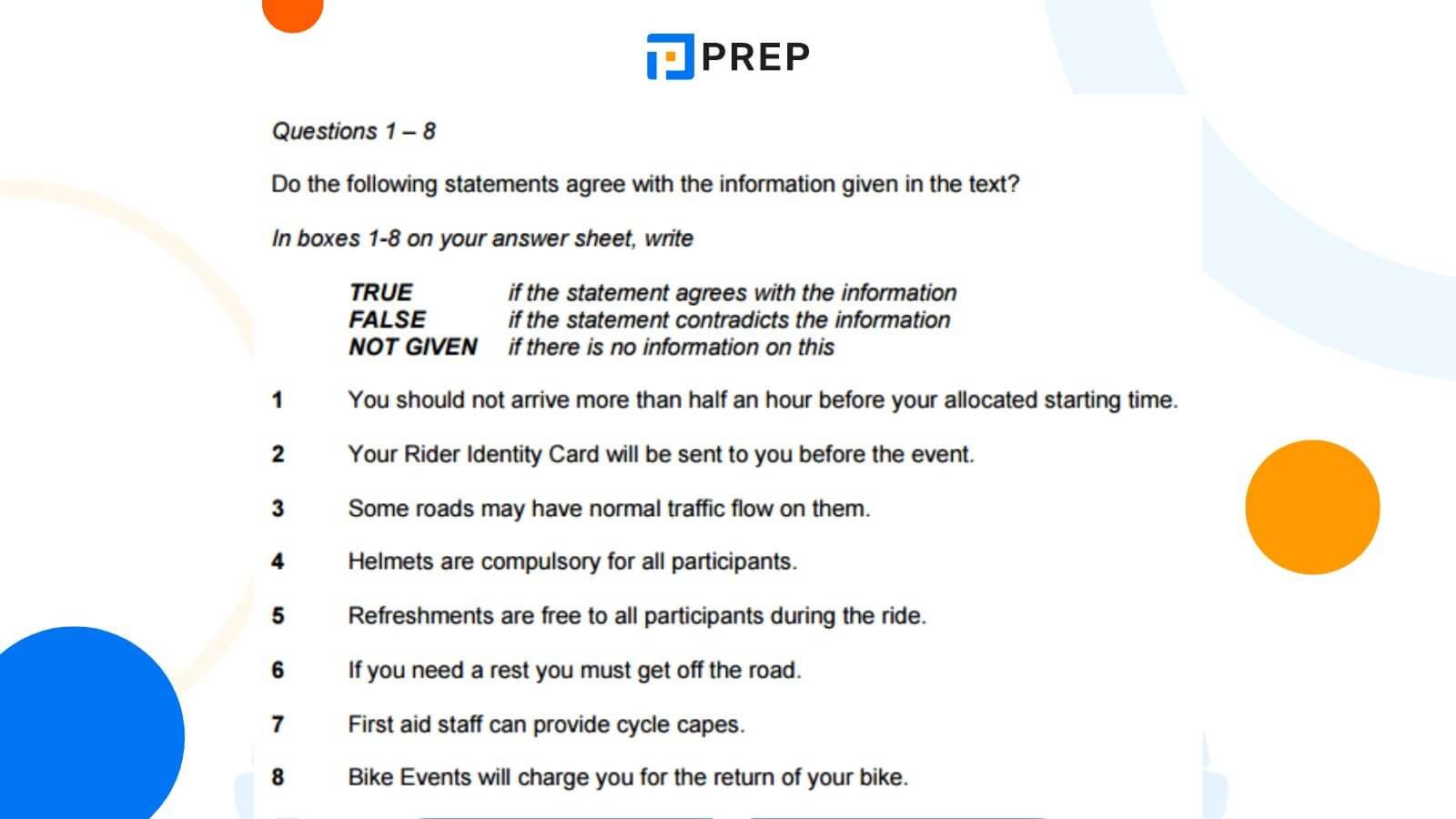
Dạng bài True/False/Not Given trong bài thi IELTS Reading yêu cầu bạn đọc kỹ bài viết và quyết định xem thông tin trong các câu hỏi có chính xác, trái ngược hoặc không được đề cập trong bài đọc.
Dạng bài này True/False/Not Given IELTS có thể xuất hiện trong mọi loại bài đọc: bài mô tả, bài phân tích, bài luận, bài báo,.... Dạng này có thể có từ 5-10 câu hỏi trong mỗi bài đọc, tuy nhiên, chúng yêu cầu sự phân tích chính xác của thí sinh.
Cách phân biệt True, False và Not Given như sau:
-
True (Đúng): Câu hỏi cung cấp thông tin hoàn toàn đúng và phù hợp với dữ liệu trong bài đọc.
-
False (Sai): Câu hỏi cung cấp thông tin mâu thuẫn với thông tin trong bài đọc. Bạn có thể tìm thấy bằng chứng trong bài để chứng minh câu đó sai. (Ví dụ: Đề nói "Tăng", bài đọc nói "Giảm").
-
Not Given (Không Có Thông Tin): Câu hỏi đưa ra thông tin mà KHÔNG CÓ trong bài đọc, có thể là thông tin thiếu hoặc không liên quan đến bài đọc. (Ví dụ: Đề nói "A giỏi hơn B", bài đọc chỉ nói "A và B đều giỏi" nhưng không hề so sánh ai hơn ai).
Tìm hiểu thêm về các dạng bài IELTS Reading:
II. Cách làm True False Not Given IELTS chi tiết
1. Đọc kỹ yêu cầu đề bài
Trước tiên, bạn cần kiểm tra xem đề yêu cầu True/False/Not Given (dựa trên sự thật trong bài) hay Yes/No/Not Given (dựa trên quan điểm/ý kiến tác giả). Tuy cách làm tương tự nhau, nhưng hãy viết đúng từ khóa vào tờ đáp án (đừng viết nhầm T/F cho câu hỏi Y/N).
Ví dụ đề thi thật 22/12/2025:
[prep_collapse_expand open_text="Xem toàn bộ đoạn văn" close_text="Ẩn đoạn văn"]
How much of the world around you do you really see?
Picture the following and prepare to be amazed. You’re walking across a college campus when a stranger asks you for directions. While you’re talking to him, two men pass between you carrying a wooden door. You feel a moment’s irritation, but you carry on describing the route. When you’ve finished, you’re told you’ve just taken part in a psychology experiment. “Did you notice anything after the two men passed with the door?” the stranger asks. “No,” you reply uneasily. He explains that the man who initially approached you walked off behind the door leaving him in his place. The first man now rejoins you. Comparing them, you notice that they are of different height and build and are dressed very differently.
Daniel Simons of Harvard University found that 50% of participants missed the substitution because of what is called change blindness. When considered with a large number of recent experimental results, this phenomenon suggests we see far less than we think we do. Rather than logging every detail of the visual scene, says Simons, we are actually highly selective. Our impression of seeing everything is just that. In fact, we extract a few details and rely on memory, or even our imagination, for the rest.
Until recently, scientists believed that vision involved creating images within the brain. By forming detailed internal representations of our surroundings and comparing them over time, we could detect any alterations. However, in his book Consciousness Explained, philosopher Daniel Dennett argued that our brains only store a few key details about the world, which is why we can function effectively.
According to Dennett, creating elaborate images in short-term memory would consume valuable cognitive resources. Instead, we record what has changed and assume everything else remains unchanged. As a result, we inevitably overlook some details. Experiments had demonstrated that we tend to ignore elements in our visual field that seem unimportant, such as a repeated word or line in a text. But even Dennett didn’t fully realize just how little we actually ‘see.’ A year later, John Grimes from the University of Illinois drew attention by showing that people who were presented with computer-generated images of natural scenes failed to notice changes made while their eyes were, for example, scanning the scene or blinking. Dennett was pleased: “In hindsight, I wish I had been bolder, as the effects are more pronounced than I originally claimed.”
Subsequently, it was discovered that our eyes don’t even need to be moving to be deceived. A typical laboratory experiment might display an image on a computer screen, like a couple dining on a terrace. The image would briefly disappear, replaced by a blank screen, then reappear with a significant change, such as a raised railing behind the couple. Many people search the screen for up to a minute before spotting the alteration, and some never see it.
This is disconcerting. However, ‘change blindness’ is somewhat artificial because, in real-life scenarios, a visible motion usually signals a change. Yet, not always. As Simons points out, “We all know the experience of missing a traffic signal change because we briefly looked away. “Inattentional blindness’ refers to not noticing a feature of a scene when you aren’t paying attention to it.”
Last year, Simons showed people a video of a basketball game and asked them to count the passes made by one of the teams. After 45 seconds, a man in a gorilla suit slowly walked behind the players. Forty percent didn’t notice him. When the tape was replayed, and they were simply told to watch it, they easily saw the gorilla. Some even doubted it was the same video.
Now, consider if the viewers had been driving a car, and the man in the gorilla suit had been a pedestrian. Some estimates suggest that nearly half of all fatal motor vehicle accidents in the US result from driver error, including attention lapses. It’s more than just academic interest that has spurred research into these cognitive errors.
These errors prompt critical questions: how can we reconcile such significant lapses with our subjective experience of continuously perceiving a rich visual environment? Last year, Stephen Kosslyn from Harvard University demonstrated that imagining a scene activates parts of the visual cortex similarly to actually seeing it. He argues that this supports the idea that we only absorb the information we consider important and mentally fill in the gaps where details are less crucial. “The illusion that we see ‘everything’ is partly due to filling in gaps with memory,” he says. “These memories can be shaped by beliefs and expectations.”
Ronald Rensink from the University of British Columbia in Canada believes our perception of a detailed visual world comes from constructing internal representations. He suggests that the brain first creates a temporary layout of the visual scene, and then our attention enhances the resolution of the scene. “What attention does,” he explains, “is stabilize these representations so they form distinct objects. Once attention shifts, they revert to an unstable, unresolved state.”
While Rensink or Kosslyn propose that internal images or memory play some role, others argue that we can perceive visual richness without storing any of that richness in our brains. Kevin O’Regan, an experimental psychologist, contends that our brains do not store a visual image of the world. Instead, we rely on the external visual environment as different parts of a scene become relevant.
According to O’Regan, our sense of controlling what we see is also an illusion. “We believe that when something flickers outside the window, we choose to look,” says Susan Blackmore from the University of the West of England, who supports O’Regan’s view. “In reality,” she explains, “our change detection mechanisms automatically drag our attention to various stimuli.”
[/prep_collapse_expand]
Questions 5–9
Do the following statements agree with the information given in Reading Passage 3?
Write:
TRUE if the statement agrees with the information
FALSE if the statement contradicts the information
NOT GIVEN if there is no information on this
5. One expert expressed regret for having underemphasized his argument in a publication.
6. We overlook insignificant items that come into our view.
7. Research into cognitive errors might potentially save lives.
8. The aging process increases the need to fill in gaps in our visual perception.
9. Our eyes are only at risk of being deceived when they are in motion.
➨ Đề bài yêu cầu TRUE / FALSE / NOT GIVEN. Bạn lưu ý chỉ bám sát vào các dữ kiện thực tế (facts) có trong đoạn văn, không suy luận theo ý kiến cá nhân.
2. Phân tích câu hỏi (Statements) và Gạch chân Keywords
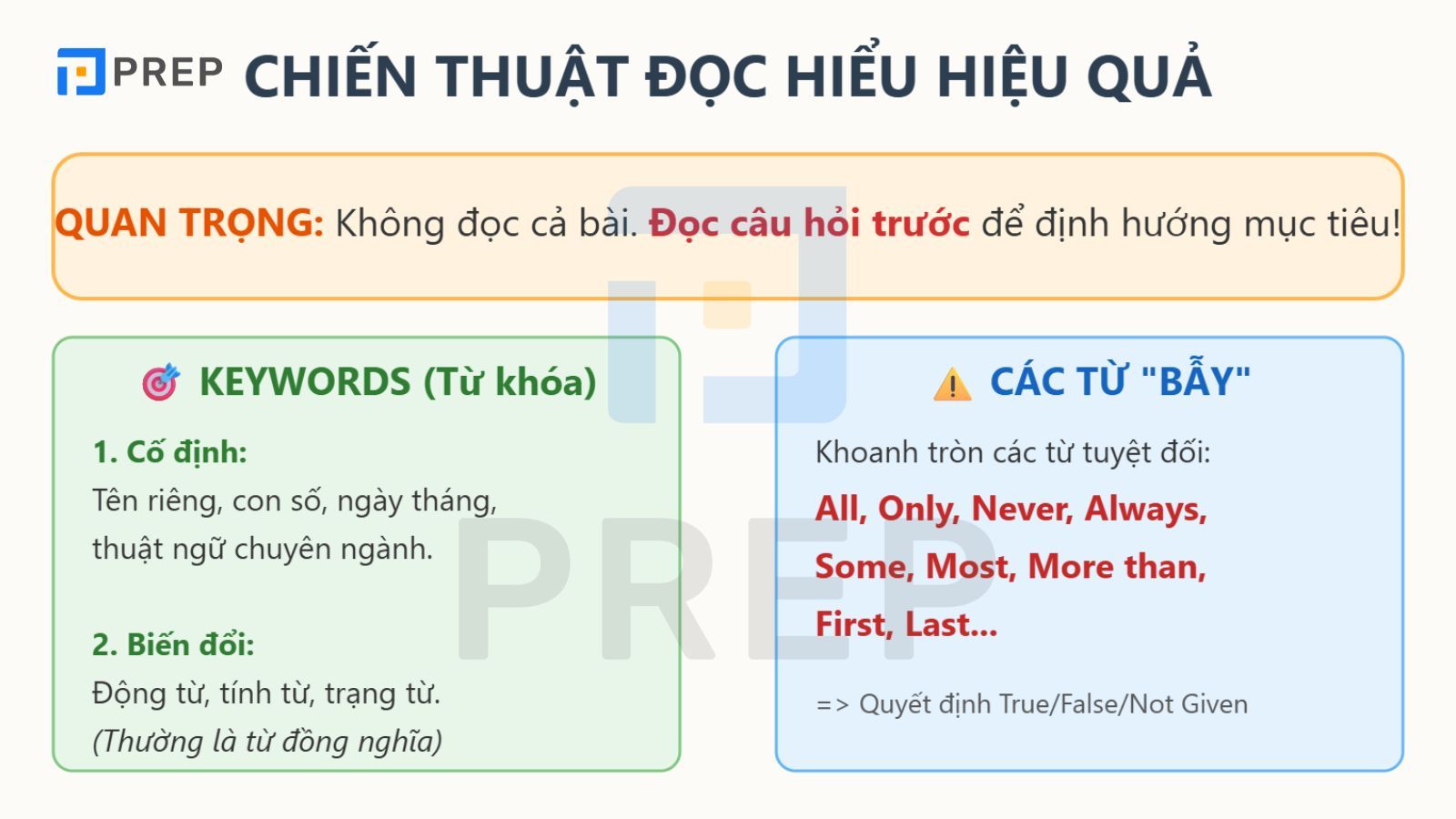
Trước khi làm, bạn đừng đọc cả bài văn ngay. Hãy đọc câu hỏi trước để xác định mục tiêu.
-
Keywords cố định: Tên riêng, con số, ngày tháng, thuật ngữ chuyên ngành (giúp bạn định vị đoạn văn nhanh).
-
Keywords biến đổi: Động từ, tính từ, trạng từ (thường sẽ bị thay thế bằng từ đồng nghĩa trong bài đọc).
-
Các từ "bẫy" (Modifiers/Quantifiers): Khoanh tròn các từ mang tính tuyệt đối hoặc so sánh như: all, only, never, always, some, most, more than, first, last... Những từ này thường là mấu chốt để quyết định câu đó là False hay Not Given.
3. Định vị vùng thông tin (Scanning)
Với bước này, chúng ta sẽ sử dụng các Keywords cố định để quét trong bài đọc xem câu hỏi nằm ở đoạn nào.
Mẹo: Các câu hỏi trong dạng này thường xuất hiện theo thứ tự trong bài đọc. Nếu bạn tìm thấy vị trí câu 1 và câu 3, câu 2 chắc chắn nằm ở khoảng giữa đó.
Áp dụng vào ví dụ đề thi thật cho bước 2 và bước 3:
|
Câu |
Đề bài |
Keywords |
Vị trí trong bài |
Đối chiếu |
|
5 |
One expert expressed regret for having underemphasized his argument in a publication. |
One expert, regret, underemphasized, publication |
Đoạn 5, câu cuối |
|
|
6 |
We overlook insignificant items that come into our view. |
Overlook, insignificant items |
Đoạn 5 |
|
|
7 |
Research into cognitive errors might potentially save lives. |
Research, cognitive errors, save lives |
Đoạn 9 |
Cognitive errors liên quan đến tai nạn chết người; nghiên cứu không chỉ mang tính học thuật → có ý nghĩa thực tế (cứu người) |
|
8 |
The aging process increases the need to fill in gaps in our visual perception. |
Aging process, fill in gaps |
Toàn bài |
Có nói về “fill in gaps” nhưng không đề cập aging process |
|
9 |
Our eyes are only at risk of being deceived when they are in motion. |
Only at risk, in motion |
Đoạn 6 |
Câu hỏi: chỉ bị lừa khi mắt chuyển động; Passage: không cần chuyển động vẫn bị lừa → mâu thuẫn |
Tìm hiểu thêm: Skimming và Scanning - Kỹ năng then chốt xử lý Reading
4. So sánh và Đối chiếu
Khi đã tìm thấy đoạn văn chứa thông tin, hãy đọc thật kỹ và đối chiếu:
-
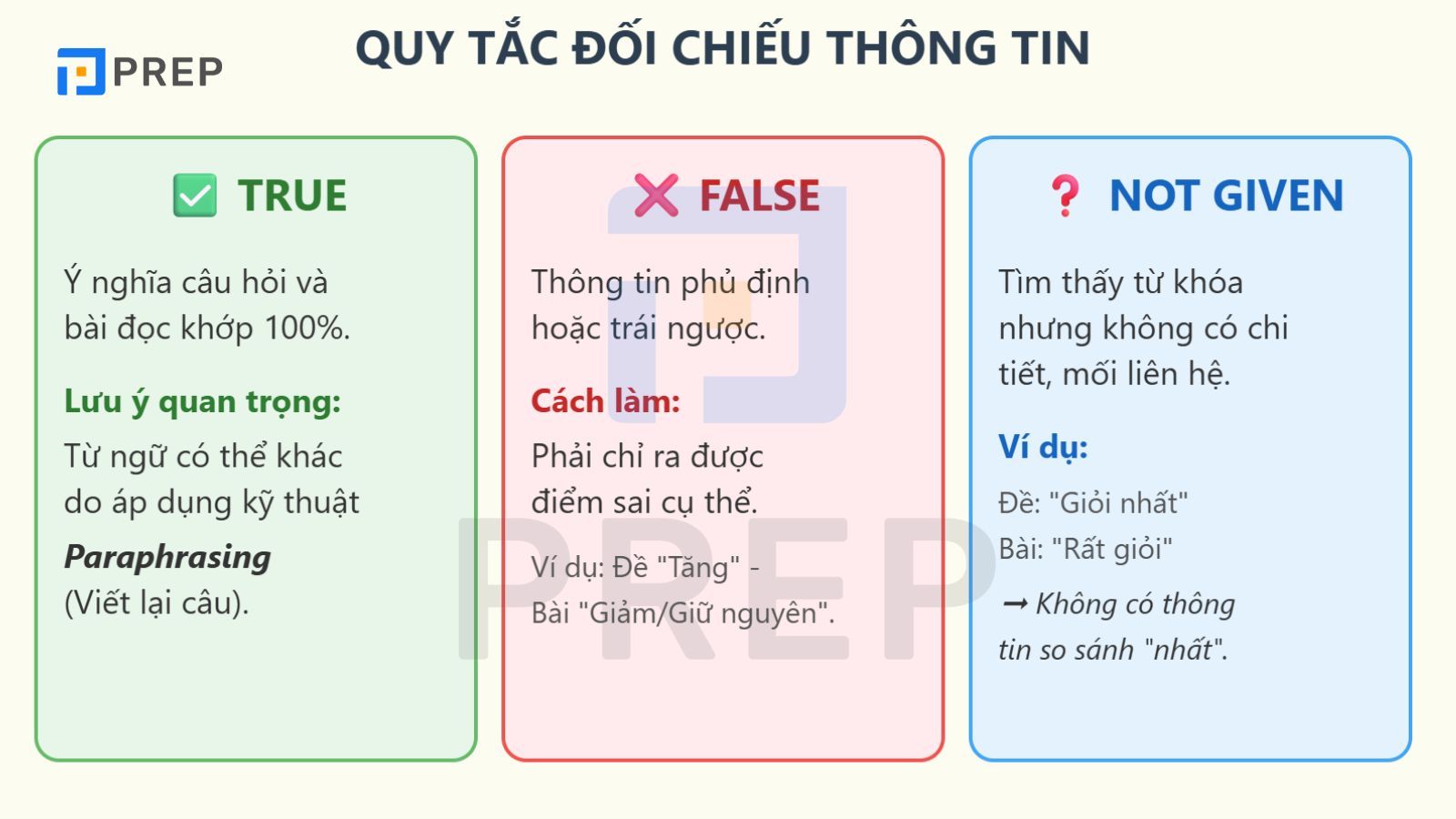
Chọn TRUE: Nếu ý nghĩa của câu hỏi và bài đọc khớp 100% (dù từ ngữ có thể khác nhau do dùng Paraphrasing).
-
Chọn FALSE: Nếu thông tin trong bài đọc phủ định hoặc trái ngược với câu hỏi. Bạn phải chỉ ra được điểm sai đó là gì (Ví dụ: Đề nói "tăng", bài nói "giữ nguyên" hoặc "giảm").
-
Chọn NOT GIVEN: Nếu bạn tìm thấy các danh từ trong câu hỏi nhưng không tìm thấy mối liên hệ hoặc chi tiết cụ thể mà câu hỏi đưa ra. (Ví dụ: Đề nói "Anh ấy là người giỏi nhất", bài chỉ nói "Anh ấy rất giỏi" ➞ Không có thông tin so sánh "nhất" ➞ Not Given).
Ví dụ đề thi ngày 22/12/2025:
|
Câu |
Đáp án |
Từ khóa chứng minh (Evidence) |
|
5 |
TRUE |
"I wish I had been bolder" = Regret. |
|
6 |
TRUE |
"Ignore elements... unimportant" = Overlook insignificant items. |
|
7 |
TRUE |
Liên hệ giữa "research" và "fatal accidents" (tai nạn chết người). |
|
8 |
NOT GIVEN |
Bài đọc không nhắc đến tuổi tác (aging). |
|
9 |
FALSE |
"Don’t even need to be moving" ngược lại với "only... in motion". |
5. Kiểm tra lại và Điền đáp án
Cuối cùng, không được bỏ trống. Nếu phân vân giữa False và Not Given, hãy đọc lại các từ hạn định (như only, all).
Mẹo: Nếu bạn phải suy luận "chắc là thế này..." hoặc "có lẽ là..." thì thường đáp án đó là Not Given.
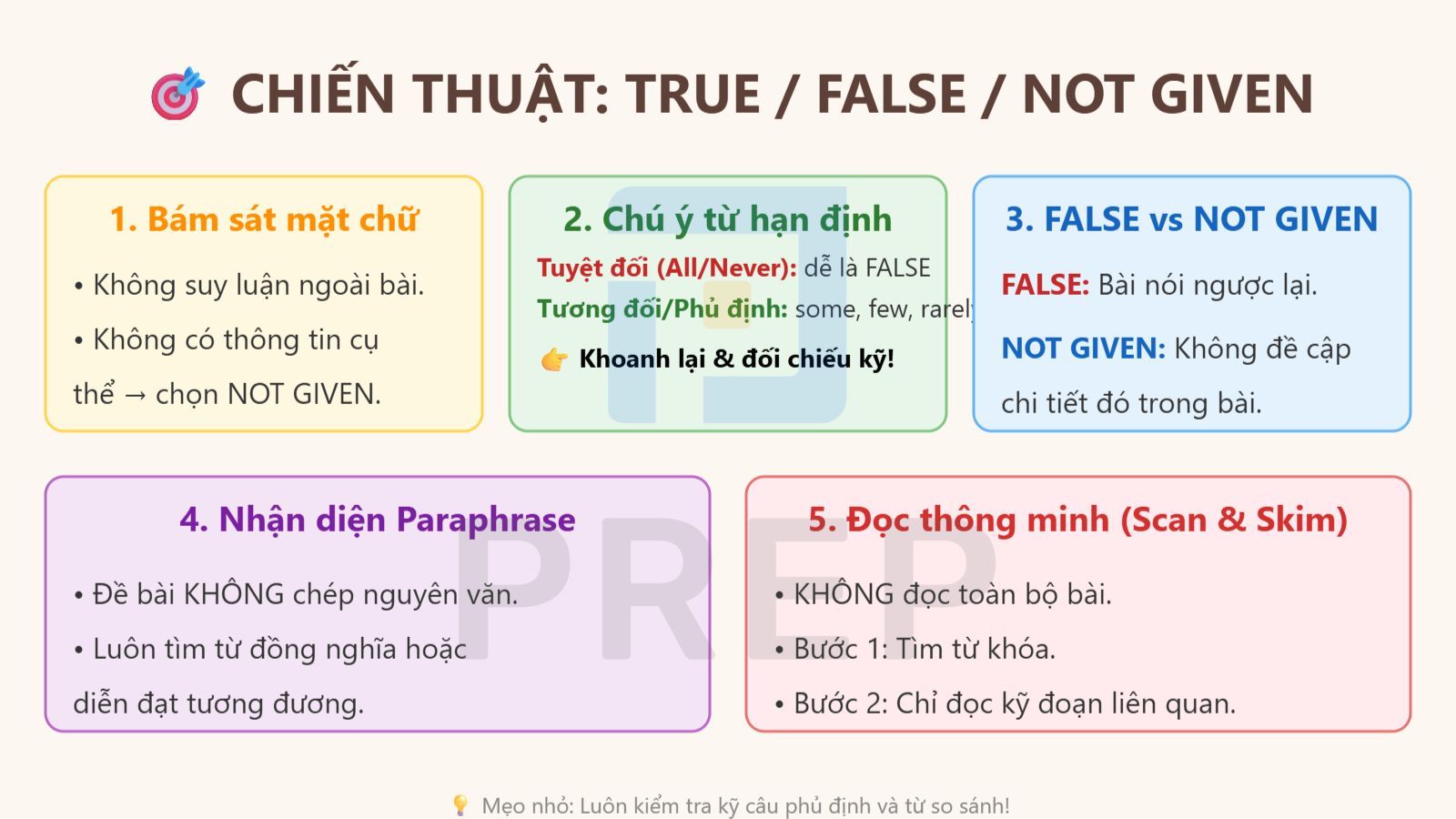
III. Mẹo làm IELTS Reading True False Not Given
Một số mẹo làm IELTS Reading True False Not Given để tránh mắc bẫy và đạt điểm cao:
|
Mẹo |
Nội dung |
|
Quy tắc "Bám sát mặt chữ" |
|
|
Cẩn thận với các Từ hạn định |
|
|
Phân biệt rõ FALSE và NOT GIVEN |
|
|
Kỹ thuật Paraphrasing (Từ đồng nghĩa) |
|
|
Đừng đọc toàn bộ bài văn (Scanning & Skimming) |
|
IV. Bài tập Reading True/False/Not Given có đáp án
Cùng thực hành một số bài tập True/False/Not Given IELTS kèm đáp án dưới đây để luyện thi IELTS hiệu quả nhé!
1. Bài tập 1
Đề thi thật ngày 22/12/2025
[prep_collapse_expand open_text="Xem đoạn văn " close_text="Ẩn đoạn văn "]
The Impact of the Potato
Jeff Chapman relates the story of history the most important vegetable
A. The potato was first cultivated in South America between three and seven thousand years ago, though scientists believe they may have grown wild in the region as long as 13,000 years ago. The genetic patterns of potato distribution indicate that the potato probably originated in the mountainous west-central region of the continent.
B. Early Spanish chroniclers who misused the Indian word batata (sweet potato) as the name for the potato noted the importance of the tuber to the Incan Empire. The Incas had learned to preserve the potato for storage by dehydrating and mashing potatoes into a substance called Chuchu could be stored in a room for up to 10 years, providing excellent insurance against possible crop failures. As well as using the food as a staple crop, the Incas thought potatoes made childbirth easier and used it to treat injuries.
C. The Spanish conquistadors first encountered the potato when they arrived in Peru in 1532 in search of gold, and noted Inca miners eating chuchu. At the time the Spaniards failed to realize that the potato represented a far more important treasure than either silver or gold, but they did gradually begin to use potatoes as basic rations aboard their ships. After the arrival of the potato in Spain in 1570,a few Spanish farmers began to cultivate them on a small scale, mostly as food for livestock.
D. Throughout Europe, potatoes were regarded with suspicion, distaste and fear. Generally considered to be unfit for human consumption, they were used only as animal fodder and sustenance for the starving. In northern Europe, potatoes were primarily grown in botanical gardens as an exotic novelty. Even peasants refused to eat from a plant that produced ugly, misshapen tubers and that had come from a heathen civilization. Some felt that the potato plant’s resemblance to plants in the nightshade family hinted that it was the creation of witches or devils.
E. In meat-loving England, farmers and urban workers regarded potatoes with extreme distaste. In 1662, the Royal Society recommended the cultivation of the tuber to the English government and the nation, but this recommendation had little impact. Potatoes did not become a staple until, during the food shortages associated with the Revolutionary Wars, the English government began to officially encourage potato cultivation. In 1795, the Board of Agriculture issued a pamphlet entitled “Hints Respecting the Culture and Use of Potatoes”; this was followed shortly by pro-potato editorials and potato recipes in The Times. Gradually, the lower classes began to follow the lead of the upper classes.
F. A similar pattern emerged across the English Channel in the Netherlands, Belgium and France. While the potato slowly gained ground in eastern France (where it was often the only crop remaining after marauding soldiers plundered wheat fields and vineyards), it did not achieve widespread acceptance until the late 1700s. The peasants remained suspicious, in spite of a 1771 paper from the Facult de Paris testifying that the potato was not harmful but beneficial. The people began to overcome their distaste when the plant received the royal seal of approval: Louis XVI began to sport a potato flower in his buttonhole, and Marie-Antoinette wore the purple potato blossom in her hair.
G. Frederick the Great of Prussia saw the potato’s potential to help feed his nation and lower the price of bread, but faced the challenge of overcoming the people’s prejudice against the plant. When he issued a 1774 order for his subjects to grow potatoes as protection against famine, the town of Kolberg replied: “The things have neither smell nor taste, not even the dogs will eat them, so what use are they to us?” Trying a less direct approach to encourage his subjects to begin planting potatoes, Frederick used a bit of reverse psychology: he planted a royal field of potato plants and stationed a heavy guard to protect this field from thieves. Nearby peasants naturally assumed that anything worth guarding was worth stealing, and so snuck into the field and snatched the plants for their home gardens. Of course, this was entirely in line with Frederick’s wishes.
H. Historians debate whether the potato was primarily a cause or an effect of the huge population boom in industrial-era England and Wales. Prior to 1800,the English diet had consisted primarily of meat, supplemented by bread, butter and cheese. Few vegetables were consumed, most vegetables being regarded as nutritionally worthless and potentially harmful. This view began to change gradually in the late 1700s. The Industrial Revolution was drawing an ever increasing percentage of the populace into crowded cities, where only the richest could afford homes with ovens or coal storage rooms, and people were working 12-16 hour days which left them with little time or energy to prepare food. High yielding, easily prepared potato crops were the obvious solution to England’s food problems.
I. Whereas most of their neighbors regarded the potato with suspicion and had to be persuaded to use it by the upper classes, the Irish peasantry embraced the tuber more passionately than anyone since the Incas. The potato was well suited to the Irish the soil and climate, and its high yield suited the most important concern of most Irish farmers: to feed their families.
J. The most dramatic example of the potato’s potential to alter population patterns occurred in Ireland, where the potato had become a staple by 1800. The Irish population doubled to eight million between 1780 and 1841,this without any significant expansion of industry or reform of agricultural techniques beyond the widespread cultivation of the potato. Though Irish landholding practices were primitive in comparison with those of England, the potato’s high yields allowed even the poorest farmers to produce more healthy food than they needed with scarcely any investment or hard labor. Even children could easily plant, harvest and cook potatoes, which of course required no threshing, curing or grinding. The abundance provided by potatoes greatly decreased infant mortality and encouraged early marriage.
[/prep_collapse_expand]
Questions 1 – 5 (TRUE/FALSE/NOT GIVEN)
Do the following statements agree with the views of the writer in Reading Passage 1? Write:
-
TRUE if the statement agrees with the information
-
FALSE if the statement contradicts the information
-
NOT GIVEN if there is no information on this
1. The early Spanish called potato as the Incan name ‘Chuchu’
2. The purposes of Spanish coming to Peru were to find out potatoes
3. The Spanish believed that the potato has the same nutrients as other vegetables
4. Peasants at that time did not like to eat potatoes because they were ugly
5. The popularity of potatoes in the UK was due to food shortages during the war
[prep_collapse_expand open_text="Xem đáp án" close_text="Ẩn đáp án"]
|
STT |
Đáp án |
Vị trí thông tin (Keywords) |
Phân tích chi tiết |
|
1 |
FALSE |
Đoạn B: "...misused the Indian word batata (sweet potato) as the name for the potato..." |
Sai ở tên gọi: Người Tây Ban Nha dùng từ batata để gọi khoai tây, còn Chuchu là tên loại thực phẩm đã qua chế biến (mashing/dehydrating). |
|
2 |
FALSE |
Đoạn C: "...arrived in Peru in 1532 in search of gold..." |
Ngược mục đích: Họ đến Peru để tìm vàng, không phải để tìm khoai tây. Họ chỉ tình cờ gặp khoai tây khi đến đó. |
|
3 |
NOT GIVEN |
Đoạn C & D |
Thiếu thông tin so sánh: Bài chỉ nói họ dùng khoai tây làm lương thực trên tàu hoặc thức ăn cho gia súc. Không có dòng nào nói họ "tin rằng" khoai tây có dinh dưỡng ngang bằng các loại rau khác. |
|
4 |
TRUE |
Đoạn D: "Even peasants refused to eat from a plant that produced ugly, misshapen tubers..." |
Khớp thông tin: Nông dân từ chối ăn vì chúng có hình dạng xấu xí (ugly), dị dạng (misshapen). |
|
5 |
TRUE |
Đoạn E: "Potatoes did not become a staple until, during the food shortages associated with the Revolutionary Wars..." |
Khớp thông tin: Khoai tây trở thành lương thực chính nhờ tình trạng thiếu hụt thực phẩm trong các cuộc chiến tranh cách mạng. |
[/prep_collapse_expand]
2. Bài tập 2
Đề thi thật ngày 10/12/2025
[prep_collapse_expand open_text="Xem đoạn văn " close_text="Ẩn đoạn văn "]
Do tiny changes of facial expression show whether someone is telling lies?
Forty years ago, the research psychologist Dr. Paul Ekman was addressing a group of young psychiatrists in training when he was asked a question, the answer to which has kept him busy ever since. Suppose the group wanted to know: a particular patient swears they are telling the truth. They look and sound sincere. So here is the question: is there any way you can be sure they are telling the truth? Ekman did not know the answer then but wanted to find out.
As part of his research, he had already filmed a series of 12-minute interviews with psychiatric patients. In a subsequent conversation, one of the patients said that he had lied to him. So, Ekman sat and looked at the film but saw nothing noteworthy. Then he slowed it down and looked again. Then he slowed it even further. And suddenly, there, across just two frames of the film, he saw it: an intense expression of extreme anguish. It lasted less than a 15th of a second, but once he had spotted the first expression, he soon found three more examples in that same interview. He termed his discovery “micro-expression”: very rapid intense demonstrations of emotion that the subject intended to be concealed.
Over the course of the next four decades, Ekman successfully demonstrated a proposition first suggested by Charles Darwin: that the ways in which we express disgust, contempt, fear, surprise, happiness, and sadness are universal. The facial muscles triggered by those seven basic emotions are, he has shown, essentially standard, regardless of language and culture, from the US to Japan and Brazil to Papua New Guinea. What is more, expressions of emotion are impossible to suppress and, particularly when we are lying, micro-expressions of powerfully felt emotions will inevitably flit across our face before we get the chance to stop them.
Fortunately for liars, most people will fail to spot these fleeting signals of inner torment. Of the 15,000 Ekman has tested, only 50 people, whom he calls “naturals,” have been able to do it. But given a little more training, Ekman says, almost anyone can develop the skill. He should know, since these tests were completed in the mid-1980s and the first publication of his research, he has been called in by the FBI and CIA (among countless more law enforcement and other agencies around the world), not just to solve cases, but to teach them how to use his techniques for themselves. He has held workshops for defense and prosecution lawyers, health professionals, even jealous spouses, all of them wanting to know exactly when someone is not being 100 per cent candid.
Most recently, Ekman’s research has featured in a new television series about the exploits of the fictional Dr. Cal Lightman, a scientist who studies involuntary body language to discover not only if you are lying but why you might have been motivated to do so. According to the publicity blurb, Lightman is a human lie detector, even more accurate than a polygraph test. Ekman concedes he was skeptical when the producer first approached him with the idea of turning his life’s work into a TV series, and initially would have stopped the project if he could. In particular, he was fearful that the show would exaggerate the effectiveness of his techniques and create the quite inaccurate impression among audiences that criminals could no longer hope to get away with lying. In the worst-case scenario, he was concerned about unfair convictions, that one day someone not properly trained in his techniques might be sitting on a jury and wrongly find someone guilty of a crime simply on the basis of a television programme.
In the end, though, he was won over because the series is unusual in several respects. It is the first time, as far as Ekman is aware, that a commercial TV drama has been based on the work of just one scientist. That scientist is also deeply involved in the project, talking through plot ideas and checking five successive drafts of each script to ensure details are correct. He was also impressed with the producer’s manifestly serious and well-intentioned reasons for making the programme. Now that the first series has been completed, he believes probably 80-90 per cent of the show is based on fact and that’s good enough for what it is. After all, a drama, not a documentary.
Ekman, incidentally, professes to have been a terrible liar ever since he was a small boy and observes that the ability to detect a lie and the ability to lie successfully are completely unrelated. He has been asked by people running for high office if he could teach them to become more credible with the public but has always refused to use his skills in that way on ethical grounds. He also insists that there are various kinds of lies. A “true” lie can be identified by having two essential characteristics: there must be a deliberate intent to mislead and there must be no notification that this is what is occurring. This means that an actor or a poker player isn’t a true liar. They are supposed to deceive you, it’s part of the game, and the same is true of flattery. He prefers to focus on the kinds of lies where the liar would be on grave trouble if they were found out and where the target would feel properly aggrieved if they knew.
[/prep_collapse_expand]
Questions 37 – 40
Do the following statements agree with the claims of the writer in Reading Passage 3?
In boxes 37 – 40 on your answer sheet, write
-
TRUE if the statement is true
-
FALSE if the statement is false
-
NOT GIVEN if the information is not given in the passage
37. Ekman regrets the lies he told as a child.
38. People who are good at lying tend to be good at detecting lies.
39. Ekman has worked with poker players to help them lie more convincingly.
40. Ekman is more interested in the types of lies with serious consequences.
[prep_collapse_expand open_text="Xem đáp án" close_text="Ẩn đáp án"]
|
STT |
Đáp án |
Vị trí thông tin (Keywords) |
Phân tích chi tiết |
|
37 |
NOT GIVEN |
Đoạn cuối: "Ekman... professes to have been a terrible liar ever since he was a small boy..." |
Thiếu thông tin: Bài chỉ nói ông ấy là một "kẻ nói dối tồi tệ" từ nhỏ, nhưng không hề nhắc đến việc ông ấy có hối hận (regrets) về điều đó hay không. |
|
38 |
FALSE |
Đoạn cuối: "...the ability to detect a lie and the ability to lie successfully are completely unrelated." |
Ngược hoàn toàn: Câu hỏi nói hai khả năng này "có xu hướng đi kèm nhau", nhưng bài đọc khẳng định chúng "hoàn toàn không liên quan". |
|
39 |
FALSE |
Đoạn cuối: "...has always refused to use his skills in that way on ethical grounds." |
Ngược hoàn toàn: Bài nói ông luôn từ chối dạy người khác nói dối vì lý do đạo đức. Ngoài ra, ông còn định nghĩa người chơi poker không phải "kẻ nói dối thực thụ". |
|
40 |
TRUE |
Đoạn cuối: "He prefers to focus on the kinds of lies where the liar would be on grave trouble if they were found out..." |
Khớp hoàn toàn: "Grave trouble" (rắc rối nghiêm trọng) tương đương với "serious consequences" (hậu quả nghiêm trọng) trong câu hỏi. |
[/prep_collapse_expand]
3. Bài tập 3
Đề thi thật 05.11.2025
[prep_collapse_expand open_text="Xem đoạn văn " close_text="Ẩn đoạn văn "]
The importance of children’s play
Brick by brick, six-year-old Alice is building a magical kingdom. Imagining fairy-tale turrets and fire-breathing dragons, wicked witches and gallant heroes, she’s creating an enchanting world. Although she isn’t aware of it, this fantasy is helping her take her first steps towards her capacity for creativity and so it will have important repercussions in her adult life.
Minutes later, Alice has abandoned the kingdom in favour of playing schools with her younger brother. When she bosses him around as his ‘teacher’, she’s practising how to regulate her emotions through pretence. Later on, when they tire of this and settle down with a board game, she’s learning about the need to follow rules and take turns with a partner.
‘Play in all its rich variety is one of the highest achievements of the human species,’ says Dr David Whitebread from the Faculty of Education at the University of Cambridge, UK. ‘It underpins how we develop as intellectual, problem-solving adults and is crucial to our success as a highly adaptable species.’
Recognising the importance of play is not new: over two millennia ago, the Greek philosopher Plato extolled its virtues as a means of developing skills for adult life, and ideas about play-based learning have been developing since the 19th century.
But we live in changing times, and Whitebread is mindful of a worldwide decline in play, pointing out that over half the people in the world now live in cities. ‘The opportunities for free play, which I experienced almost every day of my childhood, are becoming increasingly scarce,’ he says. Outdoor play is curtailed by perceptions of risk to do with traffic, as well as parents’ increased wish to protect their children from being the victims of crime, and by the emphasis on ‘earlier is better’ which is leading to greater competition in academic learning and schools.
International bodies like the United Nations and the European Union have begun to develop policies concerned with children’s right to play, and to consider implications for leisure facilities and educational programmes. But what they often lack is the evidence to base policies on.
‘The type of play we are interested in is child-initiated, spontaneous and unpredictable – but, as soon as you ask a five-year-old “to play”, then you as the researcher have intervened,’ explains Dr Sara Baker. ‘And we want to know what the long-term impact of play is. It’s a real challenge.’
Dr Jenny Gibson agrees, pointing out that although some of the steps in the puzzle of how and why play is important have been looked at, there is very little data on the impact it has on the child’s later life.
Now, thanks to the university’s new Centre for Research on Play in Education, Development and Learning (PEDAL), Whitebread, Baker, Gibson and a team of researchers hope to provide evidence on the role played by play in how a child develops.
‘A strong possibility is that play supports the early development of children’s self control,’ explains Baker. ‘This is our ability to develop awareness of our own thinking processes – it influences how effectively we go about undertaking challenging activities.’
In a study carried out by Baker with toddlers and young pre-schoolers, she found that children with greater self-control solved problems more quickly when exploring an unfamiliar set-up requiring scientific reasoning. ‘This sort of evidence makes us think that giving children the chance to play will make them more successful problem solvers in the long run.’
If playful experiences do facilitate this aspect of development, say the researchers, it could be extremely significant for educational practices, because the ability to self-regulate has been shown to be a key predictor of academic performance.
Gibson adds: ‘Playful behaviour is also an important indicator of healthy social and emotional development. In my previous research, I investigated how observing children at play can give us important clues about their well-being and can even be useful in the diagnosis of neurodevelopmental disorders like autism.’
Whitebread’s recent research has involved developing a play-based approach to supporting children’s writing. ‘Many primary school children find writing difficult, but we showed in a previous study that a playful stimulus was far more effective than an instructional one.’ Children wrote longer and better-structured stories when they first played with dolls representing characters in the story. In the latest study, children first created their story with Lego *, with similar results. ‘Many teachers commented that they had always previously had children saying they didn’t know what to write about. With the Lego building, however, not a single child said this through the whole year of the project.’
Whitebread, who directs PEDAL, trained as a primary school teacher in the early 1970s, when, as he describes, ‘the teaching of young children was largely a quiet backwater, untroubled by any serious intellectual debate or controversy.’ Now, the landscape is very different, with hotly debated topics such as school starting age.
‘Somehow the importance of play has been lost in recent decades. It’s regarded as something trivial, or even as something negative that contrasts with “work”. Let’s not lose sight of its benefits, and the fundamental contributions it makes to human achievements in the arts, sciences and technology. Let’s make sure children have a rich diet of play experiences.’
[/prep_collapse_expand]
Questions 9-13
Do the following statements agree with the information given in Reading Passage 1.
In boxes 1-5 on your answer sheet, write
-
TRUE – if the statement agrees with the information
-
FALSE – if the statement contradicts the information
-
NOT GIVEN – if there is no information on this
9. Children with good self-control are known to be likely to do well at school later on.
10. The way a child plays may provide information about possible medical problems.
11. Playing with dolls was found to benefit girls’ writing more than boys’ writing.
12. Children had problems thinking up ideas when they first created the story with Lego.
13. People nowadays regard children’s play as less significant than they did in the past.
[prep_collapse_expand open_text="Xem đáp án" close_text="Ẩn đáp án"]
|
STT |
Đáp án |
Vị trí thông tin (Keywords) |
Phân tích chi tiết |
|
9 |
TRUE |
"...the ability to self-regulate has been shown to be a key predictor of academic performance." |
Khớp thông tin: "Self-control" đồng nghĩa với "self-regulate". "Do well at school" khớp với "academic performance". |
|
10 |
TRUE |
"...useful in the diagnosis of neurodevelopmental disorders like autism." |
Khớp thông tin: Việc quan sát trẻ chơi giúp chẩn đoán (diagnosis) các rối loạn như tự kỷ, đây chính là các vấn đề y khoa (medical problems). |
|
11 |
NOT GIVEN |
"Children wrote longer... when they first played with dolls..." |
Thiếu thông tin so sánh: Bài đọc chỉ nói chung là "children" (trẻ em), không hề có sự so sánh giữa con gái (girls) và con trai (boys). |
|
12 |
FALSE |
"...with the Lego building, however, not a single child said this [didn't know what to write about]..." |
Ngược hoàn toàn: Câu hỏi nói trẻ gặp khó khăn khi nghĩ ý tưởng, nhưng bài đọc khẳng định "không một đứa trẻ nào" gặp tình trạng đó khi chơi Lego. |
|
13 |
TRUE |
"Somehow the importance of play has been lost in recent decades. It’s regarded as something trivial..." |
Khớp thông tin: "Regard as trivial" (xem là tầm thường) đồng nghĩa với "less significant" (ít quan trọng hơn) so với quá khứ. |
[/prep_collapse_expand]
True/False/Not Given không chỉ là dạng bài kiểm tra khả năng đọc hiểu mà còn là bài test về tư duy logic và sự cẩn trọng trong từng chi tiết. Khi nắm vững định nghĩa, hiểu rõ cách phân biệt ba dạng đáp án và áp dụng linh hoạt các mẹo làm bài, bạn hoàn toàn có thể kiểm soát dạng câu hỏi này thay vì “đoán mò” như trước. Điều quan trọng là luôn bám sát thông tin trong bài, tránh suy luận chủ quan và rèn luyện khả năng nhận diện paraphrase một cách chính xác.
Để cải thiện điểm số, bạn nên luyện tập thường xuyên với nhiều dạng bài khác nhau, đồng thời phân tích kỹ những câu làm sai để hiểu rõ mình đang nhầm ở bước nào. Khi đã quen với cách tư duy của IELTS, True/False/Not Given sẽ không còn là “nỗi ám ảnh” mà trở thành cơ hội giúp bạn ghi điểm một cách chắc chắn trong phần Reading.
PREP mang đến giải pháp học tiếng Anh online hiệu quả với AI độc quyền. Bạn có thể tự học tại nhà với các khóa học IELTS, TOEIC, VSTEP, APTIS và tiếng Anh giao tiếp. Teacher Bee AI sẽ hỗ trợ bạn suốt quá trình học, giúp bạn nhanh chóng nâng cao kỹ năng ngôn ngữ.
Liên hệ HOTLINE 0931428899 hoặc click TẠI ĐÂY để được tư vấn chi tiết!
Tải app PREP ngay hôm nay để bắt đầu học tiếng Anh online chất lượng cao tại nhà.

Chào bạn! Mình là Hiền Hoàng, hiện đang đảm nhận vai trò quản trị nội dung sản phẩm tại Blog của website prepedu.com.
Với hơn 5 năm tự học các ngoại ngữ như tiếng Anh, tiếng Trung và ôn luyện một số kỳ thi IELTS, TOEIC, HSK, mình đã tự đúc rút được nhiều kinh nghiệm để hỗ trợ hàng nghìn người đang gặp khó khăn trong việc học ngoại ngữ. Hy vọng rằng những chia sẻ phía trên sẽ giúp ích cho bạn trong quá trình tự ôn luyện thi hiệu quả tại nhà!
Bình luận
Nội dung premium
Xem tất cả



Lộ trình cá nhân hoá










Có thể bạn quan tâm


Kết nối với Prep





MSDN: 0109817671.
Địa chỉ liên hệ: Tòa nhà Vinaconex, 34 Láng Hạ, phường Láng, TP Hà Nội.
Trung tâm CSKH tại HN: Số 39, ngõ 12 Trần Kim Xuyến, phường Yên Hoà, Cầu Giấy
Trung tâm CSKH tại HCM: 145A-147Bis Trần Quang Khải, phường Tân Định, TP HCM
Trụ sở Công ty: Số nhà 20, ngách 234/35 đường Hoàng Quốc Việt, phường Nghĩa Đô, TP Hà Nội.
Phòng luyện ảo - Trải nghiệm thực tế - Công nghệ hàng đầu.
Hotline: 0907048899
Trụ sở Công ty: Số nhà 20, ngách 234/35 đường Hoàng Quốc Việt, phường Nghĩa Đô, TP Hà Nội.
Giấy chứng nhận hoạt động đào tạo, bồi dưỡng số 1309/QĐ-SGDĐT ngày 31 tháng 07 năm 2023 do Sở Giáo dục và Đào tạo Hà Nội cấp.