Cách làm IELTS Reading Multiple Choice chi tiết kèm ví dụ bài đọc thực tế
Dạng bài IELTS Reading Multiple Choice thường khiến nhiều thí sinh mất điểm vì câu hỏi dài, nhiều lựa chọn dễ gây nhiễu và yêu cầu hiểu chính xác nội dung bài đọc. Trong bài viết này, PREP sẽ chia sẻ cho bạn cách làm Multiple choice trong IELTS Reading chi tiết kèm ví dụ cụ thể cho từng bước, mẹo làm bài và bài tập thực hành giúp bạn tiết kiệm thời gian, xác định thông tin chính xác và nâng cao điểm số.

I. Dạng bài Multiple Choice là gì?
IELTS Reading Multiple Choice là một trong những dạng bài phổ biến trong phần thi IELTS Reading. Dạng này yêu cầu thí sinh:
-
Chọn 1 đáp án đúng duy nhất từ 3 hoặc 4 lựa chọn (A, B, C, D).
-
Hoặc chọn nhiều đáp án đúng, thường là 2 hoặc 3 đáp án phù hợp nhất với nội dung bài đọc.
Đặc điểm của dạng bài Multiple choice questions đó là:
-
Bẫy gây nhiễu (Distractors): Đề bài thường đưa ra các lựa chọn chứa từ khóa giống hệt trong bài nhưng mang nghĩa khác, hoặc thông tin đó có xuất hiện nhưng không dùng để trả lời cho câu hỏi đó.
-
Paraphrasing: Đáp án đúng thường không dùng lại từ ngữ trong bài mà sẽ được diễn đạt bằng các từ đồng nghĩa hoặc cấu trúc khác.
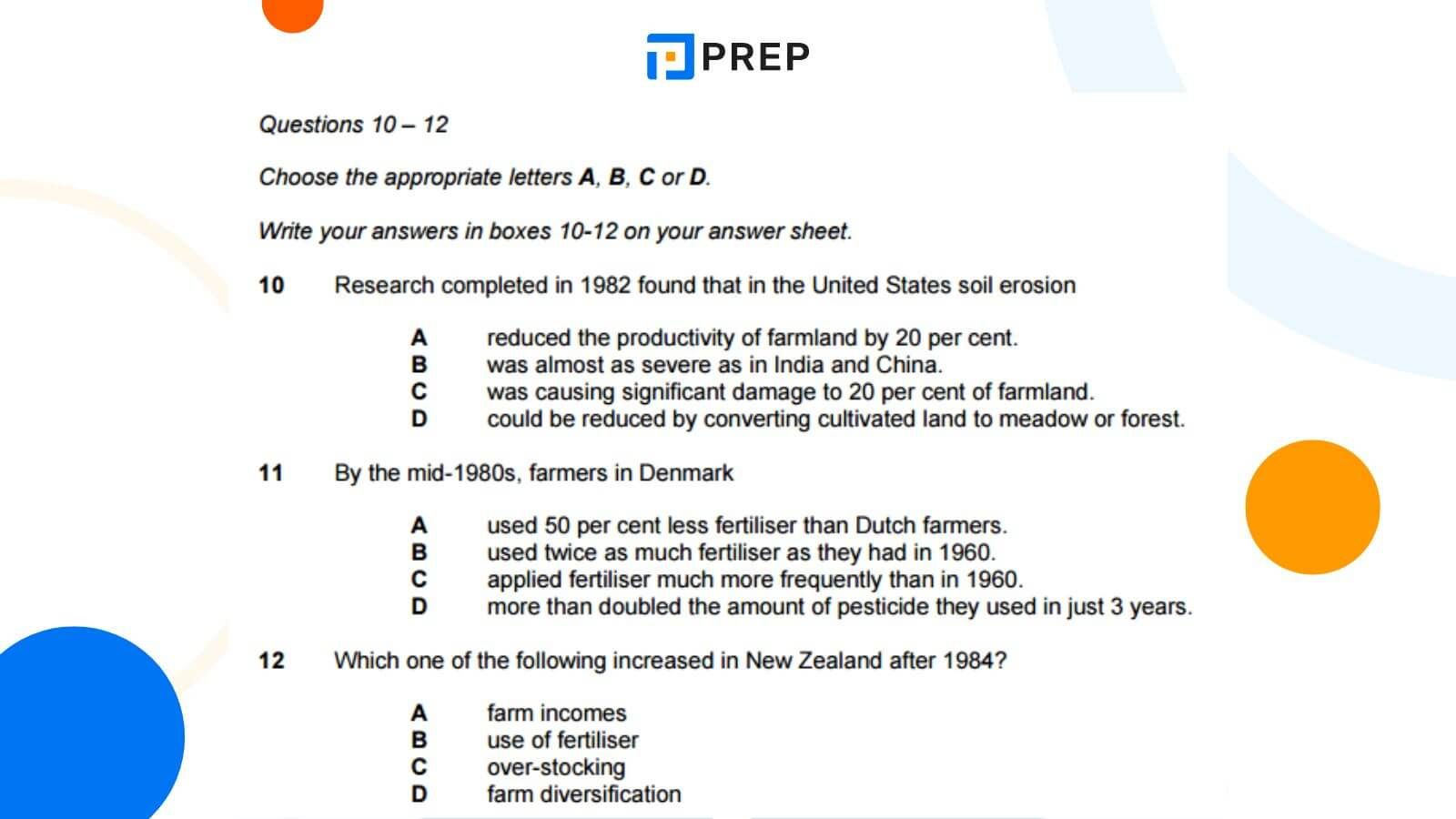
Dạng bài Multiple Choice đánh giá kỹ năng skimming, scanning và hiểu chi tiết thông tin trong văn bản. Thí sinh cần hiểu rõ nội dung, tránh bị đánh lừa bởi các từ đồng nghĩa, trái nghĩa hoặc thông tin gây nhiễu.
Tìm hiểu thêm các dạng bài khác:
II. Các bước làm IELTS Reading Multiple Choice hiệu quả
Cùng PREP khám phá các bước làm IELTS Reading Multiple Choice kèm ví dụ đề thi thật giúp bạn hiểu rõ quy trình hơn nhé!
1. Phân tích câu hỏi
Trước khi nhìn vào các đáp án, bạn nên tập trung vào câu hỏi để xác định:
-
Từ khóa định vị: Tên riêng, con số, thuật ngữ chuyên ngành (để tìm đoạn văn).
-
Yêu cầu cốt lõi: Câu hỏi hỏi về chi tiết (Fact), quan điểm (Opinion) hay ý chính (Main idea)?
➨ Tips: Gạch chân từ khóa trong câu hỏi, ví dụ: “According to the writer…”, “What is the main idea…”, “suggests”, “claims”, “refutes”,....
Ví dụ đề thi thật ngày 10/12/2025 - The art of deception:
|
The art of deception Do tiny changes of facial expression show whether someone is telling lies? Forty years ago, the research psychologist Dr. Paul Ekman was addressing a group of young psychiatrists in training when he was asked a question, the answer to which has kept him busy ever since. Suppose the group wanted to know: a particular patient swears they are telling the truth. They look and sound sincere. So here is the question: is there any way you can be sure they are telling the truth? Ekman did not know the answer then but wanted to find out. As part of his research, he had already filmed a series of 12-minute interviews with psychiatric patients. In a subsequent conversation, one of the patients said that he had lied to him. So, Ekman sat and looked at the film but saw nothing noteworthy. Then he slowed it down and looked again. Then he slowed it even further. And suddenly, there, across just two frames of the film, he saw it: an intense expression of extreme anguish. It lasted less than a 15th of a second, but once he had spotted the first expression, he soon found three more examples in that same interview. He termed his discovery “micro-expression”: very rapid intense demonstrations of emotion that the subject intended to be concealed. Over the course of the next four decades, Ekman successfully demonstrated a proposition first suggested by Charles Darwin: that the ways in which we express disgust, contempt, fear, surprise, happiness, and sadness are universal. The facial muscles triggered by those seven basic emotions are, he has shown, essentially standard, regardless of language and culture, from the US to Japan and Brazil to Papua New Guinea. What is more, expressions of emotion are impossible to suppress and, particularly when we are lying, micro-expressions of powerfully felt emotions will inevitably flit across our face before we get the chance to stop them. Fortunately for liars, most people will fail to spot these fleeting signals of inner torment. Of the 15,000 Ekman has tested, only 50 people, whom he calls “naturals,” have been able to do it. But given a little more training, Ekman says, almost anyone can develop the skill. He should know, since these tests were completed in the mid-1980s and the first publication of his research, he has been called in by the FBI and CIA (among countless more law enforcement and other agencies around the world), not just to solve cases, but to teach them how to use his techniques for themselves. He has held workshops for defense and prosecution lawyers, health professionals, even jealous spouses, all of them wanting to know exactly when someone is not being 100 per cent candid. Most recently, Ekman’s research has featured in a new television series about the exploits of the fictional Dr. Cal Lightman, a scientist who studies involuntary body language to discover not only if you are lying but why you might have been motivated to do so. According to the publicity blurb, Lightman is a human lie detector, even more accurate than a polygraph test. Ekman concedes he was skeptical when the producer first approached him with the idea of turning his life’s work into a TV series, and initially would have stopped the project if he could. In particular, he was fearful that the show would exaggerate the effectiveness of his techniques and create the quite inaccurate impression among audiences that criminals could no longer hope to get away with lying. In the worst-case scenario, he was concerned about unfair convictions, that one day someone not properly trained in his techniques might be sitting on a jury and wrongly find someone guilty of a crime simply on the basis of a television programme. In the end, though, he was won over because the series is unusual in several respects. It is the first time, as far as Ekman is aware, that a commercial TV drama has been based on the work of just one scientist. That scientist is also deeply involved in the project, talking through plot ideas and checking five successive drafts of each script to ensure details are correct. He was also impressed with the producer’s manifestly serious and well-intentioned reasons for making the programme. Now that the first series has been completed, he believes probably 80-90 per cent of the show is based on fact and that’s good enough for what it is. After all, a drama, not a documentary. Ekman, incidentally, professes to have been a terrible liar ever since he was a small boy and observes that the ability to detect a lie and the ability to lie successfully are completely unrelated. He has been asked by people running for high office if he could teach them to become more credible with the public but has always refused to use his skills in that way on ethical grounds. He also insists that there are various kinds of lies. A “true” lie can be identified by having two essential characteristics: there must be a deliberate intent to mislead and there must be no notification that this is what is occurring. This means that an actor or a poker player isn’t a true liar. They are supposed to deceive you, it’s part of the game, and the same is true of flattery. He prefers to focus on the kinds of lies where the liar would be on grave trouble if they were found out and where the target would feel properly aggrieved if they knew. Question: The writer refers to the 12-minute interviews in order to… A. illustrate how frequently patients lie B. describe the origins of Ekman’s theories C. compare Ekman’s research to previous studies D. show how patients’ behaviour is affected by filming |
➨ Phân tích cách làm:
Câu hỏi
The writer refers to the 12-minute interviews in order to… (Người viết nhắc đến các cuộc phỏng vấn dài 12 phút nhằm mục đích...)
Từ khóa trong câu hỏi
refers to
12-minute interviews
in order to
Yêu cầu cốt lõi
Đây là câu hỏi về mục đích/ý chính (Purpose)
Không phải chỉ tìm một chi tiết đúng y nguyên trong bài, mà cần hiểu vai trò của chi tiết đó trong đoạn văn.
➨ Ngay ở bước này, chúng ta biết rằng không nên đọc bài theo kiểu tìm từ trùng khớp máy móc. Ta phải xem đoạn có nhắc đến 12-minute interviews đang phục vụ ý nào lớn hơn.
2. Xác định vị trí thông tin
Bạn có thể sử dụng kỹ năng Skimming & Scanning để khoanh vùng đáp án:
-
Skimming toàn bài đọc để tìm đoạn chứa thông tin cần thiết.
-
Scanning từ khóa liên quan để nhanh chóng định vị chi tiết hỗ trợ trả lời câu hỏi.
➨ Tips: Hãy dựa vào thứ tự câu hỏi để xác định đoạn văn cần đọc, vì câu hỏi trong IELTS Reading thường đi theo thứ tự nội dung bài đọc.
Áp dụng với câu hỏi ví dụ:
Scanning
Bạn sẽ thấy cụm "12-minute interviews" xuất hiện ngay đầu đoạn văn thứ 2: "As part of his research, he had already filmed a series of 12-minute interviews with psychiatric patients..."
➨ Vì câu hỏi hỏi về mục đích tác giả nhắc đến chi tiết này, nên phải đọc cả phần trước và sau để hiểu ngữ cảnh.
Skimming
Đoạn trước nói: Ekman được hỏi liệu có cách nào chắc chắn biết ai đó nói thật hay không, và ông muốn tìm câu trả lời.
Toàn bộ đoạn 2 kể về việc Ekman xem lại các đoạn phim này, phát hiện ra một bệnh nhân nói dối, và từ đó ông tìm ra "micro-expression" (vi biểu cảm).
Những đoạn sau phát triển tiếp thành lý thuyết rộng hơn về biểu cảm và nói dối.
➨ Chi tiết 12-minute interviews xuất hiện trong phần kể lại quá trình Ekman đi đến khám phá ban đầu. Tức là nó nhiều khả năng liên quan đến nguồn gốc hình thành nghiên cứu / lý thuyết của ông.
3. Phân tích sâu nội dung
Khi đã tìm được đoạn chứa đáp án, đừng vội chọn ngay. Ở bước này, bạn cần:
-
So sánh câu hỏi với nội dung đoạn văn.
-
Xác định từ đồng nghĩa, cụm paraphrase trong bài và câu hỏi.
-
Cẩn thận với những “bẫy logic” như thông tin đúng nhưng không liên quan đến câu hỏi.
Áp dụng với câu hỏi ví dụ: Bây giờ, chúng ta đọc kỹ đoạn 2 để tìm "nguyên nhân và kết quả":
Nội dung
Ekman xem phim ➡ Lúc đầu không thấy gì ➡ Cho chạy chậm lại (slowed it down) ➡ Thấy một biểu cảm cực nhanh (1/15 giây) ➡ Gọi đó là "micro-expression".
Kết luận
Việc nhắc đến cuộc phỏng vấn này là để dẫn dắt đến cách mà Ekman đã khám phá ra lý thuyết về vi biểu cảm của mình.
Nhận diện paraphrase
"Discovery/Found out" (Khám phá) tương đương với "Origins" (Nguồn gốc).
"Micro-expression theory" tương đương với "Ekman's theories".
➨ Trong bài, đoạn này đúng là đang mô tả khởi nguồn của phát hiện về micro-expression, sau đó phát triển thành nghiên cứu lớn hơn về biểu cảm và lời nói dối.
4. Đối chiếu đáp án và loại trừ
Sau khi đã hiểu nghĩa đoạn văn, bạn mới bắt đầu soi chiếu với các lựa chọn:
-
Loại bỏ ngay các đáp án trái ngược bài đọc, không được đề cập hoặc đúng nhưng không trả lời cho câu hỏi đó.
-
So sánh phần còn lại và chọn phương án phù hợp nhất với thông tin bạn vừa phân tích ở Bước 3.
-
Với dạng chọn nhiều đáp án, hãy đảm bảo mỗi đáp án bạn chọn đều có bằng chứng rõ ràng trong đoạn văn.
Áp dụng với câu hỏi ví dụ: Bây giờ chúng ta mới quay lại các phương án và loại trừ từng đáp án.
A - illustrate how frequently patients lie (Minh họa tần suất bệnh nhân nói dối).
Loại: Bài chỉ nhắc đến "one of the patients" (một trong số các bệnh nhân), không nói về tần suất (bao nhiêu lần/thường xuyên thế nào).
B. describe the origins of Ekman’s theories (Mô tả nguồn gốc các lý thuyết của Ekman).
Khớp: Việc xem lại các cuộc phỏng vấn 12 phút chính là "điểm khởi đầu" (origins) giúp ông phát hiện ra vi biểu cảm.
=> ĐÁP ÁN ĐÚNG.
C. compare Ekman’s research to previous studies (So sánh nghiên cứu của Ekman với các nghiên cứu trước đó).
Loại: Trong đoạn này không có bất kỳ sự so sánh nào với nghiên cứu trước đó. Bài chỉ kể lại chính nghiên cứu và phát hiện của Ekman.
D. show how patients’ behaviour is affected by filming (Cho thấy hành vi của bệnh nhân bị ảnh hưởng bởi việc quay phim như thế nào).
Loại: Bài không nói việc bị quay phim làm thay đổi hành vi bệnh nhân ra sao. Việc quay phim chỉ là công cụ giúp Ekman xem lại và phát hiện micro-expression, không phải trọng tâm để phân tích ảnh hưởng của camera lên bệnh nhân.
➨ Như vậy, đáp án đúng là B.
Tìm hiểu thêm:
III. Mẹo làm Reading Multiple Choice
Một số mẹo giúp bạn làm dạng Multiple Choice IELTS Reading hiệu quả và tiết kiệm thời gian:
-
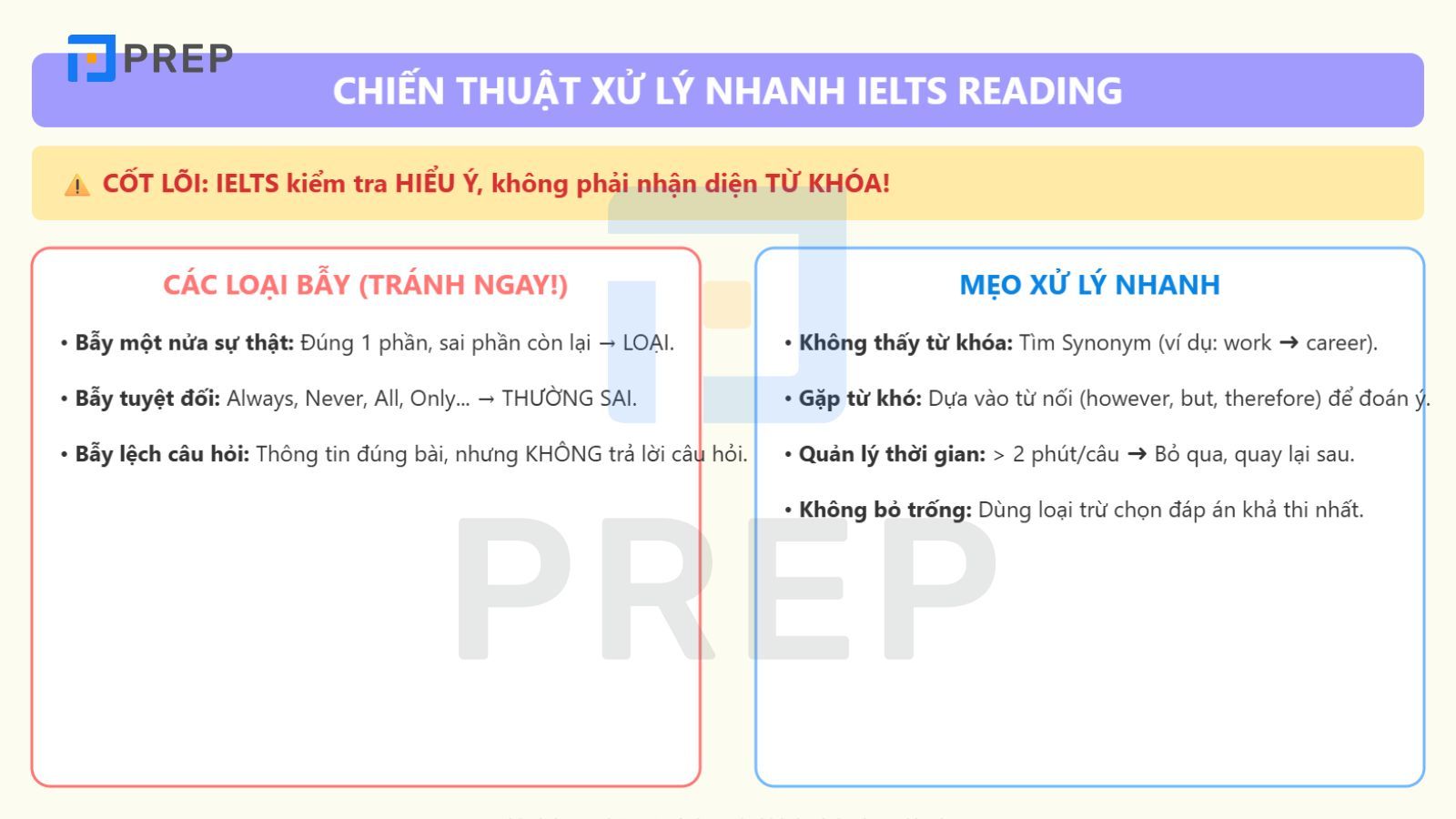
Không chọn đáp án chỉ vì có từ khóa giống trong bài: Nhiều đáp án sai cố tình lặp lại từ khóa trong bài đọc để khiến người làm bài nhầm lẫn. Tuy nhiên, IELTS chủ yếu kiểm tra khả năng hiểu ý nghĩa của câu và đoạn văn, vì vậy bạn cần đọc kỹ ngữ cảnh trước khi đưa ra lựa chọn.
-
Mẹo loại trừ: Khi phân vân giữa 2 đáp án, hãy kiểm tra xem chúng có rơi vào các "bẫy" kinh điển này không:
-
Bẫy Một nửa sự thật: Đáp án có một phần đúng với bài đọc, nhưng phần còn lại bị sai hoặc không liên quan.
-
Bẫy Quá mức: Cẩn thận với các từ như Always, Never, All, Only, Must. Trong bài đọc IELTS, thông tin thường mang tính khách quan và dè dặt hơn.
-
Bẫy Thông tin có thật nhưng không trả lời câu hỏi: Thông tin đó có xuất hiện trong đoạn văn, nhưng nó không giải quyết vấn đề mà câu hỏi đang đặt ra.
-
-
Không tìm thấy từ khóa: Quét các từ đồng nghĩa (Synonyms). Ví dụ: Thay vì tìm "Work", hãy tìm "Occupation", "Employment" hay "Career".
-
Gặp từ vựng quá khó: Đừng dừng lại. Hãy dựa vào các từ nối (But, However, Therefore) để đoán thái độ tích cực hay tiêu cực của câu.
-
Giới hạn thời gian cho mỗi câu: Nếu sau 1.5 - 2 phút vẫn chưa chốt được đáp án, hãy đánh dấu lại và chuyển sang câu tiếp theo để tránh "sa lầy".
-
Không bỏ trống đáp án: Kể cả khi không tìm thấy câu trả lời, hãy dùng phương pháp loại trừ để chọn ra phương án khả quan nhất. Bạn vẫn có 25% cơ hội đúng thay vì 0%.
IV. Thực hành bài tập Multiple Choice
Cùng PREP luyện tập dạng bài Multiple Choice Questions qua đề thi thật ngày 02/11/2025 nhé!
[prep_collapse_expand open_text="Xem đề bài đọc " close_text="Ẩn đề bài "]
The Rise and Fall of the British Textile Industry
Textile production in Britain can be said to have its roots as an industry at the beginning of the 18th century, when Thomas Crotchet and George Sorocold established what is thought to be the first factory built in Britain. It was a textile mill with a waterwheel as its source of power, the latest machinery, and even accommodation for the workers. As well as possibly being the first sweatshop in the modern sense, it was the beginning of the end for traditional textile production.
For hundreds of years the spinning and weaving of cloth had been done manually by men, women and children in their own homes. The yarn would be combed and spun using a spindle, then woven on a hand loom, and what they produced would be mainly for local consumption. Technology far more sophisticated than the spindle and hand-loom would change all that.
The demand for cotton textiles had been growing since the Middle Ages, fostered by the importation of high quality cotton fabrics from the Middle East and India. So how were local producers to fight off the competition? The imported fabrics were of course expensive, so textile makers (not just in Britain but throughout Europe) produced mixed fabrics and cotton substitutes. They also had foreign textiles banned. But the key to the increased productivity needed to meet the demand, was machine production. It would be faster, cheaper and the finished products would be consistent in quality. Not least of the advantages was that it would allow manufacturers to market their goods on a large, if not yet global, scale.
The story of the growth of the British textile industry from about 1733 and for the next two hundred years is one of constant technological innovation and expansion. In 1733 John Kay invented the fly-shuttle, which made the hand-loom more efficient, and in 1764 James Hargreaves came up with the spinning jenny, which among other things had the effect of raising productivity eightfold. The next great innovator was Richard Arkwright, who in 1768 employed John Kay (of the fly-shuttle) to help him build more efficient machinery. He was a man with a vision – to mechanise textile production – and by 1782 he had a network of mills across Britain. As the water-powered machinery, though not yet fully mechanised, became more complex, Kay began to use steam engines for power. The first power-loom, however, which was invented in 1785 by Dr Edmund Cartwright, really did mechanise the weaving stage of textile manufacture.
The pace of growth quickened with the expansion of Britain’s influence in the world and the acquisition of colonies from which cheap raw materials could be imported. For example, in a single decade, from 1781 to 1791, imports of cotton into Britain quadrupled, going on to reach 100 million pounds in weight in 1815 and 263 million in 1830. The increase in exports is equally impressive; in 1751 £46,000 worth of cloth was exported and by the end of the century this had risen to £5.4 million. By the end of the 19th century the figure had soared to close on £50 million. Britain was now supplying cheaper and better quality clothing to a global market. Yet during the course of the 20th century Britain lost its position as a major textile manufacturer.
So what happened? There are a number of views on this question, not all of them conflicting, and where there is disagreement it is usually about when the decline began. Whether it began before the First World War (1914-18), or during the inter-war years (1919-1939), or after 1945, most economists would give roughly the same reasons. To start with, there was competition from abroad, especially from developing countries in the Far East, notably Japan. It was thought by manufacturers that the best way to combat this increased competition was to modernise. However, management and the labour unions were unable to agree on how to handle this situation.
Modernisation would mean people losing their jobs and possibly a change in labour practices. Such changes as were made served only to slow down the industry’s decline rather than help regain its predominant position. Economically less developed countries, on the other hand, had the advantage of being able to provide low wage competition, without the problem of powerful labour unions.
There are, of course, many other reasons for the textile industry’s decline, two of which became particularly noticeable in the late twentieth century and are related. The first is outsourcing, when manufacturers establish factories in countries where there is cheap labour. This obviously leads to less demand for locally-produced goods. Related to this, the textile and clothing industries have acquired a bad reputation for exploiting workers, often illegal immigrants, in sweatshops where they are forced to work long hours and are paid far less than the minimum wage.
We seem to be back with Crotchet and Sorocold and their first live-in factory. The globalising trend of out-sourcing, however, was a rational response to the growing competition from overseas, which, it goes without saying, does not excuse the exploitation of workers. The British industry itself, while no longer holding a key place in the global textile market has adapted itself and now concentrates more on the world of fashion and design, where it seems to be doing quite well.
Questions 7-9
Choose the correct letter, A, B, C or D.
7. Which of the following innovations increased productivity by 800%?
A. the power-loom
B. the steam engine
C. the spinning jenny
D. the fly-shuttle
8. During which period was the British textile industry at its peak?
A. 1733-1785
B. 1781-1791
C. 1791-1830
D. 1830-1900
9. Which of the following was a major cause of the British textile industry’s decline?
A. the expansion of foreign textile industries
B. the loss of overseas markets
C. there being no demand for products
D. labour becoming too expensive
[/prep_collapse_expand]
[prep_collapse_expand open_text="Xem đáp án " close_text="Ẩn đáp án "]
|
Câu |
Đáp án |
Giải thích |
|
Q7 |
C. the spinning jenny |
Trong đoạn 4 có nêu: "...James Hargreaves came up with the spinning jenny, which... raising productivity eightfold." (Phát minh spinning jenny giúp tăng năng suất gấp 8 lần, tương đương 800%). |
|
Q8 |
D. 1830-1900 |
Cuối đoạn 5 cho biết đến cuối thế kỷ 19 (năm 1900), con số xuất khẩu tăng vọt (soared) lên gần 50 triệu bảng và Anh cung cấp hàng cho thị trường toàn cầu. Đây là thời điểm hưng thịnh nhất trước khi bắt đầu suy thoái vào thế kỷ 20. |
|
Q9 |
A. the expansion of foreign textile industries |
Đoạn 6 nêu lý do đầu tiên của sự suy thoái là: "competition from abroad (cạnh tranh từ nước ngoài), especially from developing countries... notably Japan." Điều này khớp với việc các ngành công nghiệp dệt may nước ngoài mở rộng và phát triển. |
[/prep_collapse_expand]
V. Luyện tập dạng bài IELTS Reading Multiple Choice tại PREP
Nếu muốn luyện tập nhiều hơn dạng bài IELTS Reading Multiple Choice, bạn có thể tham khảo Phòng luyện thi IELTS Practice Test tại PREP. Đây là không gian luyện đề trực tuyến giúp người học thực hành bài thi IELTS trong môi trường mô phỏng sát với kỳ thi thật. Hệ thống cung cấp ngân hàng đề thi phong phú cùng công nghệ AI hỗ trợ chấm chữa và phân tích bài làm, giúp người học rèn luyện toàn diện cả 4 kỹ năng Listening, Reading, Speaking và Writing.
Bên cạnh đó, nền tảng còn tích hợp Prep AI, giúp phân tích bài làm, chấm điểm và đưa ra nhận xét chi tiết gần giống với tiêu chí chấm thi thật. Hệ thống này tạo ra môi trường luyện tập liên tục, giúp người học phát hiện lỗi sai, cải thiện kỹ năng và theo dõi sự tiến bộ của mình một cách rõ ràng trong quá trình ôn luyện IELTS.

Trên đây, PREP đã chia sẻ cho bạn tất tần tật về cách làm dạng bài Multiple Choice trong IELTS Reading theo từng bước chi tiết kèm ví dụ minh họa từ đề thi thật, mẹo làm bài cũng như bài tập thực hành giúp bạn luyện tập. Hy vọng bài viết này sẽ giúp bạn ẵm trọn điểm số dạng đề này nhé!
Tại PREP - Nền tảng Học & Luyện thi thông minh cùng AI, bạn sẽ được học kỹ năng cốt lõi để xử lý tất cả dạng bài Reading & Listening. Đào sâu, làm chủ mọi chiến thuật từ cơ bản đến nâng cao để xử lý từng dạng câu hỏi và tăng band điểm. Đặc biệt, khi đăng ký học theo lộ trình, bạn sẽ được tích hợp Phòng luyện thi IELTS ảo Prep AI có trọn bộ đề Reading & Listening hot nhất, giải thích đáp án cặn kẽ.
Một lộ trình học IELTS Reading & Listening tinh gọn, lại trọn gói sẽ cứu bạn khỏi cái bẫy “học nản”, “học khó”, “học không hiệu quả”. Vậy còn lý do gì để không click TẠI ĐÂY để ghi danh nhanh chóng hoặc gọi HOTLINE 0931428899 và nhận tư vấn về lộ trình học hiệu quả.
Tải app PREP để học IELTS ngay tại nhà, trải nghiệm chương trình luyện thi online chất lượng và đạt điểm cao như mong muốn.

Chào bạn! Mình là Hiền Hoàng, hiện đang đảm nhận vai trò quản trị nội dung sản phẩm tại Blog của website prepedu.com.
Với hơn 5 năm tự học các ngoại ngữ như tiếng Anh, tiếng Trung và ôn luyện một số kỳ thi IELTS, TOEIC, HSK, mình đã tự đúc rút được nhiều kinh nghiệm để hỗ trợ hàng nghìn người đang gặp khó khăn trong việc học ngoại ngữ. Hy vọng rằng những chia sẻ phía trên sẽ giúp ích cho bạn trong quá trình tự ôn luyện thi hiệu quả tại nhà!
Bình luận
Nội dung premium
Xem tất cả




Lộ trình cá nhân hoá










Có thể bạn quan tâm
Kết nối với Prep





MSDN: 0109817671.
Địa chỉ liên hệ: Tòa nhà Vinaconex, 34 Láng Hạ, phường Láng, TP Hà Nội.
Trung tâm CSKH tại HN: Số 39, ngõ 12 Trần Kim Xuyến, phường Yên Hoà, Cầu Giấy
Trung tâm CSKH tại HCM: 145A-147Bis Trần Quang Khải, phường Tân Định, TP HCM
Trụ sở Công ty: Số nhà 20, ngách 234/35 đường Hoàng Quốc Việt, phường Nghĩa Đô, TP Hà Nội.
Phòng luyện ảo - Trải nghiệm thực tế - Công nghệ hàng đầu.
Hotline: 0907048899
Trụ sở Công ty: Số nhà 20, ngách 234/35 đường Hoàng Quốc Việt, phường Nghĩa Đô, TP Hà Nội.
Giấy chứng nhận hoạt động đào tạo, bồi dưỡng số 1309/QĐ-SGDĐT ngày 31 tháng 07 năm 2023 do Sở Giáo dục và Đào tạo Hà Nội cấp.