Matching Headings: Định nghĩa, cách làm, mẹo hay và bài tập thực hành
Matching Headings là một trong những dạng câu hỏi “gây lú” nhất với nhiều thí sinh vì yêu cầu kỹ năng nắm bắt ý chính đoạn văn, thay vì chỉ tìm thông tin chi tiết. Trong bài viết dưới đây, PREP sẽ giúp bạn hiểu rõ dạng bài Matching Headings là gì, hướng dẫn từng bước làm bài hiệu quả, mẹo tránh bẫy và cung cấp bài tập thực hành có đáp án để luyện tập tại nhà.

I. Matching Headings là gì?
Matching Headings là dạng bài yêu cầu thí sinh nối tiêu đề (heading) phù hợp với đoạn văn (paragraph) trong bài đọc IELTS. Trong quá trình làm bài và luyện thi IELTS, thí sinh cần đọc và hiểu nội dung từng đoạn để xác định heading phù hợp.
Format bài thi Matching Headings như sau:
-
Thường xuất hiện ở Section 1 hoặc Section 2 trong bài thi Academic và General Training
-
Được cho sẵn danh sách các headings (tiêu đề) được đánh số I, II, III…
-
Yêu cầu nối headings với đoạn văn A, B, C...
-
Có nhiều headings hơn số đoạn văn → có headings dư thừa
-
Có thể có 2 tiêu đề trông gần như y hệt, chỉ khác nhau ở một từ hạn định (như all, some, future, past).
-
Mục tiêu của dạng này: Kiểm tra khả năng nắm bắt ý chính của đoạn văn thay vì chỉ tìm thông tin chi tiết.
Tìm hiểu thêm về các dạng bài IELTS Reading:
II. Chiến lược làm Matching Heading IELTS Reading
1. Chiến lược 1: Đọc tiêu đề trước (Headings First)
Chiến lược Đọc tiêu đề trước (Headings First) phù hợp với những bạn có khả năng đọc quét (scanning) tốt và muốn có một "bản đồ nội dung" trong đầu trước khi bước vào bài đọc.
1.1. Phân tích danh sách Headings
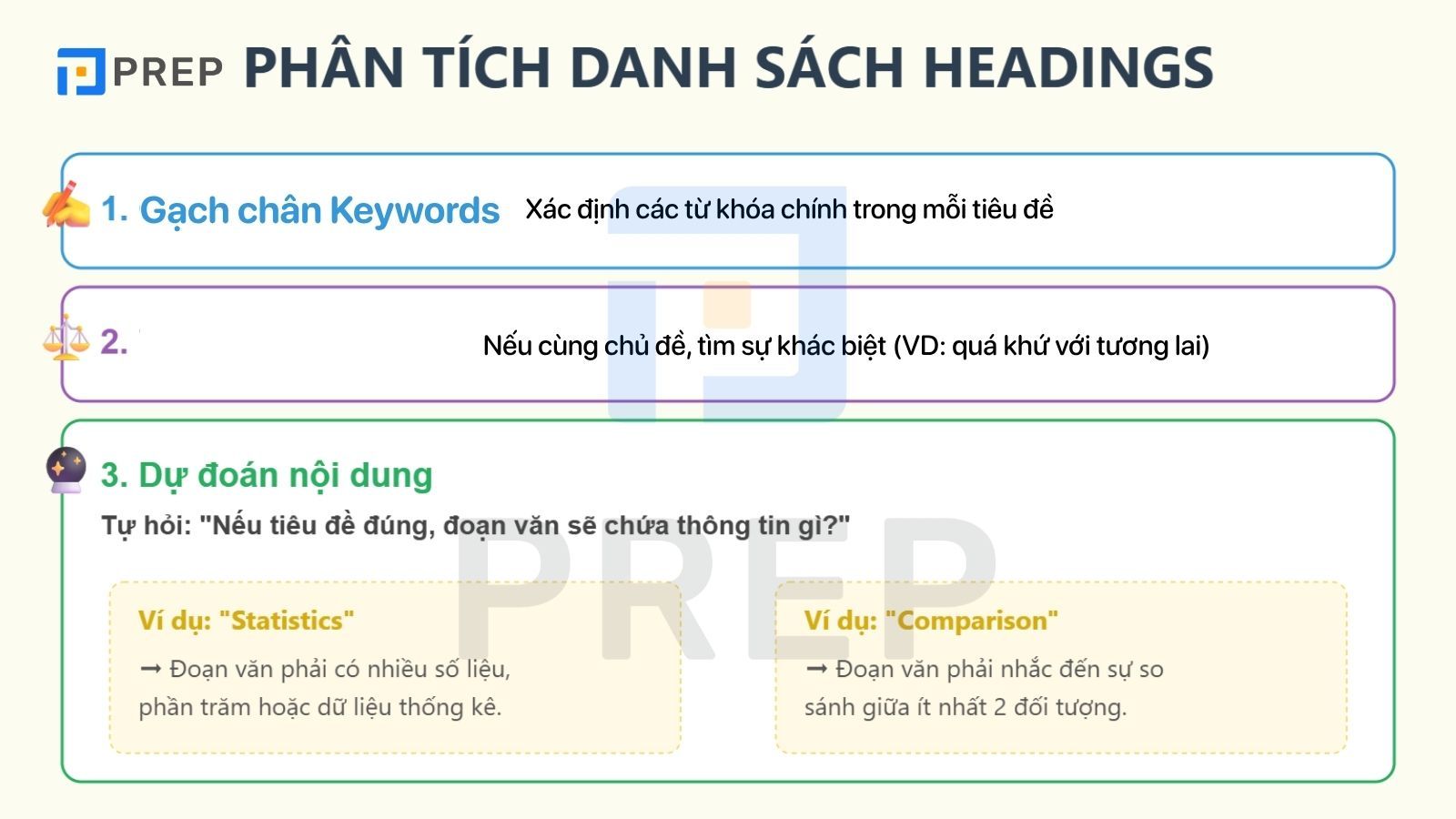
Đừng chỉ đọc lướt qua các Headings, bạn cần "mổ xẻ" các tiêu đề để thấy sự khác biệt:
-
Gạch chân Keywords: Xác định danh sách các từ khóa chính trong mỗi tiêu đề.
-
Tìm sự tương đồng và khác biệt: Nếu có hai tiêu đề cùng nói về "Environmental impact", hãy tìm điểm khác biệt (ví dụ: một cái nói về Past, một cái nói về Future).
-
Dự đoán nội dung: Tự hỏi bản thân: "Nếu tiêu đề này đúng, đoạn văn sẽ chứa những thông tin gì?".
-
Ví dụ: Tiêu đề có chữ "Statistics" ➞ Đoạn văn phải có nhiều con số, phần trăm.
-
Ví dụ: Tiêu đề có chữ "Comparison" ➞ Đoạn văn phải nhắc đến ít nhất 2 đối tượng.
-
Ví dụ đề thi thật ngày 10/12/2025:
[prep_collapse_expand open_text="Xem đoạn văn" close_text="Ẩn đoạn văn"]
Seaweeds of New Zealand
A. Seaweed is a particularly wholesome food, which absorbs and concentrates traces of a wide variety of minerals necessary to the body’s health. Many elements may occur in seaweed – aluminium, barium, calcium, chlorine, copper, iodine and iron, to name but a few – traces normally produced by erosion and carried to the seaweed beds by river and sea currents. Seaweeds are also rich in vitamins; indeed, Inuits obtain a high proportion of their bodily requirements of vitamin C from the seaweeds they eat. The health benefits of seaweed have long been recognised. For instance, there is a remarkably low incidence of goitre among the Japanese, and also among New Zealand’s indigenous Maori people, who have always eaten seaweeds, and this may well be attributed to the high iodine content of this food. Research into historical Maori eating customs shows that jellies were made using seaweeds, nuts, fuchsia and tutu berries, cape gooseberries, and many other fruits both native to New Zealand and sown there from seeds brought by settlers and explorers. As with any plant life, some seaweeds are more palatable than others, but in a survival situation, most seaweeds could be chewed to provide a certain sustenance.
B. New Zealand lays claim to approximately 700 species of seaweed, some of which have no representation outside that country. Of several species grown worldwide, New Zealand also has a particularly large share. For example, it is estimated that New Zealand has some 30 species of Gigartina, a close relative of carrageen or Irish moss. These are often referred to as the New Zealand carrageens. The substance called agar which can be extracted from these species gives them great commercial application in the production of seameal, from which seameal custard (a food product) is made, and in the canning, paint and leather industries. Agar is also used in the manufacture of cough mixtures, cosmetics, confectionery and toothpastes. In fact, during World War II, New Zealand Gigartina were sent to Australia to be used in toothpaste.
C. New Zealand has many of the commercially profitable red seaweeds, several species of which are a source of agar (Pterocladia, Gelidium, Chondrus, Gigartina). Despite this, these seaweeds were not much utilised until several decades ago. Although distribution of the Gigartina is confined to certain areas according to species, it is only on the east coast of the North Island that its occurrence is rare. And even then, the east coast, and the area around Hokianga, have a considerable supply of the two species of Pterocladia from which agar is also made. New Zealand used to import the Northern Hemisphere Irish moss (Chondrus crispus) from England and ready-made agar from Japan.
D. Seaweeds are divided into three classes determined by colour – red, brown and green – and each tends to live in a specific position. However, except for the unmistakable sea lettuce (Ulva), few are totally one colour; and especially when dry, some species can change colour significantly – a brown one may turn quite black, or a red one appear black, brown, pink or purple. Identification is nevertheless facilitated by the fact that the factors which determine where a seaweed will grow are quite precise, and they tend therefore to occur in very well-defined zones. Although there are exceptions, the green seaweeds are mainly shallow-water algae; the browns belong to the medium depths; and the reds are plants of the deeper water, furthest from the shore. Those shallow-water species able to resist long periods of exposure to sun and air are usually found on the upper shore, while those less able to withstand such exposure occur nearer to, or below, the low-water mark. Radiation from the sun, the temperature level, and the length of time immersed also play a part in the zoning of seaweeds. Flat rock surfaces near midlevel tides are the most usual habitat of sea-bombs, Venus’ necklace, and most brown seaweeds. This is also the home of the purple laver or Maori karengo, which looks rather like a reddish-purple lettuce. Deep-water rocks on open coasts, exposed only at very low tide, are usually the site of bull-kelp, strapweeds and similar tough specimens. Kelp, or bladder kelp, has stems that rise to the surface from massive bases or ‘holdfasts’, the leafy branches and long ribbons of leaves surging with the swells beyond the line of shallow coastal breakers or covering vast areas of calmer coastal water.
E. Propagation of seaweeds occurs by seed-like spores, or by fertilisation of egg cells. None have roots in the usual sense; few have leaves; and none have flowers, fruits or seeds. The plants absorb their nourishment through their leafy fronds when they are surrounded by water; the holdfast of seaweeds is purely an attaching organ, not an absorbing one.
F. Some of the large seaweeds stay on the surface of the water by means of air-filled floats; others, such as bull-kelp, have large cells filled with air. Some which spend a good part of their time exposed to the air, often reduce dehydration either by having swollen stems that contain water, or they may (like Venus’ necklace) have swollen nodules, or they may have a distinctive shape like a sea-bomb. Others, like the sea cactus, are filled with a slimy fluid or have a coating of mucilage on the surface. In some of the larger kelps, this coating is not only to keep the plant moist, but also to protect it from the violent action of waves.
[/prep_collapse_expand]
Reading Passage 1 has six paragraphs, A-F.
Choose the correct heading for each paragraph from the list of headings below. Write the correct number, i-ix, in boxes 1-6 on your answer sheet.
-
Paragraph A
-
Paragraph B
-
Paragraph C
-
Paragraph D
-
Paragraph E
-
Paragraph F
List of Headings
i. The appearance and location of different seaweeds
ii. The nutritional value of seaweeds
iii. How seaweeds reproduce and grow
iv. How to make agar from seaweeds
v. The under-use of native seaweeds
vi. Seaweed species at risk of extinction
vii. Recipes for how to cook seaweeds
viii. The range of seaweed products
ix. Why seaweeds don’t sink or dry out
➨ Phân tích danh sách Headings
i. The appearance and location...: Ngoại hình (màu sắc, hình dáng) và vị trí (nông/sâu).
ii. The nutritional value...: Giá trị dinh dưỡng (vitamin, khoáng chất, sức khỏe).
iii. How seaweeds reproduce and grow: Cách sinh sản (bào tử, trứng) và cách lớn lên (hấp thụ dinh dưỡng).
iv. How to make agar...: Cách làm ra agar (quy trình sản xuất).
v. The under-use of native seaweeds: Sự chưa được tận dụng/sử dụng ít của tảo bản địa.
vi. Seaweed species at risk of extinction: Nguy cơ tuyệt chủng (không thấy nhắc đến trong bài).
vii. Recipes for how to cook...: Công thức nấu ăn (hướng dẫn cụ thể).
viii. The range of seaweed products: Các loại sản phẩm làm từ tảo (kem đánh răng, sơn, thực phẩm...).
ix. Why seaweeds don’t sink or dry out: Tại sao không chìm (phao khí) hoặc không bị khô (chất nhầy).
1.2. Đọc đoạn văn đầu tiên (thường là đoạn A hoặc B)
Ở bước này, bạn sẽ tập trung vào đoạn A hoặc B của đề bài:
-
Tập trung vào "Vùng nhận diện": Đọc kỹ câu đầu tiên và câu cuối cùng của đoạn. Đây là nơi chứa 80% ý chính.
-
Skimming thân bài: Đọc lướt phần giữa để kiểm tra xem các ví dụ/chi tiết có ủng hộ cho câu đầu/cuối không.
-
Lưu ý các từ chuyển hướng (Signposting words): Nếu thấy However, On the other hand, But, ý chính thường nằm ngay sau đó.
1.3. Đối chiếu và Loại trừ
Sau khi đã đọc xong đoạn văn đầu tiên, bạn sẽ:
-
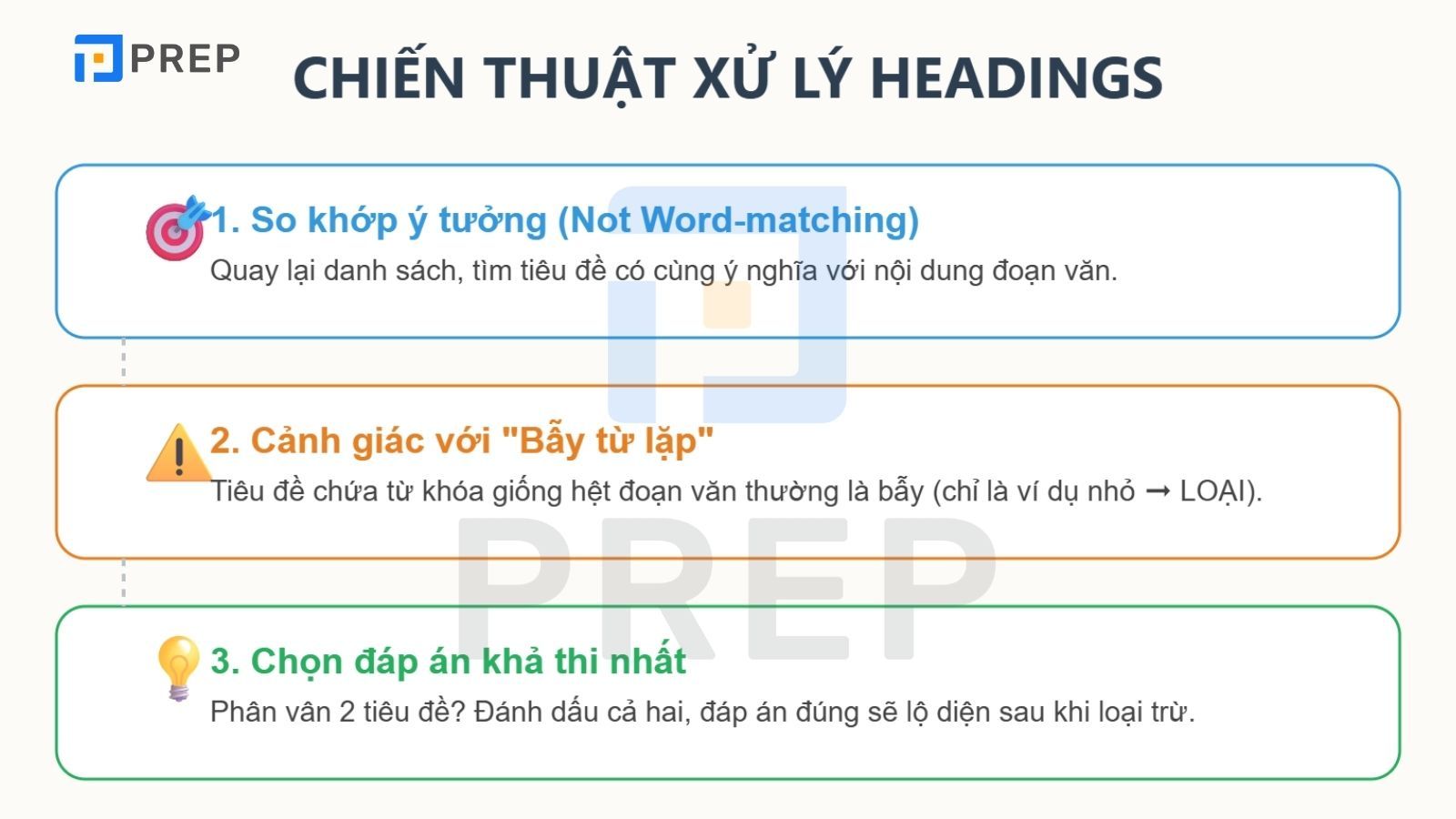
So khớp ý tưởng (Not Word-matching): Quay lại danh sách Headings. Tìm tiêu đề nào có ý nghĩa khớp với nội dung bạn vừa đọc.
-
Cảnh giác với "Bẫy từ lặp": Nếu một tiêu đề chứa chính xác từ khóa trong đoạn văn nhưng nội dung chỉ là một ví dụ nhỏ ➞ Loại.
-
Chọn đáp án khả thi nhất: Nếu phân vân giữa 2 tiêu đề, hãy đánh dấu cả hai (ví dụ: ii hoặc v) rồi chuyển sang đoạn tiếp theo. Khi làm xong các đoạn khác, đáp án đúng sẽ lộ diện qua phương pháp loại trừ.
Ví dụ đề thi thật:
|
Đoạn |
Phân tích nội dung chính (Topic Sentences) |
|
A |
Câu đầu: "Seaweed is a particularly wholesome food, which absorbs... minerals necessary to the body’s health." Nhắc đến vitamin C, iodine, giảm bệnh bướu cổ. |
|
B |
Liệt kê các loài tại New Zealand và ứng dụng: "commercial application in the production of seameal... canning, paint, leather, cough mixtures, cosmetics, toothpastes." |
|
C |
Nhấn mạnh: "Despite this, these seaweeds were not much utilised until several decades ago." Trước đây phải nhập khẩu từ Anh, Nhật dù có sẵn. |
|
D |
Nói về màu sắc (red, brown, green) và vùng sống: "green seaweeds are mainly shallow-water; browns... medium depths; reds... deeper water." |
|
E |
Câu đầu: "Propagation of seaweeds occurs by seed-like spores, or by fertilisation..." Giải thích tảo không có rễ và hấp thụ dinh dưỡng qua lá. |
|
F |
Giải thích cơ chế sinh tồn: "stay on the surface... by means of air-filled floats" (không chìm) và "reduce dehydration... coating of mucilage" (không khô). |
1.4. Gạch bỏ tiêu đề đã sử dụng
Sau khi chắc chắn, hãy gạch bỏ tiêu đề đó khỏi danh sách để không bị rối giúp bạn tập trung vào những lựa chọn còn lại.
Lưu ý: Nếu đề bài đã làm mẫu cho bạn một đoạn (ví dụ: Paragraph A - v), hãy gạch bỏ tiêu đề đó ngay lập tức trước khi bắt đầu.
Áp dụng vào đề thi:
|
Đoạn văn |
Đáp án chọn |
|
Paragraph A |
ii |
|
Paragraph B |
viii |
|
Paragraph C |
v |
|
Paragraph D |
i |
|
Paragraph E |
iii |
|
Paragraph F |
ix |
2. Chiến lược 2: Đọc đoạn văn trước (Text First)
2.1. Đọc nhanh đoạn văn (Skimming)
Thay vì nhìn vào danh sách tiêu đề, bạn tập trung vào đoạn văn đầu tiên (thường là đoạn A).
-
Đọc kỹ câu đầu và câu cuối: Đây là nơi chứa ý tưởng của đoạn.
-
Quét từ khóa ở thân đoạn: Tìm các danh từ riêng, con số hoặc các từ lặp lại nhiều lần.
-
Tìm từ nối (Signposting words): Đặc biệt chú ý những từ làm thay đổi hướng nội dung như However, Yet, In contrast, But. Ý chính thường sẽ nằm ngay sau những từ này.
2.2. Tự tóm tắt ý chính
Sau khi đọc xong đoạn văn, bạn hãy dừng lại khoảng 3-5 giây và tự trả lời câu hỏi: "Đoạn này đang nói về cái gì?"
Mẹo: Hãy tóm tắt bằng 1 cụm danh từ ngắn gọn trong đầu (Ví dụ: "Lợi ích sức khỏe của tảo", "Cách tảo sinh sản"). Việc tự tóm tắt giúp bạn không bị lệ thuộc vào cách dùng từ của đề bài, giúp bạn nhận diện Paraphrasing tốt hơn ở bước sau.
Ví dụ đề thi thật ngày 05/12/2025:
[prep_collapse_expand open_text="Xem đoạn văn " close_text="Ẩn đoạn văn "]
Satellite Technology
The space-age began with the launch of the Russian artificial satellite Sputnik in 1957 and developed further with the race to the moon between the United States and Russia. This rivalry was characterized by advanced technology and huge budgets. In this process, there were spectacular successes, some failures, but also many spin-offs.
Europe, Japan, China, and India quickly joined this space club of the superpowers. With the advent of relatively low-cost high-performance mini-satellites and launchers, the acquisition of indigenous space capabilities by smaller nations in Asia has become possible. How, in what manner, and for what purpose will these capabilities be realized?
A. Rocket technology has progressed considerably since the days of ‘fire arrows’ (bamboo poles filled with gunpowder) first used in China around 500 BC, and, during the Sung Dynasty, to repel Mongol invaders at the battle of Kaifeng (Kai-fung fu) in AD 1232. These ancient rockets stand in stark contrast to the present-day Chinese rocket launch vehicles, called the ‘Long March’, intended to place a Chinese astronaut in space by 2005 and, perhaps, to achieve a Chinese moon-landing by the end of the decade.
B. In the last decade, there has been a dramatic growth in space activities in Asia both in the utilization of space-based services and the production of satellites and launchers. This rapid expansion has led many commentators and analysts to predict that Asia will become a world space power. The space-age has had dramatic effects worldwide with direct developments in space technology influencing telecommunications, meteorological forecasting, earth resource and environmental monitoring, and disaster mitigation (flood, forest fires, and oil spills). Asian nations have been particularly eager to embrace these developments.
C. New and innovative uses for satellites are constantly being explored with potential revolutionary effects, such as in the field of health and telemedicine, distance education, crime prevention (piracy on the high seas), food and agricultural planning and production (rice crop monitoring). Space in Asia is very much influenced by the competitive commercial space sector, the emergence of low-cost mini-satellites, and the globalization of industrial and financial markets. It is not evident how Asian space will develop in the coming decades in the face of these trends. It is, however, important to understand and assess the factors and forces that shape Asian space activities and development in determining its possible consequences for the region.
D. At present, three Asian nations, Japan, China, and India, have comprehensive end-to-end space capabilities and possess a complete space infrastructure: space technology, satellite manufacturing, rockets, and spaceports. Already self-sufficient in terms of satellite design and manufacturing, South Korea is currently attempting to join their ranks with its plans to develop a launch site and spaceport. Additionally, nations in Southeast Asia as well as those bordering the Indian subcontinent (Nepal, Pakistan, and Bangladesh), have, or are starting to develop indigenous space programmes. The Association of Southeast Asian Nations (ASEAN) has, in varying degrees, embraced space applications using foreign technology and over the past five years or so its space activities have been expanding. Southeast Asia is predicted to become the largest and fastest-growing market for commercial space products and applications, driven by telecommunications (mobile and fixed services), the Internet, and remote sensing applications. In the development of this technology, many non-technical factors, such as economics, politics, culture, and history, interact and play important roles, which in turn affect Asian technology.
E. Asia and Southeast Asia, in particular, suffers from a long list of recurrent large-scale environmental problems including storms and flooding, forest fires and deforestation, and crop failures. Thus the space application that has attracted the most attention in this region is remote sensing. Remote sensing satellites equipped with instruments to take photographs of the ground at different wavelengths provide essential information for natural resource accounting, environmental management, disaster prevention and monitoring, land-use mapping, and sustainable development planning. Progress in these applications has been rapid and impressive. ASEAN members, unlike Japan, China, and India, do not have their own remote sensing satellites, however, most of its member nations have facilities to receive, process, and interpret such data from American and European satellites. In particular, Thailand, Malaysia, and Singapore have world-class remote sensing processing facilities and research programmes. ASEAN has plans to develop (and launch) its own satellites and in particular remote sensing satellites. Japan is regarded as the dominant space power in Asia and its record of successes and quality of technologies are equal to those of the West. In view of the technological challenges and high risks involved in space activities, a very long, and expensive, the learning curve has been followed to obtain those successes achieved. Japan’s satellite manufacturing was based on the old and traditional defense and military procurement methodologies as practiced in the US and Europe.
F. In recent years there have been fundamental changes in the way satellites are designed and built to drastically reduce costs. The emergence of ‘small satellites’ and their quick adoption by Asian countries as a way to develop low-cost satellite technology and rapidly establish a space capability has given these countries the possibility to shorten their learning curve by a decade or more. The global increase of technology transfer mechanisms and use of readily available commercial technology to replace costly space and military-standard components may very well result in a highly competitive Asian satellite manufacturing industry.
G. The laws of physics are the same in Tokyo as in Toulouse, and the principles of electronics and mechanics know no political or cultural boundaries. However, no such immutability applies to engineer practices and management; they are very much influenced by education, culture, and history. These factors, in turn, have an effect on costs, lead times, product designs and, eventually, international sales. Many Asian nations are sending their engineers to be trained in the West. Highly experienced, they return to work in the growing Asian space industry. Will this acquisition of technical expertise, coupled perhaps with the world-renowned Japanese manufacturing and management techniques, be applied to build world-class satellites and reduce costs?
[/prep_collapse_expand]
Questions 1-5
The reading passage has seven paragraphs, A-G. Choose the correct heading for paragraphs A-G from the list below. Write the correct number, i-ix, in boxes 1-5 on your answer sheet.
-
i. Western countries provide essential assistance
-
ii. Unbalanced development for an essential space technology
-
iii. Innovative application compelled by competition
-
iv. An ancient invention which is related to the future
-
v. Military purpose of the satellite
-
vi. Rockets for application in ancient China
-
vii. Space development in Asia in the past
-
viii. Non-technology factors counts
-
ix. competitive edge gained by more economically feasible satellite
Paragraph D Example: Current space technology development in Asia
1. Paragraph A………………..
2. Paragraph B………………..
3. Paragraph C………………..
4. Paragraph E………………..
5. Paragraph F………………..
➨ Phân tích đoạn văn & Tóm tắt ý chính:
|
Đoạn |
Phân tích |
Tóm tắt ý chính |
|
A |
So sánh tên lửa cổ đại (fire arrows) với tên lửa hiện đại (Long March) của Trung Quốc nhằm mục đích bay tới mặt trăng. |
Sự kết nối giữa phát minh cổ xưa và mục tiêu tương lai. |
|
B |
Nói về sự bùng nổ hoạt động vũ trụ ở châu Á trong thập kỷ qua (last decade) và những ảnh hưởng toàn cầu của nó. |
Lịch sử/Quá trình phát triển vũ trụ ở Châu Á những năm qua. |
|
C |
Liệt kê các ứng dụng mới (telemedicine, education) và nhấn mạnh sự ảnh hưởng của tính cạnh tranh thương mại (competitive commercial sector). |
Các ứng dụng sáng tạo do áp lực cạnh tranh. |
|
E |
Tập trung vào Remote sensing (cảm biến từ xa) để giải quyết thiên tai, nhưng nhấn mạnh sự khác biệt giữa ASEAN (chưa có vệ tinh riêng) và Nhật/Trung/Ấn. |
Sự phát triển không đồng đều của một công nghệ quan trọng (remote sensing). |
|
F |
Nói về việc giảm chi phí nhờ "vệ tinh nhỏ" và công nghệ thương mại có sẵn giúp các nước rút ngắn thời gian học hỏi. |
Lợi thế cạnh tranh nhờ vệ tinh tiết kiệm chi phí (rẻ hơn). |
2.3. Đối chiếu với danh sách Headings
Bây giờ bạn mới nhìn vào danh sách tiêu đề:
-
Tìm tiêu đề nào có ý nghĩa gần nhất với câu tóm tắt trong đầu bạn.
-
Loại trừ: Loại ngay những tiêu đề chắc chắn sai (nói về chủ đề khác hoàn toàn).
-
Chốt đáp án: Nếu thấy một tiêu đề khớp khoảng 80-90% về mặt ý nghĩa ➝ Chọn nó.
Áp dụng vào đề thi thật:
Dựa trên các ý tóm tắt ở Bước 1, chúng ta soi chiếu vào danh sách tiêu đề của đề bài:
|
Câu |
Đoạn |
Đáp án |
Giải thích lý do (Bẻ bẫy) |
|
1 |
A |
iv |
An ancient invention which is related to the future:
→ Bẫy vi sai vì vi chỉ nói về quá khứ, không nói về tương lai. |
|
2 |
B |
vii |
Space development in Asia in the past: Khớp với cụm "In the last decade" (trong thập kỷ qua). |
|
3 |
C |
iii |
Innovative application compelled by competition:
|
|
4 |
E |
ii |
Unbalanced development for an essential space technology:
|
|
5 |
F |
ix |
Competitive edge gained by more economically feasible satellite:
|
2.4. Xử lý khi phân vân
Nếu bạn thấy có 2 tiêu đề (ví dụ ii và v) đều có vẻ đúng cho đoạn A:
-
Đừng tốn quá nhiều thời gian suy nghĩ. Hãy viết cả hai bên cạnh đoạn A (A: ii / v).
-
Chuyển sang đoạn B. Sau khi làm xong đoạn B, có thể tiêu đề ii lại khớp hoàn hảo với đoạn B. Khi đó, bạn hiển nhiên biết đoạn A phải là v.
III. Các Tips khi làm IELTS Reading Matching Headings
Để làm tốt dạng này, bạn có thể áp dụng một số tips sau:
-
Chú ý câu chủ đề (Topic Sentences): Ý chính thường nằm ở 1-2 câu đầu hoặc câu cuối của đoạn văn. Tuy nhiên, đừng quá máy móc, đôi khi bạn cần đọc cả đoạn để nắm bắt được ý tưởng của nó.
-
Làm đoạn dễ trước: Nếu đoạn A quá khó, hãy bỏ qua làm đoạn B, C. Khi số lượng tiêu đề còn lại ít dần, việc chọn lựa cho đoạn khó sẽ dễ dàng hơn.
-
Gạch bỏ tiêu đề đã dùng: Sau khi chọn xong một tiêu đề, hãy gạch bỏ nó để tránh nhầm lẫn (trừ khi bạn không chắc chắn).
-
Tìm sự khác biệt giữa các Heading giống nhau: Nếu có 2 Heading tương tự, hãy gạch chân điểm khác biệt duy nhất giữa chúng và đối chiếu xem đoạn văn nhấn mạnh vào ý nào.
-
Để ý các từ nối (Connectors): Các từ như However, But, Although, In contrast... thường báo hiệu sự thay đổi nội dung, và ý chính thường nằm sau những từ này.
IV. Bài tập có đáp án
1. Bài tập 1
Đề thi thật ngày 06/10/2025:
[prep_collapse_expand open_text="Xem đoạn văn " close_text="Ẩn đoạn văn "]
Australia’s Convict Colonies
A. The 1700s in Britain saw widespread poverty and rising crime, and those convicted of crimes faced harsh penalties, including transportation to one of Britain’s overseas colonies. Since 1615, convicts had been transported to Britain’s American colonies, both as punishment and a source of labour, but this practice was halted by the Revolutionary War in America (1775-1783). The British government decided to establish a new prison colony, and Botany Bay in New South Wales was chosen as the site, (Captain Cook, exploring the southeast coast of Australia in 1770, had named the land New South Wales and claimed it for Britain.) Between 1787 and 1868, almost 160,000 convicts, of whom about 25,000 were women, were sent to Australia to serve sentences ranging from 7 years to life.
B. Eleven ships set sail from England in 1787 to take the first group of about 750 British convicts to Australia. The fleet reached Botany Bay in January 1788, but nearby Sydney Cove was selected as a more suitable site for the new settlement, which later became the city of Sydney. The first few years were difficult, with severe food shortages; by 1792, however, there were government farms and ovate gardens. Convicts worked on these farms, or on construction projects such as building roads and bridges. Although the settlement was a prison colony, few convicts served their sentences in jail. They lived in houses they had built themselves, and established families, businesses and farms. A settlement was also established on Norfolk Island, where some convicts were sent for crimes committed after arrival in the colony. Two more settlements were established on Van Diemen’s Land (now Tasmania), in 1803 and 1804.
C. Convicts not involved in public work were assigned to free settlers, providing labour in exchange for food, clothing and shelter. Some masters treated the convicts cruelly, and the punishment of convicts, particularly in the early days, could be arbitrary and savage. Lachlan Macquarie, governor of New South Wales from 1809 to 1819, adopted a more humane approach. He encouraged convicts to reform by rewarding good behaviour, even granting pardons to convicts before their sentence was completed. These emancipists, as they were called, were given land and government assistance to help them start farming. His policies were unpopular both with British authorities and wealthy free settlers, however, and the next governors were under orders to ensure that life for convicts became much stricter and more controlled. There were harsher punishments for second offenders, such as working in the ‘iron gangs’, where men were chained together to carry out exhausting work on the roads, or being sent to penal settlements where punishment was deliberately brutal so that it would act as a deterrent.
D. In the early years of settlement, the convicts greatly outnumbered free immigrants and settlers. In 1810, convicts made up almost 60 percent of the population, and over 20,000 new convicts arrived between 1821 and 1830. Even in 1831, convicts still comprised 45 percent of the population, with ex-convicts and emancipists making up another 30 percent. 25 percent of the population now consisted of people born in the colonies, and free people outnumbered convicts.
E. The first group of free settlers had arrived in Australia in 1793 to seek their fortune in the new land. Their numbers grew, with about 8,000 free settlers arriving in the 1820s to take advantage of free land grants and cheap convict labour. In 1831, the British government offered money to support new settlers, hoping to attract skilled workers and single women as immigrants. Between 1831 and 1840, more than 40,000 immigrants arrived in Australia.
F. During the 1820s there was a lengthy campaign to win certain rights for emancipists, which was opposed by wealthy free settlers. In the 1830s, free immigrants to New South Wales and Van Diemen’s Land, unhappy about living in a prison colony where civil liberties were restricted and convict labour resulted in low wages, increasingly voiced their opposition to transportation. Again, wealthy landowners disagreed, but a growing number of reformers in England were also opposed to convicting transportation. In 1838, a committee set up by the British Parliament recommended that the government end transportation to New South Wales and Van Diemen’s Land, and abolish assignment. The British duly abolished assignment, and transportation – at least to New South Wales – was halted in 1840.
G. Transportation continued, however, to other colonies and settlements. In the 1840s, most British convicts were sent to Van Diemen’s Land, where the British government introduced a convict system based on stages of reform, with the convicts gaining increasing levels of freedom for continued good behaviour. Transportation to the eastern colonies was abolished in 1852. In contrast, the convict system in Western Australia began in 1850, at the request of the Western Australian government, and continued until 1868. Convicts served part of their sentences in Britain before being transported to the colony, where they worked on badly-needed public construction projects under a system similar to that tried in Van Diemen’s Land.
[/prep_collapse_expand]
Questions 4-9
Reading Passage 1 has seven paragraphs, A-G.
Choose the correct heading for paragraphs B-G from the list of headings below.
List of Headings
-
Free settlers
-
Transportation of convicts
-
The end of transportation
-
Convict life
-
The colonial population
-
The treatment of convicts
-
Opponents of transportation
-
The first settlements
Example: Paragraph A ___ii___
4. Paragraph B _________
5. Paragraph C _________
6. Paragraph D _________
7. Paragraph E _________
8. Paragraph F _________
9. Paragraph G _________
[prep_collapse_expand open_text="Xem đáp án" close_text="Ẩn đáp án"]
|
Câu |
Đoạn |
Đáp án |
Tóm tắt ý chính & Từ khóa |
|
- |
A |
ii |
(Ví dụ) Transportation of convicts: Nói về lý do và số lượng tội phạm bị đưa đi Australia. |
|
4 |
B |
viii |
The first first settlements: Nhắc đến các chuyến tàu đầu tiên, việc chọn Sydney Cove, lập các khu định cư ở đảo Norfolk và Van Diemen’s Land. |
|
5 |
C |
vi |
The treatment of convicts: Tập trung vào cách đối xử (từ tàn bạo đến nhân đạo của Macquarie) và các hình phạt (iron gangs). |
|
6 |
D |
v |
The colonial population: Toàn bộ đoạn văn là các con số thống kê phần trăm (%) dân số: convicts chiếm 60%, 45%... |
|
7 |
E |
i |
Free settlers: Nói về nhóm người tự do đầu tiên đến định cư năm 1793 và các chính sách thu hút người lao động kỹ năng của chính phủ. |
|
8 |
F |
vii |
Opponents of transportation: Nhắc đến các chiến dịch phản đối (campaign, opposed, voiced their opposition) việc đưa tội phạm sang Australia. |
|
9 |
G |
iii |
The end of transportation: Nói về việc chấm dứt hệ thống này ở các vùng khác nhau (abolished in 1852, continued until 1868). |
[/prep_collapse_expand]
2. Bài tập 2
[prep_collapse_expand open_text="Xem đoạn văn " close_text="Ẩn đoạn văn "]
The Hollywood Film Industry
A. This chapter examines the ‘Golden Age’ of the Hollywood film studio system and explores how a particular kind of filmmaking developed during this period in US film history. It also focuses on the two key elements which influenced the emergence of the classic Hollywood studio system: the advent of sound and the business ideal of vertical integration. In addition to its historical interest, inspecting the growth of the studio system may offer clues regarding the kinds of struggles that accompany the growth of any new medium. It might, in fact, be intriguing to examine which changes occurred during the growth of the Hollywood studio, and compare those changes to contemporary struggles in which production companies are trying to define and control emerging industries, such as online film and interactive television.
B. The shift of the industry away from ‘silent’ films began during the late 1920s. Warner Bros.’ 1927 film The Jazz Singer was the first to feature synchronized speech, and with it came a period of turmoil for the industry. Studios now had proof that ‘talkie’ films would make them money, but the financial investment this kind of filmmaking would require, from new camera equipment to new projection facilities, made the studios hesitant to invest at first. In the end, the power of cinematic sound to both move audiences and enhance the story persuaded studios that talkies were worth investing in. Overall, the use of sound in film was well-received by audiences, but there were still many technical factors to consider. Although full integration of sound into movies was complete by 1930, it would take somewhat longer for them to regain their stylistic elegance and dexterity. The camera now had to be encased in a big, clumsy, unmoveable soundproof box. In addition, actors struggled, having to direct their speech to awkwardly-hidden microphones in huge plants, telephones or even costumes.
C. Vertical integration is the other key component in the rise of the Hollywood studio system. The major studios realized they could increase their profits by handling each stage of a film’s life: production (making the film), distribution (getting the film out to people) and exhibition (owning the theaters in major cities where films were shown first). Five studios, ‘The Big Five’, worked to achieve vertical integration through the late 1940s, owning vast real estate on which to construct elaborate sets. In addition, these studios set the exact terms of films’ release dates and patterns. Warner Bros., Paramount, 20th Century Fox, MGM and RKO formed this exclusive club. ‘The Little Three’ studios – Universal, Columbia and United Artists – also made pictures, but each lacked one of the crucial elements of vertical integration. Together these eight companies operated as a mature oligopoly, essentially running the entire market.
D. During the Golden Age, the studios were remarkably consistent and stable enterprises, due in large part to long-term management heads – the infamous ‘movie moguls’ who ruled their kingdoms with iron fists. At MGM, Warner Bros, and Columbia, the same men ran their studios for decades. The rise of the studio system also hinges on the treatment of stars, who were constructed and exploited to suit a studio’s image and schedule. Actors were bound up in seven-year contracts to a single studio, and the studio boss generally held all the options. Stars could be loaned out to other production companies at any time. Studio bosses could also force bad roles on actors, and manipulate every single detail of stars’ images with their mammoth in-house publicity departments. Some have compared the Hollywood studio system to a factory, and it is useful to remember that studios were out to make money first and art second.
E. On the other hand, studios also had to cultivate flexibility, in addition to consistent factory output. Studio heads realized that they couldn’t make virtually the same film over and over again with the same cast of stars and still expect to keep turning a profit. They also had to create product differentiation. Examining how each production company tried to differentiate itself has led to loose characterizations of individual studios’ styles. MGM tended to put out a lot of all-star productions while Paramount excelled in comedy and Warner Bros, developed a reputation for gritty social realism. 20th Century Fox forged the musical and a great deal of prestige biographies, while Universal specialized in classic horror movies.
F. In 1948, struggling independent movie producers and exhibitors finally triumphed in their battle against the big studios’ monopolistic behavior. In the United States versus Paramount federal decree of that year, the studios were ordered to give up their theaters in what is commonly referred to as ‘divestiture’ – opening the market to smaller producers. This, coupled with the advent of television in the 1950s, seriously compromised the studio system’s influence and profits. Hence, 1930 and 1948 are generally considered bookends to Hollywood’s Golden Age.
[/prep_collapse_expand]
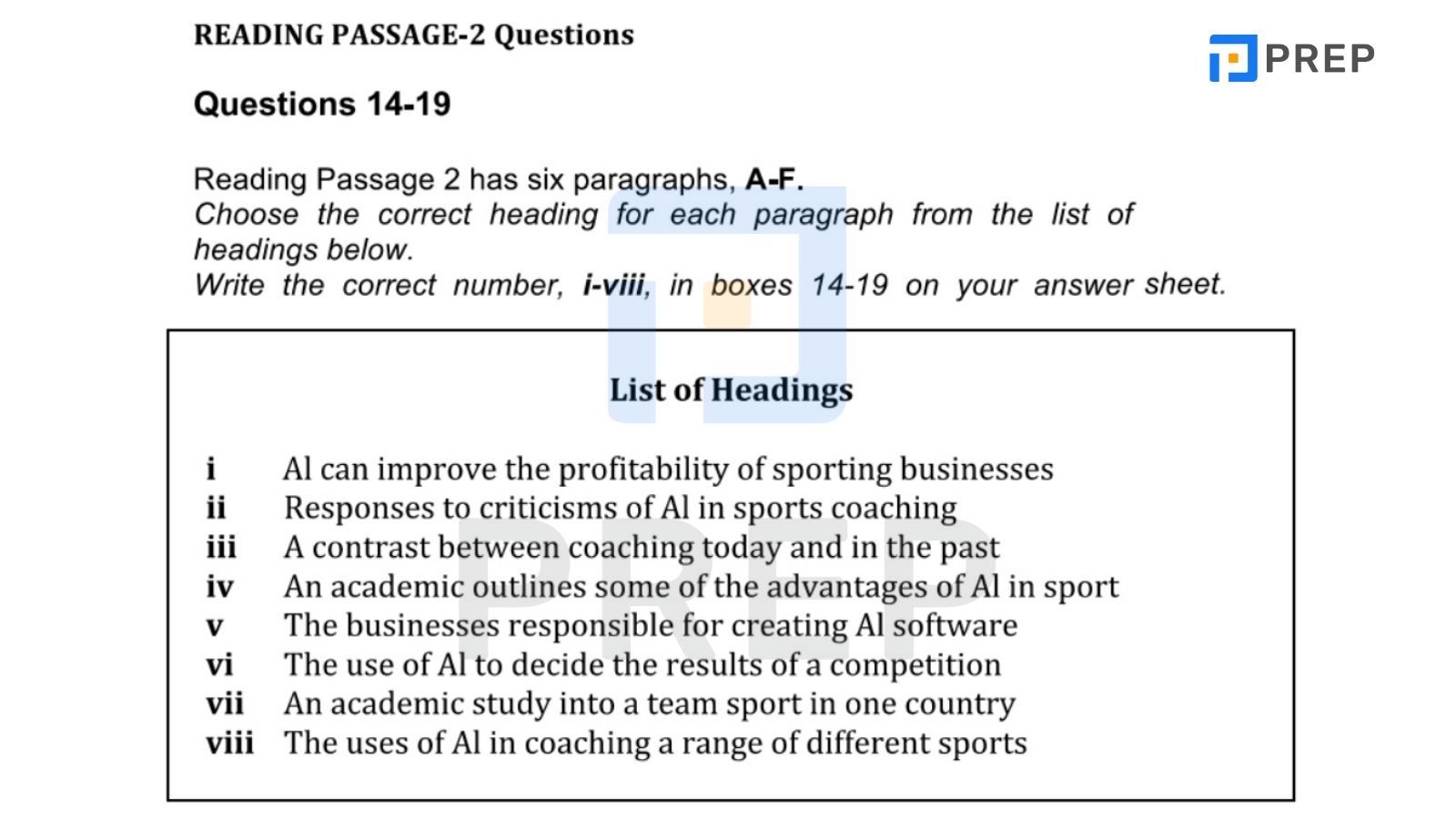
Questions 14-19
Reading Passage 2 has six paragraphs, A-F. Choose the correct heading for each paragraph from the list of headings below. write the correct letter, i-viii, in boxes 14-19 on your answer sheet.
List of Headings
i. The power within each studio
ii. The movie industry adapts to innovation
iii. Contrasts between cinema and other media of the time
iv. The value of studying Hollywood’s Golden Age
v. Distinguishing themselves from the rest of the market
vi. A double attack on film studios’ power
vii. Gaining control of the industry
viii. The top movies of Hollywood’s Golden Age
14. Paragraph A
15. Paragraph B
16. Paragraph C
17. Paragraph D
18. Paragraph E
19. Paragraph F
[prep_collapse_expand open_text="Xem đáp án" close_text="Ẩn đáp án"]
|
Câu |
Đoạn |
Đáp án |
Tóm tắt ý chính & Từ khóa |
|
14 |
A |
iv |
The value of studying Hollywood’s Golden Age: Đoạn văn giới thiệu lý do tại sao việc nghiên cứu hệ thống studio này lại quan trọng (offer clues, intriguing to examine) để hiểu về các ngành công nghiệp mới nổi hiện nay. |
|
15 |
B |
ii |
The movie industry adapts to innovation: Tập trung vào sự xuất hiện của âm thanh (sound/talkies). Các studio phải thích nghi (hesitant at first, persuaded, technical factors) với sự đổi mới này. |
|
16 |
C |
vii |
Gaining control of the industry: Giải thích về Vertical integration (tích hợp dọc) – cách các studio kiểm soát mọi giai đoạn từ sản xuất đến rạp chiếu để nắm quyền điều hành thị trường. |
|
17 |
D |
i |
The power within each studio: Nói về quyền lực của các ông trùm (movie moguls) và cách họ kiểm soát các ngôi sao bằng hợp đồng sắt đá (iron fists, seven-year contracts). |
|
18 |
E |
v |
Distinguishing themselves from the rest of the market: Giải thích về Product differentiation. Mỗi studio tạo ra phong cách riêng (MGM - all-star, Universal - horror...) để khác biệt với đối thủ. |
|
19 |
F |
vi |
A double attack on film studios’ power: Nhắc đến 2 "đòn tấn công" làm suy yếu các studio lớn: (1) Phán quyết của tòa án bắt bỏ quyền sở hữu rạp và (2) Sự ra đời của tivi. |
[/prep_collapse_expand]
Dạng bài Matching Headings trong IELTS Reading không còn là nỗi ám ảnh nếu bạn hiểu bản chất câu hỏi và có chiến lược xử lý hợp lý. Hãy luyện tập kỹ năng đọc lướt, xác định câu chủ đề và tránh bị đánh lạc hướng bởi các chi tiết phụ. Đừng quên luyện đề thường xuyên và ôn tập lại các headings đã học để tăng phản xạ bạn nhé!
PREP mang đến giải pháp học tiếng Anh online hiệu quả với AI độc quyền. Bạn có thể tự học tại nhà với các khóa học IELTS, TOEIC, VSTEP, APTIS và tiếng Anh giao tiếp. Teacher Bee AI sẽ hỗ trợ bạn suốt quá trình học, giúp bạn nhanh chóng nâng cao kỹ năng ngôn ngữ.
Liên hệ HOTLINE 0931428899 hoặc click TẠI ĐÂY để được tư vấn chi tiết!
Tải app PREP ngay hôm nay để bắt đầu học tiếng Anh online chất lượng cao tại nhà.

Chào bạn! Mình là Hiền Hoàng, hiện đang đảm nhận vai trò quản trị nội dung sản phẩm tại Blog của website prepedu.com.
Với hơn 5 năm tự học các ngoại ngữ như tiếng Anh, tiếng Trung và ôn luyện một số kỳ thi IELTS, TOEIC, HSK, mình đã tự đúc rút được nhiều kinh nghiệm để hỗ trợ hàng nghìn người đang gặp khó khăn trong việc học ngoại ngữ. Hy vọng rằng những chia sẻ phía trên sẽ giúp ích cho bạn trong quá trình tự ôn luyện thi hiệu quả tại nhà!
Bình luận
Nội dung premium
Xem tất cả




Lộ trình cá nhân hoá










Có thể bạn quan tâm



Kết nối với Prep





MSDN: 0109817671.
Địa chỉ liên hệ: Tòa nhà Vinaconex, 34 Láng Hạ, phường Láng, TP Hà Nội.
Trung tâm CSKH tại HN: Số 39, ngõ 12 Trần Kim Xuyến, phường Yên Hoà, Cầu Giấy
Trung tâm CSKH tại HCM: 145A-147Bis Trần Quang Khải, phường Tân Định, TP HCM
Trụ sở Công ty: Số nhà 20, ngách 234/35 đường Hoàng Quốc Việt, phường Nghĩa Đô, TP Hà Nội.
Phòng luyện ảo - Trải nghiệm thực tế - Công nghệ hàng đầu.
Hotline: 0907048899
Trụ sở Công ty: Số nhà 20, ngách 234/35 đường Hoàng Quốc Việt, phường Nghĩa Đô, TP Hà Nội.
Giấy chứng nhận hoạt động đào tạo, bồi dưỡng số 1309/QĐ-SGDĐT ngày 31 tháng 07 năm 2023 do Sở Giáo dục và Đào tạo Hà Nội cấp.