舉例來說英文怎麼說?10+ 種最實用說法完整指南
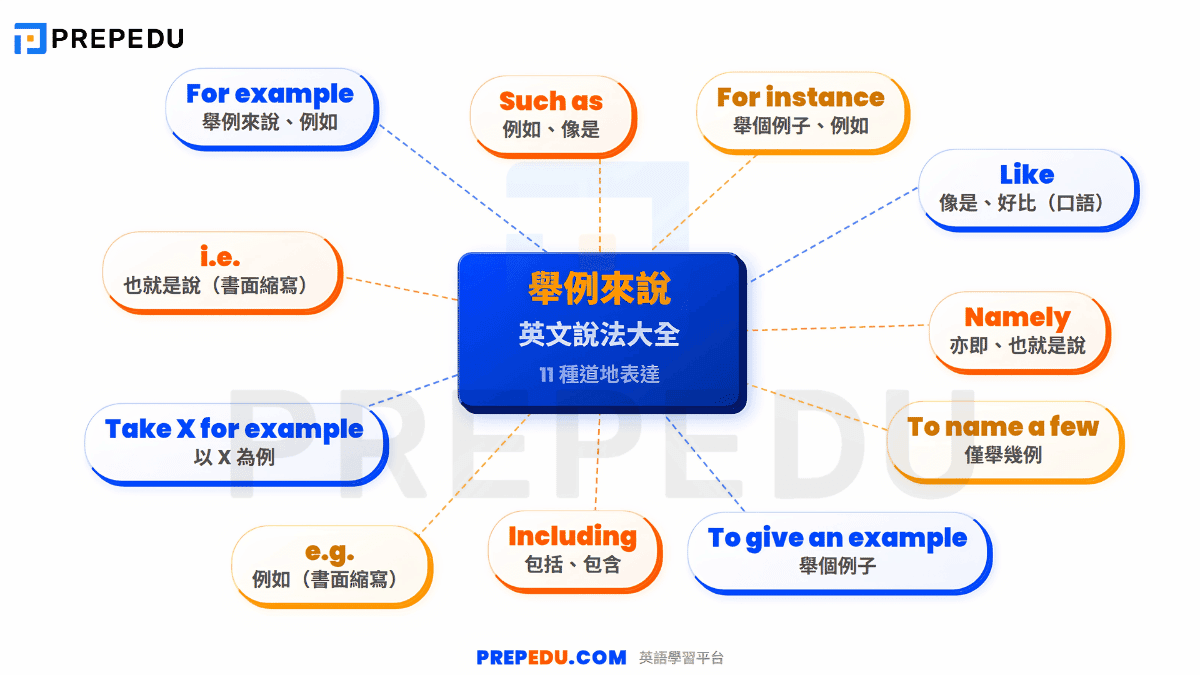
「舉例來說」的英文說法超過 10 種,最常用的包括:for example、for instance、such as、like、e.g.、i.e.、namely、take X for example、including、to name a few,以及 to give an example。
每種說法的語法功能不同,不能全部互換。For example 和 for instance 引導完整子句;such as 和 like 只能後接名詞;e.g. 是「舉例來說」的書面縮寫,i.e. 則是「也就是說」,兩者語義完全不同;namely 列舉全部而非部分例子;to name a few 出現在列舉結尾。
掌握這 10+ 種說法的語境條件與標點規則,能讓你在 TOEIC 口說、DSE 英語作文和日常英語對話中每次都選對說法,避免語法錯誤。

I. 舉例來說英文怎麼說?10+ 種最實用說法完整指南
「舉例來說」在英文中依語法功能、正式程度和語境,分配給 10 個以上的不同說法。台灣和香港學習者最常犯的錯誤是把所有說法視為同義詞——事實上,每種說法都有它不能被替換的語法條件。
|
舉例來說英文說法 |
後接語法 |
語域 |
正式程度 |
最佳使用場合 |
|
for example |
完整子句 / 名詞 |
口語 + 書面 |
★★☆☆ 通用 |
所有場合 ✅ 最安全 |
|
for instance |
完整子句 / 名詞 |
偏書面 |
★★★☆ 正式 |
DSE 作文 / 學術 |
|
such as |
名詞 / 名詞片語 |
書面 + 口語 |
★★★☆ 正式 |
名詞後列舉例子 |
|
like |
名詞 / 名詞片語 |
口語 |
★☆☆☆ 非正式 |
TOEIC 口說 / 日常 |
|
e.g. |
名詞 / 片語 |
書面 |
★★★☆ 書面 |
括號補充 / 學術 |
|
i.e. |
名詞 / 完整說明 |
書面 |
★★★☆ 書面 |
完整定義說明(非舉例) |
|
namely |
名詞(完整列舉) |
書面 |
★★★★ 正式 |
列出全部項目 |
|
take X for example |
名詞 + 子句 |
口語 + 書面 |
★★☆☆ 通用 |
口語強調 / TOEIC |
|
including |
名詞 / 名詞片語 |
口語 + 書面 |
★★☆☆ 通用 |
補充部分成員 |
|
to name a few |
—(句尾) |
口語 + 書面 |
★★☆☆ 通用 |
列舉結尾收束 |
|
to give an example |
完整子句 |
口語 |
★☆☆☆ 口語 |
TOEIC 口說 / 日常 |
1. For example
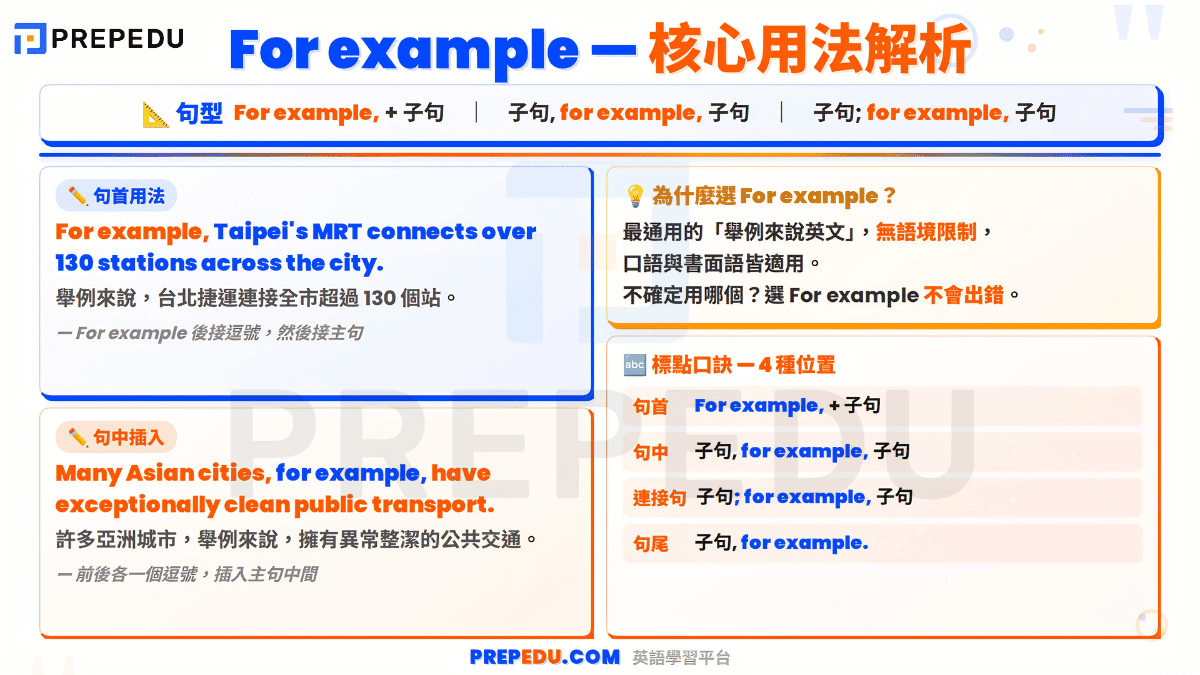
For example 是最通用的「舉例來說英文」,沒有語境限制,口語和書面語皆適用。它是所有說法中最安全的起點——當你不確定用哪個,選 for example 不會出錯。句型:
For example, + 子句
子句, for example, 子句
子句; for example, 子句
例如:
-
For example, Taipei's MRT connects over 130 stations across the city.(舉例來說,台北捷運連接全市超過 130 個站。) —— 句首:For example 後加英文逗號
-
Many Asian cities, for example, have exceptionally clean public transport.(許多亞洲城市,舉例來說,擁有異常整潔的公共交通。) —— 句中插入:前後各一個逗號
-
Learning a language takes consistent effort; for example, daily 30-minute sessions outperform weekly cramming.(學習語言需要持續努力;舉例來說,每天 30 分鐘的練習效果優於每週臨時抱佛腳。) —— 連接獨立子句:分號前、逗號後
-
She can speak several Asian languages, for example.(她會說幾種亞洲語言,舉例來說。) —— 句尾:前加逗號
💡 標點口訣:句首 → For example, ;句中 → , for example, ;連接兩句 → ; for example, ;句尾 → , for example.
2. For instance
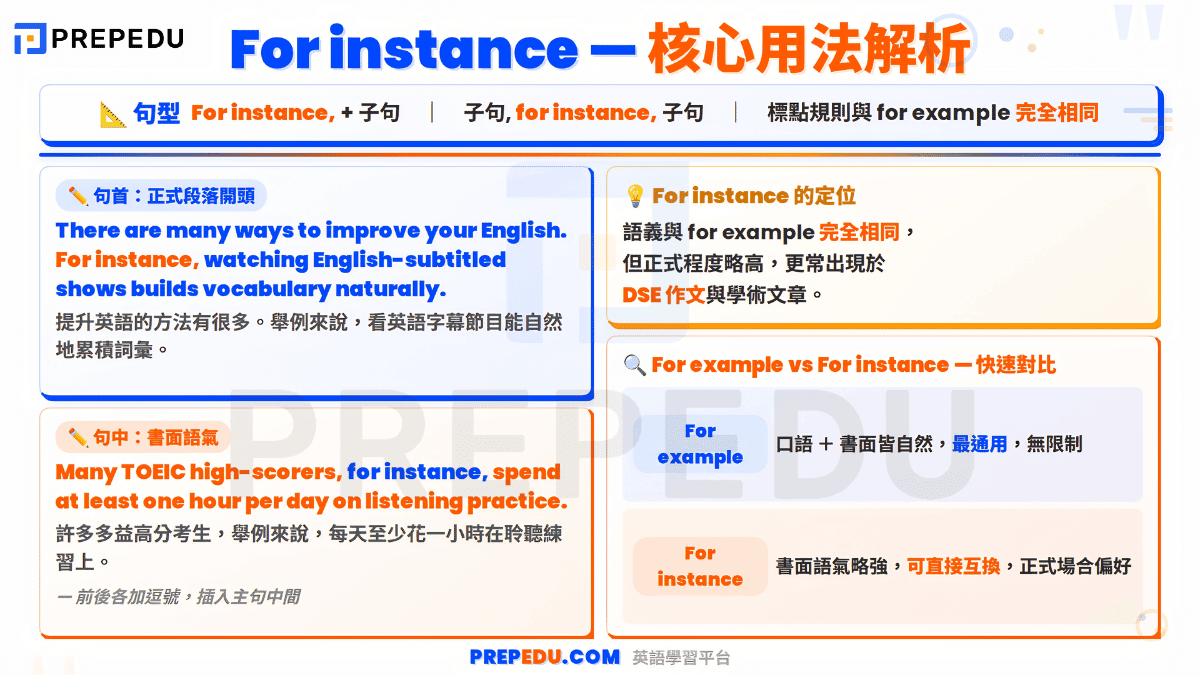
For instance 與 for example 語義相同,標點規則也完全一致。主要差異是語域:for instance 在書面語和正式場合中使用頻率略高,更常出現在 DSE 英語作文和學術文章中。兩者在大多數語境中可以直接互換。句型:
For instance, + 子句
子句, for instance, 子句(同 for example)
例如:
-
There are many ways to improve your English. For instance, watching English-subtitled shows builds vocabulary naturally.(提升英語的方法有很多。舉例來說,看英語字幕節目能自然地累積詞彙。) —— 句首:正式段落開頭
-
Many TOEIC high-scorers, for instance, spend at least one hour per day on listening practice.(許多多益高分考生,舉例來說,每天至少花一小時在聆聽練習上。) —— 句中:書面語氣
-
Bilingual cities, for instance Hong Kong and Singapore, often have higher average incomes.(雙語城市,例如香港和新加坡,平均收入往往較高。) —— 書面說明
-
DSE preparation requires multiple skills; for instance, Paper 2 alone demands strong grammar, planning, and vocabulary.(DSE 備考需要多種技能;舉例來說,光是作文卷就要求紮實的語法、規劃能力和詞彙量。) —— 連接兩個獨立子句
3. Such as
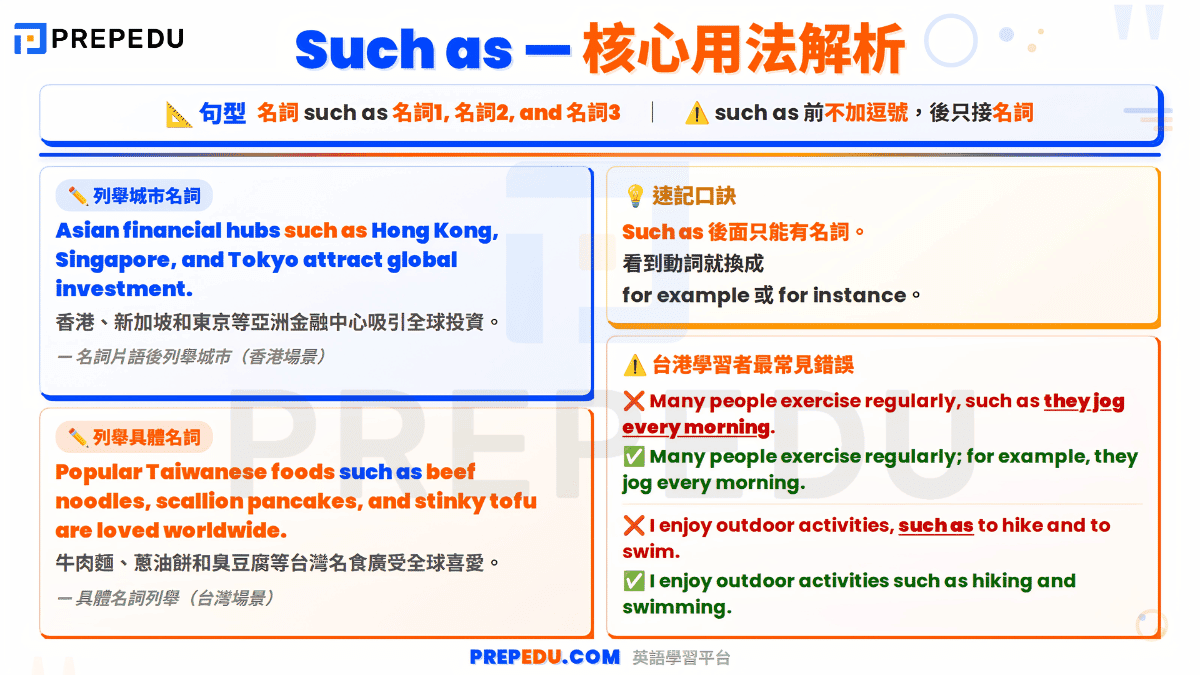
Such as 是「舉例來說英文」中語法規則最嚴格的說法之一。它只能接在名詞後面,後面必須接英文名詞或英文名詞片語——不能接有主語和動詞的完整子句。這是台灣和香港學習者最常犯的錯誤。句型:
名詞 such as 名詞1, 名詞2, and 名詞3 (such as 前通常不加逗號)
例如:
-
Asian financial hubs such as Hong Kong, Singapore, and Tokyo attract global investment.(香港、新加坡和東京等亞洲金融中心吸引全球投資。) —— 名詞片語後列舉城市
-
Soft skills such as communication, leadership, and adaptability are highly valued.(溝通、領導力和適應能力等軟技能備受重視。) —— 抽象名詞列舉
-
Popular Taiwanese foods such as beef noodles, scallion pancakes, and stinky tofu are loved worldwide.(牛肉麵、蔥油餅和臭豆腐等台灣名食廣受全球喜愛。) —— 具體名詞列舉(台灣場景)
-
Exam preparation resources such as past papers, vocabulary apps, and online mock tests are widely available.(考試備考資源,例如歷年試卷、詞彙 App 和線上模擬測試,隨處可得。) —— 複合名詞片語列舉
💡 速記:Such as 後面只能有名詞。看到英文動詞就換成 for example 或 for instance。
-
❌ Many people exercise regularly, such as they jog every morning.(such as 後接子句 → 語法錯誤)
-
✅ Many people exercise regularly; for example, they jog every morning.(改用 for example 引導子句)
4. Like
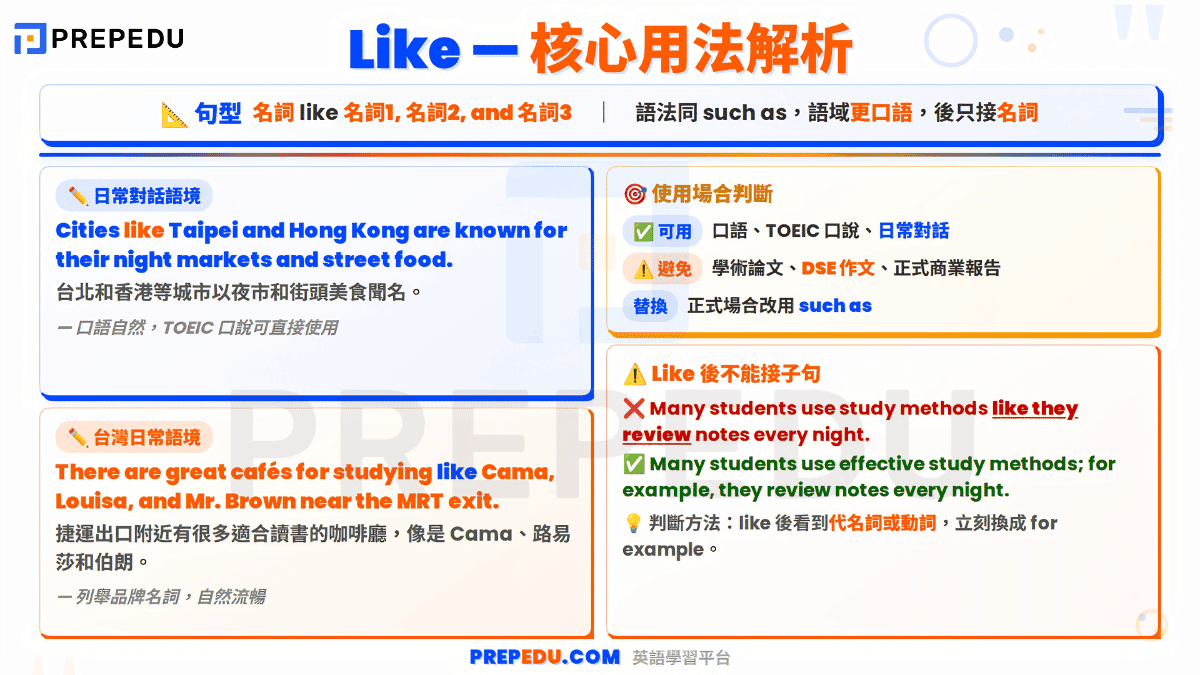
Like 在口語中常作為 such as 的非正式替代,語法功能相同——後接名詞,不能接英文子句。在正式書面語(學術論文、DSE 作文、商業報告)中,like 替代 such as 被認為不夠正式,應避免使用。TOEIC 口說回答中使用 like 是完全可以接受的。句型:
名詞 like 名詞1, 名詞2, and 名詞3(語法同 such as,語域更口語)
例如:
-
Apps like Duolingo, Anki, and YouTube have changed how people learn languages.(Duolingo、Anki 和 YouTube 等 App 改變了人們學習語言的方式。) —— 口語 / 非正式書面語
-
Cities like Taipei and Hong Kong are known for their night markets and street food.(台北和香港等城市以夜市和街頭美食聞名。) —— 日常對話語境
-
Platforms like Instagram and TikTok have become major sources of English input for young learners.(Instagram 和 TikTok 等平台已成為年輕學習者重要的英語輸入來源。) —— 非正式說明
-
There are great cafés for studying like Cama, Louisa, and Mr. Brown near the MRT exit.(捷運出口附近有很多適合讀書的咖啡廳,像是 Cama、路易莎和伯朗。) —— 台灣日常語境
Like 最常犯的語法錯誤是把它當 for example 用,在後面直接接上完整子句(有英文主語和動詞的句子)。這個錯誤來自中文語感:中文的「像是……就是……」可以接子句,但英文的 like 作為英文介系詞,語法上只能後接名詞或名詞片語。判斷方法很簡單:like 後面看到英文代名詞(they、he、she、it)或動詞,就代表後面有子句——這種情況必須換成 for example 或 for instance。
-
❌ Many students use study methods like they review notes every night.(like 後接子句 → 錯誤)
-
✅ Many students use effective study methods; for example, they review notes every night.(改用 for example)
5. e.g.
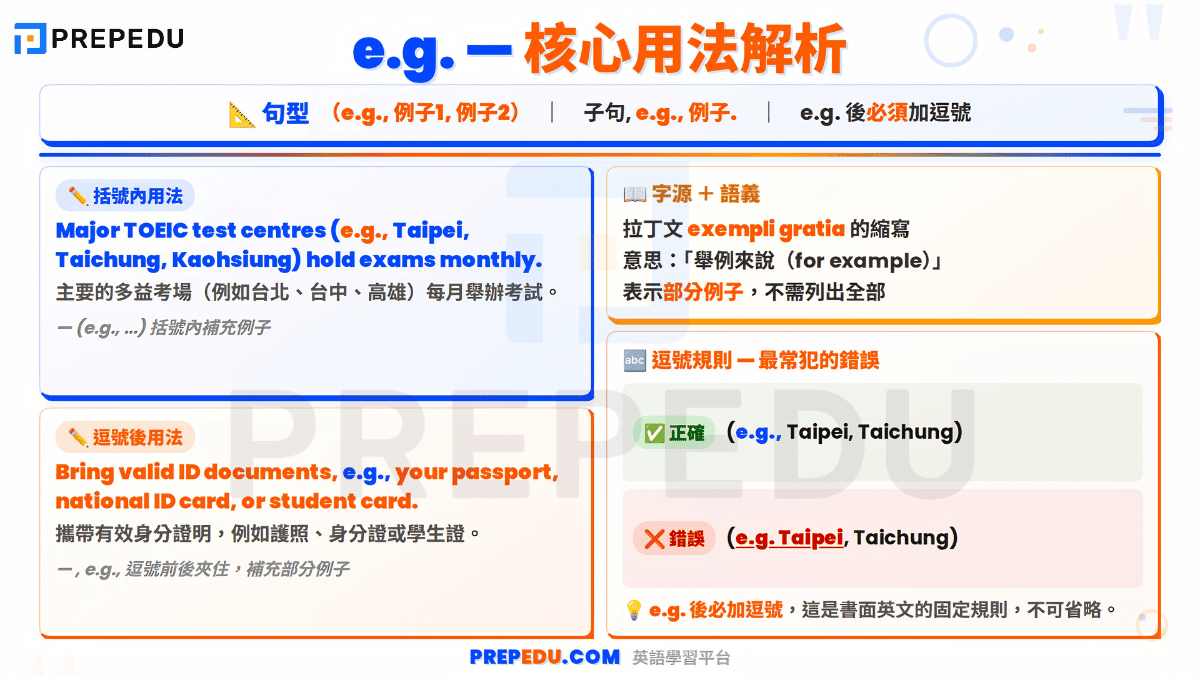
e.g. 是拉丁文 exempli gratia 的英文縮寫,意思是「舉例來說(for example)」。它用於書面英語,通常放在英文括號內或逗號後,後面必須加逗號,然後才是例子。它表示部分例子,不需要列出全部。句型:
e.g., 例子1, 例子2
子句, e.g., 例子.
例如:
-
Major TOEIC test centres (e.g., Taipei, Taichung, Kaohsiung) hold exams monthly.(主要的多益考場(例如台北、台中、高雄)每月舉辦考試。) —— 括號內:(e.g., ...)
-
Bring valid ID documents, e.g., your passport, national ID card, or student card.(攜帶有效身分證明,例如護照、身分證或學生證。) —— 逗號後:, e.g., ...
-
There are several free English learning resources, e.g., BBC Learning English, VOA, and TED Talks.(有幾個免費英語學習資源,例如 BBC 學英語、美國之音和 TED 演講。) —— 補充說明
-
Some connective phrases (e.g., 'however,' 'on the other hand,' and 'therefore') are essential for DSE writing.(某些連接詞(例如 however、on the other hand 和 therefore)對 DSE 寫作至關重要。) —— 學術補充說明
💡 規則:e.g. 後面「必須」加逗號。(e.g., Taipei) ✅ 而非 (e.g. Taipei) ❌。
閱讀更多文章:
6. i.e.
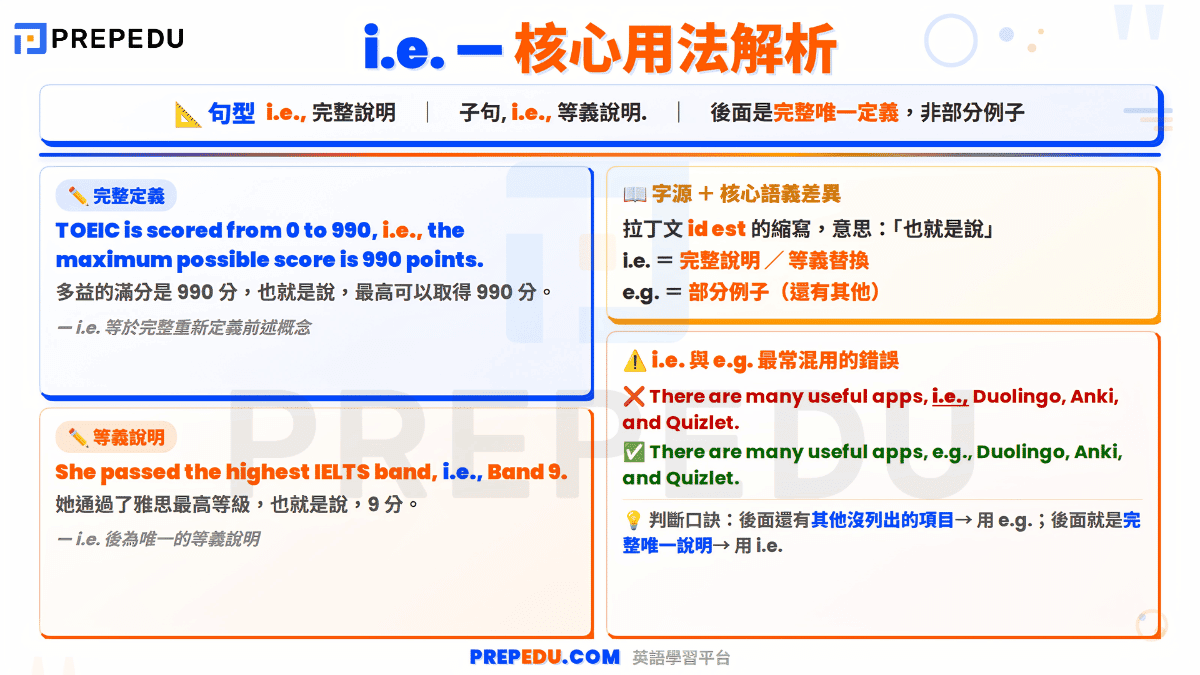
i.e. 是拉丁文 id est 的縮寫,意思是「也就是說(that is)」。它不是「舉例來說」,而是「完整說明或重新定義」。 後面的內容是對前述概念的等義替換,不是部分例子,而是完整說明——通常只有一個說法。句型:
i.e., 完整說明
子句, i.e., 等義說明.
例如:
-
TOEIC is scored on a scale from 0 to 990, i.e., the maximum possible score is 990 points.(多益的滿分是 990 分,也就是說,最高可以取得 990 分。) —— i.e. = 完整定義
-
The exam is only available in two formats, i.e., paper-based and computer-based.(考試只有兩種形式,也就是說,紙本和電腦版。) —— i.e. = 全部列出(共兩種)
-
She passed the highest IELTS band, i.e., Band 9.(她通過了雅思最高等級,也就是說,9 分。) —— i.e. = 等義說明
-
He reached the DSE top grade, i.e., Level 5.(他取得了 DSE 最高等級,也就是說,5級。) —— i.e. = 定義唯一的最高等級
i.e. 最常見的錯誤是把它當 e.g. 使用——在後面列出部分例子,但其實只想舉幾個代表性的說法。這個混用非常普遍,原因是兩個縮寫外觀相似,加上中文的「即」和「例如」在日常語境中有時可以互換,導致學習者把兩者的英文對應也視為同義詞。判斷方法:後面列出的是「全部內容」還是「部分例子」?如果後面還有其他沒列出來的項目,用 e.g.;如果後面就是完整的唯一定義或全部項目,用 i.e.。
-
❌ There are many useful apps, i.e., Duolingo, Anki, and Quizlet.(應用 e.g.:這是部分例子,非完整說明)
-
✅ There are many useful apps, e.g., Duolingo, Anki, and Quizlet.(e.g. 正確:只是幾個例子)
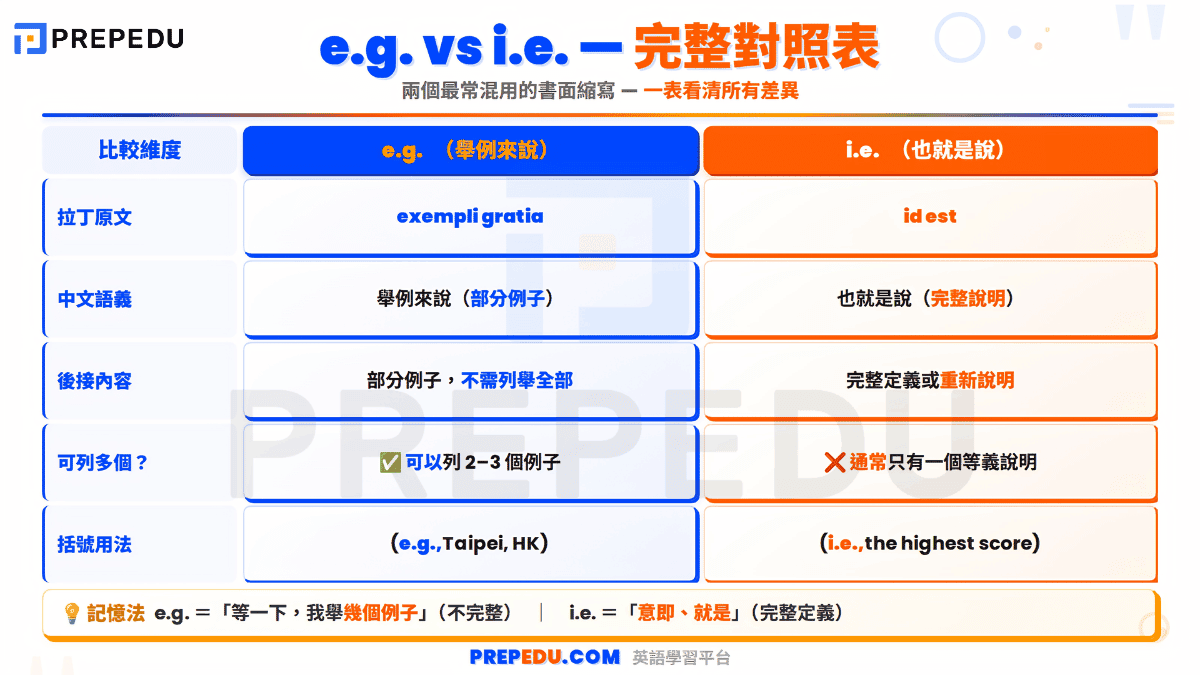
e.g. 或 i.e. 完整對照:
|
比較維度 |
E.g.(舉例來說) |
I.e.(也就是說) |
|
拉丁原文 |
exempli gratia |
id est |
|
中文語義 |
舉例來說(部分例子) |
也就是說(完整說明) |
|
後接內容 |
部分例子,不需要列舉全部 |
完整定義或重新說明 |
|
可列多個? |
✅ 可以列 2–3 個例子 |
❌ 通常只有一個等義說明 |
|
標點 |
e.g., + 例子 |
i.e., + 說明 |
|
括號用法 |
(e.g., Taipei, HK) |
(i.e., the highest score) |
💡 記憶法:
-
e.g. = 「等一下,我舉幾個例子」(不完整);
-
i.e. = 「意即、就是」(完整定義)。
7. Namely
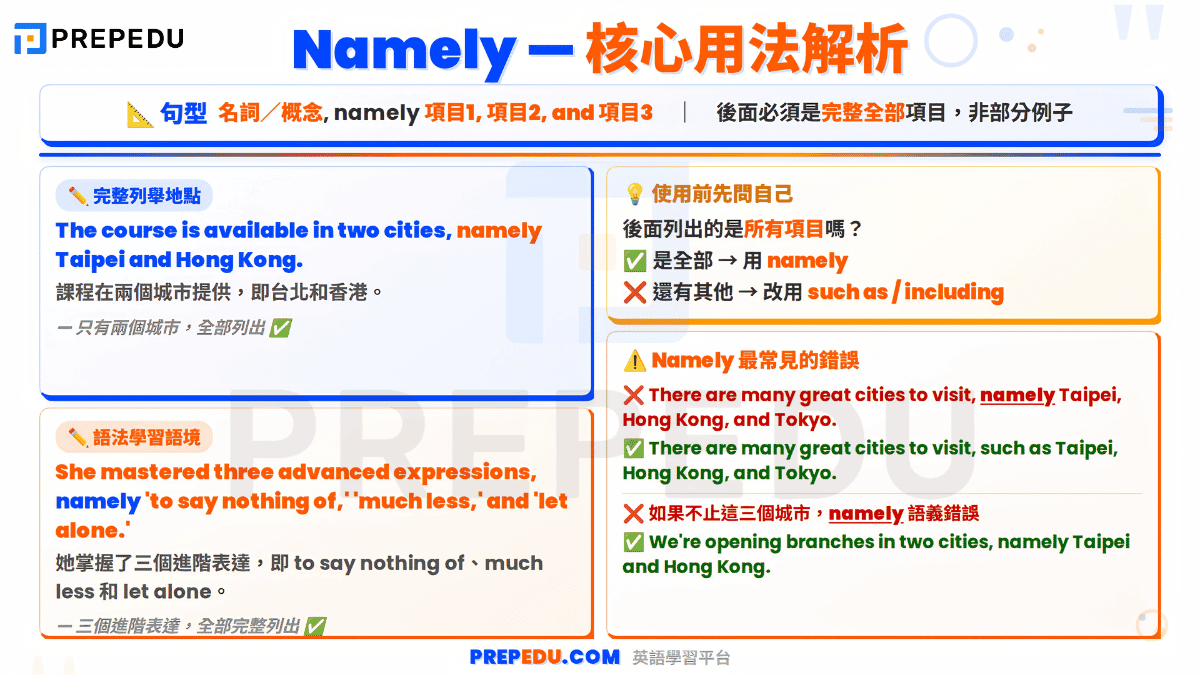
Namely 是「也就是以下全部內容」的列舉標記。它表示完整列舉——後面的項目包括所有屬於前述概念的成員,不是部分例子。如果只想列部分例子,用 for example 或 such as;如果要列出全部,用 namely。句型:
名詞/ 概念, namely 項目1, 項目2, and 項目3.
例如:
-
The exam covers three skills, namely reading, listening, and speaking.(考試涵蓋三項技能,即閱讀、聆聽和口說。) —— 共三項,全部列出
-
TOEIC has two sections, namely Listening and Reading.(多益有兩個部分,即聆聽和閱讀。) —— 共兩部分,全部列出
-
The course is available in two cities, namely Taipei and Hong Kong.(課程在兩個城市提供,即台北和香港。) —— 完整列舉所有地點
-
She mastered three advanced expressions, namely 'to say nothing of,' 'much less,' and 'let alone.'(她掌握了三個進階表達,即 to say nothing of、much less 和 let alone。) —— 語法學習語境
Namely 最常見的錯誤是把它當 such as 或 for example 使用——列出幾個例子,但前面的名詞其實包含更多未列出的項目。這個錯誤很隱蔽,因為句子看起來語法正確,但語義邏輯卻產生矛盾:namely 向讀者保證後面就是「全部內容」,如果實際上還有更多,讀者會受到誤導。判斷方法:使用 namely 前,先問自己「後面列出的是不是所有項目?」如果答案是否定的——還有其他項目沒列——改用 such as 或 including。
-
❌ There are many great cities to visit, namely Taipei, Hong Kong, and Tokyo.(如果不止這三個城市,用 such as 而非 namely)
-
✅ We're opening branches in two cities, namely Taipei and Hong Kong.(只有兩個城市,全部列出 ✅)
8. Take X for example
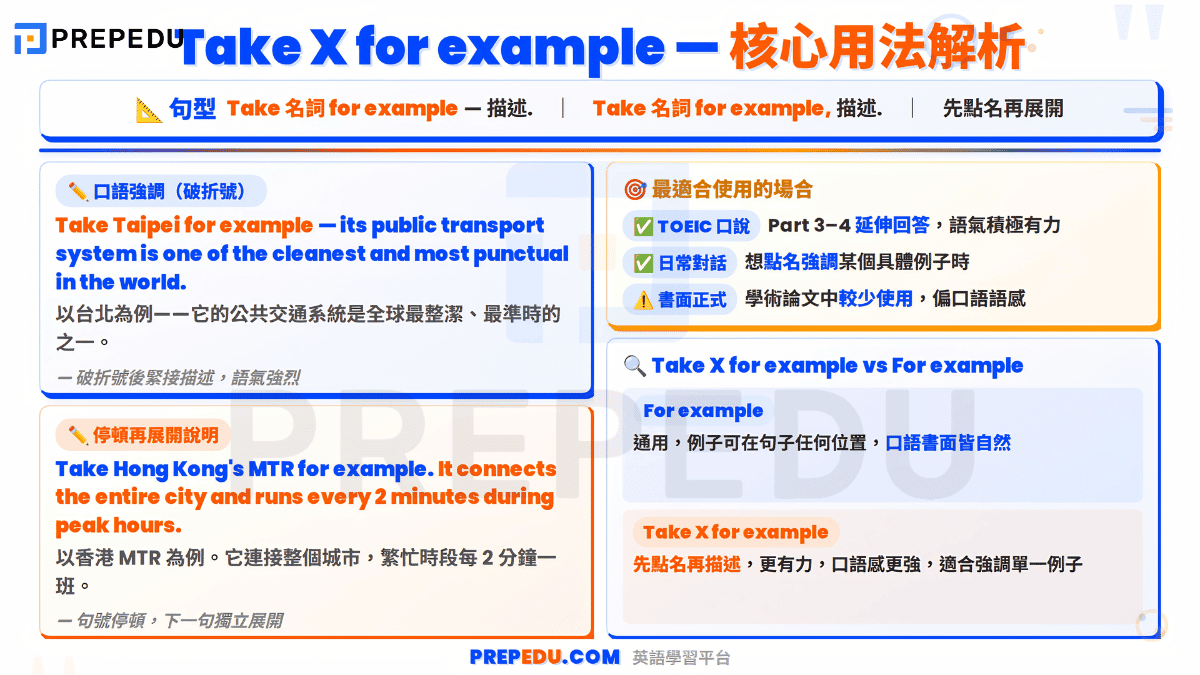
Take X for example 是口語中強調舉例的主動語態說法,語感比 for example 更有力、更具體。它先點名例子(Take X),再接描述,適合 TOEIC 口說 Part 3 – TOEIC 口說 Part 4 的延伸回答和日常對話英文中想要強調某個具體例子時使用。句型:
Take 名詞 for example — 描述.
Take 名詞 for example, 描述.
例如:
-
Take Taipei for example — its public transport system is one of the cleanest and most punctual in the world.(以台北為例——它的公共交通系統是全球最整潔、最準時的之一。) —— 口語強調例示
-
Take Hong Kong's MTR for example. It connects the entire city and runs every 2 minutes during peak hours.(以香港 MTR 為例。它連接整個城市,繁忙時段每 2 分鐘一班。) —— 停頓再展開說明
-
Take a bilingual professional for example — they typically earn 20–30% more than their monolingual counterparts.(以雙語專業人士為例——他們的薪酬通常比單語者高 20–30%。) —— TOEIC 口說延伸回答
-
Take Japan as an example: the TOEIC exam is deeply embedded in corporate culture there.(以日本為例:多益考試在當地的企業文化中根深蒂固。) —— 冒號帶出說明
9. Including
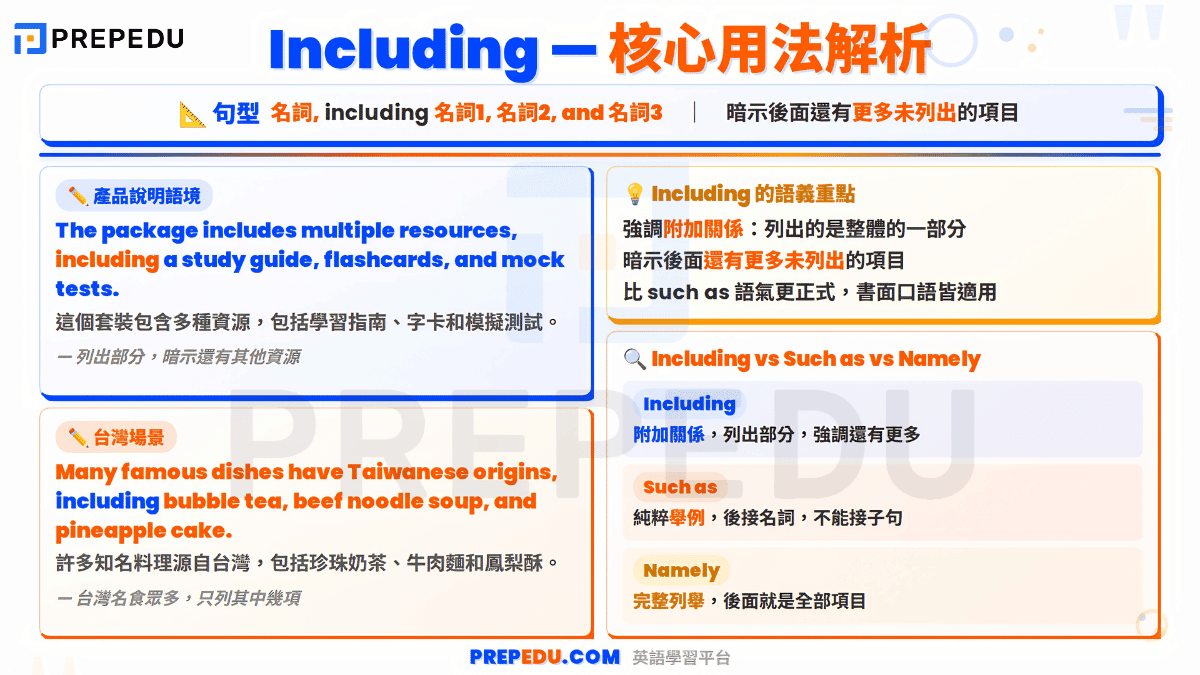
Including 表示「包括(部分成員)」,語義比 such as 更強調附加關係,而非純粹舉例。它後接名詞,表示列出的是整體的一部分——暗示後面還有更多未列出的項目。句型:
名詞, including 名詞1, 名詞2, and 名詞3
例如:
-
The course covers multiple skills, including reading, listening, and vocabulary building.(這門課涵蓋多種技能,包括閱讀、聆聽和詞彙建構。) —— 部分成員列舉
-
Several countries participated in the survey, including Taiwan, Hong Kong, Japan, and South Korea.(幾個國家參與了這次調查,包括台灣、香港、日本和韓國。) —— 地名補充
-
The package includes multiple resources, including a study guide, flashcards, and mock tests.(這個套裝包含多種資源,包括學習指南、字卡和模擬測試。) —— 產品說明語境
-
Many famous dishes have Taiwanese origins, including bubble tea, beef noodle soup, and pineapple cake.(許多知名料理源自台灣,包括珍珠奶茶、牛肉麵和鳳梨酥。) —— 台灣場景
10. To name a few
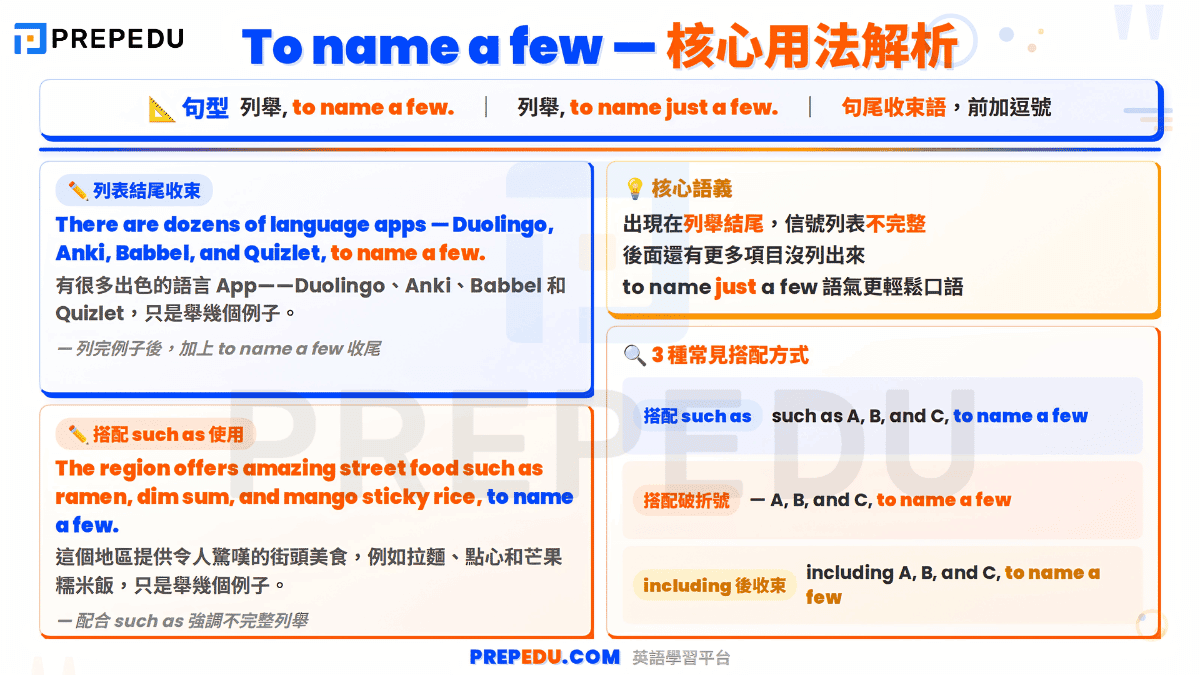
To name a few/ To name just a few 是「以上只是其中幾個例子」的收束語,出現在列舉的結尾,信號列表不完整——後面還有更多項目。它通常配合 such as 或直接列舉使用,放在句尾,前加逗號。句型:
列舉, to name a few.
列舉, to name just a few.
例如:
-
There are dozens of excellent language apps — Duolingo, Anki, Babbel, and Quizlet, to name a few.(有很多出色的語言 App——Duolingo、Anki、Babbel 和 Quizlet,只是舉幾個例子。) —— 列表結尾收束
-
The region offers amazing street food such as ramen, dim sum, satay, and mango sticky rice, to name a few.(這個地區提供令人驚嘆的街頭美食,例如拉麵、點心、沙嗲和芒果糯米飯,只是舉幾個例子。) —— 搭配 such as 使用
-
Many connecting expressions are essential in TOEIC writing — 'however,' 'therefore,' and 'furthermore,' to name just a few.(許多連接詞在多益寫作中至關重要——例如 however、therefore 和 furthermore,只是舉幾個例子。) —— 書面表達輔助
-
Taipei has many great areas for studying English — the Zhongxiao East Road cafés, NTU library, and Eslite, to name a few.(台北有很多學英語的好地方——忠孝東路的咖啡廳、台大圖書館和誠品,只是舉幾個例子。) —— 台北在地場景
11. To give an example
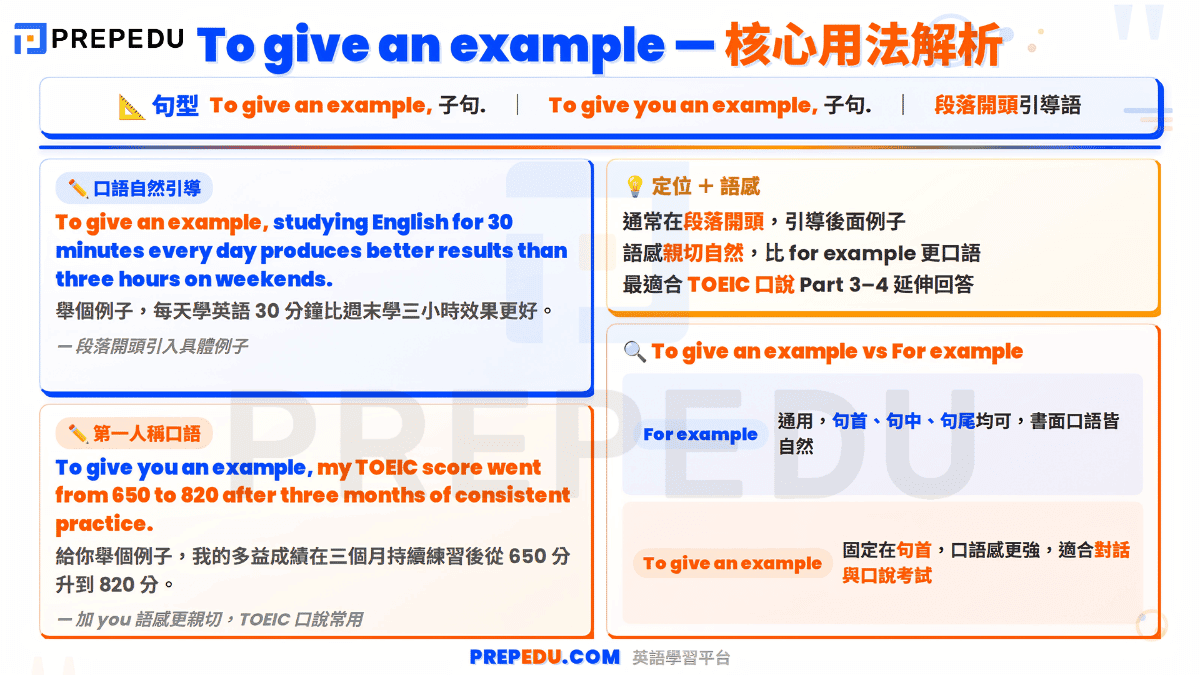
To give an example / To give you an example 是口語中最自然的舉例引導語,語感親切、自然,適合 TOEIC 口說回答和日常英語對話。它通常出現在段落開頭,後接一個具體例子說明前述論點。句型:
To give an example, 子句.
To give you an example, 子句.
例如:
-
To give an example, studying English for 30 minutes every day produces better results than three hours on weekends.(舉個例子,每天學英語 30 分鐘比週末學三小時效果更好。) —— 口語自然引導
-
To give you an example, my TOEIC score went from 650 to 820 after three months of consistent practice.(給你舉個例子,我的多益成績在三個月持續練習後從 650 分升到 820 分。) —— 英文第一人稱口語
-
To give a concrete example, Taipei's MRT carries about 2 million passengers per day.(舉個具體例子,台北捷運每天載客約 200 萬人次。) —— 加入 concrete 強化語氣
-
Let me give you an example — when you shadow a podcast, your pronunciation improves faster than with drills alone.(讓我舉個例子——當你跟著 podcast 進行跟讀練習時,發音提升速度比單純做練習題更快。) —— let me give... 變體
II. 「舉例來說英文」實戰場景
規則記住了是第一步。在真實情境中自然切換才是核心目標。以下三個場景展示 8 種說法在同一個情境中的自然搭配邏輯。
1. 場景一:TOEIC Part 4 口說回答 — 描述亞洲城市
題目:What makes Asian cities attractive to tourists and business professionals?
參考回答(展示 4 種說法輪換):Asian cities are attractive for both tourism and business. To give an example, cities like Taipei and Hong Kong offer a combination of modern infrastructure and rich culture. Many practical advantages are available, such as efficient public transport, safe streets, and a wide range of international cuisine. Take Taipei's MRT for example — it connects over 130 stations and runs with near-perfect punctuality. Business professionals also benefit from financial services, including banking, fintech, and logistics networks, to name a few.(亞洲城市對旅遊和商務人士都很有吸引力。舉個例子,台北和香港等城市兼具現代化基礎設施和豐富文化。許多實際優勢都具備,例如高效的公共交通、安全的街道和各式各樣的國際料理。就以台北捷運為例——它連接超過 130 個站,運行準點。商務人士還能受益於金融服務,包括銀行、金融科技和物流網絡,只是舉幾個例子。)
2. 場景二:DSE Paper 2 作文 — 議論文段落示範
題目:Should schools require students to learn a second language?
段落示範(書面語說法):The benefits of learning a second language are well-documented. For instance, research consistently shows that bilingual individuals outperform monolingual peers in cognitive flexibility and multitasking. Countries that prioritise multilingual education, such as Singapore, Switzerland, and Luxembourg, consistently produce globally competitive graduates. In practical terms, bilingual professionals benefit from clear advantages, namely higher earning potential, broader career opportunities, and stronger cross-cultural communication skills.(學習第二語言的好處已有充分記錄。舉例來說,研究始終顯示雙語者在認知靈活性和多工處理方面優於單語者。在多語教育方面投入資源的國家,例如新加坡、瑞士和盧森堡,持續培養出具備全球競爭力的畢業生。從實務角度來看,雙語專業人士受益於明確的優勢,即較高的薪酬潛力、更廣泛的職業機會和更強的跨文化溝通能力。)
3. 場景三:日常對話 — 咖啡廳討論 TOEIC 備考
-
A:I've been trying to improve my TOEIC score, but I don't know where to start.(我一直想提升多益成績,但不知道從哪裡開始。)
-
B:There are many good strategies. To give you an example, shadowing podcast episodes for 20 minutes every day is one of the most effective methods.(有很多好策略。舉個例子,每天跟讀 podcast 20 分鐘是最有效的方法之一。)
-
A:What resources do you recommend?(你推薦哪些資源?)
-
B:There are great options, e.g., BBC Learning English, VOA, and PREPEDU's PrepTalk English course.(有很多好選擇,例如 BBC 學英語、美國之音和 PREPEDU 的 PrepTalk 英語課程。)
-
A:Is there a difference between all the apps out there?(那些 App 之間有什麼差異嗎?)
-
B:Yes. Some focus on specific skills, such as Anki for vocabulary and PREPEDU for speaking — the key is matching the tool to your weak areas.(有的。有些針對特定技能,例如 Anki 專攻詞彙,PREPEDU 專攻口說——關鍵是讓工具對應你的弱項。)
-
A:That makes sense. Take PREPEDU for example—take PREPEDU for example, does it really help with speaking confidence?(有道理。就以 PREPEDU 為例,它真的有助於建立口說信心嗎?)
-
B:Absolutely. The structured practice covers multiple real-life scenarios, to name a few: job interviews, presentations, and daily conversation.(當然。系統化練習涵蓋多種真實場景,只是舉幾個:工作面試、簡報和日常對話。)
三個場景示範了 8 種說法在口語和書面語中的自然切換。留意每種說法在什麼語境出現:口語(to give an example, like, e.g., take X for example, to name a few)vs 書面(for instance, such as, namely)。
III. 「舉例來說英文」常見問題 FAQ
1. For example 和 For instance 完全可以互換嗎?
可以互換的情況超過 90%。For example 和 for instance 語義相同,標點規則也完全一致——把 for example 換成 for instance,句子中的逗號位置不需要改變。主要差異是語域:for instance 在正式書面語和學術寫作中使用頻率略高,for example 在口語和非正式書面語中更自然。唯一不建議互換的情況是語域明確要求高度正式(例如法律文書或學術論文),此時 for instance 更合適。DSE 英語作文中,交替使用兩者能展示詞彙多樣性,主動避免連續使用同一個說法。
2. Such as 後面可以接完整子句嗎?
不能。 Such as 在語法上是名詞的後置修飾語,後面只能接名詞或名詞片語,不能接有主語和動詞的完整子句。這是台灣和香港學習者在 TOEIC 寫作和 DSE 作文中最常犯的語法錯誤。需要引導完整子句(有主語+動詞的句子)時,使用 for example 或 for instance。
-
❌ She has good habits, such as she reads for 30 minutes every night.
-
✅ She has good habits; for example, she reads for 30 minutes every night.
一個簡單的判斷法:看 such as 後面的第一個詞是名詞還是代名詞(名詞 → 可用);如果後面出現動詞,一定要改用 for example 或 for instance。
3. e.g. 在正式學術論文中可以使用嗎?
可以,但有使用位置的規範。在學術論文的主正文中,習慣將 e.g. 限制在括號內使用(如:(e.g., Taipei, Hong Kong, Singapore)),而不放在主句的連接詞位置。如果要在正文句子中使用,改用完整說法 for example 或 for instance 更符合學術寫作慣例。另外,e.g. 後面必須加逗號是英式和美式英文共同遵守的標點規範:(e.g., Taipei) ✅ 而非 (e.g. Taipei) ❌。
4. 如何避免在文章中過度重複使用 For Example?
輪換使用語域相近的說法是最有效的方法。一篇 800 字的 DSE 英語議論文,建議的「舉例來說英文」說法分配如下:for example(2–3 次)+ for instance(1 次)+ such as(1–2 次)+ take X for example(1 次)。這樣的分配能展示詞彙多樣性,同時確保語域始終一致。另外要避免的是在同一個段落中連續使用兩個不同的「舉例來說英文」說法——例如「for example... for instance...」出現在相鄰的兩句話中,閱卷者同樣會注意到。
總結
「舉例來說英文」不是一個說法,而是一套由後接語法、語域和正式程度決定的 10+ 種工具系統。過度依賴 for example 一個說法,是台灣和香港學習者在 TOEIC 口說和 DSE 作文中最常被注記的詞彙問題之一——而解決方案不是背更多詞彙,而是搞清楚每種說法的使用條件。
四個核心規則值得記住:for example 和 for instance 引導完整子句,such as 和 like 後接名詞——兩組不能互換;e.g. 是「舉例來說」,i.e. 是「也就是說」——混用會讓英文母語者立刻察覺;namely 表示完整列舉,to name a few 表示部分例子——方向相反;所有說法都有標點規則,e.g. 後面必須加逗號,for example 在句首後也必須加逗號。
從今天開始,試著這樣練習: 每次需要舉例前,先問自己兩個問題:後面接的是完整句子還是名詞?語境是口語還是書面語?這兩個問題 10 秒內就能回答,卻能立刻提升英語表達的語法精準度。想要在 TOEIC 口說和 DSE 英語作文中系統應用這些說法,PREPEDU 的 PrepTalk English 課程提供針對台灣和香港學習者設計的情境口語訓練,讓每一個「舉例來說英文」都精準到位。

你好!我叫黃秋賢,現在在 prepedu.com 擔任內容企劃。我有超過5年的英語與韓語自學經歷,親身備考 IELTS、TOEIC 與 TOPIK,累積了大量第一手的學習者視角——包括哪些語法規則最讓台灣與香港學習者混淆,以及如何在有限的備考時間內最有效地修正這些錯誤。目前已在 prepedu.com 撰寫超過 1000 篇英語學習文章,內容涵蓋語法、詞彙與考試策略,累積協助數千位學習者解決自學過程中的語法疑問。
評論












統一企業編號:202227322W
地址:114 LAVENDER STREET, #11-83 CT HUB 2, SINGAPORE (338729)