英文 Has Have Had 用法全攻略:從基本定義、時態區分到進階完成式
Has Have Had 用法有什麼區別?這是所有英文學習者在學習時態時必然遭遇的核心問題。簡單來說,have 用於第一、二人稱及複數主詞;has 專屬第三人稱單數;had 則是所有人稱的過去式形態。掌握 Has Have Had 用法,是你建立英文時態體系的第一道關卡,也是 IELTS、TOEIC 寫作高分的必要基礎。
許多學習者以為這三個詞只有「擁有」一個意思,卻不知道它們各自身兼三種截然不同的語法角色:實義動詞、助動詞,以及情態動詞。正是這種多重身份,造成了大量的混淆與錯誤。尤其是「I have had」與「I had had」這類結構,更讓無數學習者望而卻步。
本文由 PREPEDU 教學團隊依照英文文法體系完整梳理,從 have、has、had 的基本定義出發,逐步深入現在完成式與過去完成式的時態邏輯,並涵蓋使役動詞、慣用短語等進階用法,最後附上三組實戰練習題供你即刻測驗。讀完本文,你將能在任何語境中精準判斷並靈活運用這三個英文最高頻的動詞形式。

- I. Has Have Had 用法總覽:定義、人稱與核心概念
- II. Have Had Has 用法之 Have:什麼時候用 Have?三種身份完整拆解
- III. Has Had Have 用法之 Has:Has 和 Have 有什麼區別?掌握第三人稱單數
- IV. Had Has Have 用法之 Had:Had 用在哪裡?過去式與過去完成式的核心
- V. Had Have Has 用法進階解析:I Have Had 是什麼時態?弄懂 Have Had 與 Had Had
- VI. Has Have Had 用法的特殊結構:從使役動詞到常見慣用短語
- VII. Has Have Had 用法實戰演練:3 大題型挑戰,快速檢測學習成果
- VIII. Has Have Had 用法常見疑惑解答(FAQ)
- 結論
I. Has Have Had 用法總覽:定義、人稱與核心概念
在正式拆解 Has Have Had 用法之前,你必須先建立一個清晰的全局觀。Have、has、had 是英文動詞 "have" 的三種形式,在英文句子中承擔三種截然不同的角色。理解這三種身份,是掌握所有 Has Have Had 用法變化的第一步。
|
形式 |
時態/人稱 |
作為實義動詞 |
作為助動詞 |
作為情態動詞 |
|
Have |
現在式(I/You/We/They) |
擁有、吃、經歷 |
構成現在完成式 |
have to(必須) |
|
Has |
現在式(He/She/It 及單數名詞) |
擁有、吃、經歷 |
構成現在完成式 |
has to(必須) |
|
Had |
過去式(所有人稱) |
過去擁有、過去經歷 |
構成過去完成式 |
had to(過去必須) had better(最好) |
三個詞的中文意思依語境而異:
建立這個層次概念,能讓你在任何語境中快速判斷正確的 Has Have Had 用法,不再憑感覺猜測。
II. Have Had Has 用法之 Have:什麼時候用 Have?三種身份完整拆解
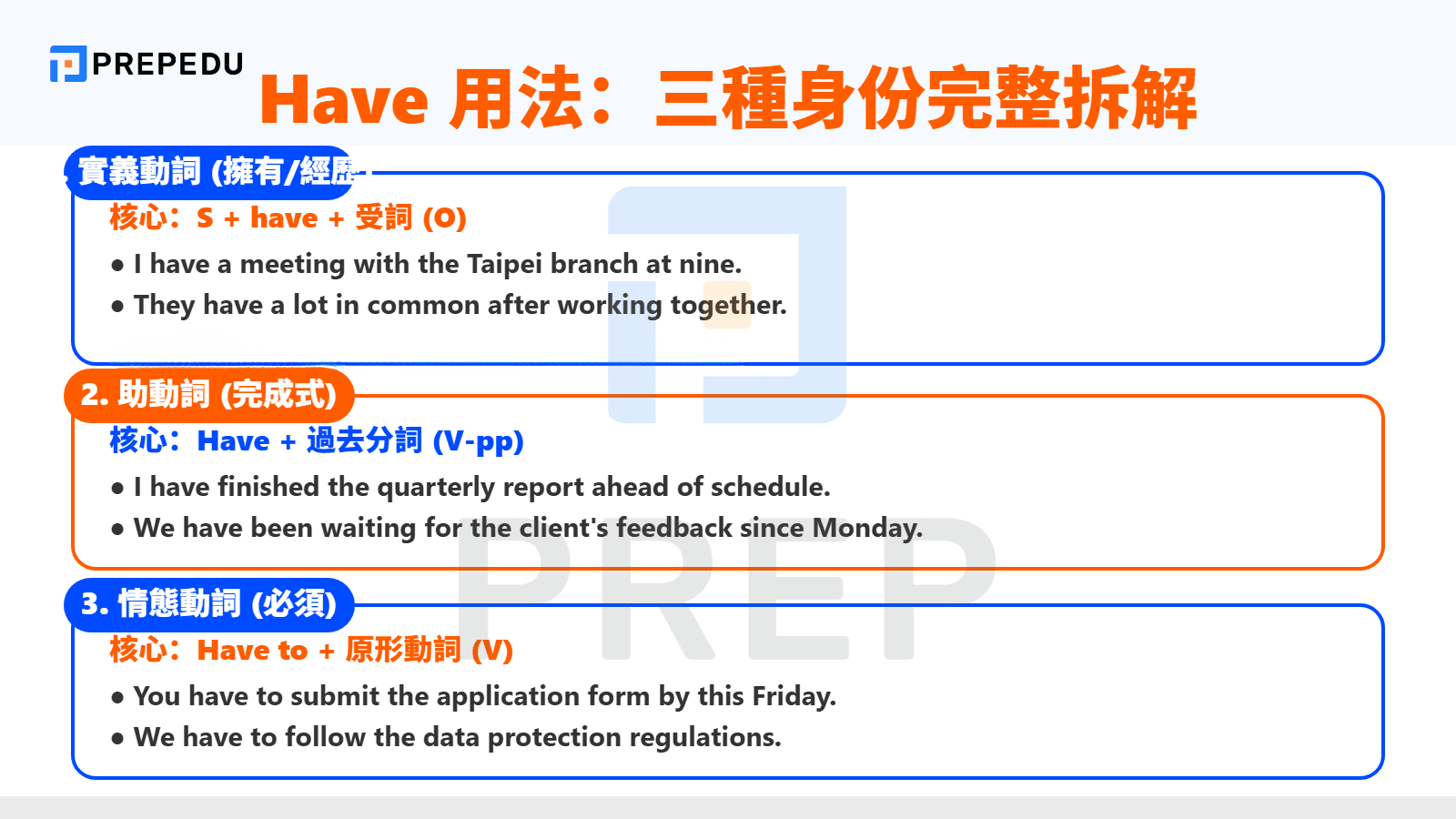
在 Has Have Had 用法體系中,Have 是原形,也是現在式的基本形態,適用於主詞為 I、You、We、They 及複數名詞的句子。Have 的應用範圍最廣,涵蓋三種不同的語法功能,每一種都對應不同的句子結構與語義重點。
1. 實義動詞:表示擁有、攝取或經歷
Have 作為一般動詞時,表示持有某物、進行某項活動,或描述身體及生活狀態。值得注意的是,當 have 作為狀態動詞(Stative Verb)表示「靜態擁有」時,不能使用進行式形式,例如 I am having a car 是錯誤的句子。這一點是 Has Have Had 用法中許多學習者容易忽略的細節。
-
I have a meeting with the Taipei branch at nine this morning.(我今天早上九點和台北分部有個會議。)
-
We have lunch together at the office canteen every Friday.(我們每週五一起在公司餐廳吃午餐。)
-
They have a lot in common after working on the same project for two years.(在同一個專案合作兩年後,他們有很多共同點。)
2. 助動詞:構成現在完成式
Have 最常見的文法功能是搭配過去分詞(Past Participle),構成現在完成式(Present Perfect Tense),表示過去發生且與現在相關的動作或持續至今的狀態。
-
I have finished the quarterly report ahead of schedule.(我提前完成了季度報告。)
-
They have lived in Taipei for over a decade now.(他們現在在台北已住了十多年。)
-
We have been waiting for the client's feedback since Monday.(我們從週一開始就一直在等客戶的回饋。)
3. 情態動詞:Have to 表示必須
Have to 的語意接近 must,表示外部義務或客觀必要性,後面接動詞原形。Have to 與 must 的關鍵差別在於:have to 強調來自外部條件的要求,而非說話者主觀的意願。在 Has Have Had 用法的情態動詞層次,這個區分至關重要。
-
You have to submit the application form by this Friday without exception.(你必須在本週五之前提交申請表,不得例外。)
-
We have to follow the company's data protection regulations at all times.(我們必須隨時遵守公司的資料保護規定。)
III. Has Had Have 用法之 Has:Has 和 Have 有什麼區別?掌握第三人稱單數
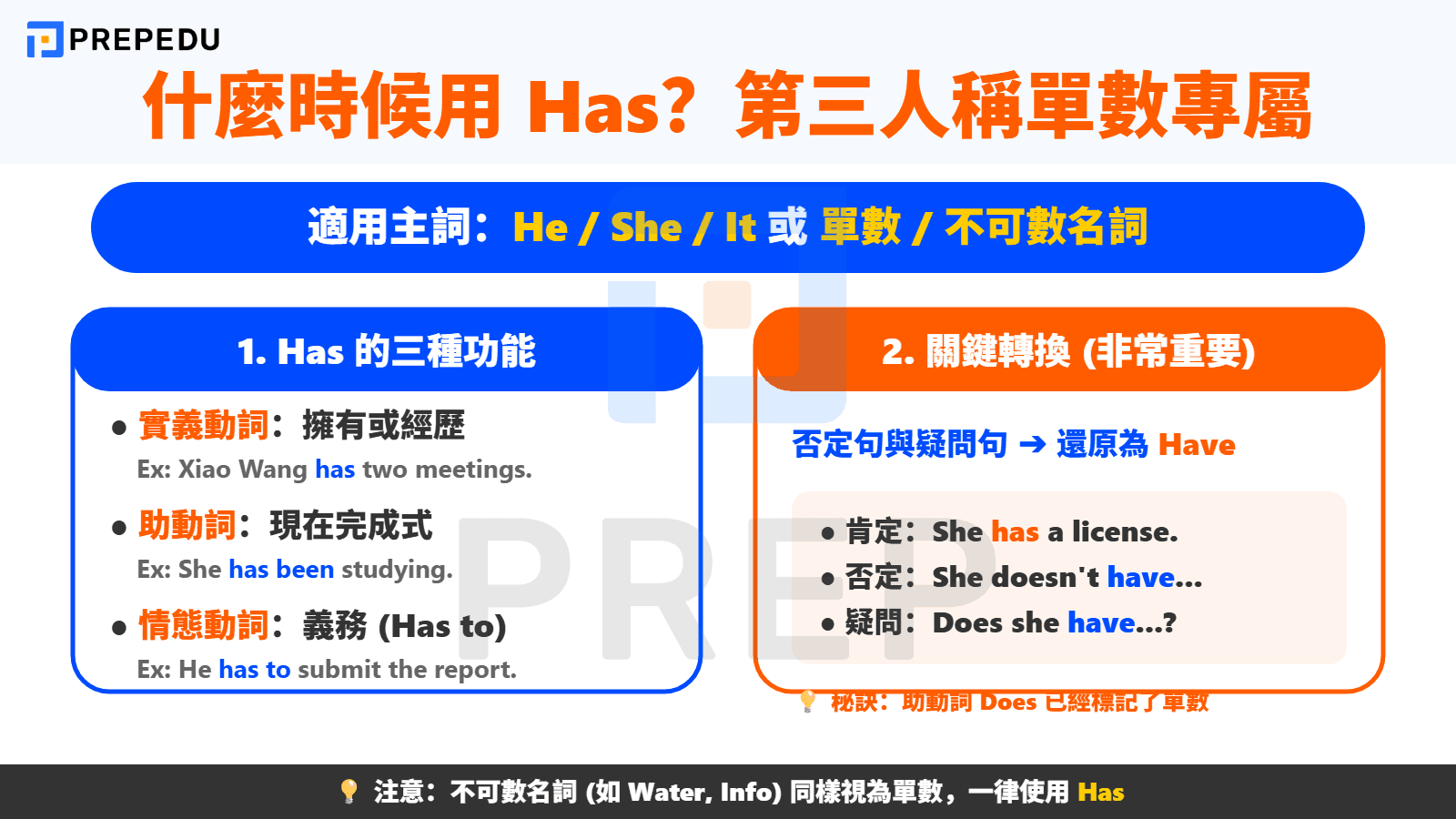
Has 是 have 的第三人稱單數現在式形態,是 Has Have Had 用法中人稱限制最明確的一個形式。當主詞為 He、She、It,或者不可數名詞、可數單數名詞時,一律使用 has。這是初學者在英文寫作中最頻繁犯錯的語法環節,也是 TOEIC 閱讀測驗的高頻考點。
核心規則:主詞為第三人稱單數(He/She/It)或單數名詞 → 一律用 Has
Has 同樣具備三種語法功能,分別對應 have 的三種身份,差異僅在於人稱限制。
|
實義動詞:表示第三人稱單數的擁有或經歷 |
|
|
助動詞:構成第三人稱現在完成式 |
|
|
情態動詞:Has to 表示第三人稱的義務 |
|
否定句與疑問句中的關鍵轉換 → 在否定句或疑問句中,has 必須還原為 have,由助動詞 does 承擔第三人稱的語法標記。理解這一轉換規則,是全面掌握 Has Have Had 用法的關鍵環節,許多學習者在此容易犯錯。
|
句型 |
正確 ✅ |
|
肯定句 |
She has a driver's license.(她有駕照。) |
|
否定句 |
She doesn't have a driver's license.(她沒有駕照。) |
|
一般疑問句 |
Does she have a driver's license?(她有駕照嗎?) |
|
完成式疑問句 |
Has she finished the report?(她已經完成報告了嗎?) |
當助動詞 does 或 did 出現在句子中,動詞必須還原為原形 have,由 does/did 承擔時態和人稱的標記功能。這條規則在 IELTS 和 TOEIC 的寫作測驗中是高頻考點,務必牢記。
IV. Had Has Have 用法之 Had:Had 用在哪裡?過去式與過去完成式的核心
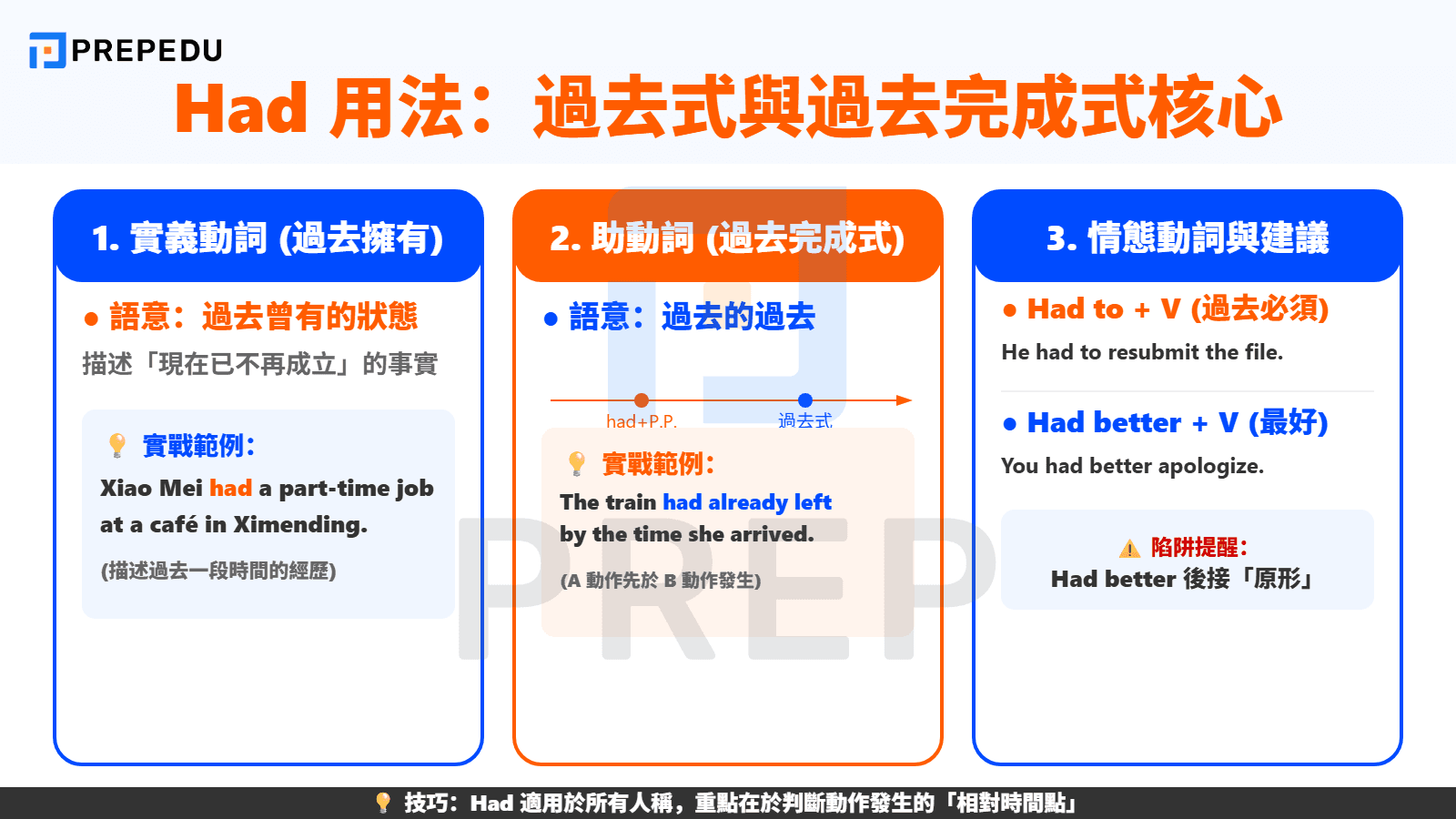
在 Has Have Had 用法體系中,had 是 have 的過去式,同時也是過去完成式的助動詞,適用於所有人稱,無論主詞是單數還是複數。Had 負責描述「過去」時間軸上的所有動作與狀態,是時態體系中用途最多元、語義層次最豐富的一個形式。
1. 過去式實義動詞:描述過去曾擁有的狀態或經歷
Had 作為實義動詞時,表示在過去某段時間內擁有的事物或狀態,現在已不再成立。換言之,過去的條件或情況已發生改變,這是 Has Have Had 用法中最直觀的時態對比。
-
Xiao Mei had a part-time job at a café in Ximending when she was a university student in Taipei.(小美在台北讀大學時,曾在西門町一家咖啡廳打工。)
-
He had a severe headache on the morning of his TOEIC exam, but still managed to score 850.(他在參加多益考試當天早上頭痛欲裂,但仍考出了 850 分。)
-
The Hong Kong branch had over two hundred staff members before the restructuring last year.(香港分部在去年重組之前,員工人數超過兩百人。)
2. 助動詞:構成過去完成式(「過去的過去」)
過去完成式(Past Perfect)用來表達在某個過去時間點「之前已發生完畢」的動作,形成「過去的過去」的語義層次。這個時態必須搭配另一個過去時間點作為參照,句子才完整。掌握這個邏輯,是深入理解 Has Have Had 用法進階結構的核心步驟。
時間軸概念:
更早的過去(had + P.P.)→ 過去某時間點(過去式)→ 現在
-
By the time Jia Ling arrived at the Taipei Main Station, the last train to Hsinchu had already left.(嘉玲抵達台北車站時,最後一班往新竹的列車已經開走了。)
-
The manager confirmed that she had reviewed all the candidates' portfolios before the interview started at nine.(面試在九點開始前,經理確認她已審閱了所有應徵者的作品集。)
-
Wei Chen had studied Mandarin intensively for three years before he relocated to Hong Kong for work.(威辰在移居香港工作之前,已密集學習了三年的普通話。)
3. 情態動詞:Had to 與 Had better
Had to 表示過去的客觀義務;had better 則是一種帶有警告語氣的建議,中文意為「最好……(否則會有不好的後果)」。兩者後面都直接接動詞原形,不加 to。
|
結構 |
語義 |
例句 |
|
had to + 動詞原形 |
過去必須(客觀義務) |
He had to resubmit the visa application because of a missing document.(他因少了一份文件而必須重新提交簽證申請。) |
|
had better + 動詞原形 |
最好……(含警告) |
You had better apologize to the client before the situation gets any worse.(你最好在事態進一步惡化之前向客戶道歉。) |
|
had better not + 動詞原形 |
最好不要…… |
She had better not miss the final deadline or her contract may be terminated.(她最好不要錯過最終截止日期,否則合約可能會被終止。) |
V. Had Have Has 用法進階解析:I Have Had 是什麼時態?弄懂 Have Had 與 Had Had
這是 Has Have Had 用法中最讓學習者困惑的進階問題。"I have had" 和 "I had had" 看起來重複,實際上各有精確的語法結構與獨立的語義。理解這兩個結構,代表你對 Has Have Had 用法已達進階水平,也意味著你能在 IELTS 寫作或 TOEIC 閱讀中準確辨別複雜的時態訊息。
在深入解析之前,必須先確認一個根基:Have 的動詞三態為 have(現在式)→ had(過去式)→ had(過去分詞)。無論是 have had 還是 had had,後面那個 had 始終是 have 的過去分詞,扮演主要動詞的角色。
1. Have Had:現在完成式的核心結構
公式:
主詞 + have/has + had(過去分詞)
在 I have had 中,第一個 have 是助動詞,第二個 had 是實義動詞 have 的過去分詞,合在一起構成現在完成式(Present Perfect Tense)。這個結構強調「從過去某時到現在為止」已完成或持續的狀態,事件的完成時間點落在「現在」。這是 Has Have Had 用法中使用頻率最高的複合結構。
|
成分 |
詞性角色 |
功能說明 |
|
have/has |
助動詞 |
標記現在完成式,依主詞人稱變化 |
|
had |
過去分詞(V.p.p.) |
主要動詞,表示「擁有、經歷、進行」 |
人稱選用規則與一般現在完成式相同:主詞為 I/You/We/They 時用 have had;主詞為 He/She/It 或單數名詞時用 has had。
例句解析:
-
I have had this laptop for almost four years, and it still runs perfectly.(我用這台筆電快四年了,它運作依然順暢。)
-
Xiao Wang has had considerable experience in international trade negotiations since joining the Taipei office.(自從加入台北辦公室以來,小王在國際貿易談判方面累積了相當豐富的經驗。)
-
We have had three rounds of interviews this week alone, and all candidates performed above expectations.(光是本週,我們就已進行了三輪面試,所有應徵者的表現都超出預期。)
2. Had Had:過去完成式的雙重結構
公式:
主詞 + had + had(過去分詞)
在 I had had 中,第一個 had 是助動詞,第二個 had 是過去分詞,合在一起構成過去完成式(Past Perfect Tense)。這個結構強調事件在某個過去時間點「之前已完成」,時間參照點落在「過去」而非現在。過去完成式不分人稱,一律使用 had,這是 Has Have Had 用法中唯一不受人稱限制的時態結構。
例句解析:
-
By the time his colleagues called him for lunch, Jia Ming had had three cups of coffee already and felt too jittery to eat.(同事叫他去吃午餐時,嘉明已經喝了三杯咖啡,緊張得沒有胃口進食。)
-
She had had the same recurring problem with the software for months before the IT team finally identified the root cause.(在 IT 團隊終於找到根本原因之前,她已被這個軟體的反覆問題困擾了好幾個月。)
3. 現在完成式 vs. 過去完成式:核心對比
|
比較項目 |
現在完成式(have had) |
過去完成式(had had) |
|
結構 |
have/has + had |
had + had |
|
時間參照點 |
現在 |
過去的某一時刻 |
|
語義焦點 |
與現在的連結 |
在某個過去時間點之前已完成 |
|
人稱限制 |
have/has 依主詞變化 |
一律使用 had,不分人稱 |
|
常搭配詞 |
for、since、already、just、ever |
before、by the time、when(過去式子句) |
關鍵判斷法則: 檢視句子中是否存在「過去的時間參照點」。若有(如 before she arrived、by the time he called),通常使用過去完成式(had had);若沒有明確的過去時間點,現在完成式(have had/has had)更為合適。這個判斷法則是貫穿整個 Has Have Had 用法學習歷程的核心思路。
VI. Has Have Had 用法的特殊結構:從使役動詞到常見慣用短語
除了基本時態,Has Have Had 用法還涵蓋兩類進階結構:使役動詞(Causative Have)與高頻慣用搭配。理解這些特殊用法,能大幅提升你在 IELTS 口語、TOEIC 情境題及日常英文溝通中的表達精準度。
1. 使役動詞:Have 的三種結構
使役動詞 have 表示「讓某人做某事」或「安排某物被處理」,是英文中高實用性的句型。在 Has Have Had 用法的進階應用中,使役結構的準確使用往往能讓書面與口語表達更自然、更道地。
|
結構 |
句型公式 |
語義重點 |
例句 |
|
Have + 人 + 動詞原形 |
主動使役(讓某人做某事) |
說話者安排他人執行動作 |
The manager had Xiao Chen send the revised proposal to the Hong Kong client by noon.(經理讓小陳在中午前將修改後的提案發給香港客戶。) |
|
Have + 物 + 過去分詞 |
被動使役(讓某物被處理) |
說話者委託他人處理某物 |
She had her laptop repaired at the service centre near Taipei Main Station.(她把筆電送到台北車站附近的服務中心維修。) |
|
Have + 物 + 現在分詞 |
狀態持續(使某事持續進行) |
說話者讓某種狀態維持 |
He had the conference call recording running throughout the entire two-hour session.(他讓視訊會議的錄音在整個兩小時的會議期間持續運作。) |
另有一個重要結構:have been to + 地點,表示曾經去過某地但現已離開,與 have gone to(已前往,尚未返回)意義不同。正確區分這兩者,是 Has Have Had 用法中不可忽略的細節。
-
I have been to Hong Kong three times for business, and I find the pace of the city both exhilarating and demanding.(我曾三次因公務前往香港,我覺得這座城市的節奏既令人振奮,又讓人倍感壓力。)
-
She has been to every major financial hub in Asia since she started her career in international banking.(自從她在國際銀行業展開職涯以來,她已造訪過亞洲每一個主要的金融中心。)
2. 高頻慣用搭配:Have 的固定片語
這些搭配中的 have 不能替換為其他動詞,使用時須根據主詞人稱與時態,依照 Has Have Had 用法的基本規則做出相應的形式調整。
|
片語 |
中文意思 |
例句 |
|
have a cold |
感冒 |
Jia Ling has a cold and decided to work from home to avoid spreading it to the team.(嘉玲感冒了,決定居家辦公,以免將病毒傳染給團隊。) |
|
have a look |
看一看 |
Could you have a look at this contract clause before I send it to the Taipei legal team?(在我把這份合約條款發給台北法務團隊之前,你能幫我看一下嗎?) |
|
have a word with |
與某人談一談 |
The supervisor needs to have a word with Wei Chen about his repeated tardiness this month.(主管需要就小威本月反覆遲到的情況與他談一談。) |
|
have a blast |
玩得非常開心 |
The entire Taipei office team had a blast at the year-end party last Friday night.(整個台北辦公室的團隊在上週五晚上的年終派對中玩得非常開心。) |
|
have a hard time |
度過艱難時期 |
Xiao Mei is having a hard time managing her workload since two colleagues resigned last month.(自從上個月兩位同事辭職以來,小美一直難以應付繁重的工作量。) |
|
have trouble (doing) |
在某事上遇到困難 |
He has trouble articulating his ideas clearly in English when presenting to overseas clients.(他在向海外客戶簡報時,難以用英文清楚表達自己的想法。) |
|
have a meeting |
開會 |
We have a meeting with the Hong Kong headquarters team every Tuesday morning via video call.(我們每週二早上透過視訊與香港總部團隊開會。) |
|
have dinner |
吃晚餐 |
Let's have dinner at the new Cantonese restaurant near Xinyi District after the client presentation.(我們在客戶簡報結束後,去信義區附近那家新開的粵菜餐廳吃晚餐吧。) |
VII. Has Have Had 用法實戰演練:3 大題型挑戰,快速檢測學習成果
理論只是起點,真正內化 Has Have Had 用法,需要透過大量練習來鞏固。以下三組題型從基礎到進階,系統性地幫你檢測掌握程度。每一題都附有詳細解析,讓你真正理解「為什麼」而非只記住「是什麼」。
1. 練習一:基礎人稱填空(選擇 Have 或 Has)
說明: 根據主詞,在空格中填入正確的 have 或 has。這是 Has Have Had 用法最基礎的辨別訓練。
-
Xiao Wang ____ a job interview at a tech company in Taipei this afternoon.
-
The students in the advanced class ____ a lot of potential.
-
My sister ____ finished packing her luggage for her business trip to Hong Kong.
-
The Hong Kong office ____ over fifty full-time staff members.
-
You ____ every reason to be confident before the IELTS speaking test.
-
He ____ to resubmit his application because of a missing signature.
-
I ____ two important deadlines this week.
-
The company ____ a strong reputation for employee welfare.
-
It ____ been raining in Taipei every afternoon for the past two weeks.
-
We ____ a team briefing scheduled for nine o'clock tomorrow morning.
答案與解析
-
has(Xiao Wang = 第三人稱單數)
-
have(The students = 複數)
-
has(My sister = 第三人稱單數)
-
has(The Hong Kong office = 單數名詞)
-
have(You = 第二人稱)
-
has(He = 第三人稱單數;has to 中的 has 為情態動詞)
-
have(I = 第一人稱)
-
has(The company = 單數名詞)
-
has(It = 第三人稱單數)
-
have(We = 複數)
2. 練習二:時態判斷轉換(現在式 → 完成式或過去式)
說明: 將下列句子依提示改寫為指定時態。這組練習幫你鞏固 Has Have Had 用法在不同時態情境下的靈活轉換能力。
-
Xiao Mei eats breakfast. → 現在完成式(Xiao Mei ____ ____ breakfast.)
-
She has a car. → 過去式(She ____ a car.)
-
He finishes the project. → 過去完成式,在截止日前(He ____ ____ the project before the deadline.)
-
They live in Taipei. → 現在完成式,持續 8 年(They ____ ____ in Taipei for eight years.)
-
She has a headache. → 過去式(She ____ a headache.)
-
Jia Ming goes to Hong Kong for work. → 現在完成式,三次(Jia Ming ____ ____ to Hong Kong for work three times.)
-
He reads the client's report. → 過去完成式(By the time the meeting started, he ____ ____ the client's report.)
-
We know the answer. → 現在完成式,自週一起(We ____ ____ the answer since Monday.)
-
The train leaves Taipei. → 過去完成式(The train ____ ____ Taipei before we arrived at the station.)
-
She studies English every day. → 現在完成式,持續兩年(She ____ ____ English every day for two years.)
答案與解析
-
has eaten(現在完成式:has + 過去分詞;主詞 Xiao Mei = 第三人稱單數,用 has)
-
had(had 是 have 的過去式)
-
had finished(過去完成式:had + 過去分詞;finish → finished)
-
have lived(現在完成式 + for 表持續;主詞 They = 複數,用 have)
-
had(had 是 has 的過去式;所有人稱的過去式一律用 had)
-
has been(go to a place and return → 用 have been to;主詞 Jia Ming = 第三人稱單數,用 has)
-
had read(過去完成式,動作發生在 the meeting started 之前;read → read)
-
have known(know → known;主詞 We = 複數,用 have)
-
had left(過去完成式,動作發生在 we arrived 之前;leave → left)
-
has studied(主詞 She = 第三人稱單數,用 has;study → studied)
3. 練習三:綜合情境改錯(找出 Have、Has、Had 的錯誤)
說明: 下列句子各有一處 have/has/had 使用錯誤,請找出並改正,同時說明原因。這是 Has Have Had 用法中難度最高的整合訓練,直接對應 IELTS Writing Task 1 與 TOEIC 閱讀的常見題型。
-
She have been working at the Taipei headquarters for over three years.
-
By the time Wei Chen arrived at the conference room, the presentation have already started.
-
Does the Hong Kong office has a dedicated legal team?
-
Xiao Wang and his colleagues has submitted the final report this morning.
-
You had better to call the client immediately to clarify the misunderstanding.
-
She didn't had time to review the contract before the signing ceremony.
-
Jia Ling have had her passport renewed last month, so she is ready for the business trip.
-
We had went to the Taipei office for a briefing before the project was officially launched.
-
Has you ever attended an international trade conference in Hong Kong?
-
The quarterly results have been reviewed, and the board have approved the new budget.
答案與解析
-
She ~~have~~ → has been working(She 為第三人稱單數,現在完成進行式助動詞應為 has)
-
the presentation ~~have~~ → had already started(需用過去完成式,動作發生在 Wei Chen arrived 之前)
-
Does the Hong Kong office ~~has~~ → have a dedicated legal team?(疑問句中助動詞 does 承擔語法標記,動詞必須還原原形 have)
-
Xiao Wang and his colleagues ~~has~~ → have submitted(複數主詞,助動詞應為 have)
-
You had better ~~to~~ call → had better call(had better 後直接接動詞原形,不加 to)
-
She didn't ~~had~~ → have time(否定句中助動詞 didn't 後接動詞原形)
-
Jia Ling ~~have~~ → has had her passport renewed(主詞 Jia Ling = 第三人稱單數,助動詞應為 has)
-
We had ~~went~~ → gone(過去完成式需用過去分詞:go → gone)
-
~~Has~~ you → Have you(You 為第二人稱,應用 have,非 has)
-
the board ~~have~~ → has approved(the board 視為單一機構,為單數名詞,應用 has)
VIII. Has Have Had 用法常見疑惑解答(FAQ)
以下整理出學習者在深入鑽研 Has Have Had 用法時最常提出的問題,給你直接、精確的解答,幫助你在考試和實際溝通中準確運用,零失誤。
1. 疑問句可以用 Has 開頭嗎?
可以。在 Has Have Had 用法的疑問句結構中,當主詞為第三人稱單數,且句子為現在完成式疑問句時,直接將 has 移至句首,形成倒裝結構。
例如:Has she submitted the application to the Hong Kong office yet?(她已經向香港辦公室提交申請了嗎?)這裡的 has 扮演助動詞角色,直接倒裝至句首。
須注意的是,若疑問句使用助動詞 do/does,則 has 必須還原為 have,例如:"Does he have a valid work permit?"(他有有效的工作許可嗎?)
2. 縮寫 's 和 've,如何判斷是 have、has,還是 is?
判斷縮寫的關鍵在於後面接的詞性,這也是 Has Have Had 用法中最讓人混淆的書面表達問題。
若縮寫後接過去分詞(如 gone、been、finished、done),則表示完成式:'s 代表 has,'ve 代表 have。
若縮寫後接形容詞、名詞或現在分詞,則通常表示 be 動詞。
-
She's gone to Hong Kong for a conference. → She has gone(完成式)
-
She's an experienced project manager. → She is(be 動詞)
-
I've already reviewed the Taipei branch report. → I have(完成式)
在語意模糊時,讀出完整形式是判斷縮寫的最可靠方法。
3. Have 什麼時候不能改成進行式 Having?
這是 Has Have Had 用法中一個常被忽視的細節。
當 have 作為狀態動詞(Stative Verb)表示「持有、擁有」時,不能使用進行式。例如 I am having a laptop(❌)是錯誤的,因為擁有是一種靜態的狀態,不具有動態的進行特質,正確說法是 I have a laptop.。
然而,當 have 表示動態動作(如進行中的活動、飲食、體驗)時,則可以使用進行式:
-
Xiao Wang is having a video call with the Hong Kong team right now.(小王現在正在和香港團隊進行視訊通話。)
-
She is having a wonderful time exploring the night markets in Taipei.(她正在台北的夜市享受美好時光。)
簡而言之,have 表示「靜態擁有」時不用進行式;表示「動態進行中的活動或體驗」時則可以使用。這條規則同樣適用於 had 的相應語境。
結論
Have Has Had 用法不只是三個動詞,它們是英文時態體系的核心架構。從第三人稱單數的 has 使用規則、had 構成的過去完成式,到 have had 與 had had 的精細區別,每一個層次都有其清晰的邏輯。全面掌握 Has Have Had 用法,你對英文時態的整體理解將提升一個層次,在聽說讀寫各方面都能更穩定地運用。
面對龐大的考試準備內容感到不知所措?PREPEDU 理解這種焦慮,設計系統幫助你在最短時間內優化學習成果。
系統不讓你盲目練習。PREPEDU 透過每次測驗分析你的優勢和弱點,專注於最需要改善的技能。這種智能學習方法比傳統方式節省高達 50% 的時間。
PREPEDU 將雅思考題和多益題型練習題按難度遞增排列,幫助你建立穩固基礎後再挑戰更難的題目。每分鐘練習都有價值,每次測驗都讓你更接近目標。
別讓時間流逝而沒有顯著進步。立即開始 PREP 的 IELTS 和 TOEIC 智能學習之旅,在最短時間內達成理想分數。
今天就開始智能練習!

你好!我叫黃秋賢,現在在 prepedu.com 擔任內容企劃。我有超過5年的英語與韓語自學經歷,親身備考 IELTS、TOEIC 與 TOPIK,累積了大量第一手的學習者視角——包括哪些語法規則最讓台灣與香港學習者混淆,以及如何在有限的備考時間內最有效地修正這些錯誤。目前已在 prepedu.com 撰寫超過 1000 篇英語學習文章,內容涵蓋語法、詞彙與考試策略,累積協助數千位學習者解決自學過程中的語法疑問。
評論












統一企業編號:202227322W
地址:114 LAVENDER STREET, #11-83 CT HUB 2, SINGAPORE (338729)