形容詞片語(Adjective Phrase)英文文法、6大種類與150+形容詞片語例句總整理
形容詞片語英文(Adjective Phrase)是什麼?簡單來說,形容詞片語是一組以形容詞為核心、由兩個或以上單字構成的詞群,在英文句子中扮演修飾名詞或作為補語的角色。它既可放在名詞前方作前置修飾,也能置於名詞後方構成後位修飾,靈活程度遠超單一形容詞。掌握形容詞片語,是讓英文寫作從「能看懂」躍升至「令人印象深刻」的核心關鍵。
許多學習者誤以為,英文寫作只要用詞正確就足夠了。然而,真正影響雅思寫作評分(Writing Task Achievement)和多益表達品質的,往往是句子結構的豐富程度——而形容詞片語正是最直接提升這一項指標的工具。一篇沒有形容詞片語的文章,就像一幅只有輪廓、缺乏色彩的素描,語意雖通,卻難以打動讀者。
PREPEDU 這份形容詞片語全攻略,將帶你系統性掌握形容詞片語英文的 6 大種類與結構、150 組以上的介系詞固定搭配例句、OSASCOMP 多個形容詞排列規則,以及如何將形容詞子句精簡為片語。無論你正在備考 IELTS、多益或 DSE,這篇文章都是你不能錯過的核心文法資源。

I. 為什麼要學英文形容詞片語?提升英文句子層次的關鍵
許多學習者以為,堆砌更多單字就能讓英文變好。事實恰恰相反——真正提升句子層次的,是你對語言結構的掌控能力。形容詞片語(Adjective Phrase)正是這項能力的核心。掌握形容詞片語,你的英文寫作就能從平淡無奇躍升至精準有力的水準。
-
精準修飾名詞細節 單一形容詞(如 tall、old)往往只能描述表面特徵。形容詞片語(如 extremely tall、old enough to vote)讓你的描述更具體、更有深度,直接提升語意精準度。
-
替換單調的單一形容詞 重複使用相同的基礎形容詞,會讓文章顯得單調乏味。形容詞片語提供豐富的語言變化,讓你的句子更有節奏感,也更能展現語言運用的成熟度。
-
簡化冗長的關係子句,提升考試寫作分數 許多學習者習慣使用 who/which/that 引導的關係子句來修飾名詞,但這類結構在學術寫作中往往顯得累贅。將子句壓縮成形容詞片語,不僅句子更簡潔,在 DSE、學測等考試中也更容易拿高分。
II. 形容詞片語是什麼?定義與核心功能解析
形容詞片語(Adjective Phrase,縮寫 AdjP)是一種以形容詞英文為核心(head word)、由兩個或以上單字構成的詞群結構,在句中扮演與單一形容詞相同的角色——修飾名詞或代名詞,或作為句中的補語。
1. 形容詞片語的基本定義
形容詞片語是一組以形容詞為核心的詞群,可以在句中替代單一形容詞的功能,用來描述或限定名詞及代名詞的特徵、狀態或性質。形容詞片語與單一形容詞的根本差異,在於它包含兩個或以上的單字,通常以「前置修飾語+形容詞核心」或「形容詞核心+後置補語」的形式構成。
對比以下例句,便能清楚看出兩者的差異:
-
單一形容詞:She is tall.(她很高。)
-
形容詞片語:She is tall enough to be a model.(她高到足以當模特兒。)
在第二句中,tall enough to be a model 是一個完整的形容詞片語,核心形容詞是 tall,被 enough to be a model 進一步修飾和擴展,提供更豐富的語意資訊。
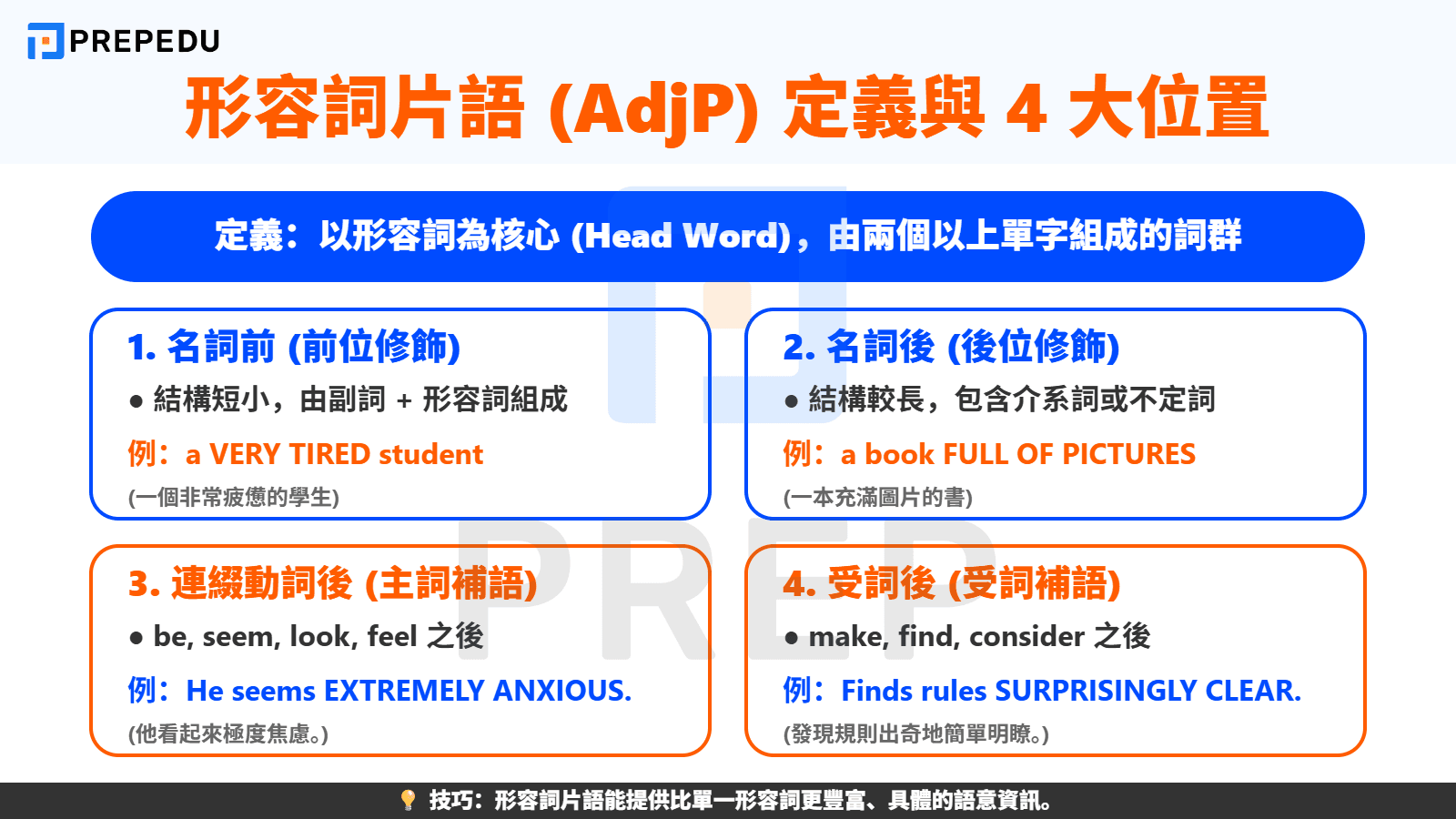
2. 形容詞片語英文的四大位置功能
形容詞片語在句中有四個核心功能位置,理解這四點是靈活運用的前提。
|
位置 |
適用條件 |
形容詞片語例句 |
|
名詞前 (前位修飾) |
由單一或少數形容詞組成、結構短小 |
|
|
名詞後方(後位修飾) |
包含介系詞、不定詞或分詞的較長片語 |
|
|
連綴動詞後(主詞補語) |
be、seem、look、feel 等動詞之後 |
|
|
動詞後(受詞補語) |
make、find、consider、keep 等動詞之後 |
|
III. 150+ 形容詞片語大全總整理(按介系詞分類)
這是本篇形容詞片語指南中實用性最高的段落。掌握形容詞與介系詞的固定搭配,是提升英文表達流暢度的捷徑。以下按介系詞類型分類,提供高頻考試形容詞片語例句,方便你系統化背誦與查閱。
1. 搭配 About / For 的形容詞片語例句
|
形容詞片語 |
中文意思 |
形容詞片語例句 |
|
crazy about |
對……著迷 |
XiaoWang is crazy about learning English grammar after watching online videos.(小王在觀看網路影片後對學習英語文法著迷了。) |
|
curious about |
對……好奇 |
Xiangang students are curious about the new IELTS test format introduced this year.(香港的學生對今年推出的新雅思考試格式感到好奇。) |
|
worried about |
對……感到擔憂 |
She is worried about her performance in the upcoming TOEIC speaking test.(她對即將到來的多益口說測驗中的表現感到擔憂。) |
|
excited about |
對……感到興奮 |
The students in Taipei are excited about studying abroad next semester.(台北的學生對下學期出國留學感到興奮。) |
|
enthusiastic about |
對……充滿熱忱 |
XiaoWang is enthusiastic about joining the English debate club at his school.(小王對加入學校英語辯論社充滿熱忱。) |
|
passionate about |
對……充滿熱情 |
The young teacher from Xiangang is passionate about helping students improve their writing skills.(來自香港的年輕教師對幫助學生提升寫作技能充滿熱情。) |
|
serious about |
認真看待…… |
If you are serious about passing IELTS band 7, daily practice is essential.(如果你認真看待通過雅思7級分,每日練習是不可或缺的。) |
|
sorry about |
對……感到抱歉 |
XiaoWang is sorry about missing the grammar review session last Tuesday.(小王對上週二缺席文法複習課感到抱歉。) |
|
certain about |
對……確定 |
She is certain about her answer for the reading comprehension question.(她對閱讀理解題的答案感到確定。) |
|
happy about |
對……感到高興 |
The Taipei study group is happy about their progress in learning adjective phrases.(台北讀書小組對在學習形容詞片語方面的進步感到高興。) |
|
famous for |
以……著名 |
Taiwan is famous for its high-quality English language teaching programs.(台灣以高品質的英語教學課程著名。) |
|
responsible for |
負責…… |
The teacher is responsible for designing a curriculum that covers adjective phrases.(該教師負責設計涵蓋形容詞片語的課程。) |
|
suitable for |
適合…… |
This study guide is suitable for students preparing for the DSE English exam.(這份學習指南適合準備香港文憑試英語科的學生。) |
|
eager for |
渴望…… |
XiaoWang is eager for a higher score in the written component of the TOEIC test.(小王渴望在多益筆試部分取得更高的分數。) |
|
ready for |
準備好…… |
After two months of practice, she finally feels ready for the IELTS speaking test.(經過兩個月的練習,她終於感到準備好迎接雅思口說測驗。) |
|
qualified for |
符合……的資格 |
He is qualified for the advanced English course offered at the Xiangang language centre.(他符合香港語言中心提供的進階英語課程的資格。) |
2. 搭配 From / In / On 的形容詞片語例句
|
形容詞片語 |
中文意思 |
形容詞片語例句 |
|
absent from |
缺席…… |
XiaoWang was absent from the grammar workshop held in Taipei last Friday.(小王缺席上週五在台北舉辦的文法工作坊。) |
|
different from |
與……不同 |
The adjective phrase structure in English is quite different from what we see in Chinese.(英語中的形容詞片語結構與我們在中文中看到的相當不同。) |
|
derived from |
源自…… |
The term "adjective phrase" is derived from Latin grammatical tradition.(「形容詞片語」這個術語源自拉丁文法傳統。) |
|
free from |
免於…… |
A well-structured essay should be free from misplaced adjective phrases.(一篇結構良好的文章應免於形容詞片語錯置的問題。) |
|
distinct from |
與……有所不同 |
An adjective phrase is distinct from an adverb phrase in both function and position.(形容詞片語在功能和位置上都與副詞片語有所不同。) |
|
separated from |
與……分隔 |
She felt separated from her study group in Xiangang after moving to Taipei.(搬到台北後,她感到與香港的讀書小組分隔。) |
|
interested in |
對……感興趣 |
XiaoWang is deeply interested in understanding how adjective phrases enhance academic writing.(小王對理解形容詞片語如何強化學術寫作深感興趣。) |
|
experienced in |
在……有經驗 |
The IELTS examiner is highly experienced in assessing adjective phrase usage in writing tasks.(這位雅思考官在評估寫作任務中形容詞片語的使用方面經驗豐富。) |
|
successful in |
在……成功 |
She was successful in identifying adjective phrases correctly in the DSE mock test.(她在文憑試模擬考試中成功正確辨識形容詞片語。) |
|
fluent in |
在……流利 |
A student fluent in English can naturally use various adjective phrase structures.(流利使用英語的學生能自然運用各種形容詞片語結構。) |
|
skilled in |
擅長…… |
XiaoWang has become quite skilled in transforming adjective clauses into phrases.(小王在將形容詞子句轉化為片語方面已變得相當熟練。) |
|
involved in |
參與…… |
She is actively involved in a Taipei language exchange group to practise adjective phrases.(她積極參與台北一個語言交換小組,以練習形容詞片語。) |
|
based on |
基於…… |
The IELTS writing band score is based on grammatical accuracy, including correct phrase usage.(雅思寫作評分基於語法準確度,包括正確的片語使用。) |
|
dependent on |
依賴…… |
Correct meaning is dependent on placing the adjective phrase next to the noun it modifies.(正確的意思取決於將形容詞片語置於其所修飾名詞的旁邊。) |
|
keen on |
熱衷於…… |
The Xiangang teacher is keen on helping students master postpositive adjective phrases.(香港教師熱衷於幫助學生掌握後置形容詞片語。) |
|
focused on |
專注於…… |
During revision, stay focused on reviewing adjective phrase positions in complex sentences.(在複習期間,專注於複習複合句中形容詞片語的位置。) |
3. 搭配 Of / To / With 的形容詞片語例句
|
形容詞片語 |
中文意思 |
形容詞片語例句 |
|
afraid of |
害怕…… |
Many Taipei students are afraid of making errors in adjective phrase placement during exams.(許多台北學生害怕在考試中犯形容詞片語位置的錯誤。) |
|
capable of |
有能力…… |
With enough practice, XiaoWang is capable of producing complex adjective phrases fluently.(經過足夠練習,小王有能力流暢地運用複雜的形容詞片語。) |
|
aware of |
意識到…… |
Be aware of the common mistake of placing long adjective phrases before a noun.(要意識到將長形容詞片語放在名詞前的常見錯誤。) |
|
proud of |
為……自豪 |
The teacher in Xiangang is proud of her students' progress in using adjective phrases correctly.(香港的老師為學生在正確使用形容詞片語方面的進步感到自豪。) |
|
tired of |
厭倦…… |
XiaoWang is tired of memorising individual adjectives without learning how to build phrases.(小王厭倦了在不學習如何構建片語的情況下記憶單一形容詞。) |
|
full of |
充滿…… |
The grammar textbook is full of well-explained adjective phrase examples from real contexts.(這本文法教科書充滿了來自真實語境且解釋清晰的形容詞片語例子。) |
|
short of |
缺乏…… |
Her essay is short of varied adjective phrases, which limits its overall score.(她的文章缺乏多樣的形容詞片語,這限制了整體分數。) |
|
independent of |
不依賴…… |
A skilled writer is independent of simple adjectives and uses rich phrases instead.(熟練的寫作者不依賴簡單的形容詞,而是使用豐富的片語。) |
|
accustomed to |
習慣於…… |
After months of practice, XiaoWang is accustomed to using postpositive adjective phrases in writing.(經過數月的練習,小王已習慣在寫作中使用後置形容詞片語。) |
|
similar to |
與……相似 |
This English grammar pattern is similar to some structures found in formal Chinese writing.(這個英語文法模式與某些正式中文寫作中的結構相似。) |
|
committed to |
致力於…… |
The Taipei study group is committed to mastering all six types of adjective phrase structures.(台北讀書小組致力於掌握全部六種形容詞片語結構。) |
|
likely to |
可能…… |
Students who study adjective phrase usage are likely to score higher in grammar sections.(學習形容詞片語用法的學生可能在文法部分取得更高分數。) |
|
eager to |
渴望…… |
She is eager to learn how to simplify relative clauses into adjective phrases before her exam.(她渴望在考試前學習如何將關係子句簡化為形容詞片語。) |
|
difficult to |
難以…… |
The postpositive adjective phrase rule is difficult to master without consistent practice.(後置形容詞片語的規則若缺乏持續練習,難以掌握。) |
|
angry with |
對……生氣 |
XiaoWang is angry with himself for confusing participial phrases and adjective clauses in his essay.(小王對自己在文章中混淆分詞片語和形容詞子句感到生氣。) |
|
satisfied with |
對……滿意 |
The examiner is satisfied with the range of adjective phrase structures used in her writing.(考官對她寫作中使用的形容詞片語結構多樣性感到滿意。) |
|
familiar with |
對……熟悉 |
Become familiar with the OSASCOMP rule so that you can arrange adjective phrases correctly.(熟悉 OSASCOMP 規則,以便你能正確排列形容詞片語。) |
|
patient with |
對……有耐心 |
A good teacher in Xiangang is patient with students who struggle with complex phrase structures.(香港的好老師對與複雜片語結構抗爭的學生有耐心。) |
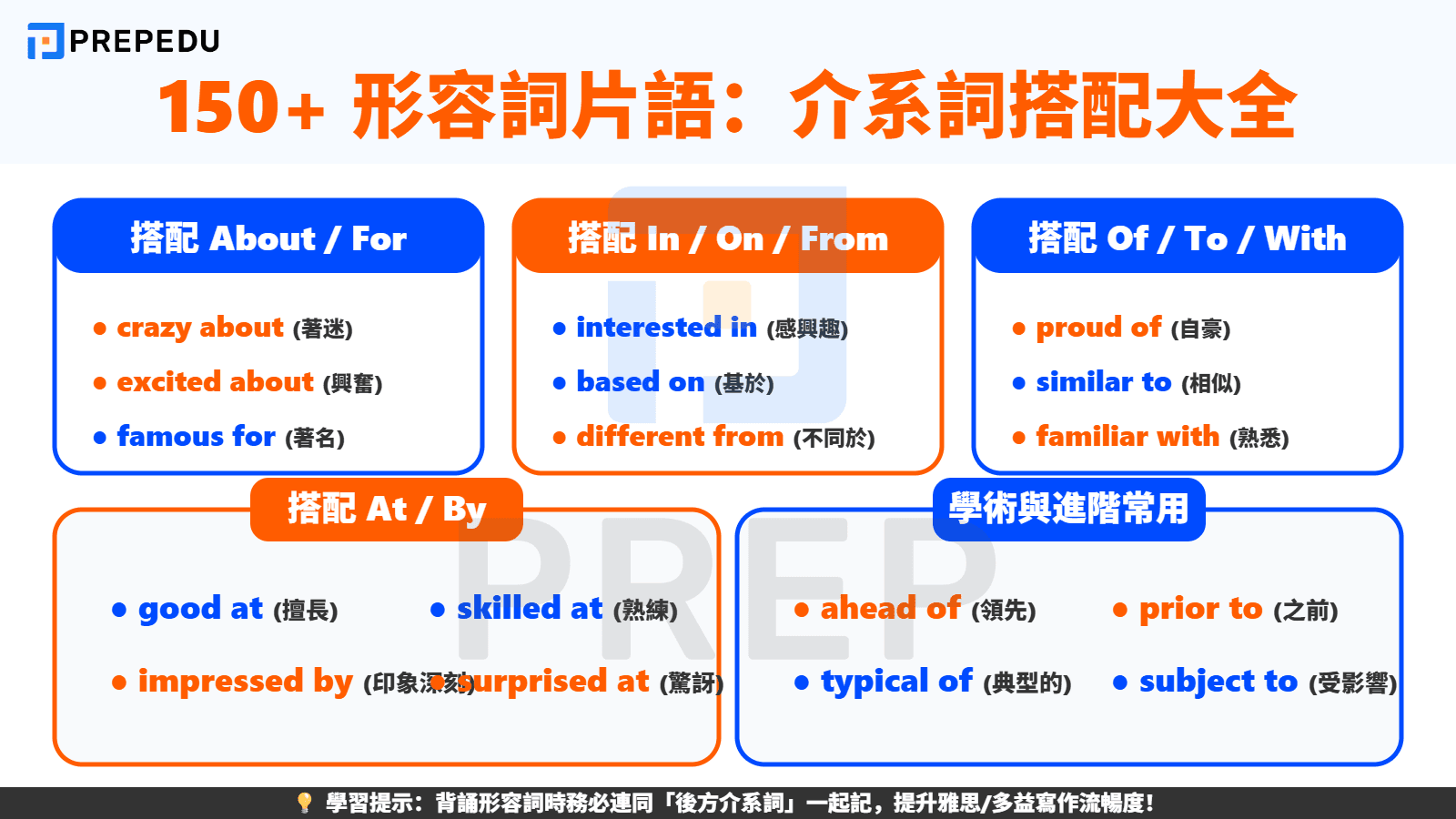
4. 搭配 At / By 的形容詞片語例句
「good at」、「shocked at」等 at 結構描述具體能力或即時反應;「impressed by」、「surrounded by」等 by 結構則強調受影響的來源或施動者,兩者均為形容詞片語的常見介系詞搭配,在雅思和多益寫作中高頻出現。
|
形容詞片語 |
中文意思 |
形容詞片語例句 |
|
good at |
擅長…… |
XiaoWang is surprisingly good at identifying adjective phrases in IELTS reading passages.(小王在辨識雅思閱讀文章中的形容詞片語方面出乎意料地擅長。) |
|
skilled at |
熟練於…… |
After six months of PREP courses, she is skilled at constructing participial adjective phrases.(經過六個月的 PREP 課程,她在構建分詞形容詞片語方面變得熟練。) |
|
quick at |
在……方面反應快 |
Taipei students tend to be quick at spotting OSASCOMP ordering mistakes in sentence correction tasks.(台北學生在句子改錯任務中往往能快速發現 OSASCOMP 排序錯誤。) |
|
terrible at |
在……方面很差 |
He admits he is terrible at arranging multiple adjective phrases in the correct sequence.(他承認自己在按正確順序排列多個形容詞片語方面很差。) |
|
clever at |
在……方面聰明 |
XiaoWang is quite clever at turning complex adjective clauses into concise adjective phrases.(小王在將複雜的形容詞子句轉化為簡潔的形容詞片語方面相當聰明。) |
|
amazed at |
對……感到驚訝 |
The examiner was amazed at the variety of adjective phrase structures in the Xiangang student's essay.(考官對這位香港學生文章中多樣的形容詞片語結構感到驚訝。) |
|
shocked at |
對……感到震驚 |
She was shocked at how simple the rule for postpositive adjective phrases actually is.(她對後置形容詞片語的規則實際上如此簡單感到震驚。) |
|
surprised at |
對……感到驚訝 |
XiaoWang was pleasantly surprised at his ability to use adjective phrases naturally after just one month.(小王對自己僅在一個月後就能自然使用形容詞片語的能力感到愉快的驚訝。) |
|
impressed by |
對……印象深刻 |
The teacher was impressed by how accurately XiaoWang placed each adjective phrase in his paragraph.(老師對小王在段落中準確放置每個形容詞片語的方式印象深刻。) |
|
surrounded by |
被……包圍 |
A learner surrounded by authentic English texts will naturally absorb adjective phrase patterns.(被真實英文文本包圍的學習者會自然地吸收形容詞片語的模式。) |
|
inspired by |
受……啟發 |
She was inspired by her Taipei teacher to explore advanced adjective phrase structures in writing.(她受到台北老師的啟發,開始探索寫作中的進階形容詞片語結構。) |
|
astonished by |
對……感到吃驚 |
The class was astonished by the improvement inXiaoWang's use of participial adjective phrases.(全班對小王在分詞形容詞片語使用上的進步感到吃驚。) |
5. 搭配其他介系詞的形容詞片語例句
英語中還有一類以位置、程度或方向性介系詞構成的形容詞片語,這些搭配在學術寫作和正式表達中尤為常見,是提升文章多樣性的重要工具。
|
形容詞片語 |
中文意思 |
形容詞片語例句 |
|
ahead of |
領先於…… |
Xiangang students are ahead of the national average in adjective phrase usage in writing tasks.(香港學生在寫作任務中形容詞片語的使用方面領先全國平均水平。) |
|
behind in |
在……落後 |
XiaoWang was behind in grammar when he started, but caught up quickly with consistent study.(小王起初在文法方面落後,但他透過持續學習很快追上了。) |
|
beyond |
超越;超出 |
The accuracy of her adjective phrase usage is beyond what is expected at intermediate level.(她形容詞片語使用的準確性超越了中級程度的預期。) |
|
close to |
接近…… |
After months of preparation in Taipei, XiaoWang is close to mastering all adjective phrase structures.(在台北準備了數月後,小王已接近掌握所有形容詞片語結構。) |
|
new to |
對……陌生 |
She is new to the concept of postpositive adjective phrases but grasps it with clear examples.(她對後置形容詞片語的概念陌生,但透過清晰的例子掌握了它。) |
|
open to |
願意接受…… |
A Xiangang student open to feedback tends to improve their adjective phrase accuracy faster.(願意接受反饋的香港學生往往能更快提升形容詞片語的準確度。) |
|
typical of |
典型的…… |
Dangling participles are typical of errors found in adjective phrase misuse by Chinese speakers.(懸垂分詞是以中文為母語者誤用形容詞片語時常見的典型錯誤。) |
|
worthy of |
值得…… |
An essay worthy of a high IELTS band score must demonstrate correct adjective phrase placement.(值得高雅思分數的文章必須展示正確的形容詞片語位置。) |
|
equal to |
等同於…… |
His skill in adjective phrase construction is now equal to that of a native-level writer.(他在形容詞片語構建方面的技巧現在等同於母語水準的寫作者。) |
|
prior to |
在……之前 |
Prior to the IELTS exam, XiaoWang reviewed all adjective phrase rules from the PREP study guide.(在雅思考試之前,小王複習了 PREP 學習指南中的所有形容詞片語規則。) |
|
subject to |
受……影響 |
Sentence meaning is subject to change when the adjective phrase is placed in the wrong position.(當形容詞片語放在錯誤位置時,句子的意義會受到改變。) |
|
opposite to |
與……相反 |
Placing an adjective phrase opposite to its correct position creates confusing sentences.(將形容詞片語置於與其正確位置相反的地方會產生令人困惑的句子。) |
IV. 形容詞片語英文的修飾位置與排列順序
形容詞片語在句中的位置並非隨意而定。位置錯誤,不僅語意模糊,更會讓讀者感到困惑。你必須掌握兩項核心規則:前位修飾的排列順序,以及後位修飾的使用條件。
1. 前位修飾與 OSASCOMP 多個形容詞排列規則
當多個形容詞同時修飾一個名詞時,英文有一套固定的形容詞順序排列規則,稱為 OSASCOMP 原則。這個縮寫代表八個類別的形容詞,必須按照固定順序排列。違反這個順序,句子聽起來會非常不自然。
|
縮寫 |
類別 |
中文說明 |
常見例子 |
|
O |
Opinion(意見) |
主觀判斷與評價 |
beautiful(美麗的), ugly(醜陋的), strange(奇怪的), wonderful(美好的) |
|
S |
Size(大小) |
尺寸與體積描述 |
big(大的), small(小的), tall(高的), tiny(極小的), enormous(巨大的) |
|
A |
Age(年齡/年代) |
新舊或年代描述 |
old(老的/舊的), young(年輕的), ancient(古老的), modern(現代的) |
|
S |
Shape(形狀) |
外形與輪廓 |
round(圓形的), square(方形的), flat(平的), triangular(三角形的) |
|
C |
Color(顏色) |
顏色描述 |
red(紅色的), blue(藍色的), golden(金色的), dark-green(深綠色的) |
|
O |
Origin(來源) |
出處、國籍或產地 |
Chinese(中國的), British(英國的), Taiwanese(台灣的) |
|
M |
Material(材質) |
製成的原料 |
wooden(木製的), metal(金屬製的), plastic(塑膠製的), cotton(棉製的) |
|
P |
Purpose(用途) |
功能或用途描述 |
sleeping(睡眠用的), running(跑步用的) |
記憶口訣:「意見大小年,形狀顏色源,材質加用途」——熟悉這個順序,你就能在任何情況下正確排列形容詞。
正確示例: a beautiful small antique round red Chinese wooden jewelry box(一個美麗的、小型的、古董的、圓形的、紅色的、中國的、木製的珠寶盒)
在實際寫作中,同時使用超過三個以上的前置形容詞較為少見,但掌握 OSASCOMP 的邏輯,能幫助你在任何情況下做出正確判斷。當兩個形容詞都屬同一類別時,可用逗號分隔(如 a long, bleak, cold winter),不必強套固定順序。
2. 後位修飾:當形容詞片語過長時的位置
當形容詞片語包含介系詞、不定詞或分詞時,它必須放在所修飾名詞的後方,而非前方。這是因為這類片語結構較長,放在名詞前會造成閱讀困難,違反英語的自然語序。
-
分詞片語後置:the man standing by the door(站在門邊的男人)
-
介系詞片語後置:a book full of useful grammar tips(充滿實用文法技巧的書)
-
不定詞片語後置:something important to remember(值得記住的重要事情)
核心原則:片語越長、越複雜,越應該放在名詞後方,讓句子結構清晰易讀。後位修飾是英語「右分支」(right-branching)語法特性的體現,這與中文的語序習慣有所不同,是台港學習者最需要特別注意的地方。
V. 形容詞片語的 6 大種類與結構大解密
形容詞片語並非單一結構,它可以由六種不同的文法成分構成。理解每一種形容詞片語的結構,你就能在閱讀時快速辨認,在寫作時靈活運用。
1. 「多個單一形容詞」組成的形容詞片語
結構公式: 形容詞 + and / but / , + 形容詞
兩個或以上的形容詞以對等連接詞(and、but)或逗號連接,共同修飾同一名詞或作為補語,呈現多維度的描述效果。這類形容詞片語結構最直觀,也是初學者最先掌握的類型。
-
She is a brilliant and dedicated student.(她是一位傑出且專注的學生。)
-
The grammar notes are long but highly practical.(這份文法筆記很長,但實用性極高。)
-
It was a long, bleak, cold winter in Taipei.(台北那是個漫長、蕭瑟、寒冷的冬天。)
2. 「副詞 + 形容詞」組成的形容詞片語
結構公式: 副詞 + 形容詞
這是最普遍的形容詞片語類型。副詞用來強調或修飾形容詞的程度,讓描述更加精確有力。常用副詞包括 very、extremely、quite、really、surprisingly、incredibly、utterly 等。
-
This road is extremely dangerous at night.(這條路在夜間極度危險。)
-
XiaoWang found the IELTS reading section surprisingly manageable after three weeks of practice.(經過三週練習,小王發現雅思閱讀部分出乎意料地可以應付。)
-
The Xiangang exam centre is incredibly well-organised.(香港的考試中心組織得令人難以置信地井然有序。)
3. 「形容詞 + 介系詞」組成的形容詞片語
結構公式: 形容詞 + Prep + (Noun / Pronoun)
這類結構即為前面第三段表格中整理的固定搭配。形容詞與特定介系詞形成慣用組合,意思固定,必須作為整體記憶。不同的介系詞選擇會帶來截然不同的語意,因此這一類型的形容詞片語需要特別下功夫背誦。
-
XiaoWang is very good at identifying adjective phrases in reading passages.(小王非常擅長在閱讀文章中辨識形容詞片語。)
-
She is deeply proud of her improvement in grammar after joining the PREP course.(加入 PREP 課程後,她對自己文法上的進步深感自豪。)
-
He is still afraid of speaking English in front of large audiences.(他仍然害怕在大批觀眾面前說英語。)
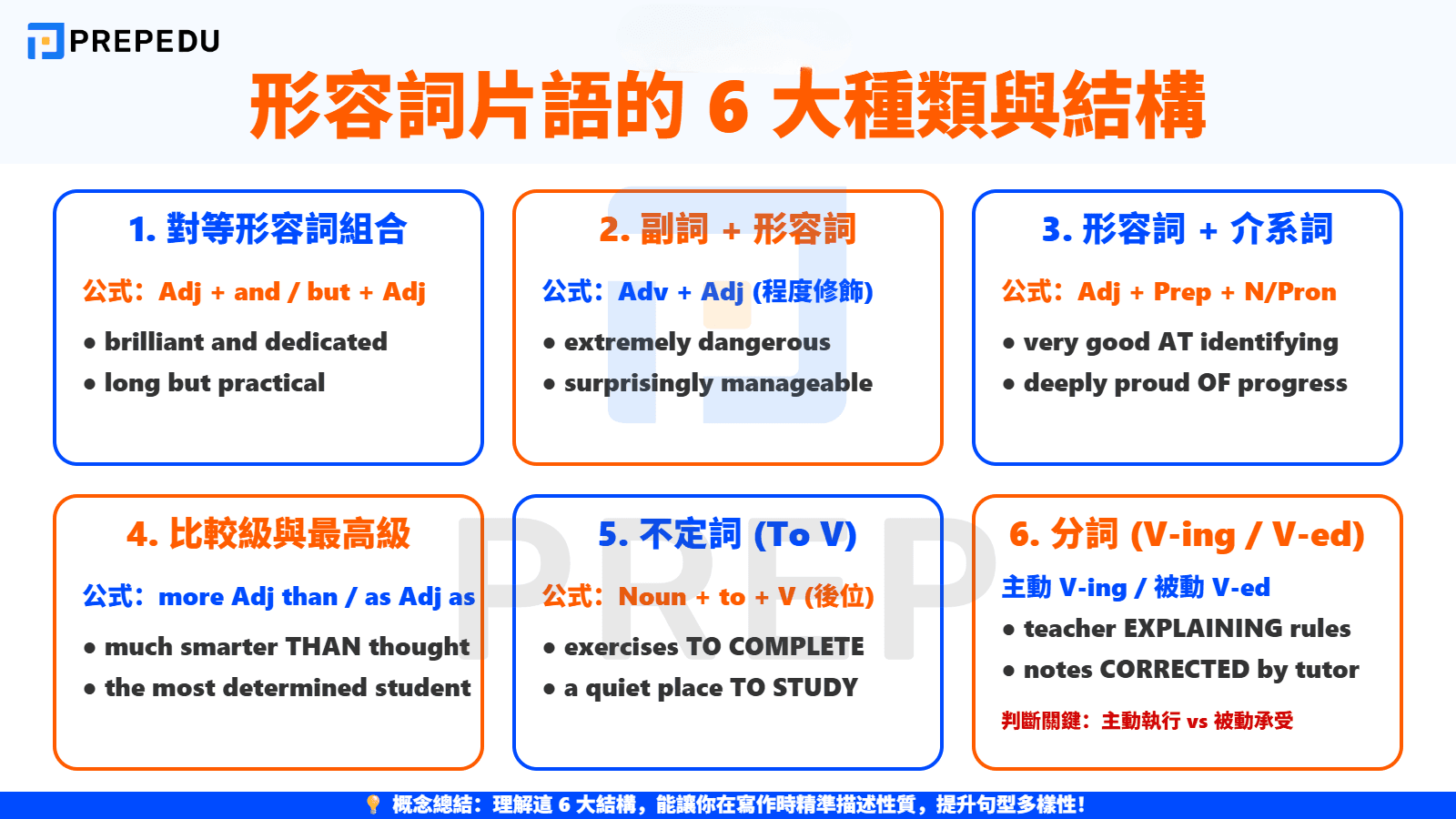
4. 「比較級與最高級」組成的形容詞片語
結構公式: more + Adj + than / as + Adj + as / the most + Adj + N
比較級和最高級本身就是擴展形容詞語意的重要方式,構成形容詞片語後,表達能力進一步增強。這類結構在議論文寫作中尤為常見,能有效強化論點的說服力。
-
XiaoWang is much smarter than he thought when it comes to grammar.(小王在文法方面比他自己以為的聰明得多。)
-
Learning adjective phrases in context is far more effective than memorising rules alone.(在語境中學習形容詞片語遠比單純背規則有效得多。)
-
She is the most determined student in the Taipei IELTS preparation class.(她是台北雅思備考班中最有決心的學生。)
5. 「不定詞(to V)」組成的形容詞片語
結構公式: Noun + to + V(原形動詞)
不定詞片語放在名詞後方,說明該名詞的用途、功能或性質,是學術寫作中常見的後位修飾結構。在此結構中,名詞在邏輯上是不定詞動作的受詞或相關對象,這與中文的語序習慣有所不同,需要特別留意。
-
She has plenty of grammar exercises to complete before her Xiangang DSE exam.(她在香港文憑試之前有大量文法練習要完成。)
-
This is the best opportunity to master adjective phrase structures.(這是掌握形容詞片語結構的最佳機會。)
-
XiaoWang is looking for a quiet place to study adjective phrases without interruption.(小王正在尋找一個安靜的地方,不受打擾地學習形容詞片語。)
注意:不定詞片語修飾名詞時,邏輯上名詞應為不定詞動作的受詞或相關對象,否則語意會不清晰。
6. 「分詞(V-ing / V-ed)」組成的形容詞片語
結構公式: V-ing(主動/進行)或 V-ed(被動/完成)+ 其他成分
分詞片語是最靈活的形容詞片語類型,分為現在分詞(V-ing)和過去分詞(V-ed)兩種,代表不同的語意關係。這也是台港學習者最容易混淆和出錯的類型,務必仔細理解主被動的邏輯差異。
現在分詞(V-ing)→ 主動或進行中的動作:
-
The teacher explaining adjective phrases on the whiteboard is from Taipei.(正在白板上解釋形容詞片語的老師來自台北。)
-
Students preparing for IELTS should pay close attention to adjective phrase placement.(正在備戰雅思的學生應密切注意形容詞片語的位置。)
過去分詞(V-ed)→ 被動或已完成的狀態:
-
The grammar guide written by the Xiangang teacher became very popular among DSE candidates.(由香港老師撰寫的文法指南在文憑試考生中變得非常受歡迎。)
-
XiaoWang is reviewing the notes corrected by his tutor last Tuesday.(小王正在複習他的導師上週二批改過的筆記。)
判斷關鍵: 若名詞「主動執行」動作,用 V-ing;若名詞「被動承受」動作,用 V-ed。這一點是考試中最常出錯的地方,務必牢記。
VI. 進階文法核心:如何將形容詞子句簡化為形容詞片語?
這是台灣學測與香港 DSE 考試的必考文法重點。將冗長的關係子句壓縮成簡潔的形容詞片語,能讓你的文章顯得更加老練、流暢。
|
比較項目 |
形容詞子句(Adjective Clause) |
形容詞片語(Adjective Phrase) |
|
定義 |
含有主詞和動詞的從屬子句 |
不含完整主詞+動詞的詞群 |
|
引導詞 |
由 who、which、that 等關係代名詞引導 |
無關係代名詞 |
|
結構特徵 |
較長、較複雜 |
較短、較簡潔 |
|
書面風格 |
一般性書寫均可使用 |
學術與正式寫作更為常見 |
|
例子(子句) |
The boy who is standing by the door is my classmate.(站在門邊的那個男孩是我的同班同學。) |
— |
|
例子(片語) |
The boy standing by the door is my classmate. |
(門邊站著的男孩是我的同班同學。) |
步驟一:確認差異(Phrase vs. Clause)
-
子句(Clause):The boy who is standing by the door is my classmate.
-
片語(Phrase):The boy standing by the door is my classmate.
子句包含主詞+動詞(who is standing),片語則去除了這兩個成分,只保留核心的語意資訊(standing by the door)。
步驟二:刪除關代與 be 動詞的轉換規則
當關係子句的動詞為「be + V-ing」或「be + V-ed」時,可以直接刪除「關係代名詞(who/which/that)」加上「be 動詞」,保留分詞部分。
-
子句原句:The report which was prepared by XiaoWang was highly detailed.(由小王準備的報告非常詳盡。)➡️ 簡化後:The report prepared by XiaoWang was highly detailed.
-
子句原句:The students who are studying in the Taipei library are preparing for IELTS.(在台北圖書館念書的學生正在備戰雅思。)➡️ 簡化後:The students studying in the Taipei library are preparing for IELTS.
步驟三:注意主被動關係
簡化時,務必確認分詞與名詞的邏輯關係。若名詞主動執行動作,用 V-ing;若名詞被動承受動作,用 V-ed。錯誤的選擇會導致語意謬誤,這是最容易扣分的失誤。
VII. 台灣與香港學生最常犯的形容詞片語英文使用錯誤
了解形容詞片語的文法規則,只是第一步。真正的進步,來自認識並糾正自己的錯誤習慣。以下三種錯誤,是台灣和香港學習者最常犯的問題,每一項都直接對應本文前幾段所教的核心概念。
|
修飾語錯置 |
OSASCOMP 順序錯誤 |
主被動分詞混淆 |
修飾語必須緊靠它所修飾的名詞,否則會產生語意歧義或荒謬情況。 |
記住 OSASCOMP 順序,避免將形容詞隨意排列,這是形容詞片語書寫中最直接影響語感的錯誤。 |
|
VIII. 形容詞片語英文綜合練習題與解析
學完上述所有文法與結構後,現在利用以下三種不同題型,檢驗你的吸收程度。每一道題目都針對本文的核心觀念設計,完成練習後,請對照文末的答案進行自我評估。
1. 測驗 1:選擇題(選出正確的形容詞片語)
請從 A、B、C、D 四個選項中,選出最適合填入空格的形容詞片語。
1. XiaoWang is very ________ English grammar. (A)good at (B)good for (C)good in (D)good about
2. She seems ________ the IELTS test results. (A)worried of (B)worried about (C)worried for (D)worried to
3. Which sentence uses OSASCOMP correctly? (A)a round small old silver coin (B)a small old round silver coin (C)a silver old small round coin (D)an old round silver small coin
4. The grammar notes ________ by the Taipei teacher were excellent. (A)writing (B)written (C)wrote (D)being write
5. After months of study, she feels ________ the speaking test. (A)ready for (B)ready to (C)ready of (D)ready about
6. The IELTS passage was ________ complex vocabulary. (A)full with (B)full in (C)full of (D)full for
7. He is ________ his progress in adjective phrase usage. (A)proud of (B)proud to (C)proud for (D)proud about
8. The student ________ near the window is from Xiangang. (A)to sit (B)sat (C)sitting (D)was sitting
9. She found the exercises ________ after reading the guide. (A)surprising easy (B)surprisingly easy (C)surprising easily (D)surprised easy
10. XiaoWang is ________ passing the TOEIC test with a high score. (A)capable to (B)capable of (C)capable for (D)capable about
答案: 1-A 2-B 3-B 4-B 5-A 6-C 7-A 8-C 9-B 10-B
2. 測驗 2:改寫題(形容詞子句簡化為片語)
請將以下各句中的關係子句,依照本文所教的步驟,簡化為形容詞片語。
-
The teacher who is standing near the whiteboard is from Taipei.
-
The report which was submitted by XiaoWang was very detailed.
-
The students who are preparing for IELTS need more practice.
-
The grammar guide which was written in 2023 is still very useful.
-
The man who is wearing a blue jacket is the TOEIC examiner.
-
The textbooks which were delivered this morning are for your class.
-
The students who are studying in the Xiangang library are very focused.
-
The window which was broken by the strong wind has been repaired.
-
The information which is provided on the PREP website is accurate.
-
The team who is competing in the Taipei language contest is well-prepared.
答案:
-
The teacher standing near the whiteboard is from Taipei.
-
The report submitted by XiaoWang was very detailed.
-
The students preparing for IELTS need more practice.
-
The grammar guide written in 2023 is still very useful.
-
The man wearing a blue jacket is the TOEIC examiner.
-
The textbooks delivered this morning are for your class.
-
The students studying in the Xiangang library are very focused.
-
The window broken by the strong wind has been repaired.
-
The information provided on the PREP website is accurate.
-
The team competing in the Taipei language contest is well-prepared.
3. 測驗 3:重組題(OSASCOMP 順序與句型重組)
請依照 OSASCOMP 規則,將以下括號中的詞語重新排列,填入正確位置,完成句子。
-
She bought a ________ handbag in Taipei. (red / small / beautiful)
-
He lives in a ________ house near Xiangang harbour. (wooden / old / tiny)
-
They found a ________ coin at the museum. (silver / round / ancient)
-
XiaoWang needs ________ shoes for the marathon. (black / running / comfortable)
-
She is reading a ________ novel this semester. (French / fascinating / long)
-
He drives a ________ car to the Taipei office. (Italian / sleek / sports)
-
We stayed in a ________ hotel near the Xiangang harbour. (Japanese / luxurious / traditional)
-
She wore a ________ dress to the ceremony. (white / elegant / lace)
-
They discovered a ________ cave during the trip. (dark / large / mysterious)
-
He gave her a ________ ring for her birthday. (gold / beautiful / antique)
答案:
-
a beautiful small red handbag
-
a tiny old wooden house
-
an ancient round silver coin
-
comfortable black running shoes
-
a fascinating long French novel
-
a sleek Italian sports car
-
a luxurious traditional Japanese hotel
-
an elegant white lace dress
-
a large mysterious dark cave
-
a beautiful antique gold ring
IX. 關於形容詞片語的常見問題(FAQs)
1. 形容詞片語一定要包含「形容詞」嗎?
答:不一定。 這是許多學習者對形容詞片語的常見誤解。「形容詞片語」的命名方式,指的是片語在句中扮演「形容詞的功能」,而非片語本身必須包含形容詞這個詞類。
例如,介系詞片語 in the room 可以作為形容詞片語,修飾名詞(the books in the room,房間裡的書)。不定詞片語 to read(a book to read,一本可以讀的書)同樣如此。在這兩個例子中都沒有傳統意義上的形容詞,但它們都在執行修飾名詞的形容詞功能。形容詞片語的本質,是「功能」而非「詞性」。
2. 什麼是「懸垂分詞」(Dangling Participle)?
答: 懸垂分詞(Dangling Participle)是指分詞片語在句中找不到它應該修飾的明確主詞,導致語意混亂或荒謬的文法錯誤。這是英文寫作中非常常見,但危害極大的錯誤。
-
✗ 錯誤示範:Walking to school in Taipei, the rain started to fall.(懸垂分詞:誰在走路?是雨嗎?)
-
✓ 正確改法:Walking to school in Taipei, XiaoWang was caught in the rain.(分詞的主詞小王明確出現在主句中)
規則:分詞片語的邏輯主詞,必須與主句的主詞一致。當兩者不一致時,就會形成懸垂分詞,導致句意混亂。在正式寫作和考試中,這種錯誤會直接影響評分。
3. 哪些形容詞片語只能放在名詞後面進行後位修飾?
答: 以下三類形容詞片語在結構上必須放在名詞後方,不能前置:
-
關係子句簡化的分詞片語: the man standing by the door(站在門邊的男人)
-
介系詞片語: the key to success(成功的鑰匙)、a cup full of water(裝滿水的杯子)
-
不定詞片語: something important to know(重要的事情)、work to complete(需要完成的工作)
這三類結構因長度或語意連結的原因,若放在名詞前方,會造成句子頭重腳輕,語意難以理解,因此英文語法規定它們必須後置。
4. 形容詞片語和副詞片語最大的差別是什麼?
答: 兩者最根本的差異在於它們所修飾的對象不同。掌握這個區別,能幫助你在句子分析和考試改錯題中快速做出正確判斷。
|
比較項目 |
形容詞片語(Adjective Phrase) |
副詞片語(Adverb Phrase) |
|
修飾對象 |
名詞或代名詞 |
動詞、形容詞或整個句子 |
|
核心問題 |
什麼樣的?(What kind?) |
如何?何時?何地?(How? When? Where?) |
|
典型結構 |
Adv + Adj 或 Adj + Prep + N |
Prep + N 或 Adv + Adv |
|
述語例子 |
She seems very nervous.(她看起來非常緊張。)➡️修飾主詞 she |
She speaks extremely clearly.(她說話非常清楚。)➡️修飾動詞 speaks |
|
混淆陷阱 |
She is happy about the result.(她對這個結果感到高興。)➡️ 修飾主詞 she |
She worked hard for the result.(她為了這個結果非常努力地工作。) ➡️ 修飾動詞 worked |
一個實用的測試方法:找到片語所修飾的成分。若答案是名詞或代名詞,則為形容詞片語;若答案是動詞、形容詞或整個句子,則為副詞片語。
結論
學習形容詞片語,從來不只是背誦一條文法規則那麼簡單。它是一套思維方式的轉變——從依賴單一形容詞的平面描述,進化到靈活運用多層次詞群的立體表達。當你能自如地在句中部署形容詞片語,你的英文就不再只是「正確」,而是開始變得「有力量」。
回顧本文所涵蓋的核心內容:你學會了形容詞片語的精確定義與四大位置功能,掌握了 150 組以上按介系詞分類的固定搭配,理解了 OSASCOMP 多個形容詞的排列邏輯,也拆解了 6 大種類的結構公式。更重要的是,你學會了如何將冗長的關係子句壓縮為精煉的形容詞片語——這正是讓雅思和多益寫作評分躍升的關鍵技巧。
面對龐大的考試準備內容和緊迫期限感到壓力? PREPEDU.COM 理解這種處境,提供專為優化時間效率設計的學習體驗。
別再進行隨機測驗練習。系統運用評估數據精準找出你的優勢和弱點,讓你專注於關鍵改善項目。這種科學方法可將學習時間縮短至傳統方式的一半。
雅思真題和多益練習題按照從易到難的順序設計,幫助你在進入更高難度挑戰前鞏固基礎知識。每分鐘都珍貴,每次測驗都助你進步。
別浪費時間卻進步緩慢。立即開始 PREPEDU Test Practice 的智能學習,以最高效率達成理想分數!

你好!我叫黃秋賢,現在在 prepedu.com 擔任內容企劃。我有超過5年的英語與韓語自學經歷,親身備考 IELTS、TOEIC 與 TOPIK,累積了大量第一手的學習者視角——包括哪些語法規則最讓台灣與香港學習者混淆,以及如何在有限的備考時間內最有效地修正這些錯誤。目前已在 prepedu.com 撰寫超過 1000 篇英語學習文章,內容涵蓋語法、詞彙與考試策略,累積協助數千位學習者解決自學過程中的語法疑問。
評論












統一企業編號:202227322W
地址:114 LAVENDER STREET, #11-83 CT HUB 2, SINGAPORE (338729)