分詞構句英文(Participle Clause)用法詳解:3大類別、改寫技巧與題庫練習
什麼是分詞構句英文?如何正確使用分詞構句來提升英文寫作水準?分詞構句(Participle Clause)是將兩個具有邏輯關係的子句合併為一個的文法結構,透過使用 V-ing 或 p.p. 開頭的形式,讓句子更加簡潔流暢。這個文法概念在 TOEIC、IELTS 等英文檢定考試中頻繁出現,更是學術寫作和商務英文的必備技能。
然而,許多學習者在使用分詞構句時常犯「懸蕩分詞」錯誤,或是混淆主動與被動語態的選擇。根據統計,超過 70% 的英文學習者在初次接觸分詞構句時會感到困惑,特別是在判斷何時該使用 V-ing、p.p. 或 Having p.p. 的時機。本文由 PREPEDU 專業教學團隊整理,將帶你完整掌握分詞構句的三大類別、實用改寫技巧,並提供 30 題完整題庫練習,從基礎到進階循序漸進,讓你在考試與寫作中都能精準運用這個重要文法工具。

I. 觀念釐清:分詞 vs. 分詞構句——傻傻分不清楚?
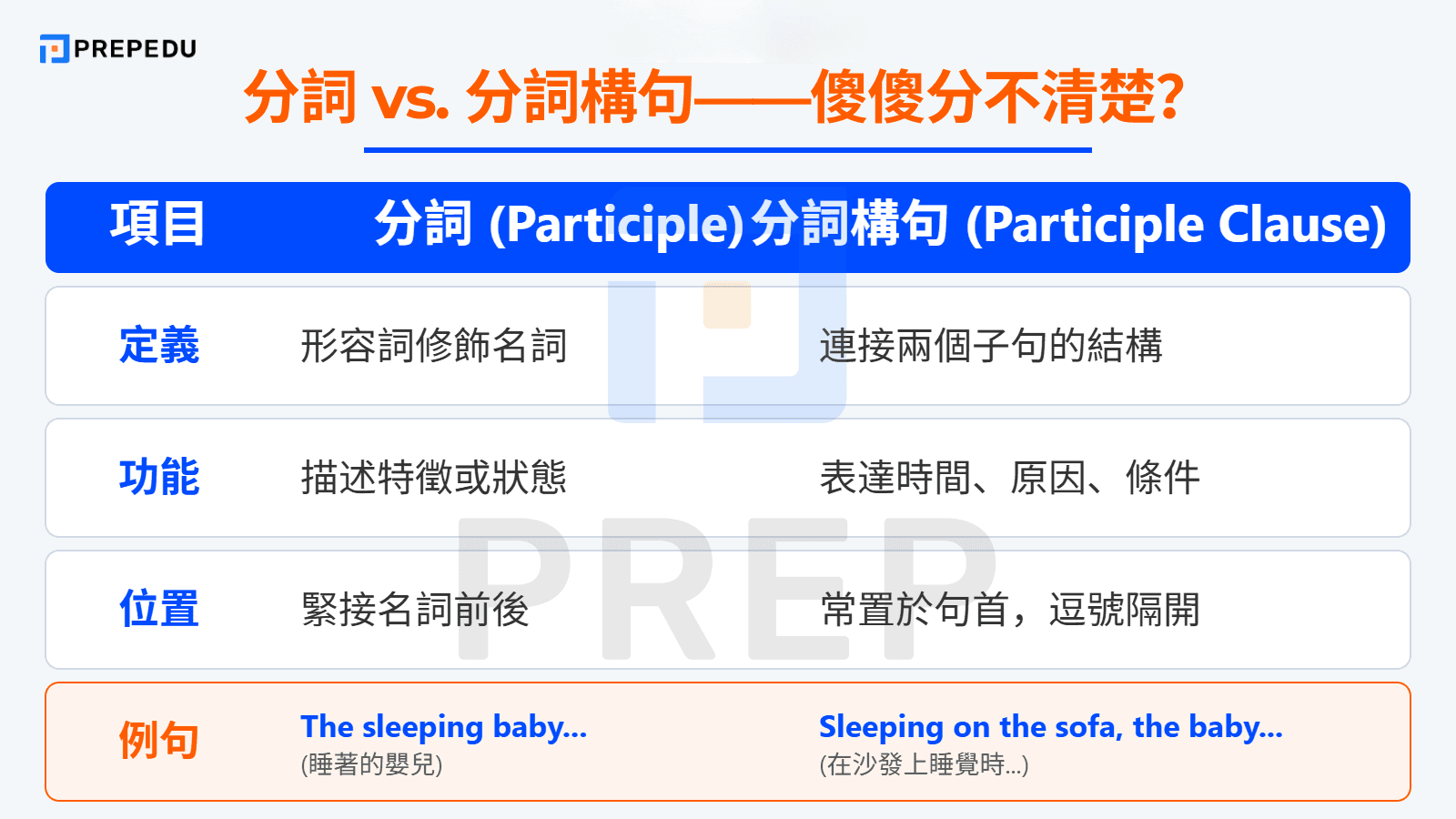
在深入學習分詞構句之前,我們需要先釐清一個常見的混淆點:「分詞」(Participle)與「分詞構句」(Participle Clause)並不完全相同。許多學習者在初次接觸時,往往將這兩個概念混為一談,導致在實際應用時出現錯誤。
|
項目 |
分詞英文 |
分詞構句英文 |
|
定義 |
動詞的變化形式,用作英文形容詞修飾名詞 |
用分詞開頭的子句結構,用來連接兩個句子 |
|
功能 |
修飾英文名詞,描述特徵或狀態 |
表達時間、原因、條件、結果等關係 |
|
位置 |
通常緊接在名詞前後 |
通常置於句首,以逗號分隔 |
|
語法特性 |
作為形容詞,無時態變化 |
具備完整的語意功能,可替代副詞子句 |
|
分詞構句例句 |
The sleeping baby looks peaceful.(睡著的嬰兒看起來很平靜) |
Sleeping on the sofa, the baby looks peaceful.(在沙發上睡覺時,嬰兒看起來很平靜) |
簡單來說,分詞構句的英文(Participle Clause)是將兩個具有因果、時間或條件關係的子句合併為一個,讓表達更緊湊流暢。當你看到句首出現 V-ing 或 p.p.,後面接著逗號,那很可能就是分詞構句的結構。這種結構在學術寫作、新聞報導和正式文體中特別常見,因為它能夠有效減少重複的連接詞,使文章讀起來更加專業。
理解這個基本概念後,我們就可以開始探討英文分詞構句的具體分類與用法。掌握分詞與分詞構句的差異,是學習這個文法概念的第一步,也是避免常見錯誤的關鍵。
II. 分詞構句英文的三大類別
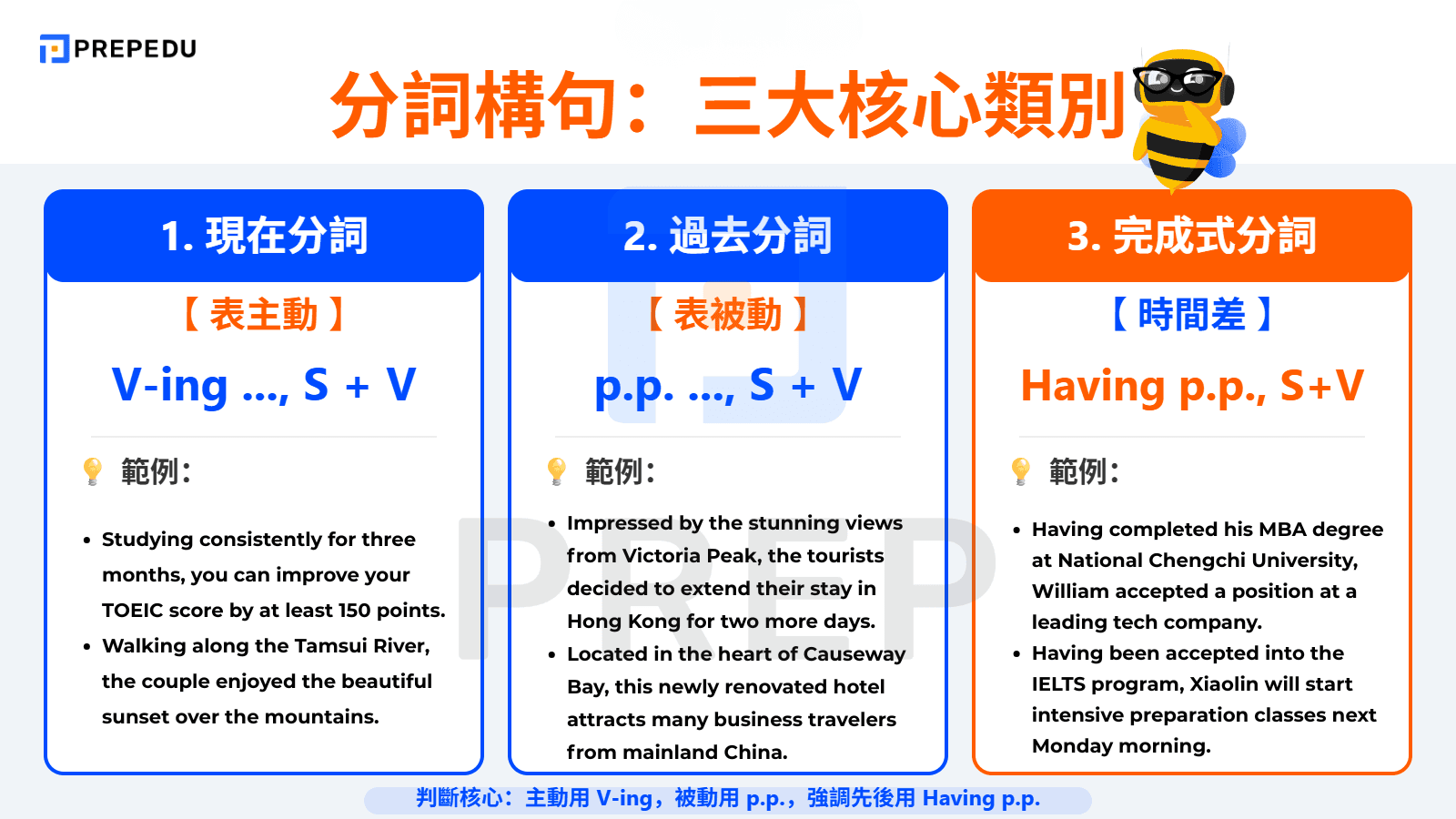
根據英文主詞與英文動詞之間的關係,以及動作發生的時間點,分詞構句可以分為三大類別:現在分詞構句(表主動)、過去分詞構句(表被動),以及完成式分詞構句(表時間先後)。掌握這三種類型的區別,是靈活運用分詞構句的關鍵。這三種類型各有其特定的使用情境和語意功能,在不同的語境中發揮不同的作用。接下來我們將逐一說明每種類型的特點與使用時機,並提供豐富的實例來幫助你理解。
1. 現在分詞構句:主動語態
當主詞「主動」執行動作時,我們使用現在分詞(V-ing)來形成分詞構句。這是最常見的分詞構句類型,廣泛應用於各種情境中。現在分詞構句可以表達同時發生的動作、原因、條件或附帶狀況,是讓句子更加簡潔有力的重要工具。
形成公式:
V-ing + 其他成分,主要子句
使用時機: 當兩個動作的主詞相同,且主詞是主動執行第一個動作時使用。這種結構特別適合用來描述兩個密切相關的動作,或是表達某個動作發生的背景。
功能分類與實例:
|
功能類型 |
例句 |
|
表達原因 |
|
|
表達時間(同時發生) |
|
|
表達條件 |
|
關鍵重點: 主詞必須是「主動」做出分詞所表達的動作。如果你看到 V-ing 開頭的分詞構句,第一時間要確認主要子句的主詞是否能主動執行這個動作。這是判斷使用現在分詞或過去分詞的重要依據。
2. 過去分詞構句:被動語態
當主詞「被動」承受動作影響時,我們使用過去分詞(p.p.)來形成分詞構句。這是分詞構句被動的重要表現形式,在描述狀態、特徵或被動動作時特別有用。過去分詞構句能夠有效地表達物體或人物所處的狀態,而不需要使用複雜的被動語態句型。
形成公式:
(Being) + p.p. + 其他成分,主要子句
關鍵提示: 在分詞構句被動結構中,Be 動詞(Being)通常會被省略,直接以 p.p. 開頭。這種省略使句子更加簡潔,是英文寫作中常見的修辭手法。然而,在某些強調語氣的情況下,Being 也可以保留。
實用例句:
|
功能類型 |
例句 |
|
描述狀態或特徵 |
|
|
表達原因(被動情況) |
|
|
表達條件(假設情況) |
|
記住這個判斷原則:如果原句中有 "be + p.p." 的被動語態結構,在改成分詞構句時,可以直接省略 Being,只留下 p.p.。這是分詞構句被動最常見的簡化方式,也是讓文章更加簡潔的有效方法。
3. 完成式分詞構句:時間差
當分詞所表達的動作「早於」主要子句的動作發生時,我們使用完成式分詞構句。這種結構能清楚表達動作的先後順序,避免時間關係混淆。完成式分詞構句在敘述連續發生的事件時特別重要,它能幫助讀者理解事件的邏輯順序。
形成公式:
Having + p.p. + 其他成分,主要子句
Having been + p.p. + 其他成分,主要子句(被動)
時間概念對比:
-
V-ing:兩個動作「同時」或「幾乎同時」發生
-
Having + p.p.:分詞動作「明顯早於」主要動作發生
實例說明:
|
功能類型 |
例句 |
|
主動完成式(先做完某事,再做另一事) |
|
|
被動完成式(某事先發生或完成,造成後續結果) |
|
比較練習(同時與先後):
-
Eating breakfast at the hotel, Mr. Wang discussed the business proposal with his partners. (在飯店吃早餐時,王先生與合夥人討論商業提案。)➜ 吃早餐和討論同時進行
-
Having eaten breakfast, Mr. Wang went to the conference room to present the business proposal.(吃完早餐後,王先生前往會議室報告商業提案。)➜ 先吃完早餐,再去報告
掌握這個時間差的概念,你就能準確判斷何時該使用 Having p.p. 而非單純的 V-ing。在學術寫作和正式文體中,正確使用完成式分詞構句能夠讓你的表達更加精確,邏輯關係更加清晰。
III. 如何形成分詞構句?兩大改寫路徑全解析
理解分詞構句的三大類別後,接下來要學習的是:如何將一般句子改寫成分詞構句?這個部分是分詞構句用法的核心技巧,也是在考試中最常測驗的重點。根據原句的結構不同,我們有兩條主要的改寫路徑。無論是哪種路徑,掌握正確的改寫步驟都能讓你在寫作時更加得心應手。
1. 路徑一:簡化「副詞子句」(Because / When / If / While / As)
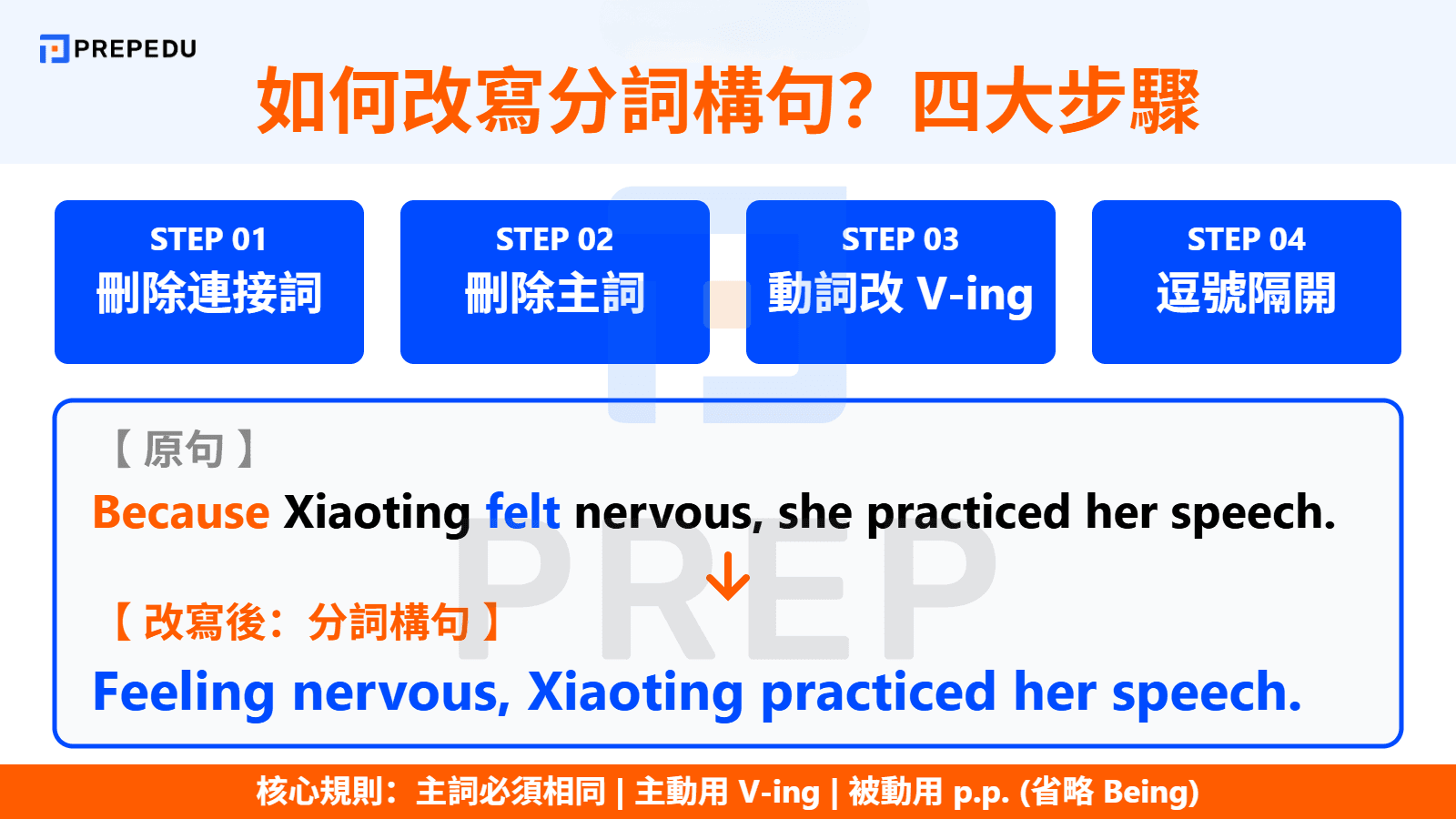
這是最常見的分詞構句形成方式。當原句包含 because、when、while、if、as 等連接詞引導的副詞子句時,可以透過以下步驟簡化。這種改寫方式能有效減少句子中的重複元素,讓表達更加簡潔流暢。
1.1. 改寫步驟:一般動詞(主動語態)
|
步驟 |
操作說明 |
注意事項 |
|
步驟一 |
刪除連接詞(because, when, while, if, as, since 等) |
確保原句有明確的連接詞 |
|
步驟二 |
刪除主詞(前提:兩個子句主詞必須相同) |
這是最關鍵的前提條件 |
|
步驟三 |
將動詞改為 V-ing 形式 |
保持動詞的語意不變 |
|
步驟四 |
調整語序(視需要將分詞構句移至句首或句尾) |
通常置於句首,用逗號分隔 |
實例示範(主動):
範例:表原因
|
步驟 |
句子變化 |
|
原句 |
Because Xiaoting felt nervous before her presentation at Taipei 101, she practiced her speech ten times. |
|
步驟一 |
Because Xiaoting felt nervous before her presentation at Taipei 101, she practiced her speech ten times. |
|
步驟二 |
Xiaoting felt nervous before her presentation at Taipei 101, she practiced her speech ten times. |
|
步驟三 |
Feeling nervous before her presentation at Taipei 101, she practiced her speech ten times. |
|
完成句 |
Feeling nervous before her presentation at Taipei 101, Xiaoting practiced her speech ten times.(在台北 101 簡報前感到緊張,小婷練習她的演講十次。) |
範例:表時間
|
步驟 |
句子變化 |
|
原句 |
When Professor Lin arrived at the Hong Kong airport, he immediately took the Airport Express to Central. |
|
步驟一 |
When Professor Lin arrived at the Hong Kong airport, he immediately took the Airport Express to Central. |
|
步驟二 |
Professor Lin arrived at the Hong Kong airport, he immediately took the Airport Express to Central. |
|
步驟三 |
Arriving at the Hong Kong airport, he immediately took the Airport Express to Central. |
|
完成句 |
Arriving at the Hong Kong airport, Professor Lin immediately took the Airport Express to Central.(抵達香港機場時,林教授立即搭乘機場快線前往中環。) |
1.2. 改寫步驟 - Be 動詞(主動與被動語態)
|
步驟 |
操作說明 |
注意事項 |
|
步驟一 |
刪除連接詞 |
適用於 because, when, as, since 等 |
|
步驟二 |
刪除主詞(前提:兩個子句主詞相同) |
主詞必須一致 |
|
步驟三 |
Be 動詞變為 Being(主動)或保持 p.p.(被動) |
Being 通常可省略 |
|
步驟四 |
保留形容詞、名詞或過去分詞 |
視原句結構而定 |
實例示範(Be 動詞):
範例:主動 - Be + 形容詞
|
步驟 |
句子變化 |
|
原句 |
As Miss Zhang was excited about winning the scholarship to study at National Taiwan University, she shared the news with her family immediately. |
|
步驟一 |
As Miss Zhang was excited about winning the scholarship to study at National Taiwan University, she shared the news with her family immediately. |
|
步驟二 |
Miss Zhang was excited about winning the scholarship to study at National Taiwan University, she shared the news with her family immediately. |
|
步驟三 |
Being excited about winning the scholarship to study at National Taiwan University, she shared the news with her family immediately. |
|
步驟四 |
Excited about winning the scholarship to study at National Taiwan University, Miss Zhang shared the news with her family immediately.(對贏得台灣大學獎學金感到興奮,張小姐立即與家人分享這個消息。) |
範例:被動 - Be + p.p.
|
步驟 |
句子變化 |
|
原句 |
Since the traditional tea house in Jiufen was built in 1920, it has attracted thousands of tourists from around the world. |
|
步驟一 |
Since the traditional tea house in Jiufen was built in 1920, it has attracted thousands of tourists from around the world. |
|
步驟二 |
the traditional tea house in Jiufen was built in 1920, it has attracted thousands of tourists from around the world. |
|
步驟三 |
Being built in 1920, it has attracted thousands of tourists from around the world. |
|
步驟四 |
Built in 1920, the traditional tea house in Jiufen has attracted thousands of tourists from around the world.(建於 1920 年,九份的這家傳統茶館吸引了來自世界各地數千名遊客。) |
功能分類完整說明:
|
功能 |
連接詞 |
改寫後的意義 |
實例 |
|
表時間 |
when, while, as |
兩個動作同時或相繼發生 |
Walking through Ximending, I saw many street performers.(走過西門町時,我看到許多街頭藝人。) |
|
表原因 |
because, since, as |
說明主要動作的原因 |
Feeling tired after the conference, she cancelled her evening plans.(會議後感到疲倦,她取消了晚上的計畫。) |
|
表條件 |
if |
假設某條件成立 |
Turning right at Pacific Place, you will find the Eslite Bookstore in Hong Kong.(在太古廣場右轉,你會找到香港誠品書店。) |
|
表讓步 |
although, though |
儘管某情況仍然... |
Knowing the risks, the entrepreneur still decided to invest in the startup.(儘管知道風險,企業家仍決定投資這家新創公司。) |
2. 路徑二:簡化「對等子句」(And)
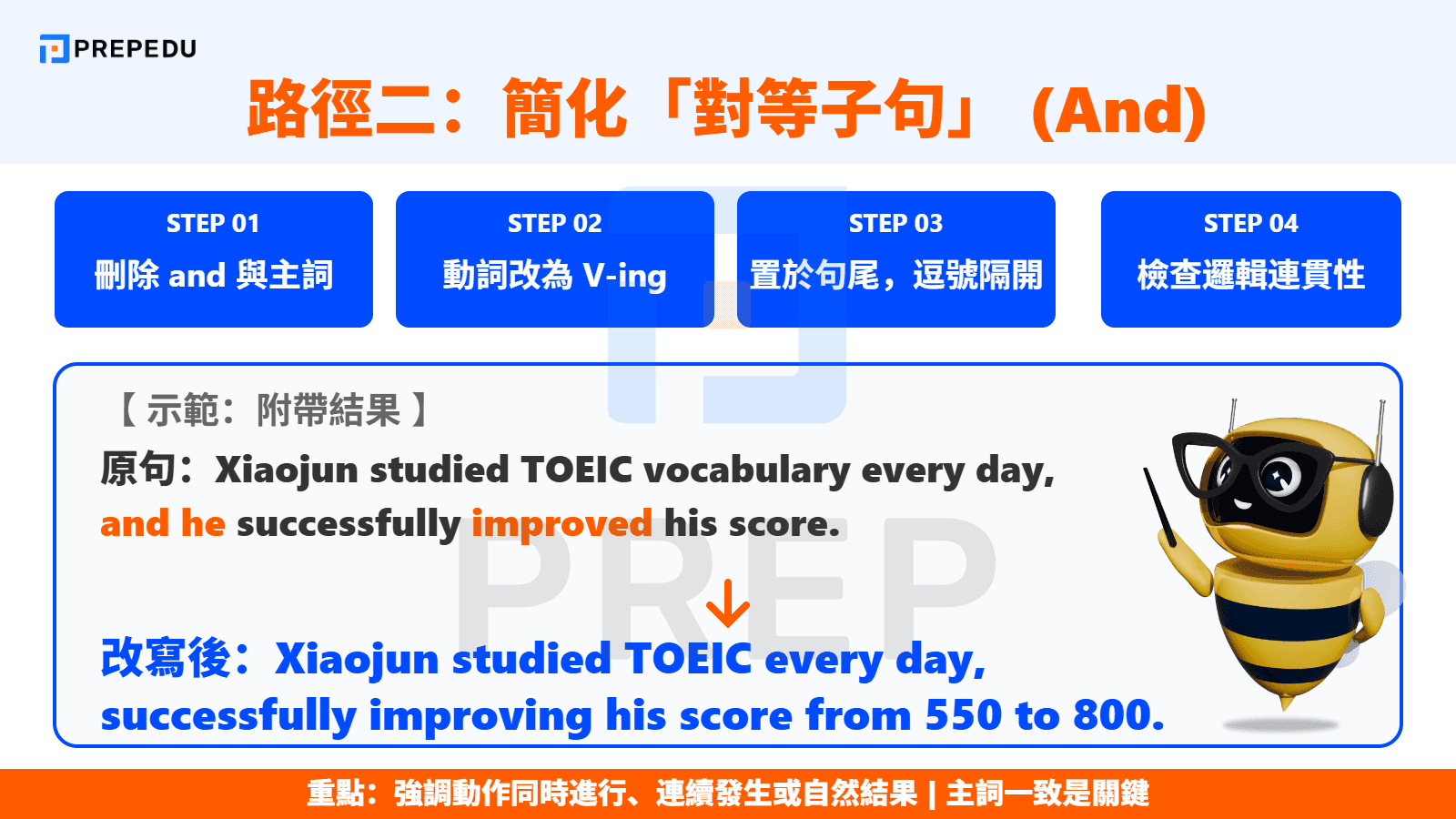
這是台灣英文教學中常提到的另一種分詞構句形成方式。當兩個對等子句用 "and" 連接,且主詞相同時,可以將後句動詞改為 V-ing,表達「附帶狀況」或「同時發生的動作」。這種用法特別適合描述連續動作或伴隨情況。
改寫步驟表
|
步驟 |
操作說明 |
重點提示 |
|
步驟一 |
刪除逗號和連接詞 and |
確認兩個子句主詞相同 |
|
步驟二 |
將第二個子句的動詞改為 V-ing |
保持英文時態一致性 |
|
步驟三 |
用逗號分隔兩部分 |
分詞構句置於句尾 |
|
步驟四 |
檢查語意是否清晰 |
確保前後動作邏輯合理 |
實例示範:
範例 1:同時發生的動作
|
步驟 |
句子變化 |
|
原句 |
Mr. Chen sat in the coffee shop near Taipei Main Station, and he worked on his laptop for three hours. |
|
步驟一 |
Mr. Chen sat in the coffee shop near Taipei Main Station , and he worked on his laptop for three hours. |
|
步驟二 |
Mr. Chen sat in the coffee shop near Taipei Main Station working on his laptop for three hours. |
|
完成句 |
Mr. Chen sat in the coffee shop near Taipei Main Station, working on his laptop for three hours.(陳先生坐在台北車站附近的咖啡廳,用筆記型電腦工作了三個小時。) |
範例 2:順序發生的動作
|
步驟 |
句子變化 |
|
原句 |
The tour guide opened the bus door, and she welcomed the tourists from Singapore warmly. |
|
步驟一 |
The tour guide opened the bus door , and she welcomed the tourists from Singapore warmly. |
|
步驟二 |
The tour guide opened the bus door welcoming the tourists from Singapore warmly. |
|
完成句 |
The tour guide opened the bus door, welcoming the tourists from Singapore warmly.(導遊打開巴士門,熱情地歡迎來自新加坡的遊客。) |
範例 3:附帶結果
|
步驟 |
句子變化 |
|
原句 |
Xiaojun studied TOEIC vocabulary every day for six months, and he successfully improved his score from 550 to 800. |
|
步驟一 |
Xiaojun studied TOEIC vocabulary every day for six months, and he successfully improved his score from 550 to 800. |
|
步驟二 |
Xiaojun studied TOEIC vocabulary every day for six months successfully improving his score from 550 to 800. |
|
完成句 |
Xiaojun studied TOEIC vocabulary every day for six months, successfully improving his score from 550 to 800.(小俊每天學習 TOEIC 單字六個月,成功地將分數從 550 提升到 800。) |
重點提醒:
-
這種用法強調兩個動作「同時進行」或「順序發生」
-
第二個動作通常是第一個動作的「附帶狀況」、「方式」或「自然結果」
-
分詞構句通常置於句尾,較少放在句首
-
兩個動作之間必須有邏輯上的關聯性
掌握這兩條改寫路徑後,你就能靈活處理各種句型,將複雜的句子轉換為簡潔的分詞構句。記住,改寫的前提永遠是「主詞一致」——這是避免產生懸蕩分詞錯誤的關鍵原則。在實際應用時,選擇哪一種改寫路徑取決於原句的結構和你想要表達的語意重點。
IV. 特殊情況與常見錯誤
在學習分詞構句與分詞片語時,有些特殊情況和常見錯誤需要特別注意。正確理解這些例外規則,能幫助你避免在考試或寫作中犯錯。這些特殊情況往往是進階學習者需要掌握的重點,也是區分熟練度的關鍵指標。
1. 特殊情況一:獨立分詞構句
當分詞構句的主詞與主要子句的主詞「不同」時,必須保留分詞構句的主詞,形成「獨立分詞構句」。這種結構在正式寫作和文學作品中特別常見,能夠增加句子的表達層次。
結構對比表:
|
類型 |
結構 |
主詞關係 |
使用場合 |
|
一般分詞構句 |
V-ing/p.p. + ..., 主詞 + 動詞 |
主詞相同 |
日常寫作 |
|
獨立分詞構句 |
主詞A + V-ing/p.p., 主詞B + 動詞 |
主詞不同 |
正式文體 |
常見例句:
-
The weather being extremely hot in Taipei, the outdoor concert at Daan Forest Park was postponed until evening.(台北天氣極度炎熱,大安森林公園的戶外音樂會被延至晚上。)➡️ 主詞不同:weather ≠ concert
-
The typhoon having passed, residents in Hualien began cleaning up the debris from their homes and streets.(颱風過境後,花蓮居民開始清理住家和街道的碎片。)➡️主詞不同:typhoon ≠ residents
慣用獨立分詞片語:
|
慣用語 |
意義 |
例句 |
|
Weather permitting |
天氣允許的話 |
Weather permitting, we will hold the Dragon Boat Festival race on the Tamsui River.(天氣允許的話,我們將在淡水河舉辦龍舟比賽。) |
|
Time permitting |
時間允許的話 |
Time permitting, Professor Wang will answer questions after the lecture at NTU.(時間允許的話,王教授將在台大演講後回答問題。) |
|
All things considered |
綜合考量 |
All things considered, moving to Hong Kong for work was the right decision for her career.(綜合考量,為工作搬到香港對她的職涯是正確的決定。) |
2. 特殊情況二:否定用法
在分詞構句中表達否定時,將 "not" 放在分詞之前。這是固定的語法規則。
否定形式對照表:
|
類型 |
肯定形式 |
否定形式 |
|
現在分詞 |
Knowing the answer |
Not knowing the answer |
|
過去分詞 |
Satisfied with the result |
Not satisfied with the result |
|
完成式 |
Having studied |
Not having studied |
正確用法示例:
-
Not knowing the way to Sun Yat-sen Memorial Hall, the tourists asked a local resident for directions.(不知道前往國父紀念館的路,遊客向當地居民問路。)
-
Not having received any response from the university, Xiaowen decided to call the admissions office in Hong Kong.(沒有收到大學的任何回覆,小文決定打電話給香港的招生辦公室。)
-
Not being a permanent resident of Taiwan, he couldn't apply for the government scholarship program.(不是台灣的永久居民,他無法申請政府獎學金計畫。)
3. 特殊情況三:慣用分詞片語
有些分詞片語已經成為固定用法,不需要考慮主詞一致性,這些被稱為「慣用分詞構句」。
常用分詞構句分詞片語整理表:
|
慣用語 |
中文意思 |
使用場合 |
例句 |
|
Generally speaking |
一般來說 |
表達概括性觀點 |
Generally speaking, students in Taiwan spend more time studying English than speaking it.(一般來說,台灣學生花更多時間學習英文而非說英文。) |
|
Frankly speaking |
坦白說 |
表達真實想法 |
Frankly speaking, I don't think this business plan will succeed in the Hong Kong market.(坦白說,我認為這個商業計畫在香港市場不會成功。) |
|
Strictly speaking |
嚴格說來 |
強調精確性 |
Strictly speaking, this sentence structure isn't grammatically perfect.(嚴格說來,這個句子結構在文法上不完美。) |
|
Roughly speaking |
粗略地說 |
提供大概估計 |
Roughly speaking, it takes about two hours to drive from Taipei to Taichung.(粗略地說,從台北開車到台中大約需要兩小時。) |
|
Judging from... |
從...判斷 |
根據觀察推斷 |
Judging from her accent, she must have grown up in southern Taiwan.(從她的口音判斷,她一定是在台灣南部長大。) |
|
Considering... |
考慮到... |
列入考量因素 |
Considering the high cost of living in Hong Kong, this salary offer is quite reasonable.(考慮到香港的高生活成本,這個薪資待遇相當合理。) |
|
Talking of... |
談到... |
轉換話題 |
Talking of travel, have you been to the new art museum in Taichung?(談到旅行,你去過台中的新美術館嗎?) |
|
Speaking of... |
說到... |
引出相關話題 |
Speaking of English exams, when is your IELTS test scheduled?(說到英文考試,你的 IELTS 考試排在什麼時候?) |
使用提示: 這些慣用語可以自由使用,不需要擔心主詞是否與主要子句一致。它們主要用來引導話題、表達態度或提供評論,是讓文章更加自然流暢的好工具。
4. 常見錯誤一:懸蕩分詞
這是學習分詞構句時最容易犯的錯誤。當分詞構句的邏輯主詞與主要子句的主詞不一致,且未明確標示時,就會產生「懸蕩分詞」,造成語意混淆或產生荒謬的意思。
錯誤類型對照表:
|
錯誤類型 |
錯誤示範 |
正確寫法 |
|
主詞混淆 |
❌ Walking through Yongkang Street, the famous beef noodles looked delicious. |
✅ Walking through Yongkang Street, I found the famous beef noodles looked delicious.(走過永康街時,我發現那家著名的牛肉麵看起來很美味。) |
|
邏輯錯誤 |
❌ Driving to Taichung, the highway was very crowded. |
✅ Driving to Taichung, we found the highway was very crowded.(開車去台中時,我們發現高速公路非常擁擠。) |
|
被動混淆 |
❌ Writing in English, the report was difficult. |
✅ Written in English, the report was difficult to understand.(用英文寫成,這份報告很難理解。) |
|
時態錯誤 |
❌ Having finished the exam, the answer sheets were collected. |
✅ Having finished the exam, students handed in their answer sheets.(考完試後,學生繳交答案卷。) |
5. 常見錯誤二:時態與語態混淆
在選擇使用 V-ing 或 p.p. 時,必須清楚判斷主詞與動作的關係。這是許多學習者容易混淆的地方。
判斷流程表:
|
判斷步驟 |
問題 |
答案選擇 |
|
步驟一 |
主詞能「主動」做這個動作嗎? |
|
|
步驟二 |
主詞是「被動」承受這個動作嗎? |
|
|
步驟三 |
動作發生在主要動作「之前」嗎? |
|
錯誤示範與修正:
|
錯誤類型 |
錯誤示範 |
正確寫法 |
|
主動與被動混淆 |
❌ Writing in Classical Chinese, this ancient text from the National Palace Museum is difficult for modern readers. |
✅ Written in Classical Chinese, this ancient text from the National Palace Museum is difficult for modern readers.(用文言文寫成,故宮的這份古籍對現代讀者來說很困難。) |
|
時間順序錯誤 |
❌ Arriving at the IELTS test center, she had already reviewed all the vocabulary. |
✅ Having reviewed all the vocabulary, she arrived at the IELTS test center feeling confident.(複習完所有單字後,她信心滿滿地抵達 IELTS 考場。) |
掌握這些特殊情況與常見錯誤,你就能更準確地使用分詞構句,避免在分詞構句練習題中失分。記住,語法規則固然重要,但理解其背後的邏輯更能幫助你在實際應用時做出正確判斷。
V. 分詞構句題庫:3大題型實戰演練
理論學習後,最重要的就是透過分詞構句練習題來鞏固概念。以下提供三種不同難度的分詞構句練習題,從基礎選擇題到進階除錯題,幫助你循序漸進掌握這個文法重點。這些題目涵蓋了各種常見考點,是準備 TOEIC、IELTS 等英文檢定考試的絕佳練習材料。
1. 第一關:基礎選擇題(TOEIC 多益題型)
這部分分詞構句題庫著重於判斷主動(V-ing)與被動(p.p.)的選擇,適合剛接觸分詞構句的學習者。每題都模擬真實考試情境,幫助你熟悉題型。
題目 1-10:請選出正確答案
-
_____ in 1998, the Taipei 101 building quickly became an iconic landmark of the city.
-
(A) Build
-
(B) Building
-
(C) Built
-
(D) To build
-
-
_____ exhausted after working overtime at the company in Xinyi District, Miss Chen went straight home without having dinner.
-
(A) Feel
-
(B) Feeling
-
(C) Felt
-
(D) To feel
-
-
_____ the recipe instructions carefully, you can make delicious Taiwanese pineapple cakes at home.
-
(A) Follow
-
(B) Following
-
(C) Followed
-
(D) To follow
-
-
_____ by millions of tourists every year, Hong Kong Disneyland has become one of Asia's top attractions.
-
(A) Visit
-
(B) Visiting
-
(C) Visited
-
(D) To visit
-
-
_____ along Zhongshan North Road without an umbrella during the sudden rainstorm, Mr. Wang caught a bad cold.
-
(A) Walk
-
(B) Walking
-
(C) Walked
-
(D) To walk
-
-
_____ in both Traditional Chinese and English, this government website makes information accessible to international residents.
-
(A) Write
-
(B) Writing
-
(C) Written
-
(D) To write
-
-
Not _____ what to order at the restaurant, the foreign student asked the waiter for recommendations.
-
(A) know
-
(B) knowing
-
(C) known
-
(D) to know
-
-
_____ all her savings from working part-time jobs, Xiaoling decided to study abroad in Canada.
-
(A) Use
-
(B) Using
-
(C) Used
-
(D) To use
-
-
_____ from organic ingredients sourced from local Taiwanese farms, this skincare product is safe for sensitive skin.
-
(A) Make
-
(B) Making
-
(C) Made
-
(D) To make
-
-
_____ by the stunning night view from Victoria Peak, tourists always take countless photos during their Hong Kong trip.
-
(A) Attract
-
(B) Attracting
-
(C) Attracted
-
(D) To attract
-
第一關答案與詳解:
-
(C) Built ➡️ 建築物是「被建造」,使用過去分詞表被動。完整句:Built in 1998, the Taipei 101 building quickly became an iconic landmark of the city.(建於 1998 年,台北 101 大樓迅速成為這座城市的標誌性地標。)
-
(B) Feeling ➡️ 陳小姐「主動感到」疲倦,使用現在分詞表主動。完整句:Feeling exhausted after working overtime at the company in Xinyi District, Miss Chen went straight home without having dinner.(在信義區公司加班後感到精疲力盡,陳小姐直接回家沒有吃晚餐。)
-
(B) Following ➡️ 你「主動遵循」食譜指示,使用現在分詞表主動。完整句:Following the recipe instructions carefully, you can make delicious Taiwanese pineapple cakes at home.(仔細遵循食譜指示,你可以在家製作美味的台灣鳳梨酥。)
-
(C) Visited ➡️ 迪士尼樂園是「被參觀」,使用過去分詞表被動。完整句:Visited by millions of tourists every year, Hong Kong Disneyland has become one of Asia's top attractions.(每年有數百萬遊客造訪,香港迪士尼樂園已成為亞洲頂尖景點之一。)
-
(B) Walking ➡️ 王先生「主動走」在中山北路上,使用現在分詞表主動。完整句:Walking along Zhongshan North Road without an umbrella during the sudden rainstorm, Mr. Wang caught a bad cold.(在突如其來的暴雨中沿著中山北路走而沒帶傘,王先生得了重感冒。)
-
(C) Written ➡️ 網站是「被寫」成,使用過去分詞表被動。完整句:Written in both Traditional Chinese and English, this government website makes information accessible to international residents.(用繁體中文和英文寫成,這個政府網站讓國際居民能夠獲取資訊。)
-
(B) knowing ➡️ 外國學生「主動不知道」,使用現在分詞,Not 置於分詞前。完整句:Not knowing what to order at the restaurant, the foreign student asked the waiter for recommendations.(不知道在餐廳該點什麼,這位外國學生向服務生詢問推薦。)
-
(B) Using ➡️ 小玲「主動使用」存款,使用現在分詞表主動。完整句:Using all her savings from working part-time jobs, Xiaoling decided to study abroad in Canada.(使用她打工存下的所有積蓄,小玲決定到加拿大留學。)
-
(C) Made ➡️ 產品是「被製造」,使用過去分詞表被動。
完整句:Made from organic ingredients sourced from local Taiwanese farms, this skincare product is safe for sensitive skin.(由台灣在地農場採購的有機成分製成,這款保養品對敏感肌膚安全。) -
(C) Attracted ➡️ 遊客是「被吸引」,使用過去分詞表被動。完整句:Attracted by the stunning night view from Victoria Peak, tourists always take countless photos during their Hong Kong trip.(被太平山頂壯麗的夜景所吸引,遊客在香港旅行期間總是拍攝無數照片。)
2. 第二關:句型改寫題(學校考試題型)
這部分著重於分詞構句用法的實際應用,請將以下含有連接詞的句子改寫為分詞構句。這類題型在學校考試中非常常見,也是檢驗你是否真正理解改寫步驟的最佳方式。
題目 1-10:請改寫下列句子
-
Because Xiaohua didn't have enough money for the concert ticket at Taipei Arena, she couldn't attend her favorite singer's performance.
-
When Professor Li arrived at Hong Kong International Airport, he realized he had left his laptop at the hotel.
-
As David was born in Kaohsiung, he speaks both Mandarin and Taiwanese fluently.
-
After Miss Lin had completed her master's thesis at National Taiwan University, she submitted it to her supervisor for review.
-
Because the documentary about Taiwan's aboriginal culture was rated as outstanding, it won several international film awards.
-
While Mr. Zhang was waiting for his client at the Starbucks near Taipei Main Station, he reviewed the business proposal one more time.
-
Since the package from the online store was damaged during delivery to Hong Kong, the customer requested a full refund immediately.
-
After the research team had discussed the environmental problem for three hours, they finally found an innovative solution.
-
Because Jenny didn't understand the traditional Chinese characters in the historical document, she asked her Taiwanese friend for help with translation.
-
As the apartment is located within walking distance from Taipei MRT Zhongxiao Fuxing Station, it is extremely convenient for daily commuting.
第二關答案:
-
Not having enough money for the concert ticket at Taipei Arena, Xiaohua couldn't attend her favorite singer's performance.(沒有足夠的錢買台北小巨蛋演唱會門票,小華無法參加她最喜歡的歌手的表演。)
-
Arriving at Hong Kong International Airport, Professor Li realized he had left his laptop at the hotel.(抵達香港國際機場時,李教授意識到他把筆記型電腦留在飯店了。)
-
(Being) Born in Kaohsiung, David speaks both Mandarin and Taiwanese fluently. 或:Born in Kaohsiung, David speaks both Mandarin and Taiwanese fluently.(在高雄出生,David 能流利地說國語和台語。)
-
Having completed her master's thesis at National Taiwan University, Miss Lin submitted it to her supervisor for review.(在台灣大學完成碩士論文後,林小姐將它提交給指導教授審查。)
-
(Being) Rated as outstanding, the documentary about Taiwan's aboriginal culture won several international film awards. 或:Rated as outstanding, the documentary about Taiwan's aboriginal culture won several international film awards.(被評為傑出作品,這部關於台灣原住民文化的紀錄片贏得了數個國際電影獎項。)
-
Waiting for his client at the Starbucks near Taipei Main Station, Mr. Zhang reviewed the business proposal one more time.(在台北車站附近的星巴克等客戶時,張先生又把商業提案複習了一遍。)
-
(Being) Damaged during delivery to Hong Kong, the package prompted the customer to request a full refund immediately. 或:Damaged during delivery to Hong Kong, the package prompted the customer to request a full refund immediately.(在運送到香港期間損壞,這個包裹促使顧客立即要求全額退款。)
-
Having discussed the environmental problem for three hours, the research team finally found an innovative solution.(討論環境問題三小時後,研究團隊終於找到創新的解決方案。)
-
Not understanding the traditional Chinese characters in the historical document, Jenny asked her Taiwanese friend for help with translation.(不懂歷史文件中的繁體中文字,Jenny 請她的台灣朋友幫忙翻譯。)
-
(Being) Located within walking distance from Taipei MRT Zhongxiao Fuxing Station, the apartment is extremely convenient for daily commuting. 或:Located within walking distance from Taipei MRT Zhongxiao Fuxing Station, the apartment is extremely convenient for daily commuting.(位於台北捷運忠孝復興站步行距離內,這間公寓對日常通勤極為方便。)
3. 第三關:進階除錯題(寫作應用題型)
這是最具挑戰性的分詞構句練習。以下句子都含有語法錯誤,請找出錯誤並提供正確寫法。這類題目能有效訓練你發現和修正錯誤的能力,是提升寫作品質的關鍵。
題目 1-10:請找出錯誤並改正
-
Walking through the busy streets of Ximending, the bubble tea shops looked very crowded.
-
Finished her homework at the library, she went to meet friends at Eslite Bookstore.
-
Being lived in Taipei for eight years, Xiaojie knows all the best night markets in the city.
-
The IELTS exam being difficult, but I still managed to achieve my target band score.
-
Written the email to the Hong Kong office, it was sent immediately by the manager.
-
Opened the door of the apartment in Daan District, a beautiful view of Taipei 101 was visible.
-
Having ate breakfast at the traditional Taiwanese restaurant, we headed to the museum.
-
Not finished the project on time, the deadline was extended by two weeks.
-
Studying hard for the TOEIC test, but the listening section was still very challenging.
-
Hearing the announcement about the typhoon warning, her travel plans to Taitung were cancelled suddenly.
第三關答案與錯誤分析:
-
錯誤: 懸蕩分詞——泡沫紅茶店不會走路 ➡️ 正確: Walking through the busy streets of Ximending, I noticed the bubble tea shops looked very crowded.(走過西門町繁忙的街道時,我注意到泡沫紅茶店看起來非常擁擠。)
-
錯誤: 缺少 Having——動作有明確先後順序 ➡️ 正確: Having finished her homework at the library, she went to meet friends at Eslite Bookstore.(在圖書館完成作業後,她去誠品書店見朋友。)
-
錯誤: Being lived 語態錯誤——live 是不及物動詞,沒有被動式 ➡️ 正確: Having lived in Taipei for eight years, Xiaojie knows all the best night markets in the city.(在台北住了八年後,小傑知道城市裡所有最好的夜市。)
-
錯誤: but 不該出現在分詞構句中 ➡️ 正確: The IELTS exam being difficult, I still managed to achieve my target band score.(雅思考試很難,我仍然成功達到目標分數。)
-
錯誤: 懸蕩分詞——電子郵件不會寫電子郵件 ➡️ 正確: Having written the email to the Hong Kong office, the manager sent it immediately.(寫完給香港辦公室的電子郵件後,經理立即將它寄出。)
-
錯誤: 懸蕩分詞——美麗的景色不會開門 ➡️ 正確: Opening the door of the apartment in Daan District, we saw a beautiful view of Taipei 101.(打開大安區公寓的門時,我們看到台北 101 的美麗景色。)
-
錯誤: ate 應為過去分詞 eaten ➡️ 正確: Having eaten breakfast at the traditional Taiwanese restaurant, we headed to the museum.(在傳統台灣餐廳吃完早餐後,我們前往博物館。)
-
錯誤: 懸蕩分詞——截止日期不會做專案 ➡️ 正確: The project not being finished on time, the deadline was extended by two weeks.(專案沒有準時完成,截止日期被延長兩週。)
-
錯誤: but 不該出現 ➡️ 正確: Studying hard for the TOEIC test, I still found the listening section very challenging.(努力準備 TOEIC 考試,我仍然覺得聽力部分非常具有挑戰性。)
-
正確! 此句無誤。她「主動聽到」颱風警報的公告,旅行計畫被取消是結果。完整句意:Hearing the announcement about the typhoon warning, her travel plans to Taitung were cancelled suddenly.(聽到颱風警報的公告,她去台東的旅行計畫突然被取消。)
完成這三關分詞構句題庫練習後,你應該能更清楚掌握分詞構句的各種用法與常見錯誤。記住,多做練習是熟練文法的不二法門。建議你將錯誤的題目重新做一遍,確保真正理解每個概念。你也可以嘗試自己創造類似的句子,運用在日常英文寫作中,這樣能更快地內化這些文法規則。
VI. 補充知識標點符號:分詞構句一定要用逗號嗎?
答案: 不一定,視位置和緊密度而定。
必須使用英文標點符號的情況:
|
情況 |
說明 |
例句 |
|
分詞構句在句首 |
幾乎都需要用逗號分隔 |
Feeling nervous before the interview at the company in Xinyi, Xiaomei practiced her self-introduction many times.(在信義區公司面試前感到緊張,小美練習自我介紹很多次。) |
|
分詞構句較長 |
包含多個成分時必須用逗號 |
Having lived in three different countries during her university years and mastered multiple languages, she found it easy to adapt to the multicultural environment in Hong Kong.(在大學期間曾住過三個不同國家並掌握多種語言後,她發現很容易適應香港的多元文化環境。) |
|
強調對比或原因 |
需要明確分隔時 |
Not having any prior experience in marketing, he found his new job at the advertising agency very challenging.(沒有任何行銷經驗,他發現在廣告公司的新工作非常具有挑戰性。) |
可省略逗號的情況:
|
情況 |
說明 |
例句 |
|
分詞構句在句尾且緊密相關 |
表達同時動作或附帶狀況 |
She sat in the library studying for her final exams.(她坐在圖書館準備期末考試。) |
|
簡短分詞片語 |
只有兩三個字時 |
He left waving goodbye.(他揮手告別後離開。) |
|
修飾緊鄰名詞 |
作為形容詞功能時 |
The man sitting at the corner table is my professor.(坐在角落桌子的那個人是我的教授。) |
寫作建議: 如果不確定,使用逗號是較安全的選擇,特別是在正式寫作或考試中。過度使用逗號比遺漏逗號造成的誤解要小。
結論
分詞構句是英文文法中兼具實用性與挑戰性的重要概念。從基礎的觀念釐清、三大類別的辨識,到改寫技巧的掌握,以及透過完整的分詞構句題庫實戰演練,相信你已經對這個文法工具有了全面深入的理解。記住分詞構句的核心原則:主詞一致、語態正確、時間清楚。這三個原則是正確使用分詞構句的基石。
對 IELTS 和 TOEIC 考試格式感到不熟悉?陌生的考試環境會影響你的得分機會。PREPEDU Test Practice 重現真實考場氛圍,針對 IELTS 四項技能和 TOEIC 商務英語情境進行優化,幫助你掌握題型和答題節奏。
豐富的雅思考題和多益題庫推薦涵蓋超過一千道精選練習題,持續更新以追蹤考試趨勢,收錄高頻題目。智能分析工具深入檢視每個錯誤,提供客製化學習建議,助你快速突破瓶頸。
獨特的視覺化學習路徑讓你在每個階段見證顯著進步。成功就在眼前。把握機會拉開與對手的差距。
立即開始 PREPEDU Test Practice,自信迎接挑戰。今天就免費試用 PREPEDU Test Practice!

你好!我叫黃秋賢,現在在 prepedu.com 擔任內容企劃。我有超過5年的英語與韓語自學經歷,親身備考 IELTS、TOEIC 與 TOPIK,累積了大量第一手的學習者視角——包括哪些語法規則最讓台灣與香港學習者混淆,以及如何在有限的備考時間內最有效地修正這些錯誤。目前已在 prepedu.com 撰寫超過 1000 篇英語學習文章,內容涵蓋語法、詞彙與考試策略,累積協助數千位學習者解決自學過程中的語法疑問。
評論












統一企業編號:202227322W
地址:114 LAVENDER STREET, #11-83 CT HUB 2, SINGAPORE (338729)