【Please 用法全攻略】從文法結構、介系詞搭配到練習題,最完整的請的英文指南
「請的英文」怎麼說?Please 用法到底有多複雜?對許多英語學習者來說,please 看似簡單,卻暗藏三種詞性、五種句型結構,以及一套容易混淆的介系詞搭配規則。簡單來說,please 可作副詞表達禮貌請求、作動詞意為「取悅某人」,衍生形容詞 pleased 則描述內心的滿足狀態——三種用法,語義截然不同。
然而,許多學習者以為只要在句子中加上 please,語氣就自然變得有禮貌。事實上,語言學研究指出,please 放錯位置、用錯句型,反而可能產生「被動式攻擊(passive-aggressive)」的效果,在職場溝通中造成誤解。這正是深入理解 please 用法的真正價值所在——不只是學一個單字,而是掌握英語禮貌策略的核心邏輯。
本文由 PREPEDU 整理,從 please 的三大詞性出發,涵蓋五種常見句型結構與 could you please 的商務用法、pleased 搭配介系詞(with、about、for、at、to V)的細微差異、日常慣用語解析,以及 plz 等網路縮寫的適用場合,最後附上三組共 30 道綜合練習題與完整解答。無論你是備考 IELTS、TOEIC,還是希望提升日常英語表達的自然度,這份指南都是你需要的完整參考。
I. Please 意思與三大 Please 詞性解析
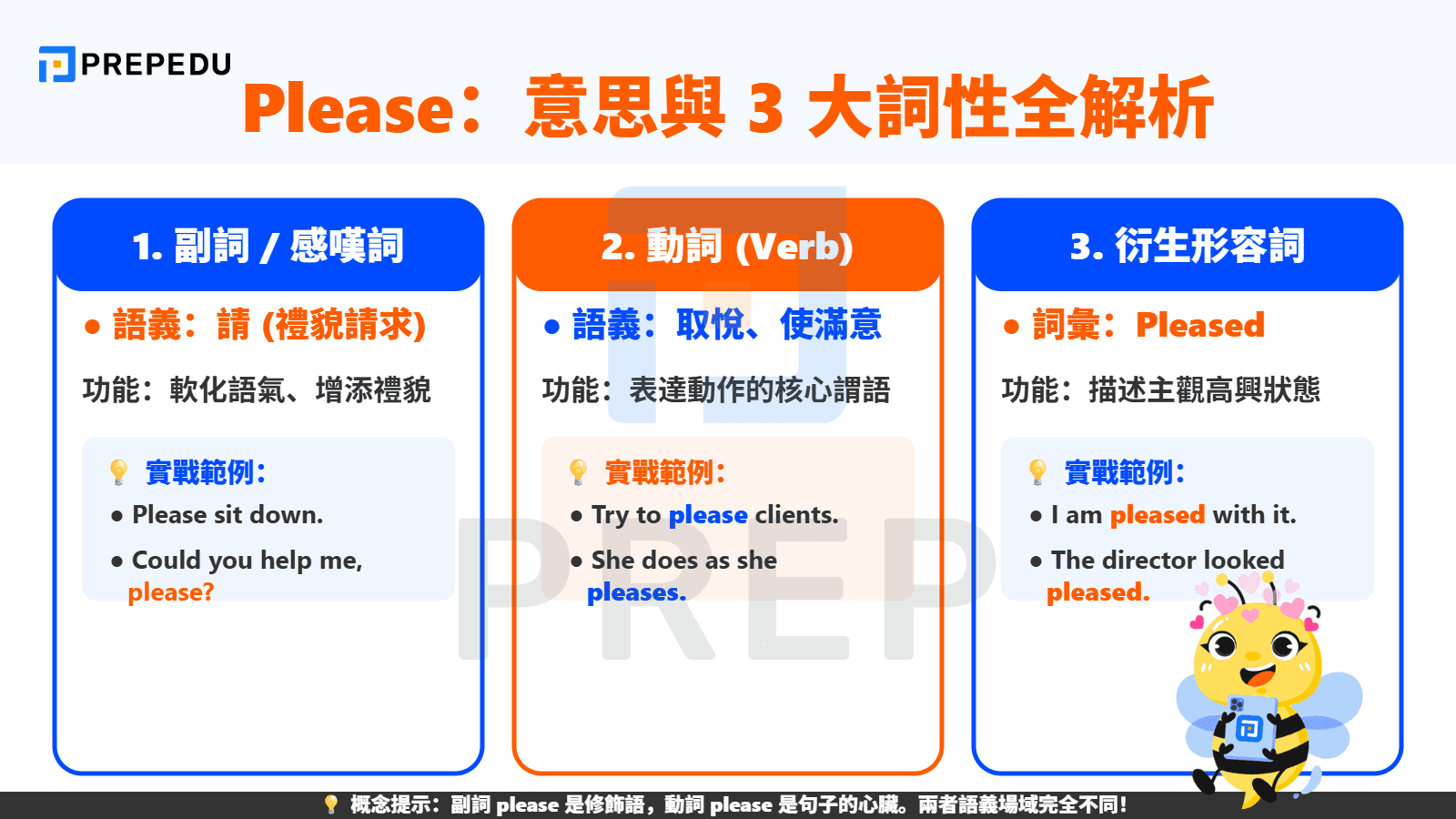
Please 在英語中同時承擔三種截然不同的語法角色——副詞∕感嘆詞(禮貌語氣)、動詞(取悅)、以及衍生形容詞 pleased(滿意的)。三種詞性,三個語義場域,混淆任何一個都會造成表達錯誤。理解 please 詞性,是真正掌握 please 用法的起點。
1. 作為副詞/感嘆詞:表達禮貌請求
作為英文副詞或英文感嘆詞時,please 的核心功能是為句子增添禮貌語氣,本身不帶實質語意,可置於句首或句尾。這是最常見的 please 詞性用法,也是幾乎每位學習者最先接觸的形式。
Please 用法(副詞)指的是「請」,用於請求或命令時軟化語氣。它的細微差別是「你能幫我……嗎?」而非單純的命令——台港學習者需要特別留意這個文化語感。直接命令加上 please 只是形式上的禮貌;真正地道的英語禮貌,來自句型的選擇(could you please 遠比 please do 更有禮貌),這一點在後文詳述。
-
Please sit down.(請坐下。)
-
Could you pass the salt, please?(可以請你遞鹽嗎?)
-
Xiaomei, please be quiet during the presentation — the clients from Taipei are on the call.(小美,簡報進行中請保持安靜——台北的客戶正在線上。)
語法提示:置於句首時,後方通常不加逗號英文;但在書面語中偶爾加逗號,例如 Please, stop interrupting me.(拜託,別再打斷我了。)這個逗號帶有輕微不耐煩的語氣,使用時需留意情境。
2. Please 動詞:取悅與使滿意
作為英文動詞時,please 的 please 意思從「請」轉變為「取悅某人」或「使某人滿意」,是完全不同的語義場域。這個 please 動詞用法在閱讀及聽力測驗中頻繁出現,卻常被學習者忽略。
-
Xiao Wang always tries to please her clients, even when their demands are unreasonable.(小旺總是努力讓客戶滿意,即使對方的要求並不合理。)
-
It is almost impossible to please everyone in a large organization.(在大型機構中,幾乎不可能讓所有人都滿意。)
-
The new menu at the Kaohsiung branch pleased both local and international guests.(高雄分店的新菜單讓本地和外國賓客都感到滿意。)
此外,please 動詞也常接在 as、what、where 等詞之後,表示「想」、「選擇」或「喜歡」做某事,例如:She always does as she pleases.(她總是隨心所欲。)這個用法在口語中相當常見。
語義差異提醒:副詞的 please 用法是修飾語,動詞用法的 please 則是句子的核心謂語。混淆兩者會造成語義錯誤。Please please me(請取悅我)雖然文法正確,但兩個詞性同時出現,閱讀時需根據句子結構判斷。
3. 衍生形容詞:Pleased(感到高興的)
由動詞 please 衍生而來的英文形容詞 pleased,描述的是主觀的滿足或高興狀態,相當於「感到滿意的」或「感到高興的」。這個詞在商務信件與正式場合中極為常用,是書面英語的核心詞彙之一。
與 please 動詞的核心差異: Pleased 描述的是人的內在情緒狀態,而非動作本身。
-
I am pleased with the quarterly results from our Hong Kong office.(我對香港辦公室的季度業績感到滿意。)
-
The director looked pleased when she heard that the project had been approved.(主任聽到專案獲批後,臉上流露出高興的神情。)
了解 pleased 的形容詞用法,同時為後續英文介系詞搭配(pleased with、pleased to)奠定基礎,是進一步深化 please 用法的關鍵一步。
II. Please 用法——五大常見句型結構與位置差異
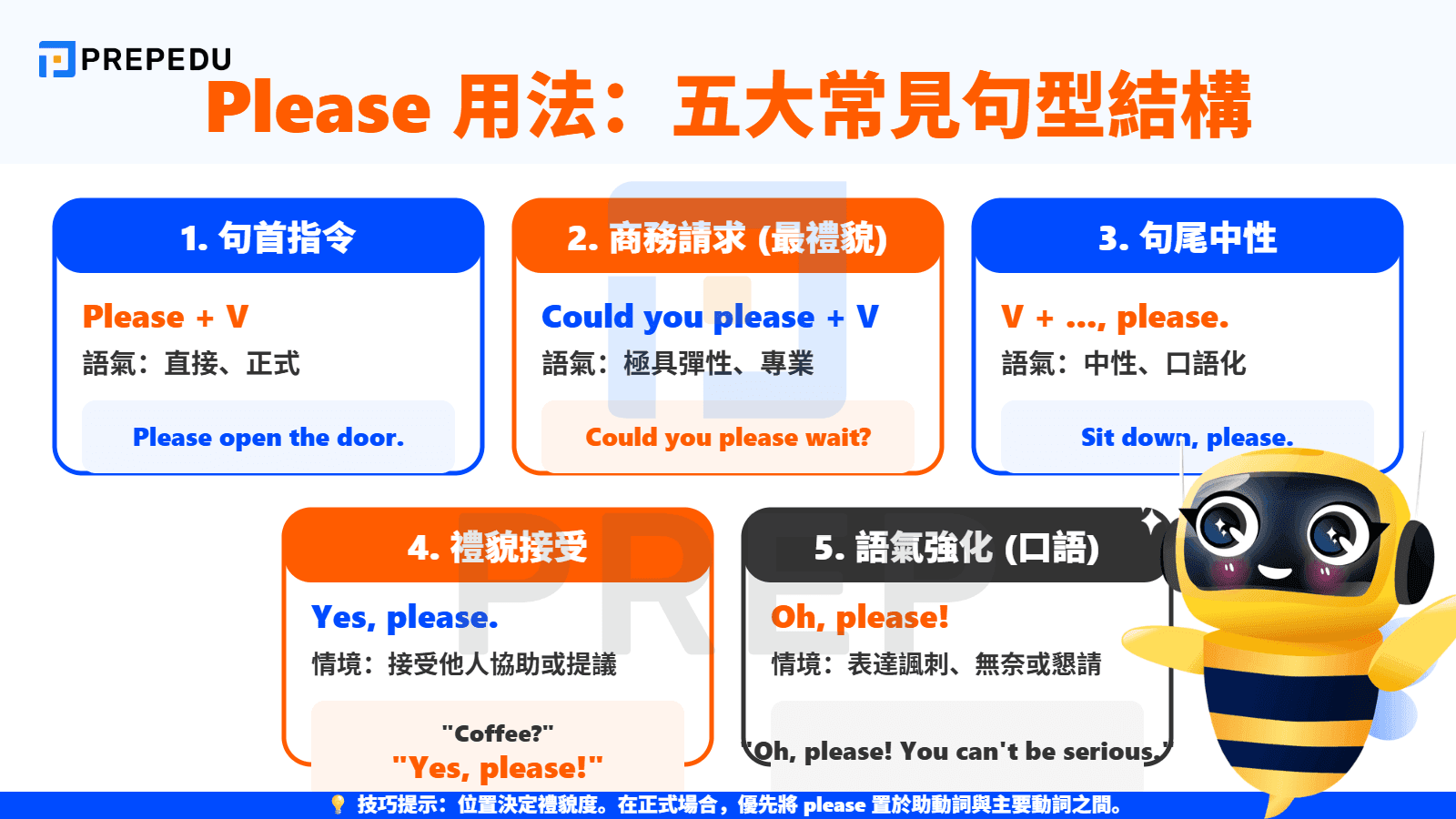
Please 用法中,最容易出錯的不是詞義,而是位置。Please 在句子中的位置,直接影響語氣的強弱與禮貌程度。以下五種主要句型結構,從最直接的句首指令到最禮貌的商務請求,語氣梯度清楚。
|
句型結構 |
例句 |
語氣特徵 |
|
Please + V(句首) |
Please open the door.(請打開門。) |
直接指令,偏正式或命令 |
|
Could you please + V |
Could you please wait?(可以請你等一下嗎?) |
最禮貌,適合商務 |
|
Would you please + V |
Would you please explain?(請你解釋一下好嗎?) |
禮貌,語氣略強於 could |
|
V + please(句尾) |
Sit down, please.(請坐。) |
較中性,可口語使用 |
|
Yes, please |
"More coffee?" "Yes, please." → 「要再來點咖啡嗎?」 → 「好的,請給我一點。」 |
接受提議的禮貌回應 |
1. 請求協助:Could you please 用法與句中位置
Could you please 用法是商務英語中最重要的 please 用法之一,也是最能展現禮貌度的請求結構。語言學研究指出,這個句型保留了對方拒絕的空間,因此比直接命令句更符合英語文化中對「消極禮貌(negative politeness)」的期待。
-
Could you please send me the revised proposal by end of day Friday?(能請你在週五下班前把修改後的提案寄給我嗎?)
-
Could you please speak a little more slowly? Xiao Wang is joining the call from Taipei and the connection isn't ideal.(能請你說慢一點嗎?小旺從台北接入通話,連線品質不太好。)
-
Could you please confirm whether the contract has been signed?(能請你確認合約是否已簽署嗎?)
位置規則: Please 置於助動詞 could you 之後、本動詞之前。這個位置使語氣達到最高禮貌程度,遠比直接說 Send me the proposal(把提案寄給我)更適合正式場合。
進階變體對比:
|
句型 |
禮貌程度 |
適用場合 |
|
Could you please + V |
最高 |
正式商務、對上司或陌生人 |
|
Would you please + V |
高 |
正式,語氣稍直接 |
|
Would you mind + V-ing |
高 |
正式,最謙遜的問法 |
|
Would you be able to + V |
高 |
商務,強調對方的能力與意願 |
|
Can you please + V |
中 |
非正式,熟識的同事或朋友 |
2. 祈使句:Please 放句首的指令語氣
Please + V 是最基本的 please 用法,廣泛出現於公告、標誌、說明書與廣播通知。這個結構簡單直接,但語氣強弱完全取決於說話語調與情境。
-
Please fasten your seatbelts — the aircraft is beginning its descent into Hong Kong International Airport.(請繫好安全帶——飛機正開始下降進入香港國際機場。)
-
Please do not take photographs inside the exhibition hall.(請勿在展覽廳內拍照。)
-
Please submit your application form before the deadline on Friday.(請在週五截止日期前提交申請表。)
台港學習者特別注意:在口語中,Please + V 有時帶有命令語氣,尤其當說話者語調平直或帶有不耐煩時,這個句型反而顯得不夠禮貌。例如,在辦公室對同事說 Please stop talking! 已接近命令而非請求。因此,在與上司、客戶或陌生人溝通時,建議使用 could you please 句型,以確保語氣禮貌。
此外,部分語言學家指出,過度使用 please + 英文祈使句,有時會產生「被動式攻擊(passive-aggressive)」的語感。例如,Please be quiet.(請安靜。)在某些情境下可能帶有諷刺或不耐煩的弦外之音,需依照現場語調判斷。
3. 接受物品或協助:放句尾的 Yes, please
當對方提供幫助或詢問你是否需要某樣東西時,Yes, please 是最地道的接受方式,也是 please 用法中社交場合最重要的表達之一。反之,若想拒絕,則說 No, thank you. 而非 No, please.
對話範例:
|
說話者 |
範例 |
|
空姐 |
Would you care for some tea or coffee?(您需要茶還是咖啡?) |
|
小旺 |
Coffee, please. Thank you.(咖啡,謝謝。) |
|
同事 |
Can I help you carry those files to the meeting room?(我可以幫你把那些文件搬到會議室嗎?) |
|
小美 |
Yes, please! That would be really helpful.(好的,太感謝了!) |
|
主持人 |
Shall I give you a moment to review the slides?(需要給你一點時間看一下投影片嗎?) |
|
演講者 |
Yes, please — just thirty seconds.(好的,請給我三十秒就好。) |
使用時機: Yes, please 永遠置於 yes 後方,或獨立成句,語氣親切自然,適用於任何社交場合,從機艙服務到商務會議皆適宜。
4. 加強語氣與鼓勵:口語中的 Oh, please!
在口語中,please 可完全脫離禮貌請求的框架,承載截然不同的情感功能。這個用法在台港學習者接觸英語影視媒體時極為常見,了解它能幫助你準確讀懂對話中的情感層次。
|
表達無奈、懷疑或諷刺(語調上揚) |
|
|
表達真誠鼓勵或懇請(語調溫和) |
|
語氣關鍵:相同的 Oh, please! 因語調、語境不同,可以是諷刺,也可以是真誠懇請。判斷依據在於說話者的情緒與前後文,而非單字本身。這正是 please 用法中最需要文化語感的部分。
III. Pleased 搭配介系詞詳解(Pleased to V 還是 V-ing?)
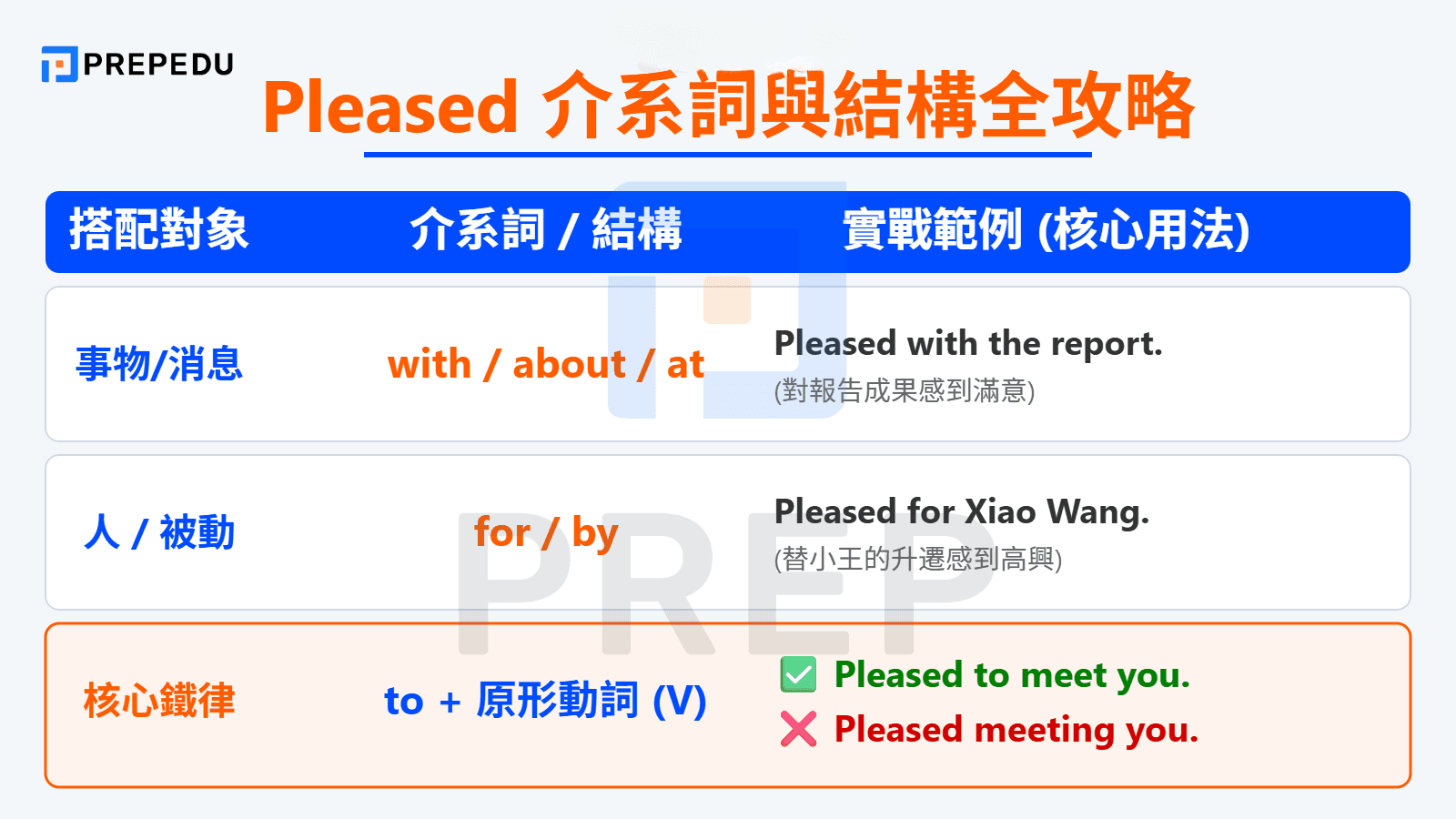
Pleased 的介系詞搭配是英語考試與商務寫作中最高頻的易錯點。從 IELTS 寫作到 TOEIC 閱讀,這個考點反覆出現。請的英文學習者在掌握基本 please 用法之後,必須進一步掌握 pleased 的介系詞規則。正確答案是:pleased 之後接不定詞 to V,而非動名詞 V-ing。 以下逐一解析各介系詞的細微語義差異。
看更多:英文不定詞動名詞(To V vs. V-ing)文法全攻略
1. Pleased with / about / at + 事物
這三個介系詞搭配在語義上高度相似,但各有細微差別,使用時需要依照情境精確選擇:
|
介系詞 |
語義重點 |
典型搭配情境 |
例如 |
|
pleased with |
對某人的表現或某物的品質感到滿意 |
結果、成果、人的行為 |
The project manager was pleased with Xiao Wang's final report — it covered every detail the client had requested.(專案經理對小旺的最終報告感到滿意——報告涵蓋了客戶要求的每一個細節。)→ 強調對成果品質的整體評價。 |
|
pleased about |
對某件事情或狀況感到高興 |
消息、決定、變化 |
The Taipei team is pleased about the new partnership with the Hong Kong distribution company.(台北團隊對與香港經銷商的新合作關係感到高興。)→ 強調對某件事的整體正面反應。 |
|
pleased at |
對某個具體事件或行為作出即時反應(較正式,書面語常見) |
特定事件 |
The senior editor was pleased at the unexpected improvement in Xiaomei's writing after just three weeks.(資深編輯對小美在短短三週內寫作進步之快感到驚喜。)→ 強調對特定事件的直接情感反應,語感較文學化。 |
2. Pleased for + 人 / Pleased by + 事物
Pleased for + 人: Please 用法表示「替某人感到高興」,強調為他人的好消息或成就而感到欣慰。這個用法在口語中自然且常見,尤其適合表達對同事或朋友升遷、獲獎的祝賀情感。
-
I'm genuinely pleased for Xiao Wang — after three years working on that account, she absolutely deserved the promotion.(我真的替小旺感到高興——在那個客戶身上工作了三年,她完全值得這次升職。)
-
Everyone on the Hong Kong team was pleased for Director Chen when the board approved his proposal.(當董事會批准陳主任的提案時,香港團隊的每個人都替他感到高興。)
Pleased by + 事物: 表示「被某事物取悅」,強調某事物帶來滿足感的被動狀態,語氣較正式,多見於書面語或正式演講中。
-
The board of directors was pleased by the thoroughness of the market analysis submitted by the Kaohsiung office.(董事會對高雄辦公室提交的市場分析之周全性感到滿意。)
-
Xiao Wang was visibly pleased by the standing ovation she received at the end of her keynote address.(小旺在主題演講結束後獲得全場起立鼓掌,她顯然深受感動。)
3. Pleased to + V(接不定詞的用法)
這是最重要的結論,也是最高頻的 please 用法:pleased 後方接不定詞 to V,而非動名詞 V-ing。台灣學習者最常見的錯誤是寫成 "pleased meeting you" 或 "pleased to attending"——前者用了動名詞,後者在 to 後面接了進行式,兩者都是典型的語法錯誤,在 IELTS Writing 和 TOEIC 寫作的評分中都會被標記。正確結構:pleased + to + 原形動詞。
-
I am pleased to meet you — I've heard a great deal about your work in the Taipei design team.(很高興認識你——我聽說了很多關於你在台北設計團隊工作的事。)— 商務場合標準問候語
-
We are pleased to announce that our new Hong Kong office will officially open next quarter.(我們很高興宣布,香港新辦公室將於下季正式開業。)
-
The admissions committee is pleased to inform you that your application has been successful.(招生委員會很高興通知你,你的申請已獲通過。)
IV. 包含 Please 的實用成語與慣用語(Idioms)
英語中以 please 為核心的慣用語,遠比課本所教的更豐富,也更貼近母語者的日常表達。掌握這些 idioms,能讓你對「請的英文」的理解從課本英語升級為真正的地道英語,也能在閱讀英美文學或影視媒體時讀懂更深一層的語義。
|
表達 |
中文意思 |
語氣 / 特點 |
例句 |
|
Please yourself |
隨你便 |
帶點不耐、無奈 |
「I've told Xiaomei three times that the deadline is Thursday, but she keeps saying she needs more time.」「Well, please yourself, Xiaomei, but don't expect me to explain it to the client.」(「我已經告訴小美三次截止日期是週四了,但她還是說需要更多時間。」「好吧,隨你便,小美,但別指望我去向客戶解釋。」) |
|
Do as you please |
按你的意願行事 |
較正式、中性 |
You are a visiting researcher — feel free to use the library resources and do as you please during your time here.(你是訪問研究員——請自由使用圖書館資源,在這段時間內完全按照自己的意願行事。) |
|
If you please(諷刺) |
你能相信嗎 |
諷刺、驚訝 |
The new intern submitted a blank document for the quarterly report, if you please. (那個新來的實習生竟然交了一份空白文件作為季度報告,你能相信嗎。)→ 強調說話者的難以置信或輕微憤慨。 |
|
Please the eye |
賞心悅目 |
描述美感 |
The interior of the new Taipei flagship store was deliberately designed to please the eye at every angle, from the entrance to the fitting rooms.(台北新旗艦店的室內設計刻意在每個角度都令人賞心悅目,從入口一直到試衣間都是如此。) |
|
Please God |
但願、希望 |
表達強烈希望 |
Please God, the negotiations go smoothly tomorrow and we can finally close this deal.(但願明天的談判進行順利,我們終於能夠完成這筆交易。)→ 台港學習者了解此用法即可,不建議在正式場合主動使用以免語感不自然。 |
V. Please 用法綜合練習題(附解答)
掌握理論之後,真正的學習在於實踐。以下提供三組共 30 道練習題,涵蓋本文所有核心知識點——從介系詞搭配、句型位置到商務情境應用。建議你先獨立作答,再對照解析,確認每一道錯題背後的語法原理,這才是鞏固 please 用法的最有效方式。
1. 第一部分:單項選擇題
請選出最適合填入空格的選項。
-
The regional director was _____ the team's presentation at the Taipei headquarters. A. pleased for B. pleased with C. pleased to D. pleased by
-
All of us in the Hong Kong office are so happy — we are really _____ Xiao Wang after she won the regional award. A. pleased with B. pleased about C. pleased for D. pleased at
-
We are _____ inform you that your scholarship application has been approved. A. pleased to B. pleased with C. pleased for D. please
-
The senior editor was _____ the unexpectedly high quality of the intern's first draft. A. pleased for B. pleased with C. pleased at D. pleased to
-
_____ you resend the invoice with the correct billing address? A. Please could B. Could you please C. Could please you D. You could please
-
The new exhibition at the Kaohsiung Museum of Fine Arts truly _____ the eye of every visitor. A. pleases B. pleased for C. is pleased D. pleasing
-
"Would you like to try our new oolong tea from Alishan?" "___________" A. Please yes. B. Yes, please. C. Please, yes. D. Yes please to.
-
It takes real skill to _____ both the client and the internal stakeholders at the same time. A. pleased B. pleasing C. please D. be pleased
-
The junior associate submitted a one-page memo for a three-month project, _____ _____ _____. A. please yourself B. if you please C. please God D. do as you please
-
Which sentence is appropriate for a formal business email? A. Plz review the attached proposal ASAP. B. Please to review the attached proposal. C. Please review the attached proposal at your earliest convenience. D. Please reviewing the proposal now.
2. 第二部分:句子改寫與位置判斷
請按照括號內的指示改寫句子,或判斷 please 用法的位置是否正確。
-
將以下祈使句改寫為最禮貌的商務請求句: Sign the NDA before the meeting begins. → _______________________________________________
-
判斷正誤並改正:Could please you close the conference room door? → _______________________________________________
-
將以下句子改寫,使其更有禮貌(使用 Would you please): Stop sending last-minute changes to the report. → _______________________________________________
-
判斷正誤並改正:Xiao Wang is pleased meeting the new clients from Hong Kong. → _______________________________________________
-
請將以下中文翻譯成英文(使用 please 於句尾,語氣較柔和): 「請出示您的護照以便辦理登機手續。」 → _______________________________________________
-
判斷正誤並改正:Please you help me carry these sample boxes to the storage room? → _______________________________________________
-
將以下句子加入 please,使其適合用於機場或捷運站廣播通知: Keep your personal belongings with you at all times. → _______________________________________________
-
判斷正誤並改正:The committee is pleased to attending the annual gala dinner. → _______________________________________________
-
將以下對話填入正確回應(接受提議): 「Our Taipei office can arrange a car to pick you up from the airport.」→ __________________
-
判斷以下哪一句適合用於正式商務電子郵件,並說明原因: A. Plz send the updated figures before the board meeting. B. Could you please send the updated figures before the board meeting? → 正確答案是:,原因:____________________________________________
3. 第三部分:商務與日常情境填空
請根據情境,在空格中填入最適當的 please 用法相關表達。
-
商務電子郵件開頭句: We are _____ _____ announce the opening of our new regional office in Kaohsiung.(我們很高興宣布高雄新區域辦公室的開幕。)
-
商務電子郵件請求句: _____ _____ _____ provide your feedback on the draft contract before Thursday at noon?(能請您在週四中午前提供您對合約草稿的意見嗎?)
-
日常對話(誠懇邀請朋友): A: Are you coming to Xiaomei's farewell dinner in Taipei tonight? B: Oh, _____ _____ come! She'll be so happy to see everyone there.(拜託一定要來!她看到大家都到場一定會非常開心。)
-
情境:在商務會議上,一位同事交出品質低落的報告,另一位同事私下低聲說: He handed in a draft full of typos for the client presentation, _____ _____ _____. (他竟然交出一份滿是錯字的草稿作為客戶簡報,真是難以置信。)
-
情境:你提醒朋友某件事的風險,但朋友仍堅持己見,你以一句話表達「隨你便,但你已被警告過了」: 「_____ _____, but don't say I didn't warn you.」
-
翻譯:「台北辦公室的新大廳裝潢設計得賞心悅目,讓每位訪客都留下深刻印象。」 → The new lobby design at the Taipei office was created to _____ _____ _____ of every visitor.
-
翻譯:「我很榮幸受邀出席這次在香港舉辦的國際英語教育論壇。」(使用 pleased to V) → I am _____ _____ _____ the International English Education Forum held in Hong Kong.
-
商務接待情境:香港客戶抵達台北辦公室,接待人員說: → _____ _____ _____ you in person — welcome to our Taipei headquarters.(很高興親自見到您——歡迎來到我們的台北總部。)
-
情境填空:會議主持人詢問與會者是否需要在正式開始前先休息,與會者想接受: 「Would you all like a five-minute break before we proceed?」→ 「_____, _____ — thank you for asking.」
-
在非正式的同學群組訊息中,你想請同學幫你轉告老師你會遲到,以下哪種表達最合適? A. Please tell the teacher I'll be late.(正式簡訊) B. Plz tell the teacher im late lol.(非正式聊天) C. 兩者在此情境中皆可接受,只是語氣不同。 → 答案:,理由:____________________________________________
4. 練習題解答與重點解析
第一部分解答
-
B — pleased with。 解析:pleased with 表示對某人的表現或成果感到滿意,是評價「結果品質」的標準搭配,適用於對具體表現作整體評價的情境。
-
C — pleased for。 解析:pleased for + 人,表示替某人感到高興,強調為他人的喜事而欣慰;這與 pleased with(評價事物品質)有本質語義差異,絕不可混用。
-
A — pleased to。 解析:pleased 接不定詞 to V,是正式商務公告的固定句型,We are pleased to inform / announce / confirm 是最常見的變體,學習者需熟練記憶。
-
C — pleased at。 解析:pleased at 強調對某個具體事件的即時正面反應,尤其帶有「出乎意料的驚喜感」,書面語中常見,語感比 pleased with 更具臨場情感色彩。
-
B — Could you please。 解析:please 必須置於助動詞(could you)之後、本動詞之前,其他選項的語序均錯誤,不符合英語語法規範。
-
A — pleases。 解析:此處 please 作動詞,意為「取悅」或「令……感到愉悅」,主詞為 The new exhibition,第三人稱單數現在式加 -s,表達藝術品對觀者視覺的持續吸引力。
-
B — Yes, please. 解析:接受提議的標準回應為 Yes, please.,please 置於 yes 後方,句尾加句號。請注意,Please yes. 語序錯誤,在英語中不存在。
-
C — please。 解析:此處 please 為動詞原形,接在不定詞 to 之後(to please both the client and the internal stakeholders),表示「同時取悅兩方」這個動作本身。
-
B — if you please。 解析:If you please 在現代英語中常以諷刺語氣表達「你能相信嗎」或「竟然」,此處說話者對提交一頁備忘錄的行為感到難以置信,語氣帶有輕微憤慨。
-
C — Please review the attached proposal at your earliest convenience. 解析:A 使用了縮寫 plz,商務郵件嚴格禁用;B 中 please to review 語法錯誤,please 後不加 to;D 中 please reviewing 同樣語法錯誤,原形動詞才是正確結構。
第二部分解答
-
Could you please sign the NDA before the meeting begins?
-
錯誤。正確:Could you please close the conference room door? — please 必須置於 you 之後、動詞之前,不可插入助動詞與主語之間。
-
Would you please stop sending last-minute changes to the report?
-
錯誤。正確:Xiao Wang is pleased to meet the new clients from Hong Kong. — pleased 後接不定詞 to V,不接動名詞 V-ing,這是最常見的文法陷阱之一。
-
Show your passport for check-in, please.(語氣較柔和,please 置於句尾)
-
錯誤。正確:Could you please help me carry these sample boxes to the storage room? — 不能以 Please you 開頭,這樣的語序在英語中不成立。
-
Please keep your personal belongings with you at all times.
-
錯誤。正確:The committee is pleased to attend the annual gala dinner. — pleased to + 原形動詞,絕不接 to + V-ing。
-
Yes, please! That would be very much appreciated.
-
B。 原因:商務電子郵件必須使用完整的 please,且 could you please + V 是最符合商務禮儀的請求句型,而 plz 屬於非正式縮寫,在任何正式場合使用都會損害說話者的專業形象。
第三部分解答
-
pleased to(We are pleased to announce the opening of our new regional office in Kaohsiung.)
-
Could you please(Could you please provide your feedback on the draft contract before Thursday at noon?)
-
please do(Oh, please do come!)— 這個結構強調真誠懇請,語氣比單純的 please come 更有感情。
-
if you please(He handed in a draft full of typos, if you please.)— 表達諷刺式的難以置信,符合職場私下評論的語氣。
-
Please yourself(Please yourself, but don't say I didn't warn you.)
-
please the eye(...was created to please the eye of every visitor.)
-
pleased to attend(I am pleased to attend the International English Education Forum held in Hong Kong.)
-
Pleased to meet(Pleased to meet you in person — welcome to our Taipei headquarters.)
-
Yes, please(Yes, please — thank you for asking.)
-
C — 兩者在此情境中皆可接受,只是語氣不同。 理由:在非正式的同學群組聊天中,plz 是廣泛接受的 please 縮寫,屬於對等社交場合的正常數位語言;A 的正式寫法同樣可用,語氣只是略顯正式。關鍵是判斷場合——若群組成員全為同齡同學且溝通氛圍輕鬆,兩者皆恰當。但只要情境稍微正式,例如涉及師長或正式通知,就必須回歸 please 的完整拼寫。
VI. 常見問題與網路用語(FAQs)
除了文法結構,please 在現代數位通訊中也衍生出新的書寫形式與文化爭議。以下解答兩個學習者最常提出的疑問,幫助你在日常英語溝通中對 please 用法做出正確判斷。
1. Please 縮寫探討:plz 意思與適用場合
PLZ 意思就是 please 的網路縮寫形式,屬於打字省力的簡化拼寫,也是最廣為人知的 please 縮寫之一。另一個常見的變體是 pls。這些縮寫起源於早期即時通訊時代,如今廣泛出現於社群媒體、遊戲聊天室與非正式簡訊中,是當代數位英語文化的一部分。
然而,please 縮寫的使用有嚴格的場合限制,混淆場合會嚴重損害你的專業形象:
|
場合 |
是否可用 plz 或 pls |
建議用法 |
|
朋友之間的即時通訊 |
可以 |
plz、pls 均可接受 |
|
社群媒體非正式貼文 |
視情況 |
非正式留言可用 |
|
商務電子郵件 |
絕對禁用 |
必須寫完整的 please |
|
職場訊息(Slack、Teams) |
建議避免 |
維持 please 以保持專業形象 |
|
學術寫作或考試 |
絕對禁用 |
不使用任何縮寫形式 |
結論: plz 和 pls 僅限私人非正式對話使用。一旦進入商務或學術語境,請務必使用完整的 please,這是書面英語的基本禮儀,也是職場英語中不可忽視的一條規則。
2. 禮貌迷思:加了 Please 就一定禮貌嗎?
這是台灣與香港學習者最常見的誤解之一。請的英文 please 用法不是萬能的禮貌符號。 在某些情境下,please 反而會製造出「被動式攻擊(passive-aggressive)」的語感,使對方感到受壓迫而非被尊重。
以下情境中,please 可能適得其反:
-
Please stop talking.(請停止說話。)— 如果語調冰冷,這句話更像命令而非請求,甚至令對方感到被羞辱。
-
Can you please just listen to me?(你能不能請你聽我說話?)— 說話者的不耐煩透過 just 和語調洩漏,please 在此強化了不滿情緒,而非軟化它。
-
I already said please!(我已經說了請了!)— 在對話中這樣強調,通常更像一種施壓,而非真誠的禮貌表達。
深層文化原因:真正的禮貌來自整體語氣、句型選擇與情境判斷的組合,而非單靠一個詞彙。Could you please...? 的禮貌程度遠高於直接的 Please do...,因為前者保留了對方「選擇拒絕」的空間,後者則接近命令。在台灣和香港的職場英語觀察中,學習者把 please 加在命令句前的頻率遠高於使用 could you please 句型——根本原因是母語教學環境長期以「please = 禮貌詞」的方式教授,卻沒有說明這個詞在不同句型結構中的語氣差距可以相當大。
結論
Please 用法是英語中使用頻率最高的單字之一,但真正用對它的學習者並不多。三大詞性的核心記憶點:副詞 please 軟化語氣、動詞 please 表示取悅、形容詞 pleased 描述內在滿足狀態——三種語義,必須根據句子結構判斷,不可混用。
請的英文的進階關鍵,在於句型選擇,而非單字本身。Could you please + V 比 Please + V 更有禮貌,原因在於前者在語法結構上就保留了對方拒絕的空間;pleased to V 而非 pleased V-ing,是商務書信最高頻的文法考點,一旦記住就終身不再出錯。
你的下一步很具體:找你最近寫過的一封英文電郵,找出所有直接以 please + 動詞開頭的請求句,試著改寫成 Could you please 或 Would you please 結構,感受語氣的變化。這個練習讓你完成了從「知道 please 的規則」到「在真實寫作中應用禮貌策略」的關鍵轉換。想系統強化英語詞彙與 IELTS∕TOEIC 備考能力,PREPEDU 的英語學習資源提供完整的語法指南與備考練習支援。

你好!我叫黃秋賢,現在在 prepedu.com 擔任內容企劃。我有超過5年的英語與韓語自學經歷,親身備考 IELTS、TOEIC 與 TOPIK,累積了大量第一手的學習者視角——包括哪些語法規則最讓台灣與香港學習者混淆,以及如何在有限的備考時間內最有效地修正這些錯誤。目前已在 prepedu.com 撰寫超過 1000 篇英語學習文章,內容涵蓋語法、詞彙與考試策略,累積協助數千位學習者解決自學過程中的語法疑問。
評論












統一企業編號:202227322W
地址:114 LAVENDER STREET, #11-83 CT HUB 2, SINGAPORE (338729)