英文動詞三態大全:規則與不規則變化總表,記憶口訣及練習題(附 PDF 下載)
什麼是動詞三態?為什麼學英文一定要掌握它?動詞三態是指英文動詞的三種基本形式:原形動詞(V1),過去式(V2)和過去分詞(V3),這是英語時態系統的核心基礎,無論是表達過去經驗,完成式或被動語態,都必須正確使用對應的動詞形式。根據語言學研究顯示,約70%的英語動詞屬於規則變化,但剩下30%的不規則動詞卻是考試和日常溝通中最常使用的核心詞彙。
許多台灣和香港的英語學習者在準備TOEIC,IELTS等國際檢定時,經常因為混淆 go-went-gone, write-wrote-writte 等不規則動詞變化而失分。更令人困擾的是,傳統的死記硬背方法不僅效率低下,更容易造成V2(過去式)與 V3(過去分詞)的使用錯誤。
PREPEDU團隊針對這個學習痛點,整理出完整的規則與不規則動詞變化總表,涵蓋250+個常用動詞,系統化的分類記憶法(AAA/ABB/ABA/ABC型),實用記憶口訣,以及30題實戰練習題附詳解。這份指南不僅提供可下載的PDF資源,更教你如何透過音韻模式和文法邏輯,快速掌握動詞三態的正確用法,讓你在考試和實際溝通中都能精準表達。

I. 什麼是動詞三態?定義與用法簡述
英文動詞三態指的是動詞在不同時態中的三種基本形式,分別是原形動詞(V1),過去式(V2)與過去分詞(V3)。這三種形式構成了英語時態系統的基礎架構,讓我們能夠清楚表達動作發生的時間點與狀態。掌握動詞三態的概念是學習英文文法的第一步,無論是在日常對話,學術寫作或商務溝通中,都需要正確運用這三種動詞形式。
|
中文名稱 |
英文術語 |
簡稱 |
主要用途 |
|
原形動詞 |
Base Form / Present |
V1 |
|
|
過去式 |
Past Simple |
V2 |
過去時間點的動作 |
|
過去分詞 |
Past Participle |
V3 |
完成式,被動語態 |
理解三態動詞的概念後,你就能準確運用各種時態結構。V1 代表動詞最原始的狀態,V2 用於描述已經完成的過去動作,而 V3 則與助動詞 have 或 be 搭配,形成完成式或被動句型。掌握這三種形式的正確用法,是寫出流暢英文句子的關鍵,也是動詞三態英文學習的基礎。
II. V1,V2,V3 的正確語法應用
許多學習者雖然背誦了動詞三態表,卻在實際使用時感到困惑。以下詳細說明每種形式的核心動詞三態用法,幫助你將知識轉化為實際的語言能力。
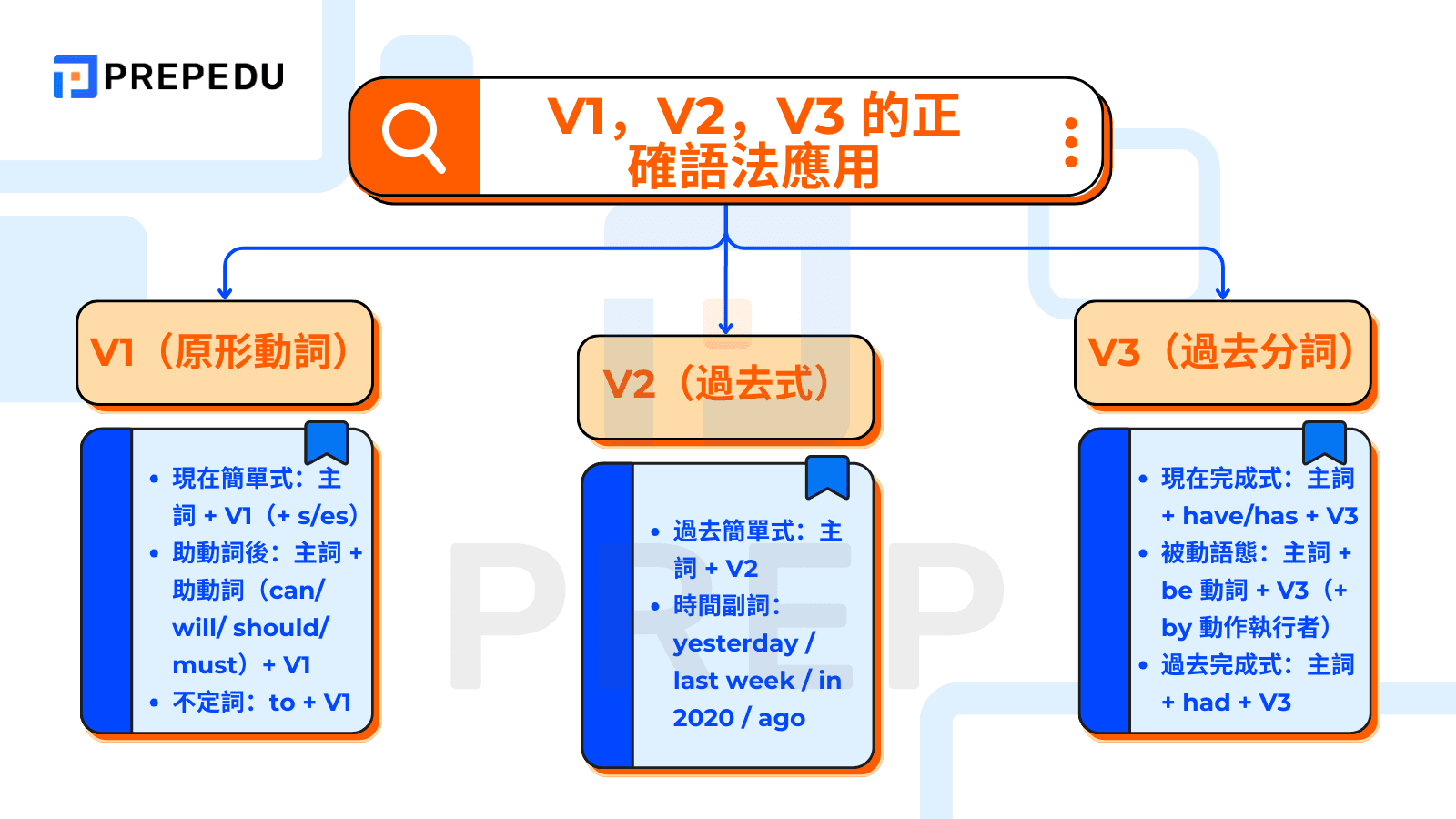
1. V1(原形動詞)的結構與使用
文法結構:
-
現在簡單式:主詞 + V1(+ s/es)
-
助動詞後:主詞 + 助動詞(can/will/should/must)+ V1
-
不定詞:to + V1
使用時機:在學習動詞三態時,必須特別注意原形動詞英文的功能。原形動詞用於描述現在的習慣、事實、真理或未來計劃。此外,當句子中出現助動詞時,其後必須接原形動詞。
例句:
-
Xiaohua goes to Taipei 101 every weekend to enjoy the city view and take photos with her friends.(小華每個週末都去台北101欣賞城市景觀並與朋友拍照。)➡️ 使用 V1(goes)描述習慣性動作,因主詞是第三人稱單數,需加 -s
-
Mr. Chen from Taichung can speak fluent English because he studied abroad in Vancouver for five years.(來自台中的陳先生能說流利的英語,因為他在溫哥華留學了五年。)➡️ 助動詞 can 後接原形動詞 speak,表示能力
2. V2(過去式)的結構與使用
文法結構:
使用時機:原形動詞(動詞三態的二態)用於描述現在的習慣、事實、真理或未來計劃。當句子中出現助動詞時,其後必須接原形動詞。
例句:
-
Last month,Xiaoming visited the National Palace Museum in Taipei and bought several traditional Chinese art postcards as souvenirs.(上個月,小明參觀了台北故宮博物院,並買了幾張中國傳統藝術明信片作為紀念品。)➡️ 使用 V2(visited,bought)描述過去完成的動作,搭配明確時間 last month
-
During the Lunar New Year holiday,my family went to Kenting National Park and stayed at a beachfront hotel for three nights.(在農曆新年假期期間,我的家人去了墾丁國家公園,並在海濱飯店住了三晚。)➡️ V2(went,stayed)用於敘述過去發生的事件,時間背景清楚
3. V3(過去分詞)的結構與使用
文法結構:
使用時機:過去分詞本身不能單獨當作句子的動詞使用,必須與助動詞搭配。在完成式中表示從過去延續至今的經驗或結果,在被動語態中強調動作的承受者。
例句:
-
Professor Wang has taught English literature at National Taiwan University for twenty years and has published five academic books.(王教授在國立台灣大學教授英國文學已有二十年,並出版了五本學術著作。)➡️ 現在完成式 has taught,has published 表示從過去持續到現在的狀態與經驗
-
This traditional Taiwanese bubble tea recipe was created by a vendor in Taichung night market during the 1980s.(這個傳統台灣珍珠奶茶配方是在1980年代由台中夜市的一位攤販創造的。)➡️ 被動語態 was created,強調動作的承受者(recipe)而非執行者
關鍵提醒:V3 絕對不能單獨出現在句子中當作主要動詞,這是學習動詞三態用法時最需要注意的重點。
III. 規則動詞三態變化法則(Regular Verbs)
英語動詞三態變化表中,約有70%的常用動詞屬於規則動詞,這類動詞的 V2 與 V3 形式完全相同,且遵循可預測的字尾變化規律。掌握以下四種規則,你就能輕鬆處理大多數動詞三態變化整理表中的基礎動詞,這些規則是學習動詞三態的基石。
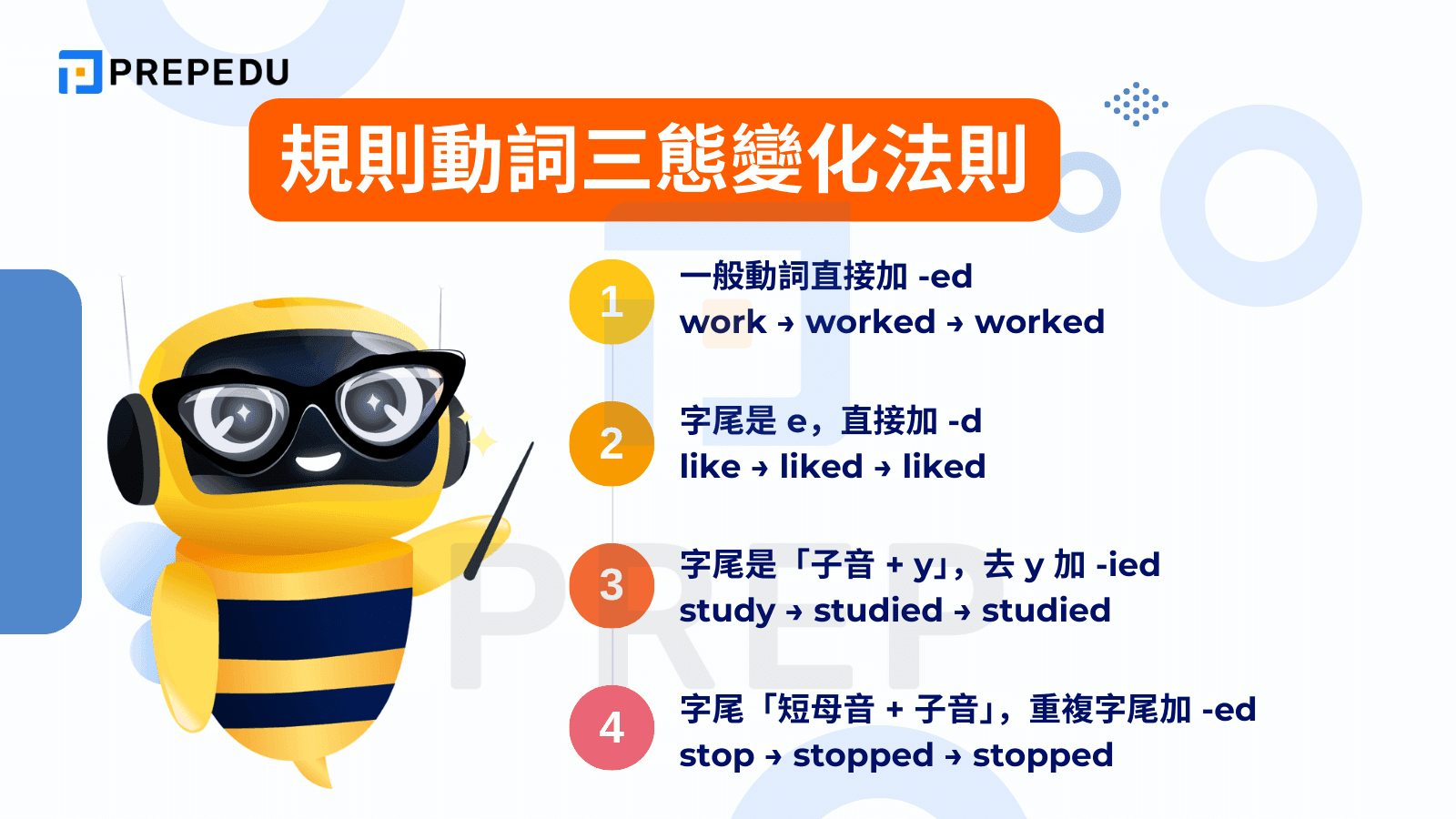
1. 規則一:一般動詞直接加 -ed
這是最基本且最常見的規則,適用於字尾不是特殊字母的一般動詞。將 -ed 直接加在動詞原形後方即可完成變化。
|
原形 V1 |
過去式 V2 |
過去分詞 V3 |
中文 |
例句 |
|
work |
worked |
worked |
工作 |
Mr. Lin worked at the Taiwan semiconductor factory for fifteen years.(林先生在台灣半導體工廠工作了十五年。) |
|
play |
played |
played |
玩 |
The children played basketball at the Taipei riverside park yesterday afternoon.(孩子們昨天下午在台北河濱公園打籃球。) |
|
listen |
listened |
listened |
聽 |
Xiaofang has listened to this Taiwanese indie band's album three times this week.(小芳這週已經聽這個台灣獨立樂團的專輯三次了。) |
|
open |
opened |
opened |
打開 |
The manager opened the new bubble tea shop in Ximen at 10 AM.(經理在上午10點開了西門的新珍珠奶茶店。) |
|
clean |
cleaned |
cleaned |
清潔 |
My grandmother cleaned the entire house before the Mid-Autumn Festival celebration.(我祖母在中秋節慶祝活動前清掃了整個房子。) |
2. 規則二:字尾是 e,直接加 -d
當動詞原形字尾已經有字母 e 時,為避免出現雙 e 的情況,只需加上 -d 即可,這是動詞三態變化中最基本也最常見的規則之一,有助於保持拼字的簡潔性。
|
原形 V1 |
過去式 V2 |
過去分詞 V3 |
中文 |
例句 |
|
like |
liked |
liked |
喜歡 |
Xiaowei has always liked the night market food culture in Taichung.(小薇一直都很喜歡台中的夜市美食文化。) |
|
love |
loved |
loved |
愛 |
My parents loved traveling around Taiwan's scenic spots during their youth.(我的父母在年輕時熱愛環遊台灣的風景名勝。) |
|
close |
closed |
closed |
關閉 |
The traditional bookstore in Tainan closed its doors after fifty years of operation.(台南的傳統書店在營運五十年後關門了。) |
|
use |
used |
used |
使用 |
The professor used digital teaching materials in her Mandarin classes at the language center.(教授在語言中心的華語課程中使用數位教材。) |
|
live |
lived |
lived |
居住 |
Mr. Chang has lived in the Taipei Daan District for over twenty years.(張先生在台北大安區居住已超過二十年。) |
3. 規則三:字尾是「子音 + y」,去 y 加 -ied
當動詞字尾是子音字母加上 y 時,需要將 y 改為 i 再加 -ed。特別注意,如果 y 前面是母音字母(如 play 中的 a),則不適用此規則,直接依照規則一處理。
|
原形 V1 |
過去式 V2 |
過去分詞 V3 |
中文 |
例句 |
|
study |
studied |
studied |
學習 |
Xiaojun studied Mandarin at National Taiwan Normal University for two semesters.(小軍在國立台灣師範大學學習華語兩個學期。) |
|
cry |
cried |
cried |
哭 |
The baby cried loudly during the flight from Taipei to Hong Kong.(嬰兒在從台北飛往香港的航班上大聲哭泣。) |
|
try |
tried |
tried |
嘗試 |
The chef tried a new recipe for pineapple cake at the Taiwanese bakery.(廚師在台灣烘焙坊嘗試了鳳梨酥的新配方。) |
|
carry |
carried |
carried |
攜帶 |
The tourists carried heavy luggage while walking through Taipei Main Station.(遊客們在穿過台北車站時攜帶著沉重的行李。) |
|
worry |
worried |
worried |
擔心 |
My mother worried about my safety when I traveled alone to Hualien.(當我獨自旅行到花蓮時,我母親很擔心我的安全。) |
4. 規則四:字尾「短母音 + 子音」,重複字尾加 -ed
當動詞符合「子音+短母音+子音」(CVC)結構,且重音在最後一個音節時,需要重複字尾子音再加 -ed。這個規則在學習動詞三態時,有助於確保拼字與發音的準確性。
|
原形 V1 |
過去式 V2 |
過去分詞 V3 |
中文 |
例句 |
|
stop |
stopped |
stopped |
停止 |
The MRT train stopped at Ximen Station for passenger boarding.(捷運列車在西門站停靠以供乘客上車。) |
|
plan |
planned |
planned |
計畫 |
The travel agency planned a ten-day tour package around Taiwan's eastern coast.(旅行社規劃了台灣東海岸的十日遊套裝行程。) |
|
drop |
dropped |
dropped |
掉落 |
Xiaoyun accidentally dropped her phone in the Sun Moon Lake during the boat tour.(小雲在遊船時不小心把手機掉進日月潭裡。) |
|
admit |
admitted |
admitted |
承認 |
The student admitted that he forgot to complete the Chinese homework assignment.(學生承認他忘記完成中文作業。) |
|
occur |
occurred |
occurred |
發生 |
A minor earthquake occurred in northern Taiwan early this morning.(今天清晨台灣北部發生了輕微地震。) |
5. 常見規則動詞三態變化總表
以下提供完整的動詞三態表供你快速動詞三態查詢使用。這張表格整合了上述四種規則的實際應用範例,是你學習規則動詞的最佳參考工具。英語動詞三 態變化表:
|
原形 V1 |
過去式 V2 |
過去分詞 V3 |
中文 |
|
accept |
accepted |
accepted |
接受 |
|
add |
added |
added |
增加 |
|
agree |
agreed |
agreed |
同意 |
|
answer |
answered |
answered |
回答 |
|
appear |
appeared |
appeared |
出現 |
|
ask |
asked |
asked |
詢問 |
|
attend |
attended |
attended |
參加 |
|
book |
booked |
booked |
預訂 |
|
call |
called |
called |
呼叫 |
|
check |
checked |
checked |
檢查 |
|
clean |
cleaned |
cleaned |
清潔 |
|
cook |
cooked |
cooked |
烹飪 |
|
finish |
finished |
finished |
完成 |
|
follow |
followed |
followed |
跟隨 |
|
happen |
happened |
happened |
發生 |
|
help |
helped |
helped |
幫助 |
|
join |
joined |
joined |
加入 |
|
laugh |
laughed |
laughed |
笑 |
|
learn |
learned |
learned |
學習 |
|
listen |
listened |
listened |
聽 |
|
look |
looked |
looked |
看 |
|
miss |
missed |
missed |
想念 |
|
move |
moved |
moved |
移動 |
|
need |
needed |
needed |
需要 |
|
open |
opened |
opened |
打開 |
|
pass |
passed |
passed |
通過 |
|
pick |
picked |
picked |
挑選 |
|
play |
played |
played |
玩 |
|
post |
posted |
posted |
發布 |
|
rain |
rained |
rained |
下雨 |
|
record |
recorded |
recorded |
記錄 |
|
return |
returned |
returned |
返回 |
|
save |
saved |
saved |
節省 |
|
seem |
seemed |
seemed |
似乎 |
|
sign |
signed |
signed |
簽署 |
|
stay |
stayed |
stayed |
停留 |
|
talk |
talked |
talked |
談話 |
|
test |
tested |
tested |
測試 |
|
thank |
thanked |
thanked |
感謝 |
|
touch |
touched |
touched |
觸摸 |
|
travel |
traveled |
traveled |
旅行 |
|
turn |
turned |
turned |
轉向 |
|
visit |
visited |
visited |
拜訪 |
|
wait |
waited |
waited |
等待 |
|
walk |
walked |
walked |
走路 |
|
want |
wanted |
wanted |
想要 |
|
wash |
washed |
washed |
洗滌 |
|
watch |
watched |
watched |
觀看 |
|
work |
worked |
worked |
工作 |
|
agree |
agreed |
agreed |
同意 |
|
arrive |
arrived |
arrived |
到達 |
|
change |
changed |
changed |
改變 |
|
close |
closed |
closed |
關閉 |
|
dance |
danced |
danced |
跳舞 |
|
decide |
decided |
decided |
決定 |
|
die |
died |
died |
死亡 |
|
hope |
hoped |
hoped |
希望 |
|
invite |
invited |
invited |
邀請 |
|
like |
liked |
liked |
喜歡 |
|
live |
lived |
lived |
居住 |
|
love |
loved |
loved |
愛 |
|
notice |
noticed |
noticed |
注意到 |
|
practice |
practiced |
practiced |
練習 |
|
promise |
promised |
promised |
承諾 |
|
refuse |
refused |
refused |
拒絕 |
|
smile |
smiled |
smiled |
微笑 |
|
use |
used |
used |
使用 |
|
apply |
applied |
applied |
申請 |
|
carry |
carried |
carried |
攜帶 |
|
copy |
copied |
copied |
複製 |
|
cry |
cried |
cried |
哭 |
|
deny |
denied |
denied |
否認 |
|
hurry |
hurried |
hurried |
匆忙 |
|
marry |
married |
married |
結婚 |
|
modify |
modified |
modified |
修改 |
|
reply |
replied |
replied |
回覆 |
|
study |
studied |
studied |
學習 |
|
try |
tried |
tried |
嘗試 |
|
worry |
worried |
worried |
擔心 |
|
admit |
admitted |
admitted |
承認 |
|
chat |
chatted |
chatted |
聊天 |
|
control |
controlled |
controlled |
控制 |
|
drop |
dropped |
dropped |
掉落 |
|
occur |
occurred |
occurred |
發生 |
|
permit |
permitted |
permitted |
允許 |
|
plan |
planned |
planned |
計畫 |
|
prefer |
preferred |
preferred |
偏好 |
|
refer |
referred |
referred |
提到 |
|
shop |
shopped |
shopped |
購物 |
|
step |
stepped |
stepped |
踏步 |
|
stop |
stopped |
stopped |
停止 |
IV. 不規則動詞三態變化法則(Irregular Verbs)
不規則動詞是學習動詞三態時最具挑戰性的部分,因為這些動詞的變化無法用固定規則推導,需要個別記憶。然而,透過分類記憶法,你可以發現不規則動詞之間的共同模式。這個章節將幫助你解決「動詞三態怎麼背」的困擾,讓記憶變得更有系統,也是準備動詞三態學習單的重要參考。

1. 變形一:AAA 型(三態同型)
AAA 型動詞的三種形式完全相同,是最容易記憶的一組。這類動詞數量較少,只需記住原形即可掌握所有時態變化。
|
原形 V1 |
過去式 V2 |
過去分詞 V3 |
中文 |
例句 |
|
cost |
cost |
cost |
花費 |
The imported electronic products from Japan cost more than expected at the Taipei technology market.(從日本進口的電子產品在台北科技市場的價格比預期高。) |
|
cut |
cut |
cut |
切,割 |
The chef cut fresh vegetables for the hot pot at the restaurant in Kaohsiung.(廚師在高雄的餐廳為火鍋切新鮮蔬菜。) |
|
hit |
hit |
hit |
打,擊 |
The typhoon hit Taiwan's eastern coast with strong winds last week.(颱風上週以強風襲擊台灣東海岸。) |
|
hurt |
hurt |
hurt |
傷害 |
Xiaoming hurt his ankle while playing basketball at the school playground.(小明在學校操場打籃球時弄傷了腳踝。) |
|
let |
let |
let |
讓 |
My parents let me travel to Hong Kong with my classmates during summer vacation.(我父母讓我在暑假期間和同學去香港旅行。) |
|
put |
put |
put |
放 |
The librarian put the new books about Taiwanese history on the display shelf.(圖書館員把關於台灣歷史的新書放在展示架上。) |
|
read |
read |
read |
閱讀 |
Professor Chen has read over fifty academic papers about Chinese linguistics this semester.(陳教授這學期已經閱讀了五十多篇關於漢語語言學的學術論文。) |
|
set |
set |
set |
設定 |
The IT technician set up the new computer system at the Taipei office yesterday.(IT 技術人員昨天在台北辦公室設置了新的電腦系統。) |
|
shut |
shut |
shut |
關閉 |
The night market vendors shut their stalls at midnight after a busy evening.(夜市攤販在忙碌的晚上後於午夜關閉攤位。) |
|
spread |
spread |
spread |
散布 |
The news about the new MRT line spread quickly among Taipei residents.(關於新捷運線的消息在台北居民中迅速傳播。) |
記憶提示:特別注意 read 這個動詞,雖然拼字三態相同,但過去式與過去分詞的發音是 /red/,與現在式的 /riːd/ 不同,需要依靠上下文判斷時態。為了更深入了解,您可以參考這篇文章的連結:《「Read 過去分詞」全攻略:從 Read - Read - Read 基礎到完成式用法,一次釐清》。
2. 變形二:ABB 型(過去式與過去分詞相同)
ABB 型是不規則動詞中數量最多的類型,過去式與過去分詞形式相同,只有原形不同。這類動詞三態的記憶重點在於掌握從 V1 到 V2/V3 的轉換模式。
|
原形 V1 |
過去式 V2 |
過去分詞 V3 |
中文 |
例句 |
|
bring |
brought |
brought |
帶來 |
Xiaofang brought homemade pineapple cakes from Taichung to share with her colleagues in Taipei.(小芳從台中帶來自製鳳梨酥與台北的同事分享。) |
|
build |
built |
built |
建造 |
The construction company built the new shopping mall in Xinyi District within two years.(建設公司在兩年內於信義區建造了新購物中心。) |
|
buy |
bought |
bought |
買 |
My grandmother bought fresh seafood at the traditional market in Keelung this morning.(我祖母今天早上在基隆傳統市場買了新鮮海鮮。) |
|
catch |
caught |
caught |
抓,趕上 |
We barely caught the high-speed rail train from Taichung to Taipei Station.(我們差點趕不上從台中到台北站的高鐵列車。) |
|
feel |
felt |
felt |
感覺 |
The exchange student felt homesick during her first month studying in Taiwan.(交換學生在台灣學習的第一個月感到思鄉。) |
|
fight |
fought |
fought |
戰鬥 |
The Taiwanese soldiers fought bravely to protect the island during wartime.(台灣士兵在戰時英勇作戰保護島嶼。) |
|
find |
found |
found |
找到 |
Xiaowei finally found her lost wallet at the Taipei MRT Lost and Found center.(小薇終於在台北捷運失物招領中心找到她遺失的錢包。) |
|
have |
had |
had |
有 |
The restaurant had a special promotion for Dragon Boat Festival last month.(這家餐廳上個月有端午節的特別促銷活動。) |
|
hear |
heard |
heard |
聽見 |
I heard traditional Chinese music playing at the temple ceremony in Tainan.(我聽到台南寺廟儀式中播放的傳統中國音樂。) |
|
hold |
held |
held |
握住,舉辦 |
The university held an international conference about Asian languages in Taipei.(大學在台北舉辦了關於亞洲語言的國際會議。) |
|
keep |
kept |
kept |
保持 |
My family has kept the traditional customs of celebrating Lunar New Year for generations.(我的家族世代保持著慶祝農曆新年的傳統習俗。) |
|
lead |
led |
led |
帶領 |
The tour guide led the group of tourists through the narrow streets of Jiufen Old Town.(導遊帶領遊客團穿過九份老街的狹窄街道。) |
|
leave |
left |
left |
離開 |
The international students left Taoyuan Airport to return home after finishing their semester.(國際學生在完成學期後離開桃園機場返家。) |
|
lend |
lent |
lent |
借出 |
Mr. Wang lent his vintage camera to his nephew for the photography exhibition.(王先生把他的復古相機借給姪子參加攝影展。) |
|
lose |
lost |
lost |
失去 |
The elderly man lost his way in the Taipei underground shopping district.(這位老人在台北地下商場迷路了。) |
|
make |
made |
made |
製作 |
The craftsman made beautiful pottery using traditional techniques at the Yingge Ceramics Museum.(工藝師在鶯歌陶瓷博物館使用傳統技術製作精美陶器。) |
|
mean |
meant |
meant |
意思是 |
What Professor Lin meant was that Chinese characters have deep cultural significance.(林教授的意思是漢字具有深厚的文化意義。) |
|
meet |
met |
met |
遇見 |
I met my high school classmates at a coffee shop in Taichung last weekend.(我上週末在台中的咖啡店遇見高中同學。) |
|
pay |
paid |
paid |
支付 |
The customer paid for the bubble tea order using a mobile payment app.(顧客使用行動支付應用程式支付珍珠奶茶訂單。) |
|
say |
said |
said |
說 |
The professor said that learning Mandarin Chinese requires consistent practice.(教授說學習華語需要持續練習。) |
|
sell |
sold |
sold |
賣 |
The vendor sold over 200 portions of stinky tofu at the Shilin Night Market yesterday.(攤販昨天在士林夜市賣了超過200份臭豆腐。) |
|
send |
sent |
sent |
發送 |
My aunt sent a package of traditional Taiwanese snacks to my cousin in Canada.(我阿姨寄了一包傳統台灣零食給在加拿大的表弟。) |
|
sit |
sat |
sat |
坐 |
We sat by the window overlooking Taipei 101 at the restaurant on the 85th floor.(我們在85樓餐廳靠窗的位置坐下,俯瞰台北101。) |
|
sleep |
slept |
slept |
睡覺 |
Xiaojun slept for only four hours because he prepared for the Chinese proficiency exam.(小軍只睡了四個小時,因為他準備中文能力考試。) |
|
spend |
spent |
spent |
花費 |
The tourists spent three days exploring the scenic areas around Sun Moon Lake.(遊客花了三天時間探索日月潭周邊的風景區。) |
|
stand |
stood |
stood |
站立 |
Hundreds of people stood in line waiting to enter the National Palace Museum.(數百人排隊等待進入故宮博物院。) |
|
sweep |
swept |
swept |
掃 |
My mother swept the courtyard before the Mid-Autumn Festival family gathering.(我母親在中秋節家庭聚會前打掃院子。) |
|
teach |
taught |
taught |
教 |
Ms. Chen has taught Mandarin to foreign students at the language institute for ten years.(陳老師在語言學院教外國學生華語已有十年。) |
|
tell |
told |
told |
告訴 |
Grandmother told us stories about traditional Taiwanese festivals when we were children.(祖母在我們小時候告訴我們關於台灣傳統節日的故事。) |
|
think |
thought |
thought |
想 |
The business consultant thought carefully about the marketing strategy for the Taiwanese brand.(商業顧問仔細思考台灣品牌的行銷策略。) |
|
understand |
understood |
understood |
理解 |
After studying Chinese for two years,Xiaohua understood the cultural nuances in conversations.(在學習中文兩年後,小華理解了對話中的文化細微差別。) |
|
win |
won |
won |
贏 |
The Taiwanese baseball team won the championship at the Asian Games.(台灣棒球隊在亞運會上贏得冠軍。) |
記憶提示:在這個類別中,你可以發現幾個重要的子規律:許多動詞以 -ought 或 -aught 字尾(如 buy-bought,teach-taught,catch-caught),還有 -elt/-ept 字尾的模式(如 feel-felt,sleep-slept)。這些音韻模式是記憶動詞三態的重要線索。
3. 變形三:ABA 型(原形與過去分詞相同)
ABA 型動詞展現「迴力鏢」的特性,過去式改變後,過去分詞又回到原形。這類動詞數量較少但使用頻率高,值得特別記憶。
|
原形 V1 |
過去式 V2 |
過去分詞 V3 |
中文 |
例句 |
|
become |
became |
become |
變成 |
After years of hard work,Xiaoming became a successful entrepreneur in the technology industry.(經過多年努力,小明在科技產業成為成功的企業家。) |
|
come |
came |
come |
來 |
Many international tourists have come to experience Taiwan's famous night market culture.(許多國際遊客來體驗台灣著名的夜市文化。) |
|
overcome |
overcame |
overcome |
克服 |
The athlete overcame numerous injuries to compete in the Taipei Marathon.(這位運動員克服了無數傷痛參加台北馬拉松。) |
|
run |
ran |
run |
跑 |
Mr. Lee has run a traditional tea shop in Dadaocheng for over thirty years.(李先生在大稻埕經營傳統茶行已超過三十年。) |
記憶提示:這組動詞可以用「時間旅行」的概念來理解,想像「出發點和終點相同,但中間經歷了變化」,就像 come-came-come 展現的軌跡一樣。
4. 變形四:ABC 型(三態皆不同)
ABC 型是最具挑戰性的類型,因為原形,過去式和過去分詞都呈現不同的形式。雖然看似複雜,但這些動詞中蘊含著有趣的「母音變化」規律,掌握了這些模式後,動詞三態查詢將變得更加系統化。
|
原形 V1 |
過去式 V2 |
過去分詞 V3 |
中文 |
例句 |
|
be |
was/ were |
been |
是 |
Professor Wang has been a Chinese language instructor at National Taiwan University since 2010.(王教授自2010年起一直是國立台灣大學的華語教師。) |
|
begin |
began |
begun |
開始 |
The Dragon Boat Festival celebrations began at Dajia Riverside Park early in the morning.(端午節慶祝活動一大早在大佳河濱公園開始。) |
|
bite |
bit |
bitten |
咬 |
The street dog bit the tourist's bag at the night market in Kenting.(野狗在墾丁夜市咬了遊客的包包。) |
|
blow |
blew |
blown |
吹 |
The strong typhoon winds blew down many trees along the coast of Hualien.(強烈的颱風吹倒了花蓮海岸沿線的許多樹木。) |
|
break |
broke |
broken |
打破 |
Xiaoyun accidentally broke her grandmother's antique teacup during the family gathering.(小雲在家庭聚會時不小心打破了祖母的古董茶杯。) |
|
choose |
chose |
chosen |
選擇 |
The committee has chosen Taipei as the host city for the international Chinese language conference.(委員會選擇台北作為國際華語會議的主辦城市。) |
|
do |
did |
done |
做 |
The volunteers have done excellent work organizing the Lantern Festival event in Pingxi.(志工們為平溪天燈節活動的組織工作做得很出色。) |
|
draw |
drew |
drawn |
畫 |
The artist drew beautiful landscape paintings of Taroko Gorge National Park.(藝術家畫了太魯閣國家公園的美麗風景畫。) |
|
drink |
drank |
drunk |
喝 |
We drank traditional oolong tea at the famous teahouse in Maokong,Taipei.(我們在台北貓空著名的茶館喝傳統烏龍茶。) |
|
drive |
drove |
driven |
開車 |
Mr. Chen has driven along the scenic Su-Hua Highway many times for business trips.(陳先生為了商務旅行沿著風景優美的蘇花公路開車多次。) |
|
eat |
ate |
eaten |
吃 |
The food blogger has eaten at over 100 different night markets across Taiwan.(美食部落客已經在台灣各地超過100個不同的夜市吃過。) |
|
fall |
fell |
fallen |
掉落 |
The autumn leaves have fallen beautifully at Alishan National Scenic Area.(秋葉在阿里山國家風景區美麗地飄落。) |
|
fly |
flew |
flown |
飛 |
The migrant birds flew south to Taiwan for the winter season.(候鳥飛往南方到台灣過冬。) |
|
forbid |
forbade |
forbidden |
禁止 |
The school strictly forbade students from using smartphones during class time.(學校嚴格禁止學生在上課時使用智慧型手機。) |
|
forget |
forgot |
forgotten |
忘記 |
Xiaojun forgot to bring his Chinese textbook to the Mandarin language class.(小軍忘記帶中文課本去華語課。) |
|
forgive |
forgave |
forgiven |
原諒 |
After many years,she finally forgave her friend for the misunderstanding.(許多年後,她終於原諒了朋友的誤會。) |
|
freeze |
froze |
frozen |
冰凍 |
The winter temperature in high mountain areas of Taiwan sometimes froze the water pipes.(台灣高山地區的冬季溫度有時會凍結水管。) |
|
get |
got |
gotten/got |
得到 |
My sister got accepted into National Taiwan University's Chinese literature department.(我姐姐獲得國立台灣大學中文系的錄取。) |
|
give |
gave |
given |
給 |
The generous donor gave scholarships to underprivileged students in rural Taiwan.(慷慨的捐贈者給予台灣偏鄉弱勢學生獎學金。) |
|
go |
went |
gone |
去 |
The exchange students have gone to visit the indigenous tribes in Taitung County.(交換學生去參觀台東縣的原住民部落。) |
|
grow |
grew |
grown |
生長 |
The organic tea leaves grown in the mountains of Nantou are famous worldwide.(南投山區種植的有機茶葉聞名世界。) |
|
hide |
hid |
hidden |
隱藏 |
The children hid traditional red envelopes under their pillows during Chinese New Year.(孩子們在農曆新年期間把傳統紅包藏在枕頭下。) |
|
know |
knew |
known |
知道 |
The calligraphy master has known the traditional Chinese writing techniques since childhood.(書法大師從小就知道傳統中國書寫技巧。) |
|
lie |
lay |
lain |
躺 |
After the long hike to Jade Mountain,we lay on the grass resting for two hours.(在長途徒步登上玉山後,我們躺在草地上休息了兩個小時。) |
|
ride |
rode |
ridden |
騎 |
The tourists rode bicycles around Sun Moon Lake on a beautiful spring morning.(遊客們在美麗的春天早晨騎自行車環繞日月潭。) |
|
ring |
rang |
rung |
響 |
The temple bells rang throughout the old streets of Lukang at dawn.(廟宇鐘聲在黎明時分響徹鹿港老街。) |
|
rise |
rose |
risen |
升起 |
The sun rose beautifully over the Pacific Ocean from the eastern coast of Taiwan.(太陽從台灣東海岸美麗地升起於太平洋上空。) |
|
see |
saw |
seen |
看見 |
I have seen traditional Taiwanese puppetry performances at cultural festivals many times.(我在文化節上看過很多次傳統台灣布袋戲表演。) |
|
show |
showed |
shown |
展示 |
The museum has shown rare artifacts from ancient Chinese dynasties this month.(博物館本月展示了來自古代中國朝代的稀有文物。) |
|
sing |
sang |
sung |
唱 |
The aboriginal choir sang traditional tribal songs at the indigenous culture center.(原住民合唱團在原住民文化中心唱傳統部落歌曲。) |
|
sink |
sank |
sunk |
下沉 |
The old fishing boat sank during the powerful storm off the coast of Keelung.(老漁船在基隆海岸外的強烈風暴中沉沒。) |
|
speak |
spoke |
spoken |
說話 |
Professor Li has spoken about Chinese linguistics at international conferences worldwide.(李教授在全球國際會議上談論過漢語語言學。) |
|
steal |
stole |
stolen |
偷 |
Someone stole the tourist's camera at the crowded night market in Kaohsiung.(有人在高雄擁擠的夜市偷了遊客的相機。) |
|
swim |
swam |
swum |
游泳 |
The athletes swam across the strait in the challenging open water competition.(運動員在具挑戰性的公開水域比賽中游過海峽。) |
|
take |
took |
taken |
拿取 |
The photographer has taken thousands of photos of Taiwan's beautiful landscapes.(攝影師拍攝了數千張台灣美麗風景的照片。) |
|
tear |
tore |
torn |
撕裂 |
The strong winds tore down the festival decorations at the outdoor celebration.(強風撕毀了戶外慶典的節日裝飾。) |
|
throw |
threw |
thrown |
投擲 |
Children threw coins into the temple donation box during the religious ceremony.(孩子們在宗教儀式期間將硬幣投入寺廟捐款箱。) |
|
wake |
woke |
woken |
醒來 |
Xiaofang woke up early to catch the sunrise at Alishan Mountain.(小芳早起去阿里山看日出。) |
|
wear |
wore |
worn |
穿 |
The bride wore a beautiful red traditional Chinese wedding dress at the ceremony.(新娘在婚禮上穿了美麗的紅色中國傳統婚禮服。) |
|
write |
wrote |
written |
寫 |
The famous author has written ten novels about Taiwanese history and culture.(這位著名作家寫了十本關於台灣歷史和文化的小說。) |
記憶提示:最經典的例子是 sing-sang-sung 展現的 i-a-u 母音變化模式,這種規律同樣適用於 ring,drink,swim 等動詞,形成了一個強大的記憶群組。另一個明顯模式是字尾 -en 的過去分詞,如 write-wrote-written,eat-ate-eaten,speak-spoke-spoken。
5. 常見不規則動詞三態變化總表
以下是最完整的不規則動詞三態變化整理表,涵蓋考試與日常溝通中最常使用的動詞。這份動詞三態表下載資源可作為你的隨身查詢工具,建議定期複習以強化記憶。
|
原形 |
過去式 |
過去分詞 |
意思 |
原形 |
過去式 |
過去分詞 |
意思 |
|
be |
was/ were |
been |
是 |
leave |
left |
left |
離開 |
|
beat |
beat |
beaten |
打敗 |
lend |
lent |
lent |
借出 |
|
become |
became |
become |
成為 |
let |
let |
let |
讓 |
|
begin |
began |
begun |
開始 |
lie |
lay |
lain |
躺 |
|
bend |
bent |
bent |
彎曲 |
light |
lit |
lit |
點亮 |
|
bet |
bet |
bet |
打賭 |
lose |
lost |
lost |
失去 |
|
bite |
bit |
bitten |
咬 |
make |
made |
made |
製作 |
|
blow |
blew |
blown |
吹 |
mean |
meant |
meant |
意思是 |
|
break |
broke |
broken |
破壞 |
meet |
met |
met |
遇見 |
|
bring |
brought |
brought |
帶來 |
pay |
paid |
paid |
支付 |
|
broadcast |
broadcast |
broadcast |
廣播 |
put |
put |
put |
放 |
|
build |
built |
built |
建造 |
read |
read |
read |
閱讀 |
|
burst |
burst |
burst |
爆炸 |
ride |
rode |
ridden |
騎 |
|
buy |
bought |
bought |
買 |
ring |
rang |
rung |
響 |
|
catch |
caught |
caught |
抓住 |
rise |
rose |
risen |
升起 |
|
choose |
chose |
chosen |
選擇 |
run |
ran |
run |
跑 |
|
come |
came |
come |
來 |
say |
said |
said |
說 |
|
cost |
cost |
cost |
花費 |
see |
saw |
seen |
看見 |
|
creep |
crept |
crept |
爬行 |
seek |
sought |
sought |
尋找 |
|
cut |
cut |
cut |
切 |
sell |
sold |
sold |
賣 |
|
deal |
dealt |
dealt |
處理 |
send |
sent |
sent |
發送 |
|
dig |
dug |
dug |
挖 |
set |
set |
set |
設置 |
|
do |
did |
done |
做 |
sew |
sewed |
sewn/sewed |
縫紉 |
|
draw |
drew |
drawn |
畫 |
shake |
shook |
shaken |
搖動 |
|
drink |
drank |
drunk |
喝 |
shine |
shone |
shone |
發光 |
|
drive |
drove |
driven |
開車 |
shoot |
shot |
shot |
射擊 |
|
eat |
ate |
eaten |
吃 |
show |
showed |
shown/showed |
展示 |
|
fall |
fell |
fallen |
跌倒 |
shrink |
shrank |
shrunk |
收縮 |
|
feed |
fed |
fed |
餵養 |
shut |
shut |
shut |
關閉 |
|
feel |
felt |
felt |
感覺 |
sing |
sang |
sung |
唱歌 |
|
fight |
fought |
fought |
戰鬥 |
sink |
sank |
sunk |
下沉 |
|
find |
found |
found |
找到 |
sit |
sat |
sat |
坐 |
|
flee |
fled |
fled |
逃跑 |
sleep |
slept |
slept |
睡覺 |
|
fly |
flew |
flown |
飛 |
slide |
slid |
slid |
滑動 |
|
forbid |
forbade |
forbidden |
禁止 |
speak |
spoke |
spoken |
說話 |
|
forget |
forgot |
forgotten |
忘記 |
spend |
spent |
spent |
花費 |
|
forgive |
forgave |
forgiven |
原諒 |
spit |
spat |
spat |
吐 |
|
freeze |
froze |
frozen |
冰凍 |
split |
split |
split |
分裂 |
|
get |
got |
gotten |
得到 |
spread |
spread |
spread |
傳播 |
|
give |
gave |
given |
給 |
spring |
sprang |
sprung |
跳躍 |
|
go |
went |
gone |
去 |
stand |
stood |
stood |
站立 |
|
grow |
grew |
grown |
生長 |
steal |
stole |
stolen |
偷 |
|
hang |
hung |
hung |
懸掛 |
stick |
stuck |
stuck |
黏住 |
|
have |
had |
had |
有 |
sting |
stung |
stung |
刺痛 |
|
hear |
heard |
heard |
聽見 |
stink |
stank |
stunk |
發臭 |
|
hide |
hid |
hidden |
隱藏 |
strike |
struck |
struck |
打擊 |
|
hit |
hit |
hit |
打 |
swear |
swore |
sworn |
發誓 |
|
hold |
held |
held |
握住 |
sweep |
swept |
swept |
掃 |
|
hurt |
hurt |
hurt |
傷害 |
swim |
swam |
swum |
游泳 |
|
keep |
kept |
kept |
保持 |
swing |
swung |
swung |
搖擺 |
|
kneel |
knelt |
knelt |
跪 |
take |
took |
taken |
拿 |
|
know |
knew |
known |
知道 |
teach |
taught |
taught |
教 |
|
lay |
laid |
laid |
放置 |
tear |
tore |
torn |
撕裂 |
|
lead |
led |
led |
領導 |
tell |
told |
told |
告訴 |
|
learn |
learnt |
learnt |
學習 |
think |
thought |
thought |
思考 |
|
leave |
left |
left |
離開 |
throw |
threw |
thrown |
投擲 |
|
lend |
lent |
lent |
借出 |
understand |
understood |
understood |
理解 |
|
let |
let |
let |
讓 |
wake |
woke |
woken |
醒來 |
|
lie |
lay |
lain |
躺 |
wear |
wore |
worn |
穿 |
|
light |
lit |
lit |
點亮 |
weep |
wept |
wept |
哭泣 |
|
lose |
lost |
lost |
失去 |
win |
won |
won |
贏 |
|
make |
made |
made |
製作 |
write |
wrote |
written |
寫 |
V. 關鍵文法:V2(過去式)與 V3(過去分詞)的用法區別
許多學習者在記憶動詞三態後,仍然混淆 V2 與 V3 的實際應用場景。理解這兩種形式的核心差異,是避免文法錯誤的關鍵。以下針對動詞三態用法進行對比分析,幫助你建立清晰的使用概念。
|
比較項目 |
V2(過去式) |
V3(過去分詞) |
|
文法結構 |
主詞 + V2 + 其他 |
|
|
使用時機 |
描述過去某個明確時間點已完成的動作 |
|
|
時間標誌 |
yesterday, last week, ago, in 2020 等明確過去時間 |
since, for, already, yet, ever, never, recently 等 |
|
能否單獨使用 |
可以單獨作為句子主要動詞 |
不能單獨使用,必須與助動詞 have 或 be 搭配 |
|
例句 1 |
Xiaoming visited the National Palace Museum last month.(小明上個月參觀了故宮博物院。)➡️ V2 單獨使用,搭配明確過去時間 last month |
Xiaoming has visited the National Palace Museum three times this year.(小明今年已經參觀故宮博物院三次。)➡️ V3 與 has 搭配,表示到目前為止的經驗累積 |
|
例句 2 |
The typhoon destroyed many houses along the coast in 2023.(颱風在2023年摧毀了沿海許多房屋。)➡️ V2 描述過去發生且結束的事件 |
Many houses were destroyed by the typhoon last year.(許多房屋去年被颱風摧毀。)➡️ V3 用於被動語態,強調房屋是動作承受者 |
關鍵提醒:V3 絕對不能單獨出現在句子中當作主要動詞,這是學習動詞三態時最需要注意的重點。當你看到 V3 形式時,前面一定要有 have/has/had 或 be 動詞,否則就是錯誤用法。
VI. 動詞三態實戰練習題(附解答)
完成理論學習後,透過實際練習才能真正內化知識。以下提供三組不同難度的動詞三態練習題,涵蓋規則動詞,不規則動詞與文法應用。這份動詞三態學習單設計由淺入深,幫助你循序漸進地檢驗學習成果。
1. 第一組:規則動詞變化
請根據規則動詞的變化法則,填寫正確的 V2 與 V3 形式。
-
walk(走路)→ _____ → _____
-
dance(跳舞)→ _____ → _____
-
study(學習)→ _____ → _____
-
plan(計畫)→ _____ → _____
-
use(使用)→ _____ → _____
-
carry(攜帶)→ _____ → _____
-
stop(停止)→ _____ → _____
-
live(居住)→ _____ → _____
-
worry(擔心)→ _____ → _____
-
drop(掉落)→ _____ → _____
2. 第二組:不規則動詞填空
請完成下表中的不規則動詞三態變化。
|
原形 V1 |
過去式 V2 |
過去分詞 V3 |
|
cut |
_____ |
_____ |
|
buy |
_____ |
_____ |
|
come |
_____ |
_____ |
|
drink |
_____ |
_____ |
|
eat |
_____ |
_____ |
|
give |
_____ |
_____ |
|
go |
_____ |
_____ |
|
make |
_____ |
_____ |
|
see |
_____ |
_____ |
|
write |
_____ |
_____ |
3. 第三組:文法應用選擇題
請選擇正確的動詞形式填入空格,注意判斷應使用 V2(過去式)或 V3(過去分詞)。
-
I _____ to Japan last summer.(go)(A)go(B)went(C)gone
-
She has _____ that movie three times.(see)(A)see(B)saw(C)seen
-
They _____ the project yesterday.(finish)(A)finish(B)finished(C)have finished
-
The book was _____ by a famous author.(write)(A)write(B)wrote(C)written
-
We have _____ in this city for five years.(live)(A)live(B)lived(C)living
-
He _____ his homework before dinner last night.(do)(A)do(B)did(C)done
-
The letter has been _____ to your address.(send)(A)send(B)sent(C)sending
-
I _____ my keys somewhere in the house.(lose)(A)lose(B)lost(C)have lost
-
The concert was _____ by thousands of people.(attend)(A)attend(B)attended(C)attending
-
She has _____ English since she was ten.(learn)(A)learn(B)learned(C)learning
4. 解答區
第一組解答:
-
walked → walked(規則一:直接加 -ed)
-
danced → danced(規則二:字尾 e 加 -d)
-
studied → studied(規則三:子音+y 變 ied)
-
planned → planned(規則四:重複字尾加 -ed)
-
used → used(規則二:字尾 e 加 -d)
-
carried → carried(規則三:子音+y 變 ied)
-
stopped → stopped(規則四:重複字尾加 -ed)
-
lived → lived(規則二:字尾 e 加 -d)
-
worried → worried(規則三:子音+y 變 ied)
-
dropped → dropped(規則四:重複字尾加 -ed)
第二組解答:
|
原形 V1 |
過去式 V2 |
過去分詞 V3 |
分類說明 |
|
cut |
cut |
cut |
AAA 型:三態同型 |
|
buy |
bought |
bought |
ABB 型:過去式與過去分詞相同 |
|
come |
came |
come |
ABA 型:原形與過去分詞相同 |
|
drink |
drank |
drunk |
ABC 型:三態皆不同(i-a-u 母音變化) |
|
eat |
ate |
eaten |
ABC 型:三態皆不同(字尾 -en) |
|
give |
gave |
given |
ABC 型:三態皆不同(字尾 -en) |
|
go |
went |
gone |
ABC 型:三態皆不同(完全不規則) |
|
make |
made |
made |
ABB 型:過去式與過去分詞相同 |
|
see |
saw |
seen |
ABC 型:三態皆不同 |
|
write |
wrote |
written |
ABC 型:三態皆不同(字尾 -en) |
第三組解答:
-
(B)went ➡️ 解析:有明確過去時間 last summer,使用過去式。go 是不規則動詞,過去式為 went。
-
(C)seen ➡️ 解析:現在完成式結構 has + V3,表示到目前為止的經驗。see 的過去分詞是 seen。
-
(B)finished ➡️ 解析:有明確過去時間 yesterday,使用過去式。finish 是規則動詞,直接加 -ed。
-
(C)written ➡️ 解析:被動語態結構 was + V3。write 的過去分詞是 written,屬於 ABC 型不規則動詞。
-
(B)lived ➡️ 解析:現在完成式結構 have + V3。live 是規則動詞,字尾 e 直接加 -d。
-
(B)did➡️ 解析:有明確過去時間 last night,使用過去式。do 是不規則動詞,過去式為 did。
-
(B)sent ➡️ 解析:被動語態結構 has been + V3。send 的過去式與過去分詞都是 sent,屬於 ABB 型。
-
(B)lost ➡️ 解析:這句話陳述過去發生的事實,雖有 somewhere 但無助動詞,應為過去式。如果改為 "I have lost my keys" 則表示「到現在還沒找到」的完成式概念。
-
(B)attended ➡️ 解析:被動語態結構 was + V3。attend 是規則動詞,直接加 -ed。
-
(B)learned ➡️ 解析:現在完成式結構 has + V3,搭配 since 表示從過去某時間點持續到現在。learn 的過去式與過去分詞都是 learned。
結論
透過這篇完整的動詞三態指南,你已經掌握了規則與不規則動詞的核心變化規律。記住,學習語言需要持續練習與應用,建議你將這份動詞三態表保存下來,作為日常複習的參考工具。定期回顧這些變化模式,搭配實際的閱讀與寫作練習,你將能夠自然而然地運用正確的動詞形式,提升整體英語溝通能力。
您是否對能否實現目標分數存疑?PREPEDU.COM Test Practice 不只是習題演練,更基於現有成績智能推算達成機率。
借助龐大的成功學員數據庫,系統精密解析得分軌跡,針對不同分數目標制定專屬學習方案。無論志在雅思 6.5 分還是多益 850 分,都有量身打造的戰術指引。
動態進度圖表直觀展示您的階段位置及抵達終點所需時程。大量學員透過 4-6 週持續練習,雅思能力躍進 0.5-1.0 分,多益實力增長 100-200 分。
勝利來自充分籌備而非幸運眷顧。讓 PREP Test Practice 化身您從現實走向夢想的穩固紐帶!

你好!我叫黃秋賢,現在在 prepedu.com 擔任內容企劃。我有超過5年的英語與韓語自學經歷,親身備考 IELTS、TOEIC 與 TOPIK,累積了大量第一手的學習者視角——包括哪些語法規則最讓台灣與香港學習者混淆,以及如何在有限的備考時間內最有效地修正這些錯誤。目前已在 prepedu.com 撰寫超過 1000 篇英語學習文章,內容涵蓋語法、詞彙與考試策略,累積協助數千位學習者解決自學過程中的語法疑問。
評論












統一企業編號:202227322W
地址:114 LAVENDER STREET, #11-83 CT HUB 2, SINGAPORE (338729)