來去動詞英文是什麼?Come,Go,Arrive,Leave 等 30+ Verbs of Motion 用法,分類清單與練習題
什麼是來去動詞英文?為什麼 "I am leaving tomorrow" 用現在進行式卻能表達未來?來去動詞(Verbs of Motion)是描述人或物體在空間中移動的動詞,包括 come(來),go(去),arrive(到達),leave(離開)等字彙。這類動詞最特別之處在於能用現在進行式搭配未來時間,表達「已確定的未來計畫」,例如 "My friends are coming to Taipei next Saturday"(我朋友下週六要來台北),強調行程已經排定的高度確定性。
許多英文學習者常在 come 和 go 的使用上感到困惑,不知道何時該說 "come back" 或 "go back"。關鍵在於「說話者視角」:come 表示朝向說話者所在位置移動,go 表示遠離說話者位置移動。除了這兩個核心動詞,來去動詞家族還包含 enter(進入),exit(離開),return(返回),advance(前進),retreat(撤退)等數十個成員,每個都有其精確的使用情境與語意差異。
PREPEDU 為你整理完整的來去動詞分類清單,涵蓋七大類別從核心動詞到常用片語,詳細用法說明與實境例句。本文還將解析為什麼來去動詞能用進行式表未來的文法原理,並提供三組共 30 題的實戰練習,幫助你徹底掌握這個英文學習者必備的重要文法概念。

I. 什麼是來去動詞英文?
來去動詞英文(Verbs of Motion)是英文教學中為了方便學習者理解而歸納出的術語,指的是描述人或物體在空間中「位置移動」或「轉移」的動詞英文。這類動詞不僅包含最基本的 come(來)和 go(去),還涵蓋所有表達出發,抵達,進入,離開,返回等移動狀態的字彙。你掌握這些來去動詞的用法之後,就能準確描述各種移動情境,讓英文表達更加生動具體。
來去動詞的核心在於「說話者視角」。Come 表示朝向說話者或聽者所在位置移動,Go 表示遠離說話者或聽者所在位置移動。這個視角差異是掌握所有來去動詞的關鍵,你必須判斷移動方向與說話者的相對關係,才能選用正確的動詞。舉例來說,當你在台北對高雄的朋友說話,要表達去高雄就用 go,但如果你在高雄對高雄的朋友說要回到高雄,就要用 come。
完整來去動詞結構分類:理解來去動詞的核心概念後,以下為你整理出七大類別,涵蓋所有常用的來去動詞及其變化形式:
-
核心動詞:Come(來),Go(去)
-
旅程起終點:Arrive(到達),Depart(出發),Leave(離開)
-
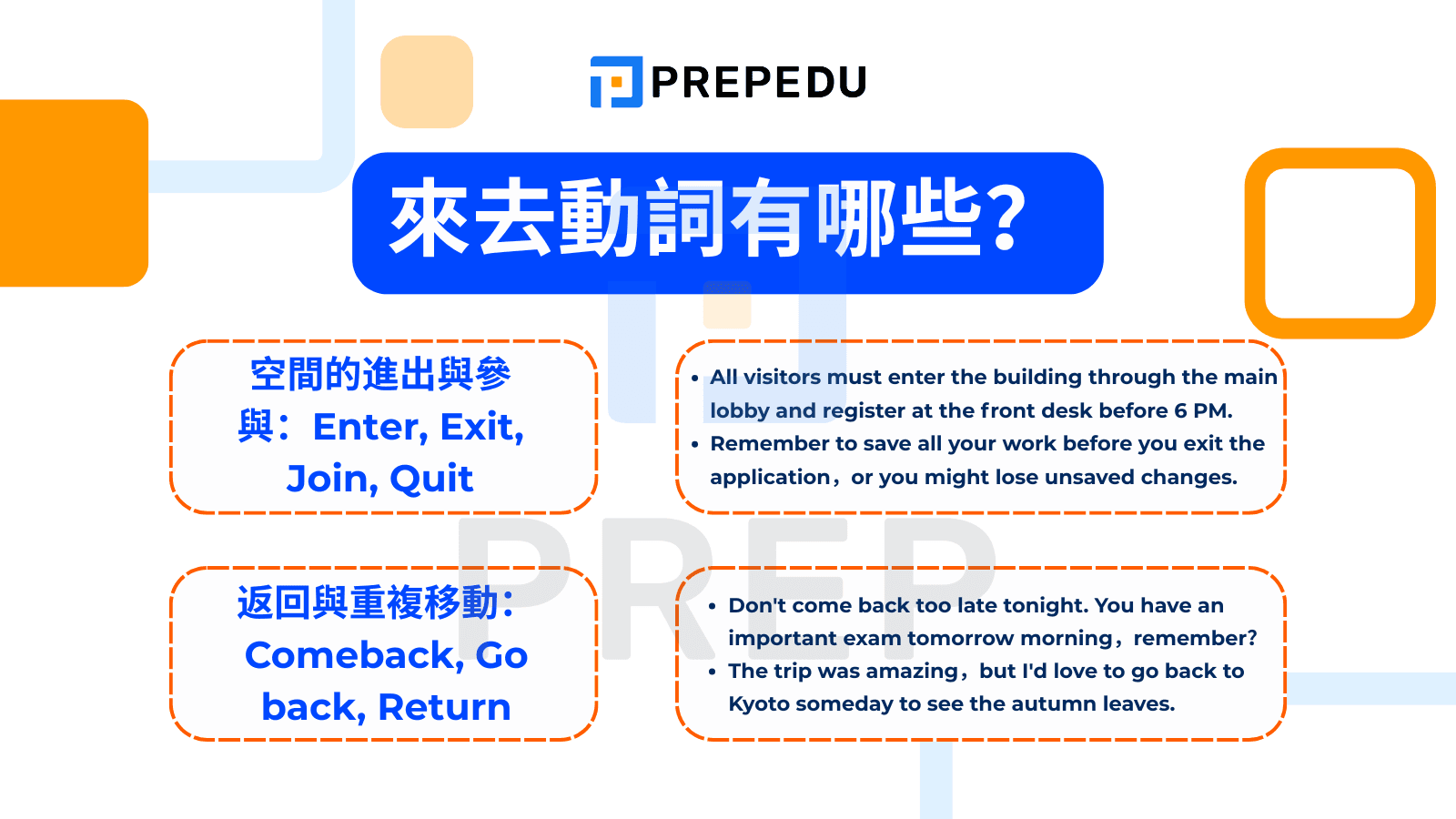
空間進出:Enter(進入),Exit(離開),Join(加入),Quit(退出)
-
返回動作:Return(返回),Come back(回來),Go back(回去)
-
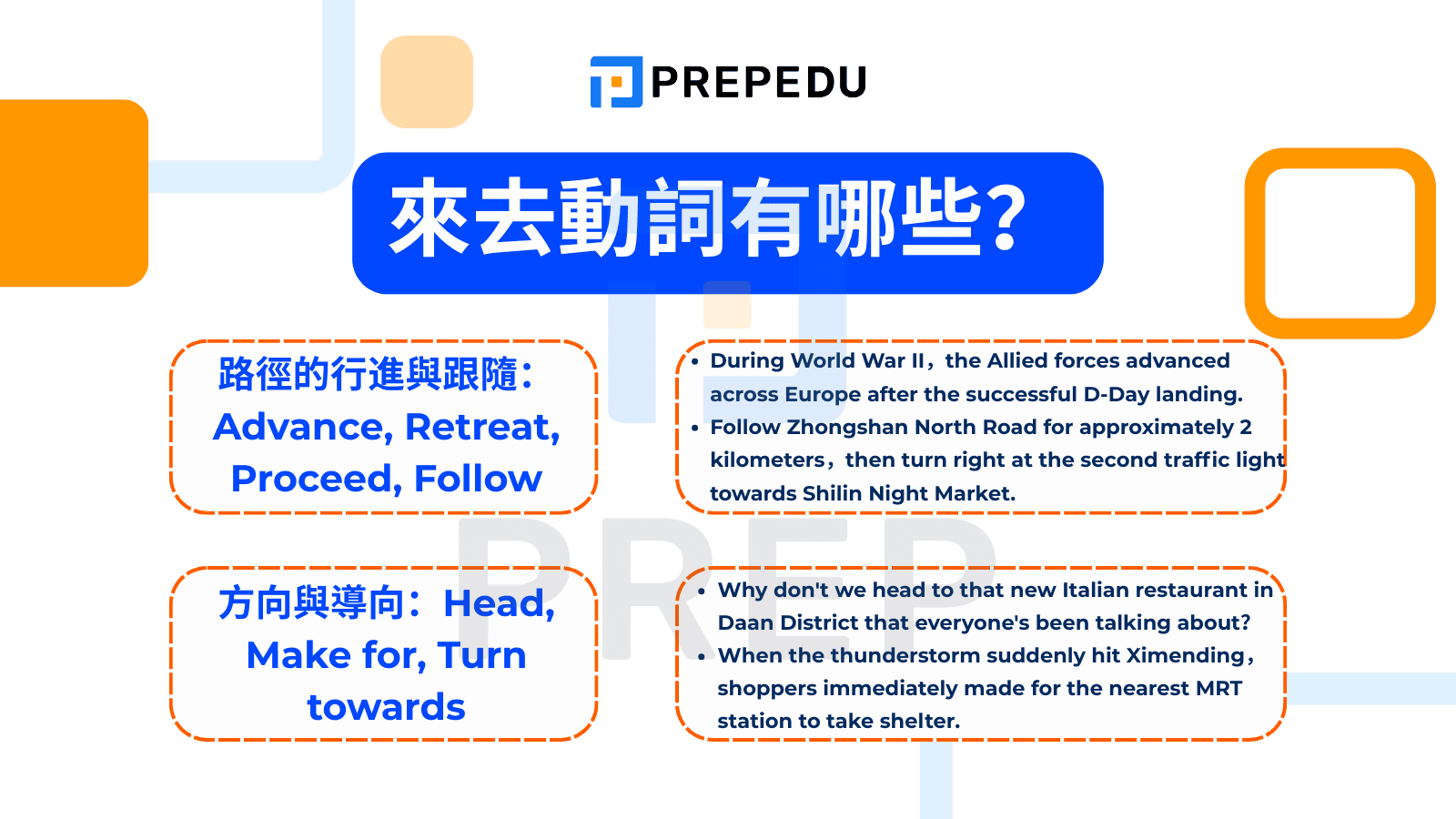
路徑行進:Advance(前進),Retreat(撤退),Proceed(繼續),Follow(跟隨)
-
方向導向:Head(前往),Make for(朝向),Turn towards(轉向)
接下來將為你詳細說明每個類別的精確用法與實際應用情境。

II. 來去動詞有哪些?完整分類清單與用法
來去動詞不僅限於 come 和 go 這兩個基本字,實際上包含描述旅程開始與結束,空間進出,返回原點,路徑行進等多種移動狀態的動詞。掌握這些來去動詞用法,能讓你在各種情境中準確表達移動的細節與細微差異。以下將這些動詞按照語意功能分為七大類,每類提供清楚的使用說明與實際例句。
1. 核心來去動詞:Come, Go
Come 和 Go 是所有來去動詞的基礎,兩者的差異完全取決於說話者的位置與移動方向的關係。
|
動詞 |
意思 |
核心概念 |
例句 |
|
Come /kʌm/ |
來,過來 |
朝向說話者/聽者移動 |
|
|
Go /ɡoʊ/ |
去,過去 |
遠離說話者/聽者移動 |
|
2. 旅程的起點與終點:Arrive, Depart, Leave
這組來去動詞聚焦於旅程的開始與結束時刻,幫助你精確描述出發,抵達或離開的動作。
|
動詞 |
意思 |
用法重點 |
例句 |
|
Arrive /əˈraɪv/ |
到達,抵達 |
強調抵達目的地的那一刻,搭配 at(小地點)或 in(大地點) |
|
|
Depart /dɪˈpɑːrt/ |
出發,啟程 |
正式用語,常用於交通工具時刻表,搭配 from(出發地)或 for(目的地) |
|
|
Leave /liːv/ |
離開,動身 |
日常口語,強調從某地走掉,直接加地點不需介系詞 |
|

3. 空間的進出與參與:Enter, Exit, Join, Quit
這組來去動詞描述進入或離開特定空間,也延伸至加入或退出團體,活動等抽象概念的「來去」。
|
動詞 |
意思 |
核心概念 |
例句 |
|
Enter /ˈentər/ |
進入 |
走進建築物,房間,通常直接接名詞不需 into |
|
|
Exit /ˈeɡzɪt/ 或 /ˈeksɪt/ |
離開,退出 |
從空間或系統中走出來,較正式 |
|
|
Join /dʒɔɪn/ |
加入,參與 |
加入團體,活動或行列,表達參與的概念 |
|
|
Quit /kwɪt/ |
退出,離開 |
離開工作,團體或停止活動,帶有結束意味 |
|
4. 返回與重複移動:Comeback, Go back, Return
這組來去動詞都表示回到原本的位置,但關鍵差異在於「說話者的位置」與「移動終點」的關係。
|
動詞/片語 |
意思 |
視角重點 |
例句 |
|
Come back /kʌm bæk/ |
回來 |
回到「說話者現在所在」的地方 |
|
|
Go back /ɡoʊ bæk/ |
回去 |
回到「說話者現在不在」的地方 |
|
|
Return /rɪˈtɜːrn/ |
返回,歸還 |
正式用語,不強調說話者位置,也指歸還物品 |
|
5. 路徑的行進與跟隨:Advance, Retreat, Proceed, Follow
這組來去動詞強調移動的方向性,連續性或跟隨性,幫助你描述更複雜的移動路徑與行進方式。
|
動詞 |
意思 |
核心概念 |
例句 |
|
Advance /ədˈvæns/ |
前進,推進 |
向前移動或取得進展,常用於軍事,戰略或比喻進步 |
|
|
Retreat /rɪˈtriːt/ |
撤退,後退 |
向後方移動或策略性撤離,也可用於比喻退縮 |
|
|
Proceed /prəˈsiːd/ |
繼續前進,進行 |
在暫停,等待或詢問後繼續移動,常見於正式指示 |
|
|
Follow /ˈfɑːloʊ/ |
跟隨,跟著 |
沿著某人的移動路徑前進,或遵循方向或指示 |
|
6. 方向與導向:Head, Make for, Turn towards
這組來去動詞幫助你表達移動的方向性與目標導向,常用於日常對話中提議前往某地或描述轉向動作。
|
動詞/片語 |
意思 |
語氣特色 |
例句 |
|
Head /hed/ |
朝向,前往 |
口語化,輕鬆隨意 |
|
|
Make for /meɪk fɔːr/ |
急忙前往,導致 |
帶有急迫感或目的性 |
|
|
Turn towards /tɜːrn təˈwɔːrdz/ |
轉向,朝向 |
強調方向改變 |
|
7. 常見移動片語動詞:Come/ Go + in, out, up, down, over
這組片語動詞英文由 come 和 go 搭配方向介系詞組成,是日常對話中最常使用的來去動詞變化。
|
片語動詞 |
意思 |
視角原則 |
例句 |
|
Come in /kʌm ɪn/ |
進來 |
說話者在裡面,邀請對方進入 |
|
|
Go in /ɡoʊ ɪn/ |
進去 |
說話者在外面,描述進入動作 |
|
|
Come out /kʌm aʊt/ |
出來 |
從內部到說話者所在的外部 |
|
|
Go out /ɡoʊ aʊt/ |
出去 |
離開說話者所在處到外面 |
|
|
Come up /kʌm ʌp/ |
上來 |
從低處到說話者所在的高處 |
|
|
Go down /ɡoʊ daʊn/ |
下去 |
從高處往低處移動 |
|
|
Come over /kʌm ˈoʊvər/ |
過來 |
到說話者家中或所在地 |
|
|
Go over /ɡoʊ ˈoʊvər/ |
過去 |
到別處或對方的地方 |
|
請參考以下文章中關於 Go 和 Come 的片語動詞:
III. 來去動詞的特殊文法:現在進行式表達確定未來
來去動詞與其他動詞相比,最特別之處在於能用現在進行式(Present Continuous)來表達「確定的未來計畫」。這個文法現象並非所有動詞都具備的特性,而是來去動詞因其「位置轉移」本質而發展出的獨特用法。
核心公式:
主詞 + be 動詞 + 來去動詞-ing(V-ing)+ 未來時間 = 已安排的確定未來
當你使用來去動詞的進行式時,你不是在描述「此刻正在移動」,而是強調「移動的準備流程已經啟動」。這個準備流程包括訂票,打包,安排交通,確認行程等具體準備動作。正因為這些準備工作已經在進行中,整個移動計畫的確定性極高,幾乎等同於現在正在發生的事實。
舉例來說,當小華說 "I am flying to Singapore next Monday"(我下週一要飛新加坡),這句話傳達的訊息不只是「我有個飛新加坡的計畫」,更重要的是「機票已經買了,行程已經排定,一切準備就緒」。這種確定性讓聽者理解這不是模糊的未來意圖,而是板上釘釘的既定行程。
來去動詞進行式與其他未來式的差異:未來式英文有多種方式,但來去動詞搭配進行式時,語意重點與其他未來式明顯不同:
-
Will + V:表示說話當下的意願,承諾或預測。例如:I will go to Tainan.(我會去台南。)——單純表達意願或預測,未必已經安排。
-
Be going to + V:強調已有的計畫或意圖。例如:I am going to visit the museum.(我打算去參觀博物館。)——有計畫,但不一定已經付諸行動準備。
-
Be V-ing + 未來時間:強調已安排,已確定的行程。例如:I am visiting the museum tomorrow.(我明天要去參觀博物館。)——行程已定,可能已買票或約好時間。
這三種表達方式的確定性程度由低到高排列為:will < be going to < be V-ing。當你想表達「一定會發生」的未來行程時,使用來去動詞的進行式最能傳達這種確定感。
並非所有移動動詞都頻繁使用進行式表未來,以下這些來去動詞最常見於此用法:
-
高頻使用:Come(來),Go(去),Leave(離開),Arrive(到達),Return(返回)
-
中頻使用:Depart(出發),Visit(拜訪),Travel(旅行),Move(搬家)
-
較少使用:Enter(進入),Exit(離開),Follow(跟隨)——這些動詞較少用於描述預先安排的行程
實際應用例句:
|
情境背景 |
例句 |
|
美芳已訂好高鐵票,確定回台南過年 |
I am going back to Tainan for Chinese New Year on January 28th,and I've already purchased the high-speed rail tickets for both ways.(我一月 28 日要回台南過年,來回高鐵票都已經買好了。) |
|
公司已安排德國客戶的訪台行程 |
Our German clients are arriving at Taoyuan Airport next Wednesday afternoon,so please arrange hotel transportation and book a conference room for Thursday morning.(我們的德國客戶下週三下午抵達桃園機場,請安排飯店接送並預訂週四早上的會議室。) |
|
建華全家已規劃好暑假旅遊計畫 |
We are traveling to Japan this summer vacation. The kids are especially excited about visiting Tokyo Disneyland and trying authentic ramen.(我們今年暑假要去日本旅遊。孩子們特別期待去東京迪士尼樂園和品嚐道地拉麵。) |
|
雅婷的公司宿舍已找好,準備搬家 |
I am moving to a new apartment near the MRT station next Saturday,and I've hired a moving company to handle all the heavy furniture.(我下週六要搬到捷運站附近的新公寓,已經請搬家公司處理所有重家具。) |
IV. 實戰演練:來去動詞精選習題
透過以下三組練習,你可以檢驗自己對來去動詞的掌握程度。每組練習針對不同面向設計,從視角判斷,時態應用到字彙選擇,全面測試你的理解與運用能力。建議先完成所有題目後再對照答案與詳解。
1. 練習一:Come vs. Go 視角判斷
根據對話情境判斷該填 come 還是 go,注意說話者與聽者的相對位置。
-
A:Are you at home now?
B:Yes. A:Great! I am _____ to see you in 10 minutes.
-
A:Where are you?
B:I'm at the office. A:OK,I will _____ there soon.
-
Mom to son:Don't forget to _____ home early tonight.
-
Please _____ to my office after class.
-
I will _____ to Kaohsiung next month to visit you.
-
I will _____ back here next month.
-
Let's _____ to the library together tomorrow.
-
A:Can you _____ to my birthday party this Saturday?B:Sure!
-
Everyone,please _____ this way to see the exhibition.
-
I'm _____ now. See you next week!
答案與詳解:
-
coming —— A 現在在 B 家附近,B 在家等待,所以 A 要「來」B 所在之處。
-
go —— A 現在不在辦公室,要「去」B 所在的地方。
-
come —— 媽媽在家,要兒子「回來」家裡。
-
come —— 老師在辦公室,邀請學生「來」辦公室。
-
go —— 你現在在台北,要「去」朋友所在的高雄。
-
come —— 你在高雄對高雄的朋友說話,表示會「回來」說話當下的這個地方。
-
go —— 兩人一起「去」第三個地點,不涉及誰在哪裡,用 go。
-
come —— 邀請對方「來」派對,派對地點就是說話者或相關的地方。
-
come —— 導遊在前方,請大家「來」這個方向。
-
going —— 你正要離開,使用 go 表示遠離現在的位置。
2. 練習二:時態與結構應用
將括號中的動詞改為適當形式,判斷是用進行式表未來還是其他時態。
-
We(leave)_____ for Tokyo next Friday. The flight is at 8 AM.
-
The train(arrive)_____ at 3:15 PM every day.
-
My parents(come)_____ to visit me this weekend. They already booked the tickets.
-
I think she(return)_____ the book tomorrow, but I'm not sure.
-
The conference(start)_____ at 2 PM sharp tomorrow. Don't be late!
-
They(go)_____ to the concert tonight. I saw their tickets.
-
When(the next bus / depart)_____?I need to catch it.
-
Look! The train(leave)_____ the station right now.
-
She(join)_____ the company next month. Everything is settled.
-
My brother(quit)_____ his job last week to start his own business.
答案與詳解:
-
are leaving —— 確定的未來計畫,班機已訂。
-
arrives —— 時刻表用現在簡單式表未來。
-
are coming —— 已訂票,確定的未來行程。
-
will return / is going to return —— 不確定性高,用 will 或 be going to,不用 be V-ing。
-
starts / is starting —— 兩者皆可,時刻表用現在簡單式,或強調確定性用進行式。
-
are going —— 已有票,確定去。
-
does the next bus depart —— 時刻表問句用現在簡單式。
-
is leaving —— 現在進行式,描述此刻正在發生的動作。
-
is joining —— 一切已定,用進行式表確定的未來。
-
quit —— 過去發生的事,用過去簡單式。
3. 練習三:綜合單字與片語填空
從選項中選出最適合的來去動詞或片語,每個選項只能用一次。
選項:arrive, depart, return, enter, exit, head, make for, come in, go out, turn towards
-
Please _____ the building through the main entrance, not the back door.
-
The airplane will _____ from Taoyuan Airport at 10:30 AM.
-
When the fire alarm rang, everyone had to _____ immediately through the emergency stairs.
-
Let's _____ to the beach this afternoon. The weather is perfect!
-
We _____ the shelter when the rain started pouring.
-
(At the door) Knock knock. "_____ ! The door is open."
-
I need to _____ tonight to meet some friends for dinner.
-
Don't forget to _____ the books to the library by the due date.
-
We should _____ in Taipei around midnight if there's no traffic.
-
He suddenly _____ the window when he heard a strange noise outside.
答案與詳解:
-
enter —— 進入建築物,用 enter。
-
depart —— 班機出發,正式用語。
-
exit —— 緊急情況離開,用 exit。
-
head —— 口語「前往」某地。
-
made for —— 快速前往避難所。
-
Come in —— 在門內邀請對方進來。
-
go out —— 離開家外出。
-
return —— 歸還書籍。
-
arrive —— 抵達目的地。
-
turned towards —— 轉向窗戶方向。
結論
來去動詞是英文表達中不可或缺的基礎文法,從最核心的 come 和 go,到描述旅程起終點的 arrive、depart、leave,再到空間進出的 enter、exit、join、quit,每個動詞都承載著精確的語意與使用情境。掌握這些來去動詞的關鍵在於理解「說話者視角」這個核心原則,判斷移動方向與說話者的相對關係,就能在 come back 和 go back、come in 和 go in 之間做出正確選擇。更重要的是,當你理解來去動詞能用現在進行式表達確定未來的特殊文法後,就能在日常對話中自然表達那些已經塵埃落定的行程安排,讓溝通更加精準有效率。
面對龐大的考試準備內容和緊迫期限感到壓力?PREPEDU.COM 理解這種處境,提供專為優化時間效率設計的學習體驗。
別再進行隨機測驗練習。系統運用評估數據精準找出你的優勢和弱點,讓你專注於關鍵改善項目。這種科學方法可將學習時間縮短至傳統方式的一半。
雅思真題和多益練習題按照從易到難的順序設計,幫助你在進入更高難度挑戰前鞏固基礎知識。每分鐘都珍貴,每次測驗都助你進步。
別浪費時間卻進步緩慢。立即開始 PREPEDU Test Practice 的智能學習,以最高效率達成理想分數!

你好!我叫黃秋賢,現在在 prepedu.com 擔任內容企劃。我有超過5年的英語與韓語自學經歷,親身備考 IELTS、TOEIC 與 TOPIK,累積了大量第一手的學習者視角——包括哪些語法規則最讓台灣與香港學習者混淆,以及如何在有限的備考時間內最有效地修正這些錯誤。目前已在 prepedu.com 撰寫超過 1000 篇英語學習文章,內容涵蓋語法、詞彙與考試策略,累積協助數千位學習者解決自學過程中的語法疑問。
評論












統一企業編號:202227322W
地址:114 LAVENDER STREET, #11-83 CT HUB 2, SINGAPORE (338729)