【情緒動詞全攻略】別再說 I am boring!3分鐘搞懂 -ed 與 -ing 的底層邏輯與介系詞搭配
為什麼很多人說「I am boring」卻鬧出笑話?「情緒動詞」在英文中扮演關鍵角色,它表達「使某人產生某種感覺」的意思,屬於使役動詞。當你說「I am boring」,其實是說「我這個人很無趣」,而非「我感到無聊」——正確說法應該是「I am bored」。這個常見錯誤源於對 -ing 與 -ed 底層邏輯的誤解。
想像情緒像一道光束:發光體使用 -ing 形式(令人感到...),被照亮者使用 -ed 形式(感到...)。這個「能量流動」概念比死背「人用 -ed,物用 -ing」更準確,因為在某些情境下,人也可能是情緒來源。掌握這個邏輯,你就能輕鬆區分「The movie is exciting」(電影令人興奮)與「I am excited」(我感到興奮)的差異。
本文由 PREPEDU 語言教育團隊精心整理,涵蓋 80+ 個常見情緒動詞(含 IPA 音標),16 種情緒分類,6 大介系詞群組與 30 題實戰練習。無論你是準備 IELTS,TOEIC 考試,還是想提升日常英文表達能力,這份完整攻略都能幫助你 3 分鐘內搞懂情緒動詞的核心概念,從此不再說錯「I am boring」!
I. 什麼是情緒動詞?
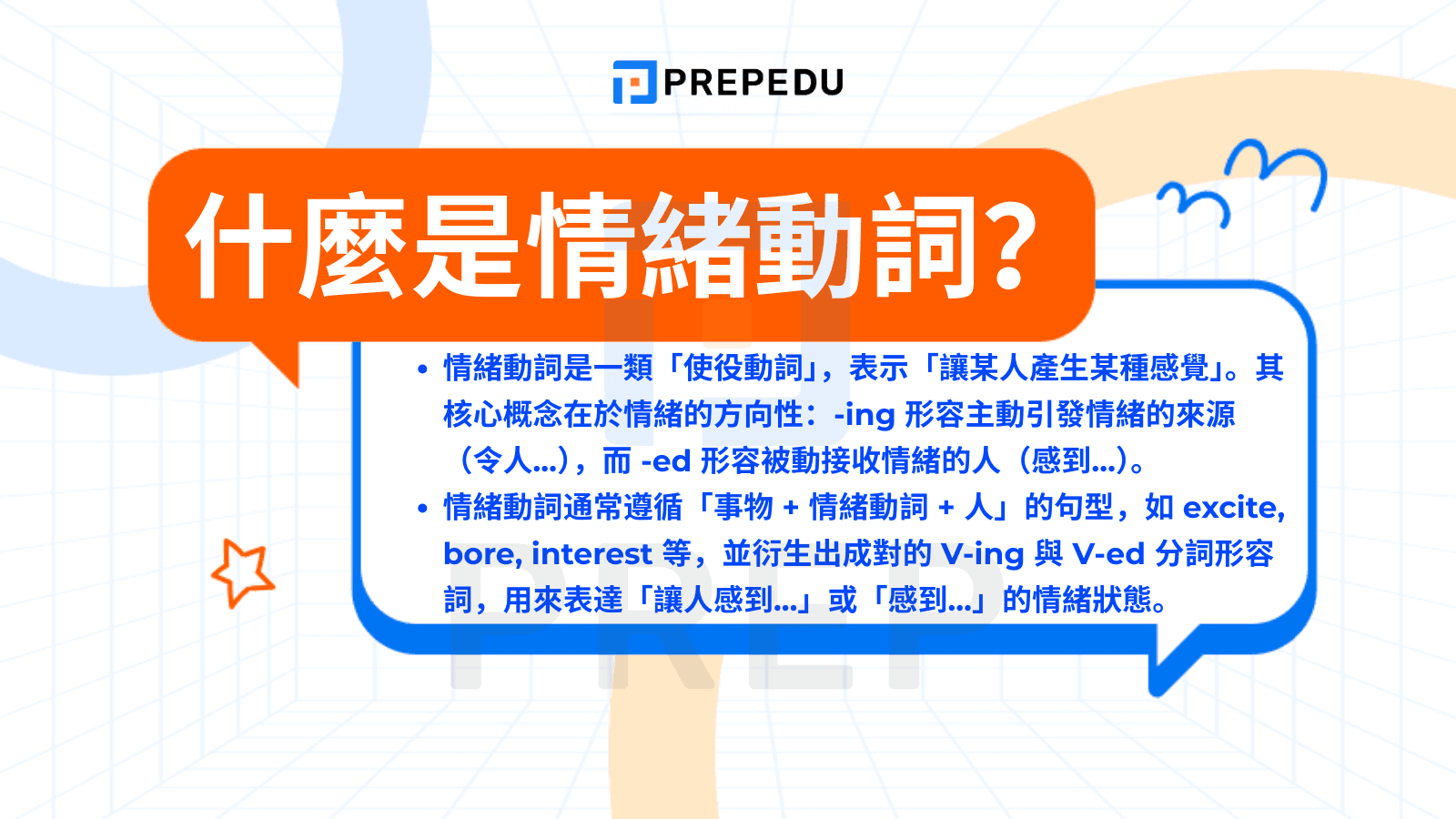
情緒動詞在英文文法結構中屬於「使役動詞」(Causative Verbs),核心意義是「使某人產生某種感覺」。這類動詞描述的不是單純的動作,而是情緒能量的傳遞過程:一方發出刺激,另一方接收並產生感受。理解情緒動詞英文的本質,你就能掌握其文法規則的關鍵。
多數學習者在使用情緒動詞時容易混淆 -ing 與 -ed 的形式,常見錯誤如「I am boring」(我很無聊,意指我這個人很無趣)而非「I am bored」(我感到無聊)。這個誤用源於對動詞能量流動方向的誤解。事實上,-ing 形式代表「主動發出情緒訊號」的一方,而 -ed 形式則代表「被動接收情緒訊號」的一方。當你說「The movie is boring」時,電影是發射「無聊」這個訊號的來源;當你說「I am bored」時,你是接收「無聊」感受的對象。
所有情緒動詞文法都遵循「事物 + 情緒動詞 + 人(受格)」的基本句型,表達「使某人感到...」的意思。例如 excite(使興奮),bore(使無聊),interest(引起興趣)等動詞,都可以延伸成成對的分詞形容詞,分為 Ving(現在分詞)和 Ved(過去分詞)兩種型態。這個邏輯適用於所有情緒動詞,為後續的句型變化奠定基礎。
II. 三大必考句型結構與轉換公式
理解情緒動詞用法的實戰核心在於掌握三種基本句型及其轉換邏輯。這三個句型展現了同一個情緒事件的不同表達角度,能夠靈活轉換代表你已真正理解情緒動詞的運作機制。
|
句型類型 |
結構公式 |
範例句 |
說明 |
|
句型 1:動詞形式 |
Thing + V + Person |
The news surprised me.(這則新聞使我驚訝。) |
強調事物對人的影響動作 |
|
句型 2:主動形容詞 |
Thing + be + V-ing |
The news is surprising.(這則新聞令人驚訝。) |
強調事物本身的特性 |
|
句型 3:被動形容詞 |
Person + be + V-ed + Prep |
I am surprised at the news.(我對這則新聞感到驚訝。) |
強調人接收到的感受 |
三個句型之間存在邏輯轉換關係。句型 1 是基礎形式,直接呈現因果關係:事物(主詞)→ 動作(動詞英文)→ 人(受詞)。句型 2 將焦點轉移到事物的特性上,使用 be 動詞加上現在分詞,形成「主詞補語」結構。句型 3 則從接收者的角度出發,使用 be 動詞加上過去分詞,後接介系詞片語補充說明情緒動詞的來源。
掌握這三個句型的轉換能力,你就能根據溝通情境選擇最適合的表達方式。當你想強調「電影很無聊」這個客觀事實時,使用「The movie is boring」; 當你想表達「我覺得無聊」這個主觀感受時,使用「I am bored with the movie」。兩者意義相近,但語氣重點不同。
III. 常見情緒動詞列表
以下提供完整的情緒動詞列表,依照情緒類型分類整理,涵蓋正面情緒,負面情緒,驚訝類情緒等不同類別。這份情緒動詞有哪些的清單包含 IPA 音標,分詞變化,介系詞搭配與中文釋義,建議你將這個列表作為學習與查閱的核心資源。
1. 興趣與著迷類情緒動詞
這類情緒動詞表達對某事物產生興趣,好奇或著迷的感受,屬於正面或中性情緒。
|
原形動詞 |
現在分詞(-ing) |
過去分詞(-ed) |
常用介系詞 |
|
interest /ˈɪntrəst/ |
interesting(有趣的) |
interested(感興趣的) |
in |
|
intrigue /ɪnˈtriːɡ/ |
intriguing(引人好奇的) |
intrigued(感到好奇的) |
by/with |
|
fascinate /ˈfæsɪneɪt/ |
fascinating(迷人的) |
fascinated(著迷的) |
by/with |
|
enchant /ɪnˈtʃɑːnt/ |
enchanting(迷人的) |
enchanted(著迷的) |
by/with |
|
captivate /ˈkæptɪveɪt/ |
captivating(迷人的) |
captivated(著迷的) |
by |
|
mesmerize /ˈmezməraɪz/ |
mesmerizing(令人著迷的) |
mesmerized(著迷的) |
by |
|
absorb /əbˈzɔːrb/ |
absorbing(吸引人的) |
absorbed(專注的) |
in |
2. 愉悅與滿意類情緒動詞
這類情緒動詞表達開心,滿意,愉快等正面情緒狀態。
|
原形動詞 |
現在分詞(-ing) |
過去分詞(-ed) |
常用介系詞 |
|
excite /ɪkˈsaɪt/ |
exciting(令人興奮的) |
excited(感到興奮的) |
about |
|
delight /dɪˈlaɪt/ |
delightful(令人愉快的) |
delighted(感到愉快的) |
at/with |
|
please /pliːz/ |
pleasing(令人愉快的) |
pleased(感到高興的) |
with |
|
satisfy /ˈsætɪsfaɪ/ |
satisfying(令人滿意的) |
satisfied(感到滿意的) |
with |
|
thrill /θrɪl/ |
thrilling(令人興奮的) |
thrilled(感到興奮的) |
about/with |
|
amuse /əˈmjuːz/ |
amusing(有趣的;好笑的) |
amused(覺得好笑的) |
by/at |
|
cheer /tʃɪr/ |
cheering(令人振奮的) |
cheered(感到振奮的) |
by |
3. 感動與鼓舞類情緒動詞
這類情緒動詞英文表達觸動心靈,感動或受到啟發的深層情感。
|
原形動詞 |
現在分詞(-ing) |
過去分詞(-ed) |
常用介系詞 |
|
touch /tʌtʃ/ |
touching(感人的) |
touched(感動的) |
by |
|
move /muːv/ |
moving(感人的) |
moved(感動的) |
by |
|
inspire /ɪnˈspaɪr/ |
inspiring(鼓舞人心的) |
inspired(受到啟發的) |
by |
|
encourage /ɪnˈkʌrɪdʒ/ |
encouraging(令人鼓舞的) |
encouraged(受到鼓勵的) |
by |
|
uplift /ˌʌpˈlɪft/ |
uplifting(令人振奮的) |
uplifted(感到振奮的) |
by |
4. 驚訝與震驚類情緒動詞
這類情緒動詞表達對意外情況或資訊的驚訝,震驚等反應。
|
原形動詞 |
現在分詞(-ing) |
過去分詞(-ed) |
常用介系詞 |
|
surprise /sərˈpraɪz/ |
surprising(令人驚訝的) |
surprised(感到驚訝的) |
at/by |
|
amaze /əˈmeɪz/ |
amazing(令人驚奇的) |
amazed(感到驚奇的) |
at/by |
|
astonish /əˈstɑːnɪʃ/ |
astonishing(令人震驚的) |
astonished(感到震驚的) |
at/by |
|
shock /ʃɑːk/ |
shocking(令人震驚的) |
shocked(感到震驚的) |
at/by |
|
stun /stʌn/ |
stunning(令人震驚的) |
stunned(感到震驚的) |
by/at |
|
astound /əˈstaʊnd/ |
astounding(令人震驚的) |
astounded(感到震驚的) |
by/at |
|
stagger /ˈstæɡər/ |
staggering(令人震驚的) |
staggered(感到震驚的) |
by/at |
|
bewilder /bɪˈwɪldər/ |
bewildering(令人困惑的) |
bewildered(感到困惑的) |
by |
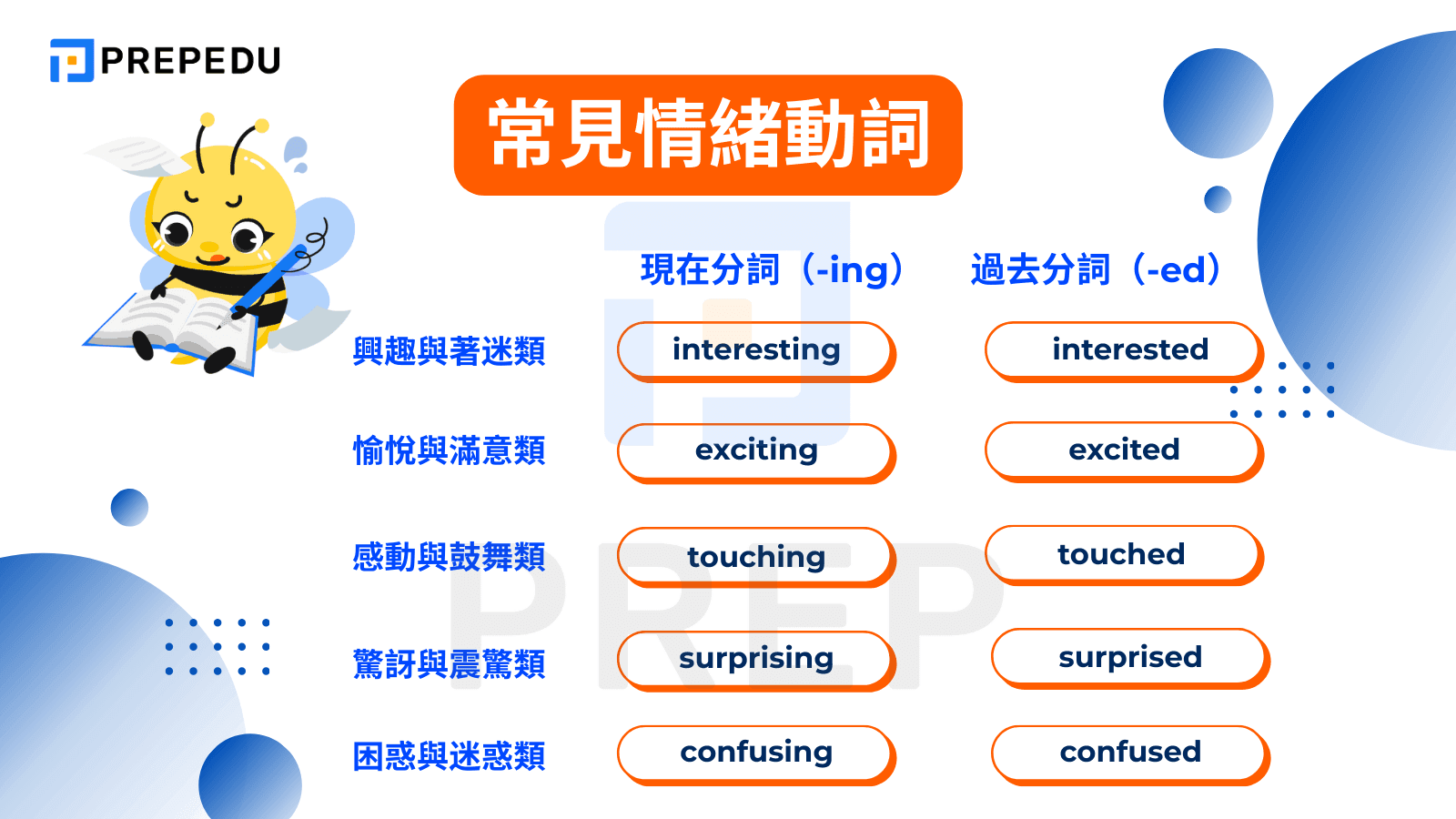
5. 困惑與迷惑類情緒動詞
這類情緒動詞表達對複雜情況感到困惑,不解或迷惑的狀態。
|
原形動詞 |
現在分詞(-ing) |
過去分詞(-ed) |
常用介系詞 |
|
confuse /kənˈfjuːz/ |
confusing(令人困惑的) |
confused(感到困惑的) |
about/by |
|
puzzle /ˈpʌzl/ |
puzzling(令人困惑的) |
puzzled(感到困惑的) |
about/by |
|
perplex /pərˈpleks/ |
perplexing(令人困惑的) |
perplexed(感到困惑的) |
by |
|
baffle /ˈbæfl/ |
baffling(令人困惑的) |
baffled(感到困惑的) |
by |
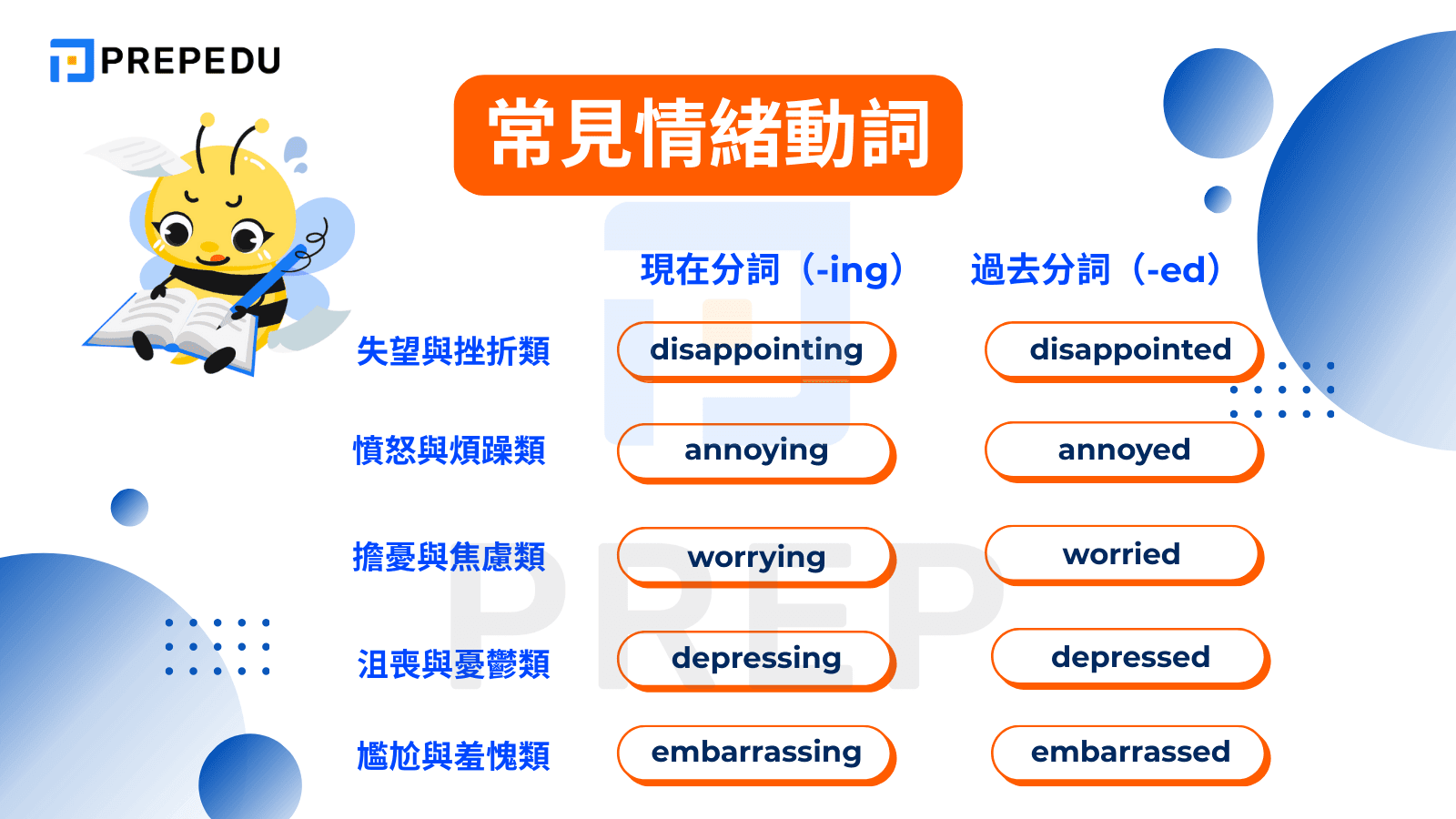
6. 失望與挫折類情緒動詞
這類情緒動詞用法表達未達預期而產生的失望,挫折等負面情緒。
|
原形動詞 |
現在分詞(-ing) |
過去分詞(-ed) |
常用介系詞 |
|
disappoint /ˌdɪsəˈpɔɪnt/ |
disappointing(令人失望的) |
disappointed(感到失望的) |
with/in |
|
frustrate /ˈfrʌstreɪt/ |
frustrating(令人沮喪的) |
frustrated(感到挫敗的) |
with/at/by |
|
discourage /dɪsˈkʌrɪdʒ/ |
discouraging(令人氣餒的) |
discouraged(感到氣餒的) |
by |
|
dishearten /dɪsˈhɑːrtn/ |
disheartening(令人沮喪的) |
disheartened(感到沮喪的) |
by |
7. 憤怒與煩躁類情緒動詞
這類情緒動詞表達生氣,惱怒,煩躁等強烈負面情緒。
|
原形動詞 |
現在分詞(-ing) |
過去分詞(-ed) |
常用介系詞 |
|
annoy /əˈnɔɪ/ |
annoying(令人惱怒的) |
annoyed(感到惱怒的) |
with/ at/ by |
|
irritate /ˈɪrɪteɪt/ |
irritating(令人惱怒的) |
irritated(感到惱怒的) |
by/with |
|
anger /ˈæŋɡər/ |
angering(令人生氣的) |
angered(感到生氣的) |
by |
|
enrage /ɪnˈreɪdʒ/ |
enraging(令人狂怒的) |
enraged(感到狂怒的) |
by |
|
infuriate /ɪnˈfjʊrieɪt/ |
infuriating(令人狂怒的) |
infuriated(感到狂怒的) |
by |
|
exasperate /ɪɡˈzæspəreɪt/ |
exasperating(令人惱怒的) |
exasperated(感到惱怒的) |
by/ with |
8. 擔憂與焦慮類情緒動詞
這類情緒動詞文法表達擔心,焦慮,不安等情緒狀態。
|
原形動詞 |
現在分詞(-ing) |
過去分詞(-ed) |
常用介系詞 |
|
worry /ˈwʌri/ |
worrying(令人擔憂的) |
worried(感到擔心的) |
about |
|
concern /kənˈsɜːrn/ |
concerning(令人擔憂的) |
concerned(感到關切的) |
about |
|
distress /dɪˈstres/ |
distressing(令人痛苦的) |
distressed(感到痛苦的) |
by |
|
trouble /ˈtrʌbl/ |
troubling(令人不安的) |
troubled(感到不安的) |
by |
9. 沮喪與憂鬱類情緒動詞
這類情緒動詞表達沮喪,低落,憂鬱等深層負面情緒。
|
原形動詞 |
現在分詞(-ing) |
過去分詞(-ed) |
常用介系詞 |
|
depress /dɪˈpres/ |
depressing(令人沮喪的) |
depressed(感到沮喪的) |
about/by |
|
sadden /ˈsædn/ |
saddening(令人悲傷的) |
saddened(感到悲傷的) |
by |
|
dishearten /dɪsˈhɑːrtn/ |
disheartening(令人沮喪的) |
disheartened(感到沮喪的) |
by |
10. 尷尬與羞愧類情緒動詞
這類情緒動詞用法表達尷尬,羞愧,難堪等社交情境中的負面情緒。
|
原形動詞 |
現在分詞(-ing) |
過去分詞(-ed) |
常用介系詞 |
|
embarrass /ɪmˈbærəs/ |
embarrassing(令人尷尬的) |
embarrassed(感到尷尬的) |
about/by |
|
humiliate /hjuːˈmɪlieɪt/ |
humiliating(令人羞辱的) |
humiliated(感到羞辱的) |
by |
|
mortify /ˈmɔːrtɪfaɪ/ |
mortifying(令人羞愧的) |
mortified(感到羞愧的) |
by |
IV. 介系詞搭配完全指南:不再只會用 "Interested In"
理解情緒動詞列表中的介系詞搭配是進階應用的關鍵。許多學習者只熟悉「interested in」這個組合,卻不清楚為什麼有些情緒動詞搭配 at,有些搭配 with 或 about。事實上,不同介系詞帶有不同的語義色彩,反映了情緒與對象之間的關係特質。以下依據介系詞分類整理情緒動詞有哪些常見搭配,採用「群組記憶策略」幫助你系統化學習。
1. 類別:AT - 針對某個點或事件的反應
介系詞 at 通常表示「對準某個點」的概念,用於描述對特定事件、現象或結果的瞬間情緒反應。這類情緒動詞用法往往帶有突發性或指向性特徵,強調情緒觸發的「定點」。
|
情緒動詞 |
完整片語 |
意思 |
例句 |
|
surprised /sərˈpraɪzd/ |
be surprised at |
對...感到驚訝 |
Xiaoming from Taipei was surprised at the sudden price increase in housing.(來自台北的小明對房價突然上漲感到驚訝。) |
|
shocked /ʃɑːkt/ |
be shocked at |
對...感到震驚 |
The professor at National Taiwan University was shocked at the student's plagiarism.(台灣大學的教授對學生的抄襲行為感到震驚。) |
|
amazed /əˈmeɪzd/ |
be amazed at |
對...感到驚奇 |
Weiwei in Hong Kong was amazed at her daughter's rapid progress in mathematics.(香港的薇薇對女兒數學進步神速感到驚奇。) |
|
astonished /əˈstɑːnɪʃt/ |
be astonished at |
對...感到震驚 |
Mr. Chen was astonished at the company's quarterly revenue of 50 million TWD.(陳先生對公司單季營收五千萬台幣感到震驚。) |
|
amused /əˈmjuːzd/ |
be amused at |
對...覺得好笑 |
The audience in Kaohsiung was amused at the comedian's local dialect jokes.(高雄的觀眾對喜劇演員的台語笑話覺得好笑。) |
|
alarmed /əˈlɑːrmd/ |
be alarmed at |
對...感到擔憂 |
Parents across Taiwan were alarmed at the rising cases of student mental health issues.(全台家長對學生心理健康問題增加感到擔憂。) |
這些情緒動詞通常是對具體事件或結果的立即反應,帶有「目標明確」的特質。當某個特定事件觸發你的情緒時,使用 at 來連接情緒與觸發點。
2. 類別:WITH - 伴隨某種狀態或滿足感
介系詞 with 傳達「伴隨」或「對於某個對象的狀態」的概念,常用於描述因長期接觸或互動而產生的持續性情緒,也可表達對某事物的滿意或不滿程度。這類情緒動詞英文強調的是「伴隨關係」。
|
情緒動詞 |
完整片語 |
意思 |
例句 |
|
bored /bɔːrd/ |
be bored with |
對...感到厭煩 |
Xiaojuan was bored with her repetitive office work in Taipei 101.(小娟對她在台北 101 重複的辦公室工作感到厭煩。) |
|
satisfied /ˈsætɪsfaɪd/ |
be satisfied with |
對...感到滿意 |
The manager was satisfied with the team's performance in the Q3 sales campaign.(經理對團隊第三季銷售活動的表現感到滿意。) |
|
pleased /pliːzd/ |
be pleased with |
對...感到高興 |
Professor Wang in Tainan was pleased with his student's dissertation progress.(台南的王教授對學生的論文進度感到高興。) |
|
disappointed /ˌdɪsəˈpɔɪntɪd/ |
be disappointed with |
對...感到失望 |
Travelers from Hong Kong were disappointed with the hotel service quality.(來自香港的旅客對飯店服務品質感到失望。) |
|
frustrated /ˈfrʌstreɪtɪd/ |
be frustrated with |
對...感到挫敗 |
Software engineers in Hsinchu were frustrated with the constant system bugs.(新竹的軟體工程師對不斷出現的系統錯誤感到挫敗。) |
|
annoyed /əˈnɔɪd/ |
be annoyed with |
對...感到惱怒 |
Ms. Liu was annoyed with her neighbor's loud music every night in Taipei.(劉小姐對鄰居每晚吵雜的音樂感到惱怒。) |
|
disgusted /dɪsˈɡʌstɪd/ |
be disgusted with |
對...感到厭惡 |
Environmental activists were disgusted with the company's pollution practices.(環保人士對該公司的污染行為感到厭惡。) |
|
impressed /ɪmˈprest/ |
be impressed with |
對...印象深刻 |
Visitors were impressed with the museum's interactive exhibits in Taichung.(訪客對台中博物館的互動展覽印象深刻。) |
這類情緒動詞通常涉及持續性的狀態或評價,而非瞬間反應。With 強調與對象之間的伴隨關係或對整體狀況的評價。
3. 類別:ABOUT - 關於某事的心理活動
介系詞 about 表示「關於」或「針對某個主題」的概念,用於描述涉及思考、擔憂或期待的情緒,強調心理活動的對象或內容。這類情緒動詞文法通常與未來事件或抽象概念相關。
|
情緒動詞 |
完整片語 |
意思 |
例句 |
|
worried /ˈwʌrid/ |
be worried about |
對...感到擔心 |
Parents in Hong Kong are worried about their children's academic pressure and mental health.(香港家長對子女的學業壓力和心理健康感到擔心。) |
|
excited /ɪkˈsaɪtɪd/ |
be excited about |
對...感到興奮 |
Students were excited about the upcoming school trip to Kenting National Park.(學生們對即將到來的墾丁國家公園校外教學感到興奮。) |
|
confused /kənˈfjuːzd/ |
be confused about |
對...感到困惑 |
First-year university students were confused about the course registration system.(大一新生對選課系統感到困惑。) |
|
concerned /kənˈsɜːrnd/ |
be concerned about |
對...感到關切 |
Residents in Tainan are concerned about the water shortage issue this summer.(台南居民對今年夏天缺水問題感到關切。) |
|
nervous /ˈnɜːrvəs/ |
be nervous about |
對...感到緊張 |
Xiaohui was nervous about her IELTS speaking test scheduled for next Monday.(小慧對下週一的雅思口說考試感到緊張。) |
|
curious /ˈkjʊriəs/ |
be curious about |
對...感到好奇 |
Teenagers in Taiwan are curious about career opportunities in the tech industry.(台灣青少年對科技產業的職業機會感到好奇。) |
|
embarrassed /ɪmˈbærəst/ |
be embarrassed about |
對...感到尷尬 |
David felt embarrassed about forgetting his colleague's name at the meeting.(大衛對在會議中忘記同事名字感到尷尬。) |
|
depressed /dɪˈprest/ |
be depressed about |
對...感到沮喪 |
Job seekers were depressed about the limited employment opportunities after graduation.(求職者對畢業後有限的就業機會感到沮喪。) |
這些情緒動詞用法涉及對特定主題或情況的心理反應,通常帶有前瞻性或思考性。About 表示情緒圍繞著某個主題或議題展開。
4. 類別:OF - 源自於內心的恐懼或疲憊
介系詞 of 常用於表達深層的恐懼、疲憊或厭倦感,這類情緒動詞通常源自內心深處,帶有較強的主觀性與持久性。Of 也可表示「脫離」或「從...而來」的概念,反映情緒來源的深度。
|
情緒動詞 |
完整片語 |
意思 |
例句 |
|
scared /skerd/ |
be scared of |
對...感到害怕 |
Many children in Taiwan are scared of going to the dentist for check-ups.(台灣許多孩童害怕去牙醫診所檢查。) |
|
afraid /əˈfreɪd/ |
be afraid of |
對...感到恐懼 |
Xiaomei has been afraid of public speaking since her embarrassing presentation in high school.(小美自從高中那次尷尬的報告後就害怕公開演講。) |
|
terrified /ˈterɪfaɪd/ |
be terrified of |
對...感到驚恐 |
The hiker was terrified of encountering wild boars during his trek in Yangmingshan.(登山客在陽明山健行時非常害怕遇到野豬。) |
|
tired /ˈtaɪərd/ |
be tired of |
對...感到厭倦 |
Office workers in Hong Kong are tired of the long commuting time exceeding two hours daily.(香港上班族對每天超過兩小時的通勤時間感到厭倦。) |
|
sick /sɪk/ |
be sick of |
對...感到厭煩 |
Teachers are sick of the excessive administrative paperwork that takes away teaching time.(教師對佔用教學時間的過多行政文書工作感到厭煩。) |
|
ashamed /əˈʃeɪmd/ |
be ashamed of |
對...感到羞愧 |
The politician was ashamed of his past dishonest behavior that was exposed by media.(這位政治人物對被媒體揭露的過去不誠實行為感到羞愧。) |
|
proud /praʊd/ |
be proud of |
對...感到驕傲 |
Parents were extremely proud of their daughter's acceptance into National Taiwan University.(父母對女兒錄取台灣大學感到非常驕傲。) |
|
weary /ˈwɪri/ |
be weary of |
對...感到厭倦 |
Long-distance truck drivers are weary of the monotonous highway routes.(長途卡車司機對單調的高速公路路線感到厭倦。) |
這類情緒動詞英文往往根深蒂固,需要較長時間或特定努力才能改變。Of 強調情緒的深度來源或持久性特質。
5. 類別:IN - 沉浸其中
介系詞 in 表達「在...之中」或「沉浸於」的概念,用於描述對某事物產生深度興趣或全神貫注的狀態。這個介系詞搭配較少,但都是高頻使用的情緒動詞文法組合。
|
情緒動詞 |
完整片語 |
意思 |
例句 |
|
interested /ˈɪntrəstɪd/ |
be interested in |
對...感興趣 |
University students in Taipei are increasingly interested in sustainable development and environmental issues.(台北大學生對永續發展和環境議題越來越感興趣。) |
|
absorbed /əbˈzɔːrbd/ |
be absorbed in |
專注於... |
The novelist was completely absorbed in writing her latest mystery novel set in 1960s Hong Kong.(這位小說家完全專注於撰寫以 1960 年代香港為背景的最新推理小說。) |
|
involved /ɪnˈvɑːlvd/ |
be involved in |
投入於... |
Young professionals are actively involved in various community service projects across Taiwan.(年輕專業人士積極投入台灣各地的社區服務計畫。) |
|
engaged /ɪnˈɡeɪdʒd/ |
be engaged in |
從事於... |
Researchers at Academia Sinica are engaged in cutting-edge artificial intelligence research.(中央研究院的研究人員從事尖端的人工智慧研究。) |
|
engrossed /ɪnˈɡroʊst/ |
be engrossed in |
全神貫注於... |
The student was so engrossed in the historical documentary that she didn't hear the phone ringing.(這位學生太專注於歷史紀錄片,沒聽到電話鈴聲。) |
這類搭配強調個體與活動或主題之間的深度連結與投入程度。In 表示完全沉浸在某個活動或興趣之中的狀態。
6. 類別:BY - 被動接受影響的來源
介系詞 by 強調被動接受某個外在來源的影響,常用於表達被某人、某事或某物所觸發的情緒。這個介系詞在情緒動詞用法中特別常見於表達感動、啟發或震驚等情緒。
|
情緒動詞 |
完整片語 |
意思 |
例句 |
|
touched /tʌtʃt/ |
be touched by |
被...感動 |
Viewers across Taiwan were deeply touched by the documentary about rural teachers' dedication.(全台觀眾被關於偏鄉教師奉獻的紀錄片深深感動。) |
|
moved /muːvd/ |
be moved by |
被...感動 |
The audience was moved by the orchestra's performance of Beethoven's Ninth Symphony.(觀眾被樂團演奏的貝多芬第九號交響曲感動。) |
|
inspired /ɪnˈspaɪərd/ |
be inspired by |
受到...的啟發 |
Young entrepreneurs were inspired by the success story of Taiwan's semiconductor industry.(年輕創業家受到台灣半導體產業成功故事的啟發。) |
|
fascinated /ˈfæsɪneɪtɪd/ |
be fascinated by |
對...感到著迷 |
Tourists are fascinated by the traditional night market culture unique to Taiwan.(遊客對台灣獨特的傳統夜市文化感到著迷。) |
|
enchanted /ɪnˈtʃɑːntɪd/ |
be enchanted by |
被...陶醉 |
Visitors were enchanted by the beautiful sunset view from Tamsui Old Street.(訪客被淡水老街的美麗夕陽景色所陶醉。) |
|
captivated /ˈkæptɪveɪtɪd/ |
be captivated by |
被...吸引 |
Art lovers were captivated by the contemporary art exhibition at Taipei Fine Arts Museum.(藝術愛好者被台北市立美術館的當代藝術展覽所吸引。) |
|
intrigued /ɪnˈtriːɡd/ |
be intrigued by |
對...感到好奇 |
Scientists are intrigued by the mysterious geological formations found in Yehliu Geopark.(科學家對野柳地質公園發現的神祕地質構造感到好奇。) |
By 在情緒動詞中明確標示出觸發情緒的來源,強調被動接受影響的關係。
這些分組整理幫助你系統化記憶情緒動詞列表中的介系詞搭配。每個介系詞組都反映了特定的語義關係:at 表示針對特定點,with 表示伴隨狀態,about 表示心理活動主題,of 表示深層來源、in 表示沉浸其中、by 表示被動來源。理解這些語義差異,你就能更精準地選擇正確的介系詞,讓情緒動詞英文表達更加道地自然。
V. 易混淆情緒動詞比較
在實際應用情緒動詞用法時,某些外觀相似或意義相近的單字特別容易造成混淆。這些陷阱往往源於詞性差異,語義細微變化或慣用法特殊性。以下針對最常見的易混淆情緒動詞英文組合進行辨析,幫助你避免常見錯誤。
|
易混淆組 |
正確用法 |
常見錯誤 |
辨析說明 |
|
Scary、Scared 與 Scaring |
|
❌ The movie was scaring. |
|
|
Fun 與 Funny |
|
❌ 混用兩者 |
|
|
Amazed 與 Amused |
|
❌ 語義混淆 |
|
|
Impressive、Impressed 與 Impressing |
|
❌ The presentation was impressing. |
|
|
Interested、Interesting、Uninterested 與 Disinterested |
|
❌ 混淆 uninterested 與 disinterested |
|
|
Bored、Boring 與 Bore |
|
❌ I am boring.(錯誤表達:我很無聊/我這個人很無趣) |
|
|
Excited、Exciting 與 Ecstatic |
|
❌ 程度混淆 |
|
|
Confused 與 Confusing |
|
❌ I am confusing.(我很令人困惑/我這個人很迷糊) |
|
|
Tired、Tiring 與 Exhausted |
|
❌ 程度錯置 |
|
|
Disappointed 與 Disappointing |
|
❌ 對象錯置 |
|
|
Frightened、Frightening 與 Afraid |
|
❌ Frightened 與 afraid 混淆 |
|
|
Satisfying 與 Satisfied |
|
❌ 主被動混淆 |
|
|
Embarrassed 與 Embarrassing |
|
❌ The party was embarrassed.(派對感到尷尬) |
|
除了上述對比,還需注意某些情緒動詞在特定語境下的特殊用法。例如「touching」除了表示「感人的」,也可指「觸摸」的動作;「moving」除了「感動的」,也可表示「移動的」。理解多義詞在不同語境中的意義,需要依靠上下文判斷。
另外,某些情緒動詞英文有特殊的強調形式,如「absolutely fascinating」(絕對迷人),「deeply moved」(深受感動),「utterly exhausted」(完全精疲力盡),「thoroughly confused」(徹底困惑),「extremely disappointed」(極度失望),這些搭配能夠表達更強烈的情緒程度。
辨析這些易混淆情緒動詞文法的關鍵在於理解其詞性本質與語義特徵。Scary 和 funny 是純形容詞,不遵循情緒動詞的 -ing/-ed 變化規則; amazed 和 amused 雖然都是過去分詞,但表達的情緒性質完全不同; impressive 是特例,慣用 -ive 後綴而非 -ing 形式; uninterested 和 disinterested 雖然外觀相似,但意義天差地別。掌握這些細節,你的情緒動詞用法就能更加精準到位。
VI. 情緒動詞練習題
以下提供三組不同類型的情緒動詞練習,共 30 題,涵蓋分詞選擇,介系詞填空與整句翻譯改寫。完成這些情緒動詞練習題能夠有效鞏固你對情緒動詞題目的理解與應用能力。
1. 練習一:分詞選擇題(-ing vs -ed)
請根據句意選擇正確的分詞形式填入空格。這組情緒動詞題目訓練你分辨主動與被動的能力。
-
The documentary about climate change shown at the environmental conference was very __________(alarm).
-
Many parents living in Taipei are __________(concern)about their children's excessive screen time and gaming habits.
-
After attending the five-hour training workshop at the Hsinchu Science Park,everyone felt completely __________(exhaust).
-
Professor Lin's success story from street vendor to university president is truly __________(inspire).
-
The freshman student seemed __________(confuse)by the complicated course selection system at National Taiwan University.
-
The rollercoaster ride at Leofoo Village Theme Park was absolutely __________(thrill).
-
Customers dining at the restaurant in Taichung were __________(disappoint)with the service quality and long waiting time.
-
The magician's performance at the Taipei Children's Festival was __________(amaze).
-
Xiaoming appeared __________(bore)during the entire three-hour lecture on classical literature.
-
The horror movie shown at the midnight screening was so __________(frighten)that many audience members left early.
2. 練習二:介系詞填空題
請在空格中填入正確的介系詞(at / with / about / of / in / by)。這組情緒動詞練習強化你對搭配詞的記憶。
-
Students majoring in business administration are very interested __________ learning digital marketing strategies.
-
The project manager at the IT company was satisfied __________ the development team's progress in the second quarter.
-
Residents in Kaohsiung are increasingly worried __________ the air quality issues during winter months.
-
Employees at the Taipei 101 office were shocked __________ the sudden announcement of company restructuring.
-
Workers in manufacturing industries are tired __________ doing repetitive tasks on the assembly line every day.
-
Young professionals working in startups are excited __________ the new product launch scheduled for next month.
-
Many children in Taiwan are scared __________ the dark and prefer sleeping with a night light.
-
The department head was pleased __________ the intern's outstanding performance during the summer program.
-
International students were confused __________ the complicated visa application procedures for Taiwan.
-
Environmental groups are deeply concerned __________ the impact of plastic pollution on marine ecosystems.
3. 練習三:整句翻譯與改寫
請將以下中文句子翻譯成英文,或根據提示改寫句子。這組情緒動詞練習測試你綜合應用句型結構的能力。
-
這部關於台灣傳統文化的紀錄片令我們非常感動。(使用 move,提供兩種句型)
-
她對自己在國際科展的成就感到驕傲。(使用 proud)
-
昨晚台北發生的地震令人震驚。(使用 shock,提供兩種句型)
-
我對這次期末考試的成績感到失望。(使用 disappoint)
-
這本關於人工智慧應用的書非常有趣。(使用 interest,提供兩種句型)
-
客戶對新推出的產品功能感到滿意。(使用 satisfy)
-
在陽明山健行十公里這項任務令人精疲力盡。(使用 exhaust)
-
我對公司突然變更遠距工作政策的決定感到驚訝。(使用 surprise)
-
這場在國家音樂廳的鋼琴演奏會鼓舞人心。(使用 inspire,提供兩種句型)
-
她對在半導體公司從事相同類型的工作感到厭倦。(使用 tire)
4. 詳解與答案
|
練習一答案 |
練習二答案 |
練習三答案 |
|
|
|
VII. 情緒動詞的常見問題(FAQ)
本節整理學習者在掌握情緒動詞英文時經常提出的疑問,補充主要內容未涵蓋的細節問題。這些問題反映了學習過程中常見的盲點與困惑,理解這些答案能讓你對情緒動詞用法有更全面的認識。
1. 所有情緒動詞都可以變成 -ing 和 -ed 兩種形式嗎?
大部分情緒動詞確實可以變化為 -ing 與 -ed 兩種分詞形式,但存在少數例外情況。例如 scare 這個動詞,其 -ing 形式在現代英文中很少使用,取而代之的是形容詞 scary。另外某些情緒動詞文法可能在特定語境下較少使用某個形式,例如 alarm 的 -ed 形式(alarmed)常見,但 alarming 也經常使用。Impress 是另一個特例,其形容詞慣用 impressive 而非 impressing。實務上,如果你不確定某個形式是否慣用,建議查閱字典或觀察母語人士的使用習慣。多數情況下,遵循本文介紹的邏輯規則即可正確判斷情緒動詞用法。
2. Fun 和 Funny 算是情緒動詞嗎?
Fun 和 funny 不是情緒動詞變化而來的形容詞,它們本身就是純形容詞,沒有對應的動詞形式(不存在 to fun 這個動詞)。Fun 表示「有趣的,好玩的」,強調令人愉快的體驗;funny 表示「滑稽的,好笑的」,有時也可表示「奇怪的」。由於它們不是分詞形式,因此不遵循情緒動詞文法的 -ing/-ed 變化規則。使用時只需記住:
-
描述活動或事物帶來的樂趣用 fun。例如「The party was fun」(派對很好玩)。
-
描述某事令人發笑或感到奇怪用 funny。例如「His joke was funny」(他的笑話很好笑)。
這兩個詞雖然與情緒相關,但不屬於情緒動詞英文的範疇。
3. Touch 當情緒動詞時怎麼用?Touching 和 Touched 有什麼區別?
Touch 作為情緒動詞時意思是「使感動,觸動人心」,遵循標準的分詞變化規則。
-
Touching(現在分詞)用於描述事物「感人的」特質,例如「The volunteer's dedication to helping elderly people living alone in remote villages was very touching.」(志工幫助偏鄉獨居老人的奉獻精神非常感人。)
-
Touched(過去分詞)用於描述人「被感動的」狀態,通常搭配介系詞 by,例如「I was deeply touched by the students' handmade farewell cards when I left the school.」(當我離開學校時,我被學生親手製作的告別卡片深深感動。)
需要注意的是,touch 也有「觸摸」的實體意義,因此需依據上下文判斷其含義。在情緒動詞用法的語境中,touch 強調心靈層面的觸動與感動,而非物理接觸。
結論
情緒動詞是英文文法中極為重要的概念,理解其底層邏輯——能量流動的 Source 與 Receiver 模型——比死背規則更有效。記住三個關鍵原則:現在分詞(V-ing)描述「令人...的」特質,用於情緒來源;過去分詞(V-ed)描述「感到...的」狀態,用於情緒接收者;不同介系詞搭配反映情緒與對象之間的關係特質。
對 IELTS 和 TOEIC 考試格式感到不熟悉?陌生的考試環境會阻礙你的表現。PREPEDU 的 Test Practice 重現真實考場氛圍,幫助你掌握題型和答題節奏。
豐富的 IELTS 真題和 TOEIC 題型題庫涵蓋超過一千道精選練習題,持續更新以追蹤考試趨勢,收錄高頻題目。智能分析工具深入檢視每個錯誤,提供個人化學習建議,助你快速突破。
獨特的視覺化學習路徑讓你在每個階段見證顯著進步。成功就在眼前。把握機會拉開與對手的差距。
立即開始 PREP 練習,自信迎接挑戰。現在就體驗 IELTS 和 TOEIC 備考!

你好!我叫黃秋賢,現在在 prepedu.com 擔任內容企劃。我有超過5年的英語與韓語自學經歷,親身備考 IELTS、TOEIC 與 TOPIK,累積了大量第一手的學習者視角——包括哪些語法規則最讓台灣與香港學習者混淆,以及如何在有限的備考時間內最有效地修正這些錯誤。目前已在 prepedu.com 撰寫超過 1000 篇英語學習文章,內容涵蓋語法、詞彙與考試策略,累積協助數千位學習者解決自學過程中的語法疑問。
評論












統一企業編號:202227322W
地址:114 LAVENDER STREET, #11-83 CT HUB 2, SINGAPORE (338729)