「說到做到」英文怎麼說?最實用說法完整指南
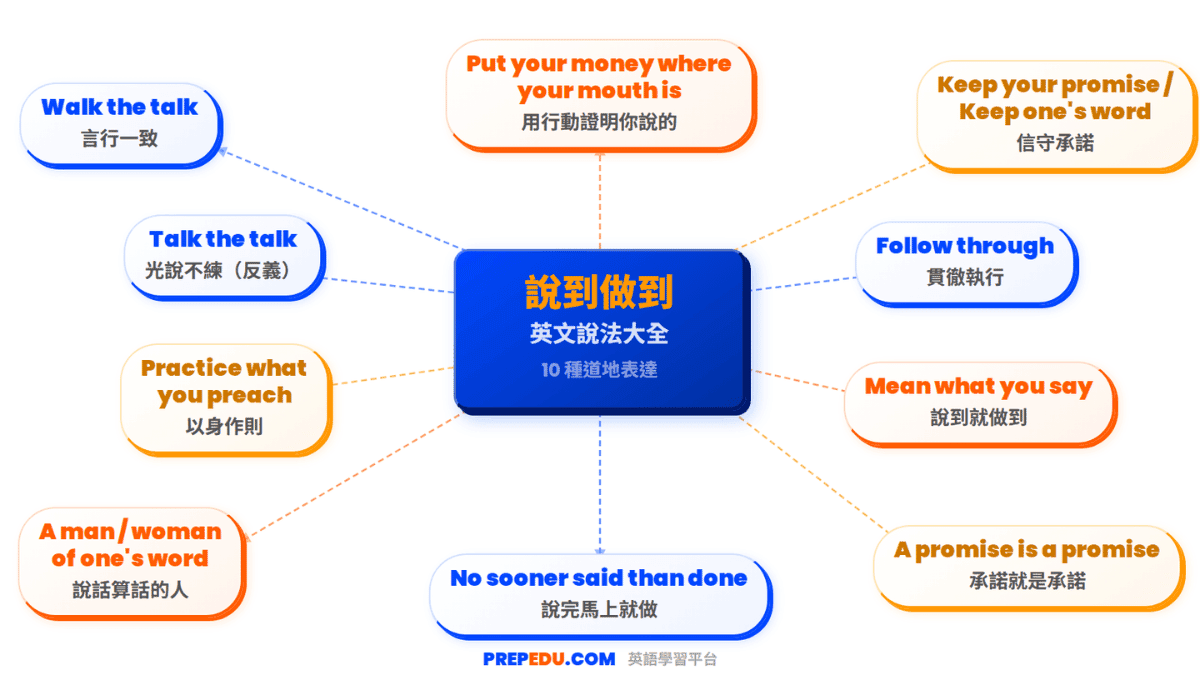
「說到做到英文」涵蓋兩組說法:承諾兌現組有 walk the talk、put your money where your mouth is、keep one's word、follow through、mean what you say、talk the talk、a promise is a promise、no sooner said than done、a man/woman of one's word 和 practice what you preach;話題轉場組有 speaking of which、on that note、that reminds me 和 now that you mention it。
每種說法語義重心不同。Keep one's word 聚焦兌現單次承諾;walk the talk 強調行動和言語的一致性;put your money where your mouth is 語氣最強,帶有挑戰意味;talk the talk 是負面對比說法,指只說不做。話題轉場組的 4 種說法則用於對話中自然過渡到相關話題,與承諾兌現組的語義完全不同,不可混用。
本文一次整理 14 種說法的結構規則、標準例句、完整對照表,以及 TOEIC 口說、IELTS 口說 和 DSE 作文的選擇邏輯,讓你每次都選對說法。

- I. 說到做到英文怎麼說?最實用說法完整指南
- 1. Walk the talk
- 2. Put your money where your mouth is
- 3. Keep your promise/ Keep one's word
- 4. Follow through (on something)
- 5. Mean what you say
- 6. Talk the talk
- 7. A promise is a promise
- 8. No sooner said than done
- 9. A man/woman of one's word
- 10. Practice what you preach
- 11. Speaking of which
- 12. On that note
- 13. That reminds me
- 14. Now that you mention it
- II. 「說到做到英文」實戰場景
- III. 「說到做到英文」常見問題 FAQ
- 總結
I. 說到做到英文怎麼說?最實用說法完整指南
「說到做到」的英文說法不止一種,每種說法的語義側重點不同,適用場合也有差異。以下按使用場景逐一整理,從承諾兌現到話題轉場,全部涵蓋。
1. Walk the talk
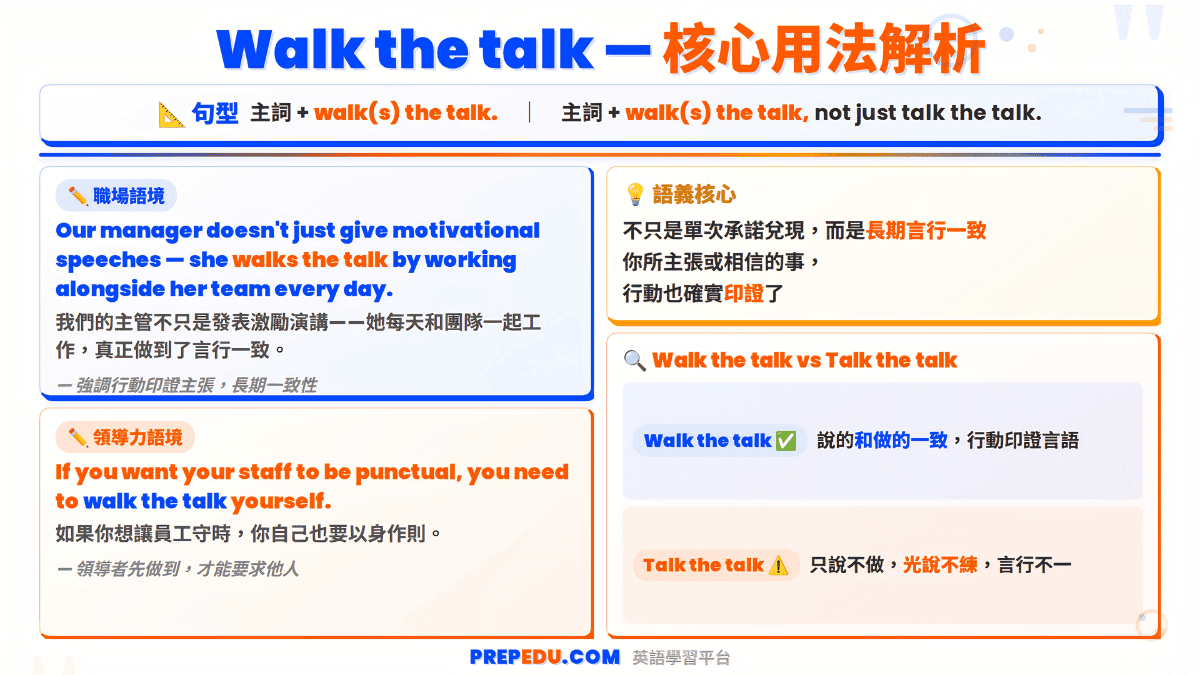
Walk the talk 是「說到做到英文」中最道地的一個說法,意思是「行動符合言語、言行一致」。它強調的不只是單次承諾的兌現,而是一個人長期的言行一致性——你所主張或相信的事,你的行動也確實印證了。句型:
英文主詞 + walk(s) the talk.
英文主詞 + walk(s) the talk, not just talk the talk.
例如:
-
Our manager doesn't just give motivational speeches — she walks the talk by working alongside her team every day.(我們的主管不只是發表激勵演講——她每天和團隊一起工作,真正做到了言行一致。) —— 職場語境
-
If you want your staff to be punctual, you need to walk the talk yourself.(如果你想讓員工守時,你自己也要以身作則。) —— 領導力語境
-
He walked the talk on environmental responsibility by converting the factory to solar energy.(他在環境責任方面說到做到,把工廠改用太陽能。) —— 具體行動印證
-
A leader who walks the talk earns far more respect than one who only talks.(一個言行一致的領導者比只會說話的人贏得更多尊重。) —— 對比句型
2. Put your money where your mouth is
Put your money where your mouth is 字面意思是「把錢放到你說話的地方」,實際語義是「用行動(或資金)來證明你的話」。它是「說到做到英文」中語氣最強烈的說法,帶有一種挑戰或督促的意味:既然你說這是值得做的事,就拿出實際行動或資源來證明。句型:
主詞 + put(s) one's money where one's mouth is.
It's time to put your money where your mouth is.
例如:
-
He says he believes in the company — now it's time to put his money where his mouth is and invest.(他說他相信這家公司——現在是時候拿出實際行動,投資進去了。) —— 商業語境
-
If you really care about climate change, put your money where your mouth is and switch to renewable energy.(如果你真的關心氣候變化,就用行動說話,改用可再生能源。) —— 社會議題
-
The government finally put its money where its mouth is by doubling the education budget.(政府終於說到做到,把教育預算增加了一倍。) —— 政策執行
-
Stop talking about starting a business — it's time to put your money where your mouth is.(別再只說要創業了——是時候說到做到了。) —— 日常口語督促
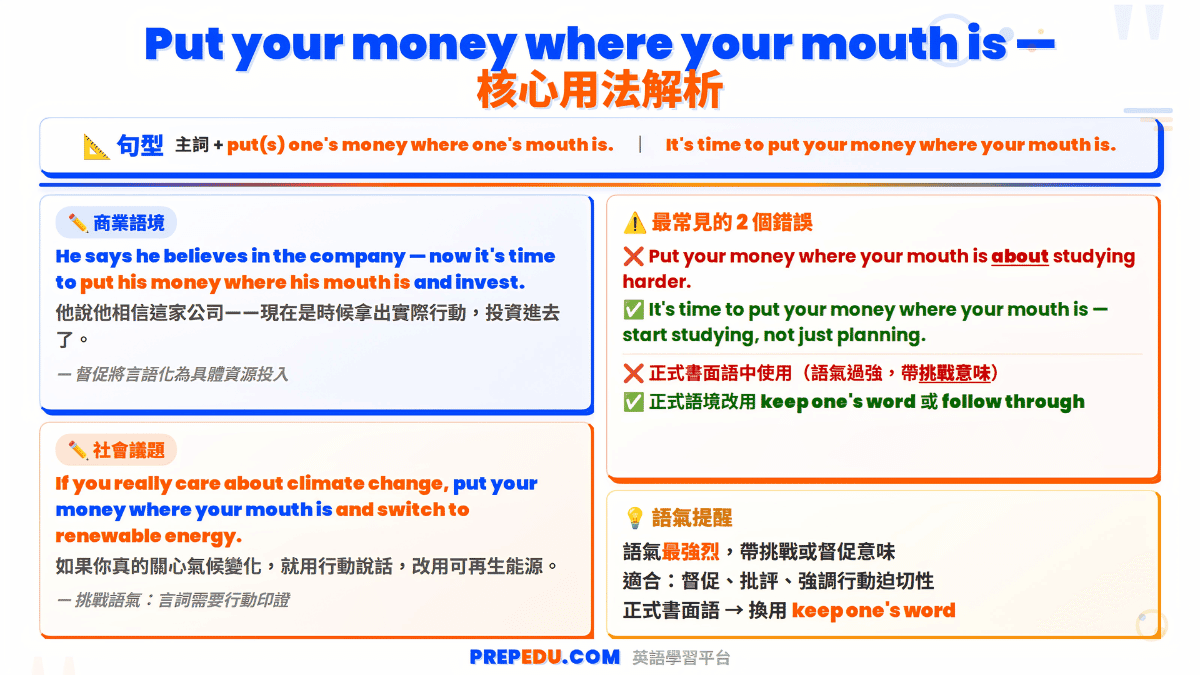
Put your money where your mouth is 最常見的錯誤有兩種:一是在 is 之後直接加英文介系詞片語(如 about、for),這會破壞這個固定慣用語的完整結構;二是把它用在正式書面語或溫和的勸說語境,忽略了它本身帶有的挑戰語氣。判斷方法:這個英文慣用語是固定短語,結構不能拆解或在後面附加補充語。要強調的內容應該放在破折號(—)後的新子句英文,或用獨立的句子說明具體行動。
-
❌ Put your money where your mouth is about studying harder.(介系詞搭配錯誤,after 'is' 不可接 about)
-
✅ It's time to put your money where your mouth is — start studying, not just planning.(正確用法)
💡 語氣提醒:Put your money where your mouth is 語氣較強,帶有挑戰意味,適合督促或批評語境。在正式書面語中,keep one's word 或 follow through 語氣更中性。
3. Keep your promise/ Keep one's word
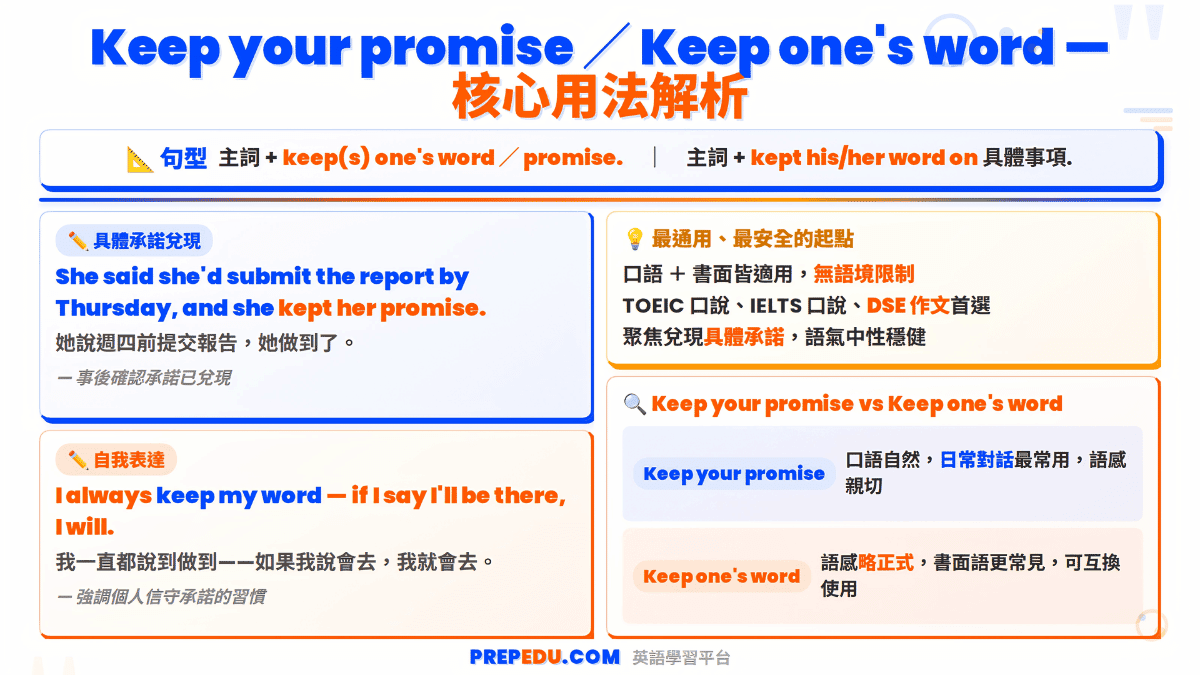
Keep your promise/ Keep one's word 是「說到做到英文」中最通用、最安全的說法,口語和書面語皆適用,沒有語境限制。它聚焦在兌現一個具體的承諾,是台灣和香港學習者在 TOEIC 口說、IELTS 口說和 DSE 作文中最穩健的起點。句型:
主詞 + keep(s) one's word/ promise.
主詞 + kept his/her word on 具體事項.
例如:
-
She said she'd submit the report by Thursday, and she kept her promise.(她說週四前提交報告,她做到了。) —— 具體承諾兌現
-
I always keep my word — if I say I'll be there, I will.(我一直都說到做到——如果我說會去,我就會去。) —— 自我表達
-
The contractor kept his promise and finished the renovation two weeks ahead of schedule.(承包商說到做到,提前兩週完成了翻新工程。) —— 商業語境
-
Trust her — she always keeps her word, no matter how difficult the circumstances.(相信她——無論情況多困難,她都會言出必行。) —— 人格描述
💡 Keep your promise 和 keep one's word 語義相同,可互換使用。Keep one's word 語感略正式,更常出現在書面語中。
4. Follow through (on something)
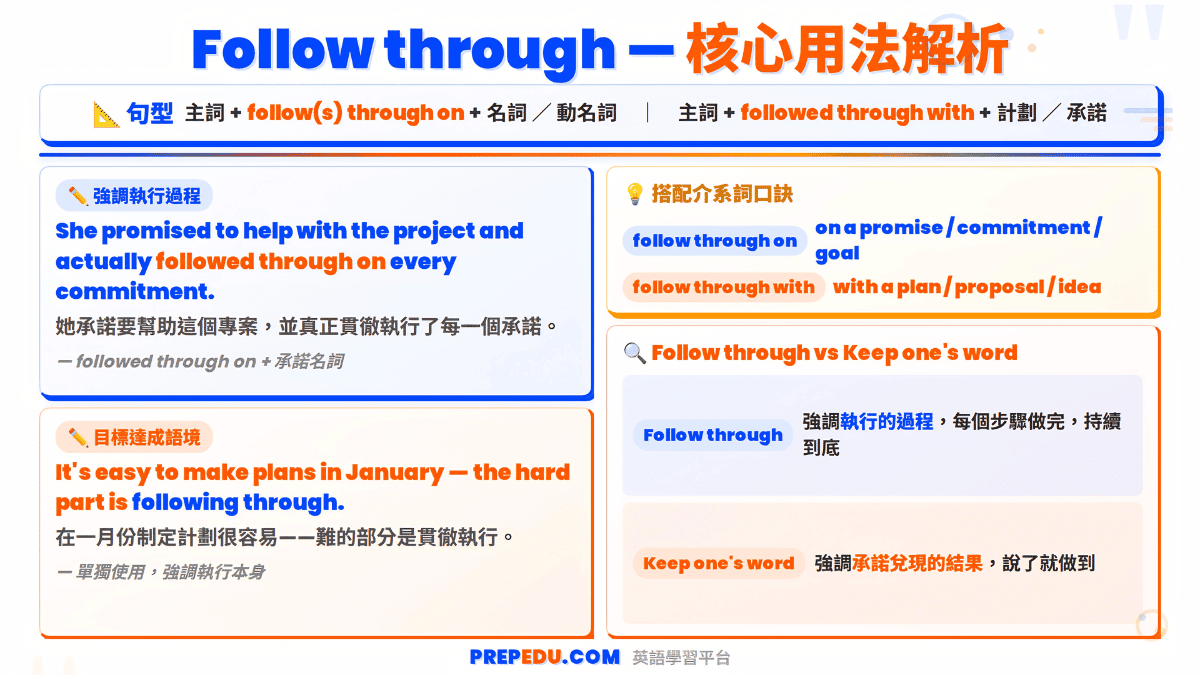
Follow through (on something) 是「貫徹執行、跟進完成所承諾之事」的說法,強調持續到底——不只是說了,也真正地把每個步驟都執行完畢。它比 keep one's word 更強調執行的過程。句型:
主詞 + follow(s) through on + 英文名詞 / 英文動名詞.
主詞 + followed through with + 計劃 / 承諾.
例如:
-
She promised to help with the project and actually followed through on every commitment.(她承諾要幫助這個專案,並真正貫徹執行了每一個承諾。) —— 強調執行過程
-
It's easy to make plans in January — the hard part is following through.(在一月份制定計劃很容易——難的部分是貫徹執行。) —— 目標達成語境
-
The team followed through with the product launch despite the last-minute challenges.(儘管面臨最後一刻的挑戰,團隊還是完成了產品發布。) —— 職場執行力
-
He makes a lot of promises but rarely follows through on them.(他許了很多承諾,但很少貫徹執行。) —— 負面描述
💡 Follow through 後接 on + 名詞,或 with + 名詞/計劃:follow through on a promise / follow through with a plan。兩種搭配語義相同。
5. Mean what you say
Mean what you say(英文過去式:I meant what I said)強調說話出自真心——你說的不是場面話,不是隨口一說,而是認真的、真誠的。與 keep one's word 的差異在於:mean what you say 強調說話當下的真誠意圖,keep one's word 強調事後的兌現行動。句型:
I mean what I say.
He/She means what he/she says.
I meant what I said.(過去式)
例如:
-
I mean what I say — if this happens again, I will have to take formal action.(我說話算數——如果再發生這種情況,我將不得不採取正式行動。) —— 強調真誠意圖
-
Don't take her lightly — she means what she says, and she follows through.(別輕視她——她說話算數,而且說到做到。) —— 配合 follow through 強化
-
He meant what he said when he promised to support the team during the difficult period.(他在承諾支持團隊度過困難時期時是認真的。) —— 過去式確認
-
I meant every word — this project is the most important thing we've worked on together.(我說的每一個字都是真心的——這個專案是我們合作過最重要的事情。) —— 情感強調
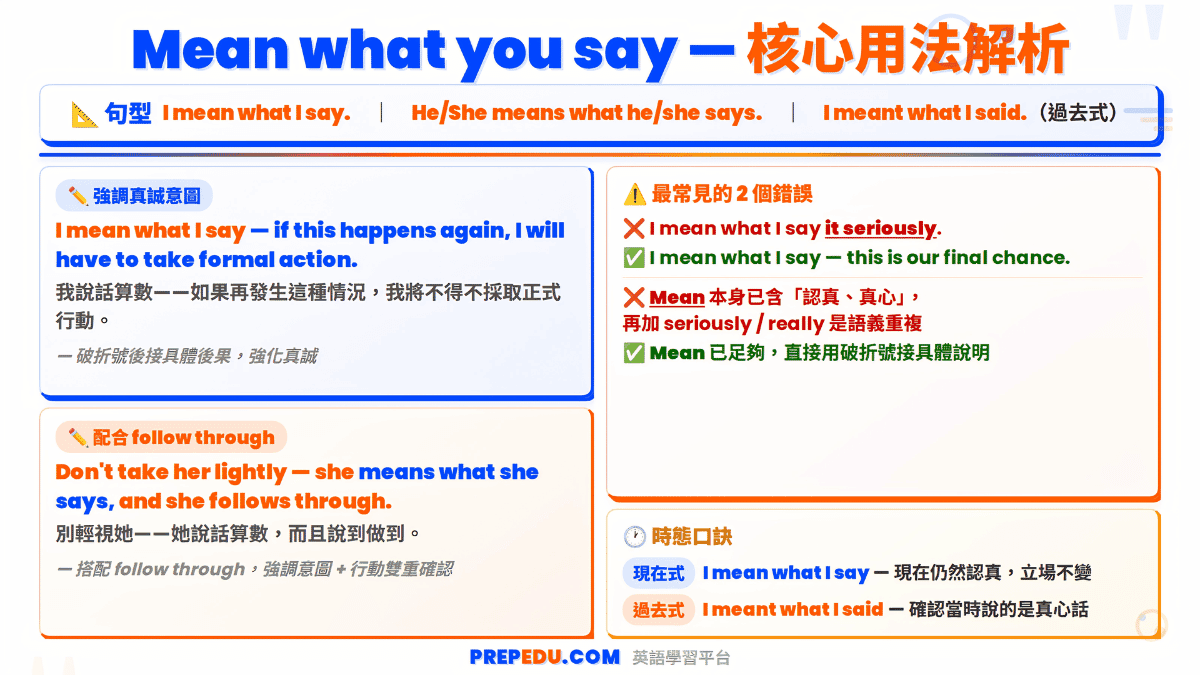
Mean what you say 最常見的錯誤是語義重複——在句子中額外加上 seriously、really 或 truly 來強調認真程度。這是不必要的,因為 mean 本身已包含「認真、真心」的語義,再加英文副詞修飾反而顯得語言不夠精煉,母語者讀到會感到累贅。
另一個常見問題是英文時態混用:用 I mean what I said 描述「現在仍然認真」的狀態時,應改用英文現在式 I mean what I say;用過去式 I meant what I said 則是確認「當時說的是真心話」。兩者語義略有不同,使用前先確認時間語境。
-
❌ I mean what I say it seriously.(不需要再加 seriously,mean 已包含「認真」語義)
-
✅ I mean what I say — this is our final chance.(簡潔直接 ✅)
6. Talk the talk
Talk the talk 是 walk the talk 的負面對比說法,意思是「說得頭頭是道,但只說不做」——一個人的語言聽起來很專業或有說服力,但行動跟不上。Talk the talk 本身帶有批評或諷刺語氣,通常用來批評一個人言過其實,或作為 walk the talk 的對比出現在同一個句子中。句型:
主詞 + can talk the talk, but can't walk the walk.
Anyone can talk the talk — few walk the walk.
例如:
-
He can talk the talk in interviews, but once he's on the job, there's very little action.(他在面試中說得頭頭是道,但一旦開始工作,幾乎沒有實際行動。) —— 面試語境批評
-
Anyone can talk the talk about leadership — very few can actually walk the walk.(任何人都可以說一口好聽的領導力理論——真正能言行一致的人寥寥無幾。) —— 對比句型
-
She doesn't just talk the talk — she's been waking up at 5 a.m. to train for six months.(她不只是說說而已——她已經連續六個月每天早上五點起床訓練了。) —— 正面反轉句型
-
It's easy to talk the talk about work-life balance, but much harder to actually change your habits.(談工作與生活的平衡說起來很容易,但真正改變習慣卻難得多。) —— 社會議題對比
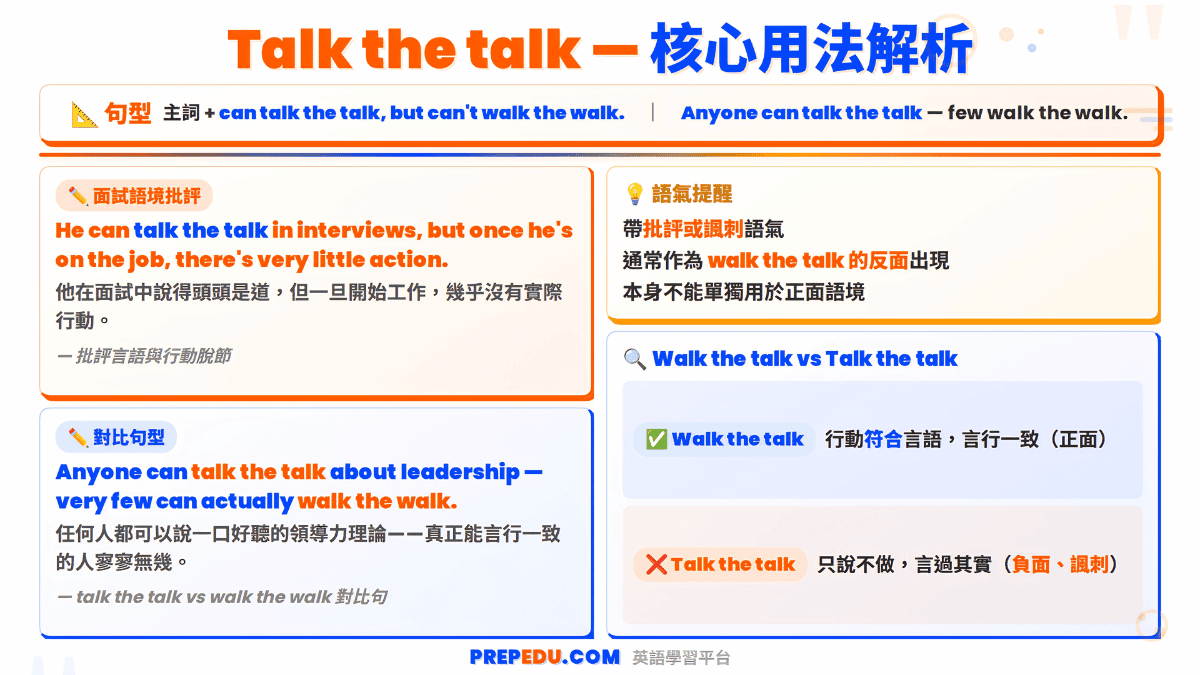
Walk the Talk vs. Talk the Talk 對比:
-
✅ Walk the talk = 行動符合言語(正面,做到了)
-
❌ Talk the talk = 只說不做(負面,說了沒做)
7. A promise is a promise
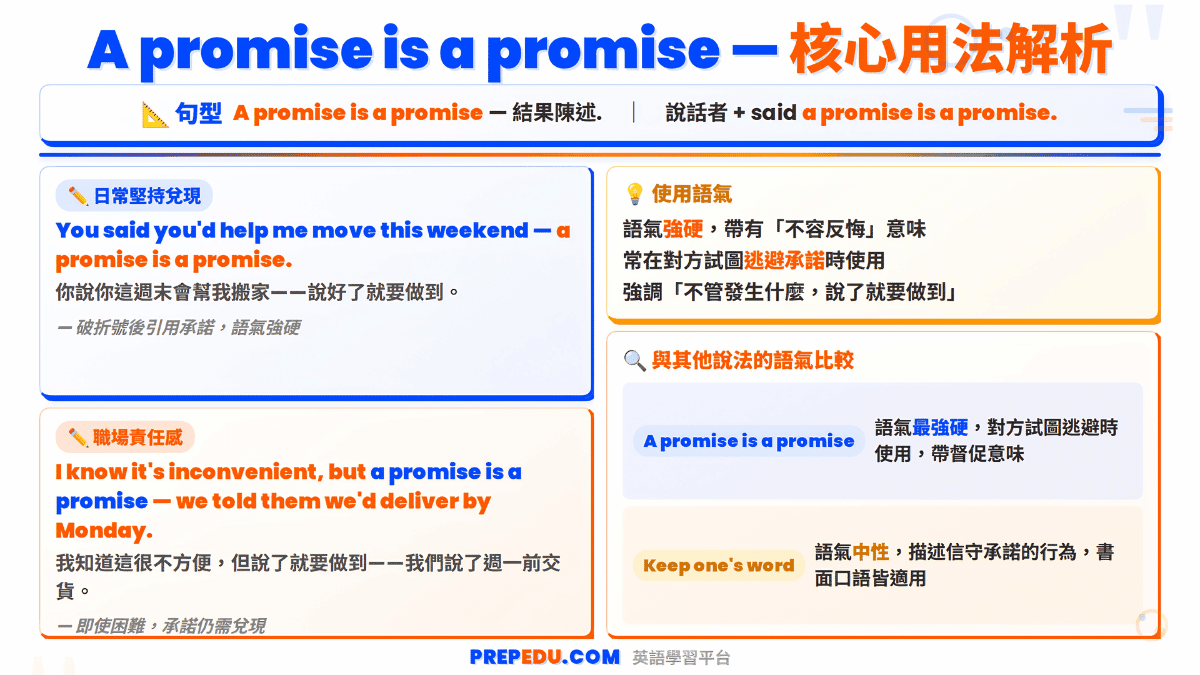
A promise is a promise 是一個慣用語,用來強調「承諾就是承諾,必須兌現,不容反悔或找藉口」。它語氣較強硬,常在有人試圖逃避承諾或要求對方兌現時使用,帶有「不管發生什麼,你說了就要做到」的意味。句型:
A promise is a promise — 結果陳述.
說話者 + said a promise is a promise.
例如:
-
You said you'd help me move this weekend — a promise is a promise.(你說你這週末會幫我搬家——說好了就要做到。) —— 日常堅持兌現
-
I know it's inconvenient, but a promise is a promise — we told them we'd deliver by Monday.(我知道這很不方便,但說了就要做到——我們說了週一前交貨。) —— 職場責任感
-
She reminded him: 'A promise is a promise. You said you'd never miss her recital again.'(她提醒他:「說話要算數。你說過你再也不會錯過她的演奏會了。」) —— 家庭語境
-
A promise is a promise — even if circumstances have changed, we need to honour the agreement.(說過的話就是說過的話——即使情況已經改變,我們也需要履行協議。) —— 正式書面語境
8. No sooner said than done
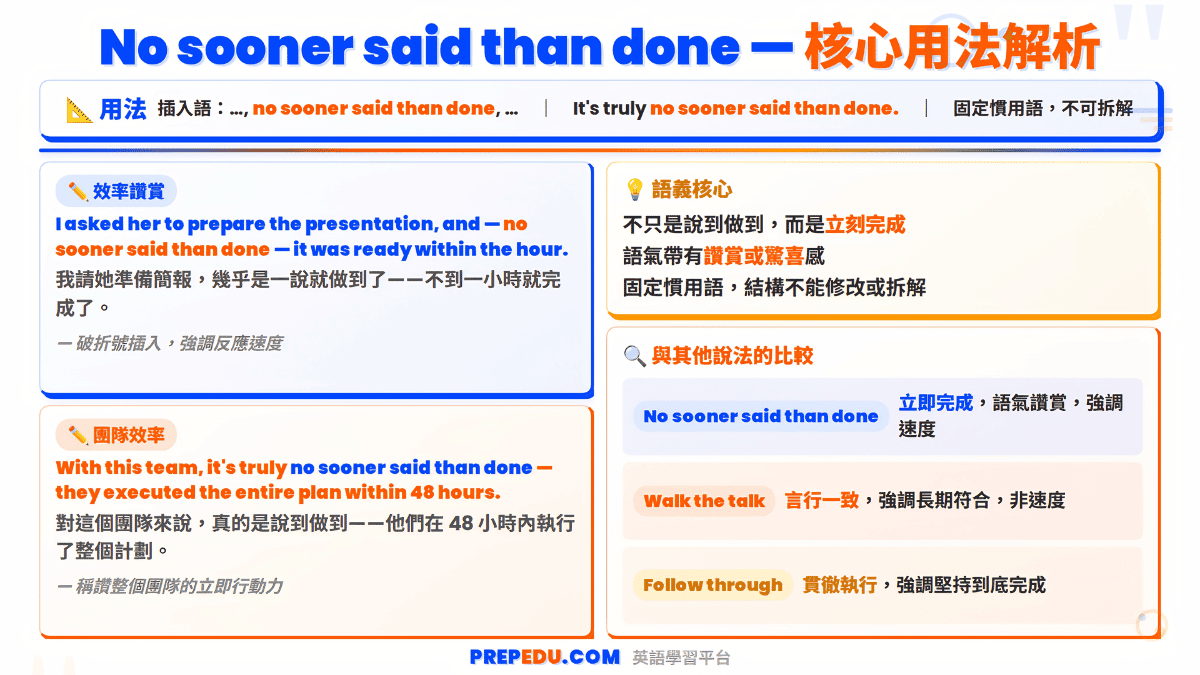
No sooner said than done 的意思是「一說即做、立即兌現」,強調的不只是說到做到,而是立刻、毫不拖延地完成。它通常用來稱讚或描述一個人效率極高、立即行動的特質,語氣帶有讚賞或驚喜感。例如:
-
I asked her to prepare the presentation, and — no sooner said than done — it was ready within the hour.(我請她準備簡報,幾乎是一說就做到了——不到一小時就完成了。) —— 效率讚賞
-
With this team, it's truly no sooner said than done — they executed the entire plan within 48 hours.(對這個團隊來說,真的是說到做到——他們在 48 小時內執行了整個計劃。) —— 團隊效率
-
No sooner said than done: we proposed the idea at 9 a.m. and had a prototype by 5 p.m.(說到就做到:我們早上九點提出想法,下午五點就有了原型。) —— 即說即做
-
He promised to fix the bug before lunch — no sooner said than done.(他承諾在午餐前修復這個錯誤——說到做到。) —— 技術語境
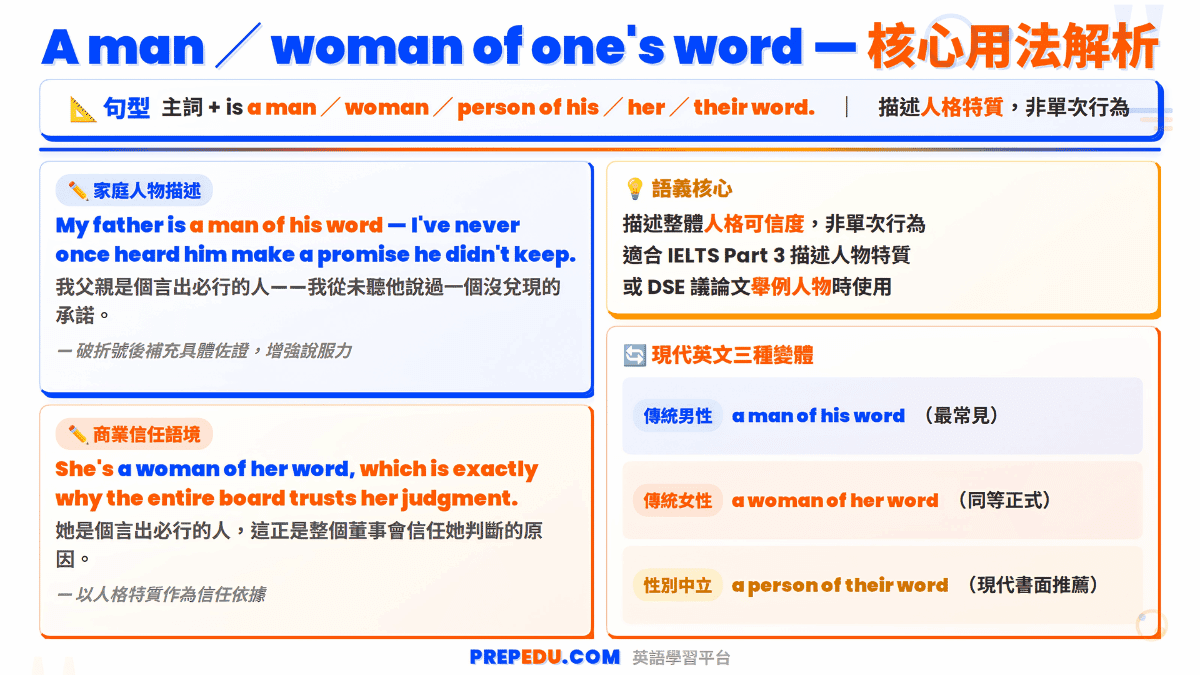
9. A man/woman of one's word
A man/woman of one's word(現代英文也用 a person of their word)是用來描述一個人人格特質的說法:這個人說話算數,承諾過的事必定兌現,從不食言。它不是描述單次行為,而是對一個人整體可信度的評價,適合 TOEIC 口說、IELTS 口說 Part 3 描述人物和 DSE 議論文舉例人物特質時使用。句型:
主詞 + is a man/woman/person of his/her/their word.
例如:
-
My father is a man of his word — I've never once heard him make a promise he didn't keep.(我父親是個言出必行的人——我從未聽他說過一個沒兌現的承諾。) —— 家庭人物描述
-
She's a woman of her word, which is exactly why the entire board trusts her judgment.(她是個言出必行的人,這正是整個董事會信任她判斷的原因。) —— 商業信任語境
-
In this industry, being a person of your word is more valuable than any marketing campaign.(在這個行業,做一個言出必行的人比任何行銷活動都更有價值。) —— 職場價值觀
-
He proved he was a man of his word when he returned to help the community despite his busy schedule.(他在百忙之中回來幫助社區,證明了自己是一個言出必行的人。) —— 社區語境
10. Practice what you preach
Practice what you preach 的意思是「以身作則、言行一致」,但語義比 walk the talk 多了一層含意:你勸別人做到的事,你自己也要做到。它常用於批評那些說教別人卻自己不做到的人(含批評語氣),也可以正面讚揚一個真正以身作則的人。句型:
主詞 + practice(s) what he/she preaches
例如:
-
The school principal practices what she preaches — she's the first to arrive and the last to leave every day.(校長以身作則——她每天第一個到,最後一個離開。) —— 正面讚揚
-
If you tell your team to maintain work-life balance, you need to practice what you preach.(如果你告訴團隊要維持工作與生活的平衡,你自己也要以身作則。) —— 領導力建議
-
He talks about healthy eating but never practices what he preaches — he eats fast food every day.(他總是談論健康飲食,卻從不以身作則——他每天都吃速食。) —— 含諷刺批評
-
The best coaches and teachers always practice what they preach.(最好的教練和老師總是以身作則。) —— 教育語境
Practice what you preach 最常見的錯誤是把語序倒裝,說成 preach what you practice。這個慣用語是固定結構,語序不能改變——practice(實踐)永遠在前,preach(說教)永遠在後,反映的邏輯是「你的行動要跟上你的言語」,倒過來語義就完全消失了。
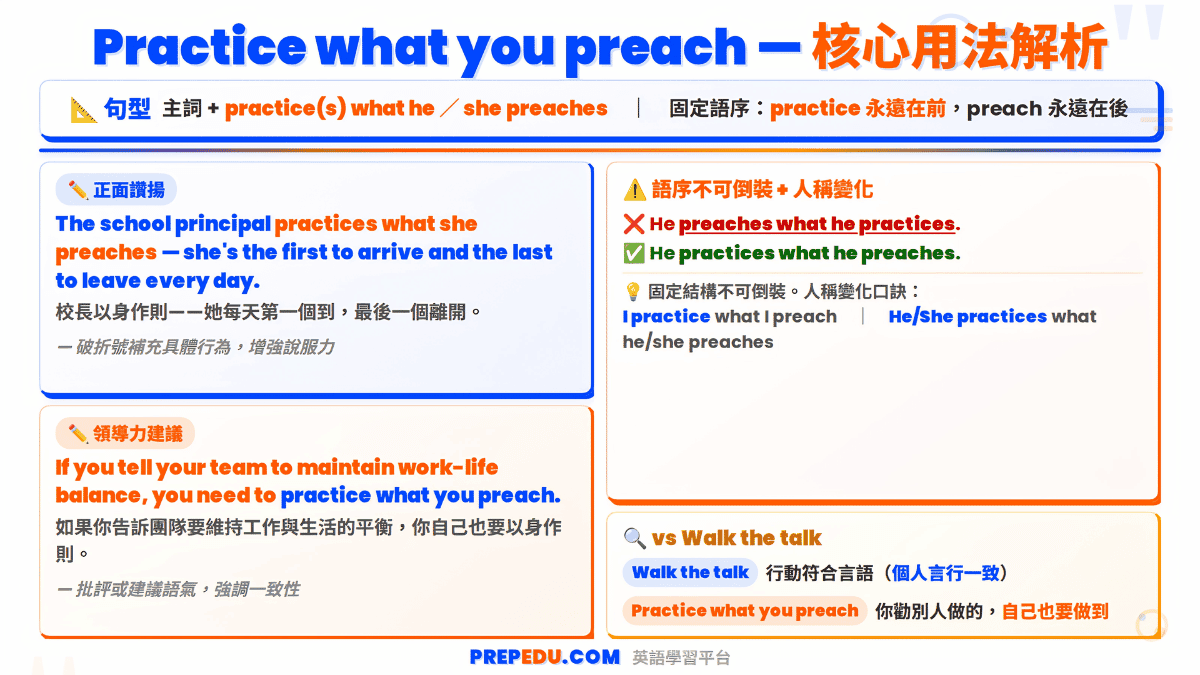
另一個需要注意的地方是主詞與動詞英文的人稱變化:說自己時用 I practice what I preach;說別人時用 he/she practices what he/she preaches;在命令或建議語境用原形 practice what you preach。三種形式在不同語境中各有對應,不可混用。
-
❌ He preaches what he practices.(語序錯誤,固定說法不可倒裝)
-
✅ He practices what he preaches.(正確語序 ✅)
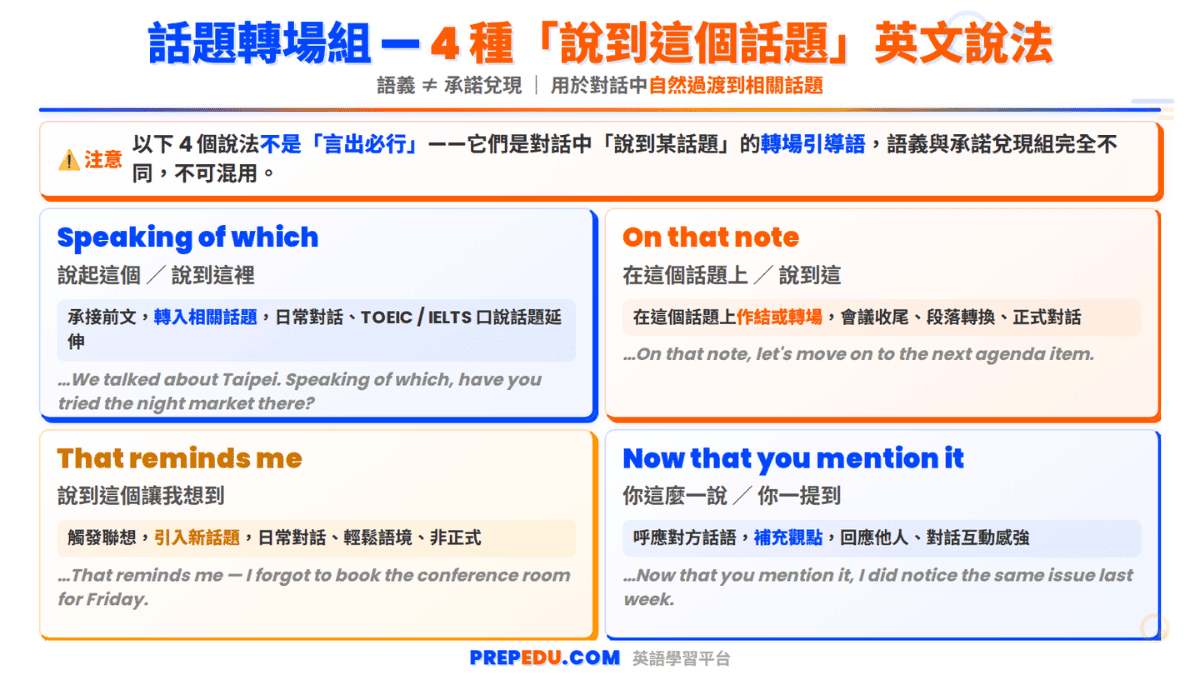
以下 4 個說法屬於「話題轉場組」,語義與承諾兌現組完全不同。它們用於對話中自然過渡到相關話題——是「說到這個話題」的英文表達,不是「言出必行」。
11. Speaking of which
Speaking of which 是對話中最自然的話題轉場語,意思是「說到這個,正好讓我想到……」。它承接前文剛出現的話題,自然地轉入相關的新話題,是母語者日常對話和 TOEIC / IELTS 口說中使用頻率極高的連接語。句型:
陳述. Speaking of which, + 新子句.
Speaking of 具體名詞, + 子句.
例如:
-
We were just talking about team performance. Speaking of which, have you seen the Q3 results yet?(我們剛在聊團隊表現。說到這個,你有看到第三季度的結果了嗎?) —— 承接前文話題
-
She mentioned the new coffee shop near the MRT exit. Speaking of which, we should try it after work.(她提到了捷運出口附近的新咖啡廳。說到這個,我們下班後應該去試試。) —— 日常對話(台灣)
-
You just described the exact problem we had last quarter. Speaking of which, the new system was designed to fix that.(你剛才描述的正是我們上季度遇到的問題。說到這個,新系統就是為了解決這個問題而設計的。) —— 職場討論
-
You mentioned the IELTS Speaking test. Speaking of which, Part 3 often asks about integrity and leadership.(你提到了雅思口說考試。說到這個,Part 3 經常問到誠信和領導力的話題。) —— IELTS Speaking 考試語境
💡 Speaking of which 指前文整體話題;Speaking of +名詞直接點名前文提到的具體詞語,語氣更精確。
12. On that note
On that note 是職場會議和正式對話中最常用的轉場語,在這個話題上作結或轉入下一個議題。它既可以收束當前話題(像是「說到這裡」),也可以帶出相關的新話題。語氣比 speaking of which 更正式,在商業會議和 TOEIC 口說 Part 4、IELTS 口說 Part 3 的回答中特別自然。句型:
On that note, + 子句.
On that note, let's + 動詞.
例如:
-
We've covered all the key points. On that note, let's move on to the Q&A section.(我們已經涵蓋了所有要點。在這個基礎上,讓我們進入問答環節。) —— 會議收束轉場
-
On that note, I'd like to share some data that supports what we've been discussing.(說到這裡,我想分享一些支持我們討論的數據。) —— 引入相關資訊
-
The team has shown excellent progress this quarter. On that note, I want to acknowledge everyone's hard work.(團隊本季度表現出色。在這個基礎上,我要表彰每個人的辛勤工作。) —— 讚揚語境
-
On that note, let me wrap up today's session and remind everyone about next week's deadline.(說到這裡,讓我結束今天的會議,提醒大家下週的截止日期。) —— 會議結束語
13. That reminds me
That reminds me 是日常對話中輕鬆自然的轉場語,意思是「某件事讓我想起了另一件事」,語感親切,適合非正式對話。它暗示說話者被觸發了一個聯想,自然地引入新話題,不需要直接邏輯連結,只需要有聯想關係。句型:
That reminds me — + 子句.
That reminds me of + 名詞.
例如:
-
You mentioned the company retreat. That reminds me — I still need to book accommodation for the trip.(你提到了公司團建。說到這個,讓我想起——我還沒有預訂那次出行的住宿。) —— 觸發聯想(日常)
-
That reminds me of the project we did last year — the one with the impossible deadline.(這讓我想起了我們去年做的那個專案——那個有不可能完成的截止日期的專案。) —— 聯想過去事件
-
We're talking about English exam prep strategies. That reminds me — PREPEDU's IELTS Speaking module has a section on exactly this.(我們在談英語考試備考策略。說到這個,讓我想起——PREPEDU 的雅思口說模組有一個專門針對這個的章節。) —— IELTS 學習語境
-
That reminds me — did you ever send that follow-up email to the Hong Kong office?(這讓我想起——你有沒有把那封後續郵件發給香港辦公室?) —— 辦公室語境(香港)
14. Now that you mention it
Now that you mention it 是「你一提,我才想起」的轉場語,明確回應對方剛說的話,補充自己的觀察或想法,語感比 that reminds me 更直接地互動。它讓對話更有互動感,表示說話者真正在聆聽和回應對方。句型:
Now that you mention it, + 子句.
例如:
-
Now that you mention it, I did notice she seemed a bit distracted during the meeting.(你一說,我確實注意到她在會議中似乎有點心不在焉。) —— 呼應對方觀察
-
Now that you mention it, the budget figures don't quite add up — let me check again.(你這麼一說,預算數字確實有點對不上——讓我再確認一下。) —— 承接觸發重新思考
-
Now that you mention it, I think I have seen that policy document before.(你這麼說,我想我以前確實看過那份政策文件。) —— 記憶被喚起
-
Now that you mention it, the new Taipei café on Zhongxiao East Road is actually right next to the MRT exit.(你這麼說,台北忠孝東路那家新咖啡廳確實就在捷運出口旁邊。) —— 日常對話(台灣)
💡 Now that you mention it 一定要呼應對方說的話;That reminds me 可以自己「突然想到」。前者互動感更強,後者更獨立。
以下兩張對照表分別整理承諾兌現組(說法 1–10)和話題轉場組(說法 11–14),方便快速選擇。
承諾兌現組(10 種):
|
說到做到英文說法 |
語義重心 |
正式程度 |
最佳使用場合 |
|
walk the talk |
行動符合言語(習慣性) |
★★☆☆ 通用 |
描述領導者、評價他人行動力 |
|
put your money where your mouth is |
用行動/資源印證言語 |
★★☆☆ 通用 |
挑戰對方、強調實際行動 |
|
keep your promise / keep one's word |
兌現具體單次承諾 |
★★☆☆ 通用 ✅ 最安全 |
所有場合皆可,最安全選擇 |
|
follow through |
貫徹執行到底 |
★★☆☆ 通用 |
職場、計劃執行、強調過程 |
|
mean what you say |
言語出自真心 |
★☆☆☆ 口語 |
日常對話、強調真誠 |
|
talk the talk |
只說不做(負面對比) |
★★☆☆ 通用 |
批評或對比,與 walk the talk 搭配 |
|
a promise is a promise |
承諾不容反悔 |
★☆☆☆ 口語 |
強調必須履行,語氣較強硬 |
|
no sooner said than done |
立即完成、即說即做 |
★★☆☆ 通用 |
稱讚立即行動、強調效率 |
|
a man/woman of one's word |
人格特質:言出必行 |
★★☆☆ 通用 |
描述人物可信度,TOEIC / IELTS / DSE |
|
practice what you preach |
言行一致,以身作則 |
★★☆☆ 通用 |
討論領袖、榜樣,含勸誡語氣 |
話題轉場組(4 種):
|
說到做到英文說法 |
語義功能 |
最佳使用場合 |
|
speaking of which |
承接前文,轉入相關話題 |
日常對話、TOEIC / IELTS 口說話題延伸 |
|
on that note |
在這個話題上作結或轉場 |
會議收尾、段落轉換、正式對話 |
|
that reminds me |
觸發聯想,引入新話題 |
日常對話、輕鬆語境、非正式 |
|
now that you mention it |
呼應對方話語,補充觀點 |
回應他人、對話互動感強 |
💡 兩組語義完全不同,不可混用:「描述言出必行」選承諾兌現組;「在對話中說到某話題」選話題轉場組。
II. 「說到做到英文」實戰場景
掌握 14 種說法的規則是第一步。以下三個場景展示承諾兌現組和話題轉場組在同一段真實對話中的自然搭配。
1. 場景一:台北職場會議 — 評估專案主管的執行力
-
A:How has David been performing as project lead this quarter?(David 這季擔任專案主管表現如何?)
-
B:Honestly, he's been exceptional. He doesn't just talk the talk — he walks the talk every single day.(說真的,他表現得非常出色。他不只說說而已——他每天都真正地言行一致。)
-
A:Can you give a specific example?(你能舉個具體例子嗎?)
-
B:He said he'd cut project costs by 15%, and he kept his word — we came in at 12% under budget. Plus, he followed through on every single action item without a single reminder.(他說要削減 15% 的專案成本,他做到了——我們比預算少了 12%。而且,他每一項行動計劃都貫徹執行,不需要任何提醒。)
-
A:That's the definition of a man of his word.(那就是言出必行的定義。)
-
B:Exactly. Speaking of which, he mentioned wanting to lead the Q4 launch. I think we should let him.(說到這個,他提到想主導第四季度的發布。我認為我們應該讓他來。)
2. 場景二:香港日常對話 — 朋友討論工作與生活
-
A:My new manager keeps saying 'work-life balance is important,' but she emails at midnight every night.(我的新主管不停地說「工作與生活的平衡很重要」,但她每晚午夜都在發電子郵件。)
-
B:Classic. She talks the talk but doesn't walk the walk.(典型例子。她說得好聽,但說一套做一套。)
-
A:Right. If you're going to preach about balance, you need to practice what you preach.(就是啊。如果你要宣揚平衡,你自己也要以身作則。)
-
B:I had a manager like that at my last job. No sooner said than done — she'd commit to something and get it done before the day was over.(我上一份工作有個那樣的主管。真的是說到就做到——她一承諾某件事,當天就完成。)
-
A:Lucky. That reminds me — I should start job hunting. Do you know if PREPEDU's interview prep course is still running?(真羨慕。說到這個,讓我想起——我應該開始找工作了。你知道 PREPEDU 的面試準備課程還在開嗎?)
-
B:Yes, I think so. Now that you mention it, I've been meaning to check their PrepTalk English module too.(對,我想是的。你這麼一說,我也一直想查他們的 PrepTalk 英語模組。)
3. 場景三:DSE Paper 2 議論文段落 — 展示承諾兌現組說法
題目:Is integrity the most important quality of a successful leader?
段落示範(書面語,承諾兌現組 4 種說法):
Integrity — the ability to walk the talk — is arguably the most indispensable quality in leadership. A leader who keeps their word consistently builds a culture of accountability in which every member of the team understands that commitments will be followed through on. Take Nelson Mandela as an example — universally regarded as a man of his word, he spent 27 years in prison rather than compromise his principles, and practiced what he preached on reconciliation by including former enemies in his government. A leader who only talks the talk without backing it with action quickly loses the trust of both their team and the public.(誠信——言行一致的能力——可以說是領導力中最不可或缺的品質。能夠言出必行的領導者能持續建立問責文化,讓團隊的每個成員都明白承諾是要貫徹執行的。以納爾遜·曼德拉為例——他被普遍視為一個言出必行的人,寧願在監獄中度過 27 年也不願妥協自己的原則,並通過將前任敵人納入政府的方式,以身作則地踐行了和解。一個只說不做的領導者,很快就會失去團隊和公眾的信任。)
4. 場景四:IELTS Speaking Part 3 — 談論誠信與領導力
考官問題:Do you think it is important for leaders to keep their promises?(你認為領導者信守承諾重要嗎?)
參考回答(展示 4 種說法):
Absolutely. A leader who walks the talk earns the trust of their team far more effectively than one who simply makes speeches. When a leader keeps their word consistently, it creates a culture where everyone follows through on their own commitments too. The most admired leaders in history have all been people of their word — and that reputation becomes one of their most powerful assets. On that note, I think integrity should be seen as a non-negotiable quality, not just a nice-to-have.(當然。言行一致的領導者比只發表演講的人更能有效地贏得團隊的信任。當領導者持續言出必行,就能創造一種文化,讓每個人也都會貫徹執行自己的承諾。歷史上最受敬仰的領導者都是言出必行的人——而這種聲譽成為他們最有力的資產之一。說到這裡,我認為誠信應被視為不可或缺的品質,而不只是加分項。)
III. 「說到做到英文」常見問題 FAQ
1. Walk the talk 和 Talk the talk 有什麼不同?
Talk the talk 是「只說不做、說得頭頭是道但沒有行動」——語氣帶諷刺,常用來批評言過其實的人。Walk the talk 是「行動符合言語、真正說到做到」——正面肯定一個人的言行一致。兩者通常一起出現在對比結構中:He can talk the talk, but can he walk the talk?(他說得好聽,但他能說到做到嗎?)單獨使用 walk the talk 是正面肯定;單獨使用 talk the talk 幾乎都是負面批評。在 TOEIC 口說和 IELTS 口說 Part 3 描述理想領導者特質時,walk the talk 是展示高級詞彙的好選擇。
2. Speaking of which 可以放在句首嗎?
可以,而且必須放在新句子的句首。 Speaking of which 是句子連接語,永遠放在新句子開頭,後面接逗號,然後才是主句內容。它不能嵌入主句中間——這與 for example 可以出現在句中不同。
-
❌ We discussed the budget, which speaking of, needs to be revised.(不能嵌入句中)
-
✅ We discussed the budget. Speaking of which, it needs to be revised by Friday.(句首 + 逗號 ✅)
3. 「信守承諾英文」和「說到做到英文」的表達一樣嗎?
大部分重疊,但語義重心略有差異。「信守承諾英文」最直接的說法是 keep one's word 或 keep a promise,聚焦於單次承諾的兌現。「說到做到英文」的最佳說法是 walk the talk,強調習慣性的言行一致,不只是一次承諾的問題。如果想用一個說法同時涵蓋兩個語義,a person of their word 最合適——它描述一個長期、習慣性地言出必行的人格特質,正好介於兩個語義之間。
4. TOEIC 口說和 IELTS 口說中,哪個「說到做到英文」說法最自然?
-
承諾兌現組首選 keep one's word——沒有語境限制,口語書面皆宜,最安全,適用於 TOEIC 口說 Part 3 – TOEIC 口說 Part 4 和 IELTS 口說 Part 2 – IELTS 口說 Part 3 的所有回答。Walk the talk 語感最道地,但需確認語境是在描述言行一致的習慣,而非單次承諾。
-
話題轉場組首選 speaking of which——在 TOEIC 口說 Part 3 和 IELTS 口說 Part 3 的回答中,用 speaking of which 把你的答案自然延伸到考官問題的相關話題,能展示口說流暢度和話題連貫性。On that note 則適合在回答即將結束時作自然收束,在兩個考試的口說部分都很實用。
總結
「說到做到英文」涵蓋 14 種說法,分為兩組。承諾兌現組的 10 種說法各有語義側重:walk the talk 強調長期言行一致;put your money where your mouth is 語氣最強、帶挑戰意味;keep one's word 是最安全的通用選擇;follow through 強調貫徹執行;talk the talk 是負面對比說法;no sooner said than done 強調即時兌現。話題轉場組的 4 種說法(speaking of which、on that note、that reminds me、now that you mention it)用於對話中自然過渡話題,與承諾兌現組語義完全不同,選錯說法對話語境立刻出現偏差。
在 TOEIC 口說、IELTS Speaking 和 DSE 作文中,建議的起點是:承諾兌現組選 keep one's word(最安全,無語境限制),進階後替換為 walk the talk 或 a person of their word 以展示詞彙深度;話題轉場組選 speaking of which(最自然),在會議語境改用 on that note,在需要呼應對方話語時用 now that you mention it。
從今天開始練習的方法: 每次說中文的「說到做到」時,試著問自己:我想表達的是「他言出必行」(→ keep his word / walk the talk)還是「說到這個話題」(→ speaking of which / that reminds me)?這個 5 秒的判斷,能讓你每次都選對說法,告別一律用「keep promise」的語感貧乏。PREPEDU 的 PrepTalk English 課程提供針對台灣和香港學習者設計的情境口語訓練,讓每一個「說到做到」都說得道地、用得精準。

你好!我叫黃秋賢,現在在 prepedu.com 擔任內容企劃。我有超過5年的英語與韓語自學經歷,親身備考 IELTS、TOEIC 與 TOPIK,累積了大量第一手的學習者視角——包括哪些語法規則最讓台灣與香港學習者混淆,以及如何在有限的備考時間內最有效地修正這些錯誤。目前已在 prepedu.com 撰寫超過 1000 篇英語學習文章,內容涵蓋語法、詞彙與考試策略,累積協助數千位學習者解決自學過程中的語法疑問。
評論


個人化路線圖










統一企業編號:202227322W
地址:114 LAVENDER STREET, #11-83 CT HUB 2, SINGAPORE (338729)