enough 用法全攻略:意思、詞性、位置規則、enough to/for 句型與練習題一次搞懂
enough 的意思是「足夠的」或「足夠地」,最常見的三種詞性是限定詞/形容詞、副詞與代名詞。對台灣學習者來說,最大的困擾不是意思,而是位置:修飾名詞放前面(enough money),修飾形容詞卻放後面(tall enough),擺錯就扣分。這篇文章從意思與詞性出發,拆解位置規則這條主軸,帶你掌握 enough to 與 enough for 句型,比較 too...to/so...that 的差別,並附常見錯誤與 30 題練習。搭配文末總整理表,一頁釐清 enough 的所有用法。

I. enough 是什麼意思?詞性與基本概念
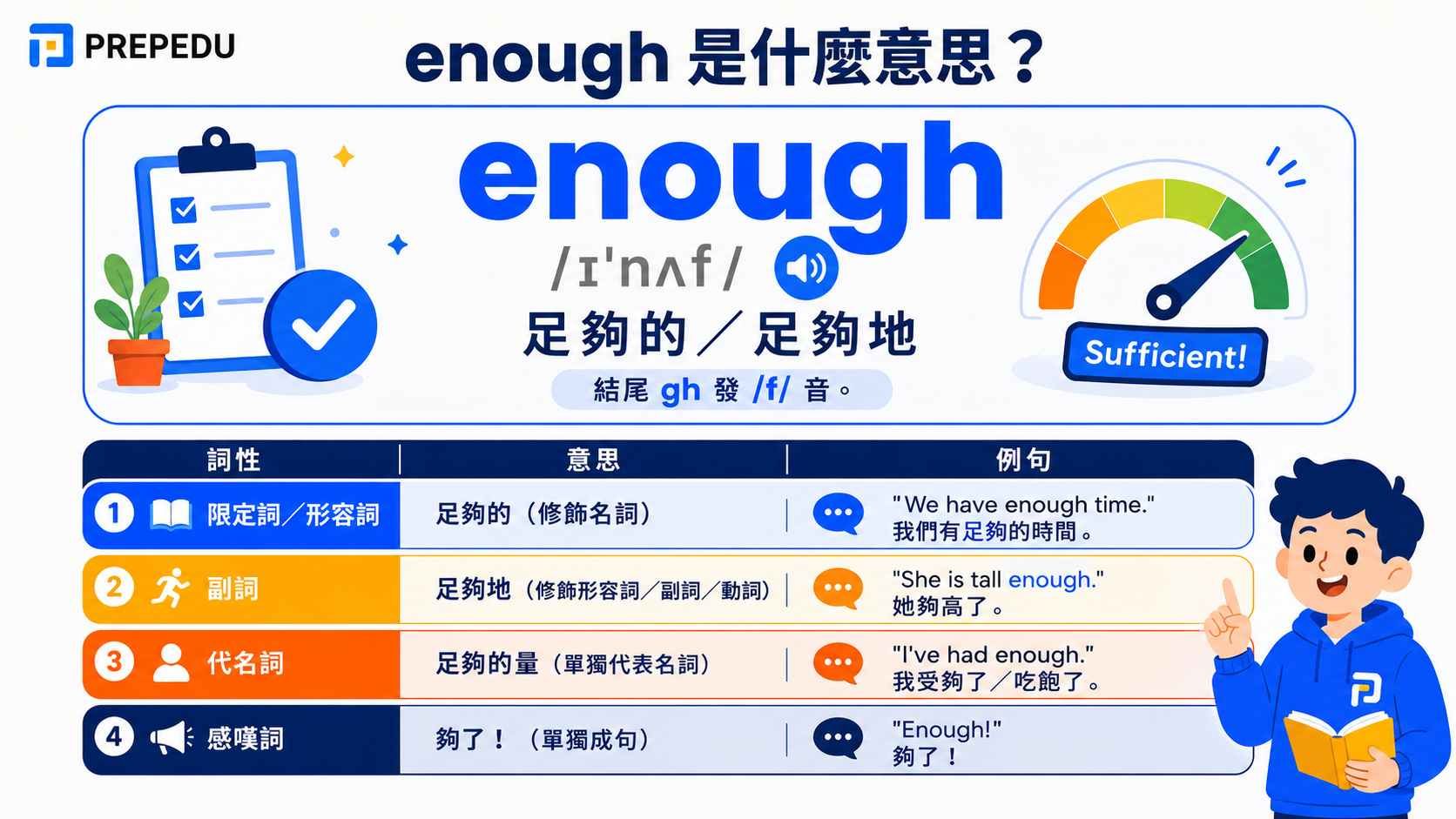
enough 的意思是「足夠的」或「足夠地」,讀音為 /ɪˈnʌf/。它最常見的三種詞性是限定詞/形容詞(修飾名詞)、副詞(修飾形容詞、副詞或動詞)以及代名詞(單獨代表「足夠的量」)。判斷 enough 在句中的詞性,是決定它該放在前面還是後面的關鍵。
很多人看到 enough 只記得「夠」這個中文,卻忽略它其實身兼數職。讀音方面要特別留意,enough 結尾的 gh 發 /f/ 的音,整個字讀作 /ɪˈnʌf/,不是字面上的「e-nough」。Cambridge 與 Oxford 等權威辭典都把 enough 同時歸類為 determiner(限定詞)、pronoun(代名詞)與 adverb(副詞),這也說明了為什麼同一個字會在句中跑來跑去。先把詞性分清楚,後面的位置規則就有了判斷依據。
enough 的核心意思:「足夠的/足夠地」→ 下表整理 enough 當不同詞性時的意思與例句。詞性不同,意思的細微差別與在句中的位置也跟著不同。
|
enough 詞性 |
enough 意思 |
例句 |
|
足夠的(修飾英文名詞) |
We have enough time.(我們有足夠的時間。) |
|
|
足夠地(修飾形容詞/副詞/動詞英文) |
She is tall enough.(她夠高了。) |
|
|
足夠的量(單獨代表名詞) |
I've had enough.(我受夠了/我吃飽了。) |
|
|
夠了!(單獨成句) |
Enough!(夠了!) |
為什麼 enough 這麼容易用錯?enough 之所以難,原因有兩個。
-
第一是位置會跑:修飾名詞時放前面,修飾形容詞、副詞時卻放後面,學習者常憑中文語感把它一律放前面,於是寫出 enough tall 這種錯誤。為什麼會有這條看似矛盾的規則?因為 enough 作限定詞時與 some、any、no 同一類,限定詞天生站在名詞前面;但它作副詞修飾形容詞或副詞時,英文的副詞 enough 屬於少數「後置副詞」之一,必須緊跟在被修飾的形容詞、副詞之後,這是英語語法的固定特例,不是可以憑語感推測的。華語沒有這種「同一個字依詞性換邊站」的現象,所以母語干擾特別強。
-
第二是當代名詞接其他名詞或代名詞時容易漏掉 of,把 enough of them 寫成 enough them。搞懂位置規則,就解決了 enough 八成的錯誤,這正是下一章要拆解的。
II. enough 的位置規則
你只要先問自己一個問題:「enough 在修飾誰?」如果修飾的是名詞,就放前面;如果修飾的是形容詞、副詞或動詞,就放後面。Cambridge Grammar 對 enough 的詞序規範也是同一條原則。下面分四種情況各看一次,把這條規則徹底坐實。

1. enough + 名詞(放前面)
當 enough 修飾名詞時,放在名詞前面,意思是「足夠的某物」。要注意 enough 後面接的是複數可數名詞或不可數名詞,單數可數名詞無法直接接 enough,因為「足夠」隱含「一定的量或數」,量化的對象必須是可累積的(不可數)或可成群的(複數),單一個體本身談不上「夠不夠」:enough books(足夠的書,複數可數)、enough money(足夠的錢,不可數)、enough time(足夠的時間,不可數)。更多例句:
-
Do we have enough chairs for all the guests?(我們的椅子夠所有客人坐嗎?)
-
I didn't bring enough cash, so I had to pay by card.(我沒帶夠現金,只好刷卡。)
-
There aren't enough volunteers to run the event.(志工人數不足,撐不起這場活動。)
2. 形容詞/副詞 + enough(放後面)
當 enough 修飾形容詞或副詞時,放在它們後面,意思是「夠……」。這是台灣學習者最常擺反的一類,因為華語的「夠高、夠快」把「夠」放在前面,直譯就會寫成 enough tall。記住:副詞 enough 是後置的,永遠跟在形容詞、副詞屁股後面。這裡有幾組高頻搭配特別值得背起來,因為它們已經固定成日常用語:good enough(夠好、過得去)、old enough(年紀夠了)、sure enough(果然、不出所料)、fair enough(有道理、可以接受)。其中 sure enough 與 fair enough 已是慣用語,語氣偏口語、輕鬆,常出現在對話而非正式書面。更多例句:
-
This apartment is big enough for a family of four.(這間公寓對四口之家來說夠大。)
-
I knocked, and sure enough, nobody answered.(我敲了門,果然沒人應。)
-
The translation is good enough to submit, though it's not perfect.(這份翻譯雖不完美,但已經好到可以交件。)
3. 動詞 + enough(放後面)
當 enough 修飾動詞時,放在動詞或其受詞英文的後面,意思是「做某事做得夠多」。順帶一提,例句中的 practise 是英式拼法(動詞 practise/名詞 practice 在英式英語分家),美式英語則動詞、名詞一律寫 practice,因此美式會寫 You don't practice enough.,兩種都正確,只是拼字依市場而定。
-
He earns enough to support his whole family.(他賺得夠養活全家。)
-
We've talked enough; now it's time to act.(我們談得夠多了,現在該行動了。)
-
You haven't rested enough to drive that far.(你休息得不夠,沒辦法開那麼遠的路。)
4. enough 當代名詞:enough 與 enough of
當 enough 單獨代表「足夠的量」時,它是代名詞,可以直接放在句子裡,不接名詞。
-
Have you had enough?(你吃夠了嗎?/你受夠了嗎?)
-
Enough is enough.(適可而止/夠了就是夠了。)
但如果 enough 後面要接 the、英文所有格或代名詞這類「已限定」的名詞時,中間必須加 of。原理是:限定詞 enough 不能直接疊在另一個限定詞(the、my、them)上,必須靠 of 把「部分」與「整體」接起來,這個 of 在華語裡沒有對應的詞,所以最容易被漏掉。
-
✓ enough of them(他們之中足夠的數量)
-
✓ enough of the money(那筆錢的一部分就夠了)
-
✗ enough them(錯,漏掉 of)
位置搞定後,enough 最常見的延伸句型就是 enough to,也就是下一章的主角。
III. enough to + 動詞:「足以……」句型
enough to 的意思是「足以……、夠……到可以做某事」,有兩種結構:「形容詞/副詞 + enough + to + 原形動詞」(She is old enough to drive. 她夠大可以開車了)以及「enough + 名詞 + to + 原形動詞」(I have enough money to buy it. 我有足夠的錢買它)。否定形「not + 形容詞 + enough + to V」表示「不夠……到能……」。
enough to 是日常與考試都高頻的句型,重點在於 enough 的位置仍然遵守第二章的規則:接形容詞放後面,接名詞放前面,後面再加 to + 原形動詞表示「足以做的那件事」。下面拆成兩種肯定結構與一種否定結構。

1. 形容詞/副詞 + enough + to V
形容詞或副詞放在 enough 前面,後面接 to + 原形動詞,表示「夠……到可以做某事」。這個 to 是不定詞,表達的是「足夠的程度所換來的結果或目的」,所以它後面永遠接原形動詞,不會接名詞,這是和下一章 for 最大的分界。
-
The coffee is cool enough to drink now.(咖啡現在涼到可以喝了。)
-
She spoke slowly enough for everyone to understand.(她說得夠慢,每個人都聽得懂。)
-
He's experienced enough to handle this on his own.(他經驗夠豐富,可以自己處理這件事。)
2. enough + 名詞 + to V
名詞放在 enough 後面,再接 to + 原形動詞,表示「有足夠的某物可以做某事」。注意此時 enough 是限定詞(在名詞前),to 一樣帶出「足以達成的動作」。
-
They didn't have enough evidence to convict him.(他們沒有足夠的證據將他定罪。)
-
Do we have enough chairs to seat everyone?(我們的椅子夠讓每個人都有位子坐嗎?)
-
She has enough experience to lead the team.(她的經驗足以帶領這個團隊。)
3. 否定:not + 形容詞 + enough + to V
加上 not 表示「不夠……到能……」,是考試與口語都常用的否定句型。語氣上,not...enough 是相對委婉的否定:它強調「差一點、尚未達標」,比起直接說 too...to(太……所以不行)更含蓄,因此在禮貌或委婉的場合更常見。
-
I'm not confident enough to give a speech in English yet.(我還沒自信到能用英文演講。)
-
This report isn't detailed enough to convince the board.(這份報告不夠詳細,說服不了董事會。)
-
We didn't save enough money to buy a house.(我們存的錢不夠買房子。)
如果想表達「對某人來說足夠」,就要把 to 換成 for,兩者差別正是下一章重點。
IV. enough for + 名詞/人:表示「對某人/某事足夠」
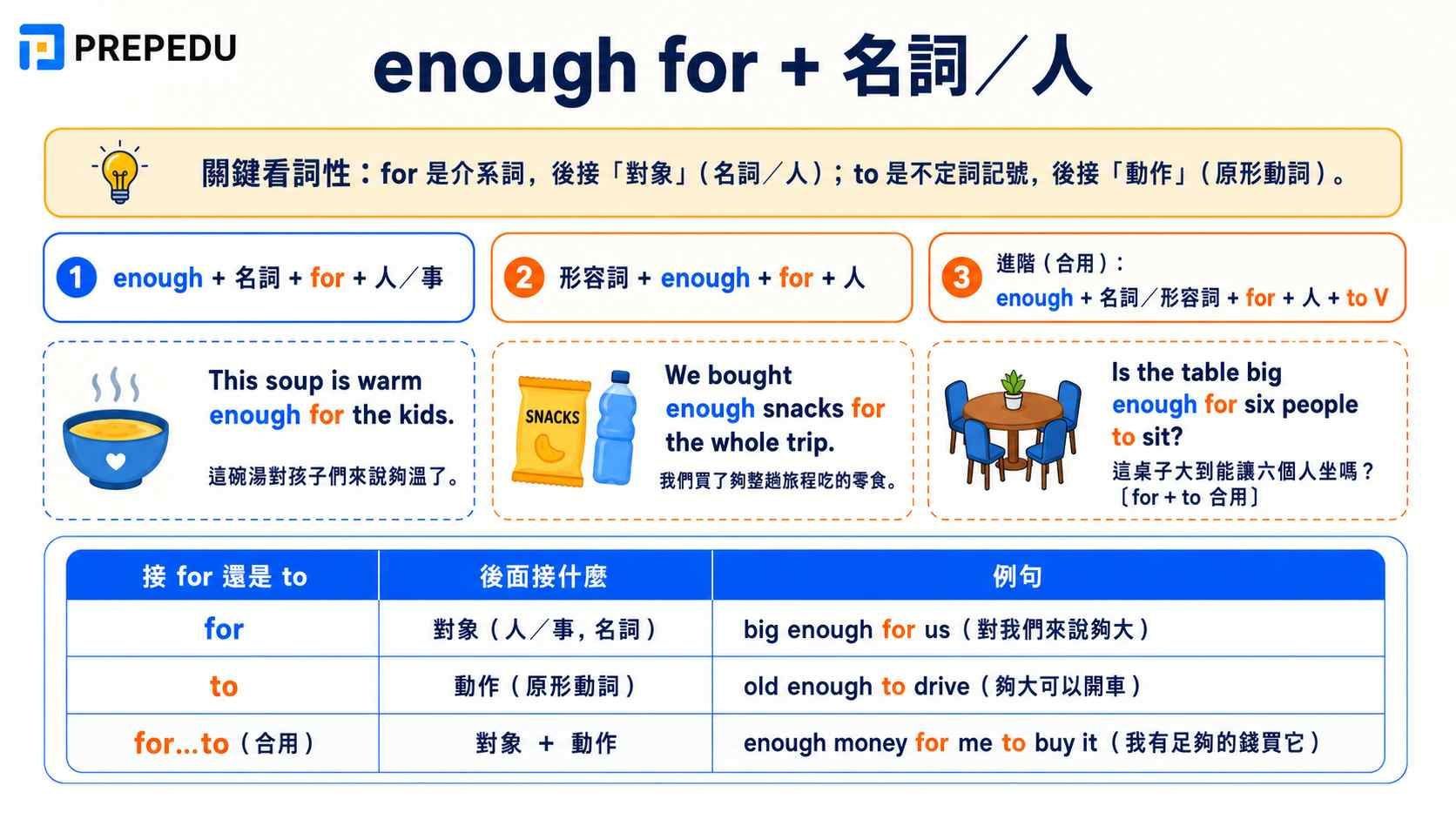
enough for 用來表示「對某人或某事足夠」,結構是「enough + 名詞 + for + 人/事」(There is enough food for everyone. 食物夠大家吃)或「形容詞 + enough + for + 人」(The room is big enough for us. 房間對我們來說夠大)。簡單區分:for 後面接「對象」,to 後面接「動作」,兩者也可合用:enough money for me to buy it。
很多人會把 enough to 和 enough for 搞混,其實判斷方式很單純:差別在於詞性。for 是介系詞,後面接「名詞或代名詞」當對象(足夠的份量是給「誰」的);to 是不定詞記號,後面接「原形動詞」當動作(足以「做」什麼)。所以只要看你接下來想講的是「一個人/東西」還是「一個動作」,就能立刻選對。華語學習者常出錯是因為中文兩種意思都用「夠……」帶過,沒有 for/to 的形式分工,於是憑感覺亂填;遇到 big enough _____ us 這種空格,記住後面是 us(對象),就只能是 for。
兩者也能合用,組成 enough + 名詞/形容詞 + for + 人 + to V,先點出「對誰」再帶出「做什麼」,這是最完整、資訊量最高的結構,常見於正式說明與書面語。公式:
-
enough + 名詞 + for + 人/事
-
形容詞 + enough + for + 人
-
進階:enough + 名詞 + for + 人 + to V(合用)
例句:
-
This soup is warm enough for the kids.(這碗湯對孩子們來說夠溫了。)
-
We bought enough snacks for the whole trip.(我們買了夠整趟旅程吃的零食。)
-
Is the table big enough for six people to sit comfortably?(這張桌子大到能讓六個人舒服地坐下嗎?)
-
The instructions were clear enough for a beginner to follow.(這份說明清楚到連新手都能照著做。)
|
接 for 還是 to |
後面接什麼 |
例句 |
|
for |
對象(人/事,名詞) |
big enough for us(對我們來說夠大) |
|
to |
動作(原形動詞) |
old enough to drive(夠大可以開車) |
|
for...to(合用) |
對象 + 動作 |
enough money for me to buy it(我有足夠的錢買它) |
V. enough 和 too...to/so...that 有什麼差別?
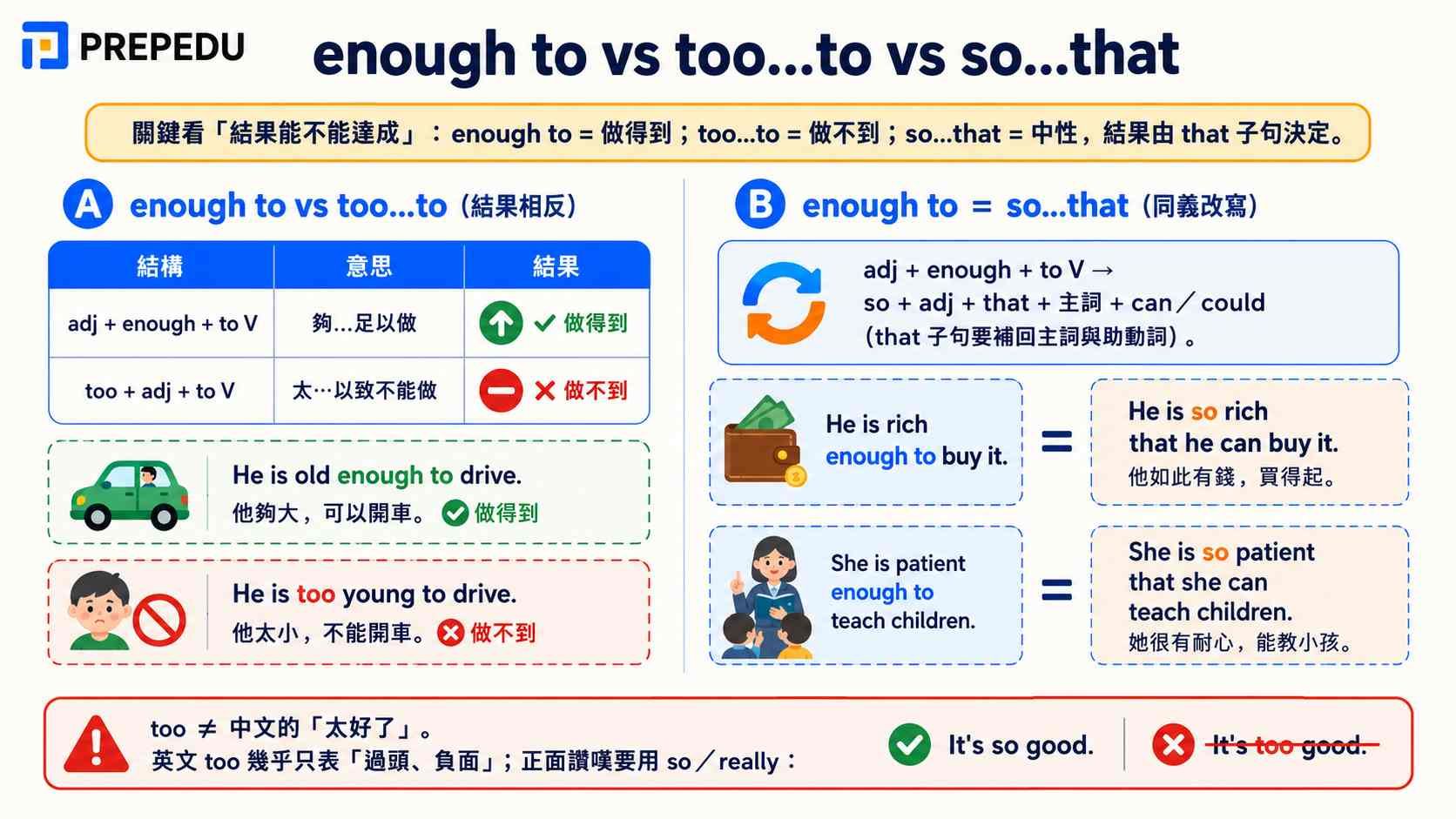
enough to 表示「足以……(做得到)」,too...to 表示「太……以致於不能……(做不到)」,兩者結果相反:He is old enough to drive(夠大→能開車)vs He is too young to drive(太小→不能開車)。enough to 也可改寫成 so...that:He is rich enough to buy it = He is so rich that he can buy it。
這一組比較是 TOEIC、學測、DSE 等升學考試的高頻考點,關鍵在於「結果能不能達成」。enough to 的結果是肯定的(做得到),too...to 的結果是否定的(做不到),so...that 則中性,結果由 that 子句決定。背後的邏輯是「程度與門檻的關係」:enough 表示程度「達到或超過」門檻,所以結果成立;too 表示程度「過頭」反而卡住,所以結果不成立。理解這層因果,比死背公式更不容易在考試裡選錯。下面分兩組看清楚。
1. enough to 和 too...to
兩者形式上都接 to + 原形動詞,意思卻完全相反。記住 too 帶有「過頭、負面」的語氣,結果是「做不到」。
|
結構 |
意思 |
結果 |
|
adj + enough + to V |
夠……足以做某事 |
做得到 |
|
too + adj + to V |
太……以致於不能做某事 |
做不到 |
例句對照:
-
He is old enough to drive.(他夠大,可以開車。→ 做得到) 和 He is too young to drive.(他太小,不能開車。→ 做不到)
-
The water is warm enough to swim in.(水夠暖,可以下去游泳。→ 做得到) 和 The water is too cold to swim in.(水太冷,沒辦法游泳。→ 做不到)
-
She speaks clearly enough to be understood.(她說得夠清楚,聽得懂。→ 做得到) 和 He was too nervous to finish his speech.(他太緊張,沒能講完。→ 做不到)
台灣高頻陷阱:too 不等於中文口語的「太好了」。中文的「太」常帶正面強調(太棒、太好了),但英文 too 幾乎只用在「過頭、超標」的負面語氣,這正是 L1 干擾最深的一點。想表達「太好了」這種正面讚嘆,要用 so 或 really,例如 It's so good. 或 It's really good.,寫成 too good 反而會變成「好過頭了(帶負面)」的意思。
2. enough to 和 so...that
enough to 可以改寫成 so...that,意思相同,只是語氣與結構不同。改寫步驟是把「adj + enough + to V」轉成「so + adj + that + 主詞 + can/could」。要注意的是,enough to 句中的不定詞主詞和主句主詞通常是同一人,所以省略不寫;改成 so...that 時,that 子句必須補回明確的英文主詞與英文助動詞(can/could),時態也要和主句一致,這是改寫最容易漏掉的細節。語氣上 so...that 把因果說得更滿,較強調、較書面。
-
He is rich enough to buy it. = He is so rich that he can buy it.(他如此有錢,所以買得起。)
-
She is patient enough to teach children. = She is so patient that she can teach children.(她很有耐心,可以教小孩。)
-
The bag was light enough to carry. = The bag was so light that I could carry it.(這個包夠輕,我提得動。)
搞懂三種句型後,最後一步就是避開實際下筆時最常踩的雷。
VI. enough 常見錯誤整理
使用 enough 最常見的錯誤是「位置擺反」:把形容詞放後面寫成 enough tall(正確應為 tall enough)。其他高頻錯誤包括:接代名詞時漏掉 of(enough them → enough of them)、後面接單數可數名詞(enough chair → enough chairs),以及把中文「太好了」直譯成 too good(應用 so good)。
PREPEDU 教學團隊在批改華語學習者的英文作業時發現,這些錯誤反覆出現,其中「位置擺反」幾乎每位初學者都犯過。多數錯誤的共同根源是同一件事:華語的「夠」不分詞性、永遠前置,也沒有 of、for、to 這些介系詞與不定詞記號的形式分工,於是學習者把中文結構整組搬到英文。下表整理這些錯誤,每個都附上正確寫法與原因。對照這張表自我檢查,就能攔下絕大多數的 enough 失分。
|
錯誤 ✗ |
正確 ✓ |
原因 |
|
She is enough tall. |
She is tall enough. |
tall 是形容詞,enough 要放後面 |
|
enough kind |
kind enough |
kind 是形容詞,enough 放後面 |
|
enough them |
enough of them |
接代名詞要加 of |
|
enough chair |
enough chairs |
單數可數名詞要改複數 |
|
It's too good!(想說「太好了」) |
It's so good! |
正面讚嘆用 so/really,不用 too |
|
big enough to us |
big enough for us |
接對象(人)用 for,不用 to |
|
She is enough clever to win. |
She is clever enough to win. |
形容詞 + enough + to V,enough 仍放形容詞後 |
|
money enough |
enough money |
enough 作限定詞修飾名詞,要放名詞前 |
|
He doesn't enough sleep. |
He doesn't sleep enough. |
修飾動詞時 enough 放動詞後,不放前面 |
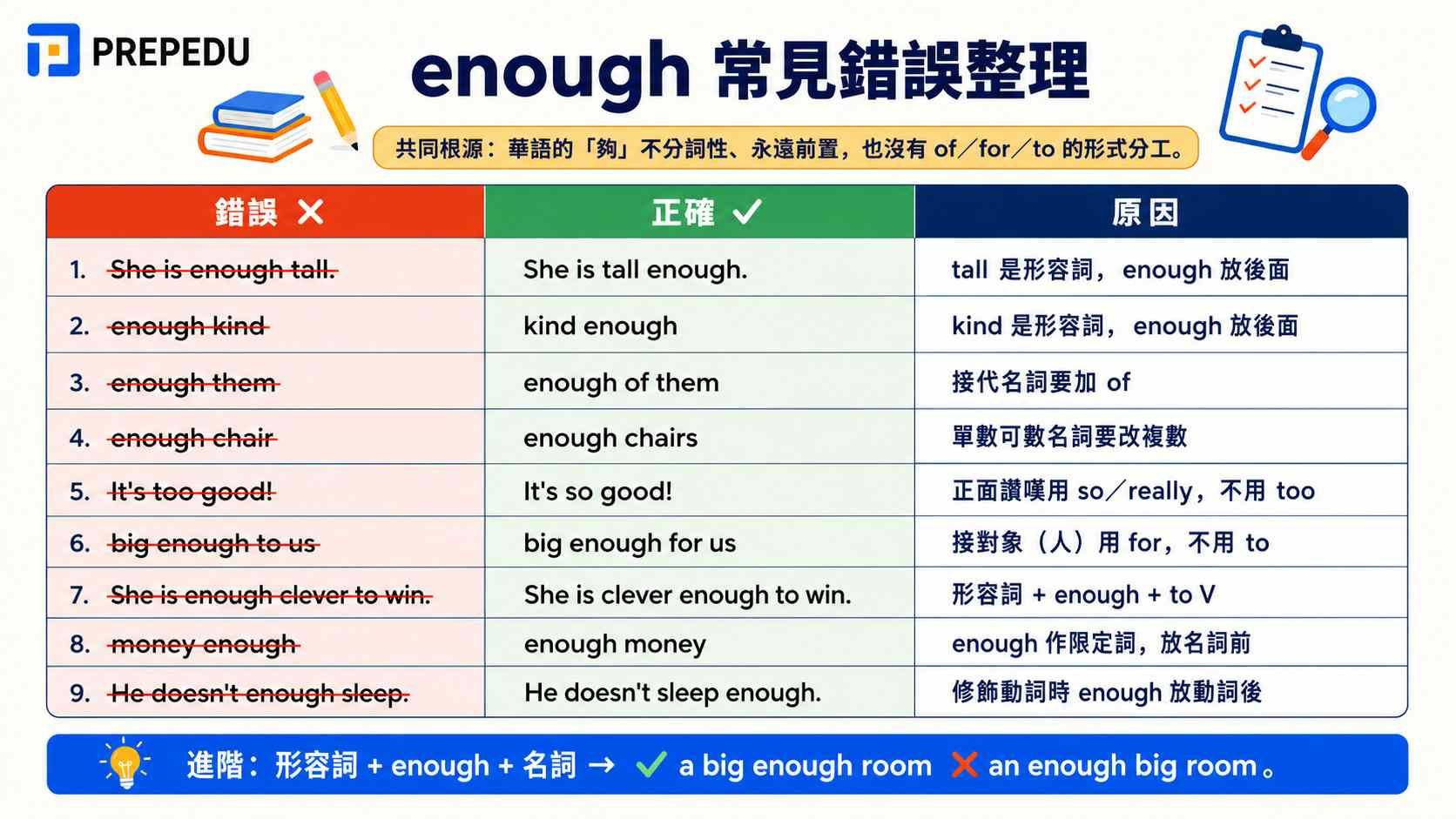
最後補充一個進階陷阱:當 enough 修飾形容詞、後面又接名詞時(例如「夠大的房間」),華語語感容易寫成 a big enough room 還是 an enough big room 拿不定主意。正解是 a big enough room,因為 enough 跟著形容詞 big 後置,整組再去修飾 room;an enough big room 把 enough 前置就錯了。這類「形容詞 + enough + 名詞」的組合在口語中很常見,例如 a good enough reason(一個夠充分的理由)。
VII. enough 練習題:實戰演練
下面三組練習分別檢測位置、enough to/for 句型,以及 too...to/so...that 的改寫。先自己作答,再對照最後的解答與解析,確認每一題背後的規則都掌握了。
1. 練習一:選出 enough 的正確位置
從括號中選出正確的寫法。
-
Yiting is (enough old / old enough) to get a driving licence.
-
We don't have (enough money / money enough) for the trip.
-
Mingzhi didn't run (enough fast / fast enough) to win.
-
Do you have (enough chairs / enough chair) for the guests?
-
Have you had (enough of them / enough them)?
-
Peiyu speaks English (enough well / well enough) to give a tour.
-
There isn't (enough sugar / sugar enough) in this coffee.
-
Xiaohua isn't (enough strong / strong enough) to move the sofa alone.
-
We have (enough volunteers / volunteer enough) to run the booth.
-
Jiahui didn't sleep (enough / enough sleep) before the exam.
2. 練習二:用 enough to / enough for 造句
依提示完成句子,填入 to 或 for,並補上適當結構。
-
The box is light _____ me to carry.
-
Yawen is clever _____ solve the problem.
-
There is _____ food _____ everyone.
-
I don't have _____ time _____ finish it today.
-
The water is warm _____ us to swim.
-
Mingzhi is tall _____ reach the top shelf.
-
We bought _____ snacks _____ the whole trip.
-
Xiaoming isn't old _____ watch this movie.
-
The room is big _____ six people to work in.
-
Peiyu saved _____ money _____ buy a new laptop.
3. 練習三:too...to/so...that 與 enough 互相改寫
依指示改寫句子,意思不變。
-
Zhiqiang is rich enough to buy a car.(改寫成 so...that)
-
Yiting is too tired to walk.(用 not...enough 改寫,意思相反方向需注意)
-
The tea is hot enough to drink.(改寫成 so...that)
-
Mingzhi is so strong that he can lift it.(改寫成 enough to)
-
The shoes are too small for him to wear.(用 not...enough for 改寫)
-
Jiahui is too young to vote.(用 not...enough 改寫)
-
The bag is light enough to carry.(改寫成 so...that)
-
This box is too heavy for me to lift.(用 not...enough for 改寫)
-
Xiaohua is patient enough to teach children.(改寫成 so...that)
-
The road is so wide that two trucks can pass.(改寫成 enough to)
4. 解答與解析
|
練習一 |
練習二 |
練習三 |
|
|
|
練習後若還有疑問,下面的延伸用法與 FAQ 幫你補齊最後拼圖。
VIII. enough 延伸用法與常見問題(FAQ)
enough、sufficient 和 adequate 都表示「足夠」,但 enough 最口語通用,sufficient 與 adequate 較正式、常見於書面或學術語境。常見慣用語包括 Enough is enough(適可而止)、fair enough(有道理、可以接受)、good enough(夠好了)以及 I can't thank you enough(對你感激不盡)。
1. enough 和 sufficient、adequate 有什麼不同?
三者都表示「足夠」,差別在於語域(register)。Cambridge 與 Oxford 都標註 sufficient 與 adequate 屬於較正式的用語。
|
用字 |
語域 |
適用情境 |
|
enough |
口語、通用 |
日常對話、寫作皆可 |
|
sufficient |
正式 |
書面、學術、商務 |
|
adequate |
正式 |
書面,強調「達到標準、足以應付」 |
2. 常見慣用語
-
Enough is enough.(適可而止、夠了就是夠了。)
-
fair enough(有道理、可以接受。)
-
good enough(夠好了。)
-
I can't thank you enough.(對你感激不盡,字面是「再怎麼謝你都不夠」。)
3. 快問快答
Q:enough 後面可以接單數可數名詞嗎? A:通常不行。enough 接複數可數名詞或不可數名詞,例如 enough chairs、enough water,不會說 enough chair。
Q:sleep enough 還是 enough sleep? A:兩種都對,但意思不同。sleep enough 的 enough 是副詞修飾動詞(睡得夠多);enough sleep 的 enough 是限定詞修飾名詞(足夠的睡眠)。
4. 生活情境對話:enough 這樣用
下面是一段在咖啡店籌備生日派對的對話,把 enough、enough to、enough for、not enough 自然地放進真實情境裡。
|
角色 |
enough 對話 |
中文翻譯 |
|
Yawen |
Do we have enough cups for all the guests? |
我們的杯子夠所有客人用嗎? |
|
Zhiqiang |
Not quite. We don't have enough for twenty people. |
還不太夠。二十個人的份量還不夠。 |
|
Yawen |
Is the cake big enough to feed everyone? |
蛋糕大到能讓每個人都吃到嗎? |
|
Zhiqiang |
It's big enough for the kids, but the adults might want more. |
給小孩吃是夠了,但大人可能會想再多一點。 |
|
Yawen |
Okay, do we have enough time to buy a second one? |
好,我們還有足夠的時間再買一個嗎? |
|
Zhiqiang |
If we leave now, we'll be quick enough to get back before six. |
如果現在出發,我們動作夠快,六點前能趕回來。 |
|
Yawen |
Great. I think that's enough planning for one morning. |
太好了。我想一個早上規劃到這裡就夠了。 |
|
Zhiqiang |
Fair enough. Let's go. |
有道理。走吧。 |
這段對話用到了 enough + 名詞(enough cups/enough time)、enough for(enough for twenty people、big enough for the kids)、形容詞/副詞 + enough + to V(big enough to feed、quick enough to get back)、否定的 not...enough,以及慣用語 fair enough。
總結
掌握 enough 只要記住一條主規則:修飾名詞放前面(enough + 名詞),修飾形容詞、副詞、動詞放後面(adj/adv/V + enough)。延伸句型 enough to 表「足以做某事」,enough for 表「對某人足夠」,與表示「太……不能……」的 too...to 結果相反。
|
詞性/句型 |
位置規則 |
例句 |
|
限定詞 + 名詞 |
enough 放名詞前 |
enough money(足夠的錢) |
|
形容詞 + enough |
enough 放形容詞後 |
tall enough(夠高) |
|
動詞 + enough |
enough 放動詞後 |
sleep enough(睡得夠) |
|
enough to + V |
足以做某事 |
old enough to drive(夠大可以開車) |
|
enough for + 人/事 |
對某對象足夠 |
big enough for us(對我們來說夠大) |
|
代名詞 enough of |
接限定名詞加 of |
enough of them(他們之中足夠的數量) |
把這張表存在手機裡,下筆前先問「enough 在修飾誰」,位置就不會再擺反。如果想讓規則真正變成反射動作,最有效的方式是大量寫、馬上修。用 PrepTalk English 在真實對話情境中練習 enough 句型,搭配 VWR(Virtual Writing Room)即時抓出 enough 位置擺錯、漏 of 這類錯誤並說明原因,能把這篇文章的規則內化成你的語感。

你好!我叫黃秋賢,現在在 prepedu.com 擔任內容企劃。我有超過5年的英語與韓語自學經歷,親身備考 IELTS、TOEIC 與 TOPIK,累積了大量第一手的學習者視角——包括哪些語法規則最讓台灣與香港學習者混淆,以及如何在有限的備考時間內最有效地修正這些錯誤。目前已在 prepedu.com 撰寫超過 1000 篇英語學習文章,內容涵蓋語法、詞彙與考試策略,累積協助數千位學習者解決自學過程中的語法疑問。
評論









統一企業編號:202227322W
地址:114 LAVENDER STREET, #11-83 CT HUB 2, SINGAPORE (338729)