英文所有格(Possessive Case)意思、用法與 's 規則整理,30 題實戰練習(附總整理表)
英文所有格是什麼意思?所有格(Possessive Case)是英文文法中用來表達「歸屬關係」的核心系統,它告訴讀者某件事物屬於誰、與誰相關,或在邏輯上由誰主導。用最簡單的方式說:中文只需在名詞後加「的」,英文則根據情境分別使用名詞加 's 或 s'、所有格代名詞(my、his、theirs 等),以及 of 片語三種形式。這三種形式看似繁複,背後卻有清晰的邏輯規律可循。
許多英語學習者對所有格英文的掌握停留在「my book」和「Tom's cat」的層次,遇到以 s 結尾的人名所有格、共同與個別所有格的差異,或無生命物體該用 's 還是 of 時,便容易產生混淆。事實上,所有格的應用遠比想像中更廣泛,從日常對話到 IELTS、TOEIC 等正式考試,所有格的正確使用都直接影響表達的精準度與得分。
PREPEDU.COM 整理了這篇所有格全攻略,涵蓋所有格意思與定義、七大名詞所有格規則(含 's 與 s' 的關鍵區別)、雙重所有格與 whose 進階用法、Its vs It's 等易混淆辨析,以及三組共 30 題實戰練習(附詳細解析),並附上一張總整理表,讓你一篇掌握英文所有格的完整面貌。
I. 所有格是什麼?Possessive Case 的定義與核心概念
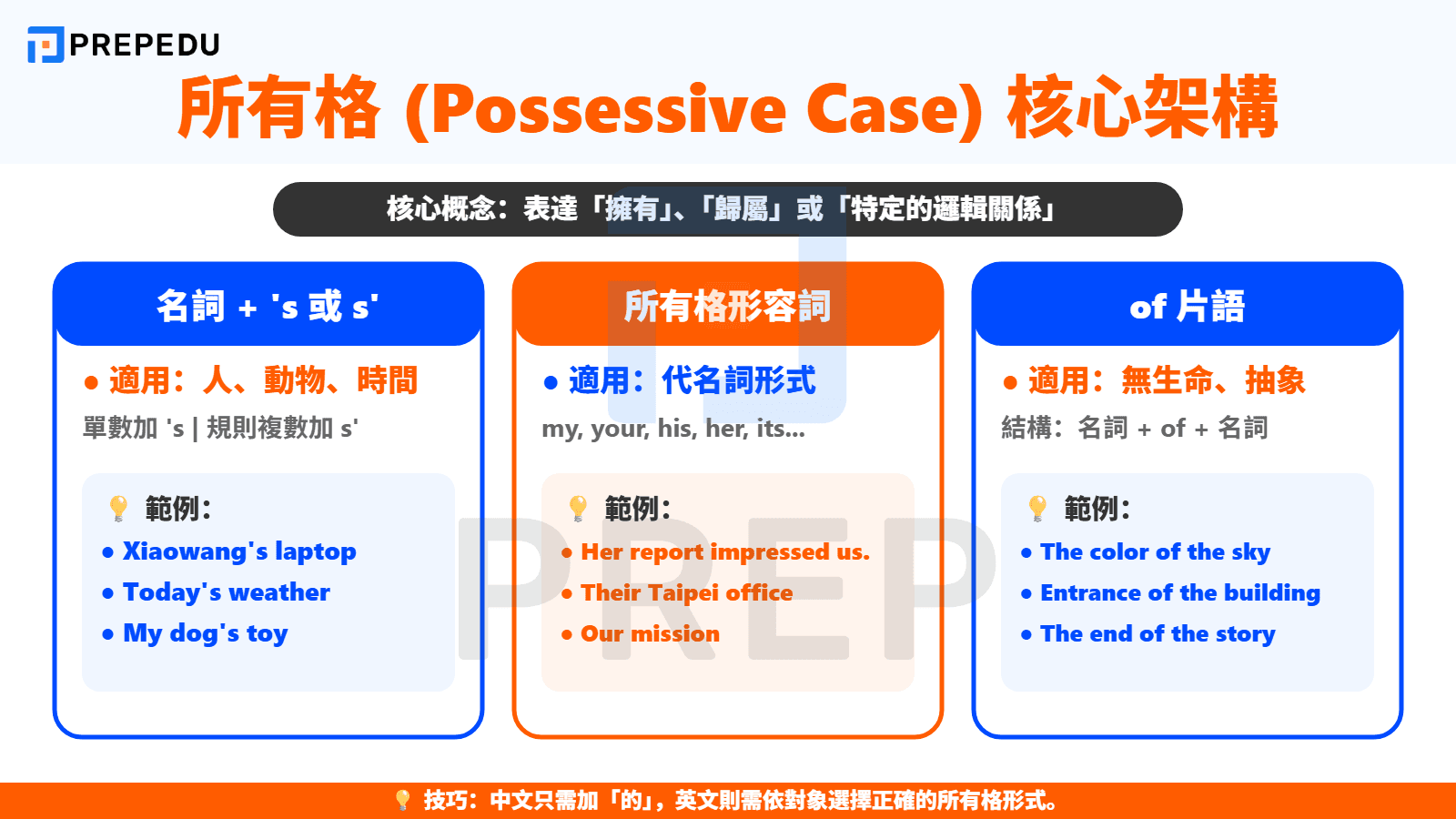
Possessive 是什麼意思?所有格(Possessive Case)是英文文法的基礎架構之一,用來表達「擁有」、「歸屬」或「特定的邏輯關係」。所有格英文(Possessive)的意思不僅限於財產占有,還涵蓋人際關係、時間範疇、機構隸屬、身體部位,乃至邏輯上的主謂與動賓關係。換句話說,只要你需要說明某件事物「屬於誰」或「與誰有關」,所有格就是你最直接的工具。
理解所有格是什麼,需要先掌握一個基本原則:中文只需加「的」來表達所有關係,而英文所有格則透過三種不同的形式來呈現,每一種對應不同的語境與詞性。
|
所有格形式 |
適用對象 |
結構 |
例句 |
|
名詞 + 's 或 s' |
有生命的人、動物;時間詞;國家 |
名詞 + 's(單數)/名詞 + s'(規則複數) |
Xiaowang's laptop(小王的筆電) |
|
所有格形容詞 |
人稱代名詞的所有格形式 |
my / your / his / her / its / our / their + 名詞 |
Her report impressed the entire Taipei office.(她的報告讓整個台北辦公室都印象深刻。) |
|
of 片語 |
無生命物體;抽象概念;長名詞片語 |
名詞 + of + 名詞 |
the main entrance of the building(大樓的正門) |
舉例說明三種形式的實際運用:
-
Xiaowang's dog won first prize at the Hong Kong pet show.(小王的狗在香港寵物展中獲得第一名。)—— 有生命的人,使用 's
-
Their office in Taipei is the largest in the region.(他們位於台北的辦公室是該地區最大的。)—— 人稱代名詞,使用所有格形容詞 their
-
The color of the sky changes every evening near Victoria Harbour.(每天傍晚維多利亞港附近的天空顏色都在變化。)—— 無生命物體,使用 of 片語
-
Today's weather forecast shows rain across northern Taiwan.(今天的天氣預報顯示台灣北部有雨。)—— 時間詞,使用 's
II. 英文所有格有哪些?代名詞分類總表(Pronouns)
英文所有格有哪些?首先從代名詞的所有格說起。所有格英文(possessives)在代名詞系統中分為兩大類:所有格形容詞(Possessive Adjectives)與所有格代名詞(Possessive Pronouns)。兩者外形相近,但功能截然不同。所有格形容詞後面一定要接名詞,而所有格代名詞則獨立使用,替代整個名詞片語,後面不接任何名詞。
所有格後面接什麼?所有格形容詞後面必須接名詞(如 my bag、their office),所有格代名詞則不接名詞,獨立出現於句中(如 The bag is mine.)。這是兩類所有格最關鍵的結構差異。
|
人稱 |
主格 |
所有格形容詞(接名詞) |
所有格代名詞(獨立使用) |
|
第一人稱單數 |
I |
My(我的) |
Mine(我的東西) |
|
第二人稱 |
You |
Your(你的) |
Yours(你的東西) |
|
第三人稱單數(男) |
He |
His(他的) |
His(他的東西) |
|
第三人稱單數(女) |
She |
Her(她的) |
Hers(她的東西) |
|
第三人稱單數(物) |
It |
Its(它的) |
——(通常不單獨使用) |
|
第一人稱複數 |
We |
Our(我們的) |
Ours(我們的東西) |
|
第三人稱複數 |
They |
Their(他們的) |
Theirs(他們的東西) |
特別注意:it 的所有格形容詞是 its,直接加 s,不加撇號。its 是所有格,it's 是「it is」的縮寫,兩者絕不可混用。
例句對照:
-
This is my notebook.(這是我的筆記本。)—— my 是所有格形容詞,後接 notebook
-
The notebook is mine.(這本筆記本是我的。)—— mine 是所有格代名詞,獨立出現
-
Their Taipei branch closed last year, but ours is still operating.(他們的台北分公司去年關閉了,但我們的仍在運營。)—— their 接名詞,ours 獨立替代 our branch
III. 名詞所有格用法全解析:'s 與 s' 的關鍵區別
名詞所有格(Noun Possessive)是英文學習者最常出錯的語法領域。's 所有格(apostrophe-s)涉及單複數、有生命與無生命、複合名詞結構、特殊人名等多種情境。本章節逐一解構「's 和 s' 和 s 有什麼區別」這個核心問題,帶你建立清晰的判斷框架。
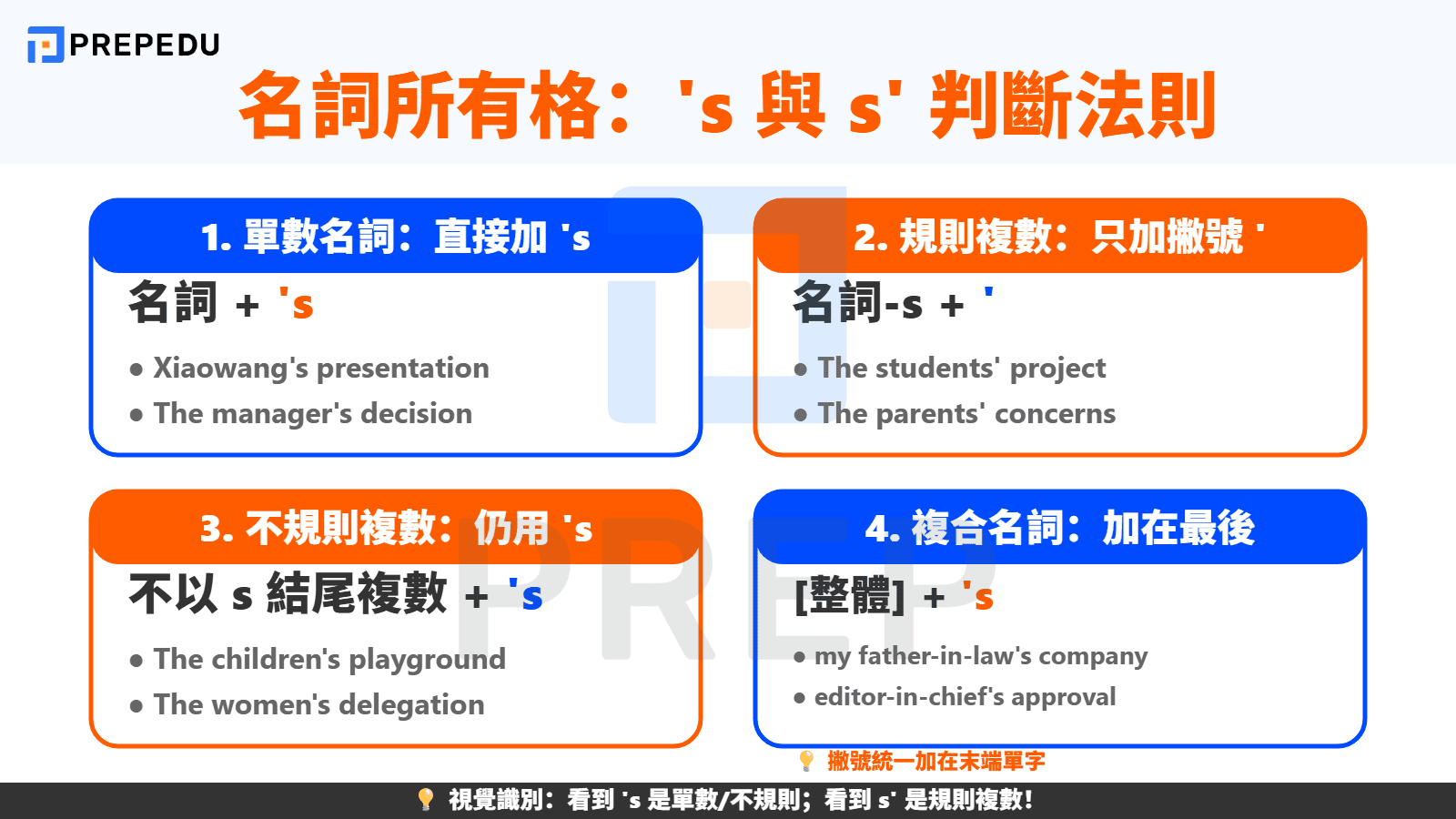
1. 單數名詞的所有格規則:直接加 's
結構:
單數名詞 + 's + 被擁有的事物
用法: 無論是人名、動物名、職稱,還是單數的普通名詞,只要是單數形式,一律在詞尾直接加 's 構成所有格。這是名詞所有格最基本的規則,適用範圍最廣。
公式: 單數名詞 + 's
-
Xiaowang's presentation at the Taipei conference received a standing ovation.(小王在台北研討會上的簡報獲得全場起立鼓掌。)
-
The manager's decision to relocate the Hong Kong office surprised the entire team.(經理將香港辦公室遷址的決定讓整個團隊大感意外。)
-
The dog's collar was engraved with its name in both English and Chinese.(那隻狗的項圈上用英文和中文刻著牠的名字。)
2. 規則複數名詞(s 結尾):只加撇號(s')
結構:
規則複數名詞(以 s 結尾)+ ' + 被擁有的事物
用法: 當名詞已透過加 s 變成規則複數,所有格只需在 s 後補上撇號,不再重複添加 s。這是 s' 的核心邏輯:避免三個 s 疊加,保持發音的自然流暢。
公式: 規則複數名詞(-s 結尾)+ '
-
The students' research project on Hong Kong's urban development won a national award.(學生們研究香港城市發展的專題計畫獲得了全國大獎。)
-
All the teachers' lesson plans for the new semester were submitted ahead of schedule.(所有老師新學期的教案都提前交了。)
-
The parents' concerns about the school's new assessment policy were addressed at the meeting.(家長們對學校新評估政策的擔憂在會議上得到了回應。)
視覺識別提示:看到 's,該名詞是單數或不規則複數;看到 s',該名詞是規則複數(已有 s 結尾)。
3. 不規則複數名詞:仍使用 's
結構:
不規則複數名詞(不以 s 結尾)+ 's + 被擁有的事物
用法: 英文中有一類不規則複數名詞,其複數形式不以 s 結尾,例如 children、people、women、men、teeth、feet、mice、geese。由於這些詞的複數形式本身沒有 s,所有格的構成方式與單數名詞相同,直接加 's。
公式: 不規則複數名詞 + 's(因詞尾無 s,規則回歸基本)
-
The children's playground near Taipei 101 was renovated last summer.(台北 101 附近的兒童遊樂場去年夏天翻新了。)
-
The women's delegation from Hong Kong presented findings at the regional summit.(來自香港的女性代表團在地區峰會上提交了研究成果。)
-
The men's locker room in the new sports complex is equipped with smart lockers.(新運動中心的男更衣室配備了智慧置物櫃。
4. 複合名詞的所有格:加在最後一個單字
結構:
整個複合名詞 + 's(撇號統一加在最末單字)
用法: 複合名詞(compound nouns)由多個詞構成一個概念單位,其所有格撇號一律加在整個複合詞的最後一個單字上,而非第一個詞。這反映了語意的整體性原則:是「整個複合概念」在擁有,而非其中的某個部分。
公式: [複合名詞整體]+ 's,撇號加在尾端最後一個詞
-
My father-in-law's company headquarters is located in the heart of Taipei's business district.(我岳父公司的總部位於台北商業區的核心地帶。)
-
The editor-in-chief's final approval is required before any article goes live on the platform.(任何文章在平台上線前,都需要主編的最終批准。)
-
The Secretary-General's speech at the Hong Kong forum drew widespread media attention.(秘書長在香港論壇上的演講引起了媒體的廣泛關注。)
長名詞片語的所有格在口語中聽起來自然,在正式寫作中亦可改用 of 片語(如 the headquarters of my father-in-law's company),兩種表達方式語意等效,視語境選擇。
5. 共同所有格與個別所有格的邏輯差異
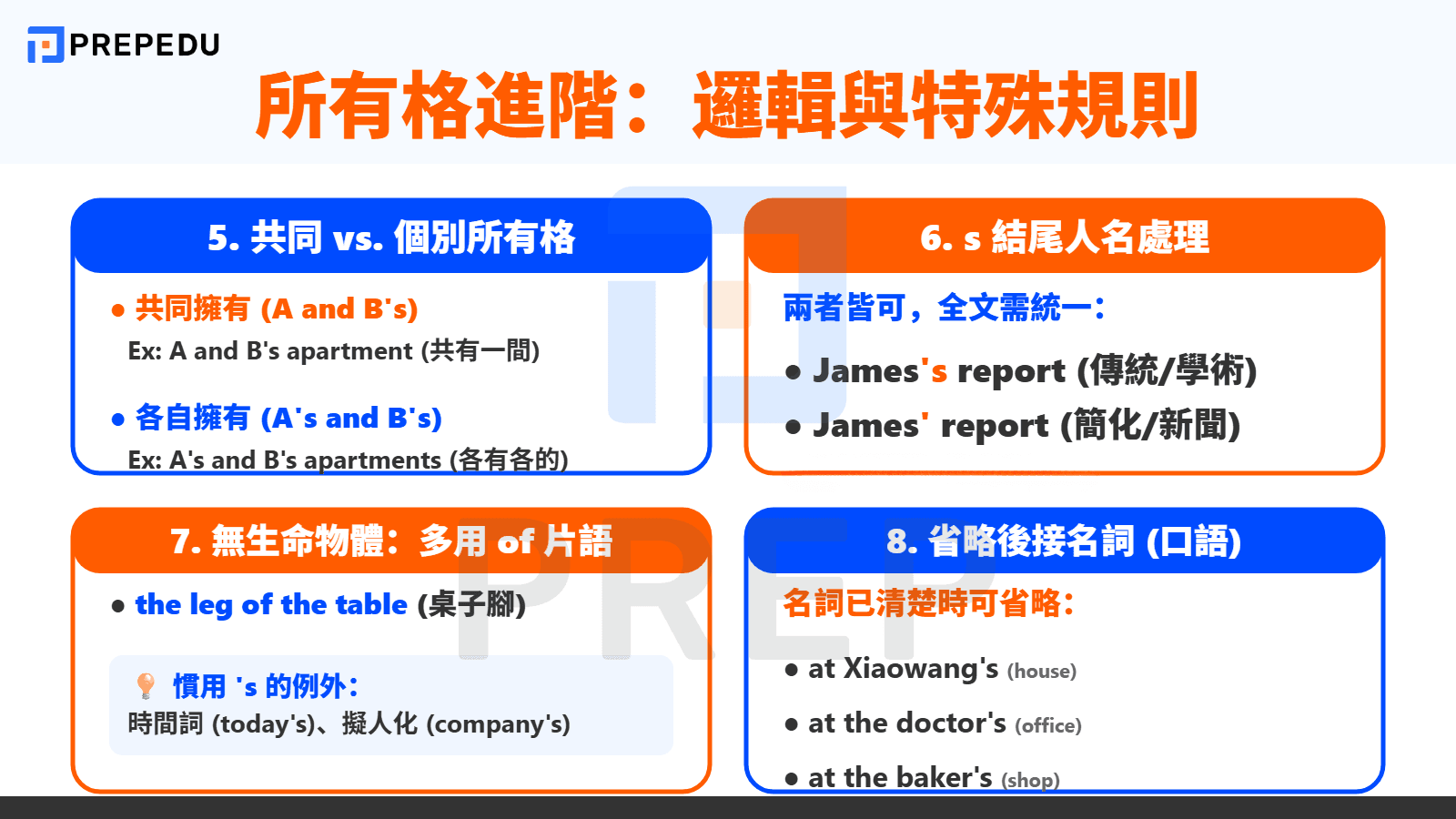
用法: 當兩個或多個名詞同時出現,若他們「共同擁有同一件事物」,所有格只標記在最後一個名詞上;若他們「各自分別擁有不同的事物」,則每個名詞都需各自標記所有格。這是個別所有格(individual possession)與共同所有格(joint possession)最關鍵的語意差異。
|
類型 |
結構 |
語意 |
英文例句 |
|
共同所有格 |
A and B's + 單數名詞 |
A 與 B 共同擁有同一個 |
Xiaowang and Xiaochen's apartment in Taipei is on the 15th floor.(小王和小陳共同擁有的台北公寓在 15 樓。) |
|
個別所有格 |
A's and B's + 複數名詞 |
A 與 B 各自擁有不同的 |
Xiaowang's and Xiaochen's apartments are in different districts of Taipei.(小王的公寓和小陳的公寓位於台北不同的區。) |
辨別要訣:共同所有格只在最後一個名詞加 's,後接單數名詞;個別所有格每個名詞均加 's,後接複數名詞。語境決定語意,寫作時必須謹慎選擇。
6. 人名所有格:以 s 結尾的特殊人名處理
用法: 以 s 結尾的人名(如 James、Charles、Dickens、Keats、Thomas)在構成人名所有格時,英文目前有兩種被廣泛接受的寫法,差異在於風格偏好,而非語法對錯。
|
寫法 |
規則 |
例句 |
適用場合 |
|
傳統寫法 |
人名(-s 結尾)+ 's |
James's report on the Taipei market was thorough.(詹姆斯關於台北市場的報告非常詳盡。) |
學術寫作、Chicago Manual of Style |
|
簡化寫法 |
人名(-s 結尾)+ ' |
James' report on the Taipei market was thorough. |
新聞寫作、AP Style |
重要原則:無論選擇哪種寫法,語意完全相同,差異僅在形式與風格。同一篇文章中應保持一致,不可兩種寫法混用。學術考試與語言測驗中,兩種寫法通常均被接受。
-
Charles' novel was assigned as required reading for the Hong Kong literature course.(查爾斯的小說被指定為香港文學課程的必讀書目。)
-
Thomas's research methodology influenced an entire generation of Taipei-based linguists.(湯瑪斯的研究方法影響了整整一代台北的語言學家。)
7. 無生命物體的所有格:使用 of 片語
用法: 無生命物體(inanimate objects)通常不使用 's 所有格,而改用「名詞 + of + 無生命名詞」結構。傳統語法認為,'s 用於有生命的事物(人與動物),而 of 片語則更適合描述事物之間的功能性從屬關係。
公式:
被擁有的事物 + of + 無生命名詞
|
建議寫法(of 片語) |
說明 |
|
the leg of the table(桌子的腳) |
無生命物體,of 為標準用法 |
|
the top of the mountain(山頂) |
地理名詞偶爾可用 's,但 of 更常見 |
|
the theme of the novel(小說的主題) |
文學作品有時可用 's,視風格而定 |
|
the entrance of the building(大樓的入口) |
建築物有時可接受 's,但 of 更正式 |
|
the surface of the moon(月球表面) |
天文地理有時可用 's(擬人化傾向) |
以下情境中,'s 用於無生命物體屬於慣用寫法,不受此規則限制:
-
時間詞:today's schedule(今天的行程)、this week's report(本週的報告)、last year's data(去年的數據)
-
距離詞:a stone's throw from Taipei Main Station(距台北車站一步之遙)
-
固定表達:at death's door(瀕臨死亡)、Fortune's wheel(命運之輪)
-
擬人化表達:the car's engine(車子的引擎)、the company's vision(公司的願景)
注意:'s 後接的名詞不加定冠詞 the。例如應寫 the engineer's car,而非 the engineer's the car。
8. 省略所有格後的名詞
用法: 當所有格後面的名詞在語境中已十分清楚(如房子、店鋪、辦公室等),可以省略該名詞,直接以所有格結尾。這在日常口語中十分常見,能讓表達更簡潔自然。
公式:
名詞 + 's(省略後接的名詞,語境已清楚點明)
-
Let's meet at Xiaowang's after the Taipei seminar.(台北研討會結束後,我們去小王家集合吧。)—— 省略 Xiaowang's place
-
She went to the doctor's to get her annual check-up.(她去診所進行年度體檢。)—— 省略 the doctor's office
-
The best tea in this district can be found at the baker's near Hong Kong Station.(這一區最好的茶可以在香港站附近的麵包店找到。)—— 省略 the baker's shop
此用法多見於口語及非正式書寫,在正式學術寫作中應補齊完整名詞。
IV. 進階用法:雙重所有格與關係代名詞 Whose
英文所有格的進階應用中,雙重所有格(Double Genitive)是許多學習者忽略的語法現象。這個結構同時使用 of 與 's(或所有格代名詞),形成「限定詞 + 名詞 + of + 所有格代名詞/名詞所有格」的組合。語意上,雙重所有格帶有「從某人的群體中取出其中一個」的分離概念,必須搭配不定冠詞(a 或 an)或指示代名詞(this、that、these、those),而非定冠詞 the。
為什麼需要雙重所有格?因為在英文中,所有格與限定詞不能同時出現在同一名詞前。例如不能說 your some friends,也不能說 your those ideas。雙重所有格正是為了解決這個結構限制而存在的自然表達方式。
|
結構 |
中文意義 |
例句 |
說明 |
|
限定詞 + 名詞 + of + mine/yours/his/hers/ours/theirs |
我的一位/一些…… |
A colleague of mine in the Taipei office is transferring to Hong Kong.(我在台北辦公室的一位同事將調往香港。) |
不可寫成 my a colleague |
|
限定詞 + 名詞 + of + 名詞's |
某人的一位/一本…… |
That proposal of Xiaowang's deserves more attention from the board.(小王的那份提案值得董事會給予更多關注。) |
不可寫成 Xiaowang's that proposal |
|
this/that + 名詞 + of + 所有格代名詞 |
那個讓人……的(帶感情色彩) |
This idea of hers could reshape the company's entire strategy.(她的這個想法可能會重塑公司的整體策略。) |
帶有感情評價,this/that 強調 |
關係代名詞 whose 是所有格疑問詞與關係詞的雙重身份,用法如下:
|
用法 |
結構 |
例句 |
|
疑問詞(詢問歸屬) |
Whose + 名詞 + 動詞? |
Whose laptop was left in the Hong Kong conference room?(是誰的筆電放在香港會議室裡?) |
|
關係代名詞(連接子句) |
名詞 + whose + 子句 |
The researcher whose findings challenged the existing theory works in Taipei.(那位研究成果顛覆現有理論的研究員在台北工作。) |
|
替代 of which(無生命,正式寫作) |
名詞 + whose + 名詞 |
The company, whose headquarters is in Hong Kong, expanded to twelve cities.(總部位於香港的那家公司已擴展至十二個城市。) |
V. 所有格常見錯誤與句子比較:Its vs It's
所有格的學習過程中,符號混用是最常見的失誤類型。以下整理六組最容易搞混的易混淆項目,每一組均附有正誤比較,協助你在寫作與考試中快速排錯。
|
易混淆項目 |
正確用法說明 |
正確示例 |
錯誤示例 |
|
Its vs It's |
Its = it 的所有格形容詞(後接名詞);It's = It is 的縮寫 |
|
The company changed it's name. ✗ Its going to be a long meeting. ✗ |
|
Your vs You're |
Your = you 的所有格(後接名詞);You're = You are 的縮寫 |
|
You're report needs revision. ✗ Your going to love Taipei. ✗ |
|
Their / There / They're |
Their = 他們的(所有格);There = 那裡(地點);They're = They are 的縮寫 |
|
Their are five rooms available. ✗ There new product is innovative. ✗ |
|
Whose vs Who's |
Whose = 誰的(所有格疑問詞);Who's = Who is 的縮寫 |
|
Who's report is on the director's desk? ✗ Whose going to chair the next meeting? ✗ |
|
所有格代名詞無撇號 |
Mine / Yours / His / Hers / Ours / Theirs 本身已是所有格,從不加撇號 |
|
The decision is her's alone. ✗ This seat is your's. ✗ |
|
's 後不加 the |
's 後接的名詞不加定冠詞 the |
Xiaowang's report(小王的報告)✓ |
Xiaowang's the report. ✗ |
核心原則:所有格代名詞(Mine、Yours、His、Hers、Its、Ours、Theirs)本身已是所有格形式,從不加撇號。代名詞中出現的撇號必定是縮寫符號,而非所有格標記。記住這條原則,可以立刻排除 your's、her's、their's 等一系列常見拼寫錯誤。
VI. 所有格實戰演練:3 大題型鞏固記憶(附解答)
掌握所有格規則是第一步,實際應用才是真正的考驗。以下三組練習題涵蓋所有格的核心考點,從代名詞選擇、名詞改寫,到進階辨析,幫助你系統性檢驗學習成果。
1. 練習一:所有格形容詞與代名詞填空
說明:根據句意,從括號中選出正確的所有格形式(形容詞或代名詞)填入空格。
|
題號 |
題目 |
選項 |
|
1 |
Is this _____ bag? I left mine at the Taipei station. |
(your / yours) |
|
2 |
The red car parked outside the Hong Kong office is _____. |
(their / theirs) |
|
3 |
Xiaolin always carries _____ notebook to every client meeting. |
(her / hers) |
|
4 |
We finished _____ project on time, but their team hasn't submitted _____. |
(our / ours;their / theirs) |
|
5 |
The company updated _____ remote work policy last quarter. |
(its / it's) |
|
6 |
Is that laptop in the meeting room _____, or does it belong to the office? |
(your / yours) |
|
7 |
He introduced me to _____ supervisor at the Hong Kong headquarters. |
(his / him) |
|
8 |
The delegates packed _____ presentation materials the evening before the summit. |
(their / theirs) |
|
9 |
My apartment is near Taipei Main Station, but _____ is closer to the MRT exit. |
(her / hers) |
|
10 |
The startup changed _____ name after relocating from Hong Kong to Singapore. |
(its / it's) |
2. 練習二:名詞所有格改寫('s, s', of)
說明:根據提示,將以下表達改寫為正確的名詞所有格形式,注意單複數與有生命或無生命的判斷。
|
題號 |
原始表達 |
所有格改寫 |
|
1 |
the report that belongs to Xiaowang |
|
|
2 |
the conference room shared by all the employees |
|
|
3 |
the research projects of both Professor Lin and Professor Chen(各自的) |
|
|
4 |
the voices of the women(不規則複數) |
|
|
5 |
the entrance of the Hong Kong Convention Centre(無生命) |
|
|
6 |
the drawings made by the children |
|
|
7 |
the villa owned by my father-in-law |
|
|
8 |
the skyline of Taipei at night(無生命) |
|
|
9 |
the strategy shared by both teams(共同擁有) |
|
|
10 |
the office belonging to the director(單數) |
3. 練習三:綜合情境與易混淆辨析
說明:每題四個選項,選出填入空格後語意與語法均正確的答案。
|
題號 |
題目 |
選項 |
|
1 |
_____ an honour to present our findings at the Taipei symposium. |
(A)Its (B)It's (C)Its' (D)It is' |
|
2 |
Xiaowang and Xiaochen's laboratory in Hong Kong was featured in a science journal. 這句話意味著___。 |
(A)Xiaowang 有一間,Xiaochen 有另一間 (B)兩人共用同一間實驗室 (C)只有 Xiaowang 的實驗室 (D)只有 Xiaochen 的實驗室 |
|
3 |
_____ briefcase was left in the Hong Kong Airport lounge? |
(A)Who's (B)Whom (C)Whose (D)Who |
|
4 |
I ran into a former colleague of _____ at the Taipei career fair. |
(A)her's (B)hers (C)she (D)her |
|
5 |
The _____ association in Hong Kong organises an annual international forum.(指女性的) |
(A)woman's (B)womens' (C)women's (D)womens's |
|
6 |
My _____ advice to move the business to Taipei proved remarkably accurate. |
(A)father-in-laws (B)father-in-law's (C)father's-in-law (D)fathers-in-law's |
|
7 |
This final decision is _____, not mine—you must take responsibility. |
(A)your's (B)yours (C)you're (D)your |
|
8 |
_____ short stories are still assigned in university literature courses across Asia.(指 Charles Dickens) |
(A)Charles Dickens' (B)Charles Dickens's (C)以上兩者皆可 (D)Charles Dickenss' |
|
9 |
The _____ reading corner at the Taipei public library was expanded this year.(指孩子們的) |
(A)childs' (B)childrens' (C)children's (D)child's |
|
10 |
Whose phone keeps ringing during the meeting? — It must be _____ since she forgot to silence it. |
(A)Xiaohua's (B)Xiaohua (C)Xiaohuas' (D)Xiaohua's' |
4. 練習題解答與詳細解析
練習一解答
|
題號 |
答案 |
解析 |
|
1 |
yours |
空格獨立出現,後無名詞,使用所有格代名詞 yours |
|
2 |
theirs |
空格在 be 動詞後獨立出現,使用所有格代名詞 theirs |
|
3 |
her |
後接名詞 notebook,使用所有格形容詞 her |
|
4 |
our;theirs |
our 後接 project(形容詞用法);theirs 獨立替代 their project(代名詞用法) |
|
5 |
its |
後接名詞 policy,使用所有格形容詞 its;it's 是 it is 縮寫,語法不符 |
|
6 |
yours |
空格在 be 動詞後獨立出現,使用所有格代名詞 yours |
|
7 |
his |
後接名詞 supervisor,使用所有格形容詞 his |
|
8 |
their |
後接名詞 presentation materials,使用所有格形容詞 their |
|
9 |
hers |
空格獨立替代 her apartment,使用所有格代名詞 hers |
|
10 |
its |
後接名詞 name,使用所有格形容詞 its;it's = it is,語意不符 |
練習二解答
|
題號 |
答案 |
解析 |
|
1 |
Xiaowang's report |
單數人名,直接加 's |
|
2 |
The employees' conference room |
規則複數 employees(有 s),所有格只加撇號 |
|
3 |
Professor Lin's and Professor Chen's research projects |
個別所有格:各自分開的專題,每個名詞均加 's |
|
4 |
The women's voices |
不規則複數 women,結尾無 s,加 's |
|
5 |
The entrance of the Hong Kong Convention Centre |
無生命名詞建議用 of 片語 |
|
6 |
The children's drawings |
不規則複數 children,結尾無 s,加 's |
|
7 |
My father-in-law's villa |
複合名詞所有格加在最後一個詞 law 之後 |
|
8 |
The skyline of Taipei at night |
無生命名詞 Taipei 使用 of 片語,結構清晰 |
|
9 |
Both teams' strategy(或 the teams' strategy) |
共同所有格:規則複數 teams(有 s),只加撇號 |
|
10 |
The director's office |
單數名詞 director,直接加 's |
練習三解答
|
題號 |
答案 |
解析 |
|
1 |
(B)It's |
It's = It is,語意為「在台北研討會上發表成果是一份榮耀」;its 是所有格,語意不符 |
|
2 |
(B)兩人共用同一間實驗室 |
「A and B's」只有最後名詞加 's,為共同所有格,表示同一間 |
|
3 |
(C)Whose |
詢問「誰的公事包」,使用所有格疑問詞 whose;who's = who is,不符語意 |
|
4 |
(B)hers |
雙重所有格結構「a colleague of + 所有格代名詞」,hers 正確;her's 並無此寫法 |
|
5 |
(C)women's |
不規則複數 women 加 's;womens 不是正確的複數形式 |
|
6 |
(B)father-in-law's |
複合名詞所有格:撇號加在整個複合詞末端 law 之後 |
|
7 |
(B)yours |
空格在 be 動詞後獨立出現,用所有格代名詞 yours;your's 並無此寫法 |
|
8 |
(C)以上兩者皆可 |
Charles Dickens 以 s 結尾,'s 與 ' 兩種寫法均被主流風格指南接受 |
|
9 |
(C)children's |
children 是 child 的不規則複數,結尾無 s,加 's;childrens' 寫法錯誤 |
|
10 |
(A)Xiaohua's |
單數人名 Xiaohua,直接加 's;Xiaohua's' 寫法錯誤 |
VII. 所有格規則總整理表
以下總整理表完整涵蓋英文所有格的核心規則,可作為快速查閱的參考工具。
|
情境 |
規則 |
正確示例 |
中文 |
|
單數名詞 |
名詞 + 's |
Xiaowang's proposal |
小王的提案 |
|
規則複數(-s 結尾) |
名詞 + ' |
the analysts' report |
分析師們的報告 |
|
不規則複數(非 -s 結尾) |
名詞 + 's |
the children's playground |
孩子們的遊樂場 |
|
複合名詞 |
整個複合名詞最末詞 + 's |
my mother-in-law's recipe |
我婆婆的食譜 |
|
共同所有格 |
最後名詞 + 's(單數被擁有物) |
Tom and Amy's project |
湯姆和艾咪共同的專案 |
|
個別所有格 |
每個名詞 + 's(複數被擁有物) |
Tom's and Amy's projects |
湯姆的和艾咪各自的專案 |
|
-s 結尾人名 |
名詞 + 's 或 '(兩種皆可) |
James's / James' notes |
詹姆斯的筆記 |
|
無生命物體 |
of + 名詞(標準) |
the top of the building |
大樓頂部 |
|
時間詞例外 |
時間詞 + 's(慣用) |
today's agenda |
今天的議程 |
|
省略後接名詞 |
名詞 + 's(語境清楚時省略名詞) |
at the dentist's |
在牙醫診所 |
|
雙重所有格 |
限定詞 + 名詞 + of + 's/代名詞 |
a friend of mine |
我的一位朋友 |
|
所有格代名詞 |
Mine/Yours/His/Hers/Ours/Theirs(無撇號) |
The book is hers. |
這本書是她的。 |
VIII. 所有格常見問題 FAQ
1. 英文所有格一定都要加撇號嗎?
不一定。所有格代名詞(His、Its、Theirs、Yours、Ours、Hers、Mine)本身就是所有格形式,不需要任何撇號。撇號是名詞所有格(如 Tom's、students')的構成要素,而非所有格的通用標記。代名詞的所有格意義已內建於詞形中,多加撇號反而構成拼寫錯誤。這個原則能幫助你立刻排除 your's、her's、their's 等常見錯誤寫法。
2. 什麼時候一定要用 of 而不能用 's?
以下四種情境應優先選擇 of 片語而非 's:
-
第一,一般無生命物體的歸屬關係(the entrance of the building),除時間詞與固定表達外
-
第二,名詞片語過長或結構複雜(the conclusions of the joint research committee on urban planning),直接加 's 會讓句子頭重腳輕
-
第三,後接無生命的抽象概念(the definition of success,而非 success's definition)
-
第四,需要強調「整體中的一部分」(the back of the menu、the last chapter of the report)。熟記這四個情境,你就能在 's 與 of 之間做出精準、道地的選擇。
3. 所有格後面可以再接另一個所有格嗎?
可以。英文允許連串的所有格結構,例如「my mother's friend's daughter(我媽媽的朋友的女兒)」。然而在正式寫作中,連串超過兩層的所有格會使句子難以閱讀,建議改用 of 片語或重組句子結構。
-
可接受:Xiaowang's supervisor's feedback(小王的上司的回饋)—— 兩層,清晰
-
建議改寫:my colleague's manager's director's email,可改為 the email from my colleague's department director(三層以上,宜簡化)
結論
所有格(Possessive Case),在法文所有格對比視角下,是英文表達「歸屬關係」的核心語法,告訴讀者某件事物屬於誰、與誰相關,或在邏輯上由誰主導。英文所有格的三大形式——名詞 's/s'、所有格代名詞與形容詞、of 片語——各有適用場合。名詞所有格標記有生命的擁有者,of 片語處理無生命物體,代名詞則以格位變化內建歸屬意義。掌握這套系統,你在英文寫作與考試中的精確度將大幅提升。
對 IELTS 或 TOEIC 考試結構感到陌生?考試當天的不確定感會影響你的表現。PREPEDU 的 Test Practice 提供真實模擬環境,讓你在實戰前熟悉題型和時間限制。
系統收錄超過 1,000 道練習題,定期更新以反映最新考試趨勢。AI 引擎分析你的錯誤,針對弱點提供改進方案。進度追蹤系統將你的成長數據化,讓進步一目了然。
你好!我叫黃秋賢,現在在 prepedu.com 擔任內容企劃。我有超過5年的英語與韓語自學經歷,親身備考 IELTS、TOEIC 與 TOPIK,累積了大量第一手的學習者視角——包括哪些語法規則最讓台灣與香港學習者混淆,以及如何在有限的備考時間內最有效地修正這些錯誤。目前已在 prepedu.com 撰寫超過 1000 篇英語學習文章,內容涵蓋語法、詞彙與考試策略,累積協助數千位學習者解決自學過程中的語法疑問。
評論












統一企業編號:202227322W
地址:114 LAVENDER STREET, #11-83 CT HUB 2, SINGAPORE (338729)