英文同音字一次搞懂:定義、大全表、陷阱與練習
同音字英文(homophone)指的是發音相同、但拼字與意思都不同的英文單字,例如 sea(海)與 see(看)、flour(麵粉)與 flower(花)。對中文母語者來說,這類單字最麻煩的地方在於:寫作時很容易選錯字,聽力測驗時又常被拿來設陷阱,明明每個字都認得,卻還是搞混。本文整理超過 100 組英文同音字大全表,解釋 homophone、homograph、homonym 三大術語,破解寫作陷阱與聽力類音字技巧,並提供記憶方法與練習題檢驗。

I. 同音字英文是什麼?先搞懂 Homophone 的定義
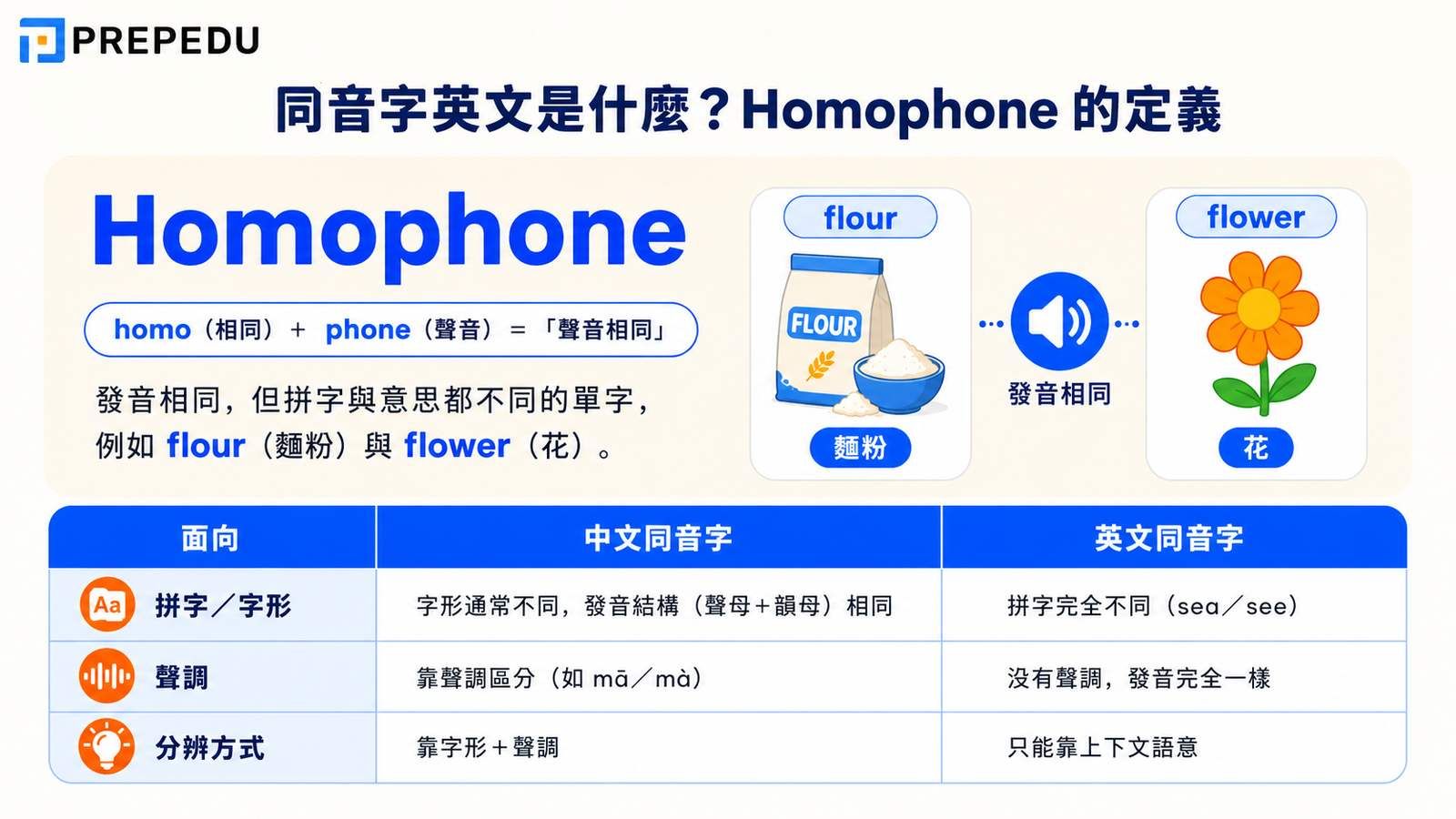
同音字英文稱為 homophone,指發音相同、但拼字不同、意思也不同的單字,例如 flour(麵粉)與 flower(花)。它跟中文同音字差在哪?中文同音字多半聲母韻母相同,只差在聲調或字形;英文同音字沒有聲調,拼字也完全不同,只能靠上下文判斷。這個差異,正是許多中文母語者一開始最容易誤會的地方。
1. Homophone 的核心定義與由來
Homophone 由兩個希臘字根組成:homo(相同)+ phone(聲音),字面意思就是「聲音相同」。劍橋詞典(Cambridge Dictionary)對它的定義是「a word that is pronounced the same as another word but differs in meaning or spelling」,也就是「發音與另一個字相同,但意思或拼字不同的單字」。
判斷一組字是不是同音字,只要問一個問題:念出來聲音一不一樣?以 sea 與 see 為例,兩個字都念 /si/,聲音完全一樣,但一個是「海」、一個是「看」,拼字也不同。這就是最典型的英文同音字。
2. 中文同音字與英文同音字:機制大不同
英文之所以有這麼多同音字,主要有兩個原因:一是英文長期向拉丁文、法文、古英文借字,來源龐雜;二是英文的拼字與發音本來就不完全對應(spelling ≠ sound),同一個音可以用好幾種拼法寫出來。於是「音相同、拼字卻天差地遠」的組合就大量出現。
這裡有一個中文母語者常見的思維陷阱:在中文裡,「在/再」、「工/公」這類同音字,聲母韻母其實相同,靠的是聲調或字形去分辨;但英文同音字沒有聲調,只能靠拼字和上下文語意來分。下面這張表把兩者的差別攤開來看:
|
面向 |
中文同音字 |
英文同音字 |
|
拼字/字形 |
字形通常不同,但發音結構(聲母+韻母)相同 |
拼字完全不同(sea/see) |
|
聲調 |
靠聲調區分(如 mā/mà) |
沒有聲調,發音完全一樣 |
|
分辨方式 |
靠字形+聲調 |
只能靠上下文語意 |
釐清了定義後,還有兩個常被混用的術語需要一起分清楚。
II. 同音異字、同形異義、同音同形異義:3 個英文術語一次搞懂
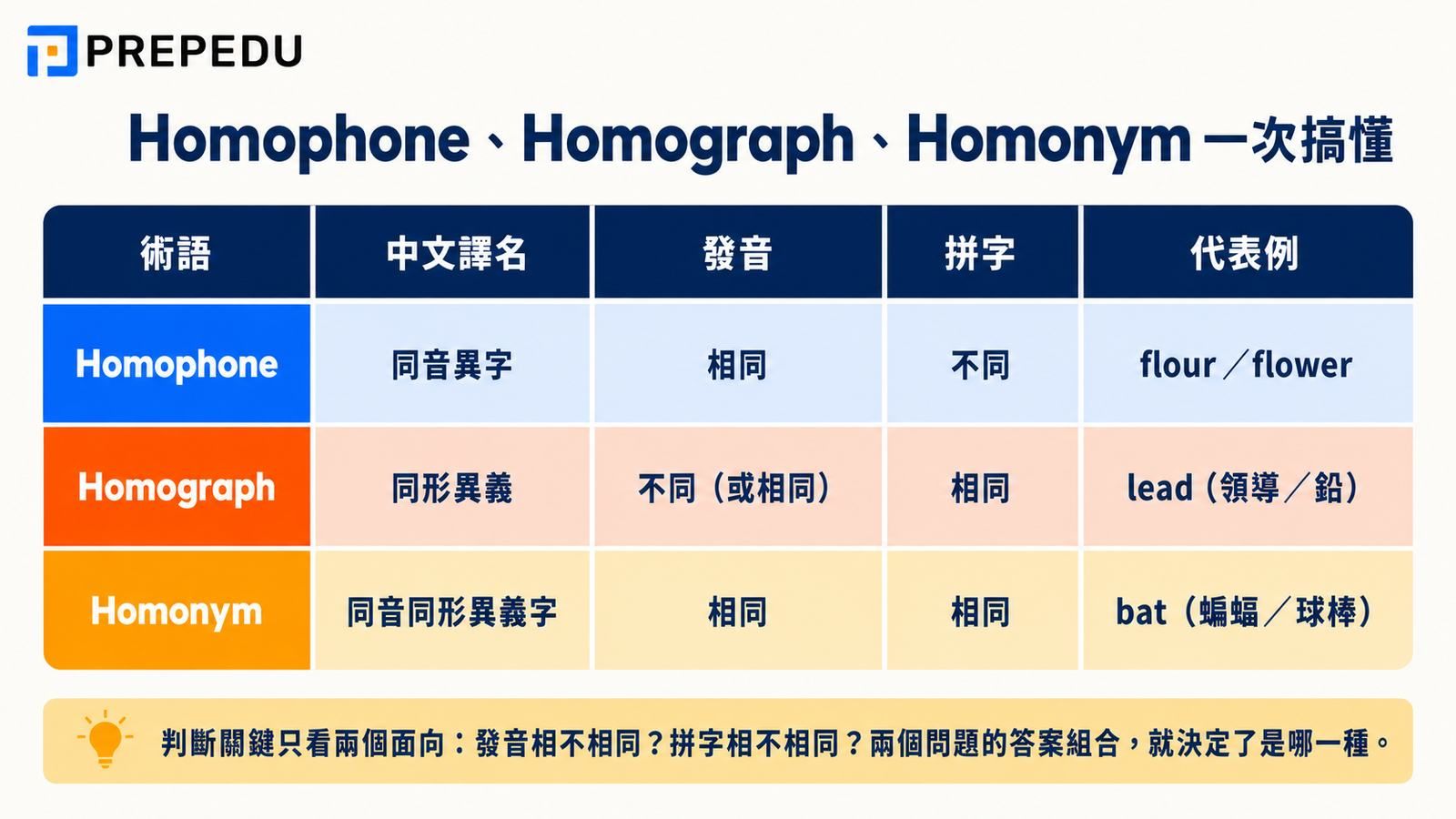
Homophone(同音異字)是音同、形異、義異;Homograph(同形異義)是形同、但音或義不同;Homonym(同音同形異義字)則是音同、形也同、只有意思不同。三者的判斷關鍵,在於「發音」與「拼字」這兩個面向是否相同。很多人分不清楚三者。其實只要把這兩個面向拆開來對照,就一目了然。
|
術語 |
中文譯名 |
發音 |
拼字 |
意思 |
代表例 |
|
Homophone |
同音異字 |
相同 |
不同 |
不同 |
flour/flower |
|
Homograph |
同形異義 |
不同(或相同) |
相同 |
不同 |
lead(領導/鉛) |
|
Homonym |
同音同形異義字 |
相同 |
相同 |
不同 |
bat(蝙蝠/球棒) |
1. Homophone(同音異字):音同、形異、義異
Homophone 的特徵是「聽起來一樣、寫出來不一樣、意思也不一樣」。這是本文的主角,也是考試與寫作最常踩雷的一類。
代表例:flour /flaʊr/(麵粉)與 flower /flaʊr/(花)、write /raɪt/(寫)與 right /raɪt/(正確的)、cell /sɛl/(細胞)與 sell /sɛl/(賣)。三組字念起來都完全相同,只能靠拼字與句意分辨。
2. Homograph(同形異義):形同、音異或義異
Homograph 剛好相反:「寫出來一樣,但念法或意思不同」。最典型的一種是拼字相同、卻有兩種讀音,各自對應不同意思。
代表例:lead 念 /liːd/ 是「領導」,念 /lɛd/ 是「鉛」;tear 念 /tɪr/ 是「眼淚」,念 /tɛr/ 是「撕」;bass 念 /beɪs/ 是「低音」,念 /bæs/ 是「鱸魚」。看到同一個拼法卻要判斷怎麼念,就是遇到 homograph 了。
3. Homonym(同音同形異義字):音同、形同、義異
Homonym 是最「省事」的一種:拼字一樣、發音也一樣,只有意思不同,全靠上下文判斷。
代表例:bat 可以是「蝙蝠」,也可以是「球棒」;bank 可以是「銀行」,也可以是「河岸」。兩個意思拼法與念法都相同,你只能從句子在講什麼來判斷。
分清術語後,接著就是最實用的部分:一張可以直接查閱的常見同音字大全表。
III. 常見英文同音字大全表
常見的英文同音字超過 100 組,例如 sea/see(海/看)、flour/flower(麵粉/花)、night/knight(夜晚/騎士)、to/too/two(到/也/二)。它們拼字完全不同。唯一可靠的分辨方法,就是句子的語意與上下文。以下依「幾個字同音」與「主題」分成三張表,方便你當成迷你字典直接查閱與背誦。每一列的讀法都放在同一欄的 KK 音標,因為同音字的發音完全一樣;例句則附上繁體中文翻譯,幫你確認每個字的實際用法。
1. 兩字同音組:必背清單
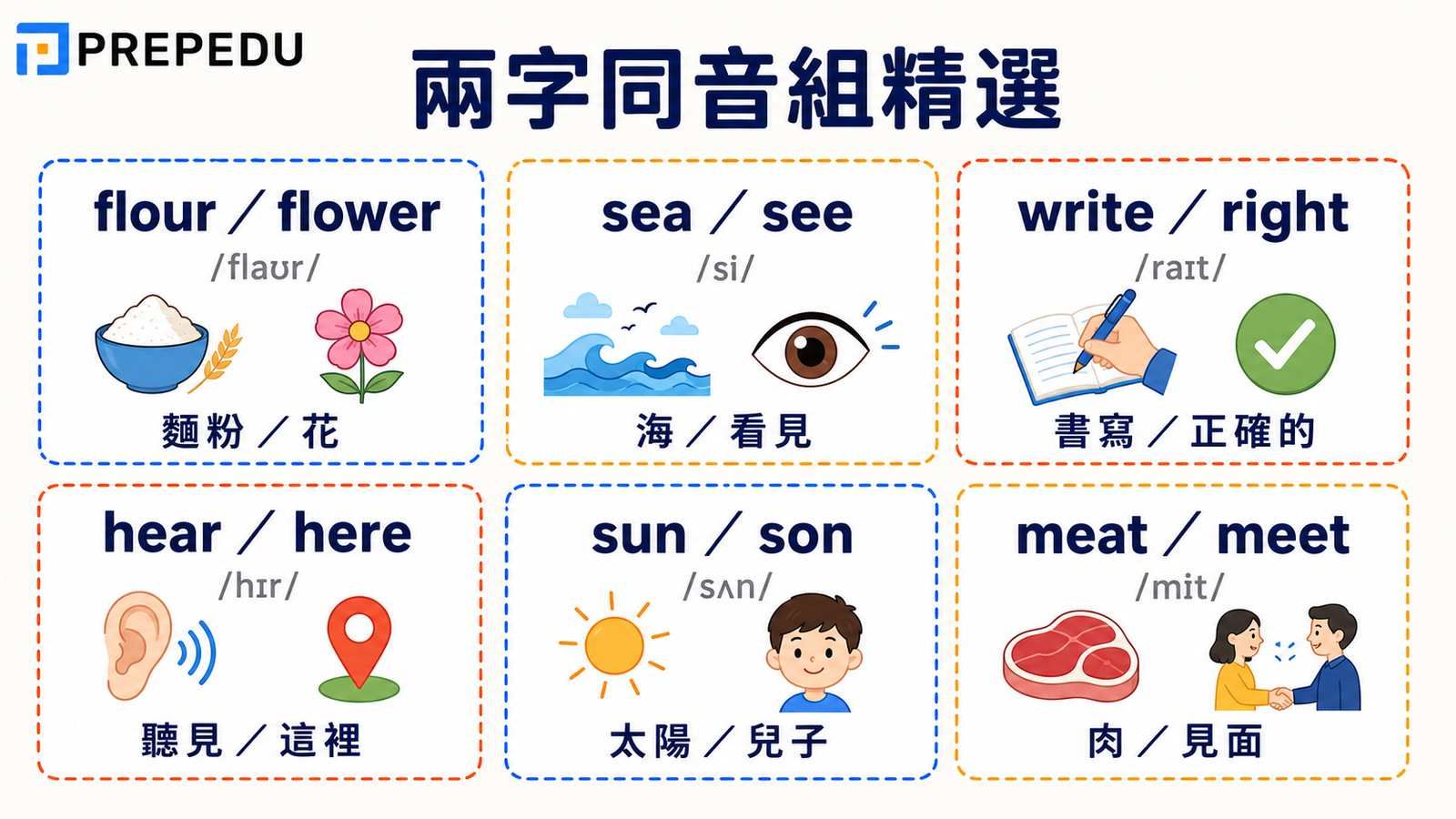
下表共近 90 組兩字同音字。第一欄與第二欄各放一個單字與它的中文意思,第三欄是兩字共用的 KK 音標,第四欄是例句與中譯。
|
同音字英文 ① |
同音字英文 ② |
KK 音標 |
例句(中譯) |
|
flour(麵粉) |
flower(花) |
/flaʊr/ |
① I need some flour to bake this cake.(我需要一些麵粉來烤這個蛋糕。) ② She gave me a beautiful flower.(她送了我一朵漂亮的花。) |
|
night(夜晚) |
knight(騎士) |
/naɪt/ |
① The knight wore shining armor.(那位騎士穿著閃亮的盔甲。) ② We watched the stars late at night.(我們深夜時分看著星星。) |
|
sea(海) |
see(看見) |
/si/ |
① We swam in the deep blue sea.(我們在深藍的大海裡游泳。) ② I can see the mountain from here.(我從這裡可以看見那座山。) |
|
buy(買) |
by(經由) |
/baɪ/ |
① I want to buy a new phone.(我想買一支新手機。) ② Please finish the report by Friday.(請在星期五之前完成這份報告。) |
|
hour(小時) |
our(我們的) |
/aʊr/ |
① The meeting lasted one hour.(這場會議持續了一個小時。) ② Our house is near the park.(我們的房子靠近公園。) |
|
peace(和平) |
piece(一塊) |
/pis/ |
① The two countries finally signed a peace treaty.(兩國終於簽署了和平條約。) ② Can I have a piece of cake?(我可以吃一塊蛋糕嗎?) |
|
sun(太陽) |
son(兒子) |
/sʌn/ |
① The sun rose early this morning.(今天早上太陽很早升起。) ② Her son loves playing basketball.(她的兒子喜歡打籃球。) |
|
meat(肉) |
meet(見面) |
/mit/ |
① He does not eat meat on Fridays.(他星期五不吃肉。) ② Let's meet at the cafe tomorrow.(我們明天在咖啡廳見面吧。) |
|
hear(聽見) |
here(這裡) |
/hɪr/ |
① I could hardly hear the music.(我幾乎聽不見那音樂。) ② Please wait here for a moment.(請在這裡稍等一下。) |
|
blue(藍色) |
blew(吹,過去式) |
/blu/ |
① She painted the wall blue.(她把牆壁漆成藍色。) ② A strong wind blew all night.(一陣強風吹了一整夜。) |
|
right(正確的) |
write(書寫) |
/raɪt/ |
① You made the right choice.(你做了正確的選擇。) ② I need to write a letter to her.(我需要寫一封信給她。) |
|
cell(細胞/電池) |
sell(販賣) |
/sɛl/ |
① Under the microscope, we saw a single cell.(在顯微鏡下,我們看到了一個細胞。) ② They sell fresh fruit at the market.(他們在市場上賣新鮮水果。) |
|
plane(飛機) |
plain(平原/樸素的) |
/plen/ |
① Our plane landed safely.(我們的飛機安全降落了。) ② The soldiers camped on an open plain.(士兵們在一片開闊的平原上紮營。) |
|
sail(航行/帆) |
sale(特賣) |
/sel/ |
① We watched the boat sail across the lake.(我們看著那艘船航行過湖面。) ② The store is having a big sale this week.(那間店這星期在大特賣。) |
|
weak(虛弱的) |
week(星期) |
/wik/ |
① He felt weak after the long illness.(他長期生病後感覺很虛弱。) ② I will be traveling next week.(我下週會出門旅行。) |
|
mail(郵件) |
male(男性) |
/mel/ |
① I sent the package by mail yesterday.(我昨天用郵寄方式寄出了包裹。) ② Only one male student joined the club.(只有一位男學生加入了社團。) |
|
tail(尾巴) |
tale(故事) |
/tel/ |
① The dog wagged its tail happily.(那隻狗開心地搖著尾巴。)② She told us an interesting tale.(她給我們講了一個有趣的故事。) |
|
wait(等待) |
weight(重量) |
/wet/ |
① Please wait for me at the entrance.(請在入口處等我。) ② He wants to lose some weight.(他想減掉一些體重。) |
|
brake(剎車) |
break(打破) |
/brek/ |
① The driver hit the brake suddenly.(司機突然踩下剎車。) ② Don't break the glass.(不要打破那個玻璃杯。) |
|
flea(跳蚤) |
flee(逃跑) |
/fli/ |
① The dog scratched at a flea.(那隻狗抓著一隻跳蚤。) ② The villagers had to flee the flood.(村民們必須逃離那場洪水。) |
|
hole(洞) |
whole(整個的) |
/hol/ |
① There is a hole in my sock.(我的襪子上有一個洞。) ② She ate the whole pizza by herself.(她一個人吃掉了整個披薩。) |
|
knew(知道,過去式) |
new(新的) |
/nju/ |
① I knew the answer immediately.(我馬上就知道答案了。) ② She bought a new dress for the party.(她為派對買了一件新洋裝。) |
|
know(知道) |
no(不) |
/no/ |
① I don't know his phone number.(我不知道他的電話號碼。) ② There is no milk left in the fridge.(冰箱裡沒有牛奶了。) |
|
made(製作,過去式) |
maid(女僕) |
/med/ |
① She made a delicious soup for dinner.(她為晚餐做了一道美味的湯。) ② The maid cleaned every room in the hotel.(那位女僕打掃了飯店的每個房間。) |
|
one(一) |
won(贏得,過去式) |
/wʌn/ |
① I only need one ticket.(我只需要一張票。) ② Our team won the championship last year.(我們隊去年贏得了冠軍。) |
|
pair(一雙) |
pear(梨子) |
/pɛr/ |
① She bought a new pair of shoes.(她買了一雙新鞋。) ② I ate a juicy pear for breakfast.(我早餐吃了一顆多汁的梨子。) |
|
road(道路) |
rode(騎,過去式) |
/rod/ |
① The road was blocked by fallen trees.(那條路被倒下的樹木擋住了。) ② He rode his bicycle to school.(他騎腳踏車去上學。) |
|
role(角色) |
roll(滾動) |
/rol/ |
① She played the leading role in the film.(她在那部電影裡飾演主角。) ② The ball began to roll down the hill.(那顆球開始滾下山坡。) |
|
scene(場景) |
seen(看見,過去分詞) |
/sin/ |
① The final scene of the movie made everyone cry.(電影的最後一幕讓大家都哭了。) ② I have never seen such a beautiful sunset.(我從未見過如此美麗的日落。) |
|
steal(偷竊) |
steel(鋼鐵) |
/stil/ |
① Someone tried to steal my bicycle.(有人試圖偷走我的腳踏車。) ② The bridge is made of steel.(這座橋是用鋼鐵建造的。) |
|
threw(投擲,過去式) |
through(穿過) |
/θru/ |
① He threw the ball to his teammate.(他把球扔給了隊友。) ② Sunlight came through the window.(陽光穿過窗戶照了進來。) |
|
waist(腰部) |
waste(浪費) |
/west/ |
① She tied a belt around her waist.(她在腰間繫了一條腰帶。) ② Please don't waste food.(請不要浪費食物。) |
|
way(方法) |
weigh(秤重) |
/we/ |
① Is there another way to the station?(還有其他路可以到車站嗎?) ② Please weigh this parcel before mailing it.(請在寄出這個包裹前先秤重。) |
|
which(哪一個) |
witch(女巫) |
/wɪtʃ/ |
① Which movie do you want to watch?(你想看哪一部電影?) ② The witch cast a strange spell.(那位女巫施了一個奇怪的咒語。) |
|
wood(木頭) |
would(將會) |
/wʊd/ |
① The table is made of dark wood.(這張桌子是用深色木頭做的。) ② I would help you if I had time.(如果我有時間,我會幫你。) |
|
board(木板) |
bored(感到無聊的) |
/bɔrd/ |
① The teacher wrote the answer on the board.(老師把答案寫在黑板上。) ② The children looked bored during the long lecture.(孩子們在冗長的演講中看起來很無聊。) |
|
cent(一分錢) |
scent(氣味) |
/sɛnt/ |
① The candy costs only one cent.(這顆糖果只要一分錢。) ② I love the scent of fresh flowers.(我喜歡新鮮花朵的香氣。) |
|
dear(親愛的) |
deer(鹿) |
/dɪr/ |
① My dear friend visited me last weekend.(我親愛的朋友上週末來看我。) ② A deer ran across the road.(一隻鹿跑過了馬路。) |
|
fair(公平的/市集) |
fare(車資) |
/fɛr/ |
① The judge tried to make a fair decision.(法官試圖做出公平的判決。) ② How much is the train fare to Taipei?(到台北的火車車資是多少?) |
|
bare(赤裸的) |
bear(熊) |
/bɛr/ |
① He walked on the bare floor without shoes.(他光著腳走在光禿禿的地板上。) ② We saw a bear near the campsite.(我們在露營地附近看到一隻熊。) |
|
ate(吃,過去式) |
eight(八) |
/et/ |
① She ate her lunch quickly.(她很快地吃完了午餐。) ② The meeting starts at eight o'clock.(會議在八點開始。) |
|
heal(治癒) |
heel(腳跟) |
/hil/ |
① The wound will heal in a few days.(傷口幾天內就會癒合。) ② She hurt her heel while running.(她跑步時傷到了腳跟。) |
|
pain(疼痛) |
pane(窗玻璃) |
/pen/ |
① He felt a sharp pain in his back.(他背部感到一陣劇痛。) ② A rock cracked the window pane.(一塊石頭撞裂了窗玻璃。) |
|
some(一些) |
sum(總和) |
/sʌm/ |
① Would you like some tea?(你想喝點茶嗎?) ② Please calculate the total sum.(請計算出總和。) |
|
toe(腳趾) |
tow(拖曳) |
/to/ |
① He stubbed his toe on the table.(他的腳趾撞到了桌子。) ② The truck came to tow away the broken car.(那輛卡車來拖走那台故障的車。) |
|
allowed(被允許) |
aloud(出聲地) |
/əˈlaʊd/ |
① Smoking is not allowed here.(這裡不允許吸菸。) ② She read the poem aloud in class.(她在課堂上大聲朗讀那首詩。) |
|
berry(莓果) |
bury(埋葬) |
/ˈbɛri/ |
① The bird picked a red berry from the bush.(那隻鳥從灌木叢摘了一顆紅莓果。) ② The dog decided to bury its bone.(那隻狗決定把牠的骨頭埋起來。) |
|
coarse(粗糙的) |
course(課程/路線) |
/kɔrs/ |
① The rope felt coarse in his hands.(那條繩子摸起來很粗糙。) ② She is taking an online course this semester.(她這學期在上一門線上課程。) |
|
creak(嘎吱聲) |
creek(小溪) |
/krik/ |
① The old floor began to creak at night.(那塊舊地板在夜裡開始發出嘎吱聲。) ② Children were playing beside the creek.(孩子們在小溪旁玩耍。) |
|
die(死亡/骰子) |
dye(染色) |
/daɪ/ |
① Plants will die without enough water.(植物如果沒有足夠的水就會枯死。) ② She wants to dye her hair blue.(她想把頭髮染成藍色。) |
|
fir(冷杉) |
fur(毛皮) |
/fɝ/ |
① A tall fir tree stood in the garden.(一棵高大的冷杉立在花園裡。) ② The cat's fur felt soft and warm.(那隻貓的毛摸起來柔軟又溫暖。) |
|
flew(飛,過去式) |
flu(流感) |
/flu/ |
① The bird flew over the lake.(那隻鳥飛過湖面。) ② He stayed home because he had the flu.(他因為得了流感而待在家裡。) |
|
foul(犯規/惡臭的) |
fowl(家禽) |
/faʊl/ |
① The referee called a foul during the match.(裁判在比賽中判了一次犯規。) ② The farmer raised fowl on his land.(那位農夫在他的土地上飼養家禽。) |
|
grate(磨碎) |
great(很棒的) |
/gret/ |
① She likes to grate cheese for pasta.(她喜歡把起司磨碎加在義大利麵上。) ② It was a great performance last night.(昨晚那場表演真是太棒了。) |
|
groan(呻吟) |
grown(長大的,過去分詞) |
/gron/ |
① He let out a loud groan of pain.(他發出一聲痛苦的呻吟。) ② The little boy has grown so tall.(那個小男孩已經長高了好多。) |
|
guessed(猜,過去式) |
guest(客人) |
/gɛst/ |
① I guessed the correct number.(我猜中了正確的數字。) ② The hotel welcomed every guest warmly.(那間飯店熱情地歡迎每一位客人。) |
|
hair(頭髮) |
hare(野兔) |
/hɛr/ |
① She has long black hair.(她有一頭烏黑的長髮。) ② The hare ran faster than the tortoise.(那隻野兔跑得比烏龜快。) |
|
heard(聽見,過去式) |
herd(畜群) |
/hɝd/ |
① I heard a strange noise outside.(我聽見外面有奇怪的聲音。) ② A herd of cattle crossed the field.(一群牛穿過了那片田野。) |
|
hoarse(沙啞的) |
horse(馬) |
/hɔrs/ |
① His voice sounded hoarse after the concert.(演唱會後他的聲音聽起來很沙啞。) ② She rides a horse every weekend.(她每個週末都會騎馬。) |
|
knead(揉捏) |
need(需要) |
/nid/ |
① You should knead the dough for ten minutes.(你應該把麵團揉十分鐘。) ② We need more time to finish this.(我們需要更多時間完成這件事。) |
|
knot(結) |
not(不) |
/nɑt/ |
① He tied a tight knot in the rope.(他在繩子上打了一個緊結。) ② This is not the right way.(這不是正確的方法。) |
|
knows(知道) |
nose(鼻子) |
/noz/ |
① Everyone knows the correct answer.(每個人都知道正確答案。) ② Her nose turned red in the cold wind.(她的鼻子在寒風中變紅了。) |
|
leak(漏) |
leek(韭蔥) |
/lik/ |
① There is a leak in the roof.(屋頂有一處漏水。) ② She chopped a fresh leek for the soup.(她切了一根新鮮韭蔥來煮湯。) |
|
loan(貸款) |
lone(單獨的) |
/lon/ |
① He applied for a bank loan.(他申請了一筆銀行貸款。) ② A lone tree stood on the hill.(一棵孤零零的樹立在山丘上。) |
|
main(主要的) |
mane(鬃毛) |
/men/ |
① The main reason is quite simple.(主要原因相當簡單。) ② The lion shook its thick mane.(那頭獅子甩動牠濃密的鬃毛。) |
|
miner(礦工) |
minor(次要的/未成年人) |
/ˈmaɪnɚ/ |
① The miner worked deep underground.(那位礦工在地底深處工作。) ② It was only a minor mistake.(那只是一個小小的錯誤。) |
|
morning(早晨) |
mourning(哀悼) |
/ˈmɔrnɪŋ/ |
① I always go jogging in the morning.(我總是在早晨去慢跑。) ② The whole town was in mourning after the tragedy.(那場悲劇後,整座城鎮都陷入哀悼。) |
|
muscle(肌肉) |
mussel(貽貝) |
/ˈmʌsəl/ |
① Regular exercise helps build muscle.(規律運動有助於增長肌肉。) ② We ordered a plate of steamed mussels.(我們點了一盤清蒸貽貝。) |
|
none(沒有一個) |
nun(修女) |
/nʌn/ |
① None of the answers were correct.(沒有一個答案是正確的。) ② The nun prayed quietly in the chapel.(那位修女在小教堂裡靜靜地祈禱。) |
|
pail(水桶) |
pale(蒼白的) |
/pel/ |
① He filled the pail with water.(他把水桶裝滿了水。) ② She looked pale after the long flight.(她長途飛行後看起來臉色蒼白。) |
|
passed(經過,過去式) |
past(過去) |
/pæst/ |
① The train passed through the tunnel quickly.(火車很快地穿過了隧道。) ② He often talks about the past.(他常常談起過去的事。) |
|
pause(暫停) |
paws(爪子,複數) |
/pɔz/ |
① Let's pause the video for a minute.(我們先暫停影片一分鐘吧。) ② The dog cleaned its paws after the walk.(那隻狗散步後清潔了牠的爪子。) |
|
peak(頂峰) |
peek(偷看) |
/pik/ |
① The climbers reached the mountain peak at noon.(登山者中午抵達了山頂。) ② She took a quick peek inside the box.(她快速地偷看了一眼盒子裡面。) |
|
pray(祈禱) |
prey(獵物) |
/pre/ |
① They pray together every Sunday.(他們每個星期天一起祈禱。) ② The eagle spotted its prey from above.(那隻老鷹從高處發現了牠的獵物。) |
|
profit(利潤) |
prophet(先知) |
/ˈprɑfɪt/ |
① The company made a huge profit this year.(那家公司今年賺了大筆利潤。) ② The prophet warned the people of danger.(那位先知警告人們有危險。) |
|
read(閱讀,過去式) |
red(紅色) |
/rɛd/ |
① I read that novel last summer.(我去年夏天讀了那本小說。) ② She wore a bright red dress.(她穿了一件鮮紅色的洋裝。) |
|
real(真實的) |
reel(捲軸) |
/ril/ |
① Is that a real diamond?(那是真的鑽石嗎?) ② He wound the fishing line onto the reel.(他把釣魚線捲上了捲軸。) |
|
rose(玫瑰) |
rows(一排排) |
/roz/ |
① He gave her a single red rose.(他送了她一朵紅玫瑰。) ② The chairs were arranged in neat rows.(椅子被排成整齊的一排排。) |
|
sole(唯一的/鞋底) |
soul(靈魂) |
/sol/ |
① This shop sells shoes with a rubber sole.(這間店賣有橡膠鞋底的鞋子。) ② Music touches the soul deeply.(音樂深深觸動人的靈魂。) |
|
stair(樓梯) |
stare(盯著看) |
/stɛr/ |
① She tripped on the last stair.(她在最後一級樓梯上絆倒了。) ② Please don't stare at strangers.(請不要盯著陌生人看。) |
|
steak(牛排) |
stake(樁/賭注) |
/stek/ |
① He ordered a medium-rare steak.(他點了一份五分熟的牛排。) ② The gardener drove a wooden stake into the ground.(園丁把一根木樁打進了地裡。) |
|
suite(套房/套組) |
sweet(甜的) |
/swit/ |
① They booked a luxury suite for their honeymoon.(他們為蜜月訂了一間豪華套房。) ② This cake tastes very sweet.(這個蛋糕嚐起來很甜。) |
|
tea(茶) |
tee(球座) |
/ti/ |
① Would you like a cup of tea?(你想喝杯茶嗎?) ② He placed the ball on the tee.(他把球放在球座上。) |
|
throne(王座) |
thrown(丟,過去分詞) |
/θron/ |
① The prince finally sat on the throne.(王子終於坐上了王座。) ② The ball was thrown across the yard.(那顆球被扔過了院子。) |
|
tide(潮汐) |
tied(綁,過去式) |
/taɪd/ |
① The tide comes in twice a day.(潮汐一天會漲兩次。) ② She tied her shoelaces before running.(她跑步前先綁好鞋帶。) |
|
war(戰爭) |
wore(穿,過去式) |
/wɔr/ |
① The war lasted for several years.(那場戰爭持續了好幾年。) ② She wore a warm coat in winter.(她冬天穿了一件保暖的外套。) |
|
weather(天氣) |
whether(是否) |
/ˈwɛðɚ/ |
① The weather is getting colder these days.(這幾天天氣越來越冷了。) ② I'm not sure whether he will come.(我不確定他是否會來。) |
|
whine(哀鳴/抱怨) |
wine(葡萄酒) |
/waɪn/ |
① Don't whine about small problems.(別再為小問題抱怨了。) ② They ordered a bottle of red wine.(他們點了一瓶紅酒。) |
|
who's(who is) |
whose(誰的) |
/huz/ |
① Who's coming to the party tonight?(今晚誰會來參加派對?) ② Whose umbrella is this?(這是誰的雨傘?) |
2. 三字(以上)同音組
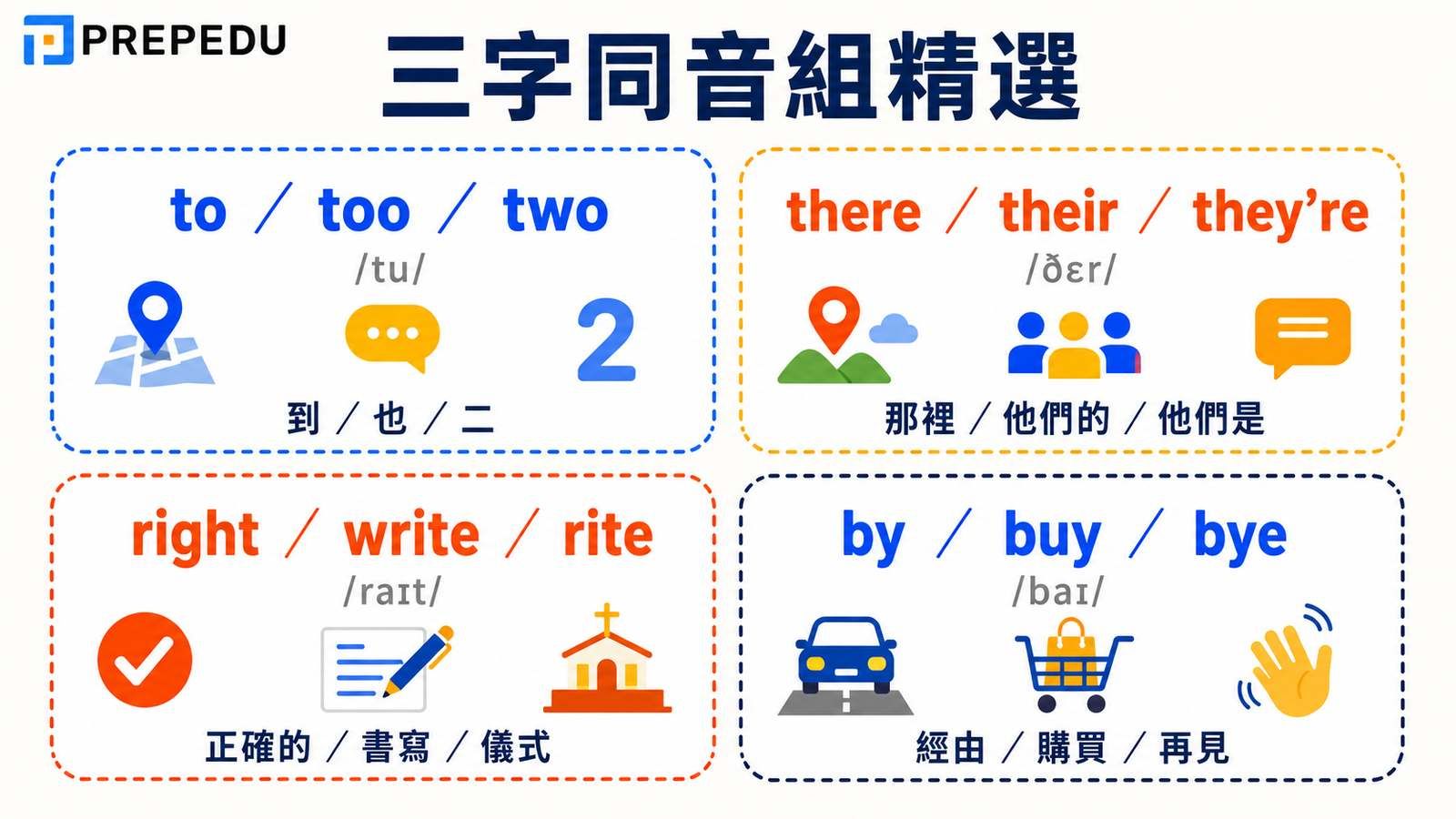
三字同音組把三個發音相同的字放在同一列,前三欄各是一個單字與中文意思,第四欄是共用的 KK 音標,第五欄是例句與中譯。
|
同音字英文 ① |
同音字英文 ② |
同音字英文 ③ |
KK 音標 |
例句 |
|
to(到) |
too(也) |
two(二) |
/tu/ |
① I want to go home now.(我現在想回家。) ② My sister wants to come too.(我妹妹也想來。) ③ I bought two tickets.(我買了兩張票。) |
|
there(那裡) |
their(他們的) |
they're(they are) |
/ðɛr/ |
① Put the box over there.(把箱子放在那裡。) ② The students left their books on the desk.(學生們把他們的書留在了桌上。) ③ They're going to the beach this weekend.(他們這週末要去海邊。) |
|
right(正確的) |
write(書寫) |
rite(儀式) |
/raɪt/ |
① That is the right way to do it.(那是做這件事正確的方法。) ② She likes to write short stories.(她喜歡寫短篇故事。) ③ The tribe performed an ancient rite.(那個部落舉行了一場古老的儀式。) |
|
by(經由) |
buy(購買) |
bye(再見) |
/baɪ/ |
① He walked by the river every morning.(他每天早上沿著河邊走路。) ② I need to buy some vegetables.(我需要買一些蔬菜。) ③ She waved and said bye before leaving.(她揮揮手說了聲再見才離開。) |
|
rain(雨) |
reign(統治) |
rein(韁繩) |
/ren/ |
① Heavy rain fell all afternoon.(大雨下了整個下午。) ② The queen's reign lasted forty years.(女王的統治持續了四十年。) ③ He pulled the rein to stop the horse.(他拉緊韁繩讓馬停下來。) |
|
for(為了) |
four(四) |
fore(前方) |
/fɔr/ |
① This gift is for you.(這份禮物是給你的。) ② She ordered four cups of coffee.(她點了四杯咖啡。) ③ The captain stood at the fore of the ship.(船長站在船的前部。) |
|
so(所以) |
sew(縫紉) |
sow(播種) |
/so/ |
① It was raining, so we stayed inside.(因為下雨,所以我們留在室內。) ② My grandmother taught me how to sew.(我奶奶教我怎麼縫紉。) ③ Farmers sow seeds in early spring.(農夫在早春播種。) |
|
air(空氣) |
heir(繼承人) |
ere(在……之前) |
/ɛr/ |
① We opened the window for fresh air.(我們打開窗戶讓新鮮空氣進來。) ② The prince is the heir to the throne.(王子是王位的繼承人。) ③ He finished his work ere the sun set.(他在日落之前完成了工作。) |
|
sight(視力) |
site(地點) |
cite(引用) |
/saɪt/ |
① Her sight improved after the surgery.(手術後她的視力改善了。) ② The construction site was closed on weekends.(那個工地週末不開放。) ③ Please cite your sources in the essay.(請在文章中引用你的資料來源。) |
|
oar(槳) |
or(或者) |
ore(礦石) |
/ɔr/ |
① He lost one oar while rowing.(他划船時掉了一支槳。) ② Would you like tea or coffee?(你想喝茶還是咖啡?) ③ The miners dug for iron ore.(礦工們挖掘鐵礦石。) |
|
vain(徒勞的) |
vane(風向標) |
vein(靜脈) |
/ven/ |
① His effort to persuade her was in vain.(他說服她的努力徒勞無功。) ② The weather vane spun in the wind.(風向標在風中轉動。) ③ The nurse found a vein for the injection.(護理師找到一條靜脈來打針。) |
|
ware(器皿/商品) |
wear(穿戴) |
where(哪裡) |
/wɛr/ |
① The stall displayed handmade ware for sale.(那個攤位展示著手工製作的器皿商品。) ② What will you wear to the party?(你派對要穿什麼?) ③ Where do you live now?(你現在住在哪裡?) |
|
flew(飛,過去式) |
flu(流感) |
flue(煙道) |
/flu/ |
① The plane flew through the storm.(飛機飛過了暴風雨。) ② He caught the flu last week.(他上週得了流感。) ③ Smoke rose through the chimney flue.(煙從煙囪的煙道往上竄。) |
3. 依主題分類的同音字(數字、自然、動作)
把同音字依主題歸類,記憶時更有畫面感,也更容易在情境中回想起來。
-
數字類: one/won(一/贏)、to/too/two(到/也/二)、for/four/fore(為了/四/前方)、ate/eight(吃過/八)。
-
自然類: sun/son(太陽/兒子)、sea/see(海/看)、rain/reign/rein(雨/統治/韁繩)、flour/flower(麵粉/花)、hair/hare(頭髮/野兔)、fir/fur(冷杉/毛皮)。
-
動作類: write/right(寫/正確)、buy/by/bye(買/經由/再見)、wait/weight(等待/重量)、meet/meat(見面/肉)、knead/need(揉捏/需要)、pray/prey(祈禱/獵物)。
-
身體類: heal/heel(治癒/腳跟)、waist/waste(腰部/浪費)、toe/tow(腳趾/拖曳)、muscle/mussel(肌肉/貽貝)、knows/nose(知道/鼻子)。
-
食物類: meat/meet(肉/見面)、flour/flower(麵粉/花)、berry/bury(莓果/埋葬)、steak/stake(牛排/樁)、leek/leak(韭蔥/漏)、tea/tee(茶/球座)。
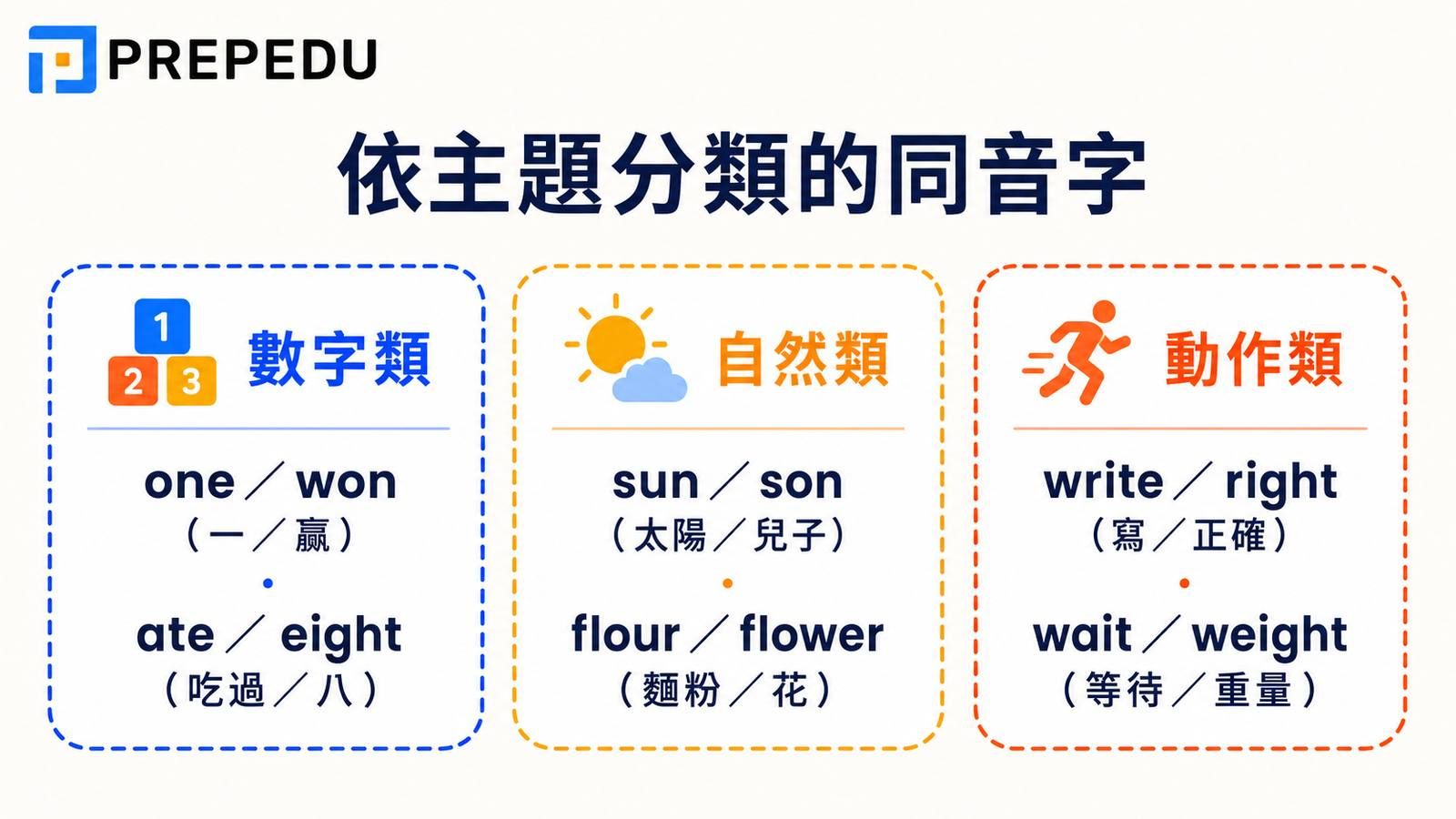
要提醒的是:這些字拼字全不同、發音卻完全一樣,沒有任何發音線索能幫你分辨,只能靠句子的語意和上下文判斷。表中有幾組因為太像,連母語者寫作時都會出錯,下一段就專門辨析。
IV. 最容易搞混的英文同音字:拼寫陷阱與辨析
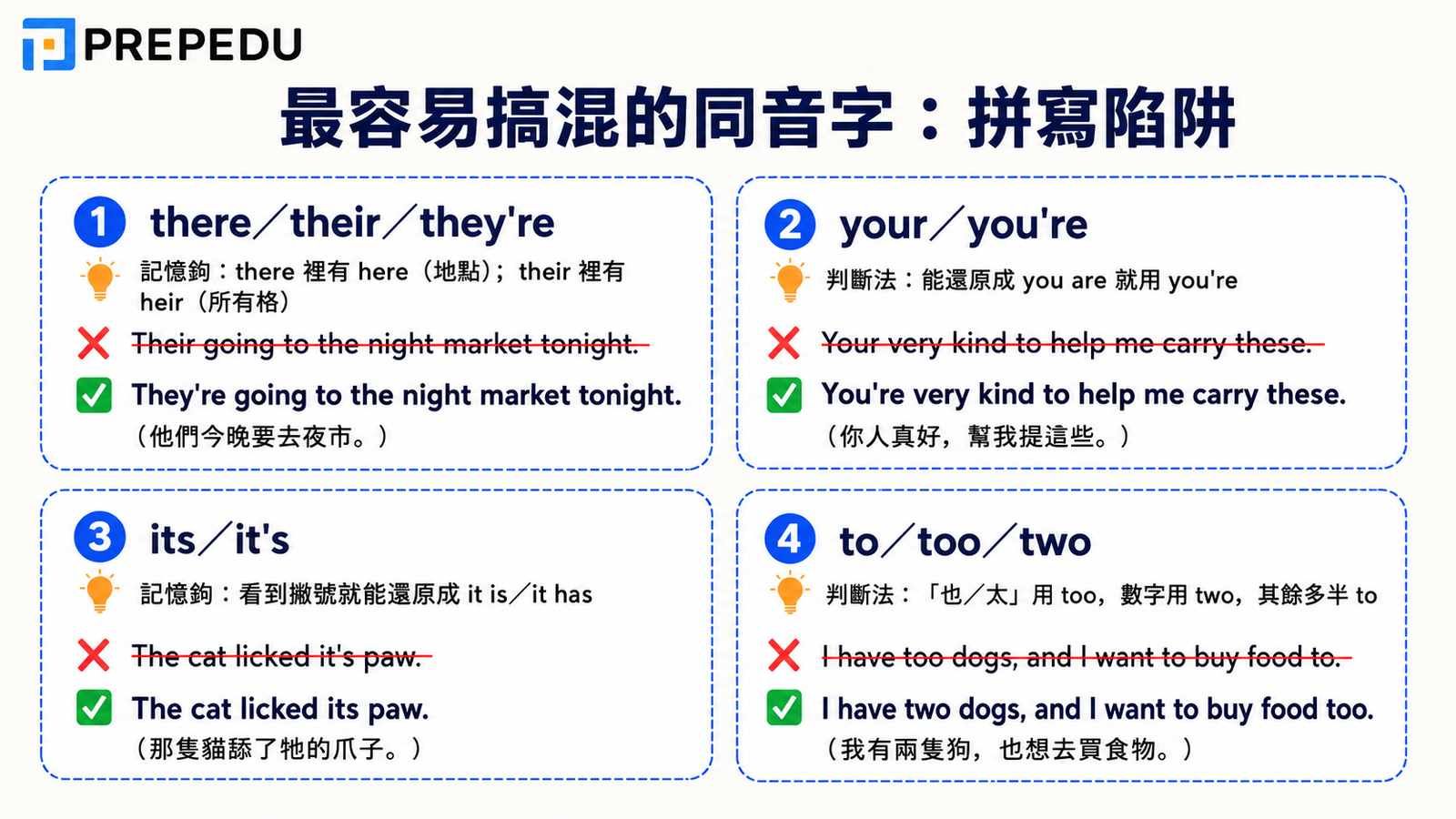
英文寫作最常拼錯的同音字是 there/their/they're、your/you're、its/it's 與 to/too/two。在 PREPEDU 批改中文母語學生的英文作文時,its/it's 幾乎是最頻繁出錯的一組——因為中文既沒有縮寫、也沒有「所有格加撇號」的規則,學生很難靠直覺分辨。判斷訣竅是先還原縮寫:they're=they are、you're=you are、it's=it is;如果句子還原後不通,就要改用所有格 their、your、its。規則、記憶鉤、常見錯誤,下面逐組拆解。先看錯句,再看正確寫法。
1. there/their/they're
這三個字念起來都是 /ðɛr/,但功能完全不同:there 表示「地點」、their 是「他們的」(英文所有格)、they're 是 they are 的縮寫。
記憶鉤:there 裡面藏著 here(這裡),兩個都跟「地點」有關;their 裡面藏著 heir(繼承人),繼承人擁有東西,對應「所有格」;they're 中間有撇號('),一定能還原成 they are。
-
❌ Their going to the night market tonight.
-
✅ They're going to the night market tonight.(還原成 They are 才通順,所以用縮寫。)
2. your/you're
your 是「你的」(所有格),you're 是 you are 的縮寫英文。判斷法只有一句話:把句子裡的字還原成 you are,通順就用 you're,不通順就用 your。
-
❌ Your very kind to help me carry these.
-
✅ You're very kind to help me carry these.(還原成 You are 通順,用縮寫。)
3. its/it's
這是最反直覺的一組,一定要特別記。its 是「它的」(所有格,沒有撇號);it's 是 it is 或 it has 的縮寫(有撇號)。反直覺的地方在於:一般名詞的所有格要加 's(如 Tom's book),但英文代名詞 its 的所有格偏偏不加撇號。
記憶鉤:只要看到撇號,it's 就一定能還原成 it is 或 it has;還原不通,就用沒有撇號的 its。
- ❌ The cat licked it's paw.
- ✅ The cat licked its paw.(「它的爪子」是所有格,不能還原成 it is,所以不加撇號。)
4. to/too/two
to 是英文介系詞或不定詞記號(go to school、want to eat);too 是「也」或「太」(me too、too hot);two 是數字「二」。判斷法:表示「也/太」用 too,數字用 two,其餘多半是 to。
- ❌ I have too dogs, and I want to buy food to.
- ✅ I have two dogs, and I want to buy food too.(數字用 two,句尾「也」用 too。)
除了這幾組,hear/here、lose/loose、weak/week 也是寫作與聽力的高頻混淆組。掌握了寫作陷阱後,你還需要應對聽力測驗的新挑戰:同音字結合發音相近的類音字。
V. 聽力測驗的同音字陷阱:同音字與類音字
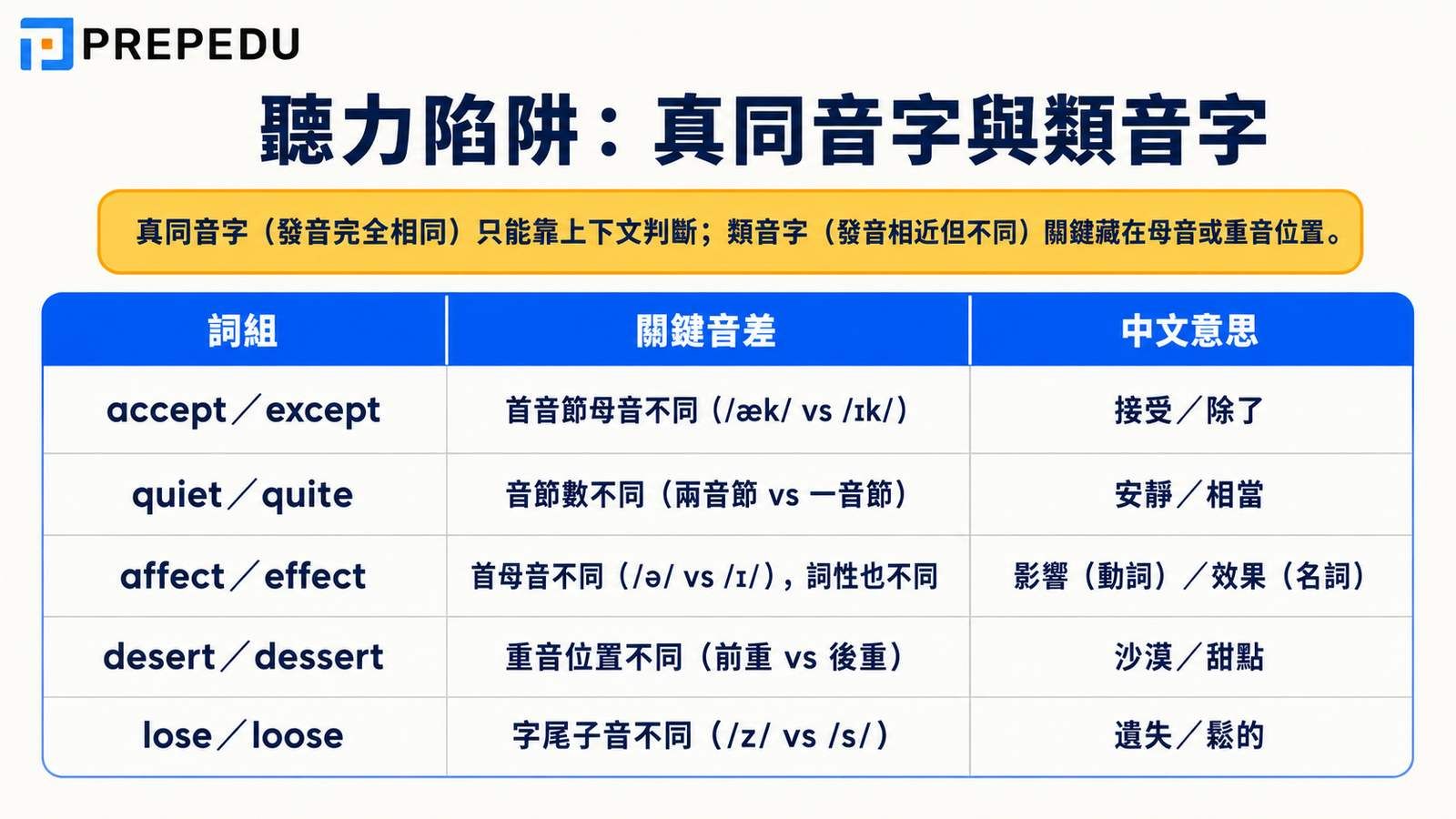
聽力測驗的同音字陷阱分兩種:真同音字(如 sail/sale 發音完全相同,只能靠上下文判斷)與類音字(如 accept/except、quiet/quite 發音相近但不同,需注意母音與重音差異)。先講清楚一個常被問到的問題:accept 和 except 不是同音字,而是容易混淆的類音字。分清這兩種,聽力才不會一直被牽著走。
-
真同音字在聽力中的陷阱 → 真同音字在聽力裡完全沒有發音線索可循。當你聽到 /sel/,它可能是 sail(航行),也可能是 sale(特賣),耳朵無法分辨,只能靠整句話在講什麼來判斷。以 TOEIC 聽力為例,題目常故意讓你聽到一個同音字,選項裡卻放另一個拼法來誘導你選錯。假設聽到「The store is having a big sale.」,若你把 sale 誤解成 sail,整句語意就跑掉了。因此聽真同音字時,重點永遠是抓住上下文:這句話的場景是商店、還是航海?語意對了,字自然就對了。
-
類音字:發音相近但不完全相同 → 類音字(near-homophone)和同音字不一樣:它們發音「相近」但並不相同,關鍵差別往往藏在母音或重音位置。這類字更常出現在 TOEIC、IELTS 聽力,因為它們比真同音字更難分辨。
|
詞組 |
關鍵音差 |
中文意思 |
|
accept/except |
首音節母音不同(/æk/ vs /ɪk/) |
接受/除了 |
|
quiet/quite |
音節數不同(/ˈkwaɪət/ 兩音節 vs /kwaɪt/ 一音節) |
安靜/相當 |
|
affect/effect |
首母音不同(/ə/ vs /ɪ/),詞性也不同 |
影響(動詞)/效果(名詞) |
|
desert/dessert |
重音位置不同(前重 vs 後重) |
沙漠/甜點 |
|
lose/loose |
字尾子音不同(/z/ vs /s/) |
遺失/鬆的 |
VI. 英文同音字字典與線上查詢工具推薦
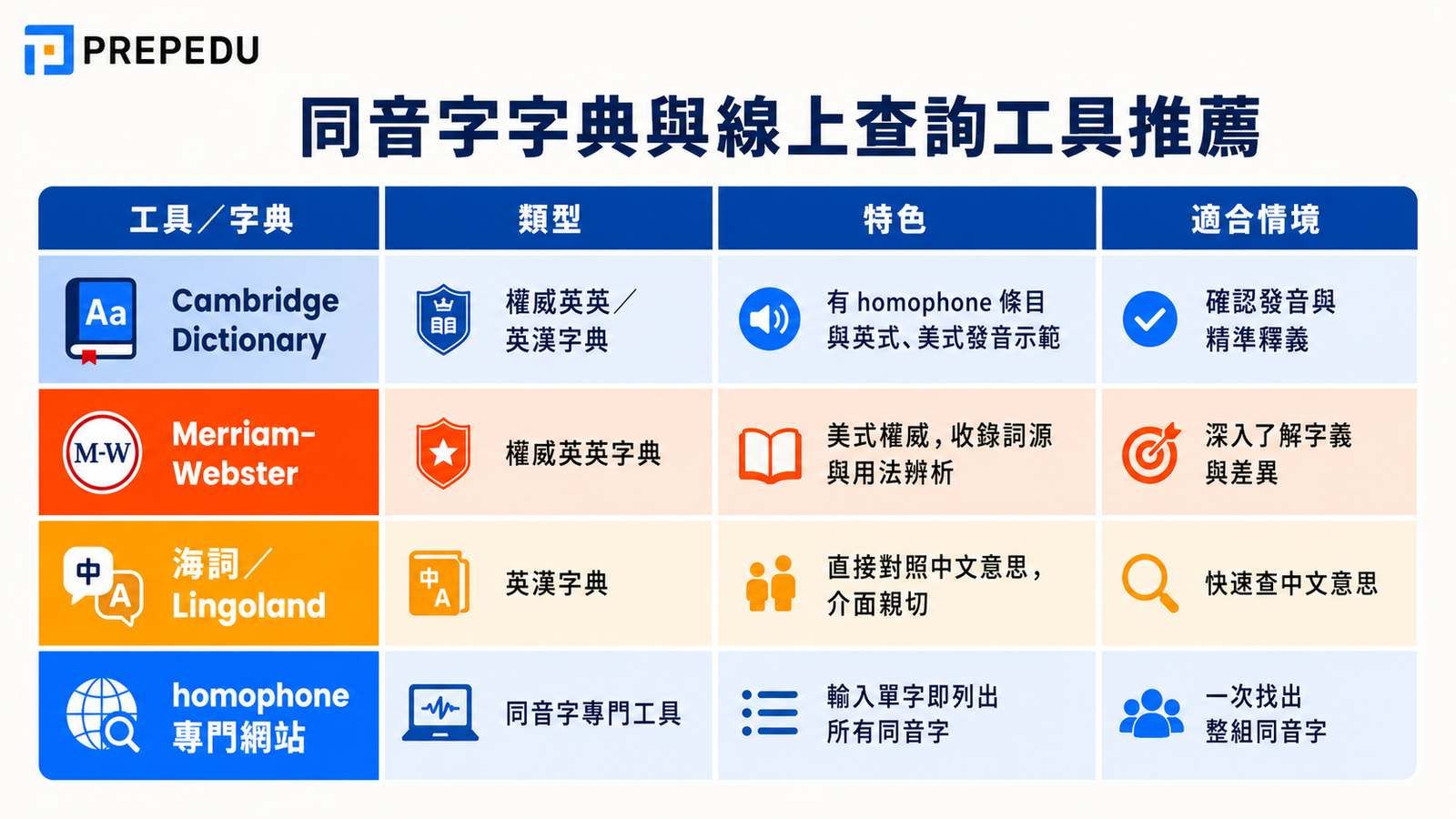
查英文同音字可用三類工具:權威英英字典(Cambridge、Merriam-Webster)確認發音與釋義;英漢字典(海詞、Lingoland)對照中文意思;以及專門的同音字網站與學習 App。想同時練習辨音,可搭配內建發音示範與 AI 跟讀評分的字典工具。下表依情境幫你選對工具:
|
工具/字典 |
類型 |
特色 |
適合情境 |
|
Cambridge Dictionary |
權威英英/英漢字典 |
有 homophone 條目與英式、美式發音示範 |
確認發音與精準釋義 |
|
Merriam-Webster |
權威英英字典 |
美式權威,收錄詞源與用法辨析 |
深入了解字義與差異 |
|
海詞/Lingoland |
英漢字典 |
直接對照中文意思,介面親切 |
快速查中文意思 |
|
homophone 專門網站 |
同音字專門工具 |
輸入單字即列出所有同音字 |
一次找出整組同音字 |
有了查詢工具,剩下的關鍵就是如何有效率地把這些同音字記起來、用出來。
VII. 英文同音字要怎麼記?記憶技巧與練習方法
記英文同音字最實用的四個方法是:用拆字記憶鉤、成對造句、情境圖像記憶,以及朗讀跟讀把發音和拼字綁在一起。搭配影子跟讀與發音評分練習,還能同時強化聽力辨音。同音字不該死背。要靠方法,把它們「綁」在記憶裡。
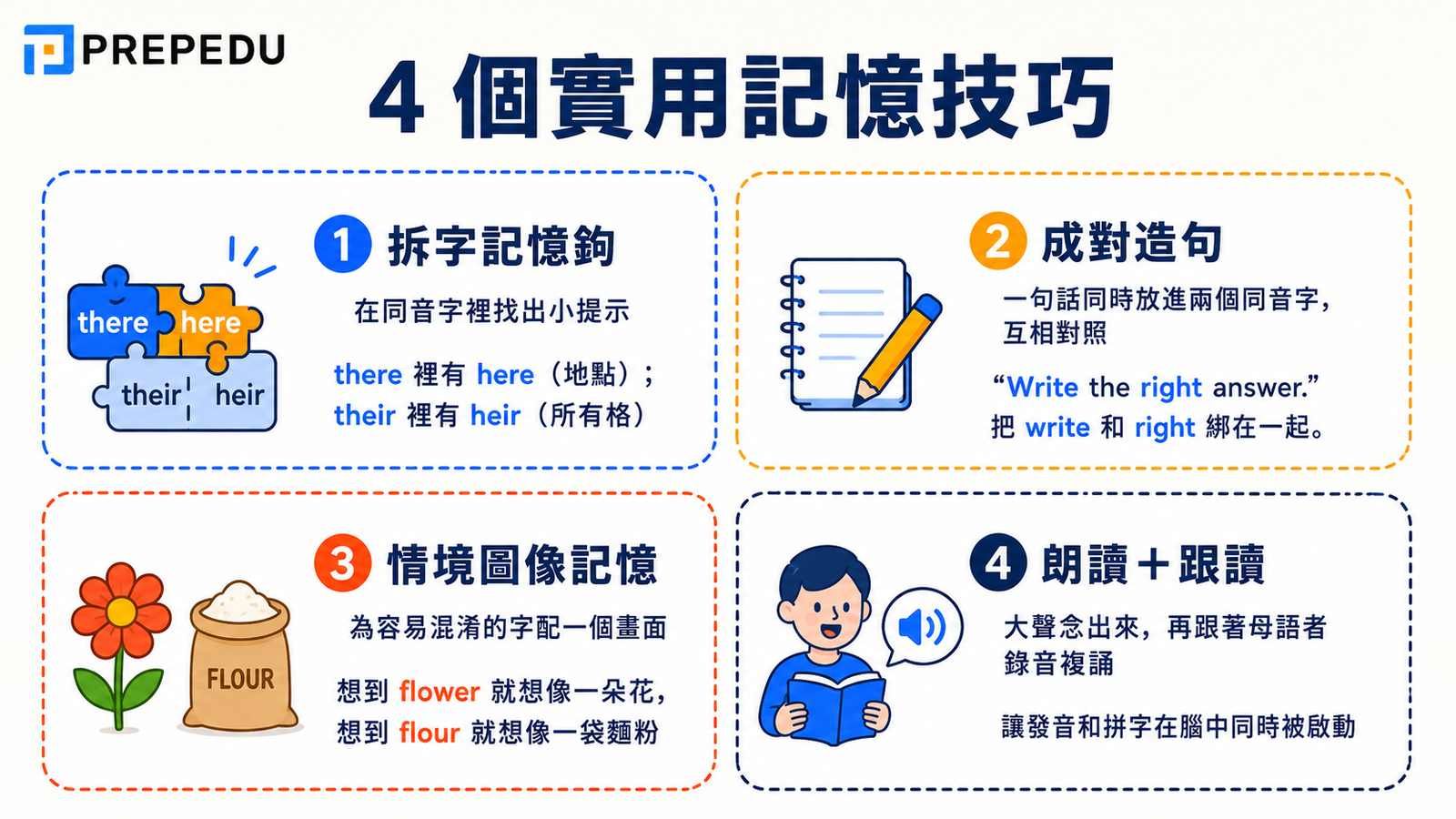
4 個實用記憶技巧:
-
拆字記憶鉤: 在同音字裡找出小提示。例如 there 裡有 here(都跟地點有關)、their 裡有 heir(繼承人擁有東西,對應所有格),一眼就能對應功能。
-
成對造句: 用一個句子同時放進兩個同音字,讓它們互相對照。例如「Write the right answer.」一句就把 write 和 right 綁在一起。
-
3情境圖像記憶: 為容英文易混淆的字配一個畫面。想到 flower 就想像一朵花、想到 flour 就想像一袋麵粉,用圖像切開相同的發音。
-
朗讀+跟讀: 把單字大聲念出來,再跟著母語者的錄音複誦,讓「發音」和「拼字」在腦中同時被啟動,減少寫作時選錯字的機率。
用聽力與口說練習內化同音字 → 真正把同音字內化,靠的是「開口」。建議用影子跟讀(shadowing):播放一句含同音字的句子,慢半拍跟著念,模仿母語者的語調與節奏;接著錄下自己的聲音,交給 AI 發音評分找出偏差。
掌握方法後,用下面兩回練習題檢驗自己是否真的分得清。
VIII. 英文同音字練習題
兩回練習的題型相同:從括號中選出正確的同音字填入。做完後可對照第三部分的解答,檢查自己最常錯的組別。先自己作答,再看答案,效果最好。
1. 練習題第一回
-
Please put the book over ______ on the shelf.(there/their/they're)
-
______ going to visit us next week.(There/Their/They're)
-
I can't believe ______ already finished the project.(your/you're)
-
The dog wagged ______ tail happily.(its/it's)
-
She wants ______ apples, but I only have one.(to/too/two)
-
Can you ______ me at the station at noon?(meat/meet)
-
We walked along the ______ to watch the sunset.(see/sea)
-
He gave the ______ answer on the test.(right/write)
-
I need to ______ a letter to my grandmother.(right/write)
-
They lost ______ keys somewhere in the park.(there/their/they're)
2. 練習題第二回
-
The store is having a huge ______ this weekend.(sail/sale)
-
After a long ______ at work, I finally got some rest.(weak/week)
-
Please don't ______ your time on things that don't matter.(waist/waste)
-
She felt ______ after skipping breakfast.(weak/week)
-
He hit the ______ to stop the car suddenly.(brake/break)
-
Let's take a short ______ before we continue.(brake/break)
-
7. The knight fought bravely all through the ______.(night/knight)
-
I bought a ______ of shoes at the mall.(pair/pear)
-
World ______ is something everyone hopes for.(peace/piece)
-
Could I have a ______ of cake, please?(peace/piece)
3. 解答與詳解
|
第一回 |
第二回 |
|
|
若對某些題目仍有疑問,下面的常見問題整理了大家最常追問的幾點。
IX. 關於英文同音字的常見問題(FAQ)
「同音字」的英文是 homophone,和同義字(synonym)不同:homophone 是發音相同、意思不同,synonym 則是意思相同、發音不同。此外,部分同音字只在特定口音下成立,例如 court 與 caught 在英式(非捲舌)發音相同、美式則略有差異。以下針對兩個最常見的追問進一步說明。
1. 同音字的英文怎麼說?和同義字(synonym)差在哪?
「同音字」的英文是 homophone。它和同義字(synonym)常被搞混,但兩者其實相反:homophone 是「音同、義不同」(如 flower 花/flour 麵粉),synonym 則是「義同、音不同」(如 big 與 large 意思相近、發音完全不同)。一句話記住:homophone 比的是聲音,synonym 比的是意思。想把發音基礎打穩,可以搭配英文發音規則/KK 音標一起學。
2. 英式與美式發音會改變同音字嗎?
會。有些組別只在特定口音下才算同音字。最典型的例子是 court 與 caught:在英式(非捲舌,non-rhotic)發音中兩者幾乎相同,但在美式(捲舌,rhotic)發音中,court 的 /r/ 會發出來,兩個字就聽得出差異。所以判斷是否同音時,最好標明是哪一種口音,聽力備考時也要留意題目採用的是英式還是美式發音,這一點在多益聽力技巧裡有更完整的說明。
掌握以上重點,就能系統化運用英文同音字。
結語
從 homophone 的定義出發,你已經分清了 homophone、homograph、homonym 三個術語,查閱了超過 100 組的常見同音字大全表,辨析了 there/their/they're、its/it's 等寫作陷阱,也拆解了聽力測驗中真同音字與類音字的差別,還認識了實用的查詢字典與記憶技巧,並用兩回練習題檢驗成果。關鍵只剩一件事:持續內化。接下來搭配發音示範與跟讀評分工具,把這些同音字的聲音與拼字綁得更牢,寫作與聽力都能少犯錯。

你好!我叫黃秋賢,現在在 prepedu.com 擔任內容企劃。我有超過5年的英語與韓語自學經歷,親身備考 IELTS、TOEIC 與 TOPIK,累積了大量第一手的學習者視角——包括哪些語法規則最讓台灣與香港學習者混淆,以及如何在有限的備考時間內最有效地修正這些錯誤。目前已在 prepedu.com 撰寫超過 1000 篇英語學習文章,內容涵蓋語法、詞彙與考試策略,累積協助數千位學習者解決自學過程中的語法疑問。
評論











統一企業編號:202227322W
地址:114 LAVENDER STREET, #11-83 CT HUB 2, SINGAPORE (338729)