英文分裂句(Cleft Sentences)教學:定義、結構用法與練習
什麼是英文分裂句?如何正確使用分裂句強調重點?分裂句(Cleft Sentences)是一種將簡單句拆解為兩部分的英文句型結構,專門用於突顯句中特定成分,如主詞、受詞或狀語。透過「It is/was...that/who」或「What...is/was」等結構,說話者能夠精準引導聽者注意力,讓關鍵訊息立即成為焦點。
想像你在台北辦公室需要清楚說明「正是行銷團隊完成了這項專案」,而非其他部門,分裂句就是最有力的表達工具。無論是商務簡報、學術論文或 IELTS 寫作測驗,掌握分裂句用法都能顯著提升表達精準度與說服力。然而許多學習者常在關聯詞選用、時態一致性及過度使用等方面犯錯,導致句子文法錯誤或失去自然語感。
PREPEDU 為你整理完整的英文強調句教學,涵蓋 It-cleft、What-cleft 等七大結構類型,搭配台北、香港真實情境例句及三組綜合練習題,幫助你從定義理解到實戰應用,全面掌握這個提升英語表達層次的關鍵句型。

I. 分裂句英文的定義與強調功能
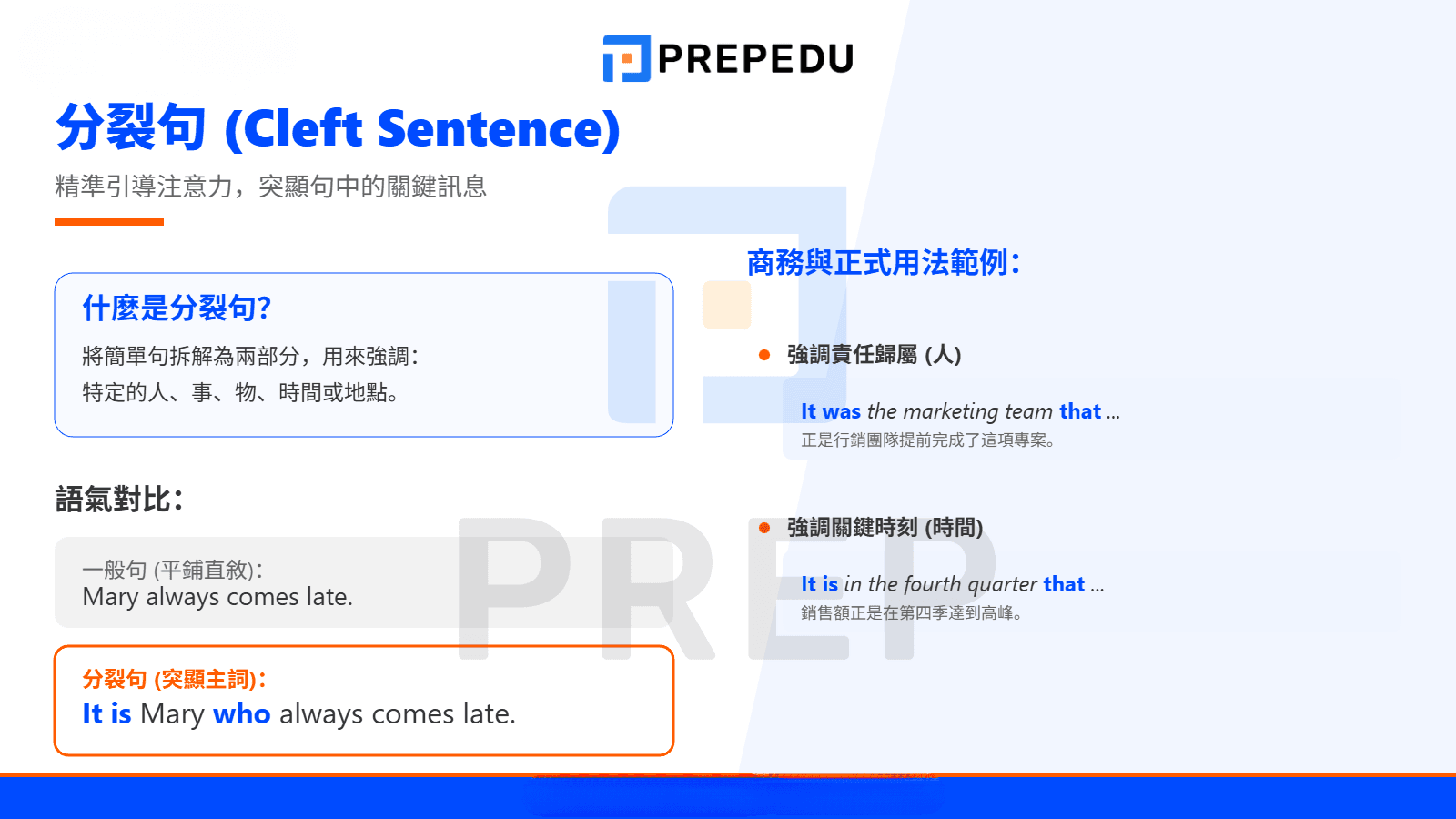
分裂句(Cleft Sentence)是一種將簡單句拆解為兩部分的句型結構,專門用於突顯句中特定成分,如主詞、受詞、狀語,或是句中最重要的人事物。透過這種語法結構,說話者能夠精準地引導聽者注意力,確保關鍵訊息得到應有的重視。在學術寫作、商業溝通及正式場合中,分裂句扮演著不可或缺的角色,幫助表達者建立清晰的資訊層級。
讓我們透過實際例句理解分裂句的運作方式。
-
一般句「Mary always comes late」平鋪直敘地陳述事實,沒有特別強調任何訊息。
-
分裂句「It is Mary who always comes late」(Mary 正是那個總是遲到的人。),主詞 Mary 立即成為焦點,清楚指出習慣性遲到者的身分。
這種結構調整不僅改變句子外在形式,更深層地影響訊息傳遞的效率。
-
It was the marketing team that completed this project ahead of schedule.(正是行銷團隊提前完成了這項專案。)➡️ 分裂句明確歸功於特定部門,避免功勞被誤認
-
It is in the fourth quarter that our sales peaked.(我們的銷售額正是在第四季達到高峰。)➡️ 時間點的強調幫助董事會快速掌握關鍵業績時段
分裂句在釐清責任歸屬、指明事件細節、引導注意力方面展現卓越效能,成為專業溝通中不可或缺的表達工具。
II. It + be 開頭的常用分裂句結構
It-cleft 構成最普遍的英文強調句型,透過「It + be 動詞」框架將原句拆分為強調部分與補充訊息兩個區塊。第一部分置入被強調元素,第二部分則以關係子句呈現其餘內容。由於可強調的成分包含主詞、受詞、狀語等不同句子要素,分裂句用法展現高度靈活性。以下四種結構涵蓋了日常表達與專業寫作中最常見的強調情境,每種結構都對應特定的溝通目的與適用場景。
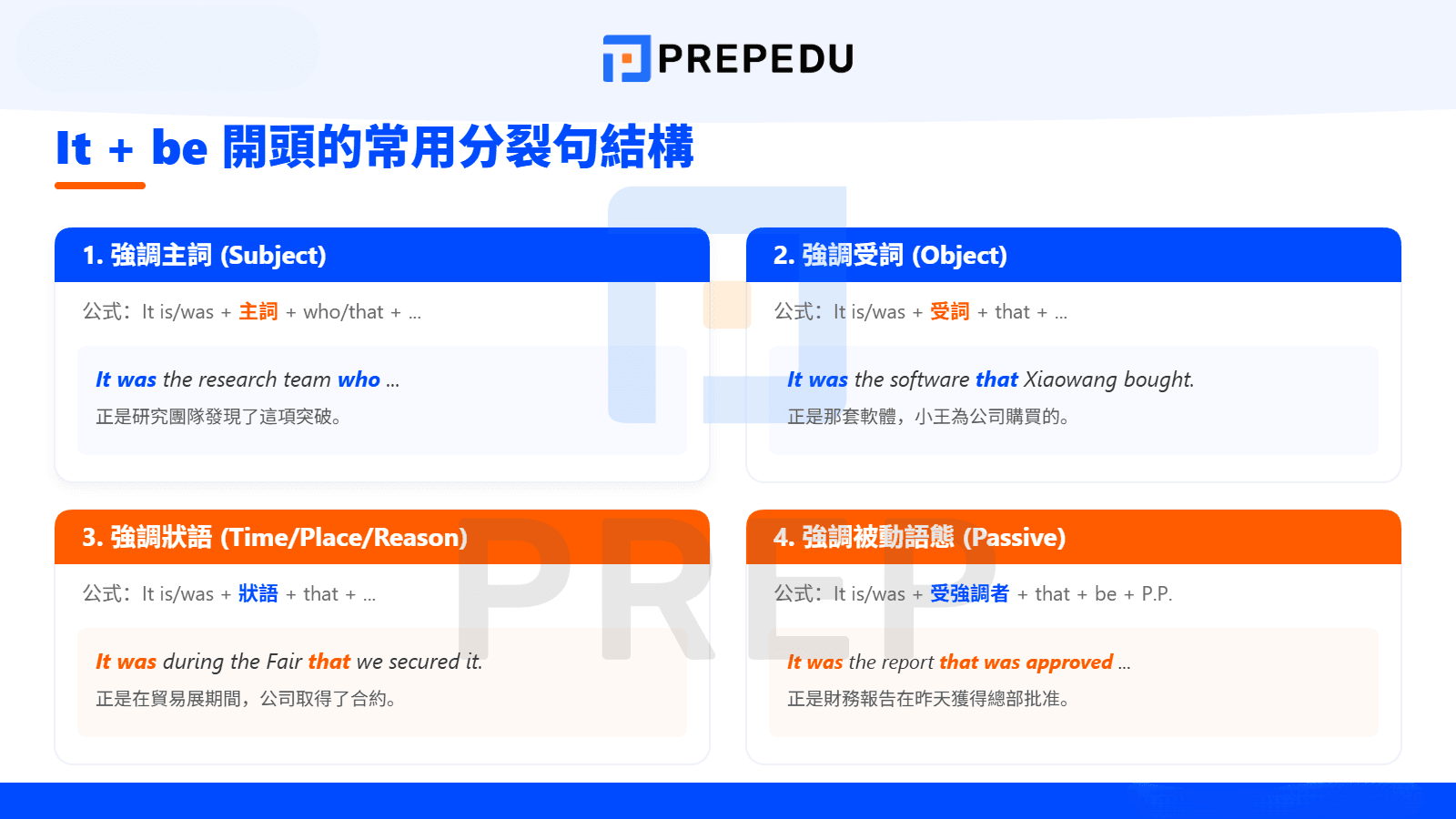
1. 強調主詞:It is/was +(主詞)+ who/that ...
|
結構元素 |
說明與範例 |
|
公式 |
It + be + 被強調主詞 + who/that + 動詞 + 其他 |
|
適用對象 |
人物主詞使用 who 或 that,事物主詞使用 that |
|
範例 |
原句:The research team discovered the breakthrough in Taipei laboratory.(研究團隊在台北實驗室發現了突破。) 分裂句:It was the research team who discovered the breakthrough in Taipei laboratory.(正是研究團隊在台北實驗室發現了突破。)➡️ 明確指出執行發現動作的主體是研究團隊 |
強調人物主詞時,關係代名詞可選用 who 或 that,前者較正式且常見於書面語,後者在口語中同樣可接受。例如:
-
It is Manager Chen from Xianggang who oversees this regional project.(正是來自香港的陳經理負責監督此區域專案。)➡️ 清楚標示負責人身分
-
It was Professor Wang from Taipei University that proposed this innovative teaching method.(正是台北大學的王教授提出了這個創新教學法。)➡️ 突顯理論創始者
此種結構在釐清責任歸屬或表揚特定貢獻者時發揮關鍵作用,讓聽者立即理解誰該為成果或問題負責。
強調事物主詞的分裂句同樣重要,例如「It was the unexpected system failure that disrupted the Xiaogang's presentation」(正是意外的系統故障中斷了小剛的簡報。)將問題根源置於焦點,協助團隊快速定位改善方向。使用時務必注意 be 動詞時態應與原句保持一致,若原句採用過去式,分裂句同樣使用 was;現在式則對應 is。這種文法一致性確保句子結構完整且符合語言規範。
2. 強調受詞:It is/was +(受詞)+ that...
|
結構元素 |
說明與範例 |
|
公式 |
It + be + 被強調受詞 + that + 主詞 + 動詞 + 其他 |
|
無論受詞為人或物,統一使用 that |
|
|
範例 |
原句:Xiaowang purchased the premium software package for his startup.(小王為他的新創公司購買了高級軟體套裝。) 分裂句:It was the premium software package that Xiaowang purchased for his startup.(正是那套高級軟體套裝,小王為他的新創公司購買的。)➡️ 突顯購買對象是高級軟體套裝而非其他產品 |
強調受詞的分裂句將動作對象前置,立即吸引注意力至該名詞或名詞片語。例如:
-
It is market research data that the Taipei branch needs most urgently」(正是市場研究數據,台北分公司最迫切需要的。)➡️ 明確指出需求項目
-
It was customer satisfaction that our Xianggang team prioritized throughout the campaign(正是客戶滿意度,我們香港團隊在整個活動期間優先考量的。)➡️ 凸顯團隊重視的核心價值。)
這類句型在商業會議中特別實用,當討論預算分配或資源優先順序時,分裂句能快速傳達決策焦點,避免會議參與者誤解或忽略關鍵訊息。
在回應疑問或修正誤解時,受詞強調句展現極佳效果。例如「Did you order the basic plan?」,你可回答「No,it is the enterprise plan that I ordered for our company」(不,正是企業方案,我為公司訂購的。),清楚修正對方認知並提供正確資訊。此種表達方式既委婉又明確,在專業場合中維持溝通品質。
3. 強調狀語(時間、地點、原因):It is/was +(狀語)+ that...
|
強調類型 |
結構範例 |
實際應用 |
|
時間狀語 |
It was during the Taipei International Trade Fair that our company secured the major contract.(正是在台北國際貿易展期間,我們公司取得了重大合約。) |
突顯事件發生的具體時間點,建立清晰時序 |
|
地點狀語 |
It is at the Xianggang Innovation Center that the research team conducts cutting-edge experiments.(正是在香港創新中心,研究團隊進行尖端實驗。) |
強調活動進行的特定地理位置 |
|
原因狀語 |
It was because of the exceptional performance that Xiaowang received the Employee of the Month award.(正是因為傑出表現,小王獲得了本月最佳員工獎。) |
明確指出行動或結果的根本原因 |
強調狀語的分裂句無論修飾時間、地點或原因,後方一律接 that 引導的子句,這是與主詞強調句的重要區別。狀語強調在敘述複雜事件或建立因果邏輯時扮演關鍵角色。例如:
-
It is in the morning sessions that participants demonstrate highest concentration levels(正是在早晨時段,參與者展現最高專注度。)➡️ 為培訓規劃提供科學依據
-
It was through continuous innovation that the Taipei startup achieved remarkable growth(正是透過持續創新,這家台北新創公司達成驚人成長。)➡️ 揭示成功關鍵因素
在學術論文或商業報告中,狀語強調句有效組織資訊層級。「It is during economic downturns that consumer behavior shifts most dramatically」(正是在經濟衰退期間,消費者行為轉變最為劇烈。)將研究焦點清楚標示於特定時期,讓讀者快速掌握研究範疇。此種精準表達方式提升專業文件的可讀性與說服力,使論點更具衝擊力。
4. 強調被動語態:It is/was +(受強調者)+ that + be + P.P....
|
結構元素 |
說明與範例 |
|
公式 |
It + be + 被強調名詞 + that + be + 過去分詞 + by + 施事者(可省略) |
|
範例 |
原句:The traditional manufacturing process was replaced by automation in the Xianggang factory.(傳統製造流程在香港工廠被自動化取代。) 分裂句:It was the traditional manufacturing process that was replaced by automation in the Xianggang factory.(正是傳統製造流程在香港工廠被自動化取代。)➡️ 突顯被取代的對象是傳統製造流程,而非其他系統 |
結合分裂句與被動語態能夠同時達成雙重修辭效果:既強調特定元素,又將動作執行者置於次要位置。例如「It is the quarterly financial report that was approved by the Taipei headquarters yesterday」(正是季度財務報告在昨天獲得台北總部批准。)聚焦於獲批文件本身,施事者(總部)雖然出現但不佔主導地位。
這種句型在科學文獻或正式報告中經常出現,用於強調研究對象、實驗材料或受影響項目,例如「It is this hypothesis that was validated through extensive laboratory testing」(正是這個假說透過大量實驗室測試獲得驗證。)。
使用被動分裂句時需特別注意兩個 be 動詞的時態協調。第一個 be 動詞(is/was)必須與原句整體時態對應,第二個 be 動詞則構成被動語態結構。以「It was the innovative marketing strategy that was implemented by Xiaowang's team last quarter」(正是這個創新行銷策略在上季由小王的團隊實施。)為例,第一個 was 呼應過去時間點 last quarter,第二個 was 與過去分詞 implemented 共同形成被動語態,確保文法正確性與語意清晰度。
III. What 引導的準分裂句(Pseudo-clefts)
準分裂句運用 what 子句擔任主詞角色,整體架構雖與 It-cleft 相似但語感存在微妙差異。這類 Cleft sentences 特別擅長強調動作內容、狀態描述或完整事件概念,而非單一名詞或片語。
What 引導的名詞子句在句中發揮主詞功能,後接 be 動詞連結被強調部分,形成「概念—定義」的語意關係。此種結構在口語表達中的使用頻率不輸 It-cleft,因其能自然傳達個人需求、偏好或事實陳述,語調較 It-cleft 的正式感更直接且具個人色彩。
準分裂句的彈性同時體現在倒裝變化上,說話者可依據語境需求調整強調重點位置,創造不同的語氣效果。標準形式先鋪陳完整概念再點明核心,倒裝形式則開門見山直指重點,兩者各有適用時機。這種靈活運用能力使 what-cleft 成為日常對話與專業討論中極受歡迎的表達方式,幫助溝通者在維持自然語感的同時精準傳遞訊息重點。
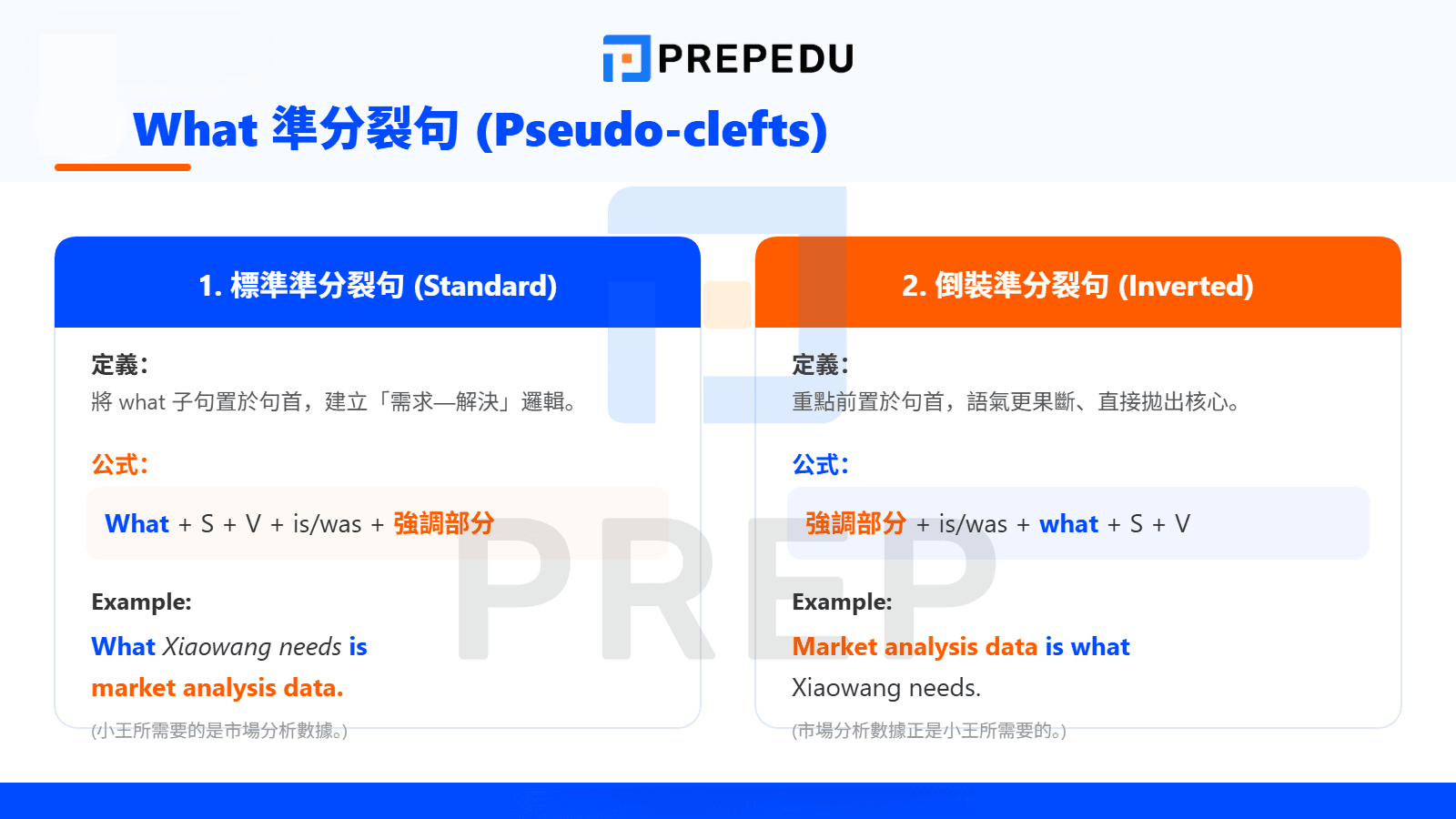
1. 標準準分裂句:What(子句)+ is/was +(強調部分)
公式:
What + 主詞 + 動詞 + is/was + 被強調名詞或片語
範例:
-
What Xiaowang needs for the Taipei presentation is comprehensive market analysis data.(小王台北簡報所需要的是全面的市場分析數據。)
-
What surprised the Xianggang management team was the rapid adoption rate among young consumers.(令香港管理團隊驚訝的是年輕消費者間的快速採用率。)
標準準分裂句將 what 子句置於句首,透過 be 動詞連結至強調重點,建立「問題—答案」或「需求—解決方案」的清晰邏輯關係。這種結構常用於表達需求、感受或必要行動。例如:
-
What concerns Taipei investors most is the stability of long-term returns」(最令台北投資者擔憂的是長期回報的穩定性。)
-
What distinguishes our Xianggang office from competitors is personalized customer service」(使我們香港辦公室有別於競爭對手的是個人化客戶服務。)
在實際運用時,what 子句內可包含完整的主詞與動詞結構,形成獨立陳述。例如「What the quarterly report reveals is a significant shift in consumer preferences」(季度報告揭示的是消費者偏好的重大轉變。)中,what 子句本身即為完整概念,而後方的「significant shift」則是被強調的關鍵發現。這種句型在總結論點、提出關鍵發現或陳述核心觀點時展現卓越效能,幫助聽者或讀者快速掌握訊息精髓。
2. 倒裝準分裂句:(強調部分)+ is/was + what(子句)
公式:
被強調名詞或片語 + is/was + what + 主詞 + 動詞
範例:
-
Comprehensive market analysis data is what Xiaowang needs for the Taipei presentation.(全面的市場分析數據正是小王台北簡報所需要的。)
-
The rapid adoption rate among young consumers was what surprised the Xianggang management team.(年輕消費者間的快速採用率正是令香港管理團隊驚訝的。)
倒裝準分裂句將強調重點前置於句首,what 子句則退居後位提供背景脈絡。這種變體在語氣上略顯果斷或強硬,因其直接拋出核心訊息,不給聽者猜測或推測空間。例如「Immediate cost reduction is what the Taipei headquarters demands from all regional offices」(立即削減成本正是台北總部對所有區域辦公室的要求。)比標準形式「What the Taipei headquarters demands from all regional offices is immediate cost reduction」更具迫切感與命令意味。
IV. 進階分裂句變體結構
英語中除了基本 It-cleft 與 what-cleft 外,尚存在多種變體結構,各具獨特語法功能與修辭效果。這些進階用法拓展分裂句的應用範圍,讓表達者能更精準傳達特定語意。掌握這些變體不僅豐富語言表達層次,更展現對英語句法的深入理解與靈活運用能力。以下三種變體在文學作品、專業演說及高階論述中頻繁出現,各自承載著特定的強調意圖。
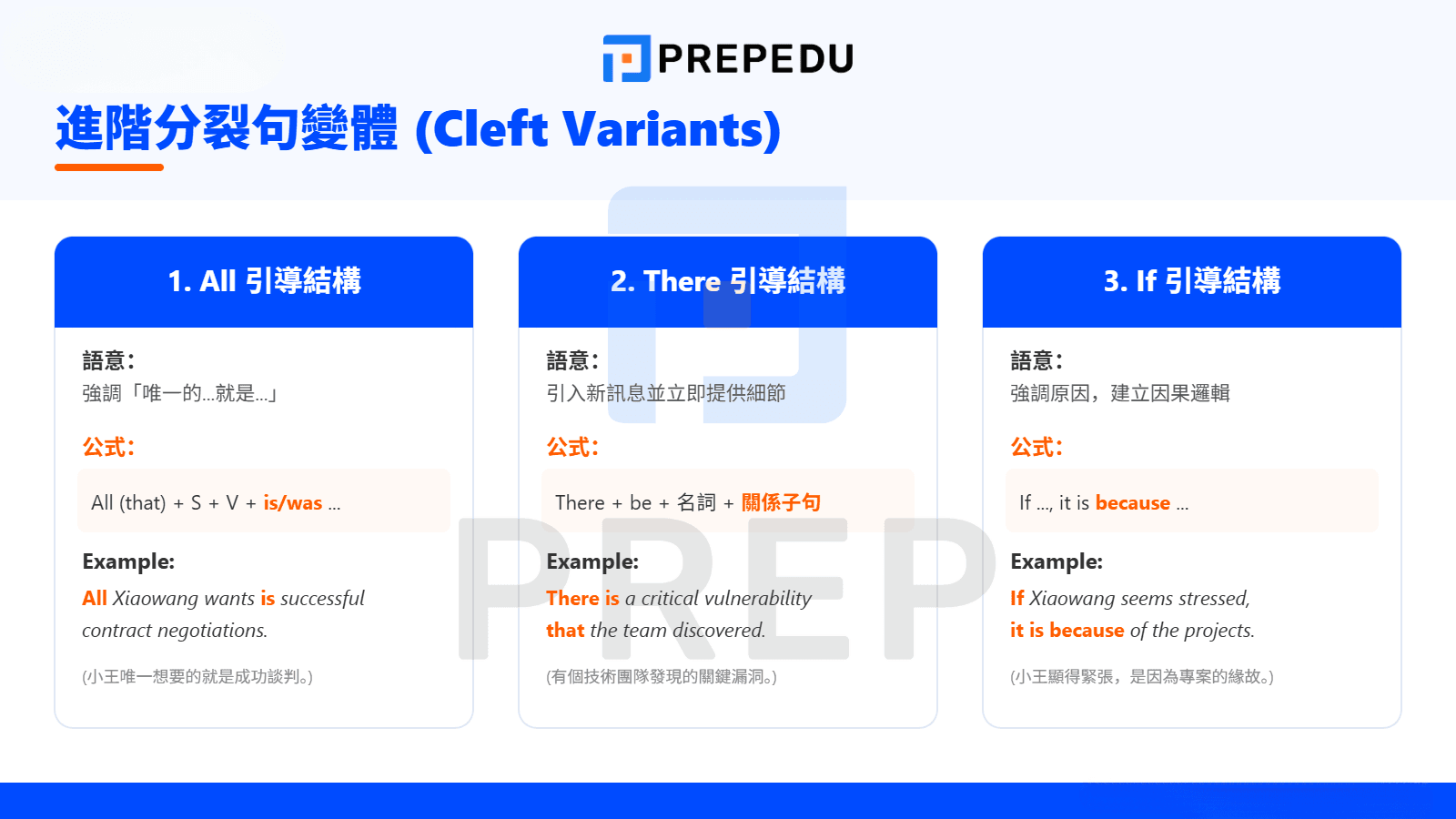
1. 使用 All 引導:All +(子句)+ is/was…
公式:
All +(that)+ 主詞 + 動詞 + is/was + 被強調部分
範例:
-
All Xiaowang wants from this Taipei business trip is successful contract negotiations.(小王這趟台北出差唯一想要的就是成功的合約談判。)
-
All that matters to the Xianggang investors is sustainable long-term growth.(對香港投資者而言唯一重要的就是可持續的長期成長。)
All-cleft 表達「唯一的…就是…」概念,帶有強烈排他性語氣。這種結構暗示其他選項皆不重要或不存在,只有被強調部分才是真正關鍵。例如分裂句:
-
All you need to accomplish before the Taipei headquarters review is finalize the quarterly financial report(在台北總部審查前你唯一需要完成的就是定稿季度財務報告。)
-
All I recall from that Xianggang conference is the keynote speaker's innovative perspective on digital transformation(那場香港會議我唯一記得的就是主講人對數位轉型的創新觀點。)
2. 使用 There 引導:There is/was +(名詞)+ that…
公式:
There + be + 名詞 + 關係子句
範例分裂句:
-
There is a critical software vulnerability that Xiaowang's technical team discovered during the Taipei security audit.(在台北安全稽核期間,小王的技術團隊發現了一個關鍵軟體漏洞。)
-
There was a transformative moment during the Xianggang leadership summit that changed the company's strategic direction.(香港領導高峰會期間有個轉折時刻改變了公司的戰略方向。)
There-cleft 結合存在句與關係子句,既引入新訊息又立即提供細節描述。這種結構在敘事或解釋複雜概念時效能卓越,因其能自然地將主題帶入討論,同時維持句子流暢度。例如「There is an innovative approach that the Taipei research institute developed for enhancing production efficiency」(台北研究機構開發了一種提升生產效率的創新方法。)先提及方法的存在,再透過關係子句說明其來源與功能,避免讀者產生「那又如何」的疑問。
3. 使用 If 引導:If(子句),it is because…
公式:
If + 條件子句,it is because + 原因子句
範例:
-
If Xiaowang seems unusually stressed lately,it is because the Taipei headquarters assigned him three concurrent high-priority projects.(如果小王最近看起來異常緊張,那是因為台北總部同時指派他三個高優先級專案。)
-
If the Xianggang office achieved record-breaking quarterly results,it was because the entire sales team exceeded their individual targets.(如果香港辦公室達成破紀錄的季度業績,那是因為整個銷售團隊都超越了各自目標。)
If-cleft 專門用於強調原因,特別適合解釋行為動機或事件起因。這種結構透過條件句引入情境,再用 because 子句點明根本原因,建立清晰的因果邏輯鏈。例如「If I appear hesitant about accepting this Taipei transfer opportunity,it is because my family situation requires careful consideration」(如果我對接受這個台北調職機會顯得猶豫,那是因為我的家庭狀況需要審慎考量。)既承認表面現象,又揭示深層原因,讓對方理解決策困難的必然性。
V. 使用分裂句的注意事項與常見錯誤
|
錯誤類型 |
錯誤範例 |
正確範例 |
說明 |
|
關聯詞誤用 |
❌ It is the innovation strategy which Xiaowang proposed to the Taipei management. |
✅ It is the innovation strategy that Xiaowang proposed to the Taipei management.(正是這個創新策略,小王向台北管理層提出的。) |
It-cleft 強調受詞或狀語時必須使用 that,不可使用 which。Which 僅適用於非限定關係子句。 |
|
❌ It is the Xianggang marketing team who has developed this successful campaign. |
✅ It is the Xianggang marketing team that have developed this successful campaign.(正是香港行銷團隊開發了這個成功的活動。) |
關係子句動詞須與先行詞一致。Team 在此作複數概念,應用 have 而非 has。 |
|
|
英文時態不一致 |
❌ It is last quarter that the Taipei branch achieved record sales. |
✅ It was last quarter that the Taipei branch achieved record sales.(正是上季台北分公司達成創紀錄銷售額。) |
原句使用過去式 achieved,分裂句的 be 動詞也應使用過去式 was。時間副詞 last quarter 明確指出過去時間。 |
|
被動結構錯誤 |
❌ It was the contract which signed by Xiaowang yesterday. |
✅ It was the contract that was signed by Xiaowang yesterday.(正是那份合約昨天由小王簽署。) |
被動分裂句需完整的被動語態結構:that + be + 過去分詞。不可省略 be 動詞。 |
|
過度使用 |
❌ It is Xiaowang who leads the team. It is in Taipei that the office locates. It was yesterday that the meeting happened. |
✅ Xiaowang leads the team in our Taipei office. The important strategy meeting took place yesterday.(小王在我們台北辦公室領導團隊。重要的策略會議昨天舉行。) |
過度依賴分裂句使文章顯得刻意造作。並非每個句子都需強調,保持一般句式維持自然流暢感。 |
使用分裂句時需特別注意文體平衡。連續使用三個以上 It-cleft 會讓讀者感到疲憊,失去自然溝通感。明智策略是在關鍵論點、轉折處或需要特別強調的訊息使用分裂句,其餘維持一般句式,創造文體節奏變化。
VI. 分裂句綜合練習題(附答案)
1. 練習一:It be 強調句改寫練習
請將以下句子依括號指示改寫為 It-cleft 結構:
-
Manager Chen from the Xianggang regional office approved this comprehensive marketing proposal.(強調主詞)
-
Our Taipei development team launched the innovative mobile application last month.(強調時間)
-
Xiaowang discovered the critical accounting error during the quarterly audit.(強調主詞)
-
The unexpected supply chain disruption affected the entire production schedule.(強調受詞)
-
The company relocated to Taipei because of superior infrastructure and talent availability.(強調原因)
-
The board of directors endorsed the ambitious five-year expansion strategy.(強調受詞)
-
I acquired these essential project management skills from my Xianggang mentor.(強調來源)
-
The sudden regulatory changes surprised all industry stakeholders.(強調主詞)
-
She selected this prestigious business school because of its outstanding international reputation.(強調原因)
-
The design team completed this award-winning architectural masterpiece in 2018.(強調時間)
解答:
-
It was Manager Chen from the Xianggang regional office who approved this comprehensive marketing proposal.(正是來自香港區域辦公室的陳經理批准了這個全面的行銷提案。)
-
It was last month that our Taipei development team launched the innovative mobile application.(正是上個月我們台北開發團隊推出了這個創新行動應用程式。)
-
It was Xiaowang who discovered the critical accounting error during the quarterly audit.(正是小王在季度稽核期間發現了這個關鍵會計錯誤。)
-
It was the entire production schedule that the unexpected supply chain disruption affected.(正是整個生產排程受到意外供應鏈中斷的影響。)
-
It was because of superior infrastructure and talent availability that the company relocated to Taipei.(正是因為優越的基礎設施與人才可得性,公司遷移至台北。)
-
It was the ambitious five-year expansion strategy that the board of directors endorsed.(正是這個雄心勃勃的五年擴張策略獲得董事會支持。)
-
It was from my Xianggang mentor that I acquired these essential project management skills.(正是從我的香港導師那裡,我獲得了這些必要的專案管理技能。)
-
It was the sudden regulatory changes that surprised all industry stakeholders.(正是突然的法規變更令所有產業利益相關者感到驚訝。)
-
It was because of its outstanding international reputation that she selected this prestigious business school.(正是因為傑出的國際聲譽,她選擇了這所著名商學院。)
-
It was in 2018 that the design team completed this award-winning architectural masterpiece.(正是在2018年設計團隊完成了這個獲獎的建築傑作。)
2. 練習二:Wh- 準分裂句與變體轉換
請將以下句子改寫為 What-cleft 或 All-cleft 結構:
-
Xiaowang needs transparent communication from the Taipei headquarters.(使用 What)
-
The Xianggang team cares exclusively about delivering measurable results.(使用 All)
-
The unexpected cultural differences surprised me most during the business negotiation.(使用 What)
-
She wants constructive feedback rather than empty praise.(使用 What)
-
They accomplished nothing except endless unproductive meetings.(使用 All)
-
The insufficient market research caused this product launch failure.(使用 What)
-
You simply need to demonstrate consistent reliability and competence.(使用 All)
-
His exceptional analytical thinking skills impressed the entire management committee.(使用 What)
-
We urgently require decisive leadership during this organizational transition.(使用 What)
-
I distinctly remember his inspiring final presentation to stakeholders.(使用 All)
解答:
-
What Xiaowang needs from the Taipei headquarters is transparent communication.(小王從台北總部需要的是透明溝通。)
-
All the Xianggang team cares about is delivering measurable results.(香港團隊唯一在乎的是提供可衡量的成果。)
-
What surprised me most during the business negotiation was the unexpected cultural differences.(商務談判期間最令我驚訝的是意外的文化差異。)
-
What she wants is constructive feedback rather than empty praise.(她想要的是建設性回饋而非空洞讚美。)
-
All they accomplished was endless unproductive meetings.(他們唯一完成的就是無止盡的無效會議。)
-
What caused this product launch failure was the insufficient market research.(造成此次產品發布失敗的是不充分的市場研究。)
-
All you need to do is demonstrate consistent reliability and competence.(你唯一需要做的就是展現持續的可靠性與能力。)
-
What impressed the entire management committee was his exceptional analytical thinking skills.(令整個管理委員會印象深刻的是他傑出的分析思考能力。)
-
What we urgently require during this organizational transition is decisive leadership.(在這次組織轉型期間我們迫切需要的是果斷領導。)
-
All I distinctly remember is his inspiring final presentation to stakeholders.(我清楚記得的唯一事就是他對利益相關者的激勵性最終簡報。)
3. 練習三:語法挑錯與修正
以下句子各有一處錯誤,請找出並修正:
-
It is the Taipei business analysts which compiled this comprehensive market research report.
-
It was Xiaowang's colleagues who has contributed to his professional development.
-
What the Xianggang management need are stronger regional partnerships.
-
It is next quarter that we had the crucial board meeting.
-
All what the shareholders expect from management is transparent financial reporting.
-
It were the strategic planning committee who made this critical decision.
-
What concern the Taipei investors most is consistent dividend payments.
-
It is for his innovative thinking why we promoted Xiaowang to senior management.
-
All the team want from leadership is clear direction.
-
It was the quarterly performance review which conducted by the regional manager.
解答:
-
It is the Taipei business analysts that compiled this comprehensive market research report.(正是台北商業分析師編制了這份全面的市場研究報告。)(which → that)
-
It was Xiaowang's colleagues who have contributed to his professional development.(正是小王的同事們對他的專業發展做出了貢獻。)(has → have)
-
What the Xianggang management needs are stronger regional partnerships.(香港管理層需要的是更強的區域合作夥伴關係。)(need → needs)
-
It is next quarter that we will have the crucial board meeting.(正是下季我們將舉行關鍵董事會議。)(had → will have)
-
All that the shareholders expect from management is transparent financial reporting.(股東們從管理層期望的唯一事就是透明的財務報告。)(刪除 what)
-
It was the strategic planning committee who made this critical decision.(正是戰略規劃委員會做出了這個關鍵決策。)(were → was)
-
What concerns the Taipei investors most is consistent dividend payments.(最令台北投資者關切的是穩定的股利支付。)(concern → concerns)
-
It is for his innovative thinking that we promoted Xiaowang to senior management.(正是因為他的創新思維,我們晉升小王至高階管理層。)(why → that)
-
All the team wants from leadership is clear direction.(團隊從領導層唯一想要的是清晰方向。)(want → wants)
-
It was the quarterly performance review that was conducted by the regional manager.(正是季度績效評估由區域經理執行。)(which conducted → that was conducted)
VII. 關於分裂句的常見問題 FAQ
1. 分裂句在口語中常用嗎?
是的,分裂句在英語口語中相當普遍,尤其是 what-cleft 結構。母語人士頻繁使用「What I mean is...」、「All I'm saying is...」等表達方式釐清觀點或強調重點。
例如「What concerns me most about this Xianggang expansion proposal is the initial capital requirement」(關於這個香港擴張提案,最令我擔憂的是初期資金需求。)以清楚表達核心疑慮。
2. 什麼是倒裝分裂句?
倒裝分裂句(Reversed cleft)是將準分裂句的強調部分與 what 子句位置對調的變體結構。
-
標準準分裂句為「What I need for the Taipei client presentation is updated financial projections」(我台北客戶簡報需要的是更新的財務預測。)
-
倒裝後變成「Updated financial projections are what I need for the Taipei client presentation」(更新的財務預測正是我台北客戶簡報需要的。)。
這種結構將重點訊息前置,語氣更直接果斷。倒裝形式特別適合回應疑問或反駁他人觀點,不需聽者等待句末才理解重點,在時間有限的商務溝通中提升效率。
3. 哪些學術場合最適合使用分裂句?
分裂句在以下學術與專業情境中發揮關鍵作用。
-
研究論文中強調發現或變因時,如「It is the temperature variance that significantly affects the chemical reaction rate in our Taipei laboratory experiments」(正是溫度變化顯著影響我們台北實驗室實驗中的化學反應速率。)
-
文獻回顧區分理論方法時,如「What distinguishes this qualitative research approach from previous quantitative studies is its focus on participant lived experiences」(使這個質性研究方法有別於先前量化研究的是其對參與者生活經驗的關注。)
-
結論章節總結核心論點時,如「What this comprehensive analysis demonstrates is the urgent need for regulatory policy reform in emerging markets」(這個全面分析所證實的是新興市場迫切需要法規政策改革。)
-
口頭報告引導聽眾注意重要數據時,如「It was in the third quarter that we observed the most significant growth trend across all Xianggang regional markets」(正是在第三季我們觀察到所有香港區域市場最顯著的成長趨勢。)
結論
透過完整學習分裂句的定義、結構變化與應用技巧,你已掌握這項重要的英語修辭工具。記得在實際寫作與溝通中適度運用,避免過度依賴單一句型造成文體僵化。持續觀察母語人士使用習慣,結合本文所學句型結構,無論是季度報告、策略提案或日常協作,都能清晰傳達核心訊息並展現專業語言掌握度。
您是否對能否實現目標分數存疑?PREPEDU.COM Test Practice 不只是習題演練,更基於現有成績智能推算達成機率。
借助龐大的成功學員數據庫,系統精密解析得分軌跡,針對不同分數目標制定專屬學習方案。無論志在雅思 6.5 分還是多益 850 分,都有量身打造的戰術指引。
動態進度圖表直觀展示您的階段位置及抵達終點所需時程。大量學員透過 4-6 週持續練習,雅思能力躍進 0.5-1.0 分,多益實力增長 100-200 分。
勝利來自充分籌備而非幸運眷顧。讓 PREP Test Practice 化身您從現實走向夢想的穩固紐帶!

你好!我叫黃秋賢,現在在 prepedu.com 擔任內容企劃。我有超過5年的英語與韓語自學經歷,親身備考 IELTS、TOEIC 與 TOPIK,累積了大量第一手的學習者視角——包括哪些語法規則最讓台灣與香港學習者混淆,以及如何在有限的備考時間內最有效地修正這些錯誤。目前已在 prepedu.com 撰寫超過 1000 篇英語學習文章,內容涵蓋語法、詞彙與考試策略,累積協助數千位學習者解決自學過程中的語法疑問。
評論












統一企業編號:202227322W
地址:114 LAVENDER STREET, #11-83 CT HUB 2, SINGAPORE (338729)