Đề bài và giải thích đáp án chi tiết Cambridge IELTS 15 Test 4 silbo gomero
Bài đọc Untitlsilbo gomeroed có chủ đề về ngôn ngữ huýt gió truyền thống của đảo La Gomera. Dưới đây là đề bài và giải thích đáp án chi tiết bài đọc Untitlsilbo gomeroed của Cambridge IELTS 15 test 4 kèm một số từ vựng quan trọng trong bài bạn nên ghi nhớ.
I. Đề bài Cambridge IELTS 15 Test 4 silbo gomero
You should spend about 20 minutes on Questions 14-26 which are based on Reading Passage 2 below.
Silbo Gomero – the whistle ‘language’ of the Canary Islands
La Gomera is one of the Canary Islands situated in the Atlantic Ocean off the northwest coast of Africa. This small volcanic island is mountainous, with steep rocky slopes and deep, wooded ravines, rising to 1,487 metres at its highest peak. It is also home to the best known of the world’s whistle ‘languages’, a means of transmitting information over long distances which is perfectly adapted to the extreme terrain of the island.
This ‘language’, known as ‘Silbo’ or ‘Silbo Gomero’ – from the Spanish word for ‘whistle’ – is now shedding light on the language-processing abilities of the human brain, according to scientists. Researchers say that Silbo activates parts of the brain normally associated with spoken language, suggesting that the brain is remarkably flexible in its ability to interpret sounds as language.
‘Science has developed the idea of brain areas that are dedicated to language, and we are starting to understand the scope of signals that can be recognised as language,’ says David Corina, co-author of a recent study and associate professor of psychology at the University of Washington in Seattle.
Silbo is a substitute for Spanish, with individual words recoded into whistles which have high- and low-frequency tones. A whistler – or silbador – puts a finger in his or her mouth to increase the whistle’s pitch, while the other hand can be cupped to adjust the direction of the sound. ‘There is much more ambiguity in the whistled signal than in the spoken signal,’ explains lead researcher Manuel Carreiras, psychology professor at the University of La Laguna on the Canary island of Tenerife. Because whistled ‘words’ can be hard to distinguish, silbadores rely on repetition, as well as awareness of context, to make themselves understood.
The silbadores of Gomera are traditionally shepherds and other isolated mountain folk, and their novel means of staying in touch allows them to communicate over distances of up to 10 kilometres. Carreiras explains that silbadores are able to pass a surprising amount of information via their whistles. ‘In daily life they use whistles to communicate short commands, but any Spanish sentence could be whistled.’ Silbo has proved particularly useful when fires have occurred on the island and rapid communication across large areas has been vital.
The study team used neuroimaging equipment to contrast the brain activity of silbadores while listening to whistled and spoken Spanish. Results showed the left temporal lobe of the brain, which is usually associated with spoken language, was engaged during the processing of Silbo. The researchers found that other key regions in the brain’s frontal lobe also responded to the whistles, including those activated in response to sign language among deaf people. When the experiments were repeated with non-whistlers, however, activation was observed in all areas of the brain.
‘Our results provide more evidence about the flexibility of human capacity for language in a variety of forms,’ Corina says. ‘These data suggest that left-hemisphere language regions are uniquely adapted for communicative purposes, independent of the modality of signal. The non-Silbo speakers were not recognising Silbo as a language. They had nothing to grab onto, so multiple areas of their brains were activated.’
Carreiras says the origins of Silbo Gomero remain obscure, but that indigenous Canary Islanders, who were of North African origin, already had a whistled language when Spain conquered the volcanic islands in the 15th century. Whistled languages survive today in Papua New Guinea, Mexico, Vietnam, Guyana, China, Nepal, Senegal, and a few mountainous pockets in southern Europe. There are thought to be as many as 70 whistled languages still in use, though only 12 have been described and studied scientifically. This form of communication is an adaptation found among cultures where people are often isolated from each other, according to Julien Meyer, a researcher at the Institute of Human Sciences in Lyon, France. ‘They are mostly used in mountains or dense forests,’ he says. ‘Whistled languages are quite clearly defined and represent an original adaptation of the spoken language for the needs of isolated human groups.’
But with modern communication technology now widely available, researchers say whistled languages like Silbo are threatened with extinction. With dwindling numbers of Gomera islanders still fluent in the language, Canaries’ authorities are taking steps to try to ensure its survival. Since 1999, Silbo Gomero has been taught in all of the island’s elementary schools. In addition, locals are seeking assistance from the United Nations Educational, Scientific and Cultural Organization (UNESCO). ‘The local authorities are trying to get an award from the organisation to declare [Silbo Gomero] as something that should be preserved for humanity,’ Carreiras adds.
Questions 14-19
Do the following statements agree with the information given in Reading Passage 2?
In boxes 14-19 on your answer sheet, write
-
TRUE if the statement agrees with the information
-
FALSE if the statement contradicts the information
-
NOT GIVEN if there is no information on this
14. La Gomera is the most mountainous of all the Canary Islands.
15. Silbo is only appropriate for short and simple messages.
16. In the brain-activity study, silbadores and non-whistlers produced different results.
17. The Spanish introduced Silbo to the islands in the 15th century.
18. There is precise data available regarding all of the whistle languages in existence today.
19. The children of Gomera now learn Silbo.
Questions 18-22
Complete the notes below.
Choose ONE WORD ONLY from the passage for each answer.
Write your answers in boxes 20-26 on your answer sheet.
Silbo Gomero
How Silbo is produced
● high- and low-frequency tones represent different sounds in Spanish 20……………
● pitch of whistle is controlled using silbador’s 21……………
● 22………….. is changed with a cupped hand
How Silbo is used
● has long been used by shepherds and people living in secluded locations
● in everyday use for the transmission of brief 23……………
● can relay essential information quickly, e.g. to inform people about 24……………
The future of Silbo
● future under threat because of new 25……………
● Canaries’ authorities hoping to receive a UNESCO 26……………. to help preserve it
II. Đáp án bài đọc Untitlsilbo gomeroed
Questions 14–19 (TRUE / FALSE / NOT GIVEN)
14. NOT GIVEN
15. FALSE
16. TRUE
17. FALSE
18. FALSE
19. TRUE
Questions 20–26 (ONE WORD ONLY)
20. words
21. finger
22. direction
23. commands
24. fires
25. technology
26. Award
III. Giải thích đáp án chi tiết
Phần TRUE / FALSE / NOT GIVEN (14–19)
Nguyên tắc nhanh:
-
TRUE = ý trong câu phù hợp rõ ràng với thông tin trong bài.
-
FALSE = câu mâu thuẫn trực tiếp với thông tin trong bài.
-
NOT GIVEN = bài không cung cấp thông tin để khẳng định hay phủ nhận câu đó.
|
Câu hỏi |
Đáp án |
Giải thích chi tiết |
|
14 |
NOT GIVEN |
Câu hỏi: La Gomera is the most mountainous of all the Canary Islands. Bài nói La Gomera “is mountainous, with steep rocky slopes and deep, wooded ravines, rising to 1,487 metres at its highest peak.” nhưng không so sánh với các đảo Canary khác, nên thiếu thông tin → NOT GIVEN. |
|
15 |
FALSE |
Câu hỏi: Silbo is only appropriate for short and simple messages. Bài viết nói: “in daily life they use whistles to communicate short commands, but any Spanish sentence could be whistled.” → Nghĩa là Silbo có thể dùng cho cả câu phức tạp, nên khẳng định “chỉ phù hợp với thông điệp ngắn” là sai → FALSE. |
|
16 |
TRUE |
Câu hỏi: In the brain-activity study, silbadores and non-whistlers produced different results. Bài nói rằng những người biết Silbo có các vùng cụ thể trong não hoạt động, trong khi non-whistlers có kích hoạt khác hoàn toàn → kết quả giữa hai nhóm rõ ràng khác nhau → TRUE. |
|
17 |
FALSE |
Câu hỏi: The Spanish introduced Silbo to the islands in the 15th century. Bài nói ngược lại: “indigenous Canary Islanders … already had a whistled language when Spain conquered the volcanic islands in the 15th century.” → Người bản địa đã có Silbo trước → khẳng định Tây Ban Nha mang đến là sai → FALSE. |
|
18 |
FALSE |
Câu hỏi: There is precise data available regarding all of the whistle languages in existence today. Bài nói: "There are thought to be as many as 70 whistled languages... though only 12 have been described and studied scientifically." → Không có dữ liệu hoàn chỉnh cho tất cả → FALSE. |
|
19 |
TRUE |
Câu hỏi: The children of Gomera now learn Silbo. Bài nói rõ: "Since 1999, Silbo Gomero has been taught in all of the island’s elementary schools." → Trẻ em ở Gomera được học Silbo → TRUE. |
Phần điền từ (20–26)
|
Câu hỏi |
Đáp án |
Giải thích chi tiết |
|
20 |
words |
Dẫn chứng: “Silbo is a substitute for Spanish, with individual words recoded into whistles …” Giải thích: Văn bản dùng đúng từ words để nói rằng các từ trong tiếng Tây Ban Nha được mã hóa thành tiếng huýt. |
|
21 |
finger |
Dẫn chứng: “A whistler– or silbador – puts a finger in his or her mouth to increase the whistle’s pitch …” Giải thích: Câu mô tả cách điều chỉnh cao độ bằng cách đưa ngón tay vào miệng → finger là từ chính xác. |
|
22 |
direction |
Dẫn chứng: “… while the other hand can be cupped to adjust the direction of the sound.” Giải thích: Tay kia được dùng để điều chỉnh hướng âm → direction phù hợp. |
|
23 |
commands |
Dẫn chứng: “In daily life they use whistles to communicate short commands, but any Spanish sentence could be whistled.” Giải thích: Câu nói rõ chức năng hàng ngày của Silbo là truyền các mệnh lệnh ngắn → commands là từ phù hợp. |
|
24 |
fires |
Dẫn chứng: “Silbo has proved particularly useful when fires have occurred on the island and rapid communication across large areas has been vital.” Giải thích: Ví dụ ứng dụng: truyền tin báo cháy nhanh qua khoảng cách lớn → fires đúng. |
|
25 |
technology |
Dẫn chứng: “But with modern communication technology now widely available, researchers say whistled languages like Silbo are threatened with extinction.” Giải thích: Nguy cơ tuyệt chủng do có công nghệ truyền thông hiện đại → technology là từ cần điền. |
|
26 |
award |
Dẫn chứng: “The local authorities are trying to get an award from the organisation to declare [Silbo Gomero] as something that should be preserved for humanity.” Giải thích: Họ muốn UNESCO trao một sự công nhận (award) để bảo tồn → award là lựa chọn chính xác. |
Xem thêm: Đề bài và đáp án chi tiết bài đọc Cam 15 test 3 reading passage 1 Henry Moore
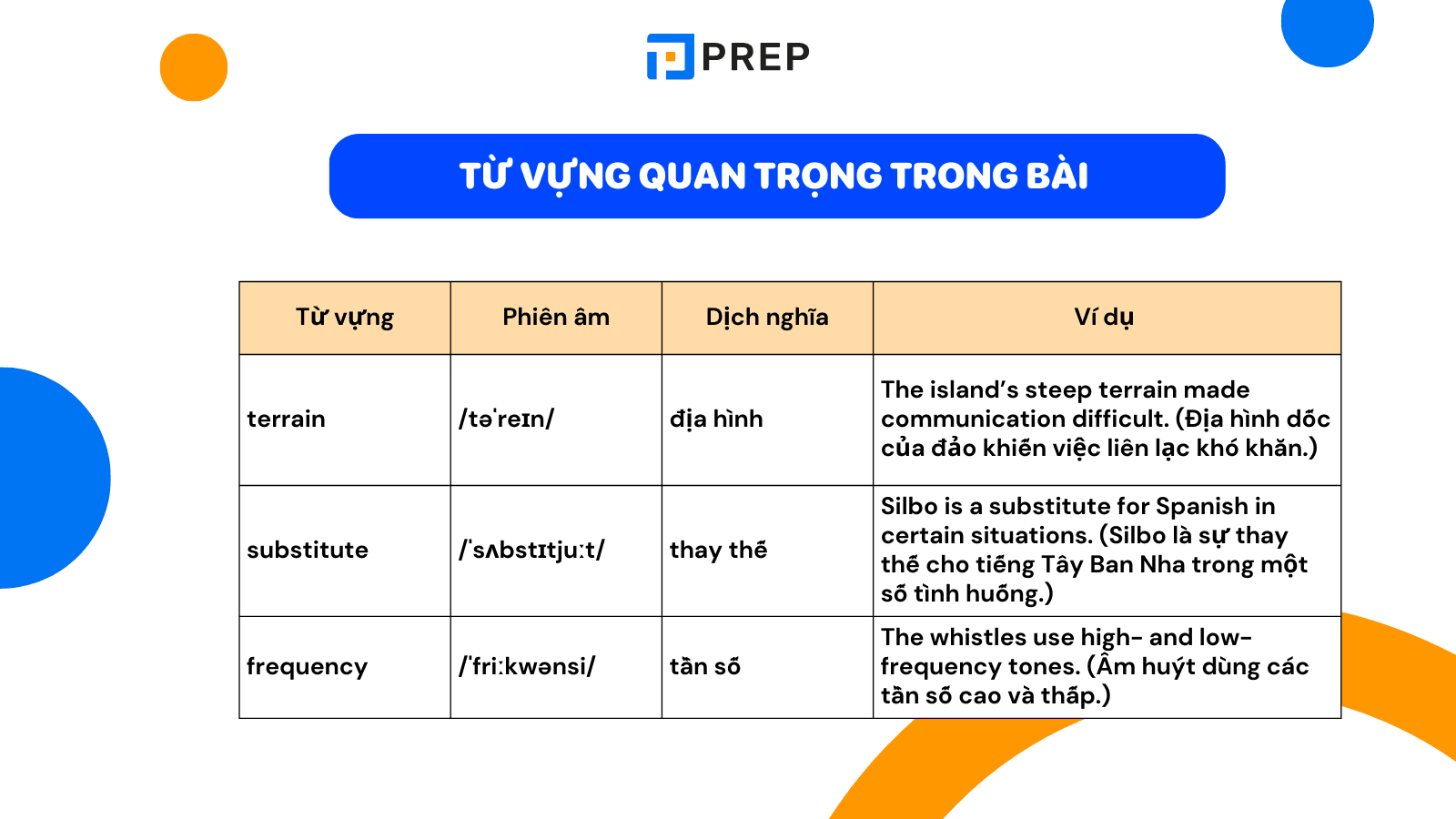
IV. Take note một số từ vựng hay trong bài
|
Từ vựng |
Phiên âm |
Dịch nghĩa |
Ví dụ |
|
terrain |
/təˈreɪn/ |
địa hình |
The island’s steep terrain made communication difficult. (Địa hình dốc của đảo khiến việc liên lạc khó khăn.) |
|
substitute |
/ˈsʌbstɪtjuːt/ |
thay thế |
Silbo is a substitute for Spanish in certain situations. (Silbo là sự thay thế cho tiếng Tây Ban Nha trong một số tình huống.) |
|
frequency |
/ˈfriːkwənsi/ |
tần số |
The whistles use high- and low-frequency tones. (Âm huýt dùng các tần số cao và thấp.) |
|
pitch |
/pɪtʃ/ |
cao độ (âm) |
A whistler puts a finger in the mouth to increase the whistle’s pitch. (Người huýt đặt ngón tay vào miệng để tăng cao độ.) |
|
ambiguity |
/ˌæmbɪˈɡjuːəti/ |
tính mơ hồ, không rõ ràng |
There is more ambiguity in the whistled signal than in the spoken signal. (Tín hiệu huýt có phần mơ hồ hơn lời nói.) |
|
context |
/ˈkɒntekst/ |
ngữ cảnh |
Whistlers rely on repetition and awareness of context to be understood. (Người huýt dựa vào lặp lại và nhận biết ngữ cảnh để được hiểu.) |
|
temporal lobe |
/ˈtempərəl ləʊb/ |
thùy thái dương (não) |
The left temporal lobe was engaged during the processing of Silbo. (Thùy thái dương trái được kích hoạt khi xử lý Silbo.) |
|
activation |
/ˌæktɪˈveɪʃən/ |
sự kích hoạt |
Brain activation differed between whistlers and non-whistlers. (Sự kích hoạt não khác nhau giữa hai nhóm.) |
|
indigenous |
/ɪnˈdɪdʒɪnəs/ |
bản địa |
Indigenous Canary Islanders already had a whistled language. (Người bản địa các đảo Canary đã có ngôn ngữ huýt.) |
|
extinct / extinction |
/ɪkˈstɪŋ(k)t/ /ɪkˈstɪŋkʃən/ |
tuyệt chủng / sự tuyệt chủng |
Modern technology threatens Silbo with extinction. (Công nghệ hiện đại đe dọa Silbo bị biến mất.) |
|
preserve |
/prɪˈzɜːv/ |
bảo tồn |
Authorities aim to preserve Silbo through teaching. (Chính quyền muốn bảo tồn Silbo bằng cách dạy trong trường.) |
|
UNESCO |
/juːˈnɛskoʊ/ |
(Tổ chức) UNESCO |
Locals are seeking assistance from UNESCO. (Người dân địa phương xin hỗ trợ từ UNESCO.) |
|
command |
/kəˈmɑːnd/ |
mệnh lệnh |
They use whistles to communicate short commands across distances. (Họ dùng huýt để truyền mệnh lệnh ngắn qua khoảng cách.) |
Trên đây là đề bài và đáp án kèm giải thích đáp án chi tiết của bài đọc Cambridge IELTS 15 Test 4 Reading passage 2 Untitlsilbo gomeroed. Hy vọng tài liệu trên sẽ giúp bạn ôn luyện IELTS hiệu quả hơn, đạt được band điểm như mong đợi.
Học tiếng Anh online dễ dàng hơn với PREP - Nền tảng Học & Luyện thi thông minh cùng AI. Nhờ công nghệ AI độc quyền, bạn có thể tự học trực tuyến ngay tại nhà, chinh phục lộ trình học IELTS, TOEIC, tiếng Anh giao tiếp hiệu quả. Bên cạnh đó, học viên còn có sự hỗ trợ tuyệt vời từ Teacher Bee AI, trợ lý ảo giúp bạn giải đáp thắc mắc và đồng hành 1-1 trong suốt quá trình học tập.
Hãy click TẠI ĐÂY hoặc liên hệ HOTLINE 0931428899 để nhận tư vấn chi tiết về các khóa học tiếng Anh chất lượng nhất thị trường!
Tải ngay app PREP để bắt đầu hành trình học tiếng Anh tại nhà với chương trình học luyện thi online chất lượng cao.

Chào bạn! Mình là Hiền Hoàng, hiện đang đảm nhận vai trò quản trị nội dung sản phẩm tại Blog của website prepedu.com.
Với hơn 5 năm tự học các ngoại ngữ như tiếng Anh, tiếng Trung và ôn luyện một số kỳ thi IELTS, TOEIC, HSK, mình đã tự đúc rút được nhiều kinh nghiệm để hỗ trợ hàng nghìn người đang gặp khó khăn trong việc học ngoại ngữ. Hy vọng rằng những chia sẻ phía trên sẽ giúp ích cho bạn trong quá trình tự ôn luyện thi hiệu quả tại nhà!
Bình luận
Nội dung premium
Xem tất cả




Lộ trình cá nhân hoá












Có thể bạn quan tâm


Kết nối với Prep





MSDN: 0109817671.
Địa chỉ liên hệ: Tòa nhà Vinaconex, 34 Láng Hạ, phường Láng, TP Hà Nội.
Trung tâm CSKH tại HN: Lô 21 C2 Khu đô thị Nam Trung Yên, phường Yên Hòa, TP Hà Nội.
Trung tâm CSKH tại HCM: 288 Pasteur, Phường Xuân Hòa, TP Hồ Chí Minh
Trụ sở Công ty: Số nhà 20, ngách 234/35 đường Hoàng Quốc Việt, phường Nghĩa Đô, TP Hà Nội.
Phòng luyện ảo - Trải nghiệm thực tế - Công nghệ hàng đầu.
Hotline: 0931 42 8899.
Trụ sở Công ty: Số nhà 20, ngách 234/35 đường Hoàng Quốc Việt, phường Nghĩa Đô, TP Hà Nội.
Giấy chứng nhận hoạt động đào tạo, bồi dưỡng số 1309/QĐ-SGDĐT ngày 31 tháng 07 năm 2023 do Sở Giáo dục và Đào tạo Hà Nội cấp.