IELTS Writing Task 1: Riverpark Map Changes
This guide explains how to approach the IELTS Writing Task 1 map question about the Riverpark area 20 years ago and now. You will learn how to describe major layout changes, organize comparisons logically, write a strong overview, and use precise spatial language to improve your band score.
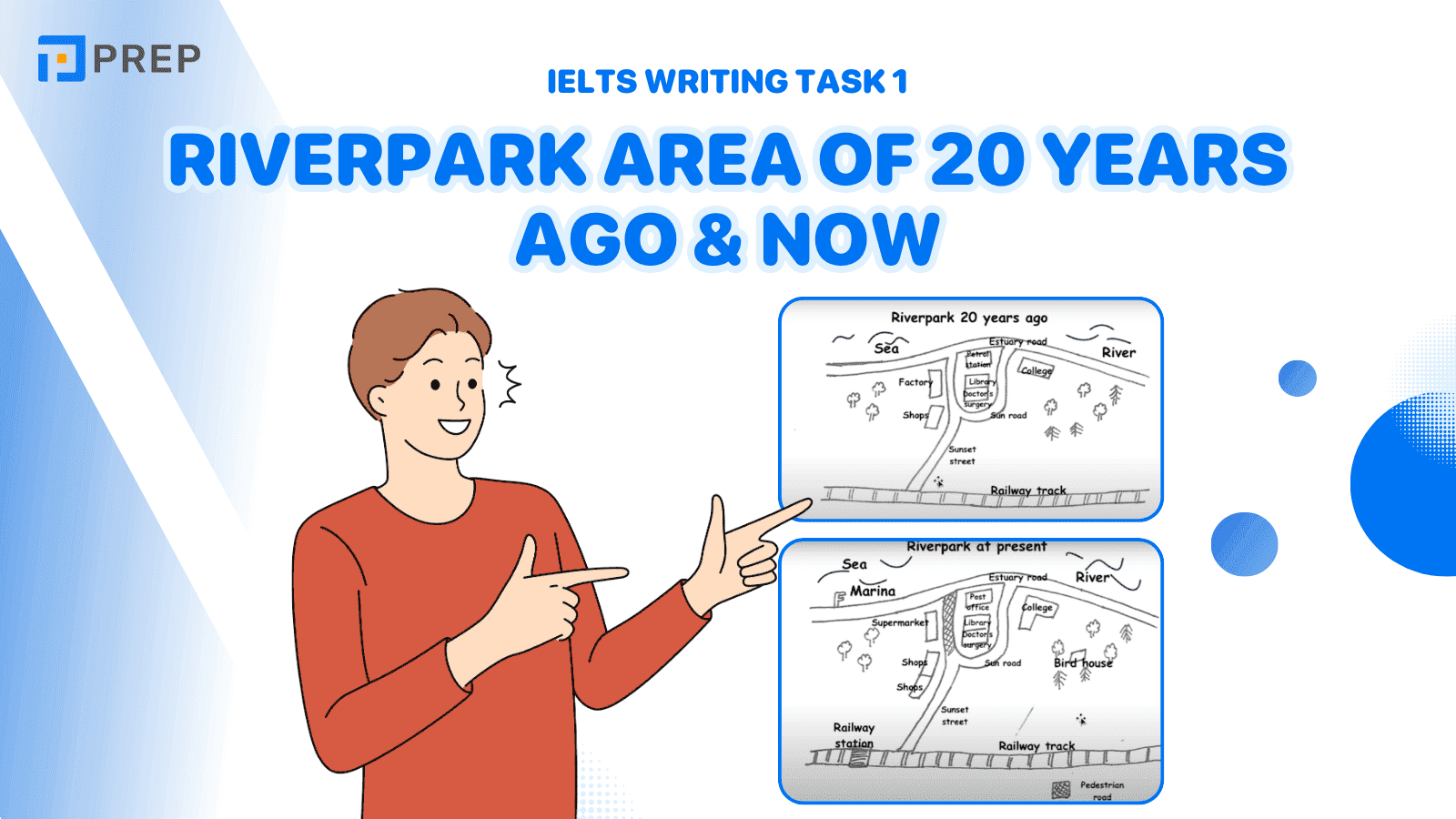
Keynote – Task 1 Quick Guide
Direct Answer: In a map comparison task like this, focus on summarizing the most important changes in the Riverpark area over the 20-year period—such as new buildings, conversions, demolitions, or major shifts in land use—rather than listing every small detail.
Key Points to Remember:
-
Identify the main features that were added, removed, or transformed
-
Use a four-part structure: Introduction, Overview, Body 1, Body 2
-
Group related changes logically (by area, feature, or function)
-
Use clear passive structures and precise language to describe change
-
Keep your writing concise, formal, and focused on summary and comparison
I. What Is This IELTS Writing Task 1 Question Type?
The question “Riverpark area of 20 years ago and now” is a classic IELTS Writing Task 1 map comparison. It presents two diagrams of the same area—one showing how Riverpark looked 20 years ago, and the other showing how it looks today.
In this task, you are required to:
-
Summarize and compare the major physical and functional changes that have occurred in the Riverpark area over the 20-year period
-
Highlight additions, removals, conversions, and unchanged features (such as new buildings, roads, parks, or changes in land use)
-
Identify and report the most significant shifts in layout, use, or function (for example: from residential to commercial, or the creation of new public facilities)
Key elements to identify before writing:
-
Time frames: Distinguish clearly between “20 years ago” and “now”
-
Major changes: Additions, demolitions, repurposing, new categories (e.g., schools, parks, shopping, transport)
-
Landmarks and features: Buildings, roads, green/open spaces, car parks, community or commercial areas
-
Patterns/themes: Has the area become more commercial, more residential, more accessible, or greener?
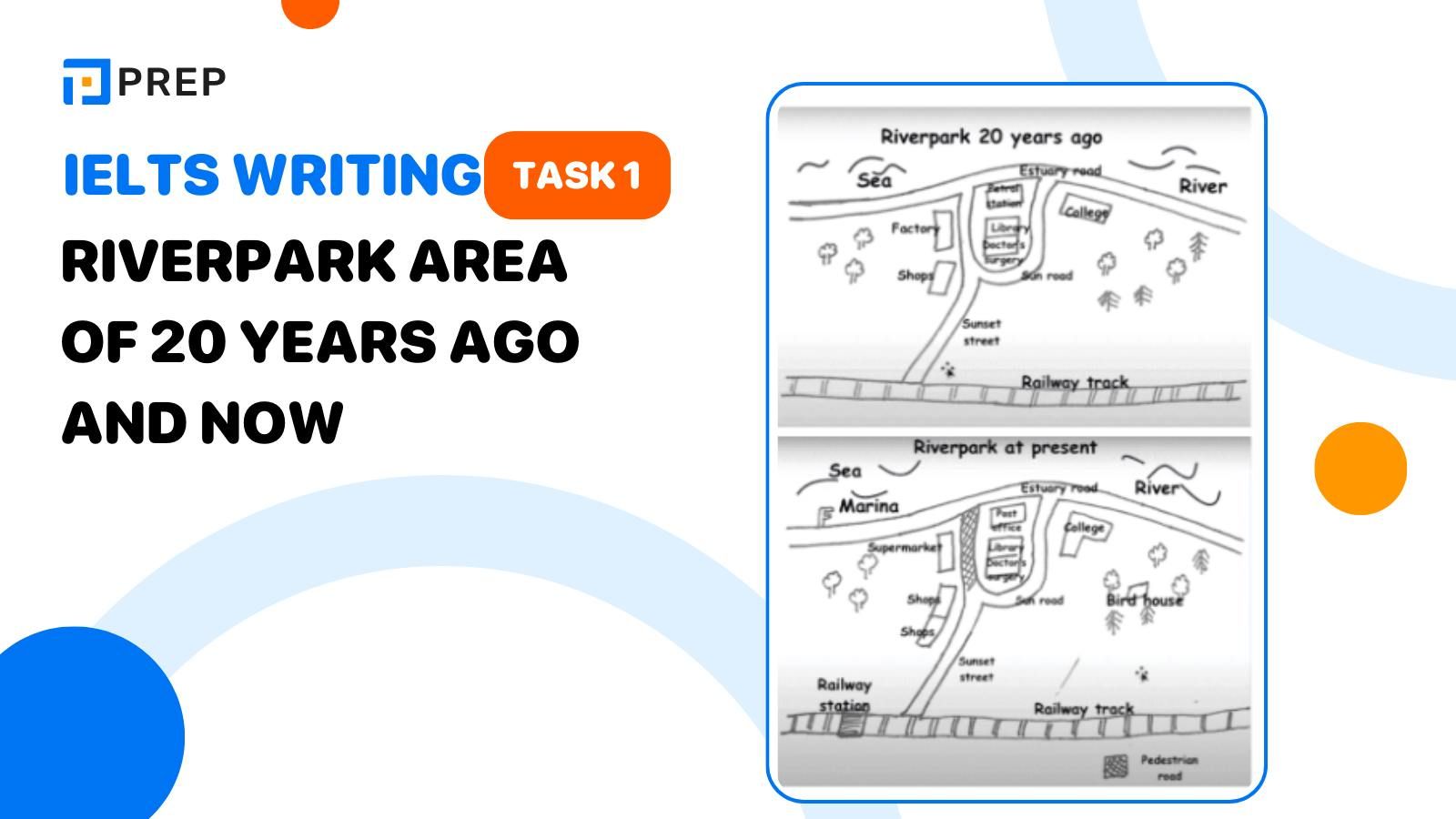
To explore more formats, you should check IELTS writing task 1 question types.
II. Recommended Structure for Task 1
For a map comparison like “Riverpark area of 20 years ago and now,” your answer should be organized into four separate paragraphs.
The standard structure includes:
-
Introduction: Paraphrase the map task and mention the two time points
-
Overview: Summarize the most significant changes and general patterns over the 20-year period. You can improve this section by learning IELTS writing task 1 overview.
-
Body Paragraph 1: Describe the first group of key changes (e.g., major additions, redevelopments, or prominent new features). To structure ideas more clearly, refer to IELTS writing task 1 body paragraph.
-
Body Paragraph 2: Present other changes, such as smaller modifications, features that remained, or details about specific areas
1. Sample Essay on IELTS Writing Task 1 – Riverpark Area of 20 Years Ago and Now
Question:
The maps below show the Riverpark area as it was 20 years ago and as it is now.
Summarize the information by selecting and reporting the main features, and make comparisons where relevant.
Sample Answer:
The two maps illustrate the changes that have taken place in the Riverpark area over the past two decades.
Overall, Riverpark has undergone significant redevelopment, transforming from a mainly residential and green area into a more urbanized space with new commercial and community facilities, improved transport links, and fewer open green areas.
Twenty years ago, Riverpark was characterized by large open fields, several detached houses along the north, and a children’s playground in the southeast. The river ran undisturbed through the center, with only one main bridge connecting the east and west sides.
Currently, most of the open fields have been replaced by apartment blocks, and a shopping center now occupies the eastern bank. The old playground has been converted into a car park, and a new sports center has been built nearby. In addition, a second bridge has been constructed to improve transport, and the river banks have been landscaped with walking paths. The detached houses in the north remain unchanged.
In summary, Riverpark has shifted from a quiet residential zone to a more densely built, mixed-use urban area, focusing on convenience and modern facilities.
Why this essay works well:
-
The introduction paraphrases the question concisely
-
The overview captures the broad trend (redevelopment, urbanization, reduction in open space)
-
Body paragraphs group major changes logically and use comparative language throughout
-
Accurate use of past simple and present perfect/continuous where needed
-
The response is detailed but avoids unnecessary specifics, focusing on key differences

You can review a full band example in IELTS writing task 1 riverpark area of 20 years ago and now sample.
2. Useful Language for This Task Type
For a Task 1 map question like Riverpark area of 20 years ago and now, you should use a range of language that clearly expresses change, position, and comparison. Focus on verbs describing transformation, location language, and structures for before/after contrasts.
This is similar to how you describe changes in describe trends in IELTS writing.
Vocabulary for Describing Change
|
Type of Change |
Useful Phrases |
|
Addition/Development |
"A new [shopping center/apartment/sports facility] was built/constructed/added…" |
|
Removal/Demolition |
"The open field was removed/demolished/cleared…" "The playground has disappeared…" |
|
Conversion/Replacement |
"The playground was converted into a car park…" "Detached houses were replaced by…" |
|
Expansion |
"The area was expanded/enlarged…" |
|
Modernization |
"The riverside was landscaped with walking paths…" "Facilities were modernized…" |
|
Unchanged Features |
"The houses remain the same…" "The river itself was not altered…" |
Vocabulary for Location and Layout
|
Function |
Examples |
|
Directions/Placement |
"to the north," "in the southeast corner," "on the eastern bank," "along the river" |
|
Relation |
"next to," "near," "adjacent to," "opposite," "between" |
|
Layout |
"located in the center," "surrounded by apartment blocks…" |
Comparative Language and Overview Structures
-
"Twenty years ago…, now…"
-
"While the original area had …, the modern layout features…"
-
"The biggest transformation was the addition of…"
-
"Some features, such as…, remained unchanged."
-
"There is now a greater focus on commercial and recreational amenities…"
-
"By contrast, open green space has been reduced…"
Grammar and Style Notes
-
Use past simple or present perfect passive for changes: "was constructed," "has been replaced"
-
Use present simple for features that are still present: "remains," "is located"
-
Use linking words for structure and contrast: "however," "in addition," "while"
-
Be objective and concise; focus on summarizing rather than listing every minor change
III. How This Task Type Is Assessed in IELTS Writing
For map comparison questions like Riverpark area of 20 years ago and now, IELTS Writing Task 1 responses are scored according to four official criteria. Here’s how they specifically apply to this map transformation task:
Task Achievement
-
You must:
Identify and summarize the key physical and functional changes between the two time points.
Highlight the biggest developments (additions, removals, new structures, re-purposed land, or unchanged features).
Provide an effective overview of the most significant changes, not just isolated details. -
Avoid:
Simply listing every single change or feature—select only the most relevant and notable ones.
Coherence and Cohesion
-
Organize your response using a clear four-part structure: Introduction, Overview, Body Paragraph 1, Body Paragraph 2.
-
Group changes logically—for example, first describing major building developments, then changes in outdoor areas.
-
Use linking and comparison language to show transition and relationships:
“While…,” “In contrast…,” “By comparison…,” “Meanwhile…,” “In addition…” -
Don’t mix all details in one paragraph or jump back and forth between time frames.
Lexical Resource
-
Demonstrate a range of vocabulary for:
-
Describing change (“constructed,” “removed,” “converted,” “expanded”)
-
Describing location (“adjacent to,” “in the southeast,” “along the river”)
-
Making comparisons (“whereas,” “while,” “by contrast”)
-
-
Avoid repeating simple words (“big,” “small,” “changed”); use precise alternatives like “extended,” “redeveloped,” or “transformed.”
-
Use objective, formal language (no personal comments or speculation).
Grammatical Range and Accuracy
-
Use a mixture of simple, compound, and complex sentences appropriate for comparisons and descriptions.
-
Use passive voice for changes when the agent is unknown (“A new bridge was built across the river…”).
-
Choose tenses carefully: past simple for features only present 20 years ago, present simple for features that remain, present perfect for changes with present consequences.
-
Ensure accuracy with subject–verb agreement, articles, and prepositions.
A high-scoring Task 1 map essay groups related changes, prioritizes key developments, avoids unnecessary repetition or detail, and uses formal, precise English with clear paragraphing.
To practice more map questions, explore IELTS writing task 1 school in 1985 and now sample.
The article provides the sample IELTS Writing Task 1 Riverpark area of 20 years ago and now compiled by top-tier teachers at PREP. Thoroughly review it to effectively prepare for the exam at home. Wishing you success in achieving your target IELTS Overall band score!

Hi I'm Chloe, and I am currently serving as an Product Content Administrator at Prep Education. With over five years of experience in independent online IELTS study and exam preparation, I am confident in my ability to support learners in achieving their highest possible scores.
Comment
Premium content
View all



Personalized roadmap


Most read




UEN: 202227322W
Address: 114 LAVENDER STREET, #11-83 CT HUB 2, SINGAPORE (338729)