HSK 3 Reading Guide: The 3 Parts, Passing Score, Speed Strategies + Free Practice Tests
Key Takeaways
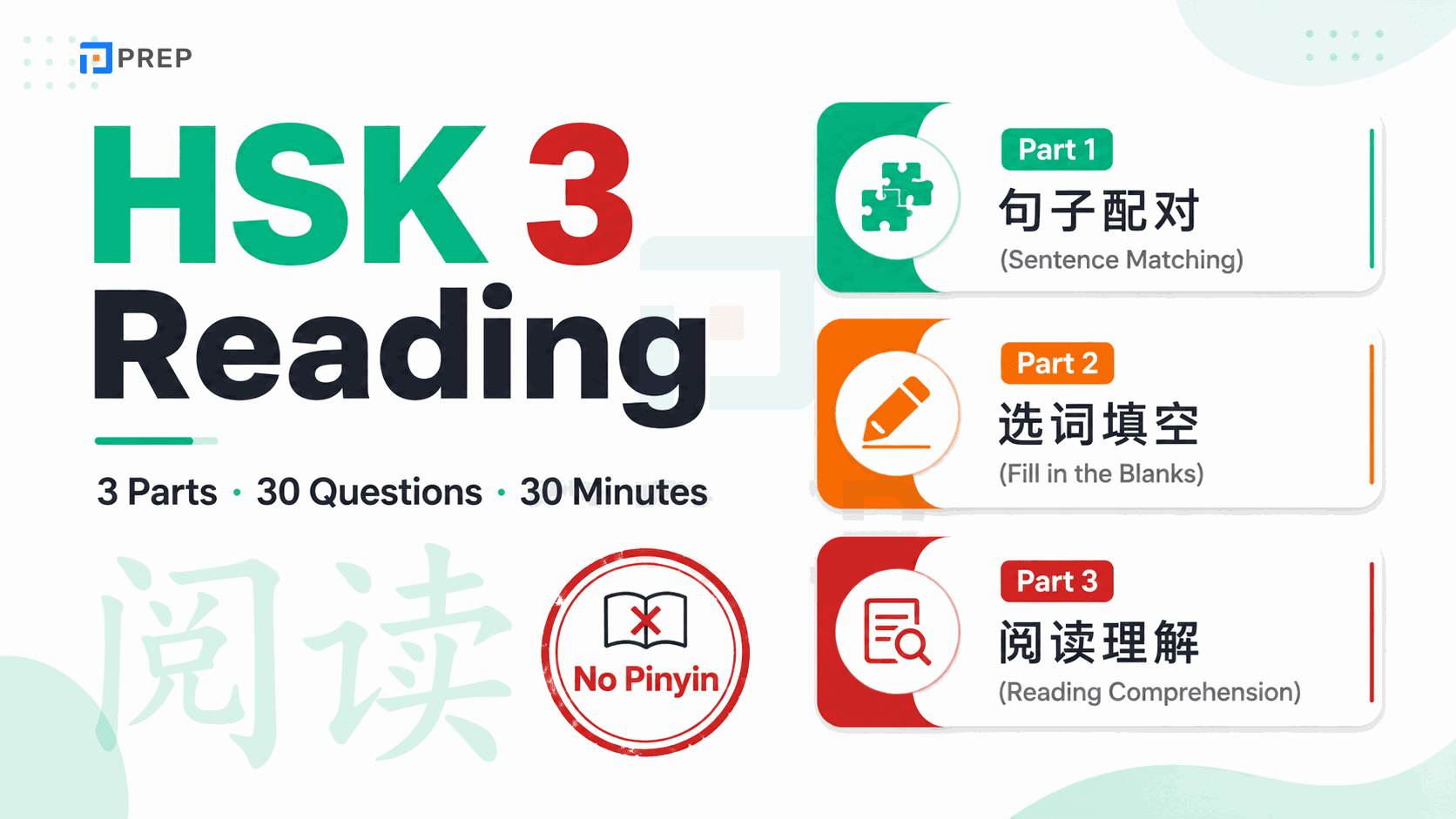
- The HSK 3 reading section has 30 questions across 3 parts and lasts 30 minutes, worth 100 points.
- The three parts are sentence matching (句子配对), fill in the blanks (选词填空), and reading comprehension (阅读理解), 10 questions each.
- HSK 3 removes pinyin, so you read passages and answer options in Chinese characters only, unlike HSK 2.
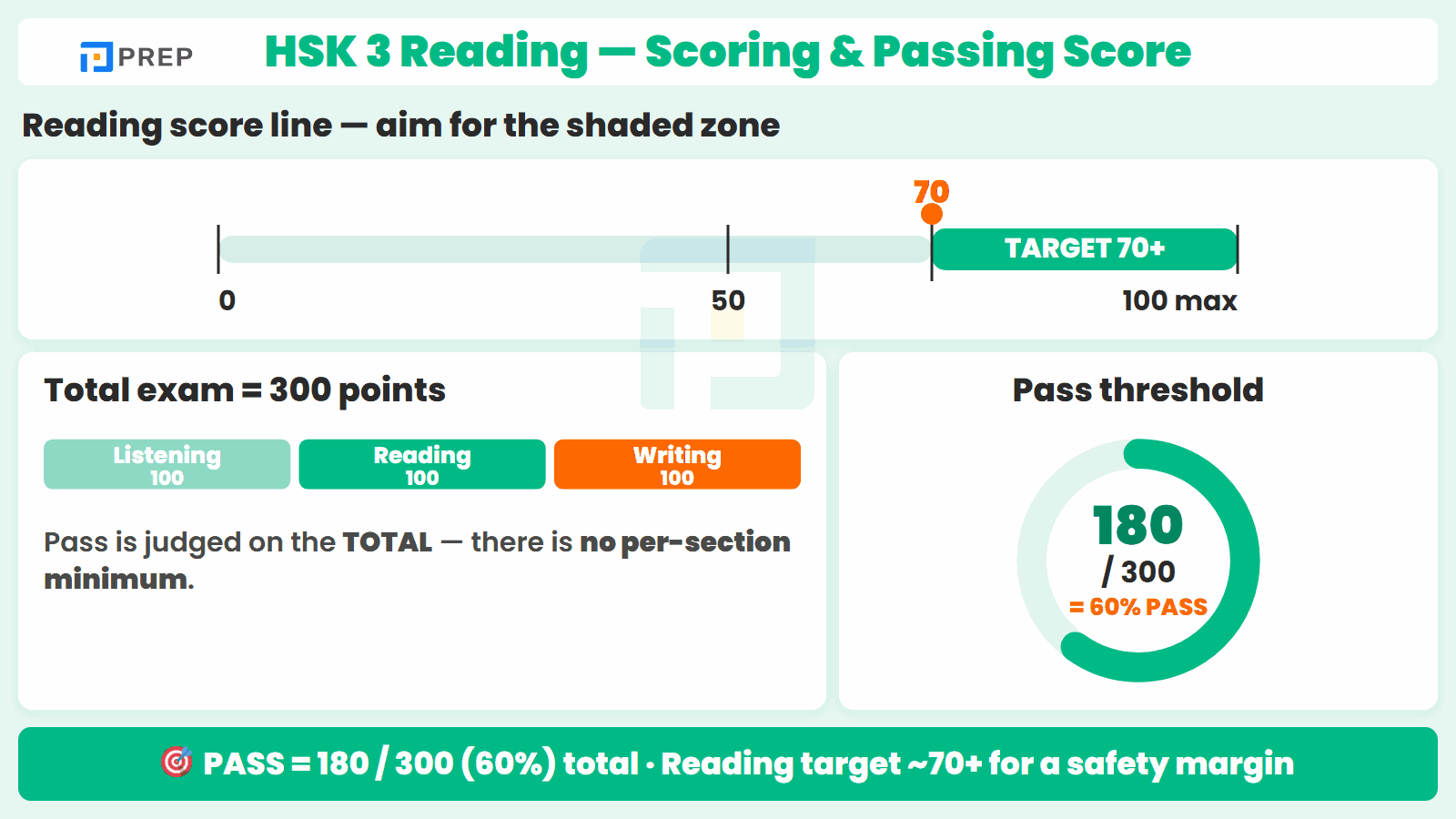
- You pass HSK 3 on a total of 180 out of 300; there is no separate reading minimum, but aim for around 70+ on reading.
- The biggest speed win is reading the question first, then scanning for keywords instead of every character.
- Your foundation is about 600 vocabulary words and 80 grammar patterns, learned by sight.
You passed HSK 2 with pinyin quietly holding your hand. Then you open an HSK 3 reading passage and the pinyin is gone, the clock shows 30 minutes for 30 questions, and every character suddenly asks to be recognised on its own.
So how many questions are in the HSK 3 reading section, and how do you finish them in time? This guide covers the exact format, real sample questions with step-by-step explanations, a mini test you can take right now, speed strategies, how scoring works, and where to find free practice tests and PDFs.
- I. HSK 3 Reading Format: 3 Parts, 30 Questions, 30 Minutes
- II. The Three Reading Parts Explained (With Sample Questions)
- III. Try a Mini HSK 3 Reading Test (No Pinyin, With Answers)
- IV. Reading Strategies to Read Faster and Score Higher
- V. HSK 3 Reading Scoring & Passing Score
- VI. How to Prepare for HSK 3 Reading
- VII. FAQ: HSK 3 Reading
- VIII. Conclusion: Turn HSK 3 Reading Into Your Strongest Section
I. HSK 3 Reading Format: 3 Parts, 30 Questions, 30 Minutes
The HSK 3 reading section (阅读) is the second of the three sections in the HSK 3 exam, after Listening and before Writing. It tests whether you can read short passages written in standalone Chinese characters, with no pinyin, which is exactly where HSK 2 learners feel the biggest jump.
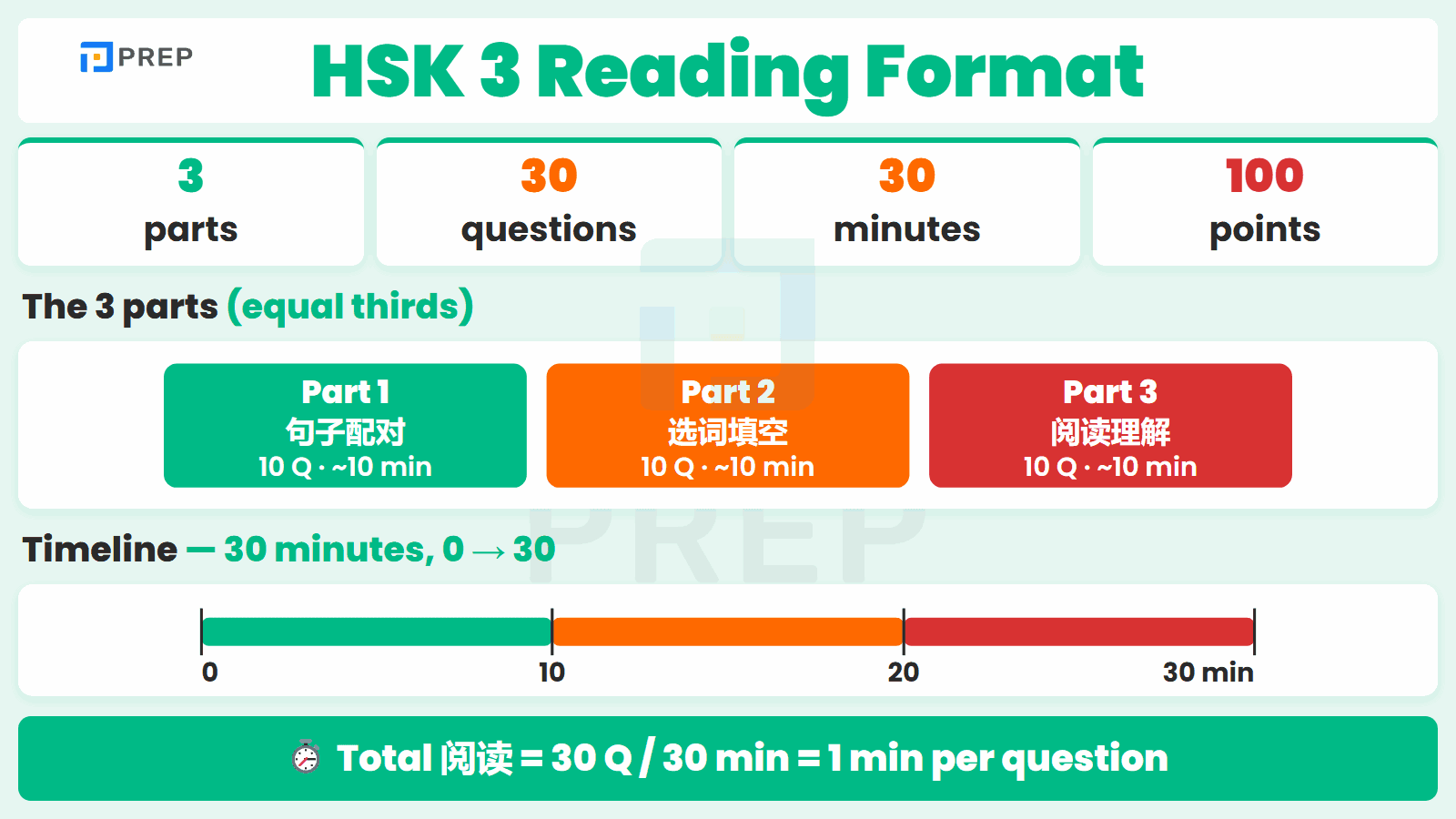
Here is the number that reframes everything: 30 questions in 30 minutes is one minute per question, which turns each part into a roughly 10-minute block you pace yourself.
|
Part |
Chinese name |
Task type |
Questions |
Suggested time |
|
Part 1 |
句子配对 |
Sentence matching |
10 |
~10 min |
|
Part 2 |
选词填空 |
Fill in the blanks |
10 |
~10 min |
|
Part 3 |
阅读理解 |
Reading comprehension |
10 |
~10 min |
|
Total |
阅读 |
Reading section |
30 |
30 min (100 points) |
Two things to note:
- There is no per-part timer on the real exam, so the ~10 minutes each is a self-pacing target you enforce, not a rule the test applies.
- Reading is worth 100 of the 300 total points, so a steady pace across all three parts matters more than perfect accuracy on any single one.
Next, each part gets a real sample question so you can see the format solved, not just described.
II. The Three Reading Parts Explained (With Sample Questions)
Each part below comes with a real sample question and a walk-through, because seeing one item solved teaches the format faster than any description can.
1. Part 1: Sentence Matching (句子配对)
In Part 1 you are given a set of sentences and match each one to the sentence it logically pairs with, usually a question to its answer. It has 10 questions.
Worked example:
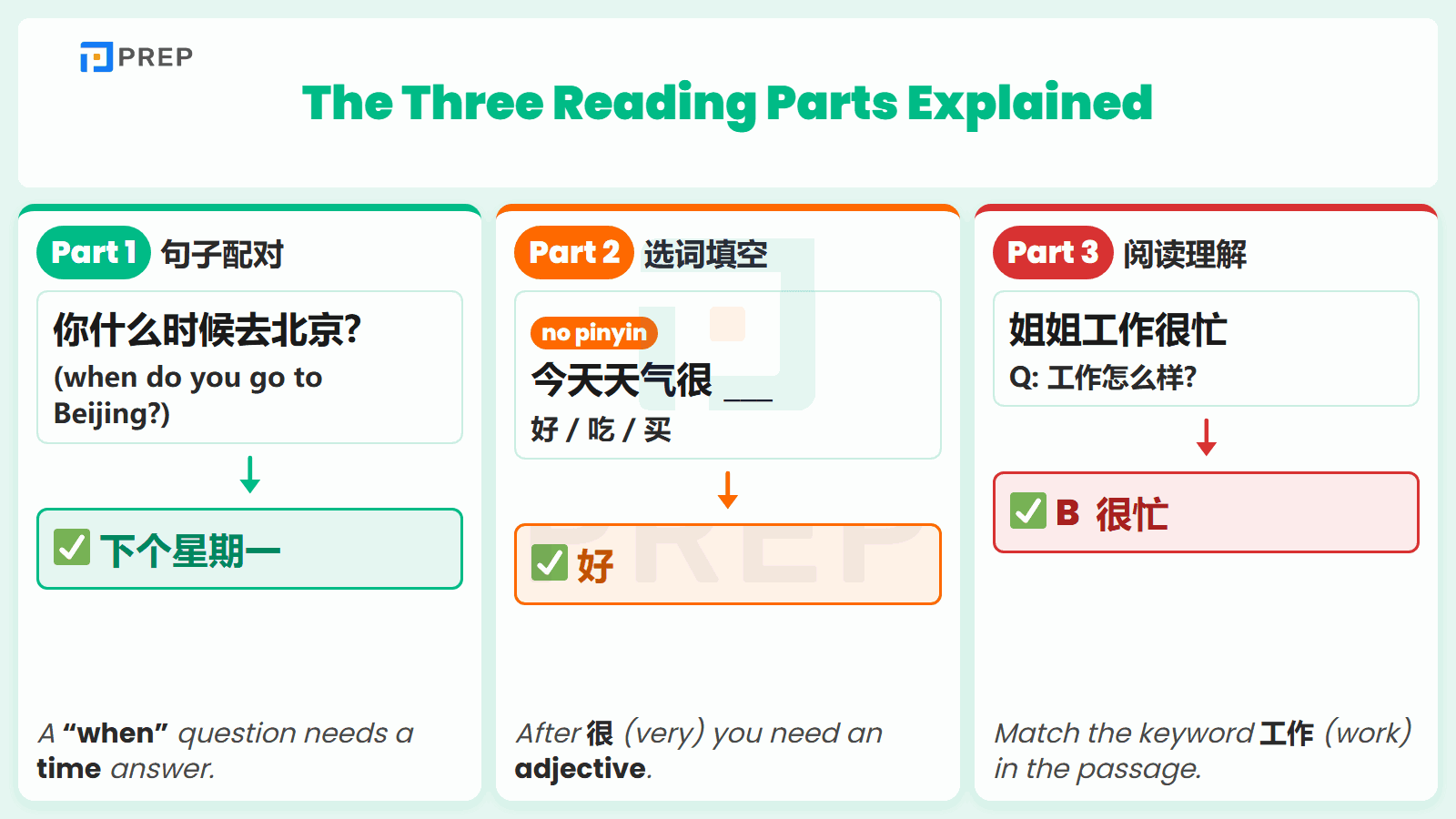
- Stem: 你什么时候去北京? ("When are you going to Beijing?")
- Correct match: 下个星期一。 ("Next Monday.")
- Why: the stem asks 什么时候 (when), so only a time answer fits.
Rule of thumb: read the question word first, then hunt the options for the answer type it demands:
- 什么时候 (when) → a time expression
- 谁 (who) → a person
- 多少钱 (how much) → a number or price
2. Part 2: Fill in the Blanks (选词填空)
In Part 2 you read a sentence with a missing word and choose from five options, and unlike HSK 2, the options are Chinese characters only, no pinyin. It has 10 questions.
Worked example:
- Sentence: 今天的天气很 _,我们出去走走吧。 ("Today's weather is very _, let's go out for a walk.")
- Options: 好 (good) · 吃 (eat) · 买 (buy) · 学习 (study) · 医院 (hospital)
- Answer → 好, the blank follows 很 (very), which needs an adjective, so the verbs and nouns are out; only 好 fits both grammar and meaning.
How to solve, in order: (1) what part of speech does the slot need? (2) which remaining word actually collocates with the sentence?
3. Part 3: Reading Comprehension (阅读理解)
In Part 3 you read a short passage of one to three sentences and answer by choosing one of three options. It has 10 questions.
Worked example:
- Passage: 我姐姐是医生,她每天工作很忙,但是她很喜欢自己的工作。 ("My sister is a doctor. She is very busy every day, but she likes her job.")
- Question: 姐姐的工作怎么样? ("How is the sister's job?")
- Options: A 很轻松 (relaxed) · B 很忙 (busy) · C 不喜欢 (dislikes)
- Answer → B, read the question first, spot the keyword 工作 (job), scan to 工作很忙; the text literally says 很忙.
The passage is short, so the answer is almost always a direct match to a phrase you can point to, not a hidden inference.
III. Try a Mini HSK 3 Reading Test (No Pinyin, With Answers)
This is a 14-question mini test in the real exam style, characters only and no pinyin, covering all three parts so you can feel the actual format before you sit a full 30-question set.
Cover the answer key at the end, give yourself about 12 to 15 minutes, then check every answer against the explanations, the reasoning is what turns practice into improvement.
1. Part 1: Sentence Matching (句子配对)
Match each numbered sentence (1–5) to the lettered sentence (A–E) it pairs with.
1. 你什么时候来我家?
2. 这个字怎么读?
3. 你怎么没吃早饭?
4. 我们坐地铁还是坐公共汽车?
5. 这件衣服多少钱?
- A. 坐地铁比较快。
- B. 因为我起床太晚了。
- C. 一百二十块。
- D. 明天下午三点。
- E. 这个字我也不认识,我们问问老师吧。
2. Part 2: Fill in the Blanks (选词填空)
Choose the correct word from the word bank. Each word is used once.
Word bank: A 电影 B 干净 C 参加 D 一定 E 声音
6. 明天的会议很重要,你 ______ 要来。
7. 他把房间打扫得很 ______ 。
8. 周末我们一起去看 ______ 吧。
9. 他说话的 ______ 很好听。
10. 这次比赛有很多人 ______ 。
3. Part 3: Reading Comprehension (阅读理解)
Read each passage and choose the correct answer (A/B/C).
11. 小李昨天买了一个新手机,但是今天早上他发现手机不能用了,所以他打算下午去商店换一个。
问:小李下午打算做什么? (A 买衣服 B 修电脑 C 去商店换手机)
12. 我家离公司不远,但是每天早上路上车很多,开车要一个小时,坐地铁只要半个小时,所以我每天坐地铁上班。
问:我为什么坐地铁上班? (A 地铁比开车快 B 公司很远 C 我没有车)
13. 王老师告诉学生们,明天下午三点有一个中文考试,大家要早点儿到教室,别迟到。
问:明天下午有什么事? (A 看电影 B 中文考试 C 开会)
14. 这个周末天气很好,我和朋友本来打算去公园跑步,但是我朋友生病了,所以我们没去,只在家里看了电视。
问:他们周末为什么没去公园? (A 朋友生病了 B 天气不好 C 公园太远)
Answer Key & Explanations
|
# |
Answer |
Why |
|
1 |
D |
什么时候 (when) needs a time, and 明天下午三点 (tomorrow at 3 pm) is the only time expression. |
|
2 |
E |
这个字怎么读 (how do you read this character) pairs with 我也不认识,问问老师 (I don't know it either, let's ask the teacher). |
|
3 |
B |
怎么没吃早饭 (why didn't you eat breakfast) asks for a reason; 因为起床太晚 (because I got up too late) gives it. |
|
4 |
A |
坐地铁还是公共汽车 (subway or bus) is answered by 坐地铁比较快 (the subway is faster). |
|
5 |
C |
多少钱 (how much) needs a price, and 一百二十块 (120 yuan) is the amount. |
|
6 |
D 一定 |
你一定要来 (you must definitely come); 一定 is the adverb that fits before 要. |
|
7 |
B 干净 |
After 打扫得很 you need an adjective; 干净 (clean) describes how the room was cleaned. |
|
8 |
A 电影 |
看电影 (watch a movie) is the natural verb-object pair with 看. |
|
9 |
E 声音 |
说话的声音 (the voice of speaking) is the noun the slot needs; 很好听 describes a sound. |
|
10 |
C 参加 |
参加比赛 (take part in a competition) is the verb the sentence needs. |
|
11 |
C |
The passage says 去商店换一个 (go to the store to exchange one), exchange the phone. |
|
12 |
A |
开车要一个小时,坐地铁只要半个小时 shows the subway is faster than driving. |
|
13 |
B |
明天下午三点有一个中文考试 states there is a Chinese exam. |
|
14 |
A |
我朋友生病了,所以我们没去 says the friend got sick, so they did not go. |
If you worked through these in about 12 to 15 minutes without sounding out each character, you are already reading at the pace the section rewards. If the timer felt tight, the strategies next close that gap.
IV. Reading Strategies to Read Faster and Score Higher
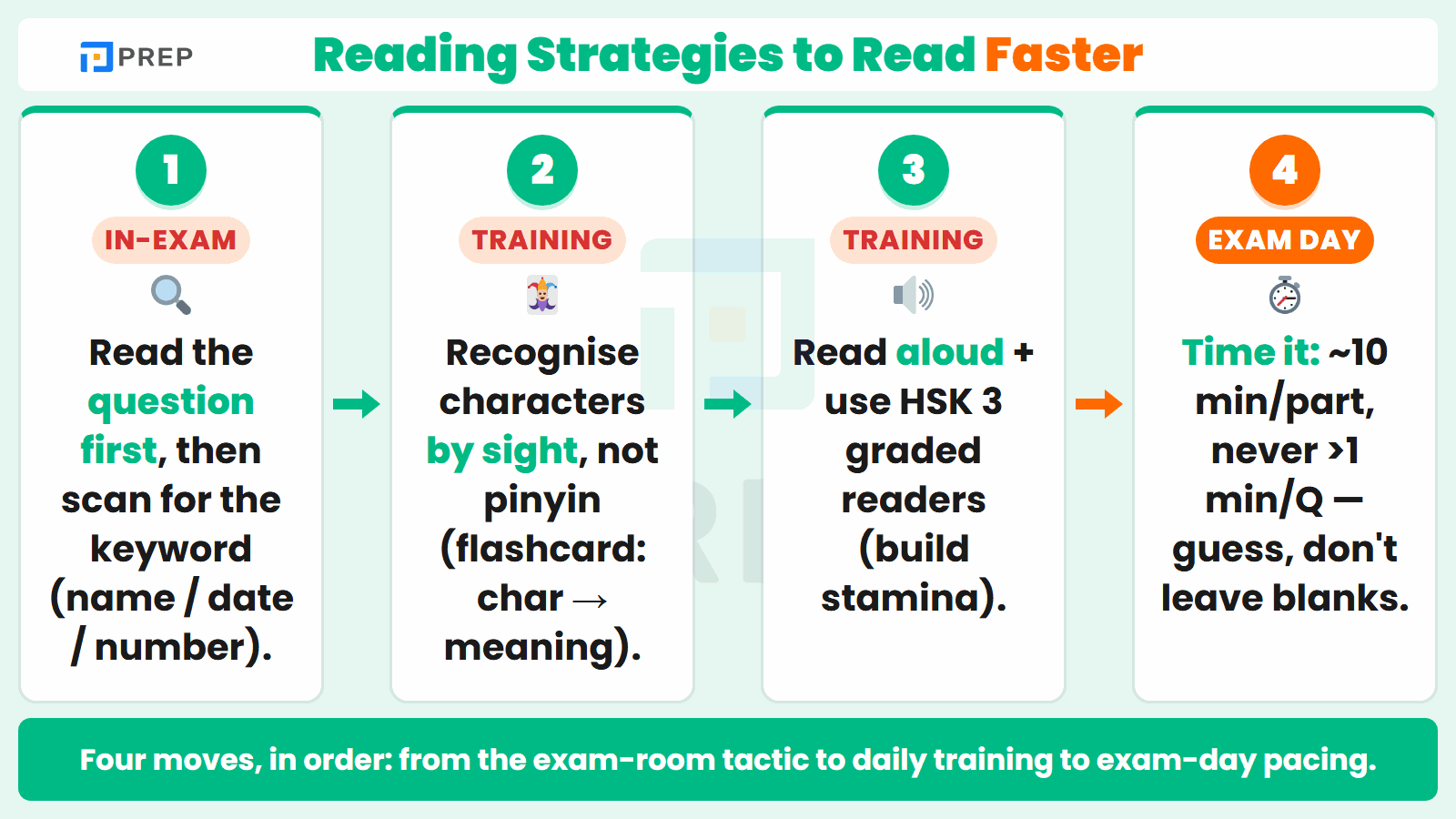
Speed on HSK 3 reading is a system, not a talent. The fix runs in a fixed order: in-exam technique first, then trained reading habits, then exam-day pacing.
1. Read the Question First, Then Scan for Keywords
Read the question first, then scan the passage for its keyword, a name, a date, a number, or a specific noun. Instead of reading top to bottom, your eyes hunt for that one keyword, which is fastest in Part 3's short passages.
The skill is choosing the right keyword to hunt:
- 什么时候 (when) → scan for a time or date
- 谁 (who) → scan for a person
- 多少钱 (how much) → scan for a number
So 他什么时候回家? sends you hunting for a time expression and ignoring everything else until you find it. Close-read only at the answer; skim everywhere else.
2. Recognize Characters, Not Pinyin
Train yourself to recognise characters by sight, not by pinyin. Parts 2 and 3 show no pinyin at all, so drill the roughly 600-word HSK 3 list as character-to-meaning flashcards.
The habit to break is sub-vocalising: seeing 医院, silently saying "yīyuàn," then retrieving "hospital." That extra hop costs seconds on every word under a 30-minute clock.
- Flip your flashcards so the front is the character, the back is the meaning, not the pinyin.
- Learn shared components: once you know 女 signals many people-and-relationship words, recognition speeds up across the whole list.
3. Read Aloud and Use Graded Readers
Reading HSK 3-level material aloud forces you to process every character. Graded readers, books written within a controlled vocabulary level, build the reading stamina the timed exam demands.
- Reading aloud stops your eyes skipping ahead: your mouth cannot fake a character it does not know.
- Choose readers at HSK 3 level, not above, so you know ~90% of the words and read for speed, not decoding.
If you reach for material where you know only half the words, you are back to decoding, the exact habit you are trying to leave behind.
4. Manage Your Time: ~10 Minutes Per Part
Give each part about 10 minutes, and never more than a minute per question.
- If a question stalls you, flag it, guess, and move on, circle back if time allows.
- With 60 seconds left, fill in every blank: HSK 3 has no penalty for wrong answers, so a guess has a chance and a blank has none.
V. HSK 3 Reading Scoring & Passing Score
Here is the nuance most learners get backwards: there is no minimum score for reading on its own. You pass HSK 3 on the 180-out-of-300 total, so "a good reading score" is a target you set, not a gate the exam enforces.
|
Metric |
Value |
Notes |
|
Reading max points |
100 |
One of three scored sections |
|
Total exam max |
300 |
Listening 100 + Reading 100 + Writing 100 |
|
Passing score |
180 / 300 (60%) |
Based on the total, not any single section |
|
Per-section minimum |
None |
Only the combined 180 total matters |
|
Recommended reading target |
~70+ |
Leaves a safety margin toward 180 |
Because there is no per-section floor, a weak reading score can be offset by strong listening or writing (and vice versa).
Still, aim for around 70+ on reading, it is the section you can most reliably improve with practice, and a solid score takes pressure off the other two. That improvability is exactly why a focused prep routine pays off, so here is where to find it.
VI. How to Prepare for HSK 3 Reading
This is your one-stop prep hub: legitimate sources, sequenced into a simple plan, not the scattered, sometimes pirated PDFs floating around search results.
Resources fall into three tiers (free online tests, the official workbook, and readers/apps/AI tools), followed by a three-phase study plan that puts them in the right order. Stick to official and reputable sources so your practice matches the real exam.
1. Free Online Reading Practice Tests
You can practise HSK 3 reading free using online mock-test tools. The good ones present all three parts and score you automatically. When you choose one, look for two things:
- Timed to 30 minutes, so you rehearse the real pacing.
- Answer keys with explanations, not just a right-or-wrong score, so you learn why a distractor was wrong.
A test that scores you but never explains teaches you very little. Treat every free mock as a pacing rehearsal, not just an accuracy check.
2. Official Workbook & Answer Keys (PDF)
The official HSK Standard Course 3 workbook is the most reliable source of reading exercises, and its answer keys are available as PDFs from the publisher and legitimate sellers.
Get them from a legitimate source: pirated PDF dumps often mislabel answers or drop pages, and a wrong answer key quietly teaches you the wrong thing. Pay for or borrow the official version, and you know the answers you check against are correct.
3. Graded Readers, Apps & AI Tools
Three categories help most between mock tests:
- HSK 3 graded readers, level-matched books you read for pleasure and speed, building stamina.
- Flashcard and spaced-repetition apps, drill the 600-word list as character-to-meaning so words register on sight.
- AI practice tools, read and speak, pairing recognition with production.
Saying a word aloud cements the character faster than silent review. You can also practise Chinese with AI that scores your pronunciation on initials, finals, and tones, and Prep's HSK tools are launching soon.
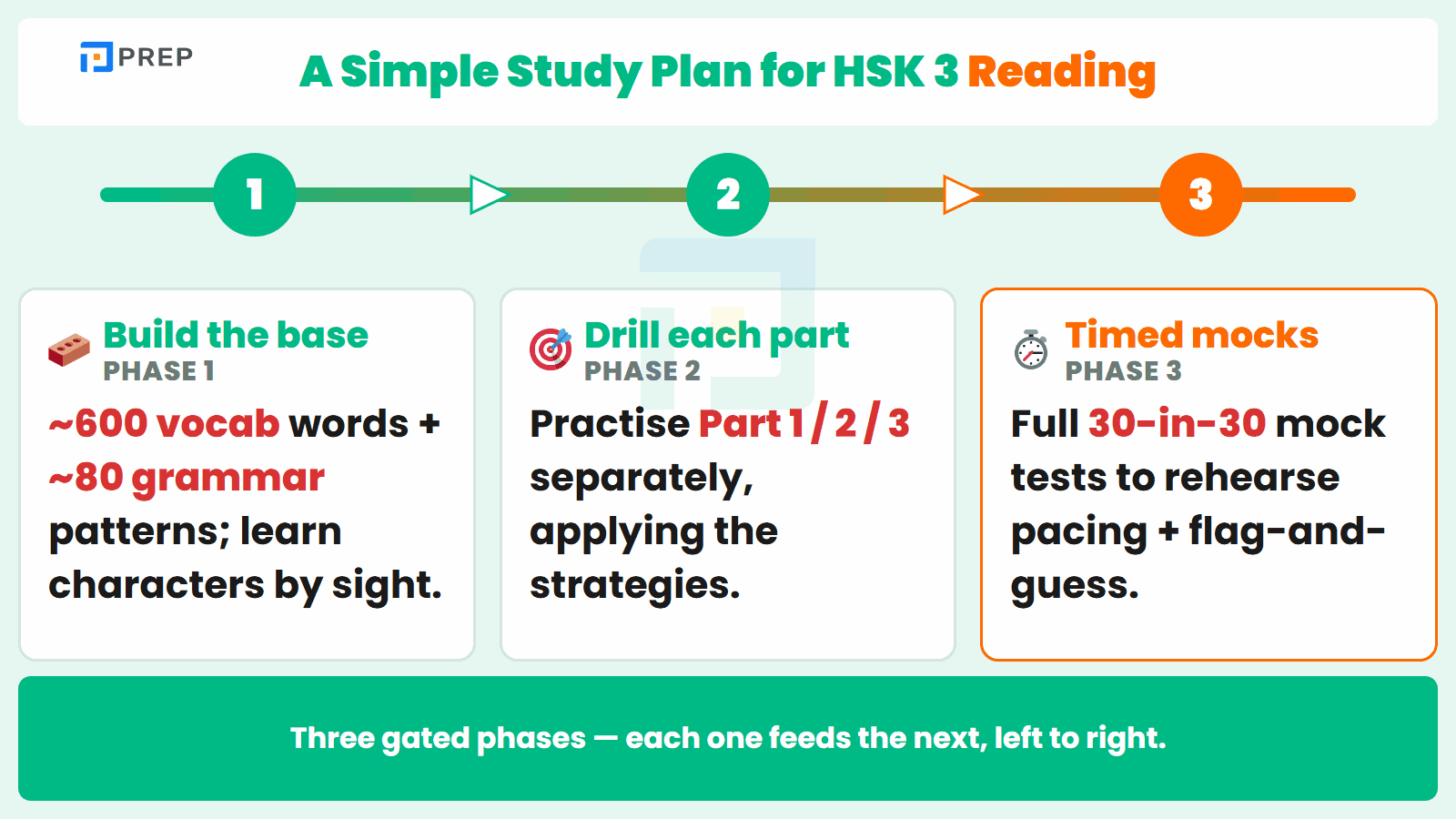
4. A Three-Phase Study Plan
The order matters more than the content: you cannot drill reading speed on characters you cannot yet read. Jumping straight to full mock tests before your vocabulary is solid is the most common way learners waste weeks.
- Phase 1: Build the base. Learn the ~600 HSK 3 words and ~80 grammar patterns, as characters by sight, not pinyin. Know ~600 words on sight and most passages become readable.
- Phase 2: Drill each part. Practise Part 1, Part 2, and Part 3 separately, applying the strategies above. Isolating each type fixes its specific weakness.
- Phase 3: Timed mock tests. Only now run full 30-in-30 mocks, so you rehearse pacing and get used to flagging-and-guessing.
Use the strategies from Section IV inside Phases 2 and 3, and the practice sources above to supply the material.
VII. FAQ: HSK 3 Reading
Quick answers to the questions learners ask most, each consistent with the numbers above.
1. How many questions are in the HSK 3 reading section?
The HSK 3 reading section has 30 questions in total, split evenly across three parts of 10 each: sentence matching, fill in the blanks, and reading comprehension. You have 30 minutes, about one minute per question.
2. Does HSK 3 reading still have pinyin?
No. The HSK 3 reading section does not show pinyin. You read passages and options in Chinese characters only, the main change from HSK 2. This is why building sight-recognition of characters is the single most useful thing to train.
3. What is a good HSK 3 reading score?
There is no separate passing score for reading alone, you pass HSK 3 on a total of 180 out of 300. Aiming for around 70+ out of 100 on reading gives you a comfortable margin toward that total.
4. How long is the HSK 3 reading section?
The HSK 3 reading section lasts 30 minutes, about one minute per question across 30 questions. There is no separate per-part timer, so pace yourself at roughly 10 minutes per part.
5. How many words do I need to know for HSK 3 reading?
HSK 3 covers about 600 vocabulary words, roughly 300 new ones on top of HSK 1 and 2, and knowing them by sight is what makes reading manageable. Pair them with the ~80 HSK 3 grammar patterns and most passages become readable at speed.
VIII. Conclusion: Turn HSK 3 Reading Into Your Strongest Section
HSK 3 reading can become your strongest section, not your weakest. Know the three-part format, read questions first instead of every character, and practise with timed mock tests. The biggest single win is training character recognition so the missing pinyin stops slowing you down.
Your next step is simple: take one timed mock today to feel the 30-in-30 pace, and drill the HSK 3 vocabulary list by sight. Do that, and the section that felt like a wall becomes the one that carries your score.

Hi I'm Chloe, and I am currently serving as an Product Content Administrator at Prep Education. With over five years of experience in independent online IELTS study and exam preparation, I am confident in my ability to support learners in achieving their highest possible scores.
Comment
Premium content
View all


Personalized roadmap


Most read


UEN: 202227322W
Address: 114 LAVENDER STREET, #11-83 CT HUB 2, SINGAPORE (338729)