IELTS Writing Task 1 Map: Complete Guide
This guide explains how to approach IELTS Writing Task 1 map questions effectively. You will learn how to identify key changes, write a strong overview, organize body paragraphs logically, and use accurate spatial language to describe developments over time and improve your band score.
Keynote – Task 1 Quick Guide
In IELTS Writing Task 1 map questions, your goal is to describe changes in layout, structure, or development clearly and logically, focusing on major transformations rather than minor details.
Key Points to Remember
-
Always identify whether the map shows:
-
Changes over time
-
A proposed future plan
-
A comparison between two layouts
-
-
Focus on:
-
Major structural changes
-
Additions, removals, relocations
-
Overall development trends
-
-
Use correct tense:
-
Past tense for historical changes
-
Present tense for static comparisons
-
Future structures for proposed plans
-
-
Group changes logically:
-
By area (north/south/center)
-
By type of change (added, removed, replaced)
-
-
Avoid:
-
Listing every small detail
-
Writing personal opinions
-
Forgetting the overview paragraph
-
I. What Is This IELTS Writing Task 1 Question Type?
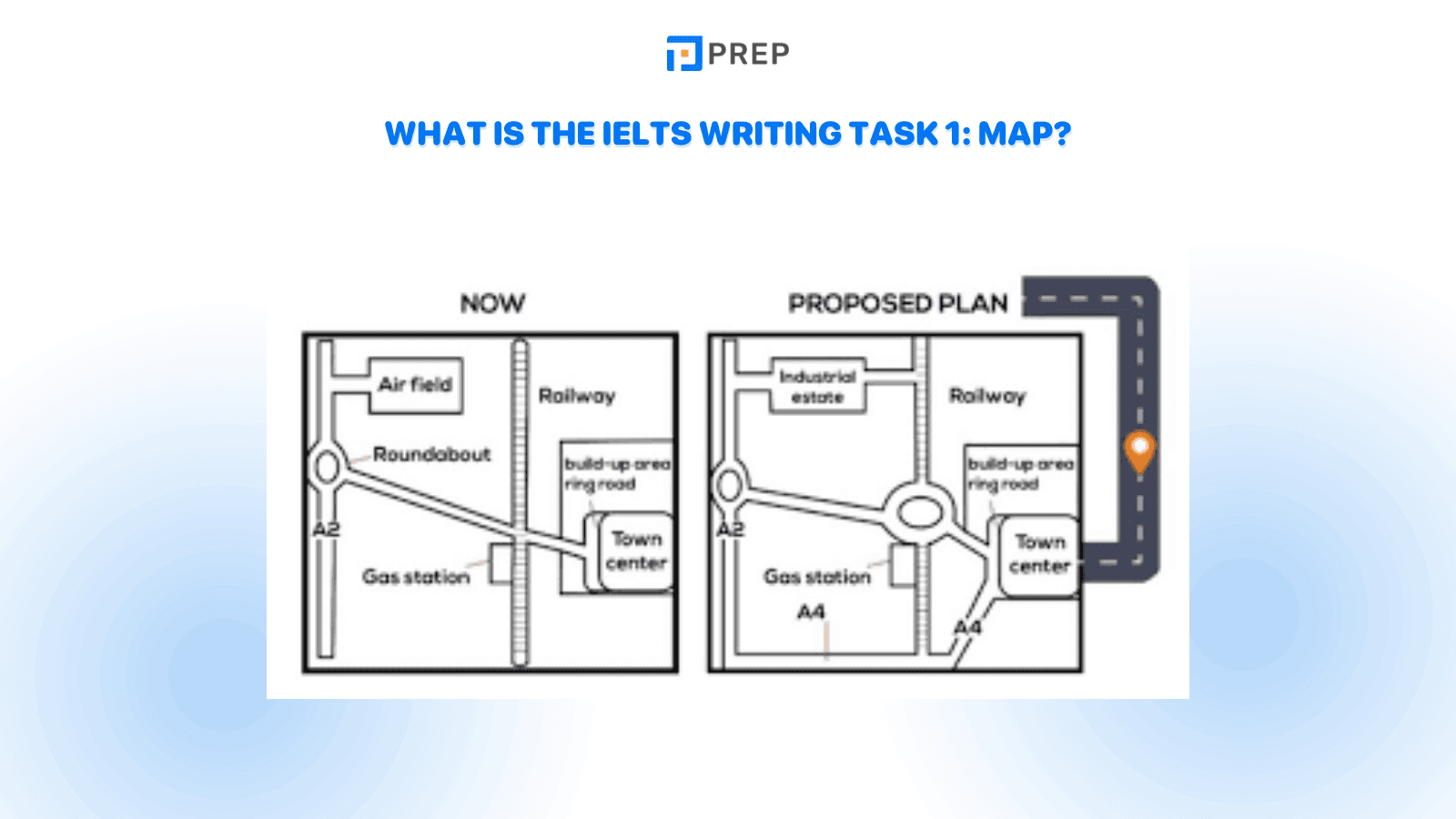
Map questions in IELTS Writing Task 1 present visual diagrams showing a place at two or more different points in time (e.g. before and after development, or comparing a town in the past and present). Sometimes, you might be asked to compare two separate maps from different years or situations.
In this task, you are required to:
-
Describe changes to locations, buildings, roads, and facilities over time
-
Compare differences and similarities between maps
-
Highlight major developments, removals, additions, and unchanged features
Unlike line or bar charts, which focus on quantities and trends, map questions focus on physical and spatial change. Instead of numbers, you describe what was added, removed, replaced, or remained the same in a location.
Key elements to identify before writing:
-
Time frames: past, present, future, or specific years for each map
-
Key locations and landmarks
-
Types of changes: removal, addition, expansion, conversion, new infrastructure
-
Major differences and any parts that stayed unchanged
Being able to spot and group the biggest changes is the first step to a high-scoring answer for IELTS Writing Task 1 map questions.
To understand how this task fits into the exam, see IELTS writing task 1 question types.
II. Recommended Structure for Task 1
To achieve a high band score for IELTS Writing Task 1 map questions, you should use a simple four-part structure. This helps you organize your ideas, summarize the most important changes, and present details logically and coherently.
-
Introduction: Paraphrase the task and introduce the maps. You can improve this step with IELTS writing task 1 introduction.
-
Overview: Summarize the main changes or key developments without detailing every change. For a detailed guide, refer to IELTS writing task 1 overview.
-
Body Paragraph 1: Describe the first set of developments. For better organization, see IELTS writing task 1 body paragraph.
-
Body Paragraph 2: Describe the remaining changes, other key areas, or features that stayed the same

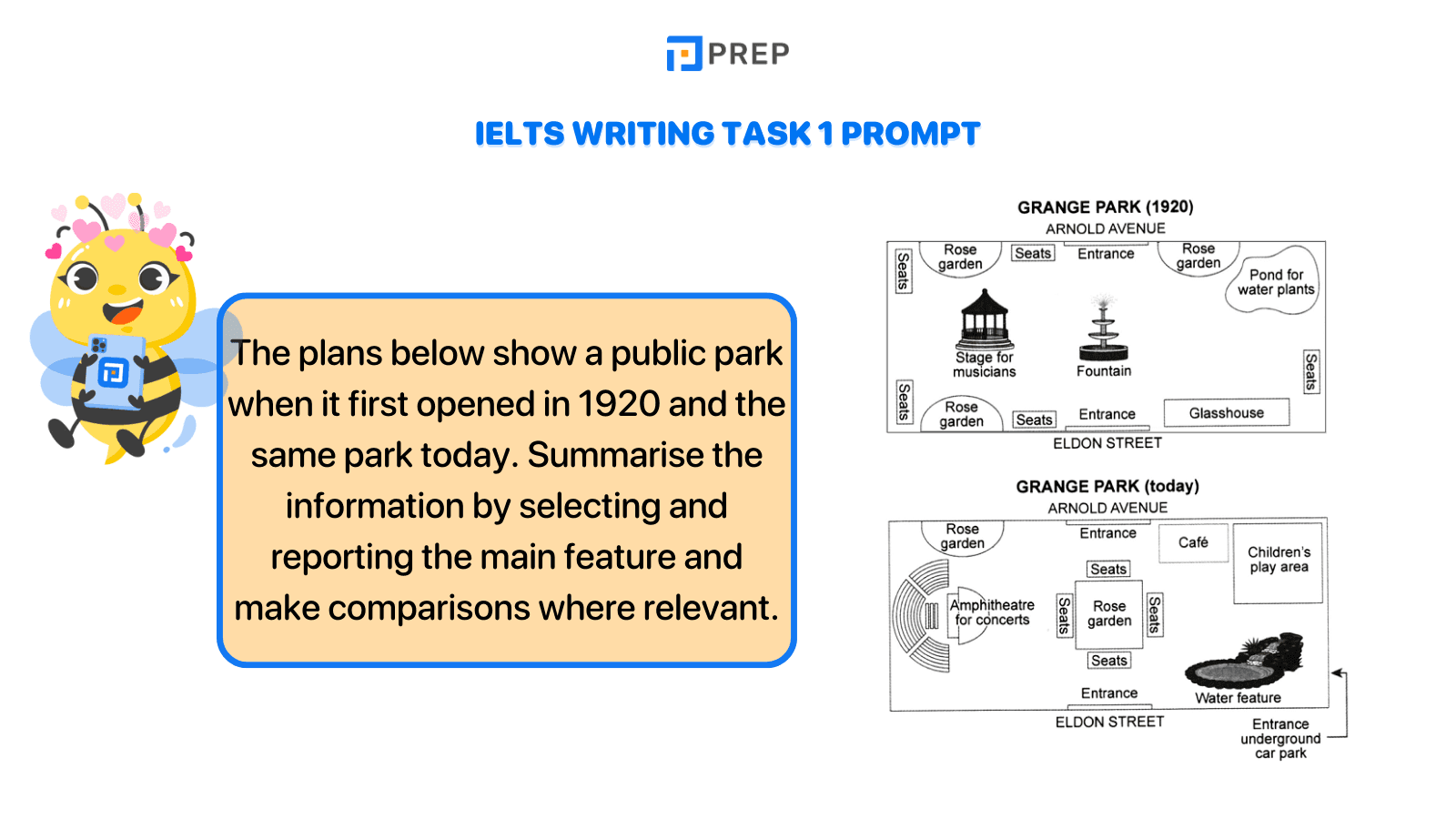
1. Sample Essay on IELTS Writing Task 1 – Map
Question:
The maps below show the center of a small town before and after redevelopment.
Summarize the information by selecting and reporting the main features, and make comparisons where relevant.
Sample Answer:
The two maps illustrate how the central area of a small town changed after redevelopment.
Overall, the area became significantly more modernized and accessible, with the introduction of new infrastructure and removal of some older features. The most notable changes include the construction of a new road system, the addition of a shopping mall, and the transformation of a park area.
Before redevelopment, the town center had a main road running east to west, surrounded by residential houses, a park, and a post office. After redevelopment, the old road was replaced by a circular road providing better access to different areas. A large shopping mall was built in the eastern part, replacing several houses. The park was converted into an open square with trees and benches. The post office remained, but the school in the north was replaced by a parking lot.
In summary, the redeveloped town center became more commercially oriented and convenient, with improved transport links and modern facilities.
Why this essay works well:
-
Introduction paraphrases the prompt clearly
-
Overview summarizes the big changes (modernization, accessibility, commercial focus)
-
Body paragraphs group details by area and change type
-
Comparative language is used to show before–after changes
-
The writing is logical, uses precise vocabulary, and separates detail from summary
For more practice, refer to this IELTS writing task 1 sample.
2. Useful Language for This Task Type
When writing about map questions in IELTS Writing Task 1, it’s crucial to use vocabulary and structures that clearly describe change, location, and comparison. You should avoid vague expressions and focus on formal, accurate language.
Vocabulary for Describing Changes
|
Type of Change |
Useful Phrases |
|
Addition |
“A new [building/road] was built/constructed/added…” “The area now includes…” |
|
Removal |
“The [supermarket] was demolished/removed/disappeared…” “[Houses] were knocked down…” |
|
Conversion/Replacement |
“The park was converted into a car park…” “[X] was replaced by [Y]…” |
|
Expansion |
“The [mall] was extended/enlarged…” “The road network was expanded…” |
|
Unchanged Features |
“The [post office] remained unchanged…” “No changes were made to [X]…” |
Vocabulary for Location and Position
|
Function |
Examples |
|
Directions |
north (of), to the south, to the east/west, in the northwest corner |
|
Relative Position |
next to, adjacent to, opposite, between, in front of, behind |
|
Describing Layout |
“Located at the center of the map…” “Along the main road…” |
Language for Comparison and Overview
-
“Before redevelopment, … / After redevelopment, …”
-
“The biggest change was the addition of…”
-
“While [X] remained unchanged, [Y] underwent significant alteration.”
-
“The town became more commercial/residential/accessible as a result of…”
Useful Tenses & Structures
-
Past simple for describing what existed “before”
-
Present perfect/passive for describing changes: “has been built,” “was replaced,” “has disappeared”
-
Structures: “used to be,” “was transformed into…”
To expand your range, explore learn IELTS writing vocabulary.
III. How This Task Type Is Assessed in IELTS Writing
Writing about maps in IELTS Task 1 is assessed using the same four official criteria as other Task 1 question types. However, this task places special emphasis on your ability to track changes, organize information spatially, and summarize the transformation of a location.
Task Achievement
-
You need to clearly select, summarize, and compare the main changes between maps.
-
Give a balanced overview of what has changed and what has stayed the same.
-
Avoid listing every small detail or describing the maps room-by-room; focus on key developments.
-
Use appropriate verb tenses (mostly past simple and passive forms).
Coherence and Cohesion
-
Use a logical structure: Introduction, Overview, Body Paragraph 1, Body Paragraph 2.
-
Organize information by area, change type, or time period (before/after).
-
Employ linking phrases for contrast and sequence: “while,” “in contrast,” “prior to,” “after redevelopment.”
-
Group similar changes together to make your answer easier to follow.
Lexical Resource
-
Demonstrate a range of accurate vocabulary for describing addition, removal, conversion, and location.
-
Use prepositions of place and direction precisely (e.g., “to the west of the park,” “adjacent to the river”).
-
Avoid basic word repetition (“make,” “do,” “made”). Use verbs specific to change: “converted,” “extended,” “transformed,” “retained.”
-
Don’t use informal or conversational expressions.
Grammatical Range and Accuracy
-
Use passive forms and a mix of simple/complex structures: “A school was built,” “The area was transformed into a shopping center.”
-
Use past simple and present perfect passives appropriately (e.g., “has been built,” “was replaced”).
-
Use comparative structures for changes: “became larger than,” “replaced the original structure.”
-
Maintain subject–verb agreement and careful use of articles.
Map questions assess your skill in summarizing visual and spatial changes concisely and accurately. The best answers are those that group related changes, make logical comparisons, and avoid unnecessary detail or repetition.
This article has provided detailed insight into IELTS Writing Task 1: Map. Hopefully, the knowledge shared by PREP above will be truly helpful for all of you, Preppies. If you need quick and effective results, PREP’s intensive IELTS course will help you achieve success faster.
-
IELTS learning: Unlock Your IELTS Success Story.

Hi I'm Chloe, and I am currently serving as an Product Content Administrator at Prep Education. With over five years of experience in independent online IELTS study and exam preparation, I am confident in my ability to support learners in achieving their highest possible scores.
Comment
Premium content
View all



Personalized roadmap


Most read




UEN: 202227322W
Address: 114 LAVENDER STREET, #11-83 CT HUB 2, SINGAPORE (338729)