HSK 2 Guide (2026): Exam Format, Vocabulary, Grammar, Resources & How to Pass
Key Takeaways
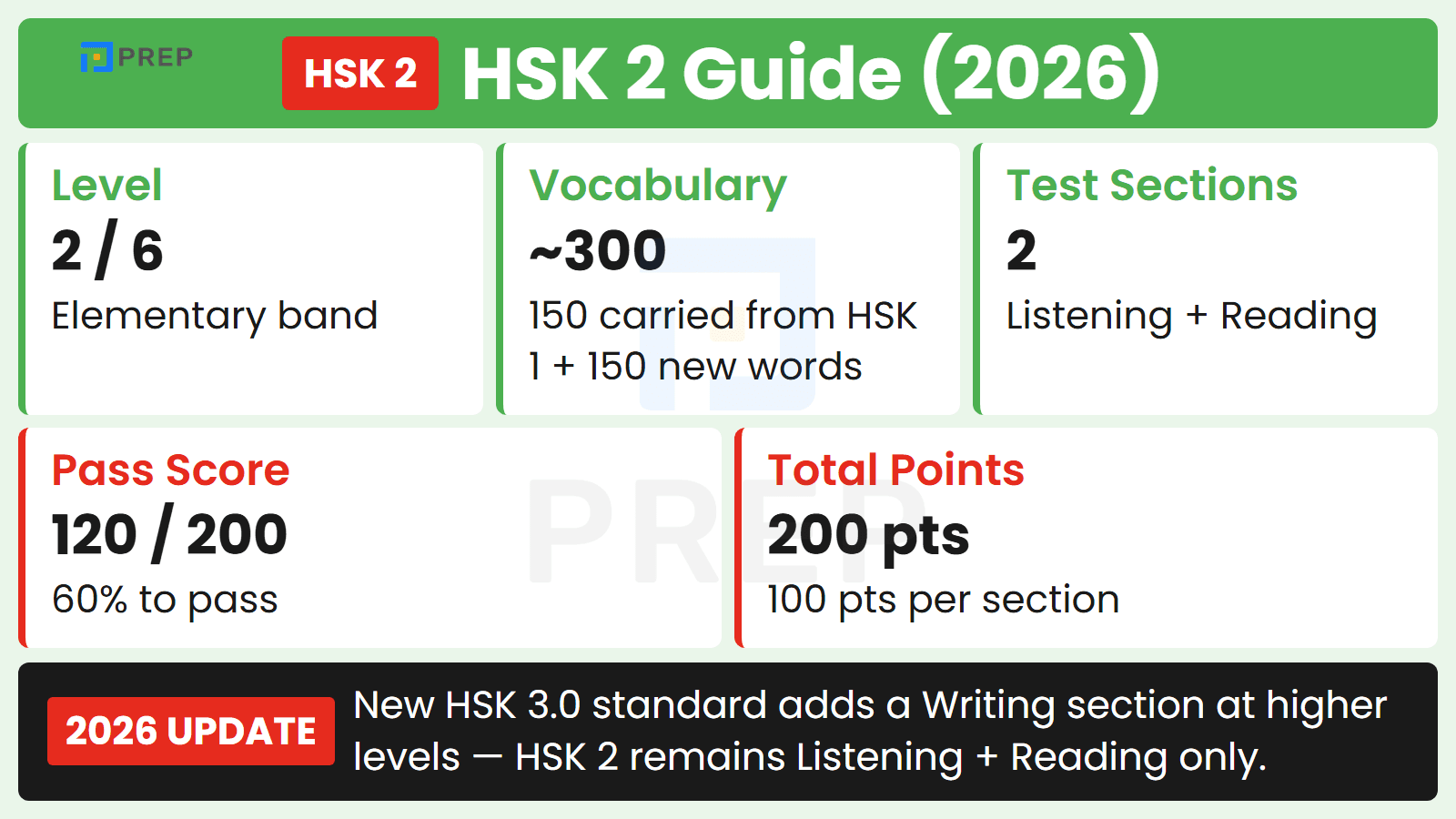
- HSK 2 is the second of six HSK levels, an elementary exam built around 300 words (150 carried from HSK 1 plus 150 new).
- The test has two scored sections, Listening and Reading, and you pass with 120 of 200 points combined.
- HSK 2.0 has no speaking or writing; the new HSK 3.0 adds a handwriting section at Level 2 for the first time.
- Reaching HSK 2 readiness takes roughly 300 cumulative study hours, or about 6 to 12 months at a steady pace.
- The particle 了 marks completion or change of state, not past tense, which is one of the most common HSK 2 grammar traps.
- A focused 4-week plan that front-loads vocabulary and grammar, then back-loads timed mock tests, is enough for most learners to clear the pass mark.
HSK 2 is the rung where learning Chinese stops feeling like collecting flashcards and starts feeling like holding a short conversation: the level that certifies you can handle simple, routine exchanges in Mandarin. This 2026-updated guide walks through what the exam contains, how it is scored, the 300 words and core grammar you need, where to find trustworthy resources, and a week-by-week plan to pass, including what is changing under the new HSK 3.0.
- I. What Is HSK 2?
- II. How Hard Is HSK 2?
- III. HSK 2 Exam Format & Scoring
- IV. Old HSK 2.0 vs New HSK 3.0 (2026): What Changed at Level 2
- V. HSK 2 Vocabulary: Mastering the 300 Words
- VI. HSK 2 Grammar Points
- VII. How to Prepare for HSK 2: A 4-Week Study Plan
- VIII. Best HSK 2 Resources: Books, Audio & Past Papers
- IX. How and Where to Register for HSK 2
- X. Frequently Asked Questions (FAQ)
- XI. Conclusion: Your Next Step After HSK 2
I. What Is HSK 2?
HSK 2 is best understood not as "a beginner test" in the absolute sense, but as the second checkpoint on a six-level ladder: the point where you prove you can use Chinese for simple, everyday purposes. Because you have likely already passed or are finishing HSK 1, the most useful way to read this level is as a continuation, the same kind of test, one step up in scope.
1. HSK 2 in the 6-level HSK Ladder
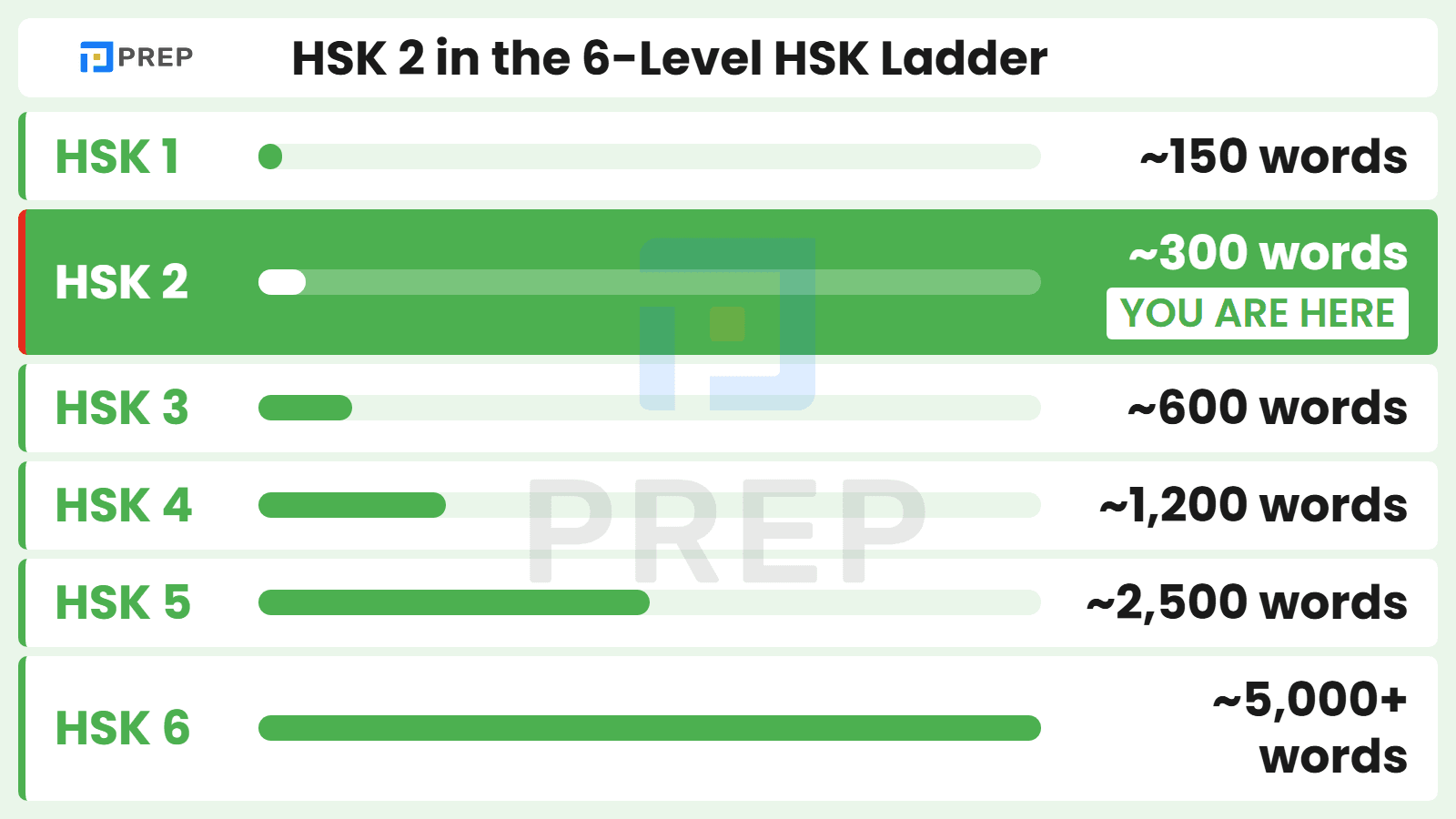
HSK 2 is the second of six HSK levels and sits in the elementary band, certifying mastery of roughly 300 Chinese words, double the ~150 words required at HSK 1. It confirms a learner can communicate on simple, routine daily topics in Mandarin.
The HSK scale runs from HSK 1 (entry) up to HSK 6 (advanced), and the jump between adjacent levels is easiest to picture through word count. The numbers below show why HSK 2 feels like a real step rather than a formality: the vocabulary load doubles from the level you just cleared.
|
HSK Level |
Band |
Approx. words |
What it certifies |
|
HSK 1 |
Beginner |
~150 |
Very basic words and phrases |
|
HSK 2 |
Elementary |
~300 |
Simple, routine daily communication |
|
HSK 3 |
Intermediate |
~600 |
Everyday life, study, and work topics |
|
HSK 4 |
Upper-intermediate |
~1,200 |
Wider range of topics, more fluency |
|
HSK 5 |
Advanced |
~2,500 |
Reading newspapers, watching films |
|
HSK 6 |
Proficient |
~5,000+ |
Near-native comprehension |
Reading across the table, the 150-to-300-to-600 progression makes the HSK 2 step concrete: you are roughly doubling what you already know, not learning a new language from scratch.
2. Who Should Take HSK 2?
HSK 2 is designed for learners who have studied Chinese for roughly 6 to 12 months (about 300 hours) and already command the ~150 HSK 1 words. It is the right first certificate for self-learners ready to prove elementary, everyday Mandarin ability.
A quick self-check decides whether you are ready. If you can recognise most of the HSK 1 vocabulary on sight and form basic sentences without translating word by word in your head, HSK 2 is the natural next target. If those ~150 words still feel shaky, spend a few weeks shoring up HSK 1 first, because Level 2 assumes that foundation rather than re-teaching it. You can map the full progression in this HSK 1 beginner's guide before committing.
For most self-learners, HSK 2 is also the first certificate worth listing on a CV or study application, because it signals you can actually use the language rather than just name a few words. That practical payoff is part of why the level draws so many candidates, and it leads straight into the next question: difficulty.
II. How Hard Is HSK 2?
HSK 2 feels harder than its word count suggests because the real challenge shifts from recognising words to processing faster, longer spoken sentences in real time. The test is manageable, but it is a genuine step up, and knowing exactly where the difficulty lives lets you prepare for it instead of fearing it.
1. How Much Study Time HSK 2 Takes (~300 Hours)
Reaching HSK 2 readiness typically takes about 300 cumulative study hours, which works out to roughly 6 to 12 months at a steady pace of 5 to 10 hours per week. Learners with daily immersion can compress this timeline.
That 300-hour figure is cumulative, so it includes the time you already spent reaching HSK 1, not 300 hours on top of it. The practical way to plan is against your own weekly calendar. At a relaxed 5 hours a week, you are looking at roughly 12 months; at a focused 10 hours a week, closer to 6 months. Daily exposure to spoken Chinese, even 20 minutes, pulls those numbers down further because listening is where most of the difficulty sits. The hours matter less than the consistency: short daily sessions beat occasional marathons for a level built on recognition speed.
2. What Makes HSK 2 Harder Than HSK 1
HSK 2 is harder than HSK 1 mainly because the vocabulary doubles from ~150 to ~300 words, sentences grow longer, and the listening audio plays faster. The test shifts from recognising isolated words to linking meaning across a short conversation.
The vocabulary jump is the obvious change, but it is not the one that trips learners. The real difficulty is meaning-linking: at HSK 1 you mostly match a word to a picture, while at HSK 2 you have to follow a two- or three-line exchange and infer what is happening. The contrast looks like this:
- Vocabulary: ~150 isolated words become ~300 words used in connected sentences.
- Listening: audio moves from single phrases to short dialogues at a slightly quicker pace.
- Sentences: longer structures with time, place, and comparison all in one line.
- Skill tested: not "do you know this word" but "can you connect meaning across the exchange."
Once you accept that HSK 2 is testing comprehension speed rather than raw vocabulary, the preparation choices (daily listening, shadowing, timed practice) start to make sense. The next thing to pin down is exactly what the test day looks like.
III. HSK 2 Exam Format & Scoring
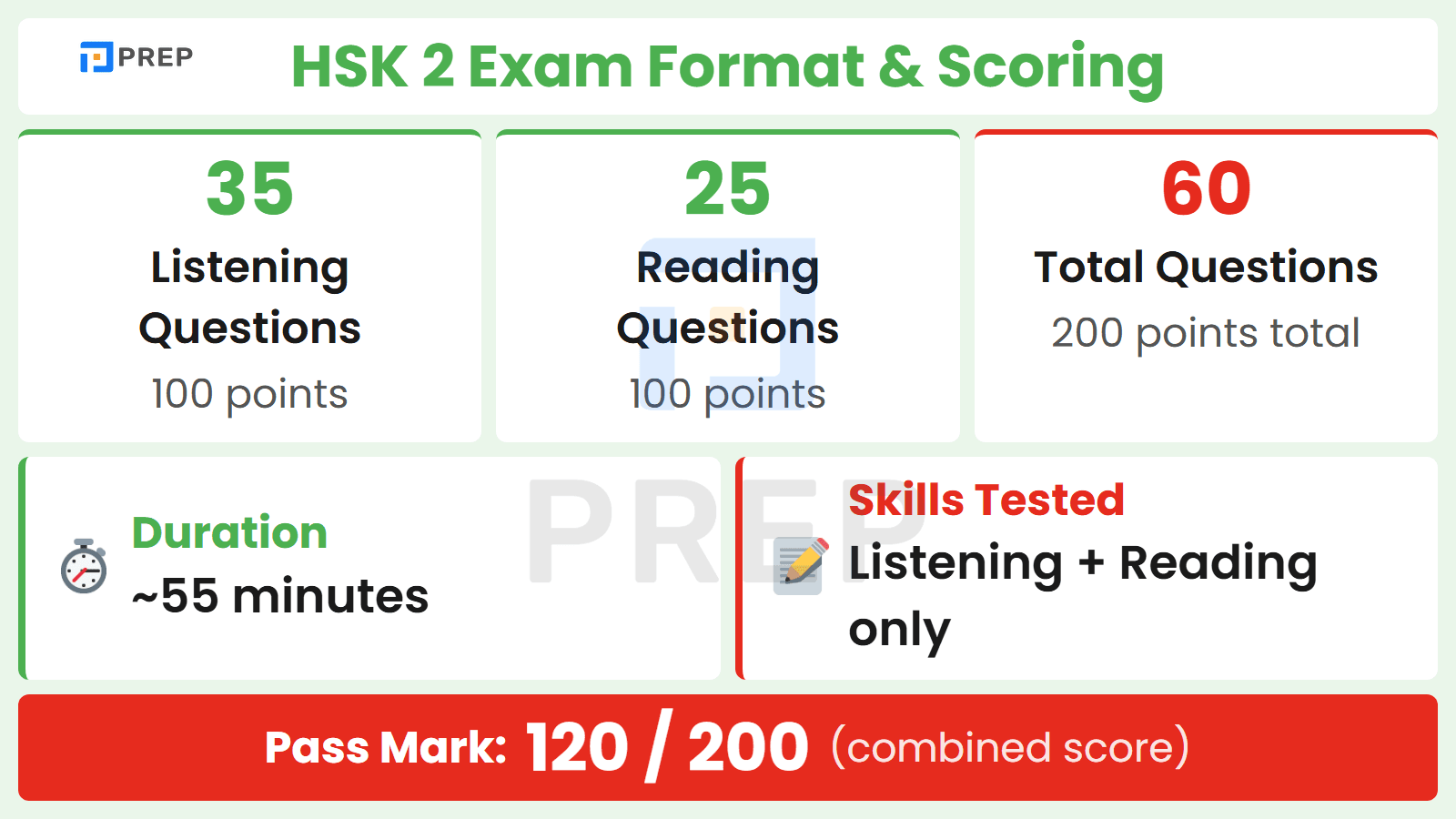
HSK 2 (in its 2.0 form) has just two scored sections, Listening then Reading, and the only number that decides pass or fail is 120 out of 200. There is no speaking and no writing in HSK 2.0, which surprises a lot of candidates. Here is how the two sections and the score break down.
1. Listening Comprehension Section
The HSK 2 Listening section has 35 questions and is the first part of the test. The audio is played twice for every question, covering picture-judgement, dialogue-matching, and short-response tasks across about 25 minutes.
The audio playing twice is the detail worth remembering, because it changes how you should listen: the first pass is for the gist, the second for confirmation. The section moves through a few recurring task types:
- True/false from a picture: you hear a short sentence and decide whether it matches the image shown.
- Dialogue-to-picture matching: a brief exchange plays and you pick the picture it describes.
- Choosing a response: you hear a question or statement and select the logical reply.
None of these require you to write anything; you simply mark answers on the answer sheet. The Reading section that follows works the same way, with characters supported by pinyin.
2. Reading Comprehension Section
The HSK 2 Reading section has 25 questions and follows Listening. Pinyin is printed above the characters at this level, and tasks include matching sentences to pictures, completing gaps, and judging whether a statement matches a short text.
The printed pinyin is a real relief at HSK 2, since you are never left staring at an unfamiliar character with no support, which keeps the reading load realistic for elementary learners. The task types mirror the listening logic but in written form:
- Sentence-to-picture matching: pair a written sentence with the image it describes.
- Gap-fill / sentence completion: choose the word that correctly fills a blank.
- Agree/disagree from text: read a short passage and judge whether a statement is true.
You have roughly 22 minutes here, so pacing matters less than in Listening, but the clock is still running. Both sections feed into a single score, which is where the pass mark comes in.
3. Scoring: 200 Points, Pass at 120
HSK 2 is scored out of 200 points, 100 for Listening and 100 for Reading, and you need 120 points total to pass. There is no separate per-section minimum; the 120 threshold applies to the combined score.
This is the misconception worth clearing up before test day: you do not need 60 in each section. A strong Listening score can carry a weaker Reading score, or the reverse, as long as the two add up to 120 or more. Your result is reported per section and as a total, so you can see exactly where your strength lies.
|
Section |
Maximum points |
Approx. questions |
|
Listening |
100 |
35 |
|
Reading |
100 |
25 |
|
Total (pass at 120) |
200 |
60 |
The takeaway from the table: aim for comfortable margin in your stronger section so a wobble in the weaker one still clears 120. But before you build a study plan around these numbers, you need to confirm which version of the exam you are actually sitting.
IV. Old HSK 2.0 vs New HSK 3.0 (2026): What Changed at Level 2
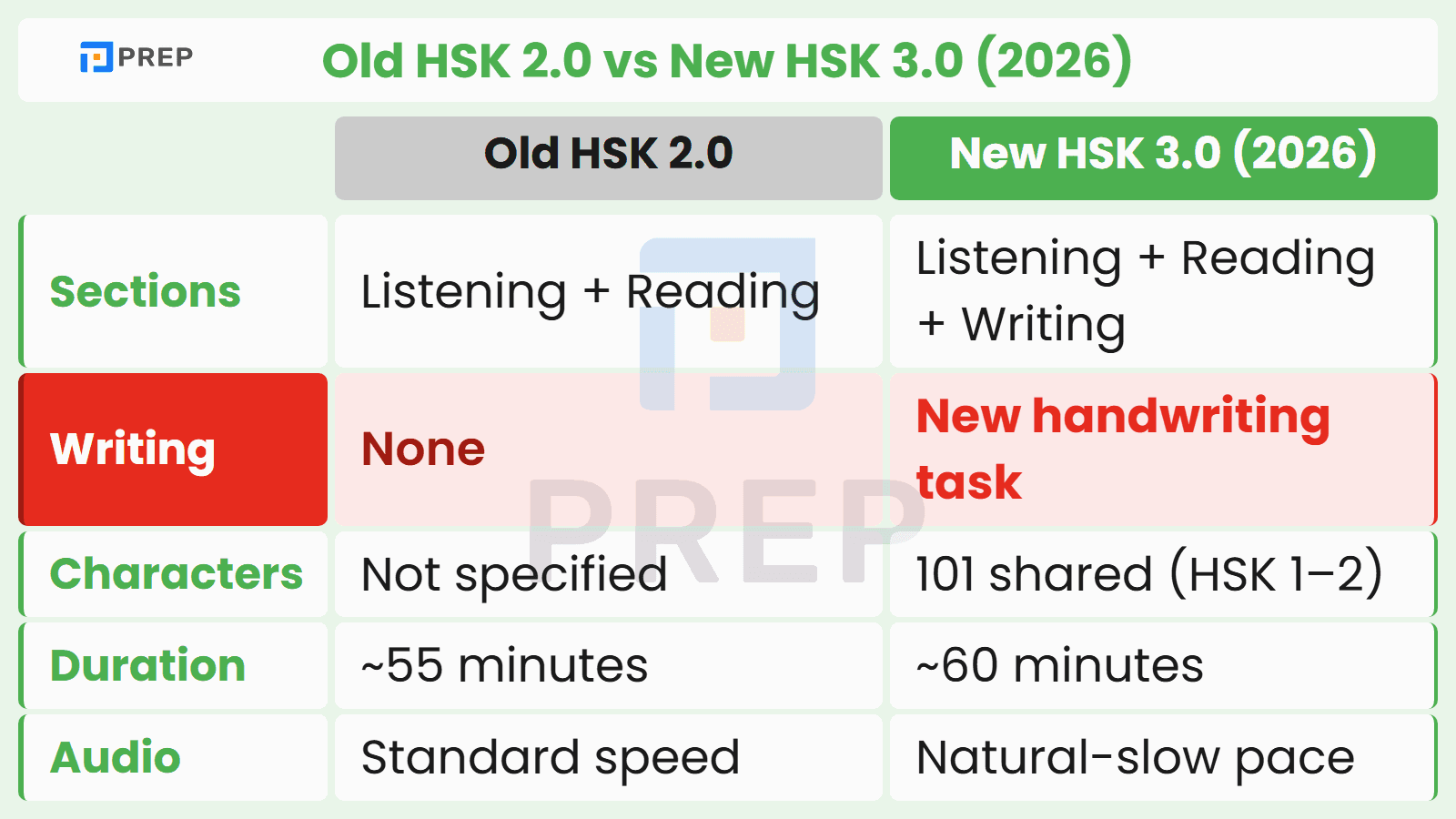
The single change that matters most at Level 2 is that HSK 3.0 adds writing, where HSK 2.0 had none; everything else (how vocabulary is framed, timing) is secondary. This is the question that causes the most anxiety, because preparing for the wrong version means practising the wrong skills. The comparison below isolates exactly what shifts at Level 2.
|
Feature |
HSK 2.0 (old) |
HSK 3.0 (2026) at Level 2 |
|
Scored sections |
Listening + Reading |
Listening + Reading + Writing |
|
Writing/handwriting |
None |
New handwriting task |
|
Shared character set |
Not specified |
101 characters across HSK 1-2 |
|
Vocabulary framing |
Recognise ~300 words |
Reorganised syllabus, active handwriting |
|
Approx. duration |
~55 minutes |
~60 minutes (with writing portion) |
|
Audio |
Standard pace |
Described as "natural-slow" |
HSK 3.0, the 2021 standard rolling out toward 2026, is the bigger reform, but at Level 2 the practical impact narrows to one new skill plus a defined character set. The three sub-sections below unpack each change so you can decide what to study.
1. Vocabulary & Character Changes
Under HSK 2.0 you only needed to recognise about 300 words, with no handwriting. HSK 3.0 reorganises the syllabus and adds active handwriting of a shared set of 101 characters spanning HSK 1-2.
The shift is from passive recognition to active production. With HSK 2.0, knowing a word meant being able to identify it when you saw or heard it. HSK 3.0 asks you to physically write a defined subset of characters, 101 of them shared across the first two levels, which is a different muscle entirely. The 300-word framing does not vanish, but it now sits alongside a concrete handwriting target rather than being the whole story.
2. The New Writing Section
Yes, for the first time, HSK 3.0 adds a writing section at Level 2, which HSK 2.0 never had. Learners handwrite characters from the shared HSK 1-2 set, adding roughly 60 minutes to the exam.
This directly answers the question almost every candidate asks: does the new HSK 2 have writing? Under HSK 3.0, it does. The task is built around handwriting characters from that shared 101-character set rather than composing essays, so it is elementary-appropriate, but it does mean stroke order and character recall become things you actively practise, not just recognise. Budget the extra time accordingly when you plan mock tests.
3. Which Version Should You Prepare For?
Prepare for the version your test centre runs on your exam date, and confirm this before studying. During the 2026 transition both may be offered; if a writing task is in scope, study HSK 3.0, otherwise HSK 2.0 preparation is sufficient.
The rollout is staged by region and centre, so there is no single global switchover date. The actionable check is two steps: first, find out which standard your chosen test centre administers on the date you want; second, confirm whether handwriting is on that paper. If it is, add character-writing practice to your plan; if not, you can prepare for the listening-and-reading format with confidence. When in doubt, building handwriting into your study costs little and future-proofs you for HSK 3. With the version settled, you can turn to the part everyone wants: the 300 words.
V. HSK 2 Vocabulary: Mastering the 300 Words
The 300-word figure overstates the real workload, because half of those words carry over from HSK 1. The genuinely new learning is 150 words plus the measure-word system that quietly trips up most candidates. Treat the vocabulary as "150 new words to add and a classifier habit to build," and the level shrinks to something you can schedule.
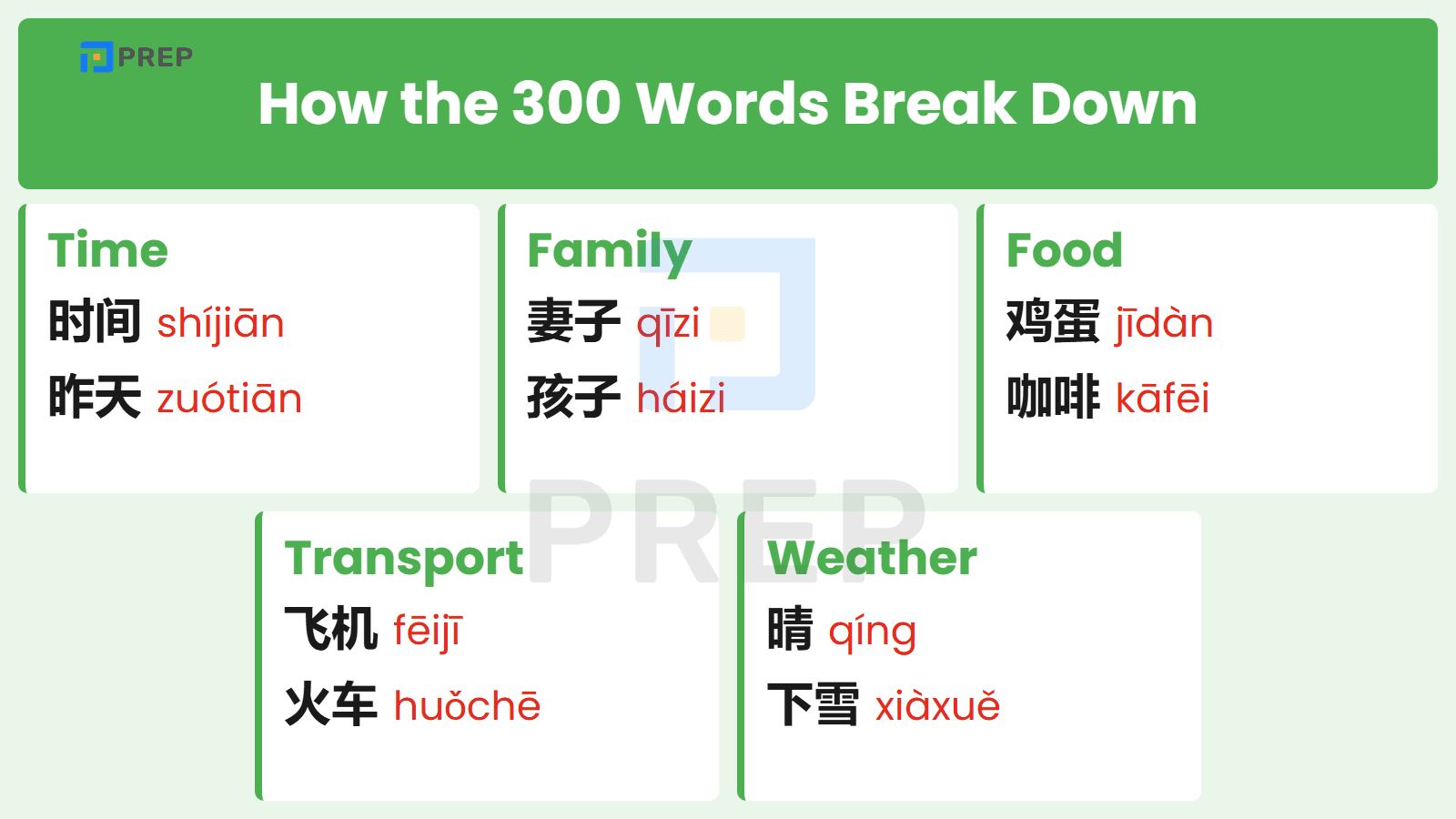
1. How the 300 Words Break Down
Grouping the 150 new words by everyday theme (time, family, food, transport, weather) makes them far easier to chunk than a flat alphabetical list. The brain remembers words in clusters of related meaning, so a thematic table mirrors how you will actually use them.
|
Theme |
Word |
Pinyin |
Meaning |
|
Time |
时间 |
shíjiān |
time |
|
Time |
分钟 |
fēnzhōng |
minute |
|
Time |
昨天 |
zuótiān |
yesterday |
|
Family |
妻子 |
qīzi |
wife |
|
Family |
丈夫 |
zhàngfu |
husband |
|
Family |
孩子 |
háizi |
child |
|
Food & drink |
鸡蛋 |
jīdàn |
egg |
|
Food & drink |
西瓜 |
xīguā |
watermelon |
|
Food & drink |
咖啡 |
kāfēi |
coffee |
|
Transport |
出租车 |
chūzūchē |
taxi |
|
Transport |
飞机 |
fēijī |
airplane |
|
Transport |
火车 |
huǒchē |
train |
|
Weather |
晴 |
qíng |
sunny |
|
Weather |
阴 |
yīn |
cloudy |
|
Weather |
下雪 |
xiàxuě |
to snow |
|
Daily actions |
起床 |
qǐchuáng |
get up |
|
Daily actions |
跑步 |
pǎobù |
to run |
|
Daily actions |
介绍 |
jièshào |
introduce |
The 150 carried-over HSK 1 words sit underneath these themes as the connective tissue: pronouns, numbers, and basic verbs you already know. Your new study list is the 150 above, which is why grouping them by theme rather than memorising 300 in isolation saves so much time. One category inside that list deserves special attention: measure words.
2. Measure Words You Must Learn (量词)
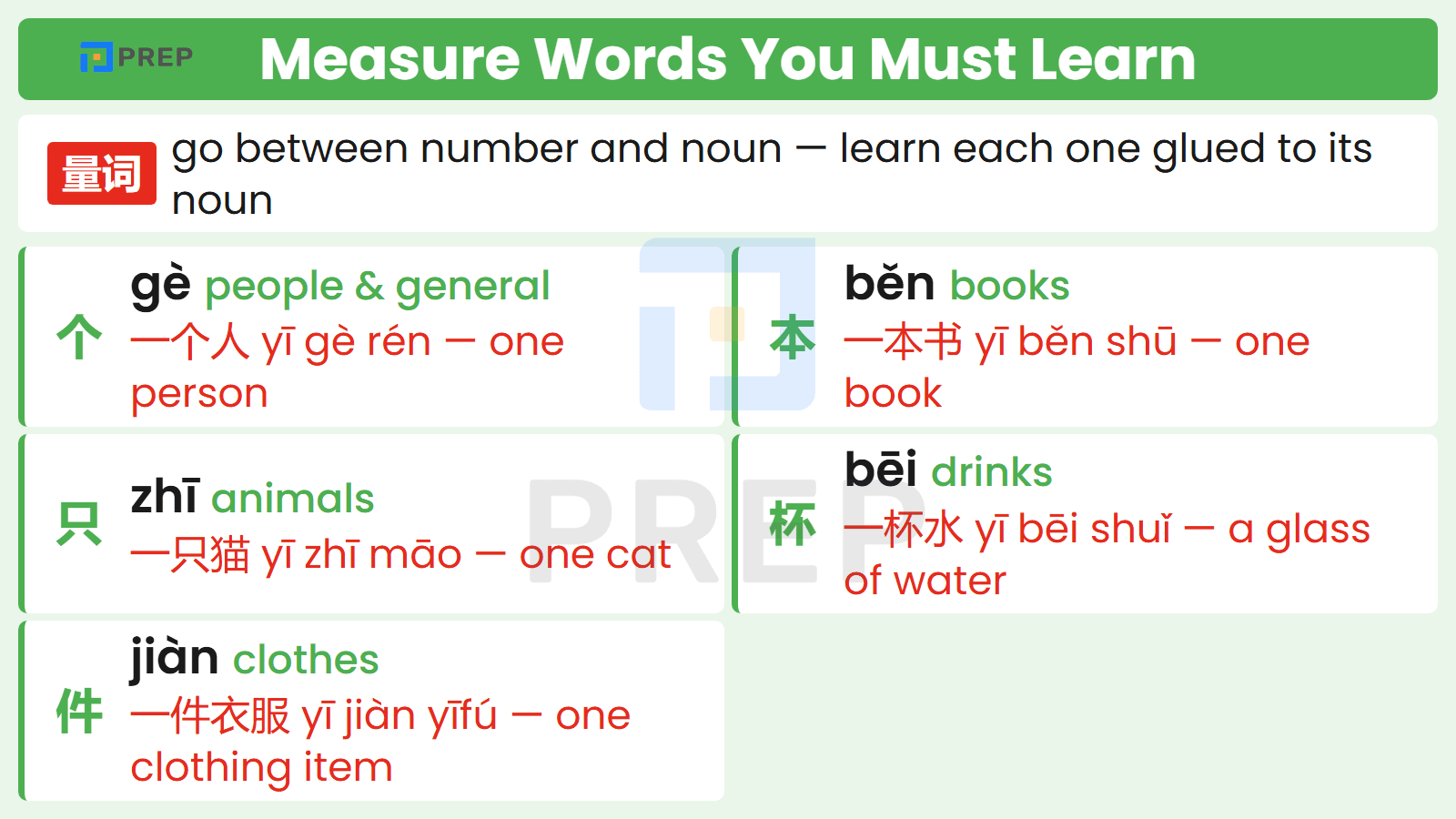
Measure words (量词) go between a number and a noun in Chinese, for example 一本书 (yì běn shū, one book). At HSK 2 you must learn classifiers like 个, 只, 本, 杯, and 件, and the key is to memorise each one glued to its typical noun rather than alone.
This is the trap that costs points: English has no real equivalent, so learners either drop the measure word or default to 个 (gè) for everything. The fix is to never learn a measure word by itself; always pair it with the noun it belongs to, the way native speakers store them.
|
Measure word |
Pinyin |
Typical noun |
Example |
Pinyin |
Meaning |
|
个 |
gè |
general / people |
一个人 |
yí ge rén |
one person |
|
本 |
běn |
books |
一本书 |
yì běn shū |
one book |
|
只 |
zhī |
animals |
一只猫 |
yì zhī māo |
one cat |
|
杯 |
bēi |
drinks |
一杯水 |
yì bēi shuǐ |
a glass of water |
|
件 |
jiàn |
clothes / matters |
一件衣服 |
yí jiàn yīfu |
one item of clothing |
Learn the right-hand example, not just the left-hand word, and the classifier comes out automatically when you speak. With the words sorted, the next question is how to get them to stick.
3. How to Memorise HSK 2 Vocabulary Efficiently
The most efficient way to memorise HSK 2 vocabulary is spaced repetition, reviewing words at growing intervals, paired with reading them in real sentences. Learning 5 to 10 new words a day clears the 150 new HSK 2 words in about three to four weeks.
Spaced repetition beats cramming because memory strengthens when you recall a word just as you are about to forget it, not when you re-read it ten times in a row. The practical method has two halves:
- Flashcards for recognition: a spaced-repetition app surfaces each word right before it fades, building fast recall.
- Reading for retention: seeing words inside real sentences anchors meaning and shows how the measure words and grammar attach.
At 5 to 10 new words daily, the 150 new words take three to four weeks, which conveniently maps onto the study plan later in this guide. Vocabulary is only half the exam, though; the grammar is where careless points leak.
VI. HSK 2 Grammar Points
HSK 2 grammar is small in count but trap-heavy. There are only a few dozen patterns, yet mastering the particle 了 and Chinese word order resolves most of the points learners lose, so those two deserve far more attention than their share of the syllabus. Every pattern below comes with a Chinese, pinyin, and English example, because grammar you cannot see in a sentence is grammar you cannot use.
1. Core Sentence Patterns at HSK 2
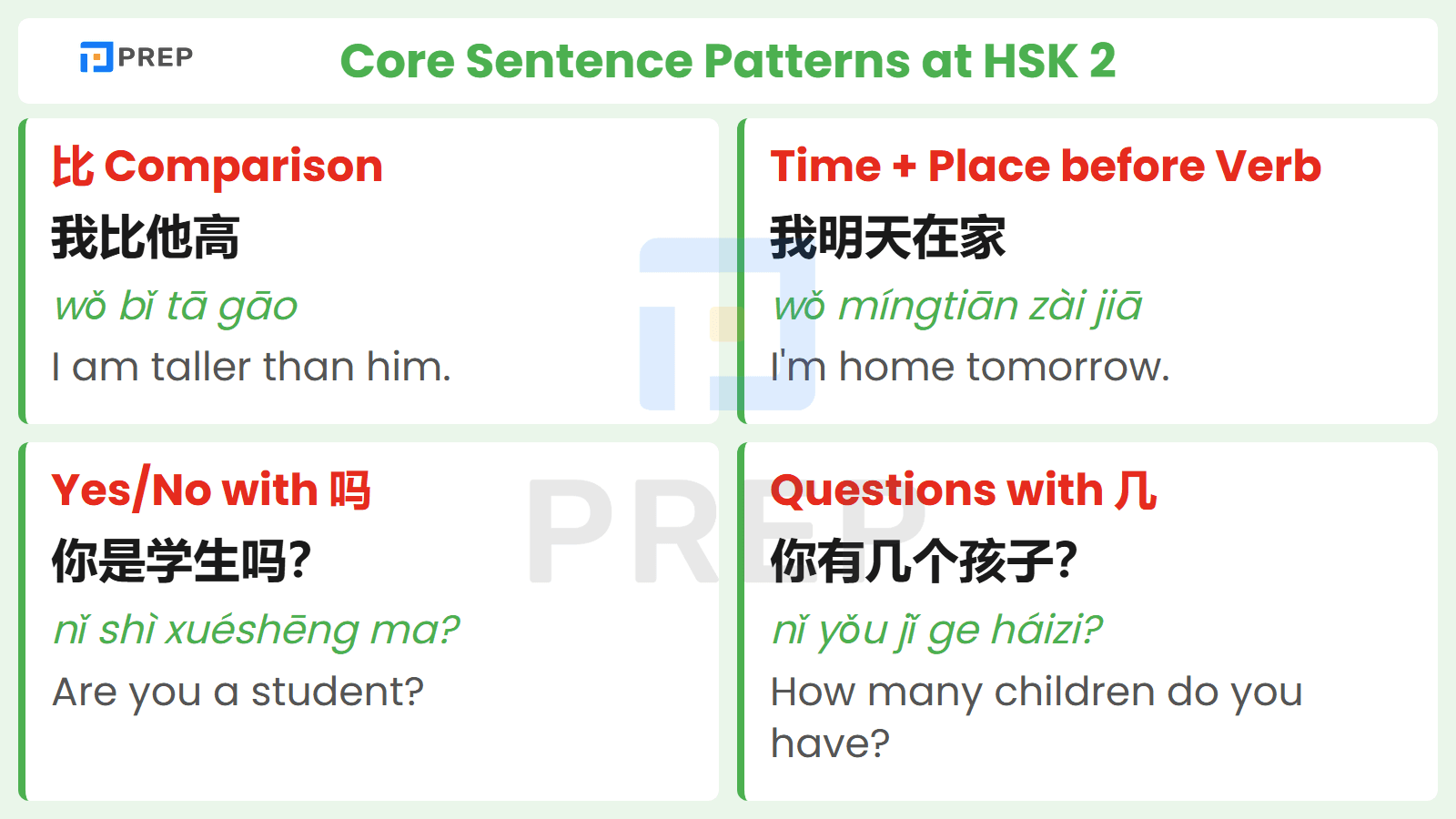
The highest-yield HSK 2 patterns are the 比 (bǐ) comparison and fixed time-and-place word order, because they reappear across both Listening and Reading. Learn these two cold and you have covered most of what the exam actually tests.
- Comparison with 比 (bǐ): A 比 B + adjective. 我比他高 (wǒ bǐ tā gāo, I am taller than him). The thing being compared comes first, 比 sits in the middle, and the adjective comes last with no "more" word needed.
- Time and place order: time and place come before the verb, not after. 我明天在家 (wǒ míngtiān zài jiā, I am at home tomorrow), literally "I tomorrow at-home."
- Yes/no questions with 吗 (ma): add 吗 to the end of a statement. 你是学生吗?(nǐ shì xuésheng ma? Are you a student?).
- Content questions with 几/多少 (jǐ / duōshao): 你有几个孩子?(nǐ yǒu jǐ ge háizi? How many children do you have?).
- Cause and effect with 因为...所以 (yīnwèi...suǒyǐ): 因为下雨,所以我没去 (yīnwèi xiàyǔ, suǒyǐ wǒ méi qù, Because it rained, I didn't go).
Drill the 比 comparison and the time-before-verb order first; they show up so often that getting them automatic frees your attention for the harder listening tasks. The single pattern that confuses learners most, though, is not in this list. It is the particle 了.
2. The Particle 了 Explained
The particle 了 (le) is not a past-tense marker, despite a common HSK 2 myth. It signals that an action is completed or that a state has changed, which is why 了 can appear in present or future contexts. Negation uses 没 (méi), not 了.
Treating 了 as "the Chinese past tense" is the error that produces the most wrong answers, because Chinese has no tense system at all. 了 marks aspect, whether an action is finished or whether something has become different from before. Compare:
- ✅ 我吃了饭 (wǒ chī le fàn, I have eaten / I ate). The eating is completed.
- ✅ 天气冷了 (tiānqì lěng le, the weather has turned cold). A change of state, happening now, not in the past.
- ❌ 我昨天没去了 (wrong: once you use 没 to negate, you drop 了). The correct form is 我昨天没去 (wǒ zuótiān méi qù, I didn't go yesterday).
The rule to carry into the exam: use 了 for completion or change, and switch to 没, never 了, when you negate. Getting this one particle right removes a whole category of mistakes, which leads neatly into the errors to watch for.
3. Common HSK 2 Grammar Mistakes to Avoid
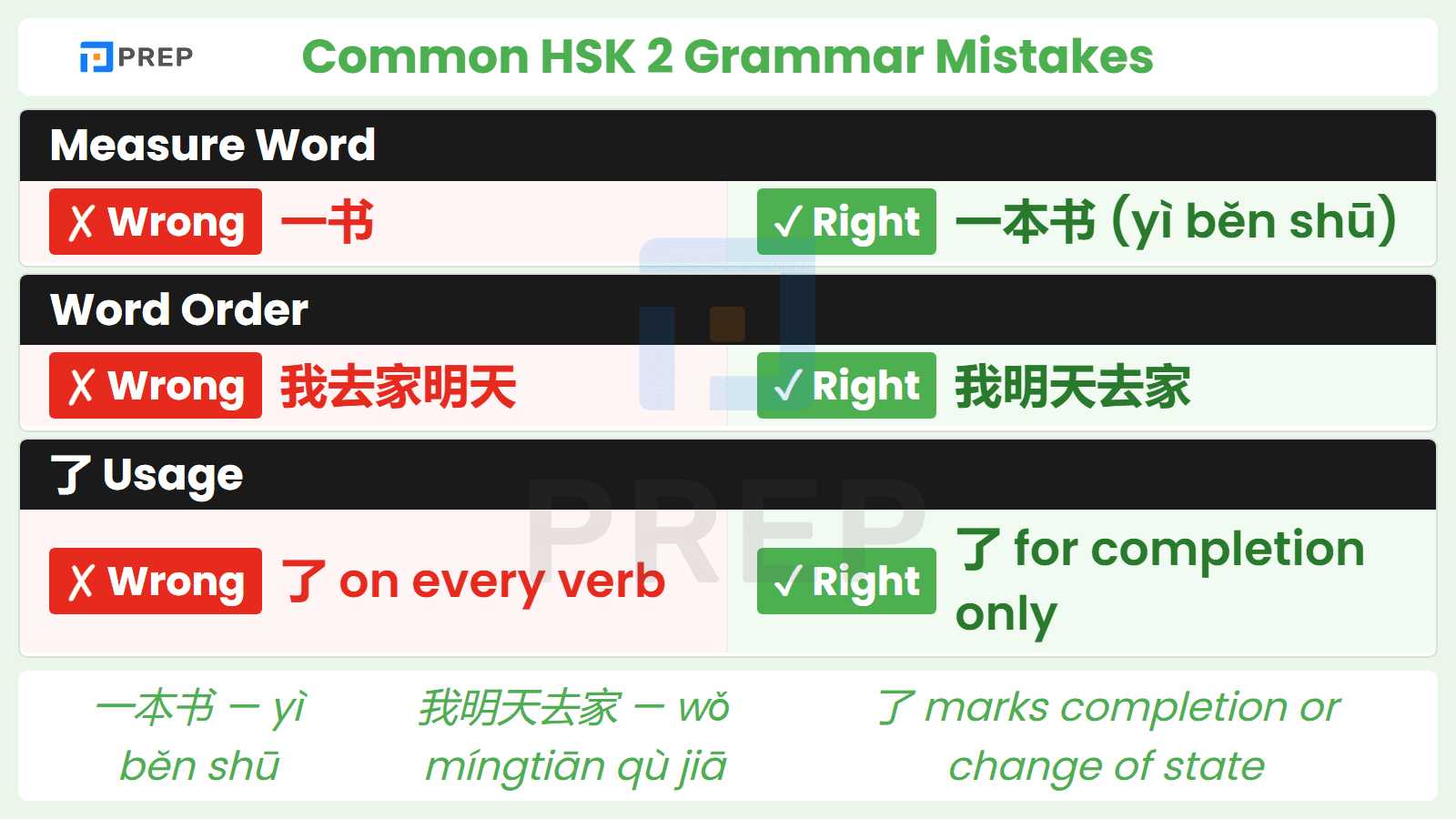
Most HSK 2 grammar errors trace back to a single habit: transferring English structure onto Chinese. Once you spot that pattern, the three recurring mistakes below become easy to catch and correct yourself.
- Dropping or defaulting the measure word. ❌ 一书 (no classifier) becomes ✅ 一本书 (yì běn shū, one book). Root cause: English needs no measure word, so learners omit it or use 个 for everything.
- English word order. ❌ 我去家明天 (verb-then-time, English style) becomes ✅ 我明天去家 (wǒ míngtiān qù jiā, I go home tomorrow). Root cause: time and place go before the verb in Chinese, the opposite of English.
- Overusing 了. ❌ sticking 了 on every verb to mark "past" becomes ✅ using it only for completion or change of state. Root cause: mistaking 了 for a tense marker.
The unifying fix is to stop translating English sentence shapes into Chinese and instead learn each pattern as its own structure. That mindset, Chinese on its own terms, is exactly what a structured study plan builds.
VII. How to Prepare for HSK 2: A 4-Week Study Plan
A focused four-week plan works only if it front-loads vocabulary and grammar, then back-loads timed mock tests; the sequence matters more than the raw hours. Cramming everything at once leaves you with no time to find and fix weak spots, while building knowledge first makes the final week's mocks diagnostic instead of discouraging. Here is how to structure it.
1. Week-by-week Breakdown
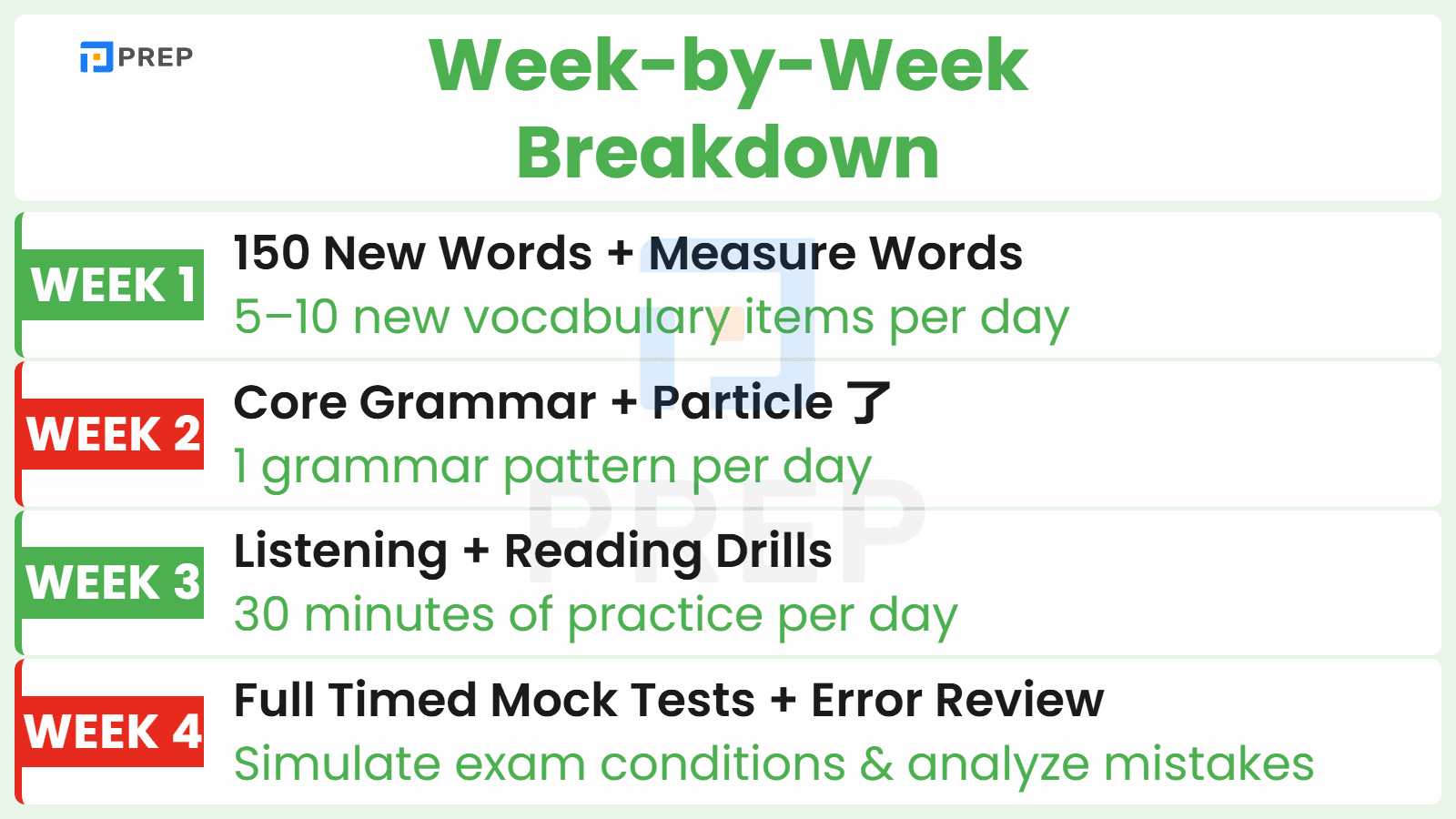
Building vocabulary and grammar in the first two weeks is what makes the final week's full mock tests diagnostic rather than demoralising. The plan moves from input to output, week by week.
|
Week |
Focus |
Daily target |
|
Week 1 |
The 150 new words + measure words |
5-10 new words/day, paired with their nouns |
|
Week 2 |
Core grammar + the particle 了 |
One pattern/day with bilingual examples |
|
Week 3 |
Listening + reading drills |
30 min listening + one reading set/day |
|
Week 4 |
Full timed mock tests + review |
One timed mock, then error-log review |
The logic running through the table: weeks 1 and 2 load the raw material, week 3 builds processing speed, and week 4 rehearses the real thing under the clock. Skip the front-loading and your week-4 mocks just confirm you are not ready; respect the sequence and they confirm you are. The daily habits that power weeks 1 to 3 are worth spelling out.
2. Daily Habits & Listening Practice
The most effective daily HSK 2 habit is 20 to 30 minutes of listening to natural-slow Chinese audio while shadowing, repeating each line aloud immediately after you hear it. Pairing this with daily spaced-repetition vocabulary review builds both recognition and speaking confidence.
Shadowing is the habit that fixes the real HSK 2 difficulty: comprehension speed. Instead of listening passively, you repeat each sentence aloud a beat after the speaker, which forces your ear and mouth to keep pace with natural rhythm. A practical daily loop looks like this:
- Listen and shadow for 20 to 30 minutes using audio at the exam's natural-slow speed.
- Review vocabulary with spaced-repetition flashcards, including the day's new words.
- Check pronunciation by recording yourself and comparing against the source.
This is also where structured tools earn their place. Prep's HSK 2 course is built around exactly this loop: its Chinese Dialogue Shadowing feature lets you shadow native dialogues with pinyin toggled on or off and switch into role-play mode, while its AI pronunciation scoring gives instant feedback on each line so you are not guessing whether you sound right. The course covers 12 themed topics with localized animated video lessons and interactive exercises, and Teacher Bee AI is available around the clock for the questions that come up mid-practice. Used as a daily-habit engine rather than a passive textbook, that kind of PREP HSK 2 course turns the shadowing routine into a measurable one. Once the daily habits are running, mock tests tell you whether they are working.
3. Using Mock Tests to Track Progress
Use HSK 2 mock tests under timed, exam-like conditions and log every mistake by type. Turning that error log into a targeted weekly review, then re-testing, is what reliably pushes your score past the 120-point pass mark with margin.
A mock test is not just a score check; it is your most efficient study tool, because recalling answers under pressure cements learning better than re-reading ever does. The method has three moves: take the mock timed and uninterrupted, log each error by category (measure word, word order, 了, a vocabulary gap), then convert that log into the next week's review list. Re-test a week later and you should see the same error types shrink. Repeat until you are clearing 120 with comfortable margin, not scraping it; that buffer is what protects you on a nervous test day. Prep's HSK 2 course includes two minitests and ten full practice tests for exactly this cycle. With the method clear, the next practical question is where to find materials worth practising on.
VIII. Best HSK 2 Resources: Books, Audio & Past Papers
The safest HSK 2 prep stack is built on official materials: the Standard Course, official audio, and official past papers, because that is where reliability holds. Third-party answer keys floating around file-sharing sites are where accuracy breaks down, and a wrong answer key teaches you the wrong thing. The three resource types below cover everything you need.
1. Standard Course Textbook & Workbook
The most recommended HSK 2 textbook is HSK Standard Course 2 (标准教程), paired with its workbook and answer key. It is aligned to the official HSK syllabus, and a single volume covers the full HSK 2 word and grammar list.
The buying decision is simpler than it looks: one Standard Course 2 book and its matching workbook cover the entire syllabus, so you do not need to assemble materials from multiple publishers. The textbook teaches the vocabulary and grammar in themed units, the workbook drills them, and the included answer key lets you self-mark without guessing. For a self-learner, that combination is the closest thing to a course in print form.
2. Audio & Listening Resources
Download HSK 2 audio from the Standard Course's official publisher channels and supplement with graded Chinese podcasts for daily listening. Choose audio at the exam's natural-slow speed so your practice matches test conditions.
Matching audio speed to the exam is the detail most learners miss. Practising on fast, native-speed podcasts can leave you over-prepared in the wrong way, while exam audio sits at a deliberate natural-slow pace. Official Standard Course audio is the safest starting point because it is calibrated to the syllabus; graded Chinese podcasts aimed at beginners make good daily supplements. Avoid random uploads of uncertain quality, since clean, correctly paced audio is worth more than a large messy library.
3. Mock Tests & Past Exam Papers
Get genuine HSK 2 past papers and sample tests from official channels such as the Confucius Institute or the official HSK website, and practise filling the real 答题卡 (dátíkǎ, answer sheet) so test-day formatting holds no surprises.
The 答题卡 detail matters more than it sounds: knowing exactly how to transfer answers to the official sheet removes a small but real source of test-day stress. Favour recent papers, since they reflect the current format, and prefer official sources over scattered third-party links whose answers you cannot trust. One official sample test plus a few recent past papers is enough to learn the rhythm of the exam. With materials sorted, the last logistical step is registering.
IX. How and Where to Register for HSK 2
Register for HSK 2 through the official HSK website or an authorised test centre or local Confucius Institute, choosing either a paper-based test at a centre or an internet-based home test. Fees are low at Level 2 and vary by region; in places like Singapore, book an authorised centre several weeks before your date.
The process is straightforward once you know the path. Registration runs through official channels rather than third-party resellers, and you choose your format at sign-up.
- Find your centre: search the official HSK site for an authorised test centre or Confucius Institute near you. In Singapore and many other cities, there are dedicated centres.
- Pick a format: paper-based at a centre, or internet-based, which can often be taken at home under remote supervision.
- Check the fee and date: Level 2 fees are among the lowest in the HSK range and vary by country; exam dates are set months in advance.
- Register early: book several weeks ahead, since popular dates and centres fill up.
Confirm the version your centre runs when you register; this is the moment to settle the HSK 2.0 versus 3.0 question for good. With registration done, the remaining questions tend to be the quick ones answered below.
X. Frequently Asked Questions (FAQ)
These are the questions learners most often ask before committing to HSK 2, each answered in a line you can act on.
1. How Many Words Do You Need for HSK 2?
HSK 2 requires you to master 300 words: the 150 from HSK 1 plus 150 new words. In practice, your new study list is just the 150 new words, since the HSK 1 half carries over.
2. How Many Points Do You Need to Pass HSK 2?
You need 120 out of 200 points to pass HSK 2. The score combines Listening (100) and Reading (100), and there is no separate per-section minimum; only the combined total counts.
3. Does HSK 2 Have a Speaking or Writing Section?
HSK 2.0 has no speaking or writing section, only Listening and Reading. Under the new HSK 3.0, a writing component is added at Level 2 for the first time, involving handwriting of a shared character set. There is no separate speaking test at this level in either version.
4. How Long Does It Take to Prepare for HSK 2?
Preparing for HSK 2 takes about 300 cumulative study hours, roughly 6 to 12 months at a steady pace, and less with daily immersion. A focused learner who already knows the HSK 1 words can be ready in about four weeks of dedicated study.
5. Is HSK 2 a Beginner Level?
Yes. HSK 2 is an elementary, beginner-band level (the second of six HSK levels), one step above HSK 1 and certifying simple, everyday Mandarin. It sits in the beginner band but is the second rung, not absolute zero. You can see how it leads into the next stage in this HSK 3 guide or the full HSK roadmap.
XI. Conclusion: Your Next Step After HSK 2
Passing HSK 2 comes down to mastering 300 words, the core grammar, and clearing 120 of 200 points across Listening and Reading, while confirming whether you sit HSK 2.0 or the new HSK 3.0 with its added writing task. None of it is hard in isolation; the difficulty is staying consistent and practising at exam speed.
The fastest path from here is structured, exam-style practice rather than scattered study. Prep's HSK 2 course is built for that final stretch: 12 themed topics taught through localized animated video, interactive exercises, two minitests, and ten full practice tests, with Chinese Dialogue Shadowing for listening and speaking, AI pronunciation scoring for instant feedback, and Teacher Bee AI on hand whenever a question comes up. Work through the 150 new words, drill the 比 comparison and the particle 了, then test yourself under the clock until 120 feels like a floor, not a ceiling. When that happens, you are ready, and HSK 3 is the natural next climb. Map it out in the HSK 3 guide when you are ready to keep going.

Hi I'm Chloe, and I am currently serving as an Product Content Administrator at Prep Education. With over five years of experience in independent online IELTS study and exam preparation, I am confident in my ability to support learners in achieving their highest possible scores.
Comment
Premium content
View all


Personalized roadmap


Most read


UEN: 202227322W
Address: 114 LAVENDER STREET, #11-83 CT HUB 2, SINGAPORE (338729)