IELTS Task 1: School Map 1985 and Now Guide
This guide explains how to approach the IELTS Writing Task 1 map question about a school in 1985 and now. You will learn how to describe layout changes clearly, organize comparisons logically, write a strong overview, and use accurate spatial vocabulary to improve your band score.
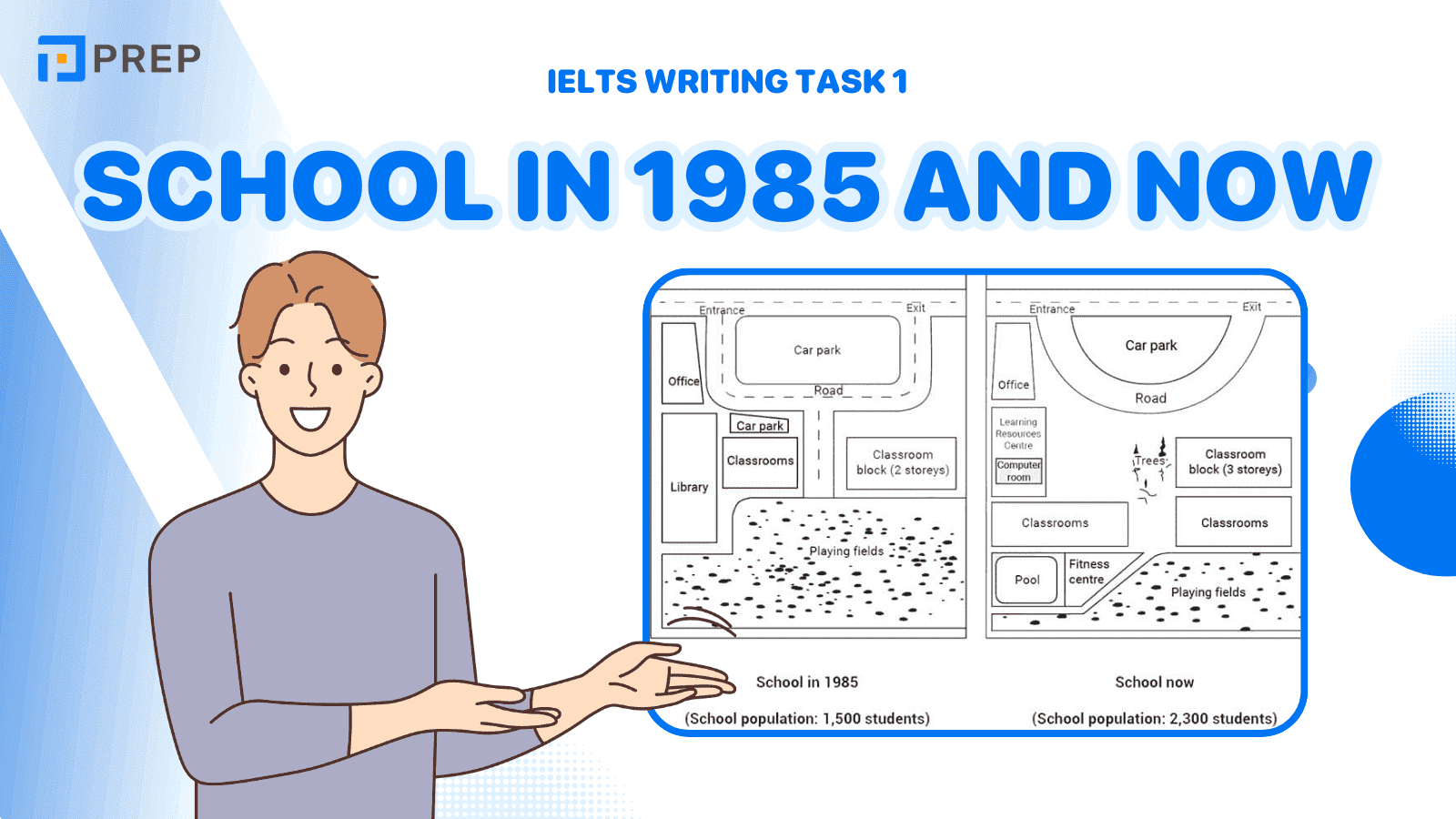
Keynote – Task 1 Quick Guide
Direct Answer: In this map comparison task, focus on summarizing the most important changes in the school’s layout, buildings, and facilities over time—such as new classroom blocks, expanded parking, or lost green areas—instead of listing every detail.
Key Points to Remember:
-
Identify buildings or spaces that were added, removed, or relocated
-
Use a four-part structure: Introduction, Overview, Body 1, Body 2
-
Group related changes logically (by location or type of facility)
-
Use passive and comparative structures to describe developments
-
Keep your writing formal, concise, and focused on clear comparison and summary
I. What Is This IELTS Writing Task 1 Question Type?
The question “School in 1985 and now” is a typical IELTS Writing Task 1 map comparison question. It presents two diagrams of the same school—one from 1985 and one showing how the school looks today.
In this task, you are required to:
-
Summarize and compare the main physical and organizational changes to the school between 1985 and the present
-
Identify new, removed, or converted buildings, landscape changes, and changes to facilities (such as new classrooms, expanded parking, new sports areas, gardens, or relocated features)
-
Report the most significant overall trends, e.g., growth, modernization, expanded student capacity, or a shift in layout or function
Key elements to identify before writing:
-
Time frames: Always clearly separate "in 1985" from "now"
-
Major changes: Added or removed buildings, repurposed rooms, larger or smaller parking/sports/garden areas
-
Landmarks: Entrances, main buildings, car parks, halls, fields, special features (e.g. library, science block, IT room)
-
Patterns or themes: Has the school expanded, modernized, changed focus, or lost green space?
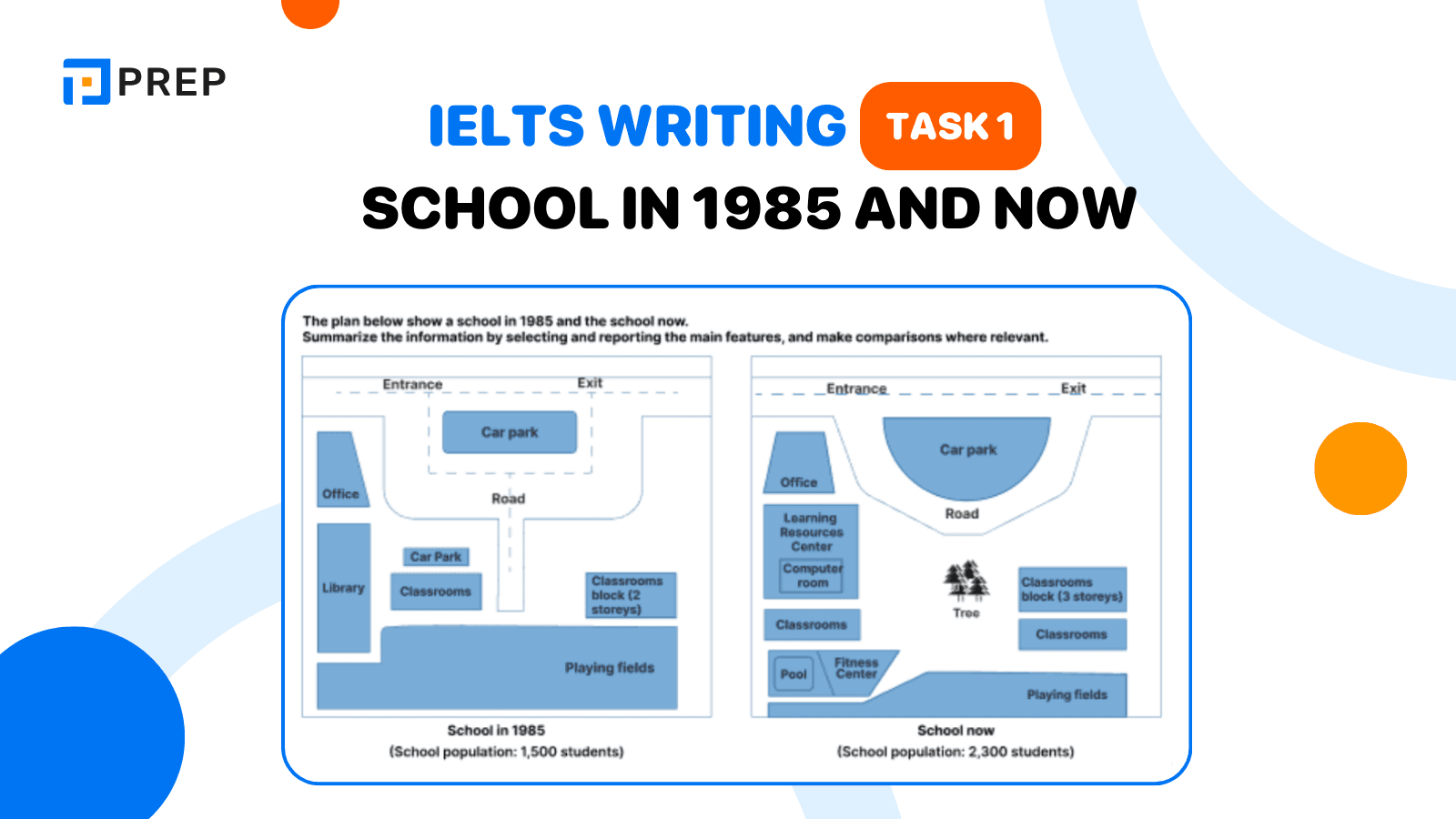
You can review IELTS writing task 1 map to better understand this question type.
II. Recommended Structure for Task 1
For a Task 1 map comparison like "School in 1985 and now", your answer should be grouped into four clear sections. This ensures logical organization, clarity, and complete coverage of the most important changes.
The standard structure includes:
-
Introduction: Paraphrase the map question and name the two time points
-
Overview: Summarize the biggest changes or overall trends in the school’s layout and facilities. You can improve this section by learning IELTS writing task 1 overview.
-
Body Paragraph 1: Describe the main developments or transformations (e.g., new classrooms or blocks, modern amenities). To structure ideas more clearly, refer to IELTS writing task 1 body paragraph.
-
Body Paragraph 2: Discuss the remaining changes, stable features, or noteworthy additions (such as car park expansion, changes in sports or green space)
1. Sample Essay on IELTS Writing Task 1 – School in 1985 and Now
Question:
The maps below show a school in 1985 and the same school now.
Summarize the information by selecting and reporting the main features, and make comparisons where relevant.
Sample Answer:
The two maps illustrate how a school’s layout and facilities changed between 1985 and the present day.
Overall, the school has undergone major redevelopment, with more buildings, expanded parking facilities, and a reduction in open green space, reflecting growth in student numbers and modernization needs.
In 1985, the school consisted of a main hall at the center, surrounded by two teaching blocks, a small staff room to the north, a library, and extensive gardens and a playing field to the east. There was a single entrance on the southern edge and a small car park beside the staff room.
Today, several new classroom blocks have been built to the north and east of the main hall. The gardens and part of the playing field have been replaced by a much larger car park and a new sports center, while the staff room was relocated and expanded. The library is now in a new building adjacent to the main entrance, and a new IT suite has been added. The only feature to remain completely unchanged is the main hall at the center.
In summary, the school has shifted from a largely open layout with gardens and playing fields to a more densely built site, prioritizing more teaching space, parking, and modern sports facilities.
Why this essay works well:
-
Introduction paraphrases the question and names the two years
-
Overview captures the main trends (more buildings, less open space, modernization)
-
Body paragraphs are well-grouped: major facilities and external/sports/parking changes
-
Accurate use of tenses and passive forms
-
Clear comparison language and precise description

You can practice a similar map task in IELTS writing task 1 riverpark area of 20 years ago and now sample.
2. Useful Language for This Task Type
For a school map comparison like "School in 1985 and now", clear and specific language for describing changes, location, and spatial relationships is essential. Use a variety of verbs, prepositions, and comparative structures to convey changes accurately.
Vocabulary for Describing Change
|
Type of Change |
Useful Phrases |
|
Addition |
“A new [building/car park/sports center/classroom block/IT suite] was built/added…” |
|
Removal/Demolition |
“The gardens/playing field/staff room was removed/demolished/replaced…” |
|
Relocation/Conversion |
“The library was relocated to…” “The gardens were converted into a car park…” |
|
Expansion |
“The car park was expanded…” “New classrooms were constructed to the north/east…” |
|
Modernization |
“A new IT suite was introduced…” “Facilities were upgraded/modernized…” |
|
Unchanged Feature |
“The main hall remained the same…” “The entrance was not moved…” |
Vocabulary for Location and Layout
|
Function |
Examples |
|
Directions/Placement |
“to the north”, “on the east side”, “at the southern entrance” |
|
Relation |
“next to”, “adjacent to”, “in front of”, “between” |
|
Layout |
“located in the center”, “surrounded by new buildings”, “at the edge” |
Comparative and Overview Language
-
“In 1985…, but now…”
-
“The biggest change was the addition/expansion of…”
-
“While the original school had…, the modern layout includes…”
-
“Some areas, including…, remained unchanged.”
-
“Compared to 1985, the school now prioritizes…”
-
“The site has shifted from mostly open grounds to a more densely built-up area.”
Grammar and Style Notes
-
Use past simple or present perfect/passive forms for changes: “was constructed”, “has been replaced”, “were added”
-
Use present simple for features that remain today: “remains”, “is now”, “are located”
-
Use linking and contrast words for clear structure: “however”, “in addition”, “while”
-
Keep your language formal, concise, and objective—avoid opinion or speculation
You should master specific terms from IELTS writing task 1 map vocabulary to describe changes accurately.”
III. How This Task Type Is Assessed in IELTS Writing
For map comparison tasks like “School in 1985 and now”, your answer is marked according to the four IELTS Writing Task 1 criteria. Here is how each applies:
Task Achievement
-
You must select and summarize the most important changes between the two time points.
-
Clearly highlight major developments (e.g., new classrooms, car park expansion, loss of green space) and note features that stayed the same.
-
The overview should summarize the most significant trends (such as increased building density, modernization, or changing use of space).
-
Avoid listing every small detail—prioritize key changes.
Coherence and Cohesion
-
Organize your answer into clear paragraphs: Introduction, Overview, Body 1, Body 2.
-
Group changes logically (e.g., internal facilities vs. outdoor/parking/sports areas).
-
Use linking/contrast language like “while,” “in contrast,” “however,” and sequence phrases (“originally,” “now,” “after redevelopment”).
-
Make sure each paragraph develops a single, clear idea without jumping between time frames.
Lexical Resource
-
Use a range of verbs and nouns for change (e.g., “expanded,” “introduced,” “demolished,” “converted,” “relocated,” “block,” “facility,” “extension”).
-
Include accurate location language (e.g., “to the east,” “adjacent to the library,” “in the center of the site”).
-
Avoid repetition; paraphrase and use synonyms where possible.
-
Keep the tone formal and academic.
Grammatical Range and Accuracy
-
Use a mix of sentence types, including passive structures (“a new building was constructed,” “the garden was removed”).
-
Match verb tenses to time—use past simple/perfect for former features, present simple for current ones.
-
Use comparative and contrast structures for change (“larger than before,” “replaced by,” “remained unchanged”).
-
Ensure accuracy in articles, plurals, prepositions, and subject–verb agreement.
A high-scoring Task 1 map essay groups and prioritizes major changes, summarizes the most important trends, and uses formal, precise English in well-organized paragraphs.
This article provides a sample IELTS Writing Task 1 School in 1985 and now with a band score of 7.0+ prepared by a top-tier teacher at PREP. Review it thoroughly to effectively practice for the IELTS exam and confidently handle other Map-type tasks.

Hi I'm Chloe, and I am currently serving as an Product Content Administrator at Prep Education. With over five years of experience in independent online IELTS study and exam preparation, I am confident in my ability to support learners in achieving their highest possible scores.
Comment
Premium content
View all




Personalized roadmap


Most read




UEN: 202227322W
Address: 114 LAVENDER STREET, #11-83 CT HUB 2, SINGAPORE (338729)