What Is the HSKK? Levels, HSK Difference, Format, Scoring, and Practice
Key Takeaways
- The HSKK (汉语水平口语考试) is the official spoken-only Chinese proficiency test, and it is audio-recorded rather than marked by a live examiner.
- It is a separate exam from the written HSK, with three named levels - Beginner (初级), Intermediate (中级), and Advanced (高级) - not numbered 1-6.
- The levels map to vocabulary of about 200, 900, and 3,000+ spoken words, matching HSK 1-2, 3-4, and 5-6.
- The HSKK is scored out of 100, and the passing score is 60 for all three levels.
- Fees run roughly 200, 400, and 600 RMB by level; you register at chinesetest.cn, and the certificate is generally valid 2 years for university admission.
- You prepare best by drilling pronunciation (initials, finals, and tones) and rehearsing under recorded, timed conditions.
The HSKK is the exam that proves you can actually speak Chinese, not just read and listen to it, which is why universities, scholarships, and employers ask for it alongside the HSK.
This guide covers what the HSKK is and how it differs from the HSK, its three levels and exam formats, scoring and registration, and a practical way to prepare for the recorded speaking test.
- I. What Is the HSKK?
- II. HSK vs HSKK: What's the Difference?
- III. The Three HSKK Levels: Beginner, Intermediate, and Advanced
- IV. HSKK Exam Format and Structure
- V. Which HSKK Level Should You Take?
- VI. HSKK Scoring and Passing Score
- VII. HSKK Registration, Fees, and Test Dates
- VIII. The HSKK Certificate: Validity and Uses
- IX. How to Prepare for the HSKK
- X. FAQ
I. What Is the HSKK?
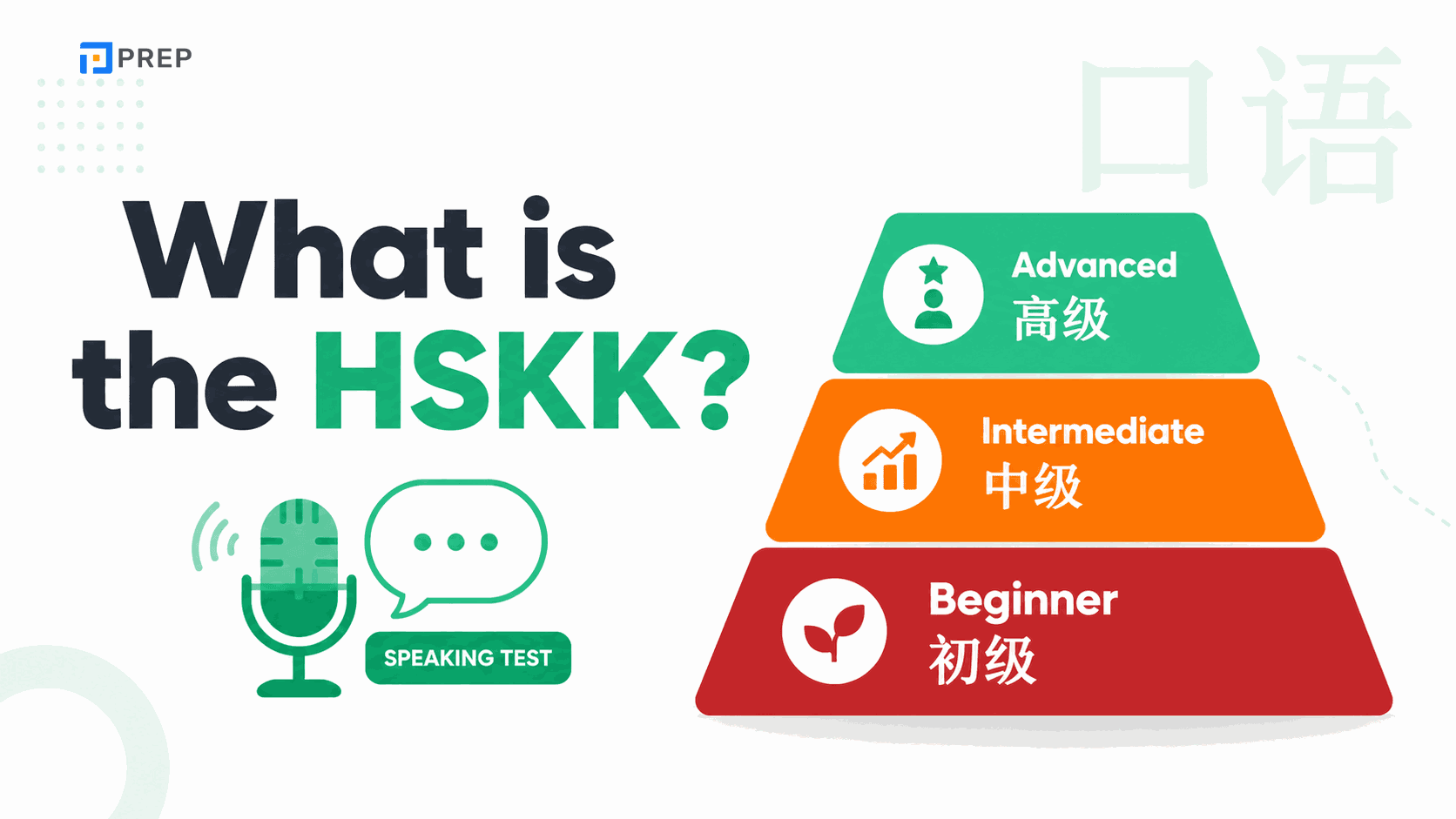
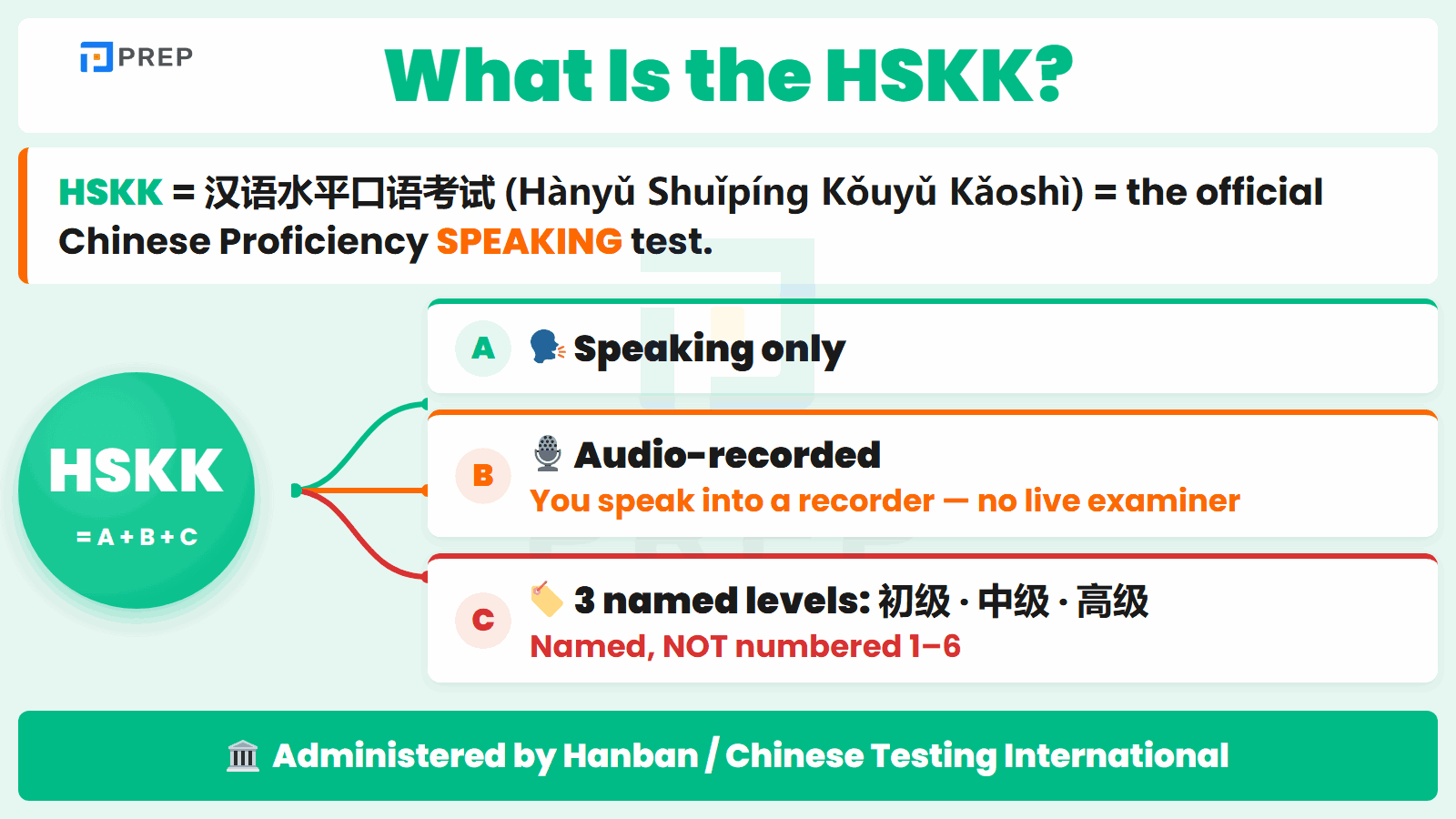
The HSKK (汉语水平口语考试, Hànyǔ Shuǐpíng Kǒuyǔ Kǎoshì) is the official standardized test that measures spoken Chinese only. It is audio-recorded - you speak your answers into a computer or recorder rather than to a live examiner - and it comes in three named levels: Beginner (初级), Intermediate (中级), and Advanced (高级), not numbered 1-6 like the HSK. It is administered by Hanban / Chinese Testing International and delivered through Confucius Institutes and authorized test centers worldwide.
The literal name says it all. HSK stands for the Chinese Proficiency Test; adding the "K" (口语, kǒuyǔ, "spoken language") turns it into the Chinese Proficiency Speaking Test. So while the HSK checks how well you read and listen, the HSKK checks one thing: how well you produce spoken Chinese, out loud, under exam conditions.
Two details trip up first-time candidates, so it helps to settle them early. First, the whole test is recorded - there is no interviewer sitting across from you, and every prompt plays in Chinese, with set preparation time before you speak. Second, the HSKK is its own exam, not a section buried inside the HSK. That single fact clears up most of the confusion, and it's exactly where the next section starts.
II. HSK vs HSKK: What's the Difference?
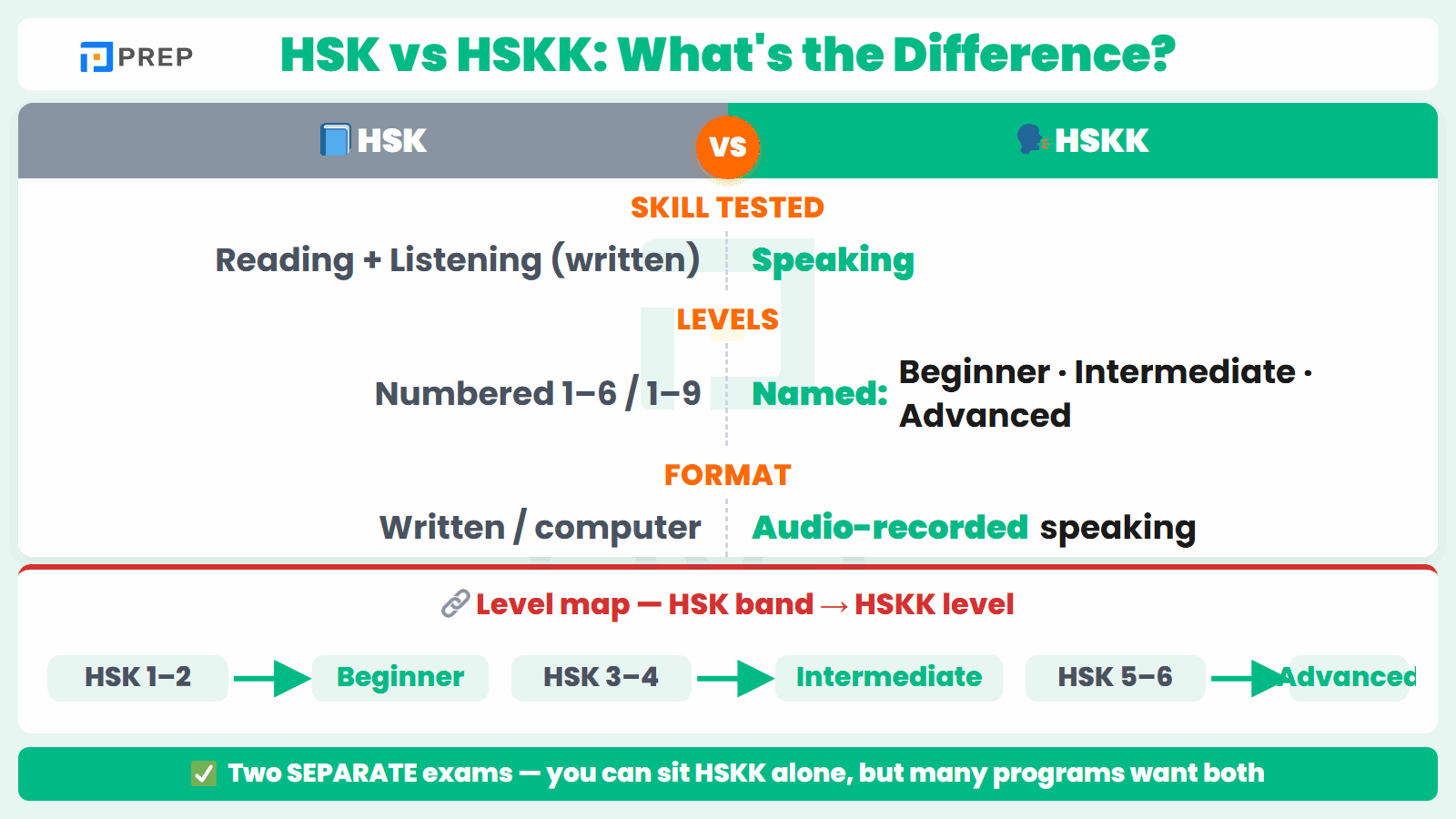
The confusion here isn't really about spelling. Most learners assume the extra "K" signals a sub-section of the HSK, so they go looking for the HSKK inside their HSK exam. The clearer mental model is "same family, different exam": the HSK and HSKK share a proficiency framework, but they are separate tests with separate registration, separate levels, and separate scores.
|
Dimension |
HSK |
HSKK |
|
What it measures |
Reading and listening comprehension |
Speaking only |
|
Format |
Written, computer- or paper-based |
Audio-recorded speaking |
|
Level system |
Numbered 1-6 (new system 1-9) |
Named: Beginner, Intermediate, Advanced |
|
How it's taken |
Independently |
Independently (no HSK required first) |
|
Typical use |
General Chinese proficiency proof |
Proof of spoken Chinese ability |
Read the table one row at a time and the relationship becomes obvious: the two exams test different skills and use different level systems, so an HSK 4 result tells a university nothing about how you sound. You can sit the HSKK on its own, without ever taking the HSK. In practice, though, many programs ask for both an HSK result and an HSKK result, because they want proof that you can read and speak - which is why picking the right level matters, and we'll get to that shortly.
III. The Three HSKK Levels: Beginner, Intermediate, and Advanced
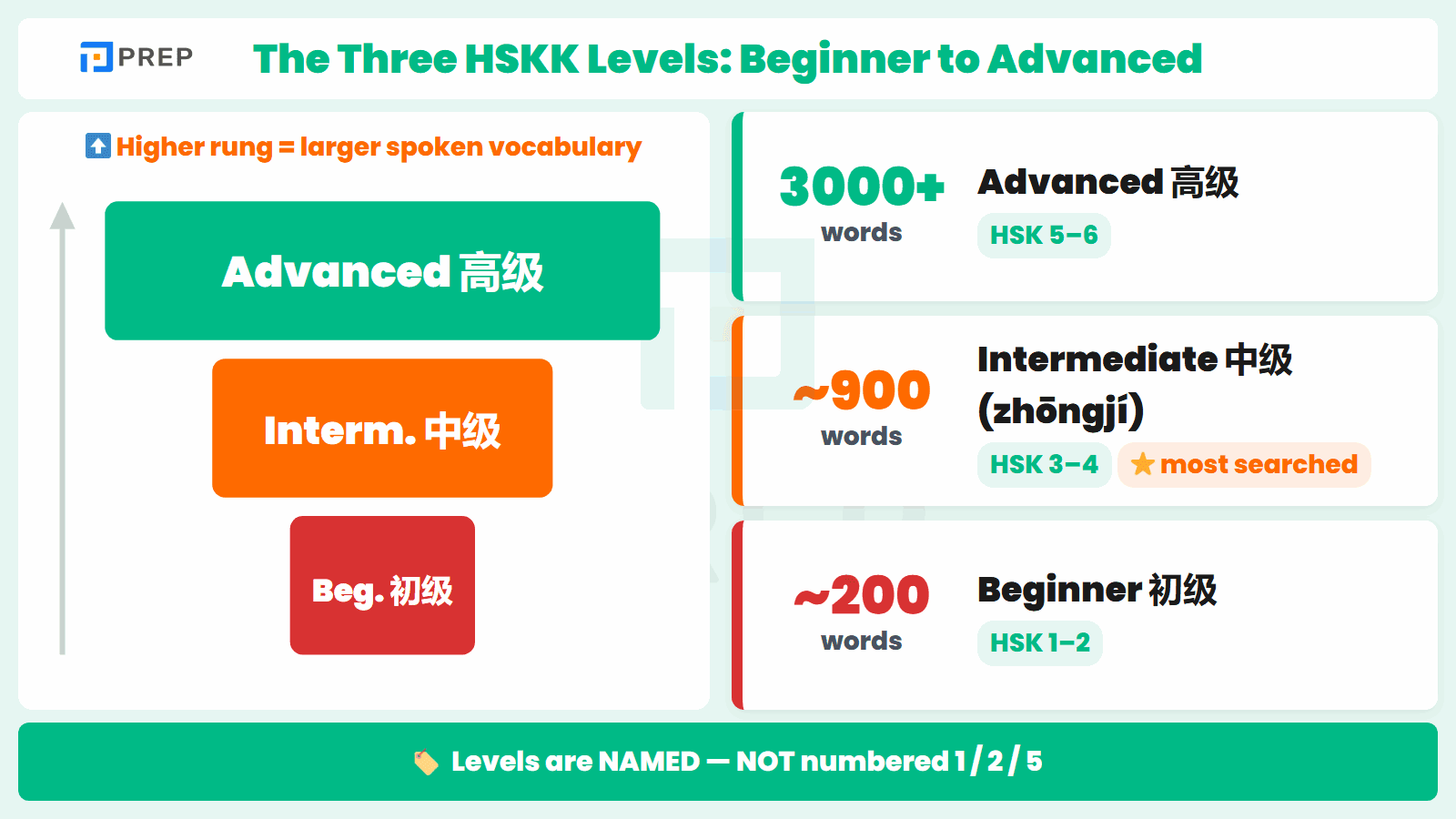
Most "which level am I?" confusion comes from importing the HSK's number system, so anchor yourself instead to two things you already know: your spoken vocabulary and your HSK band. Each HSKK level lines up with a rough word count and a matching HSK range, so you self-locate by proficiency rather than by a number that doesn't exist here.
That last point is worth stating plainly, because it drives a lot of searches. The HSKK isn't numbered 1-6 like the HSK. It has three named levels: Beginner (初级), Intermediate (中级), and Advanced (高级). If you've searched "HSKK 1", "HSKK 2", or "HSKK 5", you were using HSK numbering; the HSKK simply doesn't work that way. Here's what each named level actually means.
1. HSKK Beginner (初级, Chūjí)
HSKK Beginner (初级) is for learners with about a 200-word spoken vocabulary, roughly matching HSK levels 1-2, who can understand and respond to simple, familiar questions [1]. At this level you handle short everyday exchanges - introducing yourself, answering basic questions, repeating what you hear - rather than producing extended speech.
2. HSKK Intermediate (中级, Zhōngjí)
HSKK Intermediate (中级, zhōngjí) is for learners with about a 900-word spoken vocabulary, roughly matching HSK levels 3-4 [1]. It's the most commonly searched HSKK level - "zhongji" and "中级" turn up constantly - because it's the sweet spot most working learners and applicants aim for. Here you can discuss familiar topics, describe things at some length, and keep a short conversation going.
3. HSKK Advanced (高级, Gāojí)
HSKK Advanced (高级) is for learners with a spoken vocabulary of 3,000+ words, roughly matching HSK levels 5-6, who can speak fluently on a wide range of topics [1]. At this level you express opinions, handle abstract or unfamiliar subjects, and organize extended answers - close to a near-fluent spoken command of the language.
IV. HSKK Exam Format and Structure
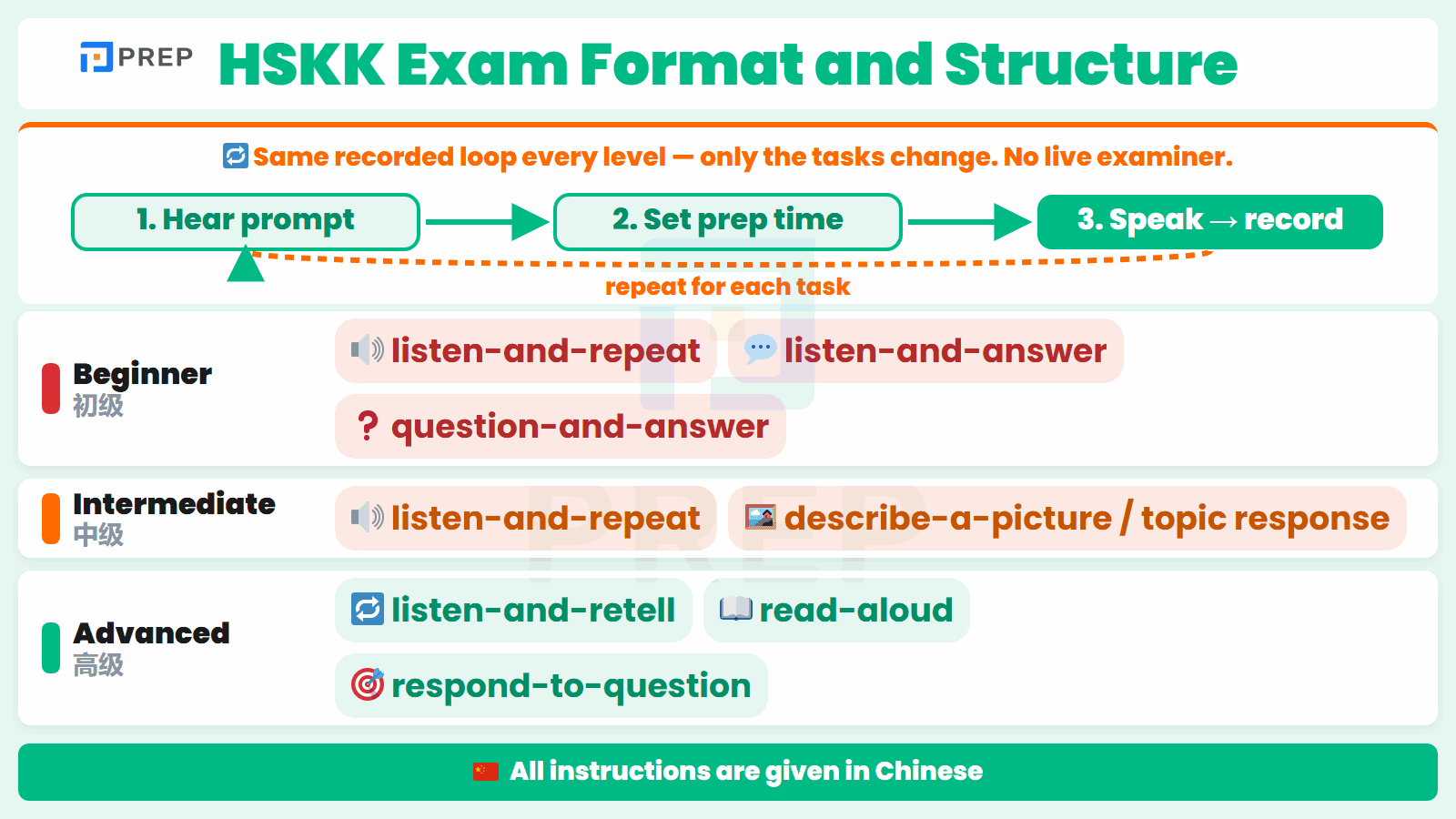
The format anxiety is really about the unknown mechanics of recording, not the questions themselves. The loop is the same at every level: you hear a prompt in Chinese, you get a set number of preparation seconds, then you speak your answer into a recorder. Once you see that each per-level test is a variation on that one predictable loop, the format stops being the scary part.
So let's name the thing candidates worry about most. You do not talk to a person. You talk to a computer or a recorder. You hear the prompts through headphones or a speaker, a prep timer counts down, and then your response is recorded for later grading. All instructions are in Chinese. What changes from level to level isn't the recording setup - it's the task types and how much you're expected to produce. The tables below are approximate; always confirm current details on the official site, since counts and timings can be updated.
1. HSKK Beginner Format (初级)
Beginner is the "repeat and reply" level: the recorder is checking whether you can reproduce sounds accurately and give simple spoken answers, not whether you can talk at length.
|
Section |
What you do |
Approx. items |
|
Listen and repeat |
Hear a sentence, then repeat it |
~15 |
|
Listen and answer |
Hear a short question, give a quick reply |
~10 |
|
Answer questions |
Respond to everyday questions with prep time |
~2 |
The whole test runs roughly 20 minutes, including several minutes of preparation time. If you can hold a simple exchange out loud, this is your level (confirm exact figures on chinesetest.cn).
2. HSKK Intermediate Format (中级)
Intermediate is the "describe and sustain" step up: you move from repeating what you hear to producing your own connected speech on a given prompt.
|
Section |
What you do |
Approx. items |
|
Listen and repeat |
Hear a sentence, then repeat it |
~10 |
|
Describe or respond |
Look at a prompt and speak about it |
~2 |
|
Answer questions |
Give a longer spoken answer to a question |
~2 |
Total time is about 20 to 25 minutes, with roughly 10 minutes of preparation built in. The jump from Beginner is fluency: you're now expected to keep talking, not just react (verify current details officially).
3. HSKK Advanced Format (高级)
Advanced is the "retell and argue" level: you summarize what you heard and defend a position, which tests fluency and organization under time pressure.
|
Section |
What you do |
Approx. items |
|
Listen and retell |
Hear a passage, then retell it in your own words |
~3 |
|
Read aloud |
Read a passage aloud clearly |
~1 |
|
Answer questions |
Give an extended, reasoned spoken answer |
~2 |
The exam lasts roughly 25 minutes, including preparation time. Because you're organizing longer answers on the spot, pacing and pronunciation carry real weight here (confirm the latest structure on the official site).
V. Which HSKK Level Should You Take?
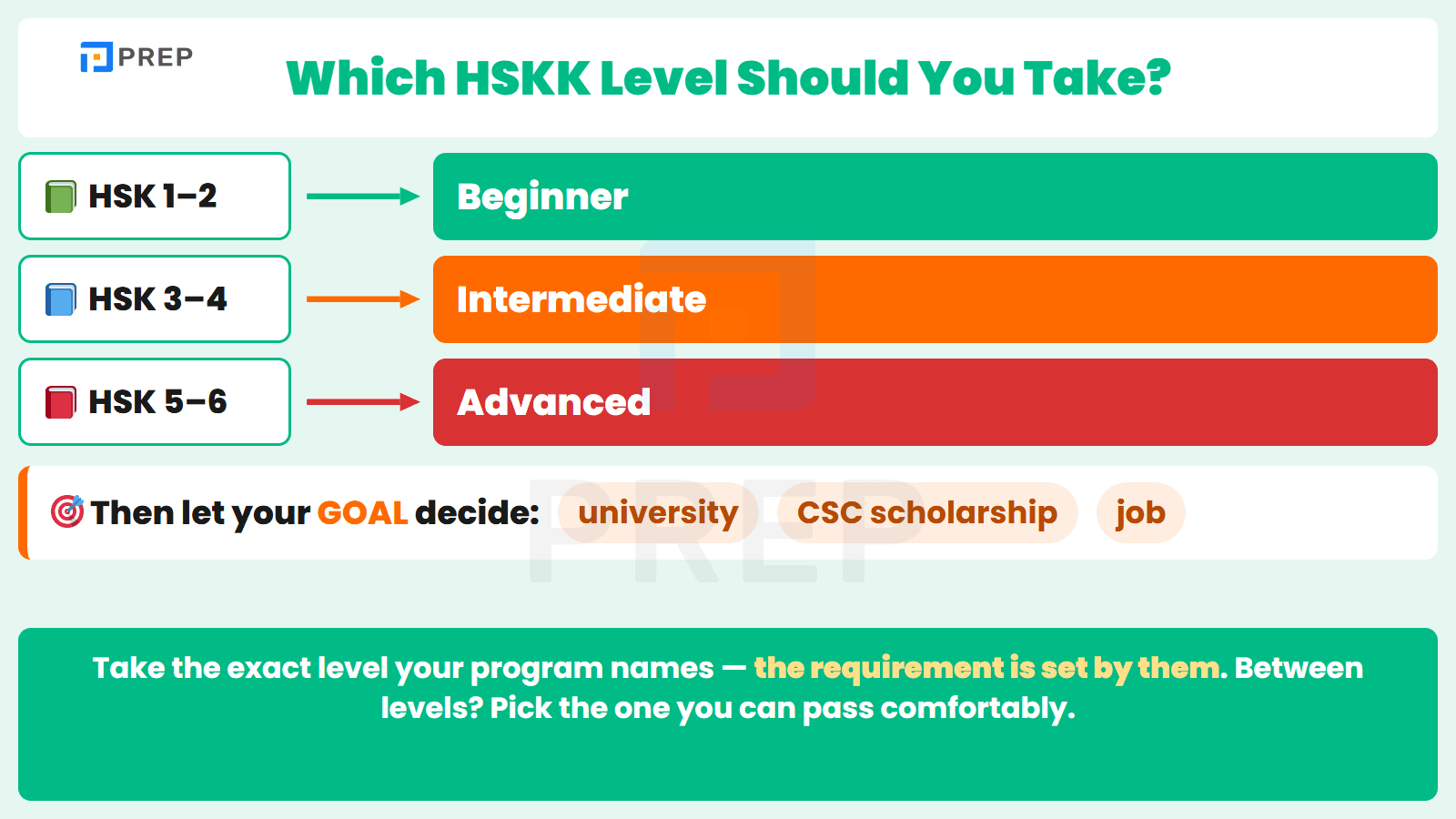
Match your HSKK level to your HSK level: take HSKK Beginner if you're around HSK 1-2, HSKK Intermediate if you're around HSK 3-4, and HSKK Advanced if you're around HSK 5-6. Beyond that, let your goal decide - always take the specific HSKK level your target university, scholarship (e.g. CSC), or employer names, since the requirement is set by them, not by a universal rule.
That HSK anchor is the fastest way to self-locate, but it's only step one. The level you actually need is set by whoever is reading your certificate. A scholarship application, a university admissions page, and a job posting will each name a minimum HSKK level (often alongside an HSK score), and those requirements don't always match the "obvious" pairing above. So before you register, check the exact wording on your target program's page and treat that as the authoritative source.
Do you even need the HSKK? Honestly, not everyone does. You only need it if a program you're applying to asks for it - many scholarships and Chinese-taught degrees do, and jobs that involve speaking Chinese often do too, but plenty of learners never require it. And if you're stuck between two levels, pick the one you can pass comfortably, unless your program names a specific level you must hit. There's no prize for sitting a harder level than you need.
VI. HSKK Scoring and Passing Score
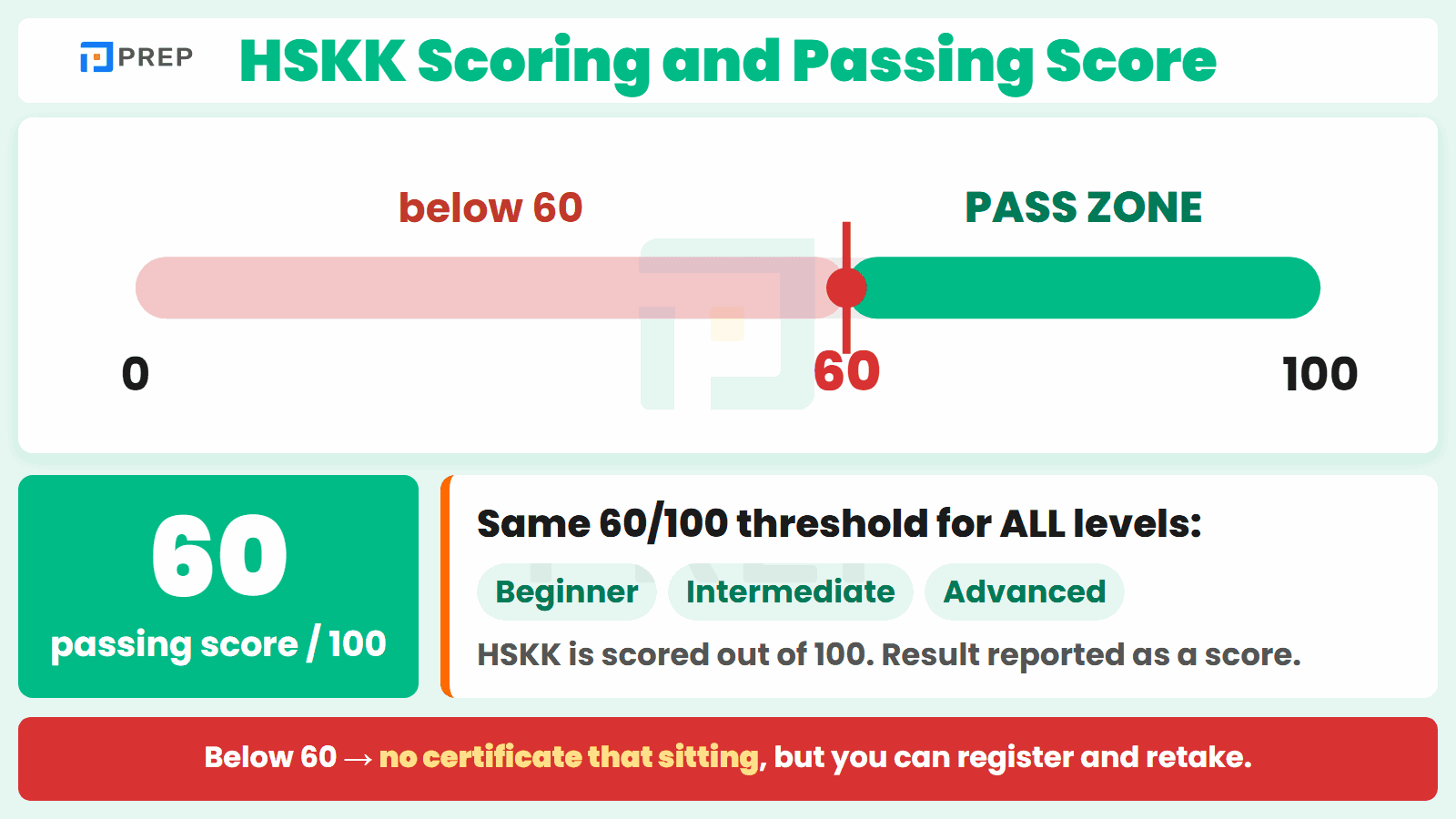
The HSKK is scored out of 100, and the passing score is 60 - the same threshold for Beginner, Intermediate, and Advanced [1]. Your result is reported as a score; if you score below 60 you don't receive a certificate for that sitting, but you can register and retake the exam.
So there's no separate, tougher pass mark waiting for you at Advanced - 60 out of 100 is the line at every level. What changes is how hard earning those points gets, since Advanced demands far more spoken range than Beginner. Your recording is graded on how well you speak: pronunciation, fluency, and how completely you answer each prompt. A failed sitting simply means no certificate that time, not a permanent mark, and you're free to prepare and try again. For the current grading breakdown, the official site is the source of truth.
VII. HSKK Registration, Fees, and Test Dates
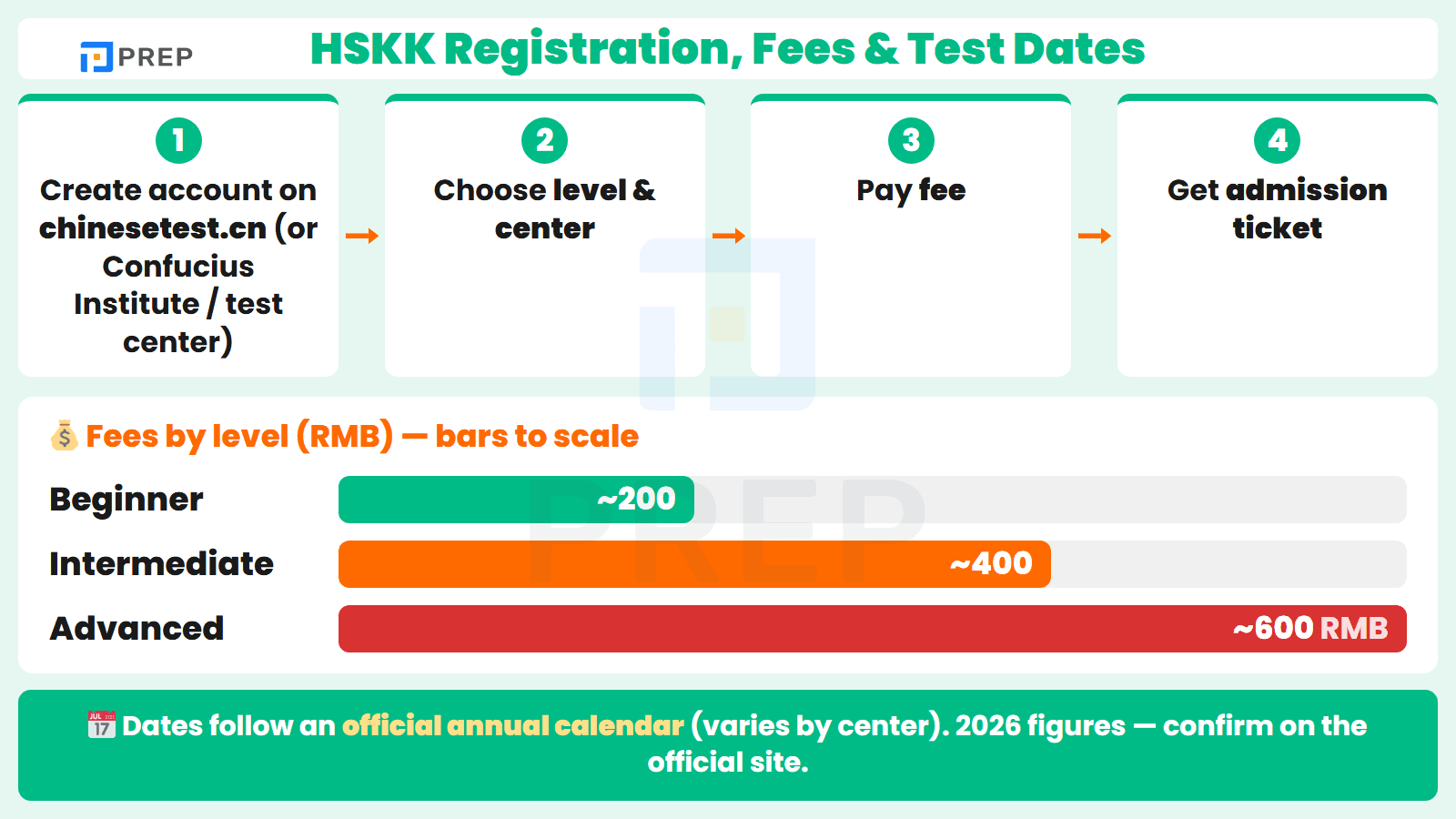
You register for the HSKK through the official portal at chinesetest.cn or an authorized test center / Confucius Institute. Fees run roughly 200 RMB (Beginner), 400 RMB (Intermediate), and 600 RMB (Advanced) [1], and test dates follow an official annual calendar that varies by center. These figures are current for 2026 - always confirm the exact fee and dates on the official site before registering.
The sign-up flow is straightforward once you know the steps. Create an account on chinesetest.cn, choose your level and a nearby test center, pay the fee, and download your admission ticket before the test day. Here are the per-level fees at a glance:
|
Level |
Approx. fee |
|
HSKK Beginner (初级) |
~200 RMB |
|
HSKK Intermediate (中级) |
~400 RMB |
|
HSKK Advanced (高级) |
~600 RMB |
Test dates are scheduled on a fixed calendar several times a year, and the exact sittings depend on your center, so check its local schedule early - popular dates fill up. One convenient detail: the HSKK is frequently offered on or near the same dates as the HSK, so you can often plan both exams in a single trip. Just remember these fees and dates are 2026 figures; verify them on chinesetest.cn before you pay.
VIII. The HSKK Certificate: Validity and Uses
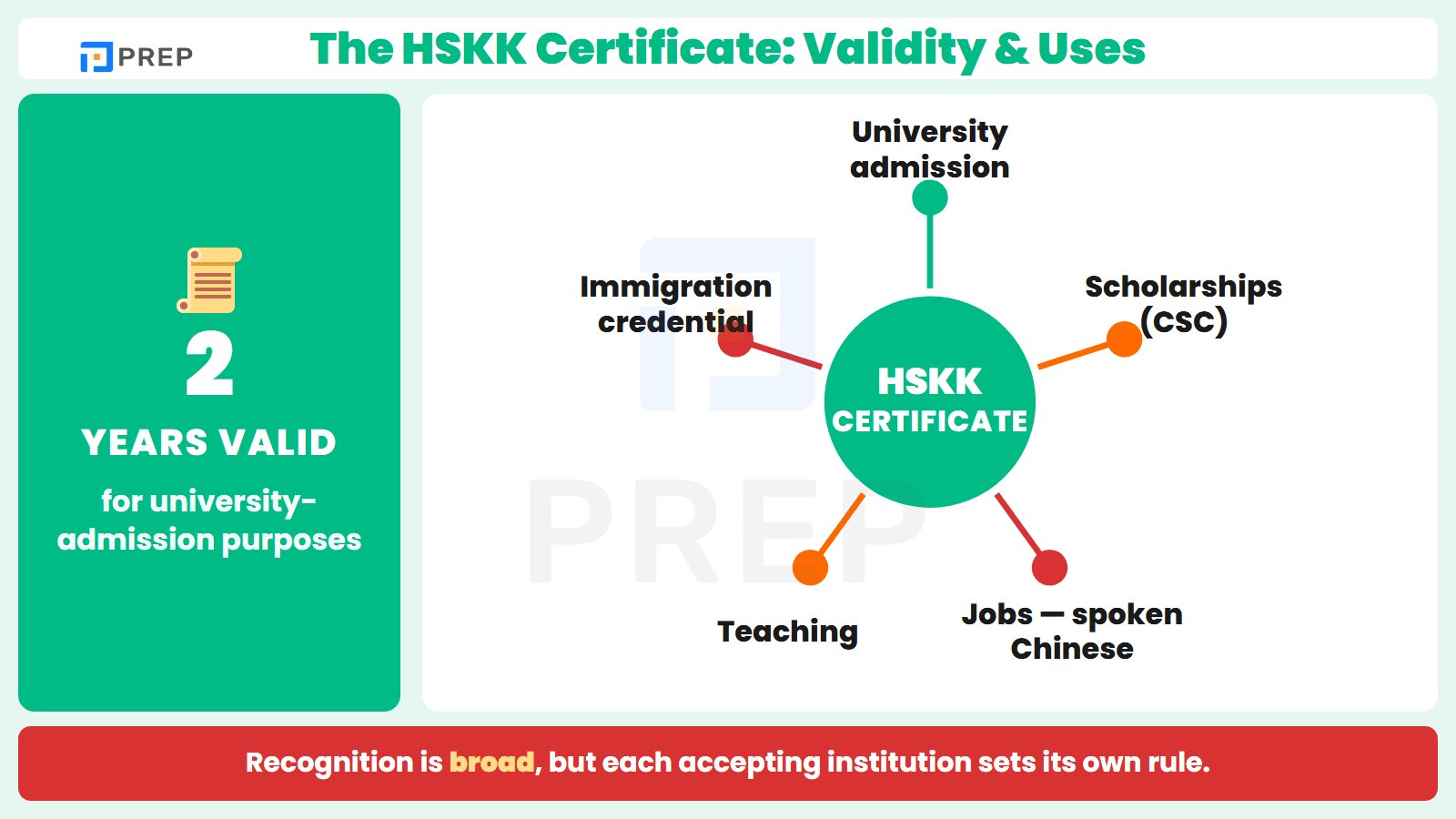
The HSKK certificate is generally treated as valid for 2 years for university-admission purposes [1]. It is used for university admission, scholarships (such as the CSC), and jobs requiring spoken Chinese, as well as teaching roles and some immigration or professional credentials. Recognition is broad, but each accepting institution sets its own rules, so confirm the requirement with your target program.
It helps to read that "2 years" correctly. The window is mainly an admissions convention - universities and scholarship boards want a reasonably recent result, so they treat certificates older than two years as expired for application purposes. Your score itself doesn't vanish; it's the acceptance rule that has a shelf life. Because recognition depends on the institution, a certificate that satisfies one scholarship might need to be more recent for another. Whenever a certificate is load-bearing for your plan, check the accepting body's exact validity rule rather than assuming.
IX. How to Prepare for the HSKK
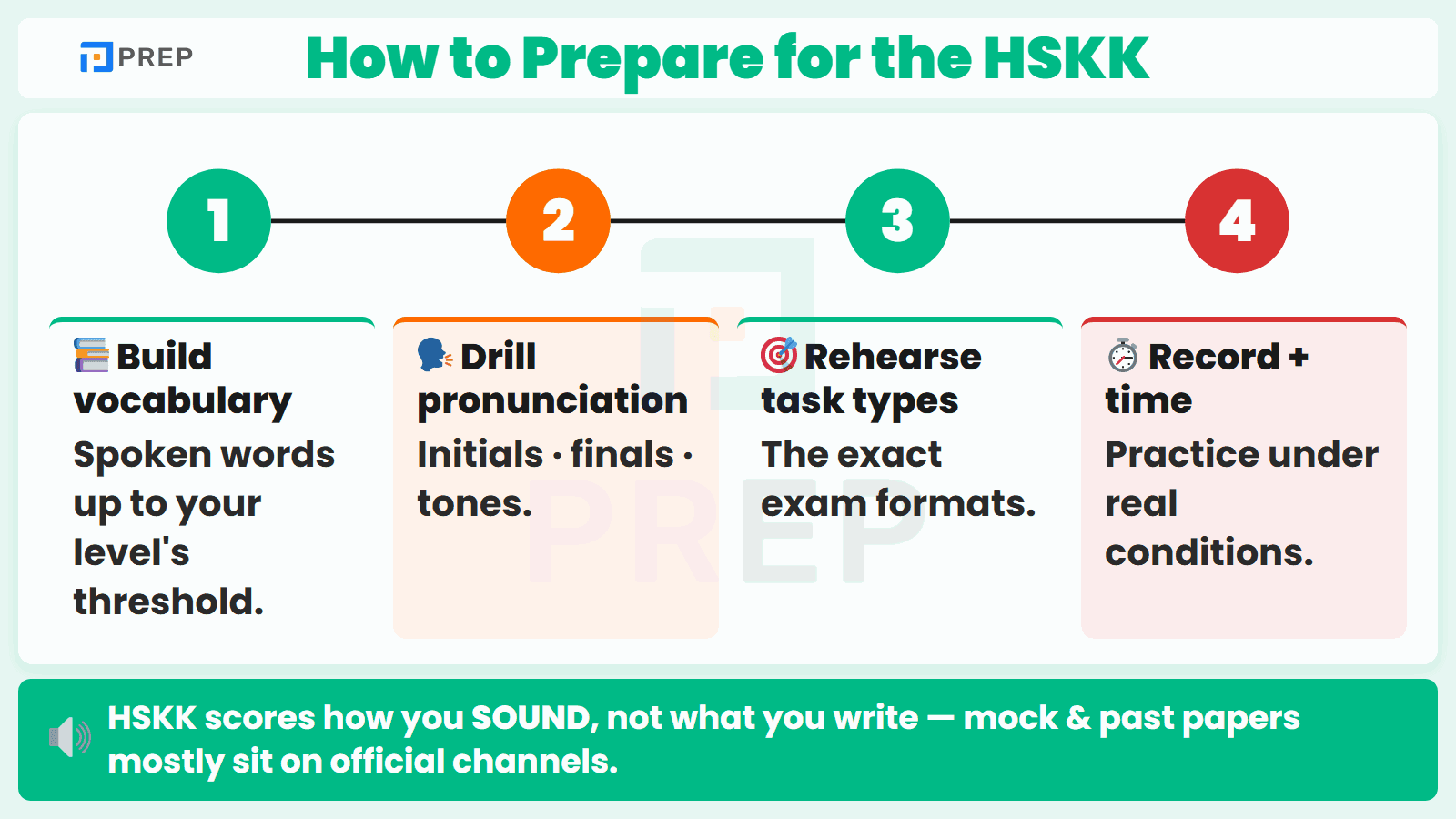
Most candidates over-prepare vocabulary and grammar and under-prepare the two things the HSKK actually scores: pronunciation - your initials, finals, and tones - and fluent speech produced under recorded, timed conditions. If your practice so far has been silent reading and flashcards, you're likely rehearsing the wrong skill. Here's a prep path built around what the recorder is really listening for.
- Build spoken vocabulary to your level's threshold. Aim for the roughly 200, 900, or 3,000+ words that match your target level, and practice saying them, not just recognizing them on a page.
- Drill pronunciation at the syllable level. Work through initials, finals, and tones deliberately, because a clear tone often carries more points than an extra fancy word.
- Rehearse the exact task types from Section IV. Repeat sentences, describe prompts, retell passages - whatever your level demands - so nothing on test day is unfamiliar.
- Practice under recorded, timed conditions. Record yourself with a prep timer running, then play it back. This one habit turns the format from an obstacle into a routine.
Because the HSKK is scored on how you sound and how fluently you respond under recording, the most useful practice is speaking aloud and getting feedback on your initials, finals, and tones. This is exactly where an AI speaking partner helps: Prep is building AI-powered Chinese speaking practice with pronunciation feedback on initials, finals, and tones, with HSKK support coming soon - a native way to rehearse spoken output and hear where your tones drift. You can pair it with the fundamentals in Chinese pronunciation: initials, finals, and tones to fix issues at the source.
One honest note on practice materials. Genuinely useful HSKK PDFs, mock tests, sample tests, and past papers mostly live on the official chinesetest.cn site and on Confucius Institute channels, and quality free resources are thinner than the search results suggest. Start with the official samples for the real question types, then spend most of your time speaking and recording rather than hunting for one more PDF.
X. FAQ
These are the fast answers to the exact questions people ask before registering. The full detail lives in the sections above; each answer here stands on its own.
1. What Does HSKK Stand For?
HSKK stands for 汉语水平口语考试 (Hànyǔ Shuǐpíng Kǒuyǔ Kǎoshì) - the Chinese Proficiency Speaking Test. The extra "K" comes from 口语 (kǒuyǔ), meaning "spoken language", which is what separates it from the written HSK.
2. Is the HSKK Part of the HSK Exam?
No. The HSKK is a separate, speaking-only exam with its own levels, registration, and scoring. Many programs ask for both an HSK and an HSKK result, but you take and pass them independently. You can find the full breakdown in HSK levels explained (HSK 1-9).
3. Is the HSKK Hard?
Its difficulty depends on your level and your speaking practice. The exam itself is predictable and the question types are fixed; most of the difficulty comes from limited spoken rehearsal under recorded, timed conditions - which is exactly the thing you can practice. Prepare by speaking aloud, and the "hard" part shrinks.
4. What Is HSKK 中级 (Zhōngjí)?
HSKK 中级 (zhōngjí) is the Intermediate level - about a 900-word spoken vocabulary, roughly matching HSK 3-4. It's the most commonly searched HSKK level because it's the one most working learners and applicants target.
5. What Is the Passing Score for the HSKK?
The passing score is 60 out of 100, and it's the same threshold for all three levels. Score below 60 and you don't get a certificate for that sitting, but you can register and retake it.
6. How Long Is the HSKK Certificate Valid For?
The HSKK certificate is generally valid for 2 years for university-admission purposes. That window is an admissions convention, and the accepting institution sets its own rule - so confirm the exact requirement with your target program.
Knowing the HSKK is really four decisions in a row: understand that it's a spoken-only test, pick the level that matches your HSK band and your goal, learn the recorded format so it holds no surprises, and then prepare by speaking rather than just studying. Keep the load-bearing facts close - three named levels, a pass mark of 60 out of 100, and a certificate that's generally good for two years.
Your next step is simple. Choose your level, then start rehearsing out loud under recorded, timed conditions, ideally with feedback on your initials, finals, and tones. That's how the speaking test stops being a source of anxiety and becomes something you've already done a dozen times before you sit it.
References
- [1] HSKK test levels, format, scoring, fees, and certificate information - Hanban / Chinese Testing International (中外语言交流合作中心), chinesetest.cn. Figures current for 2026; confirm exact details on the official site.

Hi I'm Chloe, and I am currently serving as an Product Content Administrator at Prep Education. With over five years of experience in independent online IELTS study and exam preparation, I am confident in my ability to support learners in achieving their highest possible scores.
Comment
Premium content
View all
Personalized roadmap


Most read

UEN: 202227322W
Address: 114 LAVENDER STREET, #11-83 CT HUB 2, SINGAPORE (338729)