英文授與動詞(授予動詞)是什麼?有哪些?Dative Verbs / Double Object Verbs 完整用法與練習題
授與動詞是什麼?簡單來說,英文授與動詞(Dative Verbs)是英語中一類特殊的動詞,它與一般動詞最大的差異在於:後方必須同時接兩個受詞——一個「人」(間接受詞)和一個「物」(直接受詞)——語意才能完整表達。例如 She gave me a book.(她給了我一本書。)中的 give,正是最典型的授與動詞例子。
許多人學了多年英文,卻不知道自己每天都在使用授與動詞;更多人在考試中因為一個介系詞用錯,或誤把 explain、suggest 當成授與動詞,白白丟了關鍵分數。授與動詞(Double Object Verbs)看似簡單,卻暗藏句型轉換規則、介系詞選擇邏輯,以及代名詞的絕對語法限制,是台灣與香港學生在國中英語、高中文法,乃至 TOEIC、IELTS 備考中最容易反覆踩坑的文法要點之一。
本文由 PREPEDU 整理,從授與動詞的核心定義出發,完整涵蓋兩大句型公式、to╱for╱of 三類介系詞口訣、必考文法陷阱,並附上三大題型共 30 道授與動詞練習題與學習單,讓你一篇文章徹底掌握 Dative Verbs 的所有用法,不再在同一個地方失分。

I. 什麼是授予動詞?授與動詞英文與受詞定義
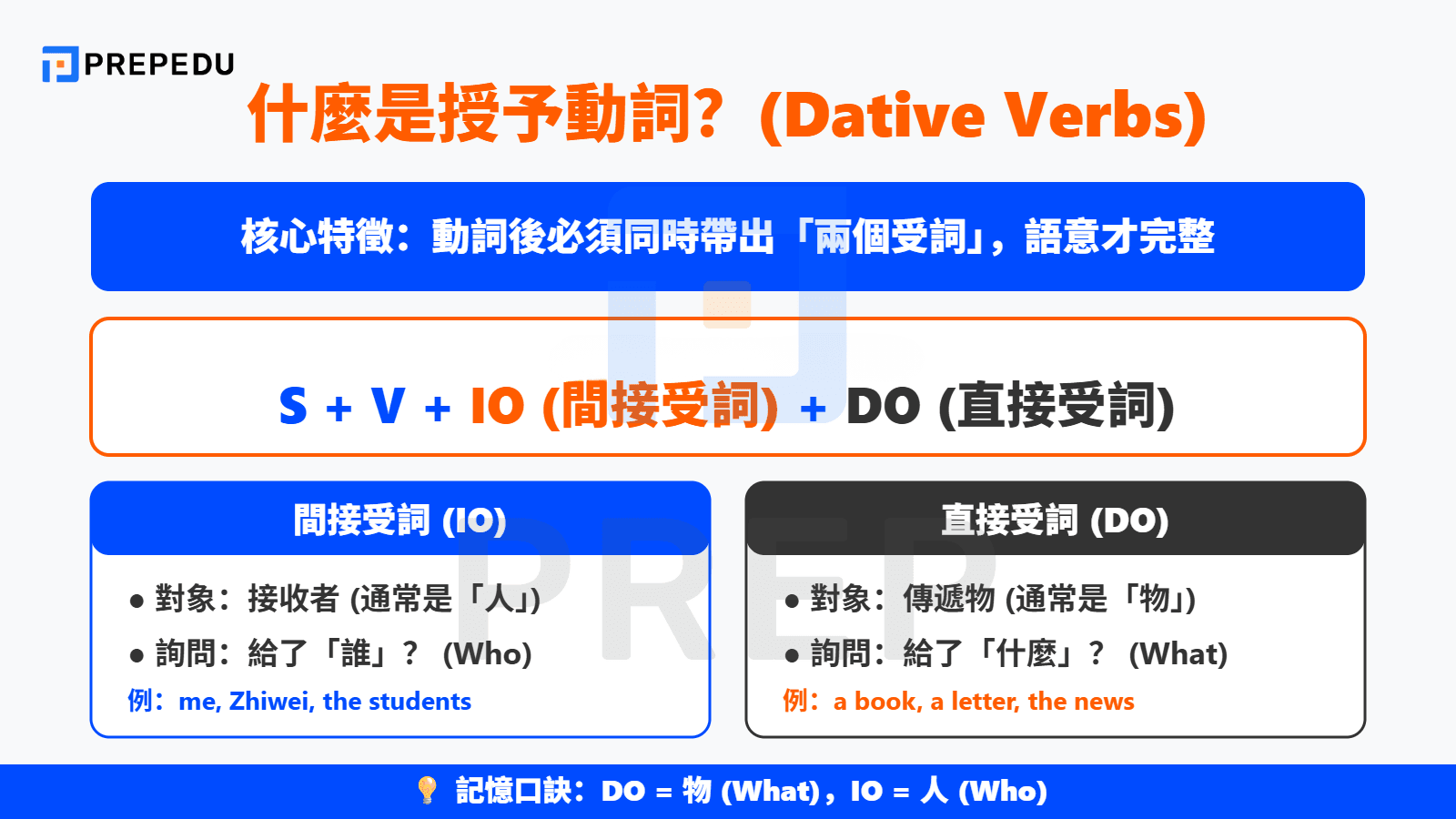
授與動詞(Dative Verbs)是英語語法架構中不可或缺的核心動詞類型,也稱為雙賓動詞英文(Double Object Verbs)。它的核心特徵在於:動詞後方必須同時帶出兩個受詞,語意才完整。掌握授與動詞的定義、句型結構與介系詞搭配,是突破台灣與香港學生文法考試失分盲區的關鍵一步。
1. 授與動詞(雙賓動詞)的基本概念
一般及物動詞只需一個受詞,語意便能完整傳達。She read a book.(她讀了一本書。)中,read 只需要 a book 一個受詞即告完結。
授與動詞(雙賓動詞)則不同——它的語意核心是「傳遞關係」,涉及一個發出者、一個接收者,以及一樣被傳遞的事物,三者缺一不可。
以最典型的授與動詞英文 give 為例:Xiaowang gave Zhiwei a design book at the Taipei Book Fair.(小旺在台北書展上給了志偉一本設計書。)
少了「物」或少了「人」,這個句子的語意便無法完整表達授予的動作。
授與動詞在英語五大句型中對應的是第四句型:
S(主詞)+ V(授與動詞)+ O₁(間接受詞)+ O₂(直接受詞)
這是台灣國中英語課程最早接觸授與動詞的句型框架,理解此句型有助於你在日後的 TOEIC 與 IELTS 寫作中正確駕馭複雜句式。
2. 授與動詞的受詞:直接受詞(DO)與間接受詞(IO)
授與動詞後方的兩個受詞,在語法上有明確的角色區分:
-
直接受詞(Direct Object,DO):指「被傳遞的物品、訊息或服務」,即動作直接接觸的對象,通常回答「給了什麼?」。例如:a letter(一封信)、some flowers(幾朵花)、the news(這則消息)。
-
間接受詞(Indirect Object,IO):指「接受該物品或訊息的人」,即傳遞動作的受益者,通常回答「給了誰?」。例如:me(我)、her(她)、the students(學生們)。
記憶口訣:DO=物(What),IO=人(Who)。先問「給了什麼?」找 DO;再問「給了誰?」找 IO。語序上,兩個受詞的出場先後決定了是否需要介系詞,這正是授與動詞句型學習的核心。
II. 授與動詞用法與句型轉換
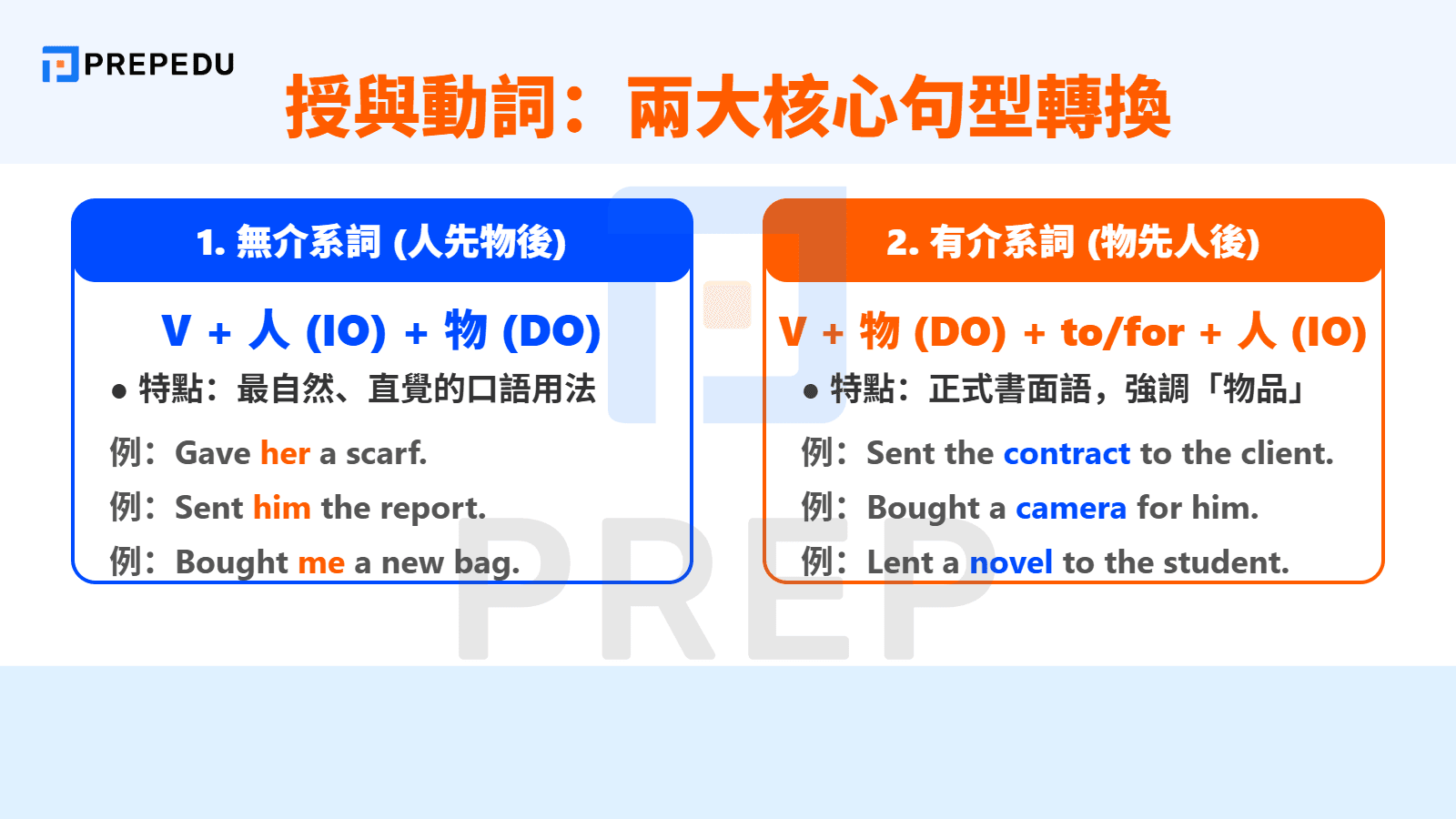
授與動詞用法的精髓,在於同一個意思可以透過兩種句型表達:「無介系詞(人先物後)」與「有介系詞(物先人後)」。兩種句型語意相同,但語序不同,強調重點各異,書面語與口語的偏好也有細微差別。
1. 授與動詞句型:無介系詞(人先物後)
這是英語口語中最自然、最直覺的授與動詞用法,結構緊湊,適合日常對話與非正式書面語。
公式:
S + V + IO(人)+ DO(物)
|
授與動詞 |
例句 |
|
give |
Xiaoting gave her grandmother a handmade scarf before Chinese New Year.(小婷在農曆新年前送給外婆一條手工圍巾。) |
|
send |
Zhiwei sent his professor the revised report on Monday morning.(志偉在週一早上把修改後的報告傳給了教授。) |
|
lend |
Can you lend Aming your portable charger before the concert?(演唱會前你能把行動電源借給阿明嗎?) |
|
tell |
She told the customs officer her travel itinerary at Hong Kong International Airport.(她在香港國際機場告訴了海關人員她的行程。) |
|
show |
The tour guide showed the visitors a century-old map of Dadaocheng.(導遊給參觀者看了一張大稻埕的百年地圖。) |
|
write |
Xiaowang wrote his sponsor a heartfelt thank-you letter after the scholarship ceremony.(小旺在獎學金頒獎典禮後寫了一封真誠的感謝信給贊助人。) |
|
buy |
His mother bought him a new backpack for the first day of high school.(他的媽媽為他買了一個新背包迎接高中第一天。) |
|
make |
Xiaoting made all her colleagues a batch of pineapple cakes from Xinyi District.(小婷為所有同事做了一批來自信義區的鳳梨酥。) |
|
offer |
The Taipei hotel offered every guest a complimentary breakfast voucher.(那家台北飯店提供每位住客一張免費早餐券。) |
|
pass |
Could you pass Aming the soy sauce at the end of the table?(你能把桌尾的醬油遞給阿明嗎?) |
2. 授與動詞句型:有介系詞(物先人後)
當說話者想強調「物品本身」,或在正式書面語、學術寫作中,通常採用介系詞結構。直接受詞(DO)先出場,間接受詞(IO)跟隨在介系詞之後。
公式:
S + V + DO(物)+ 介系詞(to / for / of)+ IO(人)
|
授與動詞 |
例句 |
|
give |
Xiaoting gave a beautifully wrapped gift to her department manager on the last workday before the holidays.(小婷在假期前的最後一個工作日,把一份精美包裝的禮物送給了部門主管。) |
|
send |
Zhiwei sent the final contract to the client in Hong Kong by express courier.(志偉透過快遞把最終合約寄給了香港的客戶。) |
|
lend |
She lent her favorite travel novel to the exchange student from Kaohsiung.(她把自己最喜愛的旅遊小說借給了來自高雄的交換學生。) |
|
sell |
The elderly calligrapher sold a framed piece of his work to a collector in Jiufen.(那位老書法家把一幅裱框作品賣給了九份的一位收藏家。) |
|
buy |
His father bought a professional camera for him as a university graduation gift.(他的父親為他買了一台專業相機作為大學畢業禮物。) |
|
make |
Aming made a personalized playlist for his girlfriend during their trip to Hualien.(阿明在花蓮旅行途中為他的女友製作了一份個人化播放清單。) |
|
book |
The travel agency booked a harbor-view suite for the newlyweds visiting Hong Kong.(旅行社為前往香港的新婚夫婦預訂了一間海景套房。) |
|
pour |
She poured another cup of oolong tea for the guest who had just arrived from Alishan.(她為剛從阿里山抵達的客人又倒了一杯烏龍茶。) |
3. 兩種句型的選用時機
兩種句型的選擇並非完全自由。以下兩個情境有明確的使用傾向,是授與動詞用法中容易被忽略的重要細節:
情境一:間接受詞(IO)是較長的片語時,優先使用句型(有介系詞)。
這是因為當接受者的描述過長,插入在動詞與直接受詞之間會使句子頭重腳輕,可讀性下降。
He showed his ticket to the immigration officer standing at the arrival gate.(他把票出示給站在入境閘口的移民局官員。)→ 此句 IO「the immigration officer standing at the arrival gate」片語較長,必須使用有介系詞的句型(有介系詞)。
情境二:間接受詞(IO)是代名詞時,通常優先使用句型(無介系詞)。
-
I poured him another glass of plum wine.(我又為他倒了一杯梅子酒。)
-
Their teacher read them an excerpt from a classic Taiwanese novel.(老師為他們朗讀了一段台灣經典小說的選段。)
然而,此規則有一個重要例外:當直接受詞(DO)是 it 或 them 時,無論如何都必須使用句型(有介系詞),這點將在第四章詳細說明。
III. 授與動詞有什麼?常見的授與動詞口訣與介系詞搭配
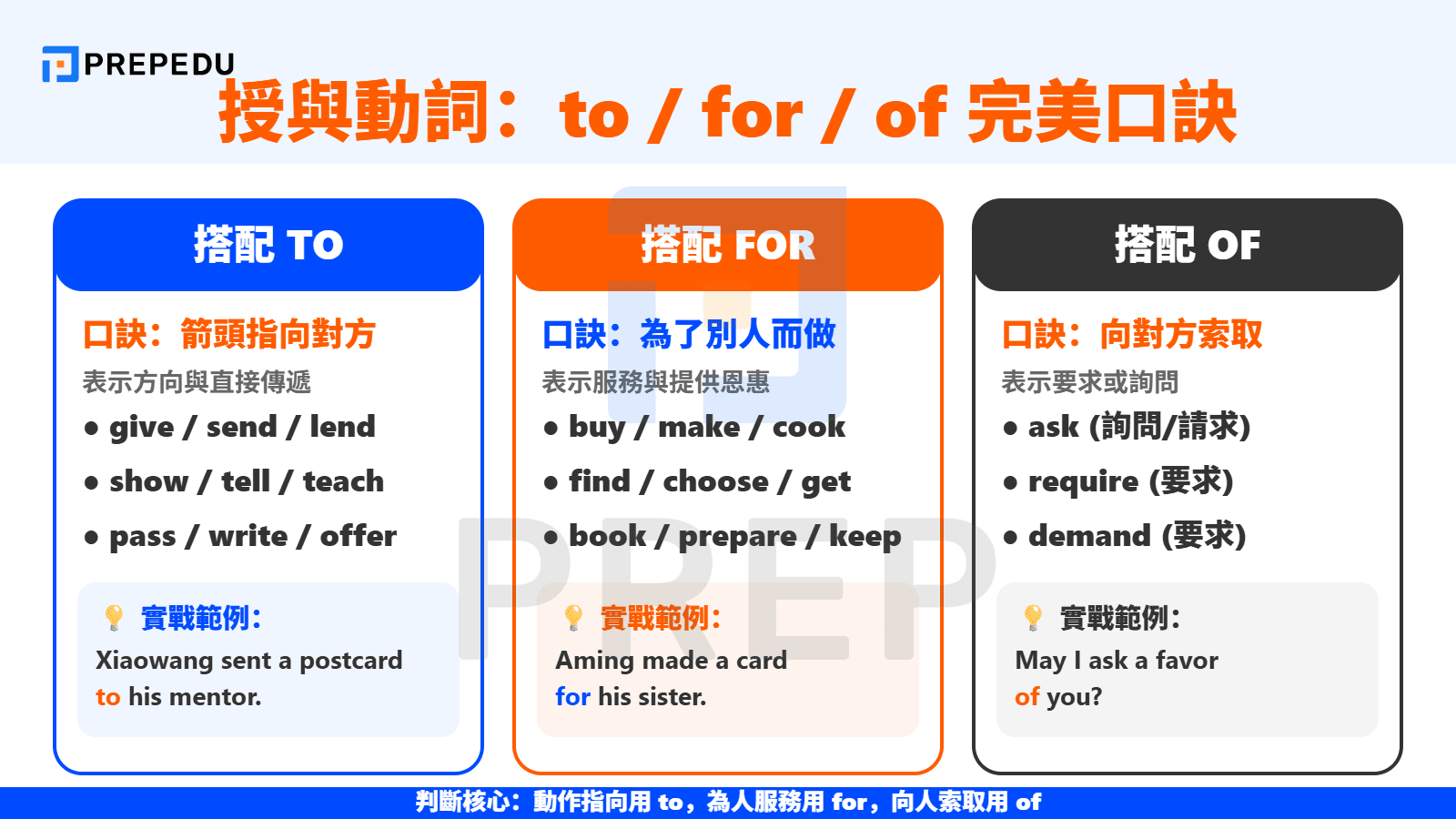
學習授與動詞,最常見的困惑不在句型本身,而在介系詞的選擇——句型②中,究竟該用 to、for,還是 of?正確的授與動詞口訣能幫你一次理清所有搭配規律。以下是以語意為核心的系統化分類。
1. 搭配 to:表示「方向與直接傳遞」
用 to 的授與動詞,其動作帶有明確的「方向性」——東西從動作發起者出發,沿著一條清晰的路徑,直接抵達接收者手中。這種傳遞可以是實體的(寄送一個包裹),也可以是非實體的(傳達一個消息)。
口訣:動作有明顯「箭頭指向對方」就用 to。
|
授與動詞 |
例句 |
|
give(給予) |
She gave the award certificate to the top student in the Jiufen painting competition.(她把獎狀頒發給九份繪畫比賽的第一名學生。) |
|
send(寄送) |
Xiaowang sent a handwritten postcard to his mentor in Tainan.(小旺把一張手寫明信片寄給了台南的恩師。) |
|
lend(借出) |
The librarian lent a rare historical atlas to the researcher from Hong Kong.(圖書館員把一本稀有的歷史地圖集借給了來自香港的研究員。) |
|
sell(出售) |
The craftsman sold a hand-carved wooden box to a tourist visiting Yingge.(那位工匠把一個手工雕刻的木盒賣給了一名遊覽鶯歌的旅客。) |
|
show(展示) |
Xiaoting showed the new product prototype to the investors at the Taipei Demo Day.(小婷在台北 Demo Day 上向投資人展示了新產品原型。) |
|
tell(告知) |
Please tell the exact meeting location to all participants before Friday.(請在週五前告知所有與會者確切的開會地點。) |
|
teach(教授) |
Zhiwei has taught advanced data analysis to graduate students for three semesters.(志偉已經教了研究生進階資料分析三個學期。) |
|
write(寫信) |
Aming wrote a formal complaint letter to the district office in Zhongzheng.(阿明寫了一封正式投訴信給中正區的區公所。) |
|
offer(提供) |
The company offered a full scholarship to the top applicant from Hong Kong.(那家公司為來自香港的最優秀申請者提供了全額獎學金。) |
|
pass(傳遞) |
Could you pass this USB drive to Xiaowang at the next seat?(你能把這支隨身碟傳給坐在旁邊的小旺嗎?) |
|
post(郵寄) |
She posted the signed agreement to the legal office in Central, Hong Kong.(她把簽署好的協議郵寄到香港中環的法律事務所。) |
|
promise(承諾) |
He promised a raise to every team member who exceeded their quarterly targets.(他向每一位超越季度目標的團隊成員承諾加薪。) |
|
read(朗讀) |
The grandmother read a Taiwanese folktale to the children before bedtime.(祖母在就寢前為孩子們朗讀了一個台灣民間故事。) |
2. 搭配 for:表示「服務與提供恩惠」
用 for 的授與動詞,動作本身「可以獨立完成,但專門是為了對方而做」——帶有服務、替代、恩惠的語意。接受者(IO)不一定在場,重點在於「這個動作是為了他╱她完成的」。
口訣:動作「可以自己完成,但為了別人做」就用 for。
|
授與動詞 |
例句 |
|
buy(購買) |
Xiaoting bought a limited-edition tea set for her colleague who collects ceramics.(小婷為她熱愛收藏陶瓷的同事買了一套限量版茶具。) |
|
make(製作) |
Aming made a handmade birthday card for his younger sister who lives in Hong Kong.(阿明為旅居香港的妹妹親手做了一張生日卡片。) |
|
cook(烹飪) |
Zhiwei cooked a traditional Sichuan hotpot for his team after the product launch.(志偉在產品發布後為他的團隊煮了一頓傳統四川火鍋。) |
|
find(尋找) |
Can you find a quiet co-working space for Xiaowang near Xinyi Station?(你能在信義站附近幫小旺找一個安靜的共享辦公空間嗎?) |
|
choose(選擇) |
The stylist chose a qipao in midnight blue for the guest of honor at the banquet.(造型師為宴會上的貴賓挑選了一件深藍色旗袍。) |
|
order(點餐╱訂購) |
Xiaoting ordered a matcha latte for her manager before the 9 a.m. briefing.(小婷在早上九點的簡報前為主管訂了一杯抹茶拿鐵。) |
|
get(取得╱買) |
Could you get a window seat for Aming on the high-speed rail to Zuoying?(你能幫阿明搶到去左營的高鐵靠窗座位嗎?) |
|
book(預訂) |
The assistant booked a meeting room for the director every Tuesday afternoon.(助理每週二下午都為主任預訂了一間會議室。) |
|
bring(帶來) |
He brought some authentic egg tarts for his colleagues from a bakery in Mong Kok.(他從旺角的一家麵包店帶了幾個正宗蛋撻給同事。) |
|
keep(保留) |
The receptionist kept a seat for the latecoming delegate from Taichung.(接待員為遲到的台中代表保留了一個座位。) |
|
pour(倒飲料) |
Xiaowang poured some freshly brewed sorghum wine for each elder at the table.(小旺為桌上每一位長輩倒了一些剛釀好的高粱酒。) |
|
save(保存╱留住) |
Please save a copy of the signed contract for Zhiwei's records.(請幫志偉保留一份已簽署合約的副本備查。) |
|
prepare(準備) |
The hotel prepared a welcome amenity for the VIP guests flying in from Singapore. (飯店為從新加坡飛來的 VIP 賓客準備了到達迎賓禮品。) |
3. 搭配 of:Ask 是授與動詞嗎?
Ask 確實是授與動詞,但它屬於第三類介系詞搭配,與 to 及 for 的方向性完全不同。搭配 of 的授與動詞傳達的是「向某人索取或提出要求」的語意——動作的方向是由說話者「朝向對方」提出請求,而非將東西傳遞出去。
|
授與動詞 |
例句 |
|
ask(請求╱詢問) |
May I ask a small personal favor of you before you leave for Hong Kong?(你去香港之前,我能請你幫我一個小忙嗎?) |
|
require(要求) |
The internship program requires a great deal of commitment of its participants.(那個實習計畫對參與者的投入程度要求甚高。) |
|
demand(要求) |
The department head demanded a full written explanation of the team responsible.(部門主管向負責的團隊要求一份完整的書面說明。) |
IV. 授與動詞必考注意事項與文法陷阱
即使掌握了授與動詞用法與句型公式,仍有三大文法陷阱常讓學習者在高中、大學及語言檢定考試中反覆失分。這三個陷阱涵蓋代名詞的絕對語法限制、外表相似卻非授與動詞的假授與動詞,以及被動語態轉換的特殊規則。
1. 代名詞做直接受詞時的絕對限制
這是授與動詞學習中最不可違背的鐵則:當直接受詞(DO)是代名詞 it 或 them 時,只能使用句型(有介系詞),句型(無介系詞)在此情況下屬於語法錯誤。
原因在於:英語習慣將「資訊量較重」的成分置於句末(end-weight principle),代名詞 it 或 them 因資訊量極輕,不適合作為句尾焦點,因此必須前移,並在間接受詞前加上介系詞。
|
情境 |
正確(✓) |
錯誤(✗) |
|
Xiaoting needs the report. Give it to her. |
Give it to her.(把它給她。) |
Give her it.(✗) |
|
He has the tickets. Send them to Aming. |
Send them to Aming.(把它們寄給阿明。) |
Send Aming them.(✗) |
|
The keys are on the desk. Bring them to me. |
Bring them to me.(把它們帶給我。) |
Bring me them.(✗) |
必考鐵則:當 DO 為代名詞(it 或 them)時,必須使用句型:V + DO + 介系詞 + IO。無論介系詞是 to 還是 for,此規則均適用。
請特別注意,this 與 that 雖然也是代名詞,但因其資訊量略重於 it╱them,在口語中有時可接受句型(無介系詞),但在正式考試寫作中,建議一律採用句型(有介系詞),以避免爭議。
2. 易混淆字詞:Borrow 是授與動詞嗎?
Borrow 不是授與動詞,這是台灣英語教學現場最常見的混淆點之一。
-
Lend 表示「借出」,帶有物品傳遞給對方的語意,因此是授與動詞
-
Borrow 表示「向對方借取」,物品的方向是由對方流向自己,不具備雙賓結構
|
動詞 |
正確用法(✓) |
錯誤用法(✗) |
|
lend(借出) |
Can you lend me your umbrella?(你能把雨傘借給我嗎?) |
無誤 |
|
borrow(借取) |
Can I borrow your umbrella?(我可以借你的雨傘嗎?) |
Can I borrow you an umbrella?(✗) |
同樣道理,以下幾個動詞因不具備「傳遞給對方」的語意核心,皆不是授與動詞,不能直接接雙受詞:
|
常見假授與動詞 |
錯誤用法(✗) |
正確用法(✓) |
|
explain(解釋) |
Please explain me the process.(✗) |
Please explain the process to me.(✓) |
|
suggest(建議) |
She suggested me a shortcut.(✗) |
She suggested a shortcut to me.(✓) |
|
introduce(介紹) |
Let me introduce you my supervisor.(✗) |
Let me introduce my supervisor to you.(✓) |
|
describe(描述) |
He described me the Jiufen street scene.(✗) |
He described the Jiufen street scene to me.(✓) |
|
announce(宣告) |
The manager announced us the new policy.(✗) |
The manager announced the new policy to us.(✓) |
|
mention(提及) |
She mentioned me the event.(✗) |
She mentioned the event to me.(✓) |
學習提醒:explain、suggest、introduce 是台灣學生在段考與模擬考中最常出現的假授與動詞陷阱,建議單獨記憶這三個動詞,並反覆練習正確句型,直到形成語感。
3. 授與動詞的被動語態轉換
授與動詞的雙賓結構可以轉換為被動語態,且有兩種方式:將「人(IO)」或「物(DO)」移至句首作主詞。台灣學測與指考,以及 IELTS Writing Task 2 中,都可能要求辨別或運用此結構。
主動句: Xiaowang gave Zhiwei a comprehensive market analysis report.(小旺給了志偉一份詳盡的市場分析報告。)
-
被動語態 A(人作主詞): Zhiwei was given a comprehensive market analysis report by Xiaowang.(志偉被小旺給了一份詳盡的市場分析報告。)
-
被動語態 B(物作主詞): A comprehensive market analysis report was given to Zhiwei by Xiaowang.(一份詳盡的市場分析報告被小旺給了志偉。)→ 介系詞 to 必須保留。
重要規則:當「物(DO)」作為被動語態主詞時,原本句型中的介系詞(to╱for)必須在句中保留,不可省略。
例如:
-
A traditional Hong Kong-style mooncake was made for Aming by his aunt.(✓ for 保留)
-
A traditional Hong Kong-style mooncake was made Aming by his aunt.(✗ 省略 for,語法錯誤)
兩種被動語態在英語中均屬正確,但「人作主詞」的形式(Zhiwei was given...)在英式英語中更為普遍;「物作主詞」的形式(A report was given to...)在正式書面語與學術寫作中則更為常見。
V. 授與動詞練習題與學習單:3 大題型實戰測驗
以下授與動詞練習題涵蓋三大核心題型,設計原則與台灣高中段考文法題及 TOEIC Part 5 句型題高度吻合。本授與動詞學習單可直接用於課堂教學或個人自學,每題均附參考解答。建議先獨立完成所有授與動詞題目,再核對解答,以達到最佳學習成效。
1. 題型一:介系詞填空題(To / For / Of)
-
Xiaoting passed the signed document _____ her manager in the Taipei branch office. (pass)
-
Zhiwei's mother made a bowl of sesame noodles _____ him after his marathon in Taichung. (make)
-
Could you ask a small professional favor _____ the senior consultant before the meeting? (ask)
-
The event coordinator booked a reserved table _____ the delegation visiting from Hong Kong. (book)
-
Please lend your bicycle helmet _____ Aming before he leaves for the cycling trail in Dongshan. (lend)
-
The teacher read an excerpt from the Taiwanese classic novel _____ the class. (read)
-
Xiaowang's company offered a generous relocation allowance _____ him when he transferred to the Kaohsiung office. (offer)
-
She poured the last portion of aged pu-erh tea _____ the honored guest at the ceremony. (pour)
-
The hotel kept a riverside room _____ the journalist who arrived late from Hong Kong. (keep)
-
The district office requires a completed application form _____ each new resident. (require)
參考解答
-
to(pass 表示直接傳遞,用 to)
-
for(make 表示為對方製作,用 for)
-
of(ask a favor of,固定搭配,表示向對方索取)
-
for(book 表示為對方預訂,用 for)
-
to(lend 表示借出傳遞給對方,用 to)
-
to(read 表示將內容朗讀給對方,用 to)
-
to(offer 表示提供給對方,用 to)
-
to(pour 在部分文體中可接 to,但多用 for;此處語境「倒給」表傳遞,用 to 亦正確)
-
for(keep 表示為對方保留,用 for)
-
of(require 表示向對方索取╱要求,用 of)
2. 題型二:授與動詞句型轉換題
-
Aming sent Xiaoting a beautiful postcard from Jiufen. → 改寫為有介系詞句型
-
Zhiwei's grandfather left him a handwritten recipe for braised pork rice. → 改寫為有介系詞句型
-
Could you save me a window seat on the Hong Kong–Taipei flight? → 改寫為有介系詞句型
-
The professor assigned every student a research topic related to Taiwanese history. → 改寫為有介系詞句型
-
Xiaowang's aunt cooked him a full Hakka-style meal on his birthday. → 改寫為有介系詞句型
-
She gave the graduation certificate to the top student at the ceremony in Hsinchu. → 改寫為無介系詞句型
-
They booked a suite with an ocean view for the guests celebrating their anniversary. → 改寫為無介系詞句型
-
The florist chose a bouquet of white chrysanthemums for the memorial service. → 改寫為無介系詞句型(注意:主詞為 florist,IO 需補充)
-
Xiaoting sold her old bicycle to her neighbor in the Daan District. → 改寫為無介系詞句型
-
Zhiwei's company offered a signing bonus to every new hire in the Taipei headquarters. → 改寫為無介系詞句型
參考解答
-
Aming sent a beautiful postcard to Xiaoting from Jiufen.
-
Zhiwei's grandfather left a handwritten recipe for braised pork rice for him.
-
Could you save a window seat for me on the Hong Kong–Taipei flight?
-
The professor assigned a research topic related to Taiwanese history to every student.
-
Xiaowang's aunt cooked a full Hakka-style meal for him on his birthday.
-
She gave the top student the graduation certificate at the ceremony in Hsinchu.
-
They booked the guests celebrating their anniversary a suite with an ocean view.
-
本題 IO 未明確提供,建議補充:The florist chose the chief mourner a bouquet of white chrysanthemums.(此答案僅供參考)
-
Xiaoting sold her neighbor in the Daan District her old bicycle.
-
Zhiwei's company offered every new hire in the Taipei headquarters a signing bonus.
3. 題型三:文法改錯題(代名詞與假授與動詞陷阱)
-
The manager explained Aming the quarterly budget in detail.
-
Xiaowang bought her it as a thank-you gift after the Taipei conference.
-
Please suggest me a reliable translation tool for the Hong Kong report.
-
Zhiwei introduced us his new colleague from the Kaohsiung branch.
-
Give me them and I will sort through the documents tonight.
-
The instructor described students the difference between Dative Verbs and regular verbs.
-
She sent Xiaoting them by registered mail last Tuesday.
-
The school announced us the new term schedule before the holiday.
-
He mentioned me the vacancy at the Hong Kong office last week.
-
Could you show me it before submitting it to the client in Taichung?
參考解答
-
錯誤:explained Aming → 正確:explained the quarterly budget to Aming(explain 不是授與動詞,只能使用 to+IO)
-
錯誤:bought her it → 正確:bought it for her(代名詞 it 作 DO,必須使用句型有介系詞)
-
錯誤:suggest me → 正確:suggest a reliable translation tool to me(suggest 不是授與動詞)
-
錯誤:introduced us his new colleague → 正確:introduced his new colleague to us(introduce 不是授與動詞)
-
錯誤:Give me them → 正確:Give them to me(代名詞 them 作 DO,必須使用句型有介系詞)
-
錯誤:described students → 正確:described the difference to the students(describe 不是授與動詞)
-
錯誤:sent Xiaoting them → 正確:sent them to Xiaoting(代名詞 them 作 DO,必須使用句型有介系詞)
-
錯誤:announced us → 正確:announced the new term schedule to us(announce 不是授與動詞)
-
錯誤:mentioned me → 正確:mentioned the vacancy to me(mention 不是授與動詞)
-
錯誤:show me it → 正確:show it to me(代名詞 it 作 DO,必須使用句型有介系詞)
結論
授與動詞(Dative Verbs)看似只是英語文法中的一個小環節,卻是連結句子結構與語意精準度的關鍵橋梁。文法規則的價值,從來不在於死背,而在於內化之後能夠不假思索地正確運用。每一條授與動詞的語法規則背後,都有其語言邏輯的支撐——理解了這個邏輯,規則便不再是負擔,而是你精準表達的工具。建議你在完成本篇授與動詞練習題之後,回到日常的英語閱讀與寫作中,主動留意授與動詞的實際出現方式,觀察母語人士如何在 to 與 for 之間做出選擇,讓語感在真實語境中持續累積與鞏固。
您是否曾懷疑自己能否達到目標分數?PREPEDU.COM 的 Test Practice 不僅協助您練習考題,更能根據目前成績精準預測達分可能性。
憑藉數千名成功學員的資料庫,系統分析分數趨勢並提供符合各項具體目標的個人化學習路徑。無論您的目標是雅思 6.5 分或多益 850 分,每個目標都有專屬策略。
視覺化進度追蹤功能顯示您目前的位置,以及達成目標還需多長時間。許多學員在持續練習 4-6 週後,雅思成績提升 0.5-1.0 分,多益成績增加 100-200 分。
成功並非來自運氣,而是源於周全的準備。讓 PREP Test Practice 成為連結現在與夢想的橋樑!
你好!我叫黃秋賢,現在在 prepedu.com 擔任內容企劃。我有超過5年的英語與韓語自學經歷,親身備考 IELTS、TOEIC 與 TOPIK,累積了大量第一手的學習者視角——包括哪些語法規則最讓台灣與香港學習者混淆,以及如何在有限的備考時間內最有效地修正這些錯誤。目前已在 prepedu.com 撰寫超過 1000 篇英語學習文章,內容涵蓋語法、詞彙與考試策略,累積協助數千位學習者解決自學過程中的語法疑問。
評論











統一企業編號:202227322W
地址:114 LAVENDER STREET, #11-83 CT HUB 2, SINGAPORE (338729)