IELTS Speaking Part 2, 3: Describe a time when you used a map that was useful
Chủ đề liên quan đến Map không chỉ xuất hiện trong IELTS Writing mà còn có mặt ở bài thi IELTS Speaking, một trong những đề bài thông dụng có thể kể đến đó là “Describe a time when you used a map that was useful”. Vậy khi gặp topic này chúng ta cần giải quyết như thế nào? Hãy cùng PREP tham khảo ngay bài mẫu Part 2 cùng câu hỏi và câu trả lời liên quan ở Part 3 ngay dưới đây nhé!
- I. Bài mẫu Describe a time when you used a map that was useful
- II. Câu trả lời mẫu IELTS Speaking Part 3 chủ đề: Describe a time when you used a map that was useful
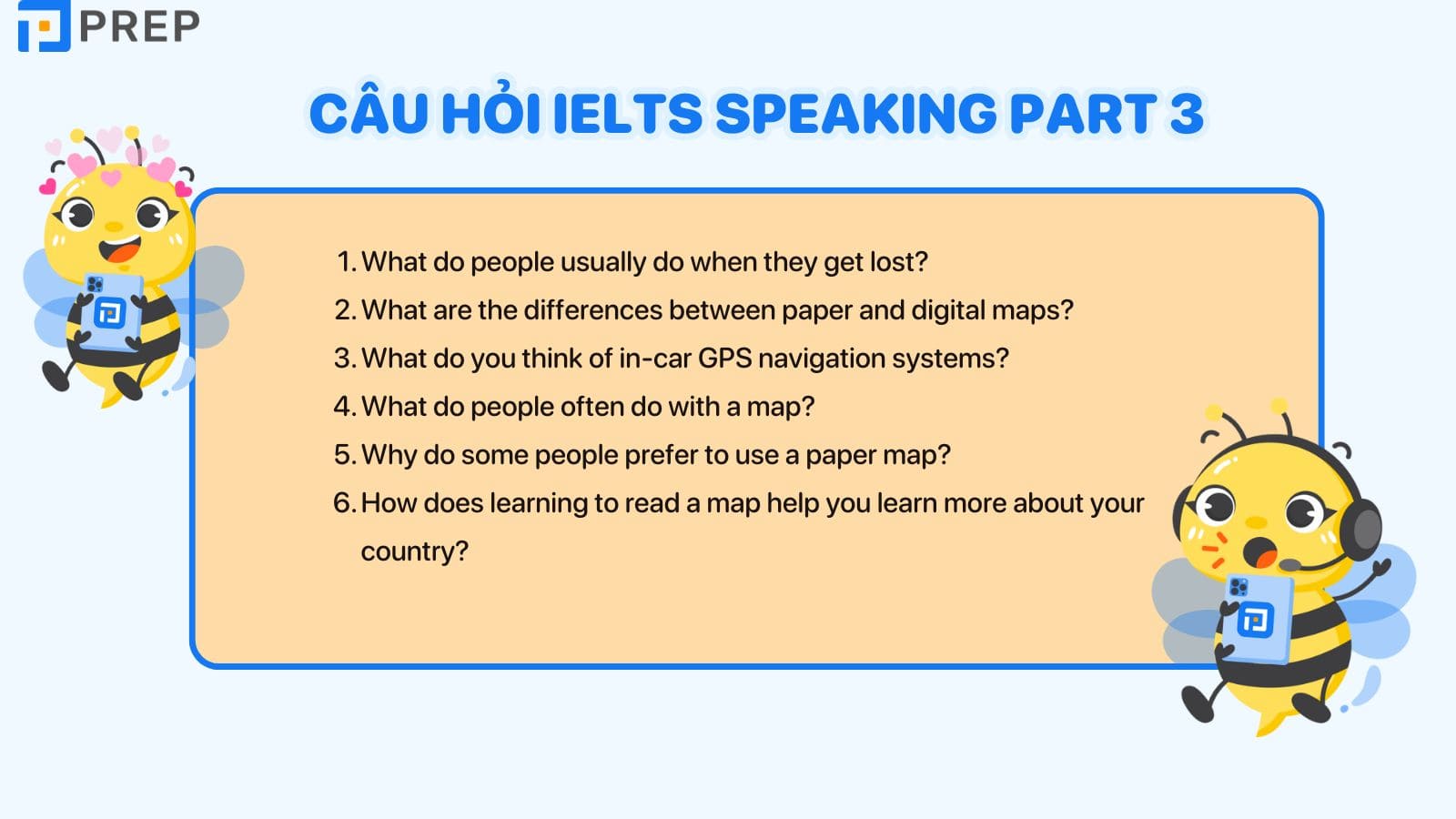
- 1. What do people usually do when they get lost?
- 2. What are the differences between paper and digital maps?
- 3. What do you think of in-car GPS navigation systems?
- 4. What do people often do with a map?
- 5. Why do some people prefer to use a paper map?
- 6. How does learning to read a map help you learn more about your country?
I. Bài mẫu Describe a time when you used a map that was useful
Dưới đây là đề bài và bài mẫu Describe a time when you used a map that was useful band 7.0+ được các thầy cô giáo tại PREP có nhiều năm kinh nghiệm trong lĩnh vực giảng dạy IELTS biên soạn. Tham khảo ngay bạn nhé!
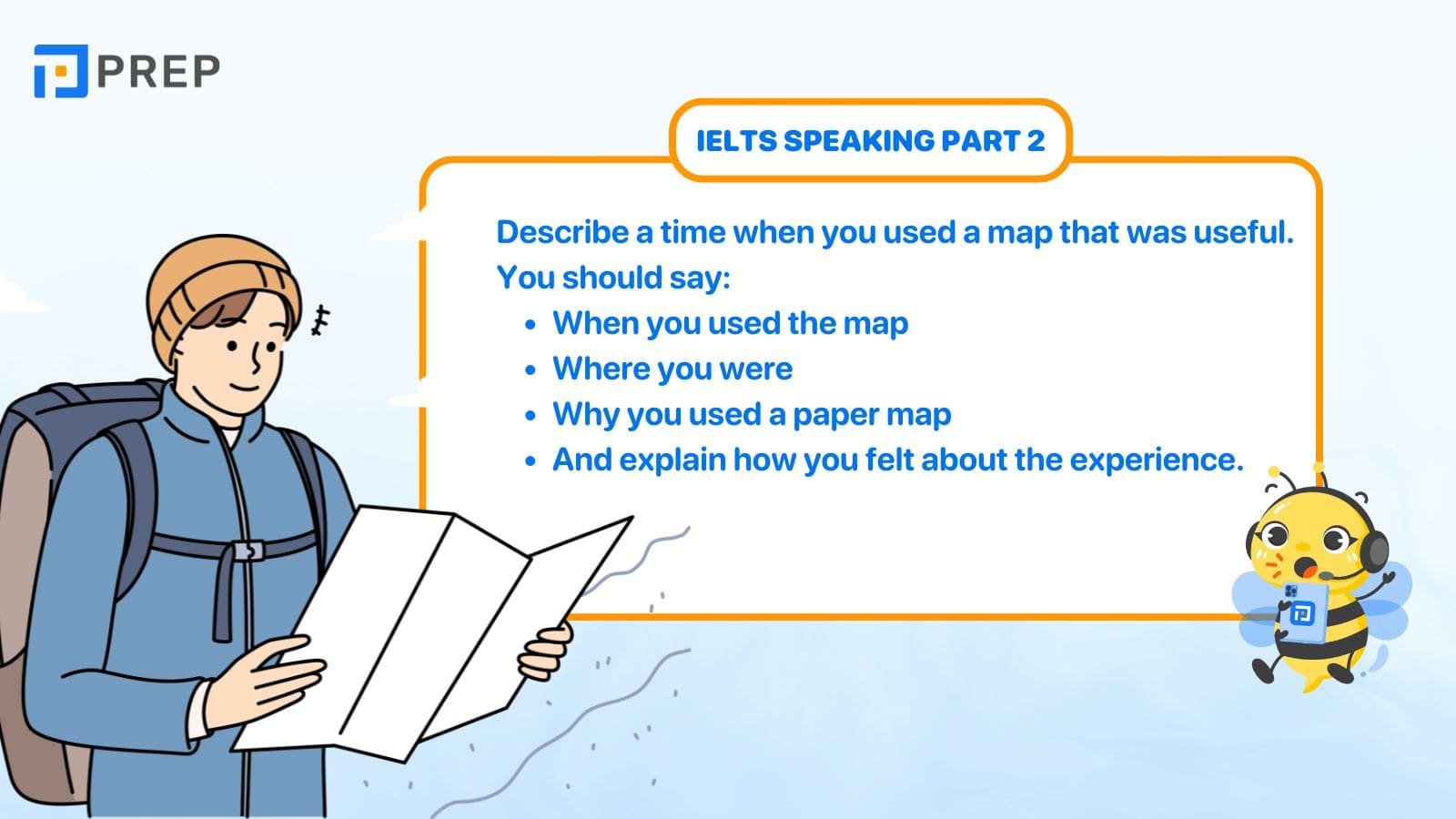
1. Đề bài
Describe a time when you used a map that was useful. You should say:
- When you used the map
- Where you were
- Why you used a paper map
And explain how you felt about the experience.
2. Sample Speaking: Describe a time when you used a map that was useful
Dưới đây là bài mẫu IELTS Speaking Part 2 chủ đề Describe a time when you used a map that was useful được biên soạn bởi thầy Minh Nhật - Marker leader của PREP, tham khảo ngay bạn nhé!
I remember a time when I actually had to use a physical map during a family road trip a couple of years ago. We were on a vacation in a remote area in the countryside, far away from the city, where GPS signals were weak and unreliable.
It was a beautiful but unfamiliar place, and we decided to explore the scenic routes, which weren't well-documented on digital maps. We found ourselves in a situation where we needed directions to get back to our accommodation, and luckily I have always had a habit of collecting paper maps for just-in-case situations, especially when my device goes out of battery. Using the paper map felt like a bit of an adventure. It was a large, foldable map of the region, and we had to figure out our current location and trace our route back to where we needed to be. It was a collaborative effort, with my family members taking turns to read the map and provide directions.
The experience was both nostalgic and refreshing. Navigating with a paper map made us feel more connected to the surroundings, as we had to pay closer attention to landmarks and road signs. It also brought a sense of camaraderie among us as we worked together to find our way. Overall, using a paper map in that situation was a memorable and enjoyable experience. It reminded us of simpler times before the ubiquity of digital navigation tools, and it added an element of excitement to our road trip.
Từ vựng hay cho Describe a time when you used a map that was useful:
- A physical map (n): Một bản đồ vật lý
- Remote area (n): Vùng sâu vùng xa
- Unreliable (adj): Không đáng tin cậy
- Explore (v): Khám phá
- Digital map (n): Bản đồ điện tử
- Get back to: Quay lại
- Just-in-case situation (n): Tình huống đề phòng
- Trace (v): Lần theo dấu vết
- Nostalgic (adj): Hoài niệm
- Camaraderie (n): Tinh thần đoàn kết
- Ubiquity (n): Tính phổ biến
- Navigation (n): Điều hướng
Tham khảo thêm bài mẫu:
II. Câu trả lời mẫu IELTS Speaking Part 3 chủ đề: Describe a time when you used a map that was useful
Dưới đây là danh sách câu hỏi và câu trả lời mẫu IELTS Speaking Part 3 chủ đề Describe a time when you used a map that was useful. Tham khảo ngay bạn nhé!
1. What do people usually do when they get lost?
Uh, when people get lost, they might, you know, ask for directions from locals or try to find a map or GPS to navigate their way. It's common to seek help from friendly passersby who can guide you back to your destination. So, people here tend to rely on the kindness of others and technology to find their way when they can't pinpoint their exact location.
- Get lost: Bị lạc đường
- Passersby (n): Người qua đường
- Guide (v): Hướng dẫn
- Destination (n): Điểm đến
- Pinpoint (n): Xác định
2. What are the differences between paper and digital maps?
Well, when it comes to the distinctions between paper and digital maps, there are several key factors to consider. Firstly, on paper maps, information is static, whereas digital maps can be updated in real-time, providing current data. Secondly, paper maps are physical and require storage and maintenance, while digital maps are easily accessible on devices. Additionally, digital maps often offer interactive features like zooming and searching, enhancing user experience. However, some may argue that paper maps have a nostalgic charm and don't rely on technology. So, the choice between them depends on your preferences and the specific use case.
- Distinction (n): Sự phân biệt
- Static (adj): Tĩnh, không có nhiều sự thay đổi
- Update (adj): Cập nhật
- Accessible (adj): Có thể truy cập được
3. What do you think of in-car GPS navigation systems?
In-car GPS navigation systems have revolutionized the way we navigate roads, I suppose. They offer several advantages. The first benefit I can see is that they provide real-time directions, helping drivers reach their destinations more efficiently. Secondly, they often include traffic updates, helping users avoid congestion and save time. However, they can be costly to install or update, and they rely on technology, which can sometimes fail or become outdated. Nevertheless, in general, I have to say they are a valuable tool for modern travelers and have significantly improved the overall driving experience.
- Revolutionized (v): Cách mạng hóa
- Real-time: Thời gian thực
- Update (n): Thông tin cập nhật
- Congestion (n): Tắc nghẽn giao thông
- Outdated (adj): Đã lỗi thời
4. What do people often do with a map?
Map users can take many advantages with it. Maps serve as indispensable tools for navigation, aiding people in charting routes and exploring unfamiliar territories. Beyond mere navigation, maps are instrumental in trip planning, facilitating a comprehensive understanding of geographical features, attractions, and landmarks, enhancing the overall travel experience.
- Take advantages with something: Tận dụng lợi thế với một cái gì đó
- Indispensable (adj): Không thể thiếu
- Aid (v): Viện trợ
- Territory (n): Lãnh thổ
- Instrumental (adj): Nhạc cụ
5. Why do some people prefer to use a paper map?
Individuals who appreciate the tactile experience and detailed visuals often opt for paper maps. The tangible nature of a paper map fosters a connection with the geographical landscape, offering a broader perspective than digital alternatives. Some find pleasure in unfolding a map, tracing routes with fingers, and absorbing the details.
- Tactile (adj): Xúc giác
- Opt for: Lựa chọn
- Tangible (adj): Hữu hình
- Alternative (n): Thay thế
- Absorb (v): Hấp thụ
6. How does learning to read a map help you learn more about your country?
Acquiring map-reading skills fosters geographical literacy, enabling individuals to decipher topography, infrastructure, and cultural nuances. This proficiency enhances one's connection to their country by unraveling its diverse landscapes and historical layers. For instance, interpreting a historical map might unveil ancient trade routes, providing insights into the economic evolution of a region. Thus, map literacy not only fosters a connection to the land but also unveils the rich narrative that shapes a country's identity.
- Literacy (n): Trình độ học vấn
- Decipher (v): Giải mã
- Topography (n): Địa hình
- Nuance (n: Sắc thái
- Unveil (v): Tiết lộ
- Narrative (n): Câu chuyện
Trên đây PREP đã cung cấp đầy đủ đề bài, từ vựng ăn điểm và câu trả lời mẫu cho IELTS Speaking Part 2, 3 Describe a time when you used a map that was useful. PREP chúc bạn ôn thi hiệu quả và đạt được band điểm mong muốn!

Chào bạn! Mình là Hiền Hoàng, hiện đang đảm nhận vai trò quản trị nội dung sản phẩm tại Blog của website prepedu.com.
Với hơn 5 năm tự học các ngoại ngữ như tiếng Anh, tiếng Trung và ôn luyện một số kỳ thi IELTS, TOEIC, HSK, mình đã tự đúc rút được nhiều kinh nghiệm để hỗ trợ hàng nghìn người đang gặp khó khăn trong việc học ngoại ngữ. Hy vọng rằng những chia sẻ phía trên sẽ giúp ích cho bạn trong quá trình tự ôn luyện thi hiệu quả tại nhà!
Bình luận
Nội dung premium
Xem tất cả


Lộ trình cá nhân hoá
![[PREP] Đăng ký thi thử IELTS tại PREP Space](/_next/image?url=https%3A%2F%2Fstatic-assets.prepcdn.com%2Fcontent-management-system%2F2703_cnp_216_Banner_blog_prep_space_0bccc8189a.png&w=768&q=75 "[PREP] Đăng ký thi thử IELTS tại PREP Space")



![[PREP] Đăng ký thi thử IELTS tại PREP Space](/_next/image?url=https%3A%2F%2Fstatic-assets.prepcdn.com%2Fcontent-management-system%2F2703_cnp_216_Banner_blog_prep_space_0bccc8189a.png&w=375&q=75 "[PREP] Đăng ký thi thử IELTS tại PREP Space")



Có thể bạn quan tâm
Kết nối với Prep







MSDN: 0109817671.
Địa chỉ liên hệ: Tòa nhà Vinaconex, 34 Láng Hạ, phường Láng, TP Hà Nội.
Trung tâm CSKH tại HN: Lô 21 C2 Khu đô thị Nam Trung Yên, phường Yên Hòa, TP Hà Nội.
Trung tâm CSKH tại HCM: 288 Pasteur, Phường Xuân Hòa, TP Hồ Chí Minh
Trụ sở Công ty: Số nhà 20, ngách 234/35 đường Hoàng Quốc Việt, phường Nghĩa Đô, TP Hà Nội.
Phòng luyện ảo - Trải nghiệm thực tế - Công nghệ hàng đầu.
Hotline: 0931 42 8899.
Trụ sở Công ty: Số nhà 20, ngách 234/35 đường Hoàng Quốc Việt, phường Nghĩa Đô, TP Hà Nội.
Giấy chứng nhận hoạt động đào tạo, bồi dưỡng số 1309/QĐ-SGDĐT ngày 31 tháng 07 năm 2023 do Sở Giáo dục và Đào tạo Hà Nội cấp.