Giải đề bài IELTS Cambridge 11 Test 4 Reading Passage 2 An Introduction to Film Sound (Chi tiết)
Bài đọc An Introduction to Film Sound – Cambridge IELTS 11 Test 4 Passage 2 – tập trung phân tích vai trò của âm thanh trong điện ảnh, bao gồm lời thoại, âm nhạc và hiệu ứng âm thanh. Bài viết dưới đây sẽ tổng hợp đề bài, đáp án chi tiết và từ vựng hay trong bài để bạn tham khảo và luyện thi hiệu quả nhé!
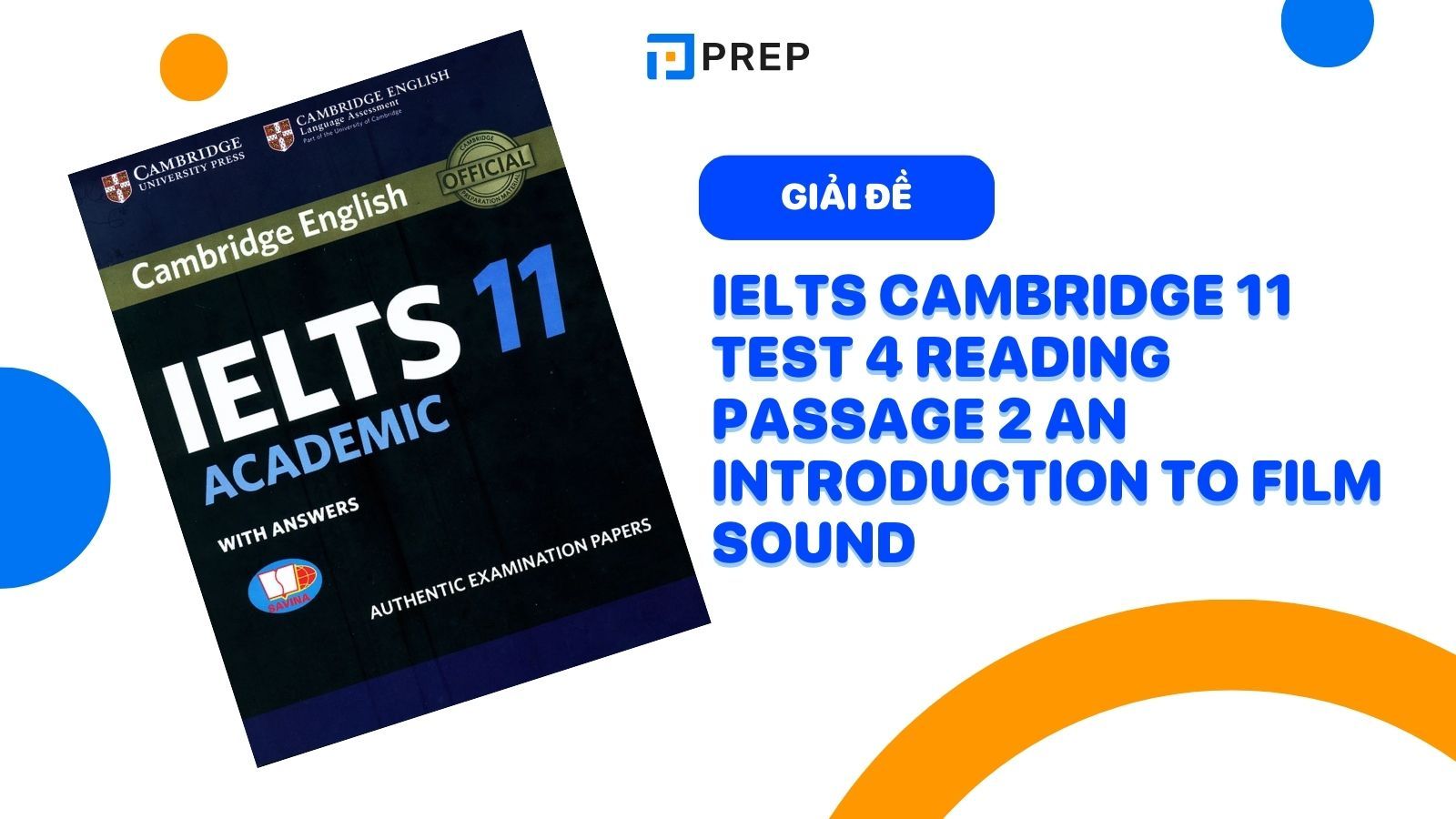
I. Đề bài IELTS Cambridge 11 Test 4 Reading Passage 2 An Introduction to Film Sound
Dưới đây là đề bài đầy đủ IELTS Cambridge 11 Test 4 Reading Passage 2 An Introduction to Film Sound:
An Introduction to Film Sound
Though we might think of film as an essentially visual experience, we really cannot afford to underestimate the importance of film sound. A meaningful soundtrack is often as complicated as the image on the screen, and is ultimately just as much the responsibility of the director. The entire soundtrack consists of three essential ingredients: the human voice, sound effects and music. These three tracks must be mixed and balanced so as to produce the necessary emphases which in turn create desired effects.
Topics which essentially refer to the three previously mentioned tracks are discussed below. They include dialogue, synchronous and asynchronous sound effects, and music.
Let us start with dialogue. As is the case with stage drama, dialogue serves to tell the story and expresses feelings and motivations of characters as well. Often with film characterization the audience perceives little or no difference between the character and the actor. Thus, for example, the actor Humphrey Bogart is the character Sam Spade; film personality and life personality seem to merge. Perhaps this is because the very texture of a performer’s voice supplies an element of character.
When voice textures fit the performer’s physiognomy and gestures, a whole and very realistic persona emerges. The viewer sees not an actor working at his craft, but another human being struggling with life. It is interesting to note that how dialogue is used and the very amount of dialogue used varies widely among films. For example, in the highly successful science-fiction film 2001, little dialogue was evident, and most of it was banal and of little intrinsic interest. In this way the film-maker was able to portray what Thomas Sobochack and Vivian Sobochack call, in An Introduction to Film, the ‘inadequacy of human responses when compared with the magnificent technology created by man and the visual beauties of the universe’.
The comedy Bringing Up Baby, on the other hand, presents practically non-stop dialogue delivered at breakneck speed. This use of dialogue underscores not only the dizzy quality of the character played by Katherine Hepburn, but also the absurdity of the film itself and thus its humor. The audience is bounced from gag to gag and conversation to conversation; there is no time for audience reflection. The audience is caught up in a whirlwind of activity in simply managing to follow the plot. This film presents pure escapism – largely due to its frenetic dialogue.
Synchronous sound effects are those sounds which are synchronized or matched with what is viewed. For example, if the film portrays a character playing the piano, the sounds of the piano are projected. Synchronous sounds contribute to the realism of film and also help to create a particular atmosphere.
For example, the ‘click’ of a door being opened may simply serve to convince the audience that the image portrayed is real, and the audience may only subconsciously note the expected sound.
However, if the ‘click’ of an opening door is part of an ominous action such as a burglary, the sound mixer may call attention to the ‘click’ with an increase in volume; this helps to engage the audience in a moment of suspense. Asynchronous sound effects, on the other hand, are not matched with a visible source of the sound on screen. Such sounds are included so as to provide an appropriate emotional nuance, and they may also add to the realism of the film. For example, a film-maker might opt to include the background sound of an ambulance’s siren while the foreground sound and image portrays an arguing couple. The asynchronous ambulance siren underscores the psychic injury incurred in the argument; at the same time the noise of the siren adds to the realism of the film by acknowledging the film’s city setting.
We are probably all familiar with background music in films, which has become so ubiquitous as to be noticeable in its absence. We are aware that it is used to add emotion and rhythm. Usually not meant to be noticeable, it often provides a tone or an emotional attitude toward the story and /or the characters depicted. In addition, background music often foreshadows a change in mood. For example, dissonant music may be used in film to indicate an approaching (but not yet visible) menace or disaster.
Background music may aid viewer understanding by linking scenes. For example, a particular musical theme associated with an individual character or situation may be repeated at various points in a film in order to remind the audience of salient motifs or ideas.
Film sound comprises conventions and innovations. We have come to expect an acceleration of music during car chases and creaky doors in horror films. Yet, it is important to note as well that sound is often brilliantly conceived. The effects of sound are often largely subtle and often are noted by only our subconscious minds. We need to foster an awareness of film sound as well as film space so as to truly appreciate an art form that sprang to life during the twentieth century – the modern film.
Questions 14–18: Multiple Choice
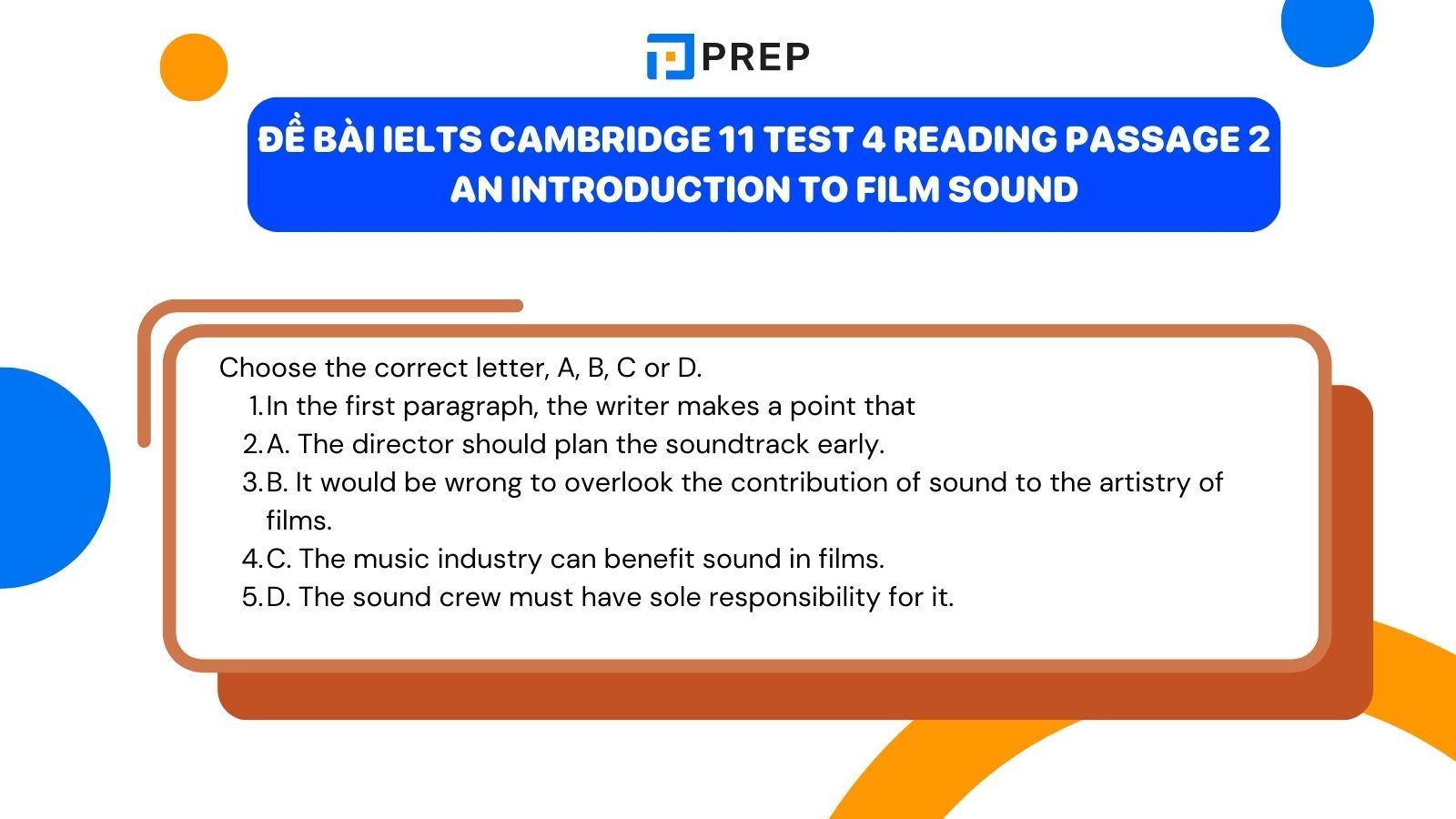
Choose the correct letter, A, B, C or D.
-
In the first paragraph, the writer makes a point that
A. The director should plan the soundtrack early.
B. It would be wrong to overlook the contribution of sound to the artistry of films.
C. The music industry can benefit sound in films.
D. The sound crew must have sole responsibility for it. -
One reason that the writer refers to Humphrey Bogart is to exemplify
A. the importance of actor and character having similar personalities
B. the audience’s preference for visually attractive actors
C. the value of actors sharing feelings with their characters
D. the audience’s preference for realistic dialogue -
In the third paragraph, the writer suggests that
A. people dislike dull dialogue
B. dull dialogue can serve a particular purpose
C. film-makers differ in their skill with dialogue
D. the best films always have good dialogue -
What does the writer suggest about Bringing Up Baby?
A. Its plot is weakened by the dialogue
B. The dialogue makes it one of the best comedies
C. There is a mismatch between dialogue and action
D. The dialogue emphasises the key elements of the film -
The reference to a door ‘click’ is used to show that realistic sounds
A. can give a false impression of events
B. may be interpreted differently by audiences
C. can be altered to influence audience response
D. are more important in realistic films
Questions 19–23: TRUE / FALSE / NOT GIVEN
-
Audiences are likely to be surprised if a film has no background music.
-
Background music may predict future events in a film.
-
Background music affects different people in different ways.
-
Background music may help audiences make connections within a film.
-
Audiences are usually conscious of the effect of background music.
Questions 24–26: Sentence Completion
Choose the correct ending, A–E.
A. when the audience listens to the dialogue
B. if the film reflects the audience’s own concerns
C. if voice, sound and music are combined effectively
D. when the director understands audience reaction
E. when appearance, voice and movement are consistent
-
The audience’s reaction to a film can be controlled …
-
The feelings and motivations of characters are understood …
-
A character seems realistic rather than artificial …
Xem thêm: Đề bài & đáp án IELTS Cambridge 11 Test 4 Section 2 Basement of Museum
II. Đáp án IELTS Cambridge 11 Test 4 Reading Passage 2 An Introduction to Film Sound
So sánh nhanh đáp án IELTS Cambridge 11 Test 4 Reading Passage 2 An Introduction to Film Sound sau đây:
|
Câu |
Đáp án |
|
14 |
B |
|
15 |
A |
|
16 |
B |
|
17 |
D |
|
18 |
C |
|
19 |
TRUE |
|
20 |
TRUE |
|
21 |
NOT GIVEN |
|
22 |
TRUE |
|
23 |
FALSE |
|
24 |
C |
|
25 |
A |
|
26 |
E |
III. Giải thích đáp án chi tiết
Tham khảo giải thích đáp án chi tiết bài IELTS Cambridge 11 Test 4 Reading Passage 2 An Introduction to Film Sound sau để có thêm tài liệu luyện thi nhé!
Questions 14–18
14. B
Đoạn mở đầu nhấn mạnh rằng không nên đánh giá thấp vai trò của âm thanh trong điện ảnh, vì nó đóng góp lớn vào giá trị nghệ thuật của bộ phim.
15. A
Humphrey Bogart được nhắc đến như ví dụ điển hình cho việc diễn viên và nhân vật có sự tương đồng, giúp nhân vật trở nên thuyết phục hơn.
16. B
Tác giả chỉ ra rằng lời thoại đơn giản hoặc “nhạt” vẫn có thể phục vụ mục đích nghệ thuật nhất định trong phim.
17. D
Lời thoại nhanh và dồn dập trong Bringing Up Baby giúp làm nổi bật phong cách và các yếu tố quan trọng của bộ phim.
18. C
Âm thanh “click” của cánh cửa được đưa ra để minh họa rằng âm thanh có thể được điều chỉnh nhằm tác động đến cảm xúc và phản ứng của khán giả.
Questions 19–23
19. TRUE – Nhạc nền phổ biến đến mức khán giả dễ nhận ra nếu thiếu nó.
20. TRUE – Nhạc nền có thể báo hiệu trước sự thay đổi hoặc diễn biến sắp xảy ra.
21. NOT GIVEN – Bài không so sánh mức độ ảnh hưởng giữa các nhóm người khác nhau.
22. TRUE – Nhạc nền giúp kết nối các cảnh và ý tưởng trong phim.
23. FALSE – Tác động của nhạc nền thường diễn ra ở mức tiềm thức, không phải lúc nào khán giả cũng nhận ra.
Questions 24–26
24. C – Phản ứng của khán giả được kiểm soát khi lời thoại, âm thanh và âm nhạc kết hợp hiệu quả.
25. A – Cảm xúc và động cơ nhân vật được thể hiện rõ thông qua lời thoại.
26. E – Nhân vật trở nên chân thực khi ngoại hình, giọng nói và chuyển động hài hòa.
IV. Từ vựng hay trong bài cần ghi nhớ
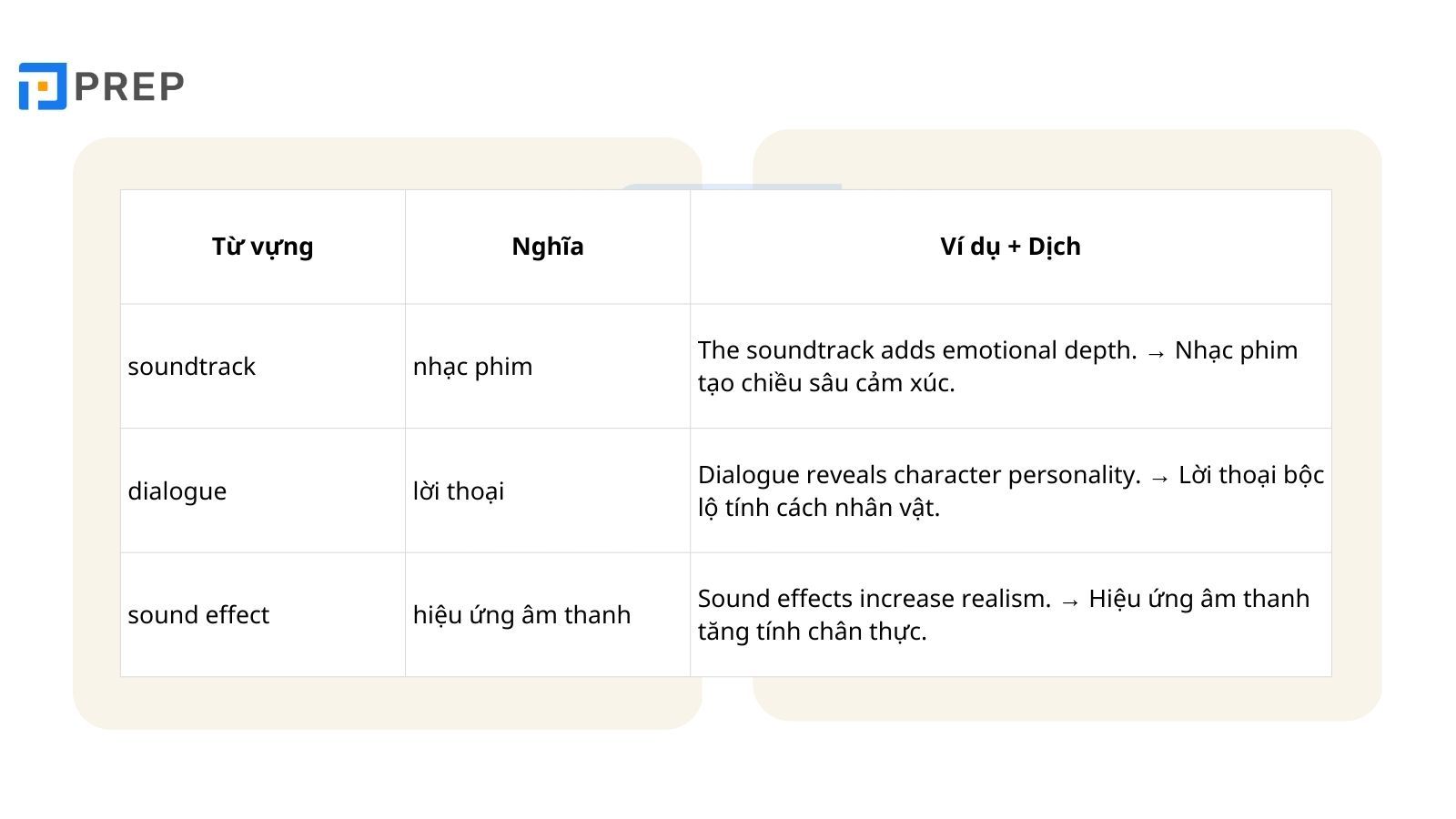
Take note nhanh từ vựng hay trong bài để mở rộng vốn từ của bạn:
|
Từ vựng |
Nghĩa |
Ví dụ + Dịch |
|
soundtrack |
nhạc phim |
The soundtrack adds emotional depth. → Nhạc phim tạo chiều sâu cảm xúc. |
|
dialogue |
lời thoại |
Dialogue reveals character personality. → Lời thoại bộc lộ tính cách nhân vật. |
|
sound effect |
hiệu ứng âm thanh |
Sound effects increase realism. → Hiệu ứng âm thanh tăng tính chân thực. |
|
foreshadow |
báo hiệu trước |
Music foreshadows a change in mood. → Âm nhạc báo hiệu thay đổi cảm xúc. |
|
subconscious |
tiềm thức |
Music works on the subconscious. → Âm nhạc tác động lên tiềm thức. |
|
banality / banal |
sự sáo rỗng |
Some dialogue is deliberately banal. → Một số lời thoại cố ý đơn giản. |
|
audience response |
phản ứng khán giả |
Sound controls audience response. → Âm thanh điều khiển phản ứng khán giả. |
Bài đọc An Introduction to Film Sound là một bài tiêu biểu trong IELTS Reading, kiểm tra khả năng hiểu lập luận học thuật và nhận diện paraphrase. Việc nắm chắc ý chính từng đoạn, kết hợp luyện tập dạng câu hỏi trắc nghiệm và TRUE/FALSE/NOT GIVEN, sẽ giúp thí sinh cải thiện đáng kể điểm số Reading. Hy vọng phần đề bài, đáp án chi tiết và từ vựng trong bài viết sẽ hỗ trợ bạn ôn luyện hiệu quả hơn.
Học tiếng Anh online dễ dàng hơn với PREP - Nền tảng Học & Luyện thi thông minh cùng AI. Nhờ công nghệ AI độc quyền, bạn có thể tự học trực tuyến ngay tại nhà, chinh phục lộ trình học IELTS, TOEIC, tiếng Anh giao tiếp hiệu quả. Bên cạnh đó, học viên còn có sự hỗ trợ tuyệt vời từ Teacher Bee AI, trợ lý ảo giúp bạn giải đáp thắc mắc và đồng hành 1-1 trong suốt quá trình học tập.
Hãy click TẠI ĐÂY hoặc liên hệ HOTLINE 0931428899 để nhận tư vấn chi tiết về các khóa học tiếng Anh chất lượng nhất thị trường!
Tải ngay app PREP để bắt đầu hành trình học tiếng Anh tại nhà với chương trình học luyện thi online chất lượng cao

Chào bạn! Mình là Hiền Hoàng, hiện đang đảm nhận vai trò quản trị nội dung sản phẩm tại Blog của website prepedu.com.
Với hơn 5 năm tự học các ngoại ngữ như tiếng Anh, tiếng Trung và ôn luyện một số kỳ thi IELTS, TOEIC, HSK, mình đã tự đúc rút được nhiều kinh nghiệm để hỗ trợ hàng nghìn người đang gặp khó khăn trong việc học ngoại ngữ. Hy vọng rằng những chia sẻ phía trên sẽ giúp ích cho bạn trong quá trình tự ôn luyện thi hiệu quả tại nhà!
Bình luận
Nội dung premium
Xem tất cả




Lộ trình cá nhân hoá
![[PREP] Đăng ký thi thử IELTS tại PREP Space](/_next/image?url=https%3A%2F%2Fstatic-assets.prepcdn.com%2Fcontent-management-system%2F2703_cnp_216_Banner_blog_prep_space_0bccc8189a.png&w=768&q=75 "[PREP] Đăng ký thi thử IELTS tại PREP Space")



![[PREP] Đăng ký thi thử IELTS tại PREP Space](/_next/image?url=https%3A%2F%2Fstatic-assets.prepcdn.com%2Fcontent-management-system%2F2703_cnp_216_Banner_blog_prep_space_0bccc8189a.png&w=375&q=75 "[PREP] Đăng ký thi thử IELTS tại PREP Space")




Có thể bạn quan tâm


Kết nối với Prep





MSDN: 0109817671.
Địa chỉ liên hệ: Tòa nhà Vinaconex, 34 Láng Hạ, phường Láng, TP Hà Nội.
Trung tâm CSKH tại HN: Lô 21 C2 Khu đô thị Nam Trung Yên, phường Yên Hòa, TP Hà Nội.
Trung tâm CSKH tại HCM: 288 Pasteur, Phường Xuân Hòa, TP Hồ Chí Minh
Trụ sở Công ty: Số nhà 20, ngách 234/35 đường Hoàng Quốc Việt, phường Nghĩa Đô, TP Hà Nội.
Phòng luyện ảo - Trải nghiệm thực tế - Công nghệ hàng đầu.
Hotline: 0931 42 8899.
Trụ sở Công ty: Số nhà 20, ngách 234/35 đường Hoàng Quốc Việt, phường Nghĩa Đô, TP Hà Nội.
Giấy chứng nhận hoạt động đào tạo, bồi dưỡng số 1309/QĐ-SGDĐT ngày 31 tháng 07 năm 2023 do Sở Giáo dục và Đào tạo Hà Nội cấp.