would you mind 用法全解析:意思、句型、if 過去式與正確回答方式(附對話與練習)
「Would you mind opening the window?」對方話一說完,你想都沒想就點頭回了一句「Yes」,結果對方卻一臉困惑,沒去開窗。問題不在你的發音,而在 would you mind 這個句型藏了一個反向邏輯:它是英文裡最客氣的請求與徵求許可說法之一,但要表達「答應」,你得用否定回答 No,而不是 Yes。這正是台灣與香港學習者最容易踩的雷——想說好,卻被理解成「我介意」。
這篇文章會一次解決四件事:would you mind 的意思與禮貌層級、兩大核心句型公式(請別人做事 vs 請求自己做事)、if 子句為什麼要用過去式,以及最關鍵的正確回答方式。每個重點都附上中英對照例句,文末還準備了三段真實情境對話、華人最常犯的錯誤診斷,以及 30 題即學即用的練習與完整解析。讀完之後,你不只會用,還會用得自然又得體。

I. would you mind 是什麼意思?真的很客氣嗎?
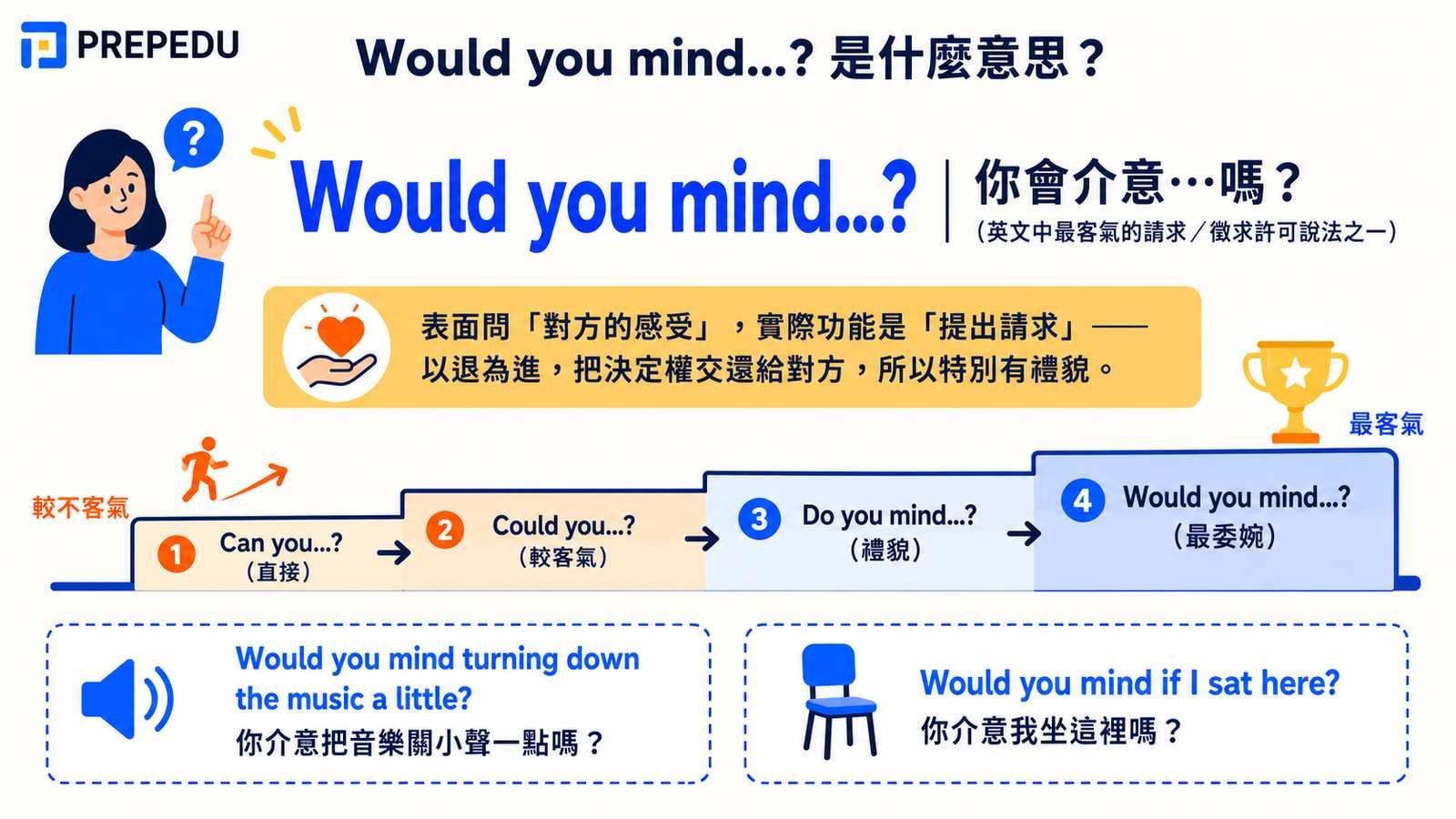
would you mind 字面意思是「你會介意⋯⋯嗎」,是英文中最客氣的請求或徵求許可說法之一。這裡的 mind 是英文動詞,意思是「介意、反對」。加上 would 之後,語氣比 Can you 或 Do you mind 更委婉。換句話說,當你想麻煩別人、又怕顯得唐突時,would you mind 幾乎是最安全的開場白。
這個句型表面上問的是「對方的感受」(你會不會覺得困擾),實際功能卻是「提出請求」。這種「以退為進」的迂迴,正是它聽起來特別有禮貌的原因:你沒有直接命令對方,而是先把決定權交還給對方。理解這層心理,後面所有用法與回答邏輯就都說得通了。範例:
-
Would you mind turning down the music a little bit? (你介意把音樂關小聲一點點嗎? )
-
Would you mind if I sat here? (你介意我坐這裡嗎? )
-
Would you mind double-checking this report for me when you have time? (你有空的時候,可以順便幫我核對一下這份報告嗎? )
II. would you mind 的兩大核心用法(句型公式)
would you mind 有兩大句型。第一種是 would you mind + 動名詞(V-ing),用來請「對方」做某事,例如 Would you mind closing the door?。第二種是 would you mind if + 主詞 + 動詞,用來請求「自己」做某事,例如 Would you mind if I sat here?。mind 後面一律接動名詞,不能用 to V 或原形動詞。
要分辨該用哪一個,最快的捷徑是問自己一句話:「動作是誰要做?」如果是請對方動手,用公式一;如果是你自己想做某事、徵求對方同意,用公式二。抓住「主詞是誰」這個關鍵,兩個句型就不會再混淆。
1. would you mind + V-ing:請對方做某事
公式是「Would you mind + 動名詞(V-ing)?」,意思是「可以麻煩你⋯⋯嗎」。mind 屬於後面只能接動名詞的動詞(和 enjoy、finish、avoid 同一類),所以動詞一定要變成 V-ing 形式,不能用 to open 或 open。
-
Would you mind sending me the report by noon?(可以麻煩你中午前把報告寄給我嗎?)
-
Would you mind speaking a little more slowly?(可以麻煩你說慢一點嗎?)
-
Would you mind helping me carry this box?(可以麻煩你幫我搬這個箱子嗎?)
-
Would you mind turning off the lights when you leave?(你離開時可以麻煩你關燈嗎?)
-
Would you mind taking a photo for us?(可以麻煩你幫我們拍張照嗎?)
2. would you mind if + 主詞 + 動詞:請求自己做某事
公式是「Would you mind if + 主詞 + 動詞?」,意思是「我⋯⋯你會介意嗎」。這裡的英文主詞通常是 I 或 we,因為你是在替「自己」徵求許可。動詞部分慣用英文過去式。
-
Would you mind if I opened the window?(我開個窗你介意嗎?)
-
Would you mind if I sat here?(我坐這裡你介意嗎?)
-
Would you mind if we joined you?(我們加入你們你介意嗎?)
-
Would you mind if I borrowed your charger for a moment?(我借一下你的充電器你介意嗎?)
-
Would you mind if we left a little early today?(我們今天早點走你介意嗎?)
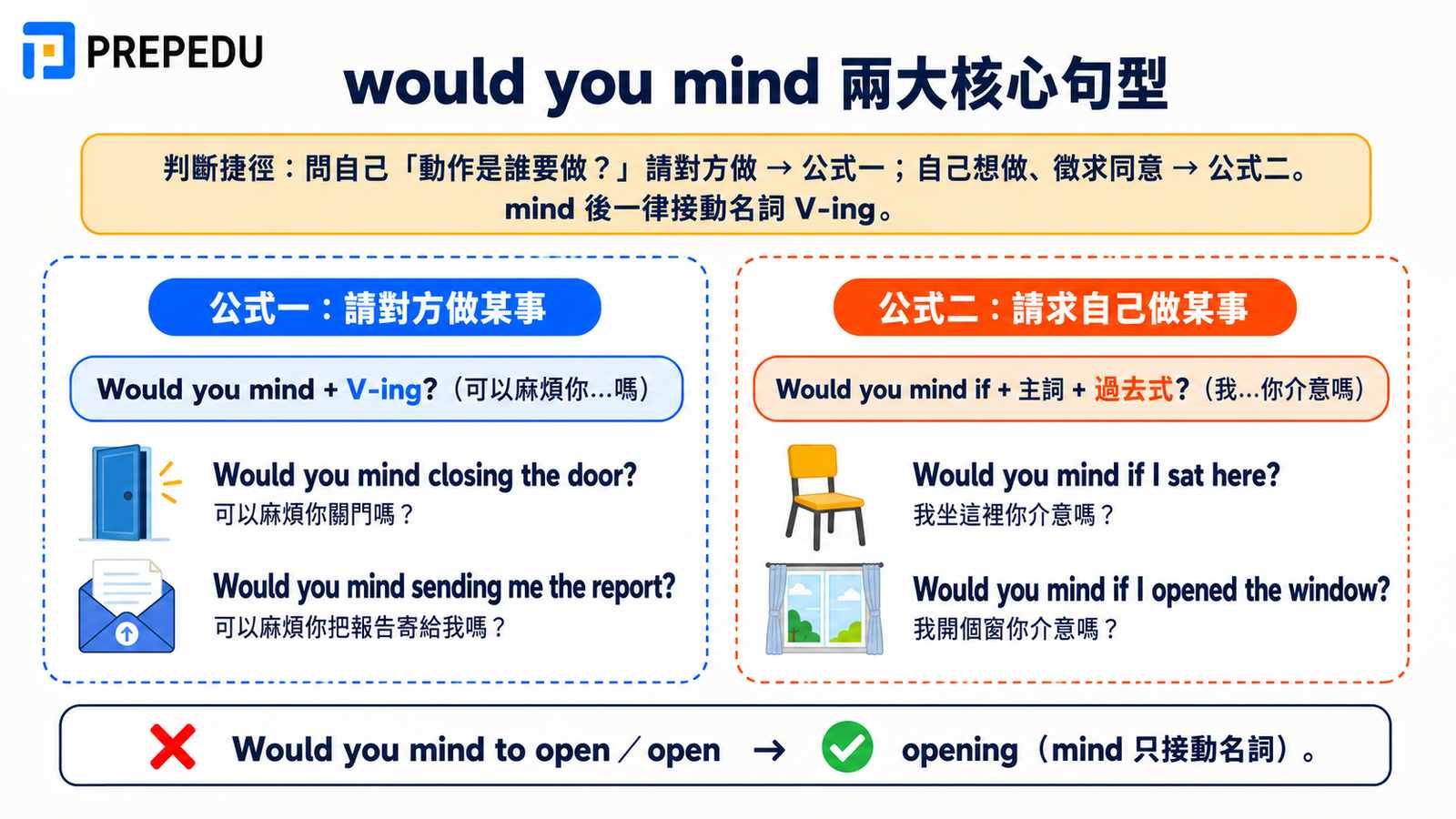
兩種句型的快速對照表 → 下表把兩個句型放進同一個框架,從主詞、動詞形式到使用時機一次看懂:
|
Would you mind 句型 |
主詞 |
動詞形式 |
中文語氣 |
使用時機 |
|
Would you mind + V-ing? |
對方(you) |
動名詞 V-ing |
可以麻煩你⋯⋯嗎 |
請別人做事,如 Would you mind closing the door?(介意幫忙關門嗎?) |
|
Would you mind if + S + V? |
自己(I/we) |
慣用過去式 |
我⋯⋯你介意嗎 |
替自己徵求許可,如 Would you mind if I sat here?(我坐這裡你介意嗎?) |
III. would you mind if 為什麼後面要用過去式?
would you mind if 後面用過去式,是因為這是「假設語氣」,用來拉開與現實的距離,讓語氣更委婉,而不是在談過去發生的事。例如 Would you mind if I opened the window? 的 opened 是禮貌用法。用英文現在式 open 也通,但過去式聽起來更正式、更客氣。
這個道理對中文母語者特別容易混淆,因為我們直覺會以為「過去式=過去時間」。但在這裡,過去式扮演的是「距離」的角色:時間上的距離被借來表達「可能性上的距離」,而距離越遠,語氣就越不強迫、越有禮貌。
過去式=英文假設語氣,不是談過去:would you mind if I sat 裡的 sat,和經典句型 If I were you(如果我是你)裡的 were 是同一套邏輯:都是假設語氣,都用「看似過去」的動詞形式,來表示一件「還沒發生、只是假設」的事。它跟過去時間完全無關。機制可以這樣理解:當你把動詞往過去推一格,等於在說「我只是假設一下、不一定真的要這麼做」,這種留有餘地的口吻,自然就顯得更委婉有禮。所以 opened、sat、went 在這裡傳達的不是「已經做了」,而是「我很客氣地問問看」。明白這點,你就不會再把它誤解成過去事件。
現在式 vs 過去式的語感差異(含例句對照):現在式並非錯誤,口語中也很常見,差別只在正式與委婉的程度。下表對照同一句的兩種時態:
|
時態 |
例句 |
語感 |
|
現在式(較隨意) |
Would you mind if I sit here?(我坐這裡你介意嗎?) |
自然、口語,朋友或輕鬆場合適用 |
|
過去式(較正式) |
Would you mind if I sat here?(我坐這裡你介意嗎?) |
更委婉、更禮貌,正式或對長輩、陌生人適用 |

簡單的判斷原則是:跟熟人聊天、想自然一點,用現在式沒問題;面對主管、客戶或不熟的人,想更得體,就選過去式。兩者都對,差在你想營造多少禮貌距離。
IV. would you mind 怎麼回答?「No」竟然是答應?
回答 would you mind 時,如果你願意答應,要用否定回答。No, not at all.(一點也不介意)或 Of course not. Go ahead. 都是常用說法。如果你想拒絕,則禮貌表達介意,例如 Actually, I'd rather you didn't.。關鍵在於:問句問的是「你介意嗎」,所以 No 代表「我不介意」,也就是同意。這一段是全文最關鍵的部分,也是台灣與香港學習者最常出錯的地方。下面把回答拆成「想答應」「想拒絕」兩大類,附上可以直接照抄的回答庫,最後再用一張總整理表收尾。
1. 想「答應」時:用否定回答(No / Not at all)
要表達「沒問題、請便」,請用否定形式的回答。因為對方問的是「你會介意嗎」,你回答「不會」(No),才等於「我不介意,你儘管做」。常用說法包括:No, not at all./Of course not./Not at all, go ahead./Sure, no problem.(這句雖含 Sure,但已成固定習慣用語,等於答應)。
-
A: Would you mind closing the window? B: No, not at all.(A:可以麻煩你關窗嗎? B:完全不會,沒問題。)
-
A: Would you mind if I sat here? B: Of course not. Go ahead.(A:我坐這裡你介意嗎? B:當然不介意,請坐。)
-
A: Would you mind waiting a moment? B: Not at all.(A:可以麻煩你稍等一下嗎? B:一點也不介意。)
2. 想「拒絕」時:禮貌表達介意
如果你其實不太願意,直接說 Yes(我介意)會顯得生硬,較得體的做法是先緩和語氣再委婉拒絕。常用說法包括:Actually, I'd rather you didn't./I'm sorry, but…/I'd prefer it if…。這些句子都帶有歉意與解釋,能把拒絕說得不傷和氣。
-
A: Would you mind if I smoked here? B: Actually, I'd rather you didn't.(A:我在這裡抽菸你介意嗎? B:其實我希望你別這麼做。)
-
A: Would you mind turning down the music? B: Sorry, but I have a call.(A:可以麻煩你把音樂關小聲嗎? B:抱歉,我要講電話。)
-
A: Would you mind if I borrowed your laptop? B: I'd prefer it if you didn't, sorry.(A:我借一下你的筆電你介意嗎? B:抱歉,我希望你別借。)
3. 為什麼「No」反而代表同意?反向邏輯解析
關鍵在於把問句拆開來看:would you mind 問的不是「你要不要」,而是「你會不會介意」。所以你的回答針對的是「介意」這件事,而不是「動作本身」。回答 No,意思是「不,我不介意」,等於把綠燈打開,請對方放心去做;回答 Yes,意思是「是的,我會介意」,反而成了拒絕。
中文母語者最容易在這裡答錯。我們的直覺是「同意就說 Yes」,於是聽到 Would you mind opening the window? 時,一邊點頭一邊脫口而出「Yes」,本意是「好啊」,對方聽到的卻是「我介意開窗」,於是場面瞬間尷尬。記住一個口訣就能避開這個陷阱:想答應,先說 No;想拒絕,才用 Yes 或委婉的歉詞。
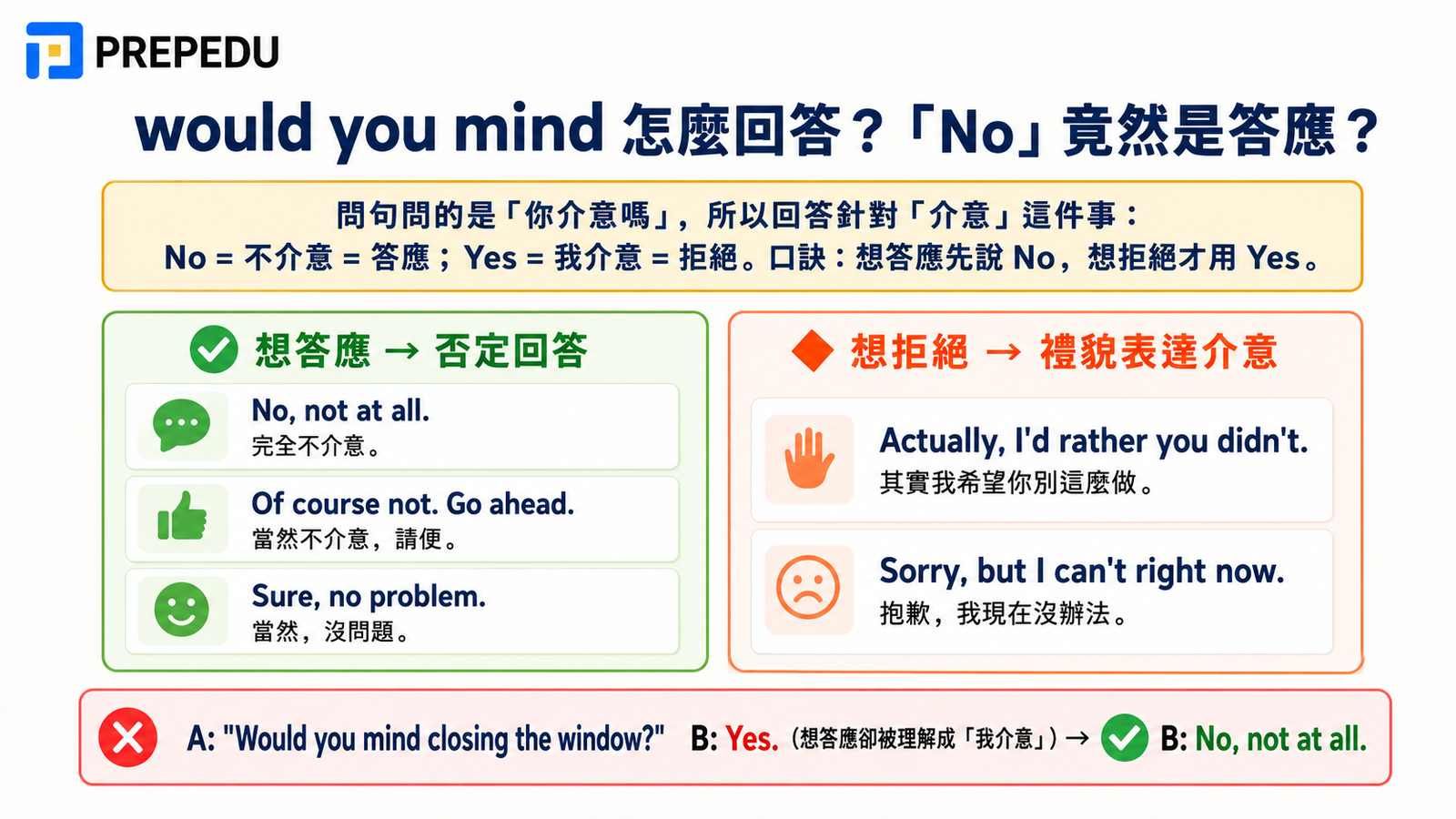
回答方式總整理表
|
你的心意 |
英文回答 |
中文翻譯 |
|
同意 |
No, not at all. |
完全不介意。 |
|
同意 |
Of course not. Go ahead. |
當然不介意,請便。 |
|
同意 |
Sure, no problem. |
當然,沒問題。 |
|
拒絕 |
Actually, I'd rather you didn't. |
其實我希望你別這麼做。 |
|
拒絕 |
I'm sorry, but I can't right now. |
很抱歉,我現在沒辦法。 |
|
視情況 |
It depends—what do you need?(先了解再決定) |
看情況——你需要什麼呢? |
V. Do you mind 和 Would you mind 有什麼差別?
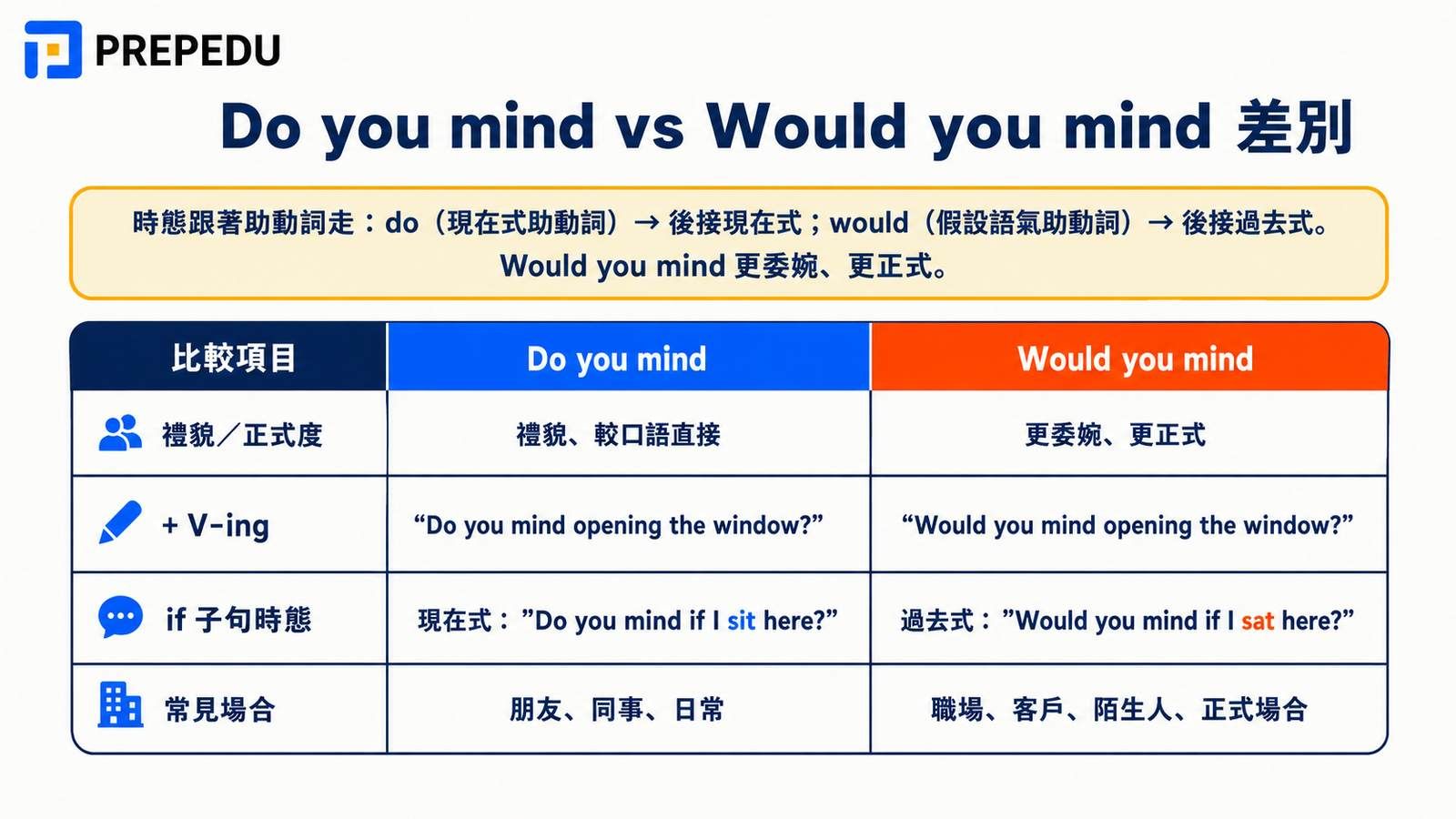
Do you mind 和 Would you mind 都是禮貌請求,差別在於 Would you mind 更委婉、更正式。時態也不同:Do you mind if 後面接現在式(Do you mind if I sit here?),Would you mind if 後面接過去式(Would you mind if I sat here?)。日常輕鬆場合多用 Do you mind,正式場合用 Would you mind。
兩者都很有禮貌,但語氣濃淡不同。Would you mind 因為帶了假設語氣的 would,聽起來更委婉、更正式,適合對主管、客戶、長輩或陌生人;Do you mind 則直接落在現在式,口吻較輕鬆直接,適合朋友、同事之間的日常小請求。說真的,越正式、越想保持距離,就越傾向選 Would you mind。
規律其實很單純:時態跟著助動詞走。do 是現在式助動詞英文,後面接現在式;would 是假設語氣助動詞,後面接過去式。記住這條,兩個句型的時態就不會搭錯。
|
比較項目 |
Do you mind |
Would you mind |
|
禮貌/正式度 |
禮貌、較口語直接 |
更委婉、更正式 |
|
+ V-ing |
Do you mind opening the window?(介意開個窗嗎?) |
Would you mind opening the window?(可以麻煩你開個窗嗎?) |
|
if 子句時態 |
現在式:Do you mind if I sit here?(我坐這裡介意嗎?) |
過去式:Would you mind if I sat here?(我坐這裡你介意嗎?) |
|
常見場合 |
朋友、同事、日常 |
職場、客戶、陌生人、正式場合 |
VI. would you mind 真實情境對話示範
光看公式還不夠,把句型放進完整對話裡,你才會知道請求與回答如何一來一往。下面三段對話分別示範職場、旅遊與朋友三種語氣,每段都包含一個正確的回答,留意說話者如何用 No 或 Go ahead 表示答應。
1. 職場情境:請同事協助(正式)
|
角色 |
would you mind 對話 |
中文翻譯 |
|
Mingzhi |
Hi Yawen, are you busy at the moment? |
雅文,你現在忙嗎? |
|
Yawen |
Not really. What's up? |
還好。怎麼了? |
|
Mingzhi |
Would you mind reviewing this report before the meeting? |
開會前可以麻煩你看一下這份報告嗎? |
|
Yawen |
No, not at all. Send it over. |
完全不會,寄給我吧。 |
|
Mingzhi |
Thank you. Would you mind highlighting anything unclear? |
謝謝。可以麻煩你把不清楚的地方標出來嗎? |
|
Yawen |
Sure, no problem. I'll send it back by three. |
當然,沒問題。我三點前回給你。 |
|
Mingzhi |
That would be a great help. Thanks again. |
那真是幫了大忙,再次謝謝你。 |
2. 旅遊情境:機上/餐廳徵求許可(中性)
|
角色 |
would you mind 對話 |
中文翻譯 |
|
Yiting |
Excuse me, is this seat taken? |
不好意思,這個位子有人坐嗎? |
|
Passenger |
No, it's free. |
沒有,是空的。 |
|
Yiting |
Would you mind if I sat here? |
我坐這裡你介意嗎? |
|
Passenger |
Of course not. Go ahead. |
當然不介意,請坐。 |
|
Yiting |
Thanks. Would you mind if I closed the window shade? |
謝謝。我把遮光板拉下來你介意嗎? |
|
Passenger |
Not at all. The sun is quite strong. |
一點也不介意,太陽是挺強的。 |
|
Yiting |
Great, thank you so much. |
太好了,非常謝謝你。 |
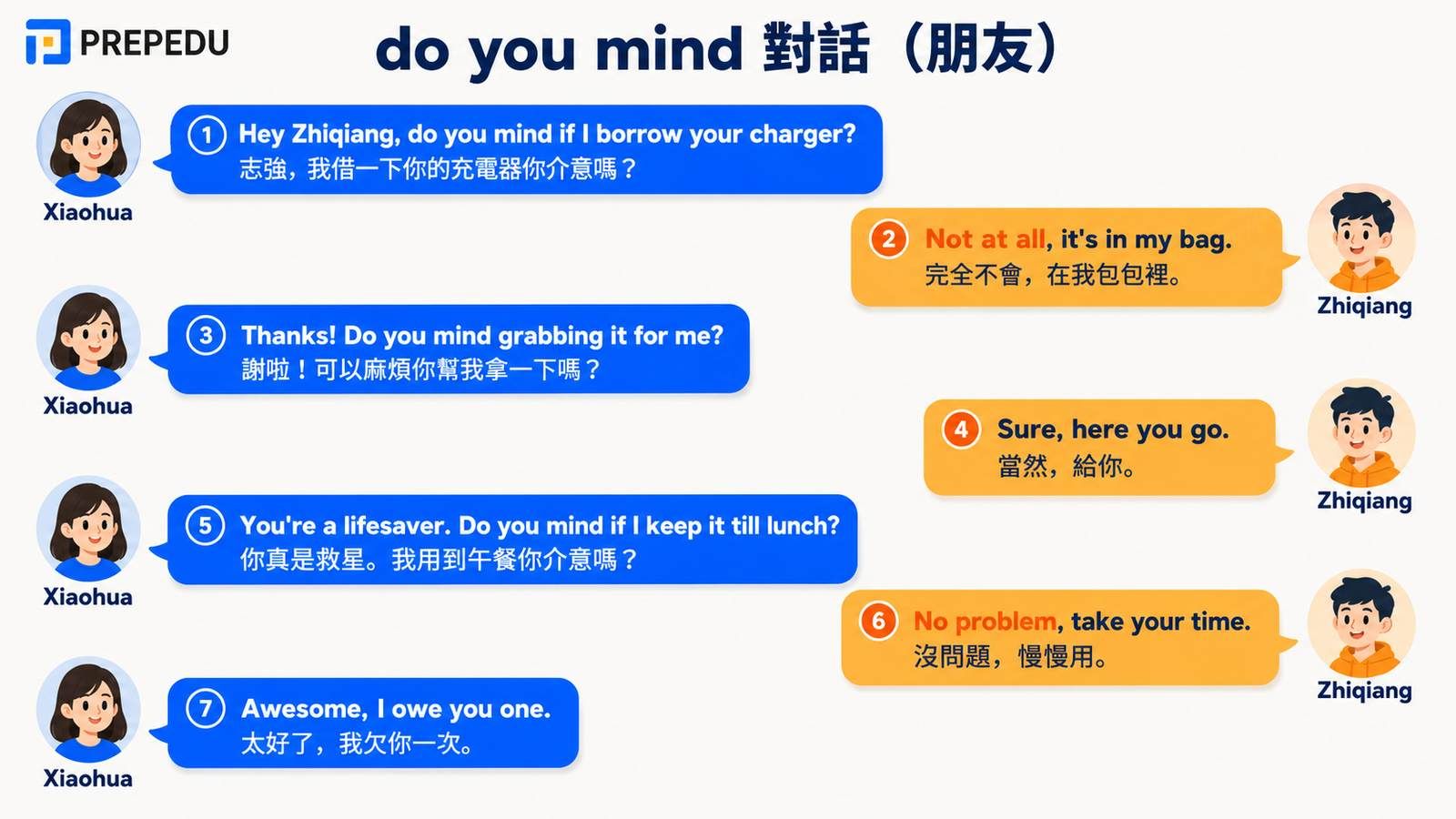
3. 朋友情境:日常小請求(輕鬆)
|
角色 |
would you mind 對話 |
中文翻譯 |
|
Xiaohua |
Hey Zhiqiang, do you mind if I borrow your charger? |
志強,我借一下你的充電器你介意嗎? |
|
Zhiqiang |
Not at all, it's in my bag. |
完全不會,在我包包裡。 |
|
Xiaohua |
Thanks! Do you mind grabbing it for me? |
謝啦!可以麻煩你幫我拿一下嗎? |
|
Zhiqiang |
Sure, here you go. |
當然,給你。 |
|
Xiaohua |
You're a lifesaver. Do you mind if I keep it till lunch? |
你真是救星。我用到午餐你介意嗎? |
|
Zhiqiang |
No problem, take your time. |
沒問題,慢慢用。 |
|
Xiaohua |
Awesome, I owe you one. |
太好了,我欠你一次。 |
VII. 華人最常犯的 would you mind 錯誤
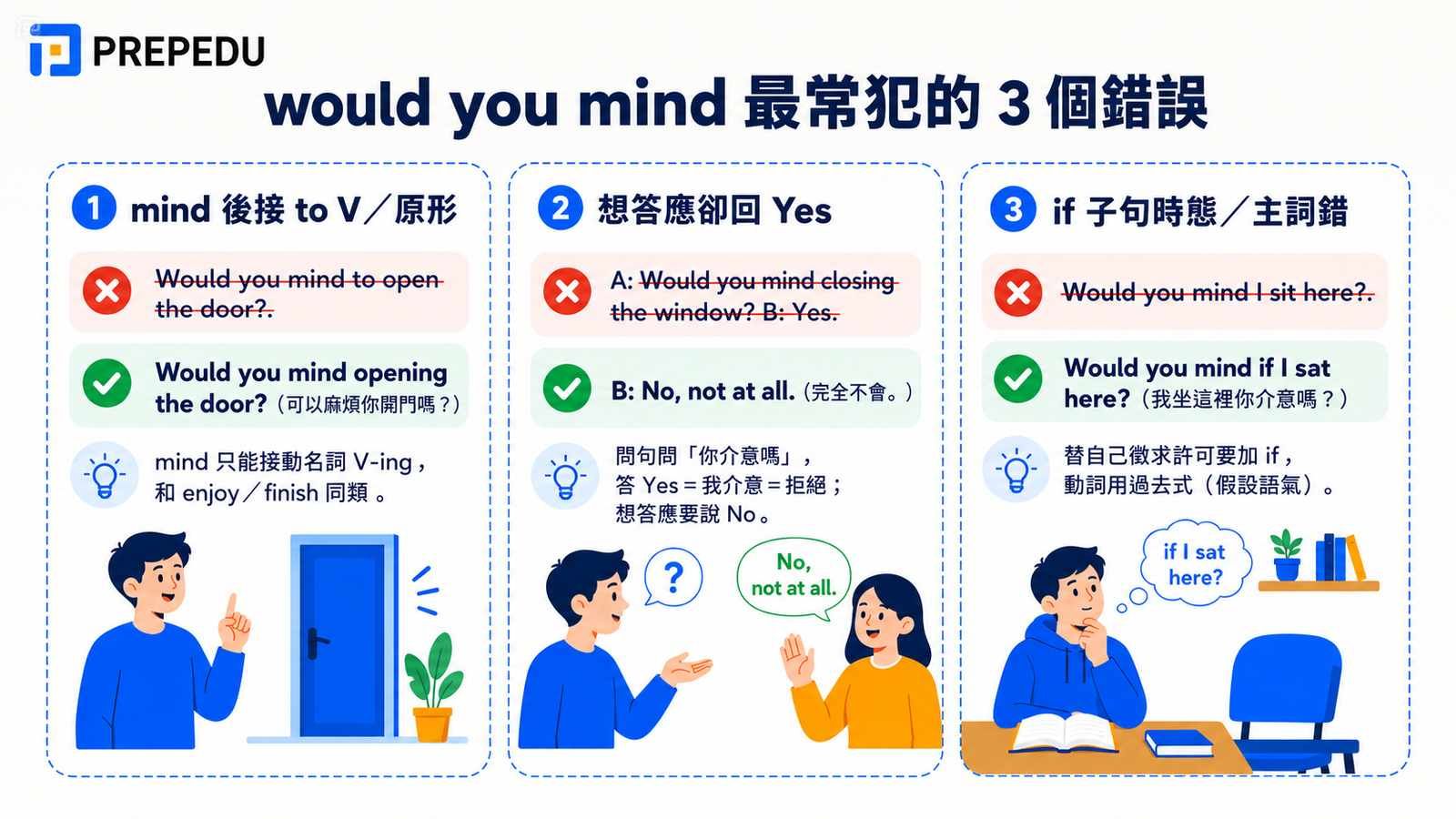
PREPEDU 教學團隊在批改華人學習者的對話練習時反覆看到同樣三個錯誤,而且幾乎和母語直覺一一對應。第一,誤說 Would you mind to open…,正確應為 opening(mind 後接動名詞)。第二,想答應卻回答 Yes,反而讓對方以為你介意,正確應說 No, not at all.。第三,省略或誤用 if 子句,例如 Would you mind I sit,正確為 Would you mind if I sat.。下面逐一診斷。
-
錯誤一:would you mind + to V / 原形動詞 → ✗ Would you mind to open the door? ✗ Would you mind open the door? ✓ Would you mind opening the door?(可以麻煩你開門嗎?)原因:mind 是「後面只能接動名詞」的動詞,和 enjoy、finish、avoid 同類,所以一律用 V-ing,不能接 to V 或原形動詞。
-
錯誤二:想答應卻回答 Yes → ✗ A: Would you mind closing the window? B: Yes.(本意想答應,卻被理解成「我介意」)✓ A: Would you mind closing the window? B: No, not at all.(A:可以麻煩你關窗嗎? B:完全不會。)原因:問句問的是「你介意嗎」,答 Yes 等於「我介意」=拒絕。想答應一定要用否定回答 No,這是最容易因為「點頭說好」的習慣而答錯的地方。
-
錯誤三:if 子句時態與主詞用錯 → ✗ Would you mind I sit here?(缺 if)✗ Would you mind if I to sit here?(if 後不可用 to V)✓ Would you mind if I sat here?(我坐這裡你介意嗎?)原因:替自己徵求許可要用「would you mind if + 主詞 + 動詞」,不能省略 if;if 後面接完整子句,動詞慣用過去式(sat),表示假設語氣與禮貌距離,不能用 to sit 或原形。
VIII. would you mind 練習題與解答(即學即用)
想確認自己真的會用 would you mind,最好的方法是動手做題。下面三個題型各 10 題,共 30 題:填空題練句型與回答、選擇題練判斷、改錯題練診斷中式英文。先全部做完,再對照最後的解答與解析。
1. 填空題
請填入正確形式(動名詞、過去式或回答用語)。
-
Would you mind ______ (close) the door?
-
Would you mind if I ______ (open) the window? It's a bit hot.
-
A: Would you mind helping me? B: ______, not at all.
-
Mingzhi: Would you mind ______ (send) me the file?
-
Would you mind if we ______ (sit) here?
-
A: Would you mind waiting? B: Of course ______.
-
Would you mind ______ (turn) off the lights?
-
Would you mind if Yawen ______ (join) us later?
-
A: Would you mind if I borrowed your pen? B: Go ______.
-
Would you mind ______ (speak) a little louder?
2. 選擇題
選出最正確且最有禮貌的選項。
-
想請同事關門,最得體的是:(A) Would you mind to close the door? (B) Would you mind closing the door? (C) Would you mind close the door? (D) You mind closing the door?
-
Yiting 想答應對方的請求,應說:(A) Yes, I mind. (B) No, not at all. (C) Yes, of course. (D) Yes, please.
-
正式場合替自己徵求許可:(A) Would you mind if I sat here? (B) Would you mind I sit here? (C) Would you mind if I to sit? (D) Would you mind sat here?
-
想委婉拒絕:(A) Yes, go ahead. (B) No problem. (C) Actually, I'd rather you didn't. (D) Not at all.
-
下列何者時態正確?(A) Do you mind if I sat here? (B) Would you mind if I sit here? (C) Would you mind if I sat here? (D) Do you mind if I to sit here?
-
Zhiqiang 想請朋友幫忙拍照,最自然的口語是:(A) Do you mind taking a photo for us? (B) Do you mind to take a photo? (C) Would you mind you take a photo? (D) You take a photo?
-
「No, not at all.」表示:(A) 拒絕 (B) 答應 (C) 不確定 (D) 生氣
-
哪一句最委婉正式?(A) Open the window. (B) Can you open the window? (C) Could you open the window? (D) Would you mind opening the window?
-
A: Would you mind if I left early? B 想答應,應說:(A) Yes, you mind. (B) Not at all, go ahead. (C) Yes, I'd rather. (D) Yes, please don't.
-
Peiyu 想請對方說慢一點:(A) Would you mind speak slowly? (B) Would you mind to speak slowly? (C) Would you mind speaking more slowly? (D) Would you mind spoke slowly?
3. 改錯題
找出並改正下列中式英文的錯誤。
-
Would you mind to help me carry this box?
-
A: Would you mind closing the window? B: Yes.
-
Would you mind I sit here?
-
Would you mind if I to open the window?
-
Jiahui: Would you mind send me the report?
-
A: Would you mind waiting? B: Yes, not at all.
-
Would you mind if I sat here? B: Yes, of course not.
-
Would you mind if I will open the window?
-
Would you mind turn off the lights?
-
Would you mind if we joins you?
4. 解答與解析
|
填空題 |
|
|
選擇題 |
|
|
改錯題 |
|
IX. would you mind 常見問題(FAQ)
would you mind 主要用於「請求」與「徵求許可」,不適合用來直接婉拒邀請。進階用法 would you mind my/me doing 是「所有格+動名詞」,語氣較正式書面,例如 Would you mind my opening the window?。
1. would you mind 可以用來婉拒邀請嗎?
不適合。would you mind 的功能是「提出請求」或「徵求許可」,不是用來回絕別人的邀約。想婉拒邀請,較自然的說法是 Thanks, but I can't make it.(謝謝,但我沒辦法參加。)或 I'd love to, but I'm busy that day.(我很想去,但那天我很忙。),語氣才對得上。
2. would you mind my/me doing 是什麼用法?
這是把動名詞的「動作者」標示出來的進階結構:在 V-ing 前加上所有格(my)或受格(me)。所有格版本 Would you mind my opening the window? 較正式、偏書面;受格版本 Would you mind me opening the window? 較口語。日常對話用基本的 Would you mind opening the window? 就很自然;這個進階用法多見於正式書信或較講究的場合。
3. would you mind 在美式與英式英文有差嗎?
用法基本一致,兩地都把 would you mind 當作客氣請求的標準句型,後面同樣接動名詞,回答邏輯也相同。差別主要在頻率與語感:英式英文使用得更頻繁、也更偏好這種委婉迂迴的表達方式;美式英文同樣通用,但日常口語有時會選擇 Could you…? 這類較直接的說法。
結語
回頭看,would you mind 之所以難,不在單字,而在它那層「以退為進」的禮貌邏輯。它字面問「你會介意嗎」,實際是最客氣的請求;接動名詞時是請對方幫忙,接 if 子句時是替自己徵求許可,而 if 後面那個過去式不是談過去,是用距離換來的委婉。真正讓多數人卡住的,是回答——想答應就說 No, not at all.,想拒絕才用 Yes 或委婉的歉詞。把這四件事串起來,你就掌握了這個句型的全貌。
不妨現在就自我檢測一下:如果同事問你 Would you mind closing the door?,你願意幫忙,該回 No 還是 Yes?答案是 No, not at all.,因為你不介意;那「我坐這裡你介意嗎」最得體的說法是什麼?是 Would you mind if I sat here?,用過去式拉開禮貌距離。能不假思索答對這兩題,代表你已經真的懂了。
剩下的,就是讓它變成反射動作。文法看懂只是第一步,真正內化要靠開口練——在模擬的職場、旅遊、朋友情境裡反覆說出請求與回答,大腦才會記住「想答應先說 No」這個反直覺的反應。PREPEDU 的 PrepTalk English 與 VSR 虛擬口說教室的角色扮演,正好能讓你在 AI 對話中安全地反覆演練這些禮貌句型,把今天學到的規則練到脫口而出。學習者缺的從來不是能力,而是一套能持續開口的系統——把 would you mind 練熟,下一次需要禮貌開口時,你會發現它已經自然地在嘴邊。

你好!我叫黃秋賢,現在在 prepedu.com 擔任內容企劃。我有超過5年的英語與韓語自學經歷,親身備考 IELTS、TOEIC 與 TOPIK,累積了大量第一手的學習者視角——包括哪些語法規則最讓台灣與香港學習者混淆,以及如何在有限的備考時間內最有效地修正這些錯誤。目前已在 prepedu.com 撰寫超過 1000 篇英語學習文章,內容涵蓋語法、詞彙與考試策略,累積協助數千位學習者解決自學過程中的語法疑問。
評論












統一企業編號:202227322W
地址:114 LAVENDER STREET, #11-83 CT HUB 2, SINGAPORE (338729)