英文假設語氣(Subjunctive Mood):從 If 條件句到意志動詞,邏輯拆解讓你不再靠死背!
假設語氣是什麼? 英文假設語氣(Subjunctive Mood)是一種動詞「語氣」,專門用來表達願望、假設與非事實的情境。它不告訴你事情發生在哪個時間點,而是傳遞說話者的態度:這件事是真實的,還是純屬想像?掌握這個核心邏輯,你就不再需要靠死背公式。
許多學習者花了大量時間記憶 If 條件句的四種公式,卻在考試現場依然選錯動詞。問題不在於努力不夠,而在於從未理解「動詞退一步」背後的真正原因。假設語氣英文貫穿了英文文法中最關鍵的幾個結構——從 If 條件句、wish 與 if only 的願望句,到 suggest、insist 等意志動詞後的 that 子句,甚至延伸到倒裝句與 It's time 的虛擬用法,這些考點在 IELTS 與 TOEIC 中反覆出現,卻鮮少被完整講透。
本文由 PREPEDU 英文教學團隊從語義邏輯出發,系統拆解假設語氣的四大條件句公式、關鍵觸發字詞、進階變體結構,並附上 30 道分類練習題與詳解,幫助你從「懂公式」升級到「會應用」,在考場上真正做到看題即辨、作答精準。
I. 英文假設語氣是什麼?(Subjunctive Mood)
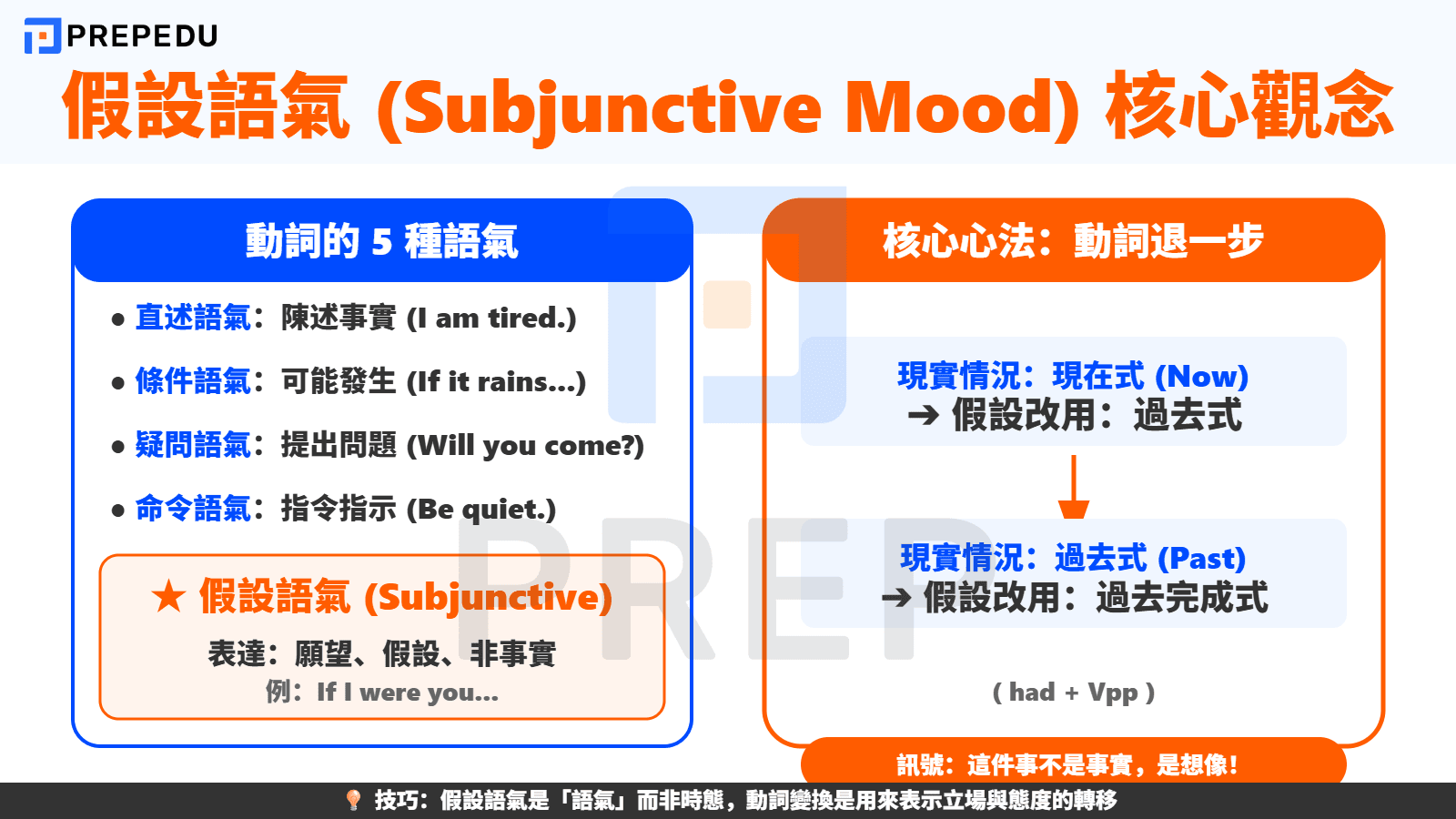
英文動詞有五種「語氣」(Mood):直述語氣(Indicative)、條件語氣(Conditional)、疑問語氣(Interrogative)、命令語氣(Imperative)與假設語氣(Subjunctive)。每一種語氣都在句子中承擔截然不同的溝通功能。其中,假設語氣專門用來表達「非事實」——也就是你說的這件事,在現實中並不存在,或者很可能不會發生。
有一個核心概念必須先釐清:假設語氣是「語氣」(Mood),而非「英文時態」(Tense)。它不告訴你事情發生在什麼時間,而是告訴你說話者對這件事的態度與立場——是陳述事實?還是表達願望、假設或想像?
理解這一點,就掌握了英文假設語氣的整體框架。以下是五種語氣的比較:
|
語氣類型 |
英文名稱 |
使用情境 |
範例 |
|
直述語氣 |
Indicative Mood |
陳述事實、真實狀況 |
I am tired.(我真的很累。) |
|
條件語氣 |
Conditional Mood |
描述可能發生的情境 |
If it rains, I will stay home.(如果下雨,我就待在家。) |
|
疑問語氣 |
Interrogative Mood |
提出問題 |
Will you come?(你會來嗎?) |
|
命令語氣 |
Imperative Mood |
命令、指示 |
Be quiet.(安靜。) |
|
假設語氣 |
Subjunctive Mood |
假設、願望、非事實 |
If I were you...(如果我是你……) |
「動詞退一步」是整個假設語氣體系的核心邏輯。現實中是現在式,假設就退到過去式;現實中是過去式,假設就退到過去完成式(had + Vpp)。這個「退後」的動作,在語義上傳遞了一個訊號:我說的這件事,不是事實,而是一種想像或願望。
換句話說,動詞時態的「借用」並非表示時間,而是一種語氣上的轉移。就像日常生活中,你說「要是我能再年輕十歲就好了」,中文的「要是」兩個字就傳遞了這種語氣;英文則透過動詞形式的改變來實現相同的效果。
掌握這個概念,所有英文假設語氣的公式就不再是死記硬背,而是有脈絡可循的語法系統。
II. If 假設語氣文法:四大條件句公式圖表
If 條件句是英語假設語氣用法中最核心、也是最常被考的部分。英文中共有四種條件句類型(Type 0 至 Type 3),加上進階的混搭條件句,構成完整的 if 假設語氣文法框架。以下依序說明每一種類型的定義、結構與例句。
1. 第零與第一條件句:事實、常理與未來可能
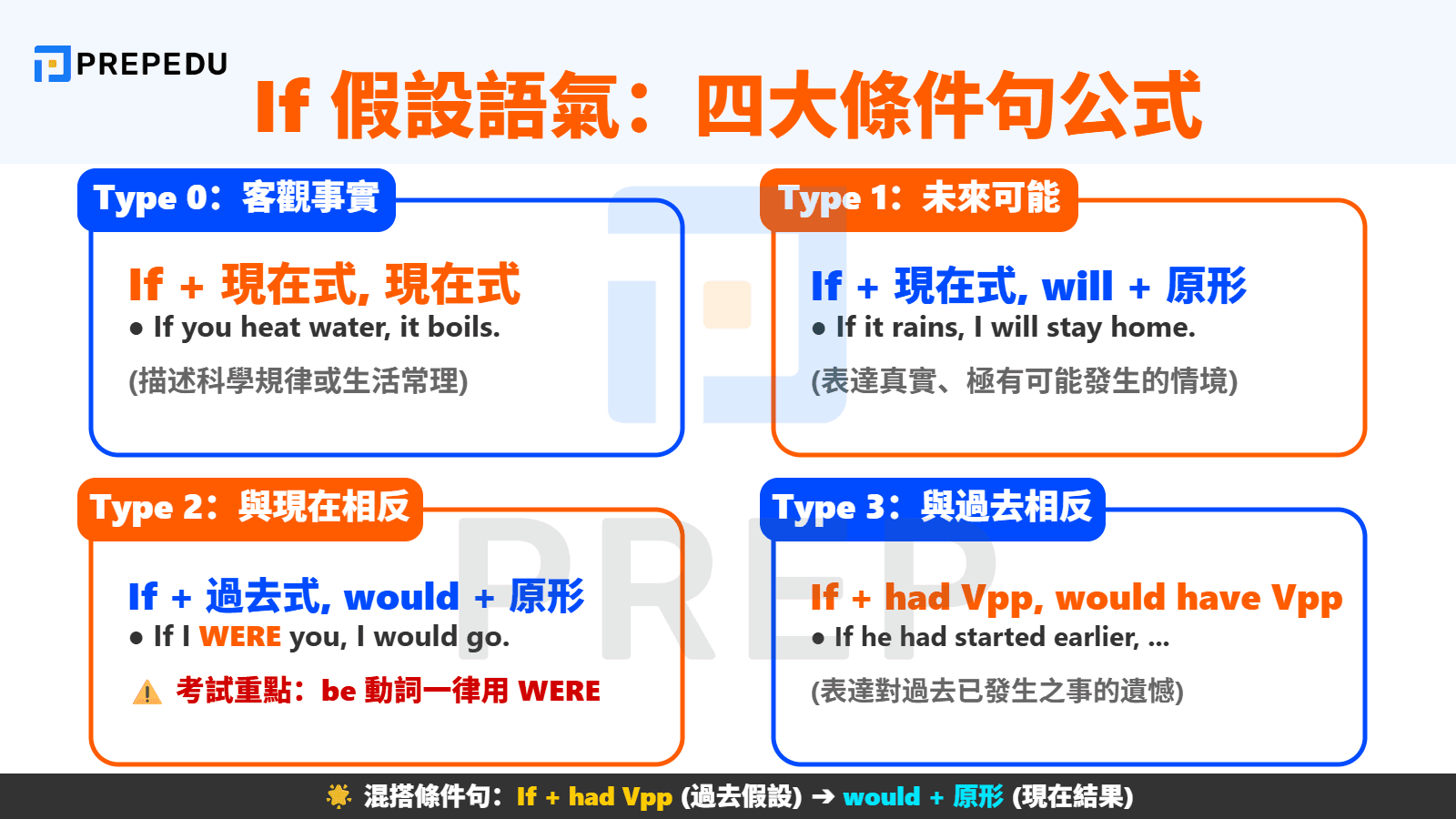
第零條件句(Type 0):陳述客觀事實或自然規律 → 第零條件句並不屬於真正的假設語氣,而是陳述永恆不變的科學規律或生活常理。兩個子句都使用現在式,強調「每次 A 發生,B 就一定發生」的恆常性。
公式:
If + 現在式, 現在式
|
結構 |
範例 |
|
If + 現在式, 現在式 |
If you heat water to 100°C, it boils.(若將水加熱至攝氏100度,它就會沸騰。) |
|
If + 現在式, 現在式 |
If Xiaowan misses the MRT at Taipei Main Station, she always calls a taxi instead.(小旺在台北車站錯過捷運,她總是改叫計程車。) |
這類句子的特殊性在於:即使使用了「if」,語氣與直述句完全相同,不帶任何假設成分。
第一條件句(Type 1):未來有可能發生的情境 → 第一條件句表達說話者認為有真實可能性發生的未來情境。這與假設語氣不同,條件語氣(Conditional Mood)更接近這類句子的本質。
公式:
If + 現在式, will + 原形動詞
|
結構 |
範例 |
|
If + 現在式, will + 原形動詞 |
If Mingzhi submits his IELTS application before Friday, he will receive the confirmation by Monday.(如果明智在週五前遞交雅思申請,他週一前就會收到確認。) |
|
If + 現在式, will + 原形動詞 |
If the typhoon hits Hong Kong this weekend, the TOEIC exam will be postponed.(如果颱風這個週末侵襲香港,多益考試將會延期。) |
第一條件句的關鍵在於:說話者相信這件事可能真的發生。這與第二條件句「與事實相反」的性質形成本質差異。
2. 第二條件句:與現在或未來事實相反(Were 還是 Was?)
第二條件句是 if 假設語氣文法中最常被討論的類型,也是最多人在 be 動詞用法上產生混淆的地方。它用來假設與現在或未來事實相反的情境,是最典型的假設語氣句型。
公式:
If + 過去式(be 動詞一律用 were), would / could / might + 原形動詞
|
結構 |
範例 |
|
If + were, would + 原形動詞 |
If Xiaowan were the team leader in Taipei, she would redesign the entire training schedule.(如果小旺是台北的組長,她會重新設計整個培訓時程。)(但她不是) |
|
If + 過去式, would + 原形動詞 |
If Mingzhi had more time before the IELTS speaking test, he would practice with native speakers every day.(如果明智在雅思口說考試前有更多時間,他每天都會與母語者練習。) |
|
If + were, could + 原形動詞 |
If the TOEIC test center in Hong Kong were closer to the station, more candidates could attend without stress.(如果香港的多益考場離車站更近,更多考生就能輕鬆赴考。) |
核心問題:be 動詞究竟應該用 were 還是 was?→ 這是假設語氣中最常見的爭議點。在正式書面語及所有英語考試中,無論主詞是第幾人稱、單數還是複數,be 動詞一律使用 were。這個規則沒有例外。以下是對照表:
|
主詞 |
正式書面語(考試標準) |
口語(非正式) |
|
I |
If I were you... |
If I was you...(不建議) |
|
He / She / It |
If she were here... |
If she was here...(口語可接受) |
|
You / We / They |
If they were able to... |
If they were able to...(相同) |
美式英語口語中,「If I was you」已相當普遍,且母語人士普遍接受,但這屬於口語的演變,在 TOEIC、IELTS、學測等正式考試中,標準答案仍是 were。
進階用法:Were to(表達未來幾乎不可能發生的假設)→「Were to」是第二條件句的進階變體,專門用於表達幾乎不可能發生的未來假設,語氣比一般第二條件句更強烈、更正式。
公式:
If + S + were to + 原形動詞, would + 原形動詞
|
結構 |
範例 |
|
If + were to + 原形動詞, would + 原形動詞 |
If Taipei were to host the Olympics, the city's transportation infrastructure would need a complete overhaul.(如果台北有朝一日舉辦奧運,城市交通基礎設施將需要全面翻新。) |
|
If + were to + 原形動詞, would + 原形動詞 |
If the English proficiency requirement were to double overnight, half the applicants in Hong Kong would need to retake their exams.(如果英語門檻一夜之間翻倍,香港有一半的申請人就必須重考。) |
3. 第三條件句:與過去事實相反的遺憾
第三條件句假設的是過去已經發生的事。這件事已成定局,無法改變,因此這類句子常帶有強烈的遺憾或後悔語氣。「動詞退後兩步」的邏輯在這裡完整體現。
公式:
If + had + 過去分詞(Vpp), would / could / might + have + Vpp
|
結構 |
範例 |
|
If + had Vpp, would have Vpp |
If Mingzhi had started IELTS preparation six months earlier, he would have achieved Band 7 on his first attempt.(如果明智早六個月開始備考雅思,他第一次就能達到雅思7分。) |
|
If + had Vpp, could have Vpp |
If Xiaowan had saved the original draft in Taipei, she could have avoided rewriting the entire report from scratch.(如果小旺當時在台北存好初稿,她就能避免從頭重寫整份報告。) |
|
If + had Vpp, might have Vpp |
If the exam venue in Hong Kong had provided clearer signage, some candidates might have found the room more easily.(如果香港的考場當時提供更清楚的指示牌,部分考生或許就能更順利找到考室。) |
4. 進階混搭條件句(Mixed Conditionals)
混搭條件句(Mixed Conditionals)是假設語氣英文中最高階的句型,在多益(TOEIC)和學測等考試中屬於高頻考點。它描述的是過去的假設影響現在的結果,因此 if 子句與主要子句分別屬於不同的條件句類型。
最常見結構:Type 3 條件子句 + Type 2 主要子句
公式:
If + had Vpp(過去假設), would + 原形動詞(現在結果)
|
結構 |
範例 |
|
If + had Vpp, would + 原形動詞 |
If Mingzhi had accepted the scholarship offer three years ago, he would be studying at a British university now.(如果明智三年前接受了那份獎學金,他現在就在英國的大學讀書了。) |
|
If + had Vpp, would + 原形動詞 |
If Xiaowan had followed her mentor's advice back then, she would be managing a team in Hong Kong today.(如果小旺當初聽從了導師的建議,她今天就會在香港帶領一個團隊。) |
辨識混搭條件句的關鍵字是主要子句中的時間副詞,例如 now、today、at this moment、currently 等。這些詞提示你:結果落在現在,不在過去。
III. 英語假設語氣關鍵字:wish、as if、if only
除了 if 條件句之外,英文假設語氣還透過特定的關鍵字來表達願望、想像與比較。這些句型在日常溝通與書面寫作中出現的頻率相當高,是假設語氣英文用法中不可忽視的核心部分。
1. I wish / If only 的三種時態變化
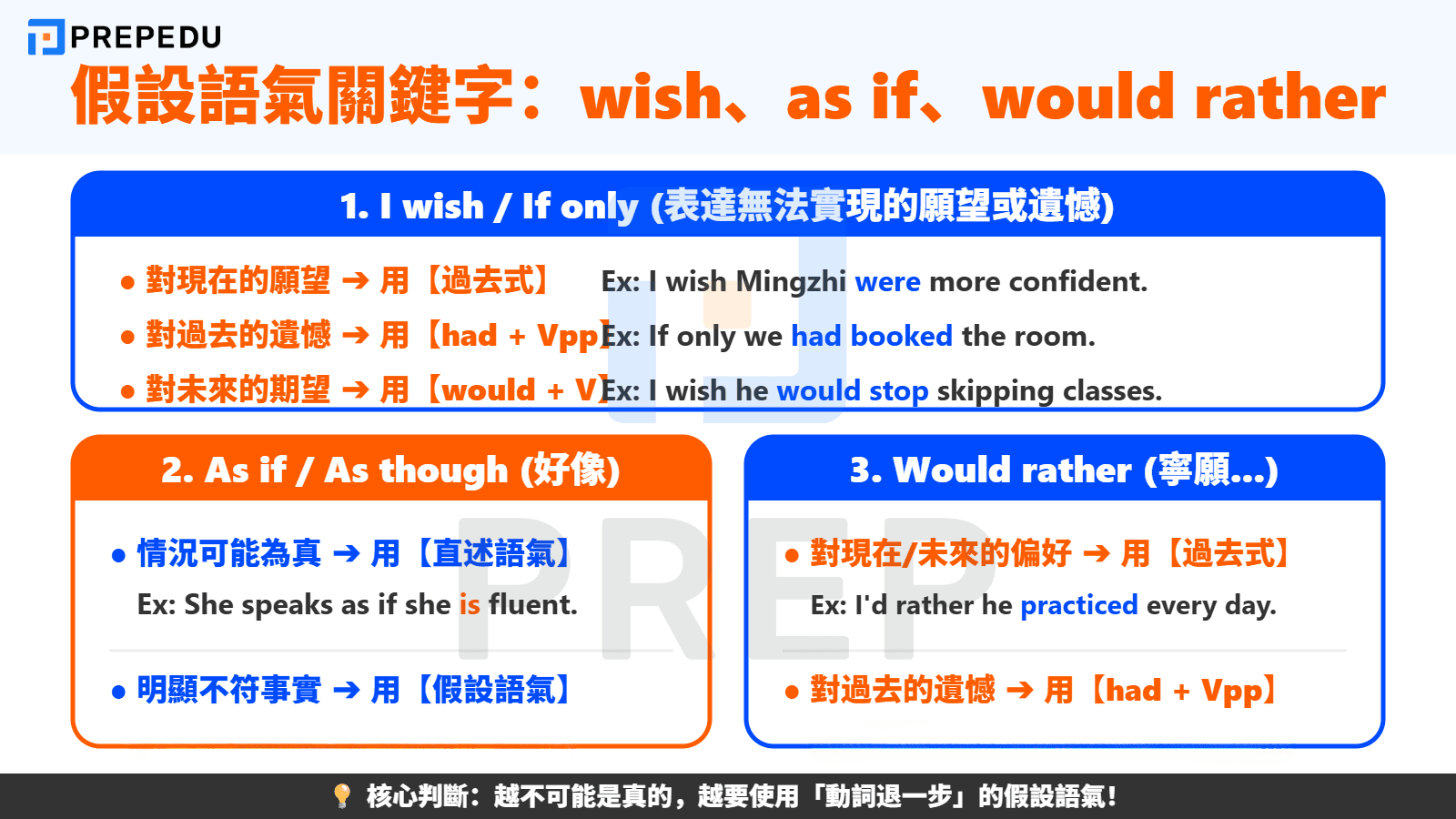
I wish 與 If only 都用來表達「現實無法實現的願望」,語義相近,但有細微差異:If only 的語氣更強烈、情感色彩更濃,常帶有深切的遺憾或渴望。
以下依時態分類說明:
|
對現在的願望(動詞用過去式) |
現實是現在式,願望就退到過去式。若涉及 be 動詞,一律用 were。範例:
|
|
對過去的願望(動詞用 had + Vpp) |
後悔過去發生或未發生的事,動詞退到過去完成式。範例:
|
|
對未來的願望(用 would + 原形動詞) |
希望某人或某事在未來有所改變,通常帶有輕微不滿或敦促之意。範例:
|
進階文法小筆記:雖然 I wish 最常用於上述三種虛擬語氣的時態變換中,但在日常商務書信或多益考試中,它還可以搭配名詞(表達祝願)或不定詞(表達正式的請求)。想要一併解鎖這些隱藏版規則,千萬別錯過完整的 Wish 用法全攻略!
2. As if / As though(好像/彷彿)的語感辨析
As if 與 As though 都翻譯為「好像」或「彷彿」,兩者在語義上完全可以互換,但動詞的選擇取決於說話者是否認為所述情況接近事實。這是假設語氣用法中最考驗語感的部分。
|
情況真實或很可能為真 |
使用直述語氣(現在式或過去式)
|
|
情況純屬假設或明顯不符合事實 |
使用假設語氣(過去式/過去完成式)
|
記住這個判斷準則:越不可能是真的,越要用假設語氣。這不是語法規則的例外,而是語義邏輯的延伸。
3. What if...? 與 Would rather that... 的用法
這兩個句型是英文假設語氣用法中常被教材略過的高頻考點,卻在 IELTS 寫作與口說中頻繁出現。
What if...?(如果……會怎樣?)
What if 是一個非正式的疑問句型,用來探討假設性情境,隱含著說話者認為這件事發生的可能性相當低。
|
情境 |
範例 |
|
現在或未來假設 |
What if Xiaowan switched her IELTS exam date to next month?(如果小旺把 IELTS 考試日期換到下個月,會怎樣呢?) |
|
過去假設 |
What if Mingzhi had chosen General Training instead of Academic IELTS two years ago?(如果明智兩年前選擇的是 IELTS General Training 而非 Academic,會怎樣呢?) |
Would rather that...(寧願……)
Would rather 後方若接 that 子句,子句內的動詞必須使用假設語氣,而非直述語氣。這是一個極常在考試中作為陷阱出現的句型。
|
情境 |
公式 |
範例 |
|
對現在或未來的偏好 |
would rather + S + 過去式(V-ed) |
I would rather Mingzhi practiced his TOEIC listening skills every evening instead of cramming the night before.(我寧願明智每天晚上練習多益聽力,而不是在考試前一晚臨時抱佛腳。) |
|
對過去的偏好(遺憾) |
would rather + S + had Vpp |
I would rather Xiaowan had registered for the Taipei exam session rather than the Hong Kong one.(我寧願小旺當時報名的是台北場次,而不是香港場次。) |
IV. 意志動詞與形容詞:省略 should 的原形動詞法則
在英文文法假設語氣的考試題型中,「意志動詞」引導的 that 子句是出現頻率最高的陷阱之一。許多學習者不知道,某些特定動詞和形容詞後方的 that 子句,動詞必須使用原形——即無論 that 子句的主詞是誰,動詞一律不加 -s、不加 -ed,也不使用助動詞 will 或 would,而是回到最基本的原形。
這個現象稱為「省略 should 的虛擬語氣」(Mandative Subjunctive)。學術上,這是英語假設語氣(Subjunctive Mood)中的「現在式假設語氣」(Present Subjunctive)。
1. 必考動詞:suggest、insist、demand、recommend
這類動詞統稱為「意志動詞」(Volitional Verbs),傳達命令、建議、要求或堅持的意志。它們的共同點是:都在「強迫或要求某件事發生」,因此 that 子句中的動詞必須維持原形,回應這種「意志」。
公式:
S1 + 意志動詞 + that + S2 + (should)+ 原形動詞
括號中的 should 可以省略,省略後動詞仍必須維持原形,不隨主詞變化。
|
意志動詞 |
範例 |
|
suggest(建議) |
The PREP tutor suggested that Mingzhi focus on paraphrasing skills before the IELTS Writing Task 2 exam.(PREP 導師建議明智在 IELTS 寫作第二部分考試前,把重點放在換句話說的技巧上。) |
|
insist(堅持) |
The examiner insisted that every candidate submit the answer sheet before the alarm sounded.(考官堅持每位考生必須在鈴聲響起前繳交答案卷。) |
|
demand(要求) |
The test coordinator in Hong Kong demanded that all phones be powered off before entering the room.(香港的考試協調員要求所有手機在進場前必須關機。) |
|
recommend(建議) |
PREP's academic team recommends that every learner complete at least two full mock exams before test day.(PREP 學術團隊建議每位學習者在考試前至少完成兩次完整模擬考。) |
|
request(請求) |
The IELTS administrator requested that Xiaowan arrive at the Taipei center at least 30 minutes early.(IELTS 行政人員請求小旺至少提前30分鐘抵達台北考場。) |
|
propose(提議) |
The study group proposed that the entire team switch to a new vocabulary app for the final two weeks.(讀書小組提議整個團隊在最後兩週改用一款新的單字應用程式。) |
|
urge(敦促) |
The coach urged that Mingzhi review the TOEIC reading section one more time before submission.(教練敦促明智在交卷前再複習一次多益閱讀部分。) |
|
advise(建議) |
The doctor advised that Xiaowan rest for at least two days after the intensive exam preparation workshop.(醫生建議小旺在密集的考試備考研討會後至少休息兩天。) |
最常見的錯誤示例:
以 suggest 為例:
-
❌ 錯誤:The PREP tutor suggested that Mingzhi focuses on paraphrasing.(動詞不可加 -s)
-
❌ 錯誤:The PREP tutor suggested that Mingzhi focused on paraphrasing.(不可使用過去式)
-
✅ 正確:The PREP tutor suggested that Mingzhi focus on paraphrasing.
2. 必考形容詞:It is essential / vital / important that...
除了意志動詞之外,部分形容詞置於「It is + 形容詞 + that...」句型中,同樣會觸發 that 子句內動詞的原形規則。這是英語假設語氣中另一個高頻考點。
公式:
It is + 形容詞 + that + S + (should)+ 原形動詞
無論 that 子句的主詞是誰、是單數還是複數,動詞一律保持原形。
|
觸發形容詞 |
範例 |
|
essential(必要的) |
It is essential that every IELTS candidate in Taipei bring a valid passport on test day.(台北的每位 IELTS 考生在考試當天攜帶有效護照,這是必要的。) |
|
vital(至關重要的) |
It is vital that Mingzhi be well-rested the night before his TOEIC speaking exam.(多益口說考試前一晚,明智好好休息是至關重要的。) |
|
important(重要的) |
It is important that the test administrator in Hong Kong verify each candidate's identity before the exam begins.(香港的考試管理員在考試開始前核實每位考生的身份,這一點非常重要。) |
|
necessary(必須的) |
It is necessary that Xiaowan submit her IELTS score report to the university before the application deadline.(小旺必須在申請截止日期前將 IELTS 成績報告提交給大學。) |
|
mandatory(強制的) |
It is mandatory that all candidates in Taipei switch off their electronic devices upon entering the examination hall.(台北的所有考生在進入考場時,強制要求關閉所有電子設備。) |
|
imperative(緊迫的) |
It is imperative that the PREP team address scoring inconsistencies in the mock TOEIC tests immediately.(PREP 團隊立即解決模擬多益測試中的評分不一致問題,是刻不容緩的事。) |
|
advisable(明智的) |
It is advisable that learners practice timed writing at least once a week during IELTS preparation.(在 IELTS 備考期間,建議學習者每週至少練習一次限時寫作。) |
|
crucial(關鍵的) |
It is crucial that every TOEIC candidate understand the distinction between real and hypothetical situations in listening comprehension.(多益考生理解聽力理解中真實與假設情境之間的區別,是非常關鍵的。) |
記住這個規律:凡是傳達「意志、命令、必要性或緊迫性」的詞,都可能觸發 that 子句中的原形動詞。
V. 假設語氣進階變體:倒裝句與 It's time
當你能靈活運用假設語氣之後,就可以進一步掌握它的正式變體。這部分在多益(TOEIC)和學測中屬於高頻考點,也是書面語中展現語言精準度的重要標誌。
1. 省略 If 的倒裝:Were / Had / Should 置首
在正式書面語中,可以省略 if,將 were、had 或 should 移至句首,形成倒裝語序。這種結構常見於商業書信、法律文件、學術論文及正式致辭中。
倒裝規則:
-
If + were → Were + 主詞
-
If + had → Had + 主詞
-
If + should → Should + 主詞
|
原始 If 句 |
|
|
If Mingzhi were to retake the IELTS, he would focus entirely on writing. |
Were Mingzhi to retake the IELTS, he would focus entirely on writing.(若明智重考 IELTS,他將把重心完全放在寫作上。) |
|
If Xiaowan had registered for the Taipei session, she would have avoided the long commute to Hong Kong. |
Had Xiaowan registered for the Taipei session, she would have avoided the long commute to Hong Kong.(若小旺當時報名台北場次,她就能避免長途通勤到香港。) |
|
If you should need any assistance during the TOEIC exam at PREP, please raise your hand. |
Should you need any assistance during the TOEIC exam at PREP, please raise your hand.(若您在 PREP 的多益考試中需要任何協助,請舉手。) |
看到句首出現 Were、Had、Should 的倒裝結構,立刻辨識這是假設語氣的正式形式——不要與疑問句混淆。
2. It is (high / about) time 的虛擬用法
這個句型在中文直覺上容易造成混淆,卻是英文假設語氣中一個極具特色的固定表達。
公式:
It is (high / about) time + S + 過去式動詞(V-ed)
這裡使用過去式,並非指「過去發生的事」,而是以虛擬語氣表達「現在就應該發生,但還沒發生」的催促或責備之意。
|
句型 |
語氣強度 |
範例 |
|
It is time |
一般催促 |
It is time Mingzhi started his TOEIC preparation seriously instead of putting it off.(明智該開始認真準備多益了,而不是一再拖延。) |
|
It is high time |
強烈催促 |
It is high time the IELTS preparation curriculum incorporated more authentic listening materials from daily life.(IELTS 備考課程早就該納入更多來自日常生活的真實聽力材料了。) |
|
It is about time |
帶有不耐煩 |
It is about time Xiaowan addressed the weaknesses in her IELTS Academic Reading score instead of focusing only on Listening.(小旺早該著手解決她在 IELTS 學術閱讀上的弱點,而不是只關注聽力了。) |
High 和 about 的加入讓語氣更強烈,傳達說話者對「這件事早就應該發生」的不耐煩或失望程度。
VI. 假設語氣練習題:三種常見題型實戰演練
理解公式後,真正的掌握來自練習。以下三個部分涵蓋假設語氣練習題中最常見的考試題型,分別測驗時態判斷、倒裝改寫和意志動詞辨析。每題附有中文翻譯與詳解,建議先獨立作答再核對答案。
1. 第一部分:動詞時態填空
請依據括號內的動詞,以正確的假設語氣時態填入空格。
-
If Mingzhi _______ (be) more patient with the listening section, he would improve his TOEIC score significantly.
-
If Xiaowan _______ (prepare) more thoroughly for last month's IELTS Academic Reading, she would have achieved a Band 8.
-
The Hong Kong exam center coordinator acts as if every candidate _______ (be) a first-time test taker, regardless of experience.
-
If only Mingzhi _______ (attend) the PREP vocabulary workshop last Tuesday in Taipei.
-
The IELTS examiner insisted that every candidate _______ (write) their answers in ink, not pencil.
-
If you add fresh ginger to hot water and honey, it _______ (soothe) a sore throat before an exam.
-
If Xiaowan _______ (email) the PREP support team before the registration deadline, she will receive a discount on the mock exam package.
-
I wish the TOEIC practice platform at PREP _______ (offer) more speaking simulation exercises.
-
(Be) _______ Mingzhi to miss the final IELTS preparation session in Hong Kong, the team would need to reschedule the mock test.
-
It is vital that every PREP learner _______ (track) heir weak points systematically throughout the preparation period.
答案與詳解:
|
題號 |
答案 |
核心邏輯說明 |
|
1 |
were |
第二條件句,be 動詞一律用 were,表達與現在事實相反的假設 |
|
2 |
had prepared |
第三條件句,對過去的假設,動詞退至過去完成式 had + Vpp |
|
3 |
were |
as if 表達明顯不符合事實的比喻,使用假設語氣過去式 were |
|
4 |
had attended |
If only 對過去的遺憾,動詞用 had + Vpp |
|
5 |
write |
意志動詞 insist,that 子句動詞一律用原形 |
|
6 |
soothes |
Type 0 條件句,陳述自然事實,兩個子句都用現在式 |
|
7 |
emails |
第一條件句,if 子句使用現在式表達真實可能 |
|
8 |
offered |
I wish + 對現在的願望,動詞退至過去式 |
|
9 |
Were |
Were to 的倒裝形式,省略 If,Were 置首,表達未來假設 |
|
10 |
track |
It is vital that 觸發原形動詞規則 |
2. 第二部分:If 倒裝句改寫
將以下 If 條件句改寫為省略 if 的正式倒裝句。
-
If Xiaowan were to transfer to the Hong Kong branch, the Taipei team would reorganize its schedule.
-
If Mingzhi had reviewed the IELTS scoring rubric carefully, he would not have lost marks on task response.
-
If you should require extra time for the TOEIC listening section at PREP, notify the proctor immediately.
-
If she were to retake the IELTS Academic module, she would approach Task 1 with a completely different strategy.
-
If the Taipei exam venue had been better ventilated, the candidates would have felt less anxious during the test.
-
If Mingzhi were in charge of the study group schedule, he would introduce timed practice sessions every week.
-
If you should encounter an unfamiliar word in the TOEIC reading section, use context clues instead of panicking.
-
If Xiaowan had taken the pre-test diagnostic at PREP, she would have identified her weak areas months earlier.
-
If the IELTS band descriptors were clearer to most candidates in Hong Kong, fewer would misunderstand the scoring criteria.
-
If Mingzhi had joined the PREP speaking club last term, he would have felt far more confident on exam day.
答案:
-
Were Xiaowan to transfer to the Hong Kong branch, the Taipei team would reorganize its schedule.
-
Had Mingzhi reviewed the IELTS scoring rubric carefully, he would not have lost marks on task response.
-
Should you require extra time for the TOEIC listening section at PREP, notify the proctor immediately.
-
Were she to retake the IELTS Academic module, she would approach Task 1 with a completely different strategy.
-
Had the Taipei exam venue been better ventilated, the candidates would have felt less anxious during the test.
-
Were Mingzhi in charge of the study group schedule, he would introduce timed practice sessions every week.
-
Should you encounter an unfamiliar word in the TOEIC reading section, use context clues instead of panicking.
-
Had Xiaowan taken the pre-test diagnostic at PREP, she would have identified her weak areas months earlier.
-
Were the IELTS band descriptors clearer to most candidates in Hong Kong, fewer would misunderstand the scoring criteria.
-
Had Mingzhi joined the PREP speaking club last term, he would have felt far more confident on exam day.
3. 第三部分:意志動詞(That 子句)選項題
選出正確的動詞形式,注意每題只有一個正確答案。
-
The PREP academic team recommended that every TOEIC candidate _______ their listening skills in authentic situations. (A)practice (B)practices (C)practiced (D)would practice
-
It is vital that Xiaowan _______ at the Hong Kong examination hall at least 45 minutes before the IELTS test begins. (A)arriving (B)arrives (C)arrived (D)arrive
-
The IELTS chief examiner demanded that all test booklets _______ collected before the official end time was announced. (A)were (B)be (C)being (D)are
-
Mingzhi's TOEIC tutor insisted that he _______ the entire listening section twice before moving on to reading. (A)reviewed (B)reviews (C)review (D)would review
-
It is mandatory that each PREP learner _______ a signed consent form before accessing the full mock test database. (A)submits (B)submit (C)submitted (D)submitting
-
The IELTS board proposed that the current Academic Writing Task 2 rubric _______ revised before the next examination cycle. (A)being (B)is (C)be (D)was
-
The Taipei test center coordinator suggested that the seating arrangement _______ adjusted to accommodate left-handed candidates. (A)will be (B)be (C)is (D)was
-
It is imperative that Xiaowan _______ her IELTS test result appeal within 28 days of the official score release. (A)filing (B)files (C)file (D)filed
-
The PREP curriculum director urged that the entire instructional team _______ the new TOEIC format guidelines before the course begins. (A)study (B)studies (C)studied (D)would study
-
It is essential that the score verification process in the Hong Kong IELTS center _______ completed within 72 hours of the test date. (A)is (B)was (C)being (D)be
答案與詳解:
|
題號 |
答案 |
說明 |
|
1 |
(A)practice |
recommend 為意志動詞,that 子句動詞用原形 |
|
2 |
(D)arrive |
It is vital that 觸發原形動詞,not arrives |
|
3 |
(B)be |
demand + that + 被動原形(be + Vpp),be collected |
|
4 |
(C)review |
insist + that + 原形動詞,不加 -ed 或 -s |
|
5 |
(B)submit |
It is mandatory that 觸發原形動詞 |
|
6 |
(C)be |
propose + that + 被動原形(be revised) |
|
7 |
(B)be |
suggest + that + 被動原形(be adjusted) |
|
8 |
(C)file |
It is imperative that 觸發原形動詞 |
|
9 |
(A)study |
urge + that + 原形動詞 |
|
10 |
(D)be |
It is essential that + 被動原形(be completed) |
VII. 假設語氣常見問題與 FAQ
1. Hope 與 Wish 的語意距離有何不同?
這是英語假設語氣學習過程中最常引發混淆的語義對比之一。
-
Hope(希望)表達的是有可能實現的期待,說話者認為這件事在現實中是有機會發生的,因此後方接一般直述語氣,動詞依正常時態使用。➡️ Mingzhi hopes that the TOEIC speaking score announcement will be released by Friday.(明智希望多益口說成績能在週五前公布。)——他認為這是有可能的。
-
Wish(但願)則專門用於表達與現實相反、難以實現的願望,後方必須使用假設語氣。➡️ Mingzhi wishes he could retake only the speaking section of the TOEIC without sitting for the full exam again.(明智但願他只需要重考多益口說部分,而不必再參加整場考試。)——但實際上規定不允許這樣做。
判斷準則很簡單:若你認為這件事「有機會發生」,用 hope;若你覺得這件事「幾乎不可能」,用 wish。
2. 為什麼在口語中可以說 If I "was" you?
在正式語法和所有英語考試的標準答案中,第二條件句的 be 動詞應一律使用 were,這是書面語的規範。然而,現代英語口語(尤其是美式英語)中,「If I was you」已相當普遍,且被大多數母語人士接受,這反映了語言在口語使用上的自然演變。
這種現象稱為「口語語法鬆動」。兩種形式在溝通上都能被理解,但語言精準度有所差異。建議你的策略是:在 TOEIC、IELTS 及學術寫作中,始終使用 were;在日常英語對話中,不必過度糾正自己或他人使用 was 的情況,但要清楚知道哪一個是正式標準。
3. 除了 suggest,還有哪些字會觸發原形動詞?
觸發 that 子句原形動詞的詞彙,遠比教科書列舉的更豐富。以下整理完整的進階清單:
-
動詞類(意志動詞): suggest、recommend、demand、insist、request、propose、require、urge、advise、command、order、move(動議)、ask、decree(頒令)、stipulate(規定)
-
形容詞類(用於 It is + 形容詞 + that 句型): essential、vital、important、necessary、critical、imperative、mandatory、advisable、preferable、urgent、recommended、proposed、suggested、obligatory(義務性的)、crucial
記住這個判斷邏輯:凡是傳達「意志、命令、必要性或緊迫性」的詞,都可能觸發 that 子句的原形動詞。當你遇到新詞時,問自己一個問題:「這個詞有沒有在要求某件事必須發生?」有的話,that 子句就用原形動詞。
結論
學習英文假設語氣,許多人走過同一條彎路:先背第一條件句,再背第二條件句,背完又忘,忘了再背,考試時依然在 was 和 were 之間猶豫不決。這不是記憶力的問題,而是方法的問題。
假設語氣在 IELTS 和 TOEIC 考試中的重要性,不僅體現在語法選擇題,更體現在寫作和口說的語言精準度上。能夠靈活使用第三條件句表達遺憾、以倒裝結構撰寫正式書信、或在 IELTS Writing Task 2 中用 were to 句型探討假設性政策,這些都是高分段考生與普通考生之間真正的差距所在。
面對龐大的考試準備內容和緊迫期限感到壓力? PREPEDU.COM 理解這種處境,提供專為優化時間效率設計的學習體驗。
別再進行隨機測驗練習。系統運用評估數據精準找出你的優勢和弱點,讓你專注於關鍵改善項目。這種科學方法可將學習時間縮短至傳統方式的一半。
雅思真題和多益練習題按照從易到難的順序設計,幫助你在進入更高難度挑戰前鞏固基礎知識。每分鐘都珍貴,每次測驗都助你進步。
別浪費時間卻進步緩慢。立即開始 PREPEDU Test Practice 的智能學習,以最高效率達成理想分數!

你好!我叫黃秋賢,現在在 prepedu.com 擔任內容企劃。我有超過5年的英語與韓語自學經歷,親身備考 IELTS、TOEIC 與 TOPIK,累積了大量第一手的學習者視角——包括哪些語法規則最讓台灣與香港學習者混淆,以及如何在有限的備考時間內最有效地修正這些錯誤。目前已在 prepedu.com 撰寫超過 1000 篇英語學習文章,內容涵蓋語法、詞彙與考試策略,累積協助數千位學習者解決自學過程中的語法疑問。
評論












統一企業編號:202227322W
地址:114 LAVENDER STREET, #11-83 CT HUB 2, SINGAPORE (338729)