英文反身代名詞(Reflexive Pronouns):Myself/ Herself/ Ourselves 用法解析,位置規則與進階練習
英文反身代名詞是什麼?該如何正確使用?反身代名詞(Reflexive Pronouns)是英文文法中用來表示「主詞與受詞為同一對象」的代名詞,包括 myself,yourself,himself,herself,itself,ourselves,yourselves,themselves 等九種形式。當你說「我傷到我自己」時,英文必須用 "I hurt myself" 而非 "I hurt me",這正是反身代名詞的核心概念——動作反射回主詞本身。掌握這個文法結構,不僅能讓你的 IELTS 寫作和 TOEIC 閱讀得分提升,更能在商務英文溝通中展現專業度。
然而,許多台灣和香港的英文學習者在使用反身代名詞時常犯下關鍵錯誤:在並列主詞中誤用 "my colleague and myself",混淆 "themselves" 與 "each other" 的差異,或是不清楚何時該用 "with her" 而非 "with herself"。這些看似微小的失誤,卻可能在正式考試或職場簡報中造成扣分或誤解。更複雜的是,現代英文逐漸接受單數 "everyone" 搭配複數 "themselves" 的用法,這讓傳統文法規則面臨新的挑戰。
本文由 PREPEDU 英文教學團隊精心撰寫,將透過完整的文法解析,實用例句,常見錯誤剖析,以及三十題精選練習題,帶你全面掌握反身代名詞的所有用法。無論你是準備英文檢定考試,或是想提升日常英文表達能力,這份攻略都能為你建立扎實的文法基礎。
I. 英文反身代名詞定義與列表
反身代词有哪些?反身代名詞用於表示動作的執行者和承受者是同一個對象,這個概念在英文中稱為 "Reflexive",意指動作「反射」回主詞本身。當主詞對自己做某個動作時,受詞位置就需要使用反身代名詞,而不是一般的受格代名詞。舉例來說,當你說「我傷到我自己」時,英文應該說 "I hurt myself" 而非 "I hurt me"。
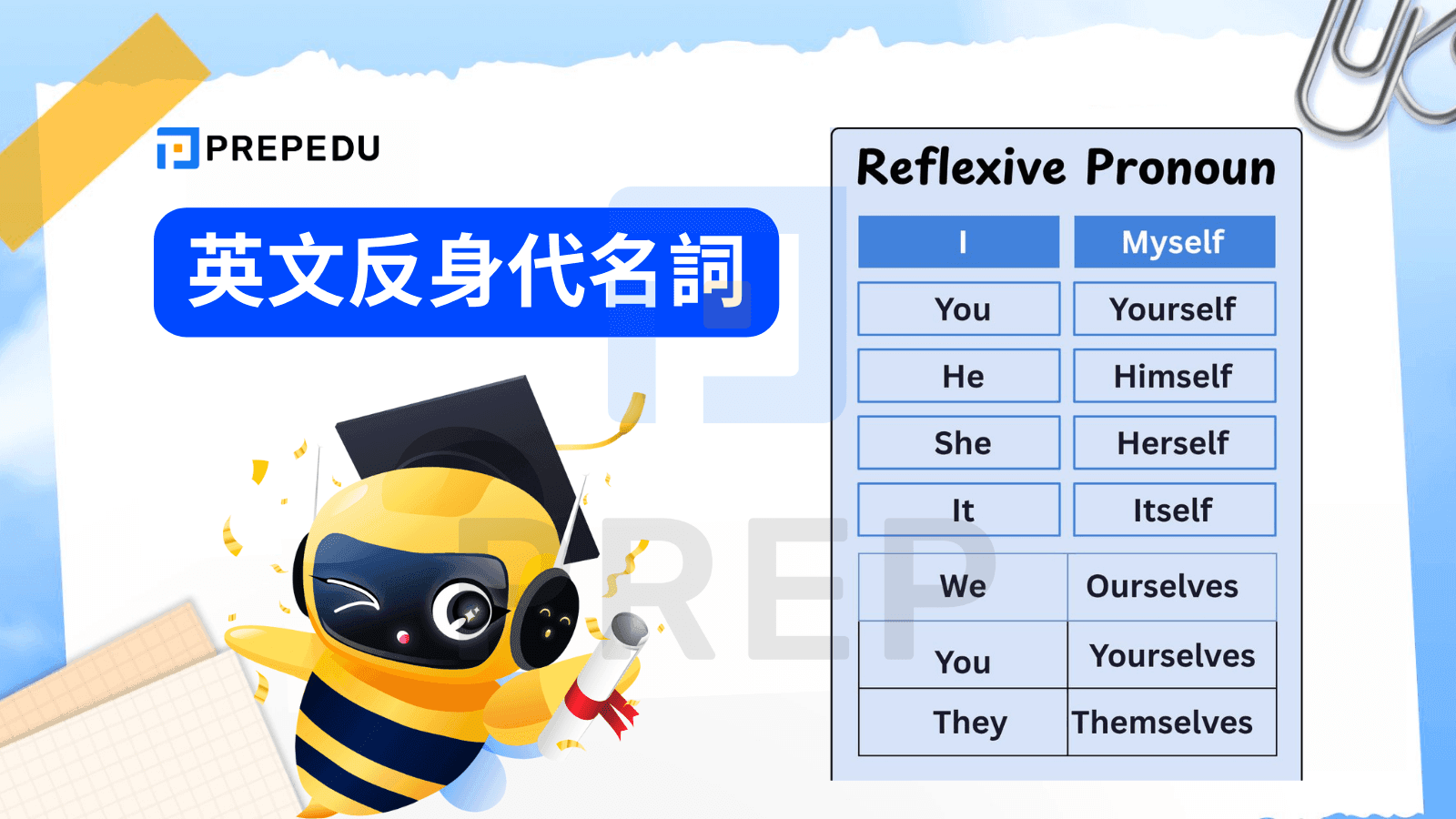
反身代名詞的形成規則很有系統:單數人稱使用 -self 結尾,複數人稱則使用 -selves 結尾。值得注意的是,英文共有九個反身代名詞,包括八個對應特定人稱的形式,以及一個泛指的形式 "oneself"。以下表格整理了所有反身代名詞的對應關係:
|
人稱 |
主格代名詞 |
反身代名詞英文 |
意思 |
|
第一人稱單數 |
I /aɪ/ |
myself /maɪˈself/ |
我自己 |
|
第二人稱單數 |
you /juː/ |
yourself /jɔːˈself/ |
你自己 |
|
第三人稱單數(男) |
he /hiː/ |
himself /hɪmˈself/ |
他自己 |
|
第三人稱單數(女) |
she /ʃiː/ |
herself /hɜːˈself/ |
她自己 |
|
第三人稱單數(物/事) |
it /ɪt/ |
itself /ɪtˈself/ |
它自己 |
|
泛指單數 |
one /wʌn/ |
oneself /wʌnˈself/ |
某人自己 |
|
第一人稱複數 |
we /wiː/ |
ourselves /ˌaʊəˈselvz/ |
我們自己 |
|
第二人稱複數 |
you /juː/ |
yourselves /jɔːˈselvz/ |
你們自己 |
|
第三人稱複數 |
they /ðeɪ/ |
themselves /ðəmˈselvz/ |
他們自己 |
Myself 是什麼代名詞英文?Myself 是反身代名詞的一種,專門對應第一人稱單數主格 "I"(人稱代名詞)。當 "I" 作為主詞,且動作的對象也是「我」本人時,就必須使用 myself 而非 me。例如:"I reminded myself to call the client."(我提醒我自己要打電話給客戶。)這裡的 myself 表示提醒的對象就是主詞「我」本人。理解這個對應關係是掌握反身代名詞用法的第一步。
II. 反身代名詞在英文句中的位置
理解反身代名詞的位置分布能幫助你更自然地運用這個文法結構。反身代名詞在句子中主要出現在三個位置,每個位置都有其特定的文法功能和意義。掌握這些位置規則,能讓你在使用反身代名詞時更加得心應手。
|
位置類型 |
說明 |
範例 |
|
英文動詞之後 |
反身代名詞作為動詞的直接受詞或間接受詞,表示動作施加在主詞自己身上 |
|
|
英文介系詞之後 |
當介系詞片語的對象指向主詞本身時使用,常見於表達情感,態度的片語 |
|
|
英文名詞/ 代名詞之後或句尾 |
用於強調主詞親自執行動作,即使省略反身代名詞,句子的基本意思仍然完整 |
|
III. 反身代名詞的結構與詳細用法解析
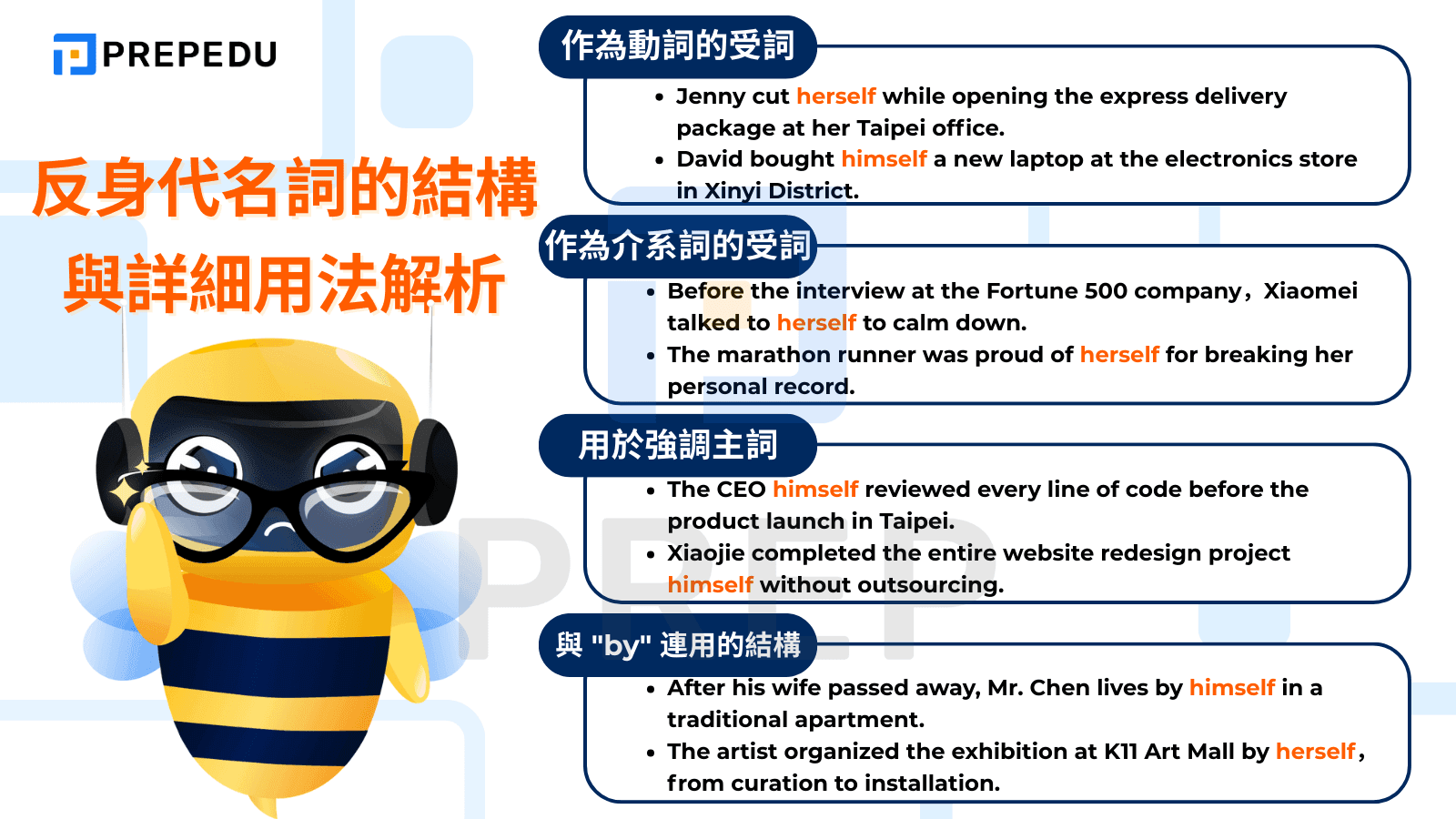
反身代名詞用法的核心在於理解四種主要的文法結構,每種結構都有其獨特的語意功能和使用情境。以下將逐一深入解析這些用法,幫助你在實際應用時能夠準確判斷何時應該使用反身代名詞。
1. 作為動詞的受詞
當動作的執行者和承受者是同一個人或物時,動詞後面必須使用反身代名詞而非一般受格代名詞。這種「反射動作」的概念是反身代名詞最基本也最重要的功能。反身代名詞可以擔任直接受詞,也可以作為間接受詞,兩者在句中扮演不同的文法角色。
|
情境 |
說明 |
範例 |
|
直接受詞 |
動作直接施加在主詞本人身上 |
|
|
間接受詞 |
主詞為自己的利益執行動作 |
|
常見搭配反身代名詞的動詞包括:hurt(傷害),cut(切割),teach(教導),introduce(介紹),blame(責備),kill(殺害),push(督促),treat(對待,款待),buy(購買),prepare(準備)等。這些動詞的共同特點是動作可以施加在執行者自己身上,或是為執行者本人的利益而進行。
2. 作為介系詞的受詞
當介系詞片語所指涉的對象需要指回主詞時,介系詞後面應使用反身代名詞。這種用法在表達情感,態度,關係或抽象概念時特別常見,是英文中表達內在狀態和自我關係的重要方式。
|
情境 |
範例 |
|
抽象關係與情感狀態 |
|
|
自我認知與態度 |
|
常見的介系詞搭配包括:for oneself(為自己),about oneself(關於自己),to oneself(對自己說),of oneself(關於自己),with oneself(對自己),by oneself(靠自己)等。掌握這些固定搭配能讓你的英文表達更道地,也能更準確地傳達內心狀態和自我關係。
3. 用於強調主詞
反身代名詞可以放在主詞後面或句尾,用來強調動作是主詞「親自」執行的,這種用法在文法上稱為「強調性反身代名詞」或「加強語氣用法」。與前兩種用法不同的是,這種強調用法即使省略反身代名詞,句子的基本語意仍然完整,但加上反身代名詞能讓語氣更強烈,更具說服力。
|
情境 |
範例 |
|
主詞後強調(緊接主詞) |
|
|
句尾強調(動作完成後強調) |
|
這種用法常用於以下情境:強調親自參與(特別是身分地位較高者親力親為),反駁他人質疑(證明確實是本人所為),凸顯特殊性或重要性(與一般情況不同),表達獨立完成的成就感。在正式文件,演講或需要建立信任的溝通場合中,這種強調手法能有效提升說服力和可信度。
4. 與 "by" 連用的結構
"by + 反身代名詞" 是一個非常常用的固定結構,表示「獨自」或「靠自己」的意思,相當於 "alone" 或 "without help"。這個結構在日常對話和寫作中出現頻率極高,是表達獨立性和自主性的重要方式。值得注意的是,by oneself 有兩層含義,實際意思需要根據上下文判斷。
|
情境 |
範例 |
|
表示「獨自一人」(alone) |
|
|
表示「靠自己的力量」(without help) |
|
需要特別注意的是,"all by oneself" 的結構能夠同時強化兩種意思,既強調「完全獨自」也強調「完全靠自己」,語氣比單純的 "by oneself" 更強烈。例如:"She renovated the entire house all by herself."(她完全靠自己翻新了整間房子。)這裡既表示沒有其他人幫忙,也強調是獨力完成的驚人成就。
IV. 常見慣用反身代名詞的固定片語
英文中有許多包含反身代名詞的固定片語,這些慣用語英文在日常溝通中使用頻繁,掌握它們能讓你的英文更接近母語者的表達方式。以下整理了最常用且實用的反身代名詞慣用片語,每個片語都附上詳細說明和實際應用例句。
|
慣用片語 |
意思 |
例句 |
|
enjoy oneself |
玩得開心,過得愉快 |
The tourists from Taiwan enjoyed themselves exploring the night markets in Raohe and Shilin.(來自台灣的遊客在饒河和士林夜市探索時玩得很開心。) |
|
help oneself (to something) |
自由取用,自便 |
Please help yourself to the buffet selection at the wedding banquet in Kaohsiung.(請自便享用高雄婚宴的自助餐點。) |
|
make oneself at home |
別拘束,像在家一樣 |
When visiting friends in Tamsui, the host said: "Make yourself at home and relax on the balcony."(拜訪淡水的朋友時,主人說:「別拘束,在陽台上放鬆休息。」) |
|
behave oneself |
守規矩,表現得體 |
The children behaved themselves during the temple ceremony in Longshan Temple.(孩子們在龍山寺的廟會儀式中表現得很得體。) |
|
express oneself |
表達自己的想法或感受 |
In the Taipei toastmasters club, members learn to express themselves confidently in public.(在台北的演講俱樂部,成員學習在公開場合自信地表達自己。) |
|
pride oneself on |
以某事為傲 |
The traditional bakery in Dadaocheng prides itself on using only natural ingredients.(大稻埕的傳統糕餅店以只使用天然食材為傲。) |
|
devote oneself to |
致力於,投身於 |
After retiring, Professor Wang devoted himself to marine conservation research in Kenting.(王教授退休後致力於墾丁的海洋保育研究。) |
|
apply oneself |
專心致力於,認真投入 |
If you apply yourself to learning Mandarin, you can become fluent within two years.(如果你專心學習中文,兩年內就能流利使用。) |
|
find oneself |
發現自己處於某種狀態 |
After the company restructure, Xiaolin found herself managing a team of twenty people.(公司重組後,小琳發現自己管理著二十人的團隊。) |
|
lose oneself in |
沉浸於,迷失在 |
Visitors often lose themselves in the artistic atmosphere of Huashan 1914 Creative Park.(遊客常常沉浸在華山 1914 創意文化園區的藝術氛圍中。) |
這些慣用片語的共同特點是反身代名詞已經成為固定搭配的一部分,不能隨意替換或省略。記住這些片語最有效的方法是將它們視為一個完整的語意單位來學習,而不是分開記憶動詞和反身代名詞。透過大量閱讀和實際應用,你會逐漸內化這些自然的表達方式。
V. 使用反身代名詞的關鍵注意事項
掌握反身代名詞的進階規則和例外情況能幫助你避免常見錯誤,展現更精確的英文能力。以下兩個要點是學習者經常忽略但實際上非常重要的文法細節,理解這些規則能讓你在正式寫作和考試中避免失分。
1. 單數主詞搭配複數反身代名詞
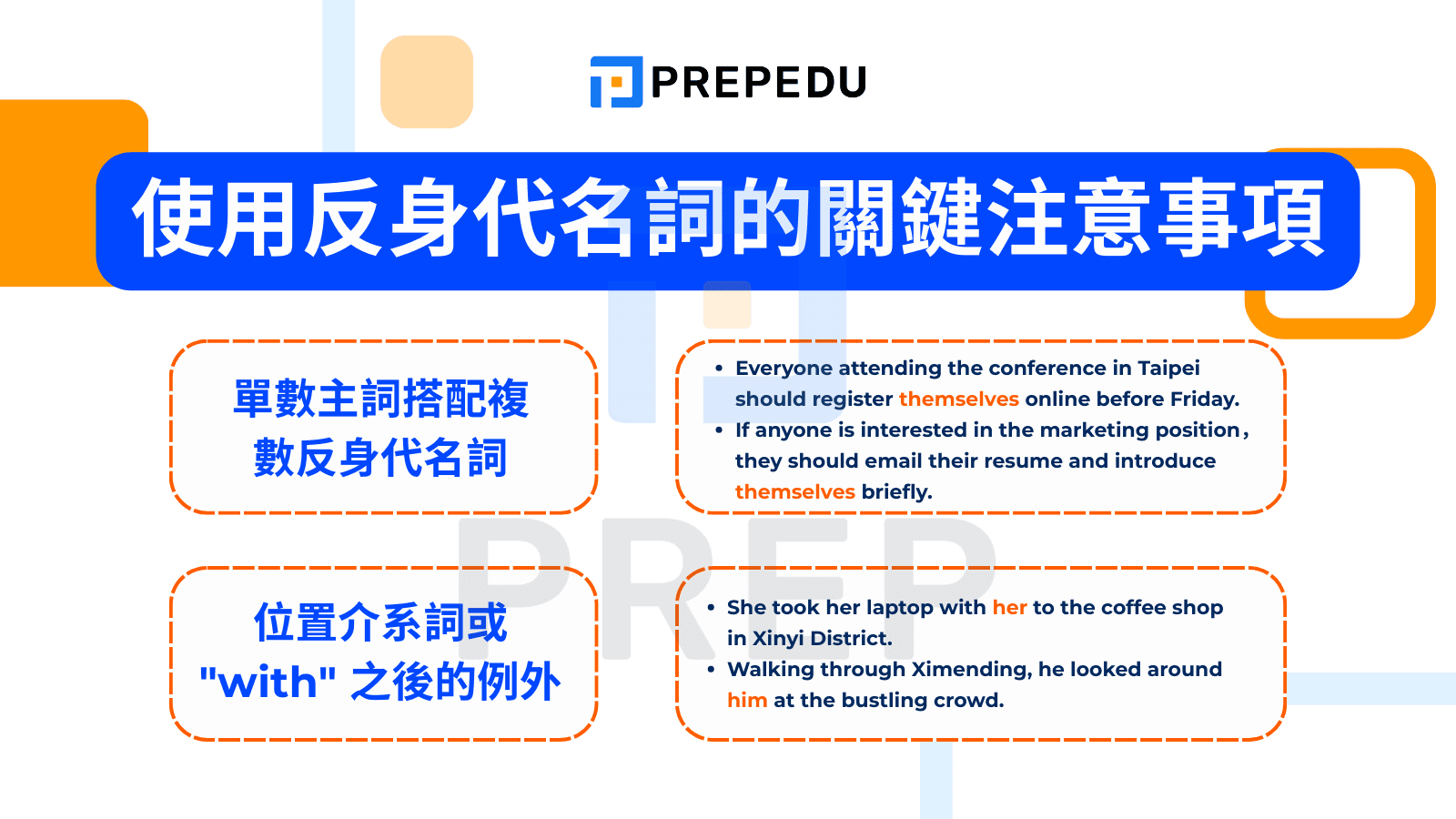
當主詞是性別不明或泛指的不定代名詞時,傳統文法要求使用 "himself or herself",但現代英文越來越常使用 "themselves" 來避免性別區分,即使從形式上看主詞是單數。
適用的不定代名詞:這種用法主要出現在 someone,everyone,anyone,no one,everybody,anybody,nobody 等不定代名詞之後。
例句:
-
Everyone attending the conference in Taipei should register themselves online before Friday.(所有參加台北會議的人都應該在週五前線上註冊。)
-
If anyone is interested in the marketing position,they should email their resume and introduce themselves briefly.(如果有人對行銷職位感興趣,應該寄履歷並簡短介紹自己。)
雖然傳統文法書可能標示 singular they 的用法為非正式或口語,但在當代英文中,特別是在追求性別包容性的語境下,使用 themselves 已經被廣泛接受且被視為更簡潔優雅的選擇。不過在應試或學術寫作中,如果你的考官或審查者較為保守,使用 "himself or herself" 仍然是最安全的選擇,可以避免任何爭議。
2. 位置介系詞或 "with" 之後的例外
這是反身代名詞用法中最容易出錯的地方,也是進階學習者必須掌握的細微差異。當英文位置介系詞表達的是物理位置,空間關係或伴隨狀態,且受詞在物理上與主詞分離時,通常使用受格代名詞而非反身代名詞。這個規則看似複雜,但理解背後的邏輯後就能準確應用。
|
情境 |
說明 |
正確用法 |
錯誤用法 |
|
"with" 的例外情況 |
表示「帶著,隨身攜帶,伴隨」時使用受格代名詞 |
She took her laptop with her to the coffee shop in Xinyi District.(她帶著筆電到信義區的咖啡店。) |
She took her laptop with herself.(錯誤)➡️ 筆電在物理上與主詞分離,是「帶著的物品」 |
|
The mother brought her two children with her to the shopping mall in Causeway Bay.(母親帶著兩個孩子到銅鑼灣的購物中心。) |
The mother brought her children with herself.(錯誤)➡️ 孩子是伴隨者,在物理上獨立於母親 |
||
|
位置介系詞的例外情況 |
表示空間位置或方向時用受格代名詞 |
Walking through Ximending, he looked around him at the bustling crowd.(走過西門町時,他環顧四周看著熙攘的人群。) |
He looked around himself.(錯誤)➡️ around 表示空間位置,觀察的對象在主詞周圍 |
|
After the meeting,she closed the door behind her and returned to her desk.(會議後,她關上身後的門回到座位。) |
She closed the door behind herself.(錯誤)➡️ behind 表示空間位置,門在主詞身後 |
判斷原則:這個細微差異的判斷關鍵在於「關係的抽象性 vs. 物理性」:
-
用反身代名詞:當介系詞表達的是抽象關係(情感,態度,心理狀態,利益),且動作或狀態指向主詞本身的內在。例如:"She was angry with herself."(她對自己生氣。)這裡的 with 表達情感關係。
-
用受格代名詞:當介系詞表達的是物理位置,空間關係或伴隨,且受詞在物理或概念上與主詞分離。例如:"She had her bag with her."(她帶著她的包。)這裡的 with 表達物理伴隨。
VI. 反身代名詞的常見錯誤與混淆
學習反身代名詞時,許多學習者會在拼字,選擇和概念理解上出現錯誤。認識這些常見陷阱能幫助你避免在考試和實際應用中失分,也能讓你的英文表達更加專業準確。以下表格整理了五大類最常見的反身代名詞錯誤:
|
錯誤類型 |
詳細說明 |
錯誤範例 |
正確範例 |
|
拼字錯誤 |
所有反身代名詞都以 -self(單數)或 -selves(複數)結尾,沒有例外。第三人稱單數男性是 him + self = himself,而非 his + self |
❌ He did it by hisself. ❌ They finished the project theirselves. ❌ We prepared ourself for the meeting. |
✅ He did it by himself.(他自己做的。) ✅ They finished the project themselves.(他們自己完成專案。) ✅ We prepared ourselves for the meeting.(我們為會議做好準備。) |
|
過度使用反身代名詞(並列主詞/受詞) |
在並列主詞或受詞中錯誤使用反身代名詞。判斷方法:去掉其他主詞,如果單獨使用時句子不成立,就不應該用反身代名詞 |
❌ My colleague and myself will attend the seminar.(我的同事和我自己將參加研討會。) ❌ Please send the report to the manager or myself.(請將報告寄給經理或我自己。) |
✅ My colleague and I will attend the seminar.(我的同事和我將參加研討會。) ✅ Please send the report to the manager or me.(請將報告寄給經理或我。) |
|
混淆 Themselves 與 Each Other |
|
|
|
|
介系詞後的錯誤選擇 |
當介系詞表示「位置/伴隨」且受詞在物理上與主詞分離時,用受格代名詞而非反身代名詞(詳見第五章第 2 節) |
❌ She brought her presentation materials with herself.(她帶著簡報資料。) ❌ He looked behind himself nervously.(他緊張地看向身後。) |
✅ She brought her presentation materials with her.(她帶著簡報資料。) ✅ He looked behind him nervously.(他緊張地看向身後。) |
|
反身代名詞不能單獨作主詞 |
反身代名詞絕對不能單獨作為句子的主詞,這是不可違反的基本規則。反身代名詞只能作為受詞或用於強調 |
❌ Myself completed the project.(我自己完成了專案。) ❌ Himself will attend the meeting.(他自己將參加會議。) |
✅ I completed the project myself.(我親自完成專案。) ✅ I myself completed the project.(我親自完成專案。) ✅ He will attend the meeting himself.(他將親自參加會議。) |
VII. 反身代名詞練習題
透過系統性的練習能幫助你鞏固反身代名詞的各項用法。以下三組練習題涵蓋基礎對應,慣用片語和進階應用,完成後請對照答案檢驗學習成效,並仔細閱讀解析以理解每題的文法要點。
1. 練習一:基礎選擇題
請選擇正確的反身代名詞填入空格:
-
During the cooking class in Taipei, I accidentally cut _______ while chopping vegetables. A)me B)myself C)mine D)my
-
The tourists from Japan enjoyed _______ at Taroko National Park. A)them B)their C)themselves D)theirselves
-
Linda looked at _______ in the fitting room mirror before buying the dress. A)her B)herself C)hers D)she
-
After winning the championship, we should be proud of _______. A)us B)our C)ourselves D)ours
-
The stray cat cleaned _______ thoroughly after the rainstorm. A)it B)its C)itself D)it's
-
Did you hurt _______ during the basketball game at Taipei Arena? A)you B)your C)yourself D)yours
-
Without any tutorial videos, David taught _______ how to code in Python. A)him B)his C)himself D)he
-
Now that they're seven years old, the twins can dress _______ independently. A)them B)their C)themselves D)theirs
-
At the networking event in Xinyi District, you should introduce _______ to potential clients. A)you B)your C)yourself D)yours
-
After the mistake cost the company money, Michelle blamed _______ severely. A)her B)herself C)hers D)she
練習一答案與解析:
-
B(主詞 I,受詞也是「我」,用 myself)
-
C(主詞 tourists,用複數 themselves,注意沒有 theirselves 這個字)
-
B(主詞 Linda,用 herself)
-
C(主詞 we,用複數 ourselves)
-
C(主詞 cat,用 itself)
-
C(主詞 you,用 yourself)
-
C(主詞 David,用 himself,表示自學)
-
C(主詞 twins,用複數 themselves)
-
C(主詞 you,用 yourself,自我介紹的固定用法)
-
B(主詞 Michelle,用 herself)
2. 練習二:慣用片語填空
請在空格中填入適當的反身代名詞,完成慣用片語:
-
At the wedding banquet in Kaohsiung, please help _______ to the seafood buffet.
-
After his divorce, Mr. Lin lives by _______ in a studio apartment near Taipei Main Station.
-
When you visit our office in Taichung, make _______ at home and use the meeting room freely.
-
The students didn't behave _______ during the field trip to the National Palace Museum.
-
The traditional tea shop in Dadaocheng prides _______ on its century-old recipe.
-
Despite the rain, the hikers enjoyed _______ at Yangmingshan National Park.
-
After years of searching, Xiaojuan finally found _______ working as a social entrepreneur.
-
In the debate competition, he expressed _______ eloquently and won first place.
-
After retiring from teaching, Professor Chen devoted _______ to writing historical novels.
-
When learning a new language, one must apply _______ diligently to make progress.
練習二答案與解析:
-
yourself(help oneself to = 自便享用)
-
himself(by oneself = 獨自一人)
-
yourself(make oneself at home = 別拘束)
-
themselves(behave oneself = 守規矩)
-
itself(pride oneself on = 以...為傲,主詞是 shop 用 itself)
-
themselves(enjoy oneself = 玩得開心)
-
herself(find oneself = 發現自己處於某狀態)
-
himself(express oneself = 表達自己)
-
himself(devote oneself to = 致力於)
-
oneself(apply oneself = 專心致力,泛指用 oneself)
3. 練習三:改錯與進階應用
請找出句子中的錯誤並改正,如果句子正確請寫 "正確的":
-
My manager and myself attended the trade show in Hong Kong last week.
-
Everyone at the startup should familiarize themselves with the new software system.
-
Before crossing Zhongxiao East Road,he looked behind himself carefully.
-
The photographer from Tainan took her camera equipment with herself to the wedding.
-
The CEO hisself announced the merger at the press conference.
-
The exchange students enjoyed theirselves exploring night markets in Taipei.
-
I designed this entire marketing campaign myself without hiring an agency.
-
If anybody wants to join the hiking trip to Alishan,they should register themself online.
-
She bought a souvenir for her and her husband at the Jiufen Old Street.
-
Our company prides ourselves on providing excellent customer service in both Mandarin and English.
練習三答案與詳細解析:
-
錯誤 → "My manager and I attended the trade show in Hong Kong last week." ➡️ 解析:並列主詞不用反身代名詞。去掉 "my manager and" 後,"myself attended" 不成立,應該用主格 "I"。
-
正確的 ➡️ 解析:現代英文接受單數 everyone 搭配複數 themselves,符合性別中立原則。
-
錯誤 → "Before crossing Zhongxiao East Road,he looked behind him carefully."➡️ 解析:位置介系詞 behind 表達空間關係,應用受格代名詞 him 而非反身代名詞 himself。
-
錯誤 → "The photographer from Tainan took her camera equipment with her to the wedding."➡️ 解析:介系詞 with 表示「帶著,伴隨」,且相機設備在物理上與主詞分離,應用受格 her。
-
錯誤 → "The CEO himself announced the merger at the press conference."➡️ 解析:拼字錯誤,第三人稱單數男性的反身代名詞是 himself,沒有 hisself 這個字。
-
錯誤 → "The exchange students enjoyed themselves exploring night markets in Taipei."➡️ 解析:拼字錯誤,複數第三人稱的反身代名詞是 themselves,不是 theirselves。
-
正確的 ➡️ 解析:句尾強調用法,myself 強調「親自」設計,文法正確。
-
錯誤 → "If anybody wants to join the hiking trip to Alishan,they should register themselves online."➡️ 解析:themself 不是正確拼字,應該用 themselves。雖然 anybody 是單數,現代用法接受複數 themselves。
-
可接受但建議修改 → "She bought a souvenir for herself and her husband at the Jiufen Old Street."➡️ 解析:如果她也為自己買,應該用 "for herself and her husband";如果只為丈夫買,原句 "for her husband" 即可。取決於實際意思。
-
正確的➡️ 解析:主詞 company 是 "our company",用 ourselves 呼應 "our" 的第一人稱複數,表示「我們公司」的概念。
結論
掌握反身代名詞需要理解其核心概念,熟記各種用法情境,並透過大量練習來內化規則。從基本的人稱對應到進階的例外情況,每個細節都會影響你英文表達的準確性。透過本文的系統性解析和練習題,相信你已經對反身代名詞有了全面的理解。持續在閱讀和寫作中注意這些用法,你的英文能力將會更上一層樓。
對 IELTS 或 TOEIC 考試結構感到陌生?考場環境的不熟悉會在關鍵時刻影響你的成績。PREPEDU Test Practice 提供完整模擬考試情境,讓你在正式考試前充分掌握題型和時間分配。
系統內建超過 1,000 道練習題,持續更新以反映最新考試趨勢。這確保你熟悉核心主題。AI 工具識別你的弱點,提供針對性改善方案,加速成績提升。
最突出的功能是即時進度追蹤系統。每次練習後,你都能清楚看到自己的進步。這個優勢讓你在競爭中保持領先。
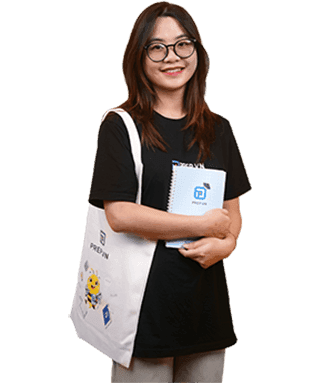
你好!我叫黃秋賢,現在在 prepedu.com 擔任內容企劃。我有超過5年的英語與韓語自學經歷,親身備考 IELTS、TOEIC 與 TOPIK,累積了大量第一手的學習者視角——包括哪些語法規則最讓台灣與香港學習者混淆,以及如何在有限的備考時間內最有效地修正這些錯誤。目前已在 prepedu.com 撰寫超過 1000 篇英語學習文章,內容涵蓋語法、詞彙與考試策略,累積協助數千位學習者解決自學過程中的語法疑問。
評論






統一企業編號:202227322W
地址:114 LAVENDER STREET, #11-83 CT HUB 2, SINGAPORE (338729)