英文所有格形容詞(Possessive Adjectives)完整指南:My/ Your/ His/ Her 等 7 大詞彙用法,對照表
什麼是所有格形容詞英文?如何正確使用 my,your,his,her 這些詞彙?所有格形容詞(Possessive Adjectives)是英語中用來表達「所屬關係」的關鍵詞彙,包括 my,your,his,her,its,our,their 等七個核心詞彙。這些詞彙必須放在名詞之前,用來說明該名詞屬於誰,例如「my book」(我的書),「their house」(他們的房子)。掌握所有格形容詞是英語學習的基礎,卻也是許多台灣與香港學習者最容易混淆的語法點之一。
許多學習者經常將所有格形容詞與所有格代名詞混淆,或是在 its 與 it's,your 與 you're 之間猶豫不決。這些看似簡單的詞彙,實際上在日常溝通,商務書信,學術寫作中都扮演著不可或缺的角色。錯誤使用不僅會造成語意不清,更可能影響專業形象與溝通效果。
本文由 PREPEDU 專業教學團隊精心編撰,為你提供完整的所有格形容詞用法指南,包含詳細定義,人稱對照表,四大使用情境解析,常見錯誤辨析,以及30道實戰練習題含詳解。無論你是準備 IELTS,TOEIC 等英語檢定,或是希望提升日常英語溝通能力,這份全攻略都能幫助你徹底掌握所有格形容詞的正確用法。
I. 英文所有格形容詞是什麼?
所有格形容詞(Possessive Adjectives)是英語中用來表達「所屬關係」的一組詞彙,它們回答「Whose?」(誰的?)這個問題。這類詞彙在句子中扮演形容詞英文的角色,意味著它們必須依附在名詞英文之前,用來修飾並說明該名詞屬於誰。與獨立使用的代名詞英文不同,所有格形容詞永遠不能單獨出現,必須與名詞搭配使用才能構成完整的語意。
結構公式:
所有格形容詞 + 名詞
所有格形容詞 + 數量詞/形容詞 + 名詞
範例:
-
Wang Xiaoming works at a tech company in Taipei,and his laptop contains all the important client data.(王小明在台北的科技公司工作,他的筆記型電腦裡有所有重要的客戶資料。)
-
The Chen family just returned from their vacation in Kenting,where their children enjoyed swimming and surfing every day.(陳家剛從墾丁度假回來,他們的孩子每天都享受游泳和衝浪的樂趣。)
需要特別注意的是,所有格形容詞與冠詞英文(a,an,the)不能同時出現在名詞前。這是許多學習者容易犯的錯誤,因為在某些語言中這種組合是允許的,但在英語中是絕對禁止的。
II. 英文所有格形容詞對照表(人稱與單複數)
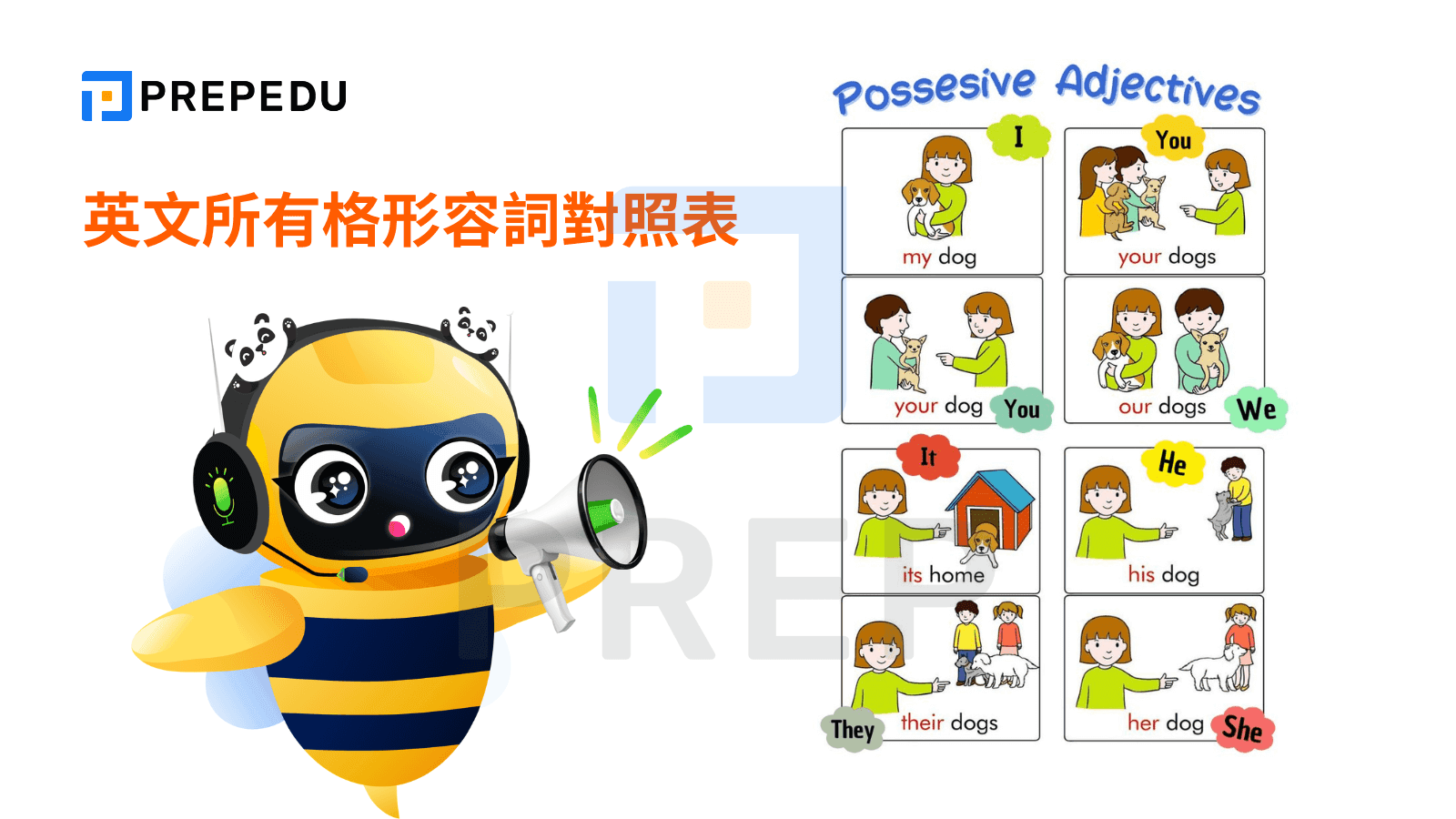
理解所有格形容詞的完整系統需要掌握它們與不同人稱的對應關係。所有格形容詞的選擇完全取決於擁有者的人稱,性別與單複數,與被擁有物的特性完全無關。以下表格整理了所有人稱的主格與對應的所有格形容詞,這是學習所有格形容詞必須熟記的基礎內容。
|
人稱 |
主格代名詞 |
所有格形容詞 |
意思 |
|
第一人稱單數 |
I |
my |
我的 |
|
第二人稱單數/複數 |
you |
your |
你的/你們的 |
|
第三人稱單數(男性) |
he |
his |
他的 |
|
第三人稱單數(女性) |
she |
her |
她的 |
|
第三人稱單數(中性/物) |
it |
its |
它的 |
|
第一人稱複數 |
we |
our |
我們的 |
|
第三人稱複數 |
they |
their |
他們的/她們的/它們的 |
從表格中可以觀察到幾個重要規律。
-
第二人稱的 your 同時適用於單數與複數,這是英語的特殊之處,與中文的「你的」和「你們的」有明確區分不同。
-
第三人稱單數依據性別分為 his(男性),her(女性)與 its(非生物或動物),這種區分在使用時需要根據所有者的性別來選擇,而非被擁有物的特性。
-
複數形式的所有格形容詞(our,their)則不區分性別,無論擁有者是男性,女性或混合群體,都使用相同的形式。
-
特別值得注意的是,its 這個所有格形容詞沒有撇號,這與縮寫形式 it's(it is 或 it has)完全不同,是寫作時最容易出錯的地方之一。
III. 所有格形容詞的具體用法與規則
掌握所有格形容詞的理論知識後,更重要的是理解它們在實際語境中的應用方式。所有格形容詞在日常溝通與學術寫作中都扮演著不可或缺的角色,以下四種情境涵蓋了所有格形容詞最常見且重要的使用場景,這些規則將幫助你在日常溝通中正確運用這個語法點。
1. 所有格形容詞表示所有權與所屬關係
這是所有格形容詞最基礎也最直觀的用法,用來表示某物品或財產屬於某個人。在這種用法中,所有格形容詞建立了物品與擁有者之間清晰的所有權關係,讓聽者或讀者能夠立即理解誰擁有什麼東西。這種用法在日常對話中最為常見,涵蓋了從個人物品到不動產的各種所有權表達。
範例:
-
Chen Weiting just bought his first car after working in Hsinchu Science Park for three years,and he is very proud of this achievement.(陳偉廷在新竹科學園區工作三年後剛買了他的第一輛車,他對這個成就感到非常自豪。)
-
The Wong family has owned their traditional shophouse in Hong Kong's Central District for over four generations,maintaining it as a family heritage.(黃家在香港中環區擁有他們的傳統商舖已經超過四代,一直把它當作家族遺產保存。)
2. 所有格形容詞表示人際與親屬關係
所有格形容詞也廣泛用於描述人與人之間的連結,特別是家庭關係與社會關係。在這種用法中,所有格形容詞表達的不是真正的「擁有」關係,而是人際之間的社會連結或血緣關係。值得注意的是,雖然我們不能真正「擁有」另一個人,但在英語中仍然使用所有格形容詞來表達這種關係連結,這是語言習慣的一部分,反映了英語對關係表達的獨特方式。
範例:
-
Wang Daming's mother runs a successful traditional Chinese medicine clinic in Taipei's Datong District,and his younger sister is currently studying pharmacy at National Taiwan University.(王大明的母親在台北大同區經營一家成功的中醫診所,而他的妹妹目前正在台灣大學攻讀藥學。)
-
During the company retreat in Taichung,our department manager praised his team members for successfully completing the challenging project ahead of schedule.(在台中的公司員工旅遊期間,我們的部門經理讚揚了他的團隊成員提前完成這個具有挑戰性的專案。)
3. 所有格形容詞表示身體部位與外觀特徵
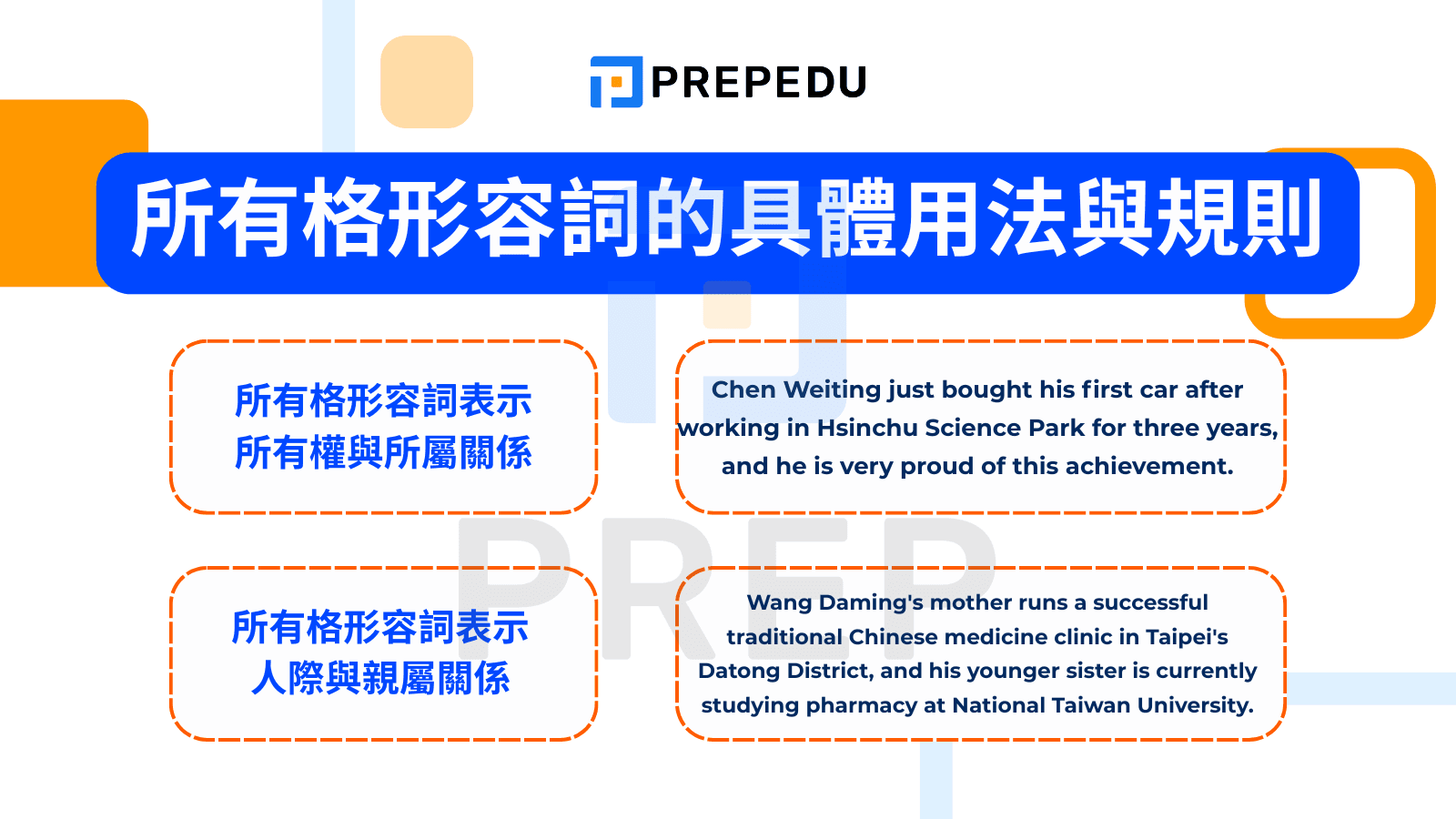
當描述身體部位或外觀特徵時,英語習慣使用所有格形容詞。這種用法在描述人的外表,健康狀況或身體動作時非常常見。但有一個特殊規則需要特別注意:當涉及動作施加於身體部位時(特別是與介系詞 on,in,by 連用時),英語通常使用定冠詞 the 而非所有格形容詞。這個規則是台灣與香港學習者經常忽略的細節,卻是母語人士的自然用法。
範例:
-
Zhang Lina inherited her mother's distinctive green eyes and curly hair,making her stand out among her classmates at Hong Kong University.(張麗娜遺傳了她母親獨特的綠色眼睛和捲髮,讓她在香港大學的同學中顯得格外突出。)
-
During the basketball game in Taipei Arena,the opposing player accidentally hit Wang Xiaoming on the head,causing a brief stoppage in play.(在台北小巨蛋的籃球比賽中,對方球員不小心打到王小明的頭,導致比賽短暫中斷。)
重要提醒:當使用「動詞 + 某人 + on/in/by + the + 身體部位」的結構時,要使用定冠詞 the,而不是所有格形容詞。例如:「He patted me on the shoulder」(他拍了我的肩膀),而不是「He patted my shoulder」。
4. 依據「擁有者」而非「被擁有物」變化
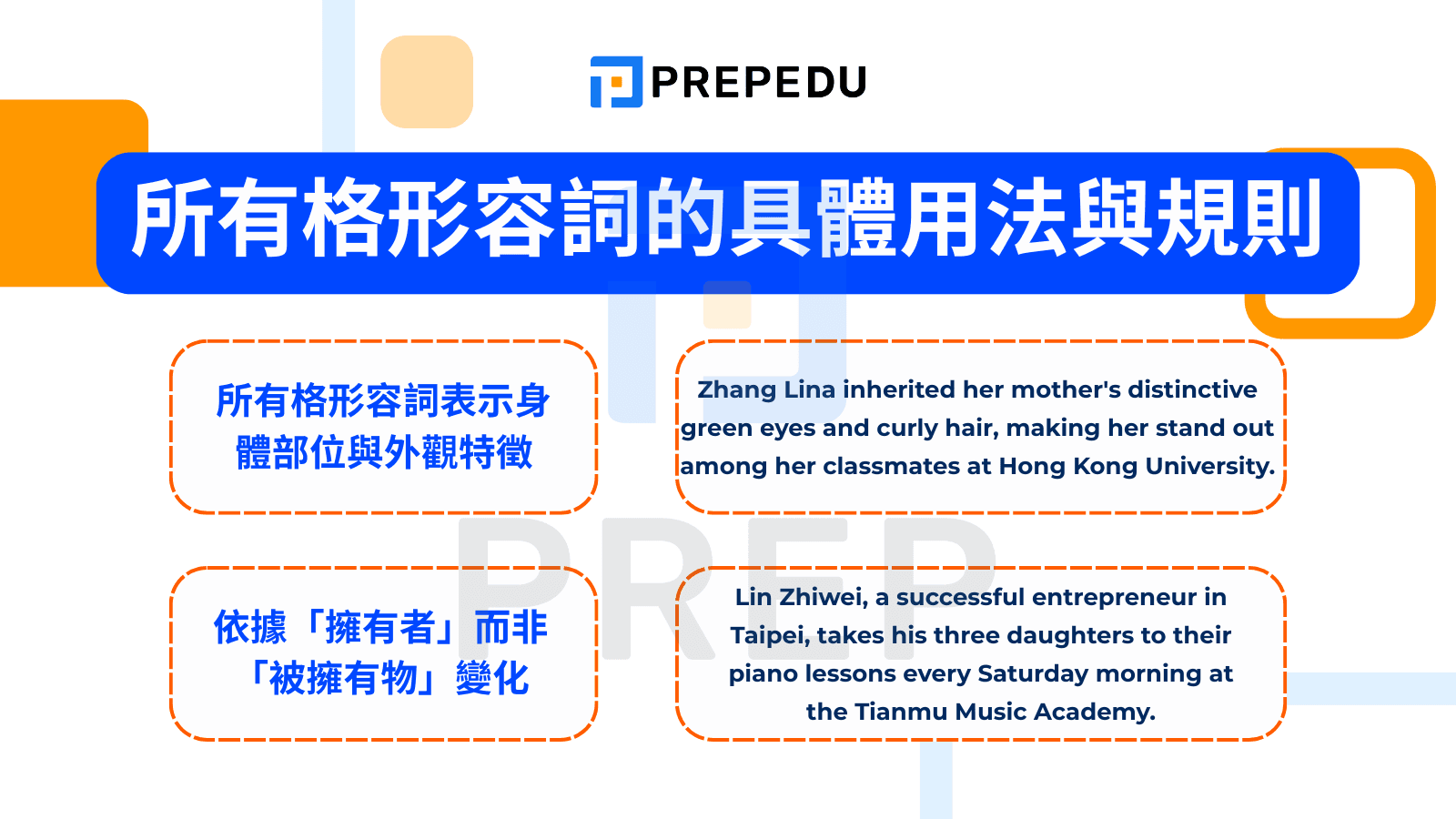
這是所有格形容詞使用中最關鍵的觀念,也是許多學習者最容易出錯的地方。所有格形容詞的選擇完全取決於擁有者的性別與人稱,與被擁有物的特性完全無關。這個規則幫助我們正確建立所有關係的語法邏輯,避免因為被擁有物的性別或數量而錯誤地選擇所有格形容詞。
核心原則:看擁有者是誰,而不是看被擁有的東西是什麼。
範例:
-
Lin Zhiwei,a successful entrepreneur in Taipei,takes his three daughters to their piano lessons every Saturday morning at the Tianmu Music Academy.(林志偉是台北一位成功的企業家,每個星期六早上都會帶他的三個女兒到天母音樂學院上鋼琴課。)
-
Wang Xiaofang recently inherited her father's construction company in Taoyuan and has been working hard to modernize the family business.(王小芳最近繼承了她父親在桃園的建築公司,一直在努力使這家家族企業現代化。)
這個規則在處理家庭關係時尤其重要。例如,一個男生談論他的姊妹時,必須說「his sister」,而不是「her sister」,因為擁有者(說話者)是男性。同樣地,一個女生談論她的哥哥時,應該說「her brother」,因為擁有者是女性。
IV. 英文所有格形容詞與其他詞類的區別
英語中有多種表達所屬關係的方式,理解所有格形容詞與其他相似詞類的差異,能夠幫助你避免常見的混淆錯誤。許多學習者在使用所有格形容詞時,經常與所有格代名詞,名詞所有格或冠詞產生混淆。
1. 所有格形容詞與所有格代名詞的差異
所有格形容詞與所有格代名詞最大的區別在於是否需要搭配名詞,以及在句子中的功能定位。所有格形容詞必須放在名詞之前,扮演修飾名詞的角色;而所有格代名詞可以獨立使用,代替「所有格形容詞 + 名詞」的整個組合,在句子中可以作為主詞,受詞或補語。掌握這個轉換規則能讓你的句型更加多樣化,避免過度重複名詞,使表達更加簡潔優雅。
對比範例:
|
類型 |
範例 |
|
所有格形容詞 + 名詞 |
|
|
所有格代名詞(獨立使用) |
|
完整對應表:
-
my → mine(我的)
-
your → yours(你的/你們的)
-
his → his(他的,形式相同)
-
her → hers(她的)
-
its → its(它的,較少單獨使用)
-
our → ours(我們的)
-
their → theirs(他們的)
2. 所有格形容詞與名詞所有格('s)的轉換
當我們想要表達某個具體人物的所有權時,可以使用名詞加上 's 的形式,這種表達方式可以與所有格形容詞互相轉換。選擇使用哪種形式取決於上下文:當對方已經知道你在談論誰時,使用所有格形容詞更自然簡潔;當需要明確指出擁有者的身分時,則使用名詞所有格更為清晰。在對話或文章中,通常第一次提到某人時使用名詞所有格,之後的提及則改用所有格形容詞,以避免重複。
轉換範例:
|
類型 |
範例 |
|
名詞所有格('s) |
|
|
所有格形容詞(代替重複) |
|
使用建議:在同一段落中,第一次提到某人時使用名詞所有格,之後的句子則改用所有格形容詞,這樣既能保持清晰度,又能避免不必要的重複。
3. 所有格形容詞與冠詞(a/an/the)的互斥關係
這是許多學習者容易犯錯的地方,也是所有格形容詞使用中最重要的限制之一。所有格形容詞與冠詞(a,an,the)不能同時出現在同一個名詞前,這是英語語法中的絕對規則。說「a my friend」或「the his book」都是嚴重的語法錯誤。這個規則的根源在於所有格形容詞本身就具有限定名詞的功能,與冠詞的功能重疊,因此兩者不能並存。
錯誤與正確對比:
|
錯誤範例 |
正確範例 |
正確範例(雙重所有格) |
|
❌ I met a my friend at the coffee shop in Xinyi District yesterday.(我昨天在信義區的咖啡店遇到了一個我的朋友。) |
✅ I met my friend at the coffee shop in Xinyi District yesterday.(我昨天在信義區的咖啡店遇到了我的朋友。) |
✅ I met a friend of mine at the coffee shop in Xinyi District yesterday.(我昨天在信義區的咖啡店遇到了我的一個朋友。) |
|
❌ Chen Xiaoming borrowed the his book from the National Central Library for his research project.(陳小明從國家圖書館借了他的那本書做研究專案。) |
✅ Chen Xiaoming borrowed his book from the National Central Library for his research project.(陳小明從國家圖書館借了他的書做研究專案。) |
✅ That book of his contains valuable information about ancient Chinese architecture.(他的那本書包含了關於中國古代建築的珍貴資訊。) |
雙重所有格結構說明:當需要表達「所有格 + 不定冠詞」的概念時,使用「a/an + 名詞 + of + 所有格代名詞」的雙重所有格結構。例如:「a friend of mine」(我的一個朋友),「a colleague of hers」(她的一位同事),「some ideas of theirs」(他們的一些想法)。這種結構巧妙地解決了冠詞與所有格形容詞不能共存的問題。
V. 常見使用所有格形容詞錯誤解析
在實際使用所有格形容詞時,有幾組詞彙因為發音相似或拼寫接近,經常被混淆使用。這些錯誤在寫作中特別常見,因為它們的發音幾乎相同,但意義和用法完全不同。即使是英語母語人士也會在寫作時犯這些錯誤,對於學習者來說更需要特別注意。以下針對四組最容易混淆的詞彙進行辨析,幫助你避免這些典型錯誤,提升你的英語寫作準確度。
1. Its vs. It's(縮寫混淆)
這是所有格形容詞錯誤中最常見的一種,也是最容易讓人困惑的部分。許多學習者誤以為撇號表示所有權,因此錯誤地寫成 it's,但實際上恰恰相反。
-
Its 是所有格形容詞,意思是「它的」,用來表示某個非生物或動物的所有物。
-
It's 則是「it is」或「it has」的縮寫,意思是「它是」或「它已經」。
記住:所有格形容詞 its 永遠不需要撇號,這是一個100%的規則,沒有例外。
檢測方法:如果你能夠將句子中的 it's 還原成 it is 或 it has 而句意仍然合理,那就使用 it's;如果不行,就使用 its。
範例:
|
類型 |
範例 |
|
Its(所有格形容詞) |
|
|
It's(it is 的縮寫) |
|
2. Your vs. You're(同音異義)
這組詞彙的混淆也極為常見,特別是在非正式的網路通訊中。
-
Your 是所有格形容詞,表示「你的」或「你們的」。
-
You're 是「you are」的縮寫,意思是「你是」或「你們是」。
辨別方法與前面相同:嘗試將 you're 還原成 you are,如果句意通順就使用 you're,否則使用 your。
對比範例:
|
類型 |
範例 |
|
Your(所有格形容詞) |
|
|
You're(you are 的縮寫) |
|
3. Their vs. There vs. They're(三詞混淆)
這三個詞的發音完全相同,但用法截然不同,是英語寫作中的三大混淆之一。
記憶訣竅:
-
Their 含有 heir(繼承人),與所有權相關
-
There 含有 here,都是地點
-
They're 可以還原成 they are
對比範例:
|
類型 |
範例 |
|
Their(所有格形容詞) |
|
|
There(地點副詞或句型) |
|
|
They're(they are 的縮寫) |
|
4. Whose vs. Who's(疑問詞混淆)
雖然這組詞彙比前面幾組較少使用,但仍然是容易混淆的一對。
-
Whose 是疑問所有格形容詞或關係所有格形容詞,用來詢問或說明所有權。
-
Who's 是「who is」或「who has」的縮寫。
對比範例:
|
類型 |
範例 |
|
Whose(所有格) |
|
|
Who's(who is 的縮寫) |
|
VI. 所有格形容詞實戰練習題
理論學習之後,透過實際練習能夠鞏固你對所有格形容詞的理解與應用能力。以下提供三組練習題,共30題,涵蓋基礎填空,辨析選擇與改錯練習,難度逐漸遞增。
1. 練習一:基礎填空(填入正確的形容詞)
請根據括號中的主格代名詞,填入正確的所有格形容詞:
-
(I)_______ name is David Chen,and I work at a technology company in Hsinchu.
-
(She)_______ sister is a nurse at National Taiwan University Hospital.
-
(They)_______ classroom is on the third floor of the main building.
-
(He)_______ favorite color is blue,just like the ocean.
-
(We)_______ teacher is very patient and always explains concepts clearly.
-
(You)_______ homework is due tomorrow morning at 9 AM.
-
(It)_______ tail is very long and fluffy.
-
(I)_______ parents live in Hong Kong and run a traditional tea shop.
-
(He)_______ birthday is in December,right before Christmas.
-
(They)_______ dog is very friendly and loves playing in Daan Park.
答案與詳解:
-
My — 第一人稱單數的所有格形容詞,表示「我的」
-
Her — 第三人稱單數女性的所有格形容詞,表示「她的」
-
Their — 第三人稱複數的所有格形容詞,表示「他們的」
-
His — 第三人稱單數男性的所有格形容詞,表示「他的」
-
Our — 第一人稱複數的所有格形容詞,表示「我們的」
-
Your — 第二人稱的所有格形容詞(單複數同形),表示「你的/你們的」
-
Its — 第三人稱單數中性的所有格形容詞,注意無撇號,表示「它的」
-
My — 第一人稱單數,修飾複數名詞 parents,仍然用 my
-
His — 第三人稱單數男性,表示「他的」
-
Their — 第三人稱複數,表示「他們的」
2. 練習二:辨析選擇(形容詞 vs 代名詞)
請選擇正確的選項填入空格:
-
Is this(your / yours)pen that I found on the desk?
-
That book about Taiwanese history is(my / mine).
-
(Their / Theirs)house in Tianmu is bigger than(our / ours)apartment in Zhongshan.
-
This is(her / hers)umbrella with the floral pattern.
-
The red car parked outside is(his / his),not(your / yours).
-
Are these(your / yours)shoes that were left in the entrance?
-
(Our / Ours)school is near Daan Park in central Taipei.
-
The final decision is(their / theirs)to make,not ours.
-
I think this handbag is(her / hers)because it matches her style.
-
(My / Mine)phone is new,but(your / yours)is much newer and more advanced.
答案與詳解:
-
your — 後面接名詞 pen,需用所有格形容詞
-
mine — 獨立使用,不接名詞,用所有格代名詞代替「my book」
-
Their / ours — Their 後接名詞 house,所以用所有格形容詞;ours 獨立使用與 their house 比較,所以用所有格代名詞
-
her — 後面接名詞 umbrella,需用所有格形容詞
-
his / yours — 第一個 his 獨立使用,雖然形式相同,但這裡是代名詞;yours 與 his 對比,也獨立使用,是所有格代名詞
-
your — 後面接名詞 shoes,需用所有格形容詞
-
Our — 後面接名詞 school,需用所有格形容詞
-
theirs — 獨立使用,作為主詞補語,意思是「那個決定是他們的」
-
hers — 獨立使用,作為主詞補語,代替「her handbag」
-
My / yours — My 後接名詞 phone,用所有格形容詞;yours 獨立使用與 my phone 比較,用所有格代名詞
3. 練習三:改錯練習
請改正下列句子中所有格形容詞使用的錯誤:
-
The cat is wagging it's tail happily in the living room.
-
You're house in Tamsui is very beautiful and has a great ocean view.
-
This is a my friend who works at Taipei 101.
-
Their going to the night market in Shilin tonight.
-
The company increased it's profits by twenty percent last quarter.
-
Is this the your book that you were looking for yesterday?
-
There house is near the MRT station in Xinyi District.
-
My sister loves she dog very much and takes it for walks daily.
-
Whose going to attend the conference in Hong Kong next week?
-
The team presented they project at the annual tech expo in Nangang.
答案與詳解:
-
The cat is wagging its tail happily in the living room.
-
錯誤:it's → 正確:its
-
說明:its 是所有格形容詞,表示「它的」,不需撇號;it's = it is 或 it has
-
-
Your house in Tamsui is very beautiful and has a great ocean view.
-
錯誤:You're → 正確:Your
-
說明:your 是所有格形容詞,表示「你的」;you're = you are,與句意不符
-
-
This is my friend who works at Taipei 101. 或 This is a friend of mine who works at Taipei 101.
-
錯誤:a my friend → 正確:my friend 或 a friend of mine
-
說明:所有格形容詞與冠詞不能同時使用;如果要表達「一個我的朋友」,可用雙重所有格「a friend of mine」
-
-
They're going to the night market in Shilin tonight.
-
錯誤:Their → 正確:They're
-
說明:they're = they are,是動詞;their 是所有格形容詞,表示「他們的」
-
-
The company increased its profits by twenty percent last quarter.
-
錯誤:it's → 正確:its
-
說明:its 是所有格形容詞,表示「它的」,無撇號;it's = it is 或 it has
-
-
Is this your book that you were looking for yesterday?
-
錯誤:the your → 正確:your
-
說明:所有格形容詞與冠詞不能並用,必須刪除定冠詞 the
-
-
Their house is near the MRT station in Xinyi District.
-
錯誤:There → 正確:Their
-
說明:their 是所有格形容詞,表示「他們的」;there 是地點副詞,表示「在那裡」
-
-
My sister loves her dog very much and takes it for walks daily.
-
錯誤:she → 正確:her
-
說明:需要用所有格形容詞 her 修飾名詞 dog;she 是主格代名詞,不能用來修飾名詞
-
-
Who's going to attend the conference in Hong Kong next week?
-
錯誤:Whose → 正確:Who's
-
說明:這裡需要的是「who is」的縮寫 who's,表示「誰將要」;whose 是所有格,表示「誰的」
-
-
The team presented their project at the annual tech expo in Nangang.
-
錯誤:they → 正確:their
-
說明:需要用所有格形容詞 their 修飾名詞 project;they 是主格代名詞,不能用來修飾名詞
-
結論
透過本文的系統學習,你已經掌握了所有格形容詞的完整知識體系,從基本定義,對照表,具體用法到常見錯誤辨析。記住,所有格形容詞的選擇永遠取決於擁有者而非被擁有物,這是理解這個語法點的核心觀念。所有格形容詞必須與名詞搭配使用,不能與冠詞並存,也不能獨立出現。持續練習這30道題目,並在日常英語使用中刻意應用,你將能夠自然而正確地運用所有格形容詞,讓你的英語表達更加精準流暢。
您是否對能否實現目標分數存疑?PREPEDU.COM Test Practice 不只是習題演練,更基於現有成績智能推算達成機率。
借助龐大的成功學員數據庫,系統精密解析得分軌跡,針對不同分數目標制定專屬學習方案。無論志在雅思 6.5 分還是多益 850 分,都有量身打造的戰術指引。
動態進度圖表直觀展示您的階段位置及抵達終點所需時程。大量學員透過 4-6 週持續練習,雅思能力躍進 0.5-1.0 分,多益實力增長 100-200 分。
勝利來自充分籌備而非幸運眷顧。讓 PREP Test Practice 化身您從現實走向夢想的穩固紐帶!
你好!我叫黃秋賢,現在在 prepedu.com 擔任內容企劃。我有超過5年的英語與韓語自學經歷,親身備考 IELTS、TOEIC 與 TOPIK,累積了大量第一手的學習者視角——包括哪些語法規則最讓台灣與香港學習者混淆,以及如何在有限的備考時間內最有效地修正這些錯誤。目前已在 prepedu.com 撰寫超過 1000 篇英語學習文章,內容涵蓋語法、詞彙與考試策略,累積協助數千位學習者解決自學過程中的語法疑問。
評論












統一企業編號:202227322W
地址:114 LAVENDER STREET, #11-83 CT HUB 2, SINGAPORE (338729)