Đề bài và đáp án bài đọc IELTS Cambridge 12 Reading Test 1 passage 1 Cork
Bài đọc IELTS Cambridge 12 Reading Test 1 passage 1 cork là bài đọc dạng thông tin khoa học, đòi hỏi thí sinh phải nắm bắt chi tiết, tư duy tổng hợp và khả năng định vị thông tin nhanh trong bài để trả lời chính xác các câu hỏi. Bài viết dưới đây sẽ cung cấp đề bài, đáp án và giải thích chi tiết giúp bạn hiểu sâu nội dung bài đọc và cải thiện kỹ năng làm bài IELTS Reading hiệu quả.
I. Đề bài đọc IELTS Cambridge 12 Reading Test 1 Passage 1 Cork
Đọc kỹ đề bài đọc IELTS Cambridge 12 Reading Test 1 Passage 1 Cork sau đây:
Cork
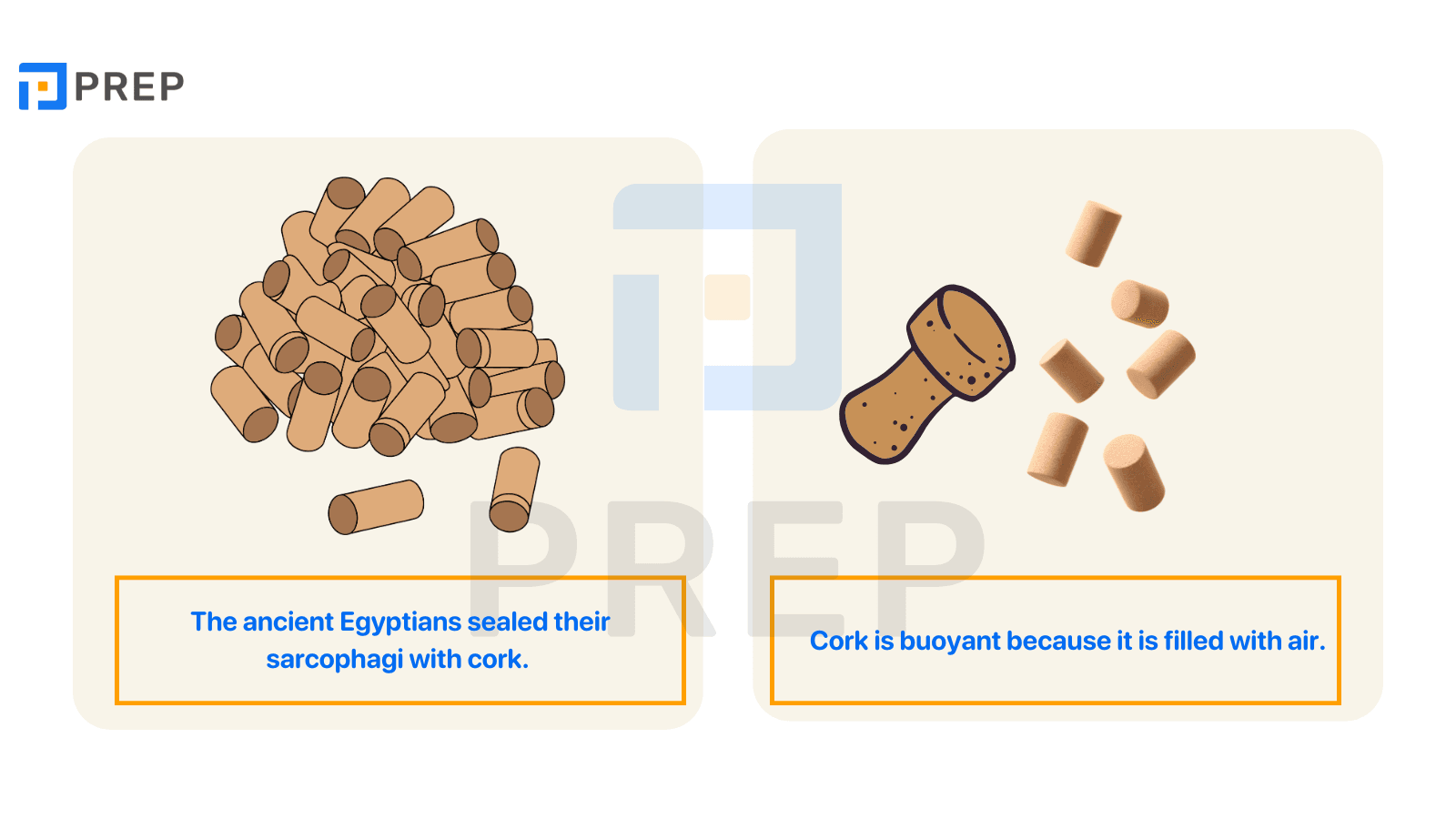
Cork – the thick bark of the cork oak tree (Quercus suber) – is a remarkable material. It is tough, elastic, buoyant, and fire-resistant, and suitable for a wide range of purposes. It has also been used for millennia: the ancient Egyptians sealed their sarcophagi (stone coffins) with cork, while the ancient Greeks and Romans used it for anything from beehives to sandals.
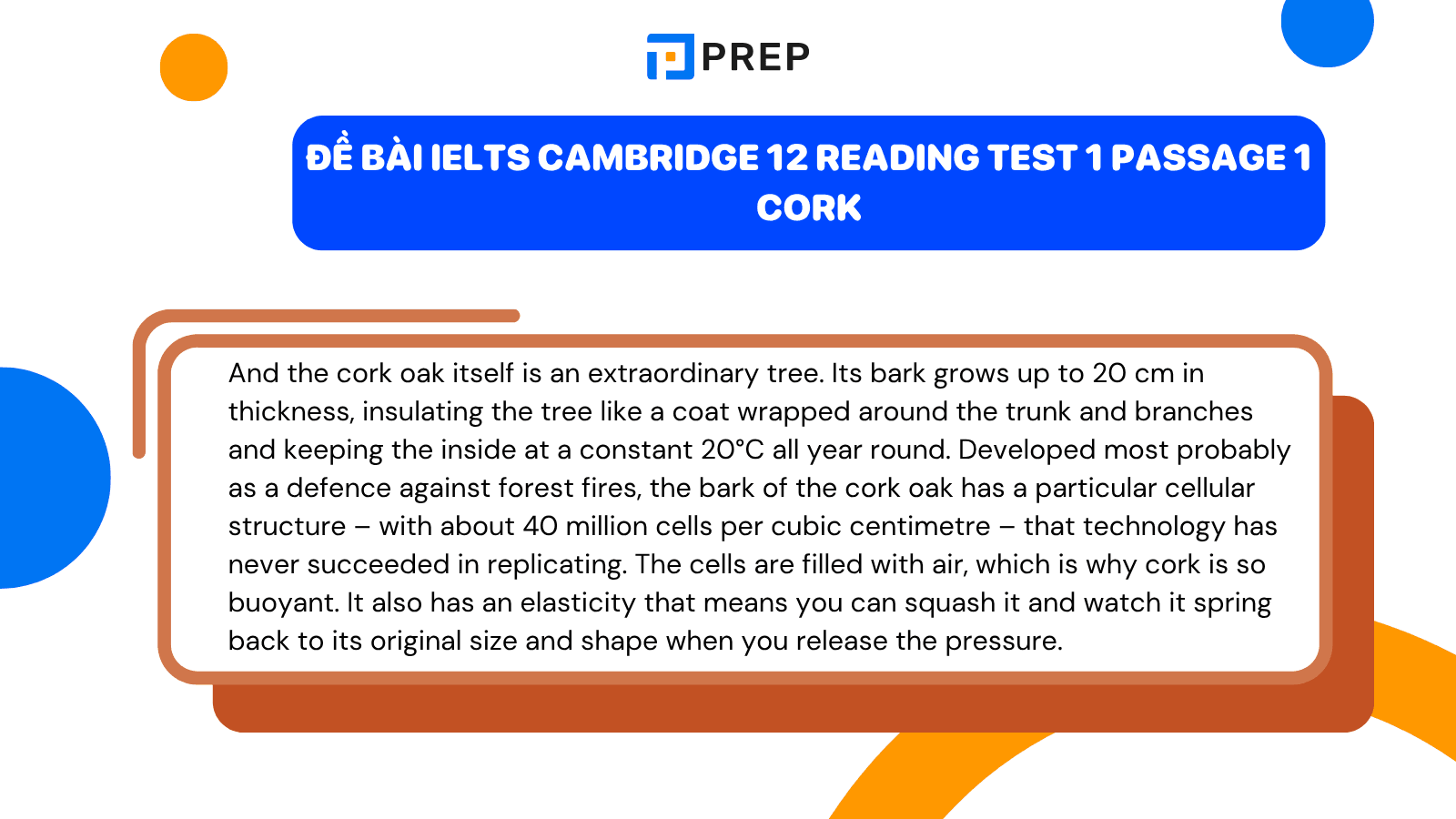
And the cork oak itself is an extraordinary tree. Its bark grows up to 20 cm in thickness, insulating the tree like a coat wrapped around the trunk and branches and keeping the inside at a constant 20°C all year round. Developed most probably as a defence against forest fires, the bark of the cork oak has a particular cellular structure – with about 40 million cells per cubic centimetre – that technology has never succeeded in replicating. The cells are filled with air, which is why cork is so buoyant. It also has an elasticity that means you can squash it and watch it spring back to its original size and shape when you release the pressure.
Cork oaks grow in a number of Mediterranean countries, including Portugal, Spain, Italy, Greece and Morocco. They flourish in warm, sunny climates where there is a minimum of 400 millimetres of rain per year, and not more than 800 millimetres. Like grape vines, the trees thrive in poor soil, putting down deep roots in search of moisture and nutrients. Southern Portugal’s Alentejo region meets all of these requirements, which explains why, by the early 20th century, this region had become the world’s largest producer of cork, and why today it accounts for roughly half of all cork production around the world.
Most cork forests are family-owned. Many of these family businesses, and indeed many of the trees themselves, are around 200 years old. Cork production is, above all, an exercise in patience. From the planting of a cork sapling to the first harvest takes 25 years, and a gap of approximately a decade must separate harvests from an individual tree. And for top-quality cork, it’s necessary to wait a further 15 or 20 years. You even have to wait for the right kind of summer’s day to harvest cork. If the bark is stripped on a day when it’s too cold – or when the air is damp – the tree will be damaged.
Cork harvesting is a very specialised profession. No mechanical means of stripping cork bark has been invented, so the job is done by teams of highly skilled workers. First, they make vertical cuts down the bark using small sharp axes, then lever it away in pieces as large as they can manage. The most skilful cork-strippers prise away a semi-circular husk that runs the length of the trunk from just above ground level to the first branches. It is then dried on the ground for about four months, before being taken to factories, where it is boiled to kill any insects that might remain in the cork. Over 60% of cork then goes on to be made into traditional bottle stoppers, with most of the remainder being used in the construction trade. Corkboard and cork tiles are ideal for thermal and acoustic insulation, while granules of cork are used in the manufacture of concrete.
Recent years have seen the end of the virtual monopoly of cork as the material for bottle stoppers, due to concerns about the effect it may have on the contents of the bottle. This is caused by a chemical compound called 2,4,6-trichloroanisole (TCA), which forms through the interaction of plant phenols, chlorine and mould. The tiniest concentrations – as little as three or four parts to a trillion – can spoil the taste of the product contained in the bottle. The result has been a gradual yet steady move first towards plastic stoppers and, more recently, to aluminium screw caps. These substitutes are cheaper to manufacture and, in the case of screw caps, more convenient for the user.
The classic cork stopper does have several advantages, however. Firstly, its traditional image is more in keeping with that of the type of high quality goods with which it has long been associated. Secondly – and very importantly – cork is a sustainable product that can be recycled without difficulty. Moreover, cork forests are a resource which support local biodiversity, and prevent desertification in the regions where they are planted. So, given the current concerns about environmental issues, the future of this ancient material once again looks promising.
Questions 1-5
Do the following statements agree with the information given in Reading Passage 1?
In boxes 1-5 on your answer sheet, write
TRUE if the statement agrees with the information
FALSE if the statement contradicts the information
NOT GIVEN if there is no information on this
-
The cork oak has the thickest bark of any living tree.
-
Scientists have developed a synthetic cork with the same cellular structure as natural cork.
-
Individual cork oak trees must be left for 25 years between the first and second harvest.
-
Cork bark should be stripped in dry atmospheric conditions.
-
The only way to remove the bark from cork oak trees is by hand.
Questions 6-13
Complete the notes below.
Choose ONE WORD ONLY from the passage for each answer.
Write your answers in boxes 6-13 on your answer sheet.
Comparison of aluminium screw caps and cork bottle stoppers
Advantages of aluminium screw caps
-
do not affect the 6 ................... of the bottle contents
-
are 7 ................... to produce
-
are 8 ................... to use
Advantages of cork bottle stoppers
-
suit the 9 ................... of quality products
-
made from a 10 ................... material
-
easily 11 ...................
-
cork forests aid 12 ...................
-
cork forests stop 13 ................... happening
II. Đáp án bài đọc IELTS Cambridge 12 Reading Test 1 Passage 1 Cork
Tham khảo đáp án bài đọc IELTS Cambridge 12 Reading test 1 passage 1 Cork:
Reading Passage 1, Questions 1-13
-
NOT GIVEN
-
FALSE
-
FALSE
-
TRUE
-
TRUE
-
taste
-
cheaper
-
convenient
-
image
-
sustainable
-
recycled
-
biodiversity
-
desertification
III. Giải thích đáp án chi tiết bài đọc IELTS Cambridge 12 Reading Test 1 Passage 1 Cork
Tham khảo phần giải thích đáp án chi tiết sau để nắm được cách xử lý từng câu hỏi trong bài.
|
Câu hỏi |
Đáp án |
Giải thích chi tiết |
|
1 |
NOT GIVEN |
Câu hỏi: "The cork oak has the thickest bark of any living tree." ⇒ Bài không nói vỏ cây sồi bần có dày nhất so với tất cả các loài cây khác hay không. Chỉ đề cập rằng vỏ dày tới 20cm, không có so sánh → Not Given. |
|
2 |
FALSE |
Câu hỏi: "Scientists have developed a synthetic cork with the same cellular structure as natural cork." ⇒ Bài nói rằng chưa thể tạo ra vật liệu nhân tạo có cấu trúc tế bào giống như vỏ sồi bần tự nhiên, nên phát biểu này là sai → False. |
|
3 |
FALSE |
Câu hỏi: "Individual cork oak trees must be left for 25 years between the first and second harvest." ⇒ Bài đọc nói khoảng cách giữa hai lần thu hoạch là 10 năm, không phải 25 năm → False. |
|
4 |
TRUE |
Câu hỏi: "Cork bark should be stripped in dry atmospheric conditions." ⇒ Bài cho biết nếu thu hoạch vào lúc trời quá lạnh hoặc ẩm, cây sẽ bị hư hại → thu hoạch nên vào điều kiện khô ráo → True. |
|
5 |
TRUE |
Câu hỏi: "The only way to remove the bark from cork oak trees is by hand." ⇒ Bài nói rằng không có cách cơ giới nào để thu hoạch vỏ cây → chỉ được thực hiện bằng tay → True. |
Xem thêm: Đề bài và giải thích đáp án bài nghe IELTS Cambridge 12 Test 1 section 4 Four business values
III. Từ vựng hay trong bài nên ghi nhớ
Take note nhanh danh sách từ vựng sau để mở rộng vốn từ vựng nhé!
|
Từ vựng |
Giải nghĩa |
Ví dụ |
|
Sarcophagus |
Quan tài bằng đá, thường dùng cho các vị vua Ai Cập cổ đại |
The ancient Egyptians sealed their sarcophagi with cork. (Người Ai Cập cổ đại niêm phong quan tài của họ bằng vỏ cây sồi bần.) |
|
Buoyant |
Nổi, có khả năng nổi lên trên mặt nước |
Cork is buoyant because it is filled with air. (Vỏ cây sồi bần nổi vì nó chứa đầy không khí.) |
|
Elasticity |
Tính đàn hồi, khả năng trở lại hình dạng ban đầu |
Cork has elasticity, so it can be squashed and then return to its original shape. (Vỏ cây sồi bần có tính đàn hồi, vì vậy nó có thể bị nén lại và trở về hình dạng ban đầu.) |
|
Desertification |
Quá trình sa mạc hóa, sự mất mát của đất đai do sự khô cằn |
Cork forests help prevent desertification in the areas where they are planted. (Rừng cây sồi bần giúp ngăn ngừa sự sa mạc hóa ở các khu vực nơi chúng được trồng.) |
|
Sustainable |
Bền vững, có thể duy trì lâu dài mà không gây hại môi trường |
Cork is a sustainable product that can be recycled. (Vỏ cây sồi bần là một sản phẩm bền vững và có thể tái chế.) |
|
Phenols |
Các hợp chất hữu cơ, thường có trong thực vật |
The interaction of plant phenols and chlorine can lead to cork taint. (Sự tương tác giữa phenol thực vật và clo có thể gây ra mùi vị không tốt của vỏ cây sồi bần.) |
|
Biodiversity |
Đa dạng sinh học, sự đa dạng của các loài sinh vật trong môi trường |
Cork forests help maintain local biodiversity. (Rừng cây sồi bần giúp duy trì đa dạng sinh học địa phương.) |
|
Insulating |
Cách điện, cách nhiệt |
Corkboard is used for thermal and acoustic insulation. (Tấm ván bần được sử dụng cho cách nhiệt và cách âm.) |
Trên đây là đề bài và đáp án bài đọc IELTS Cambridge 12 Reading Test 1 passage 1 cork. Hy vọng tài liệu trên sẽ hữu ích dành cho bạn trong quá trình luyện thi IELTS.
Học tiếng Anh online dễ dàng hơn với PREP - Nền tảng Học & Luyện thi thông minh cùng AI. Nhờ công nghệ AI độc quyền, bạn có thể tự học trực tuyến ngay tại nhà, chinh phục lộ trình học IELTS, TOEIC, tiếng Anh giao tiếp hiệu quả. Bên cạnh đó, học viên còn có sự hỗ trợ tuyệt vời từ Teacher Bee AI, trợ lý ảo giúp bạn giải đáp thắc mắc và đồng hành 1-1 trong suốt quá trình học tập.
Hãy click TẠI ĐÂY hoặc liên hệ HOTLINE 0931428899 để nhận tư vấn chi tiết về các khóa học tiếng Anh chất lượng nhất thị trường!
Tải ngay app PREP để bắt đầu hành trình học tiếng Anh tại nhà với chương trình học luyện thi online chất lượng cao.

Chào bạn! Mình là Hiền Hoàng, hiện đang đảm nhận vai trò quản trị nội dung sản phẩm tại Blog của website prepedu.com.
Với hơn 5 năm tự học các ngoại ngữ như tiếng Anh, tiếng Trung và ôn luyện một số kỳ thi IELTS, TOEIC, HSK, mình đã tự đúc rút được nhiều kinh nghiệm để hỗ trợ hàng nghìn người đang gặp khó khăn trong việc học ngoại ngữ. Hy vọng rằng những chia sẻ phía trên sẽ giúp ích cho bạn trong quá trình tự ôn luyện thi hiệu quả tại nhà!
Bình luận
Nội dung premium
Xem tất cả


Lộ trình cá nhân hoá






Có thể bạn quan tâm
Kết nối với Prep





MSDN: 0109817671.
Địa chỉ liên hệ: Tòa nhà Vinaconex, 34 Láng Hạ, phường Láng, TP Hà Nội.
Trung tâm CSKH tại HN: Số 39, ngõ 12 Trần Kim Xuyến, phường Yên Hoà, Cầu Giấy
Trung tâm CSKH tại HCM: 145A-147Bis Trần Quang Khải, phường Tân Định, TP HCM
Trụ sở Công ty: Số nhà 20, ngách 234/35 đường Hoàng Quốc Việt, phường Nghĩa Đô, TP Hà Nội.
Phòng luyện ảo - Trải nghiệm thực tế - Công nghệ hàng đầu.
Hotline: 0907048899
Trụ sở Công ty: Số nhà 20, ngách 234/35 đường Hoàng Quốc Việt, phường Nghĩa Đô, TP Hà Nội.
Giấy chứng nhận hoạt động đào tạo, bồi dưỡng số 1309/QĐ-SGDĐT ngày 31 tháng 07 năm 2023 do Sở Giáo dục và Đào tạo Hà Nội cấp.