Past Participle คืออะไร ใช้ยังไงให้ถูกต้อง
Key Takeaways
- ประมาณ ภาษาอังกฤษ มีคำใช้บ่อย 4 คำหลัก: About (ทั่วไป), Around (ใกล้เคียง), Approximately (เป็นทางการ) และ Roughly (คร่าวๆ)
- นอกจาก 4 คำหลัก ยังมีอีก 18 คำที่ ใช้ได้: Almost, Nearly, Give or take, More or less, In the region of, Plus or minus, -ish suffix และอื่นๆ
- ประมาณการ ภาษาอังกฤษ ในธุรกิจใช้คำ Projected, Forecasted, Ballpark, Estimate เน้นความเป็นทางการและ data-driven
- Estimately ไม่ใช่คำในภาษาอังกฤษมาตรฐาน คำที่ถูกต้องคือ approximately หรือ roughly
- การเลือกใช้คำ ประมาณ ภาษาอังกฤษ ขึ้นกับ formality + context: about/around สำหรับ speaking, approximately/projected สำหรับ writing/report
ประมาณ ภาษาอังกฤษ พูดได้หลากหลายแบบ ไม่ใช่แค่ "about" คำเดียวที่หลาย ใช้ไปทุก สถานการณ์ การเลือกคำที่เหมาะสมกับ context ตั้งแต่ small talk จนถึง business presentation ทำให้การสื่อสารของ ดูเป็นมืออาชีพและมีความน่าเชื่อถือมากขึ้น
บทความนี้รวม 22 คำและสำนวนสำหรับการพูดประมาณ ภาษาอังกฤษ พร้อม CEFR Level, IPA + คำอ่านไทย และตัวอย่างประโยคจริง รวมถึง 5 common mistakes ที่ คนไทยมักเจอ และวิธีใช้ในข้อสอบ IELTS Speaking + Writing Task 1
I. Past Participle คืออะไร?
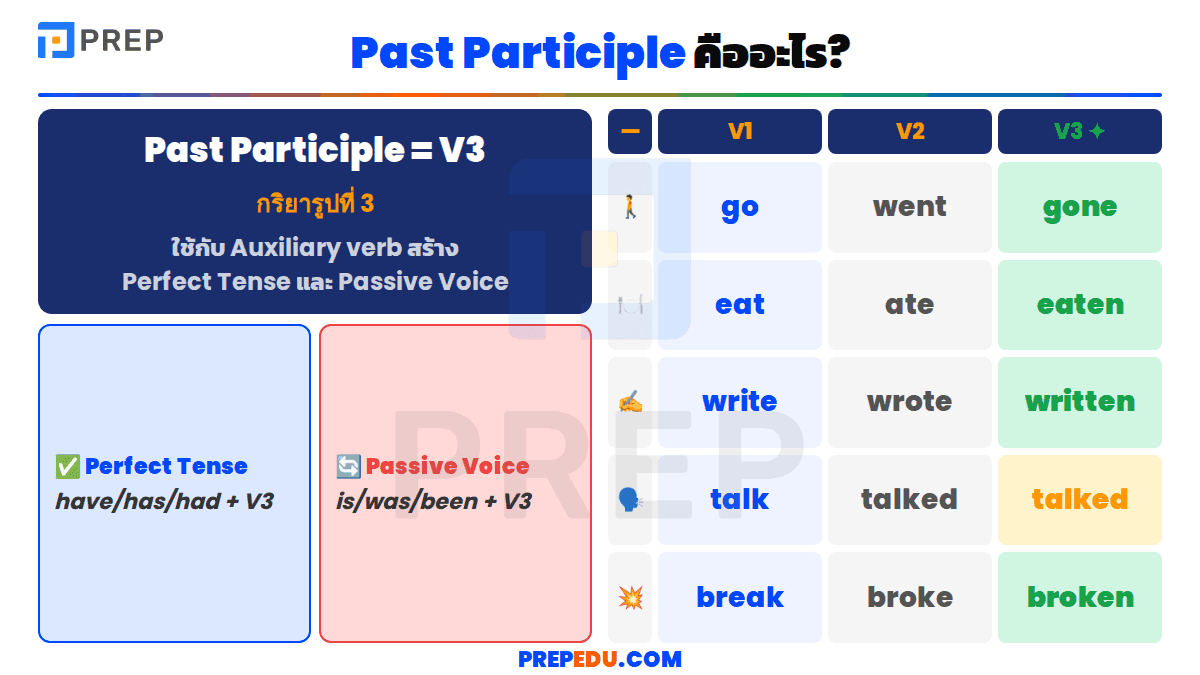
Past Participle คือกริยารูปที่ 3 (V3) ในภาษาอังกฤษ เป็นรูปกริยาที่ใช้ประกอบกับคำกริยาช่วย (Auxiliary Verbs) เพื่อสร้างโครงสร้างอย่าง Perfect Tense และ Passive Voice ตาม Cambridge Dictionary (2024) past participle คือรูปของกริยาที่ปกติลงท้ายด้วย -ed สำหรับกริยาปกติ และมีรูปเฉพาะตัวสำหรับกริยาผิดปกติ ใช้สร้าง perfect tenses และ passive forms
จุดสำคัญที่ต้องเข้าใจก่อนคือ กริยาในภาษาอังกฤษมี 3 รูปหลักที่ใช้บ่อย คือ V1 (รูปฐาน), V2 (อดีตกาลธรรมดา) และ V3 (past participle) ลองดูตัวอย่าง 5 คำนี้:
|
V1 (Base) |
V2 (Past Simple) |
V3 (Past Participle) |
|
go |
went |
gone |
|
eat |
ate |
eaten |
|
write |
wrote |
written |
|
talk |
talked |
talked |
|
break |
broke |
broken |
สังเกตว่า talk เป็นกริยาปกติ จึงมี V2 และ V3 เหมือนกัน (talked) ส่วนอีก 4 คำเป็นกริยาผิดปกติ รูปต่างกันชัดเจน
หัวใจของ V3 ที่ต้องจำให้ขึ้นใจคือ V3 "ไม่อยู่คนเดียว" ในประโยค มันต้องมีคำกริยาช่วยมานำหน้าเสมอ:
- หลัง have/has/had เพื่อสร้าง Perfect Tense เช่น I have eaten
- หลัง be (is/are/was/were) เพื่อสร้าง Passive Voice เช่น It was broken
- ข้อยกเว้นเดียวคือเมื่อ V3 ทำหน้าที่เป็น adjective (คำคุณศัพท์) เช่น a broken window ตรงนี้ยืนได้โดยไม่ต้องมีกริยาช่วย
ถ้าเห็น V3 ลอยอยู่กลางประโยคโดยไม่มี have/has/had หรือ be นำหน้า และมันไม่ได้ทำหน้าที่ขยายคำนาม นั่นคือสัญญาณว่าประโยคผิด
II. วิธีสร้าง Past Participle: กฎการสร้างและตาราง V1/V2/V3
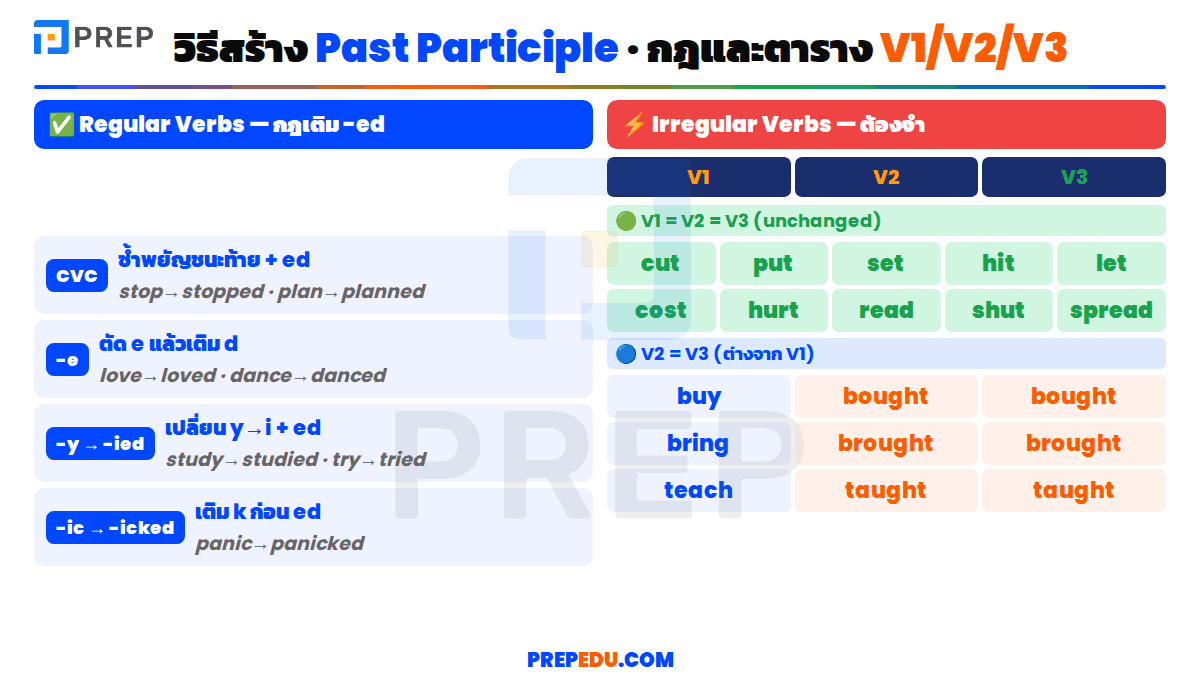
การสร้าง V3 แบ่งเป็น 2 ทางตามชนิดของกริยา กริยาปกติ (regular verbs) มีกฎตายตัวเติม -ed ส่วนกริยาผิดปกติ (irregular verbs) ต้องจำเป็นกลุ่ม จากการวิเคราะห์คลังภาษาขนาดใหญ่ใน Longman Grammar (Biber et al., 1999) กริยาที่ใช้บ่อยที่สุดในภาษาอังกฤษส่วนมากเป็นกริยาผิดปกติ การจำกลุ่มเหล่านี้จึงให้ผลคุ้มค่ากว่าการจำทีละคำแบบสุ่ม
1. Regular Verbs: กฎเติม -ed และข้อยกเว้นการสะกด
กริยาปกติสร้าง V2 และ V3 ด้วยการเติม -ed ทั้งคู่ จึงได้รูปเหมือนกัน แต่มีกฎการสะกดพิเศษ 3 กลุ่มที่ต้องระวัง บวกอีก 1 กรณีเฉพาะ:
-
CVC doubling (พยัญชนะ-สระ-พยัญชนะ): ถ้ากริยาพยางค์เดียวลงท้ายด้วยพยัญชนะ + สระ + พยัญชนะ ให้ซ้ำพยัญชนะตัวท้ายก่อนเติม -ed เช่น stop, plan, drop
-
-e drop (ตัด e): ถ้ากริยาลงท้ายด้วย e อยู่แล้ว ให้เติมแค่ -d เช่น love, dance, use
-
-y เป็น -ied: ถ้ากริยาลงท้ายด้วยพยัญชนะ + y ให้เปลี่ยน y เป็น i แล้วเติม -ed เช่น study, try, carry (กฎนี้ใช้เฉพาะเมื่อมีพยัญชนะนำหน้า y)
-
-ic เป็น -icked: ถ้ากริยาลงท้ายด้วย -ic ให้เติม k ก่อน -ed เช่น panic, picnic
|
กฎ |
V1 |
V2 |
V3 |
|
CVC doubling |
stop |
stopped |
stopped |
|
CVC doubling |
plan |
planned |
planned |
|
CVC doubling |
drop |
dropped |
dropped |
|
-e drop |
love |
loved |
loved |
|
-e drop |
dance |
danced |
danced |
|
-e drop |
use |
used |
used |
|
-y เป็น -ied |
study |
studied |
studied |
|
-y เป็น -ied |
try |
tried |
tried |
|
-y เป็น -ied |
carry |
carried |
carried |
|
-ic เป็น -icked |
panic |
panicked |
panicked |
|
-ic เป็น -icked |
picnic |
picnicked |
picnicked |
บทความแนะนำอ่านต่อ:
2. Irregular Verbs: ตาราง V1/V2/V3 (80 คำที่ใช้บ่อย)
กริยาผิดปกติจำง่ายขึ้นมากเมื่อจัดเป็น 4 กลุ่มตามรูปแบบการเปลี่ยนรูป แทนที่จะท่องเรียงตามตัวอักษร:
|
V1 |
V2 |
V3 |
กลุ่ม |
|
cut |
cut |
cut |
A-A-A |
|
put |
put |
put |
A-A-A |
|
set |
set |
set |
A-A-A |
|
hit |
hit |
hit |
A-A-A |
|
let |
let |
let |
A-A-A |
|
cost |
cost |
cost |
A-A-A |
|
hurt |
hurt |
hurt |
A-A-A |
|
read |
read |
read |
A-A-A (ออกเสียงต่าง) |
|
shut |
shut |
shut |
A-A-A |
|
spread |
spread |
spread |
A-A-A |
|
buy |
bought |
bought |
A-B-B |
|
bring |
brought |
brought |
A-B-B |
|
teach |
taught |
taught |
A-B-B |
|
think |
thought |
thought |
A-B-B |
|
catch |
caught |
caught |
A-B-B |
|
fight |
fought |
fought |
A-B-B |
|
seek |
sought |
sought |
A-B-B |
|
tell |
told |
told |
A-B-B |
|
sell |
sold |
sold |
A-B-B |
|
hear |
heard |
heard |
A-B-B |
|
hold |
held |
held |
A-B-B |
|
build |
built |
built |
A-B-B |
|
feel |
felt |
felt |
A-B-B |
|
keep |
kept |
kept |
A-B-B |
|
leave |
left |
left |
A-B-B |
|
meet |
met |
met |
A-B-B |
|
send |
sent |
sent |
A-B-B |
|
spend |
spent |
spent |
A-B-B |
|
lend |
lent |
lent |
A-B-B |
|
bend |
bent |
bent |
A-B-B |
|
mean |
meant |
meant |
A-B-B |
|
sleep |
slept |
slept |
A-B-B |
|
creep |
crept |
crept |
A-B-B |
|
stand |
stood |
stood |
A-B-B |
|
understand |
understood |
understood |
A-B-B |
|
say |
said |
said |
A-B-B |
|
make |
made |
made |
A-B-B |
|
have |
had |
had |
A-B-B |
|
sit |
sat |
sat |
A-B-B |
|
win |
won |
won |
A-B-B |
|
lose |
lost |
lost |
A-B-B |
|
dig |
dug |
dug |
A-B-B |
|
hang |
hung |
hung |
A-B-B |
|
light |
lit |
lit |
A-B-B |
|
pay |
paid |
paid |
A-B-B |
|
lay |
laid |
laid |
A-B-B |
|
go |
went |
gone |
A-B-C |
|
eat |
ate |
eaten |
A-B-C |
|
give |
gave |
given |
A-B-C |
|
take |
took |
taken |
A-B-C |
|
write |
wrote |
written |
A-B-C |
|
see |
saw |
seen |
A-B-C |
|
know |
knew |
known |
A-B-C |
|
grow |
grew |
grown |
A-B-C |
|
throw |
threw |
thrown |
A-B-C |
|
draw |
drew |
drawn |
A-B-C |
|
fly |
flew |
flown |
A-B-C |
|
blow |
blew |
blown |
A-B-C |
|
break |
broke |
broken |
A-B-C |
|
choose |
chose |
chosen |
A-B-C |
|
speak |
spoke |
spoken |
A-B-C |
|
steal |
stole |
stolen |
A-B-C |
|
wake |
woke |
woken |
A-B-C |
|
drive |
drove |
driven |
A-B-C |
|
ride |
rode |
ridden |
A-B-C |
|
rise |
rose |
risen |
A-B-C |
|
arise |
arose |
arisen |
A-B-C |
|
bite |
bit |
bitten |
A-B-C |
|
hide |
hid |
hidden |
A-B-C |
|
forbid |
forbade |
forbidden |
A-B-C |
|
begin |
began |
begun |
A-B-C |
|
drink |
drank |
drunk |
A-B-C |
|
ring |
rang |
rung |
A-B-C |
|
sing |
sang |
sung |
A-B-C |
|
sink |
sank |
sunk |
A-B-C |
|
swim |
swam |
swum |
A-B-C |
|
shrink |
shrank |
shrunk |
A-B-C |
|
spring |
sprang |
sprung |
A-B-C |
|
run |
ran |
run |
A-B-A |
|
come |
came |
come |
A-B-A |
|
become |
became |
become |
A-B-A |
วิธีอ่านตาราง: กลุ่ม A-A-A คือ V1 V2 V3 เหมือนกันหมด (จำง่ายที่สุด), กลุ่ม A-B-B คือ V2 กับ V3 เหมือนกัน, กลุ่ม A-B-C คือต่างกันทั้งสามรูป (ต้องจำให้แม่น), กลุ่ม A-B-A คือ V1 กับ V3 เหมือนกันแต่ V2 ต่าง ระวังเป็นพิเศษ เช่น run/ran/run และ come/came/come
บทความแนะนำอ่านต่อ:
III. V2 กับ V3 ต่างกันอย่างไร?
นี่คือจุดที่หลายคนพลาดบ่อยที่สุด V2 (Past Simple) กับ V3 (Past Participle) ไม่ใช่แค่ "รูปกริยาในอดีต" สองตัวที่ใช้แทนกันได้ แต่ทำหน้าที่ทางไวยากรณ์คนละอย่าง ตาม Quirk et al. (1985) A Comprehensive Grammar of the English Language past simple เป็น finite verb form ที่ทำหน้าที่เป็นกริยาหลักของประโยคได้ด้วยตัวเอง ขณะที่ past participle เป็น non-finite form ที่ต้องอาศัยกริยาช่วย ดูความต่างแบบ side-by-side:
|
หัวข้อ |
V2 (Past Simple) |
V3 (Past Participle) |
หมายเหตุ |
|
หน้าที่ |
กริยาหลักของประโยค |
ต้องมี auxiliary verb |
- |
|
ยืนคนเดียว |
ได้ |
ไม่ได้ (ยกเว้นเป็น adjective) |
- |
|
กริยาปกติ (-ed) |
รูปเหมือน V3 |
รูปเหมือน V2 |
context บอกความต่าง |
|
กริยาผิดปกติ |
รูปต่างกัน |
รูปต่างกัน |
จำแยกกัน |
นี่คือจุดที่หลายคนไม่เคยรู้มาก่อน: สำหรับกริยาปกติ V2 กับ V3 มีรูป "เหมือนกันเป๊ะ" (เติม -ed ทั้งคู่) แต่นั่นไม่ได้แปลว่ามันคือตัวเดียวกัน สิ่งที่บอกว่าคุณกำลังใช้ V2 หรือ V3 คือ "บริบทรอบข้าง" ไม่ใช่รูปคำ ถ้าคำนั้นอยู่หลัง have/has/had หรือหลัง be เมื่อไหร่ มันคือ V3 เสมอ ไม่ว่ารูปจะเหมือน V2 แค่ไหนก็ตาม
ลองดูประโยคคู่เปรียบเทียบ:
-
She ate the cake. (เธอกินเค้กไปแล้ว) - ate เป็น V2 ทำหน้าที่กริยาหลัก
-
She has eaten the cake. (เธอกินเค้กไปแล้ว) - eaten เป็น V3 เพราะอยู่หลัง has
-
The window broke. (หน้าต่างแตก) - broke เป็น V2 กริยาหลัก
-
The window was broken. (หน้าต่างถูกทำให้แตก) - broken เป็น V3 ใน Passive Voice เพราะอยู่หลัง was
-
He studied all night. (เขาอ่านหนังสือทั้งคืน) - studied เป็น V2 กริยาหลัก (กริยาปกติ)
-
He has studied all night. (เขาอ่านหนังสือมาทั้งคืนแล้ว) - studied ตัวเดียวกันนี้เป็น V3 เพราะอยู่หลัง has
คู่สุดท้ายคือหลักฐานชัดที่สุด: studied รูปเดียวกันเป๊ะ แต่ตัวบนเป็น V2 ตัวล่างเป็น V3 ความต่างอยู่ที่ has ที่นำหน้า จำสูตรนี้ไว้: หลัง have/has/had หรือ be = V3 เสมอ
IV. Past Participle ใช้ในกรณีไหนบ้าง พร้อมตัวอย่างประโยค
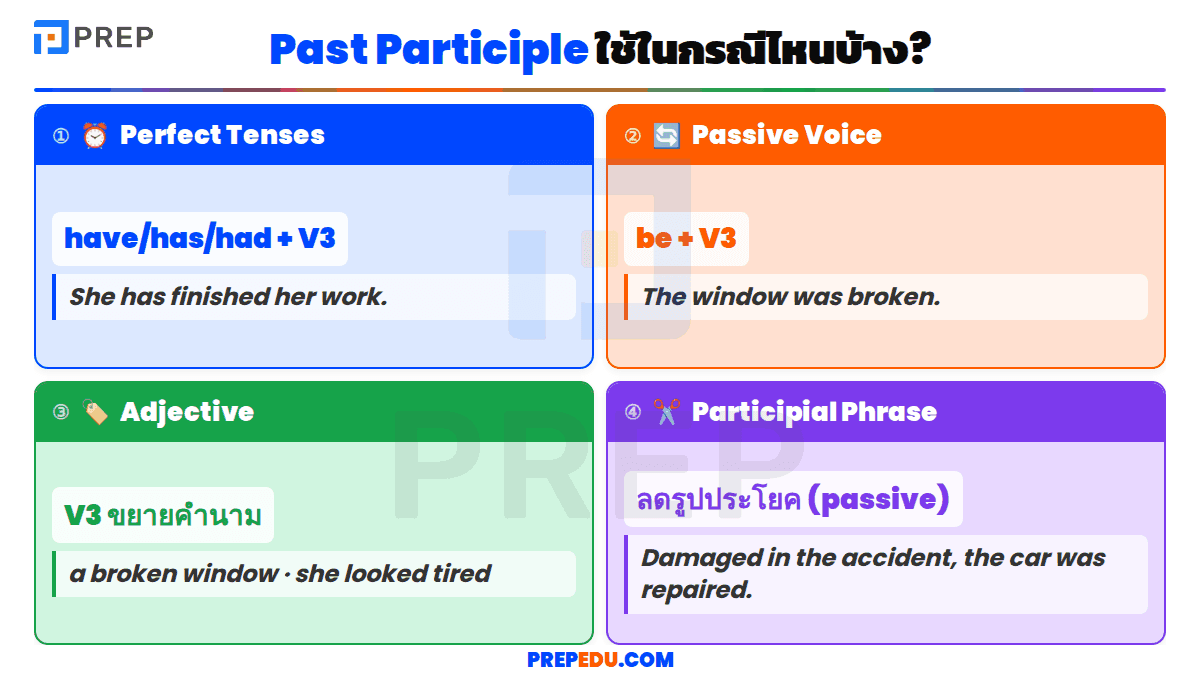
Past Participle ใช้งานได้ 4 วิธีหลักในภาษาอังกฤษ ได้แก่ สร้าง Perfect Tense, สร้าง Passive Voice, ทำหน้าที่เป็น adjective และสร้าง Participial Phrase แต่ละแบบมีโครงสร้างเฉพาะ ดังนี้
1. Perfect Tenses (have/has/had + V3)
Perfect Tense ทุกชนิดใช้สูตร have/has/had + V3 เพื่อบอกการกระทำที่เสร็จสมบูรณ์เทียบกับจุดเวลาหนึ่ง:
|
Tense |
สูตร |
ตัวอย่างประโยค |
คำแปล |
|
have/has + V3 |
I have eaten already. |
ฉันกินแล้ว |
|
|
had + V3 |
She had left before he arrived. |
เธอออกไปก่อนที่เขาจะมาถึง |
|
|
will have + V3 |
By 2030, they will have built the bridge. |
ภายในปี 2030 พวกเขาจะสร้างสะพานเสร็จ |
จุดร่วมของทั้งสาม tense คือ V3 ตามหลังกริยาช่วยในตระกูล have เสมอ ไม่เคยใช้ V2 ในตำแหน่งนี้
2. Passive Voice (be + V3)
Passive Voice ใช้เมื่อต้องการเน้นผู้ถูกกระทำมากกว่าผู้กระทำ สูตรคือ Subject + be (am/is/are/was/were) + V3 (+ by + agent)
|
Active |
Passive |
คำแปล |
|
Someone broke the window. |
The window was broken (by someone). |
หน้าต่างถูกทำให้แตก |
|
They make iPhones in China. |
iPhones are made in China. |
iPhone ถูกผลิตในจีน |
|
The teacher corrected our essays. |
Our essays were corrected by the teacher. |
เรียงความของเราถูกครูตรวจแก้ |
สังเกตว่าส่วน by + agent ไม่จำเป็นต้องมีทุกครั้ง ละได้ถ้าไม่สำคัญว่าใครเป็นคนทำ เช่น "The window was broken" ก็เป็นประโยคที่สมบูรณ์แล้ว
3. Past Participle ทำหน้าที่เป็น Adjective
V3 ทำหน้าที่เป็นคำคุณศัพท์ขยายคำนามได้ โดยให้ความหมายเชิงถูกกระทำ (passive meaning) วางได้ 2 ตำแหน่ง:
-
วางก่อนคำนาม: a broken window (หน้าต่างที่แตก), a frozen lake (ทะเลสาบที่เป็นน้ำแข็ง), a confused student (นักเรียนที่สับสน), a used car (รถมือสอง), a stolen phone (โทรศัพท์ที่ถูกขโมย)
-
วางหลัง linking verb: She looked tired. (เธอดูเหนื่อย), The door is locked. (ประตูถูกล็อก), He seems interested. (เขาดูสนใจ)
มีจุดที่ทำให้สับสนบ่อย คือความต่างระหว่าง adjective รูป -ed กับ -ing รูป -ed บอกความรู้สึกของผู้รับ ส่วน -ing บอกคุณสมบัติของสิ่งที่ทำให้เกิดความรู้สึก:
-
boring movie (หนังที่ทำให้คนเบื่อ) กับ bored audience (ผู้ชมที่รู้สึกเบื่อ)
-
interesting book (หนังสือน่าสนใจ) กับ interested student (นักเรียนที่สนใจ)
-
exciting game (เกมน่าตื่นเต้น) กับ excited fan (แฟนที่รู้สึกตื่นเต้น)
4. Participial Phrase (ลดรูปประโยค)
V3 สามารถเปิดต้นประโยคแทน relative clause ที่มีความหมายเชิงถูกกระทำ (passive) ได้ เป็นการลดรูปให้ประโยคกระชับขึ้น เปรียบเทียบประโยคเต็มกับรูปลด:
-
The car that was damaged in the accident had to be repaired. เป็น Damaged in the accident, the car had to be repaired. (รถที่เสียหายในอุบัติเหตุต้องถูกซ่อม)
-
The letter that was written by the CEO surprised everyone. เป็น Written by the CEO, the letter surprised everyone. (จดหมายที่เขียนโดย CEO ทำให้ทุกคนประหลาดใจ)
-
The books that were published in 1984 are now classics. เป็น Published in 1984, the books are now classics. (หนังสือที่ตีพิมพ์ในปี 1984 ตอนนี้กลายเป็นงานคลาสสิก)
บทความที่แนะนำ:
- วิธีใช้ Present Participle และตัวอย่างที่เข้าใจง่าย
- เข้าใจ Past Perfect Tense ใช้ยังไงให้ถูกต้อง
- สรุป Past Continuous Tense เข้าใจง่ายพร้อมตัวอย่าง
V. แบบฝึกหัดทบทวนเรื่อง Past Participle
การทำแบบฝึกหัดจะช่วยให้คุณเห็นภาพการใช้งาน past participle คืออะไรในบริบทที่ต่างกัน ลองทำดูเพื่อเช็คความชัวร์กันครับ!
Exercise 1: Multiple Choice Questions
คำชี้แจง: เลือกคำตอบที่ถูกต้องที่สุดเพื่อเติมลงในช่องว่าง
-
I have ________ my keys in the car. a) lose b) lost c) losing
-
This book was ________ by a famous author. a) written b) wrote c) write
-
The ________ child was crying for his mother. a) frighten b) frightening c) frightened
-
Have you ever ________ to Japan? a) been b) be c) was
-
The window has been ________ since yesterday. a) broke b) broken c) break
-
She is ________ in learning French. a) interested b) interesting c) interest
-
All the cookies ________ by the kids. a) were eat b) were eaten c) was eaten
-
We have ________ this movie three times. a) see b) saw c) seen
-
A ________ heart takes time to heal. a) broken b) broke c) breaking
-
The report must be ________ before Friday. a) submit b) submitted c) submitting
เฉลย:
[prep_collapse_expand open_text="View more" close_text="Show less"]
1. b | 2. a | 3. c | 4. a | 5. b | 6. a | 7. b | 8. c | 9. a | 10. b
[/prep_collapse_expand]
Exercise 2: Fill in the Blanks
คำชี้แจง: เปลี่ยนคำกริยาในวงเล็บให้อยู่ในรูป Past Participle ให้ถูกต้องตามบริบทของประโยค
-
The police found the ________ (steal) car abandoned in the woods.
-
By the time we arrived, the show had already ________ (begin).
-
I feel so ________ (exhaust) after the long meeting.
-
The cake ________ (bake) by my grandmother is always the best.
-
Have you ________ (draw) the plan for the new project yet?
-
The letter ________ (send) last week hasn't arrived.
-
Under the ________ (freeze) surface of the lake, fish are still swimming.
-
Many people were ________ (injure) in the accident.
-
________ (give) the circumstances, he did a great job.
-
The bridge ________ (construct) ten years ago is still strong.
เฉลย:
[prep_collapse_expand open_text="View more" close_text="Show less"]
-
stolen (ทำหน้าที่เป็น Adjective ขยาย car)
-
begun (ใช้ใน Past Perfect Tense)
-
exhausted (ทำหน้าที่เป็น Adjective บอกความรู้สึก)
-
baked (ลดรูปจาก which was baked เพื่อขยาย cake)
-
drawn (ใช้ใน Present Perfect Tense)
-
sent (ลดรูปจาก which was sent เพื่อขยาย letter)
-
frozen (ทำหน้าที่เป็น Adjective ขยาย surface)
-
injured (ใช้ในโครงสร้าง Passive Voice)
-
Given (เป็นสำนวนขั้นสูง หมายถึง "เมื่อพิจารณาจาก...")
-
constructed (ลดรูปจาก which was constructed)
[/prep_collapse_expand]
Exercise 3: Error Identification & Sentence Transformation
คำชี้แจง: ระบุจุดผิดในประโยคหรือแปลงประโยคตามที่กำหนด
-
(Error) The movie was so excited that I couldn't stop watching.
-
(Error) I have forgot to bring my umbrella today.
-
(Error) The breaking glass was scattered all over the floor.
-
(Error) English is speak in many countries around the world.
-
(Error) She was confusing by the complicated instructions.
-
(Transform) "Someone stole my wallet." ➔ My wallet ________. (Use Passive Voice)
-
(Transform) "I am bored by this game." ➔ This is a ________ game. (Use V-ing as Adjective)
-
(Transform) "The man who was arrested yesterday is my cousin." ➔ The man ________ yesterday is my cousin. (Reduce the clause)
-
(Error) Having finish the work, he went home.
-
(Error) The food served in that restaurant is disappoint.
เฉลย:
[prep_collapse_expand open_text="View more" close_text="Show less"]
-
ผิดที่ excited ➔ แก้เป็น exciting (หนัง "น่า" ตื่นเต้น ไม่ใช่ "รู้สึก")
-
ผิดที่ forgot ➔ แก้เป็น forgotten (V3 ของ forget)
-
ผิดที่ breaking ➔ แก้เป็น broken (แก้ว "ถูกทำให้แตก" แล้ว)
-
ผิดที่ speak ➔ แก้เป็น spoken (โครงสร้าง Passive Voice: is + V3)
-
ผิดที่ confusing ➔ แก้เป็น confused (เธอ "รู้สึก" สับสน)
-
was stolen (ใช้ V3 ใน Passive Voice)
-
boring (เปลี่ยนจาก "รู้สึกเบื่อ" เป็น "น่าเบื่อ")
-
arrested (ลดรูป Relative Clause โดยใช้ Past Participle)
-
ผิดที่ finish ➔ แก้เป็น finished (Perfect Participle: Having + V3)
-
ผิดที่ disappoint ➔ แก้เป็น disappointing (อาหาร "น่า" ผิดหวัง)
[/prep_collapse_expand]
V. คำถามที่พบบ่อยเกี่ยวกับ Past Participle
1. Participle verbs คืออะไร?
Participle verbs คือคำกริยาที่ถูกเปลี่ยนรูปเป็น participle มี 2 ประเภท คือ present participle (รูป -ing) และ past participle (รูป V3) ใช้ทำหน้าที่เป็น adjective หรือใน non-finite clause ได้ Past Participle จึงเป็น 1 ใน 2 ประเภทของ participle นั่นเอง
2. Perfect Participle (Having + V3) คืออะไร?
Having + V3 ใช้เมื่อมี action 2 อย่างเกิดต่อเนื่องกันโดยประธานคนเดียวกัน และ action แรกเสร็จก่อน action ที่สอง เช่น Having finished the exam, she went home. (เธอทำข้อสอบเสร็จก่อน แล้วจึงกลับบ้าน) โครงสร้างนี้ช่วยบอกลำดับเวลาให้ชัดในประโยคเดียว
3. Past Participle ออกสอบ O-NET / TOEIC / IELTS อย่างไร?
มักออกใน 3 รูปแบบ: (1) Error Identification หาข้อผิดพลาดการสลับ V2/V3, (2) Cloze Test เติมรูปกริยาที่ถูกต้องลงในช่องว่าง, (3) Sentence Transformation เปลี่ยนประโยค Active เป็น Passive หรือเปลี่ยน relative clause เป็น Participial Phrase ทั้งสามแบบทดสอบว่าคุณเลือกรูปกริยาถูกตามบริบทหรือไม่
4. V3 กับ Passive Voice เหมือนกันไหม?
ต่างกัน V3 คือ "รูปกริยา" ส่วน Passive Voice คือ "โครงสร้างประโยค" ที่ใช้ be + V3 พูดอีกอย่างคือ Passive Voice เป็นการนำ V3 ไปใช้แบบหนึ่ง แต่ V3 ยังใช้ใน Perfect Tense, ทำหน้าที่ adjective และสร้าง Participial Phrase ได้ด้วย ซึ่งกรณีเหล่านั้นไม่ใช่ Passive Voice
5. Past Participle ภาษาไทยเรียกว่าอะไร?
เรียกทั่วไปว่า "กริยารูปที่ 3" หรือ "V3" ส่วนคำทางการอย่าง "อดีตกาลกริยา" (Past Participle) ใช้น้อยกว่า ในห้องเรียนและข้อสอบไทยมักใช้คำว่า "V3" เป็นหลัก เพราะสั้นและตรงกับตารางกริยาที่นักเรียนคุ้นเคย
สรุปได้ว่า past participle คือ หัวใจสำคัญของการสื่อสารที่ซับซ้อนขึ้นในภาษาอังกฤษ ไม่ว่าจะเป็นการใช้ Perfect Tenses เพื่อบอกความต่อเนื่อง หรือการใช้ Passive Voice เพื่อการสื่อสารอย่างเป็นทางการ การแม่นยำในเรื่องกริยาช่อง 3 นี้จะช่วยยกระดับทักษะการเขียนและการพูดของคุณให้มีความหลากหลายและถูกต้องตามหลักไวยากรณ์มากขึ้นครับ
การพัฒนาความเข้าใจและความชำนาญในการใช้ Past Participle ต้องอาศัยการเรียนรู้อย่างเป็นระบบและการฝึกฝนอย่างต่อเนื่อง PREP English ออกแบบแผนตารางเรียน IELTS ที่เหมาะสมกับระดับและเป้าหมายของผู้เรียนแต่ละคน โดยหลักสูตร Foundation มุ่งสร้างความเข้าใจพื้นฐานเกี่ยวกับกริยา 3 ช่องและการใช้งานในบริบทต่างๆ ผ่านแบบฝึกหัดที่หลากหลาย หลักสูตร Basic และ Intermediate พัฒนาทักษะการใช้ Perfect Tenses และ Passive Voice อย่างถูกต้อง ส่วนหลักสูตร Advance เน้นการใช้โครงสร้างที่ซับซ้อน เช่น การลดรูป Adverb Clause และ Participle Phrases เพื่อทำให้การเขียนมีความกระชับและมืออาชีพมากขึ้น ระบบติดตามความก้าวหน้าแบบอัตโนมัติช่วยให้ผู้เรียนเห็นพัฒนาการของตนเอง พร้อมทั้งได้รับคำแนะนำจากอาจารย์ผู้เชี่ยวชาญที่คอยปรับแผนการเรียนให้สอดคล้องกับจุดแข็งและจุดที่ต้องพัฒนาของแต่ละบุคคล

สวัสดีค่ะ ฉันชื่อมุก ปัจจุบันดูแลด้านเนื้อหาผลิตภัณฑ์ของ Prep Education ค่ะ
ด้วยประสบการณ์มากกว่า 5 ปีในการเรียน IELTS ออนไลน์ด้วยตนเอง ฉันเข้าใจดีถึงความท้าทายที่ผู้เรียนต้องเผชิญ แล้วก็รู้ว่าอะไรที่มันเวิร์ก
มุกอยากเอาประสบการณ์ตรงนี้มาช่วยแชร์ แล้วก็ซัพพอร์ตเพื่อน ๆ ให้ได้คะแนนที่ดีที่สุดค่ะ
ความคิดเห็น
เนื้อหาแบบพรีเมียม
ดูทั้งหมด


แผนการเรียนรู้ส่วนบุคคล


อ่านมากที่สุด




ติดต่อ Prep ผ่านโซเชียล





Address: ตึก C.P. Tower 2 (ฟอร์จูนทาวน์) ชั้น 21 ถนนรัชดาภิเษก แขวงดินแดง เขตดินแดง กรุงเทพฯ 10400
Hotline: +66 25 44 0068
Email: sawatdee@prepedu.com