Direct Questions and Indirect Questions ใช้ต่างกันยังไง
เวลาพูดภาษาอังกฤษ หลายคนไม่รู้ว่าควรถามแบบตรงๆ หรือแบบอ้อมๆ ดี ทั้งที่ความหมายเหมือนกัน แต่โครงสร้างต่างกันโดยสิ้นเชิง ถ้าเลือกผิด ประโยคอาจฟังดูหยาบหรือเป็นทางการเกินไปโดยไม่ตั้งใจ
Direct questions and indirect questions คือสองรูปแบบของประโยคคำถามในภาษาอังกฤษที่ผู้เรียนต้องเข้าใจให้ชัด ความแตกต่างไม่ได้อยู่แค่ที่คำพูด แต่อยู่ที่โครงสร้างและบริบทการใช้งาน
ในภาษาอังกฤษมีรูปแบบคำถามหลากหลาย ทั้ง Wh-questions, Yes/No questions, Tag questions และ Embedded questions ซึ่ง direct และ indirect questions อยู่ในกลุ่มนี้ด้วย การเข้าใจ direct indirect questions ช่วยให้สื่อสารได้ตรงจุดและเลือกระดับภาษาได้เหมาะสม โดยเฉพาะในการสอบ IELTS Speaking ที่ต้องแสดงความสามารถในการใช้โครงสร้างหลากหลาย
บทความนี้จะพาไปรู้จัก direct and indirect questions ตั้งแต่ความหมาย โครงสร้าง การเปรียบเทียบ ไปจนถึงเทคนิคเลือกใช้ให้ถูกสถานการณ์ พร้อมแบบฝึกหัดที่ช่วยให้จำได้จริง
Key Takeaways:
Direct questions คือประโยคคำถามตรงๆ โครงสร้างแบบ Verb + Subject
Indirect questions คือประโยคคำถามสุภาพ โครงสร้างแบบ Subject + Verb
การเลือกใช้ขึ้นอยู่กับบริบทและระดับความสุภาพของสถานการณ์
Indirect questions ไม่ใช้ Do/Does/Did และไม่จำเป็นต้องมีเครื่องหมาย ?
เชื่อม Indirect questions ด้วย If / Whether สำหรับคำถาม Yes/No
I. ความหมายของ Direct และ Indirect Questions
ก่อนจะไปดูสูตรโครงสร้าง เราต้องเข้าใจ "หัวใจ" ของการใช้ direct and indirect questions ในบริบทชีวิตจริงก่อนครับ
1. Direct Question (คำถามทางตรง)
คือคำถามปกติที่เน้นความกระชับ มักใช้ในสถานการณ์ทั่วไป หรือใช้กับคนที่สนิทสนมกัน เช่น เพื่อน เพื่อนร่วมงานที่คุ้นเคย หรือคนในครอบครัว
-
ลักษณะเด่น: มีกริยาช่วย (is, am, are, do, does, can) วางอยู่หน้าประธาน และจบด้วยเครื่องหมายคำถาม (?) เสมอ
2. Indirect Question (คำถามทางอ้อม)
คือคำถามที่ถูกนำไปใส่ไว้ในประโยคอื่นอีกทีหนึ่ง เพื่อให้ดูนุ่มนวล สุภาพ และลดความเป็นทางการที่ดู "รุกราน" มากเกินไป
-
ลักษณะเด่น: มักขึ้นต้นด้วยวลีสุภาพ และส่วนที่เป็นคำถามจะเรียงลำดับเหมือน "ประโยคบอกเล่า" (ประธาน + กริยา)
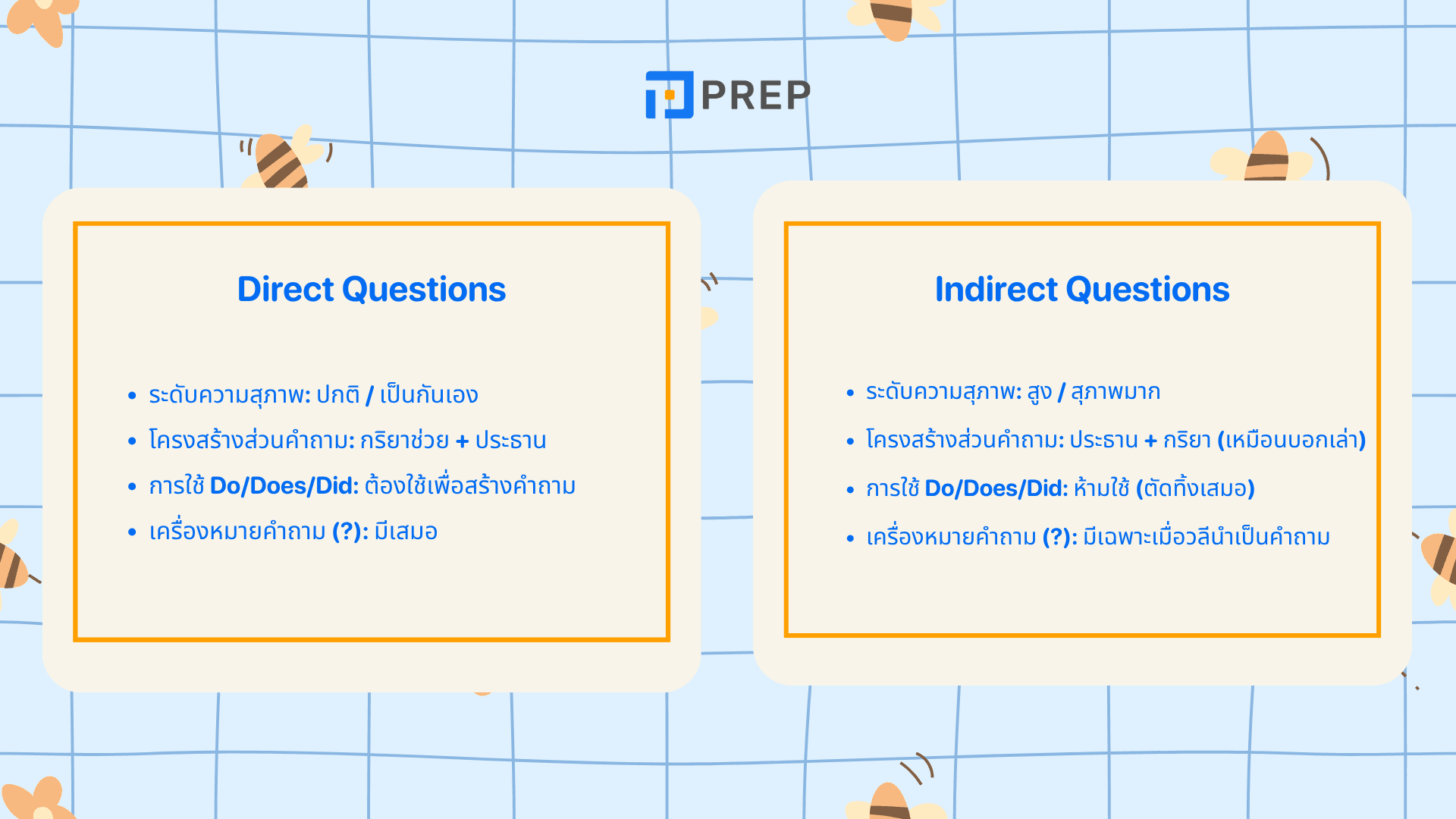
|
หัวข้อเปรียบเทียบ |
Direct Questions |
Indirect Questions |
|
ระดับความสุภาพ |
ปกติ / เป็นกันเอง |
สูง / สุภาพมาก |
|
โครงสร้างส่วนคำถาม |
กริยาช่วย + ประธาน |
ประธาน + กริยา (เหมือนบอกเล่า) |
|
การใช้ Do/Does/Did |
ต้องใช้เพื่อสร้างคำถาม |
ห้ามใช้ (ตัดทิ้งเสมอ) |
|
เครื่องหมายคำถาม (?) |
มีเสมอ |
มีเฉพาะเมื่อวลีนำเป็นคำถาม |
II. โครงสร้างประโยคและการวางตำแหน่ง
1. การเรียงลำดับ Subject และ Verb
ความแตกต่างหลักของ direct questions and indirect questions อยู่ที่การเรียง Subject-Verb ภายในประโยค
|
ประเภท |
โครงสร้าง |
ตัวอย่าง |
|
Direct Question |
Aux + S + V |
Where does he live? (เขาอยู่ที่ไหน?) |
|
Indirect Question |
S + V (ไม่สลับ) |
Could you tell me where he lives? (ช่วยบอกได้ไหมว่าเขาอยู่ที่ไหน?) |
|
Direct Question |
Did + S + V |
What did she say? (เธอพูดว่าอะไร?) |
|
Indirect Question |
S + V (ไม่สลับ) |
Do you know what she said? (คุณรู้ไหมว่าเธอพูดว่าอะไร?) |
ใน indirect questions กริยาในส่วน embedded question จะเรียงแบบประโยคบอกเล่าปกติ คือ Subject ก่อน Verb เสมอ ไม่มีการสลับ (no inversion)
บทความแนะนำ: Inversion คืออะไร?
2. การใช้ If และ Whether เชื่อม
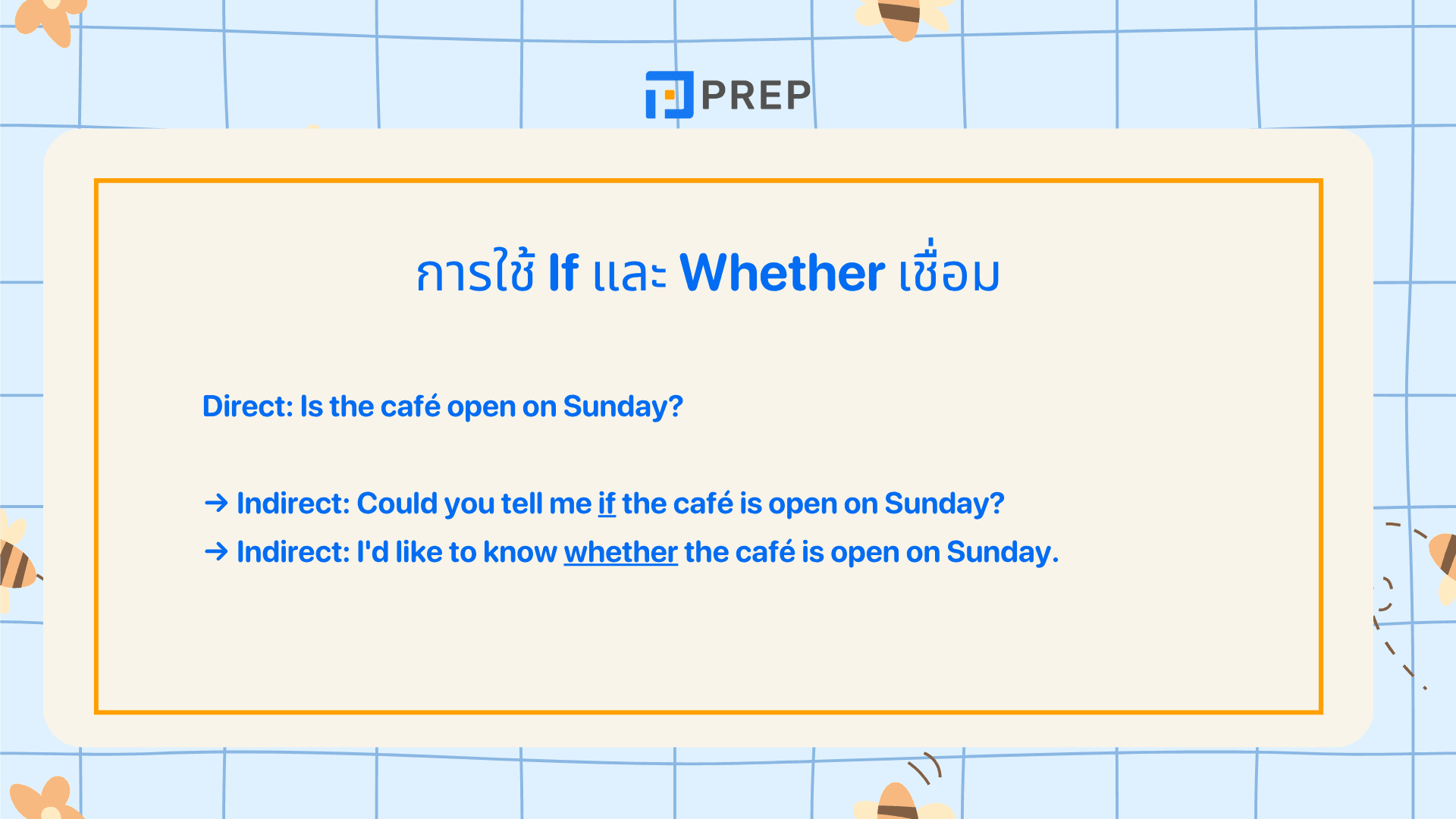
เมื่อ direct question เป็นแบบ Yes/No การแปลงเป็น indirect question ต้องใช้ if หรือ whether เชื่อม เพราะไม่มี Wh-word ที่จะใช้นำประโยค
-
Direct: Is the café open on Sunday? (ร้านกาแฟเปิดวันอาทิตย์ไหม?)
-
Indirect: Could you tell me if the café is open on Sunday? (ช่วยบอกได้ไหมว่าร้านกาแฟเปิดวันอาทิตย์ไหม?)
-
Indirect: I'd like to know whether the café is open on Sunday. (อยากรู้ว่าร้านกาแฟเปิดวันอาทิตย์ไหม)
ทั้ง if และ whether ใช้แทนกันได้ในกรณีส่วนใหญ่ แต่ whether ฟังดูทางการกว่าเล็กน้อยและมักใช้ในภาษาเขียน
III. เปรียบเทียบความแตกต่างและการใช้งาน
1. ความแตกต่างด้านความทางการ
|
ด้าน |
Direct Question |
Indirect Question |
|
ระดับภาษา |
ทั่วไป / ไม่เป็นทางการ |
สุภาพ / ทางการ |
|
โครงสร้าง |
Aux + S + V (inversion) |
S + V (ไม่สลับ) |
|
เครื่องหมาย ? |
มีเสมอ |
ขึ้นอยู่กับวลีนำ |
|
ความเป็นธรรมชาติ |
ตรงไปตรงมา |
อ้อมค้อม นุ่มนวล |
|
บริบทที่เหมาะ |
เพื่อน ครอบครัว |
ที่ทำงาน สัมภาษณ์ |
ในการสอบ IELTS Speaking การใช้ indirect questions แสดงให้เห็นว่าผู้เรียนเข้าใจระดับภาษา (register) และควบคุมโครงสร้างประโยคได้หลากหลาย ซึ่งเกี่ยวข้องโดยตรงกับเกณฑ์ Grammatical Range and Accuracy
2. การตัด Do Does Did ออก
ข้อผิดพลาดที่พบบ่อยที่สุดใน direct and indirect questions คือการเก็บ Do/Does/Did ไว้ใน indirect question ทั้งที่ต้องตัดออก
-
❌ Could you tell me where does he work?
-
✅ Could you tell me where he works?
-
❌ Do you know what did she order?
-
✅ Do you know what she ordered?
เมื่อประโยคกลายเป็น indirect questions กริยาจะผันตามประธานแบบปกติ ไม่ต้องใช้ Do/Does/Did อีก เพราะโครงสร้างไม่ใช่ประโยคคำถามโดยตรงแล้ว
IV. วลีสุภาพยอดนิยมในการขึ้นต้น Indirect Questions
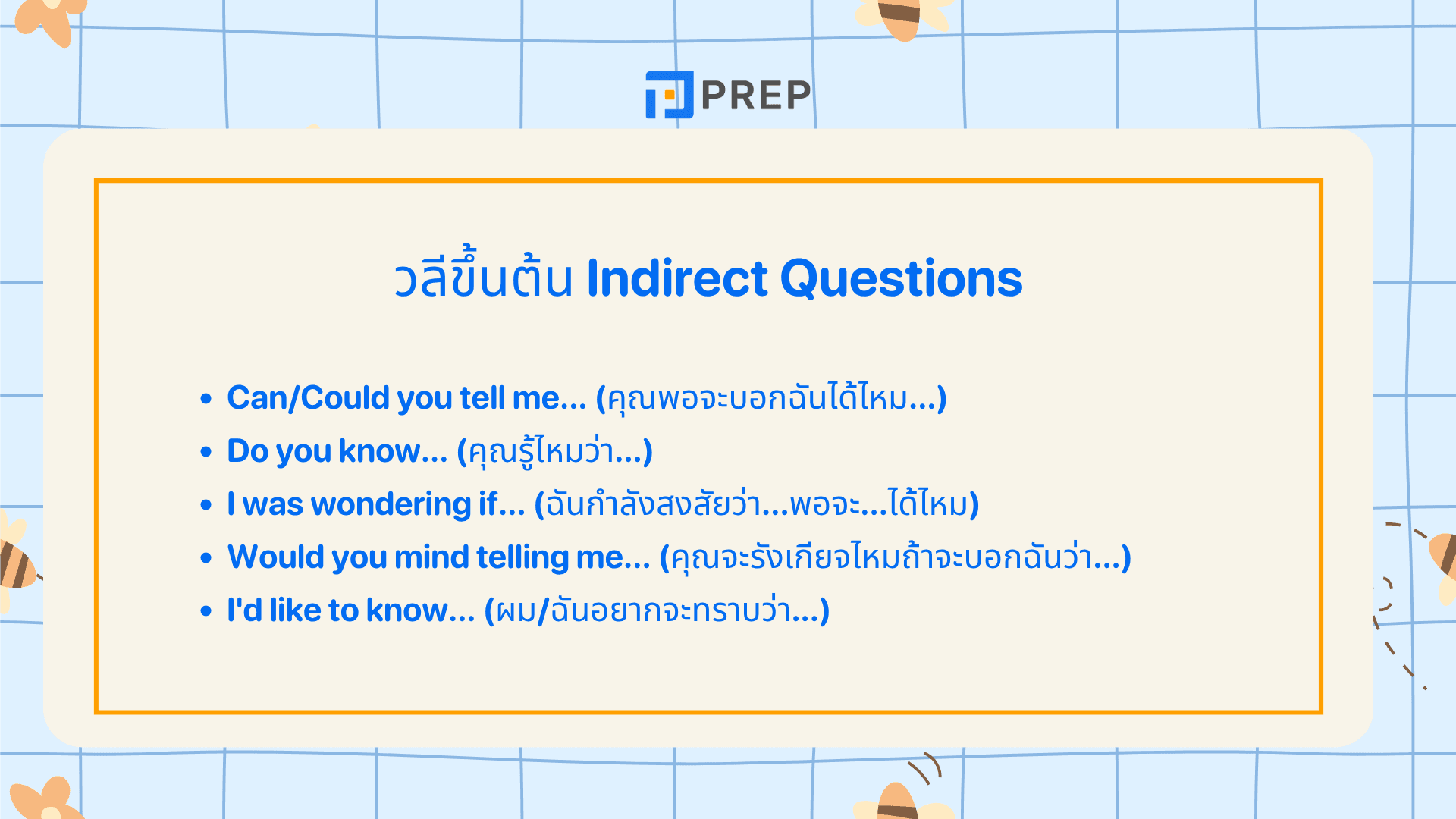
การเลือกใช้วลีนำหน้าจะช่วยกำหนดระดับความสุภาพของ indirect questions ได้อย่างดีครับ
-
Can/Could you tell me... (คุณพอจะบอกฉันได้ไหม...)
-
Do you know... (คุณรู้ไหมว่า...)
-
I was wondering if... (ฉันกำลังสงสัยว่า...พอจะ...ได้ไหม)
-
Would you mind telling me... (คุณจะรังเกียจไหมถ้าจะบอกฉันว่า...)
-
I'd like to know... (ผม/ฉันอยากจะทราบว่า...)
บทความแนะนำ:
- Direct and Indirect Speech วิธีใช้และตัวอย่าง
- โครงสร้างและตัวอย่าง Yes No Questions
- WH Questions วิธีใช้และตัวอย่าง
V. แบบฝึกหัด
Exercise 1: เปลี่ยน Direct เป็น Indirect (10 ข้อ)
-
What time is it? (Could you tell me...)
-
Where does Lucy live? (Do you know...)
-
Did he finish the report? (I wonder...)
-
Why are you late? (Can you explain...)
-
Is the supermarket open? (Do you have any idea...)
-
How much is this shirt? (I'd like to know...)
-
When will the movie start? (Could you tell me...)
-
Did they enjoy the trip? (I was wondering...)
-
What is his phone number? (Do you know...)
-
Can she drive a car? (I'm not sure...)
เฉลย:
[prep_collapse_expand open_text="View more" close_text="Show less"]
-
Could you tell me what time it is?
-
Do you know where Lucy lives? (ตัด does เติม s)
-
I wonder if he finished the report. (ตัด did เปลี่ยนเป็นช่อง 2)
-
Can you explain why you are late?
-
Do you have any idea if the supermarket is open?
-
I'd like to know how much this shirt is.
-
Could you tell me when the movie will start?
-
I was wondering if they enjoyed the trip.
-
Do you know what his phone number is?
-
I'm not sure if she can drive a car.
[/prep_collapse_expand]
Exercise 2: Multiple Choice
จงเลือกคำตอบที่ถูกต้องที่สุด (10 ข้อ)
-
I was wondering _______ to join us for dinner. A. if would you like B. if you would like C. would you like
-
Could you tell me _______? A. where the manager is B. where is the manager C. where does the manager be
-
Do you have any idea why _______? A. did she cry B. she cried C. was she crying
-
I’d like to know how long _______ in this company. A. has he been working B. he has been working C. did he work
-
Can you tell me whether _______ the results yet? A. they have received B. have they received C. did they receive
-
I wonder _______ the train is on time. A. that B. if C. what
-
Please let me know what time _______ tomorrow.
-
you will arrive B. will you arrive C. do you arrive
-
-
I don't remember where _______ my umbrella. A. did I put B. I put C. put I
-
Would you mind telling me how _______? A. does this machine work B. this machine works C. works this machine
-
I'm not sure if _______ the answer. A. does he know B. he knows C. is he knowing
เฉลย:
[prep_collapse_expand open_text="View more" close_text="Show less"]
1. B | 2. A | 3. B (ตัด did เปลี่ยนเป็นช่อง 2) | 4. B | 5. A | 6. B | 7. A | 8. B | 9. B | 10. B
[/prep_collapse_expand]
Exercise 3: Error Correction
จงแก้ไขประโยคต่อไปนี้ให้ถูกต้อง (10 ข้อ)
-
I wonder where does she go every morning.
-
Can you tell me what is the matter?
-
Do you know if did he call me yesterday?
-
I'd like to know how much is this bag.
-
Could you tell me why are you laughing?
-
I was wondering whether could you help me.
-
Do you have any idea when will the show start?
-
I don't know what does "infinitive" mean.
-
Please tell me if is she coming.
-
Would you mind telling me where did you buy that dress?
เฉลย:
[prep_collapse_expand open_text="View more" close_text="Show less"]
-
...where she goes every morning. (ตัด does เติม s)
-
...what the matter is. (ย้ายกริยาไปหลังประธาน)
-
...if he called me yesterday. (ตัด did เปลี่ยนเป็นช่อง 2)
-
...how much this bag is. (ย้าย is ไปหลังสุด)
-
...why you are laughing. (เรียงแบบบอกเล่า)
-
...whether you could help me. (สลับตำแหน่งประธาน-กริยาช่วย)
-
...when the show will start.
-
...what "infinitive" means. (ตัด does เติม s)
-
...if she is coming.
-
...where you bought that dress. (ตัด did เปลี่ยนเป็นช่อง 2)
[/prep_collapse_expand]
การฝึกฝนการใช้ direct questions and indirect questions จะช่วยให้คุณสื่อสารภาษาอังกฤษได้อย่างยืดหยุ่นและมีมารยาท ไม่ว่าจะเป็นการถามทางในต่างประเทศ หรือการประชุมงานในระดับนานาชาติ
หากคุณต้องการเจาะลึกไวยากรณ์เพื่อเตรียมตัวสอบเรียน IELTS หรือต้องการความมั่นใจในการพูด PREP มีทางเลือกที่ตอบโจทย์คุณเสมอครับ ด้วย IELTS course ที่เน้นเทคนิคการทำข้อสอบแบบเจาะลึก และการ เรียน IELTS ออนไลน์ ที่ยืดหยุ่นเข้ากับไลฟ์สไตล์คุณ ไม่ว่าคุณจะต้องการ ติว IELTS เพื่อคะแนนที่สูงขึ้น หรือต้องการปรับพื้นฐาน คอร์สเรียน IELTS ของเราพร้อมพาคุณไปสู่ความสำเร็จ มาเริ่มต้นเส้นทางสู่ Band Score ที่ฝันไว้กับ PREP วันนี้

สวัสดีค่ะ ฉันชื่อมุก ปัจจุบันดูแลด้านเนื้อหาผลิตภัณฑ์ของ Prep Education ค่ะ
ด้วยประสบการณ์มากกว่า 5 ปีในการเรียน IELTS ออนไลน์ด้วยตนเอง ฉันเข้าใจดีถึงความท้าทายที่ผู้เรียนต้องเผชิญ แล้วก็รู้ว่าอะไรที่มันเวิร์ก
มุกอยากเอาประสบการณ์ตรงนี้มาช่วยแชร์ แล้วก็ซัพพอร์ตเพื่อน ๆ ให้ได้คะแนนที่ดีที่สุดค่ะ
ความคิดเห็น
เนื้อหาแบบพรีเมียม
ดูทั้งหมด
แผนการเรียนรู้ส่วนบุคคล


อ่านมากที่สุด

ติดต่อ Prep ผ่านโซเชียล





Address: ตึก C.P. Tower 2 (ฟอร์จูนทาวน์) ชั้น 21 ถนนรัชดาภิเษก แขวงดินแดง เขตดินแดง กรุงเทพฯ 10400
Hotline: +6624606789
Email: sawatdee@prepedu.com