HSK 5 Reading: Format, Sample Questions, Practice Strategies and Free Materials (2026)
Key Takeaways
- The HSK 5 Reading section has 45 questions in 45 minutes, uses Chinese characters only with no pinyin, and works out to about one minute per question.
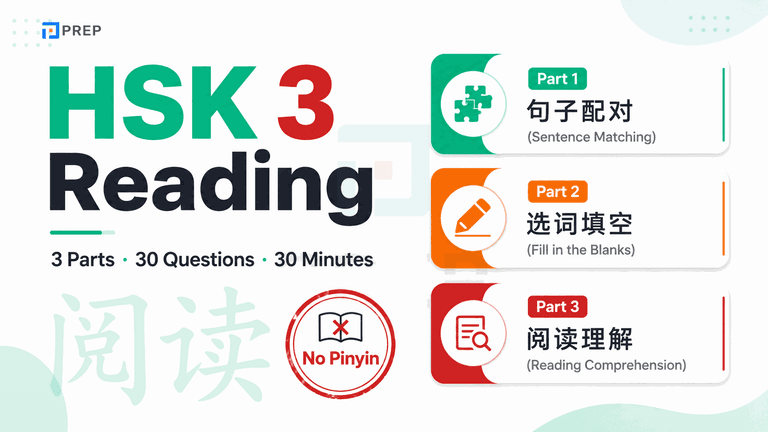
- The section splits into three parts: Part 1 fill-in-the-blank (15 questions), Part 2 matching (10 questions), and Part 3 comprehension passages (20 questions).
- HSK 5 passes at 180 out of 300 total points, and there is no separate passing score for Reading - every point feeds the same total.
- This guide gives you an original worked example for all three parts, bilingual (characters, pinyin, and English), with the reasoning behind every answer.
- HSK 5 expects about 2,500 words (roughly 3,600 under the incoming HSK 3.0), and the vocabulary jump from HSK 4 is the biggest difficulty driver.
- The new HSK 3.0 standard takes effect in July 2026, but your current HSK 2.0 skills and materials still carry over.
HSK 5 Reading is as much a speed test as a comprehension test: with 45 questions in 45 minutes, most learners lose points to the clock, not to the Chinese itself.
This guide walks through the format, gives you a worked example for every part, and then covers how to prepare, how to beat the clock, where to find free materials, and what the 2026 HSK 3.0 change means for Reading.
- I. What Is the HSK 5 Reading Section?
- II. HSK 5 Reading Format and Structure
- III. HSK 5 Reading Sample Questions With Answers and Explanations
- IV. How to Prepare for HSK 5 Reading
- V. Time Management: Beating the 1-Minute-per-Question Clock
- VI. Best HSK 5 Reading Practice Materials and PDFs
- VII. How Hard Is HSK 5 Reading?
- VIII. HSK 5 Reading and the New HSK 3.0 (2026): What's Changing
- IX. FAQ: HSK 5 Reading
- 1. How Is the HSK 5 Score Calculated?
- 2. What Is a Good HSK 5 Score, and What Is the Passing Score?
- 3. Is There a Separate Passing Score for the Reading Section?
- 4. How Many Words Do I Need to Know for HSK 5 Reading?
- 5. How Much Does It Cost to Take the Official HSK 5 Test?
- 6. Who Should Take the HSK 5 Test?
- 7. How Long Does It Take to Prepare for HSK 5 After HSK 4?
- 8. Can I Still Use My HSK 2.0 Materials After the 2026 Change?
- X. Your HSK 5 Reading Action Plan
I. What Is the HSK 5 Reading Section?
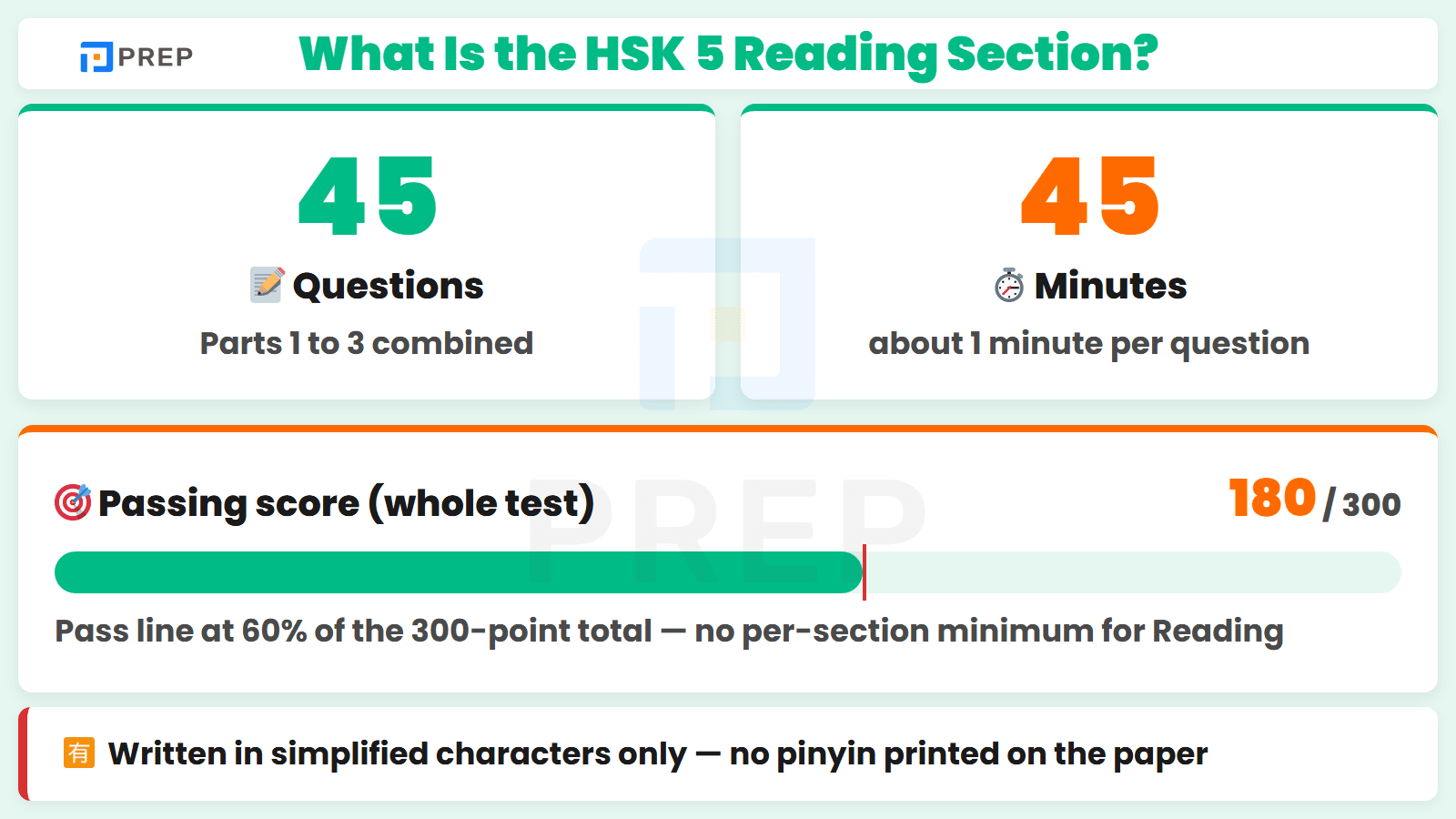
The HSK 5 Reading section (阅读, yuèdú) gives you 45 questions and 45 minutes, roughly one minute per question, and it tests how quickly and accurately you read written Chinese, using characters only with no pinyin on the paper [1].
You do not need a separate passing score for Reading: HSK 5 passes at 180 out of 300 total points, so every Reading point counts toward the same pool as Listening and Writing [1]. Reading is one of three sections, alongside Listening and Writing, and this guide covers Reading only: its format, worked examples, a prep plan, speed tactics, and free materials.
Here are the headline facts:
- Questions: 45 (Parts 1 to 3 combined)
- Time: 45 minutes, about one minute per question
- Script: simplified characters only, no pinyin
- Passing: 180 out of 300 for the whole test, with no per-section minimum
Those 45 questions aren't one uniform block. They split into three parts, and each part tests a different reading skill.
II. HSK 5 Reading Format and Structure
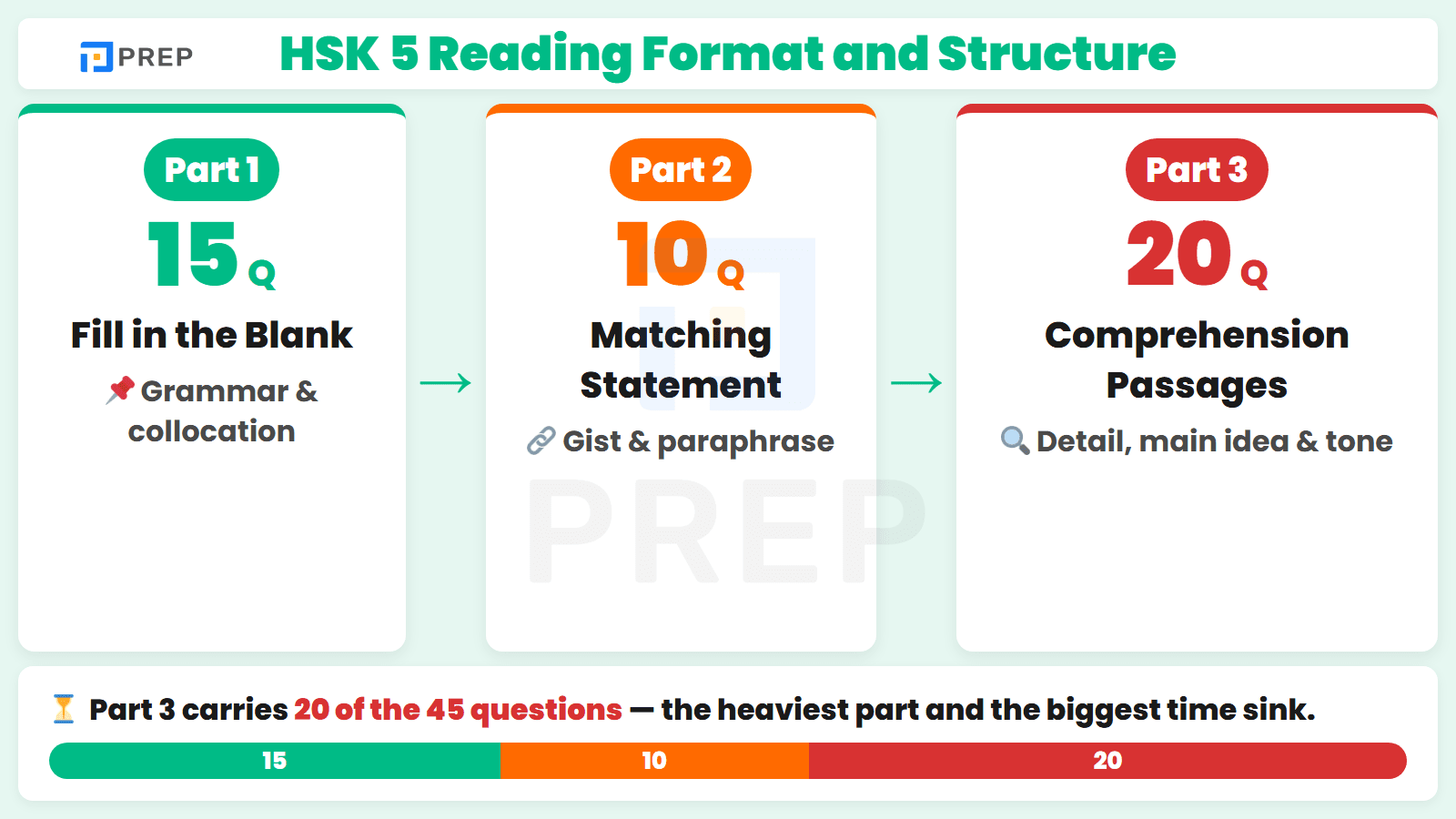
The three parts aren't just "more questions" stacked together. They climb from word-level control, meaning grammar and collocation, up to passage-level reasoning, so the part where you lose points tells you which reading skill is actually weak.
|
Part |
Question type |
Questions |
Skill measured |
|
Part 1 |
Fill in the blank |
15 |
Grammar and collocation |
|
Part 2 |
Choose the matching statement |
10 |
Gist and paraphrase |
|
Part 3 |
Comprehension passages |
20 |
Detail, main idea, and tone |
Part 3 alone carries 20 of the 45 questions, so it's both the heaviest section and the one most likely to eat your clock. Start with Part 1, where a single wrong word, not a wrong meaning, is what trips most learners.
1. Part 1 - Fill in the Blanks (15 Questions)
Part 1 gives you 15 sentences with a gap and four word or short-phrase options, and it tests collocation and grammar, not just meaning. Two options can both "mean" the right thing, yet only one fits the sentence's fixed pairing or structure.
Here's the trap: you recognize all four words, so you pick the closest synonym by meaning and move on. But Chinese pairs words in fixed ways. 提高 (tígāo) and 增加 (zēngjiā) both touch "increase," yet you 提高 a level or an ability and 增加 a number or an amount. Swap them and the sentence breaks, even though the "meaning" looks right. You should read the words on either side of the gap first, then choose the option that habitually pairs with them.
Part 2 flips the task: instead of filling a gap, you match a whole passage to its best restatement.
2. Part 2 - Choose the Matching Statement (10 Questions)
Part 2 gives you 10 short passages, each with four statements, and asks you to pick the one that agrees with the passage. The correct answer is usually a paraphrase, while the trap reuses the passage's exact words but reverses or overstates the claim.
So the tempting wrong answer is the one that looks most familiar. If a passage says 睡眠质量比时间更重要 (sleep quality matters more than duration), a trap statement might recycle 质量 and 时间 but flip the relationship. The statement that matches is the one that keeps the meaning while changing the words, not the one that keeps the words.
Part 3 is where the clock really bites: long passages, several questions each.
3. Part 3 - Reading Comprehension Passages (20 Questions)
Part 3 has 20 questions built on several longer passages, each followed by multiple questions on detail, main idea, and sometimes tone. With 20 of the 45 questions here, Part 3 is where most people run out of time.
The questions mix three types: scan-for-a-detail questions, main-idea questions, and the occasional tone or inference question. That mix is exactly why Part 3 rewards a read-once strategy over rereading, which is what Section V builds.
Knowing the map is one thing; seeing a real question solved is another. Next, three worked examples.
III. HSK 5 Reading Sample Questions With Answers and Explanations
Most free HSK 5 questions online hand you an answer key and stop there. But the answer key is the one part that doesn't transfer to the next question. The reasoning does, so each example below shows not just the right choice, but why every wrong choice is wrong.
A note on these items: Prep wrote the Chinese examples below in authentic HSK 5 style rather than copying real past papers. Treat them as practice illustrations, and have a fluent Chinese reader check every character, pinyin, tone mark, and answer before you rely on them for a real exam.
1. Worked Example - Part 1 (Fill in the Blank)
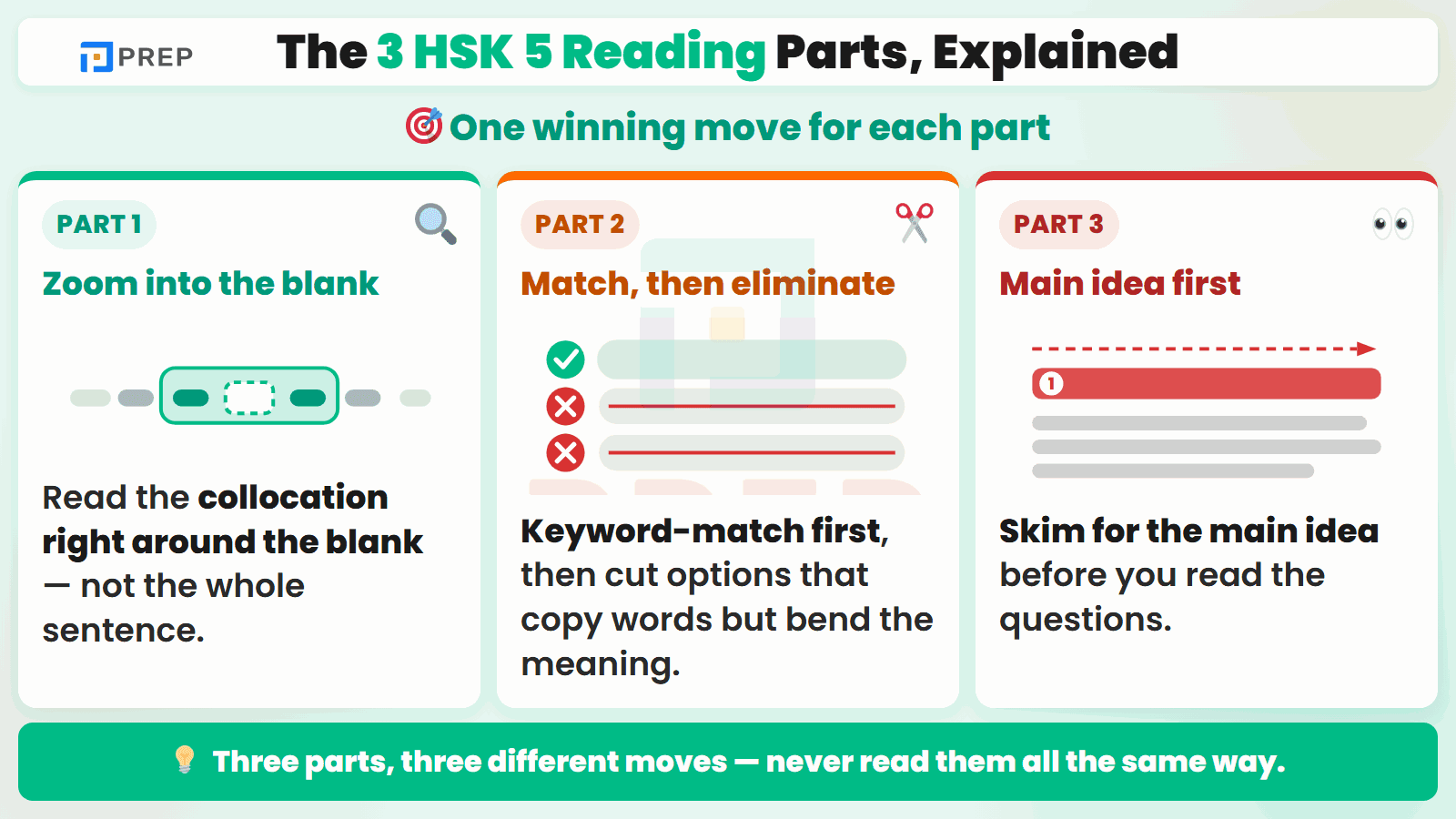
In Part 1, the fastest route to the answer is collocation: find the option that habitually pairs with the surrounding words, then confirm the grammar fits.
Question:
这次会议非常重要,请大家__准时参加。
Zhè cì huìyì fēicháng zhòngyào, qǐng dàjiā ______ zhǔnshí cānjiā.
"This meeting is very important; everyone please ____ attend on time."
Options:
- A 务必 (wùbì) - "be sure to"
- B 必然 (bìrán) - "inevitably"
- C 势必 (shìbì) - "is bound to"
- D 必定 (bìdìng) - "certainly"
Answer: A (务必).
Why:
- A 务必 is correct because it pairs with polite requests. The frame 请…务必… ("please be sure to...") is a fixed collocation, and it fits "everyone please ______ attend on time."
- B 必然, C 势必, and D 必定 all express the inevitability or certainty of an outcome, not a request made to a person. They collocate with predictions (必然会…, 势必会…, 必定会…), so none of them sit naturally after 请 ("please").
Notice what this isn't: a meaning question. All four options live near "certainly," so translating them won't separate them. Collocation and register do.
Part 2 rewards a different move: matching meaning, not words.
2. Worked Example - Part 2 (Matching)
In Part 2, the correct statement restates the passage's meaning in new words; the trap statement reuses the passage's exact words but flips or overstates the claim.
Passage:
很多人以为睡得越多越好,其实睡眠质量比睡眠时间更重要。长期睡眠不足会影响记忆力,但睡得太多也不一定对身体有好处。
Hěnduō rén yǐwéi shuì de yuè duō yuè hǎo, qíshí shuìmián zhìliàng bǐ shuìmián shíjiān gèng zhòngyào. Chángqī shuìmián bùzú huì yǐngxiǎng jìyìlì, dàn shuì de tài duō yě bù yīdìng duì shēntǐ yǒu hǎochù.
"Many people think more sleep is always better; in fact, sleep quality matters more than sleep duration. Chronic lack of sleep hurts memory, but sleeping too much isn't necessarily good for the body either."
Statements:
- A 睡觉时间越长越健康 (shuìjiào shíjiān yuè cháng yuè jiànkāng) - "the longer you sleep, the healthier you are"
- B 睡眠时间比睡眠质量重要 (shuìmián shíjiān bǐ shuìmián zhìliàng zhòngyào) - "duration matters more than quality"
- C 睡眠质量比睡多久更关键 (shuìmián zhìliàng bǐ shuì duōjiǔ gèng guānjiàn) - "sleep quality is more crucial than how long you sleep"
- D 睡眠不足对身体没有影响 (shuìmián bùzú duì shēntǐ méiyǒu yǐngxiǎng) - "lack of sleep has no effect on the body"
Answer: C.
Why:
- C is correct. It paraphrases the passage's core claim, 质量比时间更重要 ("quality matters more than duration"), in different words (关键 for 重要, 睡多久 for 时间).
- A contradicts the passage, which explicitly rejects "more is better."
- B reverses the relationship the passage states, putting duration above quality.
- D contradicts the line that says a lack of sleep hurts memory.
A and B are the classic Part 2 trap: they reuse the passage's own words (睡, 时间, 质量) while changing the claim. Familiar words are not the same as a matching meaning.
Part 3 combines both skills under real time pressure.
3. Worked Example - Part 3 (Comprehension Passage)
Skim the passage once for its structure and main idea, then scan back for the exact detail each question names. Reading every character start to finish is what costs people this section.
Passage:
某市图书馆最近把开放时间延长到晚上十一点。图书馆负责人表示,这样做主要是为了方便那些白天上班、只能晚上学习的读者。调整之后,晚上来图书馆的人数增加了大约百分之四十,其中不少是上夜班的年轻人。图书馆还计划增加更多安静的自习座位,让每一位读者都能找到适合自己的学习空间。
Mǒu shì túshūguǎn zuìjìn bǎ kāifàng shíjiān yáncháng dào wǎnshang shíyī diǎn. Túshūguǎn fùzérén biǎoshì, zhèyàng zuò zhǔyào shì wèile fāngbiàn nàxiē báitiān shàngbān, zhǐ néng wǎnshang xuéxí de dúzhě. Tiáozhěng zhīhòu, wǎnshang lái túshūguǎn de rénshù zēngjiā le dàyuē bǎifēnzhī sìshí, qízhōng bùshǎo shì shàng yèbān de niánqīng rén. Túshūguǎn hái jìhuà zēngjiā gèng duō ānjìng de zìxí zuòwèi, ràng měi yī wèi dúzhě dōu néng zhǎodào shìhé zìjǐ de xuéxí kōngjiān.
"A city library recently extended its opening hours to 11 p.m. The library's director said the main reason was to accommodate readers who work during the day and can only study at night. After the change, the number of evening visitors rose by about 40%, many of them young night-shift workers. The library also plans to add more quiet study seats so that every reader can find a suitable space to study."
Question 1 (detail - scan): 根据短文,图书馆为什么延长开放时间?
Gēnjù duǎnwén, túshūguǎn wèishénme yáncháng kāifàng shíjiān? ("According to the passage, why did the library extend its opening hours?")
- A 为了方便晚上才能学习的读者 - "to accommodate readers who can only study at night"
- B 为了减少白天的读者 - "to reduce daytime readers"
- C 为了增加图书馆的收入 - "to increase the library's income"
- D 为了增加自习座位 - "to add study seats"
Answer: A. Scan for the reason, signaled by 为了 ("in order to") right after 主要是. The passage ties the change to daytime workers who can only study at night, which A restates. D names a future plan, not the reason; B and C never appear in the text.
Question 2 (main idea - skim): 这段话主要谈的是什么?
Zhè duàn huà zhǔyào tán de shì shénme? ("What is this passage mainly about?")
- A 图书馆延长开放时间以更好地服务读者 - "the library extended its hours to serve readers better"
- B 年轻人喜欢上夜班 - "young people like night shifts"
- C 图书馆的自习座位不够 - "the library doesn't have enough study seats"
- D 晚上学习比白天学习更好 - "studying at night is better than studying by day"
Answer: A. A main-idea answer has to cover the whole passage, not one line. B and C latch onto a single detail (too narrow), and D states a comparison the passage never makes (too broad). Only A matches the passage's actual scope: a service change for readers.
See the sequence: one skim fixed the main idea for Question 2, and one targeted scan answered Question 1. You never reread the whole passage.
Solving one question well is a skill; building it reliably takes a few weeks of the right practice.
IV. How to Prepare for HSK 5 Reading
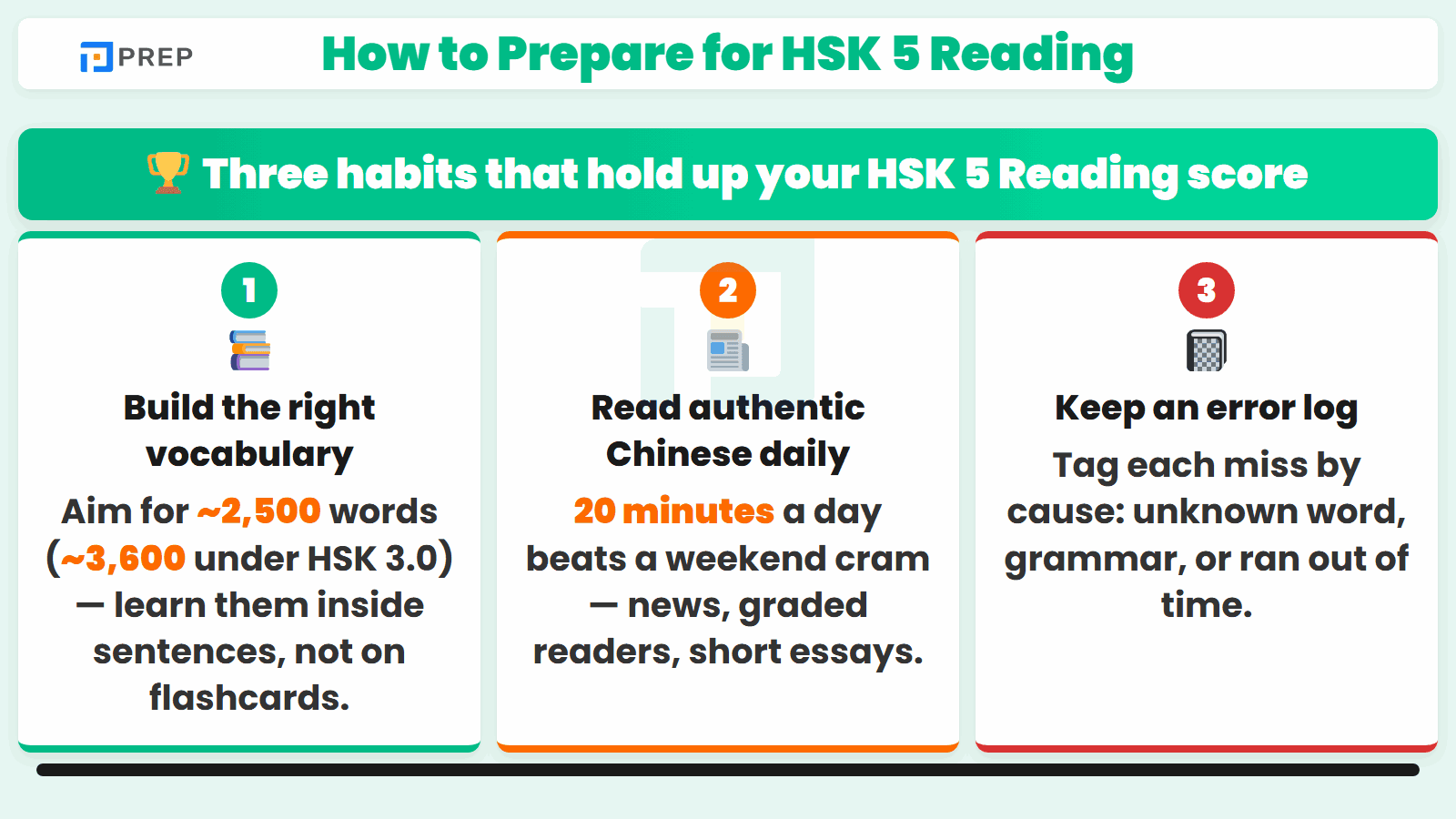
Reading gains come from two habits: closing the vocabulary gap in context, and reading real Chinese every day. Grinding mock tests measures the gap without closing it, which is why it can feel like effort without progress. Start with the words, because everything downstream depends on them.
1. Build the Right Vocabulary (2,500+ Words)
HSK 5 expects about 2,500 words cumulatively (roughly 3,600 under the incoming HSK 3.0), and the words that help your reading are the ones you meet in sentences, not on isolated flashcards [1][2].
A flashcard teaches you a word's gloss; a sentence teaches you how it behaves, which words it pairs with, what grammar it triggers, and what register it belongs to. That behavior is exactly what Part 1 tests. So learn new words where they live:
- graded readers pitched at your level
- short news articles and captions
- example sentences in a good dictionary, not just the headword
The best place to meet words in context is real text, read a little every day.
2. Read Authentic Chinese Texts Every Day
Reading something real in Chinese every day - short news items, graded readers, or brief essays - is what closes the HSK 4 to 5 gap and builds the stamina Part 3 demands.
"Authentic" just means text written for Chinese readers, not for a textbook exercise. It feels slower at first, and that's the point: the discomfort is your coverage gap becoming visible. Good daily sources include:
- short news pieces, many of them graded by level in reading apps
- graded readers built for HSK 4 to 5
- brief opinion or lifestyle essays
Twenty minutes a day beats a three-hour cram on the weekend. Why? Stamina, the kind Part 3 needs, is built by frequency, not by marathons.
Reading widely surfaces your mistakes, which are only useful if you track them.
3. Keep an Error Log and Review Your Mistakes
Log every wrong answer by its cause - unknown word, misread grammar, or ran out of time - because each cause needs a different fix.
A list of wrong answers isn't a study tool; a list of causes is. Tag each miss:
- Unknown word - add it to your context practice.
- Misread grammar or collocation - that's a Part 1 pattern to drill.
- Ran out of time - that's not a reading problem at all, and Section V is where you fix it.
Review by tag, not by test, and you'll stop repeating the same category of error.
If most of your errors are "ran out of time," the next section is written for you.
V. Time Management: Beating the 1-Minute-per-Question Clock
The clock is usually lost early, by reading every character and over-analyzing the easy questions, long before the hard passages arrive. So the fix isn't faster eyes. It's a triage habit.
The two habits that sink most people: reading every character as if it were an intensive-reading class, and over-analyzing the first easy questions until the long passages get no time. Neither is a language problem. Both are triage problems, and triage is trainable. Start with the single most useful move: knowing when to skim and when to scan.
1. Skim vs. Scan: When to Use Each
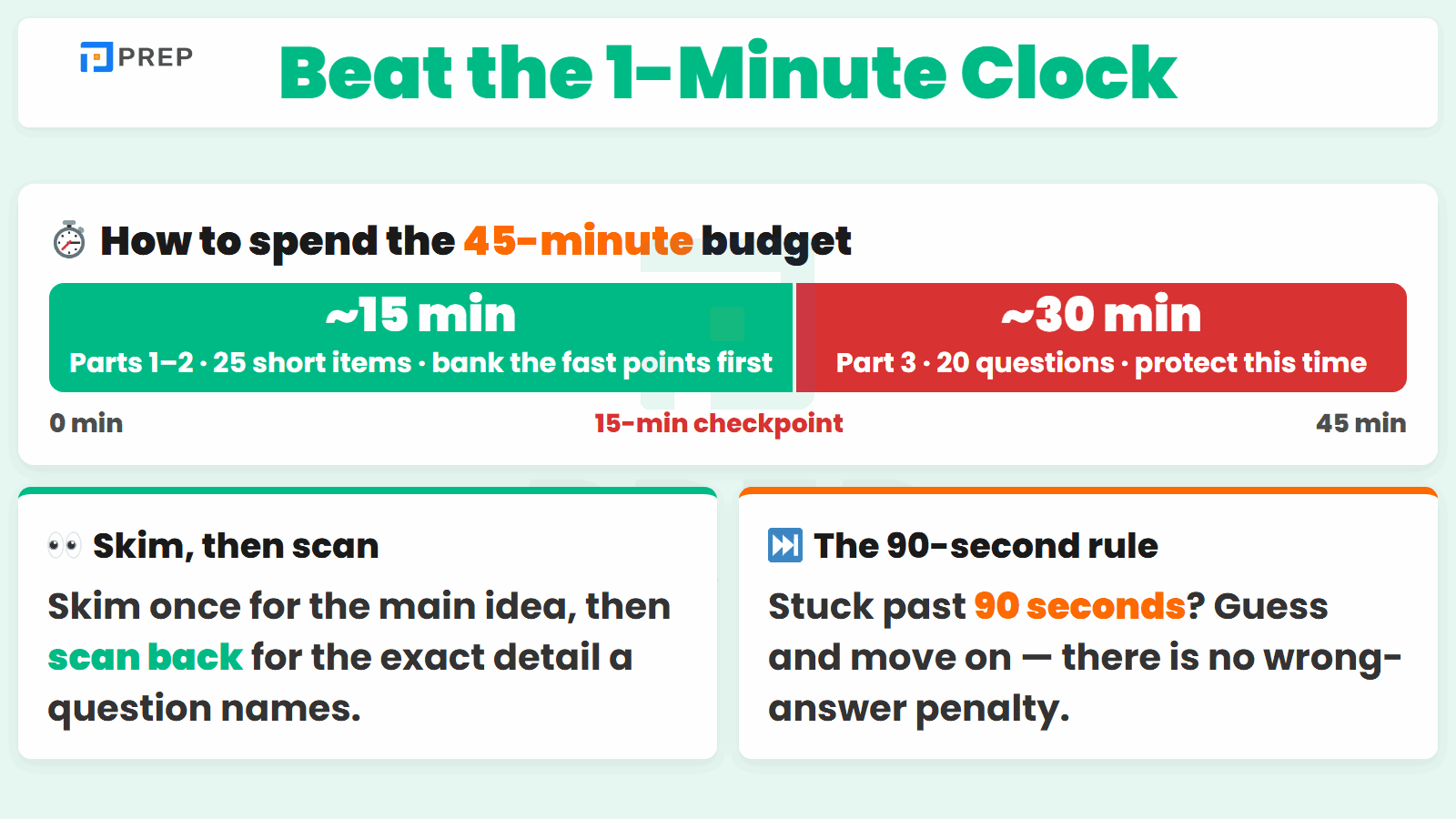
Skim first to grab the main idea and structure, then scan back for the exact detail a question asks. Skimming answers main-idea questions; scanning answers detail questions.
Skimming means moving fast to see the shape of a passage: what it's about, how it's organized, and where the turn is. Scanning means hunting for one specific thing, a name, a number, or a reason, without reading around it. Match the move to the question. A 主要谈什么 ("mainly about") question wants a skim; a 为什么 ("why") or 哪一年 ("which year") question wants a scan. Do both on a single read-through, and you rarely need a second.
Which part you point these at first matters just as much.
2. What Order Should You Answer the Three Parts In?
Bank the fast points first: do Parts 1 and 2 (the shorter items) before the long Part 3 passages, and give yourself a rough budget of about 15 minutes for Parts 1 to 2 and 30 minutes for Part 3.
This isn't an official rule; it's a tested tactic. Parts 1 and 2 are 25 short items you can clear quickly, so securing them first means a slow passage in Part 3 can't cost you points you'd otherwise have banked. Check the clock at the 15-minute mark, and if Parts 1 and 2 aren't done, speed up rather than chase perfection.
Even with a budget, one stubborn question can wreck it.
3. When Should You Skip a Question and Move On?
If a question has cost you more than about 90 seconds, mark your best guess and move on - one hard item isn't worth five easy ones you'll never reach.
There's no penalty for a wrong answer on HSK 5, so you should never leave a blank; guess before you move on, every time. The 90-second rule protects your total, because the real cost of a stubborn question is all the reachable questions it steals. Flag it, guess, and come back if time remains at the end.
You can only make these moves automatic with realistic, timed materials.
VI. Best HSK 5 Reading Practice Materials and PDFs
Free HSK 5 reading material is everywhere, but most of it is either untimed or missing explanations. Choose by whether a resource mimics exam conditions and tells you why answers are right, not by whether it's free. Start with the most-searched format: downloadable PDFs.
1. Free PDFs and Downloadable Passages
Free HSK 5 reading PDFs and past-style papers are easy to find, but many lack answer explanations or mix difficulty levels - download them, but treat any without explanations as raw practice, not a teacher.
A PDF with an answer key but no reasoning is exactly the gap Section III was built to fill. So use free PDFs for volume and timing reps, and bring your own reasoning to them: for every miss, ask why the wrong option was tempting. When you judge a PDF, check two things - does it label its level honestly, and does it explain its answers? If not, it's raw material, not instruction.
For timing practice specifically, interactive tools beat static PDFs.
2. Interactive Practice Tests and Reading Tools
The most useful tools are the ones that time you like the real exam and explain answers afterward - practicing under the clock is the only way the pacing tactics from Section V become automatic.
A static PDF can't teach pacing, because nothing is counting down. An interactive test that runs a 45-minute timer, then walks you through each answer, trains the triage habit and the reading skill at once. Prep is building an AI-powered Chinese and HSK program, with exam-simulating Test Practice and AI pronunciation feedback on initials, finals, and tones, that's coming soon for English-speaking learners.
Between timed tests, keep reading for range and pleasure.
3. Graded Readers and Books
HSK 5-level graded readers give you long-form reading at a controlled difficulty - the daily input from Section IV, in book form - so you build stamina without hitting a wall of unknown characters.
A graded reader caps its vocabulary to roughly your level, so you read for meaning instead of stopping every line to look things up. That's what makes it sustainable as daily input, and it's the most direct way to build the reading stamina Part 3 demands. Pick readers pitched at HSK 4 to 5, one notch below where you feel strained, and read a little every day.
With materials sorted, it's worth being honest about how hard Reading actually is.
VII. How Hard Is HSK 5 Reading?
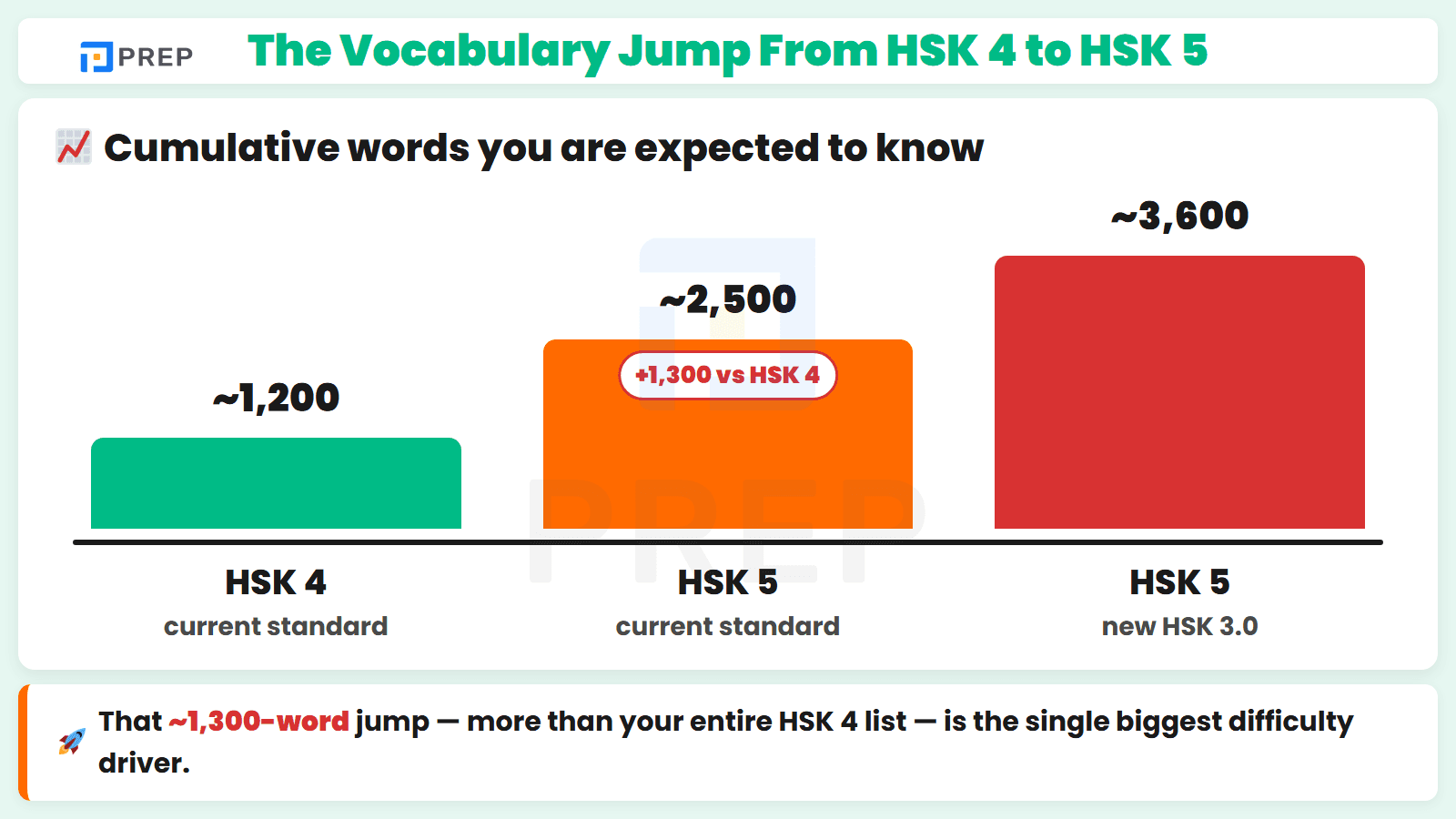
HSK 5 Reading is harder than HSK 4, and for one measurable reason above all: it more than doubles the vocabulary you're expected to know. So when it "feels impossible," that's usually a vocabulary-coverage gap, not a comprehension-ability gap, and a coverage gap is something you can close. The numbers make the jump concrete.
1. The Vocabulary Jump From HSK 4 to HSK 5
HSK 5 requires about 2,500 words to HSK 4's roughly 1,200 - that's about 1,300 new words, more than your entire HSK 4 vocabulary - which is the single biggest reason Reading suddenly feels hard [1].
Think about what that means inside a passage. At HSK 4, you meet the occasional unknown word and read around it. At HSK 5, unknown words cluster, and a sentence carrying two or three of them stops being guessable. This is countable and fixable, though: you know exactly how many words stand between you and full coverage, which is why Section IV leads with vocabulary.
Vocabulary isn't the only thing that changes, though.
2. HSK 5 vs. HSK 4 Reading: What Actually Changes
The jump isn't only more words. Passages get longer and more abstract while the clock stays fixed at 45 minutes, so the same reading speed now covers less ground.
|
Dimension |
HSK 4 Reading |
HSK 5 Reading |
|
Passage length |
Short, concrete |
Longer, multi-paragraph |
|
Topic and abstraction |
Everyday, literal |
Cultural, scientific, abstract |
|
Question style |
Mostly detail |
Detail, main idea, and tone |
|
Time pressure |
Manageable |
About one minute per question |
|
Vocabulary |
~1,200 words |
~2,500 words |
Read down the table and the pattern is clear: every dimension moves in the harder direction at once, which is why HSK 4 graduates feel the step up so sharply. Both levels are also about to shift under HSK 3.0.
VIII. HSK 5 Reading and the New HSK 3.0 (2026): What's Changing
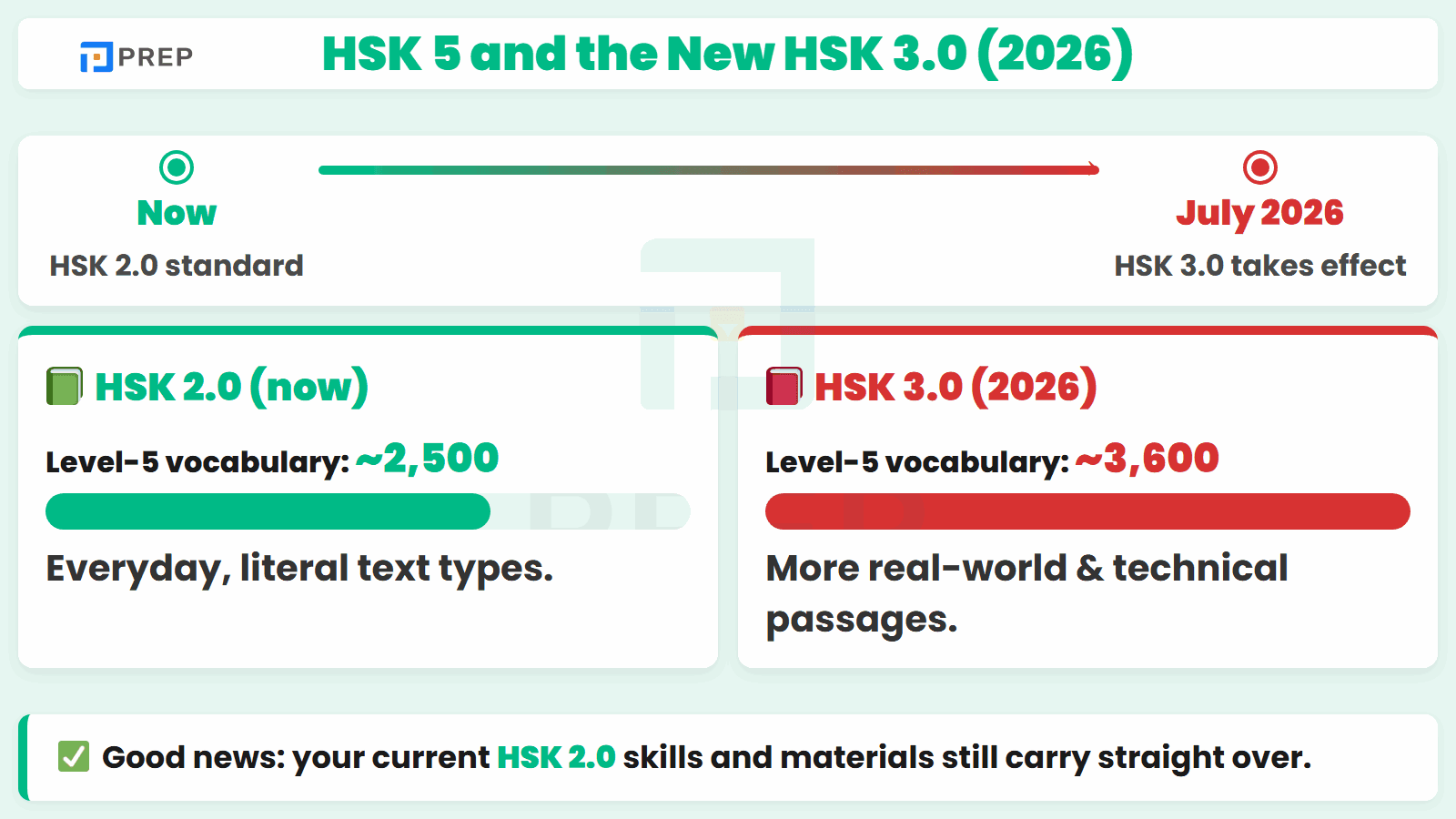
HSK 3.0 raises the vocabulary ceiling and leans toward real-world texts, but it doesn't rewrite what good reading is. The skills you build now transfer; mainly, your word targets go up [2]. Here's what actually changes, and what doesn't.
1. What's New for Reading Under HSK 3.0
Under HSK 3.0, level-5 cumulative vocabulary rises to about 3,600 words and passages lean more toward real-world and technical topics, though the core task - reading Chinese accurately under time - stays the same [2].
Two things are worth separating. The confirmed anchors are the date and the number: the new standard takes effect in July 2026, and level 5 moves to roughly 3,600 cumulative words [2]. The looser, qualitative shift is toward more practical, real-world, and technical texts. Anyone quoting an exact new question split for Reading is guessing, because that hasn't been locked down the way the vocabulary figure has.
That raises the obvious worry: is your current material now useless?
2. Are Your Current HSK 2.0 Materials Still Useful?
Yes - your HSK 2.0 materials are still useful. Core reading skills, grammar, and most vocabulary carry straight over; you mainly add words and read more real-world texts to reach the 3.0 target.
Nothing about how you read Chinese, whether it's parsing a sentence, spotting a paraphrase, or scanning for a detail, changes with a new syllabus. What changes is the size of the word list and the flavor of the passages. So don't throw anything away. Keep your 2.0 materials for skill-building, and add two things: more vocabulary toward the 3,600 mark, and more real-world reading such as news and practical texts to match the new topic mix.
For everything else people ask, here are the direct answers.
IX. FAQ: HSK 5 Reading
Most of these questions cluster around scoring and eligibility. The thread connecting them: because there's no per-section pass, your Reading points are simply fungible into the 180-point total.
1. How Is the HSK 5 Score Calculated?
The HSK 5 test has three sections - Listening, Reading, and Writing - worth 100 points each, for 300 total [1]. Your Reading score is your raw Reading result scaled into that 100-point band, and the three sections add up to your final score.
2. What Is a Good HSK 5 Score, and What Is the Passing Score?
The passing score is 180 out of 300 [1]. A comfortable score is roughly 240 or above, but any total at or above 180 is an official pass, so aim past the line rather than at it.
3. Is There a Separate Passing Score for the Reading Section?
No. There is no per-section minimum on HSK 5; only the 180 out of 300 total counts, so a strong Reading score can offset a weaker Listening or Writing section. Play to your strengths across the whole test.
4. How Many Words Do I Need to Know for HSK 5 Reading?
About 2,500 words cumulatively for HSK 5 under the current standard, rising to roughly 3,600 under HSK 3.0 [1][2]. Reading draws on the same word list as the rest of the exam, so there's no separate "reading vocabulary" to learn.
5. How Much Does It Cost to Take the Official HSK 5 Test?
The HSK 5 fee varies by country and test center, often somewhere around US$30 to US$75. Check your official or authorized test center for the exact local price, since fees and currencies differ by location.
6. Who Should Take the HSK 5 Test?
HSK 5 suits upper-intermediate learners - typically people applying to Chinese universities or scholarships, or using Mandarin at work, who have moved comfortably past HSK 4. If you can read short articles with only occasional help, you're in range.
7. How Long Does It Take to Prepare for HSK 5 After HSK 4?
Most learners need several months of consistent study after HSK 4, mainly to absorb the roughly 1,300 extra words. The exact time depends on your daily study hours and how much Chinese you already read, so treat any single number with caution.
8. Can I Still Use My HSK 2.0 Materials After the 2026 Change?
Yes - core reading skills and most vocabulary carry over to HSK 3.0. You mainly add words toward the higher target and read more real-world texts. Your current materials aren't wasted; they're your foundation.
X. Your HSK 5 Reading Action Plan
The order matters more than any single tactic here. Understand the format before you drill, and build vocabulary before you chase speed, because speed without coverage just fails faster.
Here's the sequence, start to finish:
- Learn the three-part format so you know what each part tests (Section II).
- Work through the sample questions until the reasoning, not the answer, is what you remember (Section III).
- Build vocabulary in context toward the 2,500-word target, reading real Chinese daily (Section IV).
- Drill under the clock with the skim/scan, part-order, and skip rules (Section V).
- Use curated materials and track your errors by cause, so review actually fixes patterns (Sections VI and IV).
If you'd like that timed, explained practice in one place, Prep is building an AI-powered Chinese and HSK program - with exam-simulating Test Practice, AI pronunciation feedback on initials, finals, and tones, and a personalized study path - coming soon for English-speaking learners. Until it arrives, the plan above works with any honest materials you already have. Begin with the format, and let each step earn the next.
References
- [1] HSK 5 Reading format, question counts, timing, and 180 out of 300 scoring - the official HSK standard administered by Chinese Testing International under the Center for Language Education and Cooperation (formerly Hanban). Figures current for 2026 under the HSK 2.0 standard; confirm exact details on the official site. chinesetest.cn
- [2] HSK 3.0 nine-level standard - Chinese Proficiency Grading Standards for International Chinese Language Education (GF0025-2021), issued by China's Ministry of Education and National Language Commission; new-standard testing effective July 2026.

Hi I'm Chloe, and I am currently serving as an Product Content Administrator at Prep Education. With over five years of experience in independent online IELTS study and exam preparation, I am confident in my ability to support learners in achieving their highest possible scores.
Comment
Premium content
View all
Personalized roadmap


Most read


UEN: 202227322W
Address: 114 LAVENDER STREET, #11-83 CT HUB 2, SINGAPORE (338729)