Mastering HSK 3: Structure, Key Vocabulary & Smart Preparation Guide
If you're working toward fluency in Mandarin Chinese, the HSK 3 exam is a solid stepping stone in your journey. It marks a crucial shift from beginner to lower-intermediate proficiency under the Chinese Proficiency Test (HSK) system. This guide will walk you through everything you need to understand about HSK 3, from test structure, vocabulary, and grammar rules to practical preparation tips — aligning with the requirements of the new HSK 3.0 standard.
- I. What is HSK 3?
- II. Benefits of the HSK 3 Certificate
- III. Who Should Take the HSK 3 Exam?
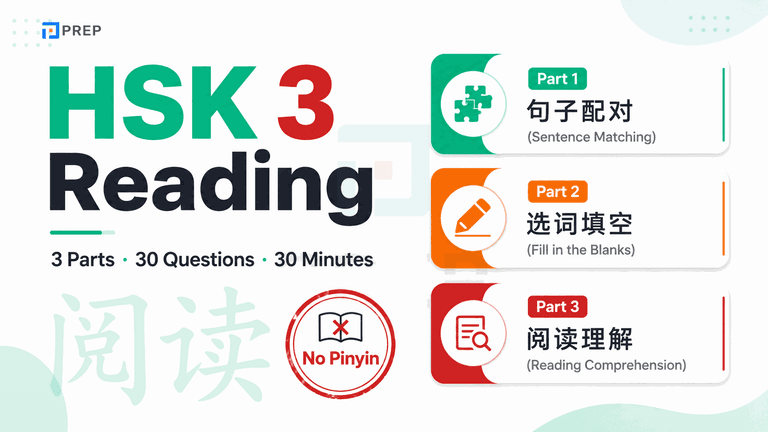
- IV. Structure of the HSK 3 Exam
- V. HSK 3 Scoring System
- VI. HSK 3 Exam Fees
- VII. HSK 3 Vocabulary
- VIII. HSK 3 Grammar
- 1. Types of Complements
- 2. Prepositions and How to Use Them in Sentences
- 3. Degree Adverbs
- 4. Structure: The More A, the More B (越 A 越 B)
- 5. Structure: Increasingly + Adjective (越来越 + Adj)
- 6. Structure: Both… and… (又 + Adj + 又 + Adj)
- 7. Structure: Doing Two Actions Simultaneously (一边 V 一边 V)
- 8. Structure: As Soon As… Then… (V1 + 了 + [O] + 就 + V2…)
- 9. Structure: Place + V + 着 + Quantity + Noun
- 10. Structure: V1 + 着 + (O1) + V2 + (O2)
- IX. How to Effectively Prepare for HSK 3 at Home and Score High
- XI. Conclusion

I. What is HSK 3?
HSK 3 is the third level of the Hanyu Shuiping Kaoshi (HSK), China’s national Mandarin proficiency test for non-native speakers. It assesses your ability to communicate in everyday situations using simple and compound sentence structures.
At this level, learners are expected to know approximately 600 Chinese words and related grammar patterns. HSK 3 is ideal for those who have completed about 150 hours of formal study and intend to reach CEFR level A2/B1.
Below is the HSK 3 Knowledge Scope within the 9-Level HSK Framework:
|
Syllables |
Characters |
Vocabulary |
Grammar Points |
Handwritten Characters |
|
|
Total |
608 |
900 |
2,245 |
210 |
300 |
|
New Content |
140 |
300 |
973 |
81 |
100 |
Skills
Listening
-
Learners can understand the content of daily conversations or short speeches (up to 300 words) using long simple sentences and basic compound sentences.
Speaking
-
Learners can use HSK 3 vocabulary and grammar to interact on various topics.
-
They are able to communicate and engage in discussions using moderately complex sentence structures.
Reading
-
Able to read required syllables, vocabulary, and characters.
-
Able to comprehend short texts (up to 300 characters) on familiar or required topics.
-
Able to understand simple compound sentences.
Writing
-
Learners can write and confidently use 300 characters from the designated handwriting character list.
II. Benefits of the HSK 3 Certificate
Passing the HSK 3 exam opens several practical and academic doors for learners and professionals alike. It establishes that you possess a functional command of daily Chinese, which carries increasing value in today’s global economy and cultural exchange.
Specifically, holding an HSK 3 certificate qualifies you for:
-
Admission into Chinese language programs at universities and academies that require proof of foundational Mandarin skills. It demonstrates your readiness to participate in academic environments where basic communication in Chinese is expected.
-
Enhanced career opportunities with international companies, especially those operating in or with China, Taiwan, or Singapore. When employers perceive your ability to interact with colleagues, clients, or partners in basic Chinese, it often boosts your candidacy for regional roles or overseas assignments.
-
Scholarships and visa support, as HSK 3 is recognized by institutions that offer Chinese government scholarships (e.g., CSC scholarships) and by consulates that require language proof for educational or long-stay visa applications. This official credential adds weight to your dossier when seeking funding or international study opportunities.
-
A measurable personal milestone, giving you not only proof of your language abilities but also motivating fuel to reach higher levels like HSK 4 or 5. As your real-world communication becomes easier, this exam becomes much more than a certificate — it’s a turning point in your language journey.
In essence, HSK 3 is a strong signal that you're no longer a beginner. You can read and write simple texts, hold short conversations, and continue progressing toward fluency with confidence.
III. Who Should Take the HSK 3 Exam?
HSK level 3 is tailored for learners who:
-
Have mastered the basics of Mandarin and can handle daily conversations.
-
Can understand and form short paragraphs involving descriptions, questions, and routine instructions.
-
Are aiming to prepare for intermediate levels like HSK 4 or transitioning to the new HSK 3.0 framework.
If you’re able to listen, speak, and read simple texts with some fluency, you’re ready for HSK 3.
IV. Structure of the HSK 3 Exam
The HSK 3 exam is a paper-based or internet-based test, lasting about 90 minutes, including 5-minute student information filling time.
It consists of three main sections:
|
Section |
Part |
No. of Questions |
Description |
|
Listening |
Part 1 |
10 questions |
You will hear short dialogues and see several images. Choose the picture that matches what you hear. |
|
Part 2 |
10 questions |
Listen to a short conversation followed by a statement. Decide whether the statement is true or false. |
|
|
Part 3 |
10 questions |
Listen to a 2-sentence conversation between two people, followed by a question. Choose the correct answer from the three options given. |
|
|
Part 4 |
10 questions |
A longer conversation (4–5 sentences) will be played. Select the correct answer based on what you hear. |
|
|
Reading |
Part 1 |
10 questions |
Match 20 sentences into 10 logical pairs based on grammar, context, and meaning. This section tests your understanding of sentence structure and logical flow. |
|
Part 2 |
10 questions |
Fill in the blanks: Five individual sentences and five mini-dialogues require you to select suitable words to complete the meaning. |
|
|
Part 3 |
10 questions |
Read ten short passages (2–3 sentences each). Then answer one multiple-choice question per passage. |
|
|
Writing |
Part 1 |
5 questions |
Sentence ordering: Rearrange scrambled words into correct and meaningful simple sentences. Grammar knowledge is essential. |
|
Part 2 |
5 questions |
Character writing: Given the Pinyin and context, you must write the correct Chinese characters to complete the sentence. |
There is no speaking component in this version, although HSKK (spoken HSK) is available separately.
V. HSK 3 Scoring System
HSK 3 has a total score of 300 points, distributed evenly across the three sections:
|
Section |
Listening |
Reading |
Writing |
Total Score |
Pass Mark |
|
Score Allocation |
100 |
100 |
100 |
300 |
180 |
|
Number of Questions |
40 |
30 |
10 |
||
|
Points per Question |
2.5 |
3.3 |
10 |
||
|
Test Duration |
40 minutes |
30 minutes |
15 minutes |
A score of 180 or higher (60%) is considered a passing grade. Institutions or employers may set their own cutoffs for acceptance.
VI. HSK 3 Exam Fees
Exam fees vary slightly depending on the country and local test center but generally range between USD $30–50.
It’s best to check with your local Confucius Institute or authorized HSK test center for current pricing and registration deadlines.
VII. HSK 3 Vocabulary
The HSK 3 vocabulary list includes about 600 words, building on the 300 words from HSK 1 and HSK 2. This forms the essential core for communicating simple ideas with improved fluidity.
|
Chinese |
Pinyin |
Meaning |
Example Sentence |
|
安静 |
ānjìng |
quiet, peaceful |
请安静一点,图书馆里不能大声说话。 |
|
办法 |
bànfǎ |
method, way |
我们需要想一个解决问题的办法。 |
|
矮 |
ǎi |
short (height) |
他比我矮一点,但是跑得很快。 |
|
比较 |
bǐjiào |
relatively |
今天的天气比较凉快,适合散步。 |
|
迟到 |
chídào |
to be late |
他每天上课都不迟到,很守时。 |
|
打扫 |
dǎsǎo |
to clean |
妈妈让我帮忙打扫房间。 |
|
地方 |
dìfang |
place |
这个地方我以前来过,很熟悉。 |
|
爬山 |
páshān |
climb a mountain |
周末我们去郊区爬山吧! |
|
附近 |
fùjìn |
nearby |
学校附近有一家很好吃的饭店。 |
|
干净 |
gānjìng |
clean |
你的衣服看起来很干净,洗过了吗? |
|
放心 |
fàngxīn |
to feel relieved |
你放心,我一定准时完成任务。 |
|
发烧 |
fāshāo |
to have a fever |
昨天我发烧了,今天好多了。 |
|
国家 |
guójiā |
country |
你想去哪个国家留学? |
|
黑板 |
hēibǎn |
blackboard |
老师在黑板上写了很多生词。 |
|
花 |
huā |
flower |
这朵花真漂亮,是你送给我的吗? |
|
换 |
huàn |
to change, exchange |
我想把这件衣服换一件大一点的。 |
|
简单 |
jiǎndān |
simple |
他的中文很简单但是很清楚。 |
|
健康 |
jiànkāng |
health; healthy |
运动是保持健康的好方法。 |
|
节目 |
jiémù |
program |
你最喜欢看哪个电视节目? |
|
结束 |
jiéshù |
to end, finish |
比赛在五点钟结束。 |
|
举行 |
jǔxíng |
to hold (event) |
学校将于明天举行运动会。 |
|
渴 |
kě |
thirsty |
我太渴了,想喝点水。 |
|
空调 |
kōngtiáo |
air conditioner |
太热了,快把空调打开吧。 |
|
留学 |
liúxué |
to study abroad |
他打算去中国留学一年。 |
|
邻居 |
línjū |
neighbor |
我的邻居每天早上都会跟我打招呼。 |
|
马上 |
mǎshàng |
immediately |
我马上就到,请再等我五分钟。 |
|
盘子 |
pánzi |
plate |
桌子上有三个盘子,你拿一个去吧。 |
|
清楚 |
qīngchu |
clear |
你说得很清楚,我都明白了。 |
|
热情 |
rèqíng |
warm, enthusiastic |
她是一个非常热情的人,总是帮助别人。 |
|
散步 |
sànbù |
to take a walk |
饭后我喜欢去公园散步。 |
Whether you're following the HSK 3 list, working through flashcards, or downloading the HSK 3 vocab list, mastering this set is non-negotiable for exam success.
If you’re studying the HSK 3 600 words, focus on multiple exposures through listening, usage, and writing, not just memorization.
VIII. HSK 3 Grammar
To confidently pass the HSK 3 exam, you must master a set of foundational grammar patterns. These include result complements, prepositions, degree adverbs, and core sentence structures. Below is your complete HSK 3 grammar guide with clear explanations and practical examples.
1. Types of Complements
Complements help complete the meaning of a verb. Here are the main types you need to know:
Result Complements
Used to indicate the outcome or result of an action.
|
Form |
Structure |
Example |
|
Affirmative |
Subject + Verb + Complement + Object |
我找到你的眼镜了。 Wǒ zhǎodào nǐ de yǎnjìng le I found your glasses. |
|
Negative |
Subject + 没(有) + Verb + Complement + Object |
我没做完今天的作业。 Wǒ méi zuò wán jīntiān de zuòyè I haven’t finished today’s homework. |
|
Interrogative |
Verb + Complement + Object + 了吗? / 了没有? |
妈妈做好今晚的饭了吗? Māmā zuò hǎo jīnwǎn de fàn le méiyǒu? Has mom finished dinner yet? |
Degree Complements
Used to show how well or to what extent the action is performed.
|
Usage |
Structure |
Example |
|
Without object (affirmative) |
S + V + 得 + Adj |
他跑得很快。 Tā pǎo de hěn kuài He runs very fast. |
|
With object (affirmative) |
S + O + V + 得 + Adj |
我英文学得很好。 Wǒ Yīngwén xué de hěn hǎo I study English well. |
|
Without object (negative) |
S + V + 得 + 不 + Adj |
他说得不快。 Tā shuō de bù kuài He doesn’t speak fast. |
|
With object (negative) |
S + O + V + 得 + 不 + Adj |
我英文学得不好。 Wǒ Yīngwén xué de bù hǎo I don’t study English well. |
|
Question (no object) |
S + V + 得 + Adj + 吗? or …不…? |
你说得对吗? Did you say it right? 今天你起得早不早? Did you wake up early today? |
|
Question (with object) |
S + O + V + 得 + Adj + 吗? |
你做饭做得好吃吗? Nǐ zuò fàn zuò de hào chī ma? Does your cooking taste good? |
Potential Complements
Used to express whether an action can or cannot be completed.
|
Form |
Structure |
Example |
|
Affirmative |
S + V + 得 + Complement + O |
我看得很清楚你写的汉字。 Wǒ kàn de hěn qīngchǔ nǐ xiě de Hànzì I can clearly read the Chinese characters you wrote. |
|
Negative |
S + V + 不 + Complement + O |
我找不到我的男朋友了。 Wǒ zhǎo bù dào wǒ de nán péngyǒu le I can’t find my boyfriend. |
|
Interrogative |
Option 1: …得…–不–…? Option 2: …得… + 吗? |
你找得到找不到我的眼镜? Can you find my glasses or not? 你找得到我的眼镜吗? Can you find my glasses? |
2. Prepositions and How to Use Them in Sentences
Prepositions describe relationships between people, places, or actions. You’ll also see key constructions like 被 (passive) and 把 (shift focus to the object).
Common Prepositions
|
Preposition |
Structure |
Example |
|
给 (for someone) |
S + 给 + N/Pronoun + V + O |
我给你买咖啡。 Wǒ gěi nǐ mǎi kāfēi I bought coffee for you. |
|
跟 (with) |
A 跟 B (一起) + V + O |
我和老朋友一起去书店。 Wǒ gēn lǎo péngyǒu yīqǐ qù shūdiàn My friend and I went to the bookstore together. |
|
对 (toward) |
A 对 B + Verb/Adj |
他对我非常好。 Tā duì wǒ fēicháng hǎo He treats me very well. |
Passive Sentence with 被
|
Structure |
Example |
|
S + 被 (+ 让/叫) + O + V + rest |
我被妈妈打了。 Wǒ bèi māmā dǎ le I got hit by mom. |
The 把 Sentence Structure
|
Intended Effect |
Structure |
Example |
|
Basic focus on object |
S + 把 + O + V |
你把面包吃吧! Eat the bread! |
|
Change of location |
S + 把 + O + 放 / 搬 + 在 / 进… + place |
我把衣服放进行李箱了。 I put the clothes into the suitcase. |
|
Giving or transferring |
S + 把 + O + 给 + Pronoun |
我把钱还给哥哥了。 I gave the money back to my brother. |
|
Using result complement |
S + 把 + O + V + result |
你把水果洗干净吧。 Wash the fruit clean. |
|
With direction complement |
S + 把 + O + V + 来 / 去 |
你把水果拿过来。 Bring the fruit here. |
3. Degree Adverbs
Used to show the extent of an adjective.
|
Structure |
Example |
|
很 / 非常 / 特别 / 真 / 不太 + Adj |
很好! Hěn hǎoVery good! 非常喜欢。 Fēicháng xǐhuān Really like it! |
|
Adj + 极了 |
我累极了。 Wǒ lèi jí le I’m extremely tired. |
|
太 + Adj + 了 |
太好了! Tài hǎo le That’s great! |
4. Structure: The More A, the More B (越 A 越 B)
Indicating gradual increase as A changes, B changes too.
|
Structure |
Example |
|
越 A 越 B |
那辆车越跑越快。 Nà liàng chē yuè pǎo yuè kuài The more the car ran, the faster it got. |
5. Structure: Increasingly + Adjective (越来越 + Adj)
Expresses steady progress or change.
|
Structure |
Example |
|
Subject + 越来越 + Adj. |
那辆车越来越快。 Nà liàng chē yuè lái yuè kuài The car is getting faster and faster. |
6. Structure: Both… and… (又 + Adj + 又 + Adj)
Describes multiple qualities at once.
|
Structure |
Example |
|
Subject + 又 + Adj1 + 又 + Adj2 |
我的妹妹又聪明又可爱。 Wǒ de mèimei yòu cōngmíng yòu kě’ài My little sister is both smart and cute. |
7. Structure: Doing Two Actions Simultaneously (一边 V 一边 V)
Used to say you’re doing two things at the same time.
|
Structure |
Example |
|
一边 + V1 + 一边 + V2 |
我男朋友一边说一边笑。 Wǒ nán péngyǒu yībiān shuō yībiān xiào My boyfriend talks while laughing. |
8. Structure: As Soon As… Then… (V1 + 了 + [O] + 就 + V2…)
Used to express two actions occurring in quick sequence.
|
Structure |
Example |
|
S + V1 + 了 + (O) + 就 + V2 |
我回了家就睡觉。 Wǒ huí le jiā jiù shuìjiào As soon as I got home, I went to sleep. |
9. Structure: Place + V + 着 + Quantity + Noun
Describes that something exists or is placed in a location.
|
Structure |
Example |
|
[Location] + Verb + 着 + Number + Noun |
桌子上放着一杯茶。 Zhuōzi shàng fàngzhe yī bēi chá There’s a cup of tea on the table. |
10. Structure: V1 + 着 + (O1) + V2 + (O2)
Describes doing one action while performing another (simultaneously or as a manner).
|
Structure |
Example |
|
V1 + 着 + (O1) + V2 + (O2) |
我站着等她。 Wǒ zhànzhe děng tā I stood waiting for her. |
Mastering these sentence models is key not just for passing the exam but for achieving functional fluency.
IX. How to Effectively Prepare for HSK 3 at Home and Score High
Self-study is a powerful option if organized properly. Here’s a simple method to structure your at-home preparation:
-
Set weekly goals based on the HSK 3 vocabulary and grammar topics.
-
Practice all three skills, especially writing — frequently overlooked.
-
Simulate real test conditions bi-weekly using mock exams.
-
Listen daily: Exposure to native speeds via slow podcasts or graded readers helps improve auditory familiarity.
-
Use spaced repetition apps like Anki for the HSK 3 vocab list to enhance retention.
-
Don’t forget to review previous HSK levels—it reinforces foundational grammar and words you’ll still encounter.
XI. Conclusion
Reaching HSK level 3 proficiency is an impressive goal and a clear signal of commitment to learning Mandarin. Whether you're studying alone or with a tutor, knowing the structure, mastering the HSK 3 vocab, and practicing the required sentence patterns will lead you to success.
Build your future fluency, one character at a time — and let HSK 3 be your next milestone.

Hi I'm Chloe, and I am currently serving as an Product Content Administrator at Prep Education. With over five years of experience in independent online IELTS study and exam preparation, I am confident in my ability to support learners in achieving their highest possible scores.
Comment
Premium content
View all


Personalized roadmap


Most read

UEN: 202227322W
Address: 114 LAVENDER STREET, #11-83 CT HUB 2, SINGAPORE (338729)