各種姿勢英文大全:拍照、瑜珈、游泳、睡姿、重訓完整詞彙指南
「姿勢英文」有 6 個核心詞彙:posture(習慣性體態)、pose(擺出的特定姿勢)、position(位置姿位)、stance(站姿)、form(動作形式)和 alignment(身體對齊)。中文的「姿勢」一個詞,在英文中依語境分屬不同的詞彙。
本文依 7 個生活場景整理超過 60 個姿勢英文詞彙:基本身體姿勢 12 個、拍照姿勢 12 個英文指令、游泳 6 種泳式(含 freestyle vs front crawl 的差異)、14 個瑜珈姿勢附梵文名稱、8 種睡覺姿勢附健康建議、10 個健身與重量訓練姿勢要點,以及現代人最常見的不良姿勢症狀英文對照。
I. 「姿勢英文」有哪幾種說法?核心詞彙
中文的「姿勢」一個詞,在英文中對應 6 個不同的詞彙,每個有它的語境歸屬。 先搞清楚這 6 個詞的差異,後面所有姿勢英文詞彙就都有了清楚的歸類依據。
|
姿勢英文詞彙 |
核心語義 |
使用語境 |
例句 |
|
Posture |
體態、習慣性姿勢 |
健康、日常、醫學 |
Good posture prevents back pain.(良好的體態能預防背痛。) |
|
Pose |
擺出的特定姿勢 |
攝影、瑜珈、表演 |
Strike a pose for the camera.(對著鏡頭擺個姿勢。) |
|
Position |
位置、姿位(通用) |
睡眠、運動、廣泛用途 |
What sleeping position do you prefer?(你喜歡什麼睡姿?) |
|
Stance |
站姿(尤其是運動或比喻) |
運動、辯論、態度 |
His batting stance is perfect.(他的打擊站姿非常標準。) |
|
Form |
動作形式(正確的運動姿勢) |
運動、健身、游泳 |
Keep your form when doing squats.(深蹲時注意保持正確動作。) |
|
Alignment |
身體對齊 / 排列 |
瑜珈、物理治療、健身 |
Spinal alignment is key in yoga.(脊椎對齊是瑜珈的關鍵。) |
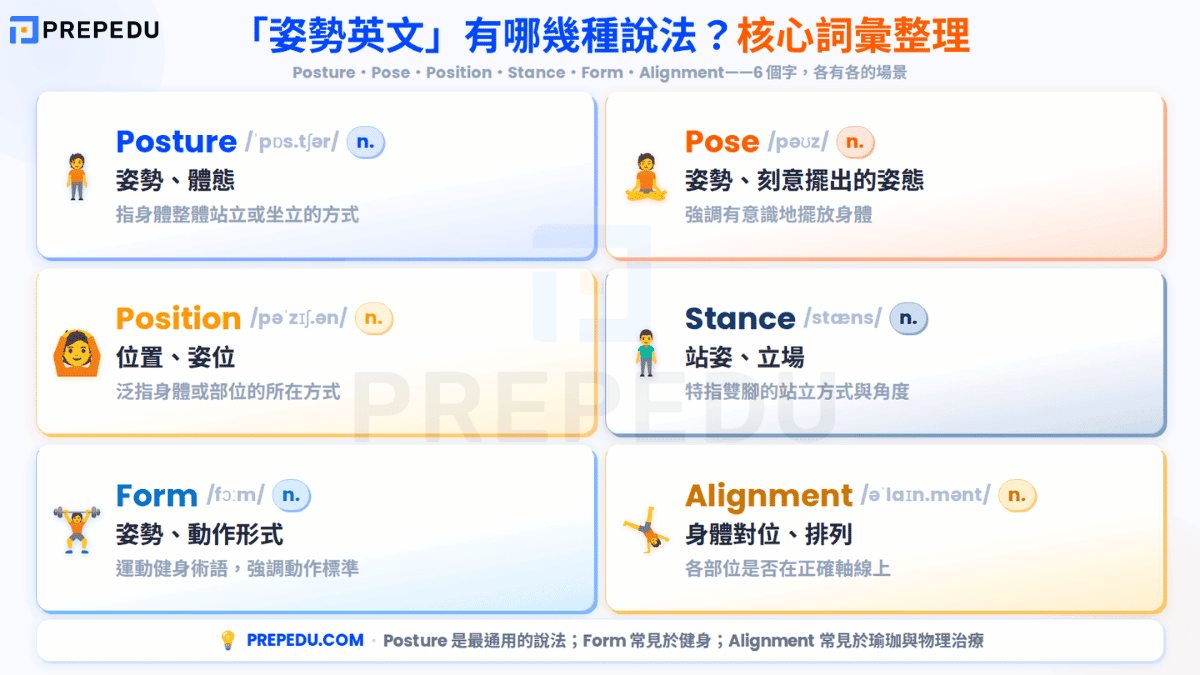
核心分辨口訣:Posture 指習慣性體態;Pose 指刻意擺出的特定姿勢;Position 指位置或姿位;Form 則專指動作是否正確,主要用於運動與健身語境。掌握這四個關鍵字的差異,就能在任何姿勢英文語境中精準選字。
II. 動作姿勢英文單字:日常生活最常見的身體姿勢
以下 7 個生活場景涵蓋台灣學習者最常遇到的姿勢英語情境。
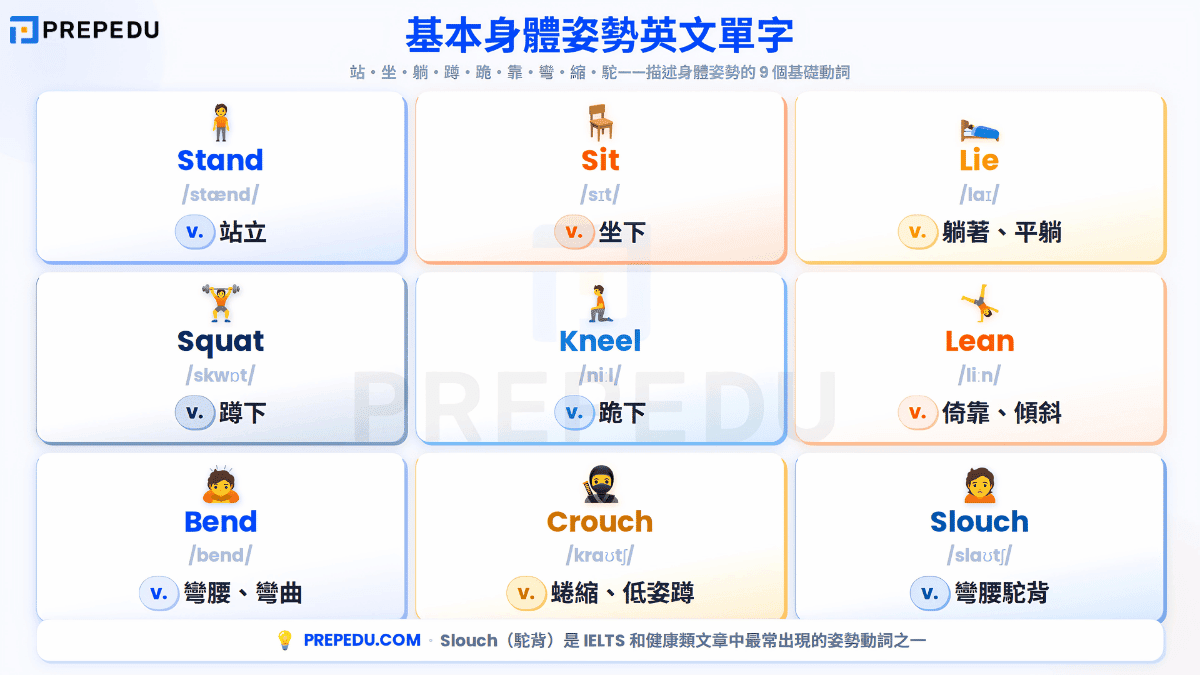
1. 基本身體姿勢英文單字(站、坐、躺、蹲)
|
基本身體姿勢英文單字 |
意義 |
例句 |
|
stand /stænd/ (v.) |
站立 |
Please stand up when the teacher enters the room.(當老師進教室時,請站起來。) |
|
sit /sɪt/ (v.) |
坐 |
She likes to sit by the window and read books.(她喜歡坐在窗邊看書。) |
|
lie /laɪ/ (v.) |
躺 / 臥 |
The doctor told him to lie down on the bed.(醫生叫他躺在床上。) |
|
squat /skwɑːt/ (v.) |
蹲 |
He had to squat down to tie his shoelaces.(他必須蹲下來綁鞋帶。) |
|
kneel /niːl/ (v.) |
跪 |
They had to kneel on the floor during the prayer.(他們在祈禱時必須跪在地上。) |
|
lean /liːn/ (v.) |
靠 / 傾斜 |
Don't lean against the door; it is freshly painted.(不要靠著門,它剛油漆好。) |
|
bend /bend/ (v.) |
彎腰 / 彎曲 |
You need to bend your knees when lifting heavy boxes.(搬重箱子時,你需要彎曲膝蓋。) |
|
crouch /kraʊtʃ/ (v.) |
蹲伏 / 蜷縮 |
The cat crouched in the grass, watching the bird.(貓咪蹲伏在草叢中,注視著那隻鳥。) |
|
slouch /slaʊtʃ/ (v.) |
駝背 / 無精打采地坐立 |
Avoid slouching at your desk to prevent back pain.(在書桌前避免駝背,以防止背痛。) |
|
recline /rɪˈklaɪn/ (v.) |
斜躺 / 靠背 |
He chose to recline on the sofa after a long day.(在漫長的一天後,他選擇斜躺在沙發上。) |
|
bow /baʊ/ (v.) |
鞠躬 |
It is customary to bow when greeting people in Japan.(在日本,與人打招呼時鞠躬是種習俗。) |
|
prostrate /ˈprɑːstreɪt/ (v. / adj.) |
俯伏 / 倒下 |
The monks lay prostrate on the temple floor.(僧侶們俯伏在寺廟的地板上。) |
|
sprawl /sprɔːl/ (v.) |
四肢攤開地躺 / 坐 |
The exhausted runner sprawled out on the grass.(筋疲力盡的跑者四肢攤開地躺在草地上。) |
|
stretch /stretʃ/ (v.) |
伸展 |
You should stretch your legs after sitting at your desk for two hours.(在書桌前坐了兩個小時後,你應該伸展一下雙腿。) |
|
arch /ɑːrtʃ/ (v.) |
弓起背部 |
Yoga instructors often tell practitioners to arch their backs during the Cow Pose.(瑜珈老師經常叫練習者在做牛式時拱起他們的背部。) |
|
curl up (phr.v.) |
蜷縮成一團 |
On rainy days, she likes to curl up on the sofa with a hot cup of tea.(下雨天時,她喜歡蜷縮在沙發上,手裡拿著一杯熱茶。) |
|
hunch /hʌntʃ/ (v.) |
弓背;縮著身子 |
Try not to hunch your shoulders when you are driving or typing.(開車或打字時,盡量不要弓著肩膀。) |
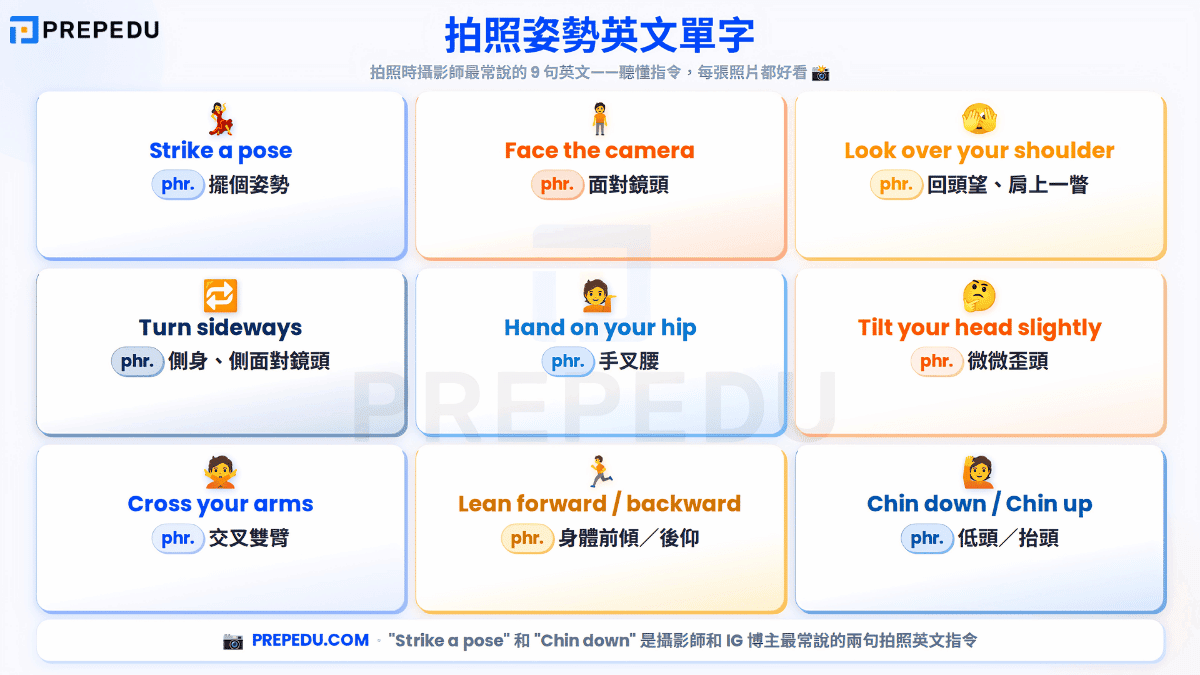
2. 拍照姿勢英文單字
|
拍照姿勢英文單字 |
中文意思 |
例句 |
|
Strike a pose |
擺個姿勢 |
Okay, strike a pose — look natural!(好,擺個姿勢——看起來自然一點!) |
|
Face the camera |
面向鏡頭 |
Face the camera and smile.(面向鏡頭然後微笑。) |
|
Look over your shoulder |
回頭看(回望) |
Now look over your left shoulder.(現在看你的左肩後方。) |
|
Turn sideways |
側身 |
Turn sideways to me — show your profile.(側面對我——讓我看你的側臉。) |
|
Hand on your hip |
把手放在腰上 |
Put your right hand on your hip and relax.(把右手放在腰上,然後放鬆。) |
|
Tilt your head slightly |
頭稍微歪一邊 |
Tilt your head slightly to the left.(頭輕輕向左歪。) |
|
Cross your arms |
交叉雙臂 |
Cross your arms and look confident.(交叉雙臂,展現自信感。) |
|
Lean forward / backward |
身體前傾/後傾 |
Lean forward just a little bit.(身體稍微向前傾一點。) |
|
Chin down / Chin up |
下巴放低 / 下巴抬高 |
Chin down slightly — perfect.(下巴稍微放低——完美。) |
|
Relax your shoulders |
放鬆肩膀 |
Relax your shoulders — you look tense.(放鬆肩膀——你看起來很緊繃。) |
|
Hold still / Freeze |
保持不動 |
Perfect — hold still!(完美——保持不動!) |
|
Give me a natural smile |
自然地微笑 |
Don't pose — just give me a natural smile.(不要刻意擺姿勢,自然地笑就好。) |
另請參閱這篇文章:
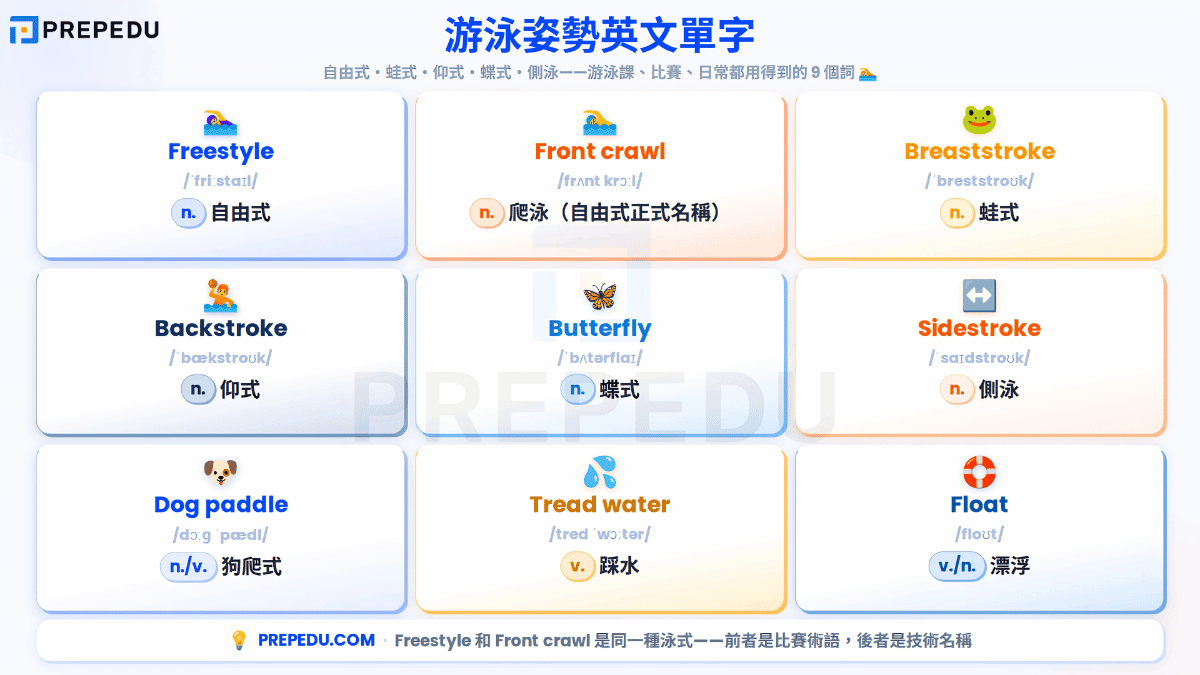
3. 游泳姿勢英文單字
|
游泳姿勢英文單字 |
意義 |
例句 |
|
freestyle /ˈfriːstaɪl/ (n.) |
自由式 |
He won the gold medal in the 100-meter freestyle.(他在100公尺自由式中獲得了金牌。) |
|
front crawl /frʌnt krɔːl/ (n.) |
捷泳(自由式常用泳姿) |
The front crawl is usually the fastest swimming stroke.(捷泳通常是最快的游泳姿勢。) |
|
breaststroke /ˈbreststroʊk/ (n.) |
蛙式 |
The breaststroke requires great coordination of legs and arms.(蛙式需要雙腿和雙臂的高度協調。) |
|
backstroke /ˈbækstroʊk/ (n.) |
仰式 |
She is practicing her backstroke to keep a straight line.(她正在練習仰式以保持直線游動。) |
|
butterfly /ˈbʌtərflaɪ/ (n.) |
蝶式 |
The butterfly stroke burns a lot of calories and requires upper body strength.(蝶式會消耗大量熱量,且需要強大的上肢力量。) |
|
sidestroke /ˈsaɪdstroʊk/ (n.) |
側泳 |
Lifesavers often use sidestroke to rescue people.(救生員經常使用側泳來拯救溺水者。) |
|
dog paddle /dɔːɡ ˈpædl/ (n. / v.) |
狗爬式 |
Children often learn the dog paddle when they first enter the pool.(孩子們剛進泳池時通常會學狗爬式。) |
|
tread water /tred ˈwɔːtər/ (v. phrase) |
踩水(立泳) |
You need to learn how to tread water for safety in deep pools.(為了深水池的安全,你需要學會如何踩水。) |
|
float /floʊt/ (v. / n.) |
漂浮 |
Lie on your back and relax so you can float on the water.(躺平並放鬆,這樣你就能漂浮在水面上。) |
|
glide /ɡlaɪd/ (v. / n.) |
滑行 |
After pushing off the wall, try to glide as far as possible.(蹬牆出發後,試著儘可能滑行得遠一點。) |
|
streamline /ˈstriːmlaɪn/ (n. / adj.) |
流線型姿勢 |
Maintaining a streamline position reduces water resistance.(保持流線型姿勢可以減少水阻。) |
|
dive /daɪv/ (v. / n.) |
跳水 / 潛水 |
No diving is allowed in the shallow end of the swimming pool.(游泳池的淺水區禁止跳水。) |
|
flip turn /flɪp tɜːrn/ (n.) |
觸壁翻轉 |
Mastering the flip turn can significantly improve your lap times in a freestyle race.(精通翻轉轉身可以顯著縮短你在自由式比賽中的每趟時間。) |
|
kick /kɪk/ (n./v.) |
打腿 |
Keep your legs straight and your ankles relaxed when you kick.(打水時,保持雙腿筆直且腳踝放鬆。) |
|
pull /pʊl/ (n./v.) |
划手 |
A strong arm pull is essential for generating forward momentum in the water.(強而有力的手臂划水對於在水中產生前進動力至關重要。) |
|
bilateral breathing /ˌbaɪˈlætərəl ˈbriːðɪŋ/ (n.) |
雙側換氣 |
Bilateral breathing helps swimmers maintain a balanced stroke and prevents shoulder injuries.(兩側換氣有助於游泳者保持平衡的划水動作,並防止肩膀受傷。) |
看更多文章:
4. 瑜珈姿勢英文單字
|
瑜珈姿勢英文單字 |
意義 |
例句 |
|
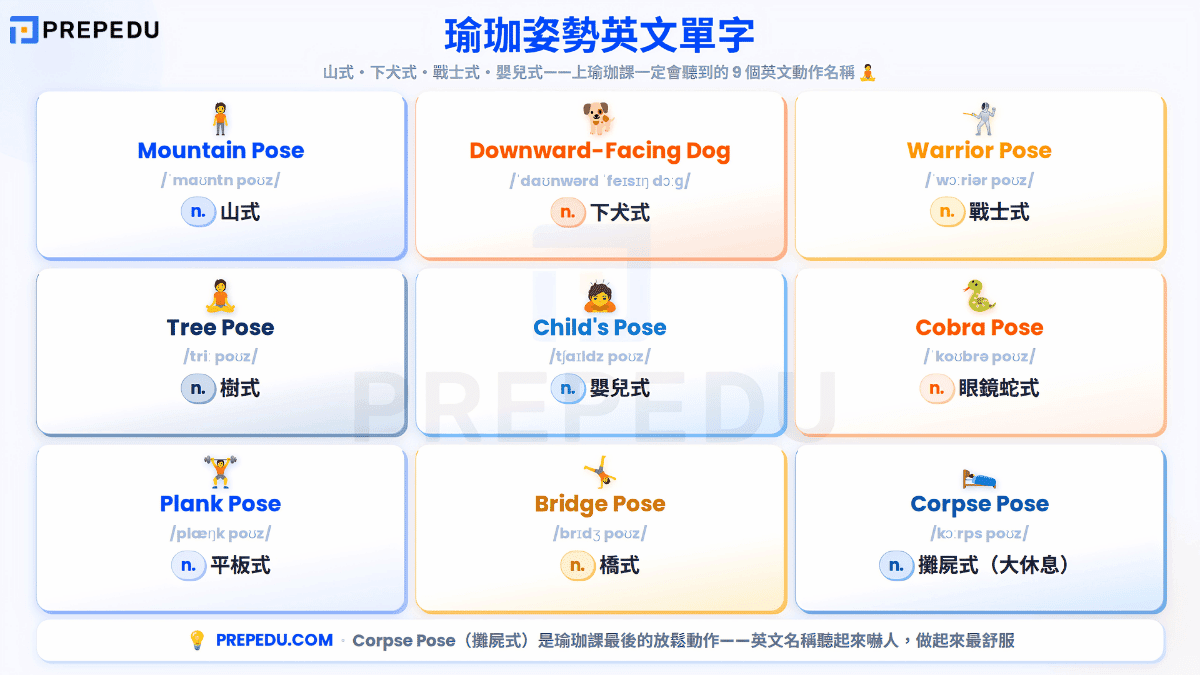
Mountain Pose /ˈmaʊntn poʊz/ (n.) |
山式 |
Mountain Pose helps improve your posture and body awareness.(山式有助於改善你的體態和身體意識。) |
|
Downface Dog /ˈdaʊnwərd f eɪsɪŋ dɔːɡ/ (n.) 全稱 Downward-Facing Dog |
下犬式 |
Downward-Facing Dog is a great stretch for your hamstrings and calves.(下犬式對你的大腿後側肌群和小腿是非常好的伸展。) |
|
Warrior Pose /ˈwɔːriər poʊz/ (n.) |
戰士式 |
Warrior Pose builds strength in your legs and core.(戰士式能建立雙腿和核心的力量。) |
|
Tree Pose /triː poʊz/ (n.) |
樹式 |
You need focus and balance to hold the Tree Pose steady.(你需要專注和平衡才能穩定地保持樹式。) |
|
Child's Pose /tʃaɪldz poʊz/ (n.) |
嬰兒式 |
Rest in Child's Pose whenever you feel tired during the yoga practice.(在瑜珈練習中,只要感到疲倦,就可以在嬰兒式中休息。) |
|
Cobra Pose /ˈkoʊbrə poʊz/ (n.) |
眼鏡蛇式 |
Cobra Pose is effective for opening up the chest and strengthening the spine.(眼鏡蛇式能有效打開胸腔並強化脊椎。) |
|
Plank Pose /plæŋk poʊz/ (n.) |
棒式 / 板式 |
Holding Plank Pose for one minute is great for core conditioning.(保持棒式一分鐘對核心鍛鍊非常有幫助。) |
|
Bridge Pose /brɪdʒ poʊz/ (n.) |
橋式 |
Bridge Pose helps to stretch the chest, neck, and spine.(橋式有助於伸展胸部、頸部和脊椎。) |
|
Corpse Pose /kɔːrps poʊz/ (n.) |
大休息 / 攤屍式 |
Yoga classes usually end with Corpse Pose for deep relaxation.(瑜珈課通常會以大休息結束,以達到深層放鬆。) |
|
alignment /əˈlaɪnmənt/ (n.) |
對齊 / 正位 |
Proper alignment is crucial to prevent injuries in yoga.(正確的正位對於防止瑜珈受傷至關重要。) |
|
flexibility /ˌflekseˈbɪləti/ (n.) |
柔軟度 |
Regular yoga practice can significantly increase your flexibility.(規律的瑜珈練習可以顯著提高你的柔軟度。) |
|
meditation /ˌmedɪˈteɪʃn/ (n.) |
冥想 |
The instructor guided us through a short meditation before the practice.(在練習開始前,指導老師引導我們進行了一段簡短的冥想。) |
|
Cat-Cow Pose /kæt kaʊ poʊz/ (n.) |
貓牛式 |
Cat-Cow Pose is a gentle way to warm up the spine.(貓牛式是暖身脊椎的一種溫和方式。) |
|
Boat Pose /boʊt poʊz/ (n.) |
船式 |
Boat Pose targets and strengthens the abdominal muscles.(船式能針對並強化腹部肌群。) |
|
Crow Pose /kroʊ poʊz/ (n.) |
烏鴉式 |
Crow Pose is a challenging arm balance for intermediate students.(烏鴉式對中階學生來說是一項具挑戰性的手臂平衡動作。) |
|
Chair Pose /tʃer poʊz/ (n.) |
椅子式 |
Hold Chair Pose for a few breaths to build leg endurance.(保持椅子式呼吸幾次,可以鍛鍊腿部耐力。) |
|
Puppy Pose /ˈpʌpi poʊz/ (n.) |
小狗伸展式 |
Puppy Pose is wonderful for opening tight shoulders and the upper back.(小狗伸展式對於打開緊繃的肩膀和上背部非常棒。) |
|
Sphinx Pose /sfɪŋks poʊz/ (n.) |
獅身人面式 |
Sphinx Pose is a gentler alternative to Cobra Pose for back extension.(獅身人面式是代替眼鏡蛇式進行後彎的更溫和選擇。) |
|
Seated Spinal Twist /ˈsiːtɪd ˈspaɪnl twɪst/ (n.) |
坐姿脊椎扭轉式 |
A seated spinal twist helps improve digestion and spine mobility.(坐姿脊椎扭轉式有助於促進消化和提高脊椎靈活性。) |
|
Happy Baby Pose /ˈhæpi ˈbeɪbi poʊz/ (n.) |
快樂嬰兒式 |
Happy Baby Pose is a deeply relaxing stretch for the hips and groin.(快樂嬰兒式是對髖部和鼠蹊部非常放鬆的伸展。) |
|
Pigeon Pose /ˈpɪdʒɪn poʊz/ (n.) |
鴿式 |
Pigeon Pose is an excellent deep stretch to release tension in the hips and glutes.(鴿子式是釋放髖部和臀大肌緊繃的極佳深層伸展。) |
|
Triangle Pose /ˈtraɪæŋɡl poʊz/ (n.) |
三角式 |
Triangle Pose helps to stretch the legs, open the chest, and improve overall balance.(三角式有助於伸展雙腿、打開胸腔,並改善整體平衡。) |
|
Warrior II /ˈwɔːriər tuː/ (n.) |
戰士二式 |
In Warrior II, make sure your front knee is stacked directly over your ankle.(在戰士二式中,確保你的前膝蓋正對齊在腳踝上方。) |
|
Camel Pose /ˈkæməl poʊz/ (n.) |
駱駝式 |
Camel Pose is a deep backbend that should be performed carefully to avoid compressing the lower back.(駱駝式是深層後彎,應小心練習以避免壓迫下背部。) |
|
Fish Pose /fɪʃ poʊz/ (n.) |
魚式 |
Fish Pose is often used as a counter-pose to stretch the neck and open the throat.(魚式常用作反向放鬆動作,用來伸展頸部並打開喉嚨。) |
5. 睡覺姿勢英文單字
|
睡覺姿勢英文單字 |
意義 |
建議 |
例句 |
|
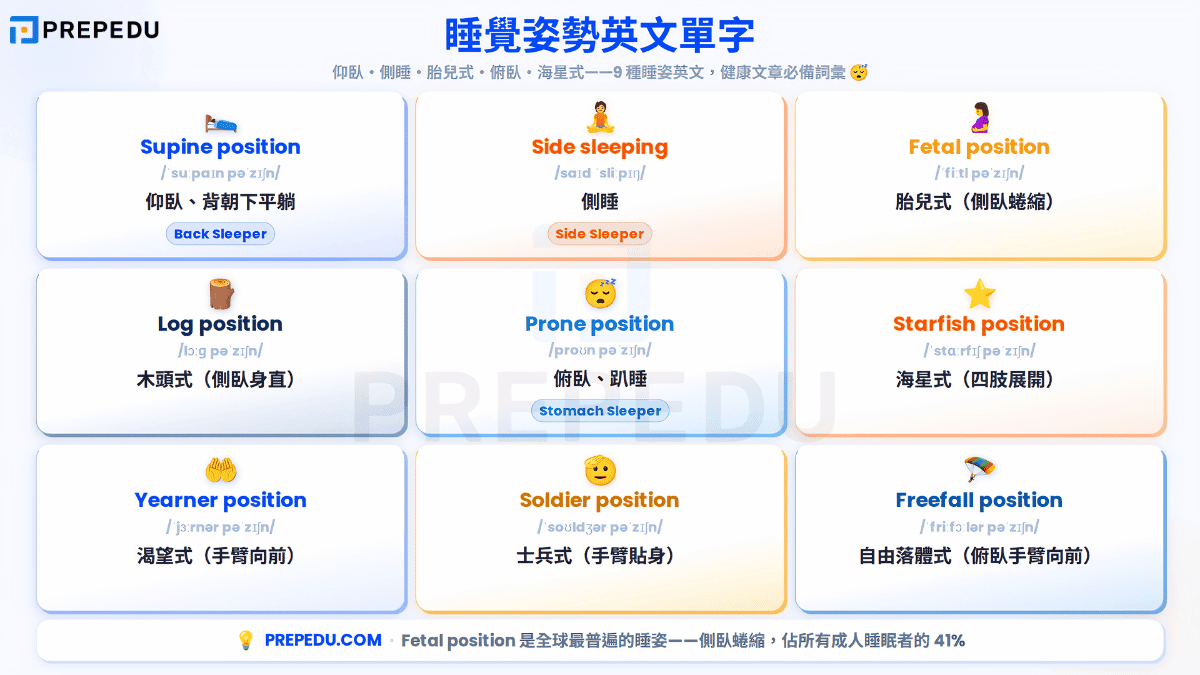
supine position /ˈsuːpaɪn pəˈzɪʃn/ (n.) 或稱 Back Sleeper |
仰睡 / 仰臥 |
建議 |
Sleeping in a supine position keeps your spine aligned and reduces pressure points.(以仰睡姿勢睡覺能保持脊椎對齊並減少壓痛點。) |
|
side sleeping /saɪd ˈsliːpɪŋ/ (n.) 或稱 Side Sleeper |
側睡 / 側臥 |
建議 |
Left-side sleeping is highly recommended for pregnant women to improve circulation.(強烈建議孕婦採取左側睡,以促進血液循環。) |
|
fetal position /ˈfiːtl pəˈzɪʃn/ (n.) |
胎兒式睡姿(蜷縮側睡) |
建議 |
The fetal position is a comfortable side-sleeping variation that reduces snoring.(胎兒式睡姿是一種舒適的側睡變體,能減少打呼。) |
|
log position /lɔːɡ pəˈzɪʃn/ (n.) |
原木式睡姿(直立側睡) |
一般 |
Sleeping in the log position keeps the back straight but can sometimes feel stiff.(以原木式睡姿睡覺能保持背部筆直,但有時會感到僵硬。) |
|
prone position /proʊn pəˈzɪʃn/ (n.) 或稱 Stomach Sleeper |
趴睡 / 俯臥 |
不建議 |
The prone position is not recommended because it strains the neck and lower back.(不建議採取趴睡姿勢,因為它會壓迫頸部和下背部。) |
|
starfish position /ˈstɑːrfɪʃ pəˈzɪʃn/ (n.) |
海星式睡姿(仰睡雙手張開) |
一般 |
The starfish position prevents wrinkles but may increase the likelihood of snoring.(海星式睡姿可以防止皺紋,但可能會增加打呼的機率。) |
|
yearner position /ˈjɜːrnər pəˈzɪʃn/ (n.) |
渴望者睡姿 (側睡雙手前伸) |
一般 |
The yearner position offers the benefits of side sleeping but can pressure the arms.(渴望者睡姿具備側睡的好處,但可能會對手臂造成壓迫。) |
|
soldier position /ˈsoʊldʒər pəˈzɪʃn/ (n.) |
軍人式睡姿(仰睡雙手貼側) |
建議 |
The soldier position is great for neck health, provided you use a supportive pillow.(只要使用有支撐力的枕頭,軍人式睡姿對頸部健康非常棒。) |
6. 健身與重量訓練姿勢英文
|
健身與重量訓練姿勢英文 |
意義 |
例句 |
|
squat /skwɑːt/ (n. / v.) |
深蹲 |
Proper squat form is essential to build lower body strength without hurting your knees.(正確的深蹲姿勢對於建立下半身力量且不傷膝蓋至關重要。) |
|
deadlift /ˈdedlɪft/ (n. / v.) |
硬舉 |
Keep your back flat during a deadlift to avoid serious spine injuries.(硬舉期間請保持背部平直,以避免嚴重的脊椎受傷。) |
|
bench press /bentʃ pres/ (n. / v.) |
臥推 |
A stable bench press requires you to plant both feet firmly on the floor.(穩定的臥推需要你將雙腳牢牢踩在全腳掌地面上。) |
|
overhead press /ˈoʊvərhed pres/ (n. / v.) |
肩推 / 頭上推舉 |
Engage your core during the overhead press to protect your lower back.(進行肩推時要收緊核心,以保護你的下背部。) |
|
lunge /lʌndʒ/ (n. / v.) |
弓步蹲 / 跨步蹲 |
Take a wide step forward when doing a lunge to keep your balance.(做弓步蹲時向前邁出一大步,以保持身體平衡。) |
|
bent-over row /bent ˈoʊvər roʊ/ (n. / v.) |
俯身划船 |
The bent-over row is a fantastic compound exercise for developing back thickness.(俯身划船是發達背部厚度非常棒的複合動作。) |
|
half-squat /hæf skwɑːt/ (n.) |
半蹲 (幅度不足的蹲) |
A half-squat is acceptable for beginners, but a full deep squat activates more muscles.(半蹲對初學者來說是可以接受的,但全深蹲能活化更多肌群。) |
|
ego lifting /ˈiːɡoʊ ˈlɪftɪŋ/ (n. phrase) |
超負荷盲目舉重 (虛榮重量) |
Ego lifting often leads to terrible form and high risk of muscle tears.(盲目追求重量通常會導致糟糕的姿勢,並帶來肌肉撕裂的高風險。) |
|
hyperextension /ˌhaɪpərɪkˈstenʃn/ (n.) |
身體過度伸展 (如腰部過度後彎) |
Avoid hyperextension of your lower back at the top of a deadlift lock-out.(在硬舉頂峰鎖定時,應避免下背部過度後彎。) |
|
push-up /pʊʃ ʌp/ (n./v.) |
伏地挺身 |
Keep your body in a straight line during a push-up to effectively engage your core.(做伏地挺身時,保持身體呈一直線能有效啟動你的核心。) |
|
pull-up /pʊl ʌp/ (n./v.) |
引體向上 |
A proper pull-up requires you to depress your shoulders before pulling yourself up.(正確的引體向上需要你在把自己拉起來之前,先將肩膀下壓。) |
|
hip thrust /hɪp θrʌst/ (n./v.) |
臀推 |
The hip thrust is widely considered one of the best exercises for glute development.(臀推被廣泛認為是發展臀大肌最好的訓練動作之一。) |
|
hip hinge /hɪp hɪndʒ/ (n.) |
髖關節鉸鏈 |
Mastering the hip hinge is necessary before you attempt heavy deadlifts or swings.(在嘗試大重量硬舉或壺鈴擺盪之前,必須先精通髖關節鉸鏈動作。) |
|
neutral spine /ˈnjuːtrəl spaɪn/ (n.) |
脊椎中立 |
Maintaining a neutral spine under heavy loads prevents spinal disc herniation.(在大重量負荷下保持中立脊椎,可以防止椎間盤突出。) |
7. 現代人常見的「不良姿勢」與症狀英文
姿勢不良英文在 IELTS 健康話題和 TOEIC 職場健康文章中都是高頻詞彙。 以下整理各身體部位良好 vs 不良姿勢對照(綠色 = 良好,紅色 = 不良),以及現代人最常見的不良姿勢症狀英文:
|
身體部位 |
良好姿勢英文 |
不良姿勢英文 |
影響 |
|
頭頸 |
Neutral neck position(頸部中立位) |
Forward head posture(頭部前傾症) |
頸椎痛 |
|
肩膀 |
Shoulders back and down |
Rounded/hunched shoulders(圓肩) |
肩頸疼痛 |
|
上背 |
Neutral thoracic spine |
Thoracic kyphosis / Hunchback(駝背) |
駝背變形 |
|
核心 |
Engaged core(核心收緊) |
Weak/disengaged core(核心無力) |
腰椎負擔 |
|
下背 |
Neutral lumbar curve |
Hyperlordosis(腰椎過度前凸) |
下背痛 |
|
骨盆 |
Neutral pelvis(骨盆中立) |
Anterior pelvic tilt(骨盆前傾) |
腰痛 |
|
膝蓋 |
Soft/ slightly bent knees |
Hyperextended knees(膝關節過度伸展) |
膝蓋損傷 |
|
整體 |
Ears, shoulders, hips aligned |
Slouching / Slumping(整體塌陷) |
全身疲勞 |
現代人常見不良姿勢症狀英文:
|
英文症狀名稱 |
中文名稱 |
例句 |
|
Forward head posture |
頭部前傾 |
Long hours of computer work can cause forward head posture and neck stiffness.(長時間電腦工作會導致頭部前傾和頸部僵硬。) |
|
Rounded shoulders |
圓肩 |
Doing chest stretches can help correct rounded shoulders caused by slouching.(做胸部伸展有助於矯正因駝背引起的圓肩。) |
|
Kyphosis / Hunchback |
脊椎後凸 / 駝背 |
Severe kyphosis can restrict lung capacity and cause back pain.(嚴重的脊椎後凸會限制肺活量並引起背痛。) |
|
Hyperlordosis |
腰椎過度前凸 |
Hyperlordosis is common among people who have weak core muscles.(腰椎過度前凸在核心肌群無力的人群中很常見。) |
|
Scoliosis |
脊椎側彎 |
Scoliosis is often diagnosed during adolescence and may require a brace.(脊椎側彎通常在青少年時期被診斷出來,可能需要配戴矯正器。) |
|
Tech neck / Text neck |
科技頸 / 低頭族頸椎症 |
Looking down at your smartphone for too long is the main cause of tech neck.(長時間低頭看智慧型手機是造成科技頸的主要原因。) |
|
Anterior pelvic tilt |
骨盆前傾 |
Prolonged sitting often leads to tight hip flexors and an anterior pelvic tilt.(久坐通常會導致髖屈肌緊繃和骨盆前傾。) |
|
Repetitive strain injury (RSI) |
重複性勞損 |
Taking regular breaks at work can significantly reduce the risk of RSI.(工作時定期休息可以顯著降低重複性勞損的風險。) |
|
Carpal tunnel syndrome |
腕隧道症候群 |
Typing with poor wrist posture can trigger carpal tunnel syndrome.(以不良的手腕姿勢打字可能會引發腕隧道症候群。) |
|
Lower back pain / Lumbago |
下背痛 |
Lifting heavy weights with a curved spine is a direct route to lower back pain.(用彎曲的脊椎搬運重物是導致下背痛的直接原因。) |
III. 姿勢英文在 IELTS Writing Task 2 中的應用場景
姿勢英文詞彙在考試中的出現頻率比大多數人預想的更高。以下整理最實際的考試應用:
試題:In many countries, the increasing reliance on technology in both work and daily life has led to a significant rise in physical health problems. What are the main causes of this trend, and what solutions can be implemented to address it?
精簡高分範文:
The increasing reliance on technology in modern life has significantly compromised public health, leading to a rise in physical ailments. This trend is primarily driven by prolonged inactivity and poor ergonomics, which can be mitigated through workplace interventions and behavioral adjustments.
The foremost cause of this health decline is the sedentary lifestyle associated with digital devices. Today, individuals spend hours immobilized in front of screens, a habit heavily compounded by poor posture. A prevalent consequence of this is forward head posture, or "tech neck," where leaning toward screens exerts intense strain on the cervical spine. Over time, these continuous physical strains inevitably culminate in severe musculoskeletal issues, such as chronic back pain and joint strain.
To address these crises, a multi-faceted approach is required. First, organizations should support ergonomics by promoting postural correction in the workplace. Providing employees with adjustable standing desks and ergonomic chairs can actively encourage proper spinal alignment. Second, individuals must take responsibility by incorporating regular movement breaks into their routines. Consciously raising devices to eye level and stretching for a few minutes every hour can effectively counteract bodily stiffness.
In conclusion, technological dependency has fostered a sedentary culture that causes improper body mechanics and chronic pain. However, by implementing ergonomic modifications at work and committing to conscious behavioral changes like active stretching, society can enjoy technological convenience without sacrificing long-term physical health.
現代生活中對科技日益增加的依賴已顯著損害了公眾健康,導致身體疾病的增加。這一趨勢主要是由長期缺乏運動和不良的人體工學所驅動,而這些問題可以透過職場干預和行為調整來緩解。
導致這種健康下降的首要原因是與數位裝置相關的久坐不動的生活方式。如今,人們在螢幕前一動不動地坐上幾個小時,這種習慣又因不良姿勢而嚴重加劇。其中一個普遍的後果就是頭部前傾姿勢,當身體向螢幕傾斜時,會對頸椎造成巨大的壓力。隨著時間推移,這些持續的身體勞損不可避免地會演變成嚴重的骨骼肌肉問題,例如慢性背痛和關節勞損。
為了應對這些危機,需要採取多管齊下的方法。首先,企業機構應透過在職場中推廣姿勢矯正來支持人體工學。為員工提供可調節的升降桌和人體工學椅,可以積極促進正確的脊椎對齊。其次,個人必須承擔起責任,將定期的活動休息納入日常作息中。自覺地將裝置提高到與眼睛齊平的高度,並每小時伸展幾分鐘,可以有效對抗身體的僵硬。
總之,對科技的依賴催生了一種久坐文化,進而導致錯誤的身體力學和慢性疼痛。然而,透過在工作中實施人體工學改良,並致力於自發性的行為改變(如積極伸展),人類社會便能在享受科技便利的同時,而不犧牲長期的身體健康。
核心詞彙核對:sedentary lifestyle、poor posture、forward head posture、musculoskeletal issues、postural correction
IV. 姿勢英文常見問題 FAQ
1. Posture 和 Pose 有什麼不同?
Posture 指習慣性的體態;Pose 指刻意擺出的特定姿勢。
-
✅ She has great posture — always stands up straight.(習慣體態,用 posture)
-
✅ She struck a beautiful pose for the photographer.(刻意擺出,用 pose)
-
❌ She has great pose.(不能用 pose 描述習慣體態)
2. 「游泳姿勢英文」中,自由式為什麼叫 Front Crawl 不叫 Freestyle?
Front crawl 是自由式泳式的正式技術名稱;freestyle 在競技游泳中是競賽項目名稱。日常對話用 freestyle 沒問題;技術討論和教學用 front crawl 更精準。
-
✅ He swims front crawl.(技術性說法)
-
✅ He competes in the freestyle event.(競技比賽說法)
3. 「正確姿勢英文」和「姿勢不良英文」怎麼說?
正確姿勢 = good posture / proper posture / correct posture。 姿勢不良 = poor posture / bad posture。具體不良姿勢有各自名稱:駝背 = slouching;頭部前傾 = forward head posture;圓肩 = rounded shoulders;骨盆前傾 = anterior pelvic tilt。
4. 健身英語中「Form Cues」是什麼意思?
Form cues 是教練給出的「姿勢提示語」,告訴你動作該怎麼做才正確。常見的 form cues 包括:neutral spine(脊椎中立)、brace your core(核心撐緊)、chest up(胸口朝上)、knees over toes(膝蓋朝腳尖)。掌握這些詞彙,你在任何英語健身環境中都能聽懂教練的指令。
總結
「姿勢英文」的核心不只是背下幾個單字,而是理解 6 個詞彙(posture、pose、position、stance、form、alignment)各自的語境歸屬——選錯詞,表達就會顯得不自然。好的體態說 posture,拍照擺姿勢說 pose,運動動作對不對說 form,這三個最容易混淆,也最值得優先掌握。
本文整理了 7 個生活場景超過 60 個姿勢詞彙:12 個拍照指令讓你聽懂攝影師、6 種泳式(含 freestyle vs front crawl 的差異)、19 個瑜珈姿勢(含 IPA 音標)、8 種睡覺姿勢附健康建議、9 個健身重訓 form cues,以及 10 個現代人最常見的不良姿勢症狀英文。這些詞彙在 IELTS 健康話題與 TOEIC 職場文章中高頻出現,是考試與日常同時派上用場的核心詞彙組。
PREPEDU 提供針對台灣學習者設計的詞彙深度學習模組,讓每個健康和生活類詞彙都在考試和真實生活中派上用場。下一步,可以進一步學習英文健康與運動的完整詞彙系統,包括肌肉名稱、運動傷害和復健相關英文,讓你的英語表達在每個身體健康場合都更加精準到位。

你好!我叫黃秋賢,現在在 prepedu.com 擔任內容企劃。我有超過5年的英語與韓語自學經歷,親身備考 IELTS、TOEIC 與 TOPIK,累積了大量第一手的學習者視角——包括哪些語法規則最讓台灣與香港學習者混淆,以及如何在有限的備考時間內最有效地修正這些錯誤。目前已在 prepedu.com 撰寫超過 1000 篇英語學習文章,內容涵蓋語法、詞彙與考試策略,累積協助數千位學習者解決自學過程中的語法疑問。
評論












統一企業編號:202227322W
地址:114 LAVENDER STREET, #11-83 CT HUB 2, SINGAPORE (338729)